Diabetes, Metabolic Syndrome and Obesity: Targets and Therapy 2019:12 59–73
Diabetes, Metabolic Syndrome and Obesity: Targets and Therapy
Dove
press
submit your manuscript | www.dovepress.com 59
M e T h O D O l O g y
open access to scientific and medical research
Open Access Full Text Article
Comparison of three meta-analytic methods using
data from digital interventions on type 2 diabetes
Mihiretu M Kebede1–3
Manuela Peters1,2
Thomas l heise1,2
Claudia R Pischke2
1Department of Public health,
University of Bremen, health Sciences, Bremen, germany; 2Department of
Prevention and evaluation, leibniz Institute for Prevention Research and epidemiology – BIPS, Bremen, germany; 3Department of health
Informatics, University of gondar, College of Medicine and health Science, Institute of Public health, gondar, ethiopia
Aims: Pooling the effect sizes of randomized controlled trials (RCTs) from continuous outcomes, such as glycated hemoglobin level (HbA1c), is an important method in evidence syntheses. However, due to challenges related to baseline imbalances and pre/post correlations, simple analysis of change scores (SACS) and simple analysis of final values (SAFV) meta-analyses result in under- or overestimation of effect estimates. This study was aimed to compare pooled effect sizes estimated by Analysis of Covariance (ANCOVA), SACS, and SAFV meta-analyses, using the example of RCTs of digital interventions with HbA1c as the main outcome.
Materials and methods: Three databases were systematically searched for RCTs published
from 1993 through June 2017. Two reviewers independently assessed titles and abstracts using predefined eligibility criteria, assessed study quality, and extracted data, with disagreements resolved by arbitration from a third reviewer.
Results: ANCOVA, SACS, and SAFV resulted in pooled HbA1c mean differences of –0.39%
(95% CI: [–0.51, –0.26]), –0.39% (95% CI: [–0.51, –0.26]), and –0.34% (95% CI: [–0.48–0.19]), respectively. Removing studies with both high baseline imbalance (≥±0.2%) and pre/post cor-relation of ≥±0.6 resulted in a mean difference of –0.39% (95% CI: [–0.53, –0.26]), –0.40% (95% CI: [–0.54, –0.26]), and –0.33% (95% CI: [–0.48, –0.18]) with ANCOVA, SACS, and SAFV meta-analyses, respectively. Substantial heterogeneity was noted. Egger’s test for funnel plot symmetry did not indicate evidence of publication bias for all methods.
Conclusion: By all meta-analytic methods, digital interventions appear effective in reducing HbA1c in type 2 diabetes. The effort to adjust for baseline imbalance and pre/post correlation using ANCOVA relies on the level of detail reported from individual studies. Reporting detailed summary data and, ideally, access to individual patient data of intervention trials are essential.
Keywords: baseline imbalance, ANCOVA, change scores, final values, systematic reviews,
HbA1c, diabetes, eHealth
Background
The number of published research doubles every 9 years,1 and its growth particularly
in medicine and health care is exponential.2 In 2010, 11 systematic reviews and 75
trials were reported to be published every day. In this fast growing era of medical research publishing, being up-to-date in the latest medical and health care evidence
is important but not easy.2
Medical or health care studies often deal with similar or related research questions at different locations, with different populations, at different time points. These studies
are many in number, and their results are often diverse or sometimes contradictory.3
Correspondence: Mihiretu M Kebede Department of Prevention and evaluation, leibniz Institute for Prevention Research and epidemiology – BIPS, Achterstrasse 30, D-28359 Bremen, germany Tel +49 421 2185 6916 Fax +49 421 2185 6941 email [email protected]
Journal name: Diabetes, Metabolic Syndrome and Obesity: Targets and Therapy Article Designation: Methodology
Year: 2019 Volume: 12
Running head verso: Kebede et al
Running head recto: Comparison of digital intervention meta-analytic methods for T2D DOI: http://dx.doi.org/10.2147/DMSO.S180106
Diabetes, Metabolic Syndrome and Obesity: Targets and Therapy downloaded from https://www.dovepress.com/ by 118.70.13.36 on 21-Aug-2020
For personal use only.
Dovepress Kebede et al
Importantly, medical and health care decisions require up-to-date and consolidated evidence. Meta-analysis offers a strategy to collect evidence available from individual stud-ies and quantify the effect of interventions, prevalence of
diseases, or risk factors associated with diseases.4
Rigorous meta-analyses are fundamental for estimat-ing the true effects of interventions which guide
clini-cal and public health practice.3,5,6 Most medical journals
encourage or call for aggregation of evidence using meta-analyses and the number of meta-meta-analyses in the medical research has exponentially grown from what it was in the
1990s.3,6 Meta-analysis has also become a very important
aspect of diabetes research. A simple PubMed search on diabetes and analysis resulted in about 10,000
meta-analyses articles published so far (https://www.ncbi.nlm.
nih.gov/pubmed/?term=diabetes+and+(meta-analys*+
or+metaanalys*)).7
A well-conducted meta-analysis is a powerful tool for
informing medicine and health care decisions.3,6,8 However,
there are many challenges that meta-analyses authors face, for instance, clinical, methodological and statistical heterogene-ity, publication bias, language barriers, outcome definitions,
and statistical challenges.6,8,9 Meta-analyses of continuous
outcomes are recognized to be more challenging than those
with binary outcomes.10,11
In meta-analyses of continuous outcomes, mean dif-ference (MD), standardized mean difdif-ference, and ratio of means are used as effect size measures. The choice of the two most commonly used effect size measures, ie, MD and standardized mean difference, of continuous outcomes is mainly determined by the scale of measurement. If the scale of measurement is similar as in glycated hemoglobin level (HbA1c), the MD can be used to aggregate effect sizes across studies. To pool the effect sizes of continuous outcomes, it is important to consider whether the baseline MD of the outcome data between the intervention and control groups
is adequately balanced.12,13 In general, baseline imbalance
can result from chance especially in small trials, or selec-tion bias due to inadequate allocaselec-tion concealment or poor
randomization.14 Therefore, in meta-analysis, it is important
to consider accounting for baseline imbalance and pre/post
correlation.13,15–17 However, the meta-analyses available
so far have by and large not taken into account a specific methodological challenge posed by baseline imbalances between groups.
None of the previous meta-analyses on digital interven-tions on type 2 diabetes that we have identified through scoping were adjusted for baseline imbalances and pre/post
correlations. Meta-analyses of randomized control trials reporting continuous outcomes, such as HbA1c, with high baseline imbalances require adjustments using an Analyses of Covariance (ANCOVA effect size estimator, both at a
pooled and individual study levels.13,15–17 ANCOVA produces
a relatively more precise effect size estimate than simple analysis of change scores (SACS) and simple analysis of
final values (SAFV).13,15,16
While there is methodological guidance available to employ ANCOVA effect size, the unavailability of sum-mary data from randomized controlled trials (RCTs) or absence of individual participant data (IPD), as well as the complexity of the ANCOVA methodology, has limited its application to synthesize continuous outcomes in the
medi-cal literature.13,15–17 Although it is important to recognize that
determining precise effect sizes is essential to understand the true effect of interventions to guide clinical and public health practice, to our knowledge, no study has applied ANCOVA to determine changes in HbA1c level effect sizes of digital interventions on type 2 diabetes. Therefore, this study was aimed to compute and compare changes in HbA1c effect sizes of digital interventions on type 2 diabetes using ANCOVA, SACS, and SAFV meta-analyses.
Materials and methods
This meta-analysis uses data from our recently completed systematic review and meta-analyses on digital interventions among poorly controlled type 2 diabetes mellitus (T2DM)
patients.18 The detailed description of the protocol and the
systematic review methods followed can be accessed
else-where.18,19 Briefly, we searched three databases (MEDLINE
via PubMed, ISI Web of Science via Thomson Reuters, and PsycINFO via OvidSP) for English language RCTs employing digital interventions among persons with poorly controlled type 2 diabetes, and published until the end of June
2017. Details of search strategy are available elsewhere.18,19
In this study, technology-based interventions delivered via mHealth, web-based applications, Personal Digital Assistant, tablet, computer, or other forms of eHealth applications were
considered as digital interventions.18,20
Two authors (MK and MP) independently conducted title, abstract, and full-text screening using Covidence. Methodological quality assessment was conducted using
the Cochrane Risk of Bias Assessment tool for RCTs.21 Two
reviewers (MK and MP) independently conducted the risk of
bias assessment by using Covidence22 and discussed quality
ratings until consensus was reached. The risk of bias tool consists of seven domains which were rated as low, high,
Diabetes, Metabolic Syndrome and Obesity: Targets and Therapy downloaded from https://www.dovepress.com/ by 118.70.13.36 on 21-Aug-2020
Dovepress Comparison of digital intervention meta-analytic methods for T2D
or unclear risk of bias. To rate “other sources of bias,” the
recommendation by Fu et al13 was used, which focuses on
the question whether the baseline distribution of participant characteristics and outcome data of both control and interven-tion groups are sufficiently described and balanced. Beside this, quality rating should include whether there was baseline imbalance and high rate of attrition. Therefore, quality rat-ings for this domain were downgraded if important baseline prognostic factors and outcome variables were not balanced
in the included studies.13
Missing crude or pooled SD values were computed from the reported standard errors, confidence intervals, or from
exact reported P-values using functions in Microsoft Excel.
If an exact P-value was reported, depending on the statistical
test used, we calculated z- or t-scores using the function
norm-sinv(1 – P-value/2) or tinv(P-value, degree of freedom).13,23
Whenever SD could not be calculated from the reported data, we contacted the corresponding and the last authors. If no response was obtained, SD values were imputed using
arithmetic means.13 Using this method, we computed the SD
values for the follow-up mean HbA1c values from a study
by Wakefield et al.24 One study25 reported median HbA1c
with its range, but mean and SD values were not available from the authors. After contacting the corresponding author was not successful, we estimated the mean and SD values
from the reported median and range using Hozo’s formula.26
Pre/post correlations were not reported in the majority of the studies. However, it is necessary to account for them in
meta-analyzing the effect sizes of continuous outcomes.13,15
Our approach accounting for this issue was based on rec-ommendations of previous methodological studies. If a study reported baseline and follow-up standard deviations (SDb and SDf), and standard deviation values for change scores (SDd), we computed pre/post correlation using
r SDb SDf SDd SDb SDf
= −
2 2 2
2 2
2 .13 Whenever, baseline and
follow-up SD were not known, correlation was estimated from the pooled SD (SDp) and change score SD (SDd) values using
r SDd SDp
=1−
2
2 .
16
Data syntheses and analysis
As highlighted in the previous sections, effect sizes of con-tinuous outcomes with an inherently similar scale of measure-ment can be computed using three methods: SAFV, SACS, or
using the ANCOVA effect size estimator.13,15–17 In comparison
to MD computed through using either SAFV or SACS, the ANCOVA effect size estimator provides a more precise and
unbiased effect size estimates.13,15–17 The ANCOVA effect
size estimator reduces the bias that arises from baseline imbalance across the included studies and accounts for
pre-/post-test correlation.13,15,17,27 In this systematic review,
the absolute value of the mean baseline HbA1c differences between intervention and control groups in the included stud-ies ranged from 0% to 0.64%, with only two RCTs having
perfectly balanced MDs.28,29 Given no publication bias, if the
two treatment groups are balanced, meta-analysis of baseline score differences between control and intervention groups
produces a combined effect size estimate of close to zero.13
Therefore, we conducted a meta-analysis of the baseline MDs across the included studies. Further, random-effects meta-analysis of the baseline MDs resulted in a pooled HbA1c difference of 0.14% (95%CI: [–0.31, 0.59]). In addition, the computed pre/post correlation values ranged from –0.06 in
a study by Ralston et al30 to 0.74 in a study by Torbjønsen et
al.31 Hence, to adjust for the observed baseline imbalance and
pre-/post-test correlation, ANCOVA effect size estimator was preferred to pool the mean HbA1c difference. If reported, ANCOVA effect size estimates were extracted directly from studies. Whether studies reported effect sizes using SACS, SAFV, or ANCOVA was also documented.
Assuming Xint and Xctrl are the baseline mean values
of intervention and control groups while Yint and Yctrl are
the follow-up mean values, the MD from SAFVs was
com-puted as follows: SAFS=Yint - Yctrl, while MD from SACS
was computed using SACS= (Yint - Yctrl)-(Xint - Xctrl).
Moreover, an ANCOVA effect size estimate was modeled
using ANCOVA =(Yint - Yctrl)-b (Xint - Xctrl), where β
is a regression coefficient calculated by using β =r SDy
SDx.
SDy and SDx are the pooled SD values of the treatment and
control groups.13,15 The variances of the final values, change
scores, and ANCOVA effect size estimates were computed
using equations by Jo McKenzie et al15 and Riley et al.17
Whenever there was no possibility to compute the ANCOVA effect size estimator, the reported change scores or final values were pooled with the ANCOVA effect size estimates, following the strategy documented in the existing
methodol-ogy literature.13,15,17 If a study reported both SACS and final
values, the estimate with a smaller effect size was combined with the ANCOVA effect size estimates. Practically, studies having zero or negligible baseline MD, equivalent or close to equivalent MD values were obtained using any of the three methods. Therefore, for studies having no or a negligible baseline difference, adding any of the three estimates in the
meta-analysis yielded comparable pooled estimates.13,15
Diabetes, Metabolic Syndrome and Obesity: Targets and Therapy downloaded from https://www.dovepress.com/ by 118.70.13.36 on 21-Aug-2020
Dovepress Kebede et al
Meta-analyses
All meta-analyses were performed using Stata version 13. Studies that were judged as homogenous in terms of participants, type of interventions, and type and scale of measurement of the outcome were subsequently combined to determine the overall pooled effectiveness of digital inter-ventions for reducing HbA1c levels.
For each study, we calculated three effect size mea-sures using the “black-belt” ANCOVA, SACS, and SAFV approaches to compare individual and pooled effect size differences.
For all meta-analyses, observed statistical heterogeneity across studies was assessed with Cochrane’s chi-squared
test. The degree of heterogeneity was quantified using the I2
statistic. In addition to statistical heterogeneity, the diversity of studies with respect to clinical and methodological aspects was assessed to choose from random- or fixed-effects meta-analysis. Hence, random-effects meta-analysis was used for
all meta-analyses.32 Sensitivity analyses were performed by
1) dropping studies with baseline imbalance (baseline mean
difference ≥±0.2, or ≥±0.3) and 2) removing studies having
high pre/post correlations (>±0.7 and >±0.6).
For all the three meta-analytic methods, differences in the publication bias were compared using visual inspection of the funnel plots and statistically using Egger’s test with
a P-value <0.1 indicating publication bias.33 The number of
missing studies in the funnel plots was estimated using the “trim and fill” imputation method to determine the changes
in effect size estimate across the three methods.34
Results
Study selection and characteristics
In total, 1,669 abstracts and titles were retrieved from the database search. Twenty-two studies fulfilled the inclusion
criteria.24,25,28–31,35–50 Twenty-three arms of 21 RCTs were
included in the quantitative syntheses. Two studies reported
results of three-armed RCTs.31,41 All of the 21 control groups
of the 21 RCTs received standard or usual care. The details of the study selection procedure and the PRISMA flowchart
can be accessed in our previously reported meta-analysis.18
Studies included in our review were published between
2009 and 2017. A majority (n=9) of the studies were
con-ducted in the United States. In the 23 intervention arms of the 21 RCTs, 3,787 patients were included and followed
for an average of 7.3 months (SD=3.05). Average
reten-tion rate at a study end point was 89.4% (SD=10.0, range
=75% to100%), whereas attrition rate was 10.6% (SD=10.0;
Table 1). One study was judged to have low risk of bias on
all dimensions of the Cochrane risk of bias assessment tool.50
Four studies were considered to have a high risk of bias on
three domains.36,38,43,45
The mean HbA1c baseline difference of the studies
included in the quantitative syntheses ranged from –0.2%24,41
to 0.64%.35 Only two RCTs29,37 had a perfect baseline balance
with a mean HbA1c difference of 0.0%. The pooled baseline difference was 0.14% (95%CI: [–0.31, 0.59]).
Differences in individual and pooled
effect sizes
Multivariate test of means showed that the MDs estimated using the three methods across the studies were not
statisti-cally different (Hotelling T2=4.65, Hotelling, F(2, 21)=2.22,
Prob>F=0.134). Visual inspection of a box plot constructed
using the individual studies’ MD values obtained using the three methods also did not indicate substantial differences (Figure 1).
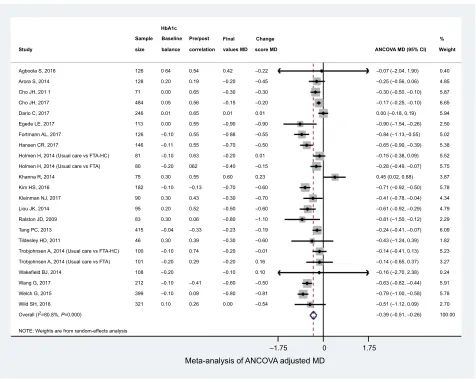
The pooled mean HbA1c difference calculated using the ANCOVA approach yielded a statistically significant pooled HbA1c reduction of –0.39% (95%CI: [–0.51, –0.26]) favor-ing the intervention group, with considerable heterogeneity
statistic (I2=80.8%; Figure 2).
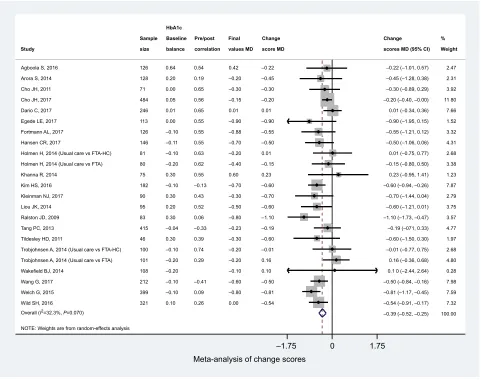
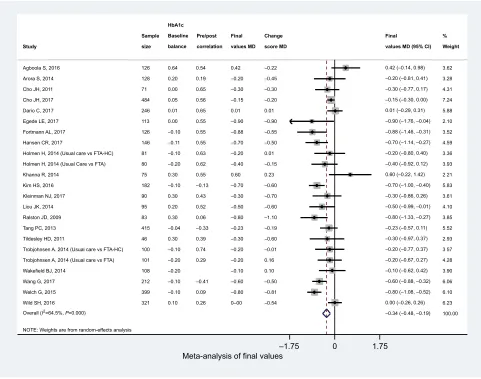
MD aggregated using meta-analysis of change scores and final values also yielded statistically significant effect estimates ie, –0.39% (95%CI: [–0.51, –0.26]; Figure 3) and –0.34% (95%CI: [–0.48, –0.19]; Figure 4), respectively. The
heterogeneity I2 statistics for change scores and final values
meta-analyses were 32.3% and 64.5%, respectively. All of the above results are from the random effects meta-analysis.
Considering the I2 statistics for change scores, we conducted
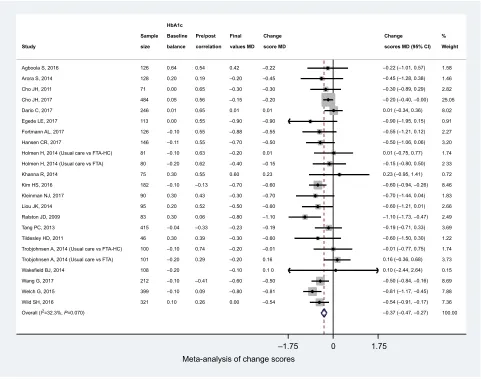
a fixed-effects meta-analysis. The pooled MD was –0.37% (95%CI: [–0.468, –0.268]; Figure 5).
Publication bias
Visual inspection of the funnel plots that were obtained using effect sizes of ANCOVA and SACS shows symmetry at the top of the plot, and there were studies missing at the bottom of the funnel plot indicating publication bias. However, a relatively symmetric funnel plot was obtained from effect sizes computed using SAFV (Figure 6).
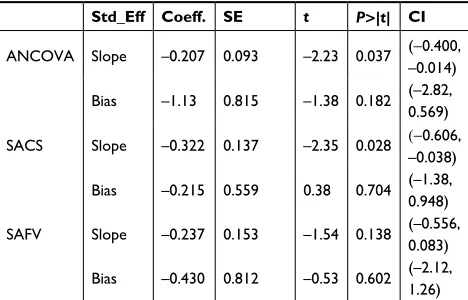
Egger’s test for funnel plot symmetry obtained from the three methods suggested that there is not enough evidence for small-study effects (Table 2).
Performing the “trim and fill” test using effect sizes of ANCOVA and SAFV did not result in changes suggesting that the influence of publication bias was negligible. How-ever, performing the “trim and fill” test using effect sizes
Diabetes, Metabolic Syndrome and Obesity: Targets and Therapy downloaded from https://www.dovepress.com/ by 118.70.13.36 on 21-Aug-2020
Dovepress Comparison of digital intervention meta-analytic methods for T2D
Table 1
Characteristics of the included studies
Study
Location
Intervention
Intervention end points (in months) Study population Baseline HbA1c (%) Included (N) Intention to treat analysis N control group
N intervention group Analyzed control Analyzed intervention Loss to follow
-up
Loss to follow- up % Retention %
Mobile phone-delivered text message interventions
Agboola et al, 2016
35
USA
Text to move (text message)
6
Spanish- or english-speaking low-income and ethnic minorities, T2DM patients
>
7.0
126
62
64
62
64
0
0.00
100.0
Arora et al, 2014
25
USA
Two daily text messages for 6 months.
education/
motivation–one text per day, medication reminders–three per week, healthier living challenge–two per week. Trivia: Unidirectional text message
6
english- or Spanish-speaking latino and black T2DM patients
>
7.5
128
64
64
45
47
36
28.1
71.9
Capozza et al, 2015
36
USA
Text message (Care4
life program)
for education and motivation, medication adherence, glucose control, weight, and exercise
3 and 6
No specific population, adult patients with T2DM
>
7.5
156
Not reported
Not reported
35
58
11
7.0
93
Fortmann et al, 2017
39
Canada
Dulce Digital: An mh
ealth SMS-Based
Intervention
3 and 6
Underserved hispanics with poor glycemic control, T2DM patients
≥
7.5
126
63
63
60
53
13
10.3
89.7
PDA, tablet, computer, and/or smartphone delivered web-based interventions
Cho et al, 2011
28
South Korea Internet diabetes management
3
No specific population, T2DM patients, South Koreans
>
7.0
71
35
36
32
32
7
9.9
90.1 (Continued
)
Diabetes, Metabolic Syndrome and Obesity: Targets and Therapy downloaded from https://www.dovepress.com/ by 118.70.13.36 on 21-Aug-2020
Dovepress Kebede et al
Table 1
(
Continued
)
Study
Location
Intervention
Intervention end points (in months) Study population Baseline HbA1c (%) Included (N) Intention to treat analysis N control group
N intervention group Analyzed control Analyzed intervention Loss to follow
-up
Loss to follow- up % Retention %
egede et al, 2017
29
USA
Telehealth and clinical decision support system
3 and 6
Type 2 diabetes, ≥18 years, T2DM patients
≥
8.0
113
59
54
44
41
28
24.8
75.2
h
olmen
et
al, 2014
41
(Usual Care vs
FTA-h
C)
Norway
Few Touch Application (diabetes diary app with health counseling
(FTA-h
C)
12
No specific population, adult patients with T2DM
>
7.0
100
50
50
41
40
18
18.0
82
h
olmen
et
al, 2014
41
(Usual Care vs FTA)
Norway
Few Touch Application (diabetes diary app without health counseling
(FTA-h
C)
12
No specific population, adult patients with T2DM
>
7.0
101
50
51
41
39
19
19.0
81
Kim et al, 2016
43
China
Internet-based glucose monitoring system
3 and 6
Male and female outpatients with T2DM patients
7.0 to 10.0
182
90
92
90
92
0
0.0
100.0
Kleinman et al, 2017
44
India
Smart phone app for patients and smart phone app and a web-based portal for providers
3
No specific population, T2DM patients for
>
6 months
7.5 to 12.5
90
46
44
33
35
22
24.4
75.6
Ralston
et al,
2009
30
USA
Web-based care management
12
No specific population, adult patients with T2DM
>
7.0
83
41
42
35
39
9
10.8
89.2
Tang et al, 2013
46
USA
Online disease management system
6 and 12
No specific population, adult patients with T2DM
>
7.5
415
213
202
193
186
36
8.67
91.33
Tildesley et al, 2011
47
Canada
Internet-based glucose monitoring system (IB
g
MS)
3, 6, and 12
No specific population, T2DM patients
>
7.0
46
23
23
23
23
0.0
0.0
100.0
Trobjohnsen 2014
69
(Usual Care vs
FTA-h
C)
Norway
Few Touch Application (diabetes diary app with health counseling
(FTA-h
C)
4
No specific population, adult patients with T2DM
>
7.0
100
50
50
43
44
13
13.0
87
Diabetes, Metabolic Syndrome and Obesity: Targets and Therapy downloaded from https://www.dovepress.com/ by 118.70.13.36 on 21-Aug-2020
Dovepress Comparison of digital intervention meta-analytic methods for T2D
Trobjohnsen 2014 (Usual Care
69 vs
FTA)
Norway
Few Touch Applications (diabetes diary app without health counseling
(FTA-h
C)
4
No specific population, adult patients with T2DM
>
7.0
101
50
51
42
44
12
12.0
88
Wang et al, 2017
48
China
Monitoring via computer/web/ mobile phone connected to glucometer via cable
3 and 6
No specific population, T2DM patients confirmed for over 1 year
7 to 10.0
212
106
106
106
106
0
0.0
100.0
Welch et al, 2015
49
USA
Internet-based integrated diabetes management system
6
latino, T2DM patients
>
7.5
399
200
199
181
172
46
11.5
88.5
Wild et al, 2016
50
Scotland
Monitoring through computer-/web- based/mobile phone connected to glucometer via modem
9
No specific population, T2DM aged
>
17
years
>
7.5
321
161
160
139
146
36
11.2
88.8
Telehealth (communication with provider via telephone or video) Dario et al, 2017
38
Italy
Videoconferencing
12
No specific population, T2DM patients
>
7.0
246
78
168
77
166
3
1.2
98.8
h
ansen
et al,
2017
40
Denmark
Videoconferencing
8
Danish speaking T2DM patients
>
7.5
165
82
83
71
68
26
15.8
84.2
Khanna et
al,
2014
42
USA
Automated telephone support with dialogic telephone card
3
Spanish-speaking patients with T2DM
>
7.5
75
37
38
37
38
0.0
0.0
100.0
liou et al, 2014
45
Taiwan
Web-based and videoconferencing
6
No specific population, adult T2DM patients
>
7.0
95
41
54
41
54
0
0.0
100.0
Wakefield et al, 2014
24
USA
Tele-monitoring
3 and 6
No specific population, subjects with established T2DM
>
8.0
108
55
53
43
40
25
23.1
76.9
Mean
180.3
85.5
94.8
75.8
84.6
16.45
9.2
89.8
Standard deviation
123.8
63.0
63.2
60.7
61.4
15.6
9.8
11.6
Abbreviations:
FTA-h
C, Few Touch Application (diabetes diary app with health counseling);
h
bA1c, glycated hemoglobin level; IB
g
MS, Internet-based glucose monitoring system; T2DM, type 2 diabetes mellitus.
Diabetes, Metabolic Syndrome and Obesity: Targets and Therapy downloaded from https://www.dovepress.com/ by 118.70.13.36 on 21-Aug-2020
Dovepress Kebede et al
Figure 1 Box plots of ANCOVA, change scores, and final values MDs.
Abbreviations: ANCOVA, analysis of covariance; MD, mean difference.
ANCOVA adjusted MD
HbA1c MD
–1
–0.5
00
.5
Change score MD Final values MD
Agboola S, 2016 Arora S, 2014 Cho JH, 201 1 Cho JH, 2017 Dario C, 2017 Egede LE, 2017 Fortmann AL, 2017 Hansen CR, 2017
Holmen H, 2014 (Usual care vs FTA-HC) Holmen H, 2014 (Usual care vs FTA) Khanna R, 2014
Kim HS, 2016 Kleinman NJ, 2017 Liou JK, 2014 Ralston JD, 2009 Tang PC, 2013 Tildesley HD, 2011
Trobjohnsen A, 2014 (Usual care vs FTA-HC) Trobjohnsen A, 2014 (Usual care vs FTA) Wakefield BJ, 2014
Wang G, 2017 Welch G, 2015 Wild SH, 2016 Overall (I2=80.8%, P=0.000)
126 128 71 484 246 113 126 146 81 80 75 182 90 95 83 415 46 100 101 108 212 399 321
0 64 0.20 0.00 0.05 0.01 0.00 –0.10 –0.11 –0.10 –0.20 0.30 –0.10 0.30 0.20 0.30 –0.04 0.30 –0.10 –0.20 –0.20 –0.10 –0.10 0.10
0.54 0.19 0.65 0.56 0.65 0.55 0.55 0.55 0.63 062 0.55 –0.13 0.43 0.52 0.06 –0.33 0.39 0.74 0.29
–0.41 0.09 0.26
0.42 –0.20 –0.30 –0.15 0.01 –0.90 –0 88 –0.70 –0.20 –0.40 0.60 –0.70 –0.30 –0.50 –0.80 –0.23 –0.30 –0.20 –0.20 –0.10 –0.60 –0.80 0.00
–0.22 –0.45 –0.30 –0.20 0.01 –0.90 –0.55 –0.50 0.01 –0.15 0.23 –0.60 –0.70 –0.60 –1.10 –0.19 –0.60 –0.01 0.16 0.10 –0.50 –0.81 –0.54
–0.07 (–2.04, 1.90) –0.25 (–0.56, 0.06) –0.30 (–0.50, –0.10) –0.17 (–0.25, –0.10) 0.00 (–0.18, 0.19) –0.90 (–1.54, –0.26) –0.84 (–1.13,–0.55) –0.65 (–0.90, –0.39) –0.15 (–0.38, 0.09) –0.28 (–0.49, –0.07) 0.45 (0.02, 0.88) –0.71 (–0.92, –0.50) –0.41 (–0.78, –0.04) –0.61 (–0.92, –0.29) –0.81 (–1.50, –0.12) –0.24 (–0.41, –0.07) –0.43 (–1.24, 0.39) –0.14 (–0.41, 0.13) –0.14 (–0.65, 0.37) –0.16 (–2.70, 2.38) –0.63 (–0.82, –0.44) –0.79 (–1.00, –0.58) –0.51 (–1.12, 0.09) –0.39 (–0.51, –0.26)
0.40 4.85 5.87 6.65 5.94 2.50 5.02 5.38 5.52 5.75 3.87 5.78 4.34 4.79 2.29 6.09 1.82 5.23 3.27 0.24 5.91 5.78 2.70 100.00
NOTE: Weights are from random-effects analysis
–1.75
Study
Sample HbA1c
Baseline Pre/post Final Change
score MD ANCOVA MD (95% CI) % Weight balance correlation values MD
size
0 1.75
Meta-analysis of ANCOVA adjusted MD
Figure 2 Random-effects meta-analysis of ANCOVA adjusted MDs.
Abbreviation: ANCOVA, analysis of covariance; FTA-hC, Few Touch Application (diabetes diary app with health counseling); MD, mean difference.
Diabetes, Metabolic Syndrome and Obesity: Targets and Therapy downloaded from https://www.dovepress.com/ by 118.70.13.36 on 21-Aug-2020
Dovepress Comparison of digital intervention meta-analytic methods for T2D
obtained from SACS resulted in imputation of one study and the pooled HbA1c difference was changed into –0.40% (95%CI: −0.53,–0.26) using a random-effects meta-analysis.
Sensitivity analyses
We performed a sensitivity analysis by removing five studies
with high baseline imbalance (≥±0.3) from the meta-analysis.
The ANCOVA approach resulted in an MD of –0.41% (95%CI: [–0.54, –0.28]), while SAFV and SACS showed an MD of –0.37% (95%CI: [–0.52, –0.22]) and –0.35%
(95%CI: [–0.45, –0.242]), respectively (see Supplementary
material 1). Expectedly, the differences in the aggregated
MDs across the three methods became less prominent when
all studies having a baseline MD of ≥0.2 were removed from
the meta-analyses. The ANCOVA approach resulted in an MD of –0.43% (95%CI: [–0.597, –0.27]), while SAFV and SACS show an MD of –0.40% (95%CI: [–0.59, –0.216]) and
–0.39% (95%CI: [–0.55, –0.23]), respectively (see Supple-mentary material 1).
Additional sensitivity analyses were performed to check the effect of pre/post correlation on the effect size estimates obtained by the three methods. ANCOVA and SACS resulted in similar estimates but higher than SAFV effect size esti-mates after dropping studies with high pre/post correlation from the meta-analyses. Hence, ANCOVA and SACS resulted in a pooled effect size estimate of –0.40% (95%CI: [–0.53, –0.27]) and –0.40% (95%CI: [–0.54, –0.26]), respectively, while SAFV resulted in –0.34% (95%CI: [–0.49, –0.19]) after
dropping one study with pre/post correlation value >0.7 (see
Supplementary material 2). Similarly, dropping five
stud-ies with pre/post correlation value >±0.6 shows ANCOVA
and SACS yielded a pooled effect size estimate of –0.47% (95%CI: [–0.64, –0.30]), –0.47% (95% CI: [–0.62, –0.32]) respectively, while SAFV provided –0.37% (95%CI: [–0.54,
Agboola S, 2016 Arora S, 2014 Cho JH, 2011 Cho JH, 2017 Dario C, 2017 Egede LE, 2017 Fortmann AL, 2017 Hansen CR, 2017
Holmen H, 2014 (Usual care vs FTA-HC) Holmen H, 2014 (Usual care vs FTA) Khanna R, 2014
Kim HS, 2016 Kleinman NJ, 2017 Liou JK, 2014 Ralston JD, 2009 Tang PC, 2013 Tildesley HD, 2011
Trobjohnsen A, 2014 (Usual care vs FTA-HC) Trobjohnsen A, 2014 (Usual care vs FTA) Wakefield BJ, 2014
Wang G, 2017 Welch G, 2015 Wild SH, 2016
Study Sample size HbA1c Baseline balance Pre/post correlation Final values MD Change score MD Change scores MD (95% CI)
% Weight 126 128 71 484 246 113 126 146 81 80 75 182 90 95 83 415 46 100 101 108 212 399 321 0.64 0.20 0.00 0.05 0.01 0.00 –0.10 –0.11 –0.10 –0.20 0.30 –0.10 0.30 0.20 0.30 –0.04 0.30 –0.10 –0.20 –0.20 –0.10 –0.10 0.10 0.54 0.19 0.65 0.56 0.65 0.55 0.55 0.55 0.63 0.62 0.55 –0.13 0.43 0.52 0.06 –0.33 0.39 0.74 0.29 –0.41 0.09 0.26 0.42 –0.20 –0.30 –0.15 0.01 –0.90 –0.88 –0.70 –0.20 –0.40 0.60 –0.70 –0.30 –0.50 –0.80 –0.23 –0.30 –0.20 –0.20 –0.10 –0.60 –0.80 0.00 –0 22 –0.45 –0.30 –0.20 0.01 –0.90 –0.55 –0.50 0.01 –0.15 0.23 –0.60 –0.70 –0.60 –1.10 –0.19 –0.60 –0.01 0.16 0.10 –0 50 –0.81 –0.54
–0.22 (–1.01, 0.57) –0.45 (–1.28, 0.38) –0.30 (–0.89, 0.29) –0.20 (–0.40, –0.00) 0.01 (–0.34, 0.36) –0.90 (–1.95, 0.15) –0.55 (–1.21, 0.12) –0.50 (–1.06, 0.06) 0.01 (–0.75, 0.77) –0.15 (–0.80, 0.50) 0.23 (–0.95, 1.41) –0.60 (–0.94, –0.26) –0.70 (–1.44, 0.04) –0.60 (–1.21, 0.01) –1.10 (–1.73, –0.47) –0.19 (–071, 0.33) –0.60 (–1.50, 0.30) –0.01 (–0.77, 0.75) 0.16 (–0.36, 0.68) 0.1 0 (–2.44, 2.64) –0.50 (–0.84, –0.16) –0.81 (–1.17, –0.45) –0.54 (–0.91, –0.17) –0.39 (–0.52, –0.25)
2.47 2.31 3.92 11 80 7.66 1.52 3.32 4.31 2.68 3.38 1.23 7.87 2.79 3.75 3.57 4.77 1.97 2.68 4.80 0.28 7.98 7.59 7.32 100.00 Overall (I2=32.3%, P=0.070)
NOTE: Weights are from random-effects analysis
Meta-analysis of change scores
–1.75 0 1.75
Figure 3 Random-effects meta-analysis of change scores.
Abbreviations: FTA-hC, Few Touch Application (diabetes diary app with health counseling); hbA1c, glycated hemoglobin level; MD, mean difference.
Diabetes, Metabolic Syndrome and Obesity: Targets and Therapy downloaded from https://www.dovepress.com/ by 118.70.13.36 on 21-Aug-2020
Dovepress Kebede et al
–0.20]; see Supplementary material 2). Meta-analyses per-formed by removing studies with both high baseline
imbal-ance (≥±0.2%) and pre/post correlation of >±0.6 resulted in
a pooled MD of –0.39% (95%CI: [–0.53, –0.26]), –0.40% (95%CI: [–0.54, –0.26]), and –0.33% (95%CI: [–0.48, –0.18]) using ANCOVA, SACS, and SAFV meta-analyses, respectively (see Supplementary material 2).
Discussion
This systematic review is the first to compare the effective-ness of digital interventions on changes in HbA1c levels by computing effect size estimates using SACS, SAFV, and ANCOVA adjusted MDs. This is also the first review to account for baseline imbalance and pre/post correlations using available robust statistical methods.
The pooled estimates obtained using the SACS, SAFV, and ANCOVA suggest clinically significant effects of digital
interventions meaning reduced HbA1c levels of persons with poorly controlled T2DM. These findings reinforce the previously reported evidence regarding the beneficial effects
of digital interventions.51–53 Digital interventions facilitate
diabetes self-management by supporting patients with dia-betes to keep track of their blood glucose, physical activity, nutrition, and other clinical and behavioral outcomes related
with diabetes.54–65
Random-effects meta-analysis using ANCOVA and change scores provided identical effect size estimates. However, fixed-effects meta-analysis using change scores and comparing the results with ANCOVA and final val-ues meta-analyses shows a slight difference in the pooled effect estimates acquired using the three methods. For all meta-analyses, the direction of the effect estimate remained unchanged. Sensitivity analyses performed by removing studies with higher baseline imbalance resulted in relatively
Agboola S, 2016 Arora S, 2014 Cho JH, 2011 Cho JH, 2017 Dario C, 2017 Egede LE, 2017 Fortmann AL, 2017 Hansen CR, 2017
Holmen H, 2014 (Usual care vs FTA-HC) Holmen H, 2014 (Usual Care vs FTA) Khanna R, 2014
Kim HS, 2016 Kleinman NJ, 2017 Liou JK, 2014 Ralston JD, 2009 Tang PC, 2013 Tildesley HD, 2011
Trobjohnsen A. 2014 (Usual care vs FTA-HC) Trobjohnsen A, 2014 (Usual care vs FTA) Wakefield BJ, 2014
Wang G, 2017 Welch G, 2015 Wild SH, 2016
126 128 71 484 246 113 126 146 81 80 75 182 90 95 83 415 46 100 101 108 212 399 321 0.64 0.20 0.00 0.05 0.01 0.00 –0.10 –0.11 –0.10 –0.20 0.30 –0.10 0.30 0.20 0.30 –0.04 0.30 –0.10 –0.20 –0.20 –0.10 –0.10 0.10 0.54 0.19 0.65 0.56 0.65 0.55 0.55 0.55 0.63 0.62 0.55 –0.13 0.43 0.52 0.06 –0.33 0.39 0.74 0.29 –0.41 0.09 0.26 0.42 –0.20 –0.30 –0.15 0.01 –0.90 –0.88 –0.70 –0.20 –0.40 0.60 –0.70 –0.30 –0.50 –0.80 –0.23 –0.30 –0.20 –0.20 –0.10 –0.60 –0.80 0–00 –0.22 –0.45 –0.30 –0.20 0.01 –0.90 –0.55 –0.50 0.01 –0.15 0.23 –0.60 –0.70 –0.60 –1.10 –0.19 –0.60 –0.01 0.16 0.10 –0.50 –0.81 –0.54 3.62 3.28 4.31 7.24 5.88 2.10 3.52 4.59 3.36 3.93 2 21 5.83 3.61 4.10 3.85 5.52 2.93 3 57 4.28 3.90 6.06 6.10 6.23 100.00 0.42 (–0.14, 0.98) –0.20 (–0.81, 0.41) –0.30 (–0.77, 0.17) –0.15 (–0.30, 0.00) 0.01 (–0.29, 0.31) –0.90 (–1.76, –0.04) –0.88 (–1.46, –0.31) –0.70 (–1.14, –0.27) –0.20 (–0.80, 0.40) –0.40 (–0.92, 0.12) 0.60 (–0.22, 1.42) –0.70 (–1.00, –0.40) –0.30 (–0.86, 0.26) –0.50 (–0.99, –0.01) –0.80 (–1.33, –0.27) –0.23 (–0.57, 0.11) –0.30 (–0.97, 0.37) –0.20 (–0.77, 0.37) –0.20 (–0.67, 0.27) –0.10 (–0.62, 0.42) –0.60 (–0.88, –0.32) –0.80 (–1.08, –0.52) 0.00 (–0.26, 0.26) –0.34 (–0.48, –0.19) Overall (I2=64.5%, P=0.000)
NOTE: Weights are from random-effects analysis
Meta-analysis of final values
Study Sample size HbA1c Baseline balance Pre/post correlation Final values MD Change score MD Final
values MD (95% CI) % Weight
–1.75 0 1.75
Figure 4 Random-effects meta-analysis of final values.
Abbreviations: FTA-hC, Few Touch Application (diabetes diary app with health counseling); hbA1c, glycated hemoglobin level; MD, mean difference.
Diabetes, Metabolic Syndrome and Obesity: Targets and Therapy downloaded from https://www.dovepress.com/ by 118.70.13.36 on 21-Aug-2020
Dovepress Comparison of digital intervention meta-analytic methods for T2D
Agboola S, 2016 Arora S, 2014 Cho JH, 2011 Cho JH, 2017 Dario C, 2017 Egede LE, 2017 Fortmann AL, 2017 Hansen CR, 2017
Holmen H, 2014 (Usual care vs FTA-HC) Holmen H, 2014 (Usual care vs FTA) Khanna R, 2014
Kim HS, 2016 Kleinman NJ, 2017 Liou JK, 2014 Ralston JD, 2009 Tang PC, 2013 Tildesley HD, 2011
Trobjohnsen A, 2014 (Usual care vs FTA-HC) Trobjohnsen A, 2014 (Usual care vs FTA) Wakefield BJ, 2014
Wang G, 2017 Welch G, 2015 Wild SH, 2016
126 128 71 484 246 113 126 146 81 80 75 182 90 95 83 415 46 100 101 108 212 399 321 0.64 0.20 0.00 0.05 0.01 0.00 –0.10 –0.11 –0.10 –0.20 0.30 –0.10 0.30 0.20 0.30 –0.04 0.30 –0.10 –0.20 –0.20 –0.10 –0.10 0.10 0.54 0.19 0.65 0.56 0.65 0.55 0.55 0.55 0.63 0.62 0.55 –0.13 0.43 0.52 0.06 –0.33 0.39 0.74 0.29 –0.41 0.09 0.26 0.42 –0.20 –0.30 –0.15 0.01 –0.90 –0.88 –0.70 –0.20 –0.40 0.60 –0.70 –0.30 –0.50 –0.80 –0.23 –0.30 –0.20 –0.20 –0.10 –0.60 –0.80 0.00 –0.22 –0.45 –0.30 –0.20 0.01 –0.90 –0.55 –0.50 0.01 –0 15 0.23 –0.60 –0.70 –0.60 –1.10 –0.19 –0.60 –0.01 0.16 0.1 0 –0.50 –0.81 –0.54 1.58 1.46 2.82 25.05 8.02 0.91 2.27 3.20 1.74 2 33 0.72 8.46 1.83 2.66 2.49 3.69 1.22 1.74 3.73 0.15 8.69 7.88 7.36 100.00 –0.22 (–1.01, 0.57) –0.45 (–1.28, 0.38) –0.30 (–0.89, 0.29) –0 20 (–0.40, –0.00) 0.01 (–0.34, 0.36) –0.90 (–1.95, 0.15) –0.55 (–1.21, 0.12) –0.50 (–1.06, 0.06) 0.01 (–0.75, 0.77) –0.15 (–0.80, 0.50) 0.23 (–0.95, 1.41) –0.60 (–0.94, –0.26) –0.70 (–1.44, 0.04) –0.60 (–1.21, 0.01) –1.10 (–1.73, –0.47) –0.19 (–0.71, 0.33) –0.60 (–1.50, 0.30) –0.01 (–0.77, 0.75) 0.16 (–0.36, 0.68) 0.10 (–2.44, 2.64) –0.50 (–0.84, –0.16) –0.81 (–1.17, –0.45) –0.54 (–0.91, –0.17) –0.37 (–0.47, –0.27) Overall (I2=32.3%, P=0.070)
Meta-analysis of change scores
–1.75 0 1.75
Study Sample size HbA1c Baseline balance Pre/post correlation Final values MD Change score MD Change scores MD (95% CI)
% Weight
Figure 5 Fixed-effects meta-analysis of change scores.
Abbreviations: hbA1c, glycated hemoglobin level; MD, mean difference.
–3.00
1.
51
Standard erro
r 0.50
1.
51
Standard erro
r 0.50
0. 40 .3 Standard erro r 0. 20 0. 1
–2.00 –1.00 0.00 ANCOVA adjusted MD
Funnel plot with pseudo 95% confidence limits Funnel plot with pseudo 95% confidence limits Funnel plot with pseudo 95% confidence limits
1.00 2.00 –3.00 –2.00 –1.00 0.00
Change score MD Final values MD
1.00 2.00 –1.00 –0.50 0.00 0.50
Figure 6 Funnel plots for assessing publication bias.
Abbreviation: MD, mean difference.
Diabetes, Metabolic Syndrome and Obesity: Targets and Therapy downloaded from https://www.dovepress.com/ by 118.70.13.36 on 21-Aug-2020
Dovepress Kebede et al
similar pooled effect estimates across the three methods. This supports the recommendations in previous methodological literature pointing to the importance of adjusting for baseline MD using the ANCOVA approach in meta-analyses of trials
with baseline imbalance.13,15,17 However, practical application
of ANCOVA to synthesize effect sizes of continuous out-comes is complex due to the unavailability of summary data from RCTs or absence of IPD. Nevertheless, with available methodological guidance, it is possible to calculate ANCOVA adjusted MDs given that study authors report summary data for all intervention and control groups, such as baseline and follow-up mean values, as well as corresponding SDs, mean and SD values for changes over time, and finally sample
sizes.13 Because the results of systematic reviews rely on the
summary findings of individual studies, future RCTs, particu-larly those with baseline imbalance, need to be reported with extensive detail if they are to be included in more advanced meta-analyses. Beside this, publishing IPD with the results of the interventions will enhance transparency of the results at the primary study level and simplify evidence syntheses subsequently.
In this review, the heterogeneity I2 statistics computed
using the three methods shows differences across the choice of meta-analytic methods. A lower heterogeneity estimate was obtained using SACS. Eyeball test on the forest plots of the three methods shows the confidence intervals of one
study (a study by Khanna et al)42 deviates from the general
pattern of the other studies on the plots. The deviation by this study gets smaller in the forest plot for SACS meta-analysis. This explains the reason why SACS has the lowest hetero-geneity compared with ANCOVA and SAFV. Previously, Fu and Holmer described that there is no clear pattern of
heterogeneity estimates among the three methods.12 Whether
to use random-effects or fixed-effects meta-analyses can be
statistically guided by the results of the I2 statistics.32 Which
meta-analytic method produces decreased or increased het-erogeneity statistics or whether there is a particular pattern across the three methods requires further research.
The results of publication bias assessment via an inspec-tion of funnel plots were not consistent across the three meth-ods. A relatively more symmetric funnel plot was constructed using the estimates obtained from the SAFV. However, funnel plots displayed for ANCOVA and SACS indicated the pres-ence of symmetry at the top and studies missing at the lower half of the plot indicating a publication bias with regard to our sample of included studies. However, Egger’s test for all the three methods suggested that there was no evidence suggesting publication bias. Further publication bias analy-ses using “trim and fill” method did not impute any missing study for ANCOVA and SAFV. However, one missing study was imputed for the SACS. Literature regarding comparison of publication bias across the three meta-analytic methods is currently lacking.
Performing sensitivity analyses is important to check the robustness of estimates obtained from trials with baseline
imbalance.13,66 Following this previously stated
recommenda-tion, we performed sensitivity analyses by removing studies with high baseline imbalance values. These analyses show that relatively comparable pooled estimates were obtained using ANCOVA, SACS, and SAFV meta-analyses. These results, in line with existing studies, suggest the importance of accounting for baseline imbalance by aggregating
continu-ous outcome measures.12,13,27,67
ANCOVA and SACS yielded similar pooled estimates after removing studies with high pre/post correlation values from the meta-analyses. Similar to our result, existing evi-dence shows that when the value of pre/post correlation gets closer to 1.0, ANCOVA and SACS tend to produce similar
effect size estimates.12,13,27 Inspecting individual study effect
sizes obtained using the three methods also shows that, ANCOVA and SAFV tend to produce similar effect size
estimates as correlation values approach zero.68
Limitations
The study has limitations. First, our search was limited to three databases only: MEDLINE, ISI Web of Science, and PsycINFO. We tried to check whether this had an impact on our search output. There was no noticeable difference compared with our preliminary search in additional search databases, such as EMBASE and CINAHL. Hence, we
Table 2 egger’s test for assessing publication bias Std_Eff Coeff. SE t P>|t| CI
ANCOVA Slope –0.207 0.093 –2.23 0.037 (-0.400, –0.014)
Bias –1.13 0.815 –1.38 0.182 (–2.82, 0.569)
SACS Slope –0.322 0.137 –2.35 0.028 (-0.606, –0.038)
Bias –0.215 0.559 0.38 0.704 (–1.38, 0.948)
SAFV Slope –0.237 0.153 –1.54 0.138 (–0.556, 0.083)
Bias –0.430 0.812 –0.53 0.602 (–2.12, 1.26)
Abbreviations: ANCOVA, analysis of covariance; Coeff, coefficient; SACS, simple
analysis of change score; SAFV, simple analysis of final values; Std_Eff, standard
effect; Se, standard error.
Diabetes, Metabolic Syndrome and Obesity: Targets and Therapy downloaded from https://www.dovepress.com/ by 118.70.13.36 on 21-Aug-2020
Dovepress Comparison of digital intervention meta-analytic methods for T2D
decided to focus on the three included databases, especially considering the workload to request and impute missing data which was crucial to answer our research questions of interest. Second, we did not consider unindexed databases and gray literature. Third, most of the studies did not report ANCOVA effect sizes. Our ANCOVA effect size calculation mainly relies on imputation from the reported data using robust statistical methods, but uncertainties remain.
Conclusion
All three meta-analytic methods show a significant effect of digital interventions on changing HbA1c levels. Analysis on the effect sizes computed for each study using the three meth-ods did not differ significantly. However, some differences were noted among the pooled effect sizes applying different statistical methods by accounting for baseline imbalances of the outcome. Authors of future systematic reviews and meta-analyses should consider using ANCOVA to estimate effect sizes, at least for interventions with baseline imbalance. However, we recognize the statistical challenge of computing ANCOVA effect sizes, if the necessary data are not reported for individual studies. Hence, future RCTs, particularly those with baseline imbalance, should report ANCOVA effect sizes. In addition, publishing IPD along with the changes in the outcomes as a result of intervention participation is helpful to simplify robust evidence syntheses.
Data sharing statement
The data collected for this study can be received from the corresponding author.
Acknowledgments
We would like to thank our research librarian, Lara Chris-tianson, for her support in developing the search strategy and optimizing it to each search database. We are grate-ful to Professor HajoZeeb, Professor Richard D Riley, Dr Jochen Wilhelm, Dr James E Pustejovsky, Professor Vanessa Didelez, and Dr Fleur Fritz for the methodological support. In addition, we are also very grateful to all corresponding authors of the individual studies for providing us with the data we requested. We disclose that the results of this study were
presented as oral presentation at the 10th Biennial Joanna
Briggs Institute Colloquium 2018 in Antwerp, Belgium.
Author contributions
MMK performed conceptualization, design, systematic literature search, title and abstract screening, quality assess-ment, data extraction, data analysis and interpretation of the
data, and write-up. MP performed title and abstract screening, and quality assessment write-up. TLH and CRP performed conceptualization, extraction of the data, and critical review. All authors contributed toward data analysis, drafting and critically revising the paper, gave final approval of the version to be published and agree to be accountable for all aspects of the work.
Disclosure
The authors report no conflicts of interest in this work.
References
1. Lutz B, Rüdiger M. Growth rates of modern science: a bibliometric analysis based on the number of publications and cited references. J Assoc Inf Sci Technol. 2015;66(11):2215–2222.
2. Bastian H, Glasziou P, Chalmers I. Seventy-five trials and eleven sys-tematic reviews a day: how will we ever keep up? PLoS Med. 2010;7(9): e1000326.
3. Haidich AB. Meta-analysis in medical research. Hippokratia. 2010;14(Suppl 1):29–37.
4. Glass GV. Primary, secondary, and meta-analysis of research. Educ Res. 1976;5(10):3–8.
5. Biondi-Zoccai G, Landoni G, Modena MG. A journey into clinical evidence: from case reports to mixed treatment comparisons. HSR Proc Intensive Care Cardiovasc Anesth. 2011;3(2):93–96.
6. Greco T, Zangrillo A, Biondi-Zoccai G, Landoni G. Meta-analysis: pitfalls and hints. Heart Lung Vessel. 2013;5(4):219–225.
7. PubMed. diabetes and (meta-analys* or metaanalys*) Secondary dia-betes and (meta-analys* or metaanalys*); 2018. Available from: https:// www.ncbi.nlm.nih.gov/pubmed/?term=diabetes+and+(meta-analys*+
or+metaanalys*). Accessed December 4, 2018.
8. Shinogle JA. Methodological Challenges Associated with Meta-Analyses in Health Care and Behavioral Health Research. Baltimore, MD: Uni-versity of Maryland; 2012.
9. Lorenc T, Felix L, Petticrew M, et al. Meta-analysis, complexity, and heterogeneity: a qualitative interview study of researchers’ methodologi-cal values and practices. Syst Rev. 2016;5(1):192.
10. Alahdab F, Zaiem F, Wang Z, Murad MH. Interpreting meta-analysis of continuous outcomes with pre and postvalues. Evid Based Med. 2016;21(4):139–140.
11. Chogtu B, Magazine R, Bairy KL. Statin use and risk of diabetes mel-litus. World J Diabetes. 2015;6(2):352–357.
12. Fu R, Holmer HK. Change score or follow-up score? Choice of mean difference estimates could impact meta-analysis conclusions. J Clin Epidemiol. 2016;76:108–117.
13. Fu R, Vandermeer BW, Shamliyan TA, et al. Handling continuous outcomes in quantitative synthesis. Methods Guide for Effectiveness and Comparative Effectiveness Reviews. Rockville, MD: Agency for Healthcare Research and Quality; 2008.
14. William F, Rosenberger JML. Randomization in Clinical Trials: Theory and Practice. New York: Wiley; 2005.
15. Mckenzie JE, Herbison GP, Deeks JJ. Impact of analysing continuous outcomes using final values, change scores and analysis of covariance on the performance of meta-analytic methods: a simulation study. Res Synth Methods. 2016;7(4):371–386.
16. Morris SB, Deshon RP. Combining effect size estimates in meta-analysis with repeated measures and independent-groups designs. Psychol Methods. 2002;7(1):105–125.
17. Riley RD, Kauser I, Bland M, et al. Meta-analysis of randomised tri-als with a continuous outcome according to baseline imbalance and availability of individual participant data. Stat Med. 2013;32(16): 2747–2766.
Diabetes, Metabolic Syndrome and Obesity: Targets and Therapy downloaded from https://www.dovepress.com/ by 118.70.13.36 on 21-Aug-2020
Dovepress Kebede et al
18. Kebede MM, Zeeb H, Peters M, Heise TL, Pischke CR. Effective-ness of digital interventions for improving glycemic control in persons with poorly controlled Type 2 diabetes: a systematic review, meta-analysis, and meta-regression analysis. Diabetes Technol Ther. 2018;20(11):767–782.
19. Kebede M, Christianson L, Khan Z, Heise TL, Pischke CR. Effective-ness of behavioral change techniques employed in eHealth interventions designed to improve glycemic control in persons with poorly controlled type 2 diabetes: a systematic review and meta-analysis protocol. Syst Rev. 2017;6(1):211.
20. Eysenbach G. What is e-health? J Med Internet Res. 2001;3(2):e20. 21. Higgins JP, Altman DG, Gøtzsche PC, et al. The Cochrane Collaboration’s
tool for assessing risk of bias in randomised trials. BMJ. 2011;343:d5928. 22. Covidence systematic review software, Veritas Health Innovation,
Melbourne, Australia.
23. Higgins JPT, Green S. Cochrane Handbook for Systematic Reviews of Interventions; 2011. Available from: http://handbook-5-1.cochrane.org/. Accessed October 25, 2018.
24. Wakefield BJ, Koopman RJ, Keplinger LE, et al. Effect of home tele-monitoring on glycemic and blood pressure control in primary care clinic patients with diabetes. Telemed J E Health. 2014;20(3):199–205. 25. Arora S, Peters AL, Burner E, Lam CN, Menchine M. Trial to examine
text message-based mHealth in emergency department patients with diabetes (TExT-MED): a randomized controlled trial. Ann Emerg Med. 2014;63(6):745–754.
26. Hozo SP, Djulbegovic B, Hozo I. Estimating the mean and variance from the median, range, and the size of a sample. BMC Med Res Methodol. 2005;5:13.
27. Vickers AJ, Altman DG. Statistics notes: analysing controlled trials with baseline and follow up measurements. BMJ. 2001;323(7321):1123–1124. 28. Cho JH, Kwon HS, Kim HS, Oh JA, Yoon KH. Effects on diabetes
management of a health-care provider mediated, remote coaching sys-tem via a PDA-type glucometer and the Internet. J Telemed Telecare. 2011;17(7):365–370.
29. Egede LE, Williams JS, Voronca DC, Knapp RG, Fernandes JK. Randomized controlled trial of technology-assisted case management in low income adults with type 2 diabetes. Diabetes Technol Ther. 2017;19(8):476–482.
30. Ralston JD, Hirsch IB, Hoath J, Mullen M, Cheadle A, Goldberg HI. Web-based collaborative care for type 2 diabetes: a pilot randomized trial. Diabetes Care. 2009;32(2):234–239.
31. Torbjørnsen A, Jenum AK, Småstuen MC, et al. A low-intensity mobile health intervention with and without health counseling for persons with Type 2 diabetes, part 1: baseline and short-term results from a random-ized controlled trial in the Norwegian Part of RENEWING HEALTH.
JMIR Mhealth Uhealth. 2014;2(4):e52.
32. Higgins JP, Thompson SG, Deeks JJ, Altman DG. Measuring inconsis-tency in meta-analyses. BMJ. 2003;327(7414):557–560.
33. Egger M, Davey Smith G, Schneider M, Minder C. Bias in meta-analysis detected by a simple, graphical test. BMJ. 1997;315(7109):629–634. 34. Duval S. Tweedie R. A nonparametric “Trim and Fill” method of
accounting for publication bias in meta-analysis. J Am Stat Assoc. 2000;95(449):89–98.
35. Agboola S, Jethwani K, Lopez L, Searl M, O’Keefe S, Kvedar J. Text to move: a randomized controlled trial of a text-messaging program to improve physical activity behaviors in patients with Type 2 diabetes mellitus. J Med Internet Res. 2016;18(11):e307.
36. Capozza K, Woolsey S, Georgsson M, et al. Going mobile with diabe-tes support: a randomized study of a text message-based personalized behavioral intervention for type 2 diabetes self-care. Diabetes Spectr. 2015;28(2):83–91.
37. Cho JH, Kim HS, Yoo SH, et al. An Internet-based health gateway device for interactive communication and automatic data uploading: clinical efficacy for type 2 diabetes in a multi-centre trial. J Telemed Telecare. 2017;23(6):595–604.
38. Dario C, Toffanin R, Calcaterra F, et al. Telemonitoring of Type 2 diabetes mellitus in Italy. Telemed J E Health. 2017;23(2):143–152.
39. Fortmann AL, Gallo LC, Garcia MI, et al. Dulce digital: an mHealth SMS-based intervention improves glycemic control in Hispanics with Type 2 diabetes. Diabetes Care. 2017;40(10):1349–1355.
40. Hansen CR, Perrild H, Koefoed BG, Zander M. Video consultations as add-on to standard care among patients with type 2 diabetes not responding to standard regimens: a randomized controlled trial. Eur J Endocrinol. 2017;176(6):727–736.
41. Holmen H, Torbjørnsen A, Wahl AK, et al. A Mobile health intervention for self-management and lifestyle change for persons with Type 2 diabe-tes, part 2: One-year results from the Norwegian randomized controlled trial RENEWING HEALTH. JMIR Mhealth Uhealth. 2014;2(4):e57. 42. Khanna R, Stoddard PJ, Gonzales EN, et al. An automated telephone
nutrition support system for Spanish-speaking patients with diabetes.
J Diabetes Sci Technol. 2014;8(6):1115–1120.
43. Kim HS, Sun C, Yang SJ, et al. Randomized, open-label, parallel group study to evaluate the effect of internet-based glucose manage-ment system on subjects with diabetes in China. Telemed J E Health. 2016;22(8):666–674.
44. Kleinman NJ, Shah A, Shah S, Phatak S, Viswanathan V. Improved medication adherence and frequency of blood glucose self-testing using an m-Health platform versus usual care in a multisite randomized clinical trial among people with Type 2 diabetes in India. Telemed J E Health. 2017;23(9):733–740.
45. Liou JK, Soon MS, Chen CH, et al. Shared care combined with telecare improves glycemic control of diabetic patients in a rural underserved community. Telemed J E Health. 2014;20(2):175–178.
46. Tang PC, Overhage JM, Chan AS, et al. Online disease management of diabetes: engaging and motivating patients online with enhanced resources-diabetes (EMPOWER-D), a randomized controlled trial. J Am Med Inform Assoc. 2013;20(3):526–534.
47. Tildesley HD, Mazanderani AB, Chan JHM, Ross SA. Efficacy of A1C reduction using internet intervention in patients with Type 2 diabetes treated with insulin. Can J Diabetes. 2011;35(3):250–253.
48. Wang G, Zhang Z, Feng Y, et al. Telemedicine in the management of Type 2 diabetes mellitus. Am J Med Sci. 2017;353(1):1–5.
49. Welch G, Zagarins SE, Santiago-Kelly P, et al. An internet-based dia-betes management platform improves team care and outcomes in an urban Latino population. Diabetes Care. 2015;38(4):561–567. 50. Wild SH, Hanley J, Lewis SC, et al. Supported telemonitoring and
glycemic control in people with Type 2 diabetes: the telescot diabe-tes pragmatic multicenter randomized controlled trial. PLOS Med. 2016;13(7):e1002163.
51. Alharbi NS, Alsubki N, Jones S, et al. Impact of information tech-nology-based interventions for Type 2 diabetes mellitus on glycemic control: a systematic review and meta-analysis. J Med Internet Res. 2016;18(11):e310.
52. Zhai YK, Zhu WJ, Cai YL, Sun DX, Zhao J. Clinical- and cost-effec-tiveness of telemedicine in type 2 diabetes mellitus: a systematic review and meta-analysis. Medicine. 2014;93(28):e312.
53. Verhoeven F, van Gemert-Pijnen L, Dijkstra K, Nijland N, Seydel E, Steehouder M. The contribution of teleconsultation and videoconfer-encing to diabetes care: a systematic literature review. J Med Internet Res. 2007;9(5):e37.
54. Tricco AC, Ivers NM, Grimshaw JM, et al. Effectiveness of quality improvement strategies on the management of diabetes: a systematic review and meta-analysis. Lancet. 2012;379(9833):2252–2261. 55. Su D, Zhou J, Kelley MS, et al. Does telemedicine improve treatment
outcomes for diabetes? A meta-analysis of results from 55 randomized controlled trials. Diabetes Res Clin Pract. 2016;116:136–148. 56. Stratton IM, Adler AI, Neil HA, et al. Association of glycaemia with
mac-rovascular and micmac-rovascular complications of type 2 diabetes (UKPDS 35): prospective observational study. BMJ. 2000;321(7258):405–412. 57. Farmer AJ, Mcsharry J, Rowbotham S, Mcgowan L, Ricci-Cabello I,
French DP. Effects of interventions promoting monitoring of medica-tion use and brief messaging on medicamedica-tion adherence for people with Type 2 diabetes: a systematic review of randomized trials. Diabet Med. 2016;33(5):565–579.
Diabetes, Metabolic Syndrome and Obesity: Targets and Therapy downloaded from https://www.dovepress.com/ by 118.70.13.36 on 21-Aug-2020
Dovepress
Diabetes, Metabolic Syndrome and Obesity: Targets and Therapy
Publish your work in this journal
Submit your manuscript here: https://www.dovepress.com/diabetes-metabolic-syndrome-and-obesity-targets-and-therapy-journal
Diabetes, Metabolic Syndrome and Obesity: Targets and Therapy is an international, peer-reviewed open-access journal committed to the rapid publication of the latest laboratory and clinical findings in the fields of diabetes, metabolic syndrome and obesity research. Original research, review, case reports, hypothesis formation, expert
opinion and commentaries are all considered for publication. The manuscript management system is completely online and includes a very quick and fair peer-review system, which is all easy to use. Visit http://www.dovepress.com/testimonials.php to read real quotes from published authors.
Dove
press
Comparison of digital intervention meta-analytic methods for T2D
58. Cheng L, Sit JW, Choi KC, et al. Effectiveness of interactive self-management interventions in individuals with poorly controlled Type 2 diabetes: a meta-analysis of randomized controlled trials. Worldviews Evid Based Nurs. 2017;14(1):65–73.
59. Avery L, Flynn D, van Wersch A, Sniehotta FF, Trenell MI. Chang-ing physical activity behavior in type 2 diabetes: a systematic review and meta-analysis of behavioral interventions. Diabetes Care. 2012;35(12):2681–2689.
60. Baron J, Mcbain H, Newman S. The impact of mobile monitoring tech-nologies on glycosylated hemoglobin in diabetes: a systematic review.
J Diabetes Sci Technol. 2012;6(5):1185–1196.
61. Kirwan M, Vandelanotte C, Fenning A, Duncan MJ. Diabetes self-management smartphone application for adults with type 1 diabetes: randomized controlled trial. J Med Internet Res. 2013;15(11):e235. 62. El-Gayar O, Timsina P, Nawar N, Eid W. Mobile applications for
dia-betes self-management: status and potential. J Diabetes Sci Technol. 2013;7(1):247–262.
63. Williams JP, Schroeder D. Popular glucose tracking apps and use of mHealth by Latinos with diabetes: review. JMIR Mhealth Uhealth. 2015;3(3):e84.
64. Ryan EA, Holland J, Stroulia E, et al. Improved A1C levels in Type 1 diabetes with Smartphone app use. Can J Diabetes. 2017;41(1):33–40.
65. Kebede MM, Liedtke TP, Möllers T, Pischke CR. Characterizing active ingredients of eHealth interventions targeting persons with poorly controlled Type 2 diabetes mellitus using the behavior change tech-niques taxonomy: scoping review. J Med Internet Res. 2017;19(10): e348.
66. Aiello F, Attanasio M, Tinè F. Assessing covariate imbalance in meta-analysis studies. Stat Med. 2011;30(22):2671–2682.
67. Trowman R, Dumville JC, Torgerson DJ, Cranny G. The impact of trial baseline imbalances should be considered in systematic reviews: a methodological case study. J Clin Epidemiol. 2007;60(12): 1229–1233.
68. Mckenzie J. Meta-analysis of continuous data: final values, change scores, and ANCOVA. In: Cochrane Statistical Methods Training Course: Addressing advanced issues in meta-analytical techniques; March 4–5, 2010; Cardiff, UK.
69. Torbjornsen A, Jenum AK, Smastuen MC, et al. A Low-Intensity Mobile Health Intervention With and Without Health Counseling for Persons With Type 2 Diabetes, Part 1: Baseline and Short-Term Results From a Randomized Controlled Trial in the Norwegian Part of RENEW-ING HEALTH. JMIR mhealth uhealth. 2014;2(4):e52. doi:10.2196/ mhealth.3535
Diabetes, Metabolic Syndrome and Obesity: Targets and Therapy downloaded from https://www.dovepress.com/ by 118.70.13.36 on 21-Aug-2020