Generalizing Homomorphic MACs for
Arithmetic Circuits
?Dario Catalano1, Dario Fiore2, Rosario Gennaro3, and Luca Nizzardo4??
1
Universit`a di Catania, [email protected]
2 IMDEA Software Institute, Spain.[email protected] 3
City College of New York, [email protected]
4 Universit`a degli Studi di Milano-Bicocca, Italy.[email protected]
Abstract. Homomorphic MACs, introduced by Gennaro and Wichs in 2013, allow anyone to validate computations on authenticated data with-out knowledge of the secret key. Moreover, the secret-key owner can verify the validity of the computation without needing to know the original (au-thenticated) inputs. Beyond security, homomorphic MACs are required to produce short tags (succinctness) and to support composability (i.e., outputs of authenticated computations should be re-usable as inputs for new computations).
At Eurocrypt 2013, Catalano and Fiore proposed two realizations of ho-momorphic MACs that support a restricted class of computations (arith-metic circuits of polynomial degree), are practically efficient, but fail to achieve both succinctness and composability at the same time.
In this paper, we generalize the work of Catalano and Fiore in several ways. First, we abstract away their results using the notion of encodings with limited malleability, thus yielding new schemes based on different algebraic settings. Next, we generalize their constructions to work with graded encodings, and more abstractly withk-linear groups. The main advantage of this latter approach is that it allows for homomorphic MACs which are (somewhat) composable while retaining succinctness. Interest-ingly, our construction uses graded encodings in a generic way. Thus, all its limitations (limited composability and non-constant size of the tags) solely depend on the fact that currently known multilinear maps share similar constraints. This means, for instance, that our scheme would sup-port arbitrary circuits (polynomial depth) if we had compact multilinear maps with an exponential number of levels.
1
Introduction
Following the recent development of cloud computing, it is becoming popular for users to delegate the storage of their data to remote service providers. On
?c
IACR 2014. This article is the final version submitted by the authors to the IACR and to Verlag on January 14, 2014. The version published by Springer-Verlag is available in the proceedings of PKC 2014.
??
one hand, this paradigm presents several benefits. For instance, users can access the data from different devices and different places. Moreover, even devices with limited storage capacity (e.g., smartphones) can have access to large amounts of data. On the other hand, outsourcing data to remote (possibly untrusted) providers exposes the users to severe risks of privacy and integrity. While the community has devoted a lot of effort to finding ways to solve the privacy issue (notably the ground-breaking work on fully-homomorphic encryption [29]), the problem of integrity has received less attention. In particular, in this work we consider the following problem. Imagine that Alice wants to outsource a large amount of data to the cloud so that she can later (reliably) delegate the cloud to perform computation on such data. By “reliably” here we mean that the cloud should perform the computation and also be able to convince Alice that the computation was carried out correctly. What makes this task non trivial is that Alice does not keep a local copy of her data (i.e., the input of the computation) and that the communication complexity of the protocol should not depend on the size of the input. The latter restriction, for instance, rules out trivial solutions in which Alice can send signed data to the cloud and then ask the same (signed) data back in order to rerun the computation locally.
Homomorphic MACs are required to satisfy three main properties. (1) They must besecure, i.e., an adversary that can (adaptively) see the tags correspond-ing to polynomially many messages of his own choice, should not be able to produce valid tags for messages that are not produced as the output ofP. (2) A homomorphic MAC should besuccinct, in the sense that the authenticity ofP’s output should be certifiable using much less communication than what required to send the original inputs. (3) Finally, a homomorphic MAC should be com-posable, in the sense that tags authenticating previous computations should be usable as inputs to further authenticate new computations, i.e., computations executed on the results of other computations.
In terms of realizations, Gennaro and Wichs [28] proposed a fully homo-morphic MAC scheme that achieves all the above three properties for arbitrary programs. On the negative side, their construction is unfortunately rather inef-ficient as it relies on the full power of fully homomorphic encryption. Moreover, it guarantees security only with respect to adversaries that are allowed to ask a constant number of verification queries. In recent work [16], Catalano and Fiore proposed a realization of homomorphic MACs that, while less general than [28], is more interesting from a practical point of view: it is more efficient, it guar-antees security for an unbounded number of verification queries, and it can be based on minimal assumptions (OWFs). On the negative side, this efficiency gain comes at the cost of a somewhat reduced flexibility. More precisely, in [16] two solutions are proposed. The first one achieves full composability but guarantees succinctness only for circuits of low degree. The second construction, instead, achieves succinctness but does not guarantee fully-fledged composability5.
Our Contribution.In this paper, we generalize the work of Catalano and Fiore, by proposing new constructions and extensions for their paradigm. In particular, our contribution is threefold.
First, we devise a general methodology to construct succinct homomorphic MACs using the notion of encodings with limited malleability first introduced in [8]. Very informally, these are encodings that are additively homomorphic and, at the same time, believed not to be multiplicative homomorphic. A bit more precisely, for the case of deterministic encodings, we require that given the econding of the ` powers of a random x, it must be computationally hard to come up with the encoding of 1/x. We show that by encodingxasgx, then the original scheme in [16] can be seen as an instance of our abstraction.
By replacing gx in [16] with Enc(x), and presenting encodings based on different intractability assumptions, we then obtain new homomorphic MAC schemes, relying on such assumptions. In particular, we discuss encoding instan-tiations based on partially-homomorphic encryption schemes, such as Paillier [36], Boneh-Goh-Nissim [13] and Brakerski-Vaikuntanathan [15]. We remark that all such schemes, constitute examples ofrandomizedencodings. In order for our proofs to go through, however, we need to be able to check when two encodings
encode the same element. To accommodate this, our security assumption must be strengthened to assume that computing an encoding of 1/x remains hard
even ifthese encryption schemes arenotsemantically secure6.
The final resulting assumption (which we call`-inversion resistance in the paper) is quite strong and somewhat non-standard: it is “non-constant” as it depends on the parameter `, and also requires, in the security simulation, the hypothetical existence of a “distinguisher” that breaks the semantic security of the underlying encryption schemes. Yet assumptions of this type have been regularly used for many protocols in this area (e.g. [8, 26], cf. Footnote 6), and an intriguing open problem is to figure out how necessary they are.
For the same reason as in [16], though, the use of encodings for obtain-ing compact tags undermines the composability property. Our second contri-bution is a solution to this issue, which is obtained by further generalizing the idea of encodings with limited malleability. In particular, we build on so-calledgraded encodings, a notion recently proposed by Garg, Gentry and Halevi [24], that also provides an “approximate” realization of (leveled) multilinear groups. Basically, graded encodings are encodings that are additively homomor-phic in the usual sense and multiplicatively homomorhomomor-phic in a limited sense.7 Our second construction uses graded encodings to obtain a homomorphic MAC scheme that achieves both composability and succinctness at the same time. In particular, if we instantiate our MAC by using the GGH graded encoding, we then obtain a scheme that allows for the following process: (1) one can generate constant-size tags, each authenticating the results of a computation yi = fi(m1, . . . , mn) for i = 1 to t, where each fi is an arithmetic circuit of degree at most D =poly(λ); (2) one can compose the above computations fi by using a “composition circuit”φof degree at mostk. Namely, one can finally authenticatey=φ(y1, . . . , yt) =f∗(m1, . . . , mn), wheref∗ =φ(f1, . . . , ft). Here kis the degree of the multilinear groups. The size of the produced tags is linear in the degree of the composition circuitφ. Compared to the scheme of Catalano and Fiore, ours supports the same class of computations (i.e., arithmetic circuits of polynomial degree) but enjoys a higher degree of composability, and preserves succinctness as long as the composition circuit is low-degree.
Finally, we observe that our second scheme discussed above is generically
built from multilinear maps. In particular, all its limitations (bounded circuits and size of the tags) are inherited from the current realizations of multilinear maps (e.g., GGH encodings): we support circuits of polynomial degree because
6 There is no contradiction here, as we are requiring the adversary tocompute some-thing (Enc(1/x)) even if it is easy to decide if a given valuetis an encoding of 0 or not. A similar situation arises in the SNARK protocols of [8, 26], when implemented with a randomized encoding – however in their case the assumptions made on the encoding are knowledge, non-falsifiable, ones (i.e. it is hard to computet=enc(x) withxsatisfying certain constraints, without knowingx). Our assumption is falsi-fiable and conceptually simpler, though we do not know of any reduction from one to the other.
7
the maps have polynomially-many levels, and our tags have size linear in the de-gree of the composition circuit because the maps are not compact. This means that our scheme would support arbitrary circuits (polynomial depth) if we had compact multilinear maps with an exponential number of levels. Furthermore, our generic construction is proven secure against adversaries making an un-bounded number of verification queries, in contrast to the fully-homomorphic MAC of Gennaro-Wichs, that can support only a constant number of verifica-tion queries. Therefore, although such powerful algebraic tools are not known, our result has the potential of yielding a fully-fledged homomorphic MAC.
Related Work. The problem of realizing homomorphic (mostly linear) au-thenticators either in the symmetric setting (MACs) or in the asymmetric one (signatures) has been the subject of several recent papers, starting with the sem-inal work of Johnson et al. [33]. The subject became popular more recently, due to an important application of homomorphic signatures to linear network cod-ing. Efficient schemes of this primitive have been proposed both in the random oracle [10, 27, 12, 17] and in the standard model [1, 2, 18, 19, 23, 3]. Realizations for more complex functionalities (i.e., beyond linear) have been proposed only very recently [11, 28, 16, 4]. In addition to the works of Gennaro-Wichs [28] and Catalano-Fiore [28] that we already discussed in the previous section, it is worth mentioning two more works that are closely related to ours. Boneh and Freeman defined the notion of (fully) homomorphic signatures and showed a realization for bounded (constant) degree polynomials, from ideal lattices [11]. Compared to our work (and more in general to homomorphic MACs) this solution has the obvious advantage of allowing for public verifiability. On the negative side, however, it is not truly practical and the bound on the degree of the supported polynomials is more stringent than in our case (as they can support only poly-nomials of constant degree). Very recently, Backes, Fiore and Reischuk [4] put forward the notion of homomorphic MACs with efficient verification, which ex-tends homomorphic MACs by requiring the verification algorithm to run more efficiently than the time necessary to compute the program P against which it verifies (precisely, they require amortized constant time). In [4], they propose a construction of this primitive based on the decision linear assumption and show applications to verifiable delegation of computation on outsourced data.
Other related work. Homomorphic signatures could be realized by using
Succinct Non-interactive Arguments of Knowledge (SNARKs) [6]. Informally, a SNARK allows to construct a succinct argument that can be used to prove knowledge of the witness of a given any NP statement. SNARKs enjoy the nice property that the size of the proof is independent of the size of both statement and witness. A drawback of SNARKs is that they are not very efficient in practice and require either the random oracle model [35] or non-standard, non-falsifiable assumptions [30]. Moreover, the composability of homomorphic signatures ob-tained via SNARKs seems to be very limited [39, 7].
2
Background and Definitions
In our work we use the notion of arithmetic circuits and related definitions. For lack of space, we refer the interested reader to [38] for a nice survey on this subject.
2.1 Homomorphic Message Authenticators
Labeled Programs. First, let us recall the notion of labeled programs in-troduced by Gennaro and Wichs in [28]. A labeled program P is defined by a tuple (f, τ1, . . . , τn) where f : Fn → F is a circuit, and the binary strings τ1, . . . , τn ∈ {0,1}∗ are the labels of the input nodes of f. Given some la-beled programs P1, . . . ,Pt and a function g : Ft → F, the composed program P∗ =g(P1, . . . ,P
t) is the circuit which evaluates a circuit g on the outputs of P1, . . . ,Ptrespectively. The labeled inputs of P∗ are all distinct labeled inputs of P1, . . . ,Pt, i.e., all inputs with the same label are put together in a single input of the new program. We denote with Iτ = (gid, τ) the identity program with labelτ wheregid is the canonical identity function andτ∈ {0,1}∗ is some
input label. Notice that any programP = (f, τ1, . . . , τn) can be expressed as the composition ofnidentity programsP=f(Iτ1, . . . ,Iτn).
Homomorphic Authenticator Scheme. A homomorphic message authenti-cator scheme HomMACconsists of the following four algorithms:
KeyGen(1λ): on input the security parameter λ, the key generation algorithm outputs a secret keyskand a public evaluation keyek.
Auth(sk, τ, m): given the secret keysk, an input-labelτ and a messagem∈ M, it outputs a tagσ.
Ver(sk, m,P, σ): given the secret key sk, a message m ∈ M, a program P = (f, τ1, . . . , τn) and a tagσ, the verification algorithm outputs 0 (reject) or 1 (accept).
Eval(ek, f,σ): given the evaluation keyek, a circuitf :Mn → Mand a vector of tagsσ= (σ1, . . . , σn), the evaluation algorithm outputs a new tagσ.
Authentication Correctness. Intuitively, a homomorphic MAC satisfies this property if any tag σ generated by the algorithmAuth(sk, τ, m) authenti-cates with respect to the identity programIτ. Formally, we require that for any message m∈ M, all keys (sk,ek)←$ KeyGen(1λ), any labelτ ∈ {0,1}∗, and any
tagσ←$ Auth(sk, τ, m), it holds: Pr[Ver(sk, m,Iτ, σ) = 1] = 1.
Evaluation Correctness. Informally, this property states that if the eval-uation algorithm is given a vector of tags σ = (σ1, . . . , σn) such that each σi authenticates some messagemi as the output of a labeled programPi, then the tag σproduced by Evalmust authenticatef(m1, . . . , mn) as the output of the composed program f(P1, . . . ,Pn).
More formally, let us fix a pair of keys (sk,ek) ←$ KeyGen(1λ), a function g:Mt→ Mand any set of message/program/tag triples{(m
Succinctness. The size of a tag is bounded by some fixed polynomial in the security parameter, that is independent of the number of inputs taken by the evaluated circuit.
Security. Here we recall the security definition of homomorphic MACs pro-posed by Catalano and Fiore [16] (which slightly weakens the one of Gennaro and Wichs [28]). A homomorphic MAC scheme HomMAC is secure if for any PPT adversaryAwe have Pr[HomUF−CMAA,HomMAC(λ) = 1]≤(λ) where(λ) is a negligible function, andHomUF−CMAA,HomMAC(λ) is the experiment below.
Setup The challenger generates (sk,ek)←$ KeyGen(1λ) and gives ektoA. Also a listT =∅is initialized.
Authentication queries The adversary can adaptively ask for tags on label-message pairs of its choice. Given a query (τ, m), if (τ, m) ∈ T (i.e., the query was previously made), then the challenger replies with the same tag generated before. IfT already contains a pair (τ, m0)∈T withm06=m(i.e., the labelτwas already queried with a different message), then the challenger ignores the query. Otherwise, if (τ, m) ∈/ T, the challenger computes σ ←$ Auth(sk, τ, m), returnsσtoAand updates the listT =T ∪(τ, m).
Verification queries The adversary is also given access to a verification oracle. Acan submit a query (m,P, σ) and the challenger replies with the output ofVer(sk, m,P, σ).
Forgery When the adversary stops running, the experiment outputs 1 if one of the verification queries made byA, say (m∗,P∗, σ∗), is a forgery.
The description of the experiment is thus concluded by defining what is a forgery. To this end, we first recall the notion of a well-defined program with respect to a list T. Informally, there are two ways for a program P∗ =
(f∗, τ1∗, . . . , τn∗) to be well-defined. Either all the τi∗’s are in T or, if there are some labels τi∗ that are not in T, then the inputs associated with such labels are “ignored” byf∗ when computing the output. In other words, inputs
corre-sponding to labels not inT do not affect the behavior off∗ in any way. More formally, a labeled programP∗ = (f∗, τ∗
1, . . . , τn∗) is well defined with
respect to T if either one of the following two cases occurs:
1. there exists i ∈ {1, . . . , n} such that (τ∗
i,·) ∈/ T (i.e., A never asked an authentication query with label τi∗), and f∗({mj}(τj,mj)∈T ∪ {m˜j}(τj,·)∈/T)
outputs the same value for all possible choices of ˜mj∈ M; 2. T contains tuples (τ∗
1, m1), . . . ,(τn∗, mn), for some messagesm1, . . . , mn.
In the experimentHomUF−CMA, a tuple (m∗,P∗, σ∗) is a forgery if and only
ifVer(sk, m∗,P∗, σ∗) = 1 and one of the following conditions holds:
– Type 1 Forgery:P∗ is not well-defined w.r.t.T.
– Type 2 Forgery: P∗ is well defined w.r.t. T and m∗ 6= f∗({m
j}(τj,mj)∈T),
i.e.,m∗ is not the correct output of the labeled programP∗ when executed
As already noted in [16], the experiment HomUF−CMA requires the chal-lenger to recognize whether a program submitted by the adversary in a veri-fication query is well-defined or not, but the latter check might not be doable in polynomial time, at least for certain classes of computations. Catalano and Fiore observe that this is not a problem for the class of arithmetic circuits of polynomial degree and over an exponentially large finite field. Here we give a simple proposition (for lack of space its proof appears in the full version) to show that testing whether a program is well-defined can be done even for arithmetic circuits of degreed, over a finite field of orderpsuch thatd/p <1/2.8
Proposition 1. Let λ, n ∈N and let F be the class of arithmetic circuits f : Fn →Fover a finite fieldFof orderpand such that the degree off is at mostd,
for d p <
1
2. Then, there exists a probabilistic algorithm that for any givenf ∈ F,
decides if there exists y∈F such that f(u) =y,∀u∈Fn (i.e., if f is constant)
and is correct with probability at least1−2−λ.
Furthermore, for the same class of computations, we show that Type-1 forg-eries essentially “collapse” into Type-2 forgforg-eries. Namely, we show that any ad-versary winning in the experiment by producing a Type-1 forgery can be con-verted into another adversary that wins by producing a Type-2 forgery. This is formalized in the following proposition whose proof is deferred to the full version:
Proposition 2. Let λ∈Nbe the security parameter, and let F be the class of arithmetic circuits f : Fn →
F over a finite field F of order p and such that
the degree of f is at most d, for dp < 12. Let Eb be the event that the adversary
wins in experiment HomUF−CMA by producing a Type-b forgery (forb= 1,2). Then, if for any adversary B we have that Pr[HomUF−CMAB,HomMAC(λ) = 1 ∧ E2] ≤ , then for any adversary A producing a Type-1 forgery it holds
Pr[HomUF−CMAA,HomMAC(λ) = 1∧ E1]≤Q(+ 2−λ).
3
Compact Homomorphic MACs Based on Encodings
with Limited Malleability
In this section we describe a generalization of the scheme of Catalano and Fiore [16] which uses a more general encoding to compress the tags. First we define the encoding that we are going to use to compress the tags. We then show the compact scheme and prove its security. Finally we show that the scheme from [16] can be seen as an instance of this generalization, and we also present a different implementation based on partially-homomorphic encryption.
Limited Malleability Encoding. An encodingEconsists of three algorithms (EncGen,Enc,Test) defined as follows:
8
EncGen(1λ). Given the security parameterλ, it outputs a pair of public/secret keyspk,dk, the message spaceZpwherepis a prime of at leastλ-bits, and an encoding space T. We denote with +,·the usual additions/multiplications overZp, while T is assumed to be an abelian group under operation×. Enc(pk, m). A possibly randomized algorithm which takes as inputm∈Zp and
returns a valuet∈T.
Test(dk, m, t) A deterministic algorithm which on input m ∈ Zp and t ∈ T outputs 1 ift∈Enc(pk, m), and 0 otherwise.
On the testing algorithm.We note that if the encoding algorithm is deter-ministic, the testing procedure can be easily carried out by re-encodingm and checking that is equal tot. Also, note that in this case there is no need of a secret key to test. This is the case for the discrete-log based encoding in [16]. For more general encodings where the encoding algorithm might be randomized, a secret decoding keydkmight be needed to “decode”t and check that is equal tom.
Definition 1. We say that an encoding is additively homomorphic if for all
m, m0 ∈ Zp, and for all h ∈ Enc(pk, m) and h0 ∈ Enc(pk, m0) we have that h×h0∈Enc(pk, m+m0).
Limited Malleability.We now define our security assumption for the encod-ingsE that we use in our scheme. Basically, we ask that giventi =Enc(pk, xi) fori = 0, . . . , `it must be hard to compute t =Enc(pk,1/x), even in the pres-ence of an oracle which decides if an element of T is an encoding of 0 or not. More formally, define the oracle O(dk, τ) which answers ”yes” if τ ∈Enc(pk,0) and “no” otherwise. Then for any PPT (adversary) A, consider the following experimentE-INVA(λ, `):
1. (pk,dk, p, T)←EncGen(1λ); 2. x←Z∗p;
3. hi←Enc(pk, xi) fori= 1, . . . , `; 4. t← AO(dk,·)(pk, p, T, h
0, . . . , h`)
We defineA’s advantage in winning theE-INVA(λ, `) game asAdvE−A IN V(λ, `)
= Pr[t∈Enc(pk,1/x)].
Definition 2. We say that E is `-inversion-resistant if for every PPT A we have thatAdvE−A IN V(λ, `)is negligible in λ.
The assumption states that computing Enc(pk,1/x) must be difficult even if
we were able to efficiently decideif a string is the encoding of 1/x (because of homomorphic properties of E deciding if τ is an encoding of 0 is equivalent to deciding ifτ is an encoding of an arbitrary element ofZp).
We remark that we donotrequire the existence of the oracle to implement the encoding and our scheme. It is just needed by the simulation (therefore making our assumption stronger than just computingEnc(pk,1/x)).
The authentication tags produced by our construction have size which is inde-pendent of the size/depth of the circuit. The description of our scheme follows.
KeyGen(1λ, D). Letλbe the security parameter, andD be a parameter of size poly(λ). The key generation works as follows. Run EncGen(1λ) to generate pk,dk, p, T. We assume that our circuits work overZp. Next, selectx
$
←Zp, a seedKof a pseudorandom functionFK :{0,1}∗→Zp, and computehi= Enc(pk, xi), fori= 0 toD−1. Outputsk= (K,dk, x),ek= (h
0, . . . , hD−1). Auth(sk, τ, m). To authenticate a message m ∈ Zp with label τ ∈ {0,1}λ, compute rτ = FK(τ), set y0 = m , y1 = (rτ −m)/xmodp, and output σ= (y0, y1)∈Z2p. The authentication tags produced byAuthare interpreted as degree-1 polynomialsy(X) =y0+y1X over the ringZp[X].
Eval(ek, f,σ). The first step of this algorithm is the same as theEvalalgorithm of the homomorphic MACs construction based on OWFs proposed in [16]. The input is the evaluation keyek, an arithmetic circuit f :Znp →Zp, and a vector σ of tags (σ1, . . . , σn) where each σi is a polynomial y(i)(X) ∈ Zp[X]. The first step is to compute the polynomial y(X) obtained by (ho-momorphically) evaluating the circuitf over the polynomial ringZp[X], i.e., y(X)←f(y(1)(X), . . . , y(n)(X)). Namely, additions and multiplications over
Zpare replaced by additions and multiplications of polynomials overZp[X]. Lety0, . . . , yd be the coefficients of the polynomialy(X) (note thatd≤D). If d = 1 then the algorithm returns σ = (y0, y1), otherwise it computes Λ=Πid=0−1hyi+1
i (where this product is computed in the group T defined by the encoding) and returnsσ=Λ.
Ver(sk, m,P, σ). LetP= (f, τ1, . . . , τn) be a labeled program,m∈Zpandσbe a tag of either the form (y0, y1)∈Z2p, orΛ∈T.
First, compute ρ = f(rτ1, . . . , rτn) where rτi←FK(τi). Next, according to
the form ofσperform the following checks:
1. Ifσ= (y0, y1), then output 1 only ifρ=y0+y1·x ∧ y0=m. 2. Ifσ=Λ, then lett=Λxand outputTest(dk, ρ−m, t)
It is not difficult to check that the scheme is correct by the construction of the polynomials y(X) and the correctness of the encoding E. The following theorem proves the security of our construction. For lack of space, the proof of Theorem 1 as well as a full proof of correctness appear in the full version.
Theorem 1. IfEis(D−1)-inversion resistant, andF is a pseudorandom func-tion, then the scheme described in Section 3 is a secure homomorphic MAC.
Possible Instantiations.
Discrete-Log Based Encoding. We first show that the protocol of Cata-lano and Fiore [16] fits into the abstraction we just described. In their case the encoding algorithms are as follows:
– Enc(pk, m) =gm. Note that the encoding scheme is deterministic.
– Test(dk, m, t) checks ift=gm
The assumption that this encoding is `-inversion resistant is equivalent to the `-Diffie-Hellman inversion assumption [14]: giveng, gx, gx2, . . . , gx` it is hard to computeg1/x. Note that the oracle which test iftis an encoding of 0 is trivially implemented by checking ift= 1, since the encoding is deterministic.
Partially Homomorphic Encryption Schemes. Any encryption scheme which is additively homomorphic over a prime field but is believed to be mul-tiplicative homomorphic only up to a constant degree, constitutes a suitable candidate to be an `-inversion resistant encoding. Let (KG, Enc, Dec) be such an encryption scheme, then:
– EncGen(1λ) runs KG(1λ) to choose a public/secret key pair (pk,sk). It sets pkto be the encoding public key anddk=skits secret decoding key.
– Enc(pk, m) = Enc(pk, m). Note that in this case the encoding scheme is randomized.
– Test(dk, m, t) checks ifDec(sk, t) =m
Examples of encryption schemes with such a partial homomorphic property in-clude the “basic” version of the Brakerski and Vaikuntanathan FHE [15], Boneh, Goh and Nissim [13], and Paillier [36] schemes.9Note that to use these schemes in our protocol we need to require them to be `-inversion resistant as defined earlier. This is a strong notion of security: we require them to be one-way in a strong sense (given encryptions of ` successive powers of x, it is impossible to come up with an encryption of 1/x)even in the presence of an oracle that breaks the semantic security of the scheme.
4
A Compact Scheme with
k
-degree Composition
In this section we propose a homomorphic MAC based on multilinear groups. Compared to [16], the main advantage of this scheme is that it provides a way to both compress the tags and enable their (later) composition. Before describing the scheme, we first recall the definition of graded encoding and its abstraction of leveled multilinear maps.
Leveled Multilinear Maps and Graded Encodings. Informally speaking, a k-graded encoding system for a ringRincludes a system of sets{S(iα)⊂ {0,1}∗:
i ∈ [0, k], α ∈ R} such that for every fixed i ∈ [0, k] the sets {Si(α) : α ∈ R} are disjoint. The set Si(α) essentially contains the level-i encodings of α ∈ R.
9 Although Paillier and BGN schemes operate over the ringZ
NwhereNis the product
of two large primes, note that the zero-divisors are only a negligible fraction ofZN.
As a first requirement, the system needs an algorithm to obtain an encoding ai∈S
(α)
i of some ring elementα(notice that such encoding can be randomized). Additionally, the encoding system is homomorphic in a graded sense. Namely, let us abuse notation and assume that every setS(iα)is a ring where +,·are the
usual addition/multiplication operations. Then, for anyai∈Si(α)and bi∈S(iβ) we have ai+bj ∈ Si(α+β). Furthermore, for ai ∈ Si(α) and bj ∈ Sj(β) we have
ai·bj ∈Si(+α·jβ), ifi+j ≤k. Finally, the encoding system has an algorithm to
test if a givenais an encoding of 0 at level i, i.e.,a∈Si(0).
Garg, Gentry and Halevi [24] recently proposed a candidate construction of a randomized graded encoding system, which has some additional algorithms to deal with the fact that the encoding is randomized. Another candidate was also proposed by Coron, Lepoint and Tibouchi [21]. We refer to these works for a precise definition of graded encodings. Here we note that graded encodings define an “approximate” version of a multilinear group family. For ease of exposition, we proceed our description of graded encodings by using the more abstract and simpler multilinear groups. Although graded encodings slightly depart from this abstraction (mainly because of the randomized “noisy” procedures), they can be adapted to work in place of multilinear groups.
In generic multilinear groups we assume the existence of an algorithmG(1λ, k) that, on input the security parameter and an integerkindicating the number of levels (i.e., the number of allowed pairing operations), generates the description pp of leveled multilinear groups (G1, . . . ,Gk), each of large prime orderp >2λ. We letgibe a canonical generator ofGiand we assume thatppincludesg1∈G1. The groups are such that there exists a set of bilinear maps{ei,j :Gi×Gj → Gi+j}i,j≥1,i+j≤k such that ∀a, b ∈ Zp: ei,j(gai, gjb) = gabi+j. When it is obvious from the context the indicesi, j are dropped fromei,j.
Limited Malleability. To prove the security of our scheme we assume that the encoding system is homomorphic only in a graded sense. Namely, given the level-1 encodings of the ` powers of w ∈ R, it must be hard to compute a level-k encoding ofw`k+1. Framed in the context of multilinear groups, this assumption can be seen as an extension of the computational Bilinear Diffie-Hellman Inversion assumption (first defined by Boneh, Boyen and Goh [9]) to the multilinear setting. Its hardness in the generic multilinear group follows by the same argument as in the “master theorem” of [9], i.e., by the linear independence of the polynomialx`k+1 w.r.t. the polynomialsx, x2, . . . , x`k. It is worth noting that a similar assumption, in the multilinear groups setting, has been recently used by Hohenberger, Sahai and Waters [32].
Definition 3 ((`, k)-Multilinear Diffie-Hellman Inversion). Let pp be the description of a set of multilinear groups and g1 ∈G1 be a random generator.
Let w ←$ Zp be chosen at random. We define the advantage of an adversary A
in solving the(`, k)-MDHI problem asAdvM DHIA (λ) = Pr[A(g1, g1w, . . . , gw
`
1 ) = gwk`+1
k ], and we say that the (`, k)-MDHI assumption holds for G if for every
The Scheme. Our homomorphic MAC based onk-linear groups allows for the following process: (1) one can generate constant-size tags, each authenticating the results of a computation vi =fi(m1, . . . , mn) fori = 1 tot, where each fi is an arithmetic circuit of degree at mostD=poly(λ); (2) one can compose the above computationsfi by using a “composition circuit”φof degree at mostk. Namely, one can finally authenticatev=φ(v1, . . . , vt) =f∗(m1, . . . , mn), where f∗=φ(f1, . . . , ft).
Before describing our scheme in full detail, we first provide an intuitive de-scription. The basic idea of our construction is to first generate the authen-tication tags as in [16] – i.e., as polynomials y(X) – and to publish in the evaluation key level-1 encodings of the D powers of the secret value x, i.e., hi = gxi
1 , i = 1, . . . , D. To authenticate a computation vi = fi(m1, . . . , mn), one first computes the polynomial y(i)(X)←fi(y1(X), . . . , yn(X))∈
Zp[X], and then generates its “compressed” representation by computing the level-1
encod-ing Λi =g1y(i)(x)−y(i)(0) =Qdj=1(gxj 1 )
y(i)j . To further authenticate the composed
computationφ(v1, . . . , vt) (withφof degreek), the idea is to compute thek-level encodingΛ= (gak−1
k )
y(x)−y(0), wherey(X)∈
Zp[X] is the polynomial obtained fromφ(y(1)(X), . . . , y(t)(X)). Precisely,Λis computed by homomorphically eval-uatingφover the level-1 encodings{Λi}i: additions inφare replaced by the group operation and multiplications are replaced by the pairing. In our scheme we also publish encodings {ηi =gaxi
1 =hai}di=0 where a ∈Zp is randomly chosen, and we include in every tag another elementΓ =Λa computed by using the values {ηi}i. Very roughly, these additional encodings are introduced to enable one to “move up” an encoding Λj from Gj to Gj+1 without publishing the generator g1∈G1, i.e., one computesΛj+1=ej,1(Λj, ga1).
A full description of our scheme follows.
KeyGen(1λ, D, k). Letλbe the security parameter, andD, k be two parameters of sizepoly(λ). The key generation works as follows.
Run G(1λ, k) to generate the description of k-linear groups
G1, . . . ,Gk of order p where p is a prime number of at least λ bits. Let g1
$
← G1 be a random generator, and choose random valuesa, x←$ Zp, and a seedK of a pseudorandom functionFK :{0,1}∗ →Zp. Next, fori = 1 to D, compute hi = gxi
1 , ηi = hai and A1 = g1a. Also, we let gi ∈ Gi be the canonical generator ofGiwhich is obtained by repeatedly applying the graded map to g1, i.e., let g2 =e(g1, g1) and gi =e(gi−1, g1). Similarly, we define Ai from A1 and we observe thatAi = ga
i
i . Finally, compute σU = (1,(rU −1)/x) for a randomrU ←$ Zp.σU is essentially a tag for the value 1 under a fixed canonical label (cf. the authentication algorithm).
Outputsk= (K, g1, x, a),ek= (A1, h1, η1, . . . , hD, ηD, σU) and let the mes-sage spaceMbeZp.
Eval1(ek, f,σ). This algorithm is the same as the Evalalgorithm of the homo-morphic MACs construction based on OWFs proposed in [16]: The input is the evaluation key ek, an arithmetic circuit f : Zn
p → Zp, and a vector σ of tags (σ1, . . . , σn) where eachσi is a polynomialy(i)(X)∈Zp[X]. The authentication tagσcomputed byEval1is the polynomialy(X) obtained by (homomorphically) evaluating the circuitf over the polynomial ringZp[X], i.e.,y(X)←f(y(1)(X), . . . , y(n)(X)). Namely, additions/multiplications over
Zpare replaced by additions/multiplications of polynomials overZp[X]. Compress(ek, σ). This algorithm takes as input an authentication tag σ of the
form y(X) ∈ Zp[X] of degree d (i.e., y(X) consists of d+ 1 coefficients (y0, . . . , yd)), and “compresses” the polynomial into a shorter value of con-stant size. The resulting tag is a triple (y0, Λ1, Γ1)∈Zp×G1×G1whereΛ1 andΓ1are computed as follows: Λ1=
Qd i=1h
yi
i , Γ1= Qd
i=1η yi
i .
Eval2(ek, φ,σ). This algorithm allows to further apply homomorphic operations on tags that were obtained usingEval1and later compressed usingCompress. Eval2takes as input the evaluation keyek, an arithmetic circuitφ:Znp →Zp of degree at mostkand a vectorσof tags (σ1, . . . , σn) such that eachσiis a triple (y0(i), Λ(1i), Γ1(i))∈Zp×G1×G1. Without loss of generality, we assume that in the circuitφaddition gates take inputs of the same degreei.10 Eval2 evaluates the circuitφover the tags by replacing additions and multi-plications as follows:
– Add(ek, σ1, σ2). On input two tags σ1 = (y (1) 0 , Λ
(1) i , Γ
(1)
i ) and σ2 = (y0(2), Λ(2)i , Γi(2)), it computes a tag σ = (y0, Λi, Γi) as follows: y0 = y0(1)+y0(2), Λi=Λ
(1) i ·Λ
(2)
i , Γi=Γ (1) i ·Γ
(2) i .
– ConstMult(ek, σ1, c). On input a tagσ1= (y (1) 0 , Λ
(1) i , Γ
(1)
i ) and a constant c ∈ Zp, it computes the tag σ = (y0, Λi, Γi): y0 = c·y
(1)
0 , Λi =
(Λ(1)i )c, Γi = (Γ(1) i )c.
– Mult(ek, σ1, σ2). This takes as input two tagsσ1= (y (1) 0 , Λ
(1) i , Γ
(1) i ) and σ2= (y
(2) 0 , Λ
(2) j , Γ
(2)
j ) and outputs a tagσ= (y0, Λd, Γd) whered=i+j. σis computed as follows:
y0=y (1) 0 ·y
(2) 0
Λd =e(Λ(1)i , Γj(2))·e(Λ(1)i , Aj)y0(2)·e(Ai, Λ(2)
j ) y(1)0
Γd =e(Γ (1) i , Γ
(2) j )·e(Γ
(1) i , Aj)y
(2)
0 ·e(Ai, Γ(2)
j ) y(1)0
Ver(sk, m,P, σ). LetP= (f, τ1, . . . , τn) be a labeled program,m∈Zpandσbe a tag of either the form (y0, y1)∈Z2p, or (y0, Λi, Γi)∈Zp×G2i.
First, compute ρ = f(rτ1, . . . , rτn) where rτi←FK(τi). Next, according to
the form ofσperform the following checks:
1. Ifσ= (y0, y1)∈Z2p, then output 1 only ifρ=y0+y1·x ∧ y0=m.
2. If σ = (y0, Λi, Γi) ∈ Zp ×G21, then output 1 only if y0 = m ∧ (gai−1
i )ρ−m=Λi ∧ Λai =Γi.
For lack of space, the correctness of the scheme is shown in the full version. In the following theorem we prove the security of the scheme for the class of arithmetic circuits of (total) degree∆ such that∆ < p, and in particular when 0< ∆/p <1 is the inverse of a small constant (e.g., 1/2). For lack of space, the proof of the theorem appears in the full version.
Theorem 2. If F is a PRF and the computational (D, k)-MDHI assumption holds forG, then the homomorphic MAC scheme described in Section 4 is secure.
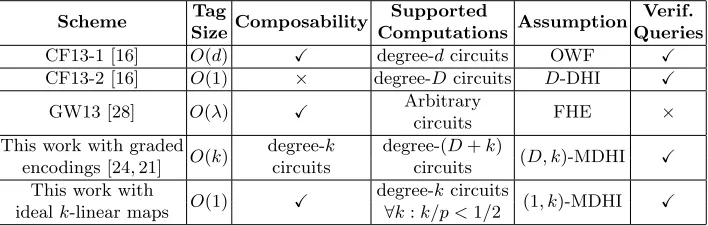
Possible Candidates. Here we discuss the possible instantiations of our scheme. A brief summary is also provided in Table 1.
GGH Graded Encodings. A first instantiation is obtained by using the recent proposal of multilinear maps [24, 21]. Since these realizations allow for a number of levels k which is polynomial in the security parameter, we obtain a homomorphic MAC that supports circuits of bounded polynomial degree and that, in particular, allows for degree-kcomposition. Also, due to the properties of the current multilinear maps realizations, the size of the final authentication tags (i.e., as generated byEval2) isO(d) whered≤kis the degree of the composition circuitφ. This limitation stems from the fact that in all current realizations the size of an encoding at leveldisO(d). Hence, we obtain the following corollary.
Corollary 1. Assume that F is a PRF, G is an instantiation of multilinear maps as in [24, 21], and the computational (D, k)-MDHI assumption holds for
G with D, k=poly(λ). Then the scheme of Section 4 is a secure homomorphic MAC with authentication tags of size O(k)and that supports computations ex-pressed by arithmetic circuits of degree at most D and composition circuits of degree at most k.
Corollary 2. Assume that F is a PRF, G is an (ideal) instantiation of com-pact multilinear maps, and the computational(1, k)-MDHI assumption holds for
G for any k < p/2≈2λ−1. Then the scheme of Section 4 is a secure
homomor-phic MAC with authentication tags of sizeO(1)and that supports computations expressed by arithmetic circuits of degree at most k.
Scheme Tag Composability Supported Assumption Verif.
Size Computations Queries
CF13-1 [16] O(d) X degree-dcircuits OWF X
CF13-2 [16] O(1) × degree-D circuits D-DHI X
GW13 [28] O(λ) X Arbitrary FHE ×
circuits This work with graded
O(k) degree-k degree-(D+k) (D, k)-MDHI X
encodings [24, 21] circuits circuits This work with
O(1) X degree-k circuits (1, k)-MDHI X
idealk-linear maps ∀k:k/p <1/2
Table 1.Summary of homomorphic MACs instantiations with message spaceZp. The
last column indicates whether unbounded verification queries are supported or not.
Acknowledgements. The research of Dario Fiore is partially supported by the European Commission’s Seventh Framework Programme Marie Curie Cofund Action AMAROUT II (grant no. 291803). The research of Rosario Gennaro was sponsored by the U.S. Army Research Laboratory and the U.K. Ministry of De-fense and was accomplished under Agreement Number W911NF-06-3-0001. The views and conclusions contained in this document are those of the author(s) and should not be interpreted as representing the official policies, either expressed or implied, of the U.S. Army Research Laboratory, the U.S. Government, the U.K. Ministry of Defence or the U.K. Government. The U.S. and U.K. Governments are authorized to reproduce and distribute reprints for Government purposes notwithstanding any copyright notation hereon.
References
1. S. Agrawal and D. Boneh. Homomorphic MACs: MAC-based integrity for network coding. In M. Abdalla, D. Pointcheval, P.-A. Fouque, and D. Vergnaud, editors,
ACNS 09, volume 5536 ofLNCS, pages 292–305. Springer, June 2009.
2. N. Attrapadung and B. Libert. Homomorphic network coding signatures in the standard model. In D. Catalano, N. Fazio, R. Gennaro, and A. Nicolosi, editors,
PKC 2011, volume 6571 ofLNCS, pages 17–34. Springer, Mar. 2011.
3. N. Attrapadung, B. Libert, and T. Peters. Efficient completely context-hiding quotable and linearly homomorphic signatures. In PKC 2013, volume 7778 of
4. M. Backes, D. Fiore, and R. M. Reischuk. Verifiable delegation of computation on outsourced data. In2013 ACM Conference on Computer and Communication Security. ACM Press, November 2013.
5. S. Benabbas, R. Gennaro, and Y. Vahlis. Verifiable delegation of computation over large datasets. In P. Rogaway, editor,CRYPTO 2011, volume 6841 ofLNCS, pages 111–131. Springer, Aug. 2011.
6. N. Bitansky, R. Canetti, A. Chiesa, and E. Tromer. From extractable collision resistance to succinct non-interactive arguments of knowledge, and back again. In ITCS ’12: Proceedings of the 3rd Symposium on Innovations in Theoretical Computer Science, 2012.
7. N. Bitansky, R. Canetti, A. Chiesa, and E. Tromer. Recursive composition and bootstrapping for snarks and proof-carrying data. STOC, 2013.
8. N. Bitansky, A. Chiesa, Y. Ishai, R. Ostrovsky, and O. Paneth. Succinct non-interactive arguments via linear non-interactive proofs. InTCC, pages 315–333, 2013. 9. D. Boneh, X. Boyen, and E.-J. Goh. Hierarchical identity based encryption with constant size ciphertext. In R. Cramer, editor,EUROCRYPT 2005, volume 3494 ofLNCS, pages 440–456. Springer, May 2005.
10. D. Boneh, D. Freeman, J. Katz, and B. Waters. Signing a linear subspace: Signature schemes for network coding. In S. Jarecki and G. Tsudik, editors, PKC 2009, volume 5443 ofLNCS, pages 68–87. Springer, Mar. 2009.
11. D. Boneh and D. M. Freeman. Homomorphic signatures for polynomial functions. In K. G. Paterson, editor,EUROCRYPT 2011, volume 6632 ofLNCS, pages 149– 168. Springer, May 2011.
12. D. Boneh and D. M. Freeman. Linearly homomorphic signatures over binary fields and new tools for lattice-based signatures. In D. Catalano, N. Fazio, R. Gennaro, and A. Nicolosi, editors,PKC 2011, volume 6571 ofLNCS, pages 1–16. Springer, Mar. 2011.
13. D. Boneh, E.-J. Goh, and K. Nissim. Evaluating 2-DNF formulas on ciphertexts. In J. Kilian, editor, TCC 2005, volume 3378 of LNCS, pages 325–341. Springer, Feb. 2005.
14. X. Boyen. The uber-assumption family (invited talk). In S. D. Galbraith and K. G. Paterson, editors,PAIRING 2008, volume 5209 ofLNCS, pages 39–56. Springer, Sept. 2008.
15. Z. Brakerski and V. Vaikuntanathan. Efficient fully homomorphic encryption from (standard) LWE. In R. Ostrovsky, editor,52nd FOCS, pages 97–106. IEEE Com-puter Society Press, Oct. 2011.
16. D. Catalano and D. Fiore. Practical homomorphic MACs for arithmetic circuits. InEUROCRYPT 2013, 2013.
17. D. Catalano, D. Fiore, R. Gennaro, and K. Vamvourellis. Algebraic (trapdoor) one way functions and their applications. InTCC 2013, volume 7785 ofLNCS, pages 680–699. Springer, 2013.
18. D. Catalano, D. Fiore, and B. Warinschi. Adaptive pseudo-free groups and appli-cations. In K. G. Paterson, editor, EUROCRYPT 2011, volume 6632 ofLNCS, pages 207–223. Springer, May 2011.
19. D. Catalano, D. Fiore, and B. Warinschi. Efficient network coding signatures in the standard model. In M. Fischlin, J. Buchmann, and M. Manulis, editors,PKC 2012, volume 7293 ofLNCS, pages 680–696. Springer, May 2012.
21. J.-S. Coron, T. Lepoint, and M. Tibouchi. Practical multilinear maps over the integers. InCRYPTO 2013, 2013.
22. D. Fiore and R. Gennaro. Publicly verifiable delegation of large polynomials and matrix computations, with applications. In 2012 ACM Conference on Computer and Communication Security.ACM Press, October 2012.
23. D. M. Freeman. Improved security for linearly homomorphic signatures: A generic framework. In M. Fischlin, J. Buchmann, and M. Manulis, editors, PKC 2012, volume 7293 ofLNCS, pages 697–714. Springer, May 2012.
24. S. Garg, C. Gentry, and S. Halevi. Candidate multilinear maps from ideal lattices and applications. InEUROCRYPT 2013, 2013.
25. R. Gennaro, C. Gentry, and B. Parno. Non-interactive verifiable computing: Out-sourcing computation to untrusted workers. In T. Rabin, editor,CRYPTO 2010, volume 6223 ofLNCS, pages 465–482. Springer, Aug. 2010.
26. R. Gennaro, C. Gentry, B. Parno, and M. Raykova. Quadratic span programs and succinct nizks without pcps. InEUROCRYPT 2013, pages 626–645, 2013. 27. R. Gennaro, J. Katz, H. Krawczyk, and T. Rabin. Secure network coding over the
integers. In P. Q. Nguyen and D. Pointcheval, editors,PKC 2010, volume 6056 of
LNCS, pages 142–160. Springer, May 2010.
28. R. Gennaro and D. Wichs. Fully homomorphic message authenticators. In ASI-ACRYPT 2013, 2013. Also in Cryptology ePrint Archive, Report 2012/290. 29. C. Gentry. Fully homomorphic encryption using ideal lattices. In M. Mitzenmacher,
editor,41st ACM STOC, pages 169–178. ACM Press, May / June 2009.
30. C. Gentry and D. Wichs. Separating succinct non-interactive arguments from all falsifiable assumptions. In L. Fortnow and S. P. Vadhan, editors,43rd ACM STOC, pages 99–108. ACM Press, June 2011.
31. S. Goldwasser, Y. T. Kalai, and G. N. Rothblum. Delegating computation: in-teractive proofs for muggles. In R. E. Ladner and C. Dwork, editors,40th ACM STOC, pages 113–122. ACM Press, May 2008.
32. S. Hohenberger, A. Sahai, and B. Waters. Full domain hash from (leveled) multi-linear maps and identity-based aggregate signatures. InCRYPTO 2013, 2013. 33. R. Johnson, D. Molnar, D. X. Song, and D. Wagner. Homomorphic signature
schemes. In B. Preneel, editor,CT-RSA 2002, volume 2271 ofLNCS, pages 244– 262. Springer, Feb. 2002.
34. J. Kilian. A note on efficient zero-knowledge proofs and arguments. In24th ACM STOC, pages 723–732. ACM Press, May 1992.
35. S. Micali. Cs proofs. In35th FOCS, Nov. 1994.
36. P. Paillier. Public-key cryptosystems based on composite degree residuosity classes. In J. Stern, editor, EUROCRYPT’99, volume 1592 of LNCS, pages 223–238. Springer, May 1999.
37. B. Parno, M. Raykova, and V. Vaikuntanathan. How to delegate and verify in public: Verifiable computation from attribute-based encryption. In R. Cramer, editor,TCC 2012, volume 7194 ofLNCS, pages 422–439. Springer, Mar. 2012. 38. A. Shpilka and A. Yehudayoff. Arithmetic circuits: A survey of recent results
and open questions. Foundations and Trends in Theoretical Computer Science, 5(3-4):207–388, 2010.