O R I G I N A L R E S E A R C H
Variable structure and function relationship of
compressive optic neuropathy at the time of
diagnosis
This article was published in the following Dove Press journal:
Clinical Ophthalmology
Poramaet Laowanapiban1,2 Niphon Chirapapaisan1 Sumitra Kemahayung1 Mathuwan Srikong1
1Department of Ophthalmology, Faculty
of Medicine Siriraj Hospital, Mahidol University, Bangkok, Thailand;
2Ophthalmology Service, Mettapracharak
(Wat Rai Khing) Hospital, Nakhon Pathom, Thailand
Video abstract
Point your SmartPhone at the code above. If you have a QR code reader the video abstract will appear. Or use:
https://youtu.be/pp-J8F7Rw2s
Purpose: To illustrate the structure–function relationship of compressive optic neuropathy (CON) at the time of diagnosis.
Patients and methods: Thirty-two eyes of newly diagnosed suprasellar CON and 60
healthy eyes were included in the study. The peripapillary retinal nervefiber layer (RNFL)
thickness and macular ganglion cell-inner plexiform layer (GCIPL) thickness were obtained using Cirrus spectral domain optical coherence tomography (SD-OCT). CON eyes were
stratified based on the similar degree and pattern of both RNFL and GCIPL.
Results:From 32 eyes of newly diagnosed suprasellar CON eyes, 27 eyes had a predomi-nantly nasal hemiretina thinning of macular GCIPL, 4 eyes showed a generalized macular thinning, and 1 eye showed a predominantly superior macular thinning. The corresponding temporal peripapillary RNFL thinning with nasal hemiretina GCIPL thinning were
incon-sistently manifested. Structure–function analysis of stratified CON eyes with similar thinning
profiles showed that a range rather than afixed value of visualfield loss based on mean
deviation (MD) index was associated to each thinning profile. The maximal limit of visual
field loss range was ubiquitously nonrestricted to any structural thinning profile. While the
minimal limit of the associated MD range was gradually reduced from 0 to about−16.0 dB,
the nasal hemiretina macular GCIPL thinning was the only manifestation and decreased from 75 to 45 µm. However, the different degrees of temporal hemiretina macular GCIPL and
superior–inferior peripapillary RNFL thinning were only seen in 10 of 32 eyes of which their
nasal hemiretina GCIPL and temporal RNFL thinning had reached significant thinning.
Interestingly when present, the minimal limit of associated MD range continued to decrease
from−16.0 to−32.0 dB.
Conclusion:CON eyes can present with variable structure and function relationship at the time of diagnosis. Using structural parameters at the time of diagnosis to predict the prognosis should be used with caution.
Keywords: peripapillary retinal nerve fiber layer, macular ganglion cell-inner plexiform layer, optical coherence tomography, suprasellar mass
Introduction
Compressive optic neuropathy (CON) is a heterogeneous disease that causes damage to the retinal ganglion cell (RGC) axon of the optic nerve by mechanical compression. It usually results in a slow progressive and painless structural and functional deterioration of optic nerve. The etiologic compressive masses can be varied in terms of different pathologic tissues, sizes, growth rates, biological
Correspondence: Niphon Chirapapaisan Department of Ophthalmology, Faculty of Medicine Siriraj Hospital, Mahidol University, Siriraj, Bangkoknoi, Bangkok 10700, Thailand
Tel +66 02 419 8033 Fax +66 02 411 1906 Email [email protected]
Clinical Ophthalmology
Dove
press
open access to scientific and medical research
Open Access Full Text Article
Clinical Ophthalmology downloaded from https://www.dovepress.com/ by 118.70.13.36 on 20-Aug-2020
behaviors, and systemic disturbances.1,2 Also, the
retino-topic rearrangement of axonalfibers themselves at the site
of compression can be region-specific along the pathway
from intraocular, intraorbital, intracanalicular, intracranial parts of the optic nerve, chiasm, optic tract before synapse at the lateral geniculate body. Therefore, the clinical pic-tures include the pattern, severity, rate of visual loss
pro-gression, disc morphology, and other associated
neurological and systemic signs and symptoms at the time of diagnosis, which can be varied.
The evaluation of both structure and function in optic neuropathies at the time of presentation provides vital information about the status of the disease and is extre-mely useful for monitoring the clinical progression and/or recovery after treatment. While glaucomatous optic neuro-pathy (GON) is among the most intensive studied optic neuropathies of which structure and function mapping are
well established,3–5other nonglaucomatous optic
neuropa-thies may have their specific patterns of structural and
functional damage and probable different degrees of
struc-ture–function relationship. CON was shown to possess
distinct patterns of RGC damage in both peripapillary
and macular areas compared to GON.6–9 CON is
asso-ciated with significantly thinner nasal and temporal sectors
of peripapillary retinal nerve fiber layer (RNFL)
thickness,6 while the macular ganglion cell-inner
plexi-form layer (GCIPL) thickness perplexi-forms better than
RNFL in discriminating between CON and GON.7There
is a report which compared the structure–function
correla-tion of RNFL measured by optical coherence tomography (OCT) with standard automated perimetry in patients with
chiasmal compression.10 RNFL is topographically related
to visualfield loss, with the temporal sectors showing the
strongest correlations. Interestingly, the correlation
between RNFL and visualfield defects strengthens as the
time from surgical intervention increases.10 While OCT
macular ganglion cell analysis has recently been shown to
strongly correlate with visual field defects from optic
chiasm compressive lesions and potentially help with
regard to prognosis following treatment.11Recently, OCT
ganglion cell complex analysis has been claimed to be
more sensitive than visualfield testing with standard
auto-mated perimetry in the detection of compressive
chiasmo-pathy or optic neurochiasmo-pathy.12
In this study, we report the variable structure–function
relationship of suprasellar CON at the time of diagnosis. The possible mean deviation (MD) ranges associated with
the different structural thinning profiles from mild to
severe are demonstrated. We also show a correlation
between differential structural thinning profile and
mini-mal limit of associated MD range at the time of CON diagnosis. The possible nature and implication of the out of proportion between functional and structural deteriora-tion are discussed.
Materials and methods
Thirty-two eyes from 19 patients with CON presented or were referred to our neuro-ophthalmology clinic at Siriraj Hospital with different degrees of visual loss. All CON
patients had been diagnostically confirmed by the presence
of the etiologic compressive lesion at the suprasellar area by neuroimaging. The research adhered to the tenets of the Declaration of Helsinki. The institutional review commit-tee had approved the research and patient written informed consent had been obtained.
All patients underwent a complete ophthalmic examina-tion, including visual acuity, refracexamina-tion, slit lamp biomicro-scopy, goniobiomicro-scopy, IOP measurement with Goldmann tonometry, and dilated stereoscopic fundus examination. All patients had a spherical refractive error within the range of ±5 D and IOP measurement of less than 21 mm Hg. Patients were excluded if they had any anterior segment, media opacity, retinal, posterior segment, or optic nerve disease other than
CON. Specifically, patients with known glaucoma, family
history of glaucoma, focal notching, or optic nerve hemor-rhage were excluded. Patients were also excluded from the study if they had a history of diabetes or any other systemic illness that may affect the retina and optic nerve.
OCT measurement of RNFL thickness and macular GCIPL thickness for each eye was performed using the Cirrus OCT (OCT-3, OCT 6.0 software; Carl Zeiss Meditec Inc., Dublin, CA, USA). RNFL Optic Disc Cube 200×200 and Macular Cube 512×128 scan protocols were
used.13 The ganglion cell analysis algorithm was used to
determine macular GCIPL thickness within 14.13 mm2
elliptical annulus area centered on the fovea. Six sectoral (superior, superonasal, inferonasal, inferior, inferotem-poral, and superotemporal) GCIPL thickness values were used for analysis. The Cirrus SD-OCT algorithm calculates the peripapillary RNFL thickness at each point on the
circle of 3.14 mm2centered on the optic disc.
Four-quad-rant (superior, nasal, inferior, and temporal) RNFL thick-nesses were used for analysis.
The visual field test was performed while pupil was
undilated using a Humphrey Field Analyzer (Carl Zeiss Meditec, Inc., Dublin, CA, USA), according to Swedish
Clinical Ophthalmology downloaded from https://www.dovepress.com/ by 118.70.13.36 on 20-Aug-2020
Interactive Threshold Algorithm standard 24-2 program.
All visualfields used for analysis had to meet the
follow-ing reliability criteria: fixation loss <20% and
false-posi-tive/false-negative error less than 15%. The MD index (dB), a central weighted mean of total deviation, has
been used to represent the visual field function.
CON eyes of similar pattern and degree of both GCIPL and RNFL thinning were grouped and illustrated with the same symbols. All statistics including mean thickness and
standard deviation of each structural profile were
com-puted using Predictive Analytics Software version 18 (SPSS, Inc., Chicago, IL, USA). Scatter plots illustrated structure-function between each OCT parameter of indivi-dual eyes versus MD index, were created by the same software.
Results
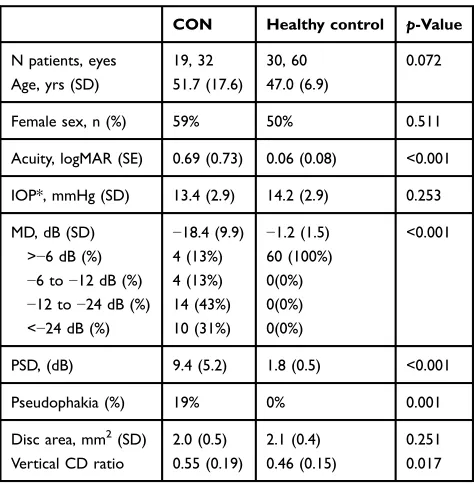
Thirty-two eyes were from heterogeneous causes of newly diagnosed suprasellar CON patients and 60 eyes from
healthy controls were included in this study (Table 1).
The etiologic compressive mass of the 32 eyes included 22 eyes from patients with pituitary adenoma (one eye from a patient with acromegaly and one eye from a patient with a rapid progression of visual loss from pituitary apoplexy), four eyes from patients with Rathke cleft cyst,
two eyes from a patient with multicystic suprasellar mass, one eye from a patient with craniopharyngioma, one eye from a patient with nasopharyngeal malignant epithelial tumor, one eye from a patient with cavernous and para-sellar meningioma, and one eye from a patient with tuber-culum meningioma. Out of 32 newly diagnosed CON eyes, 31 eyes (97%) had bilateral involvement. Not every eye from the bilateral involvement cases was included,
five eyes were not able to perform a reliable visual field
test and were thus excluded from the study. Twelve of 31
eyes (39%) showed a relatively symmetrical visual field
loss between eyes, while 19 of 31 eyes (61%) showed
apparent asymmetrical visualfield loss between the
bilat-eral involved eyes. The MD difference between eyes is greater than 6.
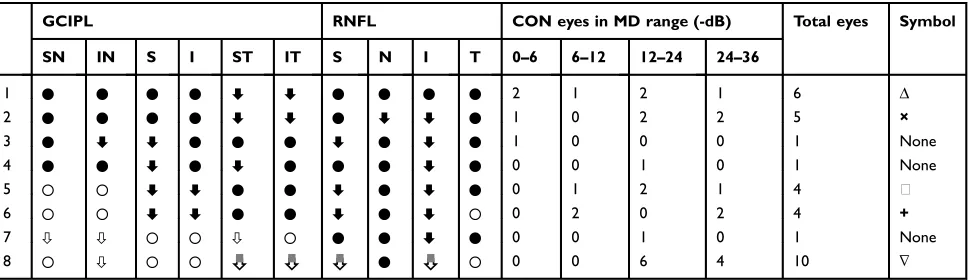
Stratification of 32 supra-sellar CON eyes based on
similar degrees and patterns of both macular GCIPL and peripapillary RNFL thinning from mild to severe degrees of thinning and their associated MD index distribution is
summarized in Table 2. CON eyes of similar pattern and
degree of both GCIPL and RNFL thinning are illustrated
with the same symbols (Table 2, 3andFigures 1and2).
The mean OCT thicknesses of each structural thinning
profile are shown inTable 3.
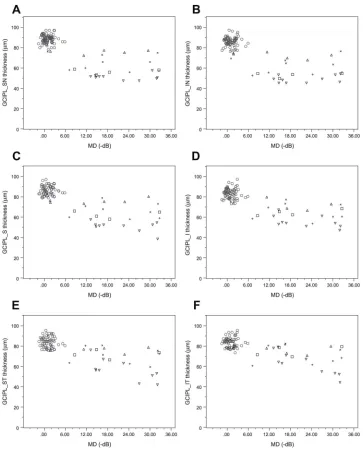
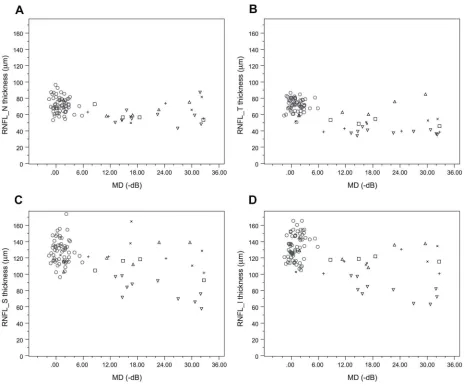
The cross-sectional structure–function distribution plot
showed that each different structural profile of macular
GCIPL and RNFL thinning was associated to a range rather
than afixed value of visualfield loss based on MD index.
The high degree of visualfield loss or MD index between
−28.0 and −32.0 dB was virtually found to be associated
with any groups of different patterns and degrees of struc-tural thinning. While the minimal limit of associated MD
range to each thinning profile showed a trend of gradual
decline from 0.0 to about−16.0 dB when there is only nasal
hemiretina (superonasal and/or inferonasal) macular GCIPL thinning and as it began to decrease from 75 to 45 µm as
shown inFigure 1Aand B. While the corresponding
man-ifested temporal RNFL thinning was less consistent. The additional temporal hemiretina (superotemporal and
infero-temporal sectors) macular GCIPL and superior–inferior
peripapillary RNFL thinning were only seen in 10 of 32 CON eyes of which their nasal hemiretina GCIPL and
temporal RNFL thinning had reached significant thinning
(45–60 and 35–45 µm, respectively). Interestingly when
temporal hemiretina GCIPL and corresponding temporal
RNFL thinning were present (45–75 µm), the minimal
limit of MD range continued to decrease from −16.0 to
−32.0 dB as the thinning increased as shown inFigure 1E
Table 1Subject demographic and ocular characteristics among groups
CON Healthy control p-Value
N patients, eyes Age, yrs (SD)
19, 32 51.7 (17.6)
30, 60 47.0 (6.9)
0.072
Female sex, n (%) 59% 50% 0.511
Acuity, logMAR (SE) 0.69 (0.73) 0.06 (0.08) <0.001
IOP*, mmHg (SD) 13.4 (2.9) 14.2 (2.9) 0.253
MD, dB (SD) >−6 dB (%)
−6 to−12 dB (%)
−12 to−24 dB (%)
<−24 dB (%)
−18.4 (9.9)
4 (13%)
4 (13%) 14 (43%) 10 (31%)
−1.2 (1.5)
60 (100%) 0(0%) 0(0%) 0(0%)
<0.001
PSD, (dB) 9.4 (5.2) 1.8 (0.5) <0.001
Pseudophakia (%) 19% 0% 0.001
Disc area, mm2(SD)
Vertical CD ratio
2.0 (0.5) 0.55 (0.19)
2.1 (0.4) 0.46 (0.15)
0.251 0.017
Note:p-Value<0.05 indicates statistical significance.
Abbreviations:CON, compressive optic neuropathy; logMAR, logarithm of the minimum angle of resolution; MD, mean deviation; PSD, pattern standard deviation; SE, standard error.
Clinical Ophthalmology downloaded from https://www.dovepress.com/ by 118.70.13.36 on 20-Aug-2020
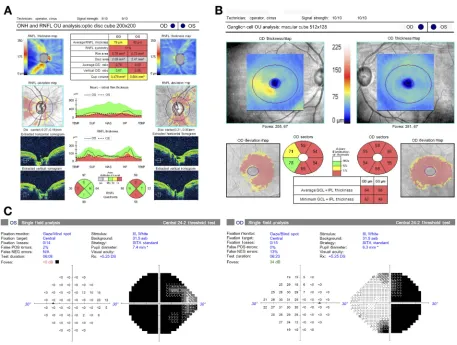
andF andFigure 2Cand D.Figure 3 shows the structural and functional data of a typical case of CON. The patient was a 54-year-old woman with slow progressive painless visual loss in the left eye for 4 months.
Discussion
From the cross-sectional data of manifested thinning pat-tern of 32 suprasellar CON eyes, 31 eyes (97%) generally
fit the similar path of thinning progression. The early
thinning profile was highly localized to the nasal
hemire-tina of macular and corresponding temporal RNFL of the optic nerve head. While different degrees of temporal
hemiretina macular GCIPL and corresponding superior–
inferior peripapillary RNFL thinning were evidenced in
the more advanced thinning profiles, where the nasal
hemiretina thinning had already been severe. This is well agreed with the pattern of early chiasmal compression of
suprasellar mass shown in many works of literature.6,7,11,14
The involvement of uncrossed temporalfibers from further
extension to either ipsilateral distal optic nerve or proximal optic tract compression prior to the complete damage to
crossed nasalfibers of chiasmal compression infrequently
occurred. As shown in our study, one CON eye from a patient with pituitary adenoma showed a minor variation of predominantly superior-sector macular GCIPL thinning with corresponding superior-quadrant peripapillary RNFL thinning at the time of diagnosis.
In our study, the macular GCIPL parameters were shown to be more consistently present than peripapillary RNFL parameters in the early phase of the structural thinning of
suprasellar CON eyes. This was agreed by many authors that macular GCIPL is more sensitive than peripapillary RNFL in the detection of the subtle structural defect of suprasellar
CON.7,12We believe this was due to the inherited broader
window of possible thinning for the superonasal and infer-onasal GCIPL parameters compared to corresponding
tem-poral RNFL, together with the significantly narrower
variance of normal healthy control of the macular GCIPL
compared to temporal RNFL parameter (as shown inTable 3,
Figure 1AandBandFigure 2AandB). While in the more
advance CON structural thinning profile, even with a more
comparable window of possible thinning between temporal hemiretina of GCIPL and superior-inferior RNFL para-meters, the macular GCIPL may still be more favorable parameters to monitor due to the remarkably narrower var-iance (standard deviation) shown in the normal healthy eyes (Table 3,Figure 1EandFandFigure 2CandD). These may explain that equivalent degrees of thinning are likely to be more consistently manifested in macular GCIPL than peri-papillary RNFL parameters. These may also explain the overlapping of manifested temporal RNFL parameters among the different degrees of macular GCIPL thinning in
the early CON structural thinning profile.
The main purpose of this study is to show the variable
structural–function relationship of CON at the time of
diag-nosis. The nature of the different proportions of structure and function damage to CON in our study is proposed. On one end where the functional damage is obviously out of proportion to the structural damage, the structural thinning delay behind the more readily functional deterioration
Table 2An array of OCT parameter thinning profiles and their distribution of associated visualfield index of 32 suprasellar CON eyes at the time of diagnosis. CON eyes with similar thinning
GCIPL RNFL CON eyes in MD range (-dB) Total eyes Symbol
SN IN S I ST IT S N I T 0–6 6–12 12–24 24–36
1 2 1 2 1 6 Δ
2 1 0 2 2 5 ×
3 1 0 0 0 1 None
4 0 0 1 0 1 None
5 0 1 2 1 4 ∇
6 0 2 0 2 4 +
7 0 0 1 0 1 None
8 0 0 6 4 10 ∇
Notes:Macular GCIPL parameter: For all sectors; solid black =76–95 µm, gray =61–75 µm, white in black border =45–60 µm, gray body/white in black head arrow =45–75 µm, down arrow = lower 1/3 of the range, circle = upper 2/3 of the range. Peripapillary RNFL parameter: For S and I quadrant; solid black =101–160 um, gray =81–100 µm, white in black border =60–80 µm. For T quadrant; solid black =56–85 µm, gray =46–55 µm, white in black border =35–45 µm. For N quadrant; solid black =66–90, gray =56–65 µm, white in black border =45– 55 µm. Down arrow = lower 1/3 of the range, circle = upper 2/3 of the range.†Different symbols have been assigned to each group to represent the similar structural thinning profile for purpose of better interpretation inFigures 1and2. ( = healthy control,Δ,×,∇,+,∇represent CON eyes with similar structural thinning profile from early to advanced, respectively).
Abbreviations:CON, compressive optic neuropathy; MD, mean deviation; GCIPL, ganglion cell-inner plexiform layer; RNFL, retinal nervefiber layer; SN, superonasal; IN, inferonasal; S, superior; I, inferior; ST, superotemporal; IT, inferotemporal; N, nasal; T, temporal.
Clinical Ophthalmology downloaded from https://www.dovepress.com/ by 118.70.13.36 on 20-Aug-2020
T able 3 Mean thickness of both macular GCIPL and peripapillar y RNFL parameters of each strati fi ed subgr oup of CON e yes with similar degr ee and pattern of structural thinning. Health y contr ol e yes ar e included Gr oup Mean macular GCIPL thickness ( μ m) Mean peripapillar y RNFL thickness ( μ m) T otal ey es Symbol † SN IN S I ST IT S N I T Health y contr ol 88.4 (4.4) 86.7 (4.7) 86.6 (4.5) 84.0 (5.0) 84.6 (5.1) 84.7 (4.8) 129.2 (14.5) 72 (9.6) 133.8 (16.1) 72.7 (7.4) 60 1 75.5 (1.9) 72.7 (3.1) 75.5 (2.4) 72.8 (4.5) 76.5 (2.4) 76.5 (3.6) 121.3 (14.8) 67.5 (8.2) 129.0 (13.8) 66.5 (11.4) 6 Δ 2 71.2 (4.9) 68.8 (5.2) 73.6 (7.5) 72.4 (6.7) 76.0 (11.4) 79 (8.1) 133.4 (20.2) 66.6 (13.2) 116.0 (11.7) 52.0 (2.2) 5 × 37 4 (NA) 65 (NA) 78 (NA) 73 (NA) 91 (NA) 88 (NA) 115 (NA) 74 (NA) 86 (NA) 49 (NA) 1 None 46 6 (NA) 70 (NA) 65 (NA) 81 (NA) 62 (NA) 73 (NA) 92 (NA) 60 (NA) 103 (NA) 48 (NA) 1 None 5 56.5 (2.6) 53.5 (2.4) 62.5 (3.7) 65.0 (3.2) 72.5 (4.2) 75.3 (5.0) 108.5 (12.0) 60.3 (8.6) 118.8 (2.5) 51.0 (4.2) 4 ∇ 6 57.8 (1.7) 54.8 (1.5) 62.0 (6.1) 61.0 (6.7) 70.3 (8.5) 68.3 (9.2) 116.5 (9.7) 62.5 (8.3) 112.3 (14.4) 40.3 (1.9) 4 + 74 7 (NA) 47 (NA) 54 (NA) 56 (NA) 49 (NA) 57 (NA) 95 (NA) 66 (NA) 109 (NA) 50 (NA) 1 None 8 51.5 (2.8) 49.7 (3.6) 51.3 (5.1) 56.4 (5.9) 57.4 (10.4) 63.6 (11.6) 81.1 (13.7) 58.3 (12.2) 80.9 (11.9) 39.4 (3.3) 10 ∇ Note: Standar d de viation of each parameter is in par enthesis, NA = not available. †Differ ent symbols ha ve been assigned to each gr oup to re pres ent the similar structural thinning pr o fi le for purpose of better interpretation in Figur es 1 and 2 .( = health y contr ol, Δ , × , ∇ , + , ∇ re pr esent CON e yes with similar structural thinning pr o fi le fr om early to advanced, respective ly). Abbre viations: CON, compressiv e optic neur opath y; GCIPL, ganglion cell-inner plexiform la yer ; RNFL, re tinal ner ve fi ber la yer ; SN, super onasal; IN, infer onasal; S, superior ; I, inferior ; ST , super otemporal; IT , infer otemporal; N, nasal; T , temporal.
Clinical Ophthalmology downloaded from https://www.dovepress.com/ by 118.70.13.36 on 20-Aug-2020
present in the acute stage of any optic neuropathies is likely
to be the possible explanation.15As CON is a progressive
process, the relative structural thinning delay behind the functional damage may continuously present in zonal fash-ion unless in CON of very slow progressfash-ion or recently inactive where the structural thinning may have caught up with the functional loss. Thus, the more rapid CON pro-gress, the more cumulative structural delay relative to func-tional loss, and thus, the degree of out of proportion of functional to structural damage is higher. Another possible cause is the axonal stasis and edema due to direct
compression or compromised vascular supplies which can also contribute to the increased thickness with impaired
function.16 Optic nerve axonal edema is evidenced in
some compressive optic neuropathies, eg, optic tract
edema from suprasellar compression17 and optic disc
edema in optic nerve sheath meningioma.18,19This causes
further structural thinning delays and only become apparent when optic disc edema was resolved. The more rapid rate or higher number of ganglion cell axonal was compressed, the higher the degree of axonal edema. Given that this mechan-ism can also operate zonal fashion in progressive CON, Figure 1The scatter plot of macular GCIPL OCT parameters of suprasellar CON eyes versus their MD index of visualfield losses at the time of diagnosis. (A) Superonasal sector mGCIPL; (B) inferonasal sector mGCIPL; (C) superior sector mGCIPL; (D) inferior sector mGCIPL; (E) superotemporal sector mGCIPL; (F) inferotemporal sector mGCIPL. The eyes with a similar structural thinning profile were grouped and illustrated with the same symbols as shown inTables 2and3.
Abbreviations:CON, compressive optic neuropathy; MD, mean deviation; GCIPL, ganglion cell-inner plexiform layer; SN, superonasal; IN, inferonasal; S, superior; I, inferior; ST, superotemporal; IT, inferotemporal.
Clinical Ophthalmology downloaded from https://www.dovepress.com/ by 118.70.13.36 on 20-Aug-2020
subclinical axonal edema can also contribute to different degrees of out of proportion between function and structural
deterioration. This agreed with the previous findings that
the correlation between RNFL and visual field defect in
CON strengthens as the time from surgical intervention
increases.10
On the other end of the structure and function mismatch where the structural damage may present earlier than the functional disturbance, as were evidenced in preperimetric RGC damage in the early stage of glaucomatous optic
neuropathies.20–22There was a report which suggested that
preperimetric macular ganglion cell thinning may also be
possible in mild degrees of CON.12 This is believed to be
due to the redundancy of the overlapping receptive field23
together with the high sensitivity of macular GCL thinning to
detect the subtle change in the early structural damage.20,21
According to ourfindings, this was likely to occur that when
the CON process is a very slow progression then the ongoing functional loss would barely precede the structural damage. Furthermore, there might be some degree of structural remo-deling of the extracellular matrix, supporting glial or vascular tissue that can also exaggerate the degree of structural thin-ning in such very slow progressive processes similar to those
of glaucomatous process.24,25
Regarding our proposed origin of structure–function
mismatch in CON at the time of diagnosis, rate pro-gression seems to be a key parameter affecting the variation of manifestation. It is interesting, from a diagnostic perspective, how CON eyes can present to a possible range from acute to chronic features at the time of diagnosis. From a retrospective review in our patients and literature, CON eyes with very slow Figure 2The scatter plot of peripapillary RNFL OCT parameters of suprasellar CON eyes versus their MD index of visualfield losses at the time of diagnosis. (A) Nasal quadrant pRNFL; (B) temporal quadrant pRNFL; (C) superior quadrant pRNFL; (D) inferior quadrant pRNFL. The eyes with similar structural thinning profile were grouped and illustrated with the same symbols as shown inTables 2and3.
Abbreviations:CON, compressive optic neuropathy; MD, mean deviation; RNFL, retinal nervefiber layer; S, superior; I, inferior; N,nasal;T, temporal.
Clinical Ophthalmology downloaded from https://www.dovepress.com/ by 118.70.13.36 on 20-Aug-2020
progression and a mild degree of peripheral visual field loss may present as normal tension glaucoma masquer-ade at the beginning, but later suspected for CON when
visual field progression seems to respect the vertical
midline.26,27 However, a mild degree of visual field
loss can sometimes be identified in CON eyes with a
relatively more rapid progression in the following situations. Endocrinological disturbance from a secret-ing functional pituitary tumor allows early clinical recognition, sometimes even before CON. With the
regular surveillance of a visual field test thereafter
increases the chance of early detection with a mild
degree of visual field defect. In our study, CON eyes
with a mild degree of visual field loss can also be
revealed incidentally from highly asymmetrical bilat-eral involved cases of which the more affected eyes visual loss have brought patients to attention with acute feature. On the other spectrum of severity with more
severe visual field loss, CON patients with more severe
visual field loss usually seek for diagnosis earlier in an
acute stage. However, some CON eyes with severe
visual field loss in our study also show relative chronic
features with more proportional degrees of structural and functional damage. This is believed to be due to an unawareness of a more affected eye, until the better
eye becomes significantly affected or intentionally
closed during an eye examination in some cases. Or in some cases, patients simply neglect to seek treat-ment due to admittance for the poor prognosis in the worse eye and only become more concerned and seek treatment when the better eye becomes affected.
Our findings that the structure–function relationship at
the time of diagnosis can be highly variable emphasized the need for caution in using structural parameters at the time of diagnosis to predict the prognosis of function recovery espe-cially when the function is unmeasurable or nonreliable. Figure 3Structural and functional data of an example case of compressive optic neuropathy. A 54-year-old woman presented with slow progressive painless blur vision in the left eye for 4 months. (A) Peripapillary retinal nervefiber layer thickness in superior, nasal, inferior, and temporal quadrants were used in the analysis; (B) macular ganglion cell-inner plexiform layer thickness in superonasal, superior, superotemporal, inferonasal, inferior, and inferotemporal sectors were used in the analysis; (C) Humphrey visualfield test using 24-2 program shows junctional scotoma and mean deviation of −16.62 and −30.68 dB in right and left eyes, respectively.
Clinical Ophthalmology downloaded from https://www.dovepress.com/ by 118.70.13.36 on 20-Aug-2020
Study limitation
As ourfindings have suggested, some CON disease
prop-erties, such as the rate of progression, may be a key factor for the different manifestations of structural and functional losses at the time of diagnosis. Our study did not directly design or include any relevant surrogate parameters in the data collection, ie, the onset and the duration of symptoms
at the time of diagnosis. However, it may be difficult to
properly obtain these data in CON patients especially when their functional losses are mild, particularly
periph-eral field involvement, and with no other systemic
symp-toms. Another limitation is the limited sample size, we only began to see the trend of the possible manifestation between structure and function of CON at the time of diagnosis. The prevalence of each manifestation is not known. Future longitudinal studies of each structural
thin-ning profile with associated different visual field losses
will give us more insight into their relevant implication to the visual prognosis upon treatment and recovery.
Conclusion
Nasal hemiretina macular GCIPL thinning has been shown to be more sensitive and consistently found than corre-sponding temporal peripapillary RNFL thinning during the
early structural thinning profile of suprasellar CON
pro-gression. The structure–function relationship of CON at
the time of diagnosis can be highly variable especially when the degree of structural thinning is mild. This emphasized the need for caution in using structural para-meters at the time of diagnosis to predict the prognosis of function recovery especially when the function is unmea-surable or nonreliable.
Disclosure
The authors report no conflicts of interest in this work.
References
1. Sheremet NL, Khanakova NA. [Etiology and diagnostics of
compres-sive optic neuropathies]. Vestn Oftalmol. 2018;134(6):72–82.
doi:10.17116/oftalma201813406172
2. Tsutsumi S, Ono H, Yasumoto Y. Vascular compression of the anterior
optic pathway: a rare occurrence? Can Assoc Radiol J. 2017;68
(4):409–413. doi:10.1016/j.carj.2017.02.001
3. Suda K, Akagi T, Nakanishi H, et al. Evaluation of structure-function relationships in longitudinal changes of glaucoma using the spectralis
OCT follow-up mode.Sci Rep.2018;8(1):17158.
doi:10.1038/s41598-018-35419-y
4. Yohannan J, Boland MV. The evolving role of the relationship between
optic nerve structure and function in glaucoma.Ophthalmology.2017;124
(12S):S66–S70. doi:10.1016/j.ophtha.2017.05.006
5. Distante P, Lombardo S, Verticchio Vercellin AC, et al. Structure/ function relationship and retinal ganglion cells counts to discriminate
glaucomatous damages.BMC Ophthalmol.2015;15:185. doi:10.1186/
s12886-015-0177-x
6. Danesh-Meyer HV, Yap J, Frampton C, et al. Differentiation of compressive from glaucomatous optic neuropathy with
spectral-domain optical coherence tomography. Ophthalmology. 2014;121
(8):1516–1523. doi:10.1016/j.ophtha.2014.02.020
7. Lee EJ, Yang HK, Kim TW, et al. Comparison of the pattern of retinal ganglion cell damage between patients with compressive and
glaucomatous optic neuropathies.Invest Ophthalmol Vis Sci.2015;56
(12):7012–7020. doi:10.1167/iovs.15-17909
8. Nakano E, Hata M, Oishi A, et al. Quantitative comparison of disc rim color in optic nerve atrophy of compressive optic neuropathy and
glaucomatous optic neuropathy.Graefes Arch Clin Exp Ophthalmol.
2016;254(8):1609–1616. doi:10.1007/s00417-016-3366-2
9. Hata M, Miyamoto K, Oishi A, et al. Comparison of optic disc morphology of optic nerve atrophy between compressive optic
neu-ropathy and glaucomatous optic neuneu-ropathy.PLoS One.2014;9(11):
e112403. doi:10.1371/journal.pone.0112403
10. Danesh-Meyer HV, Carroll SC, Foroozan R, et al. Relationship between
retinal nervefiber layer and visualfield sensitivity as measured by
optical coherence tomography in chiasmal compression. Invest
Ophthalmol Vis Sci.2006;47(11):4827–4835. doi:10.1167/iovs.06-0327
11. Vuong LN, Hedges TR 3rd. Ganglion cell layer complex
measure-ments in compressive optic neuropathy. Curr Opin Ophthalmol.
2017;28(6):573–578. doi:10.1097/ICU.0000000000000428
12. Blanch RJ, Micieli JA, Oyesiku NM, et al. Optical coherence tomo-graphy retinal ganglion cell complex analysis for the detection of
early chiasmal compression. Pituitary. 2018;21(5):515–523.
doi:10.1007/s11102-018-0906-2
13. Jeoung JW, Park KH. Comparison of cirrus OCT and stratus OCT on
the ability to detect localized retinal nervefiber layer defects in
preperimetric glaucoma. Invest Ophthalmol Vis Sci. 2010;51
(2):938–945. doi:10.1167/iovs.08-3335
14. Jorstad OK, Wigers AR, Marthinsen PB, et al. Loss of horizontal macular ganglion cell complex asymmetry: an optical coherence
tomography indicator of chiasmal compression. BMJ Open
Ophthalmol.2018;3(1):e000195. doi:10.1136/bmjophth-2018-000195
15. Goto K, Miki A, Araki S, et al. Time course of macular and peripapillary inner retinal thickness in non-arteritic anterior ischaemic optic neuropathy
using spectral-domain optical coherence tomography.
Neuro-ophthalmol-ogy.2016;40(2):74–85. doi:10.3109/01658107.2015.1136654
16. Kerr NM, Chew SS, Danesh-Meyer HV. Non-arteritic anterior
ischae-mic optic neuropathy: a review and update.J Clin Neurosci.2009;16
(8):994–1000. doi:10.1016/j.jocn.2009.04.002
17. Bussat A, Proisy M, Bruneau B, et al. Edema of the optic tract in patients with tumors of the sellar region: clinical and visual
implica-tions in the pediatric population. J Neurosurg Pediatr. 2018;21
(5):516–522. doi:10.3171/2017.11.PEDS17526
18. Sibony P, Strachovsky M, Honkanen R, et al. Optical coherence tomo-graphy shape analysis of the peripapillary retinal pigment epithelium layer
in presumed optic nerve sheath meningiomas. J Neuroophthalmol.
2014;34(2):130–136. doi:10.1097/WNO.0000000000000107
19. Monteiro ML, Goncalves AC, Siqueira SA, et al. Optic nerve sheath
meningioma in thefirst decade of life: case report and review of the
literature. Case Rep Ophthalmol. 2012;3(2):270–276. doi:10.1159/
000342261
20. Cennamo G, Montorio D, Romano MR, et al. Structure-functional parameters in differentiating between patients with different degrees
of glaucoma. J Glaucoma. 2016;25(10):e884–e8. doi:10.1097/
IJG.0000000000000491
21. Takagi ST, Kita Y, Yagi F, et al. Macular retinal ganglion cell
com-plex damage in the apparently normal visualfield of glaucomatous
eyes with hemifield defects. J Glaucoma. 2012;21(5):318–325.
doi:10.1097/IJG.0b013e31820d7e9d
Clinical Ophthalmology downloaded from https://www.dovepress.com/ by 118.70.13.36 on 20-Aug-2020
22. Kim KE, Park KH, Jeoung JW, et al. Severity-dependent association between ganglion cell inner plexiform layer thickness and macular
mean sensitivity in open-angle glaucoma.Acta Ophthalmol.2014;92
(8):e650–6. doi:10.1111/aos.12438
23. Doi E, Lewicki MS. A simple model of optimal population coding
for sensory systems. PLoS Comput Biol. 2014;10(8):e1003761.
doi:10.1371/journal.pcbi.1003761
24. Schneider M, Fuchshofer R. The role of astrocytes in optic nerve
head fibrosis in glaucoma. Exp Eye Res. 2016;142:49–55.
doi:10.1016/j.exer.2015.08.014
25. Grytz R, Girkin CA, Libertiaux V, et al. Perspectives on
biomecha-nical growth and remodeling mechanisms in glaucoma().Mech Res
Commun.2012;42:92–106. doi:10.1016/j.mechrescom.2012.01.007
26. Drummond SR, Weir C. Chiasmal compression misdiagnosed as
normal-tension glaucoma: can we avoid the pitfalls? Int
Ophthalmol.2010;30(2):215–219. doi:10.1007/s10792-009-9308-9
27. Dias DT, Ushida M, Battistella R, et al. Neurophthalmological condi-tions mimicking glaucomatous optic neuropathy: analysis of the most
common causes of misdiagnosis. BMC Ophthalmol.2017;17(1):2.
doi:10.1186/s12886-016-0395-x
Clinical Ophthalmology
Dove
press
Publish your work in this journal
Clinical Ophthalmology is an international, peer-reviewed journal cover-ing all subspecialties within ophthalmology. Key topics include: Optometry; Visual science; Pharmacology and drug therapy in eye dis-eases; Basic Sciences; Primary and Secondary eye care; Patient Safety and Quality of Care Improvements. This journal is indexed on PubMed
Central and CAS, and is the official journal of The Society of Clinical Ophthalmology (SCO). The manuscript management system is completely online and includes a very quick and fair peer-review system, which is all easy to use. Visit http://www.dovepress.com/ testimonials.php to read real quotes from published authors.
Submit your manuscript here:https://www.dovepress.com/clinical-ophthalmology-journal
Clinical Ophthalmology downloaded from https://www.dovepress.com/ by 118.70.13.36 on 20-Aug-2020