Provisions: Privacy-preserving proofs of solvency
for Bitcoin exchanges
Full Version∗
Gaby G. Dagher2 Benedikt B¨unz1 Joseph Bonneau†1 Jeremy Clark2 Dan Boneh1 1Stanford University
2Concordia University
Oct. 26, 2015
Abstract
Bitcoin exchanges function like banks, securely holding their customers’ bitcoins on their behalf. Several exchanges have suffered catastrophic losses with customers permanently losing their savings. A proof of solvency demonstrates that the exchange controls sufficient reserves to settle each customer’s account. We introduceProvisions, a privacy-preserving proof of solvency whereby an exchange does not have to disclose its Bitcoin addresses; total holdings or liabilities; or any information about its cus-tomers. We also propose an extension which prevents exchanges from colluding to cover for each other’s losses. We have implementedProvisionsand show that it offers practical computation times and proof sizes even for a large Bitcoin exchange with millions of customers.
1
Introduction
Digital currencies enable transactions that are electronically authorized, cleared and settled. After decades of research [10, 8, 2, 29] and several failed business ventures attempting to establish a digital currency, Bit-coin [27] was proposed and deployed in 2009. While still in its infancy, BitBit-coin has achieved unprecedented success, enjoying a multi-billion dollar market capitalization and deployment by large retailers. Bitcoin transactions can be executed at any time by any device in the world with low (sometimes zero) fees.
Users can maintain security of their assets by managing the private keys used to control them. However, managing cryptographic keys is difficult for many users [16]. Equipment failure, lost or stolen devices, or Bitcoin-specific malware [22] could all result in the loss of one’s holdings. Many users prefer to keep their holdings with online exchanges for a simple user experience similar to online banking—e.g., with passwords, account recovery, velocity limits and customer support. Exchanges, as their name suggest, also provide conversion services between bitcoin1and other currencies. Customers can ‘withdraw’ by instructing the exchange to send the stored bitcoin to a Bitcoin address for which they manage the private key.
∗
An extended abstract of this work appeared at ACM CCS, 2015.
†
Corresponding author,[email protected].
1
Unfortunately, storing assets with an exchange leaves users vulnerable to the exchange being hacked and losing its assets. One of the most notorious events in Bitcoin’s short but storied history is the collapse and ongoing bankruptcy of the oldest and largest exchange, Mt. Gox, which lost over US$450M in customer assets. A number of other exchanges have lost their customers’ Bitcoin holdings and declared bankruptcy due to external theft, internal theft, or technical mistakes [26].
While the vulnerability of an exchange to catastrophic loss can never be fully mitigated, a sensible safeguard is periodic demonstrations that an exchange controls enough bitcoins to settle all of its customers’ accounts. Otherwise, an exchange which has (secretly) suffered losses can continue operating until the net withdrawal of Bitcoin exceeds their holdings. Note that while conventional banks typically implement
fractional reserve bankingin which they only retain enough assets to cover a fraction of their liabilities, the Bitcoin community is skeptical of this approach and exchanges are generally expected to be fully solvent at all times.
A rudimentary approach to demonstrating assets is simply to transfer them to a fresh public key. Mt. Gox did so once in 2011 in the face of customer skepticism, moving over B420k (then worth over US$7 M) in a single large transaction. However, this demonstration exposed confidential information, such as the size of Mt. Gox’s business and the Bitcoin addresses they controlled. It was never repeated.
More importantly, a proof of reserves without a corresponding proof of liabilitiesis not sufficient to prove solvency. A proof of liabilities might consist of an audit by a trusted accountant, as done for example by Coinbase2and Bitstamp3. This might be improved by allowing users to independently verify they are in the dataset seen by the auditor, a step taken by Kraken4and OKCoin5.
A cryptographic proof of liabilities, verifiable by any party with no trusted auditor, was first proposed by Maxwell [33]. However, this initial proposal leaked information about the number and size of customer accounts (see Section 2.2). These privacy issues (as well as those inherent to a simple public proof of assets) have been cited by some exchanges (e.g.,Kraken6) as a reason to use a trusted auditor instead.
In this paper we propose Provisions, a cryptographic proof of solvency scheme with the following properties:
‚ no information is revealed about customer holdings
‚ the value of the exchange’s total holdings is kept secret
‚ the exchange maintains unlinkability from its Bitcoin address(es) through an anonymity set of arbi-trary size
‚ multiple exchanges performingProvisionscontemporaneously can prove they are not colluding
While the Maxwell proof of reserves requires only a slightly modified Merkle tree, which is a data struc-ture well known by Bitcoin community,Provisionsemploys somewhat heavier cryptography not found in Bitcoin itself—e.g.,additively homomorphic Pedersen commitments and zero-knowledge proofs. However, we demonstrate thatProvisionsis efficient enough in practice even for the largest of today’s exchanges to conduct adailyproof of solvency. The protocol is computable by a single machine in a few hours and yields proofs that are less than 20 GB.
We also consider it crucial that our protocol requires no trusted setup (or “common reference string”), consistent with the de-centralized nature of Bitcoin. More powerful cryptographic tools, such as
zero-2
A. Antonopoulos, “Coinbase Review,”antonopoulos.com(Blog), 25 Feb 2014.
3
E. Spaven, “Bitstamp Passes Audit Overseen by Bitcoin Developer Mike Hearn,”CoinDesk, 27 May 2014.
4N. Hajdarbegovic. “Kraken Bitcoin Exchange Passes ‘Proof of Reserves’ Cryptographic Audit,”CoinDesk, 24 Mar 2014. 5
J. Southurst, “OKCoin Reveals BTC Reserves of 104% as China’s Exchanges Undergo Audits,”CoinDesk, 22 Aug 2014.
6
knowledge SNARKs [4], might offer shorter proofs or improved anonymity, but require a trusted setup which may make them less palatable to the Bitcoin community.
The need to establish the trustworthiness of Bitcoin exchanges should continue to increase as Bitcoin exchanges serve more customers and larger deposits. There are also hints that proofs of solvency will even-tually become legally required in some jurisdictions: in September 2015 the U.S. Conference of State Bank Supervisors issued a proposed regulatory requirement which would require Bitcoin exchanges to demon-strate solvency, with cryptographic proofs of solvency the preferred method [13]. We believe the practicality and strong privacy guarantees ofProvisionsmake it a good candidate to fulfill this need. We hope it will become the norm for exchanges to regularly compute aProvisionsproof of solvency which might go a long way to restoring confidence in the Bitcoin ecosystem.
Limitations It is important to recognize that no proof of solvency (or any other type of audit) is future proof, as exchanges can still be hacked at any time. Likewise, proving control of a quantity of bitcoin does not guarantee the exchange itself will behave honestly in the future. It may simply abscond with all of its customers funds after completing aProvisionsproof. The best we can hope for is efficient enough proofs to enable frequent and continual monitoring of the financial health of exchanges to quickly detect the loss of funds, whichProvisionsenables.
Provisions also requires customers to check individually that their balance has been included in the proof of liabilities. This appears to be a fundamental limitation given our privacy goals that a user’s account balance is not revealed to any other party. On the positive side, as long assomeusers check and the exchange cannot predict which users will check, it runs a high risk of detection if it cheats (see Section 9.2).
Provisions is designed to prove ownership of accounts with a full public key on the blockchain. It cannot prove ownership of unused pay-to-pub-key-hash, unused pay-to-script-hash addresses, or complex multisig addresses. Removing this limitation is an interesting challenge for future work (see Section 4.2).
2
Background
We assume the reader is familiar with Bitcoin [27]. Bonneau et al. [5] provide an extensive survey of Bitcoin, although a deep understanding is not needed for understandingProvisions. The pertinent features are that each unit of bitcoin is usually redeemable by a specified public key7and this information is maintained in a public data structure called the blockchain.
Note that the blockchain is an ever-growing log of transactions. Any proof of solvency will be inherently bound to a single block, representing one snapshot of the Bitcoin ledger. In the remainder of the paper we leave implicit that the proof is valid for a specific block numbert. It is also possible for the blockchain to fork (or “re-org”) in which case an apparently-valid proof at blocktmay not be valid in the final block number t. As is standard with Bitcoin transactions, the defense against this is to wait until a block isconfirmedwith high probability, typically after observing that 6 followup blocks have been published.
Bitcoin public keys which hold funds are interchangeably calledaccountsoraddresses. We note here that while we designedProvisionswith Bitcoin in mind as it is the dominant cryptocurrency today, it could easily be ported to similar cryptocurrencies which have the above properties.
A proof of solvency consists of two components. In the first, the proof of liabilities, the exchange commits to the total quantity of bitcoin it owes to all of its users. In the second, the proof of assets, the
7
h(B2 | CID2 | Nonce2)
Hash
B2
Balance
h(B1 | CID1 | Nonce1)
Hash
B1
Balance
h(B4 | CID4 | Nonce4)
Hash
B4
Balance
h(B3 | CID3 | Nonce3)
Hash
B3
Balance
lc rc lc rc
h(Sum| lc(Hash)| rc(Hash)) Hash
lc(Sum) + rc(Sum) Sum
(Total Liabilities)
lc rc
When a customer desires to verify his account (e.g. dashed line node), only two nodes need to be sent to the customer (bold line nodes).
h(Sum| lc(Hash)| rc(Hash)) Hash
lc(Balance) + rc(Balance) Sum
h(Sum| lc(Hash)| rc(Hash)) Hash
lc(Balance) + rc(Balance) Sum
Figure 1: The Merkle tree from the Maxwell protocol [33] for proof of solvency. When a customer desires to verify their account (e.g. dashed line node), only two nodes need to be sent to the customer (bold line nodes).
exchange commits to the total value of bitcoin it has signing authority over. If the latter committed value is greater than or equal to the former, the exchange is considered solvent.
2.1 Exchange structure and holdings
Nearly all large Bitcoin exchanges operate by pooling customers’ funds into a small number of large ac-counts. Typically for security reasons the keys for some of these accounts are kept on offline computers or in hardware security modules, requiring human action to authorize transactions (commonly calledcold storage).
One might ask why an exchange does not simply maintain a separate Bitcoin address for each customer, enablingdirect monitoringby each user of their funds on the public blockchain; a simple mechanism that eschews the need for a more complicated cryptographic proof of solvency. By itself, this scheme is not secure, as a malicious exchange might attempt to convince two users with the same balance that a single address is holding funds for both of them (a variation of theclash attack[32] discussed later).
This model also has several key practical shortcomings. First, it prevents simple division of money into hot and cold storage. Current exchanges can exist with a limited amount of money in more vulnerable hot storage because, on aggregate, the number of withdrawals in a given day is typically only a small amount of total holdings. This is similar to a large offline bank which does not carry enough cash in ATMs to cover all customer accounts, keeping substantial assets in secure (but less accessible) storage.8
Second, pooling assets means that transfers between customers can be efficiently settled by changing each customers’ account balance without executing a transaction on the Bitcoin blockchain (incurring a transaction fee and a wait of around an hour for confirmation). Similarly, two exchanges can aggregate mul-tiple transactions between pairs of their customers into a single settlement payment (referred to asnetting). Minimizing reliance on the blockchain (especially for small transfers) is a key benefit of exchanges. By
8Executing Provisionswill require computation using all of an exchange’s private keys, including those for assets in cold
contrast, maintaining a separate Bitcoin account for each customer requires “hitting the blockchain” with every transaction.
Finally, although it is not typically advertised, exchanges offer a significant privacy benefit to users as pooling funds ensures that it is not easy for outside observers to link deposits and withdrawals to the same individual [24].
Thus, we consider the pooled assets model likely to persist and we have designedProvisionsto work in this model. If we combine these factors with maintaining the privacy of an exchange’s addresses— proving that one owns (i.e.,knows) a private key without disclosing which—zero-knowledge proofs appear inescapable.
2.2 Maxwell’s proof of liabilities
Maxwell proposed a protocol (summarized by Wilcox [33]) that enables an exchange to prove its total liabilities while allowing users to verify that their accounts are included in this total. The exchange constructs a binary Merkle hash tree [25] where each leaf node contains a customer’s balance, as well as the hash of the balance concatenated with the customer id and a fresh nonce (i.e.,a hash-based commitment). Each internal node stores the aggregate balance of its left child (lc) and right child (rc), as well as the hash of its aggregate balance concatenated with the hash of its left and right children. The root node stores the aggregate of all customers’ balances, representing the total liabilities, and the exchange broadcasts the root node. This is illustrated in Figure 1.
When a customer wants to verify that their balance is included in the total liabilities declared by the exchange, it is sufficient to send to the customer only part of the hash tree in order to perform the verification. Specifically, the exchange sends to the customer her nonce and the sibling node of each node on the unique path from the customer’s leaf node to the root node. The other nodes on the path, including the leaf node itself, do not need to be sent to the customer because they will have sufficient information to reconstruct them. The customer eventually accepts that their balance is included iff their path terminates with the same root broadcast by the exchange.
While elegant, this protocol does not hide the value of the exchange’s total liabilities which is published in the root node. While a rough sense of this value may be public knowledge, the exact value may be sensitive commercial data. Furthermore, regular proofs will reveal precise changes in the exchange’s holdings.
This protocol also leaks partial information about other customers’ balances. For example, if a simple balanced tree is used then each customer’s proof reveals the exact balance of the sibling account in the tree (although the account holder remains anonymous). More generally, each sibling node revealed in a given users’ path to the root node reveals the total holdings of each customer in that neighboring subtree. This could be mitigated somewhat by using an unbalanced tree so it is not immediately clear how many customers are in any neighboring subtree, but the protocol inherently leaks some information.Provisionsremoves this problem entirely, revealing no information about any users’ assets beyond the fact that the total is less than the exchange’s proven reserves.
2.3 Proof of assets
the private key associated with each address. Exchanges may be reluctant to do so for privacy and security concerns (revealing their internal division of funds between accounts).
InProvisions, we enable the exchange to prove ownership of an anonymous subset of addresses pulled from the blockchain. The total quantity of bitcoin across these addresses can then be determined, without being revealed, and proved to be equal or greater than the exchange’s total liabilities.
2.3.1 Control vs. ownership
Any proof of assets, includingProvisions, faces the inherent problem that the ability to use the signing key of an address does not necessarily imply ownership of it. A malicious exchange may collude with one or more bitcoin holders who agree to use their accounts to cover the exchange’s liabilities. However, these partners may have no intention of ever making their holdings available to the exchange’s customers.
An exchange might try consolidating its holdings into a single address to demonstrate that either ex-change or the colluder is risking their bitcoin by placing it under the other’s control. However, there is no guarantee that the single address does not implement a shared access structure by a threshold signature scheme [19].
This problem is fundamental, as no system can cryptographically prove its intentions to return some-thing of value to a given user if requested. This customer request will be made without cryptographic authentication (e.g.,relying only on password authentication) because by assumption exchange customers are unwilling or unable to manage cryptographic keys. Otherwise, assets could be proved by sending each customer’s bitcoins to a 1-out-of-2 multisig address redeemable by either the exchange or the user [33], providing a window for each customer to redeem their coins if desired. Again, we assume this is impractical for the majority of exchange customers.
2.3.2 Collusion attacks
Another potential vulnerability is that a cabal of two or more malicious exchanges might collude by using their own assets to participate in each other’s proof of assets, making each exchange appear to control the total amount controlled by the cabal. With a public proof of assets, this would be detected if done simul-taneously (because the same addresses would appear in multiple exchanges’ proofs) while the transaction graph might reveal if assets are simply being moved around in a shell game.
InProvisions, because the exchange’s addresses are kept confidential, detection of this attack becomes more challenging. However, in Section 7 we show an extension to the basic Provisions protocol which enables exchanges to prove that they are not using the same assets as other exchanges running the protocol. To do so, they publish an additional value which is unlinkable to their real Bitcoin address, yet is a deter-ministic function of (and requires knowledge of) their private key. Thus, if two exchanges attempt to use the same bitcoin address in two different solvency proofs, the re-use can be detected.
This extension imposes a small performance cost (see Section 10.4) and a small impact on the exchange’s privacy as it reveals the number of addresses to which the exchange knows the private key (see Section 9.1). Thus we leave it as an extension for now, as it will only become beneficial when multiple exchanges are implementingProvisionsand are willing to synchronize their proofs.
3
Protocol overview
contains a negative balance, (3) the exchange does not reveal its total liabilities or total assets, and (4) the exchange does not reveal its Bitcoin addresses.Provisionsconsists of three main protocols:
Protocol 1 - Proof of assets. In this protocol, the exchange compiles a large anonymity set of public keysPKcorresponding to addresses on the Bitcoin blockchain. The exchange possesses the private keys to a subset of the public keys inPK. Next, the exchange creates a commitment to its total assets and proves in zero-knowledge that the sum of balances held by the public keys it owns (i.e. public keys for which it knows the secret key) is equal to the committed value. This is done without revealing which public keys it owns.
Protocol 2 - Proof of liabilities. In this protocol, the exchange publishes a commitment to each user’s account balance. These committed values are summed homomorphically to produce a commitment to the exchange’s total liabilities. The exchange enables each user to privately verify that the commitment to their balance is correct. It also proves that every committed balance is a small positive integer.
Protocol 3 - Proof of solvency. Using the commitments to its total assets and liabilities produced by the above two protocols, the exchange will homomorphically compute a commitment to their difference and prove in zero-knowledge that this final commitment is a commitment to zero. This will prove that the total liabilities is exactly equal to the total assets (or, via a minor modification, that it is strictly less than the total assets).
3.1 Preliminaries & notation
Public parameters. We letg andhbe fixed public generators of a groupGof prime orderq. Our imple-mentation uses the elliptic curvesecp256k1[9] as the groupG; this is the group used for Bitcoin ECDSA signatures. Note that this allows us to work with existing Bitcoin public and private keys, although we do not actually perform any ECDSA signatures. While implemented over elliptic curves, we use the more conventional multiplicative notation (e.g.,y“gxinstead ofY “xG).
We stress thatProvisionsrequires no trusted setup, so that no party (or group of parties) can cause the system to malfunction.
Bitcoin balance lookups. We assume that the Bitcoin blockchain is universally agreed upon and all parties can use it to compute the quantity of bitcoin owned by each address. More precisely, for a Bitcoin public keyy P Gwe use balpyq to denote the balance associated withy. We assume balpyqis an integer between0andMaxBTCfor ally. We can represent any bitcoin account withMaxBTC “251—the rules
of Bitcoin limit the total currency supply to 21M B, each divisible into a maximum of10´8 atomic units
calledsatoshis. Note that satoshis are the true units of currency in Bitcoin. Setting B1 “ 108 satoshis is a convention to provide a more human-friendly accounting unit. In the remainder of this paper when we speak of account balances we will always be working with satoshis.
Pedersen Commitments. Provisionsmakes heavy use of Pedersen commitments [30]. The commit-ment to a messagemPZqis defined ascom“gm¨hr wheregandhare fixed public elements ofGand
the quantityris chosen at random inZq. The generatorsgandhare chosen once in a way that ensures no
one knows their relative discrete logarithm. Specifically, we use the standardgfromsecp256k1and derive hdeterministically by hashing the stringProvisions. Recall that Pedersen commitments are perfectly hiding so thatcomreveals no information aboutm.
4
Proof of assets
We begin with Protocol 1 which lets the exchangeE generate a commitment to its total assets along with a zero-knowledge proof that the exchange knows the private keys for a set of Bitcoin addresses whose total value is equal to the committed value.
The exchangeEassembles a set of Bitcoin public keys
PK“ ty1, . . . , ynu ĎG
corresponding to addresses on the blockchain that will serve as an anonymity set. Note that these must be complete public keys and not Bitcoin addresses, which are typically hashes of public keys. We discuss this limitation, as well as how to choose this set, in Section 10. We letx1, . . . , xn P Zq be the corresponding
secret keys so thatyi “gxifori“1, . . . , n.
LetSbe the exchange’s own set of Bitcoin addresses for which it knows the private keys. The anonymity setPKmust of course be a superset of the exchange’s own Bitcoin addresses so thatSĎPK.
We use the booleanssi P t0,1uto indicate which accounts the exchange controls inPK. We setsi “1
whenever the exchange knows the private keyxi for Bitcoin public key yi P PK. The exchange’s total
assets can then be expressed as
Assets“
n ÿ
i“1
si¨balpyiq
We assume balpyiq ą0for alli. Finally, we define
bi:“gbalpyiq fori“1, . . . , n.
Given the set PK, a verifier can easily compute all the bi for itself using information in the Bitcoin
blockchain.
4.1 Proof of assetsΣ-Protocol
The exchange publishes Pedersen commitments to eachsi ¨balpyiq for i P r1, nsby choosing a random
vi PZqand computing
pi“bsii ¨hvi . (1)
A homomorphic addition of these commitments yields a Pedersen commitmentZAssetstoAssets:
ZAssets :“
n ź
i“1
pi “ n ź
i“1
bsi
i ¨hvi “gAssetshp řn
i“1viq. (2)
It remains to prove in zero-knowledge thatZAssetsis valid. That is, for alliP r1, nswe havesi P t0,1u
and whensi “1the exchange knows the secret keyxiPZqfor the public keyyi. To prove this,Epublishes
a few additional values. For eachiP r1, nsthe exchange chooses a randomti PZqand publishes
li “ysiihti PG (3)
which is a Pedersen commitment forsi. Equivalently, theselican be written as
Public data from blockchain:pyi, biqforiP r1, nsandg, h
Verifier’s input from prover: ppi, liqforiP r1, ns
Prover’s input:si P t0,1u, vi, ti,xˆi PZq foriP r1, ns
Protocol:
1. ForiP r1, ns
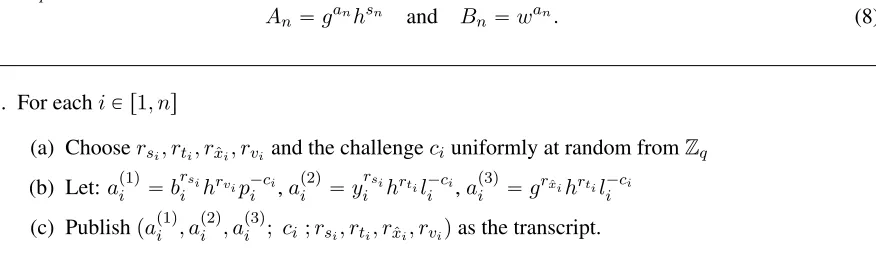
(a) Prover (E) choosesupi1q, upi2q, uip3q, upi4qÐÝ$ Zq.
(b) The prover sends to the verifier:
api1q“bu p1q i i h
upi2q , ap2q
i “y upi1q i h
upi3q , ap3q
i “g
upi4qhupi3q
(c) The verifier replies with a challengeci $
ÐÝZq
(d) Prover (E) replies with:
rsi “u
p1q
i `ci¨si, (response forsi)
rvi “u
p2q
i `ci¨vi, (response forvi)
rti “u
p3q
i `ci¨ti, (response forti)
rxˆi “u
p4q
i `ci¨xˆi, (response forxˆi)
(e) The verifier accepts if:
brisihrvi “? pci i a
p1q
i
`
verify statement (1)˘
yirsihrti “? lci i a
p2q
i
`
verify statement (3)˘
grxiˆ hrti ?
“lci i a
p3q
i
`
verify statement (5)˘
(f) Run the protocol in Appendix B to prove knowledge ofs1
i P t0,1u andv1i P Zq
satisfy-ing (1). [the bindsatisfy-ing property of Pedersen commitments ensures thatsi “s1i andvi “vi1]
2. The verifier computesZAssets:“
śn
i“1pi as in (2)
which is a Pedersen commitment to the quantityxi¨siPZq. By settingxˆi :“xi¨si, we can re-write (4) as
li“gxˆihti (5)
Now, to prove thatZAssetscomputed in (2) is a commitment to (a lower bound of) the exchange’s assets,
the exchange proves knowledge of quantities:
si P t0,1u and vi, ti,xˆi PZq foriP r1, ns (6)
satisfying conditions (1), (3), and (5). This convinces the verifier that whensi “1the exchange knows the
private keyxi PZqfor the public keyyi. To see why, observe that dividing equation (3) by (5) proves that
whensi “1the exchange knowsxˆiPZqsuch thatgˆxi “yi, as required.
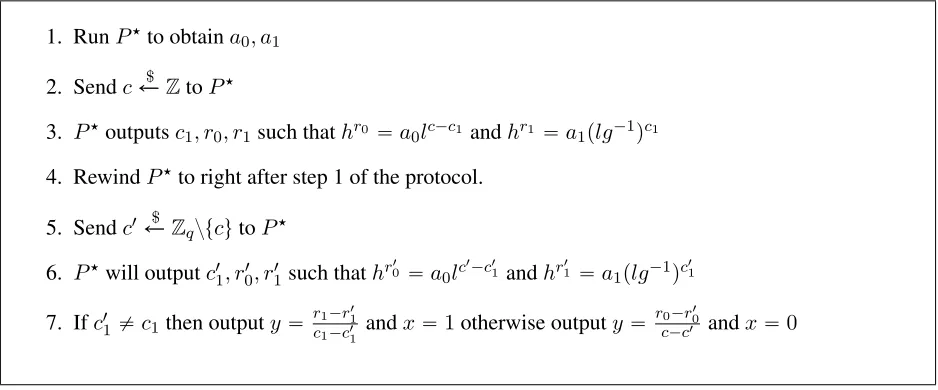
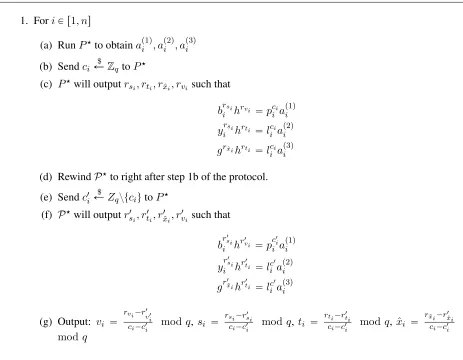
The exchange proves knowledge of the required values in (6) using Protocol 1. The protocol makes use of a standard Σ-protocol to prove that each si is binary and known to the exchange. The protocol is
presented in Appendix B for completeness.
Protocol 1 can be made non-interactive using the Fiat-Shamir heuristic. It therefore suffices to prove that the protocol is honest-verifier zero-knowledge, as shown in the following theorem:
Theorem 1. For public values g, h andpyi, bi, pi, liq for i P r1, ns, the Σ-protocol in Protocol 1 is an
honest-verifier zero-knowledge argument of knowledge of quantities
siP t0,1u, vi, ti,xˆi PZq foriP r1, ns
satisfying conditions(1),(3)and(5)for alliP r1, ns.
The proof of Theorem 1 is given in Appendix C. As explained above, this proof of knowledge convinces the verifier thatZAssets, as computed in (2), is a commitment to (a lower bound of) the exchange’s total
assets. The proof is made non-interactive using the Fiat-Shamir heuristic. Since it is honest-verifier zero-knowledge, it reveals nothing about the total assets, thesi, or thexi, as required.
Proof length. The proof size is linear in the size of the anonymity set n. We use the standard Schnorr optimization so that, for eachi P r1, ns, the proof contains only two elements inG, namelyppi, liq, and
eight elements in Zq, namely the five elements pci, rsi, rti, rxˆi, rviq plus three additional elements in Zq
from the protocol in Appendix B. This is feasible even for large anonymity sets. We discuss practical parameters in Section 10.
We can shrink the proof size by „ 10% if we choose a single challenge value c for all i P r1, ns. However, we choose a differentcifor eachiP r1, nsso that the verifier can check the proof piecemeal, one
iat a time.
4.2 Supported address types
Provisions does not support all address types which are possible in Bitcoin; it only supports addresses which correspond to a single public key. This includes all pubkey-hash (P2PKH) and some pay-to-script-hash (P2SH) address, though for these addresses the public key itself will not be revealed until after the address has first been used.9 Thus, only addresses which have already been used at least once can be utilized as part of the anonymity set.
9
Bitcoin also supports more complicated address types. Each transaction output is technically represented as a small script in a custom Bitcoin script language which can specify arbitrary conditions to redeem the funds. Provisionscan only prove the ability to spend from a script that specifies a single public key. The most common case besides a single key are multisig addresses, which specifynkeys of whichkmust sign. ExtendingProvisionsto support multisig addresses is an interesting challenge for future work.
Using a more powerful proof system such as zk-SNARKs [4], it would be possible to demonstrate the ability to satisfy an arbitrary script by compiling a Bitcoin script interpreter circuit. However, this would require a large and complex circuit which would be wasteful given that nearly all Bitcoin addresses conform to one of a very small number of script types. A better design would likely be to compile specific SNARK circuits corresponding to common script types, such as pay-to-pubkey-hash or multisig. Note that SNARKs, which support proofs on any NP statement, can in principle prove a statement of the form “Either I know a public key whose hash ish and I know the private key corresponding to this public key in which casea is a commitment to the balance of the addressh, or I don’t necessarily know the preimage ofhandais a commitment to th value 0.” This would enable a proof of reserves including pay-to-pubkey-hash addresses which have not yet been spent. Implementing such a statement efficiently using zk-SNARKs is an important future research direction.
5
Proof of liabilities
Protocol 2 enables the exchangeE to verifiably commit to its total liabilities and convince all clients that their balances were included in the commitment.
To provide some intuition behind the design of Protocol 2, consider the mapping of real customers to entries onLiabList. Each real customer should have an entry in LiabList(i.e., the mapping is a function) and no distinct customers should be given the same entry (i.e., the mapping should be injective). If two users have the same balance, a maliciousE might try to point both users to the same entry—in the voting literature, this is called a clash attack [32]. To ensure an injective mapping, customers are provided an ID in line (1d) which commits10 to unique information about the customerusernamei (which may include their
username, email address, and/or account number). The commitment is binding, preventing the exchange from opening aCIDto distinct data for different users. It is also hiding, preventing an adversary who knows theusernameiof a potential customer from determining if that customer is inLiabList(or if a user is known
to be a customer, whichCIDthey correspond to).
We do not require the mapping to be surjective—Ecan always add fake users to the list, but we ensure that doing so can only increaseE’s apparent liabilities. It might be inE’s interest to include fake users with a zero (or tiny) balance to obscure the total number of customers it truly has. However, we must ensure that any included users (real or fake) can only add to the exchange’s total liabilities. That is,E should not be able include a negative balance to try to decrease its apparent liabilities. Since negative numbers do not technically exist in modular arithmetic, the precise requirement is that when added together, the sum will never exceedq, the order of the groupG, which isq«2256for our groupG“secp256k1.
To enforce this,Eprovides a range proof (adapted from [23]) for each committed balance showing it is from a ‘small’ interval between 0 andMaxBTC“251. This ensures that an overflow will never occur as long as the exchange has fewer than2205 accounts. The range proof works by proving that the account balance is at most51bits long by committing to the account balance bit-by-bit and proving that each bit is a 0 or 1.
10
Unlike the other commitments used inProvisions, the commitment scheme used to produceCIDineed only be binding and
To verifiably commit to its liabilities,Edoes:
1. For each customerCi: 1ďiďc:
(a) Represent eachCi’s balanceBalanceias anm-bit binary number (wherem“rlg2MaxBTCs):
BinBalancei“ xxi,0, xi,1, . . . , xi,m´1y, (thenBalancei“řmk“´01xi,k¨2k)
(b) Compute and publish a Pedersen commitment to eachxi,kin the groupGusing generatorsgandh:
zi,k“gxi,khri,k, ri,k
$
ÐÝZq
(c) For everyiP r1, csconstruct a proof of knowledgeπifor the statement:
for allkP r0, m´1s, the exchangeEknowsri,kPZqandxi,kP t0,1usuch thatzi,k“gxi,khri,k.
Notice that zi:“śmk“´01pzi,kqp2 k
q is a Pedersen commitment toC
i’s balance.
Moreover, ZLiabilities :“ śc
i“1zi is a Pedersen commitment to the sum of all balances, which isE’s total liabilities.
(d) Compute a fresh customer identifierCIDiby committingCi’s username:
choose a nonceniÐ t$ 0,1u512and compute
CIDi:“Hpusernamei}niq
whereHis a collision-resistant hash function such as SHA-256
2. Publish the following list of liabilitiesLiabListof all customers’ tuples:
LiabList“ xCIDi, zi,0, . . . , zi,m´1, πiy fori“1, . . . , c.
Every clientCi, foriP r1, cs, can verify that its balance is uniquely included inLiabListas follows:
1. ClientCilogs in and is privately givenpri, niq.
2. The client recomputesCIDi“Hpusernamei}niqand verifies that is correctly included inLiabList.
3. The client verifies its own balance as follows:
computezi:“śmk“´01pzi,kqp2 kq
and verify thatzi“gbalanceihri.
4. The client validates integrity of the remaining entries inLiabListby checking the proofπifor alli“1, . . . , c.
5. Finally, ClientCicomputes and outputsZLiabilities:“ śc
i“1zi.
In practice, the clientCineed only do Steps (1)–(3). Steps (4) and (5) can be carried out by a public auditor (see Section 5.1).
This committed binary representation is homomorphically converted into an integer and homomorphically summed.
The range proof in Step (1c) is the bulk of the proof size (see Section 10). We could have used more efficient range proofs [6, 7], but making these protocols non-interactive using the Fiat-Shamir heuristic requires that we use a trusted setup.11 Our goal is to ensure that Provisions requires no trusted setup, necessitating a range proof that require no trusted setup.
Another alternative is to use zero-knowledge succinct non-interactive arguments of knowledge (zk-SNARKs) [4]. The proof would be significantly shorter (constant in the number of users) at the expense of a large common reference string, the use of heavier cryptographic tools and a trusted setup. Realizing an efficient proof of solvency using zk-SNARKs is an interesting challenge for future work.
The following theorem summarizes the security properties of Protocol 2. We do not provide a formal proof here; the proof follows from the security of the Chaum-Pedersen proof of knowledge of a representa-tion and the security properties of commitments built from collision-resistant hash funcrepresenta-tions.
Theorem 2.
‚ Protocol 2 is zero-knowledge in the following sense: there is an efficient simulator (in the random oracle model) that can simulate all the entries inLiabList given only the number of users (but not their balances or usernames).
‚ Protocol 2 is sound in the following sense: if a public auditor successfully executes verification steps (4) and (5) thenEproved knowledge of a pairpr, LiabilitiesqinZ2q such that
ZLiabilities“gLiabilitieshr
whereLiabilitiesis equal as an integer topřci“1aiqfor someaiin the ranger0,MaxBTCs. Moreover,
for every clientCi that successfully executes verification step (3) we have thatai “balancei.
5.1 Customer verification
We assume that customers each checkLiabListto verify the presence of their identifierCIDiand the
correct-ness of their committed balancezi. A maliciousE which omits some customers will be detected if at least
one of those customers checks the proof of liabilities. This is an inherent limitation given our privacy goals which require that only customers can tell if their balance has been included or not. This limitation applies equally, for example, to Maxwell’s protocol. We discuss this further in Section 9.2. Fortunately the checks required of each individual are quite lightweight. Each customerCireceives fromEtheirusernamei,riand
ni. They then locate inLiabList, with a hint fromE, their tuple:
xCIDi, zi,0, . . . , zi,m´1, πiy
Usingni, they can open their commitmentCIDiand verify that it commits tousernamei. Next, usingrithe
customer checks thatzi is indeed a commitment to their true account balanceBalancei. This is shown in
Step (3) and is a simple calculation.
The other two verification steps, (4) and (5), can be carried out by any party—we assume a public auditor will do so on behalf of most customers, so that individuals will typically not verify the entire proof (though they are free do to so). We discuss the cost of verifying the entire proof further in Section 10.
11
1. Eruns Protocol 1 to verifiably generate a commitmentZAssetsto its total assets.
2. Eruns Run Protocol 2 to verifiably generate a commitmentZLiabilitiesto its total assets and a listLiabListof its liabilities.
3. EcomputesZAssets¨ZLiabilities´1“ZAssets´Liabilities.
4. Eproves in zero-knowledge thatZAssets´Liabilitiesis a commitment to the value 0.
Protocol 3: Complete privacy-preserving proof of solvency
5.1.1 Extended customer verification
One simple extension to the Provisionsproof of liabilities is to take the pairs of commitments (CIDi, zi)
to each user’s identity and balance and arrange them as the leaves of a Merkle tree. Similar to the Maxwell protocol, each internal node of the tree will contain a hash of its two children and a commitment to the sum of their balances. This would enable each user to verify independently that their balance is included inZLiabilities by following their path to the root, checking at each node that the committed balance is the
product of its two child nodes’ committed balances.
In the Maxwell protocol, the user observes the balance in each sibling node on their path to the root to verify that no negative balances have been included. To achieve the same property withProvisions, a range proof must be given for each sibling node’s balance to ensure that it is a small positive number. Thus, for each of thelog2cnodes on the user’s path to the root they must verify one hash, one product of Pedersen commitments and one range proof. Based on our implementation in Section 10, this would lead to per-user proofs of several hundred kB in size for a large exchange.
Because the proof of assets in Provisions cannot be similarly divided on a per-user basis, verifying the proof of solvency would still require a third party verifier for most users. Generating this tree would double the proof-generation time for the exchange, so we leave it as an optional extension. However, if the exchange implemented a simpler, non-privacy-preserving proof of assets (such as moving money on the blockchain) this extension would allow efficient per-verification of the entire proof of solvency comparable to the Maxwell protocol without assuming any third-party verifiers.
6
Proof of solvency
Protocol 3 specifies howEcan complete the proof of solvency given commitments to total assets and liabili-ties from Protocols 1 and 2. The proof thatZAssets´Liabilitiesis a commitment to 0 (line 4) is a simple Schnorr
ZK proof of knowledge of the discrete log ofZAssets´Liabilitiesto the baseh, sinceZAssets´Liabilities “g0hk
for a value k known to the exchange and ifZAssets´Liabilities were a commitment to any other value then
computing its discrete log to the basehwould reveal the discrete log ofhrelative tog.
Variation for exchanges with a surplus If the exchange is actually running a surplus (total assets are greater than total liabilities), this can easily be handled with a simple modification—the exchange can create a commitment to its surplus,ZSurplus, and apply the same range proof used for customer balances to prove
that this is a small positive number. It then replaces line 3 in Protocol 3 with:
This approach reveals that a surplus exists. The exchange can also prove the magnitude of its surplus if desired by opening the commitmentZSurplus. Alternatively, to hide even the existence of any surplus, the
exchange could simply move its surplus into a separate address which is not included in the addresses S
used in its proof of assets, or include the value of the surplus in a number of fake customers’ accounts which will add to its apparent liabilities.
Variation for fractional-reserve exchanges Fractional reserve banking, in which an exchange promises to keep assets equal to only a fractionρof its total liabilities instead of all of them, has been frowned upon by many in the Bitcoin community and not seen significant deployment. However if this approach becomes more popular in the future, it is easy to modifyProvisionsto handle this case by modifying Protocol 3 to commit to a modified balancefipBalanceiq instead of the customer’s true balanceBalancei. Each user
can then check during verification thatfi was computed correctly on their true balance. Simple fractional
reserves could be implemented by defining fipxq “ ρ¨x for all users. It would also be straightforward
to definefipxq “ ρi ¨xwith a differentρi for each user if, for example, some users’ accounts are
fully-guaranteed (ρi “ 1) while others are only fractionally-guaranteed (ρi ă 1). Arbitrary other functions are
possible, with a natural example from traditional finance being guaranteeing a user’s assets up to some maximum value.
Finally, an exchange can also prove that it is running a surplus of proportion ρ by setting fipxq “
p1`ρq ¨x, with a “fractional surplus” effectively being the inverse of a fractional reserve.
7
Proof of non-collusion
Recall from Section 2.3.2 that the privacy guarantees ofProvisionsintroduce the risk that a cabal of insol-vent exchanges colluding by covering each exchanges’ individual liabilities with their collective assets. In effect, the assets of a single Bitcoin address can be used in the proof of solvency for multiple exchanges. This can be done by having the exchanges contribute to a set of joint NIZKPs of their keys (e.g., using divertable ZK [1]).
The simplest defense is for each exchange to choose an anonymity setPKwhich is smaller than the set of all public keys and where each exchange’s set is disjoint from the anonymity set of all other exchanges. This ensures that each exchange is (simultaneously) proving solvency using assets it owns and without the help of other exchanges. The difficulty with this approach is that there may not be sufficiently many addresses on the Bitcoin blockchain to accommodate strong privacy for all the exchanges. In the long run, if exchanges come to collectively control the majority of all bitcoins, we would like them to be able to use each other’s addresses in their anonymity sets.
Extension to Proof of Assets We can obtain a stronger defense by extending Protocol 1 with a few addi-tional steps. Our goal is to ensure that the assets of every Bitcoin address are used in at most one proof of solvency. Recall that the exchange has a set of Bitcoin signing keysPK“ ty1, . . . , ynuwhereyi “gxifor
iP r1, ns. The exchange knows the secret keysxi for some subset of these public keys. We use indicator
variables s1, . . . , sn P t0,1u such that si “ 1 when the exchange knows the secret key xi and si “ 0
LetwPGbe an element such that no one knows its discrete-log basedgorh.12 We extend Protocol 1 to force every exchange to also compute the list
L:“
!
wˆxi
“wxi¨si fori
P r1, ns
)
which is randomly permuted and published. Whensi “1the corresponding element inLiswxi and when
si“0the corresponding element is simply1PG, the identity element. ThusLis a random permutation of
the exchange’s Bitcoin public keys, but using the basewinstead ofg.
We require the exchange to prove thatL is correctly constructed (i.e.,a permutation ofwxˆ1, . . . , wxˆn)
using a zero-knowledge proof of knowledge derived from a component of the Neff mix [28] and presented in Appendix D. The proof of knowledge proves that, given two lists L1, L2 P Gn, the exchange knows
pz1, t1q, . . . ,pzn, tnqsuch that
L1 “ pgz1ht1, . . . , gznhtnq and L2 “permutepwz1, . . . , wznq.
That is, the proof shows that the listL2is a permutation, unblinding and base change of the listL1. The list
L1is the list of commitmentspl1, . . . , lnqgenerated in Protocol 1. This Neff-like proof thus proves that the
published listLis constructed correctly. It is a simple and efficient proof requiring about8nelements inZq,
as explained in Appendix D.
We show below that the listLreveals no information about theE’s Bitcoin addresses beyond the number of addressesνcontrolled byE. Note thatνis not revealed by the basic protocol (Protocol 1). We’ll return to the implications of making this information public in Section 9.1 but this is one reason (in addition to added complexity) why we present this as an optional protocol extension.
Now, suppose two exchanges collude and use the same Bitcoin addressy“gxin their proof of solvency. Thenwxwill appear in theLlist of both exchanges. In other words, theLlists of these two exchanges will have a non-empty intersection.
Since every exchange is required to publish its listL, an auditor can check that these lists are mutually disjoint (ignoring the elements1P G). If so, then the auditor is assured that every Bitcoin address is used in at most one proof of solvency and this holds even if all the exchanges usethe sameanonymity setPK.
An important security requirement is that all exchanges run the extension at the same time—barring this, a simple attack is for exchanges to move bitcoins from one address to another in between runs of the protocol so that the same funds can be used but with a different value forwxˆi “wxi¨siin eachL(sincex
iwill have
changed). Fortunately, the blockchain already provides an easy method of synchronization. Exchanges simply need to agree on a common block number (say, every 240thblock to run the protocol daily) and all run the protocol based on the state of the blockchain up to that block. No further synchronization is required; all exchanges can run the protocol and publish their proofs independently and any assets used by more than one exchange will be detectable.
It remains to argue that the listLreveals no information about the exchange’s set of Bitcoin addresses beyond its size ν. This follows directly from the Decision Diffie-Hellman (DDH) assumption which is believed to hold in the secp256k1group. DDH states that given the tuplexg, w, wxy, the quantitygx is computationally indistinguishable from a random element ofG. Therefore, given the listLit is not possible to distinguish then-bit stringps1, . . . , snq P t0,1unfrom a random string of the same weight.
8
Security definition & proof
We now present a general (not specific toProvisions) definition of a privacy-preserving proof of solvency. We say a functionνpkqis negligible if for all positive polynomialspp¨q, there is a sufficiently largeksuch thatνpkq ă1{ppkq.
LetAandA1denote mappingspy“gx
q ÞÑbalpyqwhereAĎA1,yis the public key corresponding to a Bitcoin address with private keyxand balpyqis the amount of currency, or assets, observably spendable by this key on the blockchain.
LetLdenote a mapping IDÞÑ`where`is the amount of currency, or liabilities, owed by the exchange to each user identified by the unique identity ID.
Definition 1(Valid Pair). We say thatAandLare avalid pairwith respect to a positive integerMaxBTC
iff@IDPL,
1. řyPAArys ´řIDPLLrIDs ě0and
2. 0ďLrIDs ďMaxBTC
Consider an interactive protocolProveSolvencyrun between an exchangeEand userU such that
1. outputProveSolvencyE p1k,MaxBTC,A,L,A1
q “ø
2. outputProveSolvencyU p1k,MaxBTC,A1,ID, `
q P tACCEPT,REJECTu
For brevity, we refer to these asoutE andoutU respectively.
Definition 2 (Privacy-Preserving Proof of Solvency). A privacy-preserving proof of solvency is a prob-abilistic polynomial-time interactive protocol ProveSolvency, with inputs/outputs as above, such that the following properties hold:
1. Correctness.IfAandLare a valid pair andLrIDs “`, thenP rroutU “ACCEPTs “1.
2. Soundness. IfAandLare instead not a valid pair, or ifLrIDs ‰ `, thenP rroutU “ REJECTs ě
1´νpkq.
3. Ownership. For all valid pairsAandL, ifP rroutU “ACCEPTs “1, then the exchange must have ‘known’ the private keys associated with the public keys inA; i.e., there exists an extractor that, given
A,L, and rewindable black-box access toE, can producexfor allyPA.
4. Privacy.A potentially dishonest user interacting with an honest exchange cannot learn anything about a valid pairAandLbeyond its validity andLrIDs(and possibly|A|and|L|); i.e., even a cheating user cannot distinguish between an interaction using the real pairAandLand any other (equally sized) valid pairAˆandLˆsuch thatLˆrIDs “LrIDs.
We prove the following theorem in Appendix E:
9
Security discussion
9.1 Anonymity sets
If the anti-collusion protocol extension of Section 7 is used, then the number of Bitcoin addressesν con-trolled by the exchange is revealed as well as the size of the anonymity setn“ |PK|(which includes the ν addresses). For efficiency reasons, exchanges may opt to use smaller anonymity sets than the set of all public keys on the blockchain; in particular, if the number of keys grows unexpectedly in the future. In such a case, the exchange must be aware that this might leak some meaningful information about whatE’s total assets are.
Specifically, the adversary can determine that E’s assets consist of one of the `nν˘ subsets of the anonymity set PK. We remark that E can easily control nand can also control ν (by splitting accounts up or by paddingν with zero balance accounts). For practical instances,`nν˘grows quickly—e.g.,ν “ 25 andµ“250already yields«2114candidates. That said, we have no idea what types of external information might be useful for eliminating unlikely or impossible totals from this set (e.g.,the adversary’s corruption of customers may provides them with a lower bound on the total assets), or for whittlingndown by eliminating addresses known or suspected not to be controlled by the exchange. Research on deanonymizing Bitcoin addresses,e.g., through clustering and reidentification [24], has demonstrated that Bitcoin’s anonymity is limited (see [5] for a survey).
If an exchange conducts proofs of solvency on a regular basis (or more than once), each anonymity set should be based closely on the anonymity set used previously—choosing independent anonymity sets could reveal the exchange’s addresses by intersecting the sets. Exchanges can remove addresses from their anonymity set if the criteria for doing so is independent of whether the exchange owns the address or not. For example, it might remove addresses once the balance is under a certain threshold. However, generally, anonymity sets should grow over time with new addresses (some owned by the exchange and some as cover) being added to the set.
We leave the process of developing and analyzing a heuristic for forming an anonymity set (in terms of size ofnandν and the distribution of amounts across theνaccounts) as future work. For the current state of Bitcoin at the time of writing, we show in Section 10 that it is reasonable for all exchanges to choose an anonymity set equal to most available accounts, sieving out tiny “dust” accounts.
9.2 User Verification
A proof of solvencyenablesuser verification, but it does not guarantee that all users actually perform the verification. Consider a maliciousE that does not correctly include some set of users accounts—by either omitting them or zeroing their balances. Assume the exchange has U users, F (for fraudulent) entries, and that a randomsubset A Ă U of users choose to audit the correctness ofLiabList. In this case, the probability that an adversary will go undetected is `U´AF˘{`UA˘, which is closely bounded from above by minrp1´A{UqF,p1´F{UqAs(cf.the probability of a malicious election authority being caught modifying ballot receipts in a cryptographic voting system [11]). This probability decreases close-to-exponentially in F andA. Due to the approximation, we conservatively conclude the probability of being caught is high, instead of overwhelming.
largest account is equivalent to zeroing out the smallest in terms of being caught, yet the former action better benefits the adversary’s goal of lowering its liabilities.
We also note that Provisions as described does not provide dispute resolution. If a user finds their account missing or balance incorrect, they do not have sufficient cryptographic evidence that this is the case [21]. The issue appears unsolvable cryptographically. Recall that the primary motivation for users keeping funds with an exchange is to avoid needing to remember long-term cryptographic secrets, therefore exchanges must be able to execute user orders and change their balance without cryptographic authentication from the user (e.g.,password authentication). Resolving this will likely require legal regulation. Users who dislike an exchange may also falsely claim that verification of their accounts failed, and it is not possible to judge if the user or the exchange is correct in this case based on aProvisionstranscript alone.
Lastly, we note that if a user does verify their account, they should use a verification tool other than one provided by the exchange itself; such a tool could be automated to increase participation. All of the issues discussed in this remark deserve followup work to ensure thatProvisionsis implemented in practice in such a way that users are likely to perform auditing and to do so correctly.
9.3 Access to private keys
One important practical consideration with Provisions is that it requires computation using private keys which exchanges should, by best practice, protect very carefully. These keys might, for example, be kept incold storagein an airgapped hardware security module (HSMs) or even kept on paper in a secure vault. Performing regularProvisionsproofs might therefore impact security practices at exchanges. This problem is inherent to any cryptographic proof of assets. If the proof is conducted at a regularly scheduled time, this can be integrated with access control practices using human intervention to access the private keys.
Each private key is needed for an addition in Step (1d) of Protocol 1. This presents a challenge in that some HSMs only support an API to perform a complete ECDSA signature with the private key and do not support an isolated addition with the key. Exchanges interested in implementingProvisionsmight need to carefully consider if they are using HSMs with a rich enough API to enable the proof-of-assets computation. Alternatively, exchanges could request their HSM providers to implement the required API. This feature could be a way for HSMs providers to differentiate themselves from the competition. An interesting challenge for future research is to design a proof-of-assets protocol that is compatible with a device that only performs complete ECDSA signatures.
The fact that Provisionsonly requires an addition with the private key also provides an opportunity: while implementing threshold ECDSA (or DSA in general) is quite challenging, it is straightforward to create additive key shares that support private key addition in a threshold fashion. This would enable an exchange implementing Provisions to distribute key shares to multiple servers (or HSMs) which must collaborate to compute aProvisionsproof.
10
Implementation
10.1 Asymptotic performance
in parallel and require only associative aggregations to compute homomorphic sums, meaning the protocol is straightforward to parallelize.
Specifically the proof of assets is linear inn, the number of public keys in the anonymity set, regardless of the size ofS, the total number of accounts actually owned byE, requiring10nintegers fromZqin total.
The proof of liabilities is linear with respect to the number of customersc. It is dominated bym`1elements fromZqused to commit to each bit of each customer’s balance, wherem“rlg2MaxBTCs“51. If needed,
an exchange could slightly reduce proof sizes by capping the size of assets below or reducing precision. For example, withm“32the exchange could still include accounts worth up to US$1 billion with precision to the nearest penny. However, we’ll assume full precision is desired in our implementation.
Full verification of the protocol requires approximately equal time to the construction of the proof. For customers opting to only validate their own balance’s correct inclusion in the proof and trust a third party to run the full verification, verification is much simpler, the customer to check theirCIDvalue with a single hash and check thatyiis a correct commitment their balance which requires onlym`2group operations.
10.2 Incremental updates
As described in Section 1 the protocol is intended to be run often (e.g. daily) to give continued proof of solvency. A natural question is whether it is possible to update the proof incrementally. We will consider updates to the anonymity set, to the assets proof and to the liabilities proof separately.
The full set of addresses (anonymity set + owned addresses) used in the proof is public. As such any newly created addresses by the exchange need to be published. To hide these new addresses it is important to additionally add addresses to the anonymity set. As with the anonymity set in general and discussed in Section 9.1 it is important to choose in such a way that the actual addresses are indistinguishable from it. A proper implementation would for example add addresses deterministically (e.g. all addresses with balances overxbitcoin).
The asset proof is almost perfectly separable, in that there is a separate and independent component for each address in the full set of addresses. The components for new addresses and addresses with changed balance need to be updated. However, it is not necessary to update the components of all other addresses. This is especially useful for cold addresses, which do not have a private key easily accessible. The set of addresses which are new or have changed balances is public on the blockchain anyways and thus no additional information is leaked.
The liabilities proof mainly consists of a commitment to each customer’s balance and a proof that said balance is within a range. For all new users and users whose balance changed the commitment the proof needs to be redone. For the other users it is not technically necessary to redo the proof. However, not changing the proofs for customers whose balance remained unchanged will leak how many users were actively using their account between the two proofs. If the complete proof were redone then this information would remain private. If an exchange were to accept this privacy leak it could drastically reduce the size of the proof updates.
10.3 Practical parameter sizes
than 0.01 BTC, which collectively control 99.97% of all bitcoin.13 As discussed in Section 4.2, some of these addresses are unusable for the protocol because they do not have public keys available (i.e.,they are pay-to-pub-key-hash addresses with only a hash of the public key visible in the blockchain), others have questionable anonymity value as they have never been moved since being mined and exchanges are not expected to be mining their own bitcoin directly. Out of these addresses roughly 431,000 have performed a send action and are thus candidates for the anonymity set. Consequently we tested our implementation with anonymity sets up to 500,000.
On the proof-of-liabilities side, Coinbase is thought to be one the largest exchanges and currently claims roughly 2 million customers.14 We take as our goal supporting this number of users.
10.4 Implementation & performance tests
To test the performance of our protocol in practice we created a prototype implementation of our protocol in Java 1.8. All cryptographic operations are performed using BouncyCastle,15 a standard cryptographic library for Java which is also used by the popularbitcoinjimplementation of Bitcoin in Java. We performed tests on a commodity server with 2 E5-2680 v2 Xenon processors and 128GB RAM. The max heap size of the JVM was set to the default 256MB. Our implementation assumes a previously downloaded and verified blockchain, to enable efficient balance lookups and selection of an appropriate anonymity set.
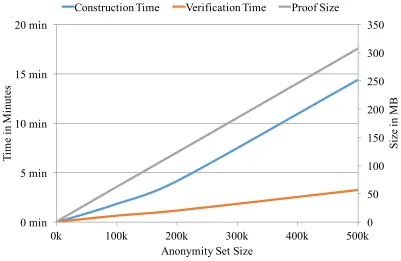
Our simulations confirm thatProvisionsshould be practical even for large exchanges desiring strong anonymity and full precision to represent customer accounts. Figure 2 shows proof sizes and computation times for Protocol 1, the proof of assets, varying the anonymity set sizenfrom 10 to 500,000. Figure 3 shows proof sizes and computation times for Protocol 2, the proof of liabilities, varying the number of customersc from 1,000 to 2,000,000. We tested withm“51, supporting full precision of account balances. Reducing m would lead to proportional reductions in proof sizes and construction times. Note that, given realistic parameters today, it appears that the proof of liabilities is the more expensive protocol today for a large exchange.
We report numbers without the protocol extension from Section 7 to ensure assets are not shared between colluding exchanges executing the protocol contemporaneously. This extension requires publishing the elementwˆxi plus eight additional values per address which increases the size and construction time of the
proof of assets by about„80%. Because the proof of liabilities is likely much larger, this extension makes only a minor impact on performance.
We omit performance figures for Protocol 3 as this protocol is constant size and negligible compared to Protocols 1 and 2. Similarly, verification time for individual clients depends onlymand not the anonymity set or number of other customers. In our implementation it took fewer than 10 ms.
11
Open research challenges
In this section we briefly summarize the open research challenges for proofs of solvency:
‚ Multisig addressesProvisions does not enable multisig addresses (Section 4.2). In principle, the proof of assets of Section 4.1 can be extended to prove control of the required majority of keys in a multisig address (assuming they are all public) without substantially new cryptographic techniques.
13https://bitinfocharts.com/top-100-richest-bitcoin-addresses.html 14https://www.coinbase.com/about
15
0 50 100 150 200 250 300 350 0 min 5 min 10 min 15 min 20 min
0k 100k 200k 300k 400k 500k
Si ze in M B Ti m e i n M inut es
Anonymity Set Size
Construction Time Verification Time Proof Size
Figure 2: Performance for Protocol 1 (proof of assets).
0 2 4 6 8 10 12 14 16 18 20 0 min 30 min 60 min 90 min 120 min 150 min 180 min 210 min 240 min 270 min 300 min
0k 250k 500k 750k 1000k 1250k 1500k 1750k 2000k
Si ze in G B Ti m e i n M inut es
Number of Customers (in Thousands), m=51 Construction Time Verification Time Proof Size
‚ Non-public public keysProvisionsdoes not enable using addresses in the anonymity set for which the public keys are unknown. As discussed in Section 4.2, this prevents using pay-to-pubkey-hash and pay-to-script-hash addresses which are common in Bitcoin. Removing this restriction requires proving knowledge of a hash preimage which will necessitate more powerful proof techniques such as zk-SNARKs.
‚ Arbitrary scripts Bitcoin enables arbitrary scripts for transaction redemption. The most general framework for solvency proofs would enable zero-knowledge proofs of the ability to satisfyany re-demption script. In principle this could be achieved by compiling an interpreter for Bitcoin scripts in a general-purpose proof system such as zk-SNARKs. The practical value of this may be low as most Bitcoin scripts conform to one of a small number of templates.
‚ ZerocashZerocash [3] is a proposed cryptocurrency with strong privacy properties. All transactions are zk-SNARKs, revealing no information about senders, recipients, or value. Proofs of solvency for Zerocash would require a substantially different proof of assets. Using zk-SNARKs is the obvious approach since they are already required for the currency. It might be valuable to combine the trusted setup for the currency itself with a trusted setup to enable solvency proofs.
‚ Velocity limitsIt might be considered valuable for an exchange to demonstrate stability by proving that some portion of its holdings have not been transferred for some period of time. The “age” of each UTXO in Bitcoin is publicly visible, so it would be possible to add this parameter to the proof-of-assets and compute a weighted sum of proof-of-assets based on age.
‚ Compatibility with ECDSA-only HSMsAs discussed in Section 9.3, some exchanges might keep their private keys in HSMs which only export ECDSA signatures and do not enable the raw mul-tiplication needed for theProvisions proof of assets. Designing a new proof of assets around this limitation is an interesting challenge.
12
Concluding Remarks
Stu Feldman has outlined a roadmap for technical maturity (as quoted in [18]):
1. You have a good idea;
2. You can make your idea work;
3. You can convince a (gullible) friend to try it; 4. People stop asking why you are doing it; and 5. Other people are asked why they are not doing it.
Given the shaky track record of Bitcoin exchanges, the onus upon an exchange to perform some kind of audit is nearing level 5. However, cryptographic solvency proofs, like the Maxwell protocol, are lagging behind around level 3. Our belief is that the privacy implications of Maxwell are hindering it—there are good reasons for an exchange not to reveal which addresses it controls, the scale of its total holdings, or potentially leak information about large customers’ account sizes. Provisions removes these barriers. While cryptographic proofs of solvency still have inherent limits, namely that control of an address’ key at present does not guarantee the future ability to use that key to refund customers, we believe that with
Acknowledgments
We thank the reviewers for their insights. We especially thank our shepherd Sarah Meiklejohn for her constructive feedback and contributions which improved the paper. J. Bonneau is supported by a Secure Usability Fellowship from the Open Technology Fund and Simply Secure as well and is also supported by DARPA. J. Clark acknowledges funding from NSERC, FQRNT and Concordia OVPRGS. D. Boneh acknowledges funding from NSF, DARPA, and a grant from ONR. Opinions, findings and conclusions or recommendations expressed in this material are those of the authors and do not necessarily reflect the views of DARPA.
References
[1] O. Baudron, P.-A. Fouque, D. Pointcheval, G. Poupard, and J. Stern. Practical multi-candidate election system. InACM PODC, 2001.
[2] M. Belenkiy. E-Cash. InHandbook of Financial Cryptography and Security. CRC, 2011.
[3] E. Ben-Sasson, A. Chiesa, C. Garman, M. Green, I. Miers, E. Tromer, and M. Virza. Zerocash: Decentralized anonymous payments from Bitcoin. InIEEE Symposium on Security and Privacy. IEEE, 2014.
[4] E. Ben-Sasson, A. Chiesa, D. Genkin, E. Tromer, and M. Virza. Snarks for C: verifying program executions succinctly and in zero knowledge. InCRYPTO, 2013.
[5] J. Bonneau, A. Miller, J. Clark, A. Narayanan, J. A. Kroll, and E. W. Felten. Research Perspectives and Challenges for Bitcoin and Cryptocurrencies. IEEE Symposium on Security and Privacy, 2015.
[6] F. Boudot. Efficient proofs that a committed number lies in an interval. InProc. of EUROCRYPT, pages 431–444, 2000.
[7] J. Camenisch, R. Chaabouni, and A. Shelat. Efficient protocols for set membership and range proofs. InASIACRYPT, pages 234–252, 2008.
[8] J. Camenisch, S. Hohenberger, and A. Lysyanskaya. Compact e-cash. InEUROCRYPT, 2005.
[9] Certicom Research. SEC 2: Recommended Elliptic Curve Domain Parameters, Version 1.0., 2000.
[10] D. Chaum. Blind signatures for untraceable payments. InCRYPTO, 1982.
[11] D. Chaum, R. Carback, J. Clark, A. Essex, S. Popoveniuc, R. L. Rivest, P. Y. A. Ryan, E. Shen, and A. T. Sherman. Scantegrity II: end-to-end verifiability for optical scan election systems using invisible ink confirmation codes. InEVT, 2008.
[12] D. Chaum and T. P. Pedersen. Wallet databases with observers. InCRYPTO, 1992.
[13] Conference of State Bank Supervisors. State Regulatory Requirements for Virtual Currency Activities Model Regulatory Framework, Sep. 2015.
![Figure 1: The Merkle tree from the Maxwell protocol [33] for proof of solvency. When a customer desirescustomer (bold line nodes).to verify their account (e.g](https://thumb-us.123doks.com/thumbv2/123dok_us/7922866.1315534/4.612.85.531.72.215/figure-merkle-maxwell-protocol-solvency-customer-desirescustomer-account.webp)