ABSTRACT
GUPTA RACHANA ASHOK. An Edge-detection and HPF based Intelligent Space – A Network
Based Integrated Navigation System. (Under the direction of Dr. Mo-Yuen Chow.)
Intelligent space (iSpace) is a large scale mechatronics system. It is a multidisciplinary
effort whose aim is to produce a network structure and components that are capable of integrating
sensors, actuators, DSP, communication, and control algorithms in a manner that suits
time-sensitive applications including real-time navigation and/or obstacle avoidance. There are many
challenges that must be overcome in order to put such a distributed, heterogeneous system together.
The research presented here deals with one of these issues, i.e. the adverse effect of processing
delays on the system. Here a novel structure for a delay-resistant sensory-motor module to
navigate a differential drive unmanned ground vehicle (UGV) in a cluttered environment is
suggested. The module consists of an early vision edge detection stage, a harmonic potential field
(HPF) planner; a network based quadratic curve fitting controller and gain schedule middleware
(GSM). The structure of this module and its components are described. Thorough experimental
results along with performance assessment comparing to the previous implementation are also
A
NE
DGE-
DETECTION ANDHPF
BASEDI
NTELLIGENTS
PACE–
A
N
ETWORKB
ASEDI
NTEGRATEDN
AVIGATIONS
YSTEMby
RACHANA ASHOK GUPTA
A thesis submitted to the Graduate Faculty of North Carolina State University
in partial fulfillment of the requirements for the Degree of
Master of Science
ELECTRICAL ENGINEERING
Raleigh, North Carolina
May 2006
APPROVED BY:
______________________ _____________________ Dr. Wesley Snyder Dr. James J. Brickley
To my parents, and my sister Apeksha
who taught me that
BIOGRAPHY
Rachana Ashok Gupta was born in Tarapur, India on the 22nd of January 1981. She
received her Bachelor of Engineering degree in Electronics and Telecommunication engineering in
2002 from Maharashtra Institute of Technology, University of Pune, India.
She worked as an Associate Consultant and Software Engineer in iFlex Solutions Ltd,
Mumbai, India in development and testing of banking software for the period of September 2002 –
July 2004.
Later in fall 2004, she joined Master of Science program in the Department of Electrical
and Computer Engineering of North Carolina State University, Raleigh. She became a part of
Advanced Diagnosis Automation and Control (ADAC) lab directed by Dr. Mo-Yuen Chow in
spring 2005. Her main research interests are computer vision for network based robotics,
computational intelligence and mechatronics systems. Her current research topic is network based
integrated navigation systems for unmanned ground vehicles. With the defense of this thesis, she is
ACKNOWLEDGEMENTS
I cannot thank enough Dr. Mo-Yuen Chow, who taught me the real meaning of the two lines which always inspired me:
Some people see things as they are and say why??? I see things those never were and say why not!!!
His invaluable guidance, great encouragement, persistent support and faith in me during the course of this research were my greatest motivators. He not only created immense opportunities for me to build up my knowledge, confidence and research capabilities but also shaped my philosophy in science and research.
I am highly grateful to Dr. Ahmad Masoud, King Fahd University of Petroleum and Minerals, Saudi Arabia. His immense knowledge, guidance, suggestions and persistence have a great share in successfully completing the research presented in this thesis.
I would like to express my sincere appreciation to my committee members: Dr. James Brickley for the continuous encouragement and faith in me, Dr. Wesley Snyder for the invaluable discussions and suggestions during and outside the teaching of the course of Computer Vision, which built the foundation of my research in computer vision for robotics.
I would also like to acknowledge the help from the members in ADAC lab: Rangsarit Vanijjirattikhan, Puxuan Dong, Le Xu, Zheng Li, Tyler Richards, Tao Hong, and Manas Talukdar. I have benefited enormously from the inspiring academic atmosphere in the ADAC lab.
My special thanks go to the electronic lab staff member Rudy Salas for his help in hardware facilities.
Of course, none of this would have been possible without my parents, their unconditional love, support and the struggle they have gone through in life to ensure my continuous progress that I have been able to strive so hard to succeed in every venture of my life and reach these academic heights. My sister Apeksha, who is my moral support system, has always been an enthusiasm for my studies.
TABLE OF CONTENTS
LIST OF TABLES... vii
LIST OF FIGURES ... viii
CHAPTER I – Introduction ... 1
CHAPTER II – Introduction to iSpace as a Network based Integrated Navigation system... 5
2. 1 Different components in iSpace... 5
2. 2 Template matching for content recognition... 8
2. 3 Limitations of Template matching approach for Network based Navigation System... 10
2. 4 Path planning using fast marching method... 11
2. 5 Path tracking controller... 13
2. 6 Limitations of path planning method in the network based navigation system... 14
2. 7 GSM for Network delay compensation ... 15
CHAPTER III – New Structure of iSpace ... 17
3. 1 Edge detection to extract the contents of the iSpace environment ... 17
3. 2 Results of edge detection ... 25
3. 3 2-D HPF planner for path planning ... 26
3. 4 HPF and Edge detection Merged together ... 29
3. 5 HPF, a region to point guidance function, combined with the network based controller 31 CHAPTER IV – Comparison of the new modules with the previous modules... 36
4. 1 Comparison of edge detection with template matching for iSpace ... 36
4. 2 Comparison of fast marching path planner with HPF path planner... 39
5. 1 Different obstacle and background cases... 44
5. 2 Performance with different Network delay and Processing delay... 46
5. 3 Special case with destination unreachable... 49
CONCLUSION... 50
LIST OF TABLES
Table 1: Sampling ticks with Δs = 1 to form 7x7 approximated kernel for ∂G(σ,x,y)/∂x and
y y x
G ∂
∂ (σ, , )/ at σ = 1 ... 23
Table 2: Calculations for Template matching computations ... 37
LIST OF FIGURES
Figure 2: iSpace block diagram ... 5
Figure 3: The graphical user interface on the internet ... 6
Figure 4: iSpace workspace image and templates for Template matching... 9
Figure 5: Finding the orientation of the UGV. ... 9
Figure 6: Explaining the restrictive assumptions by template matching about the size of the obstacles... 11
Figure 7: Path planning in iSpace ... 12
Figure 8: Sequence of path generation with fast marching method... 12
Figure 9: Path planning using fast marching method avoiding the obstacles... 13
Figure 10: Path tracking control using quadratic curve ... 13
Figure 11: Figure explaining the disadvantage of going for a fixed reference path ... 15
Figure 13: 3-D plot of 2 ( , , )at σ = 1 ... 18
y x G σ ∇ Figure 14: 2 ( , )versus r with σ = 1... 18
r G σ ∇ Figure 15: workspace image I and its zero crossing contour for I⊗ ∇2G ... 21
Figure 16: 2-D Gaussian curveG(σ,x,y) ... 21
Figure 17: Complete edge detector block diagram ... 22
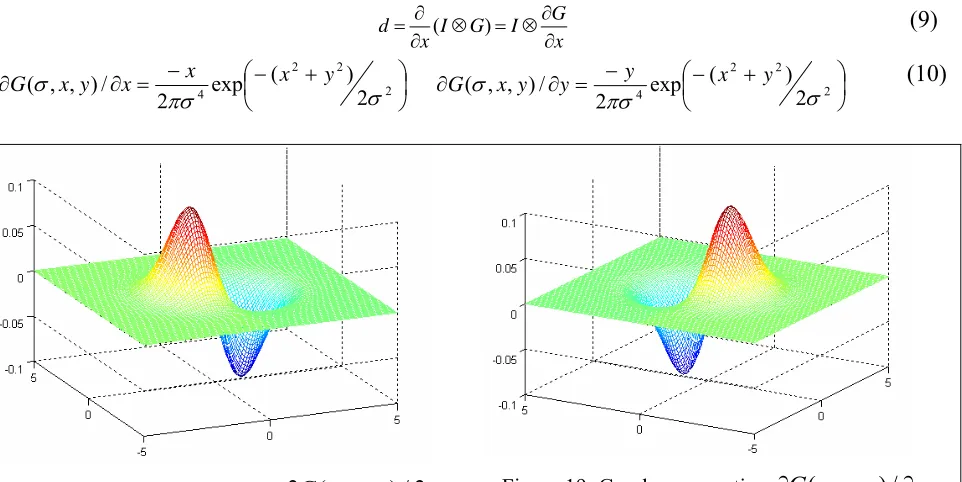
Figure 18: Graph representing∂G(
σ
,x,y)/∂x... 22Figure 19: Graph representing ∂G(σ,x,y)/∂y ... 22
Figure 20: Cross-section of the ∂G(σ,x,y)/∂xat a plane y = 0 with σ = 1... 24
Figure 21: A 20x scaled 7 point approximation of ∂G(1,x,0)/∂x... 24
Figure 23: A 20x scaled 49(7x7) point approximation of ∂G(1,x,y)/∂x... 25
Figure 24: Top view images I(x, y) with their corresponding edge maps E(x, y)... 26
Figure 25: HPF results with synthetic edge maps... 30
Figure 26: Figures showing the result of HPF planner – Region to Point guidance function. ... 31
Figure 27: HPF gradient image enlarged explaining the concept of discrete look-ahead distance. 33 Figure 28: iSpace workspace images showing the effect of different values of look-ahead distance chosen ... 33
Figure 29: Distance error increases and total time to reach the goal decreases with increase in δL. ... 34
Figure 30: Template matching and Edge detection outputs for the same workspace image... 37
Figure 31: Behavioral comparison between “path tracking” and “goal seeking” problem ... 40
Figure 32.Complete flow diagram of the new system. ... 43
Figure 33: Actual workspace images and the graph of distance error as a function of time. ... 45
Figure 34: Actual Network delay... 46
Figure 35: Mean Median and Max distance error as a function network delay for HPF planner. .. 47
Figure 36: Left – HPF planner and Right – fast marching planner for same grid size... 47
Figure 37: Maximum and mean distance error vs. network delay comparing fast marching and HPF planner... 47
Figure 38: Total time vs. network delay comparing fast marching and HPF. ... 48
Figure 39: Navigation results with network delay = 1.1 s and look-ahead distance = 0.4 m. ... 48
CHAPTER I
– Introduction
For many years now, data networking technologies have been widely applied in the control of
industrial and military applications [1]. These applications include manufacturing plants,
automobiles, and aircrafts. Connecting the control system components in these applications, such
as sensors, controllers, and actuators, via a network can effectively reduce the complexity of the
systems with nominal economical investments. Furthermore, the applications connected through a
network can be remotely controlled from a long-distance source. A Network based Integrated
Navigation System presented here is one subset of the whole genre of Network Based Systems. It
has different modules combined together to guide a UGV (Unmanned Ground Vehicle) from one
point to another in the space of interest (ℜ2), where the navigational intelligence lies on a main
controller away from the UGV. Having a remotely controlled integrated navigation system; where
the data processing, and controller module are at a central location (network controller) driving all
the UGVs has many different advantages over a system with autonomous UGVs. Network
controllers allow data to be efficiently shared. It is easy to fuse the global information to take
intelligent decisions over a large physical space. It is easy to add more sensors and UGVs with
very little cost and without heavy structural changes to the whole system. And most importantly,
they connect cyber space to physical space making task execution from a distance easily accessible
(a form of tele-presence). These systems are becoming more realizable today and have a lot of
potential applications such as manufacturing plant monitoring, nursing homes or hospitals and
tele-robotics & tele-operation etc. Fusing the global information to make intelligent decisions or to
perform a particular task requires integration of different modules like data acquisition, data
independently yet together making it one system. Therefore, a few of the issues faced by a network
based navigation systems are network delay, processing delay, data sharing and data transfer. Thus
it is evident that to improve the efficiency of a network based integrated system; we not only have
to improve each integrated module but also focus on the efficient data interface between different
modules. This is one of the main points of emphasis in the research presented here.
We deal with a prototype of Intelligent Space (iSpace) as a network based integrated
navigation system as the research platform here. iSpace in ADAC lab at North Carolina State
University is a closed-loop system consisting of different modules like image processing,
automation control, communication and networking for navigation of a differential drive UGV in a
2-D space of interest (ℜ2) as shown (Figure 1). Currently, iSpace in ADAC lab is implemented
using three basic modules: (i) A template matching-based vision system to recognize the contents
of the environment, the UGV and their configurations [42] (ii) A planning module for computing
the optimal, obstacle-free, reference path for the UGV using the fast marching method (gradient
decent algorithm) [45] [44] (iii) A quadratic curve fitting path tracking module that uses the
sequence of control commands generated by the main network controller after compensating for
time delay in the closed-loop navigational system [37][41]. There are several challenges facing the
reliable operation of the above system. Different delays are the main issues related to any
network-based integrated control system. In iSpace, delays such as
1. Network (data flow) delay – Image data from camera to the controller, Command data from
controller to robot.
2. Processing or computational delay – Image processing using template matching, Path
restricted to a specific case of environment, where all the obstacles in the workspace need to have
a pre-decided template on them. This restricts the workspace flexibility. Once the path is generated
using fast marching method, the problem is converted to a path tracking problem. Therefore, the
same path has to be tracked irrespective of how far off the UGV wanders away from that reference
path in the due course of movement because of the network delay. This may not be always an
intelligent decision considering path and time optimality.
Figure 1: Structural flow diagram for iSpace
We mainly focus on the image processing and the path planning part of the integrated
navigation system to develop a more efficient, more generic structure for iSpace in ADAC lab.
Instead of template matching, we use edge detection to extract the contents of the workspace. This
helps the system to be more generic in terms of obstacle map. Edge detection is also more efficient
in computational complexity than template matching. We also replace the Fast marching method
by Harmonic Potential field (HPF) [3][7] to generate the guidance directions for path planning.
problem; so UGV can be driven to the chosen goal from any point in the workspace, which also
makes it compatible with the network based controller giving the effect of smaller real time
computational delay. Although the marriage between the edge detection and HPF-based planner as
well as the marriage between HPF based planner and the quadratic path tracking controller are the
only modules in an interconnected structure, they simultaneously satisfy several important features
that are central to the integration of the system. Here we emphasize on the compatibility between
the different modules of the new system. This compatibility makes it possible for a module to
directly accept the output from another module without any conditioning required, hence
significantly reducing the processing delay and the chance of inter-module conflict. We believe
that creating a homogenous structure by putting edge detection, HPF planner and quadratic curve
fitting path tracking controller - three heterogeneous systems together for the first time to create a
network based system is the novel contribution to the network based integrated navigation system
area. These features and ones possessed by the other modules are discussed in later chapters
elaborating the advantages in the quantifiable performance measure. We believe that these criteria
are the key to building a system that will behave in the desired manner. Chapter II talks about the
functional and algorithmic details of the system under consideration – iSpace – as a network based
integrated navigation system, the features and functionalities of different integrated modules,
disadvantages and restrictions of the current system, and scope of improvement. Chapter III
explains the new structure and the component details. Chapter IV elaborates its advantages over
the previous structure as individual modules as well as the successful integration of the complete
system and advantages over the previous integrated system and eventually the enhancements
accomplished as a delay tolerant structure of network based integrated navigation system. Finally,
CHAPTER II
– Introduction to iSpace as a
Network based Integrated Navigation system
The network based integrated navigation system considered as a research platform – iSpace –
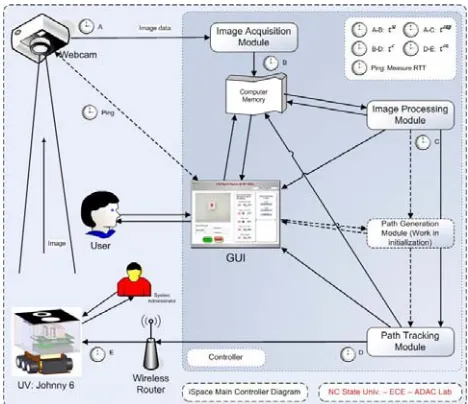
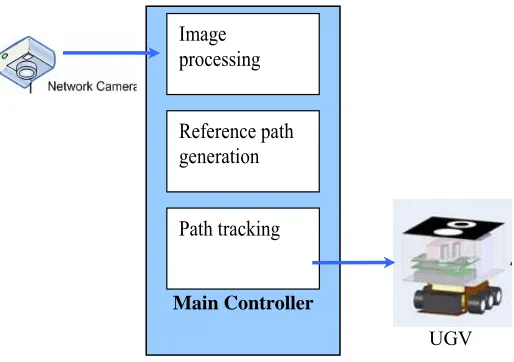
[42] has the following components (as shown in Figure 1 and Figure 2):
2. 1
Different components in iSpace
UGV
Image processing
Reference path generation
Path tracking
Main Controller
Figure 2: iSpace block diagram
(i) An overhead network camera is used as a global sensor. The web camera collects the
top-view image of the 2-D space of interest and sends to the main controller for processing.
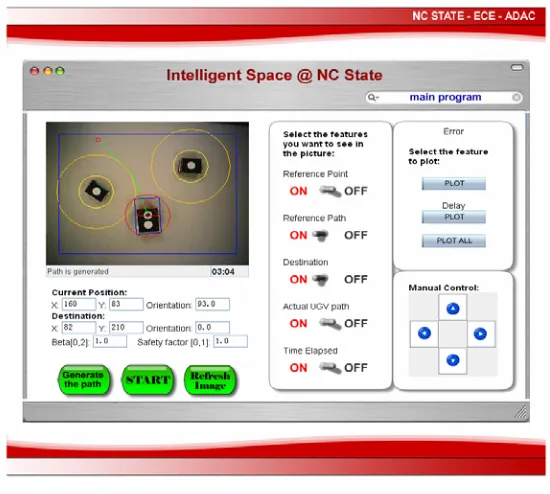
(ii) Network controller with graphical user interface (GUI) (Figure 3), which can be on any
remote computing interface in the world having the access to internet. The main network
controller is connected to the global sensor – network camera and the actuator – the UGV –
in the space of interest through a wireless channel. All the functional modules and
space from the network camera and take the decision to be conveyed to the UGV in the
space in the form of a mobility command. (Figure 2). All the algorithms on the main
controller are explained in detail further in Chapter II.
Figure 3: The graphical user interface on the internet
(iii) A differential drive UGV is the actuator / navigator in iSpace.
1
2 1
2 W
r r
W
r r
r
l
ω ν
ω = − ω
⎛ ⎞
⎛ ⎞ ⎛ ⎞
⎜ ⎟
⎜ ⎟ ⎜ ⎟
⎜ ⎟ ⎜ ⎟⎝ ⎠
⎝ ⎠ ⎝ ⎠ (1)
Eq(1) is a principle equation defining the
motion of a differential drive UGV. ν is the
linear velocity of the UGV, ω is the angular
velocity of the UGV, r is the radius of the wheel, W is the distance between 2 wheels of the
UGV and ωr, ωlare the right and left wheel angular velocities respectively. The UGV does
L
ω
R
ω
v
ω
W r
L
not have any local sensors on board. It only receives commands from the main controller
with the velocity ν and the turn-rate ω to initiate the movement to reach the destination
point specified by the user through the GUI. The UGV has a small program module
implementing the Eq(1) to calculate left ωl, and right wheel ωr speed from ν and ω and
drive the motors using the pulse width modulation. Thus, the feedback to the main
controller is the global information only from the network camera.
Let us see the different delay components at different stages of the system that this structure
has to deal with. Their definitions and significance for a network based integrated navigation
system is explained as follows.
(i) Network delay component ( k
NetworkDelay
τ )
a.Sensor to controller delay (τksc) - The time between the main controller requests the camera
for the image (Image acquisition delay ( )) and it is captured and saved on the
memory of the controller. Therefore we can say
k
imageacq τ
2
k
k k
RTT imageacq
sc τ
τ =τ + ⎜⎜⎛ ⎞
⎝ ⎠⎟⎟, where k
RTT
τ is the
round trip network time.
b.Controller to actuator delay ( k
ca
τ ) – This is the time for the reference command takes to
reach from the main controller to the UGV k 2 k
RTT ca τ τ =
(ii)Processing or computational delay component ( k )
ComputationalDelay τ
a. Non-real time Computational delay ( ) – It consists of the initial image processing time,
path generation and the system processing time.
kNRc
τ
k k k k
imeprocess pathgen sysprocess NRc
b. Real time Computational delay (τkRc) – This is the time for the main controller to execute
the control algorithm. i.e. the consecutive iterations of image processing and path tracking
algorithm. So if the loop runs for n times before the UGV reaches the destination.
(
_ _)
k k k k
imeprocess r pathtrack sysprocess r
Rc n
τ = ⋅ τ +τ +τ
k
NetworkDelay
τ is more random in nature than the computational time delay .
Therefore there are other stochastic and predictive methods used to deal with
k
ComputationalDelay
τ
k
NetworkDelay
τ . But we
can reduce by adopting faster and computationally more efficient algorithms on
the main controller. We clearly observe that reducing the real-time computational time
k
ComputationalDelay
τ
kRc
τ by
factor of k will reduce the total time to reach the destination by the factor of (n.k).
Let us also have insight in the functional features provided by algorithms implemented
previously in iSpace to study the restrictions and disadvantages to be taken care of to develop more
generic, efficient and delay tolerant network navigation system.
2. 2
Template matching for content recognition
Template matching is used to extract the information from the network camera image to know
the location of the obstacles, location and orientation of the UGV in the workspace. Let h(fA(i,j),fB)
be a function that computes the measure indicating the matching level between the template image
f
B
BB and the sub-image, fA
(i,j); where f
B and fB A
(i,j) are the transformed black and white images as
shown in Figure 4
(
)
2( , ) ( , )
( i j , ) 1 i j
A B A B
j i
h f f f f
⎛ ⎞
⎜
= − −
⎜⎜
⎝ ⎠
∑ ∑
⎟Figure 4: iSpace workspace image and templates for Template matching
Front
Back d
r
fB B C
Orientation of UGV
Figure 5: Finding the orientation of the UGV.
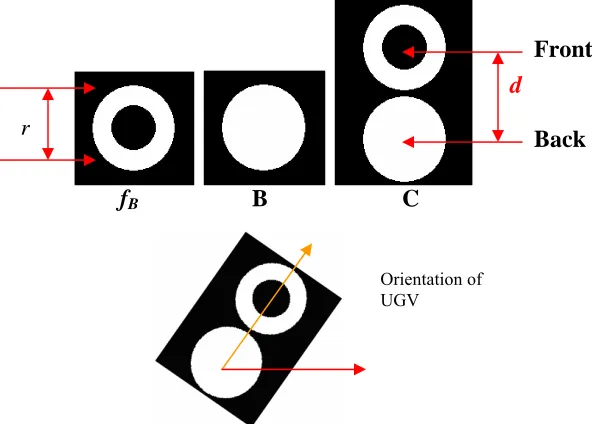
The obstacles in iSpace are recognized by the template of solid circles (image B in Figure 5)
and the two concentric circles are used as template for the front of the UGV. However the single
template image (fB) is used to recognize different circles with different matching scores. (Figure 4
and Figure 5). We can apply Eq(2) to find out the maximum matching location irrespective of the
orientation of the UGV and the obstacles in the top-view space-image. The matching scores will be
in descending order as shown in Figure 4 – Highest for UGV front, medium for obstacles and
UGV back and low for any other shape existing in the workspace. Circular templates are used
once the coordinates of front and back of the UGV are obtained from template matching using
Eq(3). Where θ is the orientation angle of UGV, (xf, yf) and (xb, yb) are the co-ordinates of UGV
front and back respectively.
1
tan b f
b f
y y
x x
θ = − ⎛⎜⎜ − ⎞ −
⎝ ⎟⎟⎠ (3)
The camera is kept at a known constant height h over the workspace; therefore it captures the
constant and predetermined area (xa x ya) of the workspace in an image of known resolution of (m
x n). The size of the template on the top of the UGV and the obstacles are also kept constant
allowing to use a template image with a fixed resolution (mtemp x ntemp). The template image fB is
(20x20) size. i.e. no zoom factor is considered. Thus the main controller does not have any
information about the size of the obstacle. Therefore, it draws a circular safety margin of radius
r
B
safe around the obstacle. Area under the safety margin is considered the part of the obstacle by the
path planning module. Details about the template matching algorithm implemented in iSpace can
be gathered from [42].
2. 3
Limitations of Template matching approach for Network based
Navigation System
The obstacles recognized by the template matching have to be a part of a priori set of obstacles
with predefined size, shape and with predefined templates on them. Thus, the controller has no
way to extract the information about the actual size and shape of the obstacles or boundary of the
obstacles. The only information the controller has is their location (co-ordinates) in the workspace.
However, to successfully avoid an obstacle keeping the path optimality, the network controller
should have the knowledge about the actual boundaries or the radius of all the obstacles in the
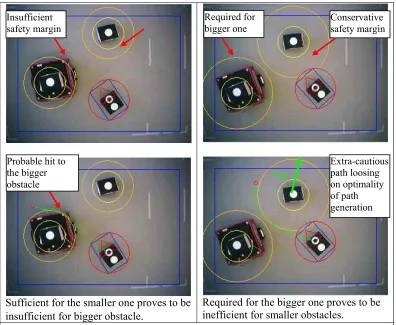
might prove conservative for small obstacles loosing the efficiency on the optimal path generation
and at the same time might prove insufficient for large obstacles increasing the probability of
hitting an obstacle as evident from Figure 6. All these make the system restricted to operate in only
a few environmental patterns.
Sufficient for the smaller one proves to be insufficient for bigger obstacle.
Required for the bigger one proves to be inefficient for smaller obstacles.
Insufficient safety margin
Probable hit to the bigger obstacle
Conservative safety margin
Extra-cautious path loosing on optimality of path generation Required for
bigger one
rsafe
Figure 6: Explaining the restrictive assumptions by template matching about the size of the obstacles.
(Yellow circle around the obstacles represent the safety margin and green line from the robot to the red dot is the path drawn avoiding the obstacles considering the safety
margin.)
2. 4
Path planning using fast marching method
The input to the path generation modules is the position and orientation of the UGV (xu, yu, θu)
and obstacles’ positions from the result of the template matching module, UGV’s destination (xd,
series of points from the initial UGV position to the destination without colliding with the
obstacles. A Dijkstra-like method named the fast marching method was applied to solve the
optimal path generation problem. The fast marching algorithm is explained in brief below in
Figure 7. To find a path from A to B, let a front expand from A in all directions (a growing circle
around A in this scenario, Figure 7). Once the front touches B, we can find the shortest path by
starting at B and proceeding backwards along the path that is always perpendicular to the
expanding front as shown in Figure 7.
Figure 7: Path planning in iSpace A
B
Obstacle
UGV
20pixel
320pixel
240pixel
Platform Area
1. With Obstacles 2. Expand front around A 3. Trace back to find path
Alive
Trial
Close
Destination
Far Obstacles Far
Figure 9: Path planning using fast marching method avoiding the obstacles. Extended detail can be found in Sethian [44][45].
2. 5
Path tracking controller
Once the optimal path is generated, the mobile robot is commanded to follow this path to the
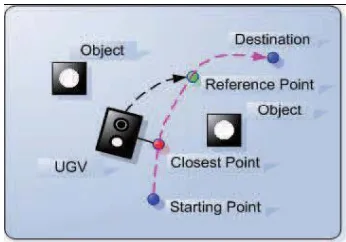
destination. This is accomplished by approaching a sequence of reference points generated on the
desired path following a quadratic curve, as shown in Figure 8. This reference point is set at a
distance (d0) ahead from the UGV current position and closer to the destination along the path.
Appropriate speed (v, in cm/s) and turn rate (ω, in rad/s) of the mobile robot is determined once the
coefficients of this quadric curve is calculated based on the error vector (ex, ey, eθ) as described in
[37] [40]. We will again come back to this quadratic curve fitting path tracking algorithm in
Chapter III.
2. 6
Limitations of path planning method in the network based navigation
system
Thus the navigation problem is looked upon as a path tracking problem and therefore the
reference path generation is mandatory. The path tracking controller is always trying to keep the
UGV on the reference path by calculating the reference points along the path irrespective of the
UGV’s current position and distance from the reference path. If we observe, we find that the only
input path tracking controller requires is the current co-ordinates of the UGV (xc, yc,θc) and the
reference point co-ordinates (xref, yref). In each control loop iteration, the path tracking controller
has to look up the complete reference path [(x1, y1), (x2, y2), (x3, y3),…, (xn, yn)] to determine the
closest point and calculate the reference point depending upon the curvature of the path. Instead of
generating the reference path, if we are successful in calculating the reference co-ordinates for
each point in the workspace with the same or less amount of calculation than the fast marching
method, it will also automatically cut down on the real time calculation time for searching of the
reference point in the control loop.
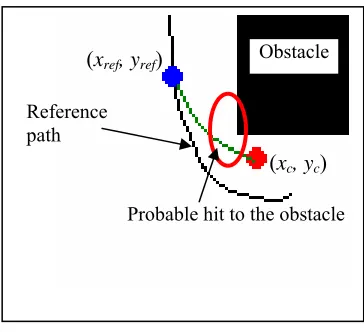
Another point of consideration is, this being a network based system, the UGV might wander
off from the path in due course of movement due to network delay. In such case, it might prove
optimal and efficient for the UGV to go the next reference position which might not lie on the
previously calculated reference path. This is explained from the Figure 9. This creates a
requirement for each point in space to have an optimal reference point toward the destination
Reference path
(xref, yref)
Probable hit to the obstacle Obstacle
(xc, yc)
Figure 11: Figure explaining the disadvantage of going for a fixed reference path
2. 7
GSM for Network delay compensation
For the network delay compensation, iSpace uses the Gain Scheduler middleware technique
introduced by Chow and Tipsuwan [41]. GSM methodology uses middleware to modify the output
of an existing controller based on a gain scheduling algorithm with respect to the current network
traffic conditions. The overall GSM operations for networked control and tele-operation can be
summarized as follows [39][40][41].
1. The feedback preprocessor waits for the feedback data from the remote system. Once the
feedback data arrives, the preprocessor processes it using the current values of network
variables and passes the preprocessed data to the controller.
2. The controller computes the control signals and sends them to the gain scheduler.
3. The gain scheduler modifies the controller output based on the current values of network
variables and sends the updated control signals to the remote system.
Thus, GSM takes care of network delay compensation satisfactorily.
Thus we can say that the delay tolerance, efficiency, accuracy, generality and optimality of
iSpace depend upon the following factors. (i) The image processing algorithm should be fast,
The output of this module should also be compatible enough with the path planning algorithm for
efficient computing time. (ii) The path planning algorithm will decide the optimality and length of
the path generated and thus probability to hit an obstacle. (iii) The time required to track that path
will also be a function of length of the path generated and the efficiency of the path tracking
algorithm. After discussing the scope of the improvement in the current iSpace, we replace the
template matching and the fast marching path planning algorithm with edge detection and
harmonic potential path planner respectively. The details of this new structure with individual
modules as the part of an efficient integrated navigation systems against the previous systems are
CHAPTER III
– New Structure of iSpace
After discussing the current setup of iSpace as a network based integrated navigation system,
and the scope of improvement, this chapter explains the new structure and the component details
for iSpace. We use edge detection instead of template matching and harmonic potential field
functions for path planning replacing the fast marching method.
3. 1
Edge detection to extract the contents of the iSpace environment
Edge detection is a classic early vision tool to extract discontinuities from the image as features.
Thus all the discontinuities which are more or less obstacle boundaries will be represented by
binary edges in the edge detected image of the UGV workspace [30][29]. We call the edge
detected image of the workspace as an “Edge map”. Before explaining the mathematical and
functional properties of the edge detection, Figure 8 explains the effect of taking the first and
second derivative of a 1-D function. We can observe that the magnitude of the first derivative
(magnitude of the gradient) can be used for detecting the presence of the edge in an image and the
sign of the second derivative can be used to determine whether an edge pixel lies on the dark or
light side of the edge, in brief it can be used to find out the direction of the gradient. Thus zero
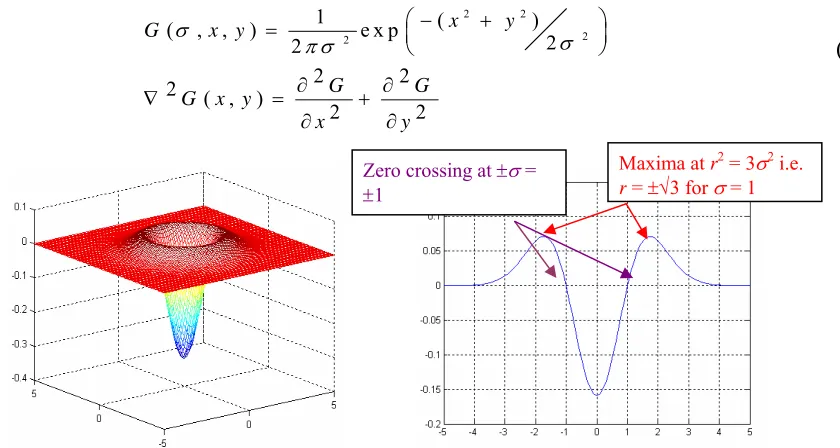
Therefore, the edge detector we use has two branches. One branch processes the workspace
image I with a circularly symmetric approximated Laplacian of 2-D Gaussian (LoG) operator to
find out the second derivative of the image which will be used to find out the zero crossings in the
image as the potential edges.
2 2
2 2
1 ( )
( , , ) e x p
2 2
2 2
2 ( , )
2 2
x y
G x y
G G
G x y
x y
σ σ
π σ
⎛ − + ⎞
= ⎜ ⎟
⎝ ⎠
∂ ∂
∇ = +
∂ ∂
Profile of a horizontal line (For e.g. Cross section of an image) First derivative gives high magnitude at the edges. Threshoding will leave out the edges. Second derivative gives the directional gradient of the edges and their potential locations
Figure 12 : Explaining the significance of the first and second derivative (This is for a 1-D cross section of an image)
(4)
Maxima at r2 = 3σ2 i.e.
r= ±√3 for σ = 1
Zero crossing at ±σ =
±1
Figure 14: ∇2G(σ,r)versus r with σ = 1
Figure 13: 3-D plot of 2 ( , , )at σ = 1 y
Let r2 = x2 + y2 Thus Laplacian of G(σ, r) with respect to r is given in Eq(5).
(
)
(
)
2 exp 2 1 2 2 4 2 2 2 2 σ σ σπσ r r
G ⎟ −
⎠ ⎞ ⎜ ⎝ ⎛ − =
∇ (5)
The Figure 12shows the cross-section of the circularly symmetric function representing
as expressed in Eq(5). From Eq(5), we have, = 0 at r
) , , ( 2 y x Gσ ∇ ) , ( 2 r Gσ
∇ ∇2G(σ,r) 2 = σ2. We also observe
that from Figure 12 thatthe zero crossing is at r = ±σ
i.e. x2+y2=σ2 (6)
Eq(6) is the equation of the circle in the plane z = 0 (radius σ and center at (0, 0)) passing through
all the zero-crossing point. To form the approximate 7 x 7 kernel representing the circularly
symmetric LoG, we sample at (x, y) = (-3, -3) to (3, 3). To find out the value of r at which
the LoG attains its maxima, we equate the third derivative ∇
) , (
2Gσ r
∇
3G(σ ,r) to zero .
(
)
3 0 2 exp 2 2 1 0 ) , ( 2 2 2 2 2 2 2 2 6 3 σ σ σ σ σ πσ σ = ∴ = − ⎟⎟ ⎠ ⎞ ⎜⎜ ⎝ ⎛ + − ∴ = ∇ r r r r GThus, maxima is attained at r2 = 3σ2 (Figure 12). Therefore, to have maxima at r = 2 i.e. second neighboring pixel from the center pixel, r = 2 ∴σ = ±2/√3. We sample the circularly symmetric
LoG and get the following discrete approximation as 7 x 7 kernel.
However, we know that elements of the kernel should sum up to zero because they are the
discrete representation of Laplacian of Gaussian Eq(5) whose average value is zero. (Proof below -
Integration from – ∞ to +∞ is zero).
(
)
(
)
( ) (
)
0 2 exp 2 1 2 exp 2 1 2 2 2 2 2 2 2 4 2 2 2 2 = ⎥⎦ ⎤ ⎢⎣ ⎡ − − = − ⎟ ⎠ ⎞ ⎜ ⎝ ⎛ − = ∇ ∞ ∞ − ∞ −∞ = ∞ −∞ =∫
∫
σ σ πσ σ σ σ πσ r r dr r r dr G r rAnd if the sum of elements is not zero, after convolving the kernel with the image (I), the
brightness factor will not be maintained, it will however be shifted with a factor of the sum of the
elements. This is more important for iterative algorithms and can be ok for convolving once as we
do in case of this edge detection. But for a good practice, we adjust the elements by subtracting the
sum from each element such that their sum is zero.
LoG =
0.0363 0.1181 0.2438 0.3032 0.2438 0.1181 0.0363 0.1181 0.3687 0.4927 0.4117 0.4927 0.3687 0.1181 0.2438 0.4927 -0.4107 -1.5261 -0.4107 0.4927 0.2438 0.3032 0.4117 -1.5261 -3.5688 -1.5261 0.4117 0.3032 0.2438 0.4927 -0.4107 -1.5261 -0.4107 0.4927 0.2438 0.1181 0.3687 0.4927 0.4117 0.4927 0.3687 0.1181 0.0363 0.1181 0.2438 0.3032 0.2438 0.1181 0.0363
⎡ ⎤ ⎢ ⎥ ⎢ ⎥ ⎢ ⎥ ⎢ ⎥ ⎢ ⎥ ⎢ ⎥ ⎢ ⎥ ⎢ ⎥ ⎢ ⎥ ⎣ ⎦ LoG
I = ⊗I LoG
The zero crossing contours from this operator are taken as the candidate edges. Such a map is
extremely noisy and practically useless as shown in Figure 13 unless the contours corresponding to
Figure 15: workspace image I and its zero crossing contour for I⊗ ∇2G
The filtering adopted here is based on the strength of the edge, i.e. its contrast. Therefore, the
second branch for the edge detection block is an approximated first derivative gradient operator of
2-D Gaussian function with x-direction and y-direction mean (μx and μy) as zero (Eq 4). It is used
to produce an estimate of the contrasts. The 2-D Gaussian function is shown in (4) where σ is the standard deviation deciding the spread of the bell curve shown in Figure 14.
.
2 2
2 2
( , )
1 ( )
( , , ) exp
2 2
T
G G
G x y
x y
x y
G σ x y σ
πσ
⎡∂ ∂ ⎤
∇ = ⎢ ⎥
∂ ∂
⎣ ⎦
⎛− + ⎞
= ⎜ ⎟
⎝ ⎠
(7)
(8)
Image
I
Laplacian of
Gaussian ∇
2G
Gradient of
Gaussian ∇G
Zero Crossing
Magnitude
Threshold
(C)
Edge
Map
E
Figure 17: Complete edge detector block diagram
Applying the first derivative Gaussian to the image is equivalent to first blurring the image
with a kernel bigger in the middle and then differentiating to get the gradient as shown in
Eq(9)[28]. If the contrast of an edge is above a certain threshold, the edge is accepted as authentic;
otherwise it is rejected as noise. This is introducing low-pass filtering which should to some extent
suppress the effect of wideband noise from the edge map removing the false edges.
( ) G
d I G I
x x ∂ ∂ = ⊗ = ⊗ ∂ ∂ ⎟ ⎠ ⎞ ⎜ ⎝ ⎛− + − = ∂ ∂ 2 2 2 4 2 ) ( exp 2 / ) , , ( σ πσ
σ x x y
x y x G 2 ) ( exp 2 / ) , , ( 2 2 2
4 ⎟⎠
⎞ ⎜ ⎝ ⎛− + − = ∂ ∂ σ πσ
σ x y y y x y
G
(9)
(10)
Figure 19: Graph representing ∂G(σ,x,y)/∂y Figure 18: Graph representing∂G(
σ
,x,y)/∂xI(x, y) is the original grey-scale image from the network camera. The first derivative with
respect to x, IGx(x, y) and with respect to y, IGy(x, y) of I(x, y) is thus obtained by using Eq(11) and
Eq (12).
( , , )
( , ) ( , )
Gx
G x y
I x y I x y
x σ ∂
= ⊗
∂ (11)
Gy( , ) ( , ) ( , , )
G x y
I x y I x y
y σ ∂
= ⊗
∂ (12)
To form the 7x7 approximated kernels representing ∂G(
σ
,x,y)/∂x and∂
G
(
σ
,
x
,
y
)
/
∂
y
, let us sample the 2-D curves shown in (Figure 16andFigure 17) at x = -3, -2, -1, 0, 1, 2, 3 and y = -3, -2,-1, 0, 1, 2, 3 forming a sampling distance Δs = 1 as shown in Table 1. Here sampling values of x
and y represent the position of the pixel relative to the center pixel with x = 0 and y = 0 at which
the kernel is applied to find the gradient at that point.
Table 1: Sampling ticks with Δs = 1 to form 7x7 approximated kernel for ∂G(σ,x,y)/∂x and y
y x
G ∂
∂ (σ, , )/ at σ= 1
(-3, -3) (-2, -3) (-1, -3) (0, -3) (1, -3) (2, -3) (3, -3)
(-3, -2) (-2, -2) (-1, -2) (0, -2) (1, -2) (2, -2) (3, -2)
(-3, -1) (-2, -1) (-1, -1) (0, -1) (1, -1) (2, -1) (3, -1)
(-3, 0) (-2, 0) (-1, 0) (0, 0) (1, 0) (2, 0) (3, 0)
… … …
… … …
… … … (3, 3)
As mentioned before σ will decide the spread of the bell curve over the 7x7 = 49 pixels. Let us
forth row of the kernel. The immediate neighbors of the center pixel (0, 0) in the x-direction i.e. at
(-1, 0) and (1, 0), should have the maximum weight in the kernel considering the intuitive
assumption that immediate neighboring pixels have more contribution in deciding the edge
presence at any pixel and therefore sampled value of ∂G(σ,x,y)/∂x should be maximum at x = 1
and -1. We find out the value of σ where the value of first derivative ∂G(σ,x,y)/∂xattains its
maximum at (-1, 0) and (1, 0) by equating the second derivative 2 ( ,1,0)/ 2 to zero. x G ∂ ∂ σ
( )
1 at 0 / ) 0 , 1 , ( 2 1 exp 2 1 2 1 / ) 0 , 1 , ( 2 ) ( exp 2 1 2 / ) , , ( 2 2 2 4 6 2 2 2 2 2 2 4 6 2 2 2 = = ∂ ∂ ∴ − ⎟⎟ ⎠ ⎞ ⎜⎜ ⎝ ⎛ − = ∂ ∂ ⎟ ⎠ ⎞ ⎜ ⎝ ⎛− + ⎟⎟ ⎠ ⎞ ⎜⎜ ⎝ ⎛ − = ∂ ∂ σ σ σ πσ πσ σ σ πσ πσ σ x G x G y x x x y x GTherefore we have the maxima of the absolute value of the first gradient of the Gaussian in the
x-direction at σ = 1, as confirmed by the Figure 18
Figure 20: Cross-section of the ∂G(σ,x,y)/∂xat a
plane y = 0 withσ = 1
Figure 21: A 20x scaled 7 point approximation of
x x
G ∂
∂ (1, ,0)/
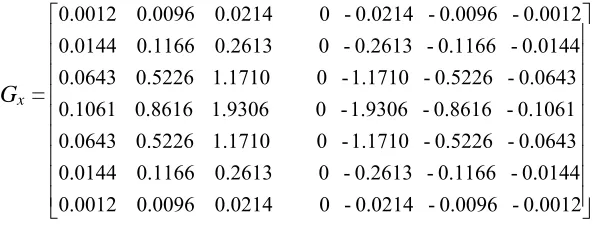
The 7 x 7 kernel Gx approximating the first derivative of 2-D Gaussian with respect to x at σ = 1 is
Gx = ⎥ ⎥ ⎥ ⎥ ⎥ ⎥ ⎥ ⎥ ⎥ ⎦ ⎤ ⎢ ⎢ ⎢ ⎢ ⎢ ⎢ ⎢ ⎢ ⎢ ⎣ ⎡ 0.0012 0.0096 0.0214 0 0.0214 0.0096 0.0012 0.0144 0.1166 0.2613 0 0.2613 0.1166 0.0144 0.0643 0.5226 1.1710 0 1.1710 0.5226 0.0643 0.1061 0.8616 1.9306 0 1.9306 0.8616 0.1061 0.0643 0.5226 1.1710 0 1.1710 0.5226 0.0643 0.0144 0.1166 0.2613 0 0.2613 0.1166 0.0144 0.0012 0.0096 0.0214 0 0.0214 0.0096 0.0012
Similarly, the gradient in y-direction Gy approximating
∂
G
(
1
,
x
,
y
)
/
∂
y
can be directly written astranspose of the Gx
Gy =
⎥ ⎥ ⎥ ⎥ ⎥ ⎥ ⎥ ⎥ ⎥ ⎦ ⎤ ⎢ ⎢ ⎢ ⎢ ⎢ ⎢ ⎢ ⎢ ⎢ ⎣ ⎡ 0.0012 0.0144 0.0643 0.1061 0.0643 0.0144 0.0012 -0.0096 0.1166 0.5226 0.8616 0.5226 0.1166 0.0096 -0.0214 0.2613 1.1710 1.9306 1.1710 0.2613 0.0214 -0 0 0 0 0 0 0 0.0214 0.2613 1.1710 1.9306 1.1710 0.2613 0.0214 0.0096 0.1166 0.5226 0.8616 0.5226 0.1166 0.0096 0.0012 0.0144 0.0643 0.1061 0.0643 0.0144 0.0012
Figure 22: ∂G(1,x,y)/∂x Figure 23: A 20x scaled 49(7x7) point approximation of ∂G(1,x,y)/∂x
3. 2
Results of edge detection
Figure 22 shows a few sample images from the actual iSpace setup in ADAC lab with different
environment such as textured background in Example 5 and Example 6, cluttered with many
obstacles in Example 2 and Example 6 and their corresponding Edge maps. The edge maps can be
E(xi, yj) = 1 if (xi, yj) ∈ΩB B
= 0 if (xi, yj) ∉ΩB for all (i, j)
Where E(x, y) is the image representing the edge map and ΩB is the set of edge points
including the boundary points for all obstacles in workspace.
Figure 24: Top view images I(x, y) with their corresponding edge maps E(x, y).
Approximation of the 2-D waveforms to form kernel is learnt from Snyder, Qi [28]
3. 3
2-D HPF planner for path planning
The Harmonic function on a domain Ω ⊂ ℜ2 is a function which satisfies the following
Laplace equation – Eq(14).
(13)
(14)
Example 1 Example 2 Example 3
Example 4 Example 5 Example 6
0 2 2 2 2
2 = + =
y x h
δ φ δ δ
φ δ φ
The use of potential field in motion planning was introduced by Khatib [2]. The obstacles were
represented by the repelling force and the point of destination was represented by the attractive
force. Unfortunately, the setting Khatib suggested suffered from a deadlock problem known as the
local minima problem. Laplace as a harmonic function was proposed by Connolly et al. [3][5] to
local minima may be intuitively demonstrated by considering the two-dimensional version of
Laplace’s Equation. Consider the two curves which are the x and y cross-sections of φ at some
point p0. If the second derivatives of φ are individually not zero at p0, then two curves in question
must have second derivatives of opposite sign forφ to satisfy Eq(14) . Assuming that φ∈C2, this
implies that one curve must be concave upward and the other must be concave downward. Thus
we have that either φ is planar at p0, or that there is a direction outward from p0 in which φ
decreases, and another in which φ increases. Therefore, in any open region where Laplace’s
equation holds, local extrema of φ cannot exist. More formally, if a function φ satisfies Laplace’s
equation on some region Ω ⊂ ℜn, then any critical points of the function in the interior of that
region must be saddle points, since local extrema of the function are not possible there. If the
effector reaches a saddle point, and it is not near the goal, then there must be a way out. This exit
from this critical point may be found by performing a search in the neighborhood of the critical
point. In this context the path from the source to the destination consists of these saddle points.
Here, we use HPF in Dirichlet’s settings. With these settings, obstacles are raised to a constant
high potential and while goal regions are kept at low potential as explained in Eq(15). The
resulting potential is then constrained by ∇2φ = 0. With this manner the gradient of φ is aligned
with the surface normal of the obstacles and thus driving the UGV away from obstacles.
2
T T
( , ) 0 , Ω
subject to
( , ) 1 , Γ
and ( , ) 0 ( , ) ( , )
∇ ≡ ∈
= ∈
= =
x y x y
x y x y
x y x y x
φ φ
φ
(15)
where∇2is the Laplace operator, Ω is the workspace of the UGV (Ω ⊂ ℜ2), Γ is the boundary
of the obstacles, and(xT,yT)is the target point. The obstacle free path to the target is generated by
traversing the negative gradient of( )φ i.e. (−∇φ).
Numerical solutions for the Laplace’s equation are readily obtained from the Finite Difference
Method. Let φ (x, y) be a function which satisfies Laplace equation and let u(xi, yi) represents
discrete regular sampling of the φ on a grid. A central difference formula for the second
derivatives of φ can be derived using Taylor’s series. Higher order terms are neglected. [3]
2
1 1
2
2
1 1
2
( , ) 2 ( , ) ( , ) ( , )
( , )
12
( , ) 2 ( , ) ( , ) ( , )
( , )
12
i j i j i j xxxx i j
xx i j
i j i j i j yyyy i j
yy i j
u x y u x y u x y h u y
x y
h
u x y u x y u x y k u x
x y
k
ξ φ
η φ
+ −
+ −
− +
= −
− +
= −
The fourth order terms can be neglected being very small. h and k are the step size in x and y
direction respectively. Assuming h = k = 1, we can write
2
1 1 1 1
( ,i j) ( i , j) ( i , j) ( ,i j ) ( ,i j ) 4 ( ,i j)
h φ x y =u x + y +u x − y +u x y + +u x y − − u x y
For φ(x, y) to satisfy the Laplace equationh2φ( ,xi yj) 0= , we
1 1 1 1
( , ) ( , ) ( , ) ( ,
( , )
4
i j i j i j i j
i j
u x y u x y u x y u x y
u x y = + + − + + + − ) (16)
Thus with Laplace equation, this method simply consists of repeatedly replacing each grid points
with the average of its neighbors using successive relaxation. Terminate when the array u contains
a sampling φof where every non-boundary condition node has a neighbor with a smaller value
3. 4
HPF and Edge detection Merged together
The close relation between Edge detection and HPF is what makes this path planning algorithm
so interestingly efficient and flexible. As with Edge detection the obstacle boundaries are already
raised to a high potential (binary edges, φ = 1) and all the other points in the workspace which are
not on the obstacle contour are at the low equal potential conditions (UGV movement area φ = 0), as we look at the Eq(13) and Eq(15). ΩB nothing but boundaries of the obstacle, Γ, raised to a high
potential. Thus it provides the exact raw data required for HPF in Dirichlet’s setting to create the
gradient direction matrix. It was also proven that the potential function in any connected
component without goals will converge to a constant potential in that UGV configuration space [3].
All the connected components in the edge map represent the obstacle boundary, so with this
principle, the obstacles in the workspace will be represented by a high potential repelling the UGV
away from it., The destination point is then represented by the lowest potential (φ = -1). The
normalized gradient at each point will then represent the directional guidance at each point in the
workspace matrix avoiding the obstacles represented by the edge map towards the destination
point. Vx and Vy are the 2-D arrays of negative directional gradient of the workspace in x and y
direction respectively. 2 2 ⎟ ⎠ ⎞ ⎜ ⎝ ⎛ ∂ ∂ + ⎟ ⎠ ⎞ ⎜ ⎝ ⎛ ∂ ∂ ∂ ∂ − = y x x Vx φ φ φ And 2 2 ⎟ ⎠ ⎞ ⎜ ⎝ ⎛ ∂ ∂ + ⎟ ⎠ ⎞ ⎜ ⎝ ⎛ ∂ ∂ ∂ ∂ − = y x y Vy φ φ φ (17) Where 2 ) , 1 ( ) , 1
(x y x y
x − − + = ∂
∂φ φ φ and
2 ) 1 , ( ) 1 , ( + − − = ∂
∂ x y x y
y
φ φ
φ
Thus HPF planner will be used as directional guidance for the UGV. However, the velocity
Figure 23 shows the result of the HPF planner after applying them on the edge map. Here the
edge maps are created synthetically to test the algorithm. However, the Figure 24 shows the HPF
results with actual iSpace workspace image edge maps. The arrows represent the gradient direction
at each point in the planner. We observe that the HPF plan of the workspace is the function of
obstacle boundaries and the destination point. Thus HPF converts the edge map into a “Region to
Point Guidance Function”.
Goal point chosen, shown as the smallred
dot
Goal point chosen, shown as the small
red dot
Figure 26: Figures showing the result of HPF planner – Region to Point guidance function.
3. 5
HPF, a region to point guidance function, combined with the network
based controller
The important feature of HPF planner to convert the edge map into a region to point guidance
function makes it easily compatible with the quadratic curve fitting UGV movement controller
reaching to the goal more efficiently. The basic principle of this control algorithm as explained in
[29] by Yoshizawa et al. is that a reference point is moved along a desired path so that the length
between the reference point and the UGV is kept in some distance. Control (velocity) commands
are generated for the UGV to reach that reference position from the current position. (Figure 8,
the gradient array of HPF has features which enable to use this method more efficiently without
advanced knowledge of the path being tracked. Once the complete 2-D gradient matrix is
calculated, all the directional information required for the UGV to reach the goal from any point in
the workspace is available in the HPF planner as shown in Figure 24. In other words, every point
in the region will have a guidance vector associated with it directing it towards next reference
position leading towards the goal. This can be treated as the same reference position required by
the quadratic curve controller as explained. Thus, the important Region to point guidance property
of HPF makes it a more efficient path planner to be combined with quadratic controller without the
reference path generation. As shown in Figure 24, the image to the right is the HPF gradient of the
left image with destination as shown. All the points in the workspace steer the UGV to the goal
showing that the gradient directions are the function of the goal point, not the source point. So thus
the problem is converted to a “goal seeking” problem from a “path tracking” problem. And the
“path generation” module is replaced by “HPF planner” module. We need to compute the gradient
array (V). The reference position ( ,xR yR) for each current position ( , )x y is calculated from the
gradient array of the HPF (∇φ). Vx and Vy are the 2-D arrays of x- and y-components of ∇φ
respectively as described in Eq(17). Then each reference position R x( ,0 y0)= ( ,xR yR) is calculated
as shown in Eq(18).
) , (
) , (
0 0 0
0 0 0
y x V y y
y x V x x
y R
x R
+ =
+ =
(18)
We can choose the reference position at a look-ahead distance (d0) from the current position.
Let the discrete look-ahead distance be represented byδL . IfδL=2 , then for the current
position
(
x0,y0)
, R x( ,0 y0)=( ,x2 y2), as explained in Figure 25. Thus for (δL >1) , Eq(18) isFigure 27: HPF gradient image enlarged explaining the concept of discrete look-ahead distance.
The accuracy of the path traced will be sensitive to the look-ahead distance (d0) selected as the
quadratic curve controller will d0 curve fitting (y = Ax2) between the current ( ,x0 y0) and the reference point( ,xR yR). The magnitude of the speed v and the turn-rate ω is proportional to the
distance d0 between( ,x y0 0)and( ,xR yR). Small δL will keep the UGV trajectory close by the desired path. However the time to complete the path will increase because of the small v and ω (as shown
in Figure 27). If δL is large, (e.g. δL= 6) then d0 will be large. The quadratic curve controller will
approximate the path between( ,x y0 0)and( ,x6 y6), which may not match the exact path generated by
the HPF planner going through
{
( ,x0 y0), ( , ),..., ( ,x y1 1 x6 y6)}
. Thus, distance error from the ideal pathwill increase increasing the probability of hitting nearby obstacles in case of large network delays
as shown in the third image in Figure 26.
δL = 1, Network delay = 0.1mS
T = 27 seconds
δL = 8, Network delay = 0.1mS T = 16 seconds
δL = 8, Network delay = 0.6mS
0.05 0.1 0.15 0.2 0.25 0.3 0.35 0.4 0 0.02 0.04 0.06 0.08 0.1 0.12
Look-ahead distance in meters
Di st an ce e rr o r o n met er
s Max DelayMean delay
Median Delay
0 0.05 0.1 0.15 0.2 0.25 0.3 14 16 18 20 22 24 26 28
Look ahead dist in meters
Tot al t im e t o r ea c h t he go al i n s eco nds
Figure 29: Distance error increases and total time to reach the goal decreases with increase in δL.
As described in [37] and [41], the quadratic path tracking controller fits the curve y = An x2
once the current position (xc, yc, θc) and the reference position (xref, yref) are known. We know that
the distance d0 at which the reference point is to be located from the current position is calculated
by the quadratic path tracking controller at each control loop, depending upon the curvature of the
path (An) at that current position by Eq(19a) [37]. Thus the discrete δL should be proportional to
d0. Thus we calculate δLusing Eq(19b). And then v and ω are calculated using Eq(19c). To choose
the reference point to start with, we take δLas its minimum value i.e. δL= 1. Thus (ex, ey, eθ) the
error vector is calculated for (xc, yc, θc) and (xref, yref) .
max 0 2 0 ( ) 1 y x x D e d
An sign e d
e A d L G
β
δ
= = + ⎢ ⎥ = ⎢ ⎥ ⎣ ⎦ (19a) n (19b)( ) 2
1 | |
n x n n
K sign e v K An K
An
α ω
= =
+ = ⋅ ⋅ (19c)
GD is a constant representing the actual physical distance in meters corresponding to i.e the
workspace distance between the two pixels of the workspace image (I) distance representing the
distance. GD is calculated as Eq(20) with workspace image resolution (m x n) and the area covered
by the network camera i.e. workspace size (xa x ya). For iSpace, image resolution is 320 x 240 and
workspace size is (4m x 3m) ∴ GD = 0.0125 m
0.0125
a a
D
x y
G m
m n
= = =
Thus at a high curvature point, d0 will be small, giving rise to a small δL (look-ahead distance).
The UGV will run slowly being more cautious on the turn. On the other hand if the path is a
straight line (low curvature point), then the reference point will be chosen at comparatively a larger
distance from current position making the UGV move faster. Thus dynamically choosing the
look-ahead distance will incorporate optimality between the path tracking accuracy and the time
required to reach the goal. Thus the HPF planner successfully provides the features required by the
quadratic curve fitting controller to calculate the v and ω for differential drive UGV.
(20)
CHAPTER IV
– Comparison of the new
modules with the previous modules
In this chapter, we formally compare not only each previous module with the new module but
also emphasize on the performance improvement in iSpace as a whole network based integrated
navigation system because of the compatibility achieved between the modules by introducing edge
detection and HPF planner.
4. 1
Comparison of edge detection with template matching for iSpace
(1) Restrictions on the contents of the environment – As we mentioned earlier, that template
matching imposes the restrictions on the contents in the iSpace environment to be a part of a
priori set with specified templates. Requirement of templates on obstacles is not a reasonable
idea. This restriction is removed with implementation of edge detection. With edge detection,
any real world obstacle can be expected to be detected without template. Figure 22 shows that
edge detection works for many different varieties of obstacles and environment cases in iSpace
and this is definitely a quality addition towards improving the generality of iSpace.
(2) Definite knowledge of obstaclesboundaries – Comparing to template matching where the
main controller only knows the location of the center of the template on the obstacle without
having any quantitative and definite knowledge about the size and shape of the obstacle, edge
detection marks the boundaries distinctively. Thus the path planning algorithm has better
knowledge about the contents of 2-D space of interest for optimal path planning. Both the
Figure 30: Template matching and Edge detection outputs for the same workspace image
(3) Computational complexity – Let us consider both the template matching and the edge
detection algorithms to learn the improvement in the computational efficiency with edge
detection. Here, we consider the major parts of the calculations involved in both the algorithms.
Table 2: Calculations for Template matching computations Template matching
Steps Number of Computations
Thresholding the grey scale image I(x, y) to get
black and white image.
(m x n) comparisons
m = 320 and n = 240
76800
Matching operations as per
(
)
2( , ) ( , )
( i j , ) 1 i j
A B A B
j i
h f f f f
⎛ ⎜
= ⎜ − − ⎟
⎜ ⎟
⎝
∑ ∑
⎞⎟ ⎠for the
image I(m x n) with the template image fB
(mtemp x ntemp)
((m- mtemp) x (n- ntemp)) x (mtempx ntemp)
m = 320, n = 240, mtemp = 20 and ntemp = 20
26400000
(Tthreshold) which is the signature value for the
template presence.
if ( ( , )i j , )
A B
h f f > Tthreshold then template present at
(i, j) else template absent.
m = 320 and n = 240
76800
Filter out the other matching scores which are
above the Tthreshold but lie on the immediate
neighborhood of the center position of the
template.
This depends upon the number of score
matching say Nn and number of obstacles are
No then
number of operations are < Nn x No
Sorting the thresholded values to distinguish
between the front and back of the UGV from
the obstacles.
This depends upon the number of score
matching i.e. number of obstacles present –
assume ksort
Approximated total (CTemplateMatching) (26553600 + ksort)
Table 3: Calculations for Edge detection computations Edge detection
Steps Number of Computations
(320 240) (7 7)
I × ⊗Gx × (m-7 x n-7) x (7 x 7) = 3573521
(320 240) (7 7)
I × ⊗Gy × (m-7 x n-7) x (7 x 7) = 3573521
Let M = (I⊗Gx)2+ ⊗(I Gy)2
I(x, y) = 0 if M(x, y) <= C
= 1 if M(x, y) > C, for all the pixels in I(x, y)
(m x n) + (m x n) =
153600
(320 240) (7 7)