ISSN(Online): 2320-9801
ISSN (Print): 2320-9798
I
nternational
J
ournal of
I
nnovative
R
esearch in
C
omputer
and
C
ommunication
E
ngineering
(An ISO 3297: 2007 Certified Organization)
Vol. 4, Issue 7, July 2016
The Ordered Knowledge from Various
Behavior for Social Identity Linkage
Kukkala Lakshmi Sunitha, Dr.N.K.Kameswara Rao
PG Scholar, Dept. of IT, Sagi Rama Krishnam Raju Engineering College, Bhimavaram, India
Associate Professor, Dept. of IT, Sagi Rama Krishnam Raju Engineering College, Bhimavaram, India
ABSTRACT: In this day and age individuals make utilization of various online networking stages for various purposes. Social identity linkage crosswise over various online networking stages is of basic significance to business intelligence by gaining from social information a more profound understanding and more precise profiling of clients. Regularly the data gave on the individual site is not finished. What’s more, divided. Linkage of character crosswise over online networking increases further comprehension of client profiles. More profound comprehension of client information mostly helps in business knowledge. This paper contains a system called hydra which comprises of 3 stages:
(i) Model the heterogeneous behavior of user. (ii) Build the structure consistency model. (iii) Final step is optimization.
Experiments have been conducted on databases where the framework does the linkage correctly and a profile will be built.
KEYWORDS: Social identity linkage, structured Learning, heterogeneous behavior, multi resolution temporal information matching, Chatting style.
I. INTRODUCTION
The capacity of accepting various personalities has for some time been a fantasy for some individuals. However it is not until the late coming of online informal organizations that this aspiration of millions has been made Conceivable in digital virtual world. Indeed, the late multiplication of interpersonal organization administrations of numerous sorts has changed our social life by furnishing everybody no sweat and fun of sharing different data's more than ever. In the interim, presumably the greatest and most captivating inquiry concerning all organizations is the way to influence this enormous social information for better business knowledge. We can share content, video, pictures, online journals, tweets and numerous things. Because of this extensive measure of information is made and it is exceptionally troublesome handle this enormous social information. Individuals are battling get the data of an utilization on the grounds that a considerable lot of the times information of a client is inadequate and divided. To beat this issue, a superior thought would interface a specific client crosswise over numerous stages with the goal that it acquires data around a client and better business knowledge. It helps us to increase taking after advantages:
Completeness: One interpersonal organization may give fractional data around a client utilizing one specific
viewpoint. It will be better on the off chance that we associate client crosswise over different online networking to get point by point data.
Consistency: User may give false and conflicting data in an informal organization. We get reliable data in the event that we cross check the data in other interpersonal organizations.
ISSN(Online): 2320-9801
ISSN (Print): 2320-9798
I
nternational
J
ournal of
I
nnovative
R
esearch in
C
omputer
and
C
ommunication
E
ngineering
(An ISO 3297: 2007 Certified Organization)
Vol. 4, Issue 7, July 2016
Two important results do emerge: a few qualities correspond essentially with a few attributes of the talking style of individuals. Some of such components are exceptionally viable in perceiving a man among an exhibition of differing people. These certainties appear to propose that there are some identity attributes that lead individuals to visit in a specific style, which ends up being extremely unmistakable.
II. RELATED WORK
Client Linkage crosswise over Social Media. Client linkage was firstly formalized as associating comparing characters crosswise over groups in and a web-seek based methodology was proposed to address it. Past exploration can be classified into three sorts: client profile-based, client created content-based, client conduct model-based and social-structure-based. Different looks into have been done on the range of social personality linkage. Past examination is separated into three classes: connecting in light of client profile, connecting based substance produced by client and last one is connecting in light of client conduct. In client profile based strategies we utilize the labeling data gave by client. The strategies utilized as a part of this write need in client labeling, individual identifiable data and client profile protection. Second strategy is connecting in view of content created by client; it makes the supposition of steady usernames. So it needs much data. Connecting in view of client conduct considers the client conduct in online networking. The past strategies have not took care of the missing data appropriately furthermore the explanation for that one. Creation ID is the procedure where that recognizes the creators by checking Dialect and composing style. Past studies contained two strategies: based of substance and Conduct model. To begin with strategy checks for substance highlights crosswise over boundless number of records. To check content proprietorship, second strategy retains composing style elements or manufactures dialect models. Most creation ID strategies bargained because of complex system structure and high level of missing data.
III. EXISTING SYSTEM
The ability of assuming multiple identities has long been a dream for many people. Yet it is not until the late advent of online social networks that this ambition of millions has been made possible in cyber virtual world. In fact, the recent proliferation of social network services of all kinds has revolutionized our social life by providing everyone with the ease and fun of sharing various information is single way to identity linkeage. one user can have multiple social network account. but all the accounts different login page form google site.
IV. PROPOSED SYSTEM
ISSN(Online): 2320-9801
ISSN (Print): 2320-9798
I
nternational
J
ournal of
I
nnovative
R
esearch in
C
omputer
and
C
ommunication
E
ngineering
(An ISO 3297: 2007 Certified Organization)
Vol. 4, Issue 7, July 2016
V. ARCHITECTURE
VI. METHODOLOGY
Problem formulation: Consider p as set of every single regular individual in true. For one social System stage s, let Ts be set of all client names having a place with a particular client and s: Ts - >p, the injective capacity mapping each online client of s to a characteristic individual. Meaning of social character linkage: Given two informal organizations stages a and b, the issue of Social Identity Linkage is to discover a capacity f to check if any two clients from a and b separately relate to the same natural person. i.e. Ts × Ts'-> {0, 1} such that for any pair of Users (ui,ui') € Ts × Ts', we have
In this paper, a framework called HYDRA is proposed which combines user’s heterogeneous behavior and core social structure. This framework consists of three main modules.
Step 1: Behavior Similarity Modeling: In this paper, the measurement of behavior similarity between two users is done.
Step 2: Structure Consistency Modeling: Here the structure consistency model is built by considering core social network structure of user and similarity in behavior.
Step 3: Optimization: In this step dealing with missing information is done. In many approaches they have not considered the missing information. Figure 1 demonstrates the framework engineering of undertaking. It comprises of three stages. Those are heterogeneous conduct model, structure consistency model and streamlining. In heterogeneous conduct model, thought of all organized and unstructured information produced by client is finished.
(a) Attributes: Usually it contains the organized information created by a client. It contains fundamental data of client like name, age, sex, and area and contact subtle elements and so on.
(b) Generated content: It contains the unstructured information created by a client. It can be content, surveys, remarks, pictures and tweets and so forth.
(c) User conducts direction. It implies conduct of a client along the course of events. Modeling of User Attributes:
ISSN(Online): 2320-9801
ISSN (Print): 2320-9798
I
nternational
J
ournal of
I
nnovative
R
esearch in
C
omputer
and
C
ommunication
E
ngineering
(An ISO 3297: 2007 Certified Organization)
Vol. 4, Issue 7, July 2016
Visual Attributes: This quality is the images in profile. It likewise helps in recognizing the profile. Here we make utilization of face acknowledgment devices to distinguish and edit the face in the pictures. Demonstrating of User Topics the vital component of informal community is over a time frame practices of the client can change. What's more, he can produce expansive number of interests. We can utilize the interests and top picks to think about between two clients of various stages like face book and twitter. In the event that the clients have same interests we can need to take them for matching the clients. Displaying of User Style User composing style is variable in recognizing clients. Client style is found in tweets, remark and re tweets. In the first place the expelling prevent words from the gathered tweets, remarks and re-tweets of the particular client, then select the extraordinary watchwords and contrast and the client over the stage. In structure consistency model, consider the center interpersonal organization structure and conduct closeness of clients for linkage between client sets. Center interpersonal organization structure is the as often as possible cooperating companions. For coordinated clients more often than not companions will be the same. Slant examination is likewise done here. For the most part clients bring their companions to informal community. At last play out the streamlining where managing the missing data for the client conduct model and structure consistency model. Here consider the invalid qualities as opposed to disregarding it.
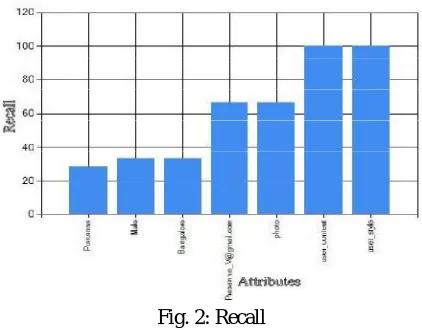
Fig. 2: Recall
VII. CONCLUSION
In this paper, we link up user accounts of the same natural person across different social
Network platforms. We propose a frame work User chatting style, a multi-objective learning Framework incorporating hetero-generous behavior core social network structure. For experimentation purpose, we made use of databases similar to face book and twitter. Then we have performed the necessary operations on the database to retrieve the linkage information of a user. In figure 2, recall value is calculated against attributes and precision remains constant. Hereby concludes that the usage of HYDRA framework helps in social identity linkage to get overall information of a user which in turn helps in business intelligence. In future order to overcome the any disadvantages of hydra we propose a new technique which measures the chatting styles of the persons and it provides a value for each word by comparing the values if it approximately matches then they are same user which they linked together, of various Cross platform.
VIII. FUTURE WORK
ISSN(Online): 2320-9801
ISSN (Print): 2320-9798
I
nternational
J
ournal of
I
nnovative
R
esearch in
C
omputer
and
C
ommunication
E
ngineering
(An ISO 3297: 2007 Certified Organization)
Vol. 4, Issue 7, July 2016
REFERENCES
[1] Christo Ananth, M.Danya Priya dharshini, “A Secure Hash Message Authen-tication Code to avoid Certificate Revocation list Checking in Vehicular Adhoc networks”, International Journal of Applied Engineering Research (IJAER), Volume 10, Special Issue 2, 2015,(1250-1254) [2] J. Liu, F. Zhang, X. Song, Y.-I. Song, C.-Y. Lin, and H.-W. Hon, "What'sin a name?: an unsupervised approach to link users across communities," in WSDM'13, 2013.
[3] R. Zafarani and H. Liu, "Connecting users across social media sites: A behavioral modeling approach," in KDD'13, 2013.
[4] J Liu, F Zhang, X Song, YI Song, CY Lin, & HW Hon. What’s in a name?: an unsupervised approach to link users across communities. In: WSDM’13.
[5] R Zafarani, & H Liu. Connecting users across social media sites: A behavioral-modeling approach. In: KDD’13.
[6] O de Vel, A Anderson, M Corney, & G Mohay. (2001). Mining e-mail content for author identification forensics. SIGMOD Record. 30(4), pp. 55–64.
[7] R Cilibrasi, & PMB Vitanyi. (2005). Clustering by compression. IEEE Transactions on Information Theory. pp. 1523–1545.
[8] J Weston, C Leslie, E Ie, D Zhou, A Elisseeff, & W Noble. (2005). Semi-supervised protein classification using cluster kernels. Bio informatics. pp. 55–64.
[9] Siyuan Liu, Shuhui Wang, & Feida Zhu. (2015). Structured Learning from Heterogeneous behavior for Social Identity Linkage. IEEE Transactions on Knowledge and Data Engineering.Vol. 27, no. 7.
[10] T Iofciu, P Fankhauser, F Abel, & K Bischoff. Identifying users across social tagging systems. In: ICWSM’11. [11] J. Vosecky, D. Hong, and V. Shen, "User identification across multiple social networks," in NDT'09, 2009, pp. 360-365. [12] N. Korula and S. Lattanzi, "An efficient reconciliation algorithm for social networks," PVLDB, pp. 377-388, 2014.
[13] X. Kong, J. Zhang, and P. S. Yu, "Inferring anchor links across multiple heterogeneous social networks," in CIKM'13, 2013, pp. 179-188. [14] D. Koutra, H. Tong, and D. Lubensky, "Big-align: Fast bipartite graph alignment," in ICDM'13, 2013, pp.389-398.
BIOGRAPHY
Kukkala Lakshmi Sunitha is currently pursuing her M.Tech(IT) in Information Technology Department, Sagi Rama Krishnam Raju Engineering College, West Godavari, A.P. She received her B.Tech in Computer Science And Engineering Department from Swarnandhra Institute of Engineering and Technology,Narsapuram.