Spatial Distribution and Channel Quality
Adaptive Protocol
Lokesh Raj K, Dr. Shashikumar D.R
M. Tech Student, CNE, Cambridge Institute of Technology, Bangalore, India
HOD, Dept. of CSE, Cambridge Institute of Technology, Bangalore, India
ABSTRACT: in this paper Proposes for Spatial Distribution and channel quality adaptive protocol, The DADCQ protocol utilizes the distance method to select forwarding nodes. The performance of this method Depends heavily on the value of the decision threshold, but it is difficult to choose a value that results in good performance across all Scenarios. Node density, spatial distribution pattern, and wireless channel quality all affect the optimal value. Broadcast protocols Tailored to vehicular networking must be adaptive to variation in these factors. The aim of this work is to give better VANETs routing mechanisms, this research gives an overview of Vehicular ad hoc networks (VANETs) and the existing VANET routing protocols; mainly it focused on vehicle to vehicle (V2V) communication and protocols. Broadcast protocols tailored to vehicular networking must be adaptive to variation in these factors. The proposed approach facilitates impact analysis of distance dependent DSRC fading channel and application-level analysis.
KEYWORDS: DADCQ; DSRC; RSU; VANET
I.INTRODUCTION
Vehicular networks are an important emerging application of wireless systems, including both vehicle-to-vehicle ad-hoc networks (VANETs) and vehicle-to-infrastructure communications. With 250 million registered vehicles in the U.S. alone in 2006 [49], the market for vehicular networking technology is large and has captured the attention of automotive manufacturers, academic researchers, and governmental agencies. A diverse set of applications utilizing vehicular communications have been proposed, introducing many interesting research topics.
VANET is a special type of mobile ad-hoc networks where vehicles are simulated as mobile nodes. VANET contains of two types of entities: access points and vehicles. Access points are generally fixed and connected to the internet and they could participate in the vehicular distribution pattern. The growth of increased number of vehicles is well equipped with wireless transceivers in order to communicate with each other. To enhance the safety of drivers and provide the comfortable driving environment, messages with several information need to be sent over the network and this is termed as inter-vehicular communication. There are three types of routing: unicast routing, multicast routing and broadcast routing. In unicast routing, communication takes place only in two dedicated vehicles viz source and destination. In multicast routing, only one source transmits information to several nodes at same instance. In broadcast routing, source sends information to many nodes in its vicinity and rebroadcasts a message if not delivered to any of the node
Many applications are built in broadcast communication and thus efficient routing methods are critical. In this paper, DADCQ protocol is addressed. The advantage of this protocol is that it uses distance method to select the forwarding nodes in order to forward the data packets. This method depends completely on the decision threshold. In order to calculate decision threshold, node density, spatial distribution pattern and wireless channel quality is used. Broadcast protocols should be adaptive to all the changes in the network
II.LITERATURESURVEY
transmission area. This model allows capturing the propagation shape of the forwarding area. Comparisons with simulations show that the analytical model is precise. Propose an Optimized Broadcast-based Directional Routing (OBDR) method that combines broadcast and position-based routing. OBDR disseminates the information on a set of chosen nodes based on their distance from their selector and the angle they have with it and with the destination. Our broadcast mechanism can replace routing and hence be the only system needed to send information, or it can be implemented at the physical layer with directive antennas.
Mr. Pawan Sharma et al [2] described intelligent transportations systems (ITS) have attracted a lot of interest from industries and research institutions. Vehicular Ad-hoc Networks (VANETs) are being considered as a backbone network for the road transport. VANET uses cars as mobile nodes in a MANET to create a mobile network. In our Paper, we discuss different vehicular communication (V2V & V2R) technologies aimed at improving vehicular communication efficiency. And surveys novel approaches and discusses research challenges related to the use of various technology in vehicular ad hoc networks. Our work is different from existing works in that we provide recent advances and research directions on applying different techniques as cognitive radio implementation (CR-VANETs), cloud computing concept, Routing in VANETs. Mainly, this method focusing on simulation tools for specific techniques, standardization, security requirement, and characteristics as well as QoS optimization for infotainment applications
G. Kavitha et al [3] this method proposes for a vehicular ad hoc network (VANET) is subclass of Mobile ad hoc network (MANET) in which vehicles act as mobile nodes. Many MANET routing protocol such as AODV and DSR are not suitable VANET .This is because VANET differs from MANET in aspects like topology and mobility model. And analyzes the advantages and disadvantages of different Inter Vehicular Routing protocols and mainly deals with Transmission Strategies of Routing Protocol.
M.Hari Prasad et al [4] this method approached Vehicular ad hoc networks (VANETs) are a promising technology to enable the communications among vehicles and between vehicles and road side units (RSU). A new algorithm to construct Stable clusters is introduced to perform cluster based routing (CBR) and to improve the performance of VANETs. The stable clustering algorithm groups the nodes based on the position and direction information to form stable clusters and elects cluster head based on a multi-metric algorithm. This method reduces the overhead of re-clustering and lead to an efficient hierarchical network topology. The proposed system is evaluated using simulation software NS2 (Network Simulator 2). The performance parameters include throughput, propagation delay and average cluster change per vehicle. Simulation results reveal that there is increase in throughput, and decrease in propagation delay and average cluster change per vehicle.
III.PROPOSEDSYSTEM
In this Proposed System Contains SUMO Simulator, and NS2 Simulator, Cluster Algorithm. And this system mainly proposed broadcasting using statistical algorithm and dynamical algorithm, and develops the Distribution-Adaptive Distance with Channel Quality (DADCQ) protocol to address this need and show that it performs well compared to several existing multihop broadcast proposals. The DADCQ protocol utilizes the distance method to select forwarding nodes. The performance of this method depends heavily on the value of the decision threshold, but it is difficult to choose a value that result in good performance across all scenarios. Node density, spatial distribution pattern, and wireless channel quality all affect the optimal value. Broadcast protocols tailored to vehicular networking must be adaptive to variation in these factors.
a) Cluster Algorithm
Clustering analysis has been an emerging research issue in data mining due its variety of applications. With the advent of many data clustering algorithms in the recent few years and its extensive use in wide variety of applications, including image processing, computational biology, mobile communication, medicine and economics, has lead to the popularity of this algorithms. Main problem with the data clustering algorithms is that it cannot be standardized. Algorithm developed may give best result with one type of data set but may fail or give poor result with data set of other types.
proposed so far. However, each algorithm has its own merits and demerits and cannot work for all real situations. Before exploring various clustering algorithms in detail let's have a brief overview about what is clustering.
b) DADCQ Protocol
The DADCQ protocol utilizes the distance method to select forwarding nodes. The performance of this method Depends heavily on the value of the decision threshold, but it is difficult to choose a value that results in good performance across all Scenarios. Node density, spatial distribution pattern, and wireless channel quality all affect the optimal value.
Distribution-Adaptive Distance with Channel Quality (DADCQ) protocol to address this need and show that it performs well compared to several existing multihop broadcast proposals. The DADCQ protocol utilizes the distance method to select forwarding nodes. The performance of this method depends heavily on the value of the decision threshold, but it is difficult to choose a value those results in good performance across all scenarios. Node density, spatial distribution pattern, and wireless channel quality all affect the optimal value. Broadcast protocols tailored to vehicular networking must be adaptive to variation in these factors. In this work, we address this design challenge by creating a decision threshold function that is simultaneously adaptive to the number of neighbors, the node clustering factor, and the Rician fading parameter. To calculate the clustering factor, this protocol proposes using the quadrant method of spatial analysis.
Fig 1: Architecture of Proposed System
c) Broadcast Algorithm
local topology information and a globally known priority function. In this paper, we first show that local broadcast algorithms based on the static approach cannot achieve a good approximation factor to the optimum solution (an NP-hard problem). However, we show that a constant approximation factor is achievable if (relative) position information is available. In the dynamic approach, local algorithms determine the status of each node “on-the-fly” based on local topology information and broadcast state information. Using the dynamic approach, it was recently shown that local broadcast algorithms can achieve a constant approximation factor to the optimum solution when (approximate) position information is available. However, using position information can simplify the problem.
d) SUMO
SUMO, including the open source components of net imports and demand modeling, it is also a traffic simulation package, used to describe the current state and future developments and extensions to the package. For example, many of the research topics to help investigate SUMO choose the path and the vehicle communication algorithm or simulating a traffic light. So a framework for automatic driving or traffic management techniques [81] is used to simulate a variety of projects.
SUMO is perfectly fine for traffic simulation. Each vehicle clearly, given the time of departure of a mark (name) at least defined, and the vehicle's path through the network. If you want a more detailed description of each vehicle. Such as lane use, speed, or position of departure and arrival of defined properties.
IV.RESULTS
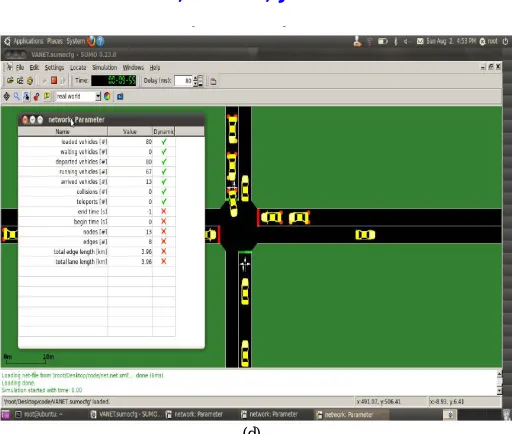
In this Results Figure 2: Represents urban traffic Scenarios that is shown in figure (a) SUMO environment Showing Urban Scenario, and after will passing the Message through the hole direction that broadcasting is Simultaneously checking due to traffic that is shown in figure (b) Data Broadcasting across the Vehicles. Then whatever before initializing the starting that will be taken to capturing the vehicles moving it mean initiated it. Which are shows in figure (c) Initial Captured, and finally captured value is simulated, which shows in figure (d) Figure 5: Final Values Captured at the end of simulation.
(b)
(d)
Figure 2: (a)SUMO Environment Showing Urban Traffic Scenario: (b) Data Broadcasting across the Vehicles; (c) Initial Captured; (d)Initial
Captured
V.CONCLUSION
In this paper Concluded Vehicular networking is an important emerging application of wireless communications. The ability for vehicles to share information with each other and with the wide-area network offers the promise of many applications related to navigation and fuel efficiency, public safety, and entertainment. The next generation of transportation systems will disseminate locally observable data from vehicle-to-vehicle to help alleviate congestion and reduce collisions. These data dissemination applications for vehicular networks will share a wide variety of information, such as traffic flow data, weather reports, business advertisement, and social communications. A critical component of these data dissemination schemes is the multihop wireless broadcast protocol. Multi-hop broadcast protocols for these schemes must reliably deliver broadcast packets to a geographically bounded region while consuming as little wireless bandwidth as possible.
REFERENCES
[1] Ahmed Soua, Walid Ben-Ameur, Hossam Afifi,”Broadcast-based Directional Routing in Vehicular Ad-Hoc Networks”.
[2] Mr. Pawan Sharma, Prof. Angeeta Hirwe, “Implementation in Vehicular Communication with Various Approaches & Techniques “,
International Journal of Scientific Engineering and Applied Science (IJSEAS), Vol 2, Issue-3, 2016.
[3] G. Kavitha, “A Study on Transmission Strategies in VANET”, International Journal of Innovative Research in Computer and Communication
Engineering, Vol. 3, Issue 5, 2015.
[4] M.Hari Prasad 1, P. Kowsalya, “Performance Enhancement of VANETs Using Cluster Based Routing”, international Journal of Innovative
Research in Science, Engineering and Technology, Vol. 3, Issue 5, 2014.
[5] S. Vijaya Kumar, A. Noble Mary Juliet, “A Study and Analysis of DADCQ Protocol for VANET”, International Journal of Computer Science
and Mobile Computing, Vol. 2, Issue. 11, 2013.
[6] Dhanashree Tajne, Dharamveer Choudhari ,” Performance Improvement of Channel Quality Adaptive protocol for effective routing in
VANET”, International Journal of Computer Applications, Vol 89, 2016.
[7] G. Kavitha, Sundararajan.M, Arulselvi S, “An Assistant in Driving to Reduce Data Forfeiture in VANET”, International Journal of Innovative
Research in Science, Engineering and Technology, Vol. 4, Issue 4, 2015.
[8] Abusayeed Saifullah, You Xu, Chenyang Lu, and Yixin Chen, “Distributed Channel Allocation Protocols for Wireless Sensor Networks”.
[9] Carlos Quadros, Aldri Santos, Mario Gerla, Eduardo Cerqueira, “A QoE-aware Mechanism to Improve the Dissemination of Live Videos over
VANETs”.