Eye-Movement Tracking For Physically
Challenged People Using Human Computer
Interaction
Aameera Thagaseen.A#1 , Dharani.K#2 , Guna Soundharya.M#3 , IswaryaVenkat#4, Radha.N5
B.E. Student, Dept. of Computer Science and Engineering, Saranathan College of Engineering, Venkateshwara Nagar,
Panjapur, Trichy, Tamilnadu, India1, 2,3,4
Assistant Professor, Dept. of Computer Science, Saranathan College of Engineering, Venkateshwara Nagar,
Panjapur, Trichy, Tamilnadu, India5
ABSTRACT:Eye-movement tracking has printed its footsteps from medical to psychological research as a tool for recording and studying human visual behavior. The concept is discussed using a perceptual organ, the eye, as an input. In this paper the real time applications are discussed. The eye tracking applications covers human computer interaction, braincomputer interaction, psychology investigation, virtual and augmented reality etc. The motivation of this paper is to introduce the reader to the basics of eye-movement technology for those who are interested in either using eye tracking in HCI research or to examine various ways in which eye movements can be systematically measured to examine interface usability and to discuss the various opportunities for eye-movement studies in future HCI research and how to overcome some of the challenges to develop an effective application.
KEYWORDS:human computer interaction, eye movement tracking, and human visual behavior
I. INTRODUCTION
Eye-movement tracking is a technique which captures individual’s eye movements as an input to determine the position where the eyes are focused at a particular time along the sequence in which their eyes are moved. Eye movements captured is also used as control signals to enable people to interact with interfaces directly without the need for mouse or keyboard, which can be a major advantage for disabled people. We start with an overview of eye-tracking technology, and progress toward a detailed discussion of the use of eye tracking in HCI and usability research. We conclude by considering the future prospects for eye-tracking research in HCI and usability testing.
II. HISTORY OF EYE TRACKING
Different techniques were developed over the years according to technology available at that time. EMILEJAVA, a
French ophthalmologist was among the first to describe the movements of the eye during text reading in 189. He observed with the help of a mirror that the eye movements are not continuously along the phrase but composed from rapid movements. EDMUND HUEY built an eye-tracking device using small contact lens provided with a hole for
pupil. An aluminium pointer was connected to the lens in order to observe the gaze direction during reading.DODGE
and CLINE in 1901, investigated the velocity of eye movements and developed the first precise and non-invasive eye tracking device based on corneal reflection, named photo chronograph. This system recorded only horizontal
movements of the eye using a photographic plate. Four years later, CHARLES H. JUDD, an American Psychologist
THOMPSON invented the first head mounted eye tracker. Thus constraints of head movement were eliminated. In 1950, ALFRED YARBUS developed eight small suction devices attached to eye. Some of them are covering completely corneal area leaving only a tiny rectangular window for subject whereas some are attached only to sclera leaving the visual field unobstructed. Both types reflect light onto photosensitive surface. Using these devices, Yarbus defined five types of eye movement measurement: fixation, saccades, tremor, drift, pursuit. A goodoverview of the
research in the period 1970 is given by RAYNER. In 1980, JUST and CARPENTER formulated the influential strong
eye-minded hypothesis, this hypothesis states that, “there is no appreciable lag between what is fixated and what is processed”. If this hypothesis is correct, then when a subject looks at a word or object, he/she also thinks about, and for exactly as long as the recorded fixation. The hypothesis is often taken for granted by the researchers using eye tracking.
III.EYETRACKINGAPPROACHES
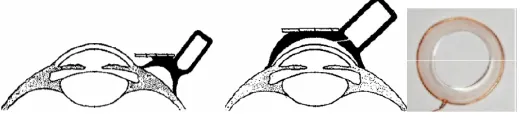
Generally, the eye tracker devices measure/determine the eye ball position in several ways that can be classified in three categories: contact lens based, electro-oculogram based and video based. The first category includes invasive eye trackers that use contact lens with mirrors or magnetic search coil. The eye trackers that uses contact lens with mirrors implies an entire process of attaching the lens to eye ball and the experiment can last only a short period of time. The eye trackers with magnetic search coil requires two soft contact lens andbetween a coil of wire with 13 mm diameter. The twisted pair of wires from search coil was connected to a magnetic coil system for measuring the intensity of magnetic field variation.
Figure 1: Contact lens with mirrors Figure2: Contact lens with magnetic search coil
These eye trackers were used especially by the scientists for research of Physiology and dynamic of eye movements. Despite the vast improvements and the accuracy obtained the systems were not widespread because of invasive process of attaching the lens and because the head had to be kept still in order not to affect the measurements. The eye trackers from second category measure the eye balls bio-potentials using electrodes placed near the eye. Because of very high nerves density of retina, the eye ball is polarized. The movement of the eye causes the surrounding electric fields to move as well. These voltages can be measured by placing electrodes near the eye. The amplitudes of acquired signals depend on position of the eye. Thus is possible to determine the eye positions and used in human computer interaction. The trackers from the third category use a video camera to track the position of the eye. This can be done remote, which means the video camera is placed some ware in front of the subject or head mounted, which means the camera is placed below to visual axis of the eye, usually on eyeglasses frame.
IV. METHODS OF EYE TRACKING
A method of recording eye position and movements is called oculographic. There are four different methods to track the motion of the eyes.
1. Electro-Oculographic:
In this method, sensors are attached at the skin around the eyes to measure an electric field exists when eyes rotate. By recording small differences in the skin potential around the eye, the position of the eye can be estimated. By carefully placing electrodes, it is possible to separately record horizontal and vertical movements. However, the signal can change when there is no eye movement. It is a cheap, easy and invasive method of recording large eye movements. The advantage of this method is its ability to detect eye movements even when the eye is closed, e.g. while sleeping. This technique is not well-suited for everyday use.
2. Sclera Search Coils:
embedded in a modified contact lens. This is inserted into the eye after local anesthetics has been introduced. An integrated mirror in the contact lens allows measuring reflected light. Alternatively, an integrated coil in the contact lens allows detecting the coil’s orientation in a magnetic field. Advantages of this method are high accuracy and unlimited resolution time. The main disadvantage is that it is an invasive method, requiring something to be placed into the eyes.
3. Infrared Oculographic:
The infrared oculographic measures intensity of reflected infrared light. In this eye tracking method, eye is illuminated by infrared light which is reflected by the sclera. The difference between the amounts of IR light reflected back from the eye surface carries the information about the eye position changes. The light source and sensors can be placed on spherical glasses. Hence it is an invasive method. The infrared oculographic has less noise than electro-oculographic, but is more sensitive on changes of external light tension. The advantages include ability to measure eye movements in darkness. Infrared oculographic is being used in gaze interaction by making use of image processing software. The main disadvantage of this method is that it can measure eye movement only for about ±35 degrees along the horizontal axis and ±20 degrees along the vertical axis.
Figure3: Eye ball polarization and Electrode Placement
4. Video Oculographic:
Video oculographic make use of single or multiple cameras to determine the movement of eye using the information obtained from the images captured. Video-based eye tracking systems may be invasive or non-invasive. Each category again splits into two other categories depending on the kind of light used: visible light or infrared light. Invasive systems or head mounted systems are commonly composed of one or more cameras. Non-invasive or remote systems are the most exciting subject of HCI. The remote eye tracking systems that appeared in the literature can be grouped into; single-camera eye tracker and multi-camera eye tracker.
V.EXISTINGSYSTEM
VI.PROPOSEDSYSTEM
In our proposed system we have developed a basic game for the users which is to be played by rotating the eye balls without using the mouse or keyboard. Developing game is our first module. In our existing system, while using webcams we faced many disadvantages. Hence we are using sensors. The implementation part is our second module. The sensors used are IR (infrared) and MEMS (micro electro mechanical system). We also use microcontroller AT89C52, a micro pic board, variable resistor, and comparator, resistors, capacitors, and LCD display and crystal oscillator. The IR Sensor contains transmitter and a photodiode called receiver. This sensor will be placed on the lens of a goggle. The distance between the eye and sensor should not be more than one meter. Generally, the transmitter and the receiver should be placed such that the receiver could be able to receive the signal sent by the transmitter. It will be difficult for both transmitter and receiver if they are placed in a single series. Hence we need an interrupt, an object such that the signal transmitted meets that object and get reflected to the receiver. Here our eye is considered as an object. The IR sensor senses the movements of eyes by transmitting rays towards the object i.e., eye. To select anything displayed in the system the eye is to be kept closed for some time. When the eye is kept closed the IR sensor captures that movement and sends higher value (1) to the microcontroller. If the eye is kept opened then the signal from the transmitter will be aborted in the middle and will not reach the receiver. Hence the value sent to the microcontroller will be lower (0). The next sensor will be the MEMS. This sensor is used in assisting the finger movements. While using webcam we may have to use eye ball to rotate and point to the direction which may be difficult for the user to rotate the eye ball continuously. But pointing towards a direction is very simple using MEMS. In this sensor 3 vectors x, y, z will be declared representing the directions. Since the value for MEMS is analog based we need an external connectivity in case of using ATMEL microcontroller. But in PIC there are ports meant for analog as well as digital values. MEMS will be placed on our finger which helps to point an object accurately. The outputs from MEMS and IR will be sent to the microcontroller PIC. It serializes the outputs and sends it to the PC via RS232 a serial cable. Before transmitting the output to PC, we have connected another IC called MAX232. This is used to balance the voltage supply to or from the PC. The maximum voltage supply for microcontroller is 5v whereas for PC it is 12v. If more voltage than 5v is supplied to the microcontroller then it may be damaged. Similarly, when data with less than 12v is supplied to the PC, the PC will not accept that data. For higher efficiency, higher speed and to avoid damages to data Crystal Oscillator is used. Hence the components.
VI. RESULT
VII.CONCLUSION
Gaze behavior can also be combined with other measurements from the user’s face and body, enabling multimodal physiological computing. Gaze-based user modeling may offer a step toward truly intelligent interfaces that are able to facilitate the user in a smart way that complements the user’s natural behavior. Advances in the technology open new areas for eye tracking, widening the scope of gaze-based applications. Current hot topics include all kinds of mobile applications and pervasive systems where the user’s visual behavior and attention is tracked and used for eye-based interaction everywhere and at any time, also called pervasive eye tracking and pervasive eye-based human-computer interaction. Other emerging areas include, for example, automotive industry (drowsiness, attention alarms, and safety), attentive navigation and location awareness, information retrieval and enhanced visual search, human-robot interaction, attentive intelligent tutoring systems. For people with special needs, mobile eye tracking may give more freedom by wheelchair control, tele-presence and tele-operation of technology. Eye tracking is becoming an increasingly interesting option even in traditional computing. Major technology companies and the gaming industry are starting to show growing interest in embedding eye tracking in their future products, such as laptops and tablets. Vision based technologies are already widely used in the gaming field, enabling players to use gestures and full body movement to control the games, and eye tracking is envisioned to be part of future gaming . The hype on smart glasses (such as the Google Glass) indicates that it is only a matter of time, when the first eye-controlled consumer product will enter the market. Wider use would mean lower costs. Thus, a breakthrough in one field can give a boost also to other areas of eye tracking.
REFERENCES
1. Cho C. W, Lee J. W, Shin K. Y, Lee E. C, Park K. R, Lee H, Cha J (2012) Gaze Detection by Wearable Eye‐Tracking and NIR LED‐Based
Head‐Tracking Device Based on SVR.
2. Daugman J. G (2007) New Methods in Iris Recognition. IEEE Transactions on Systems, Man and Cybernatics‐ Part B. 37: 1167‐1175.
3. Jason J. Corso, (2005) TECHNIQUES FOR VISION-BASED HUMAN-COMPUTER INTERACTION, A dissertation submitted to The Johns
Hopkins University Baltimore, Maryland, August, 2005.
4. Lee W. O, Lee H. C, Cho C. W, Gwon S. Y, Park K. R, Lee H, Cha J (2012) Auto‐focusing Method for Remote Gaze Tracking Camera, Optical Engineering.
5. Su Yeong Gwon1, Chul Woo Cho1, Hyeon Chang Lee1, Won Oh Lee1 and Kang Ryoung Park2, (2012), Robust Eye and Pupil Detection
Method for Gaze Tracking.
6. www.usability.gov/how-to-and-tools/methods/eye-tracking.html
7. www.people.ece.cornell.edu/land/courses/ece4760/FinalProjects/s2010/yh428_aoo34/eyetracking/
8. www.nbcnews.com/id/30116040/ns/technology_and_science-games/t/disabled-video-games-can-be-lifesaver/#.VgJTRVhCE_M
9. www.kotaku.com/he-built-a-custom-controller-to-help-disabled-kids-play-523988064
10. www.7128.com/top25/topsitesmotionimpaired.html