vi
TABLE OF CONTENTS
CHAPTER TITLE PAGE
STUDENT’S DECLARATION ii
DEDICATION iii
ACKNOWLEDGEMENT iv
ABSTRACT v
TABLE OF CONTENTS vi
LIST OF TABLES x
LIST FIGURES xi
LIST OF APPENDICES xiii
1 INTRODUCTION 1
1.1 Background Study 1
1.2 Issues 3
1.3 Study Question 4
1.4 Aim of The Study 4
1.5 Scope of the Study 5
1.6 Significant of the Study 5
1.7 Study Process and Method of Approach 6
2 LITERATURE REVIEW 8
2.1 Introduction 8
2.2 Green Building and Green Construction 9
2.2.1 Green Building 9
2.2.2 Green Construction 10
2.2.2.1 Green Contractor 11
CHAPTER TITLE PAGE
2.3.1 Lighting 12
2.3.2 Air Conditioning 14
2.3.3 Elevator 15
2.3.4 Plug Loads 15
2.4 Green Building Evaluation Systems 17
2.4.1 U.S Green Building Council 19
2.4.1.1 LEED Rating Systems 19 2.4.1.2 LEED-NC Certification
Process 20
2.4.2 Green Building Council Indonesia 24 2.4.2.1 GREENSHIP Rating System 25 2.4.2.2 GREENSHIP NB Certification
Process 26
2.4.2.3 GREENSHIP EB Certification
Process 29
2.5 Evaluation on Energy Efficiency and
Conservation based on GBCI GREENSHIP for
New Building 31
2.6 Summary 32
3 METHODOLOGY 34
3.1 Introduction 34
3.2 Research Methodology 35
3.3 Data Collection 35
3.3.1 Data Collection of Energy Consumption
of Green Building at Design Stage 35 3.3.2 Data Collection of Energy Consumption
of Green Building at Operational Stage
Affected by Occupant Behavior 36
3.4 Analysis Process 38
3.4.1 Green Building Energy Consumption at
Design Stage 39
viii
CHAPTER TITLE PAGE
Analysis at Operational Stages affected
by the Occupant behavior 40
3.5 Summary 41
4 DATA ANALYSIS 43
4.1 Introduction 43
4.2 Building Design Data 44
4.2.1 General Information 43
4.2.2 Zoning 45
4.3 Analysis of Energy Consumption of Green Building at Design Stage
47
4.3.1 Lighting 48
4.3.2 Air Conditioning 50
4.3.3 Elevator 52
4.3.4 Plug Loads 54
4.3.5 Calculation Summary of Energy Consumption of Green Building at
Design Stage 56
4.4 Analysis of User Behavior Effect to Green Building Energy Consumption at Operational
Stage 57
4.4.1 Lighting 58
4.4.2 Air Conditioning 62
4.4.3 Elevator 66
4.4.4 Plug Loads 69
4.4.5 Calculation Summary of Energy Consumption of Green Building at
Operational Stage 73
4.5 Comparison of Total Energy Consumption at Design Stage and at Operation Stage of Ministry
of Public Works Green Building 74
CHAPTER TITLE PAGE
5 CONCLUSION AND RECOMMENDATION 77
5.1 Conclusion 77
5.2 Limitation of Study 79
5.3 Recommendation 80
REFERENCE 81
x
LIST OF TABLE
TABLE NO. TITLE PAGE
2.1 USGBC LEED rating Systems 20
2.2 LEED-NC Prerequisites and Credits 22
2.3 GBCI GREENSHIP Rating Systems 26
2.4 GBCI GREENSHIP New Building Prerequisites
and Credits 27
2.5 GBCI GREENSHIP Existing Building Prerequisites
and Credits 29
2.6 GBCI GREENSHIP New Building Evaluation of
Energy and Conservation 31
3.1 Coefficient of Appliance Usage During Operational
Hours 39
4.1 Operational Hours and Coefficient 47
4.2 Typical Floor and Multiplier 47
4.3 Type of Lamp and Total Quantity 48
4.4 Quantity of FCU (Fan Coil Unit) 50
4.5 Type and Quantity of Elevator 52
4.6 Type of Plugs and Total Quantity 54
4.7 Lamp in Operation During Overtime Hours 58
4.8 Air Conditioning in Operation During Overtime
Hours 62
4.9 Elevator in Operation During Overtime Hours 66
LIST OF FIGURE
FIGURE NO. TITLE PAGE
3.1 Study Analysis Process 38
4.1 Ministry of Public Works Republic Indonesia
General Information 44
4.2 1st – 2nd Floor Zoning 45
4.3 3rd – 4th Floor Zoning 45
4.4 5th – 14th Floor Zoning 46
4.5 15th – 17th Floor Zoning 46
4.6 Comparison of lighting energy consumption at
design stage and operational stage (KW/Weeks) 61 4.7 Comparison of lighting energy consumption at
design stage and operational stage (KW/Hours) 61 4.8 Comparison of air conditioning energy
consumption at design stage and operational stage
(KW/Weeks) 65
4.9 Comparison of air conditioning energy
consumption at design stage and operational stage
(KW/Hours) 65
4.10 Comparison of elevator energy consumption at
design stage and operational stage (KW/Weeks) 68 4.11 Comparison of elevator energy consumption at
design stage and operational stage (KW/Hours) 68 4.12 Comparison of plug loads energy consumption at
xii
FIGURE NO. TITLE PAGE
design stage and operational stage (KW/Hours) 72 4.14 Comparison of energy consumption at design stage
LIST OF APPENDICES
APPENDIX TITLE PAGE
A1 Base Floor & 2nd Floor drawing 82
A2 3rd floor & 4th Floor drawing 83
A3 5th floor – 14th floor 84
A4 15th floor – 17th floor 85
B1 List and number of lamp on Base Floor &
2nd Floor 86
B2 List and number of lamp on 3rd floor & 4th
Floor drawing 88
B3 List and number of lamp on 5th floor – 14th
floor 90
B4 List and number of lamp on 15th floor – 17th
floor 92
C1 List and number of FCU on Base Floor &
2nd Floor 94
C2 List and number of FCU on 3rd floor & 4th
Floor drawing 96
C3 List and number of FCU on 5th floor – 14th
floor 98
C4 List and number of FCU on 15th floor – 17th
floor 100
D List and number of Elevator 102
E1 List and number of Plugs on Base Floor &
2nd Floor 103
E2 List and number of Plugs on 3rd floor & 4th
xiv
APPENDIX TITLE PAGE
E3 List and number of Plugs on 5th floor – 14th
floor 107
E4 List and number of Plugs on 15th floor – 17th
floor 109
F1 Behavior of occupant on Base Floor & 2nd
Floor 111
F2 Behavior of occupant on 3rd floor & 4th
Floor drawing 112
F3 Behavior of occupant on 5th floor – 14th
floor 113
F4 Behavior of occupant on 15th floor – 17th
floor 114
G1 Lighting energy consumption 115
G2 Lighting energy consumption at design
stage 116
H1 Air Conditioning energy consumption 117
H2 Air conditioning energy consumption at
design stage 119
I1 Elevator Energy Consumption 121
I2 Elevator energy consumption at design stage 121
J1 Plug loads energy consumption 122
J2 Plug loads energy consumption at design
stage 122
K1 Lighting energy consumption during
overtime hours 123
K2 Lighting energy consumption at operational
stage 124
L Air conditioning energy consumption at
operational stage 125
M1 Number of Elevator which works in
overtime hours 127
APPENDIX TITLE PAGE
stage 127
N1 Plug loads energy consumption during
overtime hours 128
N2 Plug loads energy consumption at
CHAPTER 1
INTRODUCTION
1.1 Background Study
Global warming is an issue that arises to the whole world these days. Its refers to the rising average temperature of Earth’s atmosphere and oceans, which started to increase in the late 19th century and is projected to keep going up. Since the early 20th century, Earth's average surface temperature has increased by about 0.8 °C (1.4 °F), with about two-thirds of the increase occurring since 1980 (America's Climate Choices, 2011). Warming of the climate system is unequivocal, and scientists are more than 90% certain that most of it is caused by increasing concentrations of greenhouse gases produced by human activities such as deforestation and burning fossil fuels (IPCC Synthesis Report, 2007)
dangerous anthropogenic interference with the climate system. The Protocol was initially adopted on 11 December 1997 in Kyoto, Japan, and entered into force on 16 February 2005. As of September 2011, 191 states have signed and ratified the protocol (Wikipedia, 2012).
In every country, whether developing or developed countries must have the infrastructure development activities, and the construction industry is part of these activities. The construction industry is the major natural resources consumer, for example in the UK. It’s accounts for 90% of all non-fuel mineral use (Natural Building Technologies, 2012, and large proportion of timber use. The construction industry is also use in large amount the material, such as wood, asphalt, concrete, steel, glass and various other types of material taken from nature. The use of such material resulted the industrial sector as a contributor to greenhouse gas emissions.
Meanwhile along with the pace of population growth, the construction process and the provision of infrastructure will not stop, and the process is as described above using materials from nature, which are increasingly difficult to obtain. In response to this problem the expert has developed the idea of green construction / green building as a human effort and innovation for energy saving and protect the environment from the damage that getting worse, especially caused by construction industry.
3 One of feature in green construction or green building is the energy efficiency, the energy cost in typical building roughly account for about 30 to 40 % of total operating cost, further, in most countries, electricity, which is one of the main forms of energy used in building, is generated using fossil fuels such as oil, gas and coal. These fossil fuels are non renewable and also, during combustion emit carbon dioxide, which contribute to global warming. Since building typically account for more than one-third of the total national energy consumption, government agencies in many country are promoting energy management to control energy resources and environmental emissions.
1.2 Issues
To implement the green construction method in building there are several key feature, they are emphasis design, method of construction, energy efficiency, water efficiency, Operation and Maintenance Optimization. All these features have to be implemented to achieve a good green building. To analyze all these feature is implemented well there is standard which in construction industry is called GBI (Green Building Index), usually this GBI is produced by the organization that its main concern is to assess the implementation of green construction method in building. Based on this Index then the building will be assess and get their rank base on the stage, whether its at design stage, construction stage or operational and maintenance stage.
building achieved the highest rank, for example the design is included the use of low energy and efficient energy appliance, but somehow in operational stage due to the rank is become lower, because its operational of the appliance.
1.3 Study Question
From the issues above the research Question is whether the operational stage of green building which affected by its occupant will gain the same rank as achieved at the design stage, especially based on energy consumption of the building.
1.4 Aim of The Study
Considering the issues statement above this study aimed to find out, especially for the owner:
a. To verify whether the energy consumption of green building at the operational stage is in accordance to the rank that has been obtained at the design stage;
5 1,5 Scope of the Study
This study will focus on:
a. New Building of Ministry of Pubic Works which built as a pilot project as first government building that build since the stage of planning using the method of green construction.
b. Energy uses in new buildings the ministry of public works.
c. Behavior of the users of ministry of public works new green building in the use of energy-efficient appliance;
1.6 Significant of the Study.
a. Directly the significant of the study is to develop a study about use of energy consumption in green building as one of the main feature in green building and see how behavior of the occupier will effect it
1.7 Study Process and Methods of Approach
1.7.1 First Stage - Identify Issues
Initially, the study will be carried out involving extensive reading and understanding of the concepts involved. To identify the issues, firstly it’s involve general reading on variety sources such as seminar paper, articles, journal, previous research report, magazines and electronic resources trough the World Wide Web and initial interview with the expert of green building project.
1.7.2 Second Stage-Literature Review
Literature review is the stage which the research title is further explained and discussed incorporating various types of data and information that are gathered through books, articles, magazines, journals, newspapers. Various data of green building is will be used as a reference too. This stage is vital to support and strengthen the research before the research proceeded to other stages.
1.7.3 Third Stage - Data Collection
7 methodology that adopted to conduct this research, which describe the object of study, finding data method, analysis method.
1.7.4 Fourth Stage - Data Analysis
After all the data required from the project have been collected, then its continue with the data analysis. The data analysis will concern about the implementation of design stage with the operational stage of green building.
1.7.5 Final Stage-Recommendations and Conclusion
REFERENCE
America's Climate Choices. Washington, D.C.: The National Academies Press. 2011. p. 15. ISBN 978-0-309-14585-5.
Atmann, O. (2010). Green Architecture : Advanced Technologies and Materials. New York: Mc Graw Hill
Glavinich, Thomas E. (2008). Contractors Guide to Green Building Construction: Management, Project Delivery, Documentation and Risk Reduction. New Jersey: John Wiley & Sons, Inc.
http://gbcindonesia.org (11 July 2012)
http://www.usgbc.org (11 July 2012)
Kibert, Charles J. (2005). Sustainable Construction: Green Building Design and Delivery. New Jersey: John Wiley & Sons, Inc
Kwok, Alison G and Grondzik, Walter T. (2007). The Green Studio Handbook : Environmental Strategies for Schematic Design. Oxford: Architectural Press. Kubba, S. (2010). LEED Practices, Certification, and Accreditation Handbook.
Burlington: Butterworth-Henemann.
Montoya, M. (2010). Green Building Fundamentals. New Jersey : Prentice Hall PCC, Synthesis Report, Section 1.1: Observations of climate change, in IPCC AR4
SYR 2007
RISK MANAGEMENT IN TOLL ROAD PROJECT UNDER
PUBLIC PRIVATE PARTNERSHIP SCHEME
(case study : Jakarta Outer Ring Road (JORR) W1)
HERU RAHMAT PERMANA
RISK MANAGEMENT IN TOLL ROAD PROJECT UNDER PUBLIC PRIVATE PARTNERSHIP SCHEME
(case study : Jakarta Outer Ring Road (JORR) W1)
HERU RAHMAT PERMANA
A project report submitted in partial fulfillment of the requirements for the award of the degree of Master of Science (Construction Contract Management)
Faculty of Built Environment Universiti Teknologi Malaysia
iii
ACKNOWLEDGMENT
I would like to express my gratitude to my thesis supervisor, Prof. Ahmad Rosdan Razak whose support, guidance and patient, has made the completion of this thesis possible.
I am also indebted to Ministry of Public Works Indonesia for funding my master study and important source of information for this research. PT. Jalan Lingkar Baratsatu also deserve special thanks for their assistance in supplying the information.
I would also grateful to all lecturers in Faculty of Built and Environment and my colleagues at Universiti Teknologi for their support and their assistance. Their views and tips are useful indeed.
v
ABSTRACT
TABLE OF CONTENTS
CHAPTER TITLE PAGE
DECLARATION ii
DEDICATION iii
ACKNOWLEDGEMENT iv
ABSTRACT v
TABLE OF CONTENTS vi
LIST OF TABLES viii
LIST OF FIGURES ix
1 INTRODUCTION 1
1.1 Background of The Study 1
1.2 Problem Statement 4
1.3 Research Question 5
1.4 Research Objective 6
1.5 Scope of the Research 6
1.6 Research Significance 6
1.7 Organization of The Report 7
2 LITERATURE REVIEW 8
2.1 Introduction 8
2.2 Overview of Jakarta Transportation System 9
2.3 Public Private Partnership in Indonesia 10
2.4 Toll Road Development in Indonesia 12
2.4.1 Government Funding Period (1978 – 1983) 13
2.4.2 Foreign Loans Funding Period (1983 – 1987) 14
2.4.3 Jasa Marga and Private Sector Joint Venture Period
vii
CHAPTER TITLE PAGE
2.4.4 Private Sector Funding Period (1993 – 2003) 16
2.4.5 Contractors’s Full Free Financing Period (2004 – Present) 17
2.5 Risk Management 20
2.6 Jakarta Outer Ring Road W1 Project 24
3 RESEARCH METHODOLOGY 27
3.1 Introduction 27
3.2 Literature Review 27
3.3 Data Collection 28
3.4 Data Analysis 28
3.5 Reporting 29
3.6 Case Study 31
4 DATA ANALYSIS AND FINDINGS 32
4.1 Introduction 32
4.2 Project Profile 32
4.3 Contract Package Profile 39
4.4 Cost Analysis of Construction Package 41
4.5 Construction Duration 42
4.6 Contractual Provision for Project Risk 43
4.7 Risk Analysis 46
4.8 Summary 49
5 CONCLUSIONS AND RECOMMENDATIONS 51
5.1 Introduction 51
5.2 Conclusions 51
5.2.1 Indentification of Project Risk 52
5.2.2 Risk Management Process 52
5.3 Limitations of the Study 52
5.4 Recommendations 52
REFERENCES 53
APPENDIX A
LIST OF TABLES
NO. TITLE PAGE
2.1 Road Span in Jakarta 9
4.1 Project Profile 33
4.2 Contract Package Profile 40
4.3 Cost per meter of Toll Highway 41
4.4 Duration per meter of Toll Highway 42
4.5 Contractual Provision for Project Risk in Concession Agreement
45
4.6 Risk Event 47
4.7 Risk Occurrence based on Risk Type 48
ix
LIST OF FIGURES
NO. TITLE PAGE
1.1 Location of The Project 3
2.1 Jakarta Toll Road Network Plan 10
2.2 The Concept of Toll Road Before and After The Law No 38 2004 18
2.3 The Concept of CPF Scheme 19
2.4 Project Management System 26
3.1 Research Methodology 30
4.1 JORR W1 Network, Kebun Jeruk - Penjaringan 34
4.2 Typical Cross Section of T-Type Bridge in The Main Road 35
4.3 Typical Cross Section of Pile Slab in The Main Road 36
4.4 Typical Cross Section of Extended Structure in The Main Road 36
4.5 (a) Project Location for Package 1,2,3,4 37
4.5 (b) Project Location for Package 5,6,7,8 38
CHAPTER 1
INTRODUCTION
1.1 Background of The Study
Infrastructure is a key element for the economic growth and development. It is often viewed as the wheels of economic activity since it provides the environment for productive activities to take place and facilitates the generation of growth. Furthermore, (Aigbokan, 1999) wrote that public infrastructure does three things:
a. It provides services that are part of the consumption bundle of the residents;
b. Large scale of expenditure for public works increase aggregate demand and
provide shot-run stimulus to the economy; and
c. It serves as an input into private sector production, thus augmenting output and
productivity.
2
service with the shortage of the available public funds. This condition has led to the creation of alternative resources on project financing. Government encourages private sector to play active role in providing public infrastructure under the scheme of public private-partnership project.
Public-private partnership is recognized as an effective way of delivering value-for-money public infrastructure or services. It seeks to combine the advantages of competitive tendering and flexible negotiation, and to allocate risk on agreed basis between the public sector and the private sector (Li, et.all, 2005).
In Indonesia Economic Acceleration and Expansion 2011-2015 Master Plan, infrastructure become one of the main issues particularly infrastructure that promote connectivity between regions so that it can accelerate and expand the economic development of Indonesia.
Indonesian Government has recognized the vital role of the private sector in fulfilling these needs and has been laying the foundation for private sector participation in infrastructure development through private-public partnerships (PPP). Specifically, the Government is targeting IDR 980 trillion (approximately USD 94 billion) in private sector investment under this PPP scheme over the 2010-2014 periods (The Coordinating Ministry for Economy. 2011).
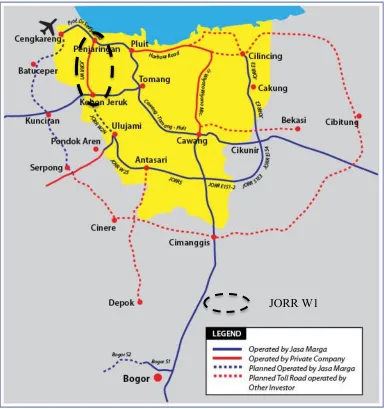
In February 2010 Jakarta Outer Ring Road W1 (JORR W1) starting operate as part of Jakarta Outer Ring Road System and alternative access for transport goods toward the Tanjung Priok Port and Soekarno-Hatta Airport. Private company under the Build, Operate, and Transfer (BOT) scheme runs the 9,35 km road. The road is part of Greater Jakarta Toll Road Network. The location of the project can be seen in the figure 1.1
Figure 1.1 Location of the Project
Source : civilhighway.wordpress.com
4
Just like other infrastructure project, JORR W1 toll road project encounter constraints that affected the project performance and considered as the risk of the project. Zayed and Chang (2002) found that risk in BOT project can be classified to the following project phases :
a. Development phase (technology, credit, and bid risks);
b. Construction phase (completion, cost overrun, performance, and political risks);
c. Operating phase (performance, cost overrun, liability, equity resale, and off take
risks); and
d. Ongoing risks (interest rate and currency risks)
As the JORR W1 project already in operating phase, it is necessary to do a review on the risk in the construction phase and what the risk management strategy in order to completed the project to gain understanding on how risk is managed in PPP project, and to give references on how to develop proper risk management in the future PPP projects.
1.2 Problem Statement
Infrastructure projects, particularly toll road construction requires a large investment with a very long construction period. The number of factors and stakeholders involved, led to the risk of the project implementation. Sources of risk can be interpreted as factors that could cause events that are negative or positive. For example, below is the source of the risk of a project:
a. Risks associated with management
b. Risks associated with technical and implementation c. Risks associated with contractual and legal
The risk is believed to be unavoidable. With regard to the public sector which demands transparency and performance improvements with limited funds, the risks faced by government agencies will be growing and increasing. Therefore, an understanding of risk become important to be able to determine priorities and program strategies in the achievement of organizational goals. The success of the project depends on how the risk can be managed. That is, events that have effect on cost, quality, and construction time. Proper risk management regarded as the key factors of project success. Since Indonesia is increasingly recognizing the need to attract private investment for its toll road development and to establish constructive partnership between private and public sector, it is necessary to discover proper risk management in toll road construction especially under the Public Private Partnership scheme.
1.3 Research Questions
In this research, there are some questions that need to be answered in order to achieve the objectives, namely:
a. What is the Public Private Partnership project definition?
b. How the implementation of PPP projects in Indonesia?
c. What are the problems usually occur in PPP project in Indonesia?
d. How does risk management in PPP project in Indonesia applied?
6
1.4 Research Objectives
Based on the problem statement and the research question above, this study will attempt to:
a. Identify the risk in PPP projects.
b. Identify the potential risk that affected the construction process.
c. Identify risk management in the construction process.
1.5 Scope of The Research
The scope and the limitation of the study:
a. The research is limited for PPP projects in toll road development under BOT
scheme.
b. The study will be focused on Jakarta Outer Ring Road W1 (JORR W1) toll road
project.
c. The study will be focused on risk during the construction process.
1.6 Research Significance
The study seeks to gain clearer understanding of how risk is managed in PPP
project, and to give references on how to develop proper risk management in the
1.7 Organization of the Report
The followings are the summary of each chapter on this research project paper.. This study is composed of five chapters as follow :
Chapter 1 presents the introduction, which is including background of the study, problem statement, objective of the study, scope of the study, importance of the study, and research methodology
Chapter 2 will reviews literature data relating to risk allocation, Indonesian toll road development, legal basis of Indonesian toll road development, and also the description of Indonesia’s Public-Private Partnership practice.
Chapter 3 describes the methodology that adopted to conduct this research, which describe the object of study, finding data method, analysis method.
Chapter 4 presents data analysis result on the risk allocation in PPP project, discussions and the literature review findings as an achievement of the objective of this research.
54
REFERENCES
Abednego, Martinus P., Ogunlana, Stephen O. (2006). Good project governance for proper risk allocation in public-private partnership in Indonesia. International Journal of Project Management 24. pp: 622-634.
Abrar Husen (2003). Analisis Alokasi Risiko pada Proyek Jalan Tol Jenis Investasi Build Operate Transfer (BOT)). University of Indonesia
Aigbokan, B. E., “Evaluating Investment on Basic Infrastructure in Nigeria”, Proceedings of the Eighth Annual Conference of the Zonal Research Units (Organised by Research Dept., Central Bank of Nigeria, at Hamdala Hotel, Kaduna, 11 –15 June, 1999), p.208
Akintoye, A.S. and MacLeod, M.J. (1997) Risk Analysis and Management in Construction, International Journal of Project Management, 15(1), 31-38.
ANSI (2004), A Guide to the Project Management Body of Knowledge (PMBOK Guide). Project Management Institute.
Chapman R.J. (2001) The Controlling Influences on Effective Risk Identification and Assessment for Construction Design Management, International Journal of Project Management, 19, 147-160.
Creswell, J.W. (2003). Research design: Qualitative, quantitative, and mixed methods approaches. Thousand Oaks, California: Sage.
Journal of the Indonesia Infrastructure Initiative, PRAKARSA Issue 5 / January 2011
managing risks and opportunities. School of the Built and Natural Environment. Glasgow Caledonian University, Blackwell Science
Li, B., Akintoye, A., Edwards, P.J., Hardcastle, C., (2005) The Allocation of Risk in PPP/PFI construction project in UK. International Journal of Project Management 23 (1), 25-35.
Norton Rose, 2011. Indonesia Inward Investment, A Industry Survey, Retrieved 29 March 2012 www.nortonrose.com
Nur Wulan. Analisa kelayakan financial proyek jalan tol: Studi kasus jalan tol Cipularang (Feasibility study of toll-road project financing: a case study of the Cipularang tollway), Tugas Akhir No. 007/TS/D-IV JT/111/2005, Politeknik Negeri Jakarta; 2005
Robert R. Moeller. 2007., COSO Enterprise Risk Management Understanding New Integrated ERM Framework. John Wiley and Sons. New Jersey
The Coordinating Ministry for Economy (2011), Public Private Partnership (PPP) Investor’s Guide. Jakarta
Vaughan, Emmet J. (1978) Fundamental Risk and Insurance, John Wiley and Sons. Santa Barbara
Ward, S., Chapman, C., 2003. Transforming project risk management into project uncertainty management. International Journal of Project Management, 21, 97-105.
World Bank, World Development Report 1994, Infrastructure for Development. Washington DC.
56
Yin, R. (1984). Case study research: Design and methods (1st ed.). Beverly Hills, CA: Sage Publishing.