2013
Learning classifiers from linked data
Harris Lin
Iowa State University
Follow this and additional works at:
https://lib.dr.iastate.edu/etd
Part of the
Artificial Intelligence and Robotics Commons
This Dissertation is brought to you for free and open access by the Iowa State University Capstones, Theses and Dissertations at Iowa State University Digital Repository. It has been accepted for inclusion in Graduate Theses and Dissertations by an authorized administrator of Iowa State University Digital Repository. For more information, please [email protected].
Recommended Citation
Lin, Harris, "Learning classifiers from linked data" (2013).Graduate Theses and Dissertations. 13545. https://lib.dr.iastate.edu/etd/13545
by Harris Lin
A dissertation submitted to the graduate faculty in partial fulfillment of the requirements for the degree of
DOCTOR OF PHILOSOPHY
Major: Computer Science
Program of Study Committee: Vasant Honavar, Major Professor
Samik Basu Oliver Eulenstein
Giora Slutzki Jin Tian
Iowa State University Ames, Iowa
DEDICATION
TABLE OF CONTENTS
LIST OF TABLES vii
LIST OF FIGURES viii
ACKNOWLEDGEMENTS x
ABSTRACT xi
CHAPTER 1. LEARNING CLASSIFIERS FROM LINKED DATA:
AN OVERVIEW 1
1.1 Introduction . . . 1
1.2 Dissertation Overview . . . 3
CHAPTER 2. LEARNING RELATIONAL BAYESIAN CLASSIFIERS FROM RDF DATA 6 2.1 Introduction . . . 6
2.2 Problem Formulation . . . 9
2.3 Learning from RDF data . . . 11
2.4 Updatable Models . . . 14
2.5 Communication Complexity . . . 17
2.6 Selective Attribute Crawling . . . 18
2.7 Experiments . . . 19
2.7.1 Communication Complexity Experiment . . . 19
2.7.2 Selective Attribute Crawling Experiment . . . 20
2.8 Conclusion . . . 24
2.8.1 Summary . . . 24
2.8.2 Related Work . . . 24
CHAPTER 3. LEARNING CLASSIFIERS FROM RDF DATA WITH SUBCLASS HIERARCHIES 25 3.1 Introduction . . . 25
3.2 Problem Formulation . . . 26
3.3 Learning Classifiers with Subclass Hierarchies . . . 27
3.4 Experiments . . . 29
3.4.1 UCI datasets with Subclass Hierarchy . . . 29
3.4.2 RDF datasets with Subclass Hierarchy . . . 30
3.5 Discussion . . . 31
3.6 Conclusion . . . 33
3.6.1 Summary . . . 33
3.6.2 Related Work . . . 34
3.6.3 Future Work . . . 34
CHAPTER 4. LEARNING CLASSIFIERS FROM DISTRIBUTIONAL DATA 36 4.1 Introduction . . . 36
4.2 Distributional Instance Classification Problem . . . 39
4.3 Distributional Instance Learning Algorithms . . . 40
4.3.1 Aggregation . . . 40 4.3.2 Generative Models . . . 41 4.3.3 Discriminative Models . . . 43 4.4 Experimental Results . . . 44 4.4.1 Experiment I . . . 44 4.4.2 Experiment II . . . 48 4.5 Conclusion . . . 51
4.5.1 Summary . . . 51
4.5.2 Related Work . . . 51
4.5.3 Future Work . . . 53
CHAPTER 5. LEARNING CLASSIFIERS FROM CHAINS OF MULTI-PLE INTERLINKED RDF DATA STORES 54 5.1 Introduction . . . 54
5.2 Learning Classifiers from RDF Data . . . 56
5.2.1 RDF Learner Defined . . . 56
5.2.2 Representative Classes of RDF Learners . . . 57
5.2.3 Sufficient Statistics . . . 58
5.2.4 Approximating Vi k . . . 59
5.3 Learning Classifiers from Multiple Interlinked RDF Data Stores . . . 60
5.3.1 Characterizing RDF Data Fragmentation . . . 61
5.3.2 Learning Classifiers under OLNF and ILNF . . . 63
5.4 Experiments and Results . . . 64
5.4.1 Data Sets . . . 64
5.4.2 Learning Classifiers from OLNF RDF Data Fragments . . . 65
5.4.3 Sensitivity of ART . . . 66 5.4.4 Communication Complexity . . . 67 5.5 Conclusion . . . 68 5.5.1 Summary . . . 68 5.5.2 Related Work . . . 69 5.5.3 Future Work . . . 70
CHAPTER 6. GENERAL CONCLUSIONS 71 6.1 Summary and Contributions . . . 71
APPENDIX A. DERIVATION OF DISCRIMINATIVE MODELS IN
SEC-TION 4.3.3 74
LIST OF TABLES
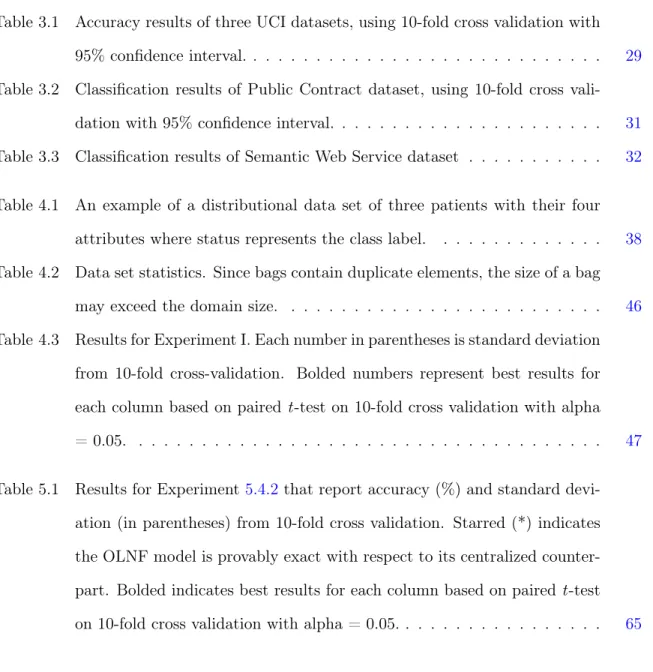
Table 3.1 Accuracy results of three UCI datasets, using 10-fold cross validation with 95% confidence interval. . . 29
Table 3.2 Classification results of Public Contract dataset, using 10-fold cross vali-dation with 95% confidence interval. . . 31
Table 3.3 Classification results of Semantic Web Service dataset . . . 32
Table 4.1 An example of a distributional data set of three patients with their four attributes where status represents the class label. . . 38
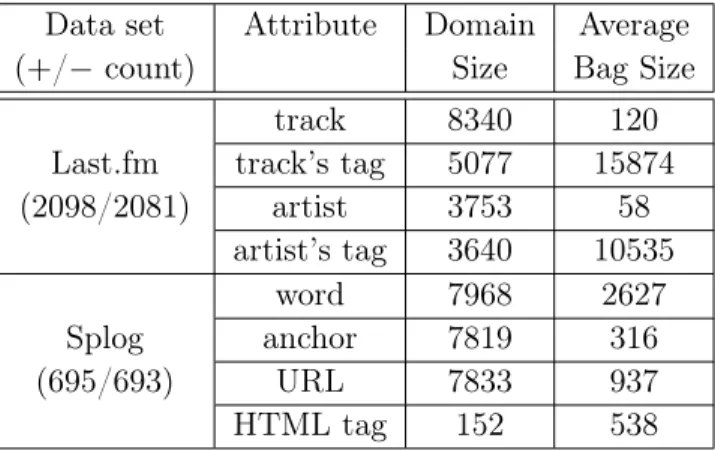
Table 4.2 Data set statistics. Since bags contain duplicate elements, the size of a bag may exceed the domain size. . . 46
Table 4.3 Results for Experiment I. Each number in parentheses is standard deviation from 10-fold cross-validation. Bolded numbers represent best results for each column based on pairedt-test on 10-fold cross validation with alpha
= 0.05. . . 47
Table 5.1 Results for Experiment 5.4.2 that report accuracy (%) and standard devi-ation (in parentheses) from 10-fold cross validdevi-ation. Starred (*) indicates the OLNF model is provably exact with respect to its centralized counter-part. Bolded indicates best results for each column based on paired t-test
LIST OF FIGURES
Figure 2.1 RDF schema for the movie domain . . . 9
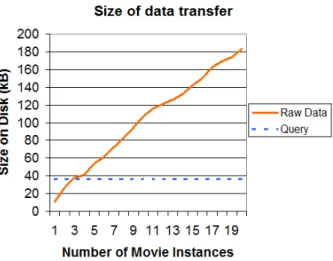
Figure 2.2 Comparison of size of data transfer for Experiment 2.7.1. . . 21
Figure 2.3 Comparison of two crawling strategies for Experiment 2.7.2 . . . 21
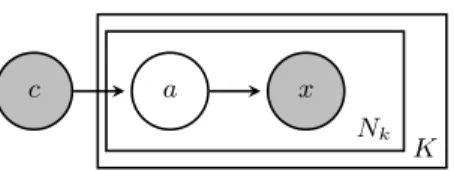
Figure 3.1 A graphical model representation of the proposed model to learn with subclass hierarchies. . . 27
Figure 4.1 A portion of Last.fm data set with entities and links among them. En-tities are users u, tracks t, track’s tags tt, artists a, and artist’s tags at.
Corresponding distributional data instances are x1 = {{t1, t2},{a1, a2},
{tt1, . . . tt5},{at1, . . . , at7}} and x2 = {{t1, t3}, {a1, a3}, {tt1, . . . , tt7},
{at1, . . . at6, at8, at9}}. . . 45 Figure 4.2 Generation process for the synthetic data. We controlc andz to generate
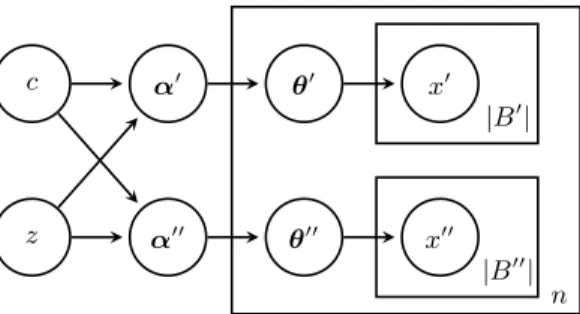
ndata with bags of size|B|=|B0|+|B00|. Dirichlet parameter α0 andα00 is deterministically generated givenc andz. . . 48
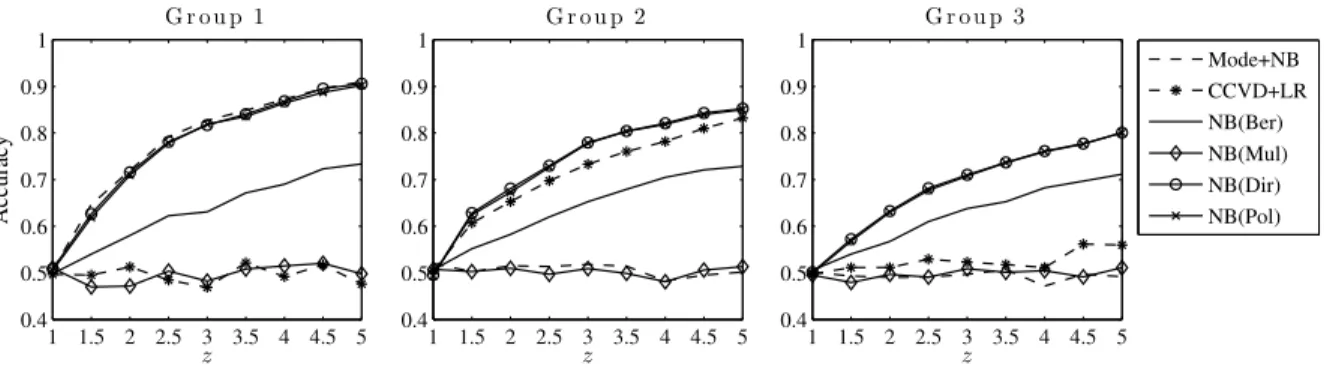
Figure 4.3 Accuracies of six classifiers on different groups of data sets where each synthetic data set consists of samples drawn from a stochastic process which is a composition of two Polya processes. . . 50
Figure 5.1 A motivating scenario of two RDF stores that are linked to form a chain
of RDF stores: Facebook users share posts about news items published in New York Times. . . 55
Figure 5.2 Distributed learning framework from multiple interlinked RDF stores. In practice there can be interactions (queries and RDF links) between any two data sources, in the figure only the adjacent interactions are drawn for simplicity. . . 60
Figure 5.3 Two fragmented data sources D1 and D2 showing an example of both OLNF and ILNF, because both subject resourcesS1∪ {S3, S4}and object resources {S2, S3} ∪ {S1, S4} for each fragment are disjoint. However it is not LFNF becauseS1 and S3 are shared. . . 62 Figure 5.4 Computation of root projection and leaf projection under different data
fragmentations: (i) LFNF (top); and (ii) OLNF and ILNF (bottom). . . . 63
Figure 5.5 RDF Schema of Last.fm data set. . . 64
Figure 5.6 Projection and matrix errors at various stages of ART approximation. . . 67
Figure 5.7 Classification performance using data reconstructed at various stages of ART approximation. . . 67
Figure 5.8 Communication complexities over the size of data sets (measured by num-ber of Users). . . 68
ACKNOWLEDGEMENTS
I would like to express my deepest gratitude to my advisor Dr. Vasant Honavar, for his continued and insightful mentoring, and his perseverant support to all stages of my graduate studies. I am also thankful for his boundless tolerance, that allows me to make mistakes and grow up from them.
I would also like to thank my program of study committee members, for supervising my graduate program and providing valuable feedbacks. My special thanks go to Dr. Oliver Eulenstein who provided a research assistantship that supported part of my graduate studies while I was still in the Masters program.
Many thanks also go to current and some of past members of the Artificial Intelligence Research Lab: Jie Bao for introducing me to the world of Semantic Web, Neeraj Koul for his constant inspiration and support, Yasser EL-Manzalawy for his kind leadership in the lab, Ngot Bui for helping with dataset preparation, Sanghack Lee for assisting with implementation on distributional data. I also appreciate many entertaining lunch discussions with all members, including Rafael Jordan, Jia Tao, Fadi Towfic, Rasna Walia, and Li Xue.
Furthermore I would like to extend my acknowledgement to Grandmaster Farrah Chen and Grandmaster Yong Chin Pak, who provided invaluable spiritual support during some of the difficult times throughout my graduate studies.
This research was supported in part by a grant (IIS 0711356) from the National Science Foundation (NSF), in part by the Iowa State University Center for Computational Intelligence, Learning, and Discovery, and in part by teaching assistantships in Computer Science Depart-ment.
ABSTRACT
The emergence of many interlinked, physically distributed, and autonomously maintained linked data sources amounts to the rapid growth of Linked Open Data (LOD) cloud, which offers unprecedented opportunities for predictive modeling and knowledge discovery from such data. However existing machine learning approaches are limited in their applicability because it is neither desirable nor feasible to gather all of the data in a centralized location for analysis due to access, memory, bandwidth, or computational restrictions. In some applications additional schema such as subclass hierarchies may be available and exploited by the learner. Furthermore, in other applications, the attributes that are relevant for specific prediction tasks are not known a priori and hence need to be discovered by the algorithm. Against this background, we present a series of approaches that attempt to address such scenarios. First, we show how to learn Relational Bayesian Classifiers (RBCs) from a single but remote data store using statistical queries, and we extend to the setting where the attributes that are relevant for prediction are not known a priori, by selectively crawling the data store for attributes of interest. Next, we introduce an algorithm for learning classifiers from a remote data store enriched with subclass hierarchies. Our algorithm encodes the constraints specified in a subclass hierarchy using latent variables in a directed graphical model, and adopts the Variational Bayesian EM approach to efficiently learn parameters. In retrospect, we observe that in learning from linked data it is often useful to represent an instance as tuples of bags of attribute values. With this inspiration, we introduce, formulate, and present solutions for a novel type of learning problem which we call distributional instance classification. Finally, building up from the foundations, we consider the problem of learning predictive models from multiple interlinked data stores. We introduce a distributed learning framework, and identify three special cases of linked data fragmentation then describe effective strategies for learning predictive models in each case. Further, we consider a novel application of a matrix reconstruction technique from the field
of Computerized Tomography to approximate the statistics needed by the learning algorithm from projections using count queries, thus dramatically reducing the amount of information transmitted from the remote data sources to the learner.
CHAPTER 1. LEARNING CLASSIFIERS FROM LINKED DATA: AN OVERVIEW
1.1 Introduction
The growing adoption of a set of best practices collectively referred to as Linked Data, for publishing structured data on the Web [Heath and Bizer (2011)] has made it possible to link and share many disparate, previously isolated, distributed, autonomously generated and managed data across virtually every domain of human endeavor. The community-driven Linked Open Data (LOD) effort allows structured data to be represented using Resource Description Framework (RDF) [Manola and Miller (2004)] in the form of subject-predicate-object triples (also called RDF triples), which describe a directed graph where the directed labeled edges encode binary relations between labeled nodes. RDF stores and associated query languages such as SPARQL [Prud’ommeaux and Seaborne (2008)] offer the means to store and query large amounts of RDF data. LOD also enables integration of previously isolated distributed data such as data stored in multi-relational databases [Hert et al. (2011)]. At present, LOD includes more than a few hundred linked data sets that together contain more than a few trillion RDF triples [Cyganiak and Jentzsch(2011)] covering domains including government, life sciences, geography, social media, and commerce. The emergence of LOD offers unprecedented opportunities for using disparate data sources in predictive modeling and decision making in a broad range of applications ranging from scientific discovery to public policy [Hert et al.
(2011);Sahoo et al.(2009)]. However, there has been very limited work on effective approaches to learning predictive models from LOD. Existing machine learning approaches are limited in their applicability in this setting:
entire data set from an RDF store for local analysis due to main memory, bandwidth, or computational constraints. In other settings, access to data may be limited due to the privacy or confidentiality considerations [Aggarwal and Yu(2008);Wu et al.(2010)]. This calls for techniques for learning predictive models from an RDF store which supports only indirect access to data through a query interface (SPARQL access point) that supports a limited class of queries (e.g., counts of RDF triples that match some specified criteria) [Prud’ommeaux and Seaborne (2008)].
• RDF triples in an RDF store have often associated with them, RDF Schema (RDFS, Brick-ley and Guha(2004)) that specifies set of classes that organize RDF objects (subjects and objects of predicates) and predicates into type hierarchies as well as domain and range restrictions on RDF predicates (i.e., the type of RDF objects that can appear as subjects or objects of a predicate respectively). Hence, there is a need for algorithms that can effectively exploit RDFS to construct compact and accurate predictive models from RDF data.
• RDF stores are sometimes subject to frequent updates. In such settings, it is necessary to update the predictive model to reflect the changes in the data source used to build the model. While in principle, the learning algorithm can be re-executed each time there is an update to the data source, it is of interest to explore more efficient solutions for incrementally updating the predictive model without the need to process the entire data set each time there is an update.
• LOD includes many loosely linked, physically distributed, autonomously maintained RDF stores where it is neither desirable nor feasible to gather all of the data in a centralized location for analysis, because of access, memory, bandwidth, and computational restric-tions. Hence, there is a need for effective approaches to learning predictive models from distributed, loosely linked RDF stores.
Against this background, this dissertation aims to develop and evaluate novel statistical machine learning algorithms for learning predictive models from LOD.
1.2 Dissertation Overview
Chapter 1: Learning Classifiers from Linked Data: an Overview
We present a general introduction and motivation for the problem of learning from Linked Data, as well as an overview and a summary of contributions of this dissertation.
Chapter 2: Learning Relational Bayesian Classifiers from RDF Data
This chapter presents our first set of results, showing an approach to learning Relational Bayesian Classifiers (RBCs, [Neville et al.(2003b)]) from a single but remote RDF data store. Specifically, we show how to build RBCs from RDF data using statistical queries through the SPARQL endpoint of the RDF store. We compare the communication complexity of our algorithm with one that requires direct centralized access to the data and hence has to retrieve the entire RDF dataset from the remote location for processing. We establish the conditions under which the RBC models can be incrementally updated in response to addition or deletion of RDF data. We show how our approach can be extended to the setting where the attributes that are relevant for prediction are not known a priori, by selectively crawling the RDF data for attributes of interest.
This chapter has been published in [Lin et al. (2011)].
Chapter 3: Learning Classifiers From RDF Data with Subclass Hierarchies
We consider a more general problem than what is presented in Chapter 2, where we intro-duce an algorithm for learning classifier from a remote RDF data store enriched with subclass hierarchies. Our algorithm encodes the constraints specified in a subclass hierarchy using latent variables in a directed graphical model, and adopts the Variational Bayesian EM approach to efficiently learn parameters. We conduct experiments with several real world datasets and show that our solution achieves equal or better performance compared to other state-of-art mod-els that incorporate subclass hierarchies, and is able to scale up to large hierarchies over few thousand nodes.
Chapter 4: Learning Classifiers from Distributional Data
We observe in the previous two chapters that in learning from linked data (or relational data in general) it is often useful to represent an instance asK-tuples of bags of feature values,
however we believe that a precise probabilistic formulation of this representation is not suffi-ciently covered in the literature. Inspired by this representation, in this chapter we set aside our motivation of learning from linked data and investigate a novel type of learning problem which we calldistributional instance classification. We motivate, precisely formulate, and present
so-lutions for this problem. We will resume our setting of linked data in Chapter 5where we will solve a more challenging problem that utilizes the results presented in this chapter.
This chapter has been published in [Lin et al. (2013)].
Chapter 5: Learning Classifiers from Chains of Multiple Interlinked RDF Data Stores
In this chapter we consider the problem of learning predictive models from multiple inter-linked RDF stores. We extend Chapter 2 by incorporating the set of classifiers introduced in
Chapter4, and further extend the problem by considering a chain of multiple interlinked RDF stores. Specifically we: (i) introduce statistical query based formulations of several represen-tative algorithms for learning classifiers from RDF data; (ii) introduce a distributed learning framework to learn classifiers from multiple interlinked RDF stores that form a chain; (iii) iden-tify three special cases of RDF data fragmentation and describe effective strategies for learning predictive models in each case; (iv) consider a novel application of a matrix reconstruction tech-nique from the field of Computerized Tomography [Herman(2009)] to approximate the statistics needed by the learning algorithm from projections using count queries, thus dramatically re-ducing the amount of information transmitted from the remote data sources to the learner; and (v) report results of experiments with a real-world social network data set (Last.fm), which demonstrate the feasibility of the proposed approach.
Chapter 6: General Conclusions
We conclude with a summary of the dissertation, the contributions, and broader directions for future work.
CHAPTER 2. LEARNING RELATIONAL BAYESIAN CLASSIFIERS FROM RDF DATA
The massive size and distributed nature of RDF data call for approaches to learning from RDF data in a setting where the data can be accessed only through a query interface, e.g., the SPARQL endpoint of the RDF store. In applications where the data are subject to frequent updates, there is a need for algorithms that allow the predictive model to be incrementally updated in response to changes in the data. Furthermore, in some applications, the attributes that are relevant for specific prediction tasks are not known a priori and hence need to be discovered by the algorithm. In this chapter we present an approach to learning Relational Bayesian Classifiers (RBCs) from RDF data that addresses such scenarios. Specifically, we show how to build RBCs from RDF data using statistical queries through the SPARQL endpoint of the RDF store. We compare the communication complexity of our algorithm with one that requires direct centralized access to the data and hence has to retrieve the entire RDF dataset from the remote location for processing. We establish the conditions under which the RBC models can be incrementally updated in response to addition or deletion of RDF data. We show how our approach can be extended to the setting where the attributes that are relevant for prediction are not known a priori, by selectively crawling the RDF data for attributes of interest. We provide open source implementation and evaluate the proposed approach on several large RDF datasets.
2.1 Introduction
The increasing availability of large RDF datasets on the web offers unprecedented oppor-tunities for extracting useful knowledge or predictive models from RDF data, and using the
resulting models to guide decisions in a broad range of application domains. Hence, it is natu-ral to consider the use of machine learning approaches, and in particular, statistical relational learning algorithms [Getoor and Taskar (2007)], to extract knowledge from RDF data [Kiefer et al.(2008);Bicer et al. (2011);Tresp et al.(2009)]. However, existing approaches to learning predictive models from RDF data have significant shortcomings that limit their applicability in practice. Specifically, existing approaches rely on the learning algorithm having direct access to RDF data. However, in many settings, it may not be feasible to transfer data a massive RDF dataset from a remote location for local processing by the learning algorithm. Even in settings where it is feasible to provide the learning algorithm direct access to a local copy of an RDF dataset, algorithms that assume in-memory access to data cannot cope with RDF datasets that are too large to fit in memory. Hence, there is an urgent need for approaches to learning from RDF data in a setting where the data can be accessed only through a query interface, e.g., the SPARQL endpoint for the RDF store. In applications where the data are subject to frequent updates, there is a need for algorithms that allow the predictive model to be incrementally updated in response to changes in the data. Furthermore, in some applications, the attributes that are relevant for specific prediction tasks are not known a priori and hence need to be dis-covered by the algorithm. We present an approach to learning Relational Bayesian Classifiers from RDF data that addresses such scenarios.
Our approach to learning Relational Bayesian Classifiers (RBCs) from RDF data adopts the general framework introduced byCaragea et al.(2005) for transforming a broad class of standard learning algorithms that assume in memory access to a dataset into algorithms that interact with the data source(s) only through statistical queries or procedures that can be executed on the remote data sources. This involves decomposing the learning algorithm into two parts: (i) a component that poses the relevant statistical queries to a data source to acquire the information needed by the learner; and (ii) a component that uses the resulting statistics to update or refine a partial model (and if necessary, further invoke the statistical query component). This approach has been previously used to learn a variety of classifiers from relational databases [Koul et al.
(2008)] using SQL queries and from biomolecular sequence data [Koul et al. (2010)]. It has recently become feasible to use a similar approach to learning RBCs from RDF data due to the
incorporation of support for aggregate queries in SPARQL. (SPARQL 1.1 supports aggregate queries whereas SPARQL 1.0 does not).
We show how to learn RBCs from RDF data using only aggregate queries through the SPARQL endpoint of the RDF store. This approach does not require in-memory access to RDF data to be processed by the learning algorithm, and hence can scale up to very large data sets. Because the predictive model is built using aggregate queries against a SPARQL endpoint, it can be used to learn RBCs from large remote RDF stores without having to transfer the data to a local RDF store for processing (in general, the cost of retrieving the statistics needed for learning is much lower than the cost of retrieving the entire dataset). Under certain conditions which we identify in the paper, we show how the RBC models can be incrementally updated in response to changes (addition or deletion of triples) from the RDF store. We further show how our approach can be extended to the setting where the attributes that are relevant for prediction are not known a priori, by selectively crawling the RDF data for attributes of interest. We have implemented the proposed approach into INDUS [Koul and Lin (2013)], an open source suite of learning algorithms, that learn from massive data sets only using statistical queries. We describe results of experiments on several large RDF datasets that demonstrate the feasibility of the proposed approach to learning RBCs from RDF stores.
The rest of the chapter is organized as follows: Section 2.2introduces a precise formulation of the problem of learning RBCs from RDF data. Section 2.3 describes how to build RBCs from RDF data using only aggregate queries. Section2.4identifies the conditions under which it is possible to incrementally update an RBC learned model from an RDF store in response to updates to the underlying RDF store. Section 2.5 presents an analysis of the communica-tion complexity of learning RBCs from RDF stores. Seccommunica-tion 2.6 describes how to extend to the setting where the attributes that are relevant for prediction are not known a priori, by selectively crawling the RDF data for attributes of interest. Section 2.7 describes results of experiments with several RDF datasets that demonstrate the feasibility proposed approach. Finally Section2.8 concludes with a summary and a brief discussion of related work.
Figure 2.1 RDF schema for the movie domain 2.2 Problem Formulation
In this section we formulate the problem of learning predictive models from RDF data. Assume there are pairwise disjoint infinite setsI,B,Land V (IRIs, Blank nodes, Literals and
Variables respectively). A triple(s, p, o)∈(I∪B)×I×(I∪B∪L)is called an RDF triple. In this triple,s is the subject,p the predicate, and o the object. An RDF graph is a set of RDF
triples.
As a running example for the following definitions, we consider the RDF schema for the movie domain as shown in Figure2.1. We wish to predict whether a movie receives more than $2M in its opening week.
Definition 2.1. [Target Class] Given an RDF graphG, atarget class is a distinguished IRI of
type rdfs:Class inG. For example, Movie.
Definition 2.2. [Instances] Given an RDF graph G and a target class T, the instances ofT,
denotedT(G)is the set {x: (x,rdf:type,T)∈ G}.
Definition 2.3. [Attribute] Given an RDF graph G and a target class T, anattribute A (of a
target classT) is a tuple of IRIs (p1, . . . , pn) such that the domain ofp1 isT, the range of pi is
the domain ofpi+1, and the range ofpn is a literal. For example, (hasActor, foaf, yearOfBirth).
We also refer the range of the attribute Aas the range of pn.
Definition 2.4. [Attribute Graph] Given an instancexof the target classT in the RDF graph G and an attribute A = (p1, . . . , pn), the attribute graph of the instance x, denoted by A(x),
is the union of the sets of triples that match the Basic Graph Pattern [Prud’ommeaux and Seaborne(2008)]
((x, p1,?v1) AND(?v1, p2,?v2)AND . . . AND(?vn−1, pn,?vn)) (2.1)
wherevi ∈V are variables.
Given an additional literal valuea, we also define a filtered attributed graph, denotedA(x, a), which includes the filter constraint FILTER(?vn=a) in the graph pattern (2.1). Further, if A
is a tuple of attributes(A1, . . . , An), then we defineA(x) to be(A1(x), . . . , An(x))
Definition 2.5. [Target Attribute] Given an RDF graph G and a target class T, a target attribute is a distinguished attribute denoted byC. For example, (openingReceipts).
C(x) is intended to describe the class label of the instance x, hence we assume that each
instance has exactly one class label, i.e.,|C(x)|= 1for everyx∈ T(G). Given a target attribute
C= (p1, . . . , pn), we define v(C, x) to be the value of ?vn matched by the graph pattern (2.1).
Definition 2.6. [Class Label] Given a target attribute C = (p1, . . . , pn), the set ofclass labels
is the the range ofpn. For brevity we denote this set by C.
Definition 2.7. [RDF Dataset] AnRDF dataset Dis a tuple(G,T,A, C)whereG is an RDF
graph,T a target class inG,Aa tuple of attributes, andCis a target attribute. We also denote
the tuple (T,A, C)asDesc(D) corresponding to the descriptor of the dataset.
Definition 2.8. [Induced Attribute Graph Dataset] Given an RDF dataset D= (G,T,A, C), its induced attribute graph dataset, denotedI(D), is defined as{(A(x), v(C, x)) : x∈ T(G)}.
We now formalize the the problem of learning from RDF data.
Problem 2.9. Given an RDF datasetD= (G,T,A, C)and its induced attribute graph dataset
I(D), a hypothesis classH, and a performance criterionP, the learning algorithmLoutputs a
classifier h∈H that optimizes P. The input to the classifier h isA(x) wherex is an instance
2.3 Learning from RDF data
We reduce the problem of learning from RDF data to the problem of learning from multiset attribute data which is defined below. This reduction allows for application of algorithms for learning from multiset attribute data (e.g. Relational Bayesian Classifier [Neville et al.(2003b)]) to this setting. Given an RDF datasetD= (G,T,A, C)and its induced attribute graph dataset
I(D), consider an attribute A and the attribute graph A(x) of an instance x ∈ T(G). The attribute graph A(x) can be viewed as a directed acyclic graph (DAG) rooted in x, and here
we are interested in only the leaves of this DAG. The following definition captures this notion. Definition 2.10. [Leaf] Given an attributeAi, we define the leaf functionL(Ai(x))that returns
the multiset of leaves of Ai(x), such that each leaf a ∈ Ai(x) is replaced with n copies of a
wherenis the number of unique paths fromx toa. For brevity we writeL(Ai(x))asLi(x) and L(Ai(x, a))asLi(x, a).
Also, we overload the leaf function on a tuple of attributesA= (A1, . . . , An)byL(A(x)) =
(L1(x), . . . ,Ln(x)). Using the leaf function, we reduce I(D) into a multiset attributed dataset M(D) = {(L(A(x)), v(C, x)) : x ∈ T(G)}. To learn from M(D) we focus our attention on Relational Bayesian Classifiers (RBC) motivated from modeling relational data [Neville et al.
(2003b)]. RBC assumes that attribute multisets are independent given the class, and the most probable class of an instance is given by:
hRBC(x) =argmax c∈C
p(c)Y
i
p(Li(x) : c) (2.2)
Several methods to estimate the probabilities p(Li(x) : c) are described by Neville et al.
(2003b):
• Aggregation: pˆagg(Li(x) : c) = ˆp(agg(Li(x)) : c), where agg is an aggregation function
such as min, max, average for continuous attributes; and mode for discrete attributes. • Independent Value: pˆind(Li(x) : c) = Qa∈Li(x)pˆ(a : c), which assumes each value in
the multiset is independently drawn from the same distribution (attribute value indepen-dence).
• Average Probability: pˆavg(Li(x) : c) = P
a∈Li(x) ˆp(a:c)
|Li(x)| , which also assumes attribute value independence as in Independent Value, however during inference the probabilities
are averaged instead of multiplied.
For estimating the parameters in (2.2), we assume that the learner does not have access to the RDF graph G but instead only has knowledge T,A,and C. In addition, we assume that the
RDF store answers statistical queries over the RDF graphGwhich in our setting correspond to
aggregate SPARQL queries submitted to a SPARQL endpoint. Given a descriptorDesc(D) = (T,A, C)whereC= (c1, . . . , cm)we assume that the RDF store supports the following type of
primitive queries:
(Q1) S(G,T) =|T(G)|, the number of instances of target typeT inG. This corresponds to the
SPARQL query:
SELECT COUNT(*) WHERE { ?x rdf:type <T> . }
(Q2) S(G,T, C =c) =|{x ∈ T(G) : v(C, x) =c}|, the number of instances of target type T
in which the target attribute takes the class label c. This corresponds to the SPARQL
query:
SELECT COUNT(*) WHERE { ?x rdf:type <T> .
?x <c1> ?c1 . ... ?cm-1 <cm> c . }
(Q3) S(G,T, C = c, Ai) = Px∈T(G)and v(C,x)=c|Li(x)|. Assuming the attribute Ai =
(p1, . . . , pj) this corresponds to the SPARQL query:
SELECT COUNT(*) WHERE { ?x rdf:type <T> .
?x <c1> ?c1 . ... ?cm-1 <cm> c . ?x <p1> ?v1 . ... ?vj-1 <pj> ?vj . }
(Q4) S(G,T, C = c, Ai = a) = Px∈T(G)and v(C,x)=c|Li(x, a)|. Assuming the attribute Ai =
(p1, . . . , pj) this corresponds to the SPARQL query:
SELECT COUNT(*) WHERE { ?x rdf:type <C> .
?x <c1> ?c1 . ... ?cm-1 <cm> c . ?x <p1> ?v1 . ... ?vj-1 <pj> a . }
(Q5) S(G,T, C =c, Ai,agg,[vl, vh]).
SELECT COUNT(*) WHERE {
{ SELECT (agg(?vj) AS ?aggvalue) WHERE { ?x rdf:type <T> .
?x <c1> ?c1 . ... ?cm-1 <cm> c .
OPTIONAL { ?x <p1> ?v1 . ... ?vj-1 <pj> ?vj . } } GROUP BY ?x
} FILTER(?aggvalue >= vl && ?aggvalue <= vh) }
We now proceed to describe how an RBC can be built using the supported SPARQL queries without requiring access to the underlying dataset. The RBC estimates the following probabil-ities from training data:
1. pˆ(c)
2. pˆ(agg(Ai) : c) for each attribute Ai where aggregation is used to estimate probabilities.
For simplicity, we discretize the aggregated values and predetermine the bins prior to learning. Hence, we estimate pˆ(agg(Ai)∈[vl, vh] : c) for each bin[vl, vh]
3. pˆ(a: c) wherea is in the range of Ai, for each attribute Ai where independent value or
average probability is used to estimate the probabilities.
The above three probabilities can be estimated (using Laplace correction for smoothing) as follows:
1. pˆ(c) = SS((GG,,TT,c)+)+1m wherem is the number of class labels
2. pˆ(agg(Ai)∈[vl, vh] : c) = S(
G,T,C=c,Ai,agg,[vl,vh])+1
S(G,T,c)+m wheremis the number of bins (ranges)
3. pˆ(a: c) = S(G,T,C=c,Ai=a)+1
S(G,T,C=c,Ai)+m whereais in the range ofAi andmis the size of range ofAi Hence, it is possible to learn RBCs from an RDF graph by interacting with the RDF store only through SPARQL queries. This approach does not require access to the underlying dataset and in most practical settings requires much less bandwidth as compared to transferring the data to a local store for processing (see Section 2.5).
2.4 Updatable Models
In many settings, the RDF store undergoes frequent updates i.e., addition or deletion of sets of RDF triples. In such settings, it is necessary to update the predictive model to reflect the changes in the RDF store used to build the model. While in principle, the algorithm introduced in Section2.3can be re-executed each time there is an update to the RDF store, it is of interest to explore more efficient solutions for incrementally updating the RBC model by updating only the relevant statistics.
Given a dataset D and a learning algorithm L, let L(D) be a predictive model built from the datasetD. Let θ be a primitive query required over the datasetDto build L(D).
Definition 2.11. [Updatable Model [Koul et al. (2010)]] Given datasets D1 andD2 such that
D1⊆D2, we say that a primitive queryθis updatable iff we can specify functionsf andg such
that:
1. θ(D2) =f(θ(D2−D1), θ(D1)) 2. θ(D1) =g(θ(D2), θ(D2−D1))
We say that the predictive model constructed using L is updatable iff all primitive queries
required over the dataset Dto build L(D) are updatable.
The following propositions show that the primitive query (Q1)of the RBC model is updat-able, whereas the rest of the queries are not updatable. Hence, in general, the RBC model is not updatable.
Proposition 2.12. The primitive query S(G,T) is updatable.
Proof. This query counts the number of instances of target typeT inG, which is the cardinality
of{x: (x,rdf:type,T)∈ G}. SinceG1⊆ G2 we haveS(G2,T) =S(G2− G1,T) +S(G1,T), and also S(G1,T) =S(G2,T)−S(G2− G1,T).
Proposition 2.13. The primitive query S(G,T, C =c, A=a) is not updatable.
Proof. We prove by showing a counter example. Let the target class be T, the target
at-tribute be C = (c1), an attribute A = (p1, . . . , pi, . . . , pn), and suppose we have the
follow-ing RDF graphs: S1 = {(x,rdf:type,T),(x, c1, c)}, S2 = {(x, p1, o1), . . . ,(oi−1, pi, oi)}, and
S3 ={(oi, pi+1, oi+1), . . . ,(on−1, pn, a)}. Suppose the graph before update is G1 =S1∪S2 and after an insertion ofS3 the graph becomesG2 =S1∪S2∪S3. For brevity letθ(G) =S(G,T, C =
c, A=a). We will show that there exists no functions f for the queryθ(G2), which counts the total number of leaves of A(x, a) such that x has the class label c. In G2 the attribute graph
A(x) is S2 ∪S3, and hence θ(G2) = 1. However, A(x) is partitioned among S2 and S3, so
θ(G1) = 0 andθ(G2− G1) = 0, therefore in this casef(θ(G2− G1), θ(G1)) =f(0,0) = 1 =θ(G2). Now consider another case where initially the graph is G3 = S1 and after insertion of S3 the graph becomes G4 =S1∪S3. In this case we have θ(G4) = 0,θ(G3) = 0, andθ(G4− G3) = 0, and sof(0,0) = 0. Since a function can not map an input to more than one output, this shows that there exists no functionf to maintain the query result.
Similarly, it can be shown that the primitive queriesS(G,T, C=c),S(G,T, C =c, A), and
S(G,T, C =c, A,agg,[vl, vh]) are not updatable.
Corollary 2.14. RBC model is not updatable.
The proof of Proposition 2.13 shows that when an attribute graph is partitioned across multiple updates, there exists no function to update the required counts. This raises the question as to whether we can ensure updatability by requiring that each update involves only complete attribute graphs. However, this requirement is not sufficient for the query to be updatable. To see why, considerG1 ={(x,rdf:type,T),(x, c1, c),(x, p1, o),(o, p2, a)}and G2− G1 =
is due to o being shared between two datasets despite the fact that each attribute graph is
complete. This motivates the restriction of not allowing the update toreuse certain subjects or
objects. We formalize this notion as follows.
Definition 2.15. [Clean Update] Assume G1 ⊆ G2, and let V(G) = {s: (s, p, o) ∈ G} ∪ {o: (s, p, o)∈ G} denote the set of all subjects and objects of an RDF graph G. An update (from G1 to G2 by insertion, or fromG2 to G1 by deletion) is said to be clean if [∀(s, p, o) ∈ G2][s /∈
V(G1)∩V(G2− G1)]. That is, triples inG2− G1 share objects with only the leaves of attribute
graphs in G1.
Proposition 2.16. RBC models are updatable if every update is clean.
Proof. LetD1 andD2 be two RDF datasets such thatD1 ⊆D2. We first consider the primitive query θ(G) = S(G,T, C = c, A = a). Since every update is clean, the attribute graphsA(x) for all attributes in A, and all instances x ∈ T(G1) and x ∈ T(G2 − G1) remain the same after insertion (or deletion). Hence, M(D2) =M(D1)∪ M(D2−D1) and similarlyM(D1) =
M(D2)− M(D2−D1) for the multiset attributed dataset reductions. It follows thatθ(G2) =
θ(G1) +θ(G2− G1) and θ(G1) = θ(G2)−θ(G2 − G1). Similar argument also holds true for the other queries used for learning a RBC.
Thus, RBC model can be updated incrementally in a restricted setting where every update is clean in the sense defined above. When clean updates are not available, RBC models can still be incrementally updated if we are willing to sacrifice some accuracy; and rebuild the model periodically by querying the entire RDF store, with the frequency of rebuild chosen based on the desired tradeoff between computational efficiency and model accuracy. Regardless of whether the RBC model is updatable or not, answering of aggregate queries from RDF stores answering can be optimized using an aggregate view maintenance algorithm [Hung et al. (2005)]. Since we assume that the data descriptor does not change as frequently as the data, the aggregate queries needed by the RBC model can be set up and maintained as views on the RDF store.
2.5 Communication Complexity
In this section, we analyze the communication complexity, i.e., the amount of data transfer needed to build an RBC model. We compare the communication complexity of building an RBC model from RDF data in the following two scenarios: (i) posing statistical queries needed for learning the model against a remote RDF store which is the approach proposed in this paper; and (ii) retrieving the entire RDF dataset from a remote RDF store for local processing.
Given an RDF dataset D= (G,T,A, C) where A= (A1, . . . , An). Suppose the RDF store
holds the RDF graphG, and let|G|denote the size of this graph. The communication complexity
in scenario (ii) is simply O(|G|). We now analyze the communication complexity in scenario (i). LetlC denote the length of tupleC, letrC denote the size of range ofC, and letlA denote
the maximum length of an attribute tuple. Also let r1A denote the maximum number of bins
of those attributes estimated by aggregation, let r2A denote the maximum size of range of the
remaining attributes, and we definerAto bemax(rA1, rA2).
The size of query expressed in SPARQL, is O(1) for (Q1),O(lC) for (Q2), andO(lC +lA)
for(Q3),(Q4), and(Q5). Further, to estimate the probabilities to build an RBC, the following number of calls for each query described in Section 2.3are required:
(Q1) one.
(Q2) rC, once for each class label.
(Q3) rC·n, once for each class label and each attribute.
(Q4) O(rC ·n·rA), once for each class label, each attribute, and each value of the attribute.
(Q5) O(rC ·n·rA), same as (Q4).
Therefore, the total complexity is O(1) +O(lCrC) +O((lC+lA)rCn)+
O((lC+lA)rC·n·rA) +O((lC +lA)rC ·n·rA) = O((lC +lA)rC ·n·rA). In Section 2.7.1 we
provide results of experiments which show thatO((lC+lA)rC·n·rA)is usually less thanO(|G|)
2.6 Selective Attribute Crawling
In previous sections we have considered the problem of learning RBCs given an RDF dataset
D= (G,T,A, C) in the setting where the learner has direct access toT,A,and C, but not G.
Here we consider a more general problem where the learner does not have a priori knowledge of
A. This requires the learner to interact with the RDF store containingG in order to determine A(e.g. by crawling and selecting attributes) that best optimizes a predetermined performance
criterionP. Since the number of attributes in an RDF store can be arbitrarily large we specify
an additional constraintZto guarantee termination (e.g. number of attributes crawled, number
of queries posed, time spent, etc.).
Problem 2.17. Given an RDF dataset without attributes,D = (G,T, C), a hypothesis class
H, a performance criterionP, and constraintZ, the learning algorithmLoutputs the following
while respecting Z: (i) The selected tuple of attributes A, and (ii) a classifier h ∈ H that
optimizesP.
For simplicity, we focus the setting where the constraintZspecifies the maximum the number
of attributes crawled. We consider the problem of identifyingAof cardinality at mostZ so as to
optimizeP. This problem is a variant of the well-studied feature subset selection problem [Liu
and Motoda(1998);Guyon and Elisseeff(2003)], albeit in a setting where the set of features is a priori unknown. Identifying attributes one at a time to optimizeP can be seen as a search over
a tree rooted atT, where the edges are IRIs of properties and the nodes are the domains/ranges
of properties, and an attribute corresponds to a path from the root to an RDF literal (a leaf in this tree). To complete the specification of the search problem, we need to specify operations for expanding a node to generate its successors and define the scoring function for evaluating nodes. Expanding a node consists of querying (i) the set of distinct properties outgoing from a node, (ii) the range of each property, and (iii) the type of each range (e.g. numeric, string, non-literal), each of which can be expressed as s SPARQL query. We define the score of a node based on the degree of correlation of the node with the target attributeC. Specifically, for each
attribute (represented by a leaf), we compute mutual information [Cover and Thomas (1991)] between it and the the target attributeC. The score of an internal node is defined (recursively)
as a function of its descendants, e.g. average of the scores of its children. Formally, the score of an attribute Ais:
Score(A) = X
C=c,A=a
p(A=a, C=c) log2 p(A=a, C=c)
p(A=a)p(C=c) (2.3) These probabilities can also be estimated based on the queries described in Section 2.3. Given this framework, a variety of alternative search strategies can be considered, along with several alternative scoring functions.
2.7 Experiments
We conduct three experiments each with a different goal. The first measures the commu-nication complexity using the LinkedMDB [Hassanzadeh and Consens (2009)] dataset. The second experiment combines the US Census dataset with a government dataset to evaluate the accuracy of models using different attribute crawling strategies. Finally we demonstrate learning of RBC from another government dataset through a live SPARQL endpoint.
2.7.1 Communication Complexity Experiment
The goal of this experiment is to measure the communication complexity under two different approaches described in Section 2.5.
2.7.1.1 Dataset and Experiment Setup
The IMDB dataset is a standard benchmark that has been used to evaluate probabilistic relational models including RBCs [Neville et al.(2003b)]. The task is to predict whether a movie receives more than $2M in its opening week. We used LinkedMDB [Hassanzadeh and Consens
(2009)], which is an RDF store extracted from IMDB, with links to other datasets on the Linked Open Data cloud [Cyganiak and Jentzsch (2011)]. We used links to Freebase1 which includes
f oaf property to theP ersonclass and three properties of class P erson. Figure2.1shows the
RDF schema of the extracted dataset. Since LinkedMDB does not have openingReceipts, we 1
add them by crawling the IMDB website2; also for the Freebase data, we parse the yearOfBirth
property for each Person from the dateOfBirth property. We extract 20 movies which are released after 2006 such that each movie has at least one actor, one director, and one producer. The target class isM ovieand the target attribute is(openingReceipts). We consider a total of 10 attributes: (runtime), and (h, f oaf, a) where h ∈ {hasActor, hasDirector, hasP roducer}
and a∈ {yearOf Birth, gender, hasAward}.
To show the growth of data transfer, we prepared 20 subsets of the dataset by corresponding to 1 to 20 movies. A movie instance consists of the URI of the movie and all reachable linked data for it. For communication complexity of learning RBC from RDF stores using statistical queries, we used the proposed approach to build an RBC for each subset and logged the SPARQL queries sent, saved the log in a plain text format, and measured the size of the logs. We compared the results with the communication complexity of learning RBC by first retrieving the data from a remote store for local processing as measured by the size of the corresponding dataset in RDF/XML format on disk.
2.7.1.2 Results
Figure 2.2 shows that the size of the raw data exceeds that of the query when there are more than three movie instances in the dataset. We also considered the case where the RDF store compresses the raw data before transfer, and in this case the size of the compressed raw data exceeds that of the query when there are more than 90 movie instances.
2.7.2 Selective Attribute Crawling Experiment
The goal of this experiment is to evaluate the accuracy of RBC models built using different attribute crawling strategies. Recall that in this setting the learner is only given a SPARQL endpoint of the RDF store, the target class, and the target attribute.
Figure 2.2 Comparison of size of data transfer for Experiment 2.7.1
Figure 2.3 Comparison of two crawling strategies for Experiment2.7.2
2.7.2.1 Dataset and Experiment Setup
In this experiment we use datasets from Data.gov and US census 2000. The target class is 52 US states and we wish to predict whether a state’s violent crime rate is over 400 per 100,000 population, which is from dataset 311 of the Data-gov project [Ding et al. (2010a)]. We link this with the US Census 2000 dataset for the corresponding states. This dataset was converted to over 1 billion RDF triples byTauberer(2011). Part of its RDF schema is shown in [Tauberer
(2011)]. It uses a property as a way to sub-divide the population, and a number at a leaf represents the population that satisfies the conditions (properties) on the path from root. In our experiment we normalize by dividing every number of a state by the state’s total population.
We vary the maximum number of attributes to be crawled. We set the constraint to be the number of attributes the learner is allowed to crawl. We apply two different attribute crawling strategies (described below) separately and build RBC models using the crawled attributes. To measure the accuracy of the built models, we randomly partition 52 states into 13 groups (of 4 states each) and perform cross validation. That is, for each group, the 4 states in the group are held out and used for prediction, and the remaining are used for training the model. The overall accuracy is the total number of correct predictions divided by the number of states (52). We experiment with two crawling strategies: BreadthFirst (BFS) and BestFirst. BFS chooses the node with the least depth to expand and BestFirst chooses the node that has the highest score as defined in Section 2.6.
2.7.2.2 Results
As shown in Figure2.3, BestFirst outperforms BFS with the exception of the case where the number of attributes is 5. We examined the crawled attributes for BestFirst from for choices of
Zfrom 20 to 45, and found that the strategy focused on expanding the household property. This
is because attribute selection is guided by mutual information between a candidate attribute and the target class. The sub-divisions of this property may provide very minimal additional information compared to the first one crawled in this group, and hence they may not contribute to the predictive accuracy. One way to circumvent this problem is to use a scoring function to that measures the amount of information gain resulting from a candidate attribute given all
the attributes that have already been chosen. Another approach is to penalize the attributes based on the depth of search. A third approach is to use the marginal improvement in the accuracy of the RBC classifier resulting from inclusion of the attribute to decide whether to retain it. Other alternatives worth exploring include different search strategies such as Iterative Deepening Search (IDS, [Korf(1985)]).
2.7.3 Live Demonstration
The goal of this experiment is to demonstrate learning of RBC from a government dataset through a live SPARQL endpoint3 hosted on Rensselaer Polytechnic Institute [Ding et al.
(2010b)]. This endpoint supports aggregate and nested queries proposed in SPARQL 1.1. 2.7.3.1 Dataset and Experiment Setup
We used a Health Information National Trends Survey (HINTS, [Nelson et al.(2004)]) from NCI which has been converted into RDF as part of the Data-gov project [Ding et al.(2010a)]. The survey represents a cross-sectional study of health media use and cancer-related knowledge among adults in the United States, and it has been used by [Ackerson and Viswanath(2009)] to study associations of covariates with different smoking statuses. There are 12080 participants across two years (2003 and 2005), represented by 623544 total number of RDF triples, and the raw RDF data (as TTL dump) has a size 35.9MB on disk. The task in our setting is to predict the smoking status (never, former, or current) of a participant from 16 other attributes such as race, sex, household income, and education. The dataset is propositional in nature although represented in RDF format; that is, every attribute has exactly one value in terms of the reduced multiset attribute data, hence the task reduces to learning of a conventional Naive Bayes classifier. Nevertheless, the experiment demonstrates learning of RBC from large and remote RDF store by querying its SPARQL endpoint.
2.7.3.2 Results
A total of 159 queries were posed to the live SPARQL endpoint, and the model was learned in approximately 30 secs, using 2.8 GHz processor with 4 GB memory, and the network download and upload speed is approximately 3 Mbps.
2.8 Conclusion 2.8.1 Summary
The emergence of RDF as a basic data representation format for Semantic Web has led to increasing availability of all kinds of data in RDF. Transforming this data into knowledge calls for approaches to learning predictive models from massive RDF stores in settings where (i) the learning algorithm can interact with the data store only through a SPARQL endpoint; (ii) the model needs to be updated in response to updates to the underlying RDF store; and (iii) the attributes that can be used to build the predictive models are not known a priori and hence need to be identified by crawling the RDF store. We have introduced an approach to learning predictive models from RDF stores in such settings using Relational Bayesian Classifiers (RBCs) as an example. We have implemented our solutions in an open source system available as part of the INDUS toolkit for learning predictive models from massive data sets [Koul and Lin(2013)] and demonstrated the its feasibility using experiments with several RDF datasets.
2.8.2 Related Work
The work on SPARQL-ML [Kiefer et al.(2008)] extends SPARQL with data mining support to build classifiers, including statistical relational models such as RBC from RDF data. Other works on learning predictive models from RDF data include [Bicer et al. (2011)] and [Tresp et al. (2009)]. Bicer et al. (2011) defined kernel machines over RDF data where features are constructed by ILP-based dynamic propositionalization. Tresp et al. (2009) represented RDF triples as entries in a Boolean matrix, and matrix completion methods are used to train the model and predict unknown triples off-line. However, all the approaches assume that the learner has direct access to RDF data. In contrast, our approach does not require the learning algorithm to have direct access to RDF data, and relies only on the ability of the RDF store to answer aggregate SPARQL queries.
CHAPTER 3. LEARNING CLASSIFIERS FROM RDF DATA WITH SUBCLASS HIERARCHIES
As shown in Chapter 2, the massive size and distributed nature of LOD cloud present a challenging machine learning problem where the data can only be accessedremotely, i.e. through
a query interface such as the SPARQL endpoint of the data store. In this chapter we further extend our work and consider incorporating other ontological information that may be available in an RDF store. Specifically, existing approaches to learning classifiers from RDF data in such a setting fail to take advantage of RDF schema (RDFS) associated with the data store that asserts subclass hierarchies which provide information that can potentially be exploited by the learner. Against this background, in this chapter we present ProbAVT, an algorithm for learning classifier from a remote RDF data store enriched with subclass hierarchies. ProbAVT encodes the constraints specified in a subclass hierarchy using latent variables in a directed graphical model, and adopts the Variational Bayesian EM approach to efficiently learn parameters. We conduct experiments with several real world datasets and show that ProbAVT achieves equal or better performance compared to other state-of-art models that incorporate subclass hierarchies, and is able to scale up to large hierarchies over few thousand nodes.
3.1 Introduction
RDF data stores often have associated RDF schema (RDFS) that provide additional infor-mation about RDF data. RDFS encode subclass hierarchies that provide background knowledge. There is a body of work which shows that background knowledge in the form of hierarchical groupings of attribute values can be exploited to produce compact yet accurate classifiers, and to minimize over-fitting from sparse data [Zhang et al. (2005); Caragea et al. (2009); Kiefer
et al. (2008); Rettinger et al.(2009)].
Against this background, we introduce ProbAVT, an algorithm for learning classifier from a remote RDF data store in settings where the RDF data (ABox in the Semantic Web parlance) is too large to be downloaded across the Internet by the learner and/or to fit in memory, but RDFS (TBox in the Semantic Web parlance) is not. ProbAVT encodes the constraints specified in a subclass hierarchy using latent variables in a directed graphical model, and adopts the Variational Bayesian EM approach to efficiently learn parameters. Our experiments with several real world datasets show that: (i) not surprisingly, ProbAVT outperforms its counterpart that does not incorporate background knowledge in the form of subclass hierarchies; (ii) ProbAVT achieves equal or better performance compared to other state-of-art models that incorporate subclass hierarchies, and is able to scale up to large hierarchies over few thousand nodes. We have implemented and incorporated ProbAVT into INDUS [Koul and Lin (2013)], an open source suite of statistical query based learning algorithms for learning predictive models from massive data.
The rest of the chapter is organized as follows: Section3.2formulates the problem of learning classifiers from RDF data and the associated RDFS subclass hierarchies. Section3.3presents a solution to incorporate subclass hierarchies using latent variables in a directed graphical model, and adapts the Variational Bayesian EM approach for parameter learning. Section3.4presents results of experiments on several real world. Finally Section 3.6concludes with a summary of of the key results and a brief discussion of related work.
3.2 Problem Formulation
In this chapter, we assume that an RDF graph may include subclass hierarchies, i.e. it includes the following set of reserved predicates: rdfs:subClassOf (sc), rdfs:domain (dom), rdfs:range(range), and rdf:type(type).
Definition 3.1. Given an RDF graph G, the TBox denoted by GT is the subset of G defined
by {(s, p, o)∈ G :p∈ {sc,dom,range}} ∪ {(s,type, o)∈ G:o∈ {rdfs:Class, rdfs:Property}}.
a
c x
K Nk
Figure 3.1 A graphical model representation of the proposed model to learn with subclass hierarchies.
Definition 3.2. Given an RDF graphG, the ABox of G denoted byGAis G \ GT.
Let R be an rdfs:Class, we denoteSub(R) to be the set of all subclasses ofR (including R itself). In this work we further assume that the range of each attribute Ak can be asserted
by a subclass hierarchy Rk, and we denote R = (R1, . . . , RK). We introduce the problem of
learning from RDF data with subclass hierarchies.
Problem 3.3. [Learning from RDF data with subclass hierarchies] Given a subclass hierarchy annotated RDF data setD= (G,T,A, C,R), a hypothesis classH, and a performance criterion P, the learning algorithmL outputs a classifierh∈H that optimizes P.
3.3 Learning Classifiers with Subclass Hierarchies
We use the Leaf function (2.10) to reduce each attribute graph into a multi-set, and transform
D into a multiset attributed dataset M(D) = {c(x),(L(A1(x)), . . . ,L(AK(x))) : x∈ T(G)},
the multi-set of leaves of the attribute graph A(x, γ) when it is viewed as a directed acyclic graph rooted inx.
We begin with modeling M(D) using a generative process that incorporates the abstrac-tion provided by subclass hierarchies, this is achieved by introducing a latent variable to each observed value in a multi-set; its graphical model is depicted in Figure 3.1 and the full joint distribution is given by (3.1) where Nk is the cardinality of L(Ak(x)), and both xkn and akn
take a value from all nodes in the subclass hierarchy Rk.
p(c,a,x) =p(c) K Y k=1 Nk Y n=1 p(akn|c)p(xkn|akn) (3.1)
We encode the subclass hierarchy of an attribute Ak by placing the following constraint:
intend to interpretakn as theabstraction that represents the observed value xkn, and then use
p(akn|c) to model the class conditional probabilities as in naive Bayes. Alternatively, we can
write p(akn|c, xkn) ∝ p(c)p(akn|c)p(xkn|akn) to describe the distribution of abstractions
that best represent a value xkn given class, which depends on the parameters learned from the
dataset. To learn those parameters, we take the Variational Bayesian approach as in [Beal and Ghahramani(2006)] where we wish to approximate the log marginal likelihoods given by:
lnp(c,x|m) = ln ˆ dθp(θ |m) I Y i=1 X ai p(ci,ai,xi |θ) (3.2)
We derive the lower bound by applying Jensen’s inequality via variational distributions
qθ(θ) and {qai(ai)} I i=1. lnp(c,x|m)≥ ˆ dθqθ(θ) ln p(θ|m) qθ(θ) + I X i=1 ˆ dθqθ(θ) X a qai(ai) ln p(ci,ai,xi|θ, m) qai(ai) (3.3) Let Nca be the expected total number of times variable A = a when its parent C = c,
similarly letNaxbe the expected total number of times variableX=xwhen its parent A=a.
We also let Ncx be the number of times C = c and X = x. The corresponding variational
E-step and M-step can be derived as follows [Beal and Ghahramani (2006)]. Variational E-step: qai(ai)∝p(c,a,x|θ) (3.4) Variational M-step: ln ˜θca=ψ(λca+Nca)−ψ X a λca+Nca ! (3.5) ln ˜θax=ψ(λax+Nax)−ψ X x λax+Nax ! (3.6) whereψ(·) is the digamma function.
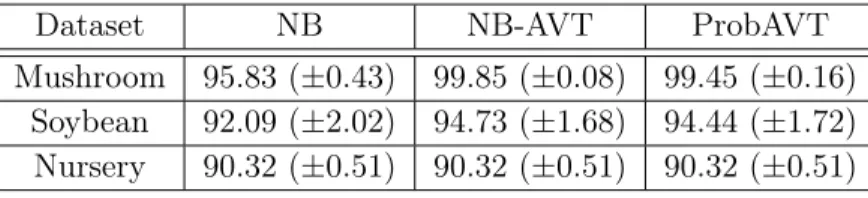
Table 3.1 Accuracy results of three UCI datasets, using 10-fold cross validation with 95% confidence interval.
Dataset NB NB-AVT ProbAVT
Mushroom 95.83 (±0.43) 99.85 (±0.08) 99.45 (±0.16) Soybean 92.09 (±2.02) 94.73 (±1.68) 94.44 (±1.72) Nursery 90.32 (±0.51) 90.32 (±0.51) 90.32 (±0.51)
Since in the E-step, every akn is independent of each other, we can simply maintain Ncax
that counts the number of times C =a,A=a, andX =x, which can be iteratively updated
by using the parameters in M-step and Ncx obtained from data. In the M-step, both Nca and
Nax can be derived from Ncax. Hence,Ncax can be initialized and maintained locally, and the
only sufficient statistic required from data isNcx.
3.4 Experiments
We present two sets of experimental results, one using datasets from UCI repository and another using RDF datasets.
3.4.1 UCI datasets with Subclass Hierarchy
We use three datasets (with only discrete attributes) from UCI repository (i.e., Mushroom, Soybean, and Nursery) where the subclass hierarchies are supplied by domain experts. These datasets correspond to a special case in our setting where Nk = 1 for all k, and the goal of
this set of experiments is to compare the proposed method (denoted by ProbAVT) against an alternative model proposed by Zhang et al. (2006) that extends naive Bayes with subclass hierarchies (denoted by NB-AVT), as well as a plain naive Bayes as a baseline (denoted by NB). Table 3.1shows the accuracy results of 10-fold cross validation. We observe that ProbAVT compares favorably with NB-AVT, while they both outperform NB in Mushroom and Soybean dataset.
3.4.2 RDF datasets with Subclass Hierarchy 3.4.2.1 Public Contract Dataset
We use Task 2 dataset of the Linked Data Mining Challenge appeared in Data Mining on Linked Data Workshop 20131. This RDF dataset contains heterogeneously integrated data
of UK public contracts using various vocabularies and ontologies such as Public Contracts Ontology2, Simple Knowledge Organization System (SKOS)3, DBpedia4, etc. The task of the
challenge is to classify the contracts as multi-contract or not, and the training set have 48 multi-contracts out of a total of 216 contracts. A multi-contract is a contract that unifies two or more unrelated commodities. In this experiment we only extract four discrete attributes: (i) Kind, with range services/supplies/works; (ii) MainObject, with a range described by a large SKOS vocabulary, and we interpret skos:broaderTransitive as a subclass hierarchy of 4539 nodes; (iii) AdditionalObject, with the same range as mainObject; and (iv) Location, encoded using NUTS (Nomenclature of territorial units for statistics5) classification, with four levels of
hierarchy consists of 197 nodes.
The extracted dataset also corresponds to a special case where Nk = 1 for all k. The
dataset is relatively small in size however it is described by several large subclass hierarchies, and NB-AVT is no longer tractable hence omitted from the results.
Table 3.2 shows the results of this experiment under 10-fold cross validation. Despite the small size and difficulty of this dataset, ProbAVT still shows moderate improvements over NB: ProbAVT achieves similar accuracy with NB, while having a lower precision and a significant higher recall; in terms of ROC ProbAVT has about 7% higher area under curve.
3.4.2.2 Web Service Dataset
We use an RDF benchmark dataset from OWLS-TC v2.16 service retrieval test collection
that contains 578 OWL-S Semantic Web service descriptions. The attributes are input and 1 http://keg.vse.cz/dmold2013 2 http://opendata.cz/public-contracts-ontology 3 http://www.w3.org/TR/skos-reference/ 4 http://dbpedia.org 5 http://epp.eurostat.ec.europa.eu/portal/page/portal/nuts_nomenclature/introduction 6 http://projects.semwebcentral.org/projects/owls-tc/
Table 3.2 Classification results of Public Contract dataset, using 10-fold cross validation with 95% confidence interval.
Performance Measure NB ProbAVT
Accuracy 81.25 (±5.21) 81.73 (±5.15) Precision 66.67 (±6.29) 55.00 (±6.63)
Recall 5.00 (±2.91) 27.50 (±5.95)
ROC 62.60 (±6.45) 69.90 (±6.12)
output concepts described by various subclass hierarchies (and even richer ontologies), and the dataset corresponds to the general case where Nk ≥1, hence we compare our method against
two other relational methods: a relational Bayesian classifier [Neville et al. (2003b)] (denoted RBC) and a modified relational probability tree [Neville et al.(2003a)] that incorporates subclass hierarchies (introduced as part of SPARQL-ML toolkit [Kiefer et al.(2008)] and hence we denote it by SML)
Table 3.3shows four performance measures (FP rate, precision, recall, f-measure) for each class under 10-fold cross validation. We observe that ProbAVT outperforms SML in all mea-sures, and outperform RBC in all measures except precision.
3.5 Discussion
We also implemented ML/MAP EM to compute a point estimate of the parameters, and as in [Beal and Ghahramani (2006)] we observe that the ML/MAP alternative can be easily trapped in a local minimum depending on the initial conditions. Variational Bayesian EM on the other hand computes a distribution over parameters and naturally incorporates a model complexity penalty, hence offers an explanation of superior and more stable performance.
Our approach of using latent variables to encode subclass hierarchies provides an alternative to the global cut framework proposed byZhang et al.(2006). A cut on a hierarchy is a subset of nodes such that every leaf of the hierarchy is a descendant of some member in the cut. Loosely speaking, a cut defines ahard abstraction over a hierarchy, whereas our proposed method defines
a soft and more general abstraction using latent variables, recall that we write p(akn|c, xkn)
Table 3.3 Classification results of Seman tic W eb Service dataset Class FP Rate Precision Recall F-measure RBC SML ProbA VT RBC SML ProbA VT RBC SML ProbA VT RBC SML ProbA VT comm unication 0.4 0.4 0.0 93.1 90.0 100.0 93.1 60.0 96.6 93.1 72.0 98.2 econom y 12.9 1.8 8.1 81.1 96.4 87.0 100.0 88.9 97.6 89.6 92.5 92.0 education 0.2 9.0 1.8 99.2 71.6 93.7 88.1 86.9 87.4 93.3 78.6 90.4 fo od 0.0 0.2 0.2 100.0 96.0 95.5 72.0 80.0 84.0 83.7 87.3 89.4 medical 0.0 3.0 0.6 100.0 68.8 93.2 55.8 55.0 78.8 71.6 61.1 85.4 tra vel 0.2 6.9 0.0 99.0 74.4 100.0 95.3 87.3 94.3 97.1 80.3 97.1 w eap on 0.2 0.2 0.7 96.2 96.4 85.2 100.0 90.0 92.0 98.0 93.1 88.5 av erage 2.0 3.1 1.6 95.5 84.8 93.5 86.3 78.3 90.1 89.5 80.7 91.6
disadvantage of learning a soft abstraction is that it can be less comprehensible, although it may be of interest to derive an optimal closest cut from a learned soft abstraction such that
they give comparable performance. Another major difference between these two methods is that a cut is seen as a model structure where as latent variables introduce parameters within the model, and they present different learning challenges. Structure learning for the cut framework requires a search over the cut space, whichZhang et al.(2006) uses the conditional log likelihood to define the cut refinement criterion; however, introducing latent variables can be intractable to estimate the marginal likelihood of parameters. Despite these challenges, our experimental results show that adopting the Variational Bayesian EM approach [Beal and Ghahramani(2006)] is an efficient solution to our problem and can be scaled to large hierarchies over few thousand nodes. Furthermore with the proposed simple dependency structure (Figure 3.1), Variational Bayesian EM can be executed using only a sufficient statistic from data, which can be queried remotely without direct access to data.
3.6 Conclusion 3.6.1 Summary
Rapid growth of RDF data in the Linked Open Data (LOD) cloud offers unprecedented opportunities for analyzing such data using machine learning algorithms. The massive size and distributed nature of LOD cloud present a challenging machine learning problem where the data can only be accessedremotely, i.e. through a query interface such as the SPARQL endpoint of
the data store. Existing approaches to learning classifiers from RDF data in such a setting fail to take advantage of RDF schema (RDFS) associated with the data store that asserts subclass hierarchies which provide information that can potentially be exploited by the learner. Against this background, we present ProbAVT, an algorithm for learning classifier from RDF data and the associated schema. ProbAVT encodes the constraints specified in a subclass hierarchy using latent variables in a directed graphical model, and adopts the Variational Bayesian EM approach to efficiently learn parameters. Our experiments with several real world datasets show that: (i) not surprisingly, ProbAVT outperforms its counterpart that does not incorporate