University of Wollongong University of Wollongong
Research Online
Research Online
University of Wollongong Thesis Collection
2017+ University of Wollongong Thesis Collections
2017
Action recognition from RGB-D data
Action recognition from RGB-D data
Pichao WangUniversity of Wollongong
Follow this and additional works at: https://ro.uow.edu.au/theses1
University of Wollongong University of Wollongong
Copyright Warning Copyright Warning
You may print or download ONE copy of this document for the purpose of your own research or study. The University does not authorise you to copy, communicate or otherwise make available electronically to any other person any
copyright material contained on this site.
You are reminded of the following: This work is copyright. Apart from any use permitted under the Copyright Act 1968, no part of this work may be reproduced by any process, nor may any other exclusive right be exercised, without the permission of the author. Copyright owners are entitled to take legal action against persons who infringe
their copyright. A reproduction of material that is protected by copyright may be a copyright infringement. A court may impose penalties and award damages in relation to offences and infringements relating to copyright material.
Higher penalties may apply, and higher damages may be awarded, for offences and infringements involving the conversion of material into digital or electronic form.
Unless otherwise indicated, the views expressed in this thesis are those of the author and do not necessarily Unless otherwise indicated, the views expressed in this thesis are those of the author and do not necessarily represent the views of the University of Wollongong.
represent the views of the University of Wollongong.
Recommended Citation Recommended Citation
Wang, Pichao, Action recognition from RGB-D data, Doctor of Philosophy thesis, School of Computing and Information Technology, University of Wollongong, 2017. https://ro.uow.edu.au/theses1/112
Research Online is the open access institutional repository for the University of Wollongong. For further information contact the UOW Library: [email protected]
Action Recognition from RGB-D Data
Pichao Wang Supervisor: A/Prof. Wanqing Li
Co-supervisor: Prof. Philip O. Ogunbona
This thesis is presented as required for the conferral of the degree:
Doctor of Philosophy
The University of Wollongong
School of Computing and Information Technology October 25, 2017
Declaration
I, Pichao Wang, declare that this thesis submitted in fulfilment of the requirements for the conferral of the degree Doctor of Philosophy, from the University of Wollongong, is wholly my own work unless otherwise referenced or acknowledged. This document has not been submitted for qualifications at any other academic institution.
Pichao Wang
Abstract
In recent years, action recognition based on RGB-D data has attracted increasing attention. Different from traditional 2D action recognition, RGB-D data contains extra depth and skeleton modalities. Different modalities have their own charac-teristics. This thesis presents seven novel methods to take advantages of the three modalities for action recognition.
First, effective handcrafted features are designed and frequent pattern min-ing method is employed to mine the most discriminative, representative and non-redundant features for skeleton-based action recognition. Second, to take advantages of powerful Convolutional Neural Networks (ConvNets), it is proposed to represent spatio-temporal information carried in 3D skeleton sequences in three 2D images by encoding the joint trajectories and their dynamics into color distribution in the images, and ConvNets are adopted to learn the discriminative features for human ac-tion recogniac-tion. Third, for depth-based action recognition, three strategies of data augmentation are proposed to apply ConvNets to small training datasets. Forth, to take full advantage of the 3D structural information offered in the depth modal-ity and its being insensitive to illumination variations, three simple, compact yet effective images-based representations are proposed and ConvNets are adopted for feature extraction and classification. However, both of previous two methods are sensitive to noise and could not differentiate well fine-grained actions. Fifth, it is proposed to represent a depth map sequence into three pairs of structured dynamic images at body, part and joint levels respectively through bidirectional rank pooling to deal with the issue. The structured dynamic image preserves the spatial-temporal information, enhances the structure information across both body parts/joints and different temporal scales, and takes advantages of ConvNets for action recognition.
Sixth, it is proposed to extract and use scene flow for action recognition from RGB and depth data. Last, to exploit the joint information in multi-modal features aris-ing from heterogeneous sources (RGB, depth), it is proposed to cooperatively train a single ConvNet (referred to as c-ConvNet) on both RGB features and depth features, and deeply aggregate the two modalities to achieve robust action recognition.
Acknowledgments
Many people have contributed in various ways to make my PhD study an exciting and memorable journey. Just to name a few:
It is a privilege to be a research student in the Advanced Multimedia Research Lab, School of Computing Information Technology, University of Wollongong. I also take this opportunity to thank the China Scholarship Council and University of Wollongong for their financial support to my study.
I would like to express my utmost gratitude to my supervisors: A/Prof. Wanqing Li and Prof. Philip Ogunbona, for all their invaluable help and advice during my studies. My principle supervisor, A/Prof. Wanqing Li, gave me freedom to explore my research interest and provide guidance to my research and life. I would never forget my co-supervisor, Prof. Philip Ogunbona, who taught me to write papers words by words, and explained every details in writing problems. I recognize my supervisors not only as my teachers but also my good friends. It would be impossible to be a qualified PhD without their enormous help.
I would like to thank Dr. Chang Tang, Dr. Jun Wan, Dr. Sergio Escalera, Jing Zhang, Song Liu, Yuyao Zhang, Zewei Ding, Chuankun Li, Zhaoyang Li, Shuang Wang, Liwei Wang and Huogen Wang, for all the cooperations with me. To be honest, I benefit a lot from their feedback when we were discussing either on my research works or on existing research papers. They also expanded my knowledge and broaden my views.
I would like to thank all my colleagues/friends in Australia, a non-exhaustive list of whom includes: Dr. Xingwang Liu, Dr. Hongda Tian, Dr. Jianjia Zhang, Dr. Rongmao Chen, Xiaoyu Yu, Lijuan Zhou, Shuai Li, Yanbo Gao, Wenfang Chen, Yan Zhao, Biting Yu, Zhongyan Zhang, Yangguang Tian and Jianchang Lai, for their company during my PhD study and living in Wollongong. Research and life in Australia could not have been as colorful as it has been without their company.
I would also thank Mr. Jun Hu and Mrs. Yuan Tian from IT support. They really helped me a lot on computer problems and saved me lots of valuable time. They are kind and patient, and every time when I have problem with my computer, it only needs to email them.
A huge thank to my Master degree supervisor A/Prof. Yonghong Hou and his wife Dr. Xinying Wang. Without their encouragement and financial support I do not think it is possible for me to pursue my PhD degree in Australia. They are my best friends and beloved family, and their support has been tremendously valuable
v and appreciated indeed.
Many thanks go to my parents. Even though poor in money, I heritage the sprite of hard working and honest from them, and enjoy the love from them. Specific thanks to my mother, who has been looking after my father after his hemiplegia more than five years ago. It is my mother who also encouraged me to continue my PhD study without too much worries. Furthermore, I thank my brother, my sister and my lovely nephews and nieces, for their love and support. I am so lucky to have all of you in my family.
The list would be incomplete without expressing the most wholehearted grati-tude to my life angel and love, Zhimin Gao. As a PhD candidate herself, she has been taking care of me for more than four years, especially when I was badly sick for one year and a half during the study. It is she who looked after me, encouraged me and helped me both in living and research. She has given up many things for me to finish my study; she has cherished with me every great moment and supported me whenever I needed it. Her unwavering love, patient endurance and tolerance of my occasional vulgar mood throughout the last four years deserve so much than just a “thank you”. Not only now, but also in the years to come.
Publications
Published/Accepted Papers
1. Pichao Wang, Wanqing Li, Philip Ogunbona, Zhimin Gao and Hanling Zhang. Mining Mid-level Features for Action Recognition Based on Effective Skeleton Representation. Published in International Conference on Digital Image Com-puting: Techniques and Applications (DICTA), 2014, 1-8.
2. Pichao Wang, Wanqing Li, Zhimin Gao, Chang Tang, Jing Zhang and Philip Ogunbona. ConvNets-Based Action Recognition from Depth Maps Through Vir-tual Cameras and Pseudocoloring. Published in ACM Multimedia (ACM MM), 2015, 1119-1122.
3. Pichao Wang, Wanqing Li, Zhimin Gao, Jing Zhang, Chang Tang and Philip Ogunbona. Action Recognition from Depth Maps Using Deep Convolutional Neural Networks, Published in IEEE Transactions on Human Machine Systems, Vol. 46, No. 4, pp. 498-509, August, 2016
4. Pichao Wang, Zhaoyang Li, Yonghong Hou and Wanqing Li. Action Recognition Based on Joint Trajectory Maps Using Convolutional Neural Networks. Pub-lished in ACM Multimedia (ACM MM), 2016, 102-106.
5. Pichao Wang, Wanqing Li, Song Liu, Zhimin Gao, Chang Tang and Philip Ogun-bona. Large-scale Isolated Gesture Recognition Using Convolutional Neural Net-works. Published in International Conference on Pattern Recognition (ICPR), 2016, 7-12.
6. Pichao Wang, Wanqing Li, Song Liu, Yuyao Zhang, Zhimin Gao and Philip Ogun-bona. Large-scale Continuous Gesture Recognition Using Convolutional Neural Networks. Published in International Conference on Pattern Recognition (ICPR), 2016, 13-18.
7. Pichao Wang, Wanqing Li, Zhimin Gao, Yuyao Zhang, Chang Tang and Philip Ogunbona. Scene Flow to Action Map: A New Representation for RGB-D Based Action Recognition with Convolutional Neural Networks. Accepted in IEEE Con-ference on Computer Vision and Pattern Recognition (CVPR), 2017.
vii 8. Pichao Wang, Shuang Wang, Zhimin Gao, Yonghong Hou, and Wanqing Li. Structured Images for RGB-D Action Recognition. Accepted in International Conference on Computer Vision Workshops (ICCVW), 2017.
9. Chuankun Li, Yonghong Hou, Pichao Wang* and Wanqing Li. Joint Distance Maps for Human Action Recognition with Convolutional Neural Networks. Pub-lished in IEEE Signal Processing Letters, Vol. 24, No. 5, pp. 624-628, May, 2017. (*Corresponding author)
10. Yonghong Hou, Zhaoyang Li, Pichao Wang* and Wanqing Li. Skeleton Optical Spectra Based Action Recognition Using Convolutional Neural Networks. Ac-cepted in IEEE Transactions on Circuits and Systems for Video Technology, in press. (*Corresponding author)
11. Chuankun Li*, Pichao Wang*, Shuang Wang, Yonghong Hou and Wanqing Li. Skeleton-based Action Recognition Using LSTM and CNN. Accepted in Large Scale 3D Human Activity Analysis Challenge in Depth Videos, ICMEW2017. (rank the first place) (* equal contribution)
12. Huogen Wang*, Pichao Wang*, Zhanjie Song, and Wanqing Li. Large-scale Mul-timodal Gesture Recognition Using Heterogeneous Networks. Accepted in IC-CVW, 2017. (* equal contribution)
13. Huogen Wang*, Pichao Wang*, Zhanjie Song, and Wanqing Li. Large-scale Mul-timodal Gesture Segmentation and Recognition based on Convolutional Neural Network. Accepted in ICCVW, 2017. (* equal contribution)
14. Zewei Ding, Pichao Wang*, Philip Ogunbona and Wanqing Li. Investigation of Different Skeleton Features for CNN-based 3D Action Recognition. Ac-cepted in Large Scale 3D Human Activity Analysis Challenge in Depth Videos, ICMEW2017. (*Corresponding author)
15. Jing Zhang, Wanqing Li, Philip Ogunbona, Pichao Wang and Chang Tang. RGB-D based Action Recognition RGB-Datasets: A Survey. Published in Pattern Recogni-tion, Vol. 60, pp.86-105, Dec. 2016.
16. Jing Zhang, Wanqing Li, Pichao Wang, Philip Ogunbona, Song Liu and Chang Tang. A Large Scale RGB-D Dataset for Action Recognition. Accepted in ICPR workshop on UHA3DS, 2016.
17. Zewei Ding, Wanqing Li, Pichao Wang, Philip Ogunbona and Ling Qin. Weakly Structured Information Aggregation for Upper-body Posture Assessment Using ConvNets. Accepted in IEEE International Conference on Multimedia & Expo (ICME), 2017.
viii
Submitted Papers
1. Pichao Wang, Wanqing Li, Chuankun Li and Yonghong Hou. Action Recognition Based on Joint Trajectory Maps with Convolutional Neural Networks. Submitted to Knowledge-Based Systems, under view.
2. Pichao Wang, Wanqing Li, Zhimin Gao, Chang Tang, and Philip Ogunbona. Depth Pooling Based Large-scale 3D Action Recognition with Convolutional Neu-ral Networks. Submitted to IEEE Transactions on Multimedia, under review. 3. Pichao Wang, Wanqing Li, Philip Ogunbona, Jun Wan and Sergio Escalera.
RGB-D-based Motion Recognition with Deep Learning: A Survey. Submitted to Computer Vision and Image Understanding, under review.
4. Pichao Wang, Wanqing Li, Jun Wan, Philp Ogunbona and Xinwang Liu. Coop-erative Training of Deep Aggregation Networks for RGB-D Action Recognition. Submitted to AAAI Conference on Artificial Intelligence (AAAI), 2018, under review.
5. Yonghong Hou, Shuang Wang, Pichao Wang*, Zhimin Gao, and Wanqing Li. Spatially and Temporally Structured Global to Fine-grained Aggregation of Dy-namic Depth Information for Action Recognition. Submitted to IEEE Access, under review. (*Corresponding author)
6. Chang Tang, Wanqing Li and Pichao Wang*. Online Action Recognition based on Incremental Learning of Weighted Covariance Descriptors. Submitted to IEEE Transactions on industrial informatics, under review. (*Corresponding author) 7. Chuankun Li, Yonghong Hou, Pichao Wang* and Wanqing Li. Decision Fusion
Based Heterogeneous Networks for 3D Action Recognition. Submitted to Infor-mation Fusion, under review. (*Corresponding author)
Contents
Abstract iii 1 Introduction 1 1.1 Research Questions . . . 2 1.2 Thesis Organization . . . 3 2 Literature Review 4 2.1 Hand-crafted Features for Action Recognition . . . 42.1.1 RGB-based Approach . . . 4
2.1.2 Skeleton-based Approach . . . 6
2.1.3 Depth-based Approach . . . 8
2.1.4 Multi-modal-based Approach . . . 11
2.2 Deep Learning for Action Recognitoin . . . 12
2.2.1 Commonly-used Networks . . . 12 2.2.2 RGB-based Approach . . . 17 2.2.3 Skeleton-based Approach . . . 21 2.2.4 Depth-based Approach . . . 23 2.2.5 Multi-modal-based Approach . . . 24 2.3 Performance Evaluation . . . 26 2.3.1 Benchmark Datasets . . . 26 2.3.2 Evaluation Metric . . . 32
3 Skeleton-based Action Recognition 33 3.1 Mining Frequent and Relevant Features . . . 33
3.1.1 Prior Works and Our Contributions . . . 33
3.1.2 The Proposed Methods . . . 34
3.1.3 Experimental Results . . . 40
3.2 Joint Trajectory Maps with ConvNets . . . 43
3.2.1 Prior Works and Our Contributions . . . 43
3.2.2 The Proposed Methods . . . 44
3.2.3 Experimental Results . . . 51
3.3 Summary . . . 59
CONTENTS xi
4 Depth-based Action Recognition 61
4.1 Weighted Hierarchical Depth Motion Maps with ConvNets . . . 61
4.1.1 Prior Works and Our Contributions . . . 61
4.1.2 The Proposed Methods . . . 63
4.1.3 Experimental Results . . . 70
4.2 Dynamic Depth Maps with ConvNets . . . 80
4.2.1 Prior Works and Our Contributions . . . 80
4.2.2 The Proposed Methods . . . 81
4.2.3 Experimental Results . . . 87
4.3 Structured Images with ConvNets . . . 91
4.3.1 Prior Works and Our Contributions . . . 91
4.3.2 The Proposed Methods . . . 93
4.3.3 Experimental Results . . . 96
4.4 Summary . . . 103
5 RGB and Depth based Action Recognition 104 5.1 Scene Flow with ConvNets . . . 104
5.1.1 Prior Works and Our Contributions . . . 104
5.1.2 The Proposed Methods . . . 106
5.1.3 Experimental Results . . . 112
5.2 Cooperative Training of ConvNets for RGB and Depth Modalities . . 117
5.2.1 Prior Works and Our Contributions . . . 117
5.2.2 The Proposed Methods . . . 119
5.2.3 Experimental Results . . . 123
5.3 Summary . . . 130
6 Conclusions and Future Work 132 6.1 Conclusions . . . 132
6.2 Future Work . . . 134
6.2.1 Challenges . . . 134
6.2.2 Future Research Directions . . . 136
List of Figures
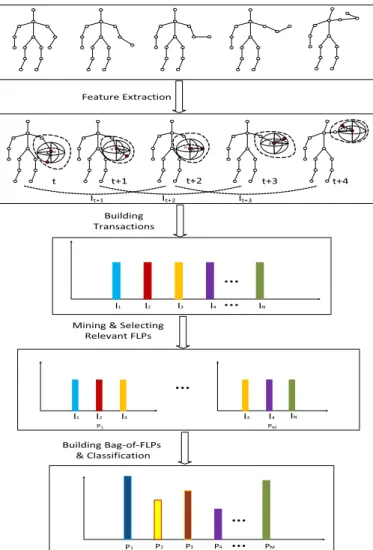
3.1 The general framework of the proposed method to mine frequent and relevant features for action recognition. . . 35 3.2 The human joints tracked with the skeleton tracker [SFC+11]. . . 35
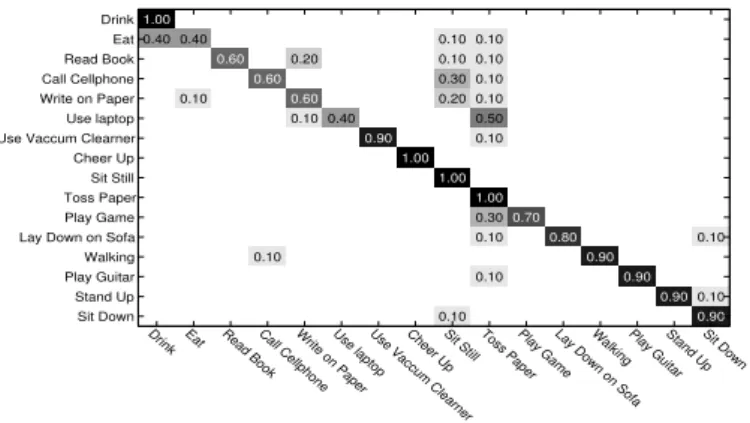
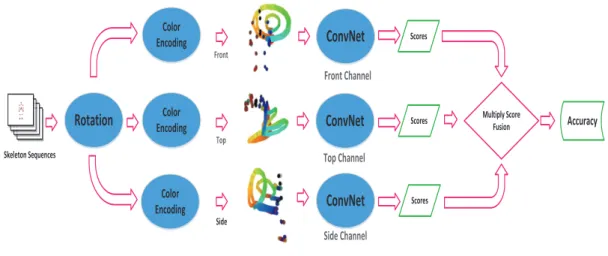
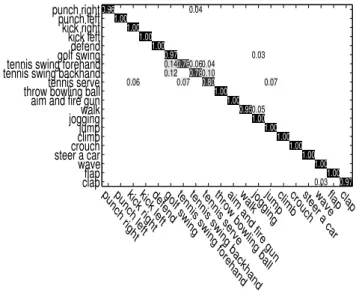
3.3 The confusion matrix of our proposed method for MSR-DailyActivity3D. . . 42 3.4 The confusion matrix of our proposed method for MSR-ActionPairs3D. 42 3.5 The framework of the proposed method. . . 44 3.6 The trajectories projected onto three Cartesian planes for action
“right hand draw circle (clockwise)” in UTD-MHAD [CJK15]: (1) front plane; (2) top plane; (3) side plane. . . 46 3.7 An example of colored coded joint trajectory with different colors
reflecting the temporal order. . . 48 3.8 Step-by-step illustration of the front JTM for action “right hand draw
circle (clockwise)” from the UTD-MHAD [CJK15] dataset. (1) Joint trajectory map without encoding any motion direction and magni-tude; (2) encoding joint motion direction in hue, where color varia-tions indicate motion direction; (3) encoding body parts with differ-ent colormaps; (4) encoding motion magnitude into saturation and brightness. . . 50 3.9 The confusion matrix of the proposed method on the MSRC-12 Kinect
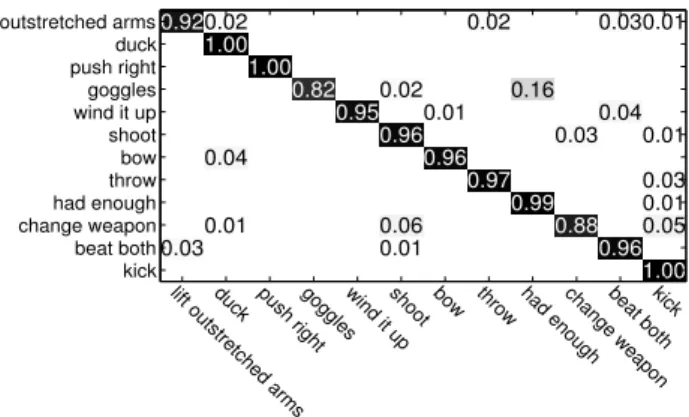
gesture dataset. . . 55 3.10 The confusion matrix of the proposed method on the G3D Dataset. . 56 3.11 The confusion matrix of the proposed method on the UTD-MHAD
dataset. . . 56 3.12 The generated JTMs of action “waving hand” performed by
dif-ferent persons and repeated difdif-ferent times from NTU RGB+D dataset [SLNW16]. . . 57 4.1 The proposed WHDMM + 3ConvNets architecture for depth-based
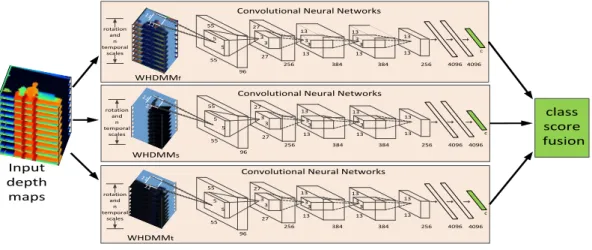
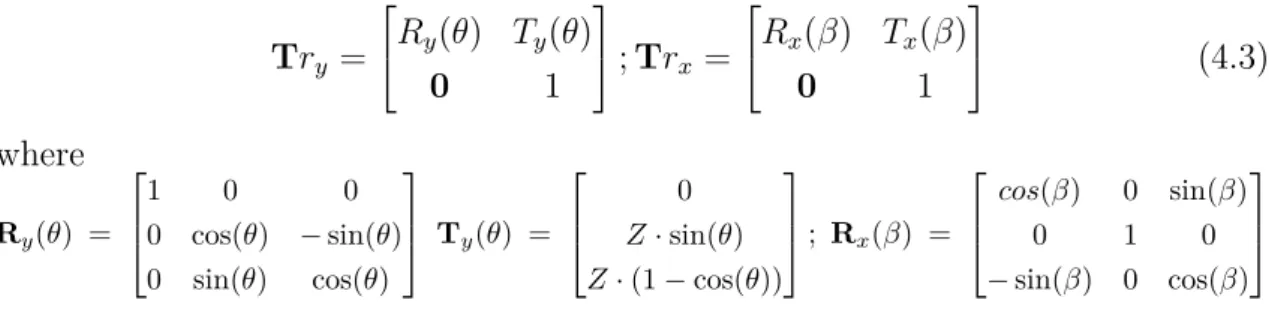
action recognition. . . 63 4.2 Process of rotating 3D points to mimic different camera viewpoints. . 64
LIST OF FIGURES xiii 4.3 Example depth maps synthesized by the virtual RGB-D camera. a)
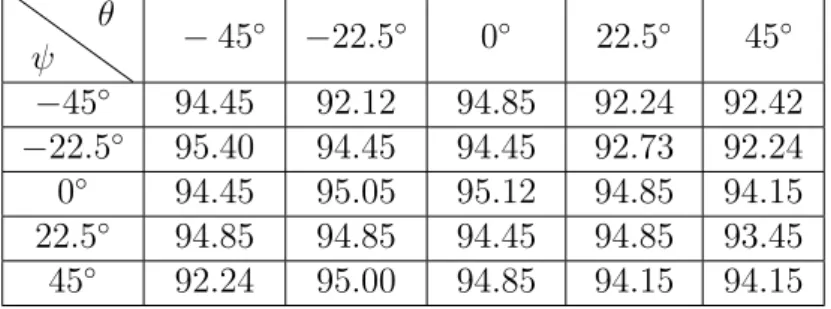
original depth map, depth maps synthesized respectively with the parameters b) (θ = 45◦, β = 45◦), c) (θ = 45◦, β = −45◦), d) (θ =
−45◦, β = 45◦) and e) (θ=−45◦, β =−45◦). . . 65 4.4 Examples of synthesised depth maps for cases whereθ andβ are very
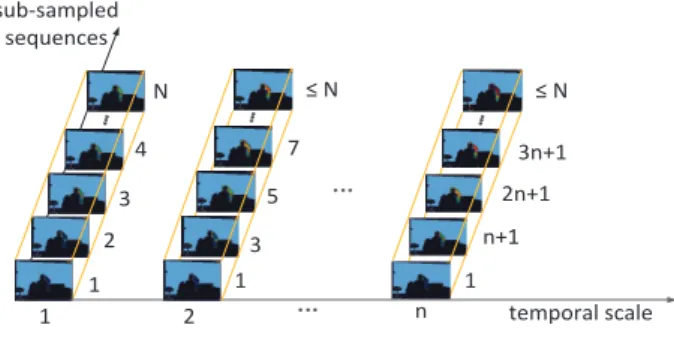
large. a) (θ=−75◦, β=−75◦); b) (θ=−85◦, β =−85◦). . . 66 4.5 Hierarchical temporal scales: for the nth temporal scale, the
sub-sampled sequence is constructed by taking one frame, starting from the first frame, from everyn frames. . . 66 4.6 Examples of pseudo-color coded WHDMMs of actions in the
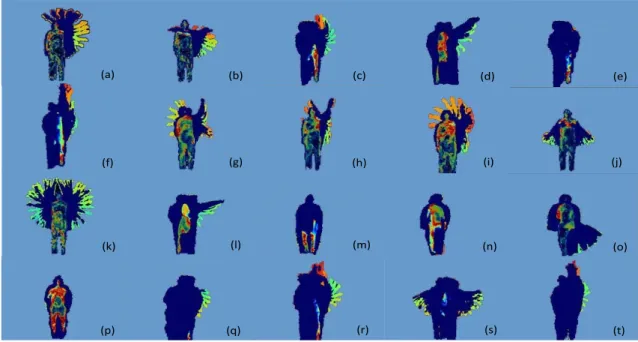
MSRAc-tion3D dataset performed by randomly selected subjects: a) high arm wave, b) horizontal arm wave, c) hammer, d) hand catch, e) forward punch, f) high throw, g) draw X, h) draw tick, i) draw circle, j) hand clap, k) two hand wave, l) side-boxing, m) bend, n) forward kick, o) side kick, p) jogging, q) tennis swing, r) tennis serve, s) golf swing, and t) pick up & throw. . . 67 4.7 Visual comparison of improved rainbow transform with α = 1 and α
= 10. . . 68 4.8 A sample color-coded WHDMM of action “eat” with differentαvalues. 69 4.9 Variation of recognition accuracy with increasing value of α.
MSR-DailyActivity3D dataset has been used with only the frontal channel. 69 4.10 The confusion matrix of proposed method for UTKinect-Action dataset. 74 4.11 The confusion matrix of proposed method for MSRDailyActivity3D
dataset. . . 75 4.12 The confusion matrix of proposed method for Combined dataset. . . . 77 4.13 The framework of the proposed method. . . 81 4.14 An example of illustrating the inter-action segmentation results.
Fig-ure from [JZW+15]. . . 82
4.15 Illustration of a two layered rank pooling with window size three (Ml
= 3) and stride one (Sl = 1). . . 84
4.16 Samples of generated forward and backward DIs [BFG+16], DDIs, DDNIs and DDMNIs for gesture Mudra1/Ardhapataka. . . 86 4.17 The three hierarchical structured DDIs for action “play game” from
the MSRDailyActivity3D Dataset [WLWY12]. From left to right: structured body DDI, structured part DDI and structured joint DDI. The red circle denotes the hand motion need to be recognized while the blue one represents the large body swaying motion. . . 92 4.18 The framework of proposed method for action recognition using
LIST OF FIGURES xiv 4.19 Illustration of non-scaled component patches of a component
con-sisted of three joints {J1, J2, J3} from three frames. The solid black
boxes are the bounding boxes of the component in each frame, while the dashed red box is the sequence-based bounding box of the com-ponent. . . 93 4.20 Stitching of component DDIs to a structured part DDI (left) and
structured joint DDI (right). . . 95 4.21 Illustration of using scaled component patches (left) and non-scaled
component patches (right) for action “write on a paper” from MSR-DailyActivity3D Dataset [WLWY12] for construction of structured joint DDI. The red circle denotes spatial distortion among human body while the blue one represents the preservation of aspect ratio among the parts and joints. . . 97 4.22 Confusion matrix for structured body DDI (left), structured part DDI
(middle) and structured joint DDI (right) on MSRDailyActivity3D Dataset. . . 101 4.23 Confusion matrix for S2DDI on the MSRDailyActivity3D dataset. . . 102
5.1 Samples of variants of SFAM for action “Bounce Basketball” from M2I Dataset [LXN+16]. For top-left to bottom-right, the images
correspond to D, S, RPf, RPb, SFAM-AMRPf, SFAM-AMRPb, SFAM-LABRPf, SFAM-LABRPb. . . 111 5.2 The framework for constructing SFAM with Channel Transform
Ker-nels using ConvNets. . . 111 5.3 Illustration of approximate computation for Channel Transform
Ker-nels using convolution kerKer-nels followed by nonlinear transforms. . . . 112 5.4 Illustration of Product Score Fusion for SFAM-RP. . . 114 5.5 The framework of proposed method. A c-ConvNet consists of one
feature extraction network shared by the ranking loss and softmax loss, and two separate branches for the two losses. Two distinct c-ConvNets are adopted to exploit bidirectional information in videos. The inputs of the two c-ConvNets are two paired DDIs and VDIs, namely, DDIf & VDIf, and DDIb & VDIb. During training process, the ranking loss and softmax loss are jointly optimized; during testing process, an effective product-score fusion method is adopted for action recognition. The softmax loss serves to learn separable features for action recognition while the ranking loss encourages the c-ConvNet to learn discriminative and modality-independent features. . . 120
LIST OF FIGURES xv 5.6 Visual comparisons of DDIf, DDIb, VDIf and VDIb. The left two
columns are the “wear a shoe” action and the right two columns are the action “handshaking” from NTU RGB+D Dataset [SLNW16]. . 121 5.7 Illustration of the intra-modality and inter-modality triplets. . . 123
Chapter 1
Introduction
Among the several human-centered research domains (human detection, tracking, pose estimation and motion recognition) in computer vision, human motion recog-nition is particularly important due to its wide applicability in video surveillance, human computer interfaces, ambient assisted living, human-robot interaction, intelli-gent driving, etc. The task of motion recognition entails the automatic identification of human behaviors from images or video sequences. Depending on the complexity and duration of the motion, it can be broadly categorized into four kinds: gesture, action, interaction and group activity. Specifically, gesture is defined as the basic movement or position of the hand, arm, body, or head that is expressive of an idea, opinion, emotion, etc. “Hand waving” and “nodding” are some typical examples of gestures. Usually, a gesture has relatively short duration and the complexity is low. Action is considered as a type of activity that is performed by a single person and involves multiple body parts. Generally it is a combination of multiple gestures, such as “walking” and “punching”. Interactionis a type of activity performed by two actors; one actor is a human while the other is a human or an object. This implies that the interaction entails human-human or human-object interaction. “Hugging each other” and “playing guitar” are examples of these two kinds of interaction, respectively. Group activity is the most complex type of activity, and it may com-bine gestures, actions and interactions. It involves more than two humans and a single or multiple objects. “Two teams playing basketball” and “group meeting” are examples of group activities.
Since the 1980s, researchers have been working on human motion recognition from 2D images or videos [AC99, WHT03, TCSU08, Pop10, GL14, ZSXF16]. Most of the early research efforts used color and texture cues in 2D images for recog-nition. However, due to problems such as background clutter, partial occlusion, view-point, lighting changes, execution rate and biometric variation, motion analy-sis from 2D images and videos is still a challenging task even for current deep learning approaches [HHP17, HAS+17]. With the development of cost-effective RGB-D
sen-sors, such as Microsoft KinectTMand Asus Xtion, RGB-D-based motion recognition
has attracted much attention in recent years. Depth is insensitive to illumination changes and includes rich 3D structural information of the scene; 3D positions of body joints can be estimated from depth maps [SFC+11]. As a consequence, RGB-D-based human motion recognition has attracted more and more attention and shown a promising direction for human motion analysis.
CHAPTER 1. INTRODUCTION 2 RGB-D data for human motion analysis comprises three modalities: RGB, depth and skeleton. The main characteristics of RGB data is its shape, color and texture which brings the benefits of detecting interesting points and extracting optical flows. Compared to RGB videos, the ideal depth modality is insensitive to illumination variations, invariant to color and texture changes, reliable for estimating body sil-houette and skeleton, and provides rich 3D structural information of the scene. Different from RGB and depth, skeleton data which consists of the positions of body joints, is a relatively high-level feature for motion recognition. It is robust to scale and illumination changes, and can be invariant to camera view as well as body rotation. In many state-of-the-art datasets, skeleton is computed from depth map. Many different methods have been proposed in the past decade to exploit the properties of the three modalities. These methods can be broadly classified into handcrafted and deeply learned representations. This thesis presents an extensive study on analyzing human motion from RGB-D modalities. The study ranges from hand-crafted features to deep-learning methods for segmented action recognition by addressing a number of challenging questions.
1.1
Research Questions
The main research questions addressed in this thesis are:
1. How to effectively mine the most frequent and relevant (discriminative, represen-tative and non-redundant) features from skeleton data for action recognition? 2. How to effectively represent skeleton sequences for ConvNets-based recognition? 3. How to adopt ConvNets for depth-based recognition on small training data? 4. How to take full advantages of depth modality for large-scale action recognition
based on ConvNets?
5. How to apply ConvNets to fine-grained action recognition using noisy depth modality?
6. How to fuse RGB and depth modalities at data-level for action recognition using ConvNets?
7. How to cooperatively train a single network using two heterogeneous input modal-ities (e.g. RGB and depth)?
CHAPTER 1. INTRODUCTION 3
1.2
Thesis Organization
The thesis is organized as follows:
Chapter 2 provides a review of the relevant literature. In this chapter, both hand-crafted features and deep learning methods for RGB, depth, skeleton and multi-modal-based action recognition are reviewed. Performance evaluation includ-ing benchmark datasets and evaluation metrics are also reviewed.
Chapter 3 addresses the first two research questions by presenting two methods for skeleton-based action recognition using hand-crafted features and a deep learning method, respectively.
Chapter 4 presents three methods to address the research questions 3-5. These methods adopt depth modality as input and take advantages of pre-trained deep learning models over ImageNet for action recognition.
Chapter 5 studies the research questions 6-7 and introduces two methods for RGB and depth based action recognition. The first method is based on extrac-tion and use of scene flow for acextrac-tion recogniextrac-tion from RGB-D data. The second method introduces a concept of cooperatively training that takes two heterogeneous inputs and trains a single network for both homogeneous and heterogeneous action recognition.
Chapter 2
Literature Review
This chapter reviews key literature related to hand-crafted feature based and deeply learned feature based action recognition. Performance indicators and commonly used benchmark datasets are also reviewed.
2.1
Hand-crafted Features for Action Recognition
The process of action recognition based on hand-crafted features can be generally divided into two main steps, action representation and action classification. Action representation consists of feature extraction and feature selection. Features can be extracted from input sources such as depth maps, skeleton and/or RGB images. Regardless of the input source, there are two main approaches, space-time approach and sequential approach, to the representation of actions. The space-time approach usually extracts local or holistic features from space-time volume, without explicit modeling of temporal dynamics. By contrast, the sequential approach normally ex-tracts local features from each frame of the input source and models the dynamics explicitly. Action classification is the step of learning a classifier based on action representation and classifying any new observations using the classifier. For space-time approaches, discriminative classifier, such as Support Vector Machine (SVM), is often used for classification. For the sequential approach, generative statistical models, such as Hidden Markov Model (HMM), are commonly used. In this litera-ture review, we first give a brief review on RGB-based approach and then introduce the skeleton-based approach, depth-based approach, and the approach that fuses them together.
2.1.1
RGB-based Approach
The RGB-based methods rely on sequential RGB images, whether based on local representations or global representations. This approach enjoys a rich history but it is still very challenging for action recognition in the wild due to the difficulties such as great intra-class variance, scaling, occlusion and clutter. In this section, we only give a brief review, listing the typical works in corresponding modules. For more comprehensive review, survey papers [ZSXF16, HHP17] are recommended to read. In the following two sub-sections, we will first review space-time based approach and then sequential approach.
CHAPTER 2. LITERATURE REVIEW 5
2.1.1.1 RGB-based Space-Time Methods
The space-time approach represents actions in volume, trajectories, and set of fea-tures and trains models for each kind of representation. For space time volume, Bobick and Davis [BD01a] proposed to recognize actions by using two components of vector images, namely, Motion Energy Images (MEI) and Motion History Images (MHI). It worked well in static background where the motion of object movement can be separated easily. Blank et al. [BGS+05] represented actions as space-time
shapes, which contained both spatial and dynamic information. This method worked fast and did not need prior video alignment.
For trajectories, Campbell and Bobick [CB95] proposed to recognise nine atomic movements of a ballet dancer by tracking trajectories of joint positions in a 3-D XYT plane. Recently, Wang et al. [WKSL13] proposed a video representation based on dense trajectories and motion boundary descriptors, in which optical flow algorithm was used to extract trajectories. Their approach achieved promising results in several benchmark datasets but it was very time-consuming to calculate the dense optical flow and corresponding features along the flows.
For space-time features, extensive works have been done. To extract local spatio-temporal features, two main steps are: feature detection and feature description. The feature detector aims to detect locations of representative interest points with various scales. The shape and motion characteristics of the detected 3D patches (or interest regions surrounding the detected interest points) can be further described by feature descriptors. Many feature detectors have been proposed in the past years. For example, Laptev and Lindeberg [Lap05] proposed a generalization of Harris and Forstner interest point detector to localize the compact representation of the event; Gilber et al. [GIB09] used a 2D Harris corner detection and data mining approach to localize multiple actions in real-time. Dollar et al. [DRCB05] proposed a spatio-temporal feature as the cuboids prototype for the recognition of human actions. Other feature detectors, such as 3D-Hessian by Willems et al. [WTVG08], Dense Sampling by Fei-Fei and Perona [FFP05], Spatio-Temporal Regularity Based Feature (STRF) by Goodhart et al. [GYS08] also been proposed. And many STIP feature descriptors are also proposed, for example, HOG/HOF [Lap05], HOG3D [KMS08], Extended SURF [WTVG08] and MoSIFT [CH09]. The combinations of these feature detectors and feature descriptors have been used in many papers.
2.1.1.2 RGB-based Sequential Methods
For RGB-based sequential approach, Darrell and Pentland [DP93] proposed a Dy-namic Time Warping (DTW) algorithm and used a view model to recognize gesture actions and effectively handle a variation in the execution of actions. Yamato et al.
CHAPTER 2. LITERATURE REVIEW 6 [YOI92] adopted a HMM to represent and recognize the actions. Park and Aggar-wal [PA04] proposed to estimate human body gestures using Bayesian networks and modelled the evolution of two persons interactions by Dynamic Bayesian Networks (DBN). Gupta and Davis [GD07] proposed a probabilistic model that exploit con-textual information for visual action analysis to improve object recognition as well as action recognition. Ivanov and Bobick [IB00] suggested using stochastic context-free grammars (SCFGs) to model visual activities and used it on an upper layer to compute the probability of temporally consistent sequences of primitive actions. Many improved works have been done following above papers, which can be seen in the survey [VA13].
2.1.2
Skeleton-based Approach
The study of skeleton-based action recognition can date back to the pioneering work by Johansson [Joh75], which demonstrated that a large set of actions can be recognized solely from the joint positions. This idea has been followed and extensively explored ever since. However, the 3D joint positions extracted by the skeleton tracker [SFC+11] are much noisy due to the possible failure caused by
noisy depth maps or occlusions, which makes the design of an effective and efficient system not accurate enough. In the following two subsections, we also first review space-time approach, followed by sequential approach. Works [PLC16, HRHZ17] are referred to read for more comprehensive reviews.
2.1.2.1 Skeleton-based Space-Time Methods
For the skeleton-based space-time volume approach, Yang et al. [YT12] proposed a new feature descriptor called EigenJoints features which contained posture features, motion features and offset features. The pair-wise joint differences in current frames and their consecutive frames were used to encode the spatial and temporal infor-mation, which were called posture features and motion features, respectively. The difference of a pose with respect to the initial pose was called offset features. The initial pose was generally assumed as a neutral pose. The three channels were nor-malized and PCA was applied to reduce redundancy and noise to obtain the Eigen-Joints descriptor. A Naive-Bayes-Nearest-Neighbor (NBNN) classifier was adopted to recognize actions. Gowayyed et al. [GTHES13] proposed a new descriptor called Histograms of Oriented Displacements (HOD) to recognize actions. The displace-ment of each joint voted with its length in a histogram of oriented angles. Each 3D trajectory was represented by the HOD of its three 2D projection. In order to preserve temporal information, a temporal pyramid was proposed, where trajecto-ries were considered as a whole, halves and quarters and then all the descriptors in
CHAPTER 2. LITERATURE REVIEW 7 these three levels were concatenated to form the final descriptor. A linear SVM was used to classify actions based on the histograms. Similar to this work, Hussein et al. [HTGES13] proposed a descriptor called Covariance of 3D Joints (Cov3DJ) for human action recognition. This descriptor used covariance matrix to capture the dependence of locations of different joints on one another during an action. In order to capture the order of motion in time, a hierarchy of Cov3DJs was used, similarly to the work in [GTHES13].
Zanfir et al. [ZLS13] proposed a descriptor called moving pose which was formed by the position, velocity and acceleration of skeleton joints within a short time win-dow around the current fame. To learn discriminative pose, a modified k-Nearest Neighbours (kNN) classifier was used that considered both the temporal location of a particular frame within the action sequence as well as the discrimination power of its moving pose descriptor compared to other frames in the training set. Wang et al. [WWY13] first estimated human joints positions from videos and then grouped the estimated joints into five parts. Each action was represented by computing sets of co-occurring spatial and temporal configurations of body parts. They used a bag of words method with the extracted features for classification. Ohn-Bar and Trivedi [OBT13a] tracked the joint angles and built a descriptor based on similar-ities between angle trajectories. This feature was further combined with a double-HOG descriptor that accounted for the spatio-temporal distribution of depth values around the joints. Theodorakopoulos et al. [TKEF14] initially processed the skele-ton data from sensor coordinate to torso PCA frame in order to gain robust and invariant pose representation. Sparse coding in dissimilarity space was utilized to sparsely represent the actions. Chaaraoui et al. [CPLCPFR14] proposed to use an evolutionary algorithm to determine the optimal subset of skeleton joints, taking into account the topological structure of the skeleton. Vemulapalli et al. [VAC14] explicitly modelled the 3D geometric relationships between various body parts using rotations and translations in 3D space. Human actions were modelled as curves in Lie group and then they mapped the action curves from the Lie group to its Lie algebra. Following, they used DTW to handle rate variations and Fourier Tempo-ral Pyramid (FTP) [WLWY14] representation to handle the tempoTempo-ral misalignment and noise issues.
2.1.2.2 Skeleton-based Sequential Methods
For the skeleton-based sequential approach, Xia et al. [XCA12] proposed a feature called Histograms of 3D Joint Locations (HOJ3D) as a representation of postures. The HOJ3D essentially encoded spatial occupancy information relative to the root joint, e.g. hip center. A modified spherical coordinate system was defined on the root joint and the 3D space was divided into N bins. The HOJ3D was reprojected
CHAPTER 2. LITERATURE REVIEW 8 using LDA to reduce dimensionality and then clustered intoK posture visual words which represented the prototypical poses of actions. HMMs were adopted to model the visual words and recognize actions. Radial distance was adopted in this spherical coordinate system which made the method to some extend view-invariant.
Koppula et al. [KGS13] explicitly modelled the motion hierarchy to enable their method to handle simple human-object interactions. The human activities and ob-ject affordances were jointly modelled as a Markov Random Field (MRF) where the nodes represented objects and sub-activities, and the edges represented the re-lationships between object affordances, their relations with sub-activities, and their evolution over time. Feature vectors that represented the object’s location and the changing information in the scene were defined by training a Structural Support Vector Machine (SSVM). Similar to this approach, Sung et al. [SPSS12] proposed a hierarchical two-layer Maximum Entropy Markov Model (MEMM) to represent an activity. The lower layer nodes represented sub-activities while higher level nodes described more complex activities, for example, “lifting left hand” and “pouring wa-ter” could be described as a sub-activity and a complex activity, respectively. With the development of deep learning, Wu and Shao [WS14b] proposed a hierarchical dynamic framework that first extracted high level skeletal joints features and then used the learned representation for estimating emission probability to infer action sequences. They replaced Gaussian mixture models with deep neural networks that contained many layers of features to predict probability distribution over states of HMM, which achieved better results.
2.1.3
Depth-based Approach
The depth-based methods rely mainly on features, either local or global, extracted from the space time volume. Compared to visual data, depth maps provide geomet-ric measurements that are invariant to lighting. However, it is still a challenging task using depth maps to design a system for action recognition which are both effective and efficient, even though depth can make segmentation of foreground and background easier. The reasons are three folds. First of all, depth sequence may contain serious occlusions, which makes the global features unstable. Secondly, the depth maps may have many “holes” due to no estimation of depth obtained in case of specific material, reflection, interference or fast motion. In addition, the depth maps do not have as much texture as color images do, and they are usually too noisy to apply local differential operators such as gradients. These challenges motivate researchers to develop features that are semi-local, highly discriminative and robust against occlusion. The majority of depth-based methods rely on space-time volume features, and we will review the literature space-time approach first, followed by
CHAPTER 2. LITERATURE REVIEW 9 sequential approach.
2.1.3.1 Depth-based Space-Time Methods
For depth-based space-time approaches, Li et al. [LZL10] proposed a bag-of-points feature representation for activity recognition from depth map sequences, where the 3D points were sampled from the silhouettes of the depth maps. They used an action graph as their classification framework, where each action was encoded in one or multiple paths in the action graph. Each node of the action graph de-noted a salient postures. One limitation of this approach was the loss of spatial context information between interest points. In addition, this approach was view-dependent, and this made it very difficult robustly sample the interest points in different views. To address these issues, Vieira et al. [VNO+12] proposed a feature descriptor called Space-Time Occupancy Patterns (STOP), in which the depth se-quence was represented in a 4D space-time grid by dividing space and time axes into multiple segments. In this way, the descriptor could preserve spatial and temporal contextual information between space-time cells and be flexible to accommodate intra-action variations.
Yang et al. [YZT12] projected depth maps onto three orthogonal planes and accumulate global activities through entire video sequences to generate the Depth Motion Maps (DMM). Histograms of Oriented Gradients (HOG) were then com-puted from DMM as the representation of an action video. Oreifej and Liu [OL13] presented a new descriptor called histogram of oriented 4d surface normals (HON4D) to capture the complex joint shape-motion cues at pixel-level. The histogram could capture the distribution of the surface normal orientation in the 4d volume of time, depth and spatial coordinates. Wang et al. [WLC+12] treated a three-dimensional
action sequence as a 4d shape and propose a semi-local features called random oc-cupancy pattern (ROP) features. The ROP features were extracted from randomly sampled 4d sub-volumes with different sizes and at different locations.
Xia and Aggarwal [XA13] proposed a filtering scheme to find local spatio-temporal interest points (STIPs) from depth videos with noise suppression func-tions to deal with the noisy data and missing values in depth maps. They also proposed a self-similarity depth cuboid feature (DCSF) as the descriptor for a spatio-temporal depth cuboid which further handled the noisy measurements and missing values. Liu and Shao [LS13a] presented a Genetic Programming (GP) learning method to select discriminative spatio-temporal features from RGB-D sensors for action recognition. They proposed a restricted graph-based genetic programming (RGGP) method which assembled 3D operators as graph-based combinations, and then evolved generation by generation by evaluating the average error rate of the classification accuracy, finally obtained the discriminative representation of RGB
CHAPTER 2. LITERATURE REVIEW 10 and depth information. Luo et al. [LWQ14] proposed a framework using both RGB videos and depth maps to action recognition. They proposed a sparse coding-based temporal pyramid structure matching approach (ScTPM) for feature representation, keeping the temporal information and reducing the approximation error compared to bag-of-words model and k-means, respectively. They proposed a center-symmetric motion local ternary pattern (CS-Mltp) descriptor to capture the spatial-temporal features from RGB videos. Then they fused the features captured from both depth maps and RGB videos to recognize actions.
Song et al. [STLY14] proposed a new depth descriptor called Body Surface Context (BSC) by utilizing 3D point cloud which contained points in the 3D real-world coordinate system to represent the external surface of human body. This descriptor described the distribution of relative locations of the neighbors for a reference point in the point cloud by encoding the cylindrical angular of the difference vector between the target point and the reference point. This descriptor was some kind of object-centered feature and robust to translations and rotations. Lu et al. [LJT14] proposed a binary range-sample feature in depth through τ tests. They developed six pixel pairs, Back-Both, Act-Both, Occ-Both, Back-Act, Back-Occ and Occ-Act. Their τ test only sampled pixel pairs Act-Both and Back-Act where they recognised Back-Act mostly describing the human body outline which was useful in recognition tasks. This descriptor worked in a high speed due to its binary property. Yang and Tian [YT14] clustered hypersurface normals in a depth sequence to form the polynormal which was used to jointly characterize the local motion and shape information. An adaptive spatio-temporal pyramid was introduced which subdivided a depth video into a set of space-time grids to globally capture the spatial and temporal orders. They then aggregated the low-level polynormals into the super normal vector (SNV) which was a simplified version of the Fisher kernel representation. Rahmani et al. [RMHM14] proposed a new descriptor and keypoint detection algorithm by directly processing process the pointclouds. The proposed descriptor was extracted at a point by encoding the Histogram of Oriented Principal Components (HOPC) within an adaptive spatio-temporal support volume around the point. By directly processing the pointclouds, their algorithm could handle view-point variations to some extent.
2.1.3.2 Depth-based Sequential Methods
For pure depth-based sequential approaches, there are few approaches to explore the possibility of explicitly modeling temporal dynamics from depth maps due to the difficulties in extracting reliable temporal correspondences, because local differential operators are not suitable for extracting features from depth maps. However, re-searchers try to design temporal motion features that are between pure depth-based
CHAPTER 2. LITERATURE REVIEW 11 methods and skeleton-based methods, for skeletons are one of the most natural features that embed such motion information.
Inspired by the success of silhouette based methods developed for visual data, Jalal et al. [JUKK11] extracted depth silhouettes to construct feature vectors. They appliedRtransform on the depth silhouette to obtain compact shape representation reflecting time-sequential profiles of the activities. Principal Component Analysis (PCA) was then used to reduce feature dimension. Linear Discriminant Analysis (LDA) was adopted to extract most discriminant vectors and HMM was utilized for recognition.
2.1.4
Multi-modal-based Approach
Although skeleton extraction has become much easier thanks to the skeleton tracker [SFC+11], only the estimated 3D joint positions are still not sufficient to design a
system for effective action recognition. One reason is that the estimated joint po-sitions are very noisy and often incorrect when there are occlusions among human limbs such as two limbs crossing each other. Furthermore, the motion of 3D joint positions is insufficient to distinguish similar activities that involve interactions be-tween objects and subjects. Consequently, some researchers start to explore fusion techniques that can be used to enhance the classification performance of human action recognition.
To fuse depth-based features with skeleton-based features, Althloothi et al. [AMZV14] presented two sets of features, features for shape representation extracted from depth data by using a spherical harmonics representation and features for kine-matic structure extracted from skeleton data by estimating 3D joint positions. The shape features were used to describe the 3D silhouette structure while the kinematic features were used to describe the movement of the human body. Both sets of fea-tures were fused at the kernel level for action recognition by using Multiple Kernel Learning (MKL) technique. Similar to this direction, Chaaraoui et al. [CPLFR13] proposed a fusion method to combine skeleton and silhouette-based features. The skeletal features were obtained by normalizing the 3D position of original skeleton data while the silhouette-based features were generated by extracting contour points of the silhouette. After feature fusion, a model called bag of key poses was employed for action recognition. The key poses were obtained by K-means clustering algo-rithm and the words were made up of key poses. In recognition stage, unknown video sequences were classified based on sequence matching.
Rahmani et al. [RMMH14] proposed an algorithm combining the discriminative information from depth maps as well as from 3D joints positions for action recogni-tion. To avoid the suppression of subtle discriminative information, local information
CHAPTER 2. LITERATURE REVIEW 12 integration and normalization were performed. Joint importance was encoded by using joint motion volume. Random Decision Forest (RDF) was trained to select the discriminant features. Because of the low dimensionality of their features, their method turned to be efficient. Wang et al. [WLWY14] proposed a Local Occupancy Patterns (LOP) feature calculated from the 3D point cloud around a particular joint to discriminate different types of interactions and Fourier Temporal Pyramid (FTP) to represent the temporal structure. Based on above two types of features, a model called Actionlet Ensemble Model (AEM) was proposed which was a combination of the features for a subset of the joints. Due to the numerous actionlets, data mining technique was used to discover discriminative actionlets. Both skeleton and point cloud information were utilized to recognize human-objects interactions. To rep-resent dynamics and appearance of parts, Shahroudy et al. [SNYW16] employed a heterogeneous set of depth and skeleton based features, and proposed a joint struc-tured sparsity regression based learning method which integrated part selection into the learning process considering the heterogeneity of features for each joint.
2.2
Deep Learning for Action Recognitoin
In this section, we first review the basic concepts of deep learning and then present RGB-based, skeleton-based, depth-based and multi-modal-based methods with deep learning for action recognition.
2.2.1
Commonly-used Networks
In this section, we introduce the deep learning concepts and architectures that are relevant or have been applied to RGB-D-based motion recognition. Readers who are interested in more background and techniques are referred to [GBC16].
2.2.1.1 Neural Networks
Neural networks are the basis of most deep architectures, and it is a generation of linear or logistic regression. The activation a of each neuron denotes a linear combination of several input x and a set of learned parameters, w and b, followed by an element-wise non-linear activation function σ(·):
a =σ(wTx+b) (2.1)
A neural network consists of Llayers of stacked neurons through which a signal is propagated as σ(wTL(σ(wTL−1...)). When multiple, feed-forward layers are stacked in such a way, multi-layered perceptron (MLP) is constructed, where the
intermedi-CHAPTER 2. LITERATURE REVIEW 13 ate layers are typically known as hidden layers. Deep neural network (DNN) is one kind of neural networks that contains many layers. Presently, there are various deep learning architectures and this research topic is fast-growing. In the following sub-sections, four main basic deep architectures including Stacked Auto-encoders (SAE), Restricted Boltzmann Machines (RBM), Convolutional Neural Networks (ConvNet) and Recurrent Neural Networks (RNN) and their corresponding variants are re-viewed.
2.2.1.2 Auto-encoders (AE) and Its Variants
As a feed-forward neural network, auto-encoder (AE) consists of two phases includ-ing encoder and decoder. Encoder takes an input x and transforms it to a hidden representation h via a non-linear mapping as follows:
h=σ(W x+b) (2.2)
The decoder maps the hidden representation back to the original representation in a similar way:
z =σ(W0h+b0) (2.3)
Model parameters (W,b,W0,b0) are learned by minimizing the reconstruction error between z and x. It is clearly shown that AE can be trained in an unsupervised way. And the hidden representation h can be regarded as a more abstract and meaningful representation for data samplex. SAE is formed by placing AE on top of each other, and it can be used to learn high-level representations. Since SAE can be trained in an unsupervised way, it provides an effective pre-training solution via initialization of the weights of deep neural network (DNN) to train the model. Once initialized, supervised fine-tuning is performed to minimize prediction error on a labeled training data. Usually, a softmax/regression layer is added on top of the network to map the output of the last layer in AE to targets. The pre-training protocol based on SAE can make DNN models have better convergence property compared to arbitrary random initialization. Denoising AE (DAE) [VLL+10] is one
commonly used and improved AE which takes a corrupted version of data as input and is trained to reconstruct/denoise the clean input x from its corrupted sample. DAE can learn more robust representation and prevent the learning of the identity transformation.
2.2.1.3 Restricted Boltzmann Machines (RBM) and Its Variants
As a special type of Markov Random Field (MRF), RBM [Hin10] consists of an input layer (visible layer) x = (x1, x2, . . . , xN) and a hidden layer h = (h1, h2, . . . , hM).
CHAPTER 2. LITERATURE REVIEW 14 The bidirectional connections between the two layers reveal it is a generative model; the latent feature representationhcan be obtained by giving an input vectorx, and vice versa. Given the model parameters (W,b,a), the energy function is formulated as:
E(x,h) =hTW x−bTx−aTh (2.4) The joint distribution over all the neurons is calculated based on the energy function as:
p(x,h) = 1
Zexp{−E(x,h)} (2.5)
whereZ = Σx,hexp(−E(x,h)) is the partition function and computing it is generally
intractable. However, computing h conditioned on x or vice versa is tractable by conditional inference and it can be derived into a simple formula as:
P(hj|x) =
1
1 +exp{−aj−Wjx}
(2.6)
Since this network is bidirectional and symmetric, a similar expression holds for
P(xi|h). RBM is trained to maximize the joint probability and the learning ofW
is conducted through the contrastive divergence method [Hin02].
Deep belief networks (DBN) [Hin09] are essentially SAEs where the AE layers are replaced by RBMs. Hence, it can be constructed by stacking multiple RBMs. Similarly to SAE, DBN can be trained in a greedy layer-wise unsupervised manner. Final fine-tuning is performed by adding a linear classifier to the top layer of the DBN and performing a supervised optimization.
2.2.1.4 Convolutional Neural Networks (ConvNet) and Its Variants
ConvNet was proposed by [LBD+90] and is renowned for image-based recognition.
Convolution is the basic operation used to model a neuron to both learn and detect features, using a kernel convolved against an input window of pixels. Convolutions are used in a fashion akin to correlation template or feature detector. The output of each convolutional filter is assembled into an output image calledfeature map, which is sent along as input to the next layer. One output image is created for each filter, and there are usually tens of filters per layer. Each convolutional filter acts as both a feature detector and a filter. The process can be formulated as follows. Suppose at each layer the input image is convolved with a set of K kernels (W1,W2, ...,WK)
and subsequently bias (b1, b2, ..., bK) are added, each generating a new feature map Xk. These features are subjected to an element-wise non-linear transform σ(·) and
the same process is repeated for every convolutional layer l:
CHAPTER 2. LITERATURE REVIEW 15 where ⊗ denotes the convolutional operation. Convolutional layers are typically alternated with pooling layers where pixel values of neighborhoods are aggregated using some permutation invariant function, typically the max or mean operations, which induce a certain amount of translation invariance and further minimize the number of model parameters. The strength of ConvNet lies in its weight sharing of kernels, exploiting the intuition that similar structures occur in different locations in an image. This drastically reduces the amount of parameters that need to be learned, and renders the network equivalent with respect to translations of the input. Analyzing filters learned by ConvNet suggests that the very first layers learn low level features (e.g., Gabor-like filters) while top layers learn high level semantics [ZF14]. At the end of the convolutional stream of the network, fully-connected layers are usually added to act as classification or regression layers, where weights are no longer shared. Differently to SAE and DBN, ConvNet is typically trained end-to-end (as opposed to layer-by-layer) in a supervised manner.
Till now, there are several classical ConvNet architectures: LeNet [LBBH98], AlexNet [KSH12], VGG [SZ14b], GoogLeNet [SLJ+15] and ResNet [HZRS16]. Based
on these classical architectures, several commonly used variants are proposed for video-based recognition, such as siamese networks [CHL05] for feature learning from egomotion [ACM15], Generative Adversarial Net (GAN) [GPAM+14] to model
scene dynamic for video segmentation and generation tasks [VPT16b], and attention model for video face recognition [YRZ+17].
2.2.1.5 Recurrent Neural Networks (RNN) and Its Variants
RNN [WZ89] is a class of dynamic, nonlinear systems for mapping sequences to sequences using the concept of virtual time. It uses an internal state space composed from a trace of the inputs seen so far. RNN also implements a form ofmemory via the recurrent inputs, which is useful for modeling sequences composed of current and past states. Compared to other finite state models such as Hidden Markov Model (HMM) [RJ86], RNN is trainable, and much more efficient and compact for sequence representation and prediction, distributing the memory states across the network in uniform memory cells, rather than forcing each state of the model to store all possible state transitions. The plain RNN maintains a latent or hidden state h at time t that is some non-linear mapping from its input xt and previous
state ht−1:
ht=σ(W xt+V ht−1+b) (2.8)
where weights matricesW andV are shared over time. For classification, some fully connected layers are typically added followed by a softmax to map the sequence to a posterior over the classes.
CHAPTER 2. LITERATURE REVIEW 16 An RNN can be remapped as a flow graph over a sequence of inputs, and then the flow graph can be unfolded into a feed-forward network (FNN). Unfolding al-lows the forward pass and backward pass through the RNN to be visualized, and also enables back-propagation through time (BPTT [Wer88]). Weight sharing is an artifact of RNN unfolding into an FNN where the weights W and V are implicitly shared at each time step. The idea of sharing weights allows for generalization to new sequences similar to the learned sequences. But in this respect, weight sharing provides for a statistical modeling capability that allows generalization and approx-imation. Contrast this with an exhaustive, logical exact-match modeling capability that requires a larger memory system containing all known sequences to match against. Generalization and weight sharing for sequences and subsequences implies variable precision. The final effect of weight sharing is that the sequence matching is not precise, but rather approximated, so an appropriate distance function must be used to predict the match probability. Therefore the final classification and match-ing is similar to poolmatch-ing each RNN cell in the sequence, and then combinmatch-ing the strength of the activations of each cell into the final match probability for a given sequence.
During the training process, gradient needs to be back-propagated from the output through time. RNN is inherently deep in time and consequently suffer from the problems of gradient fading or exploding [BSF94]. To this end, several variants have been developed. Long Short Term Memory (LSTM) [HS97] is a commonly used variant. For all the LSTM neurons in some layer, at time t, the recursive computation of activations of the units is:
it ft ot ut = σ σ σ tanh W xt ht−1 (2.9) ct=it◦ut+ft◦ct−1 (2.10) ht =ot◦tanh(ct) (2.11)
whereit,ft,ot,ut,ht,ctare input gate, forget gate, output gate, input modulation
gate, output state and internal memory cell state respectively. Operator◦indicates element-wise product. The input gate and forget gate govern the information flow into and out of the cell. The output gate controls how much information from the cell is passed to the output ht. The memory cell has a self-connected recurrent edge
CHAPTER 2. LITERATURE REVIEW 17 vanishing or exploding. Therefore, it overcomes the difficulties in training the RNN model caused by the vanishing gradient effect.
A recent variation of the LSTM is the Gated Recurrent Unit (GRU) [CVMG+14], which used only two control gates: the input gate and the dynamic gate, providing a simpler model for back-propagation tuning. If considering the current cell value and the new input value as two inputs to the GRU neural function, then the GRU dynamic gate allows for weight combinations of current value and input value.
2.2.2
RGB-based Approach
RGB is one important channel of RGB-D data. Compared with depth and skeleton modalities, the main characteristics of RGB data are its shape, color and texture which bring the benefits of extracting interesting points and optical flows [WKSL13]. These properties also make it effective to directly use texture-driven feature extrac-tion networks, such as 2D CNN [KSH12, SZ14b, HZRS16] to extract frame-level spatial information. Generally speaking, we define three categories, CNN-based, RNN-based and other-architecture-based approaches.
2.2.2.1 CNN-based Approach
For CNN-based approach, currently there are mainly four approaches to encode spatial-temporal-structural information.
The first approach applies CNN to extract features from individual frames and fuse the temporal information later. For example [KTS+14] investigated four tem-poral fusion methods, and proposed the concept of slow fusion where higher layers get access to progressively more global information in both spatial and temporal di-mensions. The implementation extends the connectivity of all convolutional layers in time and carry out temporal convolutions. [NHV+15] explored several
tempo-ral pooling methods and concluded that max pooling in the tempotempo-ral domain is preferable.
The second approach is to extend convolutional operation into temporal domain. In one such implementation, [JXYY13] proposed 3D-convolutional networks using 3D kernels (filters extended along the time axis) to extract features from both spatial and temporal dimensions. This work empirically showed that the 3D-convolutional networks outperform the 2D frame-based counterparts. With modern deep archi-tectures, such as VGG [SZ14b], and large-scale supervised training datasets, such as Sports-1M [KTS+14], [TBF+15] extended the work [JXYY13] by inclusion of 3D
pooling layers, and proposed a generic descriptor called C3D by averaging the out-puts of the first fully connected layer of the networks. However, both of these works
CHAPTER 2. LITERATURE REVIEW 18 break the video sequence into short clips and aggregate video-level information by late score fusion. This is likely to be suboptimal when considering some long action sequence, such as walking or swimming that lasts several seconds and spans tens or hundreds of video frames. To handle this problem, [VLS16] investigated the learning of long-term video representations and proposed Long-term Temporal Convolutions (LTC) at the expense of decreasing spatial resolution to keep the complexity of net-works tractable. Even straightforward and mainstreamed, extending spatial kernels to 3D spatial-temporal ones inevitably increases the number of parameters of the network. To relieve the drawbacks of 3D kernels, [SJYS15] factorized a 3D filter into a combination of 2D and 1D filters.
The third approach is to encode the video into dynamic images that contain the spatial-temporal information and then apply CNN for image-based recognition. [BFG+16] proposed to adopt rank pooling [FGM+16] to encode the video into one dynamic set of images and used pre-trained models over ImageNet [KSH12] for fine-tuning. The end-to-end learning methods with rank pooling is also proposed in [BFG+16, FG16]. Hierarchical rank pooling [FAHG16] was proposed to learn
higher order and non-linear representations compared to the original work. Gener-alized rank pooling [CFHG17] was introduced to improve the original method via a quadratic ranking function which jointly provided a low-rank approximation to the input data and preserved their temporal order in a subspace.
Besides the above works that aim to adopt one network to exploit both spatial-temporal information contained in the video, the fourth approach is to separate the two factors and adopt multiple stream networks. [SZ14a] proposed one spatial stream network fed with raw video frames, and one temporal stream network ac-cepting optical flow fields as input, and the two streams were fused together using the softmax scores. [WQT15] extended the two-stream networks by integrating im-proved trajectories [WKSL13], where trajectory-constrained sampling and pooling were used to encode deep features learned from deep CNN architecture, into effective descriptors. To incorporate long-range temporal structure using the two-stream net-works, [WXW+16] devised a temporal segment network (TSN) that used a sparse
sampling scheme to extract short snippets over a long video sequence. With the removal of redundancy from consecutive frames and a segmental structure, aggre-gated information was obtained from the sampled snippets. To reduce the expen-sive calculation of optical flow, [ZWW+16] accelerated this two stream structure
by replacing optical flow with motion vector which could be obtained directly from compressed videos without extra calculation. [WSW+16] leveraged semantic cues in
video by using a two-stream semantic region-based CNNs (SR-CNNs) to incorporate human/object detection results into the framework. In their work, [CLS15] exploited spatial structure of the human pose and extracted a pose-based convolutional neural