Gradual C Programming for Typed Lua
by
Rafi Shan Turas
A thesis
presented to the University of Waterloo in fulfillment of the
thesis requirement for the degree of Master of Mathematics
in
Computer Science
Waterloo, Ontario, Canada, 2019 © Rafi Shan Turas 2019
Author’s Declaration
I hereby declare that I am the sole author of this thesis. This is a true copy of the thesis, including any required final revisions, as accepted by my examiners.
Abstract
The work presented in this thesis deals with the problem of enhancing the performance of dynamically-typed programming languages by integrating features from statically-typed programming languages. Statically-typed languages focus on security and performance, but dynamically-typed languages focus on flexibility and automation. Optional type-systems and gradual type-systems realize some of the security benefits offered in statically-typed languages by adding a static type-system to a dynamically-typed language. However, these approaches generally do not provide the performance advantages of statically-typed languages.
In this thesis, a programming language named Poseidon Lua is proposed. It extends Typed Lua, an optionally-typed programming language, with language features that are only available from statically-typed languages. A Poseidon Lua program is able to use manual memory management to bypass the performance costs related to automatic garbage collection. A Poseidon Lua program is also able to use direct memory programming using its C pointers to avoid the performance overhead of using Lua tables. Note that Lua does not allow a program to directly manipulate raw memory. This thesis presents an extension of the compiler and virtual machine of Lua, named Modified Lua, that does allow the direct manipulation of raw memory. All Poseidon Lua programs are translated to Modified Lua programs before execution. In addition, for calling external C functions, a Modified LuaFFI library is provided for Poseidon Lua. The Modified LuaFFI library is an extension of the luaffifblibrary that avoids the performance overhead of the extra dynamic typechecking that is carried out by the cdata values. Poseidon Lua, Modifed Lua, and the Modified LuaFFI library are implemented by modifying the compiler of Typed Lua, the compiler and the virtual machine of Lua, and theluaffifb library, respectively.
Poseidon Lua is tested using a benchmark suite and a feature test suite. In the bench-mark suite, Poseidon Lua programs achieve a speedup of 0.98X with respect to corre-sponding Lua programs and a speedup of 6.82X with respect to correcorre-sponding luaffifb programs, which is a Lua program that uses the luaffifb library. One Poseidon Lua program of the suite is able to achieve a maximum speedup of 10.76X with respect to the corresponding luaffifb program. In the feature test suite, relative to a Lua program, a Poseidon Lua program is able to achieve a speedup of 4.18X and 1.31X due to man-ual memory management and direct memory programming, respectively. A Poseidon Lua program that uses the Modified LuaFFI library is able to achieve a speedup of 10.32X over a luaffifb program. Poseidon Lua along with its components achieves significant performance advantages over the dynamically-typed language Lua using features from the statically-typed programming language C.
Acknowledgements
I would like to thank my supervisor, Prof. Gregor Richards, for his guidance, support, and encouragement throughout the duration of my research work. His excellent advice and direction was indispensable with regards to the completion of this thesis.
I wish to thank my readers, Prof. Peter Buhr and Prof. Werner Dietl, for their constructive feedback. Their feedback greatly improved my ability to clearly communicate some of the more subtle technical aspects of my thesis.
I would like to thank Prof. Dan Berry, Prof. David Toman, Prof. Robin Cohen, and Prof. Michael Godfrey, whose graduate courses I attended as part of my graduate studies. I appreciate their willingness to take the time, inside and outside the classroom, to discuss with me the various topics from their courses that I found interesting.
I wish to thank Prof. Joanne Atlee, Adjunct Prof. Nick Maes, and Continuing Lecturer Corey Van De Waal for their help in my pursuit of graduate studies.
I would like to thank my fellow students, teachers, and staff of the David R. Cheriton School of Computer Science.
I am thankful to my mother, Mrs. Salma Kader, for her support during the length of my studies. I am grateful to my father, Dr. Mohammed Ali, for his encouragement to pursue graduate studies. I highly appreciate the companionship of my little brother, Shwapneel, during my graduate studies.
Dedication
Table of Contents
Title Page i Author’s Declaration ii Abstract iii Acknowledgements iv Dedication v Table of Contents ix List of Tables x List of Figures xi 1 Introduction 1 1.1 Background . . . 1 1.2 Motivation . . . 2 1.3 Statement of Problem . . . 52 Literature Review 8 2.1 Introduction . . . 8 2.2 Dynamic Typing . . . 9 2.3 Optional Typing . . . 14 2.4 Type Soundness . . . 16 2.5 Gradual Typing . . . 18 2.6 Lua . . . 21 2.6.1 Typed Lua . . . 22 2.7 Conclusions . . . 23 3 Poseidon Lua 25 3.1 Introduction . . . 25
3.2 Poseidon Lua Language . . . 26
3.2.1 Language Description . . . 26
3.2.2 Language Implementation . . . 30
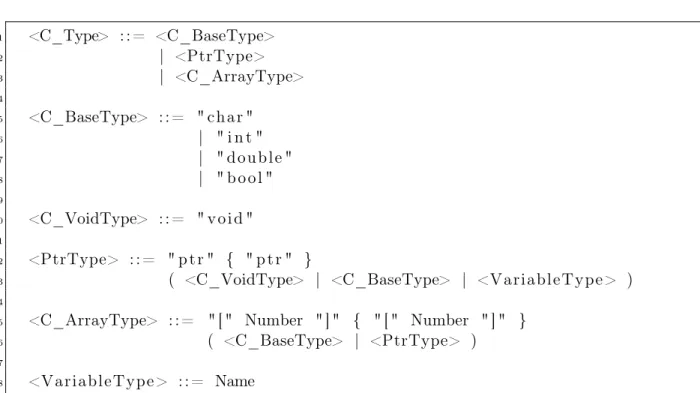
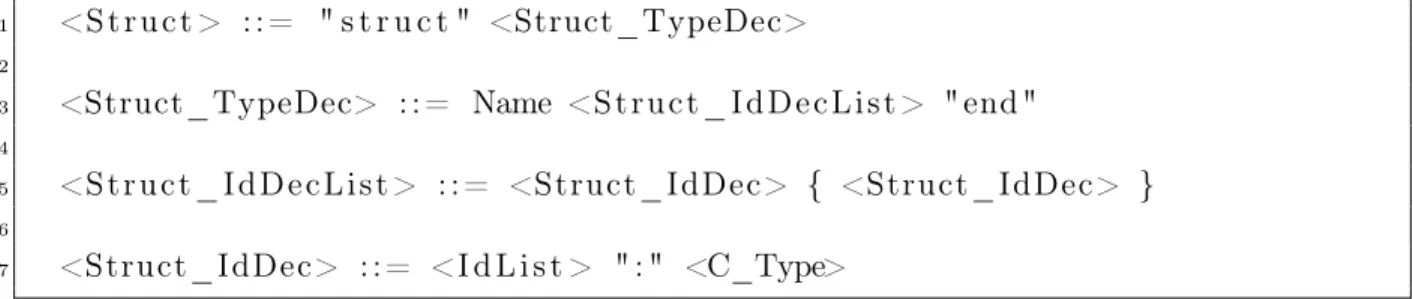
3.3 Grammar . . . 32
3.4 The C types and the sizeof operator . . . 34
3.4.1 The primitive C types . . . 34
3.4.2 The C pointer type . . . 34
3.4.3 The C struct type . . . 35
3.4.4 The C array type . . . 36
3.5 Themalloc and freeoperators . . . 37
3.5.1 The number of bytes as input . . . 37
3.5.2 The result of the sizeof operator as input . . . 39
3.5.3 The C pointer type as input . . . 39
3.5.4 The C pointer type and the number of bytes as inputs . . . 40
3.5.5 The free operator . . . 42
3.6.1 Conversions for primitive C types . . . 43
3.7 The C pointer types . . . 45
3.7.1 C pointer to void . . . 46
3.7.2 C pointer to an array of C structs . . . 46
3.7.3 Setting a C pointer to NULL value . . . 46
3.8 The C struct types . . . 47
3.8.1 The type of a member . . . 47
3.9 The C array types . . . 47
3.9.1 Assignment to a C pointer type . . . 48
3.10 Conclusions . . . 49
4 Modified Lua 51 4.1 Introduction . . . 51
4.2 Modified Lua Features . . . 52
4.2.1 Feature Description . . . 53
4.2.2 Feature Implementation . . . 56
4.3 Size and offset . . . 61
4.4 TheCS_malloc and CS_free operators . . . 61
4.5 The primitive C types . . . 62
4.6 The C pointer types . . . 64
4.7 The C array types . . . 65
4.8 The C strings . . . 66
4.9 Thecs.NULL pointer . . . 67
4.10 Conclusions . . . 68
5 Modified LuaFFI Library 71 5.1 Introduction . . . 71
5.3 Modified LuaFFI Library . . . 73
5.3.1 Modified LuaFFI Library Description . . . 73
5.3.2 Modified LuaFFI Library Implementation . . . 74
5.4 Calling an external C function . . . 74
5.5 Conclusions . . . 76 6 Performance 77 6.1 Introduction . . . 77 6.2 Test Environment . . . 78 6.3 Benchmarks . . . 78 6.3.1 Introduction . . . 78 6.3.2 Methodology . . . 79 6.3.3 Results . . . 79 6.3.4 Discussion . . . 82 6.4 Feature Testing . . . 83 6.4.1 Introduction . . . 83 6.4.2 Methodology . . . 86 6.4.3 Results . . . 86 6.4.4 Discussion . . . 87 6.5 Conclusions . . . 88
7 Conclusions and Future Work 90 7.1 Contributions . . . 90
7.2 Future Work . . . 91
List of Tables
6.1 Benchmark Mean Table . . . 81
6.2 Benchmark Speedup Table . . . 81
6.3 Feature Testing Mean Table . . . 86
List of Figures
3.1 Grammar for the C types of Poseidon Lua . . . 32
3.2 Grammar for thestruct definition construct . . . 33
3.3 Grammar for themalloc and sizeof operator expressions . . . 33
3.4 malloc.tl, Part 1 of 7 . . . 38 3.5 malloc.tl, Part 2 of 7 . . . 38 3.6 malloc.tl, Part 3 of 7 . . . 39 3.7 malloc.tl, Part 4 of 7 . . . 39 3.8 malloc.tl, Part 5 of 7 . . . 40 3.9 malloc.tl, Part 6 of 7 . . . 42 3.10 malloc.tl, Part 7 of 7 . . . 42 3.11 assignment.tl . . . 44 4.1 implementation.tl, Part 1 of 6 . . . 61 4.2 implementation.tl, Part 2 of 6 . . . 62
4.3 Part of implementation.lua translated from implementation.tl Part 2 of 6 . 62 4.4 implementation.tl, Part 3 of 6 . . . 63
4.5 Part of implementation.lua translated from implementation.tl, Part 3 of 6 64 4.6 implementation.tl, Part 4 of 6 . . . 65
4.7 Part of implementation.lua translated from implementation.tl, Part 4 of 6 65 4.8 implementation.tl, Part 5 of 6 . . . 66 4.9 Part of implementation.lua translated from implementation.tl, Part 5 of 6 66
4.10 implementation.tl, Part 6 of 6 . . . 67
4.11 Part of implementation.lua translated from implementation.tl, Part 6 of 6 68 4.12 pointers.tl . . . 69
4.13 pointers.lua translated from pointers.tl . . . 69
5.1 ffi.tl, Part 1 of 3 . . . 75
5.2 ffi.tl, Part 2 of 3 . . . 75
Chapter 1
Introduction
1.1
Background
Most modern programming languages come with a type system. A type system is a tech-nology from lightweight formal methods [22]. A type represents a set of values that is defined by a programming language. The type system of a programming language consists of a set of types as well as a set of type derivation rules. The type derivation rules can be used to derive a type for an expression of the programming language.
Typechecking is the act of enforcing the derived type for each expression of the program-ming language. Static typechecking refers to typechecking that is performed at compile-time and dynamic typechecking refers to typechecking that is performed at run-compile-time.
A statically-typed programming language performs all typechecking at compile-time. Usually, such a programming language requires the programmer to supply static type-annotations for this purpose. This static typechecking restricts the run-time behavior of an expression of the language to guarantee that the expression always evaluates to a value that belongs to its derived type at run-time. As a result, a statically-typed programming language is able to provide strong security and maintainability assurances to the program-mer.
A dynamically-typed programming language performs all typechecking at run-time. This dynamic typechecking guarantees that an expression of the language always evaluates to a value that belongs to its derived type at run-time. There are no restrictions placed on the expression at compile-time. The programmer is not required to provide any static type-annotations and all dynamic typechecking is automatically performed. As a result, a
dynamically-typed programming language is able to provide a great deal of flexibility to the programmer.
At the initial stage of a software project, the flexibility and automation of a dynamically-typed programming language is of high value to the programmer and enhances productiv-ity greatly. However, as a software project matures, securproductiv-ity and maintainabilproductiv-ity become more desirable qualities in a programming language. These qualities are already available in statically-typed languages. They can also be provided for a dynamically-typed pro-gramming language by attaching a static type system on top of it. This approach allows some static typechecking to take place for an otherwise dynamically typechecked program. Two popular methods for achieving this capability are optional type-systems and gradual type-systems.
An optional type-system adds a static type-system on top of a dynamically-typed pro-gramming language. The programmer supplies as much type annotations as they wish. These type annotations are used to perform as much static type checking as possible. The key characteristic of an optional type system is that it is not allowed to modify the run-time semantics of the underlying dynamically-typed program [3]. Thus, an optional type system cannot guarantee type soundness because at run-time, it cannot stop a statically-typed variable from being assigned a value that has a different type than the static type of the variable.
A gradual type-system also places a static type-system on top of a dynamically-typed programming language. It allows the programmer to provide as much type annotations as desired for the purpose of static typechecking. It is able to guarantee type soundness by inserting run-time checks between statically-typed code and dynamically-typed code to enforce static types at run-time [24]. Thus, a gradual type system is able to overcome the shortcomings of an optional type system. However, the extra run-time checks that are inserted by a gradual type system incurs a significant performance cost [25]. It is ultimately for the programmer to decide if the type soundness guarantee provided by a gradual type sytem is worth the extra cost in performance.
1.2
Motivation
Dynamically-typed programming languages have gained a great deal of popularity among software developers over the recent years. This popularity is principally due to the flexible programming style and extensive automation that is offered by these languages. However, as discussed earlier, security and maintainability become more of a concern than flexibility and automation when a software project matures and its codebase stabilizes.
Security and maintainability guarantees can be obtained through the addition of an optional type-system or a gradual type-system to a dynamically-typed programming lan-guage. Both optional and gradual type systems generate a program in the underlying dynamically-typed programming language as a final product. This means that their per-formance can only be as good as the perper-formance of their underlying dynamically-typed language.
Research in this area has primarily focused on the security and maintainability bene-fits that could be gained through the use of increased static typechecking. However, the addition of a static type system on top of a dynamically-typed programming language also creates a new opportunity to improve performance as well.
Statically-typed programming languages tend to run faster than dynamically-typed programming languages [27]. This benefit is mainly due to the fact that statically-typed languages provide a variety of language features that help to cut down on performance costs. Dynamically-typed languages generally do not offer these features because they would undermine the flexibility of use and automation that is provided by these languages. The work presented in this thesis investigates the integration of some of the features that are traditionally provided by statically-typed languages into an optionally-typed language. This investigation is done for the purpose of circumventing the performance limit that is imposed upon the optionally-typed language by its underlying dynamically-typed language. This thesis explores the performance impact of integrating two such language features into an optionally-typed programming language: manual memory management and di-rect memory programming. Manual memory management gives the programmer control over garbage collection activities. Direct memory programming allows the programmer to directly manipulate data that is stored in memory. Both of these language features are available in the statically-typed programming language named C [12].
These language features are integrated into the optionally-typed programming language named Typed Lua that provides an optional type system for an underlying dynamically-typed programming language named Lua. Typed Lua allows the programmer to add static type annotations to an underlying Lua program, which are used to perform static typechecking. Typed Lua outputs the underlying Lua program as the final product.
Most of the dynamically-typed languages, including Lua, provide an automatic garbage collector to deallocate blocks of memory that are no longer used by a program at run-time. The automatic garbage collector performs its tasks without the involvement of the programmer. Therefore, it is able to avoid any memory errors that could have been introduced by the programmer. It keeps track of the blocks of memory that are in use by the program and the blocks of memory that are not in use by the program. Thus, it runs
periodically to update the status of the blocks of memory and to decide when to deallocate the unused blocks of memory. As a result, it incurs a performance overhead.
In contrast, manual memory management allows the programmer to decide when to deallocate blocks of memory. Manual memory management is implemented in the C gramming language through two critical functions named malloc() and free(). The pro-grammer is able to use the malloc() function to allocate a block of memory. The program-mer is able to use the free() function to deallocate a block of memory.
Although there is a chance that the programmer may introduce memory errors, the performance overhead related to automatic garbage collection can be avoided. Manual memory management for Typed Lua is implemented using a similar mechanism to that used in C.
In this thesis, the term “direct memory programming” is used to refer to the ability of a programmer to directly manipulate memory without the need to go through an intermedi-ate mechanism. One such intermediintermedi-ate mechanism is provided by Typed Lua in the form of the Lua table. It is the main data structure provided by the Lua programming language and it is implemented as a hash table by the Lua virtual machine (VM); consequently, a member access into a Lua table requires a hash table lookup [11]. As all the memory elements have to be accessed through Lua tables indirectly, it imposes extra performance overhead.
In contrast, the C programming language allows its programmer to directly manipulate the data that is stored at an arbitrary memory location without having to go through the interface of an intervening mechanism. This language feature is implemented through a special data type called a pointer. A pointer refers to a particular location in memory. A pointer can be dereferenced to access the data that is stored at the memory location that is referred to by the pointer. A pointer can also be used to store data at the memory location referred to by the pointer. In this way, a C programmer is able to use pointers to directly manipulate memory without having to go through an intervening mechanism. We intend to integrate a pointer mechanism along with other types from C into Typed Lua to implement direct memory programming in order to avoid the performance overhead of using Lua tables for memory manipulation.
When the new pointer mechanism and other types from C are integrated into Typed Lua, it also provides an opportunity to reduce the performance overhead related to dynamic typechecking of values returned from an external C function call done through a Lua foreign function interface (FFI) library.
1.3
Statement of Problem
We propose a programming language named Poseidon Lua that extends Typed Lua with manual memory management and direct memory programming features.
We implement manual memory management for Poseidon Lua in a similar manner to the way it is implemented in the C programming language. We add a malloc operator to Poseidon Lua, which can be used by the programmer to allocate a block of memory. We also add a free operator to Poseidon Lua, which can be used by the programmer to deallocate a block of memory. In this way, a Poseidon Lua programmer is able to make use of manual memory management when it is necessary.
We attempt to offer a more efficient alternative to Lua tables for memory manipulation. We do this through the implementation of direct memory programming for Poseidon Lua. This alternative is achieved by extending the static type system of Typed Lua with a subset of the type system of the C programming language including pointers. This modification allows a Poseidon Lua programmer to use C pointers to manipulate memory directly with-out having to go through an intermediate mechanism such as a Lua table. Therefore, our solution avoids the performance overhead related to the use of Lua tables.
A Typed Lua program is statically typechecked and then translated into a correspond-ing Lua program. Similarly, a Poseidon Lua program is statically typechecked and then translated into a corresponding Modified Lua program. Modified Lua is our extension of the Lua compiler and virtual machine. Modified Lua augments Lua with special C Semantics (CS) operators that allow C values to be handled from within a Lua program.
Note that a program that is written in a dynamically-typed programming language such as Lua is ultimately incapable of matching the performance of a program that is written in a statically-typed programming language such as C. This restriction is due to the various automated features that are provided by the dynamically-typed language and the way in which the implementation of the language is built around these features. For this reason, these languages generally find libraries that are written purely in C to be indispensable from a performance standpoint. As a result, these languages tend to provide a Foreign Function Interface (FFI) library that can be used by the programmer to call external C functions from within the dynamically-typed programming language. The luaffifb library is one such FFI library for Lua.
The main problem with the approach taken by theluaffifblibrary is in the way that it treats the value that is returned by the external C function. If the returned C value is of a primitive C type, luaffifb typechecks the returned value and converts it to a Lua value at run-time. Otherwise, if the returned C value is of a composite type such as a
C struct or a C pointer, luaffifb stores the returned C value within a cdata value. At each use-site of the returned C value, the cdata value performs dynamic typechecking to ensure the correct usage of the underlying C value, which incurs a recurring performance overhead. This is necessary because Lua is a dynamically-typed programming language and, as a consequence, does not accept static type annotations from the programmer.
Poseidon Lua does accept static type annotations for its C types. Thus, it can ensure that the value that is returned by an external C function always behaves in accordance with its C type by performing static typechecking only. Thus, it can avoid the recurring performance overhead at each use-site of the returned C value. In this way, Poseidon Lua is able to reduce the performance cost of using an FFI library.
Poseidon Lua comes equipped with the Modified LuaFFI library, which enables a C pointer that is returned from an external C function to be used within Poseidon Lua code without incurring any further performance costs from extra dynamic typechecking.
In this thesis, we explore the performance impact of integrating two language features, manual memory management and direct memory programming, which are normally only found in statically-typed programming languages such as C, into our proposed optionally-typed programming language named Poseidon Lua. Furthermore, we study the perfor-mance impact of using the C types of Poseidon Lua in conjunction with an FFI library.
The novel approach proposed in this thesis allows programmers of dynamically-typed languages to enjoy some of the performance benefits as offered by statically-typed lan-guages.
1.4
Organization of the Thesis
The rest of the thesis is structured as follows.
Chapter2provides a review of the research work that is relevant to the work presented in this thesis. The language features of dynamically-typed programming languages and optionally-typed programming languages are covered. Next, we discuss the concept of type soundness. Then, the language features of gradually-typed programming languages are described. In addition, the language features of the dynamically-typed programming language Lua is given along with the language features of the optionally-typed program-ming language Typed Lua.
Chapter3provides an overview of our proposed programming language named Poseidon Lua. Poseidon Lua introduces 3 new operators: sizeof, malloc, and free. Poseidon
Lua introduces 4 primitive C types: char, int, double, and bool. Poseidon Lua also introduces 3 composite C types: C pointer type, C struct type, and C array type. In addition, Poseidon Lua includes a modification of the assignment operator of Typed Lua in order to work properly with the C types that are provided by Poseidon Lua.
In Chapter 4, we introduce Modified Lua, which is our extension of the Lua compiler and virtual machine. Modified Lua provides special operators to allow the manipulation of C values from within Lua.
In Chapter5, we introduce the Modified LuaFFI library of Poseidon Lua. This library allows a Poseidon Lua program to call an external C function through an underlying FFI library and use the C pointer that is returned by the C function.
In Chapter 6, we show the performance impact of Poseidon Lua programs relative to Lua programs that use Lua tables and Lua programs that use a FFI library.
In Chapter 7, we provide the contributions of this thesis and possible directions for future work.
Chapter 2
Literature Review
2.1
Introduction
This chapter establishes the background context from which our work draws influence. We begin with a description of dynamically-typed programming languages. The overarching goal of these languages is to offer the programmer the maximum amount of flexibility and automation that is possible. They achieve this by automatically carrying out a lot of the tasks that would normally require the involvement of the programmer in statically-typed programming languages.
For example, two prominent features of dynamically-typed languages are dynamic type-checking and automatic garbage collection [27]. In general, statically-typed languages re-quire the programmer to supply static type annotations for the purpose of performing static typechecking at compile-time. Some statically-typed programming languages do not require any static type annotations because they perform type inferencing. However, any type error that is reported by these languages may be time consuming for the programmer to track down and resolve due to the lack of explicit type annotations and the non-trivial nature of the type inferencing algorithm that is used. On the other hand, dynamically-typed languages avoid all of these issues altogether by forgoing static typechecking in favor of dynamic typechecking.
Some statically-typed languages, such as the C programming language [12], require the programmer to manually deallocate the memory blocks that are no longer used by the program. Dynamically-typed languages remove the involvement of the programmer from memory management matters by providing a garbage collector that automatically deallocates memory blocks that are no longer needed by the program at run-time.
It is common knowledge that the flexibility and automation provided by dynamically-typed languages is advantageous for programmers in the early stages of software devel-opment when the requirements are constantly changing and fast prototyping is desirable. However, in the later stages of software development, the requirements and the correspond-ing software become more stable. This makes maintainability and security very attractive qualities in a programming language. These qualities are more prevalent in statically-typed languages. Therefore, several techniques have been developed to provide static type systems for dynamically-typed languages. However, these techniques tend to emphasize se-curity and maintainability. In contrast, our research focuses on improving the performance of dynamically-typed languages by integrating features from statically-typed languages.
For convenience of discussion, we have organized the contents of the chapter according to the following topics: Dynamic typing, Optional typing, Type soundness, Gradual typing, Lua, and Typed Lua.
2.2
Dynamic Typing
Dynamically-typed languages offer a different set of language features than those offered by statically-typed languages. Each of these language features comes with benefits as well as shortcomings when compared to its counterpart in statically-typed languages. Some of these language features facilitate a way of programming that is currently not possible in a statically-typed language.
Laurence Tratt [27] identifies the major defining features of dynamically-typed lan-guages and traces the history of dynamically-typed lanlan-guages. The author recognizes Lisp and Smalltalk as the earliest incarnations of dynamically-typed languages. Tratt states that Lisp, a functional programming language, is succeeded by Scheme, which has seen wide adoption in the research community. The author notes that Smalltalk, an object-oriented programming language, is succeeded in modern times by Python and Ruby. The author also notes that the class-based object model of Smalltalk has motivated the development of the prototype-based object model of the Self programming language. Tratt states that outside of Lisp and Smalltalk, the biggest influence on the development of dynamically-typed languages comes from the text processing languages. According to the author, Sed, an early text processing language, is succeeded by AWK and AWK is in turn succeeded by Perl. The author observes that these languages continue to enjoy much popularity due to their specialization for a particular application domain.
Moreover, Tratt identifies the advantages and disadvantages of dynamically-typed lan-guages compared to statically-typed lanlan-guages. The author states that dynamically-typed
languages generally provide highly optimized built-in data types such as lists and dictionar-ies. Tratt observes that statically-typed languages tend to require these to be implemented separately in libraries. The author notes that dynamically-typed languages provide auto-matic garbage collection. The author acknowledges that statically-typed languages are also starting to adopt this technology. The author states that dynamically-typed lan-guages provide facilities for meta-programming. Tratt states that Lisp allows compile-time meta-programming via its macro definition feature. Tratt also states that Smalltalk allows run-time meta-programming through reflection-based programming. The author points out that statically-typed languages do not provide run-time meta-programming facilities of equivalent power. The author states that dynamically-typed languages offer a special feature named eval that allows a program to execute a string as a code fragment at run-time. The author notes that statically-typed languages generally do not provide this feature. Tratt observes that an important disadvantage for dynamically-typed languages in comparison to their statically-typed counterparts is slower performance.
Tratt also identifies the similarities and dissimilarities within different dynamically-typed languages. According to the author, one source of dissimilarities is object-orientation. Tratt observes that some dynamically-typed languages can be classified as Object-Oriented and others can be classified as Non-Object-Oriented. However, Tratt acknowledges that there also exists languages such as Python that started off as Non-Object-Oriented but added in Object-Oriented features over time. The author states that another source of dissimilarities is optional typing. Tratt observes that some dynamically-typed languages include an optional type system that is able to perform some compile-time typecheck-ing dependtypecheck-ing on the amount of static type annotations provided by the programmer. Tratt states that optional type systems differ according to how much type annotation they consider to be mandatory. The author notes that aside from these differences, dynamically-typed languages tend to be very similar in terms of the general facilities that they provide. Tratt notes that several features such as JIT-compilation, automatic garbage collection, and meta-programming were first pioneered in dynamically-typed languages and a lot of these features were later absorbed by statically-typed languages. The author also notes that it is reasonable to expect that many of the features that are unique to dynamically-typed languages today may be integrated into statically-dynamically-typed languages at some point in the future.
A distinguishing feature of a programming language is its object model. There are two well-known object models: class-based object model and prototype-based object model. Class-based object models are generally found in statically-typed languages and prototype-based object models are generally found in dynamically-typed languages. Usually, the prototype-based object model is more flexible.
Ungar and Smith [28] identify the advantages of prototype-based object-oriented pro-gramming over class-based object-oriented propro-gramming. The authors present the design of the Self programming language. They state that Self uses the concept of prototypes for inheritance and object creation instead of classes. They note that Self also uses named slots in place of variables and procedures. They observe that Self removes the distinc-tion between closures, procedures, and objects by allowing prototypes to model activadistinc-tion records.
Ungar et al. observe that objects are created in Self by copying a prototype instead of instantiating a class because Self does not have classes and the subclass relationship between classes. The authors note that this simplifies the relationship between objects. They state that Self can express object-oriented idioms as well as one-of-a-kind objects. They observe that Self also has facilities for inline objects as well as active values.
Ungar et al. claim that Self provides a fresh understanding of the object-oriented programming paradigm due to its expressive and simple language features.
Many dynamically-typed programming languages provide the facilities to inter-operate with statically-typed languages for performance reasons. Usually, the statically-typed lan-guage of choice is the C programming lanlan-guage and the inter-operation happens over a C API. However, care must be taken in order to avoid unintended errors during inter-operation.
Muhammad and Ierusalimschy [21] deal with the tradeoffs that can be made in the design of the C API for a scripting language to make it more efficient as an embeddable language (where the C code uses the scripting language) or as an extensible language (where the scripting language uses the C code). The authors identify data transfer, garbage collection, and function registration and calls as the key dimensions for tradeoffs in the design of the C API for a scripting language and describe these dimensions. The authors note that a scripting language represents data in a different way than C. Thus, they emphasize that the C API of the scripting language must provide facilities to manipulate data safely when data is transferred between the two languages. The authors note that a scripting language likely uses automatic garbage collection whereas C uses manual memory management. They observe that the C API of the scripting language must provide facilities for each language to handle data in a way that avoids memory errors. Finally, they assert that the C API of a scripting language must offer facilities to register and call functions from one language to another, which includes facilities to send parameters properly for a function call and receive results from function calls.
Muhammad et al. perform analysis and comparison of the design of the C APIs of 4 scripting languages: Python, Perl, Ruby, and Lua. They also consider the C API for
Java in order to understand the impact of static typing on the design of C APIs. They note that the C API that is provided by a scripting language must allow data to be manipulated in an error-free way. They observe that Python, Ruby, and Perl offer direct handles to their objects to C for manipulation. They also observe that Lua only allows indirect manipulation of its objects through stack indices. The authors note that Java uses the correspondence between its own static types and the static types of C to reduce the amount of data conversions that need to take place.
Muhammad et al. recognize that it is important for a scripting language to hide the implementation details of its garbage collection algorithm so as to prevent the C code from inadvertently introducing memory errors. The authors find that Python and Perl use reference counting algorithms and they are unable to adequately hide the use of their reference increment and reference decrement operations in their C APIs. The authors observe that Ruby uses a mark-and-sweep algorithm but it is also unable to hide this when certain kinds of Ruby objects are created from within C. They point out that Lua uses an incremental garbage collection algorithm and is able to hide it relatively well. They note that Java succeeds in completely hiding the implementation details of its garbage collection algorithm.
Muhammad et al. are of the opinion that the ease with which function calls can be made has a direct impact on the ability of a scripting language to inter-operate with C code. They find that Python, Perl, and Lua allow functions to be represented as objects that can be readily called. They observe that Java and Ruby do not consider methods to be first-class objects, and these languages provide special C types to represent methods.
Muhammad et al. implement a C library called LibScript to study and compare the C APIs of the 4 scripting languages. They find that Python’s C API provides more functions geared towards higher convenience whereas Lua’s C API provides less functions but is simpler to use. They also observe that Python and Lua as well as Java provide C APIs that define their function and C type names with prefixes in order to avoid C namespace pollution; however, Perl and Ruby provide C APIs that define their function and C type names in an arbitrary manner.
Muhammad et al. claim that when the C API of a scripting language aims to support both embedding and extension, it should focus more on embedding since the needs of extension support is covered by the needs of embedding support as well. They also note that a variety of tools already exist to deal with issues related to extension support. Therefore, they argue that putting more of an emphasis on embedding support should not be a problem.
information from the C code. This information could potentially be used to detect a larger number of type errors at compile-time than would otherwise be possible.
Klint, Roosendaal, and van Rozen [13] address the problem of ensuring high quality for Lua scripts in the absence of proper static analysis tools. The authors note that the data types and function signatures of the interface to a game engine can be utilized to enable better static analysis of embedded Lua scripts. They observe that the static types of the interface to the game engine restrict the ways in which Lua code may use the facilities that are made available to it by the game engine. They report that the functions that are provided by the game engine may only be called with arguments that are of certain types and these functions are also only allowed to return results that are of certain types. Therefore, the authors argue that the static types of these functions could be utilized by a static analysis tool to detect errors in Lua scripts.
Klint et al. propose a new framework called Lua AiR (Analysis in Rascal) that works alongside the Eclipse IDE to create an abstract syntax tree (AST) for a Lua script in order to perform various types of analysis on the AST. They note that the integration of Lua AiR into the Eclipse IDE creates an opportunity for other pre-existing tools to use the information that is generated by Lua AiR to enhance the quality of their own services. They also note that type inferencing could be used to expand Lua AiR’s ability to catch errors in Lua scripts.
Klint et al. intend to use Lua AiR on existing game-related codebases on a larger scale. They hope to provide a clearer sense of the magnitude of the impact that Lua AiR can have on the productivity of programmers. They state that it may inspire the development of other tools that could also make use of the static type information from the interface to the game engines.
A crucial feature of dynamically-typed languages is that they automatically perform dynamic typechecking at run-time without the involvement of the programmer. However, it is necessary to insert these dynamic typechecks into the program in a systematic manner in order to avoid introducing more dynamic typechecks than are actually needed.
Henglein [8] proposes an explicitly dynamically typed language for an implicitly dy-namically typed language. The author presents the dydy-namically typed λ-calculus as an
extension of the statically typed λ-calculus. The author describes that the dynamically
typed λ-calculus includes a new type named Dyn, which represents values that have been
tagged with a type constructor, and dynamic type coercions, which represent operations to tag and untag (after checking) a value with a type constructor. The author also presents the concept of completions as a way to translate a term of the untyped λ-calculus to a
type coercions as well as type annotations for variables where appropriate.
We now consider a different perspective on typechecking. Normally, statically-typed languages perform all their typechecking at compile-time. However, there may be situations where the type of a value may be unknown at compile-time. In such situations, a statically-typed language may have to perform dynamic typechecking at run-time to avoid type errors.
Abadi, Cardelli, Pierce, and Plotkin [1] address the problem of adding dynamically-typed values to a statically-dynamically-typed language for the purpose of providing strong typing guarantees in an environment where the type of the values may be statically unknown. The authors present an extension of the Simply Typed Lambda Calculus that includes a new type named Dynamic, which represents dynamically-typed values, where a certain value that belongs to the Dynamictype is a pair(VAL, TAG)whose first member is a value VALand whose second member is the type tag TAGfor the type of VAL.
Abadi et al. introduce 2 new constructs in relation to theDynamictype. They propose a dynamicconstruct, which can be used to create new values of the Dynamic type. They also propose atypecase construct, which can be used to analyse the content of a value of theDynamictype and select an expression to evaluate based on that content. The authors present an operational semantics as well as a denotational semantics for the calculus. The authors anticipate that future programming languages will include types that are similar to the proposedDynamictype as a standard feature.
2.3
Optional Typing
In statically-typed languages, the programmer has to resolve all reported type errors at compile-time. This is inconvenient for the programmer, but it provides strong security and maintainability guarantees. On the other hand, in dynamically-typed languages, the programmer only needs to resolve the type errors that are reported at run-time because dynamically-typed languages perform all typechecking at run-time automatically. Thus, dynamically-typed languages are flexible and provide enhanced productivity.
In order to provide better security and maintainability guarantees in dynamically-typed languages, static typechecking at compile-time can be added as an option on top of the dynamic typechecking that already occurs at run-time. This arrangement is known as an optional type system.
Gilad Bracha [3] tackles the issue of enhancing the expressibility and security of pro-gramming languages using pluggable optional type systems instead of mandatory type
systems. The author proposes that instead of focusing on the difference between static and dynamic type systems, everyone should focus on the difference between mandatory and optional type systems. The author observes that mandatory type systems are brittle and not secure due to there being no formal proof of correctness for most of them; therefore, these systems can pose a security problem when their assumptions fail. The author de-scribes the problem of mandatory type systems. The author observes that statically-typed programming languages normally use mandatory type systems. However, the author states that if the internal logic of one of these type systems is faulty, then a security guarantee cannot be provided by that type system. Bracha notes that without a proof of correctness, the internal logic of any of these type systems cannot be shown to be consistent. Therefore, according to the author, all the time and effort spent towards making a program conform to a mandatory type system may be wasted.
Bracha proposes that programmers use multiple optional type systems that each check for a different type system as opposed to one mandatory type system. The author describes the characteristics of an optional type system. Bracha observes that an optional type system allows a programmer to choose which type annotations to provide. The author states that an important characteristic of an optional type system is that it may not alter the dynamic semantics of the underlying dynamically-typed programming language. Bracha explains that this requirement means that each optional type system can be plugged on top of each other to form a pluggable type system. Therefore, according to the author, a pluggable type system composed of multiple optional type systems can provide a richer typechecking service than a mandatory type system.
Bracha claims that a pluggable type system is capable of supplying most of the benefits that a programmer would expect from a mandatory type system.
An optional type system does not add any new dynamic typechecks at run-time. As a result, there is no way to prevent a statically-typed variable from being assigned a value that is inconsistent with its static type at run-time. Thus, an optional type system cannot guarantee type soundness. However, such a type violation should be detected in order to give the programmer a chance to rectify the error for the proper functioning of the program. Lehtosalo and Greaves [14] address the problem of monitoring runtime type errors of optional pluggable type systems. The authors propose an optional runtime type error mon-itoring system that inserts runtime checks that log type violations but otherwise preserve the original dynamic semantics of the program. The authors explain that the runtime checks are implemented using wrapper objects or wrapper functions that track type vio-lations that may occur when values cross the boundary between statically typed code and dynamically typed code.
Lehtosalo et al. present a formal model for an extension of Featherweight Java (FJ) named FJ?, where their model incorporates support for a pluggable type system as well as
optional monitoring of runtime type errors.
An optional type system can be used to provide static typechecking facilities for pro-gramming languages from any propro-gramming paradigm. Moreover, an optional type system can integrate types from different programming paradigms.
Bonnaire-Sergeant, Davies, and Tobin-Hochstadt [2] explore the issue of providing an optional type system for a functional programming language that has support for interop-erability with an object-oriented language. The authors present an optional type system for Clojure named Typed Clojure and construct a formal model for Typed Clojure. They describe the features of Typed Clojure. The authors note that Typed Clojure includes an adaptation of the occurrence typing feature from Typed Racket. The authors explain that Typed Clojure also provides facilities to support the ability of Clojure to inter-operate with Java, which is an object-oriented language. They elaborate that for the purpose of Java interoperability, Typed Clojure provides exception-based control flow analysis to avoid null-pointer exceptions. They point out that it also provides heterogeneous dictionary types and multimethods.
Bonnaire-Sergeant et al. claim that Typed Clojure is already being used broadly in the Clojure community. They conduct a case study where they analyse a software system that is developed by a third-party using Clojure and Typed Clojure.
Bonnaire-Sergeant et al. plan to extend Typed Clojure to implement gradual typing in the future. The authors intend to make use of language features that are already available from Java and Clojure for this purpose.
2.4
Type Soundness
In a sound type system, a type error cannot be left uncaught. Statically-typed program-ming languages ensure type soundness by typechecking at compile-time. On the other hand, dynamically-typed programming languages ensure type soundness by typechecking at run-time. The problem of type soundness arises when a static type system is imposed on top of a dynamic type system while keeping the dynamically-typed language unaware of the static type system because the static type system does not perform the required dynamic typechecking related to its static types at run-time.
Mezzetti, Moller, and Strocco [20] address the problem of empirically validating the use of unsoundness in the type system of programming languages. The authors conduct an
experiment to investigate the unsoundness of the type system for the Dart programming language. They identify 10 sources of unsoundness and implement corresponding sound alternatives. First, they test whether the type system outputs a higher volume of warnings when they switch from each source of unsoundness to its sound alternative. Next, they perform a qualitative analysis of the warnings that are output. Finally, they test the impact of the set of sound alternatives that are selected on the runtime errors. They find that unsoundness in Dart is not justified in the case of bivariant function subtyping and method overriding.
Mezzetti et al. claim that some sources of unsoundness in Dart can be justified, but not all of them. The authors state that it may be beneficial to investigate how the productivity of programmers can be affected by alternative design choices for the type system of Dart. The authors also wish to evaluate different designs for the standard library of Dart to make it more type sound.
Most of the dynamically-typed languages support higher-order functions, which are functions that can take another function as an input argument. Since higher-order functions can take as an input argument another higher-order function, ensuring type soundness in languages that allow these kinds of functions can be challenging.
Findler and Felleisen [5] examine the issue of providing assertion-based contracts for higher-order functions in programming languages. The authors present a typed lambda calculus named λCON that includes support for assertion-based contracts for higher-order functions. The authors prove various properties of the calculus including type soundness. They also use examples to demonstrate their assertion monitoring system in DrScheme.
Findler et al. claim that assertions for higher-order functions allow programmers to specify contracts that they are unable to express using existing type systems. The authors hope that further research into assertions will lead to more practical type systems.
A sound type system has the ability to detect and locate type violations at run-time. However, the location in the code where the type violation occurs is usually different from the location in the code where the type violation is ultimately detected. Thus, there should be a system to link the two locations. This is called a blame tracking system.
Wadler and Findler [31] tackle the problem of providing blame tracking for a language with explicit casts. The authors present their blame calculus. They explain that the blame calculus includes a dynamic type named Dyn that represents values whose type may be unknown at compile-time. They further elaborate that it also includes subset types that augment a base type with a refinement predicate to narrow down the set of possible values to a subset of the set of values represented by the base type. They note that the calculus also includes explicit casts that have blame labels attached to them. They point out that
when a cast fails at run-time, blame is allocated to the blame label that is attached to that cast.
Wadler et al. present the concepts of positive blame and negative blame: positive blame occurs when a cast fails due to a violation from the term being casted, and negative blame occurs when a cast fails due to a violation from the surrounding context. The authors also present the concepts of a positive subtyping relation and a negative subtyping relation. They show that casting from a positive subtype to its supertype cannot cause a positive blame. They also show that casting from a negative subtype to its supertype cannot cause a negative blame.
Wadler et al. utilize the positive subtyping relation and the negative subtyping relation to show that well-typed terms of the blame calculus cannot generate blame. Therefore, the authors observe that in the case of an interaction between a well-typed term and a dynamically-typed term, a cast failure always results in the dynamically-typed term being blamed.
2.5
Gradual Typing
Like an optional type system, a gradual type system also provides a static type system for a dynamically-typed language. However, gradual type systems are introduced in order to overcome the lack of type soundness of optional type systems. In a gradual type system, typechecking happens both at compile-time and at run-time. The run-time portion of the typechecking for the static types is performed at the boundary between statically-typed code and dynamically-typed code to check for static type violations.
Siek and Taha [24] address the issue of providing a type system for a functional language that allows the programmer to control the amount of static typechecking versus dynamic typechecking. The authors present an extension of the simply-typed λ-calculus named
the gradually-typed λ-calculus. The authors explain that the gradually-typed λ-calculus
includes a dynamic type that is represented by the symbol “?”. The authors further elabo-rate that the type system for the calculus includes a type-consistency relation that allows a function application to pass static typechecking even when the type of the function or the type of the argument is unknown. The authors state that the dynamic semantics for the calculus is provided through a translation to an intermediate language with explicit cast insertion.
Siek et al. prove that for a fully annotated term, the type system of the gradually-typed
they prove that for a fully annotated term, the translation to the intermediate language results in no casts being inserted. They also prove that when a program terminates, it either generates a cast error or it generates a value that belongs to the proper type.
Siek et al. plan to integrate their gradual type system into a dynamically-typed lan-guage. They hope to measure the magnitude of its impact on programmer productivity.
Programming languages from many different paradigms can be appended with a gradual type system. However, each paradigm poses its own set of challenges when it comes to the implementation of a gradual type system.
Siek and Taha [23] tackle the issue of providing a gradual type system for an object-oriented language that allows the programmer to control the amount of static typechecking to be performed in contrast to the amount of dynamic typechecking to be performed. The authors present an object-oriented calculus named Ob?<:. They state that the Ob?<: calculus incorporates a dynamic type, “?”, to indicate a value whose type is unknown at compile-time. The authors explain that this calculus also includes the Consistent-Subtyping relation that allows method invocations to pass static typechecking in the case where the type of the method or the type of the argument may be unknown. The authors note that the Consistent-Subtyping relation combines the Subtyping relation with the Type-Consistency relation in a manner that avoids placing the dynamic type, “?”, at the top of the type hierarchy. According to the authors, this approach allows the detection of some subtle errors during static typechecking that would have originated from the up-casting mechanism of the Subtyping relation. The authors give the dynamic semantics for the calculus via translation to an intermediate language with explicit casts.
Siek et al. prove that no program belonging to the Ob?<: calculus causes any type errors at run-time. They also prove that no fully annotated program belonging to the Ob?<: calculus causes any type errors or any cast errors at run-time.
Siek et al. plan to explore the manner in which Hindley-Milner inference would work in conjunction with gradual typing. They also wish to study whether the amount of dynamic typechecks could be further decreased using static analysis.
As stated earlier, gradually-typed languages use run-time checks to enforce the static type requirements of the programmer. The main problem is to identify how and where to provide the run-time checks. Each choice has its own advantages and disadvantages.
Vitousek, Kent, Siek, and Baker [29] address the issues related to the semantics of the run-time casts in gradually-typed languages. The authors introduce a gradually-typed version of Python named Reticulated Python. They state that Reticulated Python is a source-to-source translator that accepts type annotated Python code and performs static
typechecking and outputs Python 3 code with run-time casts inserted for dynamic type-checking.
Vitousek et al. implement a Python library that encapsulates the behavior of the run-time casts. They implement 3 forms of run-run-time cast semantics for Reticulated Python: the guarded semantics uses proxies and does not preserve object identity, the transient semantics does preserve object identity but is unable to perform proper blame tracking in case of an error, and the monotonic semantics also preserves object identity but requires the type of an object to be monotonically locked to the most precise type that has ever been ascribed to that object.
Vitousek et al. perform a case study where they type annotate several pieces of third-party software and run them using Reticulated Python. They find several bugs in the third-party software. They observe that the transient and monotonic cast semantics show acceptable performance; however, the guarded semantics perform poorly due to its use of proxies that do not preserve object identity. The authors claim that they would have been able to statically type a larger proportion of Python code if they had implemented support for generics into the type system for Reticulated Python.
The main similarity between optional and gradual type systems is that both perform typechecking at compile-time. On the other hand, the main dissimilarity between the two is that only gradual type systems perform run-time typechecking. Therefore, it may be more efficient to create a gradual type system by extending a pre-existing optional type system rather than to develop the gradual type system from scratch.
Vitousek and Siek [30] address the issue of transforming an optionally-typed language cleanly into a gradually-typed language by adding run-time casts in an uncomplicated manner. The authors observe that many dynamically-typed languages already have op-tional type systems that are available for them; however, these opop-tional type systems do not insert the run-time casts that are necessary for the implementation of a gradual type system. The authors discuss two different semantics for the run-time casts that could be deployed as part of a gradual type system: the guarded semantics uses proxies to encap-sulate run-time casts, and thetransient semantics uses explicit casts instead of proxies. The authors share the results from implementing the two casting semantics for Reticulated Python, a framework that can be used to test gradual type systems for Python. They observe that it is easier to implement thetransient semantics for Python than to imple-ment the guarded semantics for Python because it is difficult to add support for proxies to Python.
Vitousek et al. note that the optional type systems for many of the dynamically-typed languages already implement the static typechecker and other facilities that are required
for a gradual type system. Due to this, they argue that it should be relatively easy to add support for the actual run-time casts that use thetransient semantics. They implement CheckScript by adding run-time checks with the transient semantics to TypeScript, an optionally-typed language that compiles to JavaScript. The authors expect that it will be possible to transform other optionally-typed languages into gradually-typed languages through the addition of run-time casts with transientsemantics as well.
As a gradual type system for a dynamically-typed programming language ensures type soundness through the use of run-time checks, it introduces extra performance costs. For a gradual type system to be useful, it must keep these performance costs under an acceptable limit.
Takikawa, Feltey, Greenman, New, Vitek, and Felleisen [25] tackle the issue of evaluat-ing the performance of gradually-typed languages. The authors propose a new method to measure the performance of gradually-typed languages and describe the method in their paper. First, they divide each benchmark program into its constituent modules. Next, they create Typed and untyped versions of each module. Then, they form each individual configuration by combining different typed and untyped modules. Then, they organize all the configurations into a lattice with the fully untyped configuration at the bottom and the fully typed configuration at the top. Finally, they calculate the performance metrics for each configuration relative to the fully untyped configuration.
Takikawa et al. apply their new method to 12 selected Typed Racket benchmark pro-grams. They find that their selected Typed Racket benchmark programs perform very poorly, even under very loose restrictions. The authors claim that better performance evaluation gained from the use of their method will result in future improvements to gradually-typed languages.
2.6
Lua
The work presented in this thesis involves the integration of the language features of C into Lua, a dynamically-typed programming language. Understanding the motivation behind the development of Lua makes it easier to comprehend the design of its features.
Ierusalimschy, de Figueiredo, and Celes [10] survey the history of the development of Lua. According to the authors, the development of Lua originated in the Computer Graphics Technology Group (Tecgraf) at PUC-Rio. The authors report that Tecgraf had created 2 languages, DEL and SOL, for Petrobras. They state that DEL was developed for data-entry purposes and SOL was developed for configuration purposes. They note that
as the need for more powerful language features became apparent, the decision was made in 1993 to replace DEL and SOL with a new language named Lua.
Ierusalimschy et al. observe that Lua has been successful in the gaming industry. The authors identify the main reason for this success as the ease with which Lua can be embedded in game engines.
As stated earlier, the work presented in this thesis involves adding language features from C to Lua that perform better than the pre-existing features of Lua. The implemen-tation of Lua provides some indication of how this performance boost can be achieved.
Ierusalimschy, de Figueiredo, and Filho [11] survey the implementation of the main features of Lua 5.0. The authors identify a register-based virtual machine, an algorithm to implement tables as arrays, and the implementation of closures and coroutines as new features in Lua 5.0 when compared to Lua 4.0.
Ierusalimschy et al. state that Lua has had a stack-based virtual machine since it was first released. They observe that Lua has switched to a register-based virtual machine starting with Lua 5.0 because a register-based virtual machine avoids executing extra stack manipulation instructions that are prevalent in stack-based virtual machines, which leads to a smaller code size. The authors claim that Lua is the first widely used language that has adopted a register-based virtual machine.
Ierusalimschy et al. state that the implementation of Lua tables has been changed to include an array component in addition to a hash table component in order to accommodate consecutive Luaintegerkeys, if any. The authors state that this change of implementation saves space since the array component does not store its keys and is more efficient to use since there is no need to hash the keys for a Lua table lookup.
2.6.1
Typed Lua
Typed Lua provides an optional type system for Lua.
Maidl, Mascarenhas, and Ierusalimschy [18] address the issue of adding a static type system to a dynamically-typed programming language. The authors present the design of an optional type system for Lua named Typed Lua. According to the authors, Typed Lua preserves some of the idioms that are commonly used by Lua programmers. The authors state that Typed Lua does not insert run-time checks as most gradual type systems do. However, the authors note that Typed Lua does contain the mechanisms to be transformed from an optional type system to a gradual type system in the future.
Maidl et al. describe the types provided by Typed Lua. They explain that Typed Lua provides first-class types for normal Lua values and second-class types for expression lists that are used in multiple assignment and function application. The authors state that all first-class types are subtypes of the value type. They point out that there is also an any type that represents dynamically-typed code. According to the authors, Typed Lua includes table types to represent Lua tables. They further elaborate that Typed Lua provides specialized syntax for indicating table types that represent maps, arrays, and records. The authors note that Typed Lua provides the facility to declare a named interface that represents atable type that represents a record.
Typed Lua provides types that are intuitive to use for Lua programmers.
Maidl, Mascarenhas, and Ierusalimschy [19] tackle the issue of providing an optional type system for a dynamically-typed language, that contains types for the most commonly used idioms of the target language. The authors perform a survey of codebases from the LuaRocks repository to determine the idioms that are most commonly used by Lua programmers. They collect data regarding the use of tables, the use of object-oriented programming, the use of modules, and the use of overloaded functions. Then, they incor-porate types corresponding to these idioms into an optional type system for Lua named Typed Lua.
Maidl et al. present a formal description of Typed Lua. The authors state that Typed Lua provides support for incremental construction of records and objects. They also ob-serve that Typed Lua provides support for projection types to deal with functions that can return multiple values. The authors claim that the features of Typed Lua can be integrated into the type systems for other languages.
2.7
Conclusions
In this chapter, we give an overview of the methods that investigate how static typecheck-ing can be integrated into a dynamically-typed programmtypecheck-ing language. We start with a description of the language features that are common to dynamically-typed programming languages and note that they differ significantly from the features that are common to statically-typed programming languages. For example, these two categories of program-ming languages differ in their handling of garbage collection and run-time metaprogram-ming.
We follow two historically distinct strategies for integrating static typechecking into a dynamically-typed language: optional type systems and gradual type systems. An optional
type system performs static typechecking only [3]. In contrast, a gradual type system performs static typechecking as well as dynamic typechecking to enforce static types at run-time [24]. The goal of these type systems is to import some of the security benefits of statically-typed languages to dynamically-typed languages.
In this thesis, we expand on this line of research with a focus towards importing some of the performance benefits of statically-typed languages to dynamically-typed languages. In the rest of the thesis, we discuss how some of the language features of C, a statically-typed language, can be integrated into Typed Lua to provide some performance benefits. Specifically, we describe how the language of Typed Lua can be extended to include support for manual memory management. We also describe how the static type system of Typed Lua can be extended with C types to allow direct memory programming using C pointers. In this way, we aim to bring some of the performance benefits of C to Typed Lua, and, by extension, to Lua as well.
Chapter 3
Poseidon Lua
3.1
Introduction
Statically-typed programming languages make use of a variety of language features to min-imize run-time performance overhead. One such feature is manual memory management, which allows the programmer to deallocate memory created by the program. This feature allows the programming language to avoid the use of an automated garbage collector and its associated performance costs.
Another feature of note is direct memory programming. We define the term “direct memory programming” to mean that a program is able to manipulate the memory directly without having to go through an intermediate mechanism such as a Lua table. This feature allows the programming language to bypass the performance costs related to the interaction with the intermediate mechanism.
The utilization of such features confers performance benefits upon statically-typed pro-gramming languages that are simply not available to dynamically-typed propro-gramming lan-guages. As a result, these benefits are also not available to the optionally-typed program-ming languages that are built on top of dynamically-typed programprogram-ming languages.
In this chapter, we introduce our proposed programming language named Poseidon Lua, and study the various language features that this language offers. Poseidon Lua ex-tends the language of Typed Lua, an optionally-typed programming language, with several special operators that can be used to perform manual memory management. Poseidon Lua also augments the type system of Typed Lua with C types. Included among these C types are C pointer types that can be used for the purpose of direct memory programming.
Typed Lua provides an optional type system for the dynamically-typed programming lan-guage named Lua. Thus, Poseidon Lua is an optionally-typed programming lanlan-guage that allows the programmer to start programming in Lua and then gradually transition towards programming in C.
In Section 3.2, the language features of Poseidon Lua and their implementation are described. The grammar rules of Poseidon Lua are given in Section3.3. From Section 3.4 to Section3.9, we discuss the C types of Poseidon Lua. Finally, we conclude the chapter in Section3.10.
3.2
Poseidon Lua Language
Poseidon Lua extends Typed Lua by adding a number of language features from the C programming language [12] that are required to enable manual memory management and direct memory programming.
3.2.1
Language Description
The Poseidon Lua language has two distinct features: operators and C types. In addition to those, a modification of the assignment operator, (=), of Typed Lua is included in Poseidon Lua. The language features are listed as follows:
1. Operators: malloc, free, and sizeof
2. Primitive C types: char, int,double, and bool 3. C pointer types
4. C struct types 5. C array types
6. Inter-operation between primitive C types and Typed Lua types 7. Modified semantics for assignment operator (=)
Poseidon Lua supports manual memory management through the malloc and free operators. The malloc operator allocates a block of memory that is of a specified size in bytes. Thefree operator deallocates a block of memory that was previously allocated by the malloc operator. The malloc operator and the free operator of Poseidon Lua have the same functionality as themallocfunction and thefreefunction of the C programming language, respectively.
Poseidon Lua provides 4 primitive C types: char, int, double, and bool. However, a variable cannot be declared to have a primitive C type directly in a Poseidon Lua program. Only a member of a C struct, an element of a C array, or the base type of a C pointer can be declared to have a primitive C type. Three of the primitive C types are the same as their counterparts in the C programming language. These are: char, int, and double. Poseidon Lua adds thebool type to make it easier to inter-operate with values of the the booleantype from Typed Lua.
Poseidon Lua supports inter-operation between values of primitive C types and values of Typed Lua types. At every use-site for a value that belongs to a primitive C type, Poseidon L