Prenatal dental care: A review
Homa amini, ddS, MPH, MS n Paul S. Casamassimo, ddS, MS
T
he identified link between early childhood caries (ECC) and the maternal transmission of bacte-ria has increased efforts to promote the oral health of women during the perinatal period.1 Pregnancy is an important time in a woman’s life, and good oral health is essential for the health of both the mother and the baby.1,2 The Surgeon General’s 2000 report on oral health empha-sized dental treatment during preg-nancy as a way to improve maternal and infant health; however, few women visit a dentist during preg-nancy.1,3,4 In addition, oral health assessment and referral are not routinely incorporated into prenatal visits.1,2 Also, patients, physicians, and dentists can be overly cautious about dental care, often delaying treatment of dental disease due to concerns for fetal safety and liabil-ity.1,5 Among women in low-income populations, lack of dental insurance is a major barrier to accessing dental services. Nonetheless, pregnancy is a time when women are more receptive to oral health promotion messages; for many low-income women, pregnancy may be the only time that they are eligible to receive dental coverage.1,4,5Dental care during pregnancy is safe, effective, and recommended, despite the lack of national guidelines. Several organizations,
including the American Academy of Pediatric Dentistry (AAPD), the ADA, and the American Academy of Pediatrics (AAP), have developed statements and recommendations for improving the oral health of pregnant women and young chil-dren.6 In 2006, the New York State Department of Health developed practice guidelines for dental care during pregnancy to assist health care professionals make appropri-ate care decisions; the California Foundation issued similar practice guidelines four years later. These guidelines were developed by an expert panel of health professionals based on review of current scientific evidence and consensus.1,6
The guidelines indicate that oral health professionals should develop comprehensive treatment plans for pregnant women that include preventive, restorative, and mainte-nance services.1,2,6 Untreated dental disease can lead to pain, infections, and unnecessary exposure to medica-tions, any of which might be harm-ful to the developing fetus. Many women may self-medicate with potentially unsafe OTC medications to alleviate dental pain.1,6
Poor oral health can also affect the nutritional intake of expectant mothers. The mother’s ability to provide the nutrients that are neces-sary for fetal growth and survival
depends on her nutritional status.7 Poor oral health has also been linked to adverse pregnancy outcomes. Some studies suggest an association between maternal periodontal dis-ease and preterm birth; in addition, evidence indicates that a child can acquire oral biofilm from the mother and/or caretaker, and poor maternal oral health may be a potential risk factor for ECC.1,2,6 Oral health is an integral part of general health, and pregnancy by itself is not a reason to defer dental care.1,6,8
Common dental findings
Hormonal changes during preg-nancy can result in changes in the oral cavity. The most common oral disease is gingivitis, which has been reported in 30–100% of pregnancies.9 During pregnancy, the inflammatory response to oral bacteria is exacerbated by fluctua-tions in estrogen and progesterone levels, changes in oral flora, and a decreased immune response.5,8,9 Although gingivitis is transient in many cases, severe cases require professional cleaning and use of chlorhexidine mouthrinse. Appro-priate home care measures (such as proper toothbrushing and flossing) should be emphasized.5,8
Tooth mobility may be a sign of periodontal disease.8 However, increased levels of progesterone good oral health during pregnancy is necessary for the health of
both the mother and the baby. dental care during pregnancy is safe, effective, and recommended, yet many dental professionals delay treatment due to concerns for fetal safety. This article discusses common dental findings and treatment considerations
during pregnancy. Oral health professionals should promote the safety of dental care during pregnancy.
received: January 21, 2010 Accepted: February 25, 2010
condition will resolve after delivery.5 A comprehensive assessment is required and immediate periodontal treatment is indicated when disease is present.6,8
Pyogenic granuloma (also known as pregnancy tumor) is a benign, painless, vascular lesion that occurs in up to 5% of pregnancies associ-ated with hormonal fluctuations in combination with local irritants and bacteria.5 Pyogenic granulomas are most commonly located on the gingiva. They also may occur on the palate, tongue, or buccal mucosa and appear as erythematous, smooth, and lobulated lesions.5 The lesions usually appear after the first trimester and typically resolve after delivery. Surgical removal of these lesions may be required when they bleed, interfere with mastication, or do not resolve after delivery. Other-wise, local debridement, chlorhexi-dine rinse, and observation is the management treatment of choice.8
A woman’s dental caries risk may increase due to changes in the oral cavity associated with the consumption of small, frequent, carbohydrate-rich meals; increased acid in the mouth from vomiting; and a lack of attention to proper hygiene during pregnancy.5,9,10 Limiting snacking to small amounts of nutritious food throughout the day should help women who experi-ence frequent nausea and vomiting. Dental erosion may be seen due to gastric acid exposure as the result of morning sickness early in pregnancy and a lax esophageal sphincter during the later stages of pregnancy. To neutralize acid after vomiting, pregnant women should rinse with a teaspoon of baking soda mixed in a cup of water. Brushing immediately
sensitivity resulting from enamel erosion/dentin exposure.1,5,6,9
Nausea and vomiting are common among pregnant woman. Ptyalism (excessive saliva production) may be observed in women who experience nausea; this condition typically resolves when the nausea improves (at approximately 12–14 weeks gestation).8 It should be noted that excessive saliva may be due to the expectant mother’s inability to swallow a normal quantity of saliva, instead of resulting from a true increase in production.8,9 Treatment considerations
As with all patients, informed consent should be obtained prior to dental procedures in accordance with the standard of care; preg-nancy by itself does not necessitate a special consent.1 Dental treatment can be delivered safely at any time during the pregnancy with no more fetal or maternal risk when compared to the risk of not provid-ing care.1 One of the most common complications of pregnancy is spontaneous abortion; however, there is no evidence linking early spontaneous miscarriage to first trimester oral health care or dental procedures.1
There is no need to obtain approval from prenatal care provid-ers to deliver routine dental care to a healthy patient.1 During the first trimester, a comprehensive exami-nation is recommended to diagnose disease processes that need immedi-ate treatment.1,6 Dental radiographs are safe at any time during preg-nancy as long as the dental team follows good radiologic practices and ALARA (as low as reason-ably achievable) principles. Use of
aprons without thyroid collars are not protective, and thyroid exposure to radiation during pregnancy has been associated with low offspring birth weight.6,8
The second trimester is an ideal time for routine general dentistry, as the risk of spontaneous abortion is lower and organogenesis is com-plete.6,8,9 Recent evidence indicates that there is no association between dental treatment and an adverse pregnancy outcome or an increased risk for adverse medical event at 13–23 weeks’ gestation.1 Generally, nausea has stopped by the end of the first trimester, and the size of the uterus has not increased to the point that reclining in a dental chair is uncomfortable for the patient.6
During the third trimester, lying back in the dental chair can be uncomfortable due to the increased size of the uterus; in addition, the uterus can push on the inferior vena cava, impeding venous return to the heart and decreasing the oxygen flow to the brain. Dizziness and/or nausea may be observed; these con-ditions can be resolved by placing a pillow under the patient’s right hip or having her lean on her left side to move the uterus off the vena cava.
Dental appointments should be kept short, allowing for frequent changes in position and making sure to keep the head above the feet.1,5,6 Pregnant women also have delayed gastric emptying and an impaired lower esophageal sphincter, allowing acidic stomach contents to escape into the esophagus and creating a risk for aspiration. It is recom-mended to keep the patient in a semi-seated position to avoid aspira-tion. Elective dental procedures can be deferred until after delivery.5
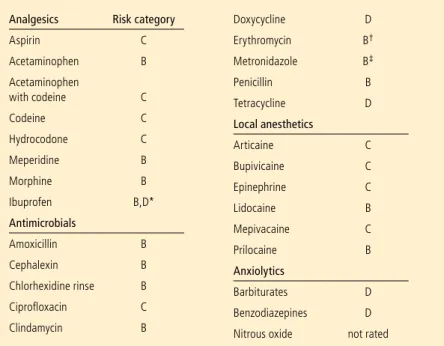
When treating pregnant women, dentists must understand which drugs can be prescribed and administered. The FDA classifies drugs into four categories (A–D) of safety for use during pregnancy (see Table 1).10 The majority of drugs
belong in category C (66%) or B (19%).6 Drugs in category A and the majority of those in category B can be used safely during pregnancy. Drugs in category C should be used only under the direction of a physician and with caution, based
on risks and benefits. Drugs in cat-egories D and X are contraindicated in pregnancy (see Table 2).6,8,9
Dentists should be aware of co-morbid conditions that may affect dental treatment and should initiate appropriate consultation with the obstetrician. For example, gestational diabetes is seen in 2–5% of pregnancies, while 12–22% of pregnancies are associated with hypertensive disorders.6 Pregnant women with hypertensive disorders may be at an increased risk of bleeding during dental treatment.6 Pregnant women who have been diagnosed with thrombophilia may receive daily heparin injections to improve the outcome of pregnancy; however, the heparin injections will increase the risk for bleeding during dental procedures.6 Antibiotics administered to prevent infective endocarditis (IE) should be based on the American College of Cardi-ology guidelines for all individuals.6 However, benign heart murmurs are common in pregnant women, since pregnancy results in an increased cardiac output, plasma volume, and heart rate. Benign systolic ejection murmurs are caused by increased blood flow across the pulmonic and aortic valves; these murmurs do not require antibiotics prior to the dental procedure.6,8 Figure 1 illus-trates a sample consultation form that may be used to facilitate com-munication between prenatal care providers and dental care providers.6 Future directions
Oral health should be an essential part of prenatal care. Access to dental services during pregnancy not only improves the overall health of pregnant women, it also provides an opportunity to counsel patients concerning harmful maternal behav-ior (for example, the use of tobacco, alcohol, and recreational drugs), Table 1. The FDA classifications for drugs in terms of their safety during
pregnancy.10
Class definition
A Adequate, well-controlled studies in pregnant women failed to demonstrate risk to fetus b No evidence of risk in humans; animal studies show risk but human findings do not;
or animal findings are negative and no adequate human studies have been performed C Human studies are lacking and animal studies are either lacking or test positive for
fetal risk; however, potential benefits may justify the risk
d Positive evidence of risk; investigational or post-marketing data show risk to fetus; however, potential benefits may outweigh risks (as with some anticonvulsive medications)
Table 2. Drugs used in dentistry (with FDA pregnancy risk category).6,8-10
analgesics risk category
Aspirin C Acetaminophen b Acetaminophen with codeine C Codeine C Hydrocodone C Meperidine b Morphine b Ibuprofen b,d* antimicrobials Amoxicillin b Cephalexin b Chlorhexidine rinse b Ciprofloxacin C Clindamycin b doxycycline d Erythromycin b† Metronidazole b‡ Penicillin b Tetracycline d Local anesthetics Articaine C bupivicaine C Epinephrine C Lidocaine b Mepivacaine C Prilocaine b anxiolytics barbiturates d benzodiazepines d Nitrous oxide not rated
* Should be avoided in the first and third trimesters and used for only 24–72 hours † Except for estolate form
‡ use with caution in the first trimester
proper oral hygiene/diet, and infant oral health.
Prenatal care providers can play an important role in emphasizing the importance of oral health and facilitating the referral of pregnant women to oral health care professionals. Engaging obstetricians in oral screenings, education, and referral is important in promoting prenatal oral health.1,6 However, effective communication between prenatal providers and oral health care professionals is a key in this process.
A recent survey of Ohio dentists and obstetricians revealed that only 38% of dentists and 39% of obstetricians agreed that there was good communication between health professionals regarding dental care during pregnancy. In the same study, 92% of obstetri-cians and 64% of dentists agreed that a fear of malpractice charges should not be seen as a reason to delay dental treatment until after delivery; additional data from this study are presented in Table 3.11 The Dentists Insurance Company (an
organization that insures 17,000 dentists nationwide) has reported only one such incidence of mal-practice in the past 15 years. The case involved a claim of miscarriage related to radiographs; however, the claim was not supported by scien-tific evidence.1
Oral health care professionals should promote the safety of dental care during pregnancy. Once the baby is born, the mother may be too preoccupied to attend dental appointments and may lose her dental insurance.1,6
Summary
Oral health assessment and treat-ment should be part of comprehen-sive prenatal care for all women. In the U.S., only 22–34% of pregnant women visit a dentist during preg-nancy.5 Common barriers include the patient’s failure to perceive a Fig. 1. A sample consultation form for pregnant women to receive oral health care.6
be safe during pregnancy. Procedure dentists obstetricians
Fillings 92 95 root canal 90 86 Cleaning 99 95 Abscess drainage 95 100 Extractions 79 92 Lidocaine 84 99 Sealants 91 73 X-rays 69 92 Nitrous oxide 10 34 Antibiotics 73 99 Periodontal surgery 29 71 Amalgams 74 26 Narcotics 16 95
doB: __________ Estimated delivery date: _____________ week of gestation today: __________ KNowN aLLErgIES: ________________________________________________________________ PrECaUTIoNS: ❒ NoNE ❒ SPECIFY (If any):
_________________________________________________________________________________ _________________________________________________________________________________ _________________________________________________________________________________ This patient may have routine dental evaluation and care, including but not limited to:
Patient may have: (Check all that apply)
• alternative pain control medication: (Specify) ___________________________________________ Prenatal Care Provider: ______________________________ Phone: _________________________ Signature: _________________________________________ date: _________________________
DO NOT HESITATE TO CALL FOR QUESTIONS
DENTIST’S REPORT (for the Prenatal Care Provider)
diagnosis: ________________________________________________________________________ _________________________________________________________________________________ Treatment Plan: ____________________________________________________________________ _________________________________________________________________________________ _________________________________________________________________________________ NaME: _________________________ date: _____________ Phone: ______________________ Signature of dentist: ________________________________________________________________ • oral health examination
• dental x-ray with abdominal and neck lead shield • dental prophylaxis
• Local anesthetic with epinephrine • Scaling and root planing
• root canal • Extraction
• restorations (amalgam or composite) filling cavities
• acetaminophen with codeine for pain control • Penicillin
• amoxicillin
• Clindamycin • Cephalosporins
need for treatment, financial barri-ers, dentists’ reluctance, misunder-standings concerning the safety of dental care during pregnancy, and a lack of referrals from prenatal care providers. These barriers may be addressed by improving patient and provider education and by developing public policies that sup-port and promote access to dental services during pregnancy.1 Author information
Dr. Amini is an associate profes-sor and director, Postdoctoral Education in Pediatric Dentistry, Ohio State University College of Dentistry, and chief of pediatric dentistry at Nationwide Chil-dren’s Hospital, Columbus, OH. Dr. Casamassimo is professor
and chair, Division of Pediatric Dentistry, Ohio State University College of Dentistry, chief of dentistry at Nationwide Children’s Hospital, and a former president of the AAPD.
References
1. Oral health during pregnancy and early child-hood: Evidence-based guidelines for health pro-fessionals. Available at: http://www. cdafoundation.org/library/docs/poh_policy_ brief.pdf. Accessed March 2010.
2. Access to oral health care during the perinatal period: A policy brief. Available at: http://www. mchoralhealth.org/PdFs/Perinatalbrief.pdf. Ac-cessed January 2010.
3. Oral health in America: A report of the surgeon general. rockville, Md: u.S. department of Health and Human Services, National Institute of dental and Craniofacial research, National Institutes of Health;2000.
4. boggess KA; Society for Maternal-Fetal Medi-cine Publications Committee. Maternal oral
health in pregnancy. Obstet gynecol 2008; 111(4):976-986.
5. Silk H, douglass Ab, douglass JM, Silk L. Oral health during pregnancy. Am Fam Physician 2008;77(8):1139-1144.
6. Oral health care during pregnancy and early childhood. Practice guidelines. Available at: http://www.health.state.ny.us/publications/ 0824.pdf. Accessed January 2010. 7. Martin-gronert MS, Ozanne SE. Maternal
nutrition during pregnancy and health of the offspring. biochem Soc Trans 2006;34(Pt 5): 779-782.
8. giglio JA, Lanni SM, Laskin dM, giglio NW. Oral health care for the pregnant patient. J Can dent Assoc 2009;75(1):43-48.
9. russell SL, Mayberry LJ. Pregnancy and oral health: A review and recommendations to re-duce gaps in practice and research. Am J Ma-tern Child Nurs 2008;33(1):32-37. 10. drugs in pregnancy. Available at: http://www.
merck.com/mmpe/sec18/ch260/ch260c.html. Accessed March 2010.
11. Strafford KE, Shellhaas C, Hade EM. Provider and patient perceptions about dental care dur-ing pregnancy. J Matern Fetal Neonatal Med 2008;21(1):63-71.