Digitally Controlled Rectifier for
Wireless Power Receivers
Dominik Huwig and Peter Wambsganß
RRC power solutions GmbH, Corporate Research, Homburg, Germany, e-mail:[email protected]
Abstract—Reducing power loss in wireless power receivers is important to avoid thermal design issues. Synchronous rectification is a suitable means for loss reduction. In this paper we propose a synchronous rectifier with a simple control scheme. A detailed analysis leads to a time-domain model which is used to perform a power loss analysis. Experimental verification shows that the predicted efficiency improvement agrees with measurement results.
Index Terms—Wireless power transmission, efficiency, syn-chronous rectifier
I. INTRODUCTION
Thanks to the advent in power electronics, more and more devices use wireless power transmission (WPT) for power or battery charging. Among the many benefits, it was recognized by a group of leading industrial companies that WPT has the potential of unifying the charging of mobile devices. This resulted in the foundation of the Wireless Power Consortium (WPC) and publication of the first international standard for providing up to 5W of power to phones, cameras and batteries in the year 2010 [1]. The consortium has defined the Qi logo which indicates that a device is compatible to the WPC standard and complies with its requirements on interoperability and performance. Despite the advances that have been made over the past years, reduction of power losses is still a design challenge. In highly integrated and small mobile devices power loss is one of the most critical design constraints as the power loss generates heat. This is particularly an issue for temperature sensitive LiIon batteries and could introduce component thermal stress.
A major part of the power loss is caused by the forward voltage drop of the rectifier diodes in the power receiver (Rx). In many cases passive full-bridge rectifiers are used. Despite its simplicity the drawback of this rectifier is that there are always two diodes conducting at the same time which results in higher power loss. This is particularly an issue for low output voltage WPT systems. For example, the efficiency of a WPT system with 5V output voltage drops by 15% when a Schottky bridge rectifier, with a typical voltage drop of2×0.45V, is used.
The forward voltage drop issue can be resolved using synchronous rectification. Typically the timing of the syn-chronous rectifier is optimized to maximize the conduction time of the MOSFETS. This requires a high speed and complex control and drive circuit which also consumes power [2]. Other implementations work well under normal conditions but show serious issues during power-up and down [3].
In this paper we propose a simple and cost-effective synchronous full-bridge rectifier. We will describe later that the control of the synchronous rectifier does not depend on current measurements and that exact timing of the switching instants is not necessary. This results in a simple control scheme that can be implemented on almost any commercially available low-cost MCU, which is already available in most wireless power receivers for monitoring and control purposes. By making use of digital control, proper power-up and down can be guaranteed.
II. QI-COMPLIANTWPT SYSTEM
A Qi-compliant WPT system that corresponds to the A1 transmitter design as defined in the WPC standard [4] is depicted in Fig. 1. A half-bridge inverter which consists of MOSFETs M1T and M2T drives the Tx resonant
circuit. The resonant circuit comprises the Tx coilLT and resonant capacitorCT. The Rx coil is inductively coupled to the Tx coil in order to enable power transfer. Capacitor
CR is used to match the load network to the output impedance of the inductive link to enhance the power transfer efficiency. According to the WPC standard a paral-lel capacitorCdis required to enable resonant detection of the power receiver. Furthermore a load modulator circuit is required to transmit data to the power transmitter. Fig. 1 shows a capacitive load modulator which consists of the capacitorsCm1andCm2as well as the modulator switches
M5andM6. If the modulator switches are turned on the series connection of Cm1 andCm2 is parallel toCd. The effective parallel capacitance significantly influences the operation of the rectifier and needs to be considered in the subsequent analysis. In this figure the load is connected to the resonant circuit through a passive full-bridge rectifier.
III. SYNCHRONOUSRECTIFIER
Fig. 2 shows a simplified schematic of the proposed synchronous rectifier (SR). The secondary coil and res-onant capacitor are modeled as a current source. The parallel capacitorC represents the equivalent capacitance of Cd,Cm1andCm2. MOSFETsM3 andM4are cross-connected and replace the low side diodes in the passive bridge rectifier. The semi-active rectifier which comprises
M3andM4is self-driven as the gate voltages are equal to the rectifier input voltage. The rectifier input voltage has an approximately rectangular waveshape when the output voltage is nearly constant.
Adaption of this self-controlled driving scheme to all four MOSFETs as in [3] causes significant issues during start-up and power-down of the circuit. To solve these issues the
Cd M5 M6 M1T M2T Cm1 Cm2 Rm
Transmitter Controller Receiver Controller
Co CI VI vT iT Ro Io Vo D1 D2 D3 D4 CT LT LR k≪1 C R
Figure 1. Qi-compliant WPT circuit using an A1 transmitter design as specified in the WPC standard [4]
iin
C
M3 M4
M1 M2
Digital SR controller IN OUT
Co Ro
io
Io
Vo
Figure 2. Proposed synchronous full-bridge rectifier
IN T rigger TMR OUT CO1 CO 2 CO 3 CA1 CA 2 CA3
Figure 3. Input and output signal at the MCU with corresponding timer. The second timer works similar, but with an phase shift of one half period.
drive signals of the upper MOSFETs are generated by the digital SR controller in Fig. 2 which can be implemented on a standard MCU. The IN-signal of the digital SR controller is directly derived from the gate drive signals of
M3andM4. Referring to Fig. 3 a rising edge of an IN-signal resets a timer and toggles the corresponding OUT-signal into high state which, in fact, turns-on one of the upper MOSFET (M1 or M2). The OUT-signal goes low when the counter value equals the compare value COn
which was determined at the time instant of the falling edge of the IN-signal in the previous cycle CAn−1. For proper operation of the circuit it is essential to maintain the self-driven operation of M3 andM4 which requires natural commutation of the current in the rec-tifier. This is achieved by turning off both of the upper MOSFETs before the end of the cycle which requires that
COn< CAn−1. In a practical implementation COn will be calculated based on the turn-off delay time plus an additional delay time as a design margin. The additional delay leads to increased power loss as the current flows through the body diode during that time. However, as illustrated in Fig. 4, the current at the end of the half-period is already close to zero and the additional loss is small. The proposed rectifier has, therefore, slightly higher conduction losses compared to more complex control schemes but a much simpler and efficient control circuit.
0 20% 40% 60% 80% 100% 20% 40% 60% 80% PD(t) iin(t) VF π ω R t iin(τ)dτ
IV. CIRCUITANALYSIS
In the subsequent sections we assume that
1) the output voltage of the wireless power receiver is constant which implies that the output voltage ripple is not considered
2) the current through the secondary coil windingiin(t) is purely sinusoidal and is described by iin(t) =
ˆ
Iinsin(ωt), an approximation that is well fulfilled in WPT systems operating close to the resonance frequency [5]
3) the circuit operates in the periodical steady-state which implies that any waveform can be described in the form x(t) =x(t+T), where T is the period length
The circuit analysis is carried out for the first half-period of the secondary coil current. The analysis of the second half-period can be performed in a similar way and yields basically identical results.
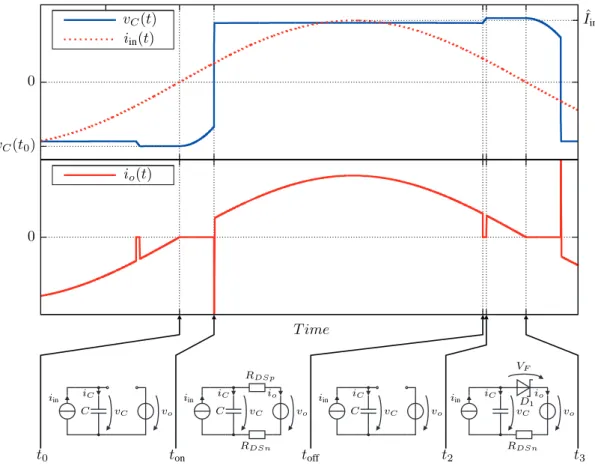
A. Interval 1 (t0 < t ≤ ton)
Depending on the capacitor voltage at the time instant whenM1 turns on the first interval consists of either one or two subintervals.
Subinterval 1a (vC(ton) < Vo + VF): This case is
illustrated in Fig. 5. At t = t0 = 0 the instantaneous voltage acrossC is vC(t0)and the sinusoidal current out of the resonant tank starts to charge C towards positive values.M1andM2 are turned-off and their body diodes are blocking because the output voltage is higher than the voltage across C in this time interval. The voltage across the capacitor can be calculated by integration of the current, starting at the voltagevC(t0)
vC(t) = vC(t0) + 1 C t Z t0 iin(τ)dτ (1) As mentioned above, both high side diodes are in blocking state and the complete resonant current charges the capac-itorC. The current flowing towards the output equals zero. At the end of Subinterval 1a the instantaneous capacitor voltage is lower than the output voltage. When MOSFET
M1is turned on the voltage differencevC(ton)−Vocauses a large negative current pulse that quickly charges the capacitor. The amplitude of this pulse is only limited by
RDSn+RDSp. The resulting power loss is significant and, therefore, this operation mode should be avoided for high efficiency.
Subinterval 1b (vC(ton)≥Vo+VF): The aforementioned
losses practically disappear if MOSFETM1 is turned on when the capacitor charged to or slightly aboveVo+VF. This case is illustrated in Fig. 6. At the time instantt1the capacitor voltage (1) equals Vo+VF and the body diode of M1 is conducting current in forward direction. RDSn
represents the drain-to-source resistance ofM4. Applying Kirchhoffs node and mesh equations yields
RDSnCvC(t)
dt +vC(t) =Vo+VF+RDSniin(t) (2)
The solution of this linear differential equation can be found in many textbooks, e.g. [6]. WithvC(t1) =Vo+VF we get vC(t) =Vo+VF+. . . · · ·+ RDSnIˆin 1 + ω λ1b 2 · n a1b(t)−b1beλ1b(t−t1) o (3) where λ1b=−1/RDSnC and a1b(t) = ω λ1b cos(ωt) + sin(ωt) (4) b1b= ω λ1b cos(ωt1) + sin(ωt1) (5) The current flowing towards the output is
io(t) = vC(t)−Vo−VF
RDSn . (6)
B. Interval 2 (ton < t ≤ toff)
AttonMOSFETM1is turned on. Note that, depending on the previous interval the current pulse at this time instant is negative and large (subinterval 1a) or positive and small (subinterval 1b). Turning onM1at the end of subinterval 1b is therefore the preferred operating mode. In interval 2 the capacitor is connected to the output voltage source through the resistorsRDSnandRDSpas shown in Fig. 5.
RDSnrepresents the drain-to-source resistance ofM4and
RDSp is the drain-to-source resistance ofM1. Applying Kirchhoffs node and mesh equations yields
RDSCdvC(t)
dt +vC(t) =Vo+RDSiin(t) (7)
where RDS =RDSn+RDSp. The solution of this linear differential equation is vC(t) =Vo−(Vo−vC(ton))eλ2(t −ton)+. . . · · ·+ RDSIˆin 1 + ω λ2 2 · n a2(t)−b2eλ2(t−ton) o (8) where λ2=−1/RDSC and a2(t) = ω λ2 cos(ωt) + sin(ωt) (9) b2= ω λ2 cos(ωton) + sin(ωton) (10) During this time interval the output current can then be calculated from
io(t) = vC(t)−Vo
RDS (11)
C. Interval 3 (toff < t ≤ t2)
Turning off M1 at t = toff leads to the condition, that
vC(toff) is smaller than the voltage that is necessary to drive a current through the diodes. The parasitic diodes of
iC iC iC iC vC vC vC vC iin iin iin iin io io vo vo vo vo C C C RDSp RDSn RDSn D1 VF t0 ton toff t2 t3 ˆ Iin vC(t0) T ime 0 0 iin(t) vC(t) io(t)
Figure 5. One half period of the rectifier input voltagevC(t)and the output currentio(t)at sinusoidal input currentiin(t).
iC iC vC vC iin iin io vo vo vo C RDSn D1 VF t0 t1 ton toff t2 t3 ˆ Iin vC(t0) T ime 0 0 iin(t) vC(t) io(t)
both,M1 andM2are blocking and the voltage acrossC is vC(t) = vC(toff) + 1 C t Z toff iin(t)dt (12) The current flowing towards the output during interval 3 equals zero.
D. Interval 4 (t2 < t ≤ t3)
In the forth time interval we have conditions similar to subinterval 1b. The capacitor voltage can again be derived from (2). WithvC(t2) =Vo+VF the solution of this linear differential equation is vC(t) =Vo+VF+. . . · · ·+ RDSnIˆin 1 + ω λ4 2 · n a4(t)−b4eλ4(t−t2) o (13) where λ4=−1/RDSnC and a4(t) = ω λ4 cos(ωt) + sin(ωt) (14) b4= ω λ4 cos(ωt2) + sin(ωt2) (15) The current flowing towards the output is given by (6).
E. Time-Domain Model and Numerical Solution
The capacitor voltage during the first half-period is
vC(t) = (1) if t0< t≤min(t1,ton) (3) if min(t1,ton)< t≤ton (8) if ton< t≤toff (12) if toff< t≤t2 (13) if t2< t≤t3 (16)
while the current delivered to the load is given by
io(t) = (6) if min(t1,ton)< t≤ton or t2 < t ≤ t3 (11) if t1 < t ≤ t2 0A otherwise (17)
Independent parameters in these equations are the switch-ing time instants t0,ton,toff and the DC load current Io. In order to calculate the voltage and current waveforms using (16) and (17) the four dependent parametersvC(t0),
t1, t2 andIˆin need to be known. Time instant t1 is only required if subinterval 1b exists, which is the case for
vC(ton)≥Vo+VF. The dependent parameters can be de-termined numerically by solving the following conditions: 1) The circuit is in periodical steady-state and both half-periods are symmetrical. Witht3=t0+T we have
vC(t0) =−vC(t0+T) (18) 2) The average of io(t) over the half-cycle must be
equal to the DC load current Io ω π π/ω Z 0 io(t)dt = Io. (19) 3) vC(t2) =Vo+VF.
4) IfvC(ton)≥Vo+VF the following condition has to be evaluated to findt1
vC(t1) =Vo+VF (20)
We have now a complete time-domain model of the proposed synchronous rectifier. It can be solved numer-ically to obtain the capacitor voltage and output current waveforms required for efficiency calculations.
F. Power Loss Analysis
Gate drive of the lower MOSFETs is lossless whereas the gate drive losses for the upper MOSFETs are
Pd = QGVoω π. (21) Switching losses Psw = ω 6π " (vC(ton)−Vo)2 RDS tr+. . . . . .+(vC(toff)−Vo) 2 RDS tf # (22) Conduction losses Pc = ω π π/ω Z 0 (vC(t)−Vo)io(t)dt (23) Total rectification loss
P = Pd+Psw+Pc (24)
V. MODELVERIFICATION
The model is verified experimentally using a Qi compliant WPT system including a prototype of the synchronous rectifier. The SR controller is implemented using two timers of a STM8L151G4 8-bit MCU running at 16MHz clock frequency [7]. The following model parameters were used: operating frequencyf = 1/T = 150kHz, n-channel MOSFETs M3, M4 are FDS9926A (RDSn = 30mΩ,
Qg = 6.2nC, tr = 9ns, tf = 15ns, VF = 0.7V), p-channel MOSFETS M1, M2 are FDS6875 (RDSp = 30mΩ,Qg= 23nC,tr= 15ns,tf= 35ns,VF = 0.7V),
COn=CAn−1−10andton−t0= 300ns.
According to the WPT standard data transmission to the transmitter can be implemented using capacitive load modulation as shown in Fig. 1. The influence of the modulation on the power loss is considered as follows: We have C = 13nF when the the modulator switches (Cm1 and Cm2 in Fig. 1) are closed and C = 2nF otherwise. The modulator switches are turned on for about
20% of the period length. The average power loss is
Pav = 0.2 ×Pmodulated + 0.8 ×Punmodulated which is used to predict the efficiency improvement in Fig. 7. The efficiency improvement due to the SR rectifier is shown relative to the efficiency of the same WPT system with passive rectification using the body diodes of the MOSFETs. Also shown in the figure are results for the
0W 5W 10W 15W 20W 0% 5% 10% 15% η0 ηS ηA
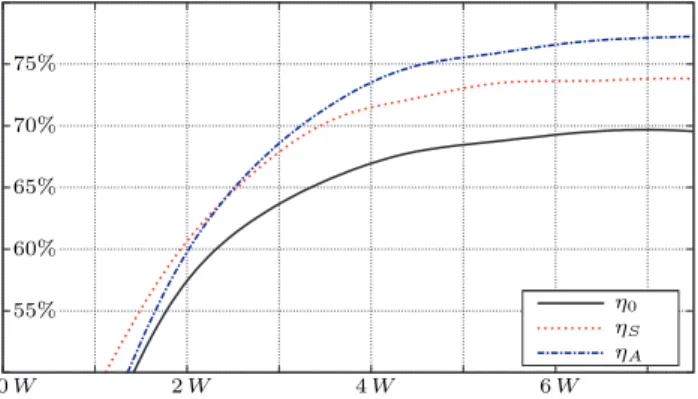
Figure 7. Efficiency Improvement normalized to η0 which is the efficiency with a passive rectifier.ηSis the efficiency with a semi-active rectifier (lower MOSFETs are self-driven and only the body diodes of the upper MOSFETs are active) andηAis the efficiency with the proposed full-synchronous rectifier 0W 2W 4W 6W 55% 60% 65% 70% 75% η0 ηS ηA
Figure 8. Efficiency measurements.η0 is the efficiency with a passive rectifier.ηSis the efficiency with a semi-active rectifier (lower MOSFETs are self-driven and only the body diodes of the upper MOSFETs are active) and ηA is the efficiency with the proposed full-synchronous rectifier
semi-active rectifier where the lower MOSFETs are self-driven and the body diodes of the upper MOSFETSs are used.
The predicted efficiency improvement (Fig. 7) and mea-sured efficiency in Fig. 8 are in good agreement. The efficiency curves drop off at low output power due to the quiescent power consumption of the system. The prediction of the crossing points is very accurate. The measured efficiency improvement is slightly lower than predicted. The reason for this is that not all dissipative circuit elements, such as the ESR of the output bulk and resonance capacitors, have been included in the model. If necessary the ESR values can be added to RDSn and
RDSp.
VI. DISCUSSION
We have already discussed that turning on the upper MOSFETs during subinterval 1a causes a large current to chargeC and results in a low efficiency. With a fixed loadtoncan be adjusted to guarentee turn-on in subinterval 1b (Fig. 5). Reducing the load leads to a smalleriinand, therefore, the voltage increase acrossC is slowing down. With a fixed ton the upper MOSFETs will turn on in subinterval 1a if the load gets small enough as illustrated in Fig. 6. This effect can also be seen in Fig. 8 as a rapid
efficiency drop when the load is reduced. In the figure the efficiency curve of the proposed SR crosses the curve for the semi-active rectifier at approximately2.5W. Below this output power the rectifier should be operated in semi-active mode.
Similary, if the load is constant an increase of the ca-pacitance C also increases the charging time and the upper MOSFETs may turn on too early. This could for example happen every time the modulator switch is closed. Therefore, operation of the SR in semi-active mode when the modulation switches are turned on could be benefitial. Ideally a look-up table which containston for a set of load ranges is used to optimize ton. Different data sets could be used depending on the modulator state.
VII. CONCLUSIONS
We have proposed a synchronous rectifier with a simple control scheme and demonstrated that an implementation on an off-the-shelf and low-cost microcontroller is feasi-ble. A prediction of the efficiency improvement was made based on a detailed circuit and loss analysis. Efficiency measurements on an experimental setup have been carried out to show that the predicted efficiency improvements are sufficiently accurate. Thanks to digital control the rectifier works properly during start-up, power-down and load changes. Future work should include an adaptive adjustment of ton and toff to further maximize efficiency independent of parameter variations.
REFERENCES [1] http://www.wirelesspowerconsortium.com.
[2] H.-M. Lee and M. Ghovanloo, “An integrated power-efficient active rectifier with offset-controlled high speed comparators for induc-tively powered applications,” Circuits and Systems I: Regular Papers, IEEE Transactions on, vol. 58, no. 8, pp. 1749 –1760, aug. 2011. [3] Y. Sun, C. jin Jeong, S. kyun Han, and S. gug Lee, “A high
speed comparator based active rectifier for wireless power transfer systems,” in Intelligent Radio for Future Personal Terminals (IMWS-IRFPT), 2011 IEEE MTT-S International Microwave Workshop Series on, aug. 2011, pp. 1 –2.
[4] System Description Wireless Power Transfer - Volume I: Low Power Part 1: Interface Definition Version 1.1. Wireless Power Consortium. [5] P. Wambsganss and D. Huwig, “Inductive power transmission system with stabilized output voltage using local primary-and secondary-side control,” in Power Electronics and Motion Control Conference (EPE/PEMC), 2010 14th International, sept. 2010.
[6] H. Wupper, Elektronische Schaltungen 1: Grundlagen, Analyse, Aufbau. Springer, 1996.
[7] Datasheet, “STM8L151x4, STM8L151x6, STM8L152x4, STM8L152x6- 8-bit ultralow power MCU, up to 32 KB Flash, 1 KB Data EEPROM, RTC, LCD, timers, USART, I2C, SPI, ADC, DAC, comparators,” STMicroelectronics. [Online]. Available: www.st.com
![Figure 1. Qi-compliant WPT circuit using an A1 transmitter design as specified in the WPC standard [4]](https://thumb-us.123doks.com/thumbv2/123dok_us/9467459.2428063/2.892.154.742.95.369/figure-compliant-circuit-using-transmitter-design-specified-standard.webp)