for Distributed Systems
by
Kouider Benmohammed-Mahieddine
~.
Submitted in accordance with the requirements for the degree of Doctor of Philosophy
The University of Leeds School of Computer Studies
October, 1991
The candidate confirms that the work submitted is his own and that appropriate credit has been given where reference has been made to the work of others.
Abstract
Distributed systems are gradually being accepted as the dominant computing paradigm of the future. However, due to the diversity and multiplicity of resources, and the need for transparency to users, global resource management raises many questions. On the performance level the potential benefits of the load balancing in resolving the occasional congestion experienced by some nodes while others are idle or lightly loaded are commonly accepted. It is also acknowledged that no single load balancing algorithm deals satisfactorily with the changing system characteristics and dynamic workload environment.
In modelling distributed systems for load balancing, optimistic assumptions of system characteristics are commonly made, with no evaluation of alternative system design options such as communications protocols. When realistic assumptions are made on system attributes such as communication bandwidth, load balancing overheads, and workload model, doubts are cast on the capability of load balancing to improve the performance of distributed systems significantly.
A taxonomy is developed for the components as well as the attributes aspects of load balancing algorithms to provide a common terminology and a comprehensive view to load balancing in distributed systems. For adaptive algorithms the taxonomy is extended to identify the issues involved and the ways of adding adaptability along different dimensions. A design methodology is also outlined. A review of related work is used to identify the most promising load balancing strategies and the modelling assumptions made in previous load balancing studies. Subsequently the research problems addressed in this thesis and the design of new algorithms are detailed.
A simulated system developed to allow an experimentation with various load balancing algorithms under different workload models and system attributes is described. Based on the nature of the file system structure and the classes of nodes processing speed involved, different models of loosely-coupled distributed systems can be defined. Four models are developed: disk-based homogeneous nodes, diskless homogeneous nodes, diskless heterogeneous nodes, and disk-based heterogeneous nodes. The nodes are connected through a broadcast transfer device.
A set of representative load balancing algorithms covering a range of strategies are evaluated and compared for the four models of distributed systems. The algorithms developed include a new algorithm called Diffuse based on explicit adaptability for the homogeneous systems. In the case of heterogeneous systems, novel modifications are made to a number of algorithms to take into account the heterogeneity of nodes speed. The evaluation on homogeneous systems is two-fold: an assessment of the effect of system attributes on the performance of the distributed system subject to these algorithms, and a ~omparison of the relative merits of the algorithms using different performance metrics, and III particular a classification of the performance of the Diffuse algorithm with regard to others in the literature. For the heterogeneous systems the performance of the adapted algorithms is compared to that of the standard versions and to the no load balancing case.
As a result of this evaluation, for a set of combinations of performance objectives, distributed system attributes, and workload environment, we identify the most . appropriate load balancing algorithm and optimal values for adjustable parameters of the algorithm.
Acknowledgements
I wish to express my deepest gratitude to Professor Peter Dew, Head of School, for his sound advice and constant encouragement. His patience will always be remembered. Many colleagues in the School of Computer Studies helped me in this project. I would like to thank especially David Mallon, for proofreading many sections of this report, Mourad Kara, for his comments on the models investigated, and Neil Bowers, for his practical help on the UNIX environment.
I acknowledge the financial support of the National Institute of Electricity and Electronics (INELEC), Boumerdes, Algeria.
Finally, I dedicate this thesis to my wife Lalia, my daughter Souhila, and my sons Adel and Tarik. They were a constant reminder of the joy of living during the darkest moments of the PhD journey.
iii
Table of Contents
Abstract ... i
Acknowledgements ... ... ... ... ... ... ... ii
Table of Contents ... ... iii
Chapter 1: Introduction ... 1
1.1 Motivation ... 1
1.2 The Problem .... ... ... ... ... 3
1.3 Thesis Organisation .. ... ... ... ... .... ... ... 5
Chapter 2: Survey of Load Balancing Algorithms in Distributed Systems
2.1 Introduction ... . 2.2 Load Balancing in Distributed Systems ... . 2.2.1 Modelling of Distributed Systems ... . 2.2.2 Load Balancing Strategies ... . 2.3 Taxonomy of Load Balancing Algorithms ... . 2.3.1 Components of a Load Balancing Algorithm ... . 2.3.2 Attributes of a Load Balancing Algorithm ... .. 2.4 Adaptive Load Balancing ... . 2.4.1 Adaptability Issues ... . 2.4.2 Tolerance of a Scheduling Algorithm ... : ... . 2.4.3 Adaptability Dimensions ... . 2.4.4 Implementation Considerations ...•... 6 6 7 8 10 12 14 21 25 28 29 31
35
2.4.5 Design Methodology for Adaptive Scheduling Algorithms ... ... 36
2.5 Description of a Selection of Algorithms ... .... ... ... ... 38
2.5.1 Representative Load Balancing Algorithms ... 39
2.5.2 Other Load Balancing Algorithms ... 42
2.6 Load Balancing Studies and Implementations ... ... ... 45
2.6.1 Load Balancing Comparative Studies ... ... ... ... 45
2.6.2 Load Balancers Implementation ... ... ... ... 49
2.7 Summary ... 51
Chapter 3: Performance Study of Load Balancing Algorithms ... ... 52
3.1 Introduction ... 52
3.2 System Modelling Issues ... 52
3.3 Design of Load Balancing Algorithms ... ... ... ... 57
3.4 Summary ... .... ... ... ... ... 60
Chapter 4: A System to Measure the Performance of Load Balancing Al-gorithms ... .... ... 62
4.1 Introduction ... ... ... ... ... 62
4.2 Experimental System Design .. ... ... ... 63
4.2.1 Experimental Models and Factors ... ... ... 64
4.2.2 Performance Studies ... ... 66
4.3 Distributed System Model .... ... ... ... ... 70
4.3.1 Overview of the Model .. ... ... ... ... 70
4.3.2 Host Modelling ... 75
4.3.3 Communication Network Model... 76
v
4.3.5 Load and Perfonnance Metrics ... ... ... ... ... 79
4.4 Simulated System Implementation ... ... ... ... 82
4.4.1 Simulation Environment ... ... ... 86
4.4.2 Autonomous Hosts ... ... 86
4.4.3 Communication Network Attributes ... 87
4.4.4 Global Scheduler ... ... ... ... ... ... ... ... 90
4.4.5 Models Generation and Perfonnance Monitoring ... 92
4.5 Simulated System Calibration and Validation ... .... ... ... ... 95
4.6 Summary ... ... ... ... ... ... 96
Chapter 5: Simulation Results ... ... 98
5.1 Overview... ... ... ... ... ... .... ... ... 98
5.2 Load Balancing in Systems with Diskless Homogeneous Nodes ... 101
5.2.1 Algorithms Perfonnance on the Baseline System ... ... 102
5.2.2 Effect of Communication Bandwidth and Protocols ... 104
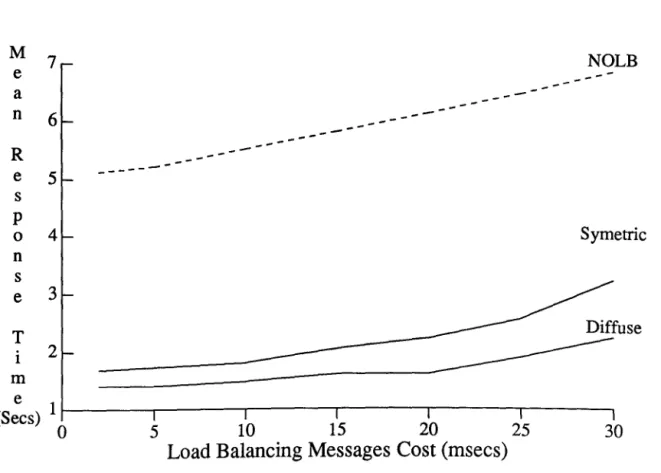
5.2.3 Impact of Load Balancing Messages Cost ... 111
5.2.4 Effect of File Server Speed ... 113
5.2.5 Perfonnance under Heterogeneous Workload ... ... ... 114
5.2.6 Conclusion ... 118
5.3 Load Balancing in Systems with Disk-based Homogeneous Nodes ... 120
5.3.1 Algorithms Perfonnance on the Baseline System . ... ... ... 120
5.3.2 Effect of Communication Bandwidth and Protocols ... :... 121
5.3.3 Impact of Load Balancing Messages Cost ... 127
5.3.4 Perfonnance under Heterogeneous Workload ... 129
5.4 Load Balancing in Systems with Heterogeneous Nodes ... 133
5.4.1 Evaluation of Algorithms under Scaled Arrival Rates ... 134
5.4.1.1 Diskless Model ... 134
5.4.1.2 Disk-based Model ... 137
5.4.2 Evaluation of Algorithms under Identical Arrival Rates ... ... ... 139
5.4.2.1 Diskless Model ... 139
5.4.2.2 Disk-based Model ... 141
5.4.3 Conclusion ... 141
5.5 Further Discussion on the Results ... 143
5.5.1 Scalability ... 143
5.5.2 Confidence Levels for the Results ... 145
Chapter 6: Summary and Future Work ... 153
6.1 Survey of Load Balancing Algorithms ... ... 153
6.2 Performance of Load Balancing Algorithms ... 154
6.2.1 Algorithms Performance within Simulated Systems ... 154
6.2.2 Effect of System Attributes and Workload Models ... 156
6.2.3 Wider Implications ... 158
6.3 Future Work ... 159
References ... 161
CHAPTER 1
Introduction
1.1. Motivation
With the advent of distributed systems, it is becoming possible to get the maximum out of a set of computing nodes through a dynamic workload redistribution to avoid the situation where some hosts are idle while others have multiple jobs queued up [Livny84]. The drive behind this load balancing is two-fold: efficiency and extensibility. The current advances in computer and communication technology make a multi-computer approach cheaper than a mainframe solution, of the same performance, provided all the computing resources are used efficiently. The extensibility aspect of a distributed system should provide for the addition of new processors as the user needs arise. A well designed load balancing scheme aims at accommodating both of these aspects. The goal of the design of such systems is to redistribute the global service demands generated at different workstations over the dynamically available computing resources.
The potential benefits of dynamic load redistribution to resolve the occasional congestion experienced by some nodes to improve the overall system performance, are commonly accepted [Zhou87] for distributed computer systems. However, no single load balancing algorithm deals satisfactorily with the various and rapidly changing system conditions, and the lack of up-to-date system state information. A load balancing algorithm consists of two elements: information and control. The information element exchanges and maintains information about the state of the distributed system. Different approaches as to what information, how much information is to be maintained, how often it is to be updated, and how large is the balancing region
involved, have been proposed. The load index and its measuring mechanism have also been the subject of many investigations. The control element uses this information to decide when it is advantageous to redistribute the load, who makes this decision, which
process to transfer or migrate, and where to transfer a process to reduce congestion and improve performance.
A number of algorithms have been reported in the literature. They differ in the performance objectives sought, the nature of their information and control elements, the attributes of the system model used as a test bed, and the simplifying assumptions made to aid the analysis or the implementation of the simulation model. Under these models and assumptions substantial job mean response time improvements at acceptable costs are reported [Zhou88].
On the modelling for performance study, the distributed system is commonly assumed to include homogeneous computing nodes and to be based on either a shared file server or each node having its own local file system. An optimistic view is often taken on some essential system characteristics such as job transfer delays as pointed out in [Mirchandan89], load balancing overheads, and workload environment. No evaluation of system design alternatives (e.g. communication protocols) has been reported.
To gain accurate insights into the performance of load balancing in distributed systems, more realistic system characteristics need to be taken into account in terms of both load balancing overheads and system model attributes. We set out to examine the validity of the assumptions made on distributed system attributes in previous load balancing studies, and to assess the relative performance order of some common load balancing algorithms when more realistic models are assumed.
3
1.2. The Problem
In previous load balancing studies, a common approach is to use a simple model of the distributed system with assumptions such as large communication bandwidth, negligible load balancing overheads, homogeneous workload, and to search for complex load balancing algorithms whose viability is questionable [Eager86] and which might provide only little or no gain when evaluated on realistic systems. The general approach taken in this project is to evaluate the effect of distributed system attributes and workload model on the performance of representative load balancing strategies.
The model extensions are added to represent features that were assumed negligible or require a greater level of details. Other extensions not covered in common system models are added to model actual systems more accurately and reflect the different distributed system architectures. The variations involve the evaluation of the effects on load balancing performance of different system characteristics design options, such as communication protocols.
To determine the interdependence of system attributes and load balancing algorithm performance, we examine distributed systems along three paths 1) modelling of distributed system attributes including: file system structure, nodes configuration,
communication network, 2) workload nature including: homogeneous users with homogeneous jobs, heterogeneous users with homogeneous jobs, and homogeneous users with heterogeneous jobs, and 3) the design and evaluation of load balancing
algorithms that take into account realistic system attributes and non-negligible load
balancing overheads introduced by load balancing activities.
The actual system being modelled consists of a network of workstations interconnected by local area networks with individual, independent, sequential jobs
arriving at each autonomous processor. For a realistic distributed system model, the analytical approach is not suitable due to model complexity, whilst prototyping requires costly equipment/environment. A more appropriate approach for the study of load balancing performance on distributed computer systems is simulation. We carry out various performance studies of a set of representative load balancing algorithms on four simulated models of loosely-coupled distributed systems: diskless homogeneous nodes, disk-based homogeneous nodes, diskless heterogeneous nodes, and disk-based heterogeneous nodes. The objectives of this performance study are:
• To measure the effect of system attributes on the performance of load balancing and in particular to classify the performance of a novel algorithm called Diffuse
with regard to others in the literature. These attributes include the file system structure and the communication bandwidth.
• To evaluate the effect of the workload model on the performance of load balancing algorithms.
• To measure the effect of the heterogeneity of nodes speed on the performance of standard load balancing algorithms and to assess the performance improvements made when adapted versions of these algorithms are used.
As a result of this evaluation, for a set of combinations of performance objectives, distributed system attributes, and workload environment, we identify the most appropriate load balancing algorithm and the optimal values for the adjustable parameters of the algorithm.
5
1.3. Thesis Organisation
In Chapter 2, a literature review on the issue of load balancing in distributed systems is presented. This is addressed at two levels: the modelling of distributed systems and the design of load balancing strategies for such environments. The results of the review are organised under a taxonomic structure for the algorithms components and attributes. A closer look at the adaptability attribute has been taken. A framework and design methodology for adaptive scheduling are developed for the case of a rapidly changing environment.
In Chapter 3, as the result of the review of previous performance studies, the research problems addressed in this thesis are defined. This includes the design of the Diffuse algorithm and the algorithm versions adapted to a heterogeneous system.
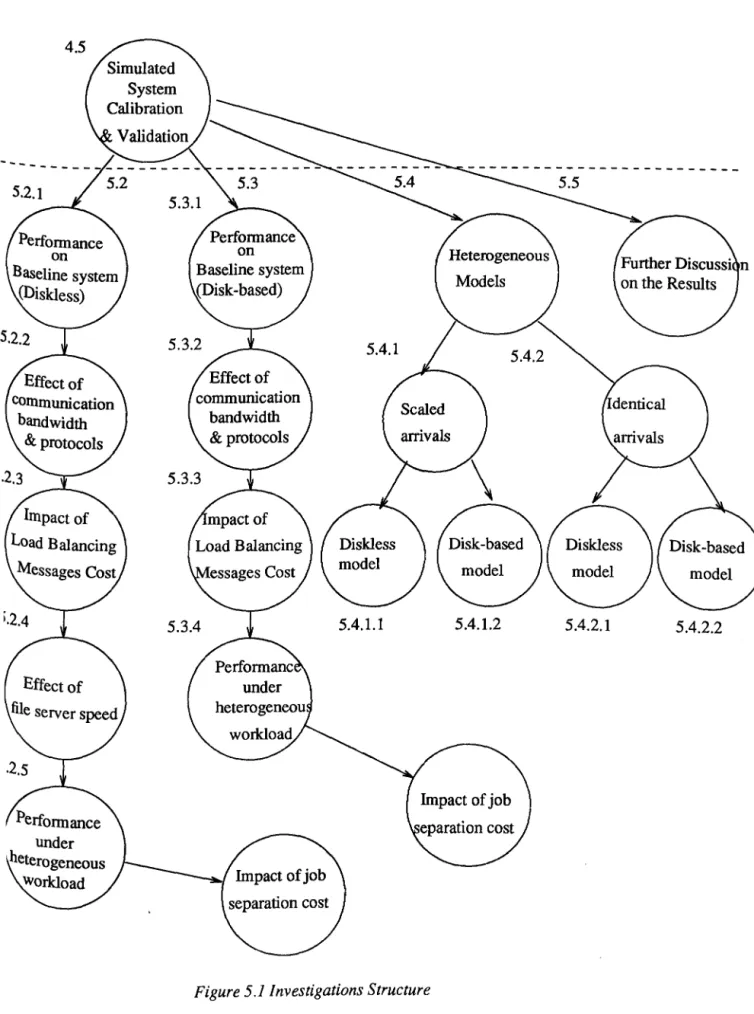
Chapter 4 describes the experimental system. First the purpose of the system design is defined and the experimental models and factors identified. Four models are considered: systems with homogeneous diskless nodes, systems with homogeneous disk-based nodes, systems with heterogeneous diskless nodes, and systems with heterogeneous disk-based nodes. Then the performance studies undertaken are outlined. The distributed systems on which this evaluation is targeted are modelled and a simulated implementation is described. This is followed by an overview of the simulation package and the simulation model calibration and validation.
In Chapter 5, the results of various performance studies undertaken on the four models to evaluate the effect of different system attributes and workload models are presented and compared to related work.
In Chapter 6, we summarise the results obtained and offer our conclusions. We then discuss future work related to this research.
Survey of Load Balancing Algorithms in Distributed Systems
2.1. Introduction
In this chapter we review the literature that has been published in the area of interest to this thesis. This can be divided into five main areas.
(i) A motivation for dynamic load balancing in distributed systems is given. Then the previous work on the modelling of distributed systems and the design of load
balancing strategies for such systems are surveyed.
(ii) The load balancing strategies reported in the literature are organised under a taxonomic structure to show how different researchers addressed the same load balancing issues. The algorithm attributes are also considered.
(iii) Special attention is given to a distributed system characterised by a rapidly changing environment. For such an environment adaptive scheduling is the way forward to maintain a consistent level of performance. The fundamentals of adaptive scheduling are described and a methodology for the design of adaptive load balancing algorithms is outlined.
(iv) A selection of load balancing algorithms is detailed. The criteria used is to select load balancing policies which include different algorithms components/attributes identified in the taxonomy and with most promising performance gain. Various algorithms included in the previous comparative studies are also described.
(v) Comparative studies of load balancing anq load balancers implementation are reviewed. The results of this survey are summarised in Section 2.7.
7
2.2. Load Balancing in Distributed Systems
In a distributed system characterised by a resource multiplicity combined with a stochastic nature of the workload [Kleinrock85, Ezzat86, Cheriton88], there is a high probability for the occurrence of the 'wait while idle' state whereby some hosts in the pool are idle while other hosts have multiple jobs queued up [Livny84, Theimer85]. In his profiling ofa network of workstations, Mutka has shown that processors are idle 70% of the time [Mutka87] while Livny showed that this probability depends on the system load and the size of the pool, and that load balancing can improve performance even in the case of homogeneous process arrival rates [Livny84]. This environment is characterised by changing and uneven loads on the hosts and a lack of up-to-date system state information. For an effective use of the resource multiplicity inherent in such systems, and to satisfy the diverse and sometimes conflicting users' performance expectations, the design of efficient distributed scheduling algorithms and mechanisms for processor allocation has been a research challenge for over a decade [Wang85, Casavant88, Goscinski90]. These algorithms deal with the global scheduling of system workload through local and remote job placement, while allocation of local resources is left to the local scheduling component.
Although the common objective of load balancing is to improve the performance of the computer system, the nature of the performance objective differs with the computing environment involved:
• For a general purpose distributed computer system based on a local area network, it is to reduce the average system response time with a minimum degradation of the performance for individual users. An, alternative objective is greedy scheduling where each job is allocated to the node where it has the best response time regardless of the effect on other jobs [Bryant81, S tankovic84].
• For a real time distributed system, it is to provide a guaranteed response time. • For a parallel computer system, it is to reduce the total execution time of a
program composed of several modules.
In this review load balancing is addressed at two levels. On the distributed system level different architectural models and perspectives are surveyed. The communication model assumed is based on the broadcast device. On the algorithm level, first previous work on dynamic algorithms is reviewed then the approaches to the adaptability problem are considered.
2.2.1. Distributed Systems Modelling
The common approach adopted in computer science is modelling then building [Power89]. Three architectural models of distributed systems have been identified [Tanenbaum85, Coulouris88]: workstation/server model [Ezzat86], processor pool
model [Needham82, Mullender86], and integrated model [Walker83]. In a workstation/server model single-user computers or workstations are provided. Most user needs are handled by his workstation, however expensive services such as file servers, high quality printers are shared. In the processor pool model application programs are executed within a set of computers managed by a processor service. The user needs only a terminal connected to the network to use the system. A hybrid model which combines features of both previous models has emerged to overcome the disadvantages in each. In the integrated model each computer can perform the role of server and application processor. The software at each computer is similar to that of a centralised multi-user system.
The communication network can be designed along two models [Livny84, Theimer88]: broadcast with the multicast as a variant, and point-to-point or store-and-forward. The store-and-forward model was first used in the wide area type of
9
networks and recently in mesh-connected parallel systems such as hypercubes and a pool of transputers. It is also popular as a general purpose model in the simulation of a pool of processors (e.g. Manhattan networks), and for analytical studies. The broadcast model is used for multicomputer systems and networks of workstations.
In this study we concentrate on loosely-coupled general purpose distributed systems. These systems consist of a collection of homogeneous or heterogeneous, autonomous processors connected by a local area network and operating in a cooperative fashion. This network of processors can be shared in two ways; either to improve system performance by relieving overloaded nodes through remote execution of part of their load on less loaded nodes, or by using a set of nodes for cooperative work on a single distributed computation. The nodes can be assumed to be public ally or privately owned. In the case of a privately owned node, a priority for local processes is required if the local user is not to be penalised. Each processor in the distributed system is managed by a replicated copy of the system kernel with associated communication protocols and load distributing software (Le. a distributed scheduler).
Distributed systems have been studied from several perspectives; based on the intended objective, different modelling approaches are appropriate. Mathematical modelling techniques have been used for formal specifications and verification [Hoare85, Broy87], and analysis based on queuing theory [Krueger87, Mitrani87]. When the objective is standardisation, a documentation such as ANSA standards [ANSA87] is used. In an approach similar to the PMS notation [Siewiorek82] (computer architecture context), a model based on the concept of BP processes [Jesty88] has been developed. It is a graphical representation used for an abstraction of the services offered by a distributed system to give a precise view of these services to the user and allow a comparison of different systems using a common terminology. Textbooks and system survey papers provide an informal description of distributed
systems [Coulouris88, Tanenbaum85]. The approach most favoured for performance evaluation purposes is simulation. Using simulation techniques the essential system features are abstracted and a model built to evaluate the system performance and behaviour, and test different solutions [Zhou88, Johnson88, Stankovic84a].
2.2.2. Load Balancing Strategies
There are so many aspects in the study of processor allocation schemes that it is of paramount importance to limit the class of algorithms and issues to be addressed, and make a precise description of the system to which they apply and the environment in which they will be tested. In this review, we concentrate on the policy aspects that deal with the collection of load information, process transfer, negotiation for an adaptive allocation of processes at the global level, based on the remote execution mechanisms described in the literature [Smith88].
Three approaches to workload scheduling on a computer system composed of multiple processors have been investigated: co-scheduling, clustering, and load balancing [Tanenbaum85]. In the clustering approach several communicating processes are assembled on the same node to reduce the communication overhead [Stankovic84]. In co-scheduling the opposite approach is taken [Ousterhout82]. The concept of distributed group is used. The members of the same group are spread over the network to exploit the concurrency among the nodes. These two approaches apply to task structure allocation. In the case of independent jobs scheduling, the favoured approach is to dynamically transfer jobs from heavily loaded hosts to lightly loaded hosts in order to improve the overall performance. The resulting form of computing is called load distributing [Eager86, Wang85, AlonsQ,86]. It refers to both load sharing Whose goal is to keep all computing nodes busy, and load balancing which attempts to have an equal load on all the nodes. The design of a load redistributing algorithm
11
depends on the performance objectives sought and the appropriate redistribution approach. The ultimate goal of these strategies is to minimise the system average and standard deviation of the response time with minimum adverse effect on individual users. The contributions to the design of load balancing algorithms can be organised into three categories:
1) Static Algorithms
These algorithms aim at finding an optimal assignment of tasks by clustering or co-scheduling, and is achieved by balancing the system loads periodically. They assume that the process behaviour is known and use graph theory models to attempt a fair distribution of the load [Efe82, L084]. The allocation decisions of the system components are based on pre-determined parameters. Early work on load balancing has been carried out along this approach but due to inherent drawbacks such as 1) the static nature of the algorithm does not allow these strategies to respond to short-term fluctuations in workload, 2) they require too much information such as arrival time and execution cost of each job or module to be implementable, and 3) they involve intensive computation to obtain the optimal schedule [Zhou87a]; the research effort has recently concentrated on the two other heuristic approaches which are implementable and achieve promising results. Quasi-static algorithms are a variant of this category. These algorithms ignore the current state of the system, but they tune their decision variables by adapting to slowly changing system characteristics such as the arrival rates of jobs[Green88] .
2) Dynamic Algorithms
Here scheduling is seen as a job routing problem. These algorithms balance the loads upon the arrival of each job. This is achieved by a continuous assessment of the system load which is dynamic and unpredictable. The allocation of the job is done in real time following a fixed policy based on the recent system state information and
currently perceived system load imbalance [Zhou88] or base their decisions on statistical averages. Extensive research work has been done in this category [Zhou88]. 3) Adaptive Algorithms
Scheduling in this approach can be interpreted as an adaptive control problem. These algorithms, like dynamic algorithms, balance loads upon the arrival of each job, but also balance loads whenever anomalies appear in the workload of the system or individual nodes. They exhibit more flexibility by adjusting their policy to match the dynamic system characteristics. In the literature some algorithms with different degrees and approaches of adaptability have been reported [Barak85, Shamir87, Krueger88]. To support adaptability, most of these algorithms use preemptive scheduling.
Although the term dynamic scheduling and adaptive scheduling have often been used interchangeably in the literature by grouping any policy that is not static under the heading of dynamic, there is a clear distinction between the two. A dynamic algorithm has a fixed policy in dealing with its dynamic environmental inputs, whereas an adaptive algorithm uses the environmental stimuli to modify the scheduling policy itself [Casavant88].
2.3. Taxonomy of Load Balancing Algorithms
Given the many dimensions involved in global scheduling of a distributed system, Casavant et al. [Casavant88] have addressed the needs for a taxonomy of the distributed scheduling algorithms reported. In the taxonomy, distributed scbeduling is addressed as a resource management problem. Using this taxonomy the algorithms of interest in this study can be classified as global, dynamic, distributed, cooperative, sub-optimal, heuristic, adaptive, and have load balancing as a global objective. They may involve one-time assignment (non-preemptive) or dynamic reassignment (preemptive) of processes. They may also include some probabilistic components
13
[Bryant81, Hsu86, Chow86]. These algorithms are an example of distributed computation and involve the concepts of optimisation, adaptability and distributed decision-making. The load balancing approach was not fully investigated.
Three subclasses of these algorithms can be identified based on the communication model they assume: broadcast with various random and polling techniques which reduce the cost of indiscriminate broadcasting, point-to-point with various nearest neighbours techniques, and a third category of algorithms which are communication model independent (Le. topology independent [Ni85]).
In this review we focus on the load balancing approach to resource management. A study of the load balancing literature reveals that a large number of design dimensions are involved in a load balancing algorithm and that there is no agreed upon terminology. In a previous work, Wang and Morris [Wang85] used mathematical techniques to categorise ten representative algorithms. The algorithms are categorised as source-initiative or server-initiative. A range of several information dependency levels involved are used to further classify the algorithms. Using a Q-factor (quality of load sharing) the performance of these algorithms is ranked. For negligible communication costs they show that at the same information level server-initiative algorithms outperform source-initiative algorithms.
In this work we take a broader view and cover several aspects of a load balancing scheme. A taxonomy can be made based on the approach taken to implement each component (Le. load balancing activities) of the algorithm, or it can be based on the attributes of the algorithm which can apply to more than one component of the algorithm, and represent some general properties of the load balancing algorithm such as decentralisation, transparency, autonomy, scalability, and adaptability.
2.3.1. Components of a Load Balancing Algorithm
The performance of a load balancing system depends on four factors: the load index, the load balancing algorithm, the workload environment, and the underlying distributed system attributes. In this review we concentrate on the first two factors.
A load balancing algorithm consists of a number of components which interact in various ways to redistribute the users' submitted jobs among the nodes of a distributed system. The objective is to improve the system performance by sharing the whole computing power available. Three main components can be identified: information gathering policy, transfer control policy, and location/negotiation control policy. The policies within the components are inter-related, fixing one would limit the options within the others. It is to be noted that Johnson [Johnson88] surveyed similar components but with more restricted dimensions for each.
1) Local Load Measure
At each node a mechanism must be provided to give a good estimation of the current local load. There are two important aspects to be considered here: a load metric which has a close correlation with the performance objective pursued, and the measuring mechanism that must give a quick and efficient evaluation of the local load state.
The local load measure alternatives described in the literature include: "load average" metric provided by the UNIX BSD 4.2 uptime(l) command, a specialised idle process for load estimation based on CPU utilisation [Ni85, Stumm88], virtual load value which is the sum of actual load and the number of processes currently in transit averaged over a period of time longer than the time necessary to migrate an average process [Krueger84], evaluation of remaining service time using probability functions [Bryant8l], using a linear combination of all main resource queues [Ferrari85, Zhou87]
15
(e.g. CPU, paging/swapping, and file I/O queues averaged over 4 seconds period), number of ready processes on a processor during a time interval [Barak85]. Zhou has shown that the CPU queue length is a good load index and has a close correlation to the mean response time [Zhou86,Zhou87a]. This is supported by the work of Kunz [Kunz91]. Although it is the favoured load metric, the CPU queue length is not an adequate load indicator when the processing node possesses a multiplicity of resources which affect the performance. This requires a combined queues length index. When the processors of the system have different processing speeds, a scaled CPU queue length is more appropriate because for the same arrival rate, the CPU utilisation level depends on the processor speed.
2) Information Policy
This component is responsible for the exchange and maintenance of the information about other individual or groups of nodes such as load level, nature of workload or the average load over the entire system. It is also responsible for the frequency of the state information update, the ways to exchange this information among the various nodes, the numbers of nodes involved in the exchange, and the amount of information made available to the decision makers. It must maintain consistent information about the global state at the distributed points of control [Casavant87].
Load balancing strategies can be categorised based on the amount of global information used, and the global information update technique. Three levels of global information can be used: local indicators only with no global state information for random policies, information about subset of nodes or partial system state information for polling policies, and information about all the nodes or system-wide state information for broadcast policies.
Two broad categories of global infonnation update technique can be assumed:
periodic update of tables of infonnation using broadcast mechanism or on demand
update of infonnation based on bidding or polling techniques. An example of the latter technique is the interrogation of neighbours or random set of nodes only when the node becomes idle.
The type of the infonnation moved between the nodes depends on the nature of the exchange. For a system state update the load index is used (e.g. CPU queue length, nature of workload, node characteristics) while for job transfer it depends on the file system structure. For a diskless node system all that is exchanged is the job name, path, input and output files names. For a disk-based node system the complete job file as well as the input files needed are transferred. At the end of the remote execution the results files are returned to the originating node.
A large and diverse number of infonnation policies are reported in the literature. Each policy is usually reported as having a better perfonnance than the no load balancing case or when compared under some restrictive system assumptions (e.g. negligible load balancing overheads) to other policies. It is not possible to cover them all in this review, however a sample of the most common approaches is described below.
i) Broadcast Approach
A systematic load exchange is done whenever the load of a node changes. This assumes a broadcast communication medium is available [Livny84].
ii) Load Distribution Vector
A load vector of a specific size is periodically updated and sent to randomly chosen nodes where a mapping of vectors is done [Barak85] . This results in a propagation of jobs similar to a "gas diffusion" process. An alternative to the
17
periodic broadcast is a restricted update where the information is exchanged with neighbours only when the load crosses the low or high water-mark [Ni85].
iii) Global System Load
When a node does not receive a reply from a node in a complementary state, it assumes that all nodes are overloaded, updates its perception of global load and broadcasts it to all nodes [Krueger84]. This is more adaptive to system extreme load conditions. An alternative global load view can be represented by a collection of distances of each processor from lightly loaded processors [Lin87]. This is applicable to point-to-point network topologies.
iv) Polling Approach
The information is requested from neighbours or randomly polled nodes only when the node becomes overloaded or idle [Eager86, Theimer88].
3) Transfer Policy
This component decides when it is beneficial to transfer a process from the local workload and selects which process to transfer/migrate. The overloaded node chooses heuristically an advantageous process (for example; long lived process, availability of specific resources at specific nodes) to transfer, based on the local information, the remote information maintained locally, or acquired during the negotiation with other nodes. The transfer policy is also responsible for requesting the transfer of work from other nodes when the local node is about to become idle. The transfer policy is the minimum component needed to implement a load balancing strategy (e.g. Random algorithm [Eager86]). Several aspects of the transfer policy can be explored:
a) Node initiating the load balancing process?
There are three ways to specify the condition of the node that initiates the load redistribution process: sender node (overloaded) attempting to push jobs, receiver node
(underloaded) attempting to pull jobs, or a dynamic switching between the two pushing or pulling jobs whenever appropriate. The latter case is called symmetrically-initiated load balancing.
b) When is it advantageous to transfer or to receive processes? i) Load balancing triggering events:
The event that triggers the load redistribution can be a newly arriving job
(exogenous event) or a process completion/resumption or a periodic invocation based on system clock to correct imbalances through process migration [Ezzat86, Johnson88] (endogenous event).
ii) Load imbalance indication:
Several types of indicators of the load imbalance have been used. They correspond to a threshold level or an imbalance gap crossing. A one level static local load threshold [Eager86] or two levels (low and high water-mark values) [Alons088, Ni85] are the most commonly assumed. A load difference bias relative to peer nodes [S tankovic 84a] or a dynamic global average load value [Krueger84] are alternative indicators. Barak [Barak85] used an implicit load difference through a periodic examination of estimated response time on another node. An alternative global load view is the inter-node load distance within gradient surface [Lin87] where the imbalance is represented by a set of distances between the nodes.
19
c) Type of transfer?
A job can be allocated to a remote node before it starts execution (non-preemptive transfer or initial placement). When the job is transferred to a remote node after it has started execution, it is said to have been migrated (preemptive transfer).
d) Which process to transfer?
Different approaches to the selection of the process to transfer have been reported. For non-preemptive transfers the newly arriving job is chosen. When an executing job can be migrated, a long-lived process is worth transferring. Krueger [Krueger84] has devised a scheme where many factors are taken into account in the selection of the process to migrate: least often transferred process, a process that has executed for a minimum amount of time, or a process with a small migration size (e.g. < 100 Kbytes). In a workload with several classes of jobs the restriction to transfer only from the class of long jobs can be made.
e) Number of successive transfers of a process?
When a job is not guaranteed execution after a transfer, different categories of queues are used to maintain process information: locally generated, remote transfer and number of moves, migrated and number of moves.
4) Negotiation Policy
Once a node has decided that it is a suitable transfer client (overloaded i.e. that is wishing to get rid of some of its load) or it is a potential transfer server (lightly loaded or idle i.e. that is looking for work), it engages in a pairing process. This process consists of a search for a transfer partner, a node in a complementary state. There are two aspects to the negotiation policy: among which set of nodes is the partner to be looked for (balancing region), how to search the load balancing region and which rule to use in selecting that partner (partner selection rule). When a system load vector is
used this policy is called location policy.
a) Balancing region of a node?
Among the alternative balancing region sizes are the neighbours for a point-to-point model, the collection of idle nodes, a cluster of nodes for a multi-domain network, and the entire system for a single domain network.
b) Partner selection rule?
The load imbalance indicator is used by the partner selection rule to pick-up the the complementary partner. The rule used can vary from the simple random probability distribution to an inspection of a load vector. The load vector inspection involves the selection of the node with the minimum value among a set of values or using a rule based on the blackboard concept [Kara89], where each node periodically checks the load vector and if it finds itself having the heaviest load it transfers a job to the node with the lightest load, and updates the vector. This process is repeated until the system is balanced (i.e. the load difference falls within the interval 8).
For sender-initiated algorithms some of the rules used are: strictly random selection [Eager86], polling based on fixed load threshold level or load difference, shortest queue length, or finding an idle node. An alternative to the random polling is a cyclic probing of neighbours [Bryant81, Stumm88]. For the bidding algorithm [Stankovic84], the node with the winning bid (i.e. the shortest load) is selected.
Below are specified the rules used for two receiver-initiated algorithms. Zhou [Zhou8?]. describes an algorithm where the underloaded node registers reservations for work at the others. These reservations are stored in a LIFO stack. The rule used here is to send the newly arrived job to the node which made the most recent reservation (i.e. on top of the stack). Ni et al. propose an algorithm where the rule used is to select the
21
2.3.2. Attributes of a Load Balancing Algorithm
In addition to the basic components that constitutes a load balancing algorithm, the latter can be synthesised through the identification of some high level attributes that characterise these components. The attributes include the load redistribution objective, the decision-making structure, the transparency, the autonomy, the scalability, and the adaptability. Each of these attributes is described below.
1) Load Redistribution Objective
Different objectives can be pursued when performing a load redistribution within a distributed system. The term load sharing is used when the objective is to keep all the nodes busy; load balancing is used when the objective is not only to keep the nodes busy but also to attempt an equalisation of the load over all the nodes. When the nodes are privately owned and their sharing is allowed only with the approval of the owner we use the term restricted sharing. The computing power is sharable only during a specific period of time based on the discretion of the node owners [Alons088].
A finer objective is the type of load imbalance that the algorithm attempts to resolve. For a steady state imbalance the jobs are transferred between the nodes so that the arrival rates approach the mean arrival rate. Transient imbalance is resolved by assigning each new job to the node with the least number of jobs.
2) Decision-making Structure
The load balancing algorithms can be distinguished based on the decision-making Structure used to implement the different components. This structure can be centralised, hierarchical, decentralised, or a hybrid form. The centrally based algorithms such as Central [Zhou87] suffer from the reliability problem due to a potential central point of failure and the potential bottleneck of the central node. Some of these problems have been addressed by the hierarchical structure proposed by Van Tilborg [Tilborg84]. But
to deal with the autonomous nature of the nodes in a distributed system, fully decentralised properties are needed [Stankovic82]. Most of the algorithms considered in this review fall under the decentralised category.
3) Transparency
The implementation of the load balancing scheme can be made transparent to users. The can be achieved by assuming non-selective transfer of jobs or by providing a system interface that identify automatically the jobs eligible for transfer. In this case, submission of the users jobs need not be accompanied with specific information about the nature of the jobs to be used in the load balancing algorithm. The users interaction with the system is not affected by the presence of the load balancing scheme.
4) Autonomy
A load balancing algorithm that has an autonomy attribute does not infringe the control of the job allocation at individual nodes. The Random and Shortest algorithms described in Section 2.5.1 override the autonomy property of the computing nodes because once a node is selected either randomly or based on the shortest queue rule it cannot refuse a transferred job. This can result in severe overloading.
5) Scalability
As the number of nodes in the distributed system grows and the range of workload fluctuations increases, scalability problems can arise. In order to cope with the communication and scheduling overhead resulting from the increased load distribution effort, a number of principles are to be observed during the design of these algorithms to make them more scalable [Barak87]:
Symmetry:
All nodes in the system should be allowed to play an equal role. Customer-server protocols:
Each customer-server interaction should involve at most two nodes (one-to-one). Partiality:
23
Every decision should be based on infonnation from a bounded subset of the other nodes.
Use o/randomness:
The set of nodes with which a node interacts is chosen at random. 6) Adaptability
Dynamic factors such as system load, network traffic, and the availability of computing nodes which characterise a distributed system, have a direct effect on the system perfonnance. To maintain the global scheduling scheme tuned to the variations in the environment, even when the system conditions change drastically, the scheme must include an adaptability feature. It is a mechanism built into the algorithm that uses the environmental parameters for a dynamic selection of the components of the global scheduling strategy:
-degree of sharing to aim for -type of process transfer to invoke
-load conditions of the node initiating the load distribution process [Hong88] -dynamic adjustment of algorithm scheduling parameters
(Le. relaxation of parameters for the infonnation, transfer, or negotiation component). It also provides a decision-making procedure to control these modifications, for example to increase the load distribution effort in the case of a wide load imbalance or to reduce it when the load of all nodes is so heavy or so light that no improvement can be achieved by such effort [Ramamritha87]. The reported approaches to adaptability can be classified into two categories.
In the first category the adaptability is included within the basic structure of the algorithm (infonnation, transfer, and negotiation). This aims at taking into account the various system parameters and the history of the system's behaviour, in perfonning process scheduling [Stankovic84] or to allow migration (preemptive transfer) of process
.'
process is activated only when necessary [Stankovic84a, Shamir87] (i.e. when the system load is below a particular minimum threshold) by turning off all parts of the load balancing algorithm except for the monitoring of the load. The algorithm described in [Krueger84] is based on the average load of the entire system, with each node aiming at keeping its load within an acceptable range from the system average. When the communication device becomes overloaded, the load balancing negotiations are slowed down. Other algorithms use dynamic mechanisms to estimate their most sensitive parameters [Ezzat86, Pulidas88]. We describe this type of adaptability as being inherent to the basic load balancing algorithm.
The second approach to making a scheduling algorithm adaptive to the system dynamic characteristics and workload conditions, is to dynamically assess the system environment and adjust the global scheduling strategy accordingly. Ramamritham et al.
[Ramamritha87] propose a meta-level controller for a distributed real-time system, which is a more predictable environment. Based on the current system conditions, it selects the algorithm(s) used for task scheduling on a node, the algorithm(s) for cooperation among the nodes, and the values of the scheduling parameters used in the chosen algorithm(s). The load distributing algorithm PollGen [Krueger87a] includes the possibility of dynamically switching from a load sharing to a load balancing objective, and having the load distribution process initiated either by the overloaded node or the idle node. We describe this category of algorithms as having an explicit
adaptability mechanism.
An extended review of the adaptability attribute is given in the following section. This includes an outline of the issues involved, the concept of tolerance of a scheduling algorithm, and the adaptability dimensions.
2S
2.4. Adaptive Load Balancing
In this section, a computing environment which is rapidly changing is described and the motivation for adaptive load balancing given. The tuning of scheduling in a distributed system can be implemented manually or automatically.
• Manual: It is performed by the system manager to adjust the system parameters to long term fluctuations of the environment.
• Automatic: It is performed by an on-line scheduling scheme. Depending on the magnitude of the fluctuations involved a dynamic or an adaptive strategy is appropriate. To deal with short term fluctuations in a rapidly changing environment, an algorithm that can dynamically switch its policy is required. The resulting scheme can be identified as an adaptive distributed scheduler.
In computing environments where the system characteristics do not fluctuate too much (e.g. homogeneous workload), and resource consumptions can be estimated (i.e. transaction processing or real time systems), the dynamic approach using initial job placement alone can provide significant improvement at a lower cost [Zhou87a], and thus does not justify the design of more complex load balancing algorithms [Eager86]. The computing environment of interest in this section is characterised by rapidly changing and unpredictable system state characteristics and workload (e.g. workstation-based distributed system [Ezzat86, Mutka87]). In these environments the load distribution is not homogeneous in nature and its magnitude can vary significantly over time. This makes it impossible to devise one single load balancing policy that performs well in all the circumstances. A new class of algorithms that adapt to changes in the system environment and are robust across a wide range of conditions is recognised as the most promising [Krueger87]. Among the changes that might occur and for which the scheduling strategy must adapt are the number of nodes available, the
variations in jobs arrival rates (e.g. bursty jobs), the distribution of process size and service demands, and the utilisation level of the communication network [Ramamritha87] .
Each of these parameters affects the choice of the appropriate level of load sharing to aim for, and the suitable scheduling strategy. The scheduling scheme for such an environment must adjust automatically the tunable parameters specific to each algorithm and/or switch to a more appropriate policy as the situation changes. These types of schemes are truly adaptive as they react immediately to anomalies, allowing the system to be always operating close to its optimal point. However, there is a potential price to pay in performance degradation due to the scheduling overhead, unless the adaptive strategy includes a mechanism by which ineffective load balancing activities are minimised. The adaptive algorithm must take into account the changing parameters to 1) provide for dynamic modifications to the components of the scheme, and 2) contain an adequate decision-making procedure to control these modifications. Apart from algorithmic adjustments, simple adjustments to the variable parameters specific to each policy (e.g. dynamic threshold calculation [Hac87]) can improve the performance significantly when the system load fluctuates [Zhou87a].
The essential static characteristics of the system for which adaptive scheduling algorithms are to be developed, have been outlined in Section 2.2. Here we concentrate on the rapidly changing aspects of the system the workload patterns and intensities as well as the dynamic characteristics of the system itself (number of active nodes, extreme node load, global system load nature and level, characterisation of scheduling algorithm overhead and communication delays), how they affect the algorithm performance, and the need for adaptability. These random and dynamic changes make a fixed load balancing policy which improves performance at some time, whilst at other times is inefficient but can even degrade the performance and cause system instability.
27
To address this problem both dynamic parameter adjustments or policy changes are required.
The adaptive load balancing algorithms are potentially more complex than their dynamic counterparts because to adapt the scheduling strategy to dynamic system conditions involves more system conditions monitoring, and CPU overhead for the dynamic adjustment of parameters and policies. It also involves more process transfer cost for the preemptive migrations made necessary in some adaptability cases. These activities put more strain on both the CPU through overhead computation costs, and the communication medium through extra message traffic leading to extra CPU queue delays for the transferred jobs. For a suboptimal performance a compromise between potential improvement of load balancing actions and the performance degradation incurred by the overhead costs must be reached. In the comparison of the merits of different algorithms both the computation costs and the communication costs must be evaluated and included in the performance assessment. The CPU overhead which includes the handling of message traffic during negotiation between nodes, the algorithm execution costs added to both sending and receiving nodes, and the excess delay (Le. wait time) caused to other local processes must be calculated. The communication costs (Le. packing, transmission and unpacking of data) are caused by an increase in message traffic over the communication medium due to the information exchange/negotiation messages, and the transfer rates increase.
In subsequent sections first the adaptability issues and approaches involved are identified. Then a framework for the design of an adaptive scheduling algorithm is described. This involves the tolerance concept [Krueger88], the adaptability dimensions, and some implementation considerations. The contribution of this review consists of a global view to the adaptability problem in load balancing algorithms and an outline of a design methodology.
2.4.1. Adaptability Issues
In the reported research on load balancing algorithms, no systematic view to the design of adaptive algorithms was taken with the exception of the work of Krueger [Krueger88]. Most algorithms have not been designed with adaptability to a widely changing environment as a specific goal. The approach usually taken is to include some flexibility into one of the algorithm components through a dynamic evaluation of some scheduling parameters. The resulting algorithms adapt only to limited type and magnitude of system changes.
There are two types of adaptability which can be included within a load balancing scheme: inherent, which is built within the basic components of the algorithm, and explicit, which involves global parameters and policy switching. The adaptability can be detailed further by identifying the type of actions taken. Among these actions are:
- dynamic process placement based on local information and probabilistic functions - parameters dynamically estimated [Pulidas88] to reflect new system conditions - parameters dynamically adjusted or ignored
- dynamic policy switching
Each of these type of actions corresponds to a level of adaptability and involves different overhead costs and algorithm complexity. The choice of the appropriate level depends on the magnitude and duration of the system and workload fluctuations.
a) Algorithms with inherent adaptability
Based on the choices made (i.e. algorithm components and attributes) in building the load balancing algorithm, different levels of adaptability and steadiness of the performance rate can be maintained.
b) Algorithms with explicit adaptability
The fundamental approach for this category of algorithms is to add adaptability mechanisms to dynamic algorithms, based on the concepts of tolerance of algorithm,
29
adaptability dimensions, and adaptive scheduling strategy. The relevance of the approach of adding explicit adaptability to load balancing algorithms was demonstrated through the PollGen algorithm example [Krueger88], which includes some adaptability mechanisms. As shown in Section 2.3, there is a multi-dimensional parameter and policy space in a load balancing algorithm. This is addressed further in Section 2.7.3.
These are some of the issues related to the adaptability of an algorithm that need to be investigated:
1) Definition of a stable and balanced system
2) To which algorithm dimension(s) and/or component(s) is adaptability to be added? 3) Trade-offs in the design of an adaptive scheme:
-complexity of algorithm and range of adaptability -responsiveness and accuracy of adaptability
-extent of variability in distributed systems and performance gain 4) How to quantify adaptability?
e.g. improvement in response time, quality of host selection
2.4.2. Tolerance of a Scheduling Algorithm
Given the fact that processors in a distributed system are autonomous and communicate only through message-passing mechanisms [Chandras90], the best load balancing algorithm cannot escape overhead costs (Le. load redistribution actions cost), both in terms of computation costs and communication delays, and uneven periods of load distribution (i.e. periods of unbalanced states). Adaptive scheduling can be expressed as finding the right balance between two conflicting issues. The first issue is the minimisation of the overhead cost by using the estimate costs established for the system environment (encouraging only the cost-effective actions). The second issue is the reduction of the duration and magnitude of these undesirable states. The concept of algorithm tolerance is suggested by Krueger JKrueger88] for adding an explicit adaptability to a load balancing algorithm. One way to reach this balance is to
distribute the load in degrees [Krueger87a]. Based on the system conditions a load sharing objective with or without anticipatory transfers, load balancing objective is activated or no load redistribution at all. To give more flexibility for the scheduling algorithm to adapt to the changing environment, it must also be allowed to deviate from its main strategy by varying within a range for each scheduling parameter and policy option. The magnitude and duration of these deviations can be specified as the tolerance of the algorithm. The adaptability mechanism is used by the algorithm to tune its strategy (Le. taken corrective actions) within the algorithm tolerance according to variations in the environment and maintain an acceptable level of performance. Three types of tolerance can be identified:
a) Minimum tolerance:
This corresponds to the ideal case where no periods of unbalanced states occur. A balanced load on all the machines at all times is maintained. Unfortunately this would be achieved with excessive costs and may even result in performance degradation as in the situation where processes are transferred from nodes with few processes to an idle node. The costs of the transfers can far outweigh the gain in load balancing.
b) Heuristic values:
These values are obtained though experimentation and can achieve adequate results. For example instead of using the strictest load difference of one between two nodes in order to perform a transfer, it is more sensible to use the higher difference of three, which gives more gain to outweigh the load distribution overhead cost. However, these results are not acceptable when we are dealing with a widely changing environment.
31
c) Adaptive values:
Here not all the parameters or policies are fixed. The sensitive features are varied to allow, based on the system state, a dynamic adjustment of the tolerance of the algorithm to be carried out to optimise the performance. The design of adaptive load balancing algorithms, in addition to the classical components of the dynamic load balancing algorithms, involves the provision of an adaptability mechanism which can
be implemented by:
1) On-line estimation of parameter changes that require adaptability of strategy (Le. current system state)
2) Including mechanisms for modification of the values within the tolerance of the algorithm (i.e. dynamic manipulation of algorithm parameters and policies) 3) Establishing the rules of the adaptive scheduling strategy
(Le. when to adjust, what, and how)
4) Providing appropriate decision-making procedure to control these modifications
2.4.3. Adaptability Dimensions
Instead of striving for the minimum tolerance, we examine how the algorithm components can be adjusted and the scheduling strategy tuned to maintain performance and stability. The adaptability of a load balancing algorithm can be explored along two paths parametric tuning with three types of parameters involved: scalar, timing, and threshold, and policy switching with four types of policies involved: condition of the node initiating the load redistribution process, type of process transfer, load redistribution objective, and basic algorithm component options.
1) Parametric Tuning
The parameters of a load balancing algorithm that can be tuned can be classified into three types: threshold, timing, and scalar. This adjustment can occur within any of the components of the load balancing scheme: load measure, information policy,
![Figure 4.1 shows a distributed-queue representation of the system inspired from the models in [Livny84, Ezzat86]](https://thumb-us.123doks.com/thumbv2/123dok_us/9404249.2421869/78.859.137.743.481.969/figure-shows-distributed-representation-inspired-models-livny-ezzat.webp)