Highly-Available, Scalable Network Storage
Edward K. Lee
Digital Equipment Corporation
Systems Research Center
[email protected]
Abstract
The ideal storage system is always available, is incre-mentally expandable, scales in performance as new com-ponents are added, and requires no management. Existing storage systems are far from this ideal. The recent intro-duction of low-cost, scalable, high-performance networks allows us to re-examine the way we build storage systems and to investigate storage architectures that bring us closer to the ideal storage system. This document examines some of the issues and ideas in building such storage systems and describes our first scalable storage prototype.
1
Motivation
Today, managing large-scale storage systems is an ex-pensive, complicated process. Various estimates suggest that for every $1 of storage, $5-$10 is spent to manage it. Adding a new storage device frequently requires a dozen or more distinct steps, many of which require reasoning about the system as a whole and are, therefore, difficult to auto-mate. Moreover, the capacity and performance of each de-vice in the system must be periodically monitored and bal-anced to reduce fragmentation and eliminate hot spots. This usually requires manually moving, partitioning, or replicat-ing files and directories. For example, directories contain-ing commonly used commands are often replicated to dis-tribute load across several disks and file servers. Also, user directories are frequently partitioned across several file sys-tems, resulting in naming artifacts such as /user1, /user2, etc.
Another important contributor to the high cost of manag-ing storage systems is component failures. In most storage systems today, the failure of even a single component can make data inaccessible. Moreover, such failures can often bring an entire system to halt until the failed component is repaired or replaced and the lost data restored. As comput-ing environments become more distributed, the adverse ef-fects of component failures become more widespread and frequent. Aside from the cost of maintaining the necessary staff and equipment, such failures could incur significant
opportunity costs.
Products such as redundant disk arrays and logical vol-ume managers often simplify the management of central-ized storage systems by automatically balancing capacity and performance across disks, and by tolerating and au-tomatically recovering from some component failures [4]. Most such products, however, do not support large-scale distributed environments. They cannot balance capacity or performance across multiple server nodes and cannot toler-ate server, network, or site failures. They are effective in managing storage local to a given server but once your sys-tem grows beyond the limits of a single server, you must face all the old management problems anew at a higher level. Moreover, because distributed systems, unlike cen-tralized systems, can suffer from communication failures, the difficulty of the problems is significantly increased.
Of course, products to manage storage in distributed en-vironments are also available. They collect information from throughout the system, summarize the information in an easy to understand format, and provide standard inter-faces for configuring storage components. We are unaware of any, however, that provides the level of automation and integration offered by the best centralized storage manage-ment products. In this paper, we propose properties that are desirable of block-level distributed storage systems and ideas for implementing such storage systems. We describe the implementation of our first distributed storage prototype based on these ideas and conclude with a summary and di-rections for future work.
2
An Architecture for Scalable Storage
The desirable properties of a distributed storage archi-tecture are straight-forward. First, the system should be al-ways available. Users should never be denied authorized access to data. Second, the system should be incremen-tally expandable, and both the capacity and throughput of the system should scale linearly as additional components are added. When components fail, the performance of the system should degrade only by the fraction of the failed components. Finally, even as the storage system’s size
in-Scalable Network
Storage Server Storage Server Storage Server Storage Server Client Client Client Client
/dev/netdisk
Figure 1: Architecture for Scalable Storage.
creases, the overhead in managing the system should re-main fixed.
Such a scalable storage architecture would allow us to build storage systems at any desired level of capacity or per-formance by simply putting together enough scalable stor-age components. Moreover, a large storstor-age system would be no more difficult to manage than a small storage system. We could start with a small system and incrementally in-crease its capacity and performance as the needs of our sys-tem grew.
But how do we design such scalable storage systems? The key technological innovation that makes scalable stor-age systems feasible is commodity scalable (switch-based) networks and interconnects. Without scalable intercon-nects, the size of a computer system is limited to a single box or at most a few boxes each containing a few process-ing, storage and communication elements. Only so many CPU’s, disks and network interfaces could be aggregated before the system interconnect, usually a bus, saturates. In contrast, scalable interconnects can support almost arbi-trary levels of performance, allowing us to build systems with an arbitrary number of processing, storage and com-munication elements. Furthermore, we could group many elements together into specialized subsystems that provide superior performance but can be accessed and managed as if they were a single element.
Figure 1 illustrates these concepts when applied to the storage subsystem. Each scalable storage server consists of a processing element, some disks, and a network inter-face. In the ideal case, we plug the components into the scalable interconnect, turn them on, and the components auto-configure, auto-manage and communicate with each other to implement a single large, highly-available, high-performance storage system. In particular, the servers auto-matically balance capacity and performance across the en-tire storage system and uses redundancy to automatically
Server 1 Server 2 Server 3 Server 0 D0 D1 D2 D3 D4 D5 D6 D7 D8 D9 D10 D11 D12 D13 D14 D15 Logical Disk
Figure 2: Round-Robin Data Striping.
tolerate and recover from component failures. All the intel-ligence needed for implementing the storage system is con-tained within each individual scalable storage server; the storage servers do not require help from the clients or a cen-tralized command center. To the clients, the storage servers collectively appear as a single large highly-available high-performance disk with multiple network interfaces. When an additional storage server is added, the storage systems simply looks like a larger, higher-performance disk with more network connections.
To conclude, all systems, whether they are biological, social, or computational, are limited in size and effective-ness by the capabilities of their basic control and transporta-tion infrastructure. The advent of commodity scalable net-works and interconnects radically alter the basic assump-tions we use for building computing systems. In particular, we believe that they will dramatically alter the way we build and use distributed storage systems.
3
Availability and Scalable Performance
The main technical challenges in designing scalable storage systems are availability and scalable performance. We have found that in large distributed systems, scalable performance is closely tied with good load-balancing. Fur-thermore, because almost all schemes for providing high-availability impose a performance penalty during the nor-mal operation of the system and also because failures should not cause disproportionate degradations in perfor-mance, the availability and performance issues are closely related. This section discusses the basic mechanisms for meeting these challenges: data striping and redundancy.
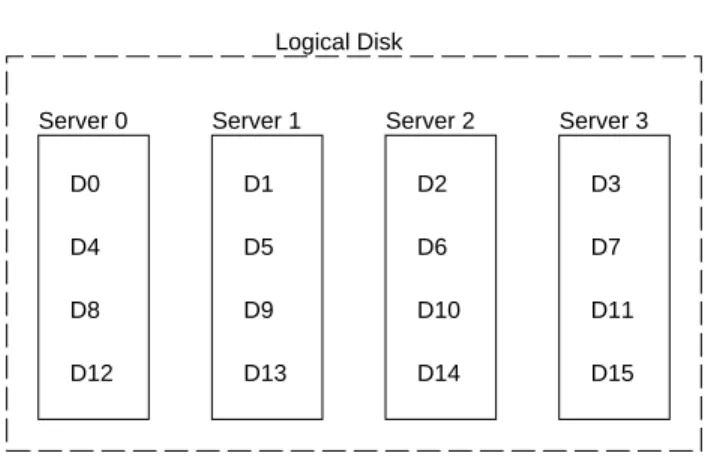
Figure 2 illustrates round-robin data striping. The solid rectangles represent blocks of storage on the specified stor-age server, the dotted rectangle emphasizes that the storstor-age
Server 1 Server 2 Server 3 Server 0 D0 D0 D1 D1 D2 D2 D3 D3 D4 D4 D5 D5 D6 D6 D7 D7 Logical Disk Figure 3: Mirrored-Striping.
servers appear as a single logical disk to its clients. Each letter represents a block of data stored in the storage system. The figure shows that the first block of data, D0, is stored on storage server 0, the second block of data, D1, is stored on storage server 1, and so on. This effectively implements a RAID 0 [4], using storage servers instead of disks. The main problem with this arrangement is the availability of the system. Any single disk failure will result in data loss and any single server failure will result in data unavailabil-ity.
In theory, you can implement a distributed RAID 5 us-ing storage servers [2]. However, in practice, the complex-ity of the additional synchronization required for RAID 5 systems in comparison to a replication-based redundancy scheme is greatly amplified in a distributed environment. Also, RAID 5 has the undesirable property that the failure of a single storage server increases the average read load by a factor of two. This makes RAID 5 unacceptable for many performance-critical applications such as video-on-demand.
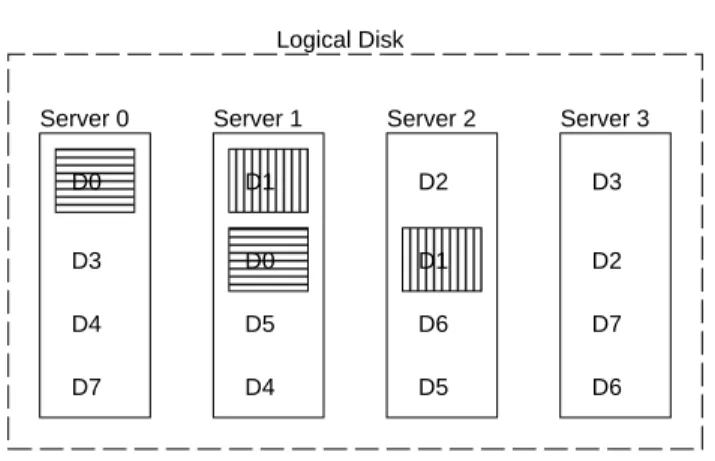
Figure 3 illustrates the mirrored-striping data placement scheme. Data is striped round-robin across a set of mir-rored servers. This provides good reliability by protecting the system from both disk and server failures. However, should Server 0 fail, Server 1 must assume all of Server 0’s load while servers 2 and 3 experience no load increase. Clearly, it would be better if all surviving servers experi-enced a 33 % increase in the read load rather than having a single server experience a 100 % increase in load.
Figure 4 illustrates the chained-declustered data place-ment scheme [7]. Note that Server 0’s copy of D0 is on Server 1, Server 1’s copy of D1 is on Server 2, and so on. Now, if Server 1 fails, servers 0 and 2 share Server 1’s read load but Server 3 experiences no load increase. This is not perfect but much better than having a single server bear all of Server 1’s load. By performing dynamic load balancing,
Server 1 Server 2 Server 3 Server 0 D0 D0 D1 D1 D2 D2 D3 D3 D4 D4 D5 D5 D6 D6 D7 D7 Logical Disk Figure 4: Chained-Declustering.
we can do much better. For example, since Server 3 has copies of some data from servers 0 and 2, servers 0 and 2 can offload some of their normal read load on Server 3 and achieve uniform load balancing.
Although we have presented this example with four servers, the same type of offloading can be done with many more servers. Chaining the data placement allows each server to offload some of its read load to either the server immediately following or preceding the given server. By cascading the offloading across multiple servers, a uni-form load can be maintained across all surviving servers. A disadvantage of this scheme is that it is less reliable than mirrored-striping. With mirrored-striping, if Server 1 failed, only the failure of Server 0 would result in data un-availability. With chained-declustering, if Server 1 fails, the failure of either Server 0 or Server 1 will result in data unavailability.
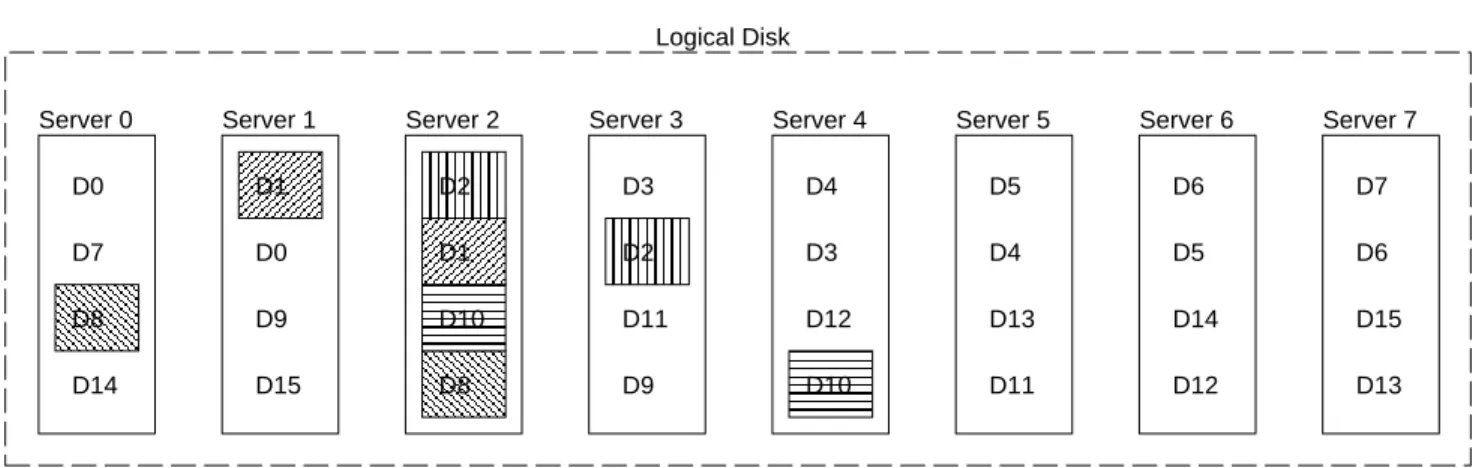
Figure 5 illustrates a variation on the chained-declustered data placement called
multi-chained-declustering. Instead of having a single chain of stride
one, multiple chains of varying strides are used. The sys-tem illustrated in Figure 5 uses chains of both stride one and stride two. If dynamic load balancing is not used, this scheme provides better load balancing than chained-declustering. For example, if Server 2 fails, servers 0, 1, 3, 4 each experience a 25 % increase in the read load com-pared to 50 % with chained-declustering. In large config-urations, multi-chained-declustering has an additional ben-efit over chained-declustering. With chained-declustering, multiple failures can prevent uniform load balancing by breaking the chain in more than one place. This effect is most pronounced if the two failures occur close together in the chain. With multi-chained declustering, this is not prob-lem since the chain of stride two can be used to skip over the failed servers. As expected, however, multi-chained-declustering is less reliable than chained-multi-chained-declustering. If,
D0 D7 D8 D14
Server 1 Server 2 Server 3
Server 0
D0 D1
D1 D2
D2 D3 D4 D5 D6 D7
Server 4 Server 5 Server 6 Server 7
D3 D4 D5 D6 D9 D10 D11 D12 D13 D14 D15 D8 D9 D10 D11 D12 D13 D15 Logical Disk Figure 5: Multi-Chained-Declustering.
for example, Server 2 fails the failure of any one of servers 0, 1, 3, and 4 results in data unavailability. As this exam-ple illustrates, in the absence of dynamic load balancing, a tradeoff exists between load balancing in the face of failures and the availability of the system.
4
Virtual Volumes
The primary practical, in contrast to technical, problem in designing scalable storage systems is making them easy to manage. Designing systems to automatically tolerate and recover from component failures and to automatic balance load is an important part of the solution, but it is not suf-ficient. Although we have described how to build a sin-gle large block-level device with high-availability and scal-able performance, we have not provided any mechanism for sharing this device in heterogeneous distributed environ-ments or for making consistent backups and restores of such large devices. For the scale of storage systems we are con-sidering, the standard UNIX mechanism of statically par-titioning a device into several fixed-size devices is inade-quate. Our solution to the problem applies a well known technique for sharing resources in computer systems; we virtualize the resource.
The primary storage management abstraction we sup-port is the virtual volume. A virtual volume looks like a large block-level device but unlike a real device, it can be created and destroyed as needed by clients of the scalable storage system. Each virtual volume gives each client ac-cess to the performance capabilities of the entire scalable storage system. Similar to the virtual address space abstrac-tion supported by many operating systems, the creaabstrac-tion of a virtual volume only allocates a range of virtual disk ad-dresses and does not in itself allocate any physical storage.
Scalable Network AdvFS NT FS PC FS BSD FFS /dev/vol1 /dev/vol2 /dev/vol3 /dev/vol4 /dev/vol5
Figure 6: Virtual Volumes.
It is only when locations in the virtual volume are used that physical storage is allocated and mapped to an address in the virtual volume. Thus, a virtual volume need not have a definite size. This can be an advantage for advanced file systems that can dynamically grow in size. For some ap-plications, it may be desirable to guarantee each virtual vol-ume some minimum amount of physical storage. Likewise, it is probably desirable to place maximum size restrictions on volumes to prevent it from using up all the physical stor-age. Figure 6 illustrates how virtual volumes might fit into heterogeneous distributed environments.
Virtual volumes are implemented by explicitly mapping each virtual volume identifier and offset to a correspond-ing physical disk address. The existence of this map be-tween virtual and physical addresses allows us to play the same type of mapping games found in virtual memory sys-tems. For example, by adding a facility for making vir-tual volumes copy-on-write, we can support an efficient
mechanism for creating instantaneous snapshots of vol-umes. Such a snapshot facility is needed to make consis-tent file system dumps without making file systems unavail-able for long periods of time. Periodic snapshots can also be used to recover accidentally deleted files and directories without resorting to tape backups. Finally, read-only snap-shots of volumes can be mounted as read-only file systems on several file servers simultaneously, allowing commonly accessed files such as executables to be servered from mul-tiple machines without having to partition or replicate the files.
5
Our First Prototype
Over the past year, we have applied the ideas described in this paper to construct our first scalable storage proto-type. The primary goal of the prototype is to study the high-availability and scalable performance characteristics of the scalable storage system. Currently, the prototype survives any single component failure including disk, server, and network failures. Appropriately partitioning the servers over two or more sites should allow the system to sur-vive site failures, but this has not been tested. The proto-type currently does not support virtual volumes. The pro-totypes is implemented using Alpha/OSF workstations and the AN1 [9] (similar to switched FDDI) network. Due to the current lack of spare disks in our computing environ-ment, we have thus far simulated the disks.
Our first prototype uses the chained declustered data placement described previously. One nice property of this data placement is that, assuming an even number of servers, placing the even and odd numbered servers at different sites results in a system that can survive any single site failure. A system using the multi-chained declustered data place-ment described in this paper can also be partitioned to sur-vive site failures, however, this placement requires a mini-mum of three rather than two sites.
We use the fail-stop failure model in designing the pro-totype’s redundancy mechanisms. That is, we assume that when a component fails, it ceases to operate. In particular, a failed component does not continue to operate incorrectly. A distributed voting mechanism based on timeouts ensures that all servers can agree on the failed or operational status of each other in the face of communication failures.
The software components of the scalable storage proto-type can be broken into roughly two basic components: the server software that runs on each scalable storage server, and the client software that runs on each client of the scal-able storage system. The client software looks just like a standard block-level device driver to its host operating sys-tem. From the clients’ perspective, adding a scalable stor-age system is similar to adding a new disk controller. Once
the scalable storage driver is installed, a client can access the scalable storage system just as if it were a locally at-tached disks.
A basic design principle in implementing the server and client software was to implement all the necessary function-ality in the server software and to maintain only “hints” in the client software. This makes it unnecessary to imple-ment complicated consistency protocols to constantly up-date information cached at clients, and ensures that a client cannot compromise the logical consistency of data stored in the scalable storage system. The client currently maintains only a small amount of high-level mapping information that is used to route read and write requests to the most appro-priate server. If the request is sent to the wrong server, the server updates the information at the client and the client retries with the new information.
A primary example of this design philosophy, is that data redundancy is implemented completely within the servers; the clients are completely unaware of the redun-dancy scheme that is used or, indeed, that any redunredun-dancy scheme is being used. This results in a particularly sim-ple network interface that makes it easier to experiment with different redundancy schemes and makes it impossible for the clients to compromise the data redundancy mech-anisms. This also means that the clients are not burdened with the additional work required for supporting data re-dundancy. For example, when a write request is generated by a client, the appropriate scalable storage server is re-sponsible for generating any additional network requests needed for updating the corresponding replica.
Preliminary performance measurements of our untuned first prototype show that each server can service 1100 512-byte read requests per second and 400 512-512-byte write re-quests per second. For 8 KB requests, each server can service read requests at 4.8 MB/s and write requests at 1.6 MB/s. The reader may have noticed that the write performance for both small and 8 KB requests is approx-imately one-third the read performance. This is because for a read request, the storage system need only read the requested data from, the simulated, disk and send it out over the network, whereas for a write request, the storage system must receive the data, send it to the corresponding replica server and the replica server must subsequently re-ceive and process the data. Thus, a write request generates three times the network processing overhead generated by a read request. As expected, preliminary performance analy-sis of the system indicates that optimization of the network-ing code should result in significant performance improve-ments. The reader should bear in mind that the above de-scribes the performance that is achieved by each server in the scalable storage system. We expect the performance of the system to scale linearly up to a hundred or more servers. The largest scalable storage system we have tested to date
is with four servers.
6
Summary, Conclusions and Future Work
The ideal storage system is always available, incremen-tally expandable, scales in performance as new components are added, and requires very little management. When ad-ditional capacity or performance is needed, a new storage server is plugged into the network and turned on. The ad-dition storage is then immediately and transparently ac-cessible to all clients of the storage system. In particular, the capacity and load is automatically distributed uniformly across all storage servers in the system.
In this paper, we have presented ideas for building stor-age systems that come closer to this ideal. We’ve outlined some of the data striping and redundancy schemes that are suitable for distributed storage systems and briefly men-tioned why RAID level 5 systems, while good for central-ized storage systems, may not generalize well to distributed storage systems. We’ve also motivated the usefulness of virtual volumes in managing and allocating storage in dis-tributed environments and some of the additional function-ality such as snapshots that they can efficiently support. Fi-nally, we have briefly described our first scalable storage prototype and tried to give an idea for the level of perfor-mance that can be expected.
Over the next year or two, we plan to finish our imple-mentation of virtual volumes, include support for adding disks and servers on-line without making the storage sys-tem unavailable, build a larger prototype using real disks, and look for interesting applications for the system. One class of applications that currently appeals to us is provid-ing a wide-area information service over the Internet.
In conclusion, we believe that large-scale distributed storage systems represents a very important opportunity for both research and product development. The avail-ability, performance and manageability of existing storage systems is inadequate for building the large-scale informa-tion systems that are envisioned for the future. If we truly wish to build the massive video-on-demand, regional med-ical information systems, enterprise-wide information sys-tems, and consumer-oriented information systems that the recent advances in telecommunications make possible, we must reexamine the basic building blocks we use in build-ing large distributed systems. Irregular stones may be fine for building cottages but we need modular bricks to build cathedrals. (Yes, it’s not a very pretty analogy but I think that it makes a point.)
References
[1] Luis-Felipe Cabrera and Darrel D. E. Long. Swift: Us-ing distributed disk stripUs-ing to provide high I/O data rates. ACM Computing Systems, 4:405–436, Fall 1991. [2] Pei Cao, Swee Boon Lim, Shivakumar Venkataraman, and John Wilkes. The TickerTAIP parallel RAID ar-chitecture. In Proc. International Symposium on
Com-puter Architecture, pages 52–63, May 1993.
[3] Peter M. Chen, Edward K. Lee, Ann L. Drapeau, Ken Lutz, Ethan L. Miller, Srinivasan Seshan, Ken Shirriff, David A. Patterson, and Randy H. Katz. Perfor-mance and design evaluation of the RAID-II storage server. Journal of Distributed and Parallel Databases, 2(3):243–260, July 1994.
[4] Peter M. Chen, Edward K. Lee, Garth A. Gibson, Randy H. Katz, and David A. Patterson. Raid: High-performance, reliable secondary storage. ACM
Com-puting Surveys, 26(2):145–185, June 1994.
[5] Joy Foglesong, George Richmond, Loellyn Cassel, Ca-role Hogan, John Kordas, and Michael Nemanic. The Livermore distributed storage: Implementation and ex-periences. Technical Report UCRL-102663, Lawrence Livermore National Laboratory, May 1990.
[6] John H. Hartman and John K. Ousterhout. Zebra: A striped network file system. In Proc. USENIX File
Sys-tems Workshop, pages 71–78, May 1992.
[7] Hui-I Hsiao and David J. DeWitt. Chained declus-tering: A new availability strategy for multiprocessor database machines. Technical Report CS TR 854, Uni-versity of Wisconsin, Madison, June 1989.
[8] A. L. Narasimha Reddy and Prithviraj Banerjee. Grace-fully degradable disk arrays. Proc. International
Sym-posium on Fault-Tolerant Computing, June 1991.
[9] Michael D. Schroeder, Andrew D. Birrell, Michael Burrows, Hal Murray, Roger M. Needham, Thomas L. Rodeheffer, Edwin H. Satterthwaite, and Charles P. Thacker. Autonet: a high-speed, self-configuring lo-cal area network using point-to-point links. Technilo-cal Report SRC-59, Digital Equipment Corporation, Sys-tems Research Center, 130 Lytton Ave., Palo Alto, CA 94301-1044, April 1990.