MPRA
Munich Personal RePEc Archive
Evaluating Quantitative Easing: A DSGE
Approach
Matteo Falagiarda
Department of Economics, University of Bologna
September 2013
Online at
http://mpra.ub.uni-muenchen.de/49457/
Evaluating Quantitative Easing:
A DSGE Approach
Matteo Falagiarda∗ University of Bologna September 2013† AbstractThis paper develops a simple Dynamic Stochastic General Equilibrium (DSGE) model capable of evaluating the effect of large purchases of treasuries by central banks. The model exhibits imperfect asset substitutability between government bonds of different maturities and a feedback from the term structure to the macroeconomy. Both are generated through the introduction of portfolio adjustment frictions. As a result, the model is able to isolate theportfolio rebalancing channel of Quantita-tive Easing (QE). This theoretical framework is employed to evaluate the impact on yields and the macroeconomy of large purchases of medium- and long-term treasuries recently carried out in the US and UK. The results from the calibrated model suggest that large asset purchases of government assets had stimulating effects in terms of lower long-term yields, and higher output and inflation. The size of the effects is nevertheless sensitive to the speed of the exit strategy chosen by monetary authorities.
KEYWORDS: unconventional monetary policies, quantitative easing, DSGE models, asset prices JEL Classification: E43, E44, E52, E58
∗
Department of Economics, University of Bologna. Mail: [email protected] Address: Piazza Scaravilli 2 - 40126 Bologna (Italy). Office Phone:+39 051 2092641
†
Useful comments have been provided by Dario Bonciani, Jochen G¨untner, Richard Harrison, Massimiliano Marzo, Davide Raggi, Luca Sessa and Paolo Zagaglia. I have benefited from conversations with Neil Cabiles, Gabriella Chiesa, Guido Ruta and Alessandro Saia. I also thank participants at seminars at the Department of Economics of the University of Bologna, at the 53rd Annual Conference of the Italian Economic Association, the ADRES Doctoral Conference 2013, the Konstanz Doctoral Workshop on Dynamic Macroeconomics 2013, the Spring Meeting of Young Economists 2013, the European Macroeconomics Workshop 2013, and the 28th Annual Congress of the European Economic Association. Any errors remain my responsibility.
1 Introduction
When an economy is stuck in a liquidity trap or experiences a liquidity shortage, the zero-lower bound (ZLB) of interest rates may challenge the conventional ways of conducting monetary policy.1 Hence, Quantitative Easing (QE) becomes one of the main tools at the disposal of central banks in order to spur economic recovery. QE can be defined as all policies carried out by central banks involving changes in the composition and/or size of their balance sheet aimed at, in a situation close to the ZLB, easing liquidity and credit conditions with the final goal of stimulating the economic system. There exist therefore a vari-ety of different unconventional measures that fall under the label of QE, such as purchases of treasuries, purchases of private securities, and direct loans to banks, companies and households. Theoretical and practical issues on unconventional monetary policies are discussed in several studies (Krugman,1998; Svensson,2003;Bernanke and Reinhart,2004;Orphanides, 2004;Borio and Disyatat, 2010;Bowdler and Radia,2012;Joyce et al.,2012). Figure 1 sketches strategies and policy options available to central banks facing ZLB problems as well as the channels through which they may affect aggregate demand.
As the recent global downturn unfolded, many advanced economies experienced a serious liquidity shortage combined with an interest rate close to the ZLB. Thus, their monetary authorities began to pur-sue QE measures. In particular, in the aftermath of the financial crisis of 2007, interbank money markets froze up due to some important bankruptcies (and, more generally, solvency concerns), a consequent widespread lack of confidence, and coordination failures among market participants. As a result, finan-cial markets also broke down with dramatic consequences for the whole economic system. In an effort to spur economic activity and restore financial market functioning, several central banks intervened by re-ducing the short-term interest rate. The ZLB quickly became a serious concern for monetary institutions since, in such situations, the availability of credit tends to become irresponsive to quantity of liquidity present in the economic system.
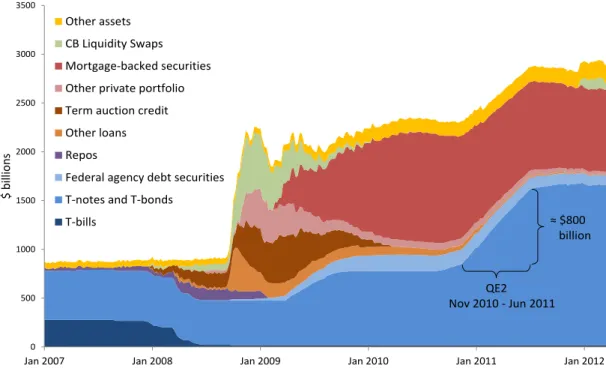
In the US, when Lehman Brothers collapsed, the Fed engaged in dramatic cuts of the policy rate, and the ZLB was virtually reached in December 2008. As Figure 2 shows, this measure was accompanied by a huge expansion of the Fed’s portfolio assets, which jumped by over $1,000 billion in a few weeks. Besides rescuing troubled companies, such as Bear Stearns and AIG, the Fed started a much more com-prehensive program to provide liquidity and reduce risk premia along the term structure and across a variety of different assets.2Given improved conditions in financial markets, many of the programs intro-duced at the onset of the crisis were suppressed by the end of 2009 or throughout 2010. A second stage of QE, called by practitioners QE2 (in contrast with the first phase QE1), took place from October 2010
1The existence ofliquidity trapswas first hypothesized byKeynes(1936), during the years following the onset of the Great
Depression, when, in a deflationary situation, short-term nominal interest rates remained for a long time very close to zero.
2New specific programs include the Mortgage-Backed Securities (MBS) purchase program, which was intended to help
mortgage and housing markets, the Term Asset-Backed Securities Loan Facility, aimed at providing credit to households and small companies, the Asset-Backed Commercial Paper Money Market Mutual Fund Liquidity Facility, which provided funding to banks for their purchase of asset-backed securities, and the Term Auction Facility, which provided term funds to depository institutions.
until June 2011, mainly consisting of purchases of medium- and long-term treasury securities.3
In September 2012, Bernanke announced that the Fed will purchase additional agency mortgage-backed securities at a pace of $40 billion per month, and will extend the average maturity of its holdings of securities. These actions are expected to increase the Fed’s holdings of longer-term securities by about $85 billion each month until the end of the year. The declared objective of QE3 is to “put downward pressure on longer-term interest rates, support mortgage markets, and help to make broader financial conditions more accommodative.” (Board of Governors of the Federal Reserve System,2012).
The QE approach of the Bank of England (BoE) has been quite different to that implemented by the Fed. As shown in Figure 3, a huge expansion of the balance sheet occurred just after the insurgence of the crisis. During this first stage, the central bank implemented some liquidity support measures, such as extensions to its lending operations, by allowing banks to borrow from a wider-than-normal range of collateral. The second stage of unconventional measures in the UK began with the establishment of the Asset Purchase Facility (APF) fund in March 2009, a separate subsidiary company of the BoE.4 The goal of the APF was to improve market functioning by injecting money into the economy in the form of purchases of high-quality public and private assets. However, APF’s operations were overwhelmingly oriented towards purchases of medium- and long-term governments bonds (Figure 4). Private securities accounted for a tiny proportion of the APF’s purchases. Because of further recessionary pressures during the end of 2011, the Bank of England extended the program in October 2011, injecting additional liquid-ity into the economy, mainly in the form of medium- and long-term gilt purchases. Two more waves of purchases took place in February 2012 and July 2012, bringing the total amount of assets purchased by the BoE to the remarkable value of £375 billion. At the time of writing this paper, a date for a definitive exit strategy is still uncertain.
Recent events have inspired a growing body of empirical literature trying to assess whether unconven-tional monetary policies have been successful. However, gauging the effects of unconventional monetary policies remains a hard task. The reasons can be found both in the uncertain time lags between actions and effects, and in the difficulties related to disentangling other important factors, especially government policies and international developments. Another empirical concern is the identification of the channels through which QE may affect yields, premia, and other variables of interest. A substantial number of empirical contributions rely therefore on event studies, i.e. they focus on the patterns of specific vari-ables, such as yields, within a narrow time interval between the announcement or the implementation of a policy. Evidence provided by event studies has been generally supportive of the effectiveness of QE policies, both in the US (Klyuev et al.,2009;Blinder,2010;Neely,2010;Gagnon et al.,2011; Krish-namurthy and Vissing-Jorgensen,2011;Swanson,2011;Glick and Leduc,2012) and in the UK (Klyuev et al.,2009;Meier,2009;Joyce et al.,2011b;Glick and Leduc,2012;Joyce and Tong,2012).
3“QE1 directly supported struggling banks by buying their problematic assets. QE2 supports the government.” (Bagus,
2010).
4The accounts of the APF are not consolidated with those of the central bank. Therefore, all the operations of the APF fund
Another strand of the empirical literature employs econometric techniques (Gagnon et al., 2011; Meaning and Zhu,2011;Bridges and Thomas,2012;D’Amico et al.,2012;Glick and Leduc,2012;Joyce and Tong,2012;Kapetanios et al.,2012;Kozicki et al.,2012;Stroebel and Taylor,2012;Wright,2012; Baumeister and Benati,2013;D’Amico and King,2013), affine term structure models (Christensen and Rudebusch,2012;Hamilton and Wu,2012) and other finance models (Doh,2010;Neely,2010). These works generally find that the unconventional monetary measures recently taken in the US and in the UK have been effective.
In addition, more or less fully-fledged structural models have been used to assess the impact of un-conventional monetary policies.5 In standard Dynamic Stochastic General Equilibrium (DSGE) models, QE may only work through asignaling channel,6 since the representation of the financial sector is very stylized. In order to capture the effects of QE policies via other channels, it is necessary to depart from the conventional DSGE framework by introducing specific financial frictions and structures.
A first attempt has been made by modeling financial intermediaries and banking frictions, in order to focus on the role of unconventional monetary policies in facilitating lending. These models are able to capture thecredit channelof QE. Contributions in this area have been produced byC´urdia and Woodford (2010),Dib(2010),Gertler and Kiyotaki(2010),Brendon et al.(2011),Del Negro et al.(2011),Gertler and Karadi(2011),Hilberg and Hollmayr(2011),Chadha et al.(2012), andChadha and Corrado(2012). A different type of DSGE models features imperfect asset substitutability to isolate the portfolio rebalancing channelof QE. Within these frameworks, QE measures may affect asset prices and returns by changing the relative supplies of different assets. There has recently been a growing attention towards the contributions byTobin(1969,1982) about imperfect asset substitutability, whose portfolio approach has been employed in dynamic optimizing models by Andr´es et al. (2004), Marzo et al.(2008), and, more recently, byFalagiarda and Marzo (2012) and Zagaglia(2013). Chen et al.(2012) andHarrison (2012a,b) adopt this framework to study unconventional monetary policies. In models with imperfect asset substitutability, investors tend to rebalance their asset portfolios whenever the supply of the different types of assets changes. Large asset purchases by the central bank vary the relative supply of assets of different maturities, inducing movements in their prices. As a result, aggregate demand may also be influenced.
By embracing this last approach, the present paper develops a DSGE model able to capture the effect of large asset purchases of treasuries by central banks. Partially drawing onChen et al.(2012) and Har-rison(2012a,b), the model is characterized by imperfect asset substitutability and a feedback effect from the term structure to the macroeconomy, both generated through the introduction of portfolio adjustment frictions. In other words, agents pay a cost whenever the relative composition of their portfolio deviates from its steady-state level. The model is therefore capable of isolating aportfolio rebalancingchannel of QE. By purchasing a particular asset, the monetary authority reduces the amount of that asset held
5For a comparison of the different DSGE approaches to QE, seeCaglar et al.(2012). A large scale non-DSGE model is
used byChung et al.(2012).
by private agents usually in exchange of risk-free reserves. As a result, the price of that asset increases and the interest rate falls, creating favorable conditions for economic recovery through the traditional monetary transmission mechanisms. Indeed, thanks to the general equilibrium nature of the model, it is possible to assess the effect of this type of QE policies on the macroeconomy as well as on yields.
Differently fromChen et al.(2012) and Harrison(2012a,b), who employ perpetuities as long-term bonds, the model presented in this paper features a secondary market for bond trading, as proposed by Ljungqvist and Sargent(2004), allowing a straightforward treatment of zero-coupon government bonds of different maturities. Moreover, unlikeChen et al.(2012) the present model relies on a representative agent setting, avoiding the troublesome differentiation between restricted and unrestricted agents. A further distinction between Harrison (2012b) and the model proposed in this paper is the absence of portfolio adjustment frictions in the utility function of households. I instead decide to include such costs more plausibly in the budget constraint. In addition, particular attention is paid to the calibration strategy in order to simulate carefully large asset purchase programs. Lastly, an extensive sensitivity analysis is performed to show how the results crucially depend on the key parameters of the model. Due to the novelties introduced, this model is more consistent with reality than the similar settings present in the literature. To the best of my knowledge, this model represents the first attempt to evaluate the effects of large asset purchases within a relatively simple DSGE framework characterized by: a) a representative agent; b) a stylized central bank’s balance sheet; c) an endogenous term structure featuring imperfect asset substitutability between zero-coupon government bonds of different maturities.
The theoretical framework is then employed to simulate the impact of large purchases of medium-and long-term treasuries in the US during QE2 (from November 2010 to June 2011 - around $800 billion of purchases - Figure 2), and in the UK during the first phase of the APF program (from March 2009 to January 2010 - around £200 billion of purchases - Figure 3). The results from the calibrated model are realistic and generally consistent with those obtained in the literature using different techniques. Overall, they suggest that large asset purchases of government assets had substantial stimulating effects both in terms of lower long-term yields and higher output and inflation. These effects seem to be generally larger for the UK than the US. This is not surprising, given that the purchases characterizing the phases of QE under consideration have been relatively more remarkable in the UK than in the US. Still, the difference in the effects between the two countries is not as large as previously found in the literature. My preferred model specification indicates that large asset purchases of QE2 in the US had a peak effect on long-term rates in annualized percentage rates of -63 basis points, on the level of real GDP of around 0.92%, and on inflation of 0.37 percentage points. In the UK, the preferred model specification suggests that the first phase of the APF program had a peak effect on long-term rates of -69 basis points, on the level of real GDP of 1.25%, and on inflation of 0.49 percentage points. However, the size of the effects crucially depends on the speed of the exit strategy chosen by monetary authorities and on the degree of substitutability among assets of different maturities.
setting through which the effects of large purchases of treasuries by central banks can be evaluated within a microfounded macro framework with optimizing agents. Second, it offers fresh evidence on the potential effectiveness of the recent large asset purchase programs conducted in the US and in the UK.
The remainder of the paper is organized as follows. Section 2 elaborates the model and introduces its key features. Section 3 presents the results from the calibrated model. Section 4 concludes.
2 The Model
A representative agent populates the economy and supplies labor inputs. Monopolistically competi-tive firms hire labor and capital to produce differentiated goods. The government conducts fiscal and monetary policy. Since the deviations from a canonical DSGE setting concern the households and the government sectors, I start here with their discussion.
2.1 Households
There is a representative household, whose preferences are defined over consumptionCt, real money balances Mt
Pt and labor effortLt, and are described by the infinite stream of utility:
Ut = ∞ X t=0 βt u Ct, Mt Pt,Lt ! (1)
whereβis the intertemporal discount factor. The instantaneous utility functionuCt,Mt
Pt,Lt is given by: u Ct, Mt Pt,Lt ! = (Ct−γCt−1)1− 1 σ 1− σ1 + 1 1−χ Mt Pt !1−χ − Ψ 1+1/ψL 1+1/ψ t (2)
whereγmeasures the importance of consumption habits,σis the elasticity of intertemporal substitution,
χis the elasticity of money demand, andψis the Frisch elasticity of labor supply.
In this economy, each agentican choose the composition of a basket of differentiated final goods. Preferences across varieties of goods have the standard constant elasticity of substitution (CES) form `a laDixit and Stiglitz(1977):
Ct = "Z 1 0 Ct(j)θ−θ1d j #θ−θ1 (3)
whereCtis the aggregate consumption index of all the differentiated final goods produced in the economy under monopolistic competition. There are j-th varieties of final goods (j∈[0,1]), andθis the elasticity of substitution between different final goods varieties (θ >1).
for bond trading as inLjungqvist and Sargent(2004): Bt PtRt + BHL,t PtRL,t (1+ACtL)+ Mt Pt + It(1+ACtI)= Bt−1 Pt + BHL,t−1 PtRt + Mt−1 Pt + wtLt+qtKt−Ct−Tt (4)
Thus, agents allocate their wealth among money holding, accumulation of capital, which is rented to firms at the rental rate qt, and holding of two types of zero-coupon bonds (Bt and BHL,t), which are purchased by households at their nominal price. They receive rental incomeqtKt, where Kt is capital,
wage incomewtLt, where wt is the real wage. They also pay a real lump-sum taxTt. It is investment, andPt is the aggregate price level.
Firms face quadratic adjustment costs of investment as inKim(2000):
ACtI = φK 2 It Kt !2 (5)
The law of motion of capital stock is expressed in the following standard way:
Kt+1 =It+(1−δ)Kt (6)
whereδrepresents the depreciation rate of the capital stock.
The different zero-coupon government bonds are defined as money-market bonds Bt and long-term bondsBHL,t, whose yields are given, respectively, byRt andRL,t. Money-market bonds are considered as
a proxy for 3-month-maturity bonds, and the long-term bonds for 10-year-maturity bonds.7 The budget constraint incorporates the secondary market for bond trading as proposed byLjungqvist and Sargent (2004). The strength of this approach is that it allows an explicit and straightforward treatment of assets of different maturities. The left-hand side of the budget constraint follows the usual formulation with bonds priced at their interest rates, since at timet, returns RandRL are known with certainty and are risk-free from the viewpoint of agents. However, the right-hand side of (4) reveals the presence of the secondary market for bond trading as proposed byLjungqvist and Sargent (2004), according to which long-term bonds are priced at the money-market rate. Even though these bonds represent sure claims for future consumption, they are subject to price risk prior to maturity. At time t−1, an agent who buys longer-maturity bonds and plans to sell them next period would be uncertain about the gains, sinceRtis not known at timet−1. As stressed byLjungqvist and Sargent(2004), the priceRtfollows from a simple
arbitrage argument, since, in periodt, these bonds represent identical sure claims to consumption goods at the time of the end of the maturity as newly issued one-period bonds in periodt.
As already mentioned, segmentation in financial markets is obtained by introducing portfolio adjust-ment frictions, which represent impediadjust-ments to arbitrage behavior that would equalize asset returns. In particular, it is assumed that the intratemporal trading between bonds of different maturities is costly to
7However, when calibrating the model, money-market bonds are assumed to include all government debt instruments with
maturity up to one year, whereas long-term bonds government debt instruments with maturity longer than one year (see Para-graph 3.1).
each agent. These bond transaction costs are given by: ACtL= φL 2 κL Bt BH L,t −1 2 Yt (7)
whereκLis the steady-state ratio of long-term bond holdings relative to short-term bond holdings
BHL B
. Thus, agents pay a cost whenever they shift the portfolio allocation between short and long maturity bonds. Transaction costs are paid in terms of income and are zero in the steady-state.8
The rationale for including portfolio frictions is threefold. First of all, these costs can be viewed as a proxy for the behavior of agents towards liquidity risk (i.e. they rationalize a liquidity premium). The longer the maturity of a bond, the less liquid is considered the asset, and vice versa. Since long-term bonds are perceived as less liquid, there are liquidity costs associated with holding them. In other words, agents perceive longer-maturity assets as riskier, and hence associated with a loss of liquidity compared to the same investment in shorter-term bonds. It follows that, as they purchase longer-term bonds, they hold additional short-term bonds to compensate themselves for the loss of liquidity. Thus, agents self-impose a sort of “precautionary liquidity holdings” on their longer-term investments (Andr´es et al.,2004). Another justification for including such portfolio frictions rests on the theory of preferred habitat, according to which agents have preferences over bond maturities (Vayanos and Vila, 2009). Therefore, any deviation from the preferred portfolio allocation is costly to households. Third, these costs can be also considered as proxies for the shares of resources devoted to covering information costs, or simply the costs of managing bond portfolios.
2.1.1 Optimality Conditions
Households maximize their lifetime utility (1) subject to the budget constraint (4) and the capital accumu-lation equation (6). The first order conditions with respect to consumption, labor, money, money-market bonds, long-term bonds, capital and investment, are respectively given by:
(Ct−γCt−1)−1/σ−βγEt(Ct+1−γCt)−1/σ =λt (8) ΨLt1/ψ=λtwt (9) Mt Pt !−χ +βEtλt+1 πt+1 = λt (10)
8This distinctive formulation resembles those proposed byAndr´es et al.(2004),Falagiarda and Marzo(2012) andHarrison
βEt λt+1 πt+1 = λt Rt + κLφLλtYt κLbbHt L,t −1 RL,t (11) βEt λt+1 πt+1Rt+1 = λt RL,t + φLλtYt κLbbHt L,t −1 2 2RL,t − κLφLλtYtbt κLbbHt L,t −1 bHL,tRL,t (12) β(1−δ)Etµt+1=µt−λt qt+φK It Kt !3 (13) βEtµt+1=λt 1+ 3 2φK It Kt !2 (14)
whereλtandµtare the two Lagrange multipliers.
2.2 The Government Sector
The consolidated government-central bank budget constraint is given by:
Bt PtRt + BL,t PtRL,t + ∆t Pt = Bt−1 Pt + BL,t−1 PtRt + Gt−Tt (15)
whereBL,tis the total amount of long-term bonds present in the economy andGtis government spending.
As stressed in the previous paragraph, money-market bonds are considered as a proxy for 3-month-maturity government debt assets, and long-term bonds for 10-year-3-month-maturity government debt assets.
Drawing onHarrison(2012b),∆tis defined as the change in the central bank balance sheet, equal to
money creation and net asset purchases:
∆t Pt = Mt−Mt−1 Pt − BCBL,t PtRL,t − BCBL,t−1 PtRt (16)
whereBCBL,t is the central bank’s holdings of long-term government debt. Thus, the stylized central bank’s balance sheet of this model includes long-term treasuries on the asset side and money on the liability side. Central bank’s holdings of long-term government bonds are a fraction x of the total amount of long-term bonds present in the economy:
The remaining proportion of long-term bonds is available to households and is given by:
BHL,t =(1−xt)BL,t (18)
Thus, asset purchases by the central bank are performed by varying the fractionxt, which is modeled as a variable following an autoregressive process of order one:
log xt X =φxlog xt −1 X +εx t (19)
whereXis the steady-state value of the fraction of long-term bonds held by the central bank
BCB L,t
BL,t
, andεxt represents an i.i.d. shock to asset purchases with zero mean and standard deviationσx. This means that
the central bank holds in the steady-state a quantity of long-term bondsX, and temporary fluctuations around this level are determined by (19). One limitation of this formulation is that it is assumed that the central bank gradually starts decumulating long-term asset holdings from the period after the shock. The persistence of the shock is nevertheless carefully calibrated to mimic different plausible exit strategies conducted by the monetary authority.
Government spending, net of interest expenses,Gtfollows an AR(1) process:
log Gt G =φGlog Gt −1 G +εG t (20) whereεG
t is an i.i.d. shock with zero mean and standard deviationσG.
I introduce the following passive fiscal policy rule, according to which the total amount of tax col-lectionTt is a function of total government’s liabilities:9
Tt =ψ0+ψ1 " bt−1 πt − b π # +ψ2 " bL,t−1 Rtπt − bL Rπ # (21)
where ψ0 is the steady-state level ofTt, and bt andbL,t denote the real stock of short- and long-term
bonds (bt = Bt/Pt,bL,t = BL,t/Pt). Equation (21) suggests that the level of taxes reacts to deviations of
the outstanding level of public debt from its steady-state level. In other words, taxes are not allowed to act independently from the stock of government liabilities outstanding in the economy.10
The central bank is the institution devoted to set the money-market rateRt, according to the following
Taylor(1993) rule: log Rt R =αRlog Rt −1 R +(1−αR) απlog π t π +αYlog Yt Y +εR t (22)
whereαR,απ,αY indicate the response ofRt with respect to lagged Rt, inflation and output. Thus, the
9In such a way, it is possible to prevent the emergence of inflation as a fiscal phenomenon (Leeper,1991). 10A similar formulation has been employed, for instance, bySchmitt-Groh´e and Uribe(2007).
policy rate is determined by the deviation of inflation and output from their steady-state values with an interest rate smoothing component. The monetary policy shockεRt is an i.i.d. with zero mean and
standard deviationσR.
Finally, the supply of long-term bonds is assumed to follow a simple exogenous AR process, as in Zagaglia(2013): log bL,t bL ! =φBLlog bL,t−1 bL ! +εBL t (23)
whereεtBLis a disturbance term with zero mean and standard deviationσBL. Thus, asset purchase shocks
are assumed to affect only the composition of outstanding government liabilities.
2.3 Firms
The final step is to model the firms’ sector, which follows a quite standard representation. Each firm j
produces and sells differentiated final goods in a monopolistically competitive market. The production function is a standard Cobb-Douglas with labor and capital:
Yt =AtKtαLt1−α−Φ (24)
whereαis the share of capital used in production, andΦis a fixed cost to ensure that profits are zero in the steady-state. Atis technology and follows an AR(1) process:
log At A =φAlog At −1 A +εA t (25)
whereεAt is an i.i.d. shock with zero mean and standard deviationσA.
Firms’ optimizing process is constrained by nominal rigidities `a laRotemberg(1982), i.e. firms face quadratic price adjustment costs:
ACtP= φP 2 Pt(j) Pt−1(j) −π !2 Yt (26)
Given the standard CES setting of equation (3), the demand function faced by each single firm jis:
Yt(j)= " pt(j) Pt #−θ Yt =⇒Pt(j)= " Yt(j) Yt #−1θ Pt (27)
Thus, the demand function for each single good jis proportionally related to the general output level of the economy, and negatively to the price of good j.
FollowingKim(2000), the profit function for each firm jis:
After employing (26) and (27) into (28), the maximization problem of each firm becomes fully dynamic: each firm maximizes the expectation of the discounted sum of profit flows, given the information at time 0: Π0(j)=E0 ∞ X t=0 ρtPtΠt(j) (29)
whereρtis a stochastic pricing kernel for contingent claims, i.e. the discount factor of firms. Assuming
that each agent in the economy has access to a complete market for contingent claims, the discount factors of households and firms are equal:
Etρt+1
ρt =
Etβλt+1
λt
(30)
Therefore, the necessary first order conditions of the maximization problem with respect to labor and capital are given respectively by:
wt =(1−α) Yt+ Φ Lt ! 1− 1 eYt ! (31) qt =α Yt+ Φ Kt ! 1− 1 eYt ! (32)
whereeYt is the output demand elasticity: 1 eYt = 1 θ ( 1−φP(πt−π)πt+βφPEt "λ t+1 λt (πt+1−π)π2t+1 Yt+1 Yt #) (33)
which measures the gross price markup over marginal cost. It is easy to check that manipulations of the log-linearized version of (33) lead to the standard New Keynesian Phillips curve.
2.4 The Resource Constraint
The model is completed by specifying the resource constraint of the economy:
Yt =Ct+Gt+It(1+ACtI)+ACPt + bHL,t RL,t
(ACLt) (34)
The total output of the economy is allocated to consumption, government spending, investment (compre-hensive of capital adjustment costs), price adjustment costs, and a component related to bond adjustment frictions.
2.5 Asset Markets: No Arbitrage and the Feedback
In order to appreciate the main features of the model, a deeper analysis of the asset market’s structure is required. Combining the log-linearized version of the two first-order conditions for bond holdings, i.e. equations (11) and (12), yields:
˜
RL,t =Rt˜ +A1EtRt˜+1+A2Etλ˜t+1−A3Etπ˜t+1−φLA4[˜bt−b˜HL,t] (35)
where Aı (ı = 1,2,3,4) are convolutions of the parameters. Equation (35) reveals that the long-term rate depends positively on the volume of long-term bonds held by private households, as desired, and positively on the volume of short-term bonds, because of the imperfect substitutability between the two assets. Thus, asset purchases carried out by the monetary authority, by reducing the supply of long-term bonds at the disposal of households, would lead to a reduction in the long-term yield, as stated by the
portfolio rebalancingchannel of QE. Conversely, an increase in the relative supply of the more illiquid asset (i.e. long-term bond) will bid up the spread between the more illiquid asset and the more liquid asset. The intuition is that to get agents to accept the fact of holding a larger (smaller) fraction of short-term bonds in their portfolio the spread between the two rates has to decrease (increase). Notice the role of the transaction costs parameterφLthat, by generating impediments to the arbitrage behavior of agents
that would equalize returns, determines the degree to which relative bonds holding movements affect the long-term rate. When financial frictions are equal to zero, equation (35) boils down to the more usual formulation:
˜
RL,t =R˜t+A1EtR˜t+1+A2Etλ˜t+1−A3Etπ˜t+1 (36)
in which a sort of expectations hypothesis holds, and the long-term rate is not affected by changes in the relative holdings of bonds of different maturities.
An additional crucial feature of the model is the presence of a feedback channel from the term structure to the macroeconomy. This can be observed by combining the log-linearized version of the first order conditions for consumption (8) and short-term bonds (11), in order to obtain the Euler equation for consumption, and employing then the first order condition of long-term bonds (12):
˜
ct =A5Etct˜+1+A6Etπ˜t+1+· · · −A7Rt˜ −A8RL˜ ,t (37)
where Aı (ı = 5,6,7,8) are convolutions of the parameters. Aggregate demand and, through general equilibrium forces, all the macro variables are therefore affected by the entire simple term structure of interest rate present in this model, and not only by the short-term rate as in standard DSGE frameworks. The whole story behind the model can be summarized as follows. Long-term bond purchases by the
central bank alter the volumes of assets of different maturities, and hence returns (equation (35)), which, in turn, stimulate the economy through standard general equilibrium mechanisms (equation (37)).
3 The Results from the Calibrated Model
The model is employed to simulate the effects of specific QE programs in the US and in the UK. More specifically, I focus my attention on QE2 in the US (from November 2010 to June 2011 - around $800 billion of purchases), and the first phase of the APF operations in the UK (from March 2009 to January 2010 - around £200 billion of purchases). As already mentioned, both phases were characterized exclu-sively by purchases of medium- and long-term government securities (Figure 2 and Figure 3). Therefore, it is possible to assess their effects using the model proposed in this paper. I simulate the impact of such programs using a calibrated version of the model.
Since the model cannot be solved analytically, I log-linearized it around the steady-state. I solved the model using both the MATLAB routineGensyswritten by Christopher Sims, andDynaredeveloped by Adjemian et al.(2011).11 In what follows, calibration issues are first discussed. I then analyze the results of the baseline model. Lastly, a sensitivity analysis is performed, exploring the effects of varying the key parameters of the model.
3.1 Calibration
The benchmark model is calibrated to match quarterly data over the most recent period prior to the financial crisis of 2008. Table 1 and Table 2 report, respectively, some steady-state values and the chosen calibration values for the standard parameters. Some parameters are chosen following previous studies and their calibrated value is quite standard in the literature. Among them: the elasticity of substitution across goodsθ, set equal to 6 (Schmitt-Groh´e and Uribe, 2004); the habit formation parameterγ, set equal to 0.7 (Smets and Wouters,2007); the elasticity of intertemporal substitutionσ, set equal to 0.5, which implies a coefficient of relative risk aversion of 2; the depreciation rate of capitalδcalibrated to 0.025 (Christiano et al.,2005;Altig et al.,2011), which implies an annual rate of depreciation on capital equal to 10 percent; the share of capital in the production functionα, set to 0.36 (Christiano et al.,2005; Altig et al.,2011); the parameter of the price adjustment costφP, calibrated to 100 (Ireland,2004); the
elasticity of real money balancesχ, set equal to 7 (Marzo et al.,2008); the Frisch elasticityψ, set equal to 1.
The parameters of the fiscal and monetary policy rules are calibrated in a standard way, with the exception ofαR, which is chosen very close to one, in order to prevent the short-term rate from responding
to inflation/output changes (reflecting a situation close to the ZLB), and, at the same time, to avoid indeterminacy.
11The codes are available upon request as well as the appendices reporting the deterministic steady-state and the equations
The AR coefficients and the standard deviations of the shocks are set toφA=0.95,φG=φBL =0.90,
σA =σBL =0.01,σR =0.005,σG =0.012 (see, for example,Christiano and Eichenbaum,1992;Kim,
2000;Andr´es et al.,2004;Altig et al.,2011;Falagiarda and Marzo,2012;Zagaglia,2013).
Some of the steady-states are obtained from the data, or following previous studies. Output is normal-ized to 1. The consumption-output ratio has been set to 0.57. The share of the representative household’s time endowment spent on paid work is set equal to 0.3. The steady-state value of the money-market rate has been chosen identical for both countries, given the very similar recent trends of rates in the US and the UK, obtained from the Federal Reserve Economic Data and the Bank of England Statistical Interactive Database.
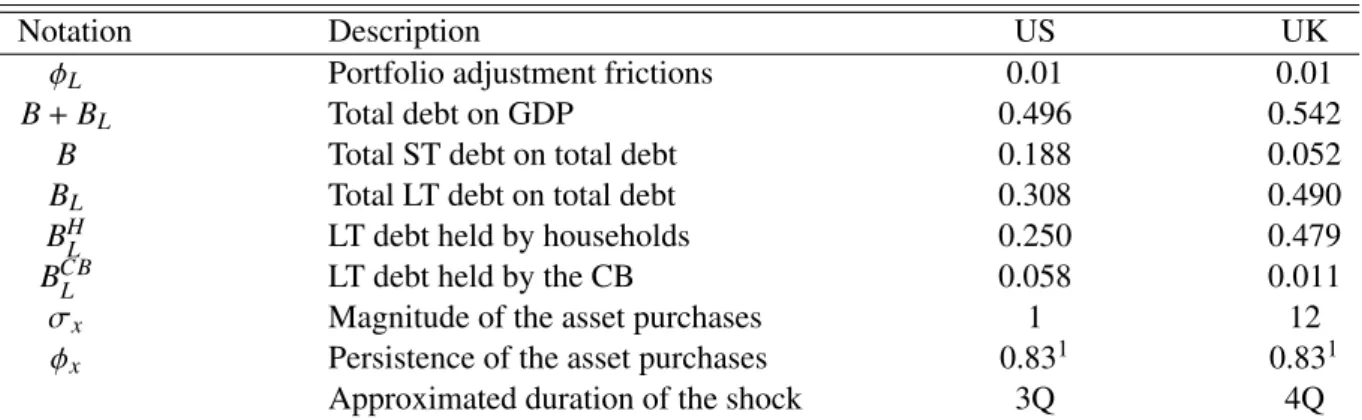
In order to simulate accurately the unconventional programs under consideration, the parameters and steady-states related to the new mechanisms proposed in this paper should be carefully chosen. Their values, reported in Table 3, are country-specific and significantly influence the impact of asset purchase policies. The ratio of total debt to GDP, the ratio of debt at different maturities to total debt, and the proportion of long-term debt held by households and the central bank, are obtained by combining data from the OECD Statistical Database, the Federal Reserve Statistical Release, the Bank of England Statistical Interactive Database, and the Bank of England APF Gilt Operational Results Dataset, and taking their values as they were just before the asset purchase shock occurred. In particular, the total debt on GDP (B+BL) is the ratio of the total amount of marketable government debt to GDP. Short-term debt
(B) includes money-market instrument plus bonds with maturity up to one year. Long-term debt (BL) is calculated by subtracting the amount of short-term debt from the total amount of debt.12
Also, the standard deviation of the asset purchase shock and the approximated duration of the shock should be carefully set. The magnitude of the asset purchase shock has been chosen equal to 1 for the US (i.e. there has been an increase of 100% in the long-term bonds held by the Fed during QE2), and 12 for the UK (i.e. the BoE increased its holding of long-term treasuries by 1200% during the first stage of the APF operations).13 The duration of the asset purchase shock is approximated to be three quarters in the US, and four quarters in the UK.
The twofreeparameters of the model, namely the persistence of the asset purchase shockφxand the
parameter of bond adjustment frictionsφL, are not easily quantified. They are set equal, respectively, to
0.83, reflecting a medium-term exit strategy from QE (approximately six years after the asset purchase shock), and 0.01, i.e. 1% of agents’ income is devoted to paying portfolio transaction costs. This calibration is similar to that inChen et al.(2012) (0.015), but diverges from those proposed byAndr´es et al.(2004) (0.045),Harrison(2012a) (0.1), andHarrison(2012b) (0.09). I set a lower value forφLdue
to the peculiar specification of portfolio adjustment costs in (7), which, being paid in terms of household’s income, assume a slightly different interpretation with respect to the works mentioned above. In the next paragraphs some sensitivity analysis on these parameters is conducted.
12A debatable assumption behind this calibration strategy is that the two countries were in the steady-state when their central
banks intervened.
Finally, the values of the remaining parameters and steady-states are computed using the determinis-tic steady-state solutions.
3.2 The Impact of Asset Purchases
The model impulse responses to an asset purchase shock are shown in Figure 5 for the US and in Figure 6 for the UK. The impulse response functions are shown as percentage deviations from the steady-state. The simulated asset purchase shock in the US lasts for three quarters and its magnitude is such that central bank’s long-term bond holdings double (left upper panel in Figure 5). This reduces the amount of long-term bonds at the disposal of households by around 23 percent, a figure in line with the empirical evidence. The reduction in long-term bond supply pushes down the long-term rate by 47 basis points. Through the feedback mechanisms from the term structure to the macroeconomy, output and inflation experience a substantial increase of 0.69 percent and 0.28 percent, respectively. Notice that the term premium decreases almost as much as the long-term rate, given that the short-term rate, being constrained at the ZLB, does not move substantially.14
Figure 6 shows that the asset purchase shock in the UK takes place over four quarters and leads to an increase of 1200 percent of long-term bonds held by the central bank. As a result, long-term government bonds held by households decrease by approximately 27 percent, leading to a reduction in the long-term rate of 69 basis points. The positive effect on the macroeconomic variables is 1.25 percent for output and 0.49 percent for inflation.
Table 4 and Table 5 summarize these findings in annualized percentage rates in the Baseline row ofMy calibrated model, reporting also analogous results obtained by previous studies using different techniques. The results obtained from the calibrated version of the model proposed in this paper are quite consistent with what has been previously found in the literature. More precisely, for the US the effect on long-term yield, output and inflation seems to be slightly larger than that obtained in other studies, whereas for the UK a bit smaller. A comparison withHarrison(2012a), who employs a similar DSGE model, reveals that the results of the present model are closer to the empirical evidence coming from empirical studies, especially as far as inflation is concerned. A substantial part of the differences between my results and those found byChen et al.(2012) andHarrison(2012a) can be ascribed to the presence of the budget constraint with secondary market, which generates higher effects on output and inflation in response to an asset purchase shock.15
Not surprisingly, given the different amount of assets purchased, the overall effect of large asset purchases on the economy is found to be larger in the UK than in the US. However, this difference is not as large as previously found in the literature.
14The term premiumξtis calculated as follows: ξt =R
L,t−N1
PN−1
j=0 EtRt+jThus, the term premium represents deviations of
the long-term yieldRL,tfrom the level consistent with the expectations hypothesis. It is assumed that the short-term rateRtis a
proxy for the 3-month yield and the long-term rateRL,tfor the 10-year rate. This implies thatN=40.
15The graphs regarding the model without the budget constraint with secondary market are available upon request from the
In order to gain intuition about some of the key mechanisms at work in the model, it is useful to carry out a sensitivity analysis exercise. In particular, in what follows I analyze what happens when changing, first, the persistence of the asset purchase shock φx, and then the parameter relative to the
portfolio adjustment frictionsφL.
3.2.1 Sensitivity Analysis: The Role of the Persistence of the Asset Purchase Shock
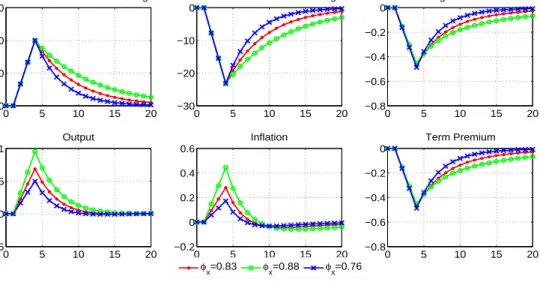
In the benchmark calibration, it has been arbitrarily assumed that central banks, after purchasing long-term assets, undertake a medium long-term exit strategy, i.e. they wind down the program over the following six years by selling the assets accumulated during the QE phases. To illustrate how results change when varying the length of the exit strategy, Figure 7 and Figure 8 plot the impulse response functions considering three different values ofφx: the benchmark value (red line), a higherφx(0.88), which reflects
a longer exit strategy from QE of approximately eight years (green line), and a lowerφx (0.76), which
corresponds to a faster exit strategy of around four years (blue line).
When the parameter relative to the persistence of the asset purchase shock φx increases, the
persis-tence of the response of the long-term yield increases as well, both for the US and the UK, while the magnitude of the response does not change significantly. Importantly, as for the macroeconomic vari-ables, not only the persistence of their response goes up, but also their impact effect. By contrast, a faster exit strategy is associated with a lower effect on the macroeconomy. This is completely in line with what is actually expected, since a longer exit strategy is likely to exert larger inflationary pressures, and a too fast exit strategy to have instead marginal effects on the economy. The reason for that is the presence of nominal rigidities, which lead firms to move their prices more (less) aggressively in response to a more (less) persistent shock (Chen et al.,2012).
Moreover, inflation responds more strongly than output to changes in the length of the policy, a fact consistent with the findings ofChen et al.(2012), and due to the presence, again, of nominal rigidities such as price stickiness. In particular, when prices are more (less) flexible, one would expect a higher (lower) response of inflation to asset purchase shocks. Chen et al. (2012) note that “... higher price flexibility shifts the adjustment in response to asset purchase programs from GDP growth to inflation, by making its process more front-loaded.”16
The quantitative effects of the simulated asset purchase shock in annualized percentage rates for the different persistence values are reported in Table 4 and Table 5. For the US, the effect on output is in the range of 0.66%-1.27%, while the effect on inflation is found to be in the range 0.23%-0.59%. For the UK, the effect on output is found to lie between 0.94% and 1.61%, and that on inflation between 0.30% and 0.73%. While these findings confirm that the effectiveness of such unconventional monetary policies seems to have been more pronounced in the UK than in the US, they also highlight that their predictions are subject to the uncertainty associated with the timing of the exit strategy from QE chosen
16A sensitivity analysis specifically conducted onφPconfirms this statement. The graphs have not been reported for the sake
by the monetary authority.
3.2.2 Sensitivity Analysis: The Role of Financial Frictions
As already noted, the magnitude ofφLmeasures the extent of the impediments to the arbitrage behavior of
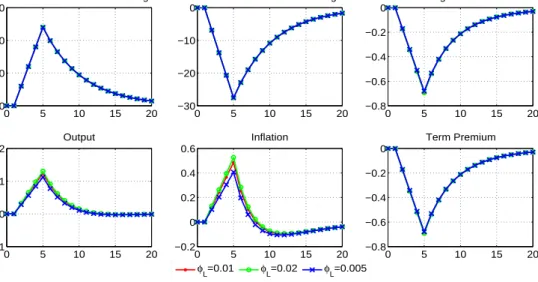
agents, and therefore the degree of imperfect asset substitutability between short- and long-term bonds. Figure 9 and Figure 10 report the impulse response functions for the baseline case (red line), and the cases with higher (0.02) and lower (0.005) portfolio adjustment costs (green and blue line, respectively). As expected, higher frictions generate larger obstacles to the arbitrage behavior of investors, making the two assets less substitutable. As a result, changes in the relative quantities of bonds held by house-holds lead to a higher responsiveness of long-term yield. The macroeconomic effects are also amplified whenφLincreases, and vice versa. UK variables seem to be less sensitive to changes in the parameter
φLin comparison with the US. A specific sensitivity exercise, whose results are not reported here, shows
that this is due to the different steady-state values of bond quantities between the two countries. The results in annualized percentage changes for the different calibrations are contained in Table 4 and Table 5.
Lastly, it is worth noting that when there are no frictions at all (φL=0), the two assets become perfect
substitutes and a reduction in the supply of long-term bonds does not generate any effect on yields and on the macroeconomy, as agents can simply increase their holdings of short-term bonds by the same amount. In such a case, the identification of theportfolio rebalancingchannel of large asset purchases would not be possible.
3.2.3 Sensitivity Analysis: Constrained vs Unconstrained Policy Rate
In order to simulate recent large asset purchases as realistic as possible, the baseline calibration outlined in paragraph 3.1 has imposed a constrained policy rate, i.e. the short-term interest rate is prevented from reacting to macro developments. An interesting exercise consists in comparing the cases when the policy rate is constrained and non-constrained. When the policy rate is allowed to follow a standard Taylor rule, the effects of large asset purchases on the variables of interest are expected to be smaller. In this case, the impact of large asset purchases is mitigated by the increase in the short-term rate due to the prescriptions of the Taylor rule. In effect, the impulse response functions displayed in Figure 11 and Figure 12 confirm this conjecture. Thus, the stimulus provided to the economy by the simulated asset purchases by the Fed and the BoE is significantly larger with a constrained policy rate (solid red line) than with a free policy rate (dashed black line). As stressed byHarrison(2012a), this provides a motivation for the implementation of large asset purchases by the central bank when the policy rate is constrained by the ZLB.17
17A similar argument is discussed inChristiano et al.(2011), who show that the government-spending multiplier can be
4 Concluding Remarks
This paper has developed a DSGE model capable of evaluating some of the effects of large purchases of treasuries by central banks. The model exhibits imperfect asset substitutability and a feedback from the term structure to the macroeconomy, both generated through the introduction of portfolio adjustment frictions. As a result, the model is able to isolate a portfolio rebalancing channel of QE. Given the novelties introduced, the theoretical framework proposed in this paper is more consistent with reality than similar models in the literature (Chen et al., 2012;Harrison, 2012a,b). The model is employed to evaluate the effects of recent specific large asset purchase programs in the US and in the UK. More specifically, the focus has been on QE2 in the US (from November 2010 to June 2011 - around $800 billion of purchases), and the first phase of the APF operations in the UK (from March 2009 to January 2010 - around £200 billion of purchases). Both phases have been characterized exclusively by purchases of medium- and long-term government securities.
The simulation results of the calibrated model are realistic and generally consistent with those ob-tained in the literature using different techniques. However, the estimated macroeconomic effect in the US has been found to be slightly larger than in previous studies, while in the UK a bit smaller. Overall, the findings suggest that large asset purchases of government assets had substantial stimulating effects both in terms of lower long-term yields and higher output and inflation in both countries. These effects seem to be generally larger for the UK than for the US. This is not surprising, given that the size of asset purchases characterizing the phases of QE under consideration has been larger, in relative terms, in the UK rather than in the US. More specifically, my preferred model specification indicates that large asset purchases of QE2 in the US had a peak effect on long-term rates in annualized terms of around -63 basis points, on the level of real GDP of 0.92%, and on inflation of 0.37 percentage points. In the UK, the preferred model specification suggests that the first phase of the APF program had a peak effect on long-term rates of -69 basis points, on the level of real GDP of 1.25%, and on inflation of 0.49 percentage points. The empirical results are nonetheless subject to some uncertainty associated with the degree of substitutability among assets of different maturities, and, more importantly, with the speed of the exit strategy chosen by monetary authorities.
All in all, the most substantive contribution of this paper is to provide a new setting through which the effects of large purchases of treasuries by central banks can be evaluated within a microfounded macro framework with optimizing agents. This study points to further avenues for future research. First of all, through the estimation of the model it would be possible to check whether actual data support the theoretical framework. Moreover, the model can be easily extended in several directions, e.g. to include an explicit and more structured central bank’s balance sheet, a wider term structure representation, or different types of assets, such as corporate bonds. Lastly, it would be worth combining this framework with those proposed byC´urdia and Woodford(2010),Gertler and Kiyotaki(2010),Brendon et al.(2011), Del Negro et al.(2011) andGertler and Karadi(2011), which, by introducing financial intermediaries,
References
Adjemian, S., Bastani, H., Juillard, M., Mihoubi, F., Perendia, G., Ratto, M., and Villemot, S. (2011). Dynare: Reference manual, version 4. Dynare Working Papers 1, CEPREMAP.
Altig, D., Christiano, L. J., Eichenbaum, M., and Lind, J. (2011). Firm-specific capital, nominal rigidities and the business cycle. Review of Economic Dynamics, 14(2):225–247.
Andr´es, J., L´opez-Salido, J. D., and Nelson, E. (2004). Tobin’s imperfect asset substitution in optimizing general equilibrium. Journal of Money, Credit and Banking, 36(4):665–690.
Bagus, P. (2010). Will there be QE3, QE4, QE5...? leeconomicsblog, (December 31, 2010).
Baumeister, C. and Benati, L. (2013). Unconventional monetary policy and the Great Recession: Esti-mating the impact of a compression in the yield spread at the zero lower bound. International Journal of Central Banking, 9(2):165–212.
Bernanke, B. S. and Reinhart, V. R. (2004). Conducting monetary policy at very low short-term interest rates. American Economic Review, 94(2):85–90.
Blinder, A. S. (2010). Quantitative easing: Entrance and exit strategies. Federal Reserve Bank of St. Louis Review, Nov-Dec:465–480.
Board of Governors of the Federal Reserve System (2012). Press Release. September 13, 2012. http: //www.federalreserve.gov/newsevents/press/monetary/20120913a.htm.
Borio, C. and Disyatat, P. (2010). Unconventional monetary policies: An appraisal. The Manchester School, 78:53–89.
Bowdler, C. and Radia, A. (2012). Unconventional monetary policy: The assessment. Oxford Review of Economic Policy, 28(4):603–621.
Brendon, C., Paustian, M., and Yates, T. (2011). Optimal conventional and unconventional monetary policy in the presence of collateral constraints and the zero bound. Unpublished manuscript.
Bridges, J. and Thomas, R. (2012). The impact of QE on the UK economy: Some supportive monetarist arithmetic. Bank of England working papers 442, Bank of England.
Caglar, E., Chadha, J. S., Meaning, J., Warren, J., and Waters, A. (2012). Non-conventional monetary policies: QE and the DSGE literature. In Chadha, J. and Holly, S., editors,Interest Rates, Prices and Liquidity: Lessons from the Financial Crisis, chapter 11.
Chadha, J. S. and Corrado, L. (2012). Macro-prudential policy on liquidity: What does a DSGE model tell us? Journal of Economics and Business, 64(1):37–62.
Chadha, J. S., Corrado, L., and Meaning, J. (2012). Reserves, liquidity and money: An assessment of balance sheet policies. CEIS Working Paper 230, CEIS.
Chen, H., C´urdia, V., and Ferrero, A. (2012). The macroeconomic effects of large-scale asset purchase programmes. Economic Journal, 122(564):F289–F315.
Christensen, J. H. E. and Rudebusch, G. D. (2012). The response of interest rates to US and UK Quanti-tative Easing. Economic Journal, 122(564):F385–F414.
Christiano, L. J. and Eichenbaum, M. (1992). Current real-business-cycle theories and aggregate labor-market fluctuations. American Economic Review, 82(3):430–450.
Christiano, L. J., Eichenbaum, M., and Evans, C. L. (2005). Nominal rigidities and the dynamic effects of a shock to monetary policy. Journal of Political Economy, 119(1):1–45.
Christiano, L. J., Eichenbaum, M., and Rebelo, S. (2011). When is the government spending multiplier large? Journal of Political Economy, 119(1):78–121.
Chung, H., Laforte, J.-P., Reifschneider, D., and Williams, J. C. (2012). Have we underestimated the likelihood and severity of zero lower bound events? Journal of Money, Credit and Banking, 44:47–82. C´urdia, V. and Woodford, M. (2010). Conventional and unconventional monetary policy.Federal reserve
Bank of St. Louis Review, (May):229–264.
D’Amico, S., English, W., L´opez-Salido, D., and Nelson, E. (2012). The Federal Reserve’s large-scale asset purchase programmes: Rationale and effects.Economic Journal, 122(564):F415–F446.
D’Amico, S. and King, T. B. (2013). Flow and stock effects of large-scale treasury purchases: Evidence on the importance of local supply. Journal of Financial Economics, 108(2):425–448.
Del Negro, M., Eggertsson, G., Ferrero, A., and Kiyotaki, N. (2011). The great escape? A quantitative evaluation of the Fed’s liquidity facilities. StaffReports 520, Federal Reserve Bank of New York. Dib, A. (2010). Banks, credit market frictions, and business cycles. Bank of Canada Working Papers
10-24.
Dixit, A. K. and Stiglitz, J. E. (1977). Monopolistic competition and optimum product diversity. Ameri-can Economic Review, 67(3):297–308.
Doh, T. (2010). The efficacy of large-scale asset purchases at the zero lower bound. Federal Reserve Bank of Kansas City Economic Review, (Q II):5–34.
Eggertsson, G. B. and Woodford, M. (2003). The zero bound on interest rates and optimal monetary policy. Brookings Papers on Economic Activity, 2003(1):139–211.
Falagiarda, M. (2012). Quantitative Easing: Origins, channels, and recent experiences. Unpublished manuscript.
Falagiarda, M. and Marzo, M. (2012). A DSGE model with endogenous term structure. Quaderni DSE Working Paper 830, Department of Economics, Universit`a di Bologna.
Gagnon, J., Raskin, M., Remache, J., and Sack, B. (2011). The financial market effects of the Federal Reserve’s large-scale asset purchases. International Journal of Central Banking, 7(1):3–43.
Gertler, M. and Karadi, P. (2011). A model of unconventional monetary policy. Journal of Monetary Economics, 58(1):17–34.
Gertler, M. L. and Kiyotaki, N. (2010). Financial intermediation and credit policy in business cycle analysis. In Friedman, B. M. and Woodford, M., editors,Handbook of Monetary Economics, volume 3, chapter 11, pages 547–599.
Glick, R. and Leduc, S. (2012). Central bank announcements of asset purchases and the impact on global financial and commodity markets. Journal of International Money and Finance, 31(8):2078–2101. Hamilton, J. D. and Wu, J. C. (2012). The effectiveness of alternative monetary policy tools in a zero
lower bound environment. Journal of Money, Credit and Banking, 44:3–46.
Harrison, R. (2012a). Asset purchase policies and portfolio balance effects: A DSGE analysis. In Chadha, J. and Holly, S., editors, Interest Rates, Prices and Liquidity: Lessons from the Financial Crisis, chapter 5.
Harrison, R. (2012b). Asset purchase policy at the effective lower bound for interest rates. Bank of England working papers 444, Bank of England.
Hilberg, B. and Hollmayr, J. (2011). Asset prices, collateral and unconventional monetary policy in a DSGE model. Working Paper Series 1373, European Central Bank.
Ireland, P. N. (2004). Money’s role in the monetary business cycle. Journal of Money, Credit and Banking, 36(6):969–83.
Joyce, M. A. S., Lasaosa, A., Stevens, I., and Tong, M. (2011a). The financial market impact of quanti-tative easing in the United Kingdom. International Journal of Central Banking, 7(3):113–161. Joyce, M. A. S., Miles, D., Scott, A., and Vayanos, D. (2012). Quantitative easing and unconventional
monetary policy: An introduction. Economic Journal, 122(564):F271–F288.
Joyce, M. A. S. and Tong, M. (2012). QE and the gilt market: A disaggregated analysis. Economic Journal, 122(564):F348–F384.
Joyce, M. A. S., Tong, M., and Woods, R. (2011b). The United Kingdom’s quantitative easing policy: Design, operation and impact. Bank of England Quarterly Bulletin, Q3:200–212.
Kapetanios, G., Mumtaz, H., Stevens, I., and Theodoridis, K. (2012). Assessing the economy-wide effects of quantitative easing. Economic Journal, 122(564):F316–F347.
Keynes, J. M. (1936).The general theory of employment, interest, and money. Macmillan, London. Kim, J. (2000). Constructing and estimating a realistic optimizing model of monetary policy. Journal of
Monetary Economics, 45(2):329–359.
Klyuev, V., de Imus, P., and Srinivasan, K. (2009). Unconventional choices for unconventional times: Credit and quantitative easing in advanced economies. IMF StaffPosition Note SPN/09/27.
Kozicki, S., Santor, E., and Suchanek, L. (2012). Central bank balance sheets and long-term forward rates. In Chadha, J. and Holly, S., editors, Interest Rates, Prices and Liquidity: Lessons from the Financial Crisis, chapter 7.
Krishnamurthy, A. and Vissing-Jorgensen, A. (2011). The effects of quantitative easing on interest rates: Channels and implications for policy. Brookings Papers on Economic Activity, (Fall):215–287. Krugman, P. R. (1998). It’s baaack: Japan’s slump and the return of the liquidity trap. Brookings Papers
on Economic Activity, 1998(2):137–205.
Leeper, E. M. (1991). Equilibria under active and passive monetary and fiscal policies. Journal of Monetary Economics, 27(1):129–147.
Ljungqvist, L. and Sargent, T. (2004).Recursive macroeconomic theory. MIT Press.
Marzo, M., S¨oderstr¨om, U., and Zagaglia, P. (2008). The term structure of interest rates and the monetary transmission mechanism. Unpublished manuscript.
Meaning, J. and Zhu, F. (2011). The impact of recent central bank asset purchase programmes. BIS Quarterly Review, December.
Meier, A. (2009). Panacea, curse, or nonevent? Unconventional monetary policy in the United Kingdom. IMF Working Papers 09/163, International Monetary Fund.
Neely, C. J. (2010). The large scale asset purchases had large international effects. Working Papers 2010-018, Federal Reserve Bank of St. Louis.
Orphanides, A. (2004). Monetary policy in deflation: The liquidity trap in history and practice. The North American Journal of Economics and Finance, 15(1):101–124.
Rotemberg, J. J. (1982). Monopolistic price adjustment and aggregate output. Review of Economic Studies, 49(4):517–531.
Schmitt-Groh´e, S. and Uribe, M. (2004). Optimal fiscal and monetary policy under imperfect competi-tion. Journal of Macroeconomics, 26(2):183–209.
Schmitt-Groh´e, S. and Uribe, M. (2007). Optimal simple and implementable monetary and fiscal rules.
Journal of Monetary Economics, 54(6):1702–1725.
Smets, F. and Wouters, R. (2007). Shocks and frictions in us business cycles: A Bayesian DSGE ap-proach. American Economic Review, 97(3):586–606.
Stroebel, J. C. and Taylor, J. B. (2012). Estimated impact of the Fed’s mortgage-backed securities purchase program. International Journal of Central Banking, 8(2):1–42.
Svensson, L. E. O. (2003). Escaping from a liquidity trap and deflation: The foolproof way and others.
Journal of Economic Perspectives, 17(4):145–166.
Swanson, E. T. (2011). Let’s twist again: A high-frequency event-study analysis of Operation Twist and its implications for QE2. Brookings Papers on Economic Activity, 42(1):151–207.
Taylor, J. B. (1993). Discretion versus policy rules in practice. Carnegie-Rochester Conference Series on Public Policy, 39:195–214.
Tobin, J. (1969). A general equilibrium approach to monetary theory. Journal of Money, Credit and Banking, 1(1):15–29.
Tobin, J. (1982). Money and finance in the macroeconomic process. Journal of Money, Credit and Banking, 14(2):171–204.
Vayanos, D. and Vila, J.-L. (2009). A preferred-habitat model of the term structure of interest rates. Working Paper 15487, National Bureau of Economic Research.
Wright, J. H. (2012). What does monetary policy do to long-term interest rates at the zero lower bound?
Economic Journal, 122(564):F447–F466.
Zagaglia, P. (2013). Forecasting long-term interest rates with a general-equilibrium model of the euro area: What role for liquidity services of bonds? Asia-Pacific Financial Markets, pages 1–48.
Tables and figures
Table 1: Steady-state values of some variables
Notation Description SS value
Y Output 1 (norm.)
C Consumption-output ratio 0.57
I Investment-output ratio 0.23
T/Y Taxes-output ratio 0.1972
L/(1−L) Ratio of market to non-market activities 0.3
R Gross money-market rate 1.010
Table 2: Benchmark calibration of some parameters
Notation Description Benchmark value
Preferences and technology
α Share of capital in the production function 0.36
β Intertemporal discount factor 0.994
σ Elasticity of intertemporal substitution 0.5
χ Elasticity of money demand 7
ψ Elasticity of labor supply 1
γ Habit formation 0.7
θ Elasticity of substitution between varieties of goods 6
φP Price adjustment costs 100
Fiscal and monetary policy
ψ1 Fiscal policy response to short-term debt 0.3
ψ2 Fiscal policy response to long-term debt 0.3
απ Monetary policy response to inflation 1.5
αY Monetary policy response to output 0
αR Monetary policy inertia 0.997
Autoregressive parameters
φA Technology shock 0.95
φG Government spending shock 0.90
φBL LT bonds shock 0.90
Standard deviations
σA Technology shock 0.01
σG Government spending shock 0.012
σR Monetary policy shock 0.005
Table 3: Calibration values of the key parameters and steady-states
Notation Description US UK
φL Portfolio adjustment frictions 0.01 0.01
B+BL Total debt on GDP 0.496 0.542
B Total ST debt on total debt 0.188 0.052
BL Total LT debt on total debt 0.308 0.490
BHL LT debt held by households 0.250 0.479
BCBL LT debt held by the CB 0.058 0.011
σx Magnitude of the asset purchases 1 12
φx Persistence of the asset purchases 0.831 0.831
Approximated duration of the shock 3Q 4Q
Notes:1A persistence of 0.83 reflects an exit strategy of approximately 6 years.
Sources: The values are calculated by combining data from the OECD statistical database, the Federal Reserve Statistical Release, the Bank of England Statistical Interactive Database, and the Bank of England APF Gilt Op-erational Results Dataset. Notice that they represent only approximations, given the difficulties of combining data with different frequency.
Table 4: Estimated effect of the LSAP2 on the LT rate,1output and inflation (US - annualized) Total impact Peak impact Peak impact
Study Method on LT Rate on Output on Inflation
KVJ (2011)2 Event study/regressions -33 bp -
-D’Amico et al.(2012) Regressions -55 bp -
-Chen et al.(2012) DSGE model -30 bp3 0.4% 0.05%
Chung et al.(2012) FRB/US model -20 bp3 0.6% 0.1%
My calibrated model Specification
Baseline -63 bp 0.92% 0.37%
High persistence (φx=0.88) -61 bp 1.27% 0.59%
Low persistence (φx =0.76) -65 bp 0.66% 0.23%
Higher frictions (φL=0.02) -77 bp 1.57% 0.75%
Lower frictions (φL=0.005) -46 bp 0.50% 0.17%
Notes:110-year Treasury yield.2Krishnamurthy and Vissing-Jorgensen(2011).3Effect on the risk premium.
Table 5: Estimated effect of the first phase of the APF on the LT rate,1output and inflation (UK - annualized) Total impact Peak impact Peak impact
Study Method on LT Rate on Output on Inflation
Glick and Leduc(2012) Event study -49 bp -
-Harrison(2012a) DSGE model -60 bp2 1.3% 0.13%
Joyce et al.(2011a) Event study -125 bp -
-Joyce et al.(2011b) SVAR - 1.5% 0.75%
Joyce et al.(2011b) Reduced form model - 1.5-2.5% 0.75-2.25%
Kapetanios et al.(2012) Time-series model - 1.5% 1.25%
Bridges and Thomas(2012) Time-series model - 2% 1%
My calibrated model Specification
Baseline -69 bp 1.25% 0.49%
High persistence (φx =0.88) -66 bp 1.61% 0.73%
Low persistence (φx =0.76) -71 bp 0.94% 0.30%
Higher frictions (φL=0.02) -69 bp 1.31% 0.53%
Lower frictions (φL=0.005) -68 bp 1.13% 0.41%
Figure 1: F acing the ZLB: Strate gies, polic y options and channels STRA TEGIES POLICY OPTIONS CHANNELS INTERMEDIA TE EFFECTS FIN AL OUTCOME ”Open mouth” policies / / # # Expect. on interest rates / / ↓ interest rates along the term structure Shaping expectations 5 5 )) Credibility issues K S Ne w monetary polic y rules / / ; ; Expect. on inflation rate / / ↓ real interest rates CB’ s strate gies = = F ore x operations (depreciation) / / 5 5 ↑ exports ( ( Signaling channel ^ ^ O O Economic stimulus Shaping quantities ; ; ) ) Portfolio rebalancing channel ( ( / / ↑ wealth 6 6 Quantitati v e Easing 7 7 55 // )) ''
Liquidity premia channel
/ / ↓ interest rates E E Credit channel / / 6 6 ↑ lending ↑ resources K K Fiscal channel / / ↓ tax b urden N N Sour ce: F alagiarda ( 2012 ).
Figure 2: Evolution of Fed assets composition 0 500 1000 1500 2000 2500 3000 3500
Jan 2007 Jan 2008 Jan 2009 Jan 2010 Jan 2011 Jan 2012
$ bi llions Other assets CB Liquidity Swaps Mortgage-backed securities Other private portfolio Term auction credit Other loans Repos
Federal agency debt securities T-notes and T-bonds
T-bills
QE2 Nov 2010 - Jun 2011
≈ $800
billion
Source:Author’s elaboration on data from the Federal Reserve Statistical Release.
Figure 3: Evolution of BoE assets composition
0 50 100 150 200 250 300 350
Jan 2007 Jan 2008 Jan 2009 Jan 2010 Jan 2011 Jan 2012
£
bi
llions
Other assets (incl. Asset Purchase Facility Fund) Ways and means advances to HM government
Longer-term reverse repos
ST open market operations
Bonds and other securities acquired via market transaction
Start of APF March 2009 End of the 1st phase of APF ≈ £200 billion of gilts