AIS Electronic Library (AISeL)
ACIS 2010 Proceedings
Australasian (ACIS)
2010
Cognitive, Affective and Behavioural Responses to
an ERP Implementation: A Dual Perspective of
Technology Acceptance and Organisational
Change
Jason F. Cohen
University of the Witwatersrand, [email protected]
Follow this and additional works at:
http://aisel.aisnet.org/acis2010
This material is brought to you by the Australasian (ACIS) at AIS Electronic Library (AISeL). It has been accepted for inclusion in ACIS 2010 Proceedings by an authorized administrator of AIS Electronic Library (AISeL). For more information, please [email protected].
Recommended Citation
Cohen, Jason F., "Cognitive, Affective and Behavioural Responses to an ERP Implementation: A Dual Perspective of Technology Acceptance and Organisational Change" (2010).ACIS 2010 Proceedings. 87.
Cognitive, Affective and Behavioural Responses to an ERP Implementation:
A Dual Perspective of Technology Acceptance and Organisational Change
Jason F. Cohen
School of Economic and Business Sciences University of the Witwatersrand
Johannesburg, South Africa Email: [email protected]
Abstract
Past studies have drawn on the technology acceptance literature in an attempt to predict users’ behavioural intentions to use a new ERP system. However, few researchers have considered the connections between technology acceptance and organisational change research; and very little ERP research has focused on explanations of user readiness, openness to change and resistance intentions from an organizational change perspective. This paper proposes a model that integrates the perspectives of the organisational change and technology acceptance literatures to define the cognitive, affective, individual and workplace related factors that underpin various behavioural intentions of users during an ERP implementation. The effects of the change management process on cognitions, affects and behavioural intentions are also explored. The context for the study is a South African university undergoing an ERP re-implementation.
Keywords
Organisational change, ERP, technology acceptance, resistance.
INTRODUCTION
Improving the success of IT-induced business change, such as those brought about by the implementation of an enterprise system, is a key business and IS management objective (Davenport 1998; Willcocks and Sykes 2000). However, there are observed differences across firms in their abilities to manage the complex process of ERP implementation (Al-Mashari 2003), to understand and manage user resistance (Aladwani 2001; Kim and Kankanhalli 2009) and to maintain support and acceptance from organisational members affected by these implementations (Abdinnour-Helm et al. 2003; Amoako-Gyampah 2007).
In an attempt to better understand and predict users’ behavioural intentions toward the use of a new ERP system, a number of past studies have drawn on the technology acceptance literature (Gyampah 2007; Amoako-Gyampah and Salam 2004; Shih 2006; Sun et al. 2009). However, that literature largely overlooks the factors associated with systems implementation and change management and how those factors may come to influence well-known technology acceptance constructs (Barki et al. 2008). Few researchers (e.g., Bhattacherjee and Hikmet 2007; Kim and Kankanhalli 2009; Kwahk and Lee 2008) have considered the connections between technology acceptance and organizational change research; and very little ERP research has focused on explanations of user readiness, openness to change and resistance intentions from an organizational change perspective (Robey et al. 2002). This is surprising given that users are heavily affected by systems implementations and many recognise that user resistance is amongst the most important causes of implementation failures.
Consequently, we still lack answers to fundamental questions about ERP implementations. What are the relevant dimensions of the user response toward an ERP induced organisational change? How do cognitive and emotional components of the user response influence pre-implementation behavioural intentions? And to what extent will these user attitudes and behavioural intentions change over time in response to a change management and communications programme?
The purpose of this study therefore is to integrate the technology acceptance and organisational change research streams with the aim to explore the affective, cognitive and behavioural responses of users toward ERP system implementation, and to examine how those attitudes change over time in response to various change management initiatives. The context for the study is a South African university (HEI) which is about to undergo an ERP re-implementation. Data will be collected at the pre-implementation phase (following the initial announcement to users) and then again prior to the system going live. This second round of data collection will allow for the effects of change management practices on user attitudes and relationships in the model to be evaluated.
The next section of this work-in-progress paper introduces the research model, its theoretical underpinnings and a description of the model’s variables. The research design is then presented. The paper concludes with a discussion of the potential contribution of the work for research and practice.
RESEARCH MODEL AND THEORETICAL BACKGROUND
This research is focused on understanding the behavioural intentions of users at the pre-implementation stage of an ERP project. This phase typically involves activities such as planning for the introduction of the system, deciding on the role of vendors and in-house resources, specifying processes to be supported by the ERP, deciding on the amount of customization, and planning the logistics of the change (Abdinnour-Helm et al. 2003; Sumner 2005). Research however has only recently begun to explore the pre-implementation phase attitudes and behavioural intentions of users (e.g. Abdinnour-Helm et al. 2003; Kim and Kankanhalli 2009).
Figure 1 integrates the perspectives of the organisational change and technology acceptance literatures to define three behavioural intentions, namely usage intentions, resistance intentions, and intention to support the change. Furthermore, the model identifies cognitive and affective responses as primary determinants of these behavioural intentions, considers cognitions toward the change object and change outcomes, considers affective responses toward the change and toward system usage, and depicts the effects of selected individual and workplace contributors to pre-implementation behaviours. The theoretical underpinnings of this research model are presented next.
Figure 1: Research Model Predicting Behavioural Intentions
Organisational Change Perspective
Taking a social psychology perspective on employee attitudes and responses to change, the organisational change literature has begun to devote considerable effort to examining individuals within organisations, their behavioural intentions to act in response to change and the various cognitive and affective precursors to those behaviours (Armenakis and Harris 2009; Lines 2005; Oreg 2006; Piderit 2000). From this perspective, change fails because organisations underestimate the importance of these individual cognitive, affective and behavioural responses (Devos et al. 2007; George and Jones 2001), and therefore the literature has varyingly considered these responses in the definition of such concepts as openness to change (Wanberg and Banas 2000), readiness for change (Holt et al., 2007), commitment to change (Chen and Wang 2007; Jaros 2010; Meyer et al. 2007) and attitude toward change (Piderit 2000).
Behavioural responses can range from strong positive intentions to support change to negative intentions to resist it (Oreg 2006; Piderit 2000). Negative behaviours can extend beyond typical resistance behaviours of inertia and opposition to include disloyalty, sabotage, aggression, industrial action, refusal to work and even exit intentions (Smollan 2006). This study adopts Ford et al.’s (2002) definition of resistance behaviours along three levels. The first is complacent resistance, which is characterized by procrastination, avoidance and withdrawal. The second is resigned resistance, which is characterized by the employee giving up trying, an unwillingness to participate, ignoring proposals, expressing despair and covert withholding. The third is overt resistance, which is characterized by active politicking, hostile and aggressive attacks on others, demonstrations of contempt, and other forms of sabotage.
On the other hand, employees may exhibit varying degrees of support for change (Meyer et al. 2007). These extend from compliance intention, which refers to an employee’s (reluctant) willingness to do what will be required of him/her by the organisation during the implementation phase to discretionary behaviours of cooperation and championing. Cooperation intention refers to the employees’ acceptance of the spirit of the change and hence willingness to exert extra effort and make modest sacrifices to make the change work. Championing is associated with extreme enthusiasm, a willingness to go well above and beyond formal requirements to make the change succeed, and importantly refers to the intention of the employee to promote and sell the change to others (Meyer et al. 2007).
The organisational change literature further theorizes that employees follow their minds (cognitions) and hearts (affects) when deciding how to respond to change events i.e. employees use a combination of cognitive and affective processes to make sense of the change and to form a behavioural response (Smollan 2006). The cognitive component refers to the individual employee’s beliefs about the need for change, the significance of the change, and the favourability of outcomes i.e. the extent to which the change will be personally and organisationally beneficial (Holt et al. 2007; Oreg 2006; Smollan 2006). These beliefs can range from strong positive beliefs to strong negative beliefs e.g. that change could hurt the individual/organisation (Piderit 2000). Lines (2005) indicates that an employee’s cognitive evaluations will also concern issues such as how the change will affect the characteristics of one’s job, and whether the organisation is capable of implementing the change. The emotional or affective component of the response refers to the employee’s feelings about the change. An employee’s response to change along this emotional dimension might range from positive emotions e.g. excitement, enthusiasm and happiness to strong negative emotions such as anger, resentment, frustration, anxiety or fear (Ford et al. 2002; Lines 2005; Oreg 2006; Piderit 2000). Some describe that organisational changes can be so stressful that emotional states consistent with traumatic changes like death and grief are often observed (Vakola and Nikolaou 2005).
Technology Acceptance Perspective
The technology acceptance literature considers usage behaviour as the pivotal factor determining the success or failure of new information systems implementations (Davis 1993). Consequently, that literature adopts usage behaviour as its criterion variable of choice indicating that information systems only have the potential to improve organisational performance if they are actually used (Mathieson 1991) and that greater use leads to greater impacts (DeLone and McLean 1992; 2002). Following the work of Fishbein and Ajzen and underpinned by the attitude-intention based model of the theory of reasoned action (TRA), the popular technology acceptance models of TAM (Davis et al. 1989) and UTAUT (Venkatesh et al. 2003) have been drawn upon to understand system usage and continued use across a range of IT systems. These models consistently describe perceived usefulness (degree to which person believes that using the system would enhance job performance) alongside perceived ease of use (degree to which person believes that using the system would be free of effort) as the most relevant cognitive beliefs influencing IS use (Davis 1993; Venkatesh et al. 2003). Prior empirical evidence establishes both their direct and their mediated effects on behaviour through user attitudes (e.g. satisfaction) toward the use of the system (Davis 1993; Wixom and Todd 2005). In a mandatory usage setting, such as those typically associated with an ERP, employees may have intentions to use the system simply because they are required to do so, there is no going back and no alternatives to consider (Brown et al. 2002). In such contexts, attitudes take on increasing relevance as an indication of the extent to which the new technology is likely to be embraced wholeheartedly (Brown et al. 2002), used extensively beyond minimal requirements (Amoako-Gyampah and Salam 2004; Hsieh and Wang 2007), and where the use of parallel systems and workarounds are avoided. The technology acceptance perspective also suggests that cognitive evaluations of system characteristics are important “external variables” influencing subsequent beliefs about system usefulness (Davis 1993). A widely accepted conceptualisation of system characteristics is derived from DeLone and McLean’s (1992; 2002) information systems success model. Their model describes how an individual’s system usage behaviour is preceded by beliefs about the quality of the information system along three dimensions. System quality is a measure of technical success, which is evidenced inter-alia by usability, reliability and availability. Information quality reflects an assessment of the extent to which the system outputs information considered complete, relevant, accurate and in the format required by the user.
Service quality refers to the extent to which the system and IS function supporting it are meeting user expectations along such service dimensions as empathy, assurance and responsiveness.
Cognitive Evaluations and Affective Responses
Taking both the organisational change and technology acceptance literatures into account, Figure 1 models resistance intentions (complacent, resigned and overt), intentions to support (compliance, cooperation and championing) and usage intentions as the study’s dependent variables. It is hypothesized that various cognitive and affective (emotional) responses to the system change will predict the behavioural response, and that emotional responses are also triggered by the preceding cognitive responses (Smollan 2006). The cognitive-affective responses are discussed next.
Discrepancy: Employees must believe that a need for change exists i.e. to avoid believing the change is arbitrary they must believe there exists a discrepancy between desired and future states (Armenakis et al. 2007). The closest concept in the technology acceptance literature is Battacherjee’s (2001) disconfirmation concept i.e. a user’s post-usage evaluation of the difference between perceived system performance and their initial expectations. Users more satisfied with the existing IS (higher levels of confirmation) and with lower levels of discrepancy will not regard change as necessary and are expected to be more resistant and less supportive of any proposed system changes.
Change-specific Cynicism: Change-specific cynicism refers to employee disbelief in management’s stated or implied motives for change and has been found an important cognition impacting resistance behaviours (Stanley et al. 2005).
Information Systems Quality: Although employees may perceive a need for change, they may not necessarily form positive cognitions about the specific change implementation that is being undertaken. Figure 1 thus considers employee perceptions of the qualities of the proposed system (the change object) along the three dimensions of system quality, information quality and service quality (DeLone and McLean 2002). Employees perceiving the new system to be of high quality are more likely to form subsequent positive cognitions regarding the use and benefits of the system.
Individual and Organisational Impacts (Valence): Faced with change, employees will assess the favourability of the change outcomes for themselves, others and for the organisation (Smollan 2006). A primary determinant of whether an employee will support or resist change is their perception of whether the change is beneficial or detrimental (Oreg 2006). Individual or personal valence is the extent to which an employee believes that he/she will (or will not) benefit from the implementation of the change, while organisational valence refers to whether the organisation will (or will not) benefit (Holt et al. 2007). These are conceptually close to the concepts of individual and organisational net impacts identified within DeLone and McLean’s (1992) IS success model. They define it as an assessment of the effectiveness of the system, capturing the balance of the positive (benefits) and negative (costs) impacts that can be attributed to the use of the system i.e. a perception of whether the benefits are worth the costs (to be) incurred. For the individual, costs might include time spent in training, an increase in role ambiguity, or loss of power (Oreg 2006).
Expected Usefulness: This popular technology acceptance construct refers to an individual’s belief that using a system will enhance their job performance making work faster, easier, more effective and productive (Davis et al. 1989).
Change-specific Scepticism: Change-specific scepticism refers to employee doubt about the viability of the change for the attainment of its stated objectives (Stanley et al. 2005). Scepticism is typically reflected by beliefs that no effective action is possible and by doubts that the change will work or have the desired effects. It is expected to lead to negative behavioural intentions.
Affective response to change: As employees evaluate how their jobs might be altered as organisational processes are reengineered to comply with the ERP software (Klaus et al. 2010), they will form positive or negative feelings toward the specific change (Oreg 2006; Piderit 2000).
Affective response to system use: The technology acceptance literature identifies various affective responses of users when they use (or consider the possibility of using) a computer based system. Computer anxiety is one such affect manifesting in tension, worry, fear and frustration when confronted with the need to use a system, while positive feelings might include perceptions of fun, pleasure and delight (Heinssen et al. 1987; Kettinger et al. 2009).
Individual and Workplace Related Factors
In both the organisational change and the technology acceptance literature, reference has been made to a number of individual, contextual, and workplace related factors that can influence how individuals respond to change and
accept new technologies. Individual factors considered important within the change literature are personality characteristics and dispositions e.g. dispositional resistance to change (Oreg 2006); self-efficacy for change (Armenakis et al. 2007; Cunningham et al. 2002; Wanberg and Banas 2000); emotional intelligence (Smollan 2006; Vakola et al. 2004); and previous experiences (Smollan 2006). Technology acceptance work, influenced by TRA, theory of planned behaviour and social-cognitive theory, considers normative and control beliefs as important additional determinants of technology usage (Compeau et al. 1999). These have lead to inclusion of variables such as computer self-efficacy and subjective-norm in models of technology acceptance. The change literature further indentifies certain workplace or contextual factors as important moderators of individual responses. These include job characteristics (Cunningham et al. 2002); organisational commitment (Miller et al. 1994); social influence (Oreg 2006); perceived support from colleagues and supervisors (Wanberg and Banas 2000); trust in managers (Oreg 2006; Stanley et al. 2005); perceptions of organisational reshaping capability (Jones et al. 2005); and the culture of the organisation (Smollan 2006). Six individual and broader workplace related factors have been selected for the study. They are each hypothesized to influence behavioural intentions.
• Self-efficacy for change: an individual’s confidence in their ability to cope with change and to function in the job despite the demands of the change (Cunningham et al. 2002; Wanberg and Banas 2000).
• Computer self-efficacy: an individual’s judgment of their capabilities to use computers in diverse situations (Compeau and Higgins 1995).
• Organisational commitment: an individual’s identification with the organisation and its goals and the extent to which the organisation is meeting the individual’s career needs (Miller et al. 1994; Vakola and Nikolaou 2005).
• Trust in management: an employee’s feeling that they can count on managers to do what is best for the organisation and its members (Oreg 2006) and that they are consistent, well informed and thoughtful before acting (Devos et al. 2007).
• Subjective norm/social influence: the social context of an employee can introduce a compliance effect where behaviour (positive or negative) is influenced by the views of referent others e.g. colleagues and supervisors. This has been demonstrated in both technology acceptance (e.g., Schepers and Wetzels 2007) and organisational change research (Oreg 2006).
• Past experience: behavioural responses to change reflect not only the current situation, but also what has happened before (Ford et al. 2002). Any previous change efforts experienced by the employee, which were not adequately completed and where past expectations were not fulfilled can breed pessimism (Ford et al. 2002). Positive past experiences will likely lead to positive responses (Smollan 2006).
THE CHANGE PROCESS
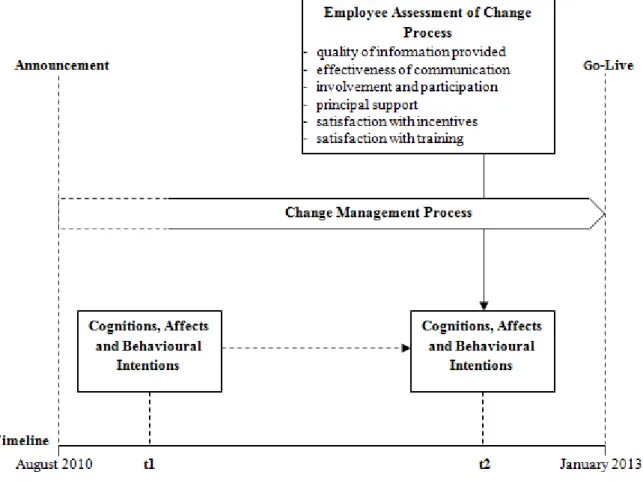
Self et al. (2007) refer to the change process as the how factor of change. Organisations are advised to place increasing emphasis on their change management practices during an ERP implementation (e.g. Calvert 2006). This is because the way in which change is introduced will affect employee response. Vakola and Nikolaou (2005) indicate that without an appropriate change process, employee’s initial attitudes toward the change are likely to endure. For example, persuasive communication and the provision of quality information about the change and the need for change can positively influence cognitive and behavioural responses (Oreg 2006; Self et al. 2007). Timely and relevant information about how the change will occur and how it will affect employees can reduce uncertainty (Miller et al. 1994). Other suggestions for the change process include engaging employees, encouraging participation and ensuring they feel they have an opportunity to provide input and ask questions (Wanberg and Banas 2000). Employees should also perceive that support from change agents has been adequate and that leaders are "walking the talk" (Armenakis et al. 2007; Wanberg and Banas 2000). Employee stress, which negatively impacts attitudes and behaviours, can also be reduced during the change process through the provision of training and incentives (Aladwani 2001; Vakola and Nikolaou 2005). Figure 2 illustrates the effect of change process factors on employee cognitions, affects and behavioural intentions.
RESEARCH DESIGN
This context for the study is a university (HEI) which is about to undergo an ERP re-implementation. Caught out by vendor consolidation and under threat of loss of any upgrade path for the future, the institution has chosen to replace its existing ERP system with an alternate solution which has a clear upgrade path and a much larger user base.
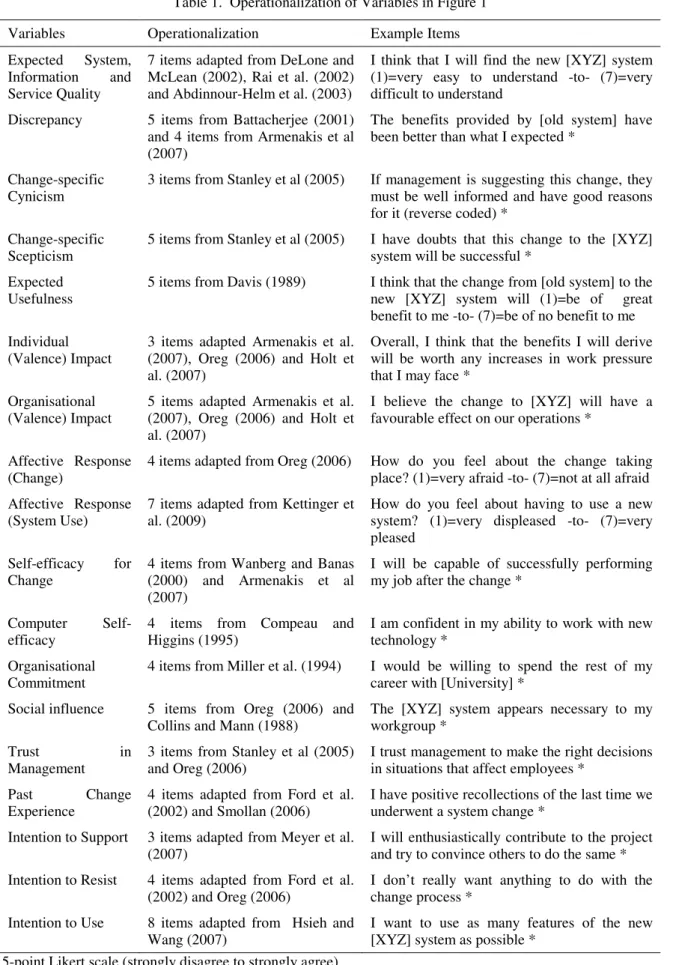
The first aim of this study is to test the effects of affective, cognitive, individual and workplace related factors on behavioural responses of users toward the implementation of the new ERP system (illustrated in Figure 1). A quantitative survey methodology will be used. The time period selected (t=1 in Figure 2) will be at a point
following the announcement of the impending system change but will be prior to commencement of the mainstream change process. Data will be collected by means of a structured questionnaire instrument. Table 1 outlines the measures.
Table 1. Operationalization of Variables in Figure 1 Variables Operationalization Example Items Expected System,
Information and Service Quality
7 items adapted from DeLone and McLean (2002), Rai et al. (2002) and Abdinnour-Helm et al. (2003)
I think that I will find the new [XYZ] system (1)=very easy to understand -to- (7)=very difficult to understand
Discrepancy 5 items from Battacherjee (2001) and 4 items from Armenakis et al (2007)
The benefits provided by [old system] have been better than what I expected *
Change-specific Cynicism
3 items from Stanley et al (2005) If management is suggesting this change, they must be well informed and have good reasons for it (reverse coded) *
Change-specific Scepticism
5 items from Stanley et al (2005) I have doubts that this change to the [XYZ] system will be successful *
Expected Usefulness
5 items from Davis (1989) I think that the change from [old system] to the new [XYZ] system will (1)=be of great benefit to me -to- (7)=be of no benefit to me Individual
(Valence) Impact
3 items adapted Armenakis et al. (2007), Oreg (2006) and Holt et al. (2007)
Overall, I think that the benefits I will derive will be worth any increases in work pressure that I may face *
Organisational (Valence) Impact
5 items adapted Armenakis et al. (2007), Oreg (2006) and Holt et al. (2007)
I believe the change to [XYZ] will have a favourable effect on our operations *
Affective Response (Change)
4 items adapted from Oreg (2006) How do you feel about the change taking place? (1)=very afraid -to- (7)=not at all afraid Affective Response
(System Use)
7 items adapted from Kettinger et al. (2009)
How do you feel about having to use a new system? (1)=very displeased -to- (7)=very pleased
Self-efficacy for Change
4 items from Wanberg and Banas (2000) and Armenakis et al (2007)
I will be capable of successfully performing my job after the change *
Computer Self-efficacy
4 items from Compeau and Higgins (1995)
I am confident in my ability to work with new technology *
Organisational Commitment
4 items from Miller et al. (1994) I would be willing to spend the rest of my career with [University] *
Social influence 5 items from Oreg (2006) and Collins and Mann (1988)
The [XYZ] system appears necessary to my workgroup *
Trust in Management
3 items from Stanley et al (2005) and Oreg (2006)
I trust management to make the right decisions in situations that affect employees *
Past Change Experience
4 items adapted from Ford et al. (2002) and Smollan (2006)
I have positive recollections of the last time we underwent a system change *
Intention to Support 3 items adapted from Meyer et al. (2007)
I will enthusiastically contribute to the project and try to convince others to do the same * Intention to Resist 4 items adapted from Ford et al.
(2002) and Oreg (2006)
I don’t really want anything to do with the change process *
Intention to Use 8 items adapted from Hsieh and Wang (2007)
I want to use as many features of the new [XYZ] system as possible *
Respondents will be users of the existing ERP solution working in organisational units that will be most impacted by the system change, including the student enrolment centre, registrar’s office, student fees office, scholarships office, examinations and graduation office, and support staff in academic departments spanning across 34 Schools in 5 Faculties.
Figure 2: Timeline and Effects of the Change Process
The second aim of this study is to examine the extent to which the affective, cognitive and behavioural intentions of users change over time in response to various change management initiatives. To achieve this, a second survey will be carried out prior to the new system going into operation but subsequent to various change management efforts (t=2 in Figure 2). This second survey will re-assess the affective, cognitive and behavioural intentions of users and will also ask employees to provide their assessments of the change process. Questionnaire items will capture quality of information provided (Miller et al. 1994; Wanberg and Banas 2000), effectiveness of communication (Self et al., 2007), involvement and participation in the process (Wanberg and Banas 2000), principal support (Armenakis et al. 2007; Wanberg and Banas 2000), and satisfaction with incentives and training received (Schmidt 2007; Vakola and Nikolaou 2005).
POTENTIAL CONTRIBUTIONS
From a theoretical perspective, this study extends our understanding of multiple behavioural intentions at the pre-implementation stage by drawing on both the technology acceptance and organisational change literatures. Klaus et al. (2010) question whether technology adoption (use) and responses such as resistance to change are on the same continuum of behaviour or whether they are separate constructs. This study provides an opportunity to confirm whether the constructs are theoretically and empirically distinct, as well as to identify their common and unique cognitive and affective determinants. We also have an opportunity to extend understanding of how ERP implementations are affected by the individual and workplace related factors long considered in the change literature as important influences e.g. trust in management and self efficacy for change. Finally, our longitudinal research design allows us to identify those aspects of attitude/response that are more enduring (i.e. change relatively little over the course of the change programme) versus those responses that are most amenable to manipulation.
Organisations typically fail in their ERP implementations because they fail to understand the social and organisational factors that influence implementation outcomes. This study will contribute to the field by
providing additional empirical evidence for how pre-implementation attitudes can have important consequences for change readiness, system adoption and use, and ultimately system success. For managers charged with responsibility for overseeing their organisation’s ERP implementation and instituting a change management programme, the model and underlying construct measures will be useful in helping them to evaluate the behavioural intentions, cognitions and affects of users pre-implementation, and to monitor the effectiveness of their change management programmes in influencing them. This is particularly important since user attitudes developed during early pre-implementation phases shape early behaviours and the subsequent attitudes that impact future implementation phases (Abdinnour-Helm et al. 2003). Understanding employee responses pre-implementation can allow management to focus on actions designed to generate positive cognitive and emotional responses (Aladwani 2001). Change managers can also use the model to identify those individuals more likely to participate and involve themselves in the change process or act as change champions selling the process to others, which may prove invaluable for facilitating a successful implementation.
REFERENCES
Abdinnour-Helm, S., Lengnick-Hall, M., and Lengnick-Hall, C. 2003. “Pre-Implementation Attitudes and Organizational Readiness for Implementing an Enterprise Resource Planning System,”, European Journal of Operational Research (146:2), April, pp 258-273.
Al-Mashari, M. 2003. “Enterprise Resource Planning (ERP) Systems: A Research Agenda,” Industrial Management & Data Systems (103:1), pp 22-27.
Aladwani, A.M. 2001. “Change Management Strategies for Successful ERP Implementation,” Business Process Management (7:3), August, pp 266-275.
Amoako-Gyampah, K. 2007. “Perceived Usefulness, User Involvement and Behavioral Intention: An Empirical Study of ERP Implementation,” Computers in Human Behavior (23:3), May, pp 1232-1248.
Amoako-Gyampah, K., and Salam, A.F. 2004. “An Extension of the Technology Acceptance Model in an ERP Implementation Environment,” Information & Management (41:6), July, pp 731-745.
Armenakis, A.A., and Harris, S.G. 2009. “Reflections: Our Journey in Organizational Change Research and Practice,” Journal of Change Management (9:2), June, pp 127-142.
Armenakis, A.A., Berneth, J.B., Pitts, J.P., and Walker, H.J. 2007. “Organizational Change Recipients’ Beliefs Scale: Development of an Assessment Instrument,” The Journal of Applied Behavioral Science (43:4), December, pp 481-505.
Barki, H., Paré, G., and Sicotte, C. 2008. “Linking IT implementation and acceptance via the construct of psychological ownership of information technology,” Journal of Information Technology (23:4), December, pp 269-280.
Battacherjee A. 2001. “Understanding Information systems continuance: An Expectation-Confirmation Model,”
MIS Quarterly (25:3), September, pp 351-370.
Bhattacherjee, A., and Hikmet, N. 2007. “Physicians’ Resistance Toward Healthcare Information Technology: A Theoretical Model and Empirical Test,” European Journal of Information Systems (16:6), December, pp 725–737.
Brown, S.A., Massey, A.P., Montoya-Weiss, M.M., and Burkman, J.R. 2002. “Do I Really Have To? User Acceptance of Mandated Technology,” European Journal of Information Systems (11:4), December, pp 283-295.
Calvert, C. 2006. “A Change-Management Model for the Implementation and Upgrade of ERP Systems,” In
ACIS 2006 Proceedings, Paper 18.
Chen, J., and Wang, L. 2007. “Locus of Control and the Three Components of Commitment to Change,”
Personality and Individual Differences (42:3), February, pp 503-512.
Compeau, D.R., and Higgins, C.A. 1995. “Computer Self-Efficacy: Development of a Measure and Initial Test,”
MIS Quarterly (19:2), June, pp 189-211.
Compeau, D.R., and Higgins, C.A., and Huff, S. “Social Cognitive Theory and Individual Reactions to Computing Technology: A Longitudinal Study,” MIS Quarterly (23:2), June, pp 145-158.
Cunningham, C.E., Woodward, C.A., Shannon, H.S., MacIntosh, J., Lendrum, B., Rosenbloom, D., and Brown, J. 2002. “Readiness for Organizational Change: A Longitudinal Study of Workplace, Psychological and Behavioural Correlates,” Journal of Occupational and Organizational Psychology (75:4), pp 377-392.
Davenport, T.H. 1998. “Putting the Enterprise into the Enterprise System,” Harvard Business Review (76:4), July-August, pp 121-131.
Davis, F.D. 1993. “User acceptance of information technology: system characteristics, user perceptions and behavioral impacts,” International Journal of Man-Machine Studies (38:3), March, pp 475-487.
Davis, F.D., Bagozzi, R.P., and Warshaw, P.R. 1989. “User Acceptance of Computer Technology: A Comparison of Two Theoretical Model,” Management Science (35:8), August, pp 982-1003.
DeLone, W.H., and McLean, E.R. 1992. “Information Systems Success: The Quest for the Dependent Variable,”
Information Systems Research (3:1), March, pp 60-95.
DeLone, W.H., and McLean, E.R. 2002. “The DeLone and McLean Model of Information Systems Success: A Ten-Year Update,” Journal of Management Information Systems (19:4), Spring, pp 9-30.
Devos, G., Buelens, M., and Bouckenooghe, D. 2007. “Contribution of Content, Context, and Process to Understanding Openness to Organizational Change: Two Experimental Simulation Studies,” Journal of Social Psychology (147:6), December, pp 607 - 630.
Ford, J.D., Ford, L.W., and McNamara, R.T. 2002. “Resistance and the Background Conversations of Change,”
Journal of Organizational Change Management (15:2), pp105-121.
George, J.M., and Jones, G.R. 2001. “Towards a Process Model of Individual Change in Organizations,” Human Relations (54:4), April, pp 419-444.
Heinssen, R.K., Glass, C.R., and Knight, L.A. “Assessing Computer Anxiety: Development and Validation of the Computer Anxiety Rating Scale,” Computers in Human Behavior (3:1), pp 49-59.
Holt, D.T., Armenakis, A.A., Feild, H.S., and Harris, S.G. 2007. “Readiness for Organizational Change: The Systematic Development of a Scale,” The Journal of Applied Behavioral Science (43:2), June, pp 232-255. Hsieh, J.J.P., and Wei, W. 2007. “Explaining Employees’ Extended Use of Complex Information Systems,”
European Journal of Information Systems (16:3), July, pp 216-227.
Jaros, S. 2010. “Commitment to Organizational Change: A Critical Review,” Journal of Change Management
(10:1), March, pp 79-108.
Jones, R.A., Jimmieson, N.L., and Griffiths, A. 2005. “The Impact of Organizational Culture and Reshaping Capabilities on Change Implementation Success: The Mediating Role of Readiness for Change,” Journal of Management Studies (42:2), pp 361-386.
Kettinger, W.J., Park, S.H., and Smith, J. 2009. “Understanding the Consequences of Information Systems Service Quality on IS Service Reuse,” Information & Management (46:6), August, pp 335-341.
Kim, H.W., and Kankanhalli, A. 2009. “Investigating User Resistance to Information Systems Implementation: A Status Quo Bias Perspective,” MIS Quarterly (33:3), September, pp 567-582.
Klaus, T., Wingreen, S.C., and Blanton, J.E. 2010. “Resistant Groups in Enterprise System Implementations: a Q-Methodology Examination,” Journal of Information Technology (25:1), March, pp 91-106.
Kwahk, K.Y., and Lee, J. 2008. “The Role of Readiness for Change in ERP Implementation: Theoretical Bases and Empirical Validation,” Information & Management (45:7), November, pp 474-481.
Lines, R. 2005. “The Structure and Function of Attitudes toward Organizational Change,” Human Resource Development Review (4:1), March, pp 8-32.
Mathieson, K. 1991. “Predicting User Intentions: Comparing the Technology Acceptance Model with the Theory of Planned Behavior,” Information Systems Research (2:3), September, pp 173-191.
Miller, V.D., Johnson, J.R., and Grau, J. 1994. “Antecedents to Willingness to Participate in a Planned Organizational Change,” Journal of Applied Communication Research (22:1), February, pp 59-80.
Meyer, J.P., Srinivas, E.S., Lal, J.B., and Topolnytsky, L. 2007. “Employee Commitment and Support for an Organizational Change: Test of the Three-Component Model in Two Cultures,” Journal of Occupational and Organizational Psychology (80:2), June, pp 185–211.
Oreg, S. 2006. “Personality, Context, and Resistance to Organizational Change,” European Journal of Work and Organizational Psychology (15:1), March, pp 73-101.
Piderit, S.K. 2000. “Rethinking Resistance and Recognizing Ambivalence: A Multidimensional View of Attitudes Toward an Organizational Change,” Academy of Management Review (25:4), October, pp 783-794.
Rai, A., Lang, S.S., and Welker, R.B. 2002. “Assessing the Validity of IS Success Models: An Empirical Test and Theoretical Analysis,” Information Systems Research (13:1), March, pp 50-69.
Robey, D., Ross, J.W., and Boudreau, M.C. 2002. “Learning to Implement Enterprise Systems: An Exploratory Study of the Dialectics of Change,” Journal of Management Information Systems (19:1), Summer, pp 17-46. Schepers, J., and Wetzels, M. 2007. “A Meta-Analysis of the Technology Acceptance Model: Investigating
Subjective Norm and Moderation Effects,” Information & Management (44:1), January, pp 90-103.
Schmidt, S.W. 2007. “The Relationship between Satisfaction With Workplace Training and Overall Job Satisfaction,” Human Resource Development Quarterly (18:4), Winter, pp 481-498.
Self, D.R., Armenakis, A.A., Schraeder, M. 2007. “Organizational Change Content,Process, and Context: A Simultaneous Analysis of Employee Reactions,” Journal of Change Management (7:2), June, pp 211–229. Shih, Y. 2006. “The Effect of Computer Self-Efficacy on Enterprise Resources Planning Usage,” Behaviour &
Information Technology (25:5), September-October, pp 407-411.
Smollan, R.K. 2006. “Minds, Hearts and Deeds: Cognitive, Affective and Behavioural Responses to Change,”
Journal of Change Management (6:2), June, pp 143-158.
Stanley, D.J., Meyer, J.P., and Topolnytsky, L. 2005. “Employee Cynicism and Resistance to Organizational Change,” Journal of Business and Psychology (19:4), June, pp 49-459.
Sumner, M. 2005. Enterprise Resource Planning, Upper Saddle River, NJ: Prentice Hall.
Sun, Y., Bhattacherjee, A., and Ma, Q. 2009. “Extending Technology Usage to Work Settings: The Role of Perceived Work Compatibility in ERP Implementation,” Information & Management (46:6), August, pp 351-356.
Vakola, M., and Nikolaou, I. 2005. “Attitudes Towards Organizational Change: What Is The Role of Employees’ Stress and Commitment?,” Employee Relations (27:2), pp 160-174.
Vakola, M., Tsaousis, I., and Nikolaou, I. 2004. “The Role of Emotional Intelligence and Personality Variables on Attitudes toward Organisational Change,” Journal of Managerial Psychology (19:2), pp 88-110.
Venkatesh, V., Morris, M.G., Davis, G.B., and Davis, F.D. 2003. “User Acceptance of Information Technology: Toward a Unified View”, MIS Quarterly (27:3), September, pp 425-478.
Wanberg, C.R., and Banas, J.T. 2000. “Predictors and Outcomes of Openness to Changes in a Reorganizing Workplace,” Journal of Applied Psychology (85:1), February, pp 132-142.
Willcocks, L.P., and Sykes, R. 2000. “Enterprise Resource Planning: The Role of the CIO and IT Function in ERP,” Communications of the ACM (43:4), April, pp 32-38.
Wixom, B.H., and Todd, P.A. 2005. “A Theoretical Integration of User Satisfaction and Technology Acceptance,” Information Systems Research (16:1), March, pp 85-102.
ACKNOWLEDGEMENTS
This material is based upon work supported financially by the National Research Foundation, South Africa.
COPYRIGHT
Jason F. Cohen © 2010. The authors assign to ACIS and educational and non-profit institutions a non-exclusive licence to use this document for personal use and in courses of instruction provided that the article is used in full and this copyright statement is reproduced. The authors also grant a non-exclusive licence to ACIS to publish this document in full in the Conference Papers and Proceedings. Those documents may be published on the World Wide Web, CD-ROM, in printed form, and on mirror sites on the World Wide Web. Any other usage is prohibited without the express permission of the authors.