Procedia Computer Science 79 ( 2016 ) 402 – 409
1877-0509 © 2016 The Authors. Published by Elsevier B.V. This is an open access article under the CC BY-NC-ND license (http://creativecommons.org/licenses/by-nc-nd/4.0/).
Peer-review under responsibility of the Organizing Committee of ICCCV 2016 doi: 10.1016/j.procs.2016.03.052
ScienceDirect
7th International Conference on Communication, Computing and Virtualization 2016
Automatic Traffic Surveillance using Video Tracking
Bhushan Nemade
Department of Information Technology, Thakur College of Engineering and Technology. Mumbai 400101 India.[email protected]
Abstract
Road traffic and traffic congestion is major problem worldwide. This system uses video surveillance as it comes as the most economical technique for monitoring road traffic. Researchers have worked on different methodologies for video processing. The problems in existing methods are occlusions and variable lightening conditions. Also recent research on Indian roads proved that current image processing systems shows 55% median error on vehicle count. Proposed system looks into both day time as well as night time conditions to monitor traffic. Also it provides vehicle classification, traffic density, vehicle count, license plate detection and Incident detection. It combines many existing methods like background subtraction, kalman filter, 2-linesalgorithm,headlight detection, license plate detection algorithm The proposed system implements 2-lines algorithm and vehicle classification using kalman filter for day time and headlight based detection for night time which helps in successful tracking of vehicles. The license plate detection uses Edge detection, Gaussian Analysis, Feature extraction and character recognition which makes it robust to detect license plates in both day and night conditions.
Median error was reduces to 11% by use of 2-lines algorithm. Vehicle classification using kalman filters gives accuracy of 82%.The proposed system will give median error less than 10% and accuracy of more than 90% in counting and classifying vehicles. The proposed system will be tested on MIT traffic data sets, MediaLab LPR database.
© 2016 The Authors. Published by Elsevier B.V.
Peer-review under responsibility of the Organizing Committee of ICCCV 2016.
Keywords: Vehicle Classification,License Plate Recognition,Vehicle Density Calculation,Video Processing, Traffic Monitoring, Video Surveillance, Vehicle Detection
1. Introduction
Traffic monitoring is one of the key part in Intelligent Traffic Systems. Traffic monitoring offers solutions to majority of the problems faced by the people. It also makes policing and controlling of traffic easier.
Video surveillance is one of the technologies which can be used for traffic monitoring. Video surveillance also is the most economical option which doesn’t involve major costs or infrastructural changes.
Corresponding author. Tel.+91-8446606444 ; E-mail address: [email protected]
© 2016 The Authors. Published by Elsevier B.V. This is an open access article under the CC BY-NC-ND license (http://creativecommons.org/licenses/by-nc-nd/4.0/).
1.1. Background
Road traffic is one of the major problems in India and worldwide. Traffic congestion is seen all the time in countries across globe. Researchers around the globe are doing research in order to solve this problem. Various alternatives and methods are looked at to solve or atleast reduce this problem. Traffic surveillance is also seen as the option to solve the problem. Intelligent Traffic Systems solves the problem like incident detection, traffic monitoring, traffic rules violations, live traffic updates, auto mated traffic signaling. Intelligent traffic system management and better access to real time along with historic information helps commuters to plan their route. It can also help to reduce congestion. Loop detectors, video cameras, mobile sensors like GPS can be used for traffic monitoring. Installing loop detectors involve high installation cost, high maintenance cost also changes in road infrastructure. Mobile sensors like GPS etc involve high cost factor from commuter point of view. In contrast of all these, installing video cameras and monitoring traffic using it is better option as it don’t require high installation, maintenance cost also no personal cost for the commuters..
1.2. Motivation
According to previous research, existing approaches for motion detection in traffic surveillance systems can be divided broadly into the three categories: temporal difference, optical flow, and background subtraction [1]. Although temporal difference approaches may be adaptive to environmental changes, their use often results in incomplete detection of the shapes of moving objects. This is especially true when objects which are motionless or feature limited mobility are present. Optical flow approaches are employed to detect moving objects by using the projected motion in the image plane with proper approximation. Unfortunately, these methods inevitably result in the generation of noise and excess computational burden. With the exception of the above-mentioned categories, background subtraction approaches are widely used for the detection of moving objects due to their ability to accomplish accurate detection of moving objects while exhibiting only moderate computational complexity. This is achieved by comparing the differences between pixel features of the current image and those of the reference background model of the previous image. Now lets into problem faced while implementing background substraction methods for Indian roads. In this method, the foreground pixels in frame N are calculated by subtracting a background frame from it. The density of frame N is calculated by the ratio of foreground pixels to total pixels in the frame. The background frame was manually selected as a frame containing no vehicles to serve as the template, where any pixel differences indicate a vehicle. This simple intuitive method gave disastrous results because of a peculiar characteristic of buses in Bengaluru. Bengaluru buses have a gray cover on their roofs, probably as a protection from heat and rain. Online image searches revealed similar characteristics of buses in other Indian cities. This gray color is almost the same color as the road, and therefore using background subtraction does not detect a vehicle. In fact, when two buses stand side by side occupying the entire road as shown background subtraction measures no density. So we propose to implement 2 lines algorithm which solves this problem. Also it is seen that the methodologies used for day time conditions are not applicable for night time or bad lightening conditions so it is proposed to have two different approaches for day and night respectively. Most of the features employed for vehicle detection, such as color, shadows, edges and motion information, are difficult or impossible to extract in dark or nighttime situations. Hence, the aforementioned methods are inadequate in dark or nighttime traffic conditions. In contrast to daytime traffic environments, headlights and rear lights become the salient features of moving vehicles in nighttime traffic conditions. However, nighttime traffic conditions are complicated and chaotic, with many potential light sources that are not vehicle headlights, such as traffic lights, street lights and reflections from vehicle headlights. The proposed algorithm, including headlight segmentation, headlight pairing and headlight tracking, does not rely on the performance of a lane detection algorithm. First, pixels of headlights are extracted from the captured image sequences by utilizing the thresholding method. Second, the pixels of the headlights are grouped and labeled to obtain characteristics of the related components. The locations and sizes of the related components are employed for headlight pairings. A related component of the headlight is indicated by enclosure within a bounding box. Finally, the bounding boxes are tracked by a tracking procedure to detect vehicles.
1.3. Main Objective
The main objective of the project is to make a system which will work in all types of conditions and gives very accurate results. Proposed system should be able to detect and classify all the vehicles on the road and should help in solving problems like traffic rules violations. System uses different methodologies according to the lightening conditions i.e. 2 lines algorithm and classification using kalman filter for day time conditions and headlight based segmentation pairing and tracking for night time conditions. License plate recognition algorithm is used for identifying the vehicles[2]. A database is maintained storing all the data which is obtained from surveillance which can be helpful for further analysis.
1.4.Scope
The proposed system will detect, count, classify and identify vehicles using various methods in day as well as night conditions. Thus data which is obtained from it can be put to good use. Traffic density and Count can be used traffic signal control and also can be helpful to commuters in route selections. License plate detection can be used for tracking criminal activities and can also help police to find location of criminal. Incident detection can be useful for pin pointing locations of accidents or vehicle breakdown to handle emergency situations. Historical traffic data which will consist of classification and count can be helpful in planning of new infrastructure
2. Proposed Algorithm
Proposed system works in following way :
Step 1: Get the data i.e. video from the surveillance camera Step 2: Apply License plate recognition algorithm
Step 3: Extract the license plate number and store it in database Step 4: Identify whether it is day-time or night-time
Step 5: If day then apply kalman filter for classification
Step 6: If night then apply headlight based detection and tracking. Step 7: Keep comparing the results and save the best one in database. 2.1 .Density Measurement Algorithm (2-line Algorithm)
To compute traffic density, we propose to place a painted coloured strip horizontally across the surface on the road. The strip colour should be in stark contrast to the colour of the road, such as yellow or white against traditionally grey roads. We plan to use yellow-coloured strip, since many traffic related instructions like parking restrictions are painted on the road in yellow, and hence drivers will not pay much attention to the strip. Other colours like green will distract the drivers. The camera will be mounted above the road pointing downward, and will capture traffic driving over the yellow strip which will later be processed by the algorithm[2], described below (see Figure 1).
The Algorithm is formalized with pseudo code as follows
step1: Divide the rectangular yellow tape and a parallel black rectangle of the road, adjacent to the tape, into vertical rectangle pairs {Bi ,Yi}
step2: For each {Bi; Yi} pair, consider the pair occupied if either: (i) The RGB difference between Bi and Yi is below a threshold C, or
(ii) The RGB difference between Yi in frame N and Yi in frame N-1 is more than a threshold T. step3: Compute raw density r as ratio of occupied rectangle pairs to total rectangle pairs.
on every frame. While this measurement reflects the density for only a one- dimensional strip of the frame, when averaged over time the result is proportional to the full two- dimensional frame density, assuming that vehicles cross the tape at their average speed for the frame.
To detect obfuscation of the tape, we propose to apply two separate tests. The first test detects vehicles that have uniform coloration on their roofs, such as buses, cars, and auto rickshaws. When such a vehicle passes over the tape, it obscures the colour contrast between the tape and the road. That is, without obfuscation there are neighbouring pixels that have very different colours (yellow for the tape, black for the road), but with obfuscation both of these pixels are the same colour (the colour of the vehicle). Detection of such cases can be done by differencing the pixels immediately inside and outside the tape, at each position across the road; if the difference exceeds a threshold, then there is a presence of a vehicle at the corresponding position. The second test detects vehicles that do not have a uniform coloration, including two-wheelers, open trucks, and the backs/sides of other vehicles. Because there is spatial variation in the vehicle’s colour, this implies that there is temporal variation in color as the vehicle travels over a fixed set of pixels. Thus, detection of the presence of such vehicles can be done by detecting changes in coloration – for a fixed set of pixels overlapping the tape between one frame and the next. Overall, a vehicle is reported if it is detected by either of the tests above. 2.2 Vehicle Classification Algorithm
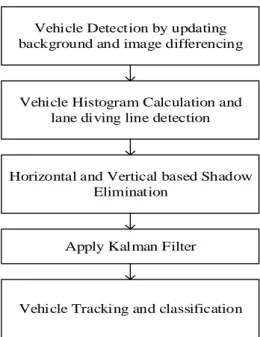
This technique helps in classifying vehicles by using size and linearity features of vehicles. It introduces new feature based on linearity. This system also designed an algorithm[3] to remove vehicle occlusions caused by shadow. While size classification technique helps in recognizing different types of vehicles. The linearity feature helps in recognizing the difference between truck and buses though both have same size. Linearity feature extracts the unslanted edges of the vehicles. Linearity feature is used to differentiate between truck and van truck/bus.Major steps for this system are shown in figure 1.
Vehicle Detection by updating background and image differencing
Vehicle Histogram Calculation and lane diving line detection
Horizontal and Vertical based Shadow Elimination
Vehicle Tracking and classification Apply Kalman Filter
2.3 License Plate Identification Algorithm Step 1: Plate Extraction
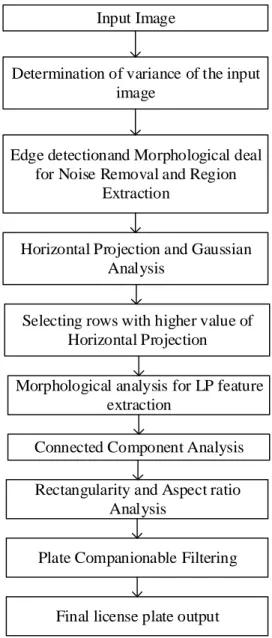
i). First of all variance of the image is computed. With an aim to reduce computationally complexity the proposed implementation begins with the thresholding of variance as a selection criterion for frames aspiring contrast enhancement. If the value is greater than the threshold then it implies that the corresponding image possesses good contrast. While if the variance is below threshold, then the image is considered to have low contrast and therefore contrast enhancement is applied to it. This method of contrast enhancement based on variance helps the system to automatically recognize whether the image is taken in daylight or in night condition[4].
ii). The license plate region mainly consists of vertical edges and therefore by calculating the average gradient variance and comparing with each other, the bigger intense of variations can be determined which represents the position of license plate region. So we can roughly locate the horizontal position candidate of license plate from the gradient value. Mathematical morphology is a non-linear filtering operation, with an objective of restraining noises, extract features and segment objects etc. Its characteristic is that it can decompose complex image and extract the meaningful features. This operation can erase white holes on dark objects or can remove small white objects in a dark background. An object will be erased if the Structuring Element does not fit within it.
iii).From previous step, it is observed that the region with bigger value of vertical gradient can roughly represent the region of license plate. So the license plate region tends to have a big value for horizontal projection of vertical gradient variance. According to this feature of license plate, we calculate the horizontal projection of gradient variance. There may be many burrs in the horizontal projection and to reduce or smoothen out these burrs in discrete curve Gaussian filter has to be applied. In subsequent step, the algorithm of connected component analysis is used to locate the coordinates of the 8-connected components. The minimum rectangle, which encloses the connected components, stands as a candidate for vehicle license plate
iv). Once the probable candidates using connected component analysis obtained, features of each component are examined in order to correctly filter out the non-license plate components. In this algorithm, rectangularity, aspect ratio analysis and plate companionable filter are defined in order to decide if a component is a license plate or not as follows
a. Rectangularity and Aspect Ratio Analysis :-The license plate takes a rectangular shape with a predetermined height to width ratio in each kind of vehicles. Under limited distortion, however, license plates in vehicle images can still be viewed approximately as rectangle shape with a certain aspect ratio. This is the most important shape feature of license plates. The aspect ratio is defined as the ratio of the height to the width of the region’s rectangle.
b. Plate Companionable Filter :-Some components may be misrecognized as candidates even after aspect ratio analysis as its satisfies all above mentioned conditions. To avoid this simple concept is employed, which is known as plate companionable filtering. According to the license plates characteristics, plate characters possess a definite size and shape and are arranged in a sequence. The variations between plate background and characters are used to make the distinction.
v).Finally there will be extracted license plate from an input image. Step 2: Character Segmentation
The License plate obtained after Plate Extraction process has characters is gray-scale. To segment the characters, first plate image is transformed into binary image. Then 'Lines' Function is used to split text on the number plate into lines, which uses ‘clip function’. Clip function crops black letter with white background. Once the image is cropped, resizing is done and same operation is continued on the cropped image. This procedure is followed until all the characters are segmented.
Input Image
Determination of variance of the input
image
Edge detectionand Morphological deal
for Noise Removal and Region
Extraction
Horizontal Projection and Gaussian
Analysis
Selecting rows with higher value of
Horizontal Projection
Morphological analysis for LP feature
extraction
Connected Component Analysis
Rectangularity and Aspect ratio
Analysis
Plate Companionable Filtering
Final license plate output
Fig 2: License Plate Identification Step 3: Feature Extraction
Feature Extraction is performed on every segmented character. Fan-beam Transform is used for computing an optional mathematical representation of an image by means of Fan- beam projections. Fan-beam function computes projections of an image matrix all along specified directions. Projection of two dimensional function f(x, y) is a set of line integrals. The line integrals are computed along paths that radiate from a single source, forming a fan shape by applying the Fan beam function.
Step 4: Character Recognition
Character Recognition step is the final and main part of this system, where segmented characters are recognized using conventional methods such as OCR “Optical Character Recognition” and “Formula Based Recognition”
2.4.Night-Time Tracking Algorithm
A night-time vehicle detection algorithm, consisting of headlight segmentation, h e a d l i g h t p a i ring a n d headlight tracking, is proposed[5]. First, the pixels of the headlights are segmented in nighttime traffic images, through the use of the thresholding method. Then the pixels of the headlights are grouped and labeled, to analyze the characteristics of related components, such as area, location and size. Headlights are paired based on their location and size and then tracked via a tracking procedure designed to detect vehicles.
Following are the important steps in Night Time Vehicle Detection :
Step 1 : Headlight Segmentation: The headlight is a strong and consistent feature in revealing the presence of a vehicle at night. Hence, the primary task is to segment the pixels of headlights in traffic image sequences. In nighttime traffic, headlights appear as the brightest regions, whether on highways or on urban roads. Regardless of the type of street lighting or the weather conditions, the vehicle headlight feature remains relatively stable. In this study, the pixels of the headlight images are segmented in grayscale images by the thresholding method
Step 2 : Headlight Pairing:Utilizing the thresholding method yields bright pixels. The bright pixels are then grouped and labeled to analyze the characteristics of related components, such as the area, location and size. Because headlights should have a predictable area, the area of related components is employed to further filter out the non-vehicle related components.
Step 3: Headlight Tracking:The aforementioned processes, including headlight segmentation and headlight pairing, do not alone provide enough information for determining the presence of vehicles. Hence, a tracking procedure is applied to analyze the motion of the potential vehicle, based on successive image frames.
i. Pixels of headlights are extracted from captured image sequences by thresholding method.
ii. Pixels of the headlights are grouped and labeled to obtain characteristics of the related components. iii.The locations and sizes of the related components are employed for headlight pairings.
iv.A related component of the headlight is indicated by enclosure within a bounding box. v. Finally, the bounding boxes are tracked by a tracking procedure to detect vehicles.
3. Result
Use of various methodologies helps us to get precise and more accurate results. Occlusions and lightening conditions will not affect the results of the proposed system. Problems of Indian roads like unlaned traffic, etc is also solved in this proposed system.
a) The median error was 11% by use of just 2-lines algorithm. Vehicle classification using filters kalman gives 82% accuracy. Our proposed system is expected to show median error below 10% and accuracy of 90%.
b) Headlight based detection using previous methods like light attenuation model gave 95.4% accuracy while for proposed system it is expected to be 97.5%.
c) License plate detection using Wavelet Transform gives 95.5% accuracy in detecting vehicles While the proposed algorithm may show 99.1% accuracy for various lightning conditions.
4.Conclusion
The proposed system aims at solving major problems of traffic and also providing specific solutions for Indian roads and vehicles. 2-lines algorithm combined with vehicle classification algorithm not only help to get traffic density but also classify and maintain count of different types of vehicles present on Indian roads. The system is designed to work under all lighting conditions ie for day as well as for night conditions. License plate detection can help in Security control of restricted areas, traffic law enforcements, surveillance systems, toll collection. This system offers solution for real time road conditions not just for fixed data sets. Travel time estimates based on the results obtained of this proposed system could be considered for further work and research.
References
[1] Norbert Buch, Sergio A. Velastin, and James Orwell “A Review of Computer Vision Techniques for the
Analysis of Urban Traffic”,IEEE TRANSACTIONS ON INTELLIGENT TRANSPORTATION SYSTEMS, VOL. 12,
NO. 3, SEPTEMBER2011
[2]Rijurekha Sen, Andrew Cross, Aditya Vashistha ”Accurate Speed and Density Measurement for Road Traffic in India”,DEV’13, January 11–12, 2013, Bangalore, India.
[3] Kanwal Yousaf, Arta Iftikhar, Ali Javed “Comparative Analysis of Automatic Vehicle Classification Techniques: A Survey”,I.J. Image, Graphics and Signal Processing, 2012
[4] Gee-Sern Hsu, Jiun-Chang Chen, and Yu-Zu Chung “Application-Oriented License Plate Recognition”,IEEE TRANSACTIONS ON VEHICULAR TECHNOLOGY, VOL. 62, NO. 2, FEBRUARY 2013
[5] Yen-Lin Chen, Bing-Fei Wu, Hao-Yu Huang and Chung-Jui Fan “A Real-Time Vision System
for Nighttime Vehicle Detection and Traffic Surveillance”, IEEE TRANSACTIONS ON INDUSTRIAL