Divya et al. World Journal of Engineering Research and Technology
MULTIPLE FACE DETECTION AND TRACKING FROM VIDEO
USING HAAR CLASSIFICATION ALGORITHM
Mrs. A. Komathi, MCA, Mphil., Ph.D.,1 S. Divya2*
1
Head and Assistant Professor, Department of Computer Science and Information,
Technology, Nadar Saraswathi College of Arts and Science, Theni. 2
Research Scholar, Department of Computer Science and Information, Technology, Nadar
Saraswathi College of Arts and Science, Theni.
Article Received on 18/02/2017 Article Revised on 11/03/2017 Article Accepted on 31/03/2017
ABSTRACT
Face detection and tracking systems have received increasing interest
in the last decade. Face detection and tracking are subfield of biometric
information processing and object tracking, respectively. Recent
advances in theory and practical implementations made the online
detection and tracking system work in real time Face detection and
tracking system designed and implemented in this paper exploits a
combination of techniques in two topics; Face detection and tracking.
Face detection is performed online achieved images from video. Processes exploited in the
system are color balance, skin segmentation, and facial image extraction on face candidates.
In this paper, intend to implement multiple face detection and tracking the head poses
position from high definition video using Haar cascade classifier. Finally, the result from
detection part is engaged with a Kalman filter for tracking candidate face in reasonable speed
of change the system is tested in practice and have shown to have acceptable performance for
tracking faces with in the proposed limits. The proposed will give satisfactory results for
multiple faces in live achieved images with in each video frame.
KEYWORDS: Face detection, object tracking, facial feature extraction, Haar cascade classifier, Kalman filter.
World Journal of Engineering Research and Technology
WJERT
www.wjert.org
SJIF Impact Factor:4.326
*Corresponding Author S. Divya
Research Scholar,
Department of Computer
Science and Information,
Technology, Nadar
Saraswathi College of Arts
1. INTRODUTION
An image may be defined as a two-dimensional function, where x and y are spatial (plane)
coordinatinates, and the amplitude of F at any pair of coordinates (x,y) is called the intensity
or gray level of the image at that point. In this paper work focuses on the study of face
detection and tracking.
From video streams. Face detection and tracking systems are sub-fields of image processing
and they are receiving increasing interest by researchers and industry. In this manner, face
detection and tracking can be attractive in several uses, in particular for surveillance, high
security entrance, care systems, and automatic teller machines (ATM). Face detection
algorithms detect faces and extract facial images based on the location of eyes, nose, and lips
whereas the tracking algorithms use estimation/correction methods. This makes the combined
algorithm more complicated than individual detection or tracking algorithm. The face
detection and tracking methods used in this thesis work are fundamentally based on Haar
classification method and Kalman filter algorithm, respectively.
In this paper, the MATLAB Simulink platform is used for creating a system with an online
digital camera. Consequently, all the implemented algorithms are integrated with this system
to process video frames sequentially one after another. All data processing, detection and
tracking algorithms are handled within the simulation framework.
The contents of this paper work are specified as follows:
Face detection and tracking system should detect, extract faces, and track frontal faces from
live video sequences.
System should work under indoor and outdoor lighting condition.
1.1 Video Processing
Video processing technology has revolutionized the world of multimedia with products such
as Digital Versatile Disk (DVD), the Digital Satellite System (DSS), high definition
television (HDTV), digital still and video cameras. The different areas of video processing
includes.
(i) Video Compression
(ii) Video Indexing
(iii)Video Segmentation
2. Face Detection
Face, nose, mouth and eyes have been detected using the MATLAB built-in class and
function. Based on Viola-Jones face detection algorithm, the computer vision system toolbox
contains vision.CascadeObjectDetector System object which detects objects based on above
mentioned algorithm.
Face detection is a computer technology being used in a variety of applications that identifies human faces in digital images. Face detection also refers to the psychological process by which humans locate and attend to faces in a visual scene.
3. Face Tracking
The faces which are detected in the face detection system should be used to track the faces.
Face tracking system is composed of preprocessing facial image, system state model,
prediction, measurement, and correction. The Kalman filter has two basic structures which
are described by system rate model and measurement model .One can employ the adaptive
Kalman filtering to track the objects in video streams. The system state model in Kalman
filtering is constructed by the motion model and it is used in prediction step.
Object tracking is the problem of estimating the positions and other relevant information of
moving objects in image sequences.
Two-frame tracking can be accomplished using correlation-based matching methods,
optical flow techniques, or change-based moving object detection methods.
Rapid appearance changes caused by image noise, illumination changes, norigid motion,
and varying poses
4. Skin Segmention
In skin segmentation, RGB, HSV color spaces are examined for skin like color RGB is
sensitive to light changes but HSV is not because of its separated intensity and color changes.
However, in our implementation the best results are obtained using the RGB color space. The
result of skin segmentation will be a grayscale image. Skin regions are observed brighter than
the non-skin regions. The final image is applied for pointed locations of faces and results are
sent to the next step. The result of skin segmentation is used by a Haar-like feature extraction
method. This method extracts five types of Haar-like features from the skin segmented
5. Haar Cascade Classifiers
The core basis for Haar classifier object detection is the Haar-like features. These features,
rather than using the intensity values of a pixel, use the change in contrast values between
adjacent rectangular groups of pixels. The contrast variances between the pixel groups are
used to determine relative light and dark areas. Two or three adjacent groups with a relative
contrast variance form a Haar-like feature. Haar features can easily be scaled by increasing or
decreasing the size of the pixel group being examined. This allows features to be used to
detect objects of various sizes.
6. Methodology 6.1 Basic Concepts
This paper on face detection and tracking are planned and state-of-the-art algorithms were
summarized in the previous chapter. Among the many possible approaches, the combinations
of Haar classification method for face detection and Kalman filter method for tracking have
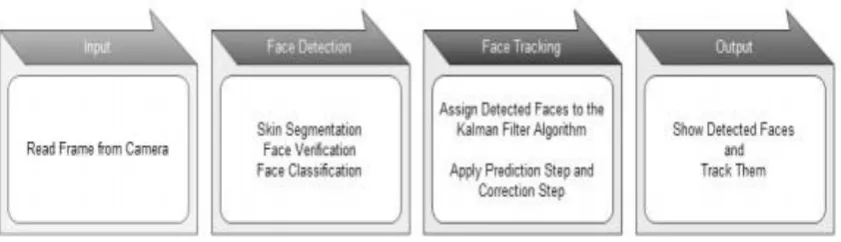
been chosen. Below fig 6.1.1 is represented by Face Detection and Tracking System
Figure 6.1.1: The Implemented Face Detection and Tracking System
Face Detection
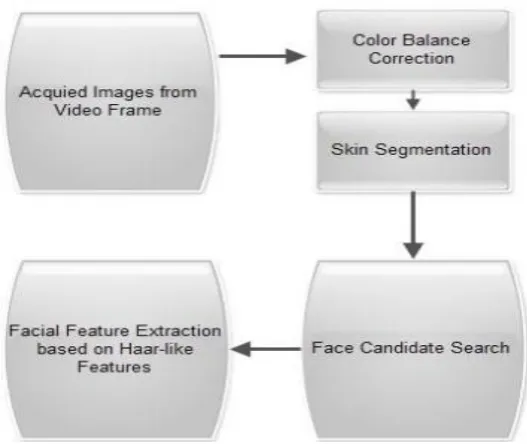
Face detection procedure extracts facial images and locates facial images over the current
Figure 6.2.1: Block Diagram of the Face Detection Procedure.
After reading a video frame, the first step of the face detection procedure is color balance
correction. Color balance is needed for the global adjustment of color intensities. The main
goal of the adjustment is to render specific colors correctly. This is why color balance should
be applied before face segmentation. For the purpose of color balance correction, the mean
values (mv) of Red (Rmv), Green (Gmv), and Blue (Bmv) colors from N×M image are
calculated together with the mean value of gray color:
(1.1)
7. Haar Like Feature
Haar-like feature extraction method. This method extracts five types of Haar-like features
from the skin segmented images. These features use the alteration in contrast values between
adjacent rectangular groups of pixel values. The five types of Haar-like feature templates
used in this thesis are shown in Figure 7.1.These five types of feature templates are used for
Figure 7.1: Features of Haar-like method.
The simple rectangular Haar-like features of an image are calculated using an intermediate
representation of the image, known as the integral image.The integral image is an array
containing the sums of the pixels’ intensity values located directly to the left and above the
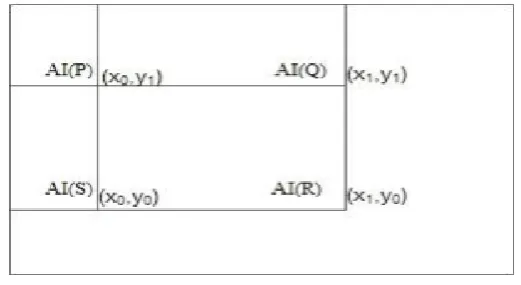
pixel at location (x, y). The integral image (AI[x,y]) of an image A[x,y] is computed using
equation 1.4, that is graphically illustrated in Figure 7.2
(1.4)
The integral image, also known as summed area table can be computed easily in a single pass
over the image using the fact that:
(1.5)
Once the integral image has been computed, area of any rectangular region (P, Q, R, S) over
the image can be computed in constant time as follows: Let P(x0,y1), Q(x1,y1), R(x1,y0),
and S(x0,y0) (see Figure 7.2), then
(1.6)
A Haar feature classifier uses the summed area table to calculate the value of each Haar-like
feature. A stage comparator sums all the Haar feature results in each stage and compares it
with a stage threshold. The threshold is also a constant obtained from the weak classifier.
8. Implementation of Face Detection and Tracking System
The system on face detection and tracking was studied and state-of-the-art was appraised and
summarized in the methodology section. To make automatic face detection and tracking
system for an online video, we require extracting and tracking faces in an image from a video
sequence. For making such type of system, we have included three distinct phases. First,
faces are detected and classified in each frame of a video sequence by using weak classifier.
Candidate faces are posted to Kalman filter module for prediction and tracking. Then, the
candidate faces are updated frame to frame. Finally, the result is shown in rectangular boxes
as output.
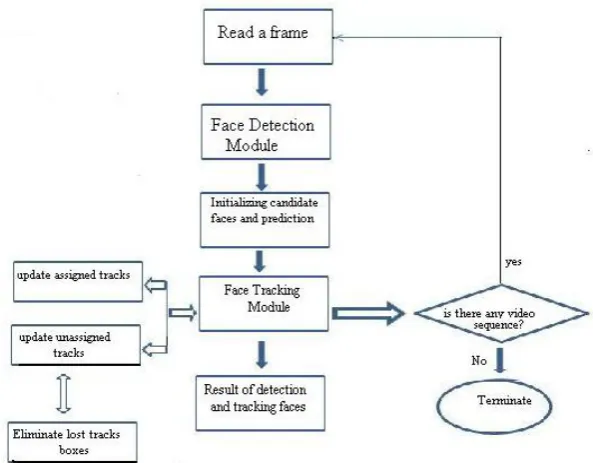
A flowchart depicting the main stage of the system is shown in Figure 8 and more
explanation will be given below.
As the main part of this work, we discuss reading a frame from video sequence. “Read frame” is the action needed to ensure that the system commence its issue with a correct clarification of the current frame of video sequence. “Acquiring image” task is performed in
this part. An image is acquired from each frame of video and it is converted to digital data for
performing image processing subtractions.A video sequence is defined in 640×480 pixels and
color space is defined as RGB. The capturing frame is sent to face detection part.
8.1 Face Detection
In order to detect the faces, extraction is performed in the RGB color space. In this regard,
RGB color space is more suitable for color extraction. To solve face detection problem, as
explained in the previous chapter, we use the Haar-like features by engaging the weak
classifier method. The Haar-like features consist of eyes, nose, and lips. These features are
able to construct a more powerful classification. Furthermore, color balance and skin
segmentation are applied for commencing of the face detection process. Lighting conditions
are always changing, or different lighting is occurred in indoor/ outdoor environments.
8.2 Face Tracking
After detecting faces, with the locations stored in the bounding box data set, Kalman filter is
applied for each of the candidate faces. In this regard, the location of each candidate faces is
initialized as input in the Kalman filter chain. Also, estimation error is initialized for the
tracking moving faces in the noisy environments.
9. RESULT AND DISCUSSION 9.1 Face Detection
First of all, implementation of system is performed on face detection in acquiring image form
each frame, and skin like region segmentation is a first implementation of face detection. In
that case, many methods have been tried to select which segmentation algorithm works best
on acquired images. Based on RGB, HSV, and HSV and YCbCr are tested on acquired
images from frames and the best result are taken from RGB color space.
After segmentation is completed, candidate search is achieved as described in the previous
chapter. Candidate faces are followed by facial feature extraction and face verification of
(a) The 213th frame
(b)The 219th frame
The Experimental Result in Outdoor
(d)The 232th frame
Figure 9: Blocking and Tracking of Candidate Faces.
Online tracking faces are shown with respect to output of face detection and tracking system
by covering boxes for each candidate face. Also, detection of a new face candidate and
tracking of candidate faces are updated for each frame of video sequence, because some
candidates are probably eliminated or inserted.
9.2 DISCUSSION
In this paper focuses on implementing face detection and tracking system. System is
composed of acquired images form online video stream; face detection part, and tracking
part.
Haar classifier method is performed for face detection part by Haar-Like facial features with
combination of skin color balance. Methods are combined due to decreasing computational
time and increasing accuracy of detection part. Before skin color segmentation, color balance
correction is executed to overcome color problem while achieving image from frames. Also,
the method was useful for black race of humans in bright environments.
On the other hand, RGB skin color segmentation used in the algorithm works well at any
environment tested (Indoor/Outdoor condition) in our experimental studies. Segmentation is
performed on recorded images after color balance. Face candidates are selected from
segments and facial feature extraction is executed to verify face candidate and extract face
images. Haar-like method is performed to show facial components clearly. After extraction of
is performed by Haar classifier learning algorithm. The algorithm is good for training and
classification problem.
10. CONCLUSION
Face detection and tracking system is part of image processing applications. Implementations
of system are video surveillance and similar security activities. The goal is reached by face
detection and tracking methods. Facial feature face detection methods are used to find
position and extract faces in achieved images form frames of video. Implanted methods are
color balance and facial features. Also, Kalman filter is used for face tracking. A Weak
classifier is employed to classify and solve face detection problem since face tracking is
required. Classification results are satisfactory. Also, classification is satisfactory when
extracted faces are small oriented, smiled, closed eye, wore sunglass, and wore hat. The
proposed algorithm is capable of detecting multiple faces, and leads to acceptable
performance in terms of obtained results.
BIBLIOGRAPHY
1. Zheng, Wenlong, and Suchendra M. Bhandarkar. "Face detection and tracking using a
Boosted Adaptive Particle Filter." Journal of Visual Communication and Image
Representation 20.1.
2. Viola, Paul, and Michael J. Jones. "Robust real-time face detection." International journal
of computer vision 57.2.
3. Rowley, Henry A., Shumeet Baluja, and Takeo Kanade. "Neural network-based face
detection." Pattern Analysis and Machine Intelligence, IEEE Transactions on 20.1.
4. Lawrence, Steve, C. Lee Giles, Ah Chung Tsoi, and Andrew D. Back. "Face recognition:
A convolutional neural-network approach." Neural Networks, IEEE Transactions on 8,
no. 1.
5. Rowley, Henry A., Shumeet Baluja, andamp; Takeo Kanade. andquot; Neural
network-based face detection. Pattern Analysis and Machine Intelligence, IEEE Transactions on
20.1, 1998.
6. Corvee, Etienne, François Bremond. Combining face detection and people tracking in
video sequences, 2009.
7. Viola, Paul, andamp; Michael Jones. andquot; Rapid object detection using a boosted
8. Manohar, V., Soundararajan, P., Raju, H., Gold of, D., Kasturi, R., Garofolo, J.
(2006).Performance evaluation of object detection and tracking in video. In Computer
Vision–ACCV 2006.
9. Osuna, Edgar, Robert Freund, Federico Girosi. andquot; Support vector machines:
Training and applications, 1997.
10.Bradski, Gary R. andquot; Real time face and object tracking as a component of a