Semantic Errors in SQL Queries: A Quite Complete List
Stefan Brass
Christian Goldberg
Martin-Luther-Universit¨at Halle-Wittenberg, D-06099 Halle (Saale), Germany
(brass|goldberg)@informatik.uni-halle.de
Abstract
We investigate classes of SQL queries which are syn-tactically correct, but certainly not intended, no mat-ter for which task the query was written. For instance, queries that are contradictory, i.e. always return the empty set, are obviously not intended. However, current database management systems execute such queries without any warning. In this paper, we give an exten-sive list of conditions that are strong indications of se-mantic errors. Of course, questions like the satisfiabil-ity are in general undecidable, but a significant subset of SQL queries can actually be checked. We believe that future database management systems will perform such checks and that the generated warnings will help to de-velop code with fewer bugs in less time.
1. Introduction
Errors in SQL queries can be classified into syntactic errors and semantic errors. A syntactic error means that the entered character string is not a valid SQL query. In this case, any DBMS will print an error message be-cause it cannot execute the query. Thus, the error is cer-tainly detected and usually easy to correct.
A semantic error means that a legal SQL query was entered, but the query does not or not always produce the intended results, and is therefore incorrect for the given task. Semantic errors can be further classified into cases where the task must be known in order to detect that the query is incorrect, and cases where there is suffi-cient evidence that the query is incorrect no matter what the task is. Our focus in this paper is on this latter class, since there is often no independent specification of the goal of the query. For instance, consider this query:
SELECT * FROM EMP
WHERE JOB = ’CLERK’ AND JOB = ’MANAGER’
This is a legal SQL query, and it is executed e.g. in Or-acle9i and DB2 V8.1 without any warning. However, the condition is actually inconsistent, so the query re-sult will be always empty. Since nobody would use a database in order to get an always empty result, we can state that this query is incorrect without actually know-ing what the task of the query was. Such cases do hap-pen, e.g. in one exam exercise that we analyzed, 10 out of 70 students wrote an inconsistent condition.
It is well known that the consistency of formulas is undecidable, and that this applies also to database queries. However, although the task is in general un-decidable, many cases that occur in practice can be de-tected with relatively simple algorithms.
Our work is also inspired by the program lint, which is or was a semantic checker for the “C” pro-gramming language. Today C compilers do most of the checks that lint was developed for, but in ear-lier times, C compilers checked just enough so that they could generate machine code. We are still at this development stage with SQL today. Printing warnings for strange SQL queries is very uncommon in current database management systems.
We currently develop a similar tool for SQL queries (calledsqllint). We believe that such a tool would be useful not only in teaching, but also in application software development. At least, a good error message could speed up the debugging process. Furthermore, runtime errors are possible in SQL, e.g., in some con-texts, SQL queries or subqueries must return not more than one row. The occurrence of this error depends on the database state (the data), therefore it is no neces-sarily found during testing. Certainly it would be good to prove that all queries in a program can never violate this condition. Our tool does not depend on the data, it only takes the schema information (including con-straints) and an SQL query as input. Therefore, it is not necessary to check the queries in each execution.
The main contribution of this paper is a list of seman-tic errors that represents years of experience while
cor-recting hundreds of exams that contained SQL queries. However, we have also tried to explain the general prin-ciples from which these errors can be derived (as far as possible). Therefore, it is not simply by chance whether an error appears on our list, but the list has a certain de-gree of completeness (except possibly in Section 4).
While our experience so far has only been with errors made by students, not professional programmers, most of the students will become programmers, and they will not immediately make fewer errors.
The paper is structured by reasons why SQL queries can be considered suspicious: Unnecessary complica-tions (Section 2), inefficient formulacomplica-tions (Section 3), violations of standard patterns (Section 4), many dupli-cates (Section 5), and the possibility of runtime errors (Section 6). Furthermore we suggest some style checks in Section 7. Section 8 contains some statistics how of-ten errors appeared in exams. Related work is discussed in Section 9.
In the examples, we use a database schema for stor-ing information about employees and departments:
EMP(EMPNO, ENAME, JOB, SAL, COMM, DEPTNO→DEPT)
DEPT(DEPTNO, DNAME, LOC)
This is a simplified version of an example schema that comes with the Oracle DBMS.
2. Unnecessary Complications
Queries can be considered as “probably not in-tended” when they are unnecessarily complicated. Sup-pose the user wrote a queryQ, and there is an equivalent query Q0 that is significantly simpler, and can be de-rived fromQby deleting certain parts. There might be the following reasons why the user did not writeQ0:
• The user knew thatQ0is not a correct formulation of the task at hand. In this case,Qis of course also not correct, but the error might be hidden in the more complicated query, so that the user did not realize this. A warning would certainly be helpful in this case.
• The user did not know thatQ0is equivalent. Since
Q0 is not a completely different query, but results fromQ by deleting certain parts, this shows that the user does not yet master SQL. Again, a warn-ing would be helpful. Often, the simpler query will actually run faster (e.g. the Oracle 9i query opti-mizer does not seem to remove unnecessary joins).
• The user knew thatQ0 is equivalent, but he or she believed thatQwould run faster. Since SQL is a declarative language this should only be the last re-sort. With modern optimizers, this should not hap-pen often in practice. If it is necessary, there prob-ably should be some comment, and this could also be used to shut off the warning. Although we know at least one case where a more complicated query actually does run faster on Oracle 9i, SQL does not make any guarantees about how a query is evalu-ated. Thus, in the next Oracle version or when one uses a different DBMS, it might be that the rela-tive speed ofQandQ0dramatically changes. • The user knew thatQ0 is equivalent, but thought
thatQwould be clearer for the human reader and easier to maintain. One must be careful to define the possible transformations from Q to Q0 such that this does not happen. For instance, it might be clearer to use explicit tuple variables in attribute references, even if the attribute name is unique. Re-moving the tuple variable in this case cannot be considered as producing a different, shorter query. Obviously, we would also not require that mean-ingful names for tuple variables are shortened or that comments are removed. Furthermore, using certain optional keywords (e.g. “AS”) is a matter of taste. Unfortunately, this means that every pos-sible “shortening transformation” of SQL queries must be considered separately (as done below). Actually, “equivalence” in the sense of requiring exactly the same query result in all database states would make the condition still too strict. First, we not only want to minimize the query, but also the query result. Consider the following query which is quite typical for beginning SQL programmers:
SELECT EMPNO, ENAME, JOB FROM EMP
WHERE JOB = ’MANAGER’
The last column in the query result is superfluous, we know that it must always be “MANAGER”. Therefore, no information is lost when this column is removed. Of course, trying to minimize the query result without loss of information does not mean that we apply compres-sion algorithms or difficult encodings. The important re-quirement is that from the shorter query result, the user can reconstruct the original query result with “very lit-tle intellectual effort” — less than what would be re-quired for reading the long version. This statement is a bit fuzzy, but it can be made precise by listing the oper-ations that are permitted for reconstructing the original
query result. In this paper, we only need constant rela-tions (in the case of inconsistent condirela-tions) and projec-tions. In the example, we would use
π
EMPNO,ENAME,JOB←’MANAGER’.Furthermore, it is better to exclude certain unusual states when we require that the result of both queries (QandQ0) is the same. For example, it happens some-times that students declare a tuple variable, and then do not use it and forget to delete it:
SELECT DISTINCT DNAME FROM DEPT, EMP
The “DISTINCT” is also a typical example where the wrong patch was applied to a problem noticed by the student (many duplicates). The above query returns al-ways the same result as the following one, except when EMPis empty:
SELECT DISTINCT DNAME FROM DEPT
Therefore, we will require the equivalence only for states in which all relations are non-empty. It might even be possible to assume that all columns contain at least two different values.
Some types of errors produce many duplicates. More powerful query simplifications can be used if these du-plicates are not considered as important for the equiv-alence (at least if the simpler query Q0 produces less duplicates than the more difficult queryQ). E.g. in the above example, we would want to delete the unused tu-ple variable even ifDISTINCTwere not specified. Du-plicates are further considered in Section 5.
Now we give a list of all cases in which a query can be obviously simplified under this slightly weakened notion of equivalence. In each of these cases, a warn-ing should be given to the user.
2.1. Entire Query Unnecessary
Error 1: Inconsistent conditions. Nobody would pose a query if he or she knew beforehand that the query re-sult is empty, no matter what the database state is. In general, one could also construct other queries that have a constant result for all database states (maybe under the assumption that relations are not empty).
2.2. SELECT Clause
Error 2: Unnecessary DISTINCT. One should use an explicit duplicate elimination only when necessary. Be-cause of keys it sometimes can be proven that a query
cannot return duplicates. Then DISTINCTshould not be used, because the query then will run slower (at least the Oracle 9i and DB2 V8.1 optimizers do not remove the unnecessary duplicate elimination). Always writ-ing “DISTINCT” furthermore shadows possible errors: When a query does produce duplicates, it is often help-ful to understand why.
Error 3: Constant output column. An output column is unnecessary if it contains a single value that is con-stant and can be derived from the query without any knowledge about the database state. This was already illustrated at the beginning of this section.
Error 4: Duplicate output column. An output column is also unnecessary if it is always identical to another output column.
2.3. FROM Clause: Unnecessary Tuple Vars
Error 5: Unused tuple variables. (See the discussion about equivalence at the beginning of this section.) Error 6: Unnecessary joins. If only the key attributes of a tuple variable X are accessed, and this key is equated with the foreign key of another tuple vari-ableY,Xis not needed.
Error 7: Tuple variables that are always identical. If the key attributes of two tuple variablesX andY over the same relation are equated, the two tuple variables must always point to the same tuple.
2.4. WHERE Clause
Error 8: Implied, tautological, or inconsistent sub-conditions. The WHERE-condition is unnecessarily complicated if a subcondition (some node in the oper-ator tree) can be replaced by TRUEorFALSEand the condition is still equivalent. E.g. it happens sometimes that a condition is tested underWHEREthat is actually a constraint on the relation.
Error 9: Comparison with NULL. At least in Ora-cle, it is syntactically valid to writeA = NULL, but this condition has a constant truth value (null/unknown). In other systems, this would be a syntax error.
Error 10: Unnecessarily general comparison opera-tor. Consider the query:
SELECT ENAME, SAL FROM EMP
WHERE SAL >= (SELECT MAX(SAL) FROM EMP)
In this case, one could write=instead of>=. Also writ-ingINhere is quite confusing.
Error 11: LIKE without wildcards. IfLIKEis used without wildcards “%” and “_”, it can and should be re-placed by “=(there is a small semantic difference with blank-padded vs. non blank-padded comparison seman-tics in some systems). This could be seen as a special case of Error 10, but it is so common that it should be treated separately.
Error 12: Unnecessarily complicated SELECT lists in EXISTS-subqueries. In EXISTS-subqueries, the SELECTlist is not important. Therefore, it should be something simple (e.g. “*” or “1” or a single attribute). Error 13: IN/EXITS condition can be replaced by comparison. Consider the following query:
SELECT ENAME FROM EMP X
WHERE X.EMPNO NOT IN (SELECT Y.EMPNO
FROM EMP Y
WHERE Y.JOB = ’MANAGER’) TheWHERE-condition can be equivalently replaced by X.JOB <> ’MANAGER’. The point here is that the two tuple variables over the same relation are matched on their key. This is very similar to Error 7 above, but here a subquery is involved.
2.5. Aggregation Functions
Error 14: Unnecessary DISTINCT in aggrega-tions. MIN and MAX never need DISTINCT. When DISTINCT is used in other aggregation functions, it might not be necessary because of keys. See also Er-ror 30.
Error 15: Unnecessary argument of COUNT. There are two versions of the aggregation function COUNT: One with an argument, and one without an argument (written asCOUNT(*)). We would prefer the version without argument whenever this is equivalent, i.e. when there is no DISTINCT and when the argument can-not be null. That might be a matter of taste, but at least when counting duplicates is important, the meaning of the query is obscured by aCOUNTargument.
2.6. GROUP BY Clause
Error 16: GROUP BY with singleton groups. If it can be proven that each group consists only of a sin-gle row, the entire aggregation is unnecessary.
Error 17: GROUP BY with only a single group. If it can be proven that there is always only a single group, theGROUP BYclause is unnecessary, except when the GROUP BYattribute should be printed underSELECT. Error 18: Unnecessary GROUP BY attributes. If a grouping attribute is functionally determined by other such attributes and if it does not appear underSELECT orHAVINGoutside of aggregations, it can be removed from theGROUP BYclause.
Error 19: GROUP BY can be replaced by DIS-TINCT. If exactly the SELECT-attributes are listed under GROUP BY, and no aggregation functions are used, the GROUP BY clause can be replaced by SELECT DISTINCT(which is shorter and clearer).
2.7. HAVING Clause
In the HAVING-clause, the same errors as in the WHERE-clause are possible. In addition, conditions that are possible underWHEREare better written there (see Error 22 below).
2.8. UNION/UNION ALL
Error 20: UNION can be replaced by OR. If the two SELECT-expressions use the same FROM-list the same SELECT-list, and mutually exclusive WHERE -conditions, UNION ALL can be replaced by a single query with theWHERE-conditions connect byOR. There are similar conditions forUNION.
2.9. ORDER BY Clause
Error 21: Unnecessary ORDER BY terms. Suppose that the order by clause is ORDER BY t1, . . . , tn.
Thentiis unnecessary if it is functionally determined
byt1, . . . , ti−1. This especially includes the case thatti
has only one possible value.
3. Inefficient Formulations
Although SQL is a declarative language, the pro-grammer should help the system to execute the query ef-ficiently. Most of the unnecessary complications above also lead to a longer runtime, if the optimizer does not discover them (e.g., errors 2, 5, 6, 7, 8, 11, 13, 14, 16, 17, 20). In the following two cases the query does not get shorter by choosing the more efficient formulation.
Error 22: Inefficient HAVING. If a condition uses only GROUP BY attributes and no aggregation func-tion, it can be written underWHEREor underHAVING. It is much cheaper to check it already underWHERE. Error 23: Inefficient UNION. UNIONshould be re-placed byUNION ALLif one can prove that the results of the two queries are always disjoint, and that none of the two queries returns duplicates.
4. Violations of Standard Patterns
Another indicator for possible errors is the violation of standard patterns for queries.
Error 24: Missing join conditions. Missing join con-ditions are a type of semantic error that is mentioned in most text books. However, it is seldom made precise how such a test should be formally done. The follow-ing is a very strict version: First, the conditions is con-verted to DNF, and the test is done for each conjunc-tion separately. One creates a graph with the tuple vari-ablesXas nodes. Edges are drawn between tuple vari-ables for which a foreign key is equated to a key, ex-cept in the case of self-joins, where any equation suf-fices. The graph then should be connected, with the pos-sible exception of nodesX such that there is a condi-tionX.A=cwith a key attributeAand a constantc. Error 25: Uncorrelated EXISTS-subqueries. If an
EXISTS-subquery makes no reference to a tuple vari-able from the outer query, is is either globally true or globally false. This is a very unusual behaviour. Actu-ally, uncorrelatedEXISTS-subqueries are simply miss-ing join conditions (possibly for anti-joins).
Error 26: SELECT-Clause of subquery uses no tu-ple variable from the subquery. E.g. something like the following puzzled a team of software engineers for quite some time, they even thought that their DBMS contained a bug, because it did not give any error:
SELECT ENAME FROM EMP
WHERE DEPTNO IN (SELECT EMPNO
FROM DEPT
WHERE LOC = ’BOSTON’) The underlined attribute is a typing error, correct would beDEPTNO. However, this is correct SQL,EMPNO sim-ply references the tuple variable from the outer query. In this particular example, also missing join condition should have been detected, but that is not always the case.
Error 27: Conditions in the subquery that can be moved up. A condition in the subquery that accesses only tuple variables from the main query is strange. Error 28: Comparison between different domains. If domain information is available, a comparison be-tween attributes of different domains is suspicious. This is another reason why in the design phase, domains should be defined, even if they are not directly sup-ported in the DBMS. If there is no domain informa-tion, one could analyze an example database state for columns that are nearly disjoint.
Error 29: Strange HAVING. UsingHAVINGwithout aGROUP BYclause is strange: Such a query can have only one result or none at all.
Error 30: DISTINCT in SUM and AVG. For the ag-gregation functionsSUMandAVG, duplicates are most likely significant.
Error 31: Wildcards without LIKE. When “=” is used with a comparison string that contains “%”, proba-bly “LIKE” was meant. For the other wildcard, “_”, it is not that clear, because it might more often appear in normal strings.
5. Duplicates
Query results that contain many duplicates are diffi-cult to read. It is unlikely that such a query is really in-tended. Furthermore, duplicates are often an indication for another error, e.g. missing join conditions.
Error 32: Many duplicates. Consider this example:
SELECT JOB FROM EMP
This query will produce many duplicates without any order. It is quite clear that it would have been better to chose one of the following formulations:
• If the number of duplicates is not important: SELECT DISTINCT JOB FROM EMP
• If it is important:
SELECT JOB, COUNT(*)
FROM EMP
GROUP BY JOB
But duplicates are not always bad. Consider, e.g.: SELECT ENAME
FROM EMP
Although it might be possible that there are two em-ployees with a common name, this is not very likely. And when it happens, the duplicate might be important. The reason is that although the name is not a strict key, it is used in practice for identifying employees. Thus, we need a declaration of such “soft keys”. Then we check whether there could possibly be duplicates under the as-sumption that these soft keys were real keys.
If there is no information about soft keys, one could run the query on an example database state. If it pro-duces a lot of duplicates, we could give a warning. Tech-niques developed in query optimization for estimating the result size can also be used.
6. Possible Runtime Errors
Runtime errors are detected by the DBMS while it executes the query. Often they occur only in some database states, while the same query runs well for other data. A query should be considered as problematic if there is at least one state in which the error occurs. Error 33: Subqueries terms that might return more than one tuple. If one uses a subquery as a term, e.g. in a condition of the form A = (SELECT ...), it is important that the subquery returns only a single value. If this condition should ever be violated, the DBMS will generate a run-time error.
As usual for runtime errors, the occurrence of the er-ror depends on the evaluation sequence. For instance, consider the following query:
SELECT DISTINCT E1.ENAME FROM EMP E1, EMP E2 WHERE ’NEW YORK’ =
(SELECT LOC FROM DEPT D WHERE D.DEPTNO = E1.DEPTNO
OR D.DEPTNO = E2.DEPTNO) AND E1.EMPNO = E2.EMPNO
If the underlined condition is evaluated before the sub-query (or pushed into the subsub-query), there is no prob-lem. Otherwise the runtime error occurs. The SQL stan-dard does not clarify this point, but it seems safest to require that the subquery returns only a single tuple for each assignment of the tuple variables in the outer query, no matter whether that assignment satisfies the conditions of the outer query or not.
Error 34: SELECT INTO that might return more than one tuple. If aSELECT ... INTO ... com-mand in embedded SQL should ever return more than one tuple, a runtime error occurs.
Error 35: No indicator variable for arguments that might be null. In Embedded SQL, it is necessary to specify an indicator variable if a result column can be null. If no indicator variable is specified, a runtime er-ror results. Note that this can happen also with aggrega-tion funcaggrega-tions that get an empty input.
Error 36: Difficult type conversions. Also, the very permissive type system of at least Oracle SQL can pose a problem: Sometimes strings are implicitly converted to numbers, which can generate runtime errors. Error 37: Runtime errors in datatype functions. Datatype operators have the usual problems (e.g. divi-sion by zero). It is difficult for the SQL programmer to really avoid this, e.g. this is still unsafe:
SELECT ENAME FROM EMP
WHERE COMM <> 0 AND SAL/COMM > 2
SQL does not guarantee any specific evaluation se-quence. A declarative solution would be to extend SQL’s three-valued logic by a truth value “error”, and to evaluate e.g. “error and false” to false. We do not know whether this is done in any DBMS. Thus, our test should print a warning whenever in a termA/B appear-ing underWHERE,Bcan be zero, no matter what other conditions there are. However, if the term appears un-derSELECT, one can assume that theWHERE-condition is satisfied.
7. Style Checks
1. A tuple variable in the main query should not be “shadowed” by a tuple variable of the same name in a subquery.
2. A tuple variable from an outer query should not be accessed without its name in a subquery (i.e. only “A” instead of “X.A”).
3. AnIN-subquery that is correlated, i.e. accesses tu-ple variables from the outer query, should proba-bly be replaced by anEXISTS-subquery.
4. It might be a matter of taste, but a large number of unnecessary parentheses is also not helpful for reading the query.
5. Of course, SQL queries should be portable be-tween different DBMS. However, there is a trade-off between portability on the one hand, and con-ciseness and efficiency on the other hand.
8. Some Numbers about Error Occurrence
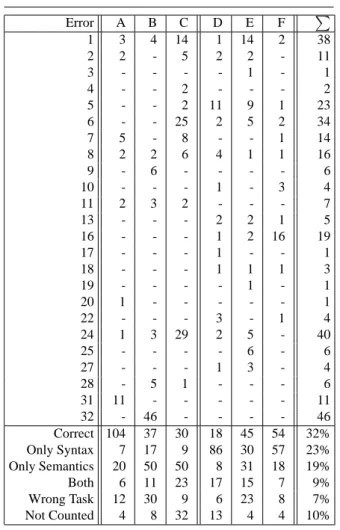
The above list is based on our experience from grad-ing a large number of exams and homeworks. Af-ter this error taxonomy was finished, we analyzed the SQL exercises in midterm and final exam of the course “Databases I” at the University of Halle, win-ter win-term 2003/04. The results are shown in Figure 1. The midterm exam had 153 participants (exercises A, B, C), and the final exam hat 148 participants (exer-cises D, E, F). Course material and exam exer(exer-cises are available from the project web page (see Con-clusions). We did sometimes count several unrelated semantic errors in the same exercise, but that did not oc-cur often. The number of exams that contained at least one semantic error is the sum of the entries “Only Se-mantics” and “Both”. Of course we counted only semantic errors from our above list, i.e. that are de-tectable without knowing the task of the query. “Wrong task” lists the number of exams that can only be de-tected as incorrect if the goal of the query is known. As can be seen, in the syntactically relatively simple ex-ercises of the midterm exam, there are many more exams with detectable semantic errors than with syn-tax errors. This demonstrates that the tool we are developing will be useful. “Not Counted” lists ex-ams that did not try the particular exercise, or that contained so severe syntax errors that looking at se-mantic errors in detail was not possible.
In the exams that were analyzed with this error tax-onomy, the most often occurring semantic errors are (percentages are relative to all detected semantic er-rors):
15,2 % 32. Many Duplicates 13,2 % 24. Missing Join Conditions 12,5 % 1. Inconsistent Conditions 11,2 % 6. Unnecessary Joins
7,6 % 5. Unused Tuple Vars 6,3 % 16. Singleton Groups
5,3 % 8. Implied etc. Subconditions
9. Related Work
It seems that the general question of detecting se-mantic errors in SQL queries (as defined above) is new. However, it is strongly related to the two fields of se-mantic query optimization and cooperative answering.
Semantic query optimization (see e.g. [3, 9, 2]), also tries to find unnecessary complications in the query, but otherwise the goals are different. As far as we know, no system prints a warning if the optimizations are “too
Error A B C D E F P 1 3 4 14 1 14 2 38 2 2 - 5 2 2 - 11 3 - - - - 1 - 1 4 - - 2 - - - 2 5 - - 2 11 9 1 23 6 - - 25 2 5 2 34 7 5 - 8 - - 1 14 8 2 2 6 4 1 1 16 9 - 6 - - - - 6 10 - - - 1 - 3 4 11 2 3 2 - - - 7 13 - - - 2 2 1 5 16 - - - 1 2 16 19 17 - - - 1 - - 1 18 - - - 1 1 1 3 19 - - - - 1 - 1 20 1 - - - 1 22 - - - 3 - 1 4 24 1 3 29 2 5 - 40 25 - - - - 6 - 6 27 - - - 1 3 - 4 28 - 5 1 - - - 6 31 11 - - - 11 32 - 46 - - - - 46 Correct 104 37 30 18 45 54 32% Only Syntax 7 17 9 86 30 57 23% Only Semantics 20 50 50 8 31 18 19% Both 6 11 23 17 15 7 9% Wrong Task 12 30 9 6 23 8 7% Not Counted 4 8 32 13 4 4 10%
Figure 1. Error Statistics for Two Exams
good to be true”. Also the effort for query optimization must be amortized when the query is executed, whereas for error detection, we would be willing to spend more time. Finally, soft constraints (that can have exceptions) can be used for generating warnings about possible er-rors. but not for query optimization.
Our work is also related to the field of cooperative query answering (see, e.g., [8, 5, 7]). However, there the emphasis is more on the dialogue between DBMS and user. As far as we know, a question like the possibility of runtime errors in the query is not asked. Also, there usu-ally is a database state given, whereas we do not assume any particular state. For instance, the CoBase system would try to weaken the query condition if the query returns no answers. It would not notice that the condi-tion is inconsistent and thus would not give a clear er-ror message. However, the results obtained there might help to suggest corrections for a query that contains this
type of semantic error.
The SQL Tutor system described in [11, 12] discov-ers semantic errors, too, but it has knowledge about the task that has to be solved (in form of a correct query). In contrast, our approach assumes no such knowledge, which makes it applicable also for software develop-ment, not only for teaching.
Further studies about errors in database queries, es-pecially psychological aspects, are [14, 13, 10, 6, 4].
10. Conclusions
There is a large class of SQL queries that are syntac-tically correct, but nevertheless certainly not intended, no matter what the task of the query might be. One could expect that a good DBMS prints a warning for such queries, but, as far as we know, no DBMS does this yet.
We are currently developing a tool “sqllint” for finding semantic errors in SQL queries. The list of er-ror types contained in this paper can serve as a specifi-cation of the task of this tool. We have algorithms for all of the error types (for a suitable SQL subset), but for space reasons, we could not present them here (see, however, the technical report [1]). The error checks can often be reduced to a consistency test. While the unde-cidability in the general case remains, we can at least use the mature methods of automated theorem prov-ing. We also have simpler, direct sufficient conditions for some of the errors. The current state of the project is reported at:
http://www.informatik.uni-halle.de /˜brass/sqllint/
In future work, we especially want to investigate pat-terns for SQL queries in greater detail (by analyzing a large collection of SQL queries from real projects).
The authors would be thankful for reports about any further semantic errors or violations of good style that are not treated in this paper.
Acknowledgements
We would like to thank the following persons, who all made important contributions to this work. Sergei Haller and Ravishankar Balike told us about Error 26. Joachim Biskup contributed the idea that query size es-timation techniques could be used. We had a very inter-esting and inspiring discussion with Ralph Acker about runtime errors. Elvis Samson developed the prototype of the consistency test. The discussions with Alexander
Hinneburg have been very helpful, especially he sug-gested further related work and gave us an example for an SQL query that is longer than an equivalent query, but runs faster.
References
[1] Stefan Brass, Christian Goldberg. Detecting Logical
Er-rors in SQL Queries. Technical Report, University of
Halle, 2004.
[2] Qi Cheng, Jarek Gryz, Fred Koo, Cliff Leung, Linqi Liu, Xiaoyan Qian, Bernhard Schiefer. Implementation of Two Semantic Query Optimization Techniques in DB2 Universal Database. Proceedings of the 25th VLDB
Con-ference, 687-698, 1999.
[3] U. S. Chakravarthy, J. Grant, and J. Minker. Logic-based approach to semantic query optimization. ACM
Trans-actions on Database Systems, 15:162–207, 1990.
[4] Hock C. Chan. The relationship between user query ac-curacy and lines of code. Int. Journ. Human Computer
Studies 51, 851-864, 1999.
[5] Wesley W. Chu, M.A. Merzbacher and L. Berkovich. The design and implementation of CoBase. In Proc. of
ACM SIGMOD, 517-522, 1993.
[6] Hock C. Chan, Bernard C.Y. Tan and Kwok-Kee Wei. Three important determinants of user performance for database retrieval. Int. Journ. Human-Computer
Stud-ies 51, 895-918, 1999.
[7] Wesley W. Chu, Hua Yang, Kuorong Chiang, Michael Minock, Gladys Chow and Chris Larson. Cobase: A scalable and extensible cooperative information system.
Journal of Intelligent Information Systems, 1996.
[8] Terry Gaasterland, Parke Godfrey and Jack Minker. An Overview of Cooperative Answering. Journal of Intelli-gent Information Systems 21:2, 123–157, 1992. [9] Chun-Nan Hsu and Craig A. Knoblock. Using inductive
learning to generate rules for semantic query optimiza-tion. In Advances in Knowledge Discovery and Data
Mining, pages 425–445. AAAI/MIT Press, 1996.
[10] W.J. Kenny Jih, David A. Bradbard, Charles A. Snyder, Nancy G.A. Thompson. The effects of relational and entity-relationship data models on query performance of end users. Int. Journ. Man-Machine Studies, 31:257– 267, 1989.
[11] A. Mitrovic. A knowledge-based teaching system for SQL. In ED-MEDIA 98, pages 1027–1032, 1998. [12] Antonija Mitrovic, Brent Martin, and Michael Mayo.
Using evaluation to shape its design: Results and ex-periences with SQL-Tutor. User Modeling and
User-Adapted Interaction, 12:243–279, 2002.
[13] A. Rizzo, S. Bagnara and Michele Visciola. Human er-ror detecting processes. Int. Journ. Man-Machine
Stud-ies 27, 555-570, 1987.
[14] C. Welty. Correcting user errors in SQL. International