NASA/CR-2007-214862
NIA Report No. 2007-05
Distributed Saturation
Ming-Ying Chung and Gianfranco Ciardo University of California, Riverside, California Radu I. Siminiceanu
National Institute of Aerospace (NIA), Hampton, Virginia
April 2007
The NASA STI Program Office . . . in Profile
Since its founding, NASA has been dedicated to the advancement of aeronautics and space science. The NASA Scientific and Technical Information (STI) Program Office plays a key part in helping NASA maintain this important role.
The NASA STI Program Office is operated by Langley Research Center, the lead center for NASA’s scientific and technical information. The NASA STI Program Office provides access to the NASA STI Database, the largest collection of aeronautical and space science STI in the world. The Program Office is also NASA’s institutional mechanism for
disseminating the results of its research and
development activities. These results are published by NASA in the NASA STI Report Series, which includes the following report types:
• TECHNICAL PUBLICATION. Reports of completed research or a major significant phase of research that present the results of NASA programs and include extensive data or theoretical analysis. Includes compilations of significant scientific and technical data and information deemed to be of continuing reference value. NASA counterpart of peer-reviewed formal professional papers, but having less stringent limitations on manuscript length and extent of graphic presentations.
• TECHNICAL MEMORANDUM. Scientific and technical findings that are preliminary or of specialized interest, e.g., quick release reports, working papers, and bibliographies that contain minimal annotation. Does not contain extensive analysis.
• CONTRACTOR REPORT. Scientific and technical findings by NASA-sponsored contractors and grantees.
• CONFERENCE PUBLICATION. Collected papers from scientific and technical
conferences, symposia, seminars, or other meetings sponsored or co-sponsored by NASA.
• SPECIAL PUBLICATION. Scientific,
technical, or historical information from NASA programs, projects, and missions, often
concerned with subjects having substantial public interest.
• TECHNICAL TRANSLATION. English-language translations of foreign scientific and technical material pertinent to NASA’s mission. Specialized services that complement the STI Program Office’s diverse offerings include creating custom thesauri, building customized databases, organizing and publishing research results ... even providing videos.
For more information about the NASA STI Program Office, see the following:
• Access the NASA STI Program Home Page at
http://www.sti.nasa.gov
• E-mail your question via the Internet to [email protected]
• Fax your question to the NASA STI Help Desk at (301) 621-0134
• Phone the NASA STI Help Desk at (301) 621-0390
• Write to:
NASA STI Help Desk
NASA Center for AeroSpace Information 7115 Standard Drive
NASA/CR-2007-214862
NIA Report No. 2007-05
Distributed Saturation
Ming-Ying Chung and Gianfranco Ciardo University of California, Riverside, California Radu I. Siminiceanu
National Institute of Aerospace (NIA), Hampton, Virginia
National Aeronautics and Space Administration
Langley Research Center Prepared for Langley Research Center
Hampton, Virginia 23681-2199 under Cooperative Agreement NCC1-02043
Available from:
NASA Center for AeroSpace Information (CASI) National Technical Information Service (NTIS)
7115 Standard Drive 5285 Port Royal Road
Hanover, MD 21076-1320 Springfield, VA 22161-2171
DISTRIBUTED SATURATION
Ming-Ying Chung, ∗ Gianfranco Ciardo, † and Radu I. Siminiceanu ‡ §
ABSTRACT
TheSaturation algorithm for symbolic state-space generation, has been a recent break-through in the exhaustive verification of complex systems, in particular globally-asyn-chronous/locally-synchronous systems. The algorithm uses a very compact Multiway Decision Diagram (MDD) encoding for states and the fastest symbolic exploration algo-rithm to date. The distributed version of Saturation uses the overall memory available on a network of workstations (NOW) to efficiently spread the memory load during the highly irregular exploration. A crucial factor in limiting the memory consumption during the symbolic state-space generation is the ability to performgarbage collection
to free up the memory occupied by dead nodes. However, garbage collection over a NOW requires a nontrivial communication overhead. In addition, operation cache poli-cies become critical while analyzing large-scale systems using the symbolic approach. In this technical report, we develop a garbage collection scheme and several opera-tion cache policies to help on solving extremely complex systems. Experiments show that our schemes improve the performance of the original distributed implementation,
SmArTNow, in terms of time and memory efficiency.
1 INTRODUCTION
Formal verification techniques such as model checking and theorem proving have become widely used in industry for quality assurance, as they can be used to detect errors early in the design lifecycle. State-space generation, also called reachability analysis, is an essential but very memory-intensive step in model checking. The increasing complexity of system designs stresses the limits of most model checkers. Even though symbolic state-space encodings based onbinary decision diagrams (BDDs) [2] and multiway decision diagrams (MDDs) [20] help cope with the inherent state-space explosion of discrete-state systems, the analysis of some industrial size models may still rely on the use of virtual memory. Our discussion regarding state-space generation focuses on symbolic state-space generation.
A natural way to deal with the excessive memory consumption of reachability analysis is using parallel and distributed approaches. Most of the research in this area has been focused onvertical slicing schemes to parallelize BDD manipulations, by decomposing boolean func-tions lines and distributing the computation over a NOW [18, 21, 25]. This scheme allows algorithms to overlap the image computation (the application of the next-state function to a set of states encoded by a decision diagram node), but the distributed state-space generation is still synchronous, consisting of interleaved rounds of computation and communication, in which the fastest or the most lightly loaded workstation must wait for the heavily loaded ones
∗University of California, Riverside, CA 92521. Email:[email protected] †University of California, Riverside, CA 92521. Email:[email protected]
‡National Institute of Aerospace, 100 Exploration Way, Hampton VA, 23666. E-mail:[email protected] §This work was supported in part by the National Aeronautics and Space Administration under the
at the end of each round. Thus, the global synchronization required at the end of each round is detrimental to this scheme in terms of scalability. To overcome this drawback, Grumberg et al [17] introduced an asynchronous version of the vertical slicing approach which not only performs image computation and message passing concurrently, but also incorporates an adaptive mechanism taking into account the availability of free computational power to split workload.
In [5], we instead use MDDs and partition them horizontally onto a NOW, so that each workstation exclusively owns a contiguous range of MDD levels. Therefore, the memory re-quired for state-space encoding is mutually exclusively partitioned onto workstations. Since the horizontally distributed state-space generation does not create any redundant or du-plicate work at all, synchronization is avoided. Furthermore, within the horizontal slicing scheme, only peer-to-peer communication between neighboring workstations is used, so scal-ability is not an issue. However, this approach comes with a severe tradeoff. Given the highly optimized nature of saturation, which was designed as a sequential algorithm, only one work-station is active at anytime, hence the distributed computation is virtually sequentialized. This leaves only limited opportunities for speedup. To tackle this drawback, in [6, 7], we introduced an idea to speedup distributed state-space generation by using workstations’ idle time to speculatively perform image computations.
Also, during distributed state-space generation, performing garbage collection for dead MDD nodes over a NOW requires a nontrivial communication overhead. In addition, MDD cache policies become relatively critical in a large-scale symbolic reachability analysis. Thus, in this paper, we develop a garbage collection scheme and several operation cache policies to help on solving extremely complex systems. The paper is organized as follows. Sect. 2 gives the necessary background on state-space generation, decision diagrams, Kronecker encoding, and the evolution of saturation algorithm. Sect. 3 details our new garbage collection scheme tailor-made for distributed state-space generation. Sect. 4 discusses several operation cache policies which might help on solving complex systems. Sect. 5 shows experimental results. Sect. 6 draws conclusions and discusses future research directions.
2 BACKGROUND
A discrete-state model is a triple (Sb,sinit,N), where Sb is the set of potential states of the
model, sinit∈Sbis theinitial state, andN :S →b 2Sbis thenext-state function specifying the
states reachable from each state in a single step. We assume that the model is composed of K submodels. Thus, a (global) state i is a K-tuple (iK, ...,i1), where ik is the local state
of submodel k, K ≥ k ≥ 1, and Sb = SK × · · · × S1 is the cross-product of K local state spaces. This allows us to use techniques targeted at exploiting system structure, in particular, symbolic techniques to store the state space based on decision diagrams.
Since we target globally-asynchronous locally-synchronous systems, we decompose N
into a disjunction of next-state functions [4]: N(i) = Se∈ENe(i), where E is a finite set of
events and Ne is the next-state function associated with event e. We then seek to build
the (reachable) state space S ⊆Sb, the smallest set containing sinit and closed with respect
toN: S ={sinit} ∪ N(sinit)∪ N(N(sinit))∪ · · ·=N∗(sinit), where “∗” denotes reflexive and
2.1 Symbolic encoding of S
In the sequel, we assume that each Sk is known a priori. In practice, the local state
spaces Sk can actually be generated “on-the-fly” by interleaving symbolic global
state-space generation with explicit local state-state-space generation [12]. We then use the mappings ψk :Sk→ {0,1, . . . , nk−1}, withnk=|Sk|, identify local state ik with its index ik=ψk(ik),
thusSk with {0,1, . . . , nk−1}, and encode any set X ⊆Sbin a(quasi-reduced ordered) MDD
over Sb. Formally, an MDD is a directed acyclic edge-labeled multi-graph where:
• Each node p belongs to a level k ∈ {K, ...,1,0}, denoted p.lvl.
• There is a single root noder at level K.
• Level 0 can only contain the twoterminal nodes Zero and One.
• A node p at level k > 0 has nk outgoing edges, labeled from 0 to nk−1. The edge
labeled by ik points to a node q at level k−1; we write p[ik] = q.
• Given nodesp andq at level k, ifp[ik] = q[ik] for all ik∈ Sk, thenp=q, i.e., there are
noduplicates.
The MDD encodes a set of states B(r), defined by the recursive formula:
B(p) = S ik∈Sk{ik} × B(p[ik]) if p.lvl =k > 1 {i1 :p[i1] = One} if p.lvl = 1 .
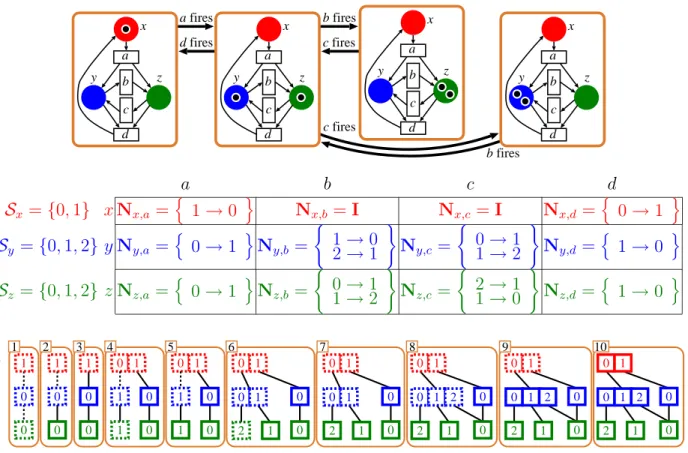
For example, box 10 at the bottom of Fig. 1 shows a five-node MDD with K = 3 encoding four global states: (0,0,2), (0,1,1), (0,2,0), and (1,0,0). In our MDDs, arcs point down and their label is written in a box in the node from where the arc originates; the terminal nodes Zero and One and nodes p such that B(p) = ∅, as well as any arc pointing to them, are omitted.
Compared with BDDs, MDDs have the disadvantage of resulting in larger and less share-able nodes when the varishare-able domains Sk are very large. On the other hand, MDDs have
several advantages. First, many real-world models (e.g., non-safe Petri nets and software protocols) have variable domains with a priori unknown or very large upper bounds. These bounds must then be discovered “on the fly” during the symbolic iterations [12, 14], and MDDs are preferable to BDDs when using this approach, due to the ease with which MDD nodes and variable domains can be extended. A second advantage, related to the present paper, is that our chaining heuristics applied to the MDD state variables more closely reflect structural information of the model behavior, which is instead spread on multiple levels in a BDD.
2.2 Symbolic encoding of N
ForN, we adopt a Kronecker representation inspired by work on Markov chains [3], possible if the model isKronecker consistent [10, 11]. EachNeis conjunctively decomposed intoKlocal
next-state functions Nk,e, for K ≥ k ≥ 1, satisfying, in any global state (iK, . . . , i1) ∈ Sb, Ne(iK, . . . , i1) = NK,e(iK) × · · · × N1,e(i1). Using K · |E| matrices Nk,e ∈ {0,1}nk×nk,
with Nk,e[ik, jk] = 1 ⇔ jk ∈ Nk,e(ik), we encode Ne as a (boolean) Kronecker product:
j ∈ Ne(i) ⇔
N
x y z a b c d x y z a b c d x y z a b c d x y z a b c d b fires b fires c fires c fires d fires a fires a b c d Sx ={0,1} xNx,a = n 1→0 o Nx,b =I Nx,c=I Nx,d = n 0→1 o Sy ={0,1,2}yNy,a= n 0→1 oNy,b = ( 1→0 2→1 ) Ny,c = ( 0→1 1→2 ) Ny,d= n 1→0 o Sz ={0,1,2} zNz,a= n 0→1 oNz,b = ( 0→1 1→2 ) Nz,c = ( 2→1 1→0 ) Nz,d = n 1→0 o 0 0 x y z 1 0 0 1 0 0 1 1 2 3 4 5 6 7 8 9 10 0 1 0 0 0 2 1 1 2 0 1 0 0 0 2 1 1 2 0 1 0 0 0 2 1 1 2 0 1 0 0 0 2 1 1 0 1 0 0 0 2 1 1 1 1 0 1 0 0 1 1 0 1 0 0
Figure 1: Reachability graph,Sx,Sy,Sz, and N, evolution of the MDD,
in Sb and N indicates the Kronecker product of matrices. The Nk,e matrices are extremely
sparse, for standard Petri nets, each row contains at most one nonzero entry.
For example, the middle of Fig. 1 shows the Kronecker encoding ofN according to events (a, b, c, d) and levels (x, y, z), listing only the nonzero entries, e.g.,
Ny,b= 1→0 2→1 means Ny,b= 0 0 01 0 0 0 1 0
and Ny,b[1,0] = 1 indicates that if the local state at level y is 1, event b is locally enabled
and firing b, if globally possible, moves the local state from 1 to 0.
2.3 Saturation-based iteration strategy
In addition to efficiently representingN, the Kronecker encoding allows us to recognizeevent locality [10, 22] and employ saturation algorithm [11]. We say that event e is independent of level k if Nk,e = I, the identity matrix. Let Top(e) and Bot(e) denote the highest and
lowest levels for which Nk,e 6= I. An MDD node p at level k is said to be saturated if it is
a fixed point with respect to all Ne such that Top(e) ≤ k, i.e., SK × · · · × Sk+1 × B(p) ⊇ N≤k(SK× · · · × Sk+1× B(p)), whereN≤k =Se:Top(e)≤kNe. To saturate MDD nodeponce all
its descendants have been saturated, we update it in place so that it encodes also any state inNk,e× · · · × N1,e(B(p)), for any event esuch that Top(e) =k. This can create new MDD
nodes at levels belowk, which are saturated immediately, prior to completing the saturation of p.
If we start with the MDD encoding the initial state sinit and saturate its nodes bottom up, the rootr will encode S =N∗(sinit) at the end, because: (1)N∗(sinit)⊇ B(r)⊇ {sinit},
since we only add states, and only through legal event firings, and (2) B(r)⊇ N≤K(B(r)) =
N(B(r)), since r is saturated.
The reachability graph of a three-place Petri net is shown at the top of Fig. 1. A global state is described by the local state of place x, y, and z, in that order, and we index local states by the number of tokens in the corresponding place. Three global states, (0,1,1), (0,0,2), and (0,2,0), are reachable from the initial state (1,0,0). The three local state spaces and the Kronecker description of N are shown in the middle of Fig. 1. The list of nonzero entries for matrix Ny,b, for example, indicates that firing event b decreases the number of
tokens in place y, either from 2 to 1 or from 1 to 0; it also indicates thatb is disabled when place y contains 0 tokens, as no transition is listed from local state 0. The saturation-based state-space generation of this model is shown at the bottom of Fig. 1, where solid MDD nodes are saturated and dashed MDD nodes are not.
1 Initial configuration : Set up the MDD encoding the initial global state (1,0,0). 2 Saturate node 0 at level z : No action is required, since there is no event with
Top(event) = z. The node is saturated by definition.
3 Saturate node 0 at level y : Top(b) =Top(c) =y, but neitherb norcare enabled at both levels y and z, Thus, no firing is possible, and the node is saturated.
4 Saturate node 1 at levelx : Top(a) =x anda is enabled for all levels, thus event a must be fired on the node. Since, by firing event a, local state 1 is reachable from 0 for both levels yand z, node 1 at levely and node 1 at levelz, are created (not yet saturated), This also implies that a new global state, (0,1,1), is discovered.
5 Saturate node 1 at level z : Again, no action is required as the node is saturated by definition.
6 Saturate node 1 at level y : Top(b) =y and b is enabled for all levels, thus event b must be fired on the node. Since, by firing event b, local state 0 is reached from 1 at level y and local state 2 is reached from 1 at level z, node 1 at levely is extended to 01 and node 2 at level z is created. This also implies that a new global state, (0,0,2), is discovered.
7 Saturate node 2 at level z : Again, no action is required, as the node is saturated by definition.
8 Saturate node 01 at level y : Top(c) = yand cis enabled for all levels, thus event cmust be fired on the node. Since, by firing eventc, local state 2 is reachable from 1 at level y and local state 0 is reachable from 1 at level z, node 01 at level y is extended to 012 and node 0 at level z, which has been created and saturated previously, is referenced. This also implies that a new global state, (0,2,0), is discovered.
9 Saturate node 012 at level y : After exploring all possible firings, the node is saturated.
10 Saturate node 01 at level x : Since no firing can find new global states, the root is saturated.
Saturation consists of many “lightweight” nested “local” fixed-point image computations and is completely different from the traditional breadth-first approach that employs a single “heavyweight” global fixed-point image computation. No matter whether the chaining idea is applied or not, results in [11, 12, 13, 14, 8] consistently show that the saturation ap-proach outperforms the breadth-first apap-proach of symbolic state-space generation by several orders of magnitude in both memory and time, making it arguably the most efficient state-space generation algorithm for globally-asynchronous locally-synchronous discrete event sys-tems. Thus, it makes sense to attempt its parallelization, while parallelizing the less efficient breadth-first approach would not offset the enormous speedups and memory reductions of saturation approach.
2.4 Saturation NOW
[5] described a message-passing algorithm,Saturation NOW, that distributes the MDD nodes encoding states over a NOW, to study large models where a single workstation would have to rely on virtual memory to explore the state space. On a NOW withW ≤K workstations numbered from W down to 1, each workstation w has two neighbors: one “below”, w−1 (unless w = 1), and one “above”, w + 1 (unless w = W). Initially, we evenly allocate the K MDD levels to the W workstations accordingly, by assigning the ownership of levels
bw·K/Wcthroughb(w−1)·K/Wc+1 to workstationw. Local variablesmytopw andmybotw indicate the highest- and lowest-numbered levels owned by workstation w, respectively.
For distributed state-space generation, each workstation w first generates the Kronecker matricesNk,e for those events and levels whereNk,e 6=Iandmytopw ≥k ≥mybotw, without
any synchronization. Then, the sequential saturation algorithm begins, except that, when workstationw >1 would normally issue a recursive call to levelmybotw−1, it must instead
send a request to perform this operation in workstationw−1 and wait for a reply. A linear organization of the workstations suffices, since each workstation only needs to communicate with its neighbors.
3 DISTRIBUTED GARBAGE COLLECTION
The implementation of garbage collection in SmArT follows the cleanup procedure based on reference counts where each decision diagram node has a counter to record the number of references: the number of the incoming arcs to the node. A node’s reference counter decreases by one whenever one of its parents node dereferences it. Whenever the reference counter of a node is becomes zero, any following cleanup invocation will delete the node and remove it from the corresponding unique table. Then, a garbage collection call will recycle the free space using level-based recycling pools. If the strict policy of garbage collection is used in SmArT, any dereference may proceed recursively down to the bottom level of decision diagrams. Although a deeper recursive dereference can contribute to freeing up more memory, it can be much costly in terms of runtime as well. So, to relax this policy, SmArTallows users to forbid the garbage collection to be triggered until the number of dead nodes reaches some given threshold.
However, updating the reference counters within the decision diagram during distributed state-space generation over a NOW requires a non-trivial amount of messages passing among workstations. We therefore prefer to skip the costly bookkeeping effort on maintaining up-to-date reference counters, in order to avoid the communication overhead. Yet, when the
w=3 w=2 w=1 mytop = 6 mybot = 5 mytop = 4 mybot = 3 mytop = 2 mybot = 1 3 3 2 2 1 1 0 1 2 3 2 1 2 3 0 1 0 1 2 0 1 1 0 1 2 0 1 2 0 2 2 1 2 0 1 2 0 1 0 1 2 0 1 2 0 1 0 1 2 3 2 1 2 3 0 1 0 1 2 0 1 1 0 1 2 0 1 2 2 1 2 0 1 2 0 1 2 0 1 2 0 1 0 1 2 3 2 1 2 3 0 1 1 0 1 2 2 0 1 2 0 1 2 0 1 2 0 1
Figure 2: Garbage collection example
overall memory consumption reaches some given threshold, we perform distributed cleanup by freezing state-space exploration temporarily to deal with the disconnected nodes at run-time. Without the up-to-date reference counters, the distributed cleanup issued at the kth level needs to perform a scan at the previous level, reading through allk+1th nodes’ outgoing arcs, to determine the referencing information of the kth nodes. To overlap the distributed cleanup and referencing information retrieval, it makes sense to clean up several consecutive levels at a time in a top-down fashion. Thus, our distributed garbage collection triggers a series of distributed cleanups starting at the kth level to recycle disconnected nodes at any level equal to or lower than the kth. In general, the higher level the distributed cleanup is
invoked at, the more communication overhead may be introduced.
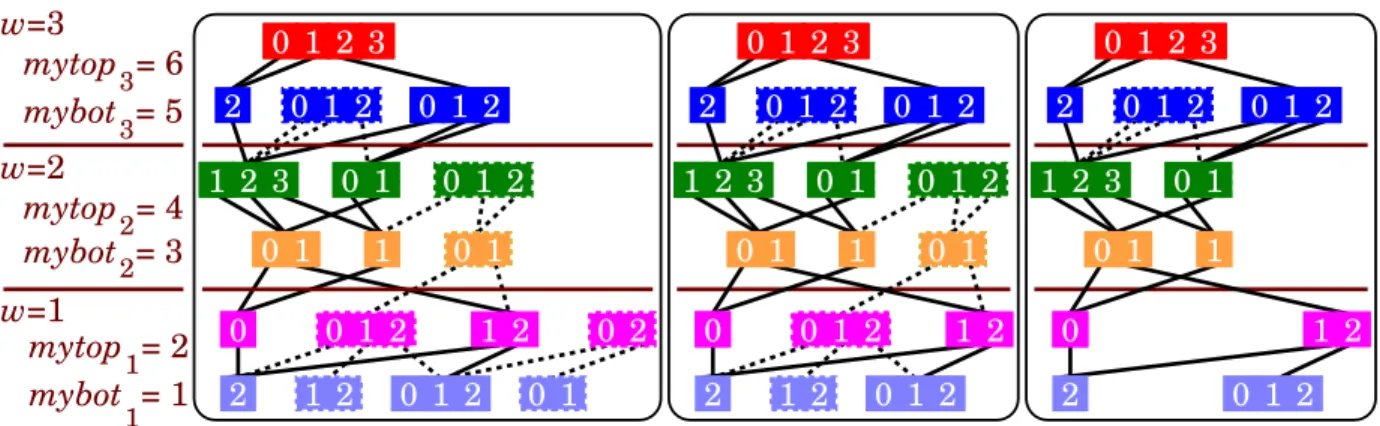
The left of Fig. 2 shows a runtime snapshot of a six-level decision diagram distributed over three workstations where each workstation manages two levels of the MDD. The dashed boxes and lines indicate the disconnected nodes. The middle of Fig. 2 shows the decision diagram resulting when the two bottom workstations (w = 2 and 1) perform distributed cleanup on the decision diagram shown in the left of Fig. 2 starting at level 2. In this case, one node at level 2 and one node at level 1 have been cleaned out. The right of Fig. 2 shows the decision diagrams resulting when three workstations perform distributed cleanup on the same decision diagram but starting at level 4 instead. In this case, four nodes have been removed.
4 OPERATION CACHE POLICIES
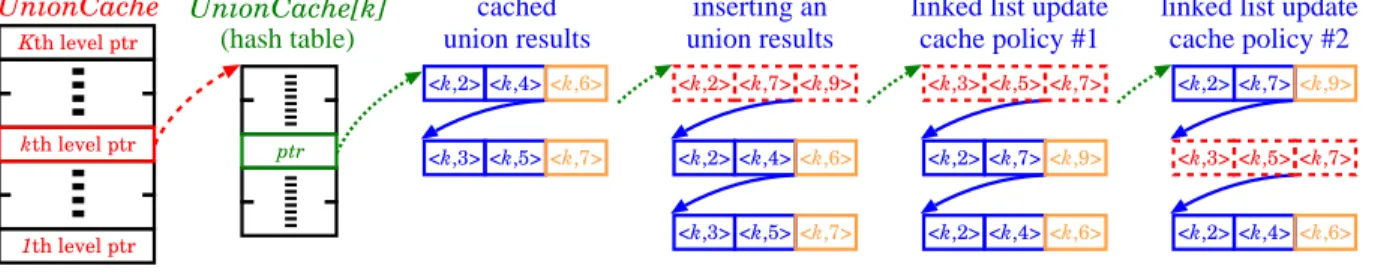
The main reason why symbolic model checking can outperform the explicit approach is that the implicit state-space construction allows nodes to share not only their children roots of isomorphic decision diagrams (memory efficient) but also the computation corresponding to each of those children (time efficient). To efficiently share the computation during symbolic state-space generation, hashing is considered to be one of the most effective way to cache computed data dynamically. However, a good hashing can still create identical hash values for distinct entries. To cope with this so-calledhash-collisionissue, we use collision-tolerating hash tables: multiple entries having identical hash value are stored together using a linked list.
In detail, in each collision-tolerating hash table, we use a singly linked list to store each set of entries having identical hash value. For each level of decision diagrams, we use such
UnionCache Kth level ptr UnionCache[k] (hash table) ptr <k,2> <k,4><k,6> <k,3> <k,5><k,7> cached union results <k,2> <k,7> <k,9> <k,2> <k,4><k,6> <k,3> <k,5><k,7> <k,3> <k,5> <k,7> <k,2> <k,7><k,9> <k,2> <k,4><k,6> <k,2> <k,7><k,9> <k,3> <k,5> <k,7> <k,2> <k,4><k,6> inserting an union results
linked list update cache policy #1
kth level ptr
1th level ptr
linked list update cache policy #2
Figure 3: Union caches
a collision-tolerating hash table for each kind of operation (union, fire) and rehash each of the tables whenever the projected number of collisions becomes too large. Fig. 3 shows the data structure that we use to cache the results of union operation during distributed state-space generation. The fourth column of Fig. 3 shows an example that caching a newly computed result, the union ofhk,2ihk,7i → hk,9i, having same hash value as the the union of hk,2ihk,4i and the union of hk,3ihk,5i. In this case, three entries are stored in the same linked list.
Yet, during symbolic state-space generation, the collision toleration described previously may hold up any cache-related operation and slowdown the overall computation, because any hash table lookup might end up searching in a linked list. An alternative way to ease the hash-collision issue is to perform rehashing: enlarging each hash table as needed to decrease the chance of hash collision. Yet, excessive rehashing can be very memory consuming as well. Thus, we tend to use a hybrid solution in our application.
4.1 Bounded-rehashing and bounded-collision caches
We develop a bounded-rehashing and bounded-collision cache policy to facilitate all cache-related operations.
In detail, for each collision-tolerating hash table, we keep track of MaxCollision, the maximal size of linked lists used in the table, indicating that the time to retrieve any entry (might end up searching in a linked list) is O(MaxCollision). Whenever some hash table’s MaxCollision exceed the given threshold, MaxAllowedCollision, we rehash the table by dou-bling the size of the table. To prevent overusing memory for caching computed results, we prohibit rehashing a table if the size of the table has exceeded another given threshold, RehashThreshold. To preserve that the data retrieval time of the caches is asymptotically bounded, we restrict MaxCollision ≤ MaxAllowedCollision: the size of linked lists used in any hash table is limited to MaxAllowedCollision. In other words, the maximal number of entries having identical hash value is alwaysMaxAllowedCollision no matter whether the size of the hash table has exceeded RehashThreshold or not. So, the time to retrieve a cached entry is also O(MaxAllowedCollision).
After all, to bound the size of the linked lists once they are full, we always update linked lists by inserting the new element at the front and removing the last one. Also, the maximal values of MaxAllowedCollision and RehashThreshold allowed in a distributed program can be much larger than those used in a sequential program.
4.2 Policies of single-level caches
Since the number of elements allowed to be stored in each linked list is limited, deciding how to sift out the less useful element is an issue. An entry is said to be a cache-hit if it is retrieved by some hash table lookup. To take the usefulness of entries into account, we need some cache policy to preserve those frequently cache-hit entry which means to keep them in the firstMaxAllowedCollision elements of the corresponding linked list.
LRU, a frequently used policy, treats any newly cache-hit entry the same as a newly cached one: moving every newly retrieved element to the front of the corresponding linked list. Yet, this policy treats every cache-hit entry equally no matter how often each of them has been retrieved. So, another idea is to switch the newly cache-hit entry with its previous one. The last two columns of Fig. 3 show how a linked list will be updated following this two policies after the result of the union of hk,3ihk,5i → hk,7i is cache-hit. After all, while using either of these two policies, the time to retrieve each cached entry is still
O(MaxAllowedCollision).
5 RESULTS
5.1 Experiments of bounded rehashing scheme
We evaluated the rehashing heuristic by using the saturation algorithm to generate the state space of the following parameterized models.
• Round robin mutex protocol (Robin) [16] models the round robin solution of a mutual exclusion problem whereN is the number of processes involved.
• Flexible manufacturing system (FMS) [22] models a manufacturing system with three machines to process three different types of parts whereN is the number of each type of parts.
• Slotted ring network protocol (Slot) [23] models a local area network protocol where N is the number of nodes in the network.
• Leader election protocol (Leader) [19] models a protocol for designating a unique processor as the leader by sending messages along a unidirectional ring ofN processors.
• Aloha network protocol (Aloha) [9] models a local area network protocol where N is the number of nodes in the network.
• Kanban manufacturing system (Kanban) [26] models a manufacturing system autho-rizing production based on the consumption at the downstream stations where N is the admission threshold to each machine.
• Bounded open queuing network (BQ) [15] models an open queuing network where the capacity of the queue is bounded by N.
• Knights problem(Knight) models the problem of determining how many non-attacking knights can be placed on an N ×N chessboard.
Model N Cache Time (sec) Memory (mgb) Rehash
init max HashI HashM DHash HashI HashM DHash (times)
Robin 600 100 50K 41 34 37 326 555 349 2677 FMS 250 100 100K 174 55 56 103 240 108 62 Slot 150 100 100K 122 97 104 210 324 233 1302 Leader 7 100 100K 123 12 15 147 205 172 684 Aloha 70 100 500K 85 12 16 227 502 255 699 Kanban 60 100 1M 124 16 16 60 175 69 143 BQ 40 100 1M 102 58 60 97 120 106 43 Knight 6 100 1M 160 9 12 69 336 123 370 Queen 12 1000 1M 22 10 11 65 149 72 35 RIPS 14444 1000 10M 567 113 127 168 854 516 124
Table 1: Experimental results of rehashing.
• Queens puzzle (Queen) models the game of placing 8 queens on an N×N chessboard so that none of them can hit any other in one move.
• Runway safety monitor (RIPS) [24] models an avionics system monitoring T targets with S speeds on a grid represented as aX×Y ×Z grid.
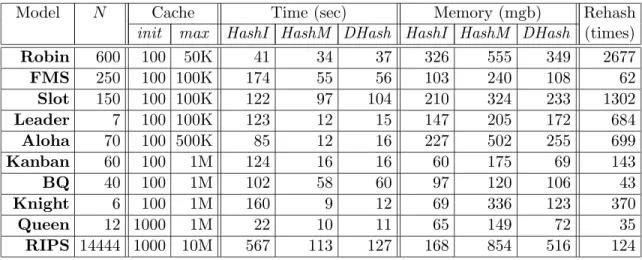
Table 1 shows the experimental study performed on a Pentium IV 3GHz workstations with 1GB of RAM. The first two columns show the model names and the corresponding parameters used for this evaluation. The third and fourth columns indicate the initial size (init) of hash tables and the maximal size (max) allowed for rehashing. The next six columns present the time and memory consumption of three different approaches: fixed-size hashing using init, fixed-size hashing using max, dynamic hashing using init and then allowing to rehash untilmax is researched, denoted as HashI,HashM, and DHash respectively. The last column shows the number of rehashing has been performed while experimenting DHash.
In Table 1, we can see that HashI is always the most memory efficient approach and HashM is always the most time efficient one. However, in all cases, the memory consump-tion of DHash can be as low as HashI’s, while the runtime of DHash being very close to HashM’s Note that, the tradeoff in performing dynamical rehashing (shown in the last col-umn of Table 1) is the runtime difference betweenHashM and DHash which is insignificant. Additionally, the high memory consumption of DHash implies that excessive unbounded re-hashing can be expensive and unrealistic. In conclusion, the experiment shows that rere-hashing works well in many cases making the bounded rehashing idea more practical.
5.2 Experiments for the message-passing implementation
This experimental study ofSmArTand SmArTNow onRobin andSlotwas performed on Sci-clone [1] cluster at the College of William and Mary consisting many different heterogeneous subclusters. We used the Whirlwind (homogeneous) subcluster which consists of 64 single-cpu Sun Fire V120 nodes (UltraSPARC IIi+ 650 MHz, 1 GB RAM) connecting by Myrinet and running Solaris 9 with LAM/MPI on TCP/IP. Three parameters selected for both mod-els represents the small, medium, and large cases of symbolic state-space generation, where the sequential program requires≈100MB,≈500MB and≈900MB to accomplish the tasks.
the parameter of the input model 120 60 64 32 16 8 4 2 1 66K 33K 2K second(s) N = 200 mem all mem used runtime 700 350 64 32 16 8 4 2 1 66K 33K 8K 4K N = 700 1.4K 0.7K 64 32 16 8 4 2 1 66K 33K 12K 6K mega byte(s) N = 1000 time diff mem diff
the number of workstation
Figure 4: Experiments on Robin
For each test case, we run SmArTNow on 1, 2, 4, 8, 16, 32, and 64 workstation(s) and record the runtime (the pointed lines corresponding to the left axes) in seconds and the used and the total NOW memory (filled and dashed boxes corresponding to the right axes) in megabytes . To see the actual overhead of the distributed approach, we use the memory information reported by the operating system (information retrieved from /proc). Also, we use fixed-size hashing to test all cases, even though, in comparison to SmArT, running SmArTNow on a NOW will have more memory for rehashing to accelerate the computation
Fig. 4 and 5 show that, when the RAM of a single workstation is sufficient to run the test case, the runtime of SmArT is better than that of SmArTNow on multiple workstations. The message-passing overhead, while not huge, is not trivial either. In the small test cases, the runtime of SmArTNow is few times larger than that of SmArT. However, the difference diminishes as the model size grows, even way before memory swapping becomes an issue. Indeed, such huge differences arise even when comparingSmArTNowwith itself using different values of W. Considering the case of ROBIN N = 1000, the optimal number Wopt of
workstations to use is 4. In the right of Fig. 4, the runtime difference was indicated by red solid-arrows and the memory consumption difference was indicated by pink dashed-arrows. In detail, SmArT rarely triggers memory swapping where 862MB of memory was used in a single machine and SmArTNow does not use virtual memory at all where 1026MB of NOW memory was used over four network-connected machines.
In addition, while suchWopt cannot be known a priori, the results clearly show that using
too many workstations affects the runtime only by a small factor, while using too few, or just one, results in very large penalties, if the algorithm completes at all. Considering the case of
ROBIN N = 1000 again, the runtime penalty of using W = 1 < Wopt is even higher than
that of using W = 32. Furthermore, even though the runtime penalty of using W > Wopt
is not trivial, the difference between the pinked shaded boxes and the blue dashed boxes indicate the large amount of NOW memory leftover which can be used for model checking or some anticipation for accelerating the computation.
the parameter of the input model 500 250 64 32 16 8 4 2 1 66K 33K 1.4K second(s) N = 100 mem all mem used runtime 2.6K 1.3K 64 32 16 8 4 2 1 66K 33K 2.8K N = 200 4.6K 2.3K 64 32 16 8 4 2 1 66K 33K 3.8K mega byte(s) N = 250
the number of workstation
Figure 5: Experiments on Slot
After all, Robin and Slot are two of the average-case problems for our distributed algorithm. However, the scalability of our current implementation of distributed saturation is restricted by the number of partitions of the input model: the number of workstations we used,W, cannot exceed the number of MDD levels, K. In the other words, the ownership of each MDD level is exclusive among workstations, although these ownership can be transfered between workstations. So, this two models are selected simply because they have more than 64 MDD levels. Yet, this drawback can be resolved by allowing multiple workstations managing the same MDD level but then additional communication overhead is required for maintaining the canonicity of MDD nodes over workstations. In the end, the experiment of the two cache policies merely show a small improvement in comparison to our original implementation.
6 CONCLUSIONS AND FUTURE RESEARCH DIRECTIONS
We designed and implemented a new version of the distributed symbolic state-space genera-tor,SmArTNow, whose level-based node allocation scheme achieves excellent memory distribu-tion and scalability over NOWs. Thanks to the ever increasing network speed, our approach effectively provides the large amounts of memory needed when studying large systems, al-though it offers no theoretical speedup. Also, the cache heuristics speed up our algorithm and make the performance of the distributed approach more convincing.
Some future research directions are discussed below.
6.1 Two-level cache policies
Since the single-level cache policy mixes up the newly cached entries and the cache-hit entries, it might offset the idea of distinguishing the usefulness of each entry. In detail, the cache policy to distinguish the entries according to how frequent each of them has been retrieved makes more sense if the comparison is only among those cache-hit ones. Also, heavy element insertion might cancel out the usefulness of bookkeeping corresponding to some key. Thus,
2LUnionCache Kth level L1 ptr UnionCacheL1[k] ptr <k,2> <k,4><k,6> <k,3> <k,5><k,7> cached union results <k,2> <k,7> <k,9> <k,2> <k,4><k,6> <k,3> <k,5><k,7> <k,3> <k,5> <k,7> kth level L1 ptr 1th level L2 ptr 1th level L2 ptr kth level L2 ptr Kth level L2 ptr UnionCacheL2[k] ptr <k,1> <k,2><k,5> <k,1> <k,4><k,8> cache-hit union results <k,2> <k,7><k,9> <k,2> <k,4><k,6> <k,1> <k,2><k,5> <k,1> <k,4><k,8> <k,1> <k,2><k,5> <k,1> <k,4><k,8> adding an union results
linked list update after a L2 cache-hit
<k,2> <k,7><k,9>
<k,2> <k,4><k,6> linked list update after a L1 cache-hit
<k,1> <k,2><k,5>
<k,1> <k,4> <k,8>
<k,3> <k,5><k,7>
Figure 6: 2-levels union caches
we suggest a two-level operation cache (L1 and L2) : L1 cache is used to store cache-hit entries; L2 cache is used to store newly cached entries. A newly computed result will be cached in L2 initially. Once some L2-cached entry is cache-hit, it will be moved to L1 cache. If an entry stored in L1 cache is cache-hit, its position will be changed. Fig. 6 shows the new structure we use to cache union operations. The three examples shown in the last three columns of Fig. 6 are: caching a newly computed result, the union of hk,2ihk,7i is hk,9i, sharing a key with the union ofhk,2ihk,4iand the union ofhk,3ihk,5i; the update following an L2 cache hit on the result of the union of hk,3ihk,5i; the update following an L1 cache hit on the result of the union of hk,1ihk,4i. After all, the time to access each entry stored in this new hash table is stillO(MaxAllowedCollision).
6.2 Parallel version of SmArTNow
In [6], we introduced the idea of utilizing idle workstation time by firing events e with Top(e)> k on saturated MDD nodes at level k a priori. Since we cannot know in advance whether such an event will need to be fired onp, and a na¨ıve speculative scheme asking each idle workstation to compute all possible firings may require excessive memory, we introduce the idea that workstations recognize event firing patterns, namely sequences of events that have been fired on MDD nodes so far, then speculatively explore only firings conforming to these patterns to prevent unrestrained speculation from squandering the overall NOW mem-ory. Also, in [7], we explore how to encode the evolution of each firing pattern implicitly, so that MDD nodes can share the encoding of the same patterns. The implicit method for pattern encoding is not only for reducing the memory overhead of this prediction scheme but also for tuning the accuracy of speculation. In the near future, we plan to apply this specu-lative image computation idea to speedup the distributed reachability analysis on large scale systems on heterogeneous cluster (Myrinet connected single-chip multi-processing machines) using the combination of message passing (MPI) and shared memory (OpenMP) libraries. A preliminary experiment of an OpenMP implementation of parallel saturation shows that, in the best case, the speculation idea decreases the runtime of (sequential) saturation by a factor of 3 while using 4 threads. However, in this method, there is one thread assigned only for managing the history of event firing patterns, so only three threads were doing the real computation (either saturation or speculation). Then, we can see that a linear speedup is
almost achieved. Now, we are trying the same experiment on a SGI SMP machine which has 32 dual-core processors to see whether this idea is scalable or not.
REFERENCES
[1] Sciclone cluster project. http://www.compsci.wm.edu/sciclone/.
[2] Randy E. Bryant. Graph-based algorithms for boolean function manipulation. IEEE Trans. Comp., 35(8):677–691, August 1986.
[3] Peter Buchholz, Gianfranco Ciardo, Susanna Donatelli, and Peter Kemper. Complexity of memory-efficient Kronecker operations with applications to the solution of Markov models. INFORMS J. Comp., 12(3):203–222, 2000.
[4] Jerry R. Burch, Edmund M. Clarke, and David E. Long. Symbolic model checking with partitioned transition relations. In A. Halaas and P.B. Denyer, editors,Int. Conference on Very Large Scale Integration, pages 49–58, Edinburgh, Scotland, August 1991. IFIP Transactions, North-Holland.
[5] Ming-Ying Chung and Gianfranco Ciardo. Saturation NOW. In Proc. QEST, pages 272–281, Enschede, The Netherlands, September 2004. IEEE Comp. Soc. Press.
[6] Ming-Ying Chung and Gianfranco Ciardo. A pattern recognition approach for specula-tive firing prediction in distributed saturation state-space generation. In Leucker Martin and Jaco van de Pol, editors, Workshop on Parallel and Distributed Model Checking (PDMC), ENTCS, pages 65–79, Lisbon, Portugal, July 2005. Elsevier.
[7] Ming-Ying Chung and Gianfranco Ciardo. A dynamic firing speculation to speedup dis-tributed symbolic state-space generation. In Proc. International Parallel & Distributed Processing Symposium (IPDPS), Rhodes, Greece, April 2006. IEEE Computer Society. [8] Ming-Ying Chung, Gianfranco Ciardo, and Andy Jinqing Yu. A fine-grained fullness-guided chaining heuristic for symbolic reachability analysis. InProc. International Sym-posium on Automated Technology for Verification and Analysis (ATVA), LNCS, Beijing, China, October 2006. Springer-Verlag.
[9] Gianfranco Ciardo and Yingjie Lan. Faster discrete-event simulation through structural caching. In Proc. Sixth Int. Workshop on Performability Modeling of Computer and Communication Systems (PMCCS-6), pages 11–14, Monticello, IL, USA, September 2003.
[10] Gianfranco Ciardo, Gerald L¨uttgen, and Radu Siminiceanu. Efficient symbolic state-space construction for asynchronous systems. In Mogens Nielsen and Dan Simpson, editors, Proc. 21th Int. Conf. on Applications and Theory of Petri Nets, LNCS 1825, pages 103–122, Aarhus, Denmark, June 2000. Springer-Verlag.
[11] Gianfranco Ciardo, Gerald L¨uttgen, and Radu Siminiceanu. Saturation: An efficient iteration strategy for symbolic state space generation. In Tiziana Margaria and Wang Yi, editors, Proc. Tools and Algorithms for the Construction and Analysis of Systems (TACAS), LNCS 2031, pages 328–342, Genova, Italy, April 2001. Springer-Verlag.
[12] Gianfranco Ciardo, Robert Marmorstein, and Radu Siminiceanu. Saturation unbound. In Hubert Garavel and John Hatcliff, editors, Proc. Tools and Algorithms for the Con-struction and Analysis of Systems (TACAS), LNCS 2619, pages 379–393, Warsaw, Poland, April 2003. Springer-Verlag.
[13] Gianfranco Ciardo and Radu Siminiceanu. Structural symbolic CTL model checking of asynchronous systems. In Warren Hunt, Jr. and Fabio Somenzi, editors, Computer Aided Verification (CAV’03), LNCS 2725, pages 40–53, Boulder, CO, USA, July 2003. Springer-Verlag.
[14] Gianfranco Ciardo and Andy Jinqing Yu. Saturation-based symbolic reachability analy-sis using conjunctive and disjunctive partitioning. In Dominique Borrione and Wolfgang Paul, editors, Proc. CHARME, LNCS 3725, pages 146–161, Saarbr¨ucken, Germany, Oc-tober 2005. Springer-Verlag.
[15] Paulo Fernandes, Brigitte Plateau, and William J. Stewart. Efficient descriptor-vector multiplication in stochastic automata networks. J. ACM, 45(3):381–414, 1998.
[16] Susanne Graf, Bernhard Steffen, and Gerald L¨uttgen. Compositional minimisation of finite state systems using interface specifications. Formal Asp. of Comp., 8(5):607–616, 1996.
[17] Orna Grumberg, Tamir Heyman, Nili Ifergan, and Assaf Schuster. Achieving speedups in distributed symbolic reachability analysis through asynchronous computation. In Proc. CHARME, LNCS 3725, pages 129–145, Saarbr¨ucken, Germany, October 2005. Springer-Verlag.
[18] Tamir Heyman, Danny Geist, Orna Grumberg, and Assaf Schuster. Achieving scalability in parallel reachability analysis of very large circuits. In E. Allen Emerson and A. Prasad Sistla, editors, Computer-Aided Verification, 12th International Conference (CAV’00), volume 1855 ofLNCS, pages 20–35, Chicago, IL, USA, 2000. Springer.
[19] Alon Itai and Michael Rodeh. Symmetry breaking in distributed networks. In 22th Annual Symp. on Foundations of Computer Science, pages 150–158. IEEE Comp. Soc. Press, October 1981.
[20] Timothy Kam, Tiziano Villa, Robert K. Brayton, and Alberto Sangiovanni-Vincentelli. Multi-valued decision diagrams: theory and applications. Multiple-Valued Logic, 4(1– 2):9–62, 1998.
[21] Kim Milvang-Jensen and Alan J. Hu. BDDNOW: A parallel BDD package. In H. Beilner and F. Bause, editors, Formal Methods in Computer-Aided Design, LNCS 1522, pages 501–507. Springer-Verlag, 1998.
[22] Andrew S. Miner and Gianfranco Ciardo. Efficient reachability set generation and storage using decision diagrams. In H.C.M. Kleijn and Susanna Donatelli, editors, Proc. 20th Int. Conf. on Applications and Theory of Petri Nets, LNCS 1639, pages 6–25, Williamsburg, VA, USA, June 1999. Springer-Verlag.
[23] Enric Pastor, Oriol Roig, Jordi Cortadella, and Rosa M. Badia. Petri net analysis using boolean manipulation. In Robert Valette, editor, Proc. 15th Int. Conf. on Applications and Theory of Petri Nets, LNCS 815, pages 416–435, Zaragoza, Spain, June 1994. Springer-Verlag.
[24] Radu Siminiceanu and Gianfranco Ciardo. Formal verification of the NASA Runway Safety Monitor. In Michael Huth, editor,Proc. Fourth International Workshop on Au-tomated Verification of Critical Systems (AVoCS’04), ENTCS, London, UK, September 2004. Elsevier.
[25] Anthony L. Stornetta. Implementation of an Efficient Parallel BDD Package. Master’s thesis, University of California, Santa Barbara, 1995.
[26] Marco Tilgner, Yukio Takahashi, and Gianfranco Ciardo. SNS 1.0: Synchronized Net-work Solver. In 1st Int. Workshop on Manufacturing and Petri Nets, pages 215–234, Osaka, Japan, June 1996.
REPORT DOCUMENTATION PAGE OMB No. 0704-0188 Form Approved
The public reporting burden for this collection of information is estimated to average 1 hour per response, including the time for reviewing instructions, searching existing data sources, gathering and maintaining the data needed, and completing and reviewing the collection of information. Send comments regarding this burden estimate or any other aspect of this collection of information, including suggestions for reducing this burden, to Department of Defense, Washington Headquarters Services, Directorate for Information Operations and Reports (0704-0188), 1215 Jefferson Davis Highway, Suite 1204, Arlington, VA 22202-4302. Respondents should be aware that
notwithstanding any other provision of law, no person shall be subject to any penalty for failing to comply with a collection of information if it does not display a currently valid OMB control number.
PLEASE DO NOT RETURN YOUR FORM TO THE ABOVE ADDRESS.
1. REPORT DATE (DD-MM-YYYY) 2. REPORT TYPE 3. DATES COVERED (From - To)
4. TITLE AND SUBTITLE 5a. CONTRACT NUMBER
5b. GRANT NUMBER
5c. PROGRAM ELEMENT NUMBER
6. AUTHOR(S) 5d. PROJECT NUMBER
5e. TASK NUMBER 5f. WORK UNIT NUMBER
7. PERFORMING ORGANIZATION NAME(S) AND ADDRESS(ES) 8. PERFORMING ORGANIZATION REPORT NUMBER
9. SPONSORING/MONITORING AGENCY NAME(S) AND ADDRESS(ES) 10. SPONSORING/MONITOR'S ACRONYM(S)
11. SPONSORING/MONITORING REPORT NUMBER 12. DISTRIBUTION/AVAILABILITY STATEMENT 13. SUPPLEMENTARY NOTES 14. ABSTRACT 15. SUBJECT TERMS
16. SECURITY CLASSIFICATION OF: 17. LIMITATION OF ABSTRACT 18. NUMBER OF PAGES
19b. NAME OF RESPONSIBLE PERSON a. REPORT b. ABSTRACT c. THIS PAGE
19b. TELEPHONE NUMBER (Include area code)
01/04/2007 Contractor Report Distributed Saturation NCC1-02043 2605 Ming-Ying Chung Gianfranco Ciardo Radu I. Siminiceanu
NASA Langley Research Center National Institute of Aerospace (NIA) Hampton, VA 23681-2199 100 Exploration Way
Hampton, VA 23666
NIA Report No. 2007-05
National Aeronautics and Space Administration Washington, DC 20546-0001
NASA
NASA/CR-2007-214862
Unclassified - Unlimited Subject Category 62
Availability: NASA CASI (301) 621-0390
Langley Technical Monitor: Ben Di Vito
The Saturation algorithm for symbolic state-space generation, has been a recent break-through in the exhaustive verification of complex systems, in particular globally-asynchronous/locally-synchronous systems. The algorithm uses a very compact Multiway Decision Diagram (MDD) encoding for states and the fastest symbolic exploration algorithm to date. The distributed version of Saturation uses the overall memory available on a network of workstations (NOW) to efficiently spread the memory load during the highly irregular exploration. A crucial factor in limiting the memory consumption during the symbolic state-space generation is the ability to perform garbage collection to free up the memory occupied by dead nodes. However, garbage collection over a NOW requires a nontrivial communication overhead. In addition, operation cache policies become critical while analyzing large-scale systems using the symbolic approach. In this technical report, we develop a garbage collection scheme and several operation cache policies to help on solving extremely complex systems. Experiments show that our schemes improve the performance of the original distributed implementation, SmArTNow, in terms of time and memory efficiency.
Model Checking; Parallel Algorithms; Distributed Computing
U U U UU 21
STI Help Desk (email: [email protected])