SALEHE IDDI SEGUMBA
A DISSERTATION SUBMITTED IN PARTIAL FULFILMENT OF THE REQUIREMENTS FOR THE DEGREE OF MASTER OF EDUCATION IN
ADMINISTRATION, PLANNING AND POLICY STUDY AT OPEN UNIVERSITY OF TANZANIA
CERTIFICATION
The undersigned certify that I have read and hereby recommend for acceptance by the Open University of Tanzania a dissertation entitled: Study on the causes of dropout among the primary school pupils: A case of Temeke District, in partial fulfillment of the requirements for award of the degree of Masters of Education in administration planning and Policy studies (MED APPS) of the Open University of Tanzania.
………
Dr Ogondek (Supervisor)
COPY RIGHT
This dissertation is copy right material protected under the Berne convention, the copy right Act of 1999 and other national and international enactments in that on behalf on intellectual property. No part of this dissertation may be reproduced ,stored in any retrieval system or transmitted in any form by means ,electronic, mechanical, photocopying ,recording or otherwise without prior written permission of the author or the Open University of Tanzania in that behalf
DECLARATION
I Salehe Iddi Segumba declare that this dissertation is my own original work and that it has not been presented and will not be presented to any other university of higher institution of learning for a similar or any other degree award.
……… SALEHE IDDI SEGUMBA
DEDICATION
I dedicate this project to my dear parents: my father Iddi Rajabu Segumba and my late mother Batuli Salehe for having given me the opportunity to excel in my academics.
ACKNOWLEDGEMENT
My deepest appreciation and gratitude go to my wife Farida Mwaimu, my dauthers Batuli, Badria and Barke for their understanding and support. To my supervisors thank you for putting me on the academic road of research for I am researcher in waiting. Thanks to my friends who motivated me in one way or another on completing this task
I am solely responsible for any shortcomings, errors of omission and commission found in this study.
ABSTRACT
This study investigated the factors that contribute to drop out problem among the primary school pupils in Temeke district and find the solution on how to mange it. The study was guided by the following objectives; to establish school factors which contribute to pupils dropping out of school, to assess the influence of parent‟s education level on pupils dropout and to investigate which group between boy and girl pupils are more dropout than the other .The sample consisted of six primary school, 30 teachers, 36 dropout pupils and 1DEO whom were interviewed, 30 continuing pupils and 6 head teachers were supplied with questionnaires. Also six dropout pupils and six teachers were involved in focus group discussion .The study adopted simple random Sampling and purposive sampling techniques to sample its respondents. The study employed both quantitatively and qualitatively approaches. The study consists of five chapters. Chapter one provides the introduction of the research problem, the conceptual frame work, objective of the study, research questions and the significance of the study. Chapter two provides literature review. Chapter three gives research methodology and chapter four offers the research finding. Chapter five provide the conclusion and recommendations. The research findings concluded that school factors that causes dropout among pupils included fear of teachers, excessive corporal punishment, overcrowded classrooms, ineffective teaching, persistence poor performance, long distance from school, lack of food provision in school and poor administration. Also the research findings indicated that children from uneducated parents are more likely to dropout from schools than children from educated parents. Furthermore the finding pointed out that girl pupils dropped out more than boy pupils. Not only that but also the study suggests measures to combat dropout in the district where the research was under taken. In conclusion, despite the government efforts through PEDP to improve the quality of education with emphasis to equal access for boys and girls, still the dropout is an alarming issue where by the girl pupils dropped out more than boy pupils. The parents should be sensitized on the importance of education so as to understand their role and involvement in their children education affecting their children education.
TABLE OF CONTENT CERTIFICATION ... i COPY RIGHT ... ii DECLARATION ... iii DEDICATION ... iv ACKNOWLEDGEMENT ... v ABSTRACT ... vi
TABLE OF CONTENT ... vii
LIST OF TABLE ... xi
LIST OF FIGURES ... xii
LIST OF ABREVIATIONS ... xiii
CHAPTER ONE... ... 1
1.1 Introduction ... 1
1.2 Background of the Problem ... 1
1.3. Statement of the Problem ... 9
1.4 General Objective of the Study ... 10
1.5 Specific Objectives of the Study ... 10
1.6 Research Questions ... 10
1.7 Significance of the study ... 10
1.8 Scope of the Study ... 11
1.9 Limitations of the Study ... 11
1.10 Conceptual Framework ... 12
1.12 Organization of the Study ... 14
CHAPTER TWO: LITERATURE REVIEW ... 15
2.1 Introduction ... 15
2.2 Global Situation of School Dropout ... 15
2.3 School Dropout Situation in Africa ... 17
2.4 School Dropout Situations in Tanzania ... 18
2.5 Theoretical Literature ... 19
2.5.1 Social capital theory ... 19
2.6 Factors Affecting/Leading to Drop Out of School... 22
2.6.1 School factors as related to school dropouts ... 22
2.6.2 Teacher pupil‟s relationship ... 23
2.6.3 Teaching approaches ... 23
2.6.4 School curriculum ... 24
2.6.5 Distance from school ... 24
2.6.6 Corporal punishment ... 26
2.6.7 School management style... 27
2.7 Gender as Related to School Dropout ... 30
2.8 The Influence of Parent‟s Education Level to Pupils ‟Dropout ... 32
2.9 Empirical Review and Knowledge Gap ... 34
CHAPTER THREE: RESEARCH METHODOLOGY ... 37
3.1 Introduction ... 37
3.2 Area of the Study ... 37
3.4 Research Approaches ... 38
3.5 Population ... 38
3.5.1 Target population ... 38
3.6 Sample size and Sample Technique ... 39
3.6.1 Sample size ... 39
3.6.2 Sampling technique ... 39
3.7 Data Collection Methods and Instruments ... 40
3.7.1 Questionnaire ... 40
3.7.2 Interview ... 41
3.7.3 Focus group discussion ... 42
3.8 Source of Data ... 42
3.8.1 Primary data ... 42
3.8.2 Secondary data ... 42
3.9 Data Analysis Plan ... 43
3.9.1 Qualitative data analysis ... 43
3.9.2 Quantitative data analysis ... 44
3.9.3 Validation of instruments and data ... 44
3.10 Ethical Consideration ... 44
CHAPTER FOUR: DATA PRESENTATION, ANALYSIS AND DISCUSSION ... 46
4.1 Introduction ... 46
4.2.1 The findings on the school factors contributing to pupils‟ dropout
among the pupils ... 50
4.3 The influence of Parents Educational Level to Pupils Dropouts ... 56
4.3.1 The findings on the influence of parent education level to pupils dropouts ... 59
4.4 Which Group between Boys and Girls Pupils is More Dropout than the other? ... 61
4.5 Finding of Which Group Between Boy And Girl Pupils is More Dropout Than The Other? ... 63
CHAPTER FIVE: SUMMAARY, CONCLUSION AND RECOMMENDATIONS ... 66
5.1 Introduction ... 66
5.2 Summary ... 66
5.3 Conclusion ... 66
5.3.1 The school factors which contribute to pupils dropping out of school ... 67
5.3.2 To assess the influence of parents‟ education level on pupil dropping out from school ... 67
5.3.3 To determine which group between boys and girls are dropping out than the other? ... 68
5.4 Recommendation ... 69
5.5 Areas of Further Studies ... 71
REFERENCES... ... 72
LIST OF TABLE
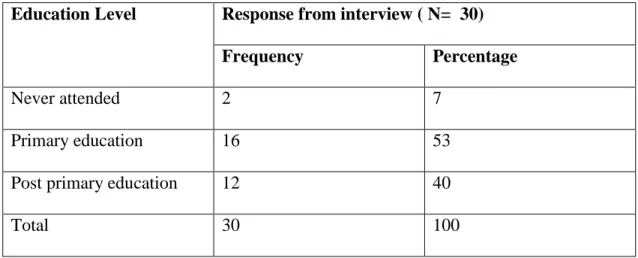
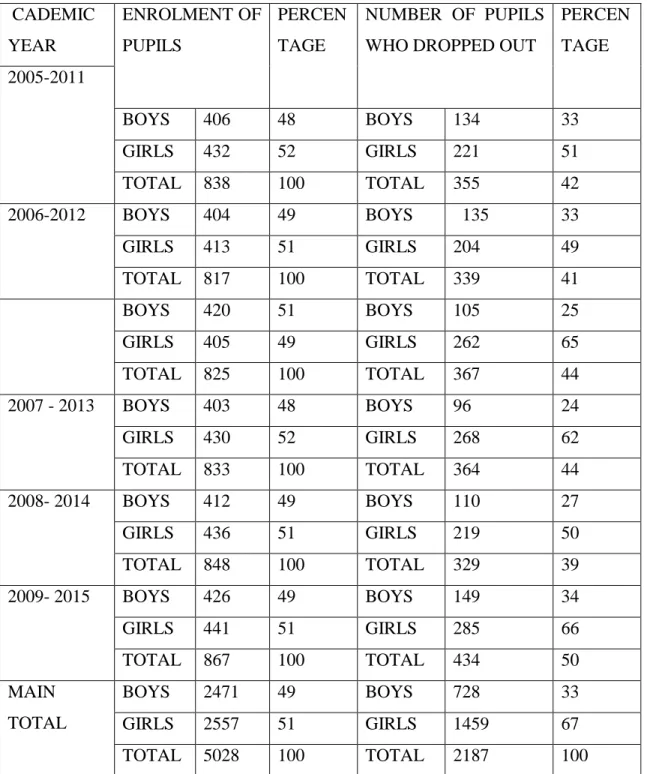
Table 1 School factors contributing to pupils‟ dropout ... 47 Table 2: Distribution of dropouts‟ parent response on their education Level ... 57 Table 3: Level of education of Parents of the continuing pupils ... 58 Table 4: Overview of the selected schools by Enrollment and Dropout
LIST OF FIGURES
Figure 1: Factors that lead to primary school dropout ... 13
Figure 1: School factors that contribute to pupils‟ dropout ... 48
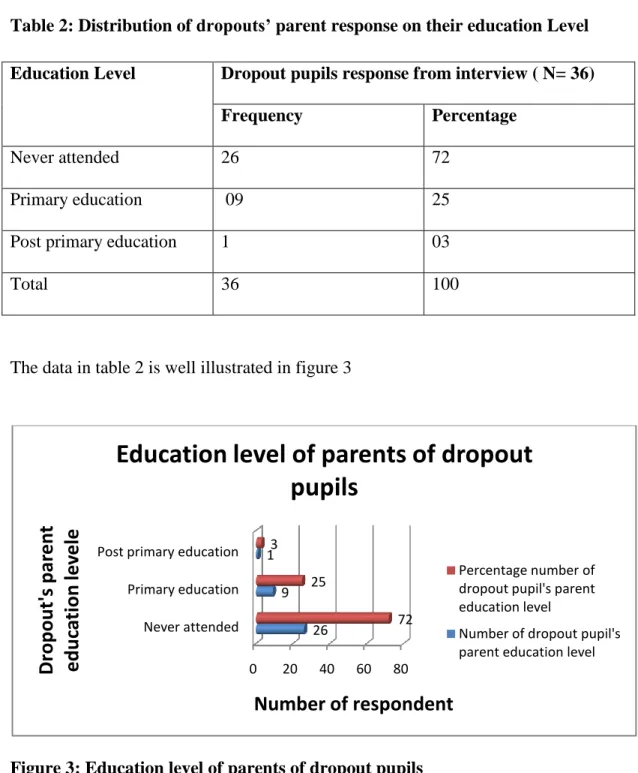
Figure 2: Education level of parents of dropout pupils ... 57
LIST OF ABREVIATIONS APA American Psychological Association DEO District Education Officer
EFA Education for all
GDP Gross Domestic product GER Gross Enrollment ratio GNP Gross national product
MDGS Millennium Development goals NER Net enrolment ratio
PEDP Primary education development program UN United Nations
UNESCO United Nations Educational Scientific and cultural organization UNICEF United Nations Children Fund
UPE Universal primary education URT United Republic of Tanzania USA United states of America
CHAPTER ONE 1.1 Introduction
Dropout is the serious problem in our schools in which this problem start in primary school and continue in Secondary School which makes an early intervention necessary to try to prevent pupils from continuing on this path through their educational experiences. Dropout is an alarming issue, which affects the socio economic development. Pupil‟s dropout does not only affect the community they belong but also affect the nation at large. Pupils‟ dropout from schools leads to wasteful utilization of scarce educational resources without achieving the nation„s educational aspirations. This does not mean for healthy educational system and would have negative effect on the economy of a state because those who dropout may create higher future cost .The objective of primary education in Tanzania is to provide pupils with academic and vocational skills as well as moral ethics but it is unfortunate that these objectives have not been fully achieved due to the high level of pupils‟ dropout among the primary school pupils
1.2 Background of the Problem
Education brings many benefits to both individuals and societies. Education is viewed as being a fundamental to the development of individuals and as such, the right to primary education is legally guaranteed in most countries in the world (UNESCO, 2005). Education is regarded as a prime mover for the socio-economic development of countries and accounts for as much as 20% of the annual Gross National Product (GNP) of developing nations (Alvares, Gillies, & Biadsher, 2003). This is considered so because education has been found to improve the productive
value of human beings by imparting knowledge, skills, attitudes and behavior traits referred to as human, social and cultural capital which are required in producing goods and services (Lazear, 2002). In addition to the productive value, education promotes harmonious co-existence, population control, healthy living, effective citizenship, nutritional adequacy and child upbringing (Psacharopoulos & Woodhall, 1985). UNESCO (2005) support this notion by indicating that education is one of the most effective ways to reduce poverty, give people opportunity in civil society. With the realization that primary school is important for the achievement of National development, many governments have made access to primary education a basic human right.
Many governments might fail to meet Education for All (EFA) Goal 3 which aims at promoting learning and life skills for young people and adults by 2015 if dropout rate among learners is still rampant. If students are dropping out of school, there is no way in which their learning needs can be catered for. According to Coombs (1970:14) educational planning, in its broadest generic sense, is the application of rational, systematic analysis to the process of educational development with the aim of making education more effective and efficient in responding to the needs and goals of its students and society. Nations cannot achieve the goal of educational development if students who start a cohort dropout of the system for whatever reasons. Students should find it an obligation to complete an educational cycle with aim of meeting their needs and that of society. The main reason why governments make education available to all is that education is considered to develop the individual‟s intellect, behaviors, attitudes and abilities. Such knowledge and skills
empower the individuals so that they become more productive in society. It is not ideal therefore to drop out of school for one would not acquire the necessary talents that make one highly functional in society. It is argued that a high dropout rate diminishes the pool of well qualified people from diverse backgrounds who will enter the professional and political ranks that make important policy decisions (APA, 2010).
International human rights conventions recognized the right to education. The right to education has been ratified succession of UN Conventions, starting from the Universal Declaration of Human Rights in 1948 to the Convention on the Rights of the Child in 1989, which received the status of international law in 1990. According to Article 28 of the Convention, governments have the responsibility of making primary education compulsory and available for free to all. Education is recognized as crucial not only to human development and to the eradication of poverty but also to enable all people to live in dignity (Wils et al., 2006). The Education for All (EFA) movement and the Millennium Development Goals (MDGs) have resulted in more attention being paid to issues of both participation and completion in education. Universal primary education is goal number two of both EFA (Jomtien, 1990; reaffirmed in Dakar, 2000) and the millennium development goals (MDGs), and was adopted by UN Member States in 2000 (UNESCO, 2005).
UNESCO (2012) global report on education quoted Hendrik van der Pol, UNESCO Institute for Statistics director as saying: The world has just a few short years to make good on the promise to fulfill every child‟s right to primary education by 2015. School systems are reaching more children but losing them due to inefficiencies
which lead to early school leaving. It is far more difficult and costly to reach children once they leave school than to address the barriers and bottlenecks in the systems (UNESCO, 2012, p.1). The major concern out of the report is that of global dropout rates, that do not seem to have gone down over the years. In many countries of the world there are high rates of pupils leaving school, worse in the developing world including Tanzania
The objective of primary education in Tanzania is to provide students with academic and vocational skills as well as moral ethics but it is unfortunate that these objectives have not been fully achieved due to the high level of pupils‟ dropout among the primary school pupils. Primary education in Tanzania is seven years education cycle .It is compulsory in terms of enrollment and terminal in the sense of being complete in itself. In attempt to improve access to education and achieving universal primary education, the government of Tanzania embarked on country wide programmed(PEDP) both phases (I,2002-2006 and II,2007-2011) to ensure that every eligible child gets quality education(Ngodu, 2011)
The findings of UNESCO (2006) study on global gains made towards attainment of Universal Primary Education (UPE) indicated that many countries have relatively high initial enrolment figures but poor Primary school completion rates
UNESCO (2012) Global Report on education stated that there was an urgent need to address the high numbers of children leaving school before completing primary education. The findings by UNESCO (2011) on the global picture towards attainment of Universal Primary Education (UPE) indicated that about 31.2million
primary pupils in 2010 dropped out of school globally and may never return. Bledsoe (2002) pointed out the irony that the richest and poorest countries share the problem of dropout. He contended that in the United States, over 30% of pupils leave school prematurely and this for the most part, condemns them to marginal part in the cultural and economic life of the country.
Bacolod and Ranjan (2005) indicated that the annual number of high school dropouts in the USA alone in 2012 was estimated to be about 3,030,000 translating into 8,300 dropouts per day. In many Latin American countries basic education is near universal, completion rates are low because of high drop-out and repetition rates attainment (Birdsall et al., 2005). Failure to complete is a particular problem for children in poor families, trapping them in poverty. UNESCO (2003) indicated that three surveys done in Canada place the national dropout rate at 18%. In Asia, the problem of wastage through drop-out is rampant. A look at the pattern of survival for the system as a whole reveals big differences in the proportion class on entrants who reach the end of primary schooling. Korea and Malaysia have a survival rate of approximately 40%. Indonesia, Nepal, the Philippines, Singapore, and Srilanka have a moderately high survival rate of 20% (Bledsoe, 2002).
In South and West Asia, out of every 100 pupils who start primary school, 33 leave before reaching the last grade. While in Latin America and the Caribbean, 17 per cent of pupils leave school before completing primary education. South Asian countries, sees 13.54 million of its children leave school before completing primary education. Pakistan has the highest rate of dropouts in the region at 38.5 per cent
followed by Nepal with 38.3 per cent and Bangladesh comes third with 33.8 per cent, (UNESCO 2012)
UNESCO (2012) revealed that Africa has the world‟s highest drop-out rate. 42% of African school children will leave school early, with about one in six leaving before Grade 2. This means that more than two in five children who start school will not reach the last grade of primary education.
Africa has been relatively good at getting children into primary school, but poor at inducing them to complete their primary education. This problem of drop-outs affects many African countries. They spend large amounts of money teaching children who do not stay in school long enough to acquire any qualification. In a study by Oxfam (Watkins, 2000), for example, it was discovered that fewer than one third of the boys and one tenth of the girls aged between 6 and 11 start school and one quarter of those who do start drop out during the first two grades. Girls are more likely to drop out in early stages than the boys are. The average time spent in school by those who drop out is 2.7 years. In Mozambique, the situation was found to be even worse because fewer than half of those who enter grade one reach grade five. This situation seems to envelop other parts of Africa. For example, a progress report on Africa by Mingat et al. (2001) says that in Senegal 65% of each age cohort enters grade 1 and 40% of the entrants reach the end of the cycle, whereas in Chad the figures are 83% and 19% respectively.
The study by Sabates et al (2010), on primary school completion rates indicated low primary school completion rate in 2005 for countries like Benin and Democratic
Republic of Congo, due high dropout rate. As a result of substantial rates of drop out and non-completion of primary school, many children are leaving schooling without acquiring the most basic skills. According to Ngodu (2010) a total of 67million primary school age children were out of school in 2008.That some 43% of them live in Sub-Saharan Africa
Hadley (2010) indicated that Sub-Saharan Africa region has the highest dropout rate, which rose from 40% to 42% between 1999 and 2009. This meant that more than two in five children who start school may not reach the last grade of primary education. Dropout rates were highest in Chad (72%), Uganda (68%) and Angola (68%), where more than two out of three children starting primary school were expected to leave before reaching the last grade. In contrast, dropout rates were lowest in Mauritius (2%) and Botswana (7%).
In Tanzania Rajani and Robbinson (1999) reported a substantial increase in dropout rates in the school year 1996/1997,especially in standards 5 and 6,increasing from 3.5 percent to 13.6 percent.
The objective of primary education in Tanzania is to provide students with academic and vocational skills as well as moral ethics but it is unfortunate that these objectives have not been fully achieved due to the high level of pupils‟ dropout among the primary school pupils. Primary education in Tanzania is seven years education cycle .It is compulsory in terms of enrollment and terminal in the sense of being complete in itself. In attempt to improve access to education and achieving universal primary education, the government of Tanzania embarked on country wide
programmed(PEDP) both phases (I,2002-2006 and II,2007-2011) to ensure that every eligible child gets quality education(URT, 2011)
Despite of the government efforts through PEDP to double the enrolment rates in primary school for stance in 2004 more than 7million children were enrolled in primary school, an increase of nearly 2.2million children as compared to 2001(a 44% increase in pupils enrolment in three years).These figures also show that the GER and NER have reached 108.3% and 90.5% respectively which suggests that UPE is closed to being accomplished (URT,2008).But unfortunately many pupils among them do not complete the primary education due to various reasons including pregnancy among the girls, illness, death, house hold work etc. For stance in 2004 about 32469 primary school pupils which was 77% dropped out from school and in 2005 about 44603 primary school pupils which was 77.6% also dropped out from school (Basic Education Statistics National Data ,2009). In 2011 about 57085 primary school pupils which was 74.9% dropped out from school (Basic Education Statistics National Data 2011)
Girl‟s pupils seemed to be more affected with dropout than boy‟s pupils. For example according to Barozi (2013) stated that thousands of girls in Tanzania have their journey to obtaining an education cut short every year as a result of pregnancy. Also further argued that, Tanzania is said to have one of the highest adolescent pregnancy rate in the World, affecting girls‟ health, education, and future employment and reaching their full potential in life, every year more than 8000 girls out from school due to pregnancy in which Mtwara seems to be region with the highest dropout rate about 55%. Also according to Guardian (2007) President
Kikwete said that the current data indicated the primary school dropout raised from 32469 pupils in the year 2005 to 44742 in 2006.This is un acceptable as a Nation we must seek ways to end this problem so that every child can both study and graduate “Kikwete said”
1.3. Statement of the Problem
The objective of primary education in Tanzania is to provide students with academic and vocational skills as well as moral ethics, but it is quite unfortunate that these objectives have not been fully achieved due to the high level of pupils dropping out. Despite the efforts undertaken by the government of Tanzania through PEDP to improve the quality of primary education, there has been a growing concern throughout the country that many pupils do not complete primary education and hence dropout. , for instance in 2004 more than 7 million children were enrolled in primary school in Tanzania, an increase of nearly 2.2million children as compared to 2001(a 44% increase in pupils enrolment in three years).These figures also show that the GER and NER have reached 108.3% and 90.5% respectively which suggests that UPE is closed to being accomplished (URT, 2008). But unfortunately many pupils among them did not complete primary education due to various reasons including pregnancy among the girls, illness, death, house hold work, poverty etc
For instance in 2004 about 32469 (77%) primary school pupils which was dropped out from school and in 2005 about 44603 (77.6% ) primary school pupils which was also dropped out from school (Basic Education Statistics National Data ,2009). In 2011 about 57085 (74.9%) primary school pupils dropped out from school for various reasons (Basic Education Statistics National Data 2011) .Due to high
level of dropout in primary schools the study focused on the factors leading to dropout in primary school pupils in Temeke district and find the solution on how to alleviate the dropout problem
1.4 General Objective of the Study
The general objective of the study was to examine the factors leading to dropout in primary school pupils in Temeke
1.5 Specific Objectives of the Study
1. To examine the school factors which contribute to pupils dropping out of school?
2. To assess the influence of parents‟ education level on pupil dropping out from school
3. To assess which group between boys and girls are dropping out than the other?
1.6 Research Questions
1. What factors in schools contribute to pupils dropping out of school? 2. How does parent‟s education level influence pupils dropout from school? 3. Is the rate of dropout more among which group between boy and girl pupils
during the period under study?
1.7 Significance of the Study
This study was considered to be useful in the sense that it provide detailed information on the reasons for pupil dropping out from primary schools as the
findings assisted in developing ways for alleviating the problem, The recommendation and suggestions given were considered useful for improving children‟s‟ right for education and overcome the pupils from dropping out from schools for the benefit of the children themselves, their families and nation. The study was useful t o student who are studying administration in the field of education as it gave them an insight on how to handle dropout pupils. The results of this study provide suggestions to policy makers at the Ministry of Education and Vocational Training in Tanzania to come up with interventions that enhance pupils‟ retention in schools.
The study also helped in the discovery of the fundamental aspects of dropout that is mostly found among pupils, with this proper guidance and counseling was given to them to enable them make the best out of education. The study also provided valuable information about pupils drop out which would be used for further research and reference.
1.8 Scope of the Study
This study was conducted in six primary schools in Temeke District. The study focused on the causes of dropout in primary school pupils. It is mainly limited to public primary school pupils in Temeke.
1.9 Limitations of the Study
Due to financial and time constraints, the research study was confined to primary schools in Temeke districts. The major problem which the researcher faced was
inadequate financial assistance in which researcher traveled from one place to another to collect data from the respondents.
1.10 Conceptual Framework
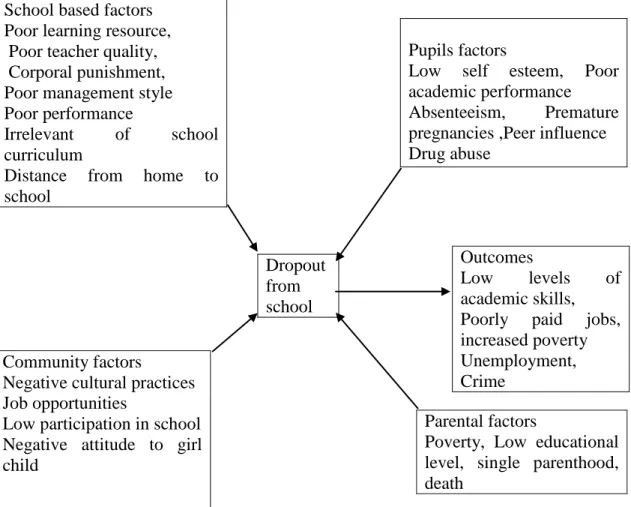
This study was conceptualized within a framework that specifies component parts of a school system as performing specific component roles (independent variable) that are necessary if the school has to achieve its desired goals (dependent variables). These components are the parents, the students, the school environment and the community and must play their respective roles effectively to ensure the pupils participate in schooling and complete their primary education successfully. The roles performed by the four components are complimentary to one another. In the event of one of them malfunctioning, the whole system most likely not achieves its intended goals. The end result is wastage and missing out on the opportunity to achieve the educational goals. Figure1. Shows how variables within the school and the community interact and affect the students, making them not to enroll in schools, repeat classes and leave school prematurely as dropouts
Figure 1.1: Factors that Lead to Primary School Dropout
Adopted from Gachungi, (2005)
1.11 Operational Definition of Terms
The following are definition of terms as used in this study
School dropout- In this study refers to a child who was once enrolled in school but has since left school for various reasons other than completion
„At Risk’ – Pupils who exhibit characteristics that correlate to dropping out, though they may not necessarily drop out of school.
School based factors Poor learning resource, Poor teacher quality, Corporal punishment, Poor management style Poor performance
Irrelevant of school curriculum
Distance from home to school
Pupils factors
Low self esteem, Poor academic performance Absenteeism, Premature pregnancies ,Peer influence Drug abuse
Outcomes
Low levels of academic skills, Poorly paid jobs, increased poverty Unemployment, Crime Dropout from school Community factors
Negative cultural practices Job opportunities
Low participation in school Negative attitude to girl child
Parental factors
Poverty, Low educational level, single parenthood, death
Pull factors- Factors in the environment outside the school that lead to children dropping out of school.
Push factors- Factors in the school environment that lead to children dropping out of school.
1.12 Organization of the Study
This study report has five chapters. Chapter one deals with the background to the study, statement of the problem, purpose of the study, research questions ,scope, significance of the study, limitation of the study, conceptual frame work and definitions of the terms as they have been used in this study as well as organization of the study. Chapter two contains review of related literature while research methodology is presented in chapter three. Chapter four contains the findings of the study, analysis and discussion. Chapter five provides summary, conclusion and recommendations of the study. The last part of the report provides a list of references as well as instruments for data collection that were used for the study and research clearance letter
CHAPTER TWO LITERATURE REVIEW 2.1 Introduction
This chapter reviews the literature related to the problem of school dropout in Tanzania and elsewhere in the World. The .The chapter discusses statistics available on school dropout in various parts of the world. Also review of the literature focus on school factor, the influence of parent‟s education level and pupils gender as predictor variable and school dropout among primary pupils as the outcome.
2.2 Global Situation of School Dropout
UNESCO (2012) Global Report on education stated that there was an urgent need to address the high numbers of children leaving school before completing primary education. The findings by UNESCO (2011) on the global picture towards attainment of Universal Primary Education (UPE) indicated that about 31.2million primary pupils in 2010 dropped out of school globally and may never return.
The findings of UNESCO (2006) study on global gains made towards attainment of Universal Primary Education (UPE) indicated that many countries have relatively high initial enrolment figures but poor primary school completion rates. This due to continued dropping out of school making attainment of Universal Primary Education (UPE) difficulty in several countries of the world like Malawi, Bangladesh, Pakistan, Bolivia to name a few. Completion rates provide a much stronger test of UPE than enrolment rate alone.
Studies by Lloyd, Mete and Grant, (2009) in rural Pakistan on primary completion rates found that though Pakistan had a national enrolment of 83% its completion rate was only 48% as a result of high dropout rate. Cameron (2005) conducted studies on dropout rates in the United States of America (USA) and Canada. He found that USA national dropout rate in 2011 stood at 25% with some places like Mississippi having a dropout rate of as high as 38%.
Bacolod and Ranjan (2005) in their study on dropouts in America found that the annual number of high school dropouts in the USA alone in 2012 was estimated to be about 3,030,000 translating into 8,300 dropouts per day.
UNICEF (2003) showed worrisome report from sub-Saharan Africa where the number of girls out of school rose from 20 million in 1990 to 24 million in 2002. The report also indicated that 83% of all girls out of school in the world live in sub-Saharan Africa, South Asia, East Asia and the Pacific.
Policies to improve school progression and reduce the numbers of children dropping out of school are critical if Universal Primary Education (UPE) is to be achieved. Children are starting primary school in greater numbers than ever before but dropout rates are significant and lead to low levels of primary school completion in many countries. In Benin, for example, the primary school completion rate in 2005 was 62 percent, although it increased steadily from 38 percent in 2000. In the Democratic Republic of Congo, the primary school completion rate in 2007 was 51 percent, which was the same completion rate for the country in the early 1990s. . As a result of substantial rates of drop out and non-completion of primary school many children
are leaving schooling without acquiring the most basic skills. Their brief schooling experience consists frequently of limited learning opportunities in overcrowded classrooms with insufficient learning materials and under-qualified teachers (Alexander, 2008).
2.3 School Dropout Situation in Africa
Policies to improve school progression and reduce the numbers of children dropping out of school are critical if UPE is to be achieved. In Africa evidence indicate that children are starting primary school in greater numbers than ever before but dropout rates are significant in many countries. For, example, the study by Sabates et al (2010), on primary school completion rates indicated low primary school completion rate in 2005 for countries like Benin and Democratic Republic of Congo, due high dropout rate. As a result of substantial rates of drop out and non-completion of primary school, many children are leaving schooling without acquiring the most basic skills. The same study by Sabates et al. (2010), found that failure to complete a basic cycle of primary school not only limits future opportunities for children but also represents a significant drain on the limited resources that countries have for the provision of primary education. They cited the World Bank 2007 report on the Government of Malawi for example, which allocated 4.2 percent of Gross Domestic Product (GDP) towards public educational expenditure in 2007, which represented around 195 million dollars. Of this, 55 percent was allocated towards primary school. With a primary school dropout rate of 65 percent in 2007, it is estimated that children, who fail to complete primary school, took up nearly half a million-school places. In monetary terms, this broadly represented an annual expenditure of 60
million dollars, 1.3 percent of GDP in 2007, on the education of children who probably left schooling without any basic skills.
A study by Hadley (2010) on primary school dropout rates of Sub-Saharan Africa region found that the region has the highest dropout rate, which rose from 40% to 42% between 1999 and 2009. This meant that more than two in five children who start school may not reach the last grade of primary education. Dropout rates were highest in Chad (72%), Uganda (68%) and Angola (68%), where more than two out of three children starting primary school were expected to leave before reaching the last grade.
According to Nekatibeb (2002) learning environments have been well recognized as inadequate in Sub-Saharan Africa due to low level of economic development and poverty. Most learning institutions are in short supply of classrooms, facilities and learning materials. Nekatibeb (2002) observed that in many countries, teachers are poorly paid than other sectors or are not paid in good time. The results are teacher absenteeism, lack of motivation or attrition where schools and teachers are forced to search for alternative incomes from parents or to use student lab our; this situation has relation to school drop among the pupils
2.4 School Dropout Situations in Tanzania
The objective of primary education in Tanzania is to provide students with academic and vocational skills as well as moral ethics but it is unfortunate that these objectives have not been fully achieved due to the high level of pupils‟ dropout among the primary school pupils. Despite of the government efforts through PEDP to
double the enrolment rates in primary school for stance in 2004 more than 7million children were enrolled in primary school, an increase of nearly 2.2million children as compared to 2001(a 44% increase in pupils enrolment in three years).These figures also show that the GER and NER have reached 108.3% and 90.5% respectively which suggests that UPE is closed to being accomplished (URT,2008).But unfortunately many pupils among them do not complete the primary education due to various reasons. For stance in 2004 about 32469 primary school pupils which was 77% dropped out from school and in 2005 about 44603 primary school pupils which was 77.6% also dropped out from school (Basic Education Statistics National Data ,2009). In 2011 about 57085 primary school pupils which was 74.9% dropped out from school (Basic Education Statistics National Data 2011
It is now estimated that in Tanzania about half of enrolled pupils dropout before completing primary education (Tanzania today)
2.5 Theoretical Literature
The researcher employed social capital theory on study of management of problems of dropout in primary school pupils
2.5.1 Social capital theory
Meier, (1999) and Coleman, (1988) argued that three factors are responsible for children well being which are family income, parental education level and social capital.
Smith et.al. (1992:75) providing the importance of social capital in studying dropout states that one of the more promising theoretical approaches to the study of the problem of high school dropouts is social capital theory. Social capital refers to social networks and social interaction that facilitates educational attainment. Social capital may occur both within and out-side the family. Coleman (1988) suggests a relationship between a child, his/ her family, friends, community, and school could translate into higher academic achievement (Meier, 1999). Within the family, social capital is represented by the amount of positive parent-child interaction which allows children to translate the financial and human capital present in the family into human capital or some other attribute that in-creases well-being (Coleman, 1988, Teach man et. al. 1996). Outside the family, density of social interactions among parents in different families and among parents and institutions in the community, particularly schools, serves to increase closure intergenerational relations (ibid). Social capital exists in the norms, social networks, and interactions between adults that facilitate or support educational attainment at the community level (Smith et. al.1992).
Isreal & Beaulieu (2004) further simplified the social capital theory by dividing into different categories. First, they describe „family social capital‟ by saying that family structure and resources affect the extent of social capital. Coleman (1990) states that family social capital represents the norms, social networks, and relationships between parents and children which are valuable for children while growing up. Family income and educational attainment of parents represent important resources that can influence a child's academic aspirations and success. The greater the socio-economic resources present in a home, the better the academic performance and
school completion rates of students (Isreal & Beaulieu, 2004:37). In relation to my study, The researcher assume that if the family or parents lack socio-economic resources and have low education background it becomes difficult for parents to give continuation to children‟s schooling.
„Interactive social capital‟ within the family deals with the scope and quality of a parent's relationship with their children. It includes parent‟s nurturing activities, such as helping children with their homework, discussing important school activities with them, and expressing high educational aspirations for them (Downey, 1995).In relation to this study, the researcher assume that if parents are uneducated, they might not feel the importance of educating children. Those parents expect the ultimate benefit for their children in an early age and push them to work. Families with high educational expectations choose to spend more family time on activities that support learning for children
(Isreal & Beaulieu, 2004). Family social capital and academic achievement can be moderated by geography as well. Rural families tend to have larger number of children with limited education and income that fall below the poverty line which affect the quality and quantity of parent-child interaction and, in turn, children‟s academic achievement and aspirations (Beaulieu & Israel, 1997). Large number of siblings in a family might create difficulties for parents to fulfill every demand such as schooling of children.
School social capital includes the composition of the student body, the size and resource base of school, and the nature of the climate evident in the school and
classroom (Stockard & Mayberry, 1992). Smaller schools often tend to have lower student-teacher ratio, teachers can give closer attention as per the needs of students, and consequently students have higher academic performance. Increased school size is often associated to greater absenteeism of students, lower academic performance, lower participation in school activities, and lower high school completion (Beaulieu & Israel, 1997). The researcher assume that the attraction towards schooling and education decreases with the increase in higher pupil-student ratio, lack of quality teaching, learning behavior and physical facilities available at school. „Community social capital‟ which includes community structure, available resources and socio-economic capacity determine children‟s Schooling whether high or low (Beaulieu & Israel, 1997).
2.6 Factors Affecting/Leading to Drop Out of School Factors are categorized as follows;
2.6.1 School factors as related to school dropouts
School level factors also play a role in increasing pressures to dropout such as teacher absenteeism, school location and poor quality educational provision (Alexander, 2008) .The system of educational provisional at the school level generates conditions that can ultimately have an impact on the likelihood of children dropping out from school. Education facilities are linked to quality in terms of human resources and in-school resources. Availability of resources such as textbooks, desks and blackboards has been found to influence dropout (Molteno et al., 2000), as have various aspects of teaching and learning processes. Teaching
practice and behaviour can particularly influence a pupil‟s decision to drop out. Smith (2003) found that in some schools in Zimbabwe‟s Southern Province teachers did not prepare lessons, had no schemes of work, and left pupils‟ assignments unmarked. Such classroom practices and implicit lack of in-service teacher development has serious implications for retention.
2.6.2 Teacher pupil’s relationship
Students with poor relationship with teachers avoid school in order to avoid their teachers. Fornwalt (1947) argued that teachers who subject their students to shame sarcasm, name calling, ridicule and humiliations are the contributing factor towards dropping out.
2.6.3 Teaching approaches
Miles (2000) argued that certain teachers still employ authoritarian types of teaching which could result in learner‟s absenting themselves from school. The educator‟s instructional approach and his or her feelings towards his or her work may be one of the factors that cause some learners to engage into absenteeism and latter drop out. An enthusiastic educator instills enthusiasm and motivation in learners. On the other hand a demoralized educator who shows little interest in his or her work discourages learners. Furthermore, the educator‟s attitude towards his or her work could either be negative or positive is contagious and often affects the Learners. (Donald, Lazarus and Lolwana, 1997:115). Enthusiastic and motivated educator may be perceived to have positive attitude towards their work and are more likely to be Keen to vary their instructional approaches. Also Deal and Celotti (1980) found that 47% of pupils
dropout because they are bored, unmotivated and disengaged due to poor teaching methods with heavy reliance on lecture, drill and test preparations
With regard to cognitive style, described by Rayners and Riding (1996:447), a teaching style which is restricted to one approach tends to exclude some learners. It is possibly difficult for some learner particularly the low ability groups to compensate which results in a likelihood of resorting to absenteeism and consequently drop out. Van Petegam.(1994:276) acknowledges the effects of teaching style by stating that incongruence between teacher‟s approach and what the learners are interested in leads to a decline in motivation and consequently pupils dropout
2.6.4 School curriculum
King and Schielmann (2004) argued that, if school curriculum does not reflect the pupil‟s society it affects negatively the ability for students to relate what they learn to their work and educational goals and equally impacts negatively on their decision to complete education cycle resulting in dropping out. The current curriculum provides few options, if any, for students. For example, Sabates et al. (2010) found that in Tanzania the curriculum assumes children have had some pre-primary skills are ready to begin formal instruction. Urban children are the ones who are more likely to have attended pre-primary school than rural
2.6.5 Distance from school
Juneja (2001) observes that in areas where schools are further away from homes, the distance may be considered too far for younger children to travel, especially young
girls. This is also true in the cases of older girls and those children regarded by parents as vulnerable to sexual harassment (Colclough et al., 2000; Nekatibeb, 2002). Parents are afraid of the safety of their children when they have to travel longer distances to school. Thus, the likelihood of children attending school decreases the greater the distance to the nearest school.
According to Nekatibeb (2002) distances from school has been another deterrent for girls‟ education in many countries in Africa. A large number of studies in the region have reported that the long distances girls travel to school has two major problems including: one related to the length of time; and the energy children have to spend to cover the distance, often on an empty stomach, this relates to the concern and apprehension parents have for the sexual safety of their daughters. The problem of distance from school also has implications for the motivation of pupils to stay in school. In Guinea, studies show that close proximity to schools had a positive motivating impact on girls; participation in schools while in Mali, most girls stated that living far away from school and having to walk discourages them (Ibid).Similarly, research by Ainsworth et al (2005) in Tanzania, indicate that drop outs increase in areas where distance to school is longer.
Mirsky (2003) argued that long journey to and from school and often on an empty stomach makes school going on unpleasant routine for the poor children leading to their dropping out of school. In rural districts, there are no roads and vehicles hence children have to walk for long distances through difficult terrain and dangerous environment which consequently affects their academic performance (Kimitei, 2010).
Distance travelled to school has some measure of relationship to ills like absenteeism, delinquency, truancy, lateness, indiscipline, and non-attendance to school. These ills, either singly or combined ultimately affect achievement at school. Also, when the distance travelled to school is too far for the child, besides fatigue, there is the tendency for the child to lose interest at school and begin to be truant and may drop out of school completely (Arubayi, 2005; Duze, 2005).
It has also been observed that cases about where children travel up to five kilometers to school on foot. Even when they could afford to travel by car, motorcycle or bicycle for such long distances, the stress of commuting to school weighed the children down, and the exigencies of the road left parents and guardians worried until their children returned home safely If students walk over one kilometer to school, the outcomes would not be in the best interest of both the child and the school because set goals and objectives may not be truly achieved. But today, it does appear that many Nigerian children still travel long distances to and from school (AIT News Hour, 2008).
2.6.6 Corporal punishment
According to the Society for the Protection of the Rights of the Child, about 35,000 school children in Pakistan dropout from school each year due to corporal punishment. Such beatings at schools are also responsible for one of the highest dropout rates in the world, which stands at 50% during the first five years of education (United Nations, 2008). Despite growing awareness regarding the issue, many school teachers remain convinced that some degree of corporal punishment is necessary to instruct children. Although all the provincial governments of Pakistan
banned corporal punishment in schools since 1999 and issued directives to all teachers not to use corporal punishment on children, the fact is that the directives remain poorly implemented which causes a high dropout at primary level.
A study done by Hussain (2011) in Pakistan titled causes of dropout in primary schools revealed that corporal punishment was one of the major reasons for dropping out of pupils from school. Beatings at school are considered culturally acceptable to ensure obedience. In 1989, 52% of Pakistani teachers were found to use physical punishment with their students (United Nations, 2008).
2.6.7 School management style
The work of school leaders nowadays is more complex than ever before. They are expected to perform managerial and instructional roles. By virtues of their positions the school managers oversee all activities taking place in a school and become accountable to activities within the school compound.
The core business of school managers is the success of the school by making teaching and learning more effective. Studies have cited school management styles as a school factor that has the potential to contribute to pupil dropouts. The community expects more than anything else the school management to produce high academic achievement and reputable moral ethos. If the school fails to sustain good academic performance and moral aptitudes the school management is bound to be underrated by those the school is accountable to.
As alluded to one of the causes of students‟ dropout is poor academic performance, this implies that the school leaders should play the role of an instructional leader. Instructional leadership involves setting goals, managing curriculum, allocating resources and evaluating teachers regularly to promote effective teaching and learning in the classroom. According to Strauss (2013) instructional leadership behavior has shown to be the most crucial role to improve teachers‟ performance and students‟ academic achievement. Knowing what happens in the classroom makes school managers to be innovative, visionary and perseverant. Once the students become aware that the school administration is concerned about their performance they tend to remain in the school.
In order for the school management teams to enhance retention they should be instructional leaders. Successful instructional leaders should possess excellent planning and observation skills as well as proficiency in research and evaluation of both teachers and students performance (Strauss, 2013). Failure to become instructional leaders may seriously affect the retention role of school managers.
A study by Hammond et al. (2007) recommended the need for administrators and teachers to design strategies to make the school a more attractive place for pupils to be. The same study found that school policies associated with dropout include raising academic standards without providing supports, tracking, and frequent use of suspension. The study observed methods schools used to regulate pupils‟ behavior had a relationship with dropping out. The study defined pupil control ideology as the teacher‟s stated belief regarding the control of students in classrooms and schools. A custodial pupil control ideology stresses the maintenance of order, impersonality,
unilateral downward communication, distrust of pupils, and a punitive, moralistic orientation toward the control of students. At the other end of the scale, a humanistic pupil control orientation emphasizes the psychological and sociological bases of learning and behavior, an accepting, trustful view of pupils, and confidence in their ability to be self-disciplining and responsible.
The study found that a custodial pupil control ideology is associated with high dropout rates. Positive school climate is associated with lower rates of dropout. The findings of the study indicated that statistically significant relationships exist between teacher pupil control ideology and the quality of school life as perceived by pupils.
A study on pupil control ideology and the quality of school life by Lunenburg and Schmidt (1989) showed that the general attitude pupils hold regarding their school determined what pupils viewed as the quality of life in a school and had an influence on their decision to drop out. They identified three factors that contribute to the quality of life in a school: level of pupils‟ general reactions to school, the level of pupil‟s interest in work prompted by the educational opportunities available and the nature of the student-teacher relationship. The study found that pupils with low personal satisfaction with various elements of school life are more likely to drop out.
The study by Hussain (2011) in Pakistan also indicated some of the administrative factors which are contributing towards high dropout rate .The findings indicated that about two-thirds (73%) of the respondents stated that careless supervision and weak administration is one of the major causes of high dropout. Similarly, 77% of the
participants affirmed that in-different attitude of administrative and supervisory personnel towards teaching community also contribute towards high dropout. (Government of Pakistan, 2009)
2.7 Gender as Related to School Dropout
According to Nkinyangi (1980), girls tended to be victims of drop out as opposed to boys in families with low socio-economic status. For instance, in a situation where parents cannot pay fees for both boys and girls, the latter is obvious a sacrifice. Boys are allowed to proceed while girls dropout. It is wise to say that those children who do not continue or dropout from school at early years usually belong to poorer families. The majority of such children are girls. The question that arises is why? Colclough et. Al. (2000) state gender roles in the society change the balance between boys and girls to attend school.
Colclough et. Al. (2000) He further adds that several household contexts and cultural practices also increase these gender disparities. In societies where men are regarded as the main leaders of the society, girls are generally married earlier and girls future are seen as being devoted to home and family, the intensives for girls to attend and continue schooling is generally lower than boys (ibid). Girls are generally more expected to perform household chores and to look after their younger siblings. These variables increase demand of girls to stay at home rather than going to school which affects their regularity to school and finally leads to high rate of dropout
UNICEF (2003) showed worrisome report from sub-Saharan Africa where the number of girls out of school rose from 20million in 1990 to 24 million in 2002. The
report also indicated that 83% of all girls out of school in the world live in sub-Saharan Africa, South Asia, East Asia and the Pacific.
According to Economic Survey (2006), Enrolment rates in Kenya were almost the same at primary school for both boys and girls. The gap started to widen in upper primary as more girls left school than boys in certain parts of the country.
UNICEF report (2004) indicated that girls‟ primary school completion rate is far behind that of boys, at 76% compared with 85% for boys. This gender gap means that millions more girls than boys are dropping out of school each year. This goes to show that the majority of children not in school are girls.
Gender of pupils has effect on school dropout. Apparently, there is no remarkable difference in pupils‟ dropout between girls and boys. Both leave school for specific reasons: girls (pregnancy and marriage) boys (employment, behavioral difficulties). But boys are more prone to withdrawal from school system than girls. Furthermore boys dropout of school because they want to acquire a skill early in order to earn their living. Some boy‟s dropout of school to pursue business that is lucrative in nature. (UNICEF, 2004)
According to the Economic Survey (2011), more than 400,000 pupils in Kenya who enrolled in school under free primary education program did not complete standard eight. They were forced to drop out or repeat and only 59 percent of the pupils completed. A greater percentage of the dropouts were girls. This caused concern on the high level of wastage in the education system attributed to repetition and dropout.
UNICEF (2004) report indicates that girls‟ education leads to more equitable development, stronger families, better services, better child health and effective participation in governance. Despite the obvious benefits of Education to national development, research findings indicate that girls‟ dropout rate from school is higher than that of boys.
Odaga and Heneveld (1995), further note that parents worry about wasting money on the education of girls because there are most likely to get pregnant or married before completing their schooling and that once married, girls become part of another family and the parental investment in them is lost this therefore perpetuates parents discouraging the girl child from continuing with school and hence they prefer to invest more in boys education rather than girls education.
UNICEF (2004) report indicates that some 121 million children are out of school for various reasons and 65 million of them are girls. With the educational rights of 65 million girls unmet, something should be done to ensure that they complete their education. The same report indicates that Nigeria is one of the 25 developing countries of the world with low enrolment rates for girls, gender gap of more than 10% in primary education and with more than 1 million girls out of school.
2.8 The Influence of Parent’s Education Level to Pupils ’Dropout
Ersado (2005) argues that parents‟ education is the most consistent determinant of a child Participation in education. It has been documented that the higher the education of the parent or the household head, the greater the chances of increased access,
regular attendance and lower dropout rates (Ainsworth et al., 2005; Connelly and Zhen, 2003; Duyear, 2003)
Barongo (2007) revealed that children, whose parents or guardians occupations were peasantry, fishing or involved in petty trade were likely to be truants and in the long run drop out from school. On the other hand children, whose parents or guardians had formal employment like teachers and nurses, were less likely to fall under the category of irregular attendance. Such phenomenon could have largely resulted from the fact that educated parents know the value of education for their children and insist them to attend school regularly. Apart from this, they are in a position to assist their children academically or find someone who can do remedial teaching to the young ones. The trend of pupils dropping out from school is connected to the low educational status of the parents or relatives in the homes in which a child is grown up. Nkoma (1979) in his study on truancy and school dropped out in Pangani in Tanzania revealed that, children who played truant or dropped out of school belong to not only economically poor families, but also to the parents with little formal education . It was found that educated parents tend to motivate their children in matters related to schooling and support them academically. They are very keen to make follow up visits to school for the academic welfare of their children.
The educational level of the family is one variable that has the most consistent relationship with the aspects of schooling .The level of the highest educational attainment by any member of the family is found to influence enrolment rates and regularity in attendance positively and dropout population among children negatively. There were a lower percentage of dropouts of girls from homes where
parents and other members have high level of education. This was because they are aware of their influence over their children‟s academic performance in schools. They were also actively involved in the education process of their children, for instance, supporting the pupil‟s basic learning and development at home. Illiterate parents are not able to do this effectively; therefore, their children are highly disadvantaged and as a result can withdraw from school early (Epstein & Conoley, 1987)
2.9 Empirical Review and Knowledge Gap
A study done in America by Coley (1995) on high dropout rates in the United States of America found that learners with higher educational expectation are associated with Low dropout rates than those with low expectation. Pupils who want to go far in their educations are less likely to drop out.
The study done by Hussain (2011) in Pakistan titled causes of dropout in primary school revealed that curriculum related factors contributed towards high dropout rate. Analysis indicated that two-thirds (66%) of the participants agreed that in Pakistan curriculum at primary level is not in harmony with the needs and abilities of children. They feel boring and not satisfy with the prescribed curriculum which forces them to leave school. Similarly, 67% of the participants stated that the prescribed curriculum at primary level do not fulfill the needs of the community. Therefore, students do not take interest in their education and they leave the school and join a workshop or factory. They also stated that heavy load of school bag also compel students to dropout at early stages.
A study by Ampiah and Adu-Yeboah (2009) on mapping the incidence of school dropouts in northern Ghana identified some school factors that contributed to pupils dropping out of school. These included grade repetition, low achievement, over age enrolment and regular absenteeism or previous temporary withdrawals from school. It is unclear whether grade repetition increases the chances of completion, but what was apparent in this study was that grade repetition extends the age range in a particular grade, and thus increases the possibility of repeaters dropping out. The study found that children who were made to repeat grades with a view of improving their performance ended up dropping out of school.
Research evidence through studies by Lewin, (2009) in sub-Saharan Africa, Akyeampong et al. (2007) on basic education in Ghana and by Ampiah et al. (2010) in Ghana all identified grade repetition as one school factor (variable) associated with dropout. Grade repetition increases the age in grade, which in turn increases opportunity cost for repeaters. A research study by Nkoma (1987) on the factors, which influence persistence absenteeism and dropout in rural primary school in Mainland Tanzania, found that broken family and low level of formal education of parents or guardians were among the causes of school dropout. A research study by Barongo (2007) on truancy and school dropout in Rufiji Districts showed that traditional practices such as „jando and unyago‟ contributed to school dropout
Makame (1998) conducted study to find out the reasons contributing to drop out in primary schools in Zanzibar. In his study overcrowded classes, fishing and agricultural activities and lack of qualified teachers were identified as reasons for primary school dropout. His study revealed that parent of the pupil‟s were not able to
provide the children with school facilities such as school uniforms, school fees and exercise copy book .He further argued that due to lack of parent students dropped out from school because they lack humanitarian support and therefore engage in per business.
Essau (2005) studied on the persistence truancy and school dropout in Iringa region. In his study he argued that despite the effort made by the government of Tanzania to promote primary education truancy is still a major cause for school dropout
Through the analysis of empirical studies done in various places, it shows that the school dropout in schools is a great phenomena and the research done in Tanzania and other countries worldwide shows that school dropout exists in schools and needs to be combated using different ways in order to ensure the realization of universal education. Most of the researchers who researched on this matter have came up with crucial intervention towards eradicating school dropout problem basing to the facts that the research environment are differ from one area and another. The dropout problem still is persisting in our primary schools. Therefore there is a gap to be filled. Therefore the study attempted to examine the leading factors to school dropout and find out the way towards alleviating the problem of dropout in primary schools.