Volume 43, 2012
way. actually in science, there is no such thing as a failed experiment. even if your pupil didn’t get the expected results, there is learning in what didn’t go right, and why. all these elements and also other elements are incorporated in the inquiry-based science education (ibse). in ibse, learners are encouraged to learn through exploring, discovery and investigation. there is a connection between the learning and home environment in such a way that children are able to identify with the learning process. ibse is in practice when pupils are developing concepts that enable them to understand the scientific aspects of the world around them through their own thinking, using critical and logical reasoning about evidence that they have gathered. this may involve them in the first-hand manipulation of objects and materials and observation of events. teachers are leading pupils to develop the skills of inquiry and an understanding of science concepts through the pupils’ own activity and reasoning. from the previous information is obvious, there is a chance to increase pupils’ interest in science subjects, but there are necessary to apply new methods and forms in the teaching process of science subjects.
received: April 18, 2012 accepted: May 25, 2012
Milan Kubiatko PhD, Assistant Professor at Institute for Research in School Education at Facu-lty of Education, Masaryk University in Brno, Czech Republic.
E-mail: [email protected] Website: http://www.kubiatko.eu/
THE “SCHOOL. MY CHANCE!” PROJECT – A
CASE STUDY FOR PREVENTING
PUPILS’ SCHOOL DROPOUT IN ROMANIA
Valentin Cosmin Blândul University of Oradea, Romania E-mail: [email protected]
Abstract
Pupils’ school dropout could be defined as an early and final abandonment of school before graduation, which prevents the pupil from registering in the following stage of education, losing in this way the possibility of benefiting from a proper and higher education. The statistics show that, unfortunately, in recent years school dropout rates have been increasing among secondary school pupils. The University of Oradea and The Bihor County School Inspectorate, Romania, have implemented a project called “School. My chance!” The aim of the project was to prevent and reduce the phenomenon of early school leaving by 100 pupils. The pupils attended five schools in Avram Iancu, Bogei, Carasau, Les and Suncuius, all village in Bihor, Romania, and were identified with higher school dropout risks. This paper proposes to present the partial results obtained at the end of the first period of the project implementation – the second semester of the 2010 / 2011 school year. The sample was represented by those 100 pupils from the above mentioned schools, who were included in Cognitive Therapy, implemented with the help of the project. The method consisted of analysing and comparing the pupils’ school marks at the beginning and at the end of the relevant period. The results proved that, after one school semester, the pupils’ marks remained rather unchanged, but in a few specific cases (schools or school subjects) small progresses were made. These results can, however, be seen as a significant success, because in education it is very difficult to obtain some spectacular improvements in such a short time and the most important aim of our project was to help those pupils to remain in the formal learning system so that that the positive conditions were created for their personal development.
Key words: formal learning system, prevention, school dropout, school performance.
Introduction
the causality of school absenteeism is extremely diverse and includes a number of factors, out of which Mihaela Jigău (1998) mentions the socio-cultural, economic, psychological and pedagogical ones. as far as the latter aspect is concerned, one of the most important predictors of school dropout is massive school absenteeism (more than 80 hours per year). A transnational study conducted in 2000 and published in 2005 (the YOUNG project, p. 59) shows that the highest rate of school absenteeism was recorded in denmark (24%), austria was placed at the middle of the list with 14%, while the lowest values were recorded in Belgium (9%) and in Luxembourg (8%). The least punctual pupils are those from Finland and Sweden, while the Austrians and Germans are the strictest ones about observing the school timetable. Nearly 56% of the italian pupils skip school with their parents’ consent, while austrian pupils take again a position in the middle of the list. the study also showed that in france school absenteeism increases together with the pupils’ age, with values of 2% for those at the age of 13.7 for those at the age of 17 and 9% for those at the age of 19. In Italy, the minimum of compulsory school days is 200, and school attendance is mandatory in percentage of 50-70%. Finally, in England, data for the 2001-2002 school year showed that the minimum of school absenteeism rate was approximately 7.3%, with 5.9% for primary school and 8.7% for secondary school. it is possible, of course, to have differences between official statistics and the real ones (the reasons could be both objective and subjective) and thus question the above figures (Kempes et. al., 2005).
beyond the figures that express in absolute values the rate of school dropout, there are two explanatory theories of this phenomenon that are worth mentioning (Kerbs et. al., 2007). On the first hand, the traditional school’s viewpoint projects the entire “guilt” of early school leaving on the pupil, invoking as possible causes their inadequate behaviour, moderate school performance, their psychological state and level of intellectual development, as well as unfavorable socio-economic parameters. According to Andrea Fabian (2006, p. 55), the simplest explanatory mechanism starts from a pupil’s iQ below the average, poor school performance, associating with pupils that have similar psycho-educational profile, school dropout, as well as delinquency. on the other hand, the second viewpoint is the exact opposite of the first one. it “blames” school for the pupils’ failure, considering them “excluded”. The main reason seems to be related to the pupil’s negative school experiences, against a background of questionable quality educational programmes, unsatisfactory relations with the other educational agents involved, the pupil’s intellectual and emotional immaturity, which prevents them from understanding the need to complete their studies and receive a certificate, and so on (Bartollar, 1997). It is interesting to notice that the two theories exclude by no means each other, but, on the contrary, they are complementary and can be found in the majority of schools that face school dropout. the common point of these theories is given by the process of disengagement, regarded as the phenomenon of mutual rejection between school and pupil. thus, the pupil’s intellectual and emotional interest in school gradually decreases, while on the side of school rejection develops as a result of failure to produce positive educational experiences (Fullerton, 2010).
Research Focus
of education in the 21st century Volume 43, 2012
2007-2013 (posdru). the main objective of the project was preventing and correcting school dropout in villages with pupils at high risk in this respect, by facilitating their access to quality formal education. the target group of the project consisted of secondary school pupils from the schools of Avram Iancu, Bogei, Cărăsău, Leş, and Şuncuiuş – Bihor county, Romania. the main activity of the project (code a.11) was represented by Implementing the A and B Cognitive Therapy programme addressed to pupils with a high risk of early school leaving. the central objective of this activity was to increase the rate of formal education attendance in the case of pupils with a high risk of early school leaving by involving them in educational programmes organised after the compulsory school classes. concretely, every day, from monday to friday, during school weeks, the pupils exposed to the risk of leaving the formal educational system attended a number of educational activities aimed at deepening and consolidating the theoretical knowledge acquired during classes. the school subjects included in the a and b Cognitive Therapies programme were the following: S08 Avram Iancu – English language and Mathematics; S08 Bogei – Romanian language and English language; S08 Cărăsău and S08 Leş – Romanian language and Mathematics, and in the case of GRI Şuncuiuş – History and english language. the above mentioned school subjects were chosen based on the educational needs of the pupils included in the target group, starting from their school performance, as well as based on the availability of teachers to get involved in the project. the actual educational activities consisted of doing homework, explaining certain terms and notions not understood well enough during classes, extra assignments for the pupils in the 8th grade, as well as other types of activities (games, contests, extra reading tasks, watching documentaries, etc.) (blândul et al, 2010).
Methodology of Research
Research Objectives
starting from the above things, the purpose of the study was to determine the school progress of the pupils in the target group in the subjects that were included in the a and b cognitive therapy programme after the first year of project implementation. concretely, the specific objectives of the project were: (1) comparative analysis of the pupils’ marks at the beginning of the programme and at the end of the first year of activity, as well as (2) preparing a psycho-pedagogical characterization of the pupils in the target group who were prone to the risk of early school leaving. the specific hypothesis of the study was that in the case of pupils with major school dropout risk the intervention with the a and b cognitive therapy programme would significantly improve the pupils’ school performances in at least half of the curriculum subjects by the end of the first year of the project.
The Sample of Research
many people, etc.); they did not benefit from other projects / support programmes; they wanted to participate in the implementation of the a and b cognitive therapy programme.
Instrument and Procedures
as far as the methodology was concerned, achieving the purpose of the study assumed both quantitative and qualitative evaluation of the pupils’ school progress. the quantitative evaluation was performed by giving the pupils written tests both at the beginning and at the end of the relevant period, which was followed by recording the school marks in each of the subjects included in the a and b cognitive therapy programme at the beginning and at the end of the second semester of the 2010 / 2011 school year (Feb. - Jun. 2011), the period in which the first part of a.11 was implemented. the pupils’ progress was monitored looking at the performance expressed by their marks, that is, whether the marks remained the same, improved or decreased.
the teachers who implemented the programme prepared each pupil’s psycho- pedagogical characterization, which monitored in details the pupils’ progress in respect of school behaviour and attitude towards formal education. the qualitative evaluation of the pupils’ school progress was performed by interpreting these characterisations.
Data Analysis
the statistical interpretation of study data was performed by calculating the frequencies that showed improvement, decrease or lack of change in the pupils’ marks, as well as by establishing the statistical correlations between the marks at the beginning and at the middle of the programme. the bravais-pearson correlation coefficient (r) was calculated, the significance of the values obtained for various levels (p) being established.
Results of Research
the results obtained from the quantitative interpretation of the data provided by the respondentswere the following.
Table 1. General school progress of the pupils in the target group.
S08 A. Iancu S08 Bogei S08 Cărăsău S08 Leş GRI Şuncuiuş
N % N % N % N % N %
No
change 23 57.5 27 67.5 18 60 27 90 33 55
Progress 13 32.5 8 20 12 40 2 6.66 16 26.66
Regress 4 10 5 12.5 - - 1 3.34 11 18.34
of education in the 21st century Volume 43, 2012 11
high risk of early school leaving show a slight improvement, which creates the premises for school success and, therefore, also for keeping these pupils in the formal educational system. in order to better understand the particularities of each case, we suggest looking at the school progress of the pupils from the 5 schools in each subject.
Table 2. School progress of the pupils in the target group considering each school and the subjects that were included in the programme.
S08 A. Iancu S08 Bogei CărăsăuS08 S08 Leş GRI Şuncuiuş
N % N % N % N % N %
English language languageEnglish Romanian language Romanian language English language
No
change 10 50 11 55 9 60 13 86.6 22 73.3
Progress 9 45 3 25 6 40 1 6.7 7 23.3
Regress 1 5 4 20 - - 1 6.7 1 3.4
Mathematics Romanian language Mathematics Mathematics History
No
change 13 65 16 80 9 60 14 93.3 11 36.6
Progress 4 20 3 15 6 40 1 6.7 9 30.1
Regress 3 15 1 5 - - - - 10 33.3
It can be seen in Table 2 that in the case of S08 Avram Iancu, the general no change trend in the school performance of the pupils with major risk of early school leaving is kept. Thus, 57.5% maintained their school performance at the same level, while 32.5% improved it. further analysis, which looks at the subjects too, shows, however, that the improvement is due mainly to the results in English, where 45% of the pupils recorded progress, and less to Mathematics, where 65% of the pupils had the same marks at the end of the second semester as at its beginning, and only 20% of them improved their performance. A somewhat similar situation can be seen at S08 Bogei too, where the performance of 67.5% of the pupils’, as expressed by the marks at the beginning and at the end of the 2010 / 2011 school year, is relatively unchanged, while 20% of the pupils improved their results. Regarding the evaluation of school performance in each subject included in the study, the results are similar with those of S08 Avram Iancu, in the sense that 25% of the pupils improved their marks in English, while for the Romanian language, there was no change in the case of 80% of the pupils. This fact can be explained by a more complex and strict teaching / evaluation in mathematics and romania language, which are two subjects the pupils have to take national tests in at the end of the 8th grade. though equally important, the english language is perceived as an easier subject and, as a result, the teachers are more indulgent when assessing the pupils’ knowledge in this subject, which can explain the pupils’ higher marks
mathematics. as both these subjects are equally important, it seems they were taught with the same seriousness by the respective teachers.
In the case of the pupils from GRI Şuncuiuş, the same general trend in school performance can be noticed for 55% of them, while other 26.66% pupils show a slight improvement. A somewhat special situation is that of history, where there are similar figures for no change, for progress and for regress. the explanation might be found in the pupils’ lower interest in this subject, which seems to be regarded as less important. thus, some pupils show interest in history, and make progress accordingly, while others believe that only romanian language and mathematics are important, and neglect the other subjects.
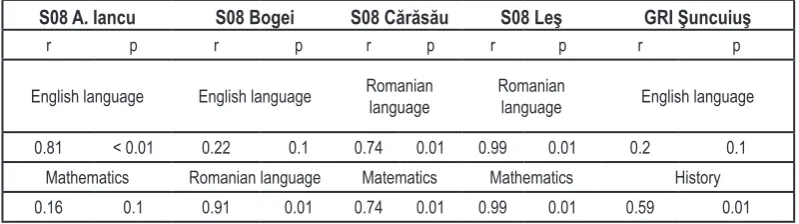
Table 3. Statistical correlations between the pupils’ marks at the beginning and at the end of the first year of programme implementation.
S08 A. Iancu S08 Bogei S08 Cărăsău S08 Leş GRI Şuncuiuş
r p r p r p r p r p
English language English language Romanian language Romanian language English language
0.81 < 0.01 0.22 0.1 0.74 0.01 0.99 0.01 0.2 0.1
Mathematics Romanian language Matematics Mathematics History
0.16 0.1 0.91 0.01 0.74 0.01 0.99 0.01 0.59 0.01
The results in Table 3 show that in most cases the statistical correlations between the pupils’ marks at the beginning of the programme and at the end of its first year are strongly significant at p=0.01. These values confirm the school progress achieved by the pupils of the target group in 7 out of 10 cases in the subjects included in the programme. The situations with statistically significant correlations at p=0.10 are for S08 Avram Iancu (Mathematics), S08 Bogei (English language) and GRI Şuncuiuş (English language). It seems that the pupils and the respective teachers are less interested in the subjects pupils do not have to take mational tests in at the end of the 8th grade, and the school performances of the first ones do not show significant changes. nevertheless, in the other cases, we can speak of significant school progress from a statistical point of view, which confirms the specific hypothesis of our study.
Discussion
further analysis of the tables above leads to a number of interesting observations. a first observation would be that in the subjects included in the a and b cognitive therapies programme the majority of the marks achieved by the pupils of the target group remained unchanged or showed progress. this fact is particularly gratifying from a psycho-pedagogical point of view, given the central idea of the project – preventing vulnerable pupils’ early school leaving by keeping them as long as possible in the formal educational system. in such circumstances, even the fact that there were only a few cases of regress in the concerned pupils’ marks in the relevant subjects can be regarded as an educational success. for these pupils, the cognitive support received, but also that emotional, as well as material, can be strong enough arguments to make them stay in the educational system, preventing in this way the phenomenon of early school leaving.
of education in the 21st century Volume 43, 2012 13
the tables above, it can be noticed that the least changes were recorded in romanian language and mathematics, two subjects perceived as more important and complicated, if not otherwise at least because the national tests the pupils have to take at the end of the 8th grade. in such circumstances, the teachers who teach and assess the pupils’ school performances in these subjects have much higher expectations, a fact that explains both the pupils’ lower marks and their lack of significant progress. on the contrary, english language and history are subjects regarded as less important and easier, which makes the pupils less interested in the them, and the teachers more indulgent. this observation is reflected both in the higher marks of the pupils in the target group and in the fluctuation of these marks, either upwards or downwards.
a third aspect that drew our attention was the result of the pupils’ qualitative evaluation obtained after interpreting the psycho-pedagogical characterizations prepared by the teachers for each pupil they had worked with. the range of personality traits of the pupils with high school dropout risk is very large, but its analysis highlights psycho-emotional and behavioural instability, poor concentration, a desire for involvement in preferred activities, escapist tendencies, giving up easily when faced with obstacles, intellectual capacity below average, which is also the result of rather poor cognitive stimuli in the environment in which they reside, etc. to all these, the economic difficulties, as well as the social and cultural problems of the environments they come from are to be added. the teachers who worked with this category of pupils observed that when they were involved in activities (curricular or extracurricular) which they preferred, most of the pupils with high risk of early school leaving can develop interest in formal education and can show their interest to remain in the system. the results are the more promising as the pupils in the target group were not included only in the a and b cognitive therapies programme, but they were also involved in a number of activities aimed to promote and improve social skills – games, contests, cleaning the area next to their school, helping people / families in need, celebrating together events significant for their age, and so on.
Conclusions and Recommendations
after analyzing the above tables, as well as the comments associated with them, a number of conclusions can be drawn.
at the end of the first year of the project, the marks of most pupils included in the target group formed by the 5 schools remained unchanged. There are also situations of improved school results and of poorer ones, but in both these cases the changes did not exceed 1-2 points. the subjects included in the a and b cognitive therapies programme in which the pupils’ marks remained unchanged are those in which national tests are taken at the end of the 8th grade – Romanian language and Mathematics. It seems that both teachers and pupils are aware of the importance of these two subjects and treat them with much seriousness, without making compromises when it is not necessary. on the other hand, the teachers seem to be more indulgent in the cases of subjects regarded as easier – English language and History – and this can explain the pupils’ improved school performances. another argument that can be put forward in this case is the easier informational content of these subjects, a fact that can influence their learning by some pupils with poorer psycho-intellectual capabilities. the psycho-pedagogical profile of the pupil with high risk of school dropout shows a person emotionally unstable, with difficulties in relating to other people and several educational deficiencies. it is required therefore to complete the psycho-pedagogical intervention with another one that addresses these pupils’ personal development.
-providing quality educational services; involving pupils in extracurricular activities; promoting inclusive education; supporting pupils with poorer school results, etc.
taking into account the things presented in this paper, it can be concluded that at the end of the first year of the project, the a and b cognitive therapies programme can be seen as a success. in education, however, partial results can be misleading, and optimizing the pupils’ school performances can be a mere illusion. for this reason we think it absolutely mandatory to continue this educational program so that we can consolidate the progress achieved and contribute in this way to the prevention and correction o school dropout in the 5 educational institutions included in the project.
References
Bartollar C. (1997). Juvenile Delinquency. boston: allyn and bacon.
Blândul, V., & Roşu, E., & Iacob, A., & Blândul, F. (2010).School, My Chance! – A Guide for Teachers. oradea: oradea university press.
Chen, R. (2008). Financial Aid and Student Dropout in Higher Education: A Heterogeneous Research
approach. in: higher education: handbook of theory and research, Volume 23, Springer Netherlands, 210.
Fabian, A. (2006). Juvenile Delinquency in Romania after 1989. cluj-napoca: studia publishing house.
Fullerton, A. S., & Wallace, M., & Stern, M. J. (2010). Multiple Models for Scholar Dropout Prevention.
handbook of politics, Springer New York, 407.
Jigău, M. (1998). The Factors of School Success. Bucharest: Grafoart Publishing House.
Kempes, m., & matthys, W., & de Vries,H., & Van Engeland, H. (2005). Reactive and proactive
aggression in children a review of theory, findings and the relevance for child and adolescent psychiatry. European Child & Adolescent Psychiatry Journal, 14 (1),302-307.
Kerbs, J., Jolley, J. (2007). The Joy of Violence: What about Violence is Fun in Middle-School? american Journal of criminal Justice Journal, 32 (1-2), 226.
Neamţu, C. (2003). Juvenile Deviance in School. Iaşi: Polirom Publishing House.
nelson, m. c., & m. c., & sprague, J., & J., & Jolivette, K., & K., & smith, c., & c., & tobin, T. (2009). Positive Behavior Support T. (2009). Positive Behavior Support
in alternative education, community-based mental health, and Juvenile Justice settings. in: handbook of positive behavior support, issues in clinical child psychology, USA, 109. YOUNG (2005). Integrated Actions to Fight School Absenteeism and Child Labour. bucharest: romanian
institute for educational sciences.
Advised by Orţan Florica, University of Oradea, Romania
received: April 24, 2012 accepted: June 12, 2012
Blândul Valentin Cosmin Assoc. Prof., PhD., University of Oradea, Teacher Training Department, 1 University Street, Oradea, 410087, Bihor, Romania.