AN EVALUATION OF A PERFORMANCE MANAGEMENT SYSTEM IN A FREIGHT RAIL ORGANISATION
by
S’THEMBISO SAMUEL MBONAMBI
Submitted in accordance with the requirements for the degree of
MASTER OF COMMERCE
in the subject
INDUSTRIAL AND ORGANISATIONAL PSYCHOLOGY
at the
UNIVERSITY OF SOUTH AFRICA
SUPERVISOR: PROF F MALOA
i
ABSTRACT
The purpose of this study was to evaluate the effectiveness of the existing p erformance management system (PMS) in enhancing performance at this freight rail organisation (FRO). The focus of this study was to establish whether the performance management processes are effective in enhancing the individual performance level in t h i s F R O . The performance management processes referred to in this study include conceptualising and exploring; performance management and its processes, the balanced scorecard (BSC) as a tool of performance management and explaining the relationship between performance management and a reward system within the FRO.
A qualitative research design was used for this study to answer the research question. The research design consisted of a case study where thirty semi structured interviews were conducted with the first line managers, junior managers, middle managers and senior managers at this FRO. The interviews were transcribed, and research data was analysed using a content analysis method.
This study yielded a number of benefits in terms of the research findings, conclusions and recommendations about the effectiveness of performance management processes, the BS and the relationship between individual performance and reward. As a result, the study will not only benefit management in dealing with a strategy and drive individual performance, but will also assist all levels of employees within the FRO and other organisations in understanding the day-to-day operational activities of performance management. It will also help human capital professionals, industrial psychologists at the FRO and other organisations in knowing and understanding the best practices to adopt, in managing their individual performance levels.
ii
Key words: Effectiveness, Performance Management System (PMS), Freight Rail Organisation (FRO), Balance Scorecard (BSC); Reward, Goal Alignment, Performance Planning, Coaching, Performance Reviews.
iii
ACKNOWLEDGEMENTS
First and foremost I would like to thank God for all of the blessings. I could not have done it on my own, and word of God says what is impossible with man, is possible with God. His promises are yes and amen.
I would like to take this opportunity to express my deepest gratitude to all the colleagues /interview participants at this FRO who made this study possible. I would also like to take this opportunity to acknowledge the following individuals for their contribution in the writing of this dissertation:
Professor Frans Maloa, for having supervised the body of work and for his valued insight, firm guidance, and constructive criticism which motivated me to improve my performance.
My employer for giving me the opportunity and providing all the necessary tools to conduct this research study.
Allison (late) and Thandiwe Mbonambi, my loving parents for their direction and emphasis on the importance of education.
My wife, Mrs Nothando Mbonambi for all the love, strong belief, and support that you gave me throughout my years of study to accomplish this despite the many challenges I was faced with.
Sandile Mbonambi (my son) for all the encouragement, and support you gave me throughout my years of study.
My mentor: Mpho Magau thanks for your mentorship, support, guidance and for your prompt constructive feedback.
Finally, I would like to thank Nicholas Challis M.A. (SA) (PEG=professional
iv
Furthermore, I would like to dedicate this body of knowledge to the following: Bongani Patrick Mbonambi (My brother) (1984 – 2006).
Lindani and Nozipho Mbonambi, Amahle, Alwande, Siphesihle, Zanda, Ziyanda, and Zanokuhle Mbonambi. Thanks for your encouragement and support (My only surviving brother and his family).
This is also dedicated to all Mbonambi/Mbuyazi people: Education is simply the soul of a society as it passes from one generation to another. Let’s
emphasise the importance of education to our children, so that we become an educated nation.
v
DECLARATION
I, Sthembiso Mbonambi, hereby declare that this thesis, submitted for my Master of Commerce degree at the University of South Africa, is my own independent work and has not previously been submitted by me at another university or faculty.
Sthembiso Mbonambi
09 September 2016
___________________________ ______________________
vi TABLE OF CONTENTS ABSTRACT ... I KEY WORDS. ... II ACKNOWLEDGEMENTS ... III DECLARATION ... V TABLEOFCONTENTS ... VI LISTOFFIGURES ... X LISTOFTABLES ... XI CHAPTER 1: INTRODUCTION ... 1 1.1. INTRODUCTION ... 1
1.2. BACKGROUND AND MOTIVATION FOR THE STUDY ... 2
1.3. PROBLEM STATEMENT ... 8
1.4. RESEARCH OBJECTIVES ... 9
1.5. RESEARCH QUESTIONS ... 9
1.6. ANTICIPATED CONTRIBUTION OF THE STUDY ... 10
1.7. PARADIGM PERSPECTIVE ... 11
1.8. RESEARCH DESIGN ... 13
1.8.1. Type of research ... 13
1.8.2. Population and Sampling Method ... 13
1.8.3. Methods of Data Collection, Analysis and Interpretations ... 14
1.8.4. Data Analysis ... 16
1.8.5. Strategies that will be employed to ensure quality data and ethical considerations ... 18
1.8.5.1. Credibility ... 18
1.8.5.2. Confirmability ... 18
1.8.5.3. Transferability ... 18
1.8.5.4. Dependability ... 18
1.9. CONCLUSION,LIMITATIONS AND RECOMMENDATIONS ... 19
1.9.1. Conclusions ... 19
1.9.2. Limitations ... 20
1.9.3. Recommendations ... 20
vii
CHAPTER 2: PERFORMANCE MANAGEMENT ... 22
2.1. INTRODUCTION ... 22
2.2. DEFINITION OF PERFORMANCE MANAGEMENT ... 22
2.3. PERFORMANCE MANAGEMENT SYSTEM EFFECTIVENESS ... 27
2.3.1. Why Performance Management Fails? ... 28
2.3.2. Factors contributing to effective Implementation of the performance management ... 29
2.4. PERFORMANCE MANAGEMENT PROCESS ... 36
2.4.1. Goal Alignment ... 36
2.4.2. Performance Planning ... 38
2.4.3. Performance Coaching ... 42
2.4.4. Performance Reviews and Assessments ... 46
2.4.5. Performance Reviews and Assessments in this FRO ... 49
2.5. THE FRAMEWORKS APPLIED IN PERFORMANCE MANAGEMENT... 50
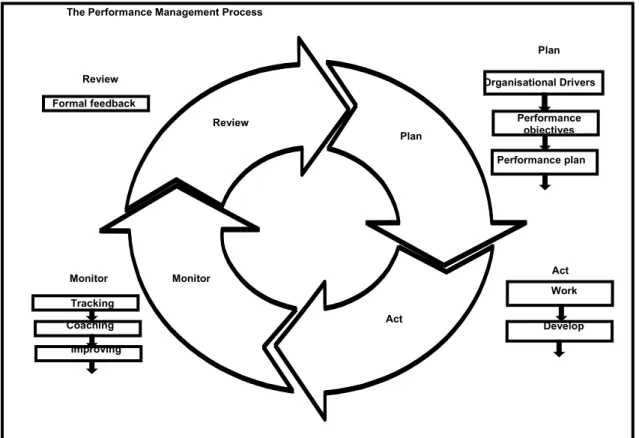
FIGURE 2. 1: THE PERFORMANCE MANAGEMENT FRAMEWORK ... 51
2.6. THE IMPLEMENTATION OF THE BALANCED SCORECARD AS A TOOL OF PERFORMANCE MANAGEMENT ... 54
2.6.1. Definition of the Balanced Scorecard (BSC) ... 54
2.6.2. Effective Implementation of a Balanced Scorecard as a tool of a Performance Management System ... ... 56
2.6.3. Advantages of Using a Balanced Scorecard ... 57
2.6.4. Critiques of Using a Balanced Scorecard ... 58
2.6.5. Balanced Scorecard Implementation in the FRO ... 60
2.6.6. Example of a Balanced Scorecard Perspectives in this FRO ... 60
2.7. CONCLUSION ... 63
CHAPTER 3: THE RELATIONSHIP BETWEEN INDIVIDUAL PERFORMANCE AND REWARD ... 65
3.1. INTRODUCTION ... 65
3.2. THEORY ON THE RELATIONSHIP BETWEEN INDIVIDUAL PERFORMANCE AND REWARD ... 65
viii
3.3.1. Expectancy Theory ... 69
3.3.2. Equity Theory of Motivation ... 70
3.4. THE TOTAL REWARD SYSTEM ... 75
3.4.1. Types of Reward Programmes ... 75
3.5. THE RELATIONSHIP BETWEEN INDIVIDUAL PERFORMANCE AND REWARD IN THIS FRO ... 81
3.5.1. How is the mandate for the management increases determined? ... 83
3.5.2. How does performance rating influence the annual increase for bargaining unit employees? ... 84
3.5.3. How does performance rating influence short term incentive pay-out? .. 85
3.5.4. Linking Performance to Non - Monetary Reward in the FRO (Recognition and Reward) ... 86
3.6. CONCLUSION ... 87
CHAPTER 4: RESEARCH DESIGN ... 89
4.1. INTRODUCTION ... 89
4.2. RESEARCH APPROACH ... 89
4.3. RESEARCH STRATEGY ... 89
4.4. RESEARCH METHOD ... 91
4.4.1. Entree and establishing research roles ... 91
4.4.2. Pilot Study ... 92
4.5. SAMPLING ... 93
4.5.1. Demographic information ... 93
4.6. DATA COLLECTION METHOD ... 95
4.7. DATA ANALYSIS ... 95
4.8. STRATEGIES TO ENSURE DATA QUALITY AND REPORTING ... 97
4.8.1. Credibility ... 97
4.8.2. Confirmability ... 97
4.8.3. Transferability ... 97
4.8.4 Dependability ... 98
4.10. CONCLUSION ... 100
CHAPTER 5: RESEARCH FINDINGS ... 101
ix
5.2. PRESENTATION OF RESULTS ... 102
5.2.4. DISCUSSION ... 123
5.3. CONCLUSIONS... 133
CHAPTER 6: CONCLUSIONS, LIMITATIONS AND RECOMMENDATIONS ... 134
6.1. INTRODUCTION ... 134
6.2. CONCLUSIONS FOR THE LITERATURE REVIEW AND EMPIRICAL STUDY ... 134
6.2.1. Literature review conclusions ... 134
6.2.2. Empirical study conclusions ... 137
6.3. RECOMMENDATIONS FOR THE STUDY ... 139
6.4. LIMITATIONS OF THE STUDY ... 143
6.5. RECOMMENDATIONS FOR FUTURE STUDIES ... 144
REFERENCE LIST ... 145
APPENDICES LIST ... 157
APPENDIX1:QUESTIONNAIRES ... 157
APPENDIX2:PERMISSIONLETTER ... 161
APPENDIX3:SIGNEDCONSENTFORMS ... 162
APPENDIX4:ETHICALCLEARANCE ... 163
x
LIST OF FIGURES
Figure 2. 1: The Performance
Management
Framework
... 51Figure 2.2: WorldatWork Performance Management Process Framework ... 52
Figure 2.3: The FRO Performance Management Process Framework ... 53
Figure 2.4: Methodology Overview, Balanced Scorecard... 59
Figure 2.5: FRO Balanced Scorecard Perspectives ... 62
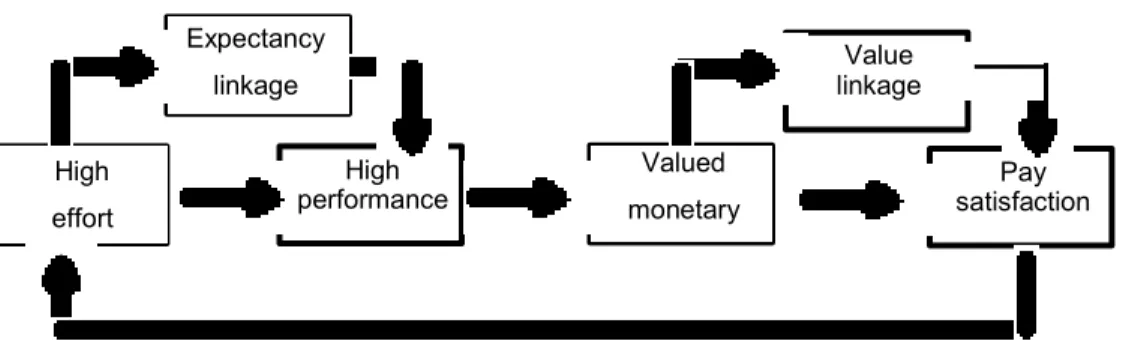
Figure 3.1: Pay-for-Performance and Expectancy Theory ... 71
xi
LIST OF TABLES
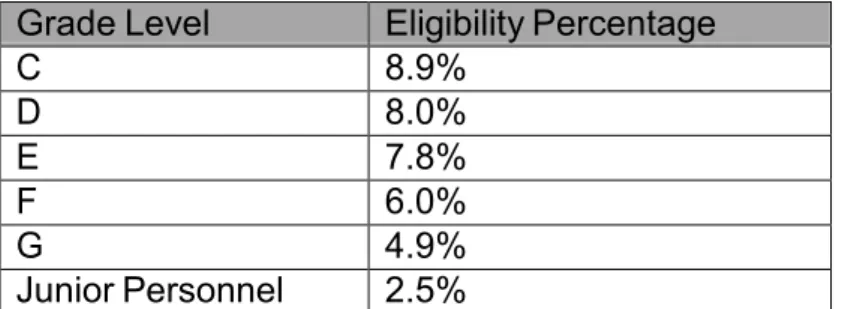
Table 3. 1: Example of Reward Allocation Guidelines for Management ... 83 Table 3. 2: Example of calculation of negotiated increase ... 85 Table 3. 3: Example of eligibility percentage (for performance bonus pay-out) per grade level
... 86
Table 4. 1 : Outline of the research design 91
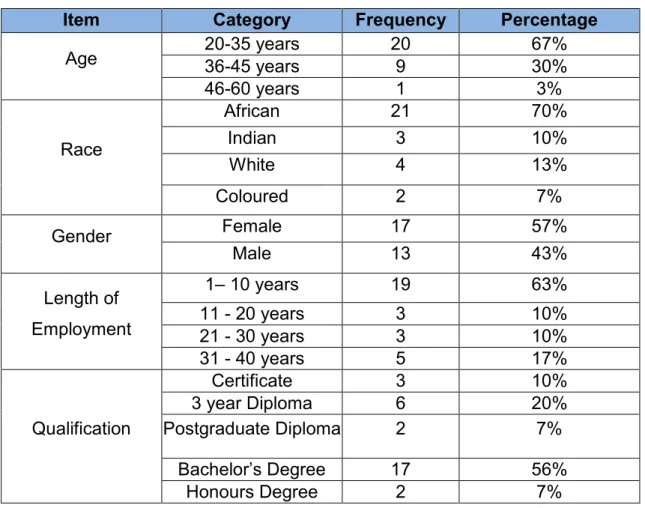
Table 4. 2 : Summary of Bibliographical Distribution of Sample ... 94 Table 5. 1: Research findings ... 103
1
CHAPTER 1: INTRODUCTION
1.1. Introduction
Organisations like this FRO utilise performance management systems and methodologies for the execution and achievement of their strategic objectives. However, there are very few organisations that utilise their existing performance management systems in productive ways (Aguinis, 2009). As inferred from Aguinis (2009) it appears that managers and employees only view performance management systems as a paper exercise and nothing else. This means that they only comply and complete their performance contracts because it is required by their human resources (HR) departments for their annual salary increases and short term incentive bonuses. They tend to overlook other critical phases of performance management process.
According to Bussin (2011) a performance management tool is still viewed by most managers and employees, as a reward tool instead of being seriously taken as a tool to assist managers in identifying competencies required for the successful execution of strategic objectives of an organisation. Performance management starts with the development and understanding of organisational strategy and then becomes a series of steps that involve the identification of individual performance expectations, providing performance direction, encouraging employee participation, and conducting performance appraisal (Mathis & Jackson, 2012). S ome managers still use the performance management system as punitive measures to substitute for lack of performance. The reality is that, with sound use, performance management can actually become a positive, daily conversation that leads to better results and performance throughout the organisation. Bluen and Binedell (2013) were of the view that objectives of performance management included the setting of performance goals that are aligned with the strategic objectives of the organisation, determining performance standards, evaluation of work, providing each employee with frequent feedback, determining training and development, and rewarding them for achieving the strategic goals.
This study evaluated the effectiveness of the existing PMS in enhancing performance in this FRO. The study was undertaken in the largest division of the
2
Group, which is Freight Rail. This group comprises of the following departments, namely; Finance, Technology Management and Communications, Capital Programme, Corporate Safety, Operational Readiness, and Human Capital. The study focused on first line managers, junior managers, middle managers, and senior managers of the FRO.
1.2. Background and Motivation for the Study
The existence of an effective performance management system (PMS) is often the major differentiator between organisations that yield adequate results and those that excel. Research shows that the regular use of performance management systems leads to better organisational results (Yiannis, Nikolaos & Loannis, 2009). The need to manage and measure performance exists in all spheres of life as the pressure to perform continues to be a reality. Organisations achieve their objectives through employees and in order to monitor the attainment of a n y set business objectives, the performance of these employees needs to be assessed and measured. The need to measure performance at all levels of an organisation has, therefore, led to the development of performance management systems (Bezuidenhout, Grobler & Hyra, 2013).
The fundamental purpose of performance management is to focus organisations towards achieving strategic objectives and, ultimately, strive for the linking of individual staff objectives to broader organisational objectives (Lefter & Puia, 2009). Theoretically, performance should improve if the objectives are made clear to employees. Employees will increase their performance if they know what is expected, how to do it and what the standards are. To perform better, employees always welcome guidance to improve performance (Bussin, 2011). Heathfield (2007) was of the view that performance management is the process of creating a work environment or setting in which people are enabled to perform to the best of their abilities. According to Van der Walt (2012) performance management focuses not only on individual employees, but also on systems, processes, programmes, and the organisation as a whole.
Organisational performance management takes a wider institutional perspective as far as the input (resources), processing (systems, procedures, methods, policies,
3
administration) output (services and products) and outcomes (results of output) of public institutions are concerned. It refers to any integrated, systematic approach of improving organisational performance to achieve strategic aims and promote an organisation’s mission and values through aligning the employees’ actions, ( i . e . behaviour and performance) with the set standard or targets (Van der Walt, 2012).
In view of the foregoing, it is clear that performance management processes are associated with organisational and employees’ performance improvement. Research has demonstrated that there is a high correlation between performance culture, performance management practices and business performance (Di Costa, 2008). According to the recent institute for Corporate Productivity study, when it comes to training managers in performance management processes there is a large disparity between the amount of time that high performing companies spend on training compared to their low performing counterparts. For example, 46 percent of high performing organisations said to a high extent that they provide training on developing goals, 45 percent on giving or receiving feedback, and 44 percent on conducting a performance appraisal, compared to approximately 21 percent, and 22 percent, respectively, of low performing organisations (Pace, 2011).
Traditionally, this FRO introduced a performance management system for the administration of employees that was based on employees’ performances being measured on the outputs agreed to and a rating scale would be applied in terms of which employees would receive a performance bonus. Depending on the rating received by a manager and mutually agreed u p o n , the employee would then be rewarded with a percentage of salary as a once off bonus. The performance management system for junior employees in administrative jobs continued until 2003.
The performance management system for management employees was revised in 1997/98. The key changes that were introduced were that the final performance rating was input into the annual salary adjustment as well as into a short term incentive bonus.
4
In 2008, this FRO introduced performance management to all first line managers, specialists and technicians (FST’s). The change here is that the FST’s moved from a basic pay dispensation to a cost to company package approach. The purpose of the FST’s agreement was to govern the remuneration of these employees to retain their skills (First Line Managers, Specialists and Technicians Agreement, 2008). The annual percentage increase for FST’s is negotiated at the bargaining council. However, the seventy five percent (75%) of the annual negotiated increase percentage of the FST’s category employees is across the board and the twenty five percent (25%) is performance based.
The introduction of performance management to management employees and FST’s was done with the aim of improving productivity. According to Cascio (2010) such variable pay systems at lower levels almost guarantees cost control, and any productivity gains are shared 25 percent by the employee and 75percent (75%) by the company. If business takes off, more pay goes to workers.
For lower level employees (junior officials), a performance productivity e nhancement programme (PPEP) was implemented in 2011. The aim of the PPEP is to assist junior officials or bargaining unit employees (lower than FTS employees) understand the business objectives of the FRO and to identify the development areas for individuals and teams. The only challenge with the PPEP is that it is not linked to reward. It was designed only to assist managers to give performance feedback to employees and teams.
In the year 2013, this FRO introduced the balanced scorecard (BSC) to performance management to the m anagement employees and FST employees. This FRO utilises the BSC methodology in order to improve organisational performance by aligning individual outputs to the FRO’s strategic and business objectives. According to De Felice et al.(2013), most organisations adopt the BSC as the foundation and decision support tool for their strategic management systems. This has always been a challenge in the FRO environment where performance objectives by some managers and employees have not been linked to FRO’s strategy and has not cascaded to the next level of managers and employees.
5
The introduction of the BSC at this FRO was aimed at enhancing the performance at both the individual and organisational level, and to support the market demand strategy (MDS). The MDS of this FBO is a seven year plan aimed at railing more than 350.3 million tons of cargo a year by 2018 – 2019 (Market Demand Strategy Guide, 2012). As far as employees are concerned the purpose of the MDS is to ensure that this FBO attracts skilled employees, and retains those with scarce or critical skills. It also seeks to provide incentives and rewards to employees who perform well.
Since the introduction of performance management system to management and FSTs, there have been numerous challenges relative to the effective implementation of performance management processes. This ineffective implementation of the performance management processes by some managers and employees leads to some b usiness u nits and d epartments failing to meet or achieve their performance targets as per t h e F R O Business Plan. According to Bluen and Binedell (2013) when properly designed and implemented, performance management assists employees to know how they are doing relative to performance expectations. It is clear that performance management is critical in clarifying what needs to be done to improve the performance of an organisation.
The other challenge includes strategic business objectives only reflecting high level business targets. Furthermore, other challenges are that it also includes managers not allocating time to coach or give continuous feedback to their subordinates and failure to review development needs of their employees, and performance assessments (quarterly and midyear reviews) being taken for granted or not done at all. In addition, there has been insufficient differentiation between good and poor performers as well as performing and non performing departments resulting in under rewarding of good performers and over rewarding of average performers.
Poor performance is not managed properly. Some managers use performance management as a yard stick to discipline employees. As a result, there are a number of grievances relating to performance management and poor performance not being handled well. Manyaka and Sebola (2012) were of the view that what
6
constitutes poor performance is not as clear cut as it appears; in fact, it depends on the standard established for performance and how these standards are applied.
Many managers and supervisors choose to ignore poor performance and poor performers all together. Instead, they choose to assign the work to effective employees or even do it themselves. Ineffective managers allow poor performers to get away with poor performance, leading to the overall lower levels of performance in the organisation (Manyaka, & Sebola, 2012). Aguinis (2009) w a s of the view that in order to address performance problems properly, managers must find information that will allow them to understand whether the source of the problem is declarative knowledge, procedural knowledge, motivation, or some combination of these three factors.
Thus p erformance m anagement is still seen as a vehicle to get an incentive bonus and better annual increase at the end of the financial year. This has also created a number of problems when it comes to adhering to the performance management process.
Further to this, it is important that managers allocate time for informal reviews and give regular feedback to their subordinates. Bussin (2013) is of the view that managing performance includes a continuous process of providing feedback on performance, conducting informal progress reviews and updating objectives, and dealing with performance problems.
There are many studies that have been done in performance management system. Munzhedzi (2011) conducted a study on performance management system which aimed to determine whether the performance management systems of the Department of Local Government and Housing in the Limpopo Province contribute to improved productivity.
That study missed some critical linkages as far as p erformance management processes are concerned. The study only highlighted the importance of signing performance agreements and measuring performance as one of the effective ways of improving productivity. However, the first step in developing an effective
7
performance management system that will improve productivity or enhance performance is to determine the organisation’s objectives, and then translate these into departmental and, ultimately, individual goals (Bussin, 2013). Goals should evolve f ro m the mission and vision of the organisation, and should be communicated downward. In this way, everyone knows what the objectives of the organisation are, and everyone is involved in the achievement of the organisational goals. The linking of individual employee goals to the organisational goals, therefore, contributes to the achievement of results (Bussin, 2013).
According to Aguinus et al.(2012) In developing an effective performance management system, it is important to begin with the establishment of an organisation’s mission and strategic goals. This ensures that the goals of the particular job are aligned with the organisation’s goals. Gruman and Saks (2011) fully concurred with the above that there should be alignment between individual goals and organisational goal. This ensures that employees engage themselves in tasks that are of vital importance towards achieving the strategic objectives of an organisation.
Munzhedzi’s (2011) study highlights another aspect as it was also conducted in a completely different dimension with focus in the Limpopo’s local government and housing department whereas this study is focusing on a public entity. Government departments and public entities operate differently according to the public finance management act (PFMA). Private entities are managed under schedule two of the PFMA whereas the government department’s (public service) are guided by the public administration ethos of section 195 of the Constitution of the Republic of South Africa of 1996.
It is for this reason that this present study has been undertaken to evaluate the effectiveness of performance management system in enhancing performance and to establish the impact of performance management practices in this FRO. The main focus of the study was to investigate whether the performance management processes are effective in enhancing the individual performance level in t h e F R O . The performance management processes referred to are; goal alignment and performance planning, coaching and performance reviews and assessments.
8
The BSC and reward system were explored as tools in implementing performance management within this FRO. The findings of this study provide meaningful input towards optimising performance management processes within the organisation. 1.3. Problem Statement
One of the main goals of any performance management system is to promote the achievement of the organisation’s broad goals. If managers and employees are not aware of these strategic goals, it is unlikely that the performance management system will be instrumental in accomplishing the strategic goals. Aguinis (2009) was of the view that the p erformance management process included six closely related components: (1) Prerequisites, (2) Performance Planning, (3) Performance Execution, (4) Performance Assessments, (5) Performance Review and (6) Performance Renewal and Re-contracting. There is a need to continuously monitor the prerequisites so that performance planning and all subsequent stages of performance management processes are consistent with the organisation’s strategic objectives. The real issue in performance management is to ensure that the organisation meets its overall objectives. Performance management processes are associated with performance improvement (Bussin, 2013).
Since the introduction and upgrade of performance management for m anagement in 1997 and in 2008 for FST employees, there have been problems in implementing performance management processes correctly. The business plan is not adequately shared with all employees at all levels, resulting in performance objectives not being cascaded to the next level. In addition, managers and subordinates are not adhering to performance management timelines. Other challenges include managers failing to give regular performance feedback and failure to identify development areas for their subordinates, quarterly and midyear reviews not being adequately conducted. Employees are signing the generic performance scorecards that they do not understand, and poor performance is not being managed properly. As a result, a significant number of grievances have been reported with regard to the implementation of performance management processes and reward. Another challenge is that employees still view performance management as a determinant of reward. This has also partly contributed to the challenges in the effective implementation of a performance management system in
9
the FRO. Managers and subordinates attempt to adhere to performance management processes towards the end of the financial year.
To address the above mentioned problems, the main research problem that will be investigated in this study is:
i. Whether Performance Management Processes, including the Balanced Scorecard are effective in enhancing the individual performance level at the FRO?
ii. Whether performance management is linked to employee reward? 1.4. Research Objectives
The main theoretical aims of the study were categorised as follows:
Research aim 1: To conceptualise performance management and its processes. Research aim 2: To conceptualise BSC as a tool of performance management. Research aim 3: To explain the relationship between performance management and reward.
The empirical aims of this study were as follows:
Research aim 1: To evaluate the implementation of the performance management processes on improving individual performance at this FRO.
Research aim 2: To analyse whether the implementation of the BSC as a tool of performance management would contribute towards improving individual performance at the FRO.
Research aim 3: To investigate the relationship between performance management and reward at the FRO.
1.5. Research Questions
The theoretical research questions of this study were as follows:
Research question 1: What is performance management and its processes?
Research question 2: What is BSC and how its effective implementation improves performance?
10
Research question 3: What is the relationship between performance and reward?
The empirical research questions of the study were as follows:
Research question 1: What influence does performance management processes have on improving individual performance at this FRO?
Research question 2: How would the implementation of the BSC improve individual performance within this FRO?
Research question 3: What is the relationship between performance management and reward at the FRO?
1.6. Anticipated Contribution of the Study
Research has established that there is a high correlation between performance culture and performance management practices on the one hand, and business performance on the other (De Swardt, 2011). The contribution of the study is categorised as follows:
1.6.1. Literature contribution
The findings of the literature review will contribute further knowledge to the field of industrial psychology, with particular emphasis on personnel psychology. The literature contribution will provide understanding into the conceptualisation of performance management, performance management processes, and BSC as a tool of performance management. The literature will further provide understanding of the relationship between individual performance and reward. This study will help Human Capital professionals, employees and managers within the FRO and other organisations in understanding the theoretical models that need to be utilised in performance management.
1.6.2. Empirical contribution
The qualitative method will be used for this study, and there are number of benefits or advantages of applying this method for this study. The qualitative method allows for the obtaining of in-depth information about how managers and employees perceive performance management at the FRO. Hence, the data gathered from the qualitative, semi-structured interviews of 30 participants will serve to enrich this base
11 of knowledge.
This will be achieved because the participants should provide more authentic and open answers. As the result, the researcher may discover new themes and interpretations of the findings. This study may also yield benefits in terms of the number of conclusions and recommendations about the effectiveness of performance management processes, the BSC and the relationship between individual performance and reward. Another benefit for this study may be that the measuring instruments developed and used in this study can further be applied as guides in any performance management research projects.
1.6.3. Practical contribution
According to Bussin (2013) performance management processes are associated with performance improvement. The study will help Human Capital professionals, Industrial Psychologists at this FRO and other organisations in knowing and understanding best practices to adopt in managing individual performance levels. The study will not only benefit management in dealing with a strategy and drive individual performance, but will also assist all levels of employees within the FRO and other organisations in understanding the day-to-day operational activities of performance management. Gruman and Saks (2011) suggested that if performance management is effectively applied, this will assist the organisation to create a higher performance culture which leads to higher levels of performance.
1.7. Paradigm Perspective
According to Hart (2010) paradigm is a set of beliefs, values, and assumptions about the world and about gaining knowledge that goes together to guide people’s actions on how they are going to go about their research. This research was set up on a paradigm of social constructivism. Constructivist approaches to research have the intention of understanding the world of human experience, suggesting that reality is socially constructed (Mackenzie & Knipe, 2006). The language is crucial since it provides us with an approach of structuring our experience of the world (Krauss, 2005). Krauss (2005) further proposed that the constructivism research must depend upon the participant’s views of the situation being studied and recognises the impact of the research of their own background and experiences. Constructivism research does not start with a theory rather it creates a theory of pattern of meanings during
12
the research process (Nassazi, 2013). In constructivism research, the qualitative data collection methods dominate even though quantitative methods may also be used (Shenton, 2004). Social constructionist theory does not assume that there is a single unitary reality apart from our perceptions, as each of us experiences from our own point of view; every single one of us experiences a different reality. As such, this phenomenon emphasises the concept of multiple realities. Conducting research without taking this into consideration interrupts the fundamental view of the individual (Krauss, 2005).
The qualitative method was appropriate for this study as the data collected and examined from various angles intended to construct a rich and meaningful picture of a complex and multifaceted situation. This study amongst other things highlighted the understanding of performance management by participants, the frequency of feedback and performance reviews by participants. The factors mentioned above, which are the understand of performance management by participants, the frequency of feedback and performance reviews by participants directed constructivism as a suitable paradigm in which to base this study. The intention of this study was to understand the research participants’ world and experiences as far as evaluating the implementation of the performance management processes on improving individual performance at the organisation is concerned. The intention also included understanding the research participants’ experiences and their understanding of a relationship between performance management and reward. The constructivism paradigm was appropriate for this study, as the construction of experiences by research participants on effectiveness of performance management was attained. In this study, the participants used the language to explain various phenomenon of the implementation of performance management processes.
13 1.8. Research Design
A qualitative approach will be used for this study to answer the research questions. In qualitative study the researcher collects numerous forms of data and examines them from various angles to construct a rich and meaningful picture of a complex, multifaceted situation. The qualitative research study provides a means through which the researcher can judge the effectiveness of particular policies, practices, or innovations (Leedy, & Ormrod, 2005). The type of research for this study, the population and sampling method, methods used to collect data and the data analysis methods will be discussed below.
1.8.1. Type of research
As mentioned above, a qualitative approach will be used for this study. The decision to approach the study qualitatively is based on the research questions driving the study, prior work, the planned research design, and the desired contributions the researcher wishes to make. The state of the literature on the topic also demands a qualitative examination or re-examination to document new phenomenon, test perceptions and causal mechanisms (Blum et al. 2011).
According to Silverman (2011) qualitative research often studies phenomena in the context in which they arise through observation and/or recording and internet material. In qualitative research, there is no agreed way to analyse data. M ultiple research models exist (grounded theory, constructionism, and discourse analysis) and sometimes there is conflict with each other (Silverman, 2011). The qualitative research approach involves an in-depth exploration of participants’ behaviour and reasons that govern participants’ behaviour (Babooa, 2008).
1.8.2. Population and Sampling Method
A population was defined by Melville and Goddard (2011) as any group that is the subject of research interest. Mouton (2006) defined a population as the sum total of all the cases that meet our definition of the unit of analysis. For the purpose of this research, the population consists of three hundred (300) employees from various managerial levels of the FRO.
14
general findings based on a study of only a subset of the population and such subsets are called samples. Samples must be representative of the population being studied. The sample for this study consisted of employees from various management levels with more than three years exposure or experience in the FRO performance management system. The sample for this study will be categorised according to demographic characteristics (i.e. age, gender, race and educational qualification). These criteria ensure that the study only focuses on employees with a broader understanding of the FRO’s performance management system. The sampling strategy that will be used for this study is purposive sampling with convenience sampling. Purposive sampling is when you select those individuals or objects that will yield the most information about the topic under investigation (Leedy & Ormrod, 2005). This sample will consist of permanently employed FRO employees, that is, first line managers, junior managers, middle managers and senior managers.
In this research, a convenience sample will be used. A convenience sample is a simple one in which the researcher uses any subjects that are available to participate in the research study. In this research, it will be first line managers, junior managers, middle managers and senior managers to whom the researcher has regular access.
1.8.3. Methods of Data Collection, Analysis and Interpretations
1.8.3.1. Interviews
Qualitatively interviewing individuals is particularly useful as a research method for accessing individuals’ attitudes and values, things that cannot necessarily be observed or accommodated in a formal questionnaire. Open-ended and flexible questions are likely to get a more considered response than closed questions and, therefore, provide better access to interviewees’ views, interpretation of events, understanding, experiences and opinions. Qualitative interviewing when done well is able to achieve a level of depth and complexity that is not available to others, particularly survey based approaches (Silverman, 2011).
For this study, one-on-one, semi-structured, in-depth interviews will be conducted with the first line managers, junior managers, middle managers and senior managers in the FRO.
15
The questions that will be asked during the interviews will be predominantly covering the effective implementation of performance management processes. Some of these questions will include how their individual performance contracting/planning is conducted in their department? “How often is performance feedback provided to them by the respective supervisor?” How often are performance assessments done in the department?” Are there any corrective actions that are applied in the department to employees that are under performing?” In your opinion, can you say that the PMS contributes to the improvement of performance in your department?” Additional questions will include the following: “How would you describe your level of understanding of the BSC methodology?” In your opinion, what is the relationship between performance management and reward at the FRO?” What improvement would you like to see made in the performance management of this FRO? Why?”
1.8.3.2. Observations
Participant observation is about engaging in a social scene, experiencing it and seeking to understand and explain it. The researcher is the medium through which this takes place. By listening and experiencing, impressions are formed and theories considered, reflected upon, developed and modified (May 2011). The qualitative researcher may make observations either as a relative outsider or as a participant observer. Observations in qualitative study are intentionally unstructured and free-flowing. In qualitative research, the researcher shifts focus from one thing to another as new and potentially significant objects and events present themselves. The primary advantage of conducting observations in this manner is flexibility. The researcher can take advantage of unforeseen data sources as they surface (Leedy & Ormorod, 2005).
For this study, semi-structured interviews will be supplemented by personal observations on how various departments manage the performance management Process. Field notes will be taken during various phases of performance management, meetings and workshops. According to Marshall and Rossman (2006) observation entails the systematic noting and recording of events, behaviour and objects in the social setting chosen for the study. The researcher of this study is a performance and reward specialist in the compensation department
16
of the FRO, so it will be easier for the researcher to observe the events or phases of performance management that is, during planning for performance, quarterly, midyear and final performance reviews, the behaviour of employees during phases of performance management processes, and performance meetings.
1.8.4. Data Analysis
Becker and Burke (2012) argued that data analysis follows general procedures for qualitative research including preparing and organising data, reducing data into themes through a process of coding, and representing data into Figures, Tables and discussions. Given (2008) argued that there are many variants of qualitative research involving many forms of data analysis, including interview transcripts, field notes, conversational analysis, visual data, photographs, and observations of internet occurrences. For this particular study, a combination of the content, phenomenological, and case study analyses will be conducted.
The following are the reasons why the above mentioned method of data analyses was preferred for this particular study:
The case study enables the categorisation and interpretation of data in terms of common themes. The observation, interview, and observation will be the method of data collection for this study. Other relevant materials that will be consulted on performance management included the following:
a) The FRO performance management policy. b) First line, specialist, and technicians agreements.
c) Academic books on performance management systems. d) Journal Articles.
The process of categorising and coding the data involves developing a matrix table which will be developed based on the individual transcript. A further subdivision will then follow using data analysis position categories. These categories will be classified according to the various ranking levels within the organisation (i.e., senior management, junior management and junior employees). The researcher will go through each individual transcript to establish concepts related to the respective sub-themes which will be in line with the research objectives of this study. The results will
17 be presented in chapter 5.
Similar participants’ responses will be plotted on a spreadsheet to allow themes to be extracted from which an analysis could be made. The themes will be based on the three empirical research objectives as outlined earlier and further sub-divided according to the sub factors which make up the theory on performance management systems. The three major research objectives that will be used to classify the themes include:
a. Implementation of the performance management system. b. Implementation of the BSC.
c. Relationship between the performance management system and reward. The Microsoft Excel will be used to capture the responses from each originally handwritten interview transcript to enable the coding process. The researcher will then read through all the responses to identify and colour code similar themes and sub-themes across the various categories of managerial levels. For example, for the question on the implementation of performance management system, the theme presented will be first on performance management experiences of participants, then sub-themes will be presented including Subtheme 1.1 Implementation of performance reviews procedure; Subtheme 1.2 Frequency of feedback on the implementation processes, and Subtheme 1.3 Management support in performance reviews.
This system enables the researcher to comprehensively analyse the strengths and weaknesses in the implementation of the performance management system.
The researcher will further engage himself in writing up the data as soon as possible in order to arrive at a more profound analysis of the data. These short or lengthy writing bouts often yield insights that are not readily apparent even after coding has been completed (Given, 2008). The researcher will also elaborate, interpret and check the data through linking it with relevant literature.
18
1.8.5. Strategies that will be employed to ensure quality data and ethical considerations
1.8.5.1. Credibility
Bowen (2005) stated that credibility refers to the confidence one can have in the truth of the findings. This can be established by various means, which are triangulation, member checking and negative case analysis. According to Shenton (2004) the investigator seeks to ensure that the study measures or tests what is actually anticipated. The researcher will strive to achieve this by using the same ideas and words that are used by the participants (Bowen, 2005).
1.8.5.2. Confirmability
According to Shenton (2004)) it is important in qualitative research to achieve confirmability; steps must be taken to assist in making sure that the findings are the results of the experiences and ideas of the participants rather than the characteristics and preferences of the researcher. This researcher will achieve confirmability in this study by remaining impartial throughout the study and not influencing the research results. During the interviews, the researcher will record the interviews, and all interview transcripts will be verified to confirm the accuracy and numbering of responses.
1.8.5.3. Transferability
Transferability is concerned with the extent to which the results of one study can be applied to other situations (Bowen, 2005). Shenton (2004) stated that it is the responsibility of the researcher to make sure that sufficient contextual information about fieldwork sites is provided and that the sufficient thick description of the phenomenon under investigation is provided to enable the reader to make such transfer. The researcher will aim to increase the transferability potential of the results by presenting findings with thick descriptions of the phenomena and providing the exact definitions of concepts as determined by the literature review.
19
Dependability entails that the processes within the study should obtain the same findings when it is repeated with the similar participants in the same context. Thus, the dependability researchers should attempt to enable a future investigator to repeat the study if not necessarily to achieve the same results (Shenton, 2004). The researcher will aim to accomplish this by documenting the research process in a rational and well-organised manner for ease of coherence and understanding.
1.8.6. Ethical Considerations
A letter of consent was signed by authorities to conduct this study in the FRO. The appropriate procedures of ethical issues for conducting this study will be followed to obtain participant’s informed consent; privacy and anonymity will be assured to participants. Participants will be protected from harm, and findings will be reported in a complete and honest fashion with professional colleagues without misrepresentation (Leedy & Ormrod, 2005). The researcher will obtain consent from participants to make use of the audio recording during interviews. The researcher will briefly describe the study and obtain a participant’s written consent before beginning his observations. The researcher will also sign a declaration about the policy on Research Ethics of UNISA. The findings of this study including the researcher’s interpretation and conclusion will be published in the form of a dissertation at Master’s level.
1.9. Conclusion, Limitations and Recommendations
The conclusion, limitations and recommendations of this study a r e based on research objectives.
1.9.1. Conclusions
The main purpose of this study is to investigate whether the performance management processes are effective in enhancing the individual performance at this FBO. The BSC and reward as a tool in implementing performance management within the FRO will also be explored.
In summary, this chapter addresses the introduction, background to the study, identifies the problem statement, objectives, research questions, possible contribution of this study and research design, methods of data collection, and data analysis. Strategies to ensure quality data and ethical considerations were also
20 discussed.
1.9.2. Limitations
The limitations of this study will be examined and discussed under chapter 6.
1.9.3. Recommendations
Recommendations from employees regarding this study are presented under chapter 6.
1.10. Chapter Lay Out
The chapter lay-out for the research and findings in this Masters dissertation will be as follows:
Chapter 1: This chapter provides a scientific orientation to the study by discussing the introduction, background and motivation for the study, the problem statement, paradigm perspective, the research objectives, the research questions, the anticipated contribution of the study and the research design.
Chapter 2: This chapter addresses the literature review and conceptualises performance management, performance management effectiveness and the basic factors contributing to effective implementation of performance management from a theoretical perspective. The phases in the performance management process, the frameworks that are applied in performance management and the implementation of the balanced scorecard (BSC) as a tool of performance management will also be discussed in detail from a theoretical perspective. The phases in the performance management process and BSC will also be explored in relation to what is happening in the FRO.
Chapter 3: This chapter addresses the relationship between individual performance and reward, theories of motivation, the total reward system, and the types of reward programme from a theoretical perspective. Linking performance to monetary and non-monetary reward in this FRO will also be explored in detail.
21
entree involving establishing research roles, research strategy, pilot study, sampling, data collection method, recording of the data and data analysis. Strategies to ensure data quality and ethical considerations will also be explained in detail..
Chapter 5: This chapter outlines the findings, discussion and interpretation of the data of the research study. The analysis is based on the data collected through the interviews with the FRO employees.
Chapter 6: This chapter outlines the conclusion, limitations, and recommendations
22
CHAPTER 2: PERFORMANCE MANAGEMENT
2.1. Introduction
Chapter one provides a scientific orientation to the study by discussing the introduction, background and motivation for the study. In addition, the problem statement, the research objectives, the research questions, anticipated contribution of the study and research design were presented. Chapter 2 addresses the literature review and conceptualises performance management. The basic factors contributing to effective implementation of performance management and performance management processes will be explained in detail. The frameworks that are applied in performance management will also be explained by means of models. The implementation of the BSC as a tool to measure performance will also be explored in detail. The phases in the performance management process and BSC will also be discussed in relation to what is performance management practice within the FRO.
2.2. Definition of Performance Management
Di Costa (2008) viewed performance management as a tool to assist in achieving organisational goals and staff performance. It, therefore, involves goal establishment, performance evaluation, employee development and reward. Bussin (2013) defined the objectives of performance management as follows;
i. To align organisational and individual goals,
ii. To foster organisation-wide commitment to a performance oriented culture, iii. To develop and manage the human resources needed to achieve
organisational results,
iv. To identify and address performance inefficiencies,
v. To create a culture of accountability and a focus on customer service, vi. To link rewards to performance.
Butler (2011) defined performance management as a journey which measures the implementation of the organisation’s strategy. It is also a management tool to plan, monitor, measure, review and report on performance indicators to ensure efficiency and effectiveness. Performance management is part of our daily function and not a
23 quarterly event which frustrates everyone.
An effective performance management system (PMS) focuses on identifying, measuring, and dealing with employees’ performance evaluations (Mathis & Jackson, 2009). Dessler (2013) defined performance management as a special goal- oriented and continuous way to appraise and manage employees’ performance. It is the continuous process of identifying, measuring, and developing the performance of individuals and teams and aligning their performance with the organisation’s goals (Dessler, 2012). According to Bach and Edwards (2013) performance management encompasses the whole organisation and extends beyond setting individual objectives to include broader organisational priorities such as talent management. According to Matunhu and Matunhu (2008) performance management is a human resources management approach intended to raise productivity in organisations through a coordinated system of planning employee performance, facilitating the attainment of goals and measuring performance. It is guided by principles of management by agreement rather than management by command.
According to Wilton (2013), performance management represents the range of human resources activities that enable, encourage, coordinate and support employees to achieve their objectives, monitor, measure and reward their achievements and fundamentally to contribute to the long-term success of an organisation. Sebashe and Mtapuri (2011) argued that performance management is about getting results from individuals and teams in an organisation within agreed norms; (i.e.– goals, objectives and standards). Redman and Wilkinson (2009) defined performance management as systems and attitude which help organisations to plan, delegate and assess the operation of their services.
According to DeSimone and Werner (2012) performance management incorporates planning, employee goal setting, feedback, coaching, rewards, and individual development. As such, performance management focuses on an on-going process of performance improvement, rather than primarily emphasising an annual performance review. Aguinis (2009) defined performance management as a continuous process of identifying, measuring, and developing the performance of individuals and teams and aligning performance with strategic goals of the
24
organisation. The performance of an organisation depends on the performance of its people, regardless of the organisation’s size, purpose, and other characteristics. It is clear that the above mentioned authors (Aguinis, 2009; DeSimone & Werner, 2012; Wilton, 2013) fully concurred that performance management is all about providing regular informal performance feedback, coaching and support, and conducting formal performance reviews to ensure that the organisation can achieve its key strategic objectives (Bussin, 2013).
Performance management is a two way process, where employees also need to approach their managers to discuss progress and obstacles on performance objectives. Unfortunately, there are few managers and subordinates who utilise performance management in an effective way (Aguinis, 2009). This researcher is of the view that some managers and employees still view performance management as a once off exercise that can be used for a reward purpose. Boninelli and Meyer (2011) fully concurred that performance management is not a once or twice a year meeting where goals are set or performance is rated, however, it is the day- to-day management of people to produce the desired outcome and to ensure the delivering on the strategy so as to satisfy customer needs.
It is clear from the above definitions that performance management is an important process to ensure organisational focus and alignment on individual level. This forms the basis to establish accountability, for regular performance and development conversations and for achieving organisational and team targets. The achievement of strategic business objectives start with the cascading of performance objective, for example, from strategic business objectives are cascaded from the FRO Group to Operating Divisions, from various Operating Divisions to Business Units or Departments, from Departments to individual or team. In this way progress throughout the organisation is measurable.
There are few studies that have been conducted on performance management. In a study that was done by Matlala (2011), she concluded that performance management starts with performance planning. The manager and employee must plan and agree on job objectives, weighting, KPI’s and performance measures to be
25
achieved in a particular financial year and develop Individual Development Plan. Recommendations were that a consultation with all employees on the implementation of the system was required which cascaded from the performance management to all lower level employees, and that municipality must pay performance bonuses to good performing employees.
Matlala (2011) did not highlight the fact that the first step in developing an effective performance management system originated with determining the organisation’s objectives, and then cascading these into departmental and, ultimately, individual goals. This is known as goal setting.
Jordan, and Scraeder (2011), fully concurred that goal setting is the first step and in this step goals should evolve from the mission and vision of the organisation, and should be communicated downward. This allows employees to make contributions that will have a positive impact on their units and organisation as a whole. It is clear that goal setting involves sharing business objectives that are derived from the shareholder compact and cascaded from management to lower level employees in the organisation. These can be achieved by organising goal setting workshops in a n organisation which assist the business to ‘pull’ in the same direction. Once the goals have been set and agreed upon for department, or business unit, the management has to cascade the goals to the individuals’ goals. This streamlined the contracting process between the supervisors and employees and made it easier for them to achieve the strategic business objectives.
Another important argument regarding goal setting that the above mentioned study Matlala (2011) did not refer to is the fact that goal setting assists line managers and employees to avert from being contracted on strategic business objectives that are only reflecting a high level business targets. Goal setting also assists line managers and employees to avoid duplicating targets during contracting process. It is important to note that success in business is not just getting a lot of work done by several employees, but getting the right work done. During goal setting, the issue of resources and capacity are also discussed and prioritised in order to achieve the strategic objectives of the department or business unit. Another argument that both studies omitted is the fact that departments or business units must ensure that their internal or external customers
26
participate in the goal setting sessions. This does not only assist departments or business units to understand customer expectations but also improves the relationship between the service provider and the customer. If the above mentioned practices are applied correctly, employees are contracted on outputs that they can influence, which enhances performance at individual, departmental and ultimately at organisational level.
Another critique for Matlala’s study is that she only linked t h e performance planning phase with the results; that is, the key performance areas or objectives that should be accomplished during a given performance period. This phase of performance management should also be linked with the kind of behaviour expected in a particular job. For example, for a lower level employee or an employee in a n operational environment this may include, arriving on time as per shift roster or work schedules, wears correct protection clothing at all times, and informs his/her supervisor in advance if they will not be at work.
Matlala’s study (2011) only focused on generic performance management system (PMS) where an individual employee receives feedback from their line manager. The latest developments in PMS suggest that the employees receive what is known as multiple-rater feedback or 360 degree feedback evaluation method. According to Mondy and Mondy (2014), 360 degree feedback provides an all-inclusive view of each employee, people all around the rated employee may provide ratings, including senior manager, the employee himself or herself, supervisors, subordinate, peers, team members, internal or external customers.
While Matlala’s study deepened the body of knowledge as far as p erformance management processes are concerned, however, she do not sufficiently answer the question on how the performance management processes effectively applied to enhance the individual performance level in the FRO. It is for this reason that this study is undertaken to investigate the impact of performance management practices in the FRO. This study mainly seeks to answer key questions on performance management processes. Whether p erformance management processes at t h e F R O have any influence on improving individual performance (Biron et al., 2011). These include questions on whether employees participate in setting goals of their
27
departments and planning individual performance with their supervisors or line managers so that they understand what is expected of them, and what can be done to deal with a challenge of non-adherence to deadlines of performance contracting? The study further answer questions on the frequency of giving regular feedback and performance reviews.
2.3. Performance Management System Effectiveness
According to Biron et al., (2011) performance management refers to a variety of undertakings engaged in by the organisations to improve the performance of individuals and units with the eventual purpose of enhancing organisational effectiveness. The undertakings that are appropriate for this definition are for example, the setting of corporate, departmental, team, and individual objectives, and the use of assessment reviews, reward strategies, training schemes and individual career plans.
There are number of critiques that contest the fact that performance management plays an important role in the organisation’s success. More precisely, performance management has been one of the most praised, criticised, and debated management practices for decades and it continues to be a cause of frustration for managers and supervisors. On the one hand, research shows a significant number of proponents of performance management, providing an indication that organisations that manage the performance of their employees outperform those without such programmes on a wide range of financial and productivity measures. Crowe et al., (2008) are of the view that organisations with a PMS tend to outperform those that do not have such programmes. For example, on a study that was conducted by Malmi (2001) improvements were noticed in a number of areas, subsequent to the introduction of the tool of PMS, this is after the implementation of the BSC in their organisations. Improvements were in the number of areas such as logistics, delivery reliability, real time changing targets and warehouse turnover (Yu, Crowe & Perera, 2008). Maharaj (2012) fully concurred that the effectiveness of the performance management process is defined as the accomplishment of financial as well as non-financial targets, the development of skills and competencies, and improvement of customer satisfaction and quality.