Kansas Agricultural Experiment Station Research Reports
Kansas Agricultural Experiment Station Research Reports
Volume 6
Issue 3 Roundup Article 2
2020
Using Modified Intensive Early Stocking for Cow/Calf Production
Using Modified Intensive Early Stocking for Cow/Calf Production
Keith R. Harmoney
Kansas State University, [email protected]
John R. Jaeger
Kansas State University, Manhattan, [email protected]
This report is brought to you for free and open access by New Prairie Press. It has been accepted for inclusion in Kansas Agricultural Experiment Station Research Reports by an authorized administrator of New Prairie Press. Copyright 2020 Kansas State University Agricultural Experiment Station and Cooperative Extension Service. Contents of this publication may be freely reproduced for educational purposes. All other rights reserved. Brand names appearing in this publication are for product identification purposes only. No endorsement is intended, nor is criticism implied of similar products not mentioned. K-State Research and Extension is an equal opportunity provider and employer.
Follow this and additional works at: https://newprairiepress.org/kaesrr
Part of the Agronomy and Crop Sciences Commons, and the Beef Science Commons Recommended Citation
Recommended Citation
Harmoney, Keith R. and Jaeger, John R. (2020) "Using Modified Intensive Early Stocking for Cow/Calf Production," Kansas Agricultural Experiment Station Research Reports: Vol. 6: Iss. 3. https://doi.org/ 10.4148/2378-5977.7899
Abstract Abstract
Intensive early stocking (IES) was introduced nearly a half century ago in eastern Kansas and has since been adopted as a major management tool to increase animal production, efficiency of production, and economic return on tallgrass rangelands. These increases have come almost exclusively by using IES with young stocker animals. Intensive early stocking and its gains have been proven effective repeatedly in published research. A similar modified IES (MIES) system has increased production efficiency of stocker animals on western Kansas rangelands. Perennial grassland acres for cattle production, as well as cattle numbers, are declining. Using management practices that mimic the MIES system to increase beef cattle stocking density for breeding herds may allow producers to maintain or increase cow numbers for beef production on fewer perennial grassland resources. The objective of this project is to compare cow and calf growth and performance in traditional continuous season-long stocking (SLS) and MIES beef production systems.
Keywords Keywords
available herbage, body condition score, continuous season-long stocking, intensive early stocking, species composition
Creative Commons License Creative Commons License
This work is licensed under a Creative Commons Attribution 4.0 License.
This research report is available in Kansas Agricultural Experiment Station Research Reports: https://newprairiepress.org/kaesrr/vol6/iss3/2
Agricultural Research Center – Hays
Roundup 2020
Kansas State University Agricultural Experiment Station and Cooperative Extension Service
1
Using Modified Intensive Early Stocking
for Cow/Calf Production
Keith Harmoney and John Jaeger
Introduction
Intensive early stocking (IES) was introduced nearly a half century ago in eastern Kan-sas and has since been adopted as a major management tool to increase animal produc-tion, efficiency of producproduc-tion, and economic return on tallgrass rangelands. These in-creases have come almost exclusively by using IES with young stocker animals. Intensive early stocking and its gains have been proven effective repeatedly in published research. A similar modified IES (MIES) system has increased production efficiency of stocker animals on western Kansas rangelands. Perennial grassland acres for cattle produc-tion, as well as cattle numbers, are declining. Using management practices that mimic the MIES system to increase beef cattle stocking density for breeding herds may allow producers to maintain or increase cow numbers for beef production on fewer peren-nial grassland resources. The objective of this project is to compare cow and calf growth and performance in traditional continuous season-long stocking (SLS) and MIES beef production systems.
Experimental Procedures
On native mixed-grass rangelands, 211–225 total cow/calf pairs at two locations were stocked at either 1.45× the typical stocking density May through November, or at a typical 1× density during the growing seasons of 2015–2019. The grazing study oc-curred at the Saline Experimental Range in northeast Ellis County, and the HB Ranch in southern Trego County. Both stocking treatments were implemented at both loca-tions. Calves from 1.45× cows were weaned mid-growing season in late July and were backgrounded in a feedlot, thus reducing pasture stocking rate and density for the last portion of the grazing season. Calves from 1× cows were weaned in October. Cow body weights and body condition scores (BCS) were measured each year at the start of graz-ing in May, at the grazgraz-ing mid-point in late July, and at the end of the grazgraz-ing season in October. Calf weights were also recorded at these times. Additional calf weights were measured at approximately 4 and 8 weeks after weaning time periods. Cows were syn-chronized for artificial insemination (AI), and pregnancy was determined 30–35 days following AI and at the end of the grazing season by using transrectal ultrasonography. All pastures were monitored for plant species composition, ground cover, and biomass along transects at representative ecological sites to compare rangeland health between MIES and continuous stocking systems. Available herbage dry matter (DM) availability was measured through a double sampling protocol of clipped sample plots calibrated to
readings from a falling plate meter, while ground cover and species composition were estimated with a modified step-point technique along the same transects. Cows were in-termingled during the winter, managed together, and had access to the same stockpiled winter rangeland and short-term feed resources until being sorted into their respective stocking treatments at grazing turnout in May.
Results and Discussion
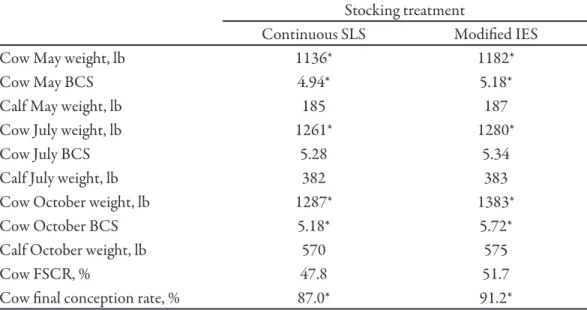
Cow body weight and BCS were similar between grazing treatments at the start of the experiment in May 2015, but cow weight and BCS in May were greater for the MIES treatment after five years (Table 1). Cow BCS was similar for both grazing treatments each year at the midpoint of the grazing season, at the end of July (Table 1). Cows in the MIES treatment had greater cow body weight and BCS in October each year. Even though MIES cows were stocked at a greater density, early-weaning calves in late July allowed the MIES cows to gain weight and condition each fall. The MIES cows retained some of this greater body condition through the winter and subsequently had greater body weight and condition to start the grazing season in May. Cow grazing treatment did not affect cow first service conception rate (FSCR), but final conception rate was greater for the MIES grazing treatment (Table 1). Greater average cow BCS to start the grazing season in the MIES cow group may have benefitted final pregnancy rate. Aver-aged over all five years, calf body weight was not different for the two grazing treatments at any time during the growing season.
Total available herbage dry matter was similar between grazing treatments in the year prior to the study and was also similar between grazing treatments at the midpoint in late July and the end of grazing in October for each of the five study years (Table 2). However, in 2019, July and October available standing dry matter between the two stocking treatments was separated by 200 and 300 lb/acre, respectively. This separation was almost two times greater than any other year, but was still not detected as being statistically different. This separation does indicate that a downward trend in pasture yield may have started in the MIES treatment, and yields in the following years should be monitored and observed closely for a continued downward trend. Initial composi-tion was slightly different between pasture treatments. The MIES pastures started with a greater composition of little bluestem (Schizachyrium scoparium) than the continuous SLS pastures, but no other major grass or forb species was statistically different between treatments in 2015. After five years, continuous SLS pastures had greater Japanese brome (Bromus arvensis) and western ragweed (Ambrosia psilostachya) composition, while MIES treatment pastures had greater sideoats grama (Bouteloua curtipendula) and continued to have greater little bluestem composition than continuous SLS pastures. The direction of composition trends was unexpected based on the observed separation in available dry matter at the end of the growing season between treatments.
Implications
The use of an MIES system appears to be a suitable stocking strategy to increase cow/ calf units while maintaining rangeland productivity. Cows in the MIES system with early weaning had similar or improved values for most production characteristics, in-cluding beginning and end of season BCS and final pregnancy rate. These characteristics may result in long-term greater pasture production trends, such as more beef lb/acre.
Kansas State University Agricultural Experiment Station and Cooperative Extension Service
3
2020 Agricultural Research Center–Hays
However, the separation in pasture yield that developed at the end of five years may be an indicator that the upward limit on stocking has been reached in the MIES pastures, and future yield trends need to be monitored closely.
Table 1. Cow body weights and body condition scores (BCS), and calf body weights at the start of the grazing season, at the end of July at mid-grazing season, and at the end of the grazing season from 2015–2019
Stocking treatment
Continuous SLS Modified IES
Cow May weight, lb 1136* 1182*
Cow May BCS 4.94* 5.18*
Calf May weight, lb 185 187
Cow July weight, lb 1261* 1280*
Cow July BCS 5.28 5.34
Calf July weight, lb 382 383
Cow October weight, lb 1287* 1383*
Cow October BCS 5.18* 5.72*
Calf October weight, lb 570 575
Cow FSCR, % 47.8 51.7
Cow final conception rate, % 87.0* 91.2*
*Indicates statistically different values between treatments at the P ≤ 0.05 level.
Cow first service conception rate (FSCR) to timed AI and final conception rate is also included. SLS = season long stocking. IES = intensive early stocking.
Table 2. Pasture available herbage dry matter yield determined by falling plate meter readings calibrated with clipped frame samples in the fall of 2014 prior to grazing treat-ments, and in 2015–2019 at mid-season in July and after the growing season in October
Cow stocking treatment
July October
Year Continuous SLS Modified IES Continuous SLS Modified IES Available dry matter (lb/acre)
2014 1831 1861 2015 2298 2260 1997 1980 2016 2655 2526 2365 2279 2017 1970 2026 1579 1584 2018 1944 2042 2232a 2436a 2019 2066 1861 2276 1983 Average 2015–2019 2187 2143 2074 2010
aData from one location only. Heavy snowfall occurred and matted the vegetation before standing available dry
matter was clipped at the second location.
Table 3. Plant species composition of continuous SLS and MIES pastures at the onset of grazing treatments in 2015 and at the end of five years of grazing in 2019
Cow stocking treatment
2015 2019
Speciesa Continuous SLS Modified IES Continuous SLS Modified IES
Composition (%) Big bluestem 8.2 6.3 8.7 10.1 Little bluestem 12.3* 18.8* 13.9* 18.8* Indiangrass 2.1 0.2 2.3 0.3 Sideoats grama 20.2 26.0 15.1* 24.2* Blue grama 19.9 17.5 13.4 12.0 Buffalograss 8.0 8.1 8.7 9.0 Western wheatgrass 9.5 0.9 4.2 1.6 Japanese brome 0.0 0.0 8.1* 4.8* Sedges 4.6 1.1 5.7 2.7 Western ragweed 2.7 4.9 3.6* 2.4*
aBig bluestem (Andropogon gerardii), Indiangrass (Sorghastrum nutans), blue grama (Bouteloua gracilis),
buffalo-grass (Bouteloua dactyloides), western wheatgrass (Pascopyrum smithii), and sedges (Carex spp.). *Indicates statistically different values between treatments at the P ≤ 0.10 level.