© HATII, University of Glasgow
1
Data Audit Framework
Methodology
Jones, Ross, Ruusalepp
Release: Version 1.8
Date: 26 May 2009
Draft for discussion
© HATII, University of Glasgow
2 Catalogue entry
Title Data Audit Framework Methodology
Creator Humanities Advanced Technology and information Institute (HATII), University of Glasgow
Subject audit; research data; higher education; further education; data management.
Description The methodology presented here provides specific guidance on how to plan and execute an audit of research data assets in line with the Data Audit Framework (DAF) conceived by the JISC-funded DAFD project. DAF will enable institutions to find out what data they hold, where it is located and who is (or is not) responsible for it, as well as offering a tool for managing this information and sharing it with other organisations in a controlled environment.
Publisher HATII at the University of Glasgow Contributor Sarah Jones
Contributor Seamus Ross Contributor Raivo Ruusalepp Contributor Milena Dobreva
Date 2009.05.26
Type Text
Format Adobe Portable Document Format v.1.8 Language English
Rights © HATII, University of Glasgow
Citation Guidelines
Jones, S., Ross, S., and Ruusalepp, R., Data Audit Framework Methodology, draft for discussion, version 1.8, (Glasgow, HATII, May 2009)
Copyright Notices
© HATII, University of Glasgow
3 TABLE OF CONTENTS
PART I BACKGROUND TO THE DATA AUDIT FRAMEWORK ... 5
1) Overview... 5
a) Executive summary ... 5
b) Introduction ... 5
c) Glossary of Terms... 5
d) Scope of the Data Audit Framework... 6
e) Caveats... 7
2) The Need for a Data Audit Framework ... 8
a) Why Audit Data Assets?... 8
b) How the Data Audit Framework can Help ... 9
PART II THE DATA AUDIT FRAMEWORK TOOLKIT... 11
3) Guidance for using the Data Audit Framework... 11
a) How to Use the Data Audit Framework... 11
b) Support for those Using the Data Audit Framework ... 14
4) Stage 1: Planning the audit... 15
a) Aim of this Stage ... 15
b) Tasks Associated with this Stage... 15
c) Anticipated Results of this Stage ... 15
d) What Resources are Required to Complete this Stage?... 15
e) Instructions for Completing the Stage ... 17
f) Checklist ... 21
5) Stage 2: Identifying and classifying data assets ... 22
a) Aim of this Stage ... 22
b) Tasks Associated with this Stage... 22
c) Anticipated Results of this Stage ... 22
d) What Resources are Required to Complete this Stage?... 22
e) Instructions for Completing the Stage ... 24
f) What to do in the Event of Required Information Being Unavailable... 28
g) Discussion... 29
h) Checklist ... 30
6) Stage 3: Assessing the management of data assets... 31
a) Aim of this Stage ... 31
b) Tasks Associated with this Stage... 31
c) Anticipated Results of this Stage ... 31
d) What Resources are Required to Complete this Stage?... 31
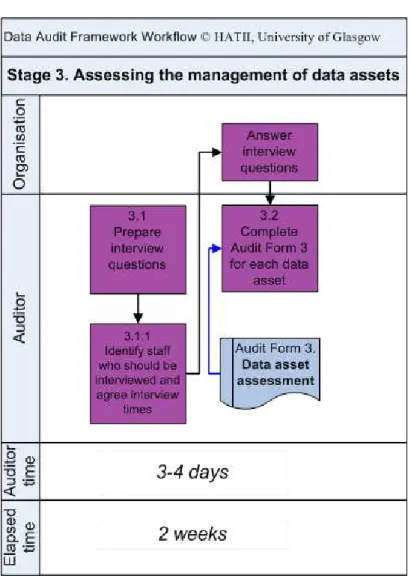
e) Instructions for Completing the Stage ... 32
© HATII, University of Glasgow
4
7) Stage 4: Reporting results and making recommendations ... 37
a) Aim of this Stage ... 37
b) Tasks Associated with this Stage... 37
c) Anticipated Results of this Stage ... 37
d) What Resources are Required to Complete this Stage?... 37
e) Instructions for Completing the Stage ... 38
f) Checklist ... 40
APPENDICES... 41
8) Appendix 1: Template audit forms and worked examples ... 41
a) Audit Form 1: Audited organisation ... 41
b) Audit Form 2: Inventory of data assets... 43
c) Audit Form 3: Data asset management ... 45
9) Appendix 2: Forms... 52
a) Ethical approval forms ... 52
b) Proposed audit timetable for on-site activities ... 58
10) Appendix 3: Guidance documents... 59
a) Example email approach to target organisation... 59
b) Formula for establishing how much time is needed to complete a data audit... 59
c) Example business case... 62
© HATII, University of Glasgow
5
PART I BACKGROUND TO THE DATA AUDIT FRAMEWORK
1) Overviewa) Executive summary
The Data Audit Framework Development (DAFD) project was conceived in direct response to recommendations made by Liz Lyon in the seminal JISC-commissioned report Dealing with Data: ‘a framework must be conceived to enable all universities and colleges to carry out an audit of departmental data collections, awareness, policies and practice for data curation and preservation.’ The aim of the DAFD project is to develop and provide examples for a Data Audit Framework (DAF) adapted to the current needs of data curation activities in UK Higher and Further Education institutions. The project will develop a general solution as well as highlight, through case studies, differences caused by research field and organisation type. DAF will enable institutions to find out what data they hold, where it is located and who is (or is not) responsible for it, as well as offering a tool for managing this information and sharing it with other organisations in a controlled environment. The DAFD project will distribute a software tool intended to support and facilitate data audit that incorporates a registry component for recording the results of data audits. This tool will provide a powerful mechanism to enable institutions to know what data they have and where it is. The accompanying registry will provide a national perspective of UK research data assets to facilitate future research collaborations and strategic planning.
b) Introduction
The methodology presented here provides specific guidance on how to plan and execute an audit of data assets in line with the Data Audit Framework conceived by the JISC-funded DAFD project. The first two chapters provide background information. Chapter 1 provides details on the scope of the Data Audit Framework and chapter 2 addresses the need for an audit framework, providing several benefits that could be used to formulate a business case. Chapters 3-7 are concerned with the practical work of the audit. Chapter 3 provides details on how to use the Data Audit Framework, chapter 4 covers planning the audit, chapter 5 identifying and classifying assets, chapter 6 assessing the management of data assets, and chapter 7 final reporting and recommendations. Template documents and additional guidance materials for completing the audit are available in the appendices.
c) Glossary of Terms
The definitions below identify specific meanings attributed to common terms within the context of the Data Audit Framework.
auditor a nominated representative, either from within the department / institution being audited or an external individual, who has been chosen to identify and assess the current value and condition of data assets to make recommendations for their long term management and preservation
appraisal the process of determining the length of time records should be retained, based on legal requirements and on their current and potential usefulness1
1
Richard Pearce-Moses, A Glosary of Archival and Records Terminology, (2005), available at:
© HATII, University of Glasgow
6 Data Audit
Framework
a framework developed by the JISC-funded DAFD project to identify data assets held within Higher and Further Educational institutions and to explore how they are managed. The framework is structured around audit at departmental or unit level with results being amassed to obtain an institutional or national perspective. data assets
data collections data holdings
broad terms to cover all research data created in Higher and Further Education, including the outputs of funded research projects as well as academics’ personal data collections created over the course of their career
department audits are often described here as being conducted within departments as most of the test audits took place at this level. This is not to suggest that the Framework is only suitable for use at this level; indeed, departmental audits could be scaled up to provide an institution-wide survey or the Framework could be applied directly at such a level using a top-down approach. As such the terms institution and organisation are also used throughout the various sections.
inventory a detailed list of data assets created by and/or used within an organisation
record data or information in a fixed form that is created or received in the course of individual or institutional activity and set aside (preserved) as evidence of that activity for future reference2
registry an online system to collect audit results, allowing this data to be federated at institutional or national level. The registry will continue to grow long after the DAFD project ends, enhancing its usefulness as a national reference point.
d) Scope of the Data Audit Framework
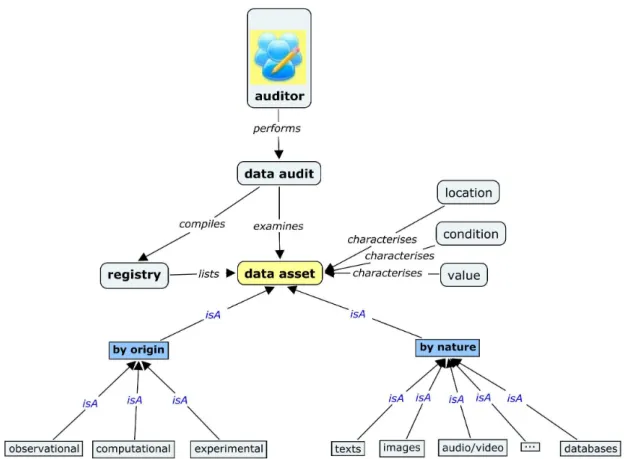
Educational institutions create a wide array of digital assets, including learning objects, electronic journal articles, publications, web resources and datasets. A decision was made between DAFD project management and the JISC to restrict the scope of the Data Audit Framework to research data assets. As such DAF audits are not concerned with administrative assets, such as student databases or inventories of research outputs, nor publications and research papers or web resources. The decision was made on the grounds that existing records management systems and Institutional Repository structures are attempting to address data management issues associated with these other resources. The concept map in Figure 1 provides an overview of the Data Audit Framework.
2
Richard Pearce-Moses, A Glosary of Archival and Records Terminology, (2005), available at:
© HATII, University of Glasgow
7
Figure 1: Concept map to demonstrate the scope of the Data Audit Framework3
e) Caveats
Given the project scope and that the data audit tool should be applicable to all universities and colleges we cannot prescribe a fixed top-down method, whereby we determine exactly how the auditor should proceed. We have provided various options and guidance on how to complete the audit but DAF relies on the department or institution and its auditor defining the best course of action.
3
The concept map uses two taxonomic groups for data assets (‘by origin’ and ‘by nature’). These groups follow the classification suggested in the USA National Science Board’s (NSB) report ‘Long-Lived Digital Data Collections: Enabling Research and Education in the 21st Century’, published by the National Science Foundation in September 2005. The report is available at: http://www.nsf.gov/pubs/2005/nsb0540/start.jsp
© HATII, University of Glasgow
8 2) The Need for a Data Audit Framework a) Why Audit Data Assets?
To effectively manage data holdings and fully realize their potential, an organisation must first be aware of the location, condition and value of its assets. Conducting an audit will provide this information, raising awareness of collection strengths and data issues to improve overall strategy. An audit will highlight duplication of effort and areas that require additional investment, allowing an organisation to put its resources to best use. It will also highlight inadequacies in data creation and curation practices, suggesting policy change to lessen the risks faced. An organisation that is knowledgeable about its data puts itself in a position to maximise the value of its collections through continued use. Broadly speaking, auditing data brings three main benefits:
• prioritisation of resources which leads to efficiency savings;
• ability to manage risks associated with data loss and irretrievability;
• realizing the value of data through improved access and reuse. Efficiency savings
Failure to share information on data holdings can result in duplication of effort and general inefficiency. It’s only from a position of knowledge that organisations can make informed decisions as to how best to utilise resources for data management. Auditing data assets provides such information, identifying valuable data assets so efforts can be directed towards these. This ensures resources are not wasted managing assets unnecessarily, for example if they are already being curated elsewhere or legally should not be kept. Data can be disposed of appropriately or moved to more cost-effective offsite storage.
The information gained through auditing holdings also assists in forward planning as it gives a more realistic idea of infrastructure and storage requirements. Institutional repositories can be informed of the type and quantity of data being created so appropriate capacity and skills can be secured. Creating a centralised system for managing data leads to further efficiency savings, as curation actions can be carried out on all relevant datasets at once. Indeed, workflows can be improved throughout the whole curation lifecycle by drawing on the recommendations provided at the end of the audit.4 Records of data assessments also act as an audit trail of management decisions, providing evidence of the level of resource dedicated to data management and justification for the selections made.
Risk management
Organisations need to be aware of data holdings and have appropriate data management structures in place in order to be able to manage risks. The implications of poor data management and quality are widespread and potentially damaging, financially, legally, and in terms of reputation. There are many scenarios in which data could put an organisation at risk. The natural flow of staff turnover can lead to assets being orphaned: the member of staff who created or was responsible for the data may leave before a new asset manager is assigned. This reduces the value of the asset, its usability and its chances of surviving in the long term. Mismanagement of data can also reduce its value, either by failing to update content so the data remains current; creating poor or misleading metadata that
4
The DCC curation lifecycle model maps processes and activities involved throughout the lifespan of digital objects and is available at: http://www.dcc.ac.uk/docs/publications/DCCLifecycle.pdf
© HATII, University of Glasgow
9
hinders resource discovery; or non-adherence to correct handling, preservation and disaster recovery procedures that leads to data loss. Misuse of data is a major concern, as research data often incorporates sensitive or personal details. If such data is used in an inappropriate way or for a purpose to which subjects did not give consent, questions will be raised as to why appropriate data management protocols were not in place and penalties may ensue.
Proper maintenance of data assets protects against the cost of legal action, so it’s necessary that organisations are aware of their assets and how they are being managed. Underlying all risk management is knowledge: knowledge about your assets; where they are; what is happening to them; what potentially detrimental things could happen to them; the likelihood of such occurrences; and most importantly, an understanding of the implications associated with such risks. Armed with such information, organisations can implement policies appropriate to their circumstances.
Access and reuse
Unless organisations are aware of their data holdings it will prove difficult to adequately promote them to encourage reuse. Appropriate levels of information on the data, the organisation and the context of creation are collected in the audit. Such metadata facilitates resource discovery and allows future users to trust the information provided. If this metadata is interoperable, conforming to controlled vocabularies and taxonomies, it will also allow broader data sharing. Audits help to ascertain the value of assets and identify resources that are underused. Little known datasets can then be more actively promoted to raise awareness and encourage reuse. Knowledge of data holdings also promotes synergies within organisations as researchers become more aware of each others’ work and more likely to collaborate. Keeping data available in the long-term enables organisations to undertake comparative research, such as longitudinal studies. Promoting access and reuse in this way will have significant benefits in terms of research rating and reputation.
As data is increasingly relied upon to act as an evidential base for analytic work, reassurances of its persistent availability and reusability are sought. Some funding councils mandate data deposit in a trusted repository or require it remains available for a number of years after publication so research findings can be verified. In order to adhere with such regulations organisations need to implement and practice appropriate data management policies; data audit provides a method of ensuring institutional readiness to comply. Moreover the Data Audit Framework toolkit could be used as a preceding step to other audits such as ISO270001: Information Security Management, acting as an overview to lead into more detailed work to help organisations develop robust data strategies.
Auditing data assets and improving data management systems inevitably requires an initial investment of time and resources. The benefits to be gained in terms of efficiency savings, improved risk management, and the ability to fully exploit the value of data should outweigh these initial costs. The reason why an organisation decides to audit its data will vary with each case. Several benefits have been outlined here that could be used to justify undertaking a data audit. Chapter 4.e.ii provides more detail on preparing a business case and tailoring benefits to meet specific organisational needs.
b) How the Data Audit Framework can Help
Organisations need guidance as to what information should be collected in a data audit, where they can find the information and how they might exploit the information and data once they have collected it. DAF has been developed with these needs in mind. The inventory collects basic information to raise awareness of data holdings and improve knowledge of data issues. The asset
© HATII, University of Glasgow
10
manager is recorded so orphaned works can be identified and investigated further. This aspect may also highlight poor data management practices, for example if one person is responsible for all data, placing the organisation at risk if this person were to leave. The classification process can belie weaknesses in data management. Organisations with large quantities of minor or little used data held locally are unlikely to be making best use of resources. The overall inventory will highlight other inefficiencies such as data being stored by several researchers, which increases storage and back-up costs as well as making it difficult to ascertain which copy is most current.
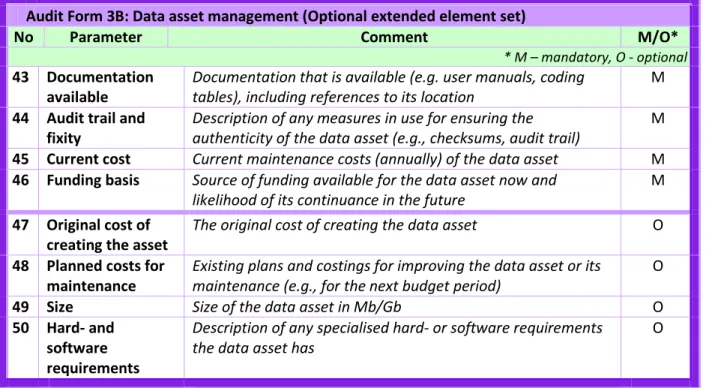
Information collected in the basic data asset management form (Audit Form 3A) will provide additional benefits. More detailed information is collected on the data asset such as the author, subject, date and rights. This will be crucial for making data available for reuse. Background contextual information is collected such as the original purpose, source and usage frequency. These aspects will assist the organisation in attributing value. Data being actively used or added to may be rated more highly. The source could be central for some domains, such as archaeology or performing arts where data can not be recreated due to ephemerality. Information is collected at this stage on data management to highlight weaknesses. The data type and format will note any collections that are complex to curate and preserve. Finally the ‘back-up and archiving policy’ and ‘management to date’ elements will demonstrate to what extent the organisation is engaging with data management. A more extended element set is also provided for cases where additional information is available, or where a more extensive examination of data management practice is desired. This set of information will allow more detailed recommendations to be provided to help ensure the audited organisation can obtain significant efficiency savings, implement better data management and improve reuse.
The framework is designed to be used at both departmental and institutional level without dedicated or specialist staff and with limited investment of time or effort. The audit forms seek to collect only the necessary level of information required to make informed decisions how best to manage data assets in the long term. Optional fields are included for circumstances when extra data is readily available, however the audit does not require onerous amounts of data to be collected unnecessarily. The audit addresses five core questions:
1. What data assets currently exist? 2. Where are these assets located?
3. How have these been managed to date?
4. Which of these assets need to be maintained in the long term? 5. Do current data management practices place these assets at risk?
The information collected by DAF is sufficient to provide a clear overall picture of organisational data collections, current data curation and preservation policies and staff awareness of data issues. Organisations armed with this information can make changes to improve existing data management. DAF provides a simple method of collecting and using this information. The following chapter outlines how to use DAF and details additional sources of support.
© HATII, University of Glasgow
11
PART II THE DATA AUDIT FRAMEWORK TOOLKIT
3) Guidance for using the Data Audit Framework a) How to Use the Data Audit FrameworkThe guidance in this methodology is based around audits being conducted at research group, unit or departmental level. The Framework could also be applied at institutional level, either by scaling up departmental audits or approaching the audit on an institution-wide basis. The success of the data audit will depend on the strength of the collaboration between the auditor and the organisation being audited. Chapter 4.e.i will discuss how to select an auditor. The ability of this individual or team to perform a complete and accurate assessment depends on the willingness of the organisation being audited to share information and the co-operation of key personnel. It is crucial that a positive relationship is fostered from the early stages.
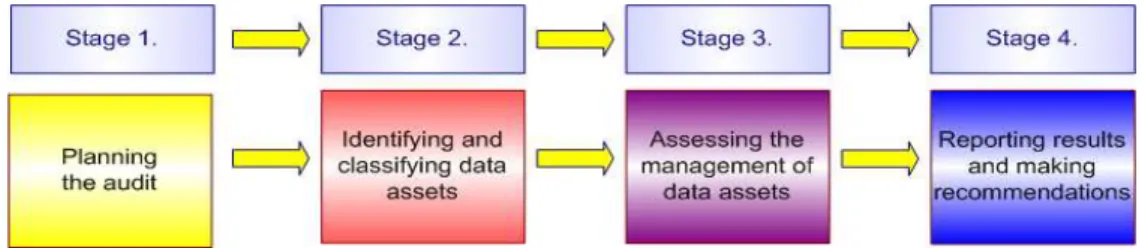
There are four main stages to the Data Audit Framework: 1. Planning the audit;
2. Identifying and classifying data assets; 3. Assessing the management of data assets; 4. Reporting findings and recommending change.
© HATII, University of Glasgow
12
© HATII, University of Glasgow
13
The stages are designed to run sequentially as shown in the simple overview in Figure 2 and the full workflow in Figure 3. Depending on the level of information provided before the auditor begins work on-site, the initial task of analysing documentary sources in stage 2 may begin during stage 1. The overall audit is expected to take between 11-17 days in terms of auditor man hours. The actual time will depend on the size of the department or unit being audited, the number of vital data assets it has and how readily information is made available. Approximately half of this time (5-8 days) will need to be spent on-site. The experience of the first trial audits has shown that around 2 months of elapsed time is needed for each audit. A large amount of this time falls within the planning stage as the audit is set up. The elapsed time during stages 2 and 3 reflects the time needed to schedule interviews. As a general rule of thumb it takes around 2-3 weeks from initially requesting an interview to the event taking place. The auditor will require full access to internal documents and systems during the entire audit period (including elapsed time).
The time requirements above are based on audits taking place at unit or departmental level rather than at university level, as it was thought variations in research and data management policy would necessitate audits at this level. The results of departmental audits could be federated to facilitate an institution wide audit. Alternatively a shallower audit could be conducted across an entire institution to obtain a picture of holdings and data management. This could involve an institution appointing a single auditor to go out to various departments. The process of scoping the audit is discussed below to explain how the Framework can be adapted to small units as well as larger departments or schools. The three initial test audits run in May and July 2008 took place in departments of varying size with very diverse data collections. As such the scoping and level of granularity adopted varied considerably. The audit at the University of Edinburgh took place in the School of Geosciences, a large research centre with over 150 members of staff and 130 PhD students. Data assets created by PhD students were eliminated from the scope and a decision was made to interview staff based on their involvement in the 5 research groups. Over 35 members of staff were interviewed and an inventory of 25 data assets was created. While this is by no means a comprehensive survey, the later interviews started to provide information already collected, suggesting the most important data assets had been recorded. At Glasgow University meanwhile the audit was conducted in GUARD (Glasgow University Archaeological Research Division), a small commercial unit employing 33 members of staff. Although GUARD is much smaller than the School of Geosciences, its data holdings are very extensive. Around 60 projects are funded each year that create significant digital data assets. The scope was set to create a comprehensive inventory for 2005-2008, however after recording all data assets created over a period of 18 months a decision was made to sample the remaining data. This was due to projects creating typical types and quantities of data, resulting in quite a repetitive inventory and a consistent range of data issues faced. The sample tried to pick out more unusual data collections to explore any other data issues the unit faced that had not already been identified.
Decisions on the overall scope of the audit and level of granularity recorded are dependent on end user expectations. For large scale audits that attempt to cover whole schools, faculties or institutions it is more feasible to create inventories with a limited focus or that act as representative samples rather than comprehensive studies. Pockets of detailed information could feed into larger audits: if a unit is conducting innovative research its data assets may be comprehensively audited while those of other departments are just sampled. Conducting a very detailed audit across an entire institution is likely to demand too high a level of time and resources. As such, identifying the expected outcomes and scoping the audit appropriately is crucial.
© HATII, University of Glasgow
14
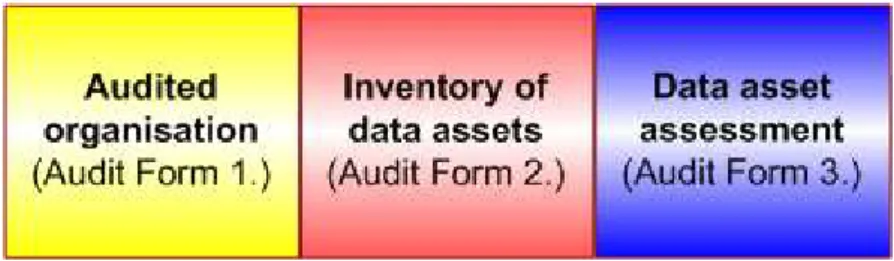
There are three component forms used to complete the data audit as shown in Figure 4. These forms are provided in Appendix 1 and various guidance documents for completing the audit are available in Appendix 3.
Figure 4: Data Audit Components
b) Support for those Using the Data Audit Framework
The Data Audit Framework will be iteratively developed through a series of pilot studies run at four universities throughout the UK and then by a range of audits by four pilot implementation projects. The institutions involved are suitably representative of the wider UK HE data landscape to offer a valuable degree of diversity in terms of scale, scope, materials and strategy.5 The results of these pilot audits will facilitate the development of an online audit tool: DAF Interactive. DAF Interactive will assist the completion of audit forms and compilation of the final audit report. It will also provide a shared area where users of the tool can seek advice and share knowledge gained from their experiences. DAF Interactive will incorporate a central audit registry into which institutions and departments are encouraged to deposit their audit data so it can be federated at institutional and national level to assist funding councils and strategy makers to plan future work.
© HATII, University of Glasgow
15 4) Stage 1: Planning the audit
a) Aim of this Stage
There are two key objectives of the planning stage: first to secure organisational buy-in by presenting a robust business case; and second to prepare as much as possible in advance of the audit so time spent on-site can be put to best use. For staff to commit time and effort to assisting the auditor they need to understand the benefits to be gained from auditing data holdings. Securing agreement from the top management and ensuring this commitment to the audit is filtered down is crucial. By conducting background research the auditor can minimise demands placed on staff, as s/he will be familiar with the departmental context and more able to navigate holdings, or at least aware of the best source of advice should challenges be encountered. Moreover organising interview times and locations in advance will ensure staff are prepared and ready to contribute to the audit.
b) Tasks Associated with this Stage
Planning of the data audit should proceed through the following steps:
• Appoint an auditor;
• Establish a business case to approach the department;
• Conduct initial research to plan the audit;
• Set up the audit.
An example approach made to a department is available in Appendix 3.
It should be noted that the level of time required to complete these steps will depend on whether the auditor is internal or external to the department being audited. DAF has been developed with both scenarios in mind. The initial research stages in which the auditor learns about the departmental context may not be necessary for an internal auditor. An external auditor in contrast is likely to be unfamiliar with the department so will need to complete all tasks associated with this stage.
c) Anticipated Results of this Stage
By the end of this stage the audit should be ready to go ahead. There are several outputs necessary for this to happen:
• an auditor must be appointed;
• the department in question must consent to the audit and inform staff;
• dates and times for the audit and, where possible, for interviews must be agreed;
• background research should be completed to familiarise the auditor with the department and its data assets.
d) What Resources are Required to Complete this Stage?
Anticipated effort: 2-4 days, depending on the level of prior knowledge the auditor has of the department being audited. This effort will be spread across a period of around 3 weeks as the auditor waits on information to be provided and responses from staff with whom interviews are requested. The main focus of effort in this stage will be on research, initially to prepare a business case with which to approach the department and secondly to plan the audit in full. In order to prepare the
© HATII, University of Glasgow
16
business case the auditor will need to find information on current data management practices and where possible issues that are faced. This information will allow the approach and introduction to DAF to be tailored by profiling the benefits specific to the department’s needs. Tailoring the approach and highlighting confidentiality is particularly important when the auditor is external as there are likely to be more concerns about granting access to departmental assets and systems. This is especially true in cases where research data is sensitive, so the benefits need to clearly outweigh the risks involved. In cases where an internal auditor is appointed it is likely the department has already recognised the benefits to be gained and decided to run an audit themselves, so the work of the auditor can begin with task 1.3: Conduct initial research to plan the audit.
Before starting this stage auditors should become familiar with the Data Audit Framework to be able to explain the process to the department. Once an agreement exists between the department and the auditor, more detailed research can begin to enable specific details of the audit to be fixed. If the auditor is internal many of the core details may already be known. The research conducted before the audit should attempt to establish:
• details of staff working in the department;
• who is mainly responsible for creating and curating data assets;
• what documents exist that provide information on data holdings;
• whether the department has previously analysed and documented its assets;
• the general context in which the department operates.
Once the auditor is aware of the key personnel to be contacted dates and times can be set for the audit and interviews to take place. Time spent administering these beforehand allows time on-site to be focused on collecting information about data assets. The departmental secretary is likely to be of assistance in allocating times and venues for interviews to take place.
In order to complete this stage, auditors:
• need to establish a relationship with the department;
• need to become familiar with the context of the department;
© HATII, University of Glasgow
17 e) Instructions for Completing the Stage
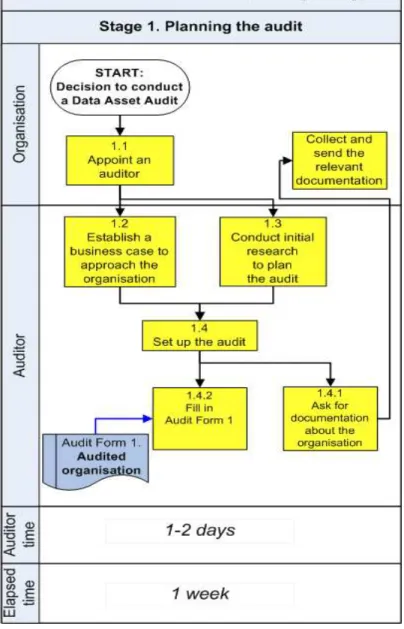
Figure 5: Workflow for Stage 1: Planning the audit
i) Task 1.1: Appoint an auditor
The auditor can be internal or external. In cases where an entire institution is being audited it’s likely a single auditor or audit team would be appointed to go into various departments and assess data holdings, however as the Framework has been developed to support self-audit it is likely that in many cases the auditor will be internal. PhD students have been suggested as ideal auditors as they understand the subject area, are familiar with staff, have access to internal documents and are likely to be able to focus effort on the audit. The results of internal audits may also be easier to maintain as the skills developed to create the inventory will reside within the department. Ideally the time invested to create a baseline inventory will feed into ongoing population and maintenance. Data policy should be adjusted to encourage researchers to add their assets to the inventory as they are created or updated, ensuring accurate information is captured early on to facilitate data management.
© HATII, University of Glasgow
18
An important function of the auditor is to ensure the department takes ownership of the audit results, hence the consultation steps when classifying assets and reporting results. By taking ownership departments can ensure the audit brings long-term benefits with audit findings shaping ongoing data management policy and the inventory realising its full value as a regularly updated working document that supports effective data management and reuse.
The success of the audit will depend largely on the effectiveness of the auditor, so choosing the most appropriate person to perform this role is not an easy decision. Whether an auditor is internal or external to the department there are certain characteristics s/he should possess. Auditors need to be able to gather evidence, so an inquisitive nature and ability to quickly understand systems to determine where information is likely to be found are essential. People skills are also fundamental, especially in cases where the auditor is external as staff many fear the audit process and be unwilling to share information in case it reflects badly on their work. The auditor should be able to put people at ease and effectively communicate the benefits to be gained. Auditors also need a certain level of vision: time on-site is limited so s/he must be able to quickly determine the current state of play and identify what this may mean for the department in the future. In terms of conducting data audits it desirable that the auditor is familiar with data creation and curation practices. Ideally s/he would have a qualification in library, archive or information management, or significant experience working with data assets.
If an internal auditor is appointed the person chosen should be familiar with the organisation’s data management. Ideally s/he would be involved in as many aspects of the department’s work as possible to have a good breadth of understanding. The individual should be of a suitable level of seniority and trust to be able to encourage staff participation and be granted complete access to internal documents and systems. Time must be set aside for an internal auditor to conduct the data audit. The demands placed on the auditor could be lessened by establishing an audit team. A team would afford multiple perspectives so may result in a more objective outcome.
ii) Task 1.2: Establish a business case to approach the department
In internal audits it is likely the department has already recognised the benefits of conducting a data audit so a formal business case may not need to be developed. When an external auditor is required to approach a department a business case should be provided to convince management of the benefits. By researching current holdings and collecting information of data management practices the auditor can identify relevant benefits to persuade management to take part. The business case should provide justification for undertaking the data audit, based on the expected costs, risks, benefits and savings. The business case should include:
• reasons why the outcome is needed;
• expected benefits;
• costs and timescale;
• and an investment appraisal.
An example business case for the Data Audit Framework is available in Appendix 3.
The espida model6 is useful for constructing business cases where benefits are intangible. The approach centres on defining the objectives of an organisation from four perspectives (customers; business processes; innovation and learning; and the financial situation) so that benefits can be aligned with these to make explicit how the proposed action will be advantageous to the organisation.
6
espida, espida Handbook: expressing project costs and benefits in a systematic way for investment in information and IT, (2007), available at: http://hdl.handle.net/1905/691
© HATII, University of Glasgow
19
Once a business case is established the department could be approached in several ways. A common method would be to send a letter or email outlining the benefits, which could then be followed up with a phone call or meeting. Another approach would be to organise a meeting to convince management of the necessity to audit data. A good degree of research should be conducted in preparation for such a meeting to ensure queries could be answered by demonstrating specific benefits. In cases where an institution has agreed to an audit, the support of top-level management could be requested, for example in terms of writing a letter in support of the initiative that could be forwarded to departments. Examples of correspondence used to approach departments are provided in Appendix 3.
iii) Task 1.3: Conduct initial research to plan the audit
This chapter should be read in conjunction with task 2.1 Analysis of documentary sources as much of the preliminary research needed to begin the inventory could be conducted before the on-site audit begins, particularly if documents are made available to the auditor in advance.
Research should be conducted to familiarise the auditor with the context in which the department operates. This will make it easier to understand the recordkeeping systems that are used. The auditor should also investigate who works within the department and identify the main individuals responsible for data assets. This information will enable the auditor to prepare an audit schedule and set up interview times in task 1.4. The initial research should also explore ways to gain access to data assets that the department holds. Details should be sought on the current location of the assets, who has access to them and whether they are confidential. Gaining consent to access sensitive or confidential datasets may be time consuming so the process of setting up approvals should be started at the earliest opportunity. The background information can first be collected from publicly available sources like:
• annual reports;
• strategic planning documents;
• statistical reports;
• website and intranet;
• scholarly publications;
• research reports.
These documents can often be found on the public websites of departments and may also include references to data assets that the organisation is using or is responsible for.
Further documentation should be requested from the department in advance. If documentation is of a sensitive nature a confidentiality agreement can be signed to assure the organisation of the auditor’s commitment not to disclose such details. The confidentiality agreement used in the initial test audits is available in Appendix 2. This allowed the organisation to decide what information needed to be kept confidential and what could be incorporated into the Data Audit Framework registry. As audits involve surveys and interviews ethical approval may need to be sought by each institution to adopt the Framework. The forms used to obtain ethical approval by the DAF development project are available in Appendix 2 for reference. The internal documents that could be made available for the auditor in advance include:
© HATII, University of Glasgow
20
• existing registers of data assets;
• RAE returns;
• funding council monitoring / final reports;
• strategic planning documents (e.g., business plans, departmental development plans);
• annual reports;
• research reports;
• a recent organisational chart;
• research publications;
• relevant legislation and regulations;
• organisation’s risk register, disaster plan, contingency plan or exit strategy;
• procedural manuals and system workflows;
• lists and registers of IT systems and information systems;
• documents describing the technical architecture in place;
• system documentation;
• disaster recovery plans for IT systems;
• results of any other relevant audits, departmental assessments or self-assessments;
• vital records lists;
• risk registers.
Information in these sources will help the auditor to navigate the landscape of data assets that the department is likely to have. It should be noted that internal documents must often be treated with caution, because they may be out of date, incomplete or representative of an official viewpoint that has little relation with actual practice. However, these inconsistencies can be rectified in the next tasks.
iv) Task 1.4: Set up the audit
As many specific details as possible should be set up in advance of the audit. The research conducted in task 1.3 should have identified key personnel the auditor will need to work with. The schedule for the audit should be planned around the availability of these key staff. An audit schedule should be established in advance so all staff in the department are aware of the required contribution and have agreed to spend time sharing information with the auditor. Questionnaires could be prepared during this time and sent through to the department in advance. As many interview times and venues should be arranged in advance to make sure staff are available and have information ready to hand. It should be possible to make an assessment of the time needed to complete the audit at this stage.
It may be helpful for the auditor to establish a main point of contact within the department. The main administrator could be useful in this role and s/he should be familiar with all the staff, perhaps also having an awareness of their work schedules and a certain level of influence to encourage their participation. The main contact should have a good overall awareness of the work of the department to be able to point the auditor in the right direction or suggest the most relevant person to contact.
© HATII, University of Glasgow
21
f)
ChecklistBefore proceeding to the next stage, the auditor must ensure that s/he has successfully completed the following items:
• established who will be responsible for conducting the audit;
• obtained approval from the departmental management for the audit to take place;
• agreed for staff time to be set aside for the audit and for the auditor to be granted access to the departments records and systems;
• sign a confidentiality agreement if necessary – a template is available in Appendix 2;
• conducted initial research into the department and its data creation / curation practices;
• agreed dates for the audit to take place and if possible set-up interviews with key personnel;
• ensured staff are aware of what the audit process entails and are committed to taking part;
• have attempted to minimise demands on staff time by sending interview questions and requesting documentation in advance.
© HATII, University of Glasgow
22 5) Stage 2: Identifying and classifying data assets a) Aim of this Stage
The purpose of this stage in the audit process is to establish what type of data assets exist in the department and classify them according to their value for the organisation. Essentially, an inventory of data assets is compiled through a mapping exercise. The mapping exercise should produce as complete a picture of the existing data assets as possible. Quality of the entire audit depends on this first knowledge-gathering exercise. Vital assets should not be missed or they will be excluded from further scrutiny and evaluation. Therefore, the first stage should identify all data assets and resources that members of staff use in their work, in order to paint a complete picture of what resources are necessary for the organisation to conduct its work. The classification step will determine the scope of further audit activities. The next stage of the audit – assessing the management of data assets – will only be applied to these assets that have been appraised as vital or important for the department. The scope of further tasks in the audit should only concern the assets that really are the responsibility of the department itself, leaving aside shared data assets that cannot be controlled by it.
b) Tasks Associated with this Stage
Throughout this stage the auditor will develop a structured list of data assets and their managers that help the department to achieve its goals and objectives and document the way it works.
The identification of data assets should proceed through the following steps:
• Analysis of documentary sources;
• Conducting a written survey;
• Following it up with interviews;
• Preparing the data asset inventory (including classifying identified assets)
• Approving and finalising the asset classification.
Each stage is documented using the audit forms (later the electronic audit tool). See Audit Form 2 in Appendix 1.
c) Anticipated Results of this Stage
This stage will result in an inventory of data assets and their managers, divided into groups according to their appraised value for the organisation. The appraisal decisions will be approved by the management of the organisation. The inventory will form the main basis for the next stages of the audit where the data assets are assessed and described in detail. The comprehensiveness of the list prepared in this stage plays a crucial role in the usefulness of later recommendations.
d) What Resources are Required to Complete this Stage?
Anticipated effort required: 4-6 days, depending on the size and type of department or organisation being audited. If interviews have been planned in advance during Stage 1, elapsed time should only be a couple of weeks. This could increase if staff are unavailable to participate.
Analysing a department’s data assets is a rigorous and resource-intensive process. The main time investment is expected to go into identifying all the data assets and into considering activities, assets and staff as an interlinked organism. Unless existing and up-to-date inventories or lists of assets and
© HATII, University of Glasgow
23
technology are available, these will have to be created as part of this stage. Classification can be done in parallel to identification, though the results of this process should be verified with management and if necessary reviewed before proceeding to the next step.
Auditors can return to the list developed during this stage at a later point during the assessment process in order to add to it when new information about further assets comes to light.
Before starting this stage, auditors should:
• have a general understanding of the department and the contexts within which it operates;
• obtain managerial support to undertake the analysis of its data assets;
• acquire a list of members of staff and their responsibilities;
• determine whether the department has previously analysed and documented its data assets. If the department has recently been analysed for other purposes it may be possible to draw on the results of such work, rather than starting from scratch. Projects that may involve an analysis of assets and activities include:
• compiling inventory of IT systems and resources;
• systems implementation;
• activity-based costing or management;
• business classification development;
• quality accreditation;
• business process re-engineering
• workflow automation.
Lists, registers or inventories of assets and technology may have been compiled for various purposes during analyses of business, compliance studies and audits, contingency planning exercises, etc. Most departments maintain an inventory of IT hard- and software and their licenses, which can also point to data assets that are managed with the help of the inventoried technology. If the analysis arising from such projects is available, auditors will need to consider how, why and when the projects were undertaken to determine whether their findings are applicable for the purposes of this audit.
In order to complete this stage, auditors:
• must have access to internal documents, such as strategic planning documents, departmental structure charts, lists of assets, technology and systems, operational manuals, procedural guides, task and target lists to identify assets and records that identify vital assets such as risk registers, business contingency plans and disaster plans for classification;
• may need to have the right to circulate a written survey questionnaire to all members of staff;
• will preferably need to have access for interviews to all members of staff who are using or are responsible for department’s data assets;
• will need to have access for interviews to at least managerial and IT personnel with further knowledge of the data assets, technology and systems, as well as those responsible for their long-term curation.
© HATII, University of Glasgow
24 e) Instructions for Completing the Stage
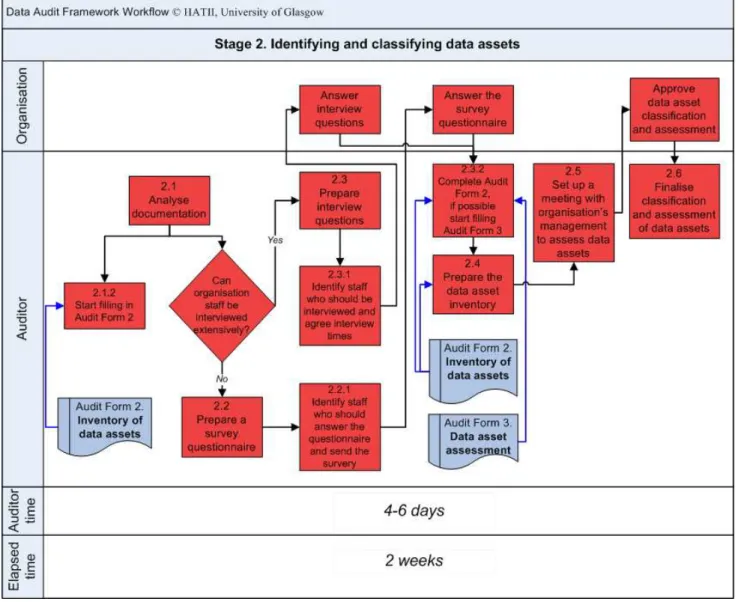
Figure 6: Workflow for Stage 2: Identifying and classifying data assets
i) Task 2.1: Analysis of documentary sources
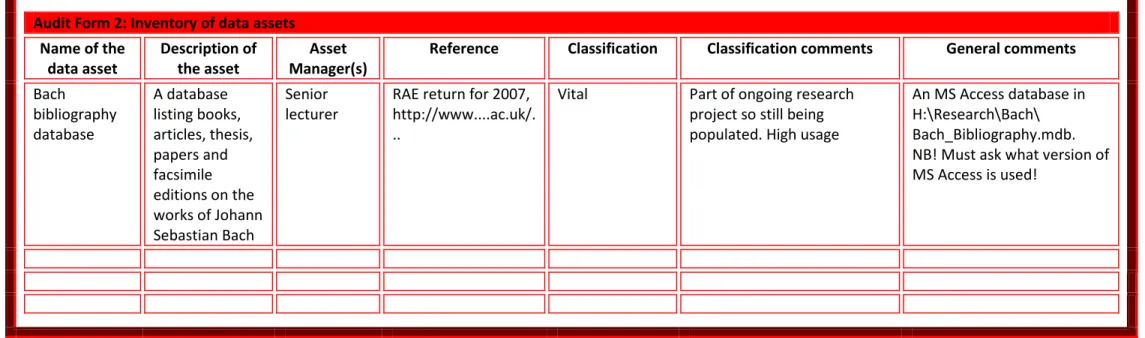
The audit process will begin some time prior to a visit to the department taking place, with initial research being undertaken into the context of the department and its activities (see also Chapter 4.e.iii Task 1.3: Conduct initial research to plan the audit). Understanding the context where the data assets are being created, used and managed will help with identification and facilitate the interview process described in Task 2.3. Supporting documents will be requested from the department and gathered in advance, in order to ensure that time spent on-site is optimised. Data assets that are mentioned in department’s documents should be documented using the audit forms as in the following example:
© HATII, University of Glasgow
25
Audit Form 2: Inventory of data assets Name of the data asset Description of the asset Asset Manager(s)
Reference Classification Classification comments General comments
Bach bibliography database A database listing books, articles, thesis, papers and facsimile editions on the works of Johann Sebastian Bach Senior lecturer
RAE return for 2007, http://www....ac.uk/. ..
Vital Part of ongoing research
project so still being populated. High usage
An MS Access database in H:\Research\Bach\ Bach_Bibliography.mdb. NB! Must ask what version of MS Access is used!
Figure 7: Data Asset Audit Form 2
The first column of the form should include the name of the data asset as found in the documents. An optional column could also be used to record the variant or name commonly used for the asset in the organisation. The second column should provide a brief description of what the data asset includes and how it is used, based on the information that can be drawn from the documentation. The third column identifies the person responsible for managing and updating the data asset, as can be determined from documentation. In many cases the responsibility for data assets is shared by members of a research team, several teams or even several organisations. It is advisable to identify at this stage at least one person as the asset manager (e.g., leader of the research team) who could be contacted with further questions about the asset. The fourth column includes a reference to the document where the information about the data asset was discovered and a reference where the document itself can be found. The following two columns deal with classification: the first attributing a classification to the asset and the second justifying this classification. The final column is reserved for comments and reminders for the auditor. Any additional information that is readily to hand such as details of the creation date, original purpose, type of data, or file format may also be included here.
© HATII, University of Glasgow
26 ii) Task 2.2: Conduct survey questionnaire
Depending on the availability of staff at the audited organisation, the auditor will have to choose the appropriate method for collecting detailed information about data assets. If the members of staff can be interviewed in person, it would be preferable to use the interviews described in Task 2.3. If access to members of staff is limited during the period when the audit is conducted, a written survey questionnaire should be used to collect the information. In cases where the majority of information is collected by questionnaire due consideration must be given to classification early on so guidance can be provided with the questions to ensure all respondents are working to the same criteria. Suggested classification schemes are discussed in more detail in chapter 5.e.iii Conduct follow-up interviews. Questionnaires provide a simple means of gathering information from a large number of respondents. The survey questionnaire should be based on the Audit Form 2, and could be disseminated in electronic form to all members of staff or made available as a web-based form on the organisation’s intranet, wiki or a separate password-protected website. When the electronic data asset audit tool becomes available, members of staff can be advised how to access the audit tool and how to fill in the forms about each data asset that they use and/or are responsible for.
Questionnaires have the disadvantage of usually achieving low rates of return. Personal contact with staff is lacking and the quality of the information is depending on respondents understanding the task and questions, and being willing to reply thoroughly and accurately. Usually follow-up enquiries are needed to clarify or complete the forms. Thus, information collected through the survey can be used to fill in Audit Form 2 to prepare follow-up interviews to fill any gaps remaining in Audit Form 2. Analysis of the survey results will help the auditor to decide:
• what other documents can be consulted, based on the references column, that could reveal further information about data assets;
• where are the biggest gaps in the knowledge about the data assets (for example, when
description of assets has been left incomplete; when assets were found in the documentation, but the survey did not reveal any further information about these);
• who are the asset managers who need to be interviewed further to complete the data asset identification exercise;
• what questions need to be asked during follow-up interviews.
It is also possible that the initial survey produces more information than is asked in Audit Form 2, for example technical information can be added about an asset, or a problem with it reported. It would be useful to include a comments or a free text field in the survey questionnaire. This information can already be used to begin filling in Audit Form 3 (cf. Chapter 7.e.i below).
iii) Task 2.3: Conduct follow-up interviews
Follow-up interviews should be set up to clarify unclear information or gaps in information gathered from documentation and written questionnaire. Interviews can be organised on an individual basis or as group interviews that involve all managers and users of the same data asset. The selection of staff to be interviewed should be based on their knowledge of the data assets, not their seniority or position. At this stage of the audit, gathering a number of interviewees into a focus group for a group interview may be the fastest way to collect the required information and to agree classifications by consensus.
© HATII, University of Glasgow
27 Interviews can be set up as:
• structured interviews using a questionnaire distributed to the interviewees prior to the interview;
• unstructured interviews as a free-flowing discussion;
• group interviews as discussions or brainstorming exercises;
• auditor participating at a department or unit meeting where this can be discussed.
Interviews can potentially be time-consuming, but they have the benefit of providing personal contact with members of staff and it is often possible to collect more detailed information than from questionnaires. Interviews allow supplementary questions to be asked on the spot and thus offer greater flexibility in following up initial answers. Informal information can also be collected, such as opinions on data assets and their users, or suggestions for improvement.
The interviews should be documented using the Audit Form 2. It would be preferable to have any previously collected information already in the audit tool available and visible during the interview, for example by using a data projector.
Interviews are arguably the best method of agreeing classifications as staff can engage in discussion as to which criteria are most important to the organisation being audited. The DAF audit tool proposes three categories for classifying the organisation’s data assets, though obviously the most appropriate classification will vary on a case by case basis:
Category Description
Vital Vital data assets are crucial for the functioning of the organisation, their efficient management and protection should be the first concern of the organisation. Vital data assets will include datasets and information systems that:
• are still being created or added to;
• are used on frequent basis in the course of organisation’s work;
• underpin scientific replication e.g. revalidation;
• play a pivotal role in ongoing research;
• or are being using to provide services to external clients and partners. Important Important data assets include the ones that:
• the organisation is responsible for, but that are completed (i.e. no data is added to them);
• the organisation is using in its work, but less frequently;
• the organisation may use in the future to provide services to external clients.
Minor Minor data assets include those that the organisation has, but has no explicit need for, or it no longer wants to have the responsibility for (e.g., data assets that could be handed over to specialised preservation and curation service providers). Shared data assets or information systems which the organisation cannot control may also be classified as minor as somebody else is responsible for long-term curation.
Other classifications are possible for categorising data assets and in discussion with the audited organisation the proposed three-tier classification can be extended to include further categories, or to include sub-classification. Examples of sub-classification would be to show whether important data assets need to be retained and managed on-site or to determine if minor data assets need to be actively managed or if they could be disposed of.
© HATII, University of Glasgow
28
It is feasible to have a numerical rating aligned to the three categories to help to show where on the scale each asset falls. For example, the vital assets could be characterised with scores from 8 to 10, important assets with scores from 4 to 7, and minor assets with scores from 0 to 3.
The determination of the value of a data asset is important for managing risk and reliability for the organisation’s business. Value helps to decide the level of security and control the asset requires, as well as the investment in maintenance that should be made.
Other examples of classification exist, for example the United States National Science Foundation is using the following three functional categories of data collections:7
• research database collections, which are specific to a single investigator or research project;
• resource or community database collections, which are intermediate in duration, standardisation, and community of users;
• and reference collections, which are managed for long-term use by many users.
The classification used at this stage of the audit does not need to be final. Indeed, based only on the information collected in this stage, it would be very difficult to offer a final classification of data assets. The main purpose of the classification here is to help scope the next stage of the audit and to exclude data assets that do not have significant value for the department being audited from further analysis. A more elaborated version of the data asset classification can be offered in the final audit report.
iv) Task 2.4: Preparing the data asset inventory
Following the information collecting exercise the data asset inventory (Audit Form 2) should be cleaned and prepared for the next stage by the auditor, filling in gaps and highlighting the issues that have come to light about some assets (e.g., technical difficulties of using the asset, inadequately described assets, orphaned assets with nobody assigned responsibility for maintaining them, etc.). If possible, the information provided for the inventory in questionnaires should be edited using the same editorial style. The first draft of the complete inventory will be presented to the departmental management for approval and further comments.
v) Task 2.5: Approving classification with departmental management
The classification of data assets prepared by the auditor should be discussed with management, or, if possible, with all managers identified as responsible for the data assets. The best format for the discussion would be a physical meeting with everyone involved participating and being able to voice their concerns and requirements. As a result of the discussion a decision should be made which data assets should be analysed further. It is likely that amendments and changes will need to be made to the inventory to move data assets from one category to another, or to add further sub-classifications if the organisation has requested these. The auditor will make any necessary changes in the inventory (Audit Form 2) based on the feedback received during the discussion.
f) What to do in the Event of Required Information Being Unavailable
The information on assets of the organisation should be made available to the auditor in a complete and unabridged form. If this proves difficult, senior management should be contacted and the necessary authorisations acquired to gain access to the required information. Further usage restrictions can be agreed for the list of assets that is created in this stage in order to protect the
7
NSF, Long-Lived Digital Data Collections Enabling Research and Education in the 21st Century, Appendix D. Digital Data Collections by Categories. http://www.nsf.gov/pubs/2005/nsb0540/nsb0540_11.pdf
© HATII, University of Glasgow
29
sensitive information it may contain. Not being able to access complete information on what the organisation is doing will be detrimental to the audit.
g) Discussion
Determining responsibility for maintaining data assets and assuming an adequate level of granularity for this information can be challenging. Depending on the source of information, it could be recorded as an individual person, a project team, an office or a unit within the organisation (e.g. literature, legal). It is difficult to prescribe a fixed level for this information at this stage of the audit – further details on the responsibility for the data asset can be documented at stage 3 of the audit. Sufficient information should be collected about asset managers at stage 2 to be able to approach the correct people with further questions later on.
The responsibility for data assets that an organisation is using in its work can sometimes be difficult to determine. In addition to data assets that have been created internally by the organisation itself, the work usually relies on other, shared data assets and information systems. In the case of a university department or institute this could be for example:
1) systems and data assets owned and managed centrally by the university:
• student research databases;
• teaching course information databases;
• library;
• institutional repository (e-prints, theses);
• electronic records and document management systems;
• archive of the university; 2) external resources
• international and national level data collections archives;
• subject-based data collections, libraries, on-line resources; 3) collaborative environments;
• wiki;
• intranet and other group-work tools.
Although the focus of this audit will be the data assets managed by the department itself, it is useful to chart all the assets that are being used by the institution, in order to:
1) be able to better ascertain the value of each asset held by the organisation and its relationship with data assets curated elsewhere;
2) build a network of data assets used by the organisation and to determine the vital systems and data assets among them that the institution at large should support and preserve (because units within the institution are relying on these assets).
Many institutions are engaged in collaborative research projects, creating data assets that are maintained by a whole community. This naturally raises the question of who is responsible for long-term maintenance. Editorial rights for such collaborative data assets as well as parties responsible for long-term curation and preservation must be defined so collaborators recognise and fulfil their role. The decision of what criteria to apply when appraising data assets can be difficult to make. Should it include only the current business needs of the department or should the auditor also look to potential future uses of assets and try to assess their future or even archival value? Trying to do both may result in a decision to classify everything as vital assets. It is often difficult to know who may want to make
© HATII, University of Glasgow
30
use of a dataset in the future, but the creators of the dataset can see many potential uses for it, even though it is unlikely that all of these will be realized.
The classification applied at this stage of the audit can be quite crude at first, to encourage further discussion of how the organisation is making use of its data assets. As a result of the discussion, some minor or important data assets can be moved to a higher category, because not enough is known about them and it is expected the analysis stage will reveal further details about the asset to allow for better classification. Although a few methods of classification have been suggested here, audits may require different approaches. One of the preliminary test audits altered the classification scheme as the unit in question was a commercial centre with many active projects at any one time. To restrict the number of vital assets the classification was amended to focus more heavily on reuse and revenue.
h) Checklist
Before proceeding to the next stage, the auditor must ensure that s/he has successfully completed the following items:
• contacted all key personnel either via a questionnaire or in an interview;
• identified all or most data assets;
• assigned all data assets to a category to define the scope of the next stage;