Software Support for
Virtual Memory-Mapped Communication
Cezary Dubnicki, Liviu Iftode, Edward W. Felten, Kai Li
Department of Computer Science
Princeton University
Abstract
Virtual memory-mapped communication (VMMC) is a communication model providing direct data trans-fer between the sender's and receiver's virtual address spaces. This model eliminates operating system in-volvement in communication, provides full protection, supports user-level buer management and zero-copy protocols, and minimizes software communication over-head. This paper describes system software support for the model including its API, operating system support, and software architecture, for two network interfaces designed in the SHRIMP project. Our implementations and experiments show that the VMMC model can in-deed expose the available hardware performance to user programs. On two Pentium PCs with our prototype network interface hardware over a network, we have achieved user-to-user latency of 4.8 sec and sustained bandwidth of 23 MB/s, which is close to the peak hardware bandwidth. Software communication overhead is only a few user-level instructions.
1 Introduction
The trend in building scalable systems has been toward high-level integration using high-volume com-modity components. While it is commonplace to build supercomputers using o-the-shelf microprocessor chips instead of custom-designed processing elements, the industry is now building large-scale systems us-ing commodity board-level integration. For example, Convex uses HP workstation boards to construct their shared-memory multiprocessor, and IBM uses their high-end workstation boards to construct the SP2 multicomputer. The availability of new interconnection technologies has motivated several research projects to investigate how to use entire commodity workstation or PC systems and software to build high-performance scalable systems. This approach reduces system cost and tracks closely the exponential increase in all aspects of the technology base.
A challenge in building scalable systems using net-works of commodity components is to achieve
com-munication performance competitive with or better than custom-designed systems. The performance gap between the current networking technologies for local area networks (LANs) and those for custom-designed multicomputers is large. Message-passing latency for LANs, for example, is in the order of hundreds of microseconds whereas the latency for multicomputers is in tens. To bridge this gap, one needs to develop a very \thin" communication mechanism that allows applications to achieve communication latency and bandwidth very close to those available in hardware.
In order to satisfy the requirements of a variety of applications, the communication mechanism should support a wide range of communication facilities, including client-server protocols and multicomputer message-passing interfaces such as NX, PVM, and MPI. To achieve this goal, the communication mechanism should:
support protected communication in multi-user environment,
be easy to customize and integrate with commodity hardware and software, and
provide user-to-user latency and bandwidth close to the underlying hardware and minimize CPU involvement in communication.
Traditional communication mechanisms for LANs and even for multicomputers do not meet these criteria. The total user-to-user message transfer latency is often one or even two orders of magnitude higher than the possible minimum time imposed by the underlying hardware. For example, on the Intel Paragon multi-computer, sending and receiving a message requires at least 30 sec, of which less than 1 sec is due to time on the wire [7].
Virtual memory-mapped communication (VMMC) is a communication model that allows user-to-user data transfers with latency and bandwidth close to those supported by the underlying hardware. This model requires very little host processor involvement in data transfer. The critical features of VMMC are:
elimination of operating system involvement in communication,
support for user-level buer management and zero-copy protocols,
no CPU involvement in data receiving,
minimal CPU overhead when sending data, and support for protected communication in a
multi-user environment.
The implementation of the VMMC model requires close cooperation between software and hardware. This paper describes the software support for VMMC and presents its hardware requirements. We have imple-mented VMMC for two network interface designs in the SHRIMP project [1, 2, 4]. We achieved user-to-user latency of 4.8 sec and sustained bandwidth of 23 MB/s, which is close to the peak hardware bandwidth. The software communication overhead is only a few user-level instructions. In addition, the VMMC API is simple and its implementation requires minimal hardware and operating system support.
Section 2 discusses the reasons why traditional communication mechanisms deliver poor performance. Section 3 describes the model of virtual memory-mapped communication. Section 4 describes the ap-plication programming interface. In section 5 we dis-cuss VMMC's requirements for hardware and operating system support and give two examples of VMMC imple-mentations. The performance of these implementations is discussed in Section 6. Section 7 contains discussion of related work. We present conclusions in section 8.
2 Problems with traditional
communi-cation models
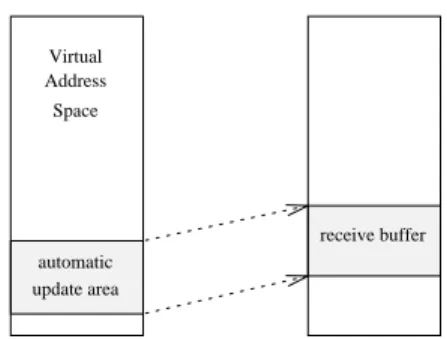
Designing a new model requires understanding why the traditional send/receive communication model per-forms so poorly. Traditional systems provide protection by requiring applications to access the network through system calls, which signicantly increases latency. The challenge for new communication mechanisms is to elim-inate the system calls without sacricing protection. On the sending side, additional sources of latency in the traditional model include verication in software of data access rights; checking for availability of receive buers and preparation of packet descriptors. An interrupt is needed on the receiving side, resulting in even higher latency. Data copying on both ends reduces performance further. In our approach we would like to remove these overheads from the common case of data transfer. Virtual Address Space update area automatic receive buffer Sender Receiver
Figure 1: Example of automatic update mapping. The sender maps its local virtual address range to an imported buer, for automatic update.
Existing communication models are dicult to cus-tomize because they are too high-level with too much se-mantics already built in. For example, the send/receive model includes complex buer management function-ality. If an application needs only xed size buers or can used preallocated buers for communication, it cannot make use of this information to improve communication performance. For these reasons, our new communication mechanism should be low-level and minimal.
3 VMMC model
Essentially, virtual memory-mapped communication is a mechanism for protected data transfer from the sender's virtual address space to the receiver's virtual address space. Communication is protected because it may take place only after the receiver gives the sender permission to transfer data to a given area of the receiver's address space. The receiving process expresses this permission by exporting areas of its address space as receive buers where it is willing to accept incoming data. A sending process must import remote buers which it will use as destinations for transferred data. An exporter can restrict possible importers of a buer; VMMC enforces the restrictions when an import is attempted. After a successful import, the sender can transfer data from its virtual memory into the imported receive buer. VMMC makes sure that transferred data do not overwrite receiver's addresses outside the destination receive buer.
VMMC supports two data transfer modes: deliberate update and automatic update. Deliberate update is an explicitly initiated transfer of a contiguous block of data from any (readable) virtual address in the caller's process to a previously imported receive buer. VMMC guarantees in-order, reliable delivery of deliberate update messages.
Automatic update is performed implicitly by the system on each write to local memory. To use
auto-matic update, a sender must rst create an autoauto-matic update mapping. This designates a region of the sender's virtual memory as an automatic update area and \maps" it to a remote receive buer (see Figure 1). Once the automatic update mapping exists, all writes by the sender to its automatic update area are automat-ically propagated to the remote receive buer. Since writes are propagated automatically, there is no way to explicitly specify a destination for each write. The VMMC subsystem infers the destination from the local address written to. As a result, there may be only one automatic update destination associated with a given local address. VMMC guarantees in-order, reliable delivery of automatic update messages.
When a message sent by either transfer mode arrives at its destination, it is transferred directly into the memory of the receiving process, without interrupting the receiver's CPU. Thus there is no explicit receive operation in VMMC.
VMMC supports user-level buer management be-cause transfer is performed between user-level memory locations. Buer management is divorced from the data movement mechanism and becomes the responsibility of the communicating parties. Zero copy protocols are possible because a direct application-to-application transfer of data can occur.
The CPU overhead to send data can be very small: one local write for automatic update, or a few user-level instructions for deliberate update. The model does not impose any CPU overhead to receive data, as there is no explicit receive operation. CPU involvement in receiving data can be as little as checking a ag; moreover program logic can be used to reason about what data has already arrived (since messages are delivered in order).
Our model as described in this section can be applied to communication between processes executing on one uniprocessor machine, on separate processors of a shared memory multiprocessor, or between processes executing on dierent nodes in a local area network. In the former two cases, VMMC is a special restricted case of shared memory communication with deliberate update added for bulk transfer. The LAN case is discussed in the next section.
4 Application programming interface
In this section we describe the VMMC API for distributed memory machines. We extend the model described in section 3 and introduce destination proxy space and notifications. Notications are used to transfer control between processes and to notify receivers about external events. They are described in 4.4. receive buffer imported ImpAddr receive buffer Proxy Space Destination Virtual Space Address Sender Receiver
Figure 2: Mapping a receive buer into a sender's destination space. The receiver exports the receive buer which is imported by the sender.
Destination proxy space is a logically separate special address space in each sender process; it is used for addressing imported receive buers. This new address space is usually a subspace of the sender's virtual address space1, but it is not backed by local memory and
its addresses do not refer to code or local data. Instead, they are used only to specify destinations for data transfer. After sender imports a remote receive buer, a representation of the imported buer is mapped into the sender's destination proxy space. This representation is simply a range of addresses in destination proxy space. An address belonging to a given range can be translated by VMMC into a destination machine, process, and virtual address. Figure 2 shows the mapping of a receive buer allocated on node Receiver into destination proxy space of node Sender.
4.1 Establishing import-export mappings
In VMMC, data transfer can occur only after receive buer has been mapped into the sender's destination proxy space. The mapping is needed for several reasons. First, it enforces protection by allowing VMMC to verify that the sender has permission to transfer data into the receiver's buer. Second, it allows receive buers to be pre-allocated, so the sender can transfer data without having to check the availability of receive buer space. Third, it allows VMMC to identify which memory areas are writable by incoming messages.
The sender and receiver cooperate to establish an import-export mapping. The receiving process exports a part of its address space with the following operation:
Export(mapId; recvBuf; nbytes; permissions) where recvBuf is the virtual address of the rst byte of the receive buer to be exported, and nbytes is its size. permissions describes the set of processes that are allowed to import this receive buer. mapId is an
1Depending on the implementation, destination space can be
integer identier, which is used by importer to establish import-export mapping with the following call:
Import(mapId; exporter;&impAddr; &nbytes) where exporter identies the exporting process. After a successful import, impAddr contains the starting address in the importer's destination proxy space of a local representation of imported receive buer (see Figure 2) and nbytes contains the size of the imported buer.
VMMC supports both blocking and nonblocking versions of the import operation. The blocking version waits until a matching buer has been exported, while the nonblocking version returns a handle which can be used later to check whether the import operation has nished.
Establishing an import-export mapping requires a trusted third party (operating system kernel or daemon process) to verify protection, so it can be relatively expensive. However, it should occur infrequently, as import is required only once for a given receive buer; afterward messages can be send cheaply.
4.2 Deliberate update
Deliberate update is an explicit request to transfer data from anywhere in virtual memory of a sender to a previously imported receive buer. The basic deliberate update operation is as follows:
SendMsg(srcAddr; destAddr; nbytes)
This is a request to transfer nbytes of data from sender's virtual address srcAddr to a receive buer designated by destAddr in the sender's destination proxy space. For example, if process Sender uses ImpAddr (see Figure 2) as a destination address, this request will transfer data to beginning of Receiver's receive buer. It is the responsibility of VMMC to ensure that data is not transferred outside the selected receive buer.
If no error occurs, SendMsg returns after all data has been sent out to the network. VMMC also provides a non-blocking variant of SendMsg, which takes the same arguments, but initiates the data transfer and then immediately returns a handle identifying the request. The handle can be used later to inquire about the status of the request. The non-blocking send is designed to minimize the CPU overhead required to start a data transfer. VMMC does not notify the sender when the data arrives at the receiver or when the receiver consumes the data. Obtaining this information requires a higher-level protocol.
4.3 Automatic update
Deliberate update allows any local data to be sent to any previously imported receive buer. Automatic update is introduced to obtain lower latency and to
avoid explicit transfer initiation. (This can benet applications like shared virtual memory).
Automatic update propagates writes to local memory to remote receive buers. A sender process sends updates to a receiver simply by writing to the sender's local virtual memory. The latency of transfer initiation can be completely hidden from the sender. Since no special send operation is required, existing code using shared memory model can be often ported to VMMC system with little or no modication.
To allow automatic update, VMMC provides the Map operation. It maps an area in the virtual address space, for automatic update, to an already imported receive buer, as in Figure 1. Separation Map and Import is useful since the former can be implemented as a local operation. VMMC also provides an Unmap operation which unmaps given range of local addresses mapped previously as an automatic update area. This operation can be also used to change automatic up-date destination (which requires unmapping the old destination and mapping the new one), or to avoid overwriting the remote receive buer while performing local computations.
4.4 Notications
VMMC provides notifications to support transfer of control and to notify receiving processes about external events. Attaching a notication to a message causes the invocation of a user-level handler function in the receiving process after the message has been delivered into the receiver's memory.
A variant of the deliberate update SendMsg oper-ation is provided to send a message with a notica-tion attached. When an automatic update mapping is created, a sender may specify that a notication should be attached to every automatic update message propagated by the mapping.
The receiving process can associate a separate noti-cation handler with each exported buer. If a message with notication arrives at a receive buer that has no handler, the notication is ignored.
Like UNIX signals, notications can be blocked and unblocked; they can be discarded or accepted (sepa-rately for each buer); and a process may be suspended waiting for notications. Unlike signals, notications are queued when blocked.
4.5 Destroying import-export mappings
Either the receiver or the sender may destroy an import-export mapping. A sender calls Unimport to indicate that it no longer plans to transfer data to a given receive buer. After the unimport completes, the range of sender's destination proxy space associated with the unimported buer becomes free and can be reused for another imported buer.
A receiver calls Unexport to destroy a given receive buer. After this call completes, all import mappings to this buer are gone and any messages sent using these mappings have been delivered. Since Unexport may require communication with multiple senders to ush and destroy mappings, VMMC API supports a non-blocking version of Unexport.
5 Implementation
In this section we discuss what the VMMC imple-mentation needs from the hardware and the operating system. The hardware description is mostly functional and is presented to establish context for the discussion of operating system requirements. We will describe the software architecture of two VMMC implementations we have done as part of the SHRIMP project.
VMMC is implemented by cooperating software and hardware. Most of VMMC's functionality can and should be provided by software, with hardware imple-menting only performance-critical features. The exact division of labor between hardware and software varies between implementations.
Data transfer, including direct placement of data into the receiver's memory, should clearly be provided by hardware, since it is the most common operation. Establishing and destroying import-export mappings can be relegated to software, since it is much less common than data transfer.
5.1 Hardware requirements
To realize the potential performance of VMMC some hardware support is necessary. We discuss it in stages, starting with hardware that is easy to implement (or already existing on commodity systems), proceeding to hardware that is useful but progressively more dicult to implement.
The necessary hardware features are as follows: cache-coherent DMA to and from the network: The
networkinterface must be able to transfer data directly to and from cacheable memory. This allows the source and destination buers to be in cacheable memory. Without cache-coherent DMA, incoming messages would have to be written into special non-cacheable memory, requiring an extra user-level copy, or would require taking an inter-rupt on data arrival. Many popular architectures, including PCs, support cache-coherent DMA. abilityto cheaplydetermine destination physical
address for incoming data: In order to transfer incoming data directly into memory without in-terrupting the CPU, the networkinterface should be able to gure out where to put the data. One
simple way to do this is to pin receive buers in memory and communicate the physical addresses of buer frames to importers. In this approach, each message carries a destination physical address in its header. Thus, virtual memory mapping is implemented in software on top of hardware that supports physical memory mapping.
reliable, ordered network message delivery: De-livering messages out of order directly into user space or losing packets is bound to cause a disaster unless user code runs an expensive higher-level protocol. Modern networks like SCI and Myrinet deliver messages in the order they were sent. SCI provides reliable message delivery, while Myrinet has extremely low error rates, so data loss can be treated as a catastrophic event.
Useful, but more dicult to implement hardware features include:
support for automatic update: Automatic dupli-cation of local writes to remote memory can be implemented by snooping the memory bus, or by allocating part of main memory on a standard I/O bus networkinterface.
support for user-level, protected initiation of delib-erate update: In the absence of automatic update, this feature is important for low latency. Even with automatic update, it is still useful for limiting the CPU overhead required to initiate a large transfer [2].
support for receive buers larger than the size of DRAM: This would require a TLB on the network interface and some support for handling misses when the destination page is not in main memory.
5.2 Operating system requirements
We assume that most of the VMMC functionality is provided by a user-level VMMC daemon (server) process; the server implements creation and destruction of import-export and automatic update mappings. We introduce the daemon to minimize the kernel modica-tions required.
The operating system requirements are a direct con-sequence of the support provided by the hardware. Here are the operating system features we deem necessary for VMMC implementation:
abilityto DMA between anylocation in physical memoryand the network: We want to use cache coherent DMA to transfer data directly between user-level structures and network, so the operating system should allow any memory to be used as a source or destination of a DMA transfer.
DMA-aware pager: The operating system must take care to avoid paging out a page that is being used as a source for a currently-executing outgoing DMA transfer. Such a page should be considered temporarily locked until the transfer is nished. In practice this means that OS pager should be able to quickly determine whether a given page is scheduled to be used, or is being used now, as a source for DMA transfer. The network interface knows the physical addresses of such pages; it must allow some way for the operating system to check whether a specic page is a source of a pending transfer.
support for VMMC-specic memory locking: On the receiving side, the network interface hardware usually cannot translate virtual to physical ad-dresses, so receive buer pages must be locked into memory. Once a page of a receive buer is locked in memory, it must remain locked until all of its import-export mappings are dead, even if the process owning it dies. As long as an import-export mapping exists, a message may arrive at the page, so the page cannot be reused.
support for direct page modications from the net-work: The initiation of outgoing DMA to the network is synchronous with respect to operating system activities, while incoming transfer from the network is asynchronous. Receive buer pages can be changed by incoming packets quietly, behind the back of the operating system. This has two con-sequences: optimizations like copy-on-write should not be allowed on locked pages, and, when deciding if such pages are dirty, the operating system should take into account the possiblity of modications from the network. One simple solution is to assume that all locked pages are dirty; another is to use a per-page dirty bit implemented in the network interface hardware.
Additional operating system support is required when more features are provided by the hardware. For example, if the network interface supports user-level deliberate update, then special virtual memory mappings are needed [2]. In this case, the VMMC daemon must be able to manipulate the client's virtual address space.
If automatic update is supported by snooping, writes to automatic update areas should appear on the bus snooped by the network interface. Operating system support for selecting per-page caching strategy is useful in this case; we can cache pages mapped for automatic update in write-through mode and all other pages in write-back mode.
5.3 Software architecture
We describe our software architecture in the context of the SHRIMP project. Two network interfaces have been designed for the SHRIMP multicomputer; SHRIMP is constructed from EISA Pentium PCs and an Intel Paragon routing network. The rst design explores how to minimally modify the traditional DMA-based network interface design, while implementing virtual memory mapping in software. It requires a system call to initiate outgoing data transfer, but received messages are delivered directly to memory by hardware, reducing the receive software overhead to only a few instructions in the common case. The second design implements virtual memory mapping completely in hardware. This approach provides fully protected, user-level message passing, and it allows user programs to initiate an outgoing block data transfer with two user-level instructions. Based on these network interfaces we built two implementations of VMMC.
SHRIMP-I [4], the rst network interface designed by the SHRIMP team, uses the traditional DMA approach with added support for including destination physical address in the message header. On export, receive buer pages are pinned in physical memory, so virtual memory mapping across nodes is implemented using physical memory mapping. For each process, the system software maintains a destination table, pro-viding translation from destination space addresses to remote physical memory addresses. Deliberate update is initiated with a system call, and automatic update is not supported. On message arrival, the network interface hardware uses the physical address included in the message header to transfer message data directly into memory.
SHRIMP-II, like SHRIMP-I, includes destination physical address in the message header, allowing direct transfer into the destination memory. Also as in SHRIMP-I, receive buers are pinned and physical memory mapping across nodes is used. SHRIMP-II extends the SHRIMP-I interface by implementing automatic update and user-level protected initiation of deliberate update. Destination space is now a part of the sender's virtual address space, and the destination table is maintained on the network interface. Automatic update writes are snooped o the memory bus. A user process can initiate a deliberate update transfer with just two memory-mapped I/Oinstructions [2]; these instructions access locations on the network interface board across I/Obus. Virtual memory mappings are used to verify permissions and provide protection between users on initiation of deliberate update.
Functionally, the VMMC software architectures on the two SHRIMP systems are similar. Each consists of
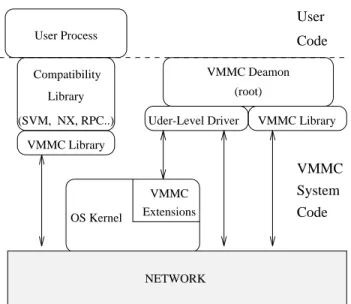
User Process Compatibility Library (SVM, NX, RPC..) VMMC Library Extensions VMMC OS Kernel VMMC System Code Code User NETWORK VMMC Deamon (root) VMMC Library Uder-Level Driver
Figure 3: System software implementing VMMC in SHRIMP-II.
ve parts:
a VMMC daemon running on eachnode, a user-level network interface driver, VMMC-specic kernel extensions, the VMMC basic library, and compatibility libraries.
Figure 3 shows the relationship among these com-ponents in the case of SHRIMP-II. The one feature specic to SHRIMP-II is that the VMMC library has direct access to the network. In SHRIMP-I access to the network is through a system call.
The VMMC daemon runs on eachnode of the SHRIMP machine with superuser permission. The purpose of the daemon is to assist user processes in establishing and destroying import-export mappings and automatic update mappings (if automatic update is supported by hardware). Client processes communicate withtheir local daemon, never withremote daemons. The daemons communicate with each other, exchanging information about clients, exported buers, and out-standing import requests, as well as global conguration information. Export requests are maintained by the local daemon in a hash table. Import requests are propagated to the daemon of the exporter where they are matched to the appropriate export, or queued in the daemon hash table if the requested export has not been performed yet.
The network interface driver, linked into the dae-mon's address space, allows daemons to manipulate the
protected hardware state, for example to establish an import-export mapping.
Kernel 2 extensions are used by a daemon to lock
receive buer memory and to create destination space mappings for both SHRIMP systems. Additionally, in SHRIMP-I deliberate update send is implemented as a system call. In SHRIMP-II, there are two system calls to manipulate destination space (which is a part of client's virtual address space) and one more system call to control page caching mode. This latter call is used to specify write-through caching for automatic update pages.
Programs that use VMMC are linked withthe VMMC library which provides system-specic imple-mentation of the VMMC operations. The library implements the interface described in section 4. Most of the API calls are implemented as IPC to the local daemon in both SHRIMP systems. The exception is deliberate update initiation, which in SHRIMP-I is a system call, and in SHRIMP-II is a small user-level procedure. The VMMC library is intended to provide a basic, low-level interface for libraries implementing higher-level specialized interfaces.
To exploit the performance benets of VMMC with-out extensive rewriting of applications, we provide compatibility libraries. By using the VMMC library, which hides the details of memory-mapped communica-tion implementacommunica-tion, compatibility libraries are system-independent. Eachcompatibility library implements one programming model interface like RPC, stream sockets, NX/2 [7] message passing, or shared virtual memory. Compared to traditional implementations of these models, we avoid receive system calls in both SHRIMP systems, and send system calls in SHRIMP-II. Depending on the model, some additional savings can be realized by using VMMC. For example, in our RPC implementation [1], calls to the stream and network layers are replaced withcalls to the VMMC library; as a result, a copy between the user buer and the stream buer can be avoided. Compared to the standard TCP-based implementation, null RPC on SHRIMP-II executes only one fourthas many instructions and has four fewer system calls per RPC. The VMMC implementation of NX/2 [1] achieves a user-to-user four-byte message latency of 12 seconds, which is about factor of four smaller than that on the Intel Paragon. Shared virtual memory on SHRIMP-II [5] uses automatic update to merge ne-grain updates to shared pages and to avoid page faults if pages are shared by only two nodes. As a result, this implementation achieves substantial speedups compared to start-of-the art SVM implementations, even if the same network is
used in both cases [5].
6 Performance
To verify how our two VMMC implementations compare with the traditional send/receive model, we performed a number of experiments. All performance numbers are preliminary, as our hardware is untuned and the SHRIMP system is still in the phase of debug-ging and integration.
Our system consists of 60 MHz Pentium PCs with Xpress memory bus and EISA I/Obus, connected by a high-performance Intel Paragon backplane. The hardware local-to-remote memory bandwidth is limited by the EISA bus bandwidth. The theoretical peak EISA bandwidth is 33 MB/sec, but this cannot be achieved in practice because some cycles are lost because of memory refresh and mandatory periodic rearbitrations for the bus. The hardware local-to-remote memory latency is about 4 sec.
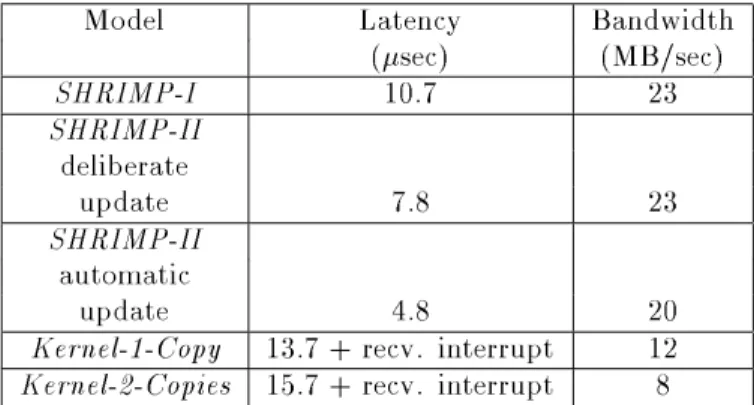
In SHRIMP-II, we measured user-to-user latency using a ping-pong test. Automatic update latency was about 4:8 sec; deliberate update latency was 7:8 sec. This one-way time includes transfer initiation, data transfer across the network, and DMA into an already exported receive buer, plus overhead caused by the test code. Deliberate update latency is longer than automatic update latency because of two memory-mapped I/Oreferences over the slow EISA bus, ad-ditional DMA on the sending side, and checking for page alingment. Both latency numbers are close to the hardware minimum.
User-to-user bandwidth in both SHRIMP systems is about 23 MB/s, which is close to the raw band-width we were able to achieve over the EISA buses in our PCs. It is also 70% of 33 MB/sec, which is the maximum theoretical bandwidth of the EISA bus. The discrepancy between achieved and theoretical bandwidths is not caused by the VMMC protocol, but by practical limitations of the EISA bus. Automatic update bandwidth is 20 MB/sec when writes are to consecutive locations (because they can be combined by network interface).
VMMC provides good support for overlapping com-munication and computation, because it is cheap to initiate a message. For automatic update, the CPU overhead to send is single local write. For deliberate update on SHRIMP-II, initiating a transfer requires two references to memory-mapped I/Ospace, plus some instructions to check for page boundaries within the message. The total cost is about 2.8 sec. In SHRIMP-I, this overhead is higher | about 6.7 sec for 1 word transfer | because a send system call is required.
We compared SHRIMP performance with an
opti-mistic estimation of latency, bandwidth and software overhead in the traditional send/receive model (assum-ing the same network and interface as in our other ex-periments). We considered two kernel implementations of traditional send/receive communication: the Kernel-1-Copy protocol is similar to the NX implementation for Intel multicomputers; the Kernel-2-Copies protocol corresponds to a standard workstation implementation. Both models require send and receive system calls and an explicit receive operation that copies data from the system receive buer into an application buer. They dier in how the send operation is implemented: Kernel-2-Copies copies data from user space to kernel send buer, whereas Kernel-1-Copy sends data directly from user space.
Model Latency Bandwidth (sec) (MB/sec) SHRIMP-I 10.7 23 SHRIMP-II deliberate update 7.8 23 SHRIMP-II automatic update 4.8 20
Kernel-1-Copy 13.7 + recv. interrupt 12 Kernel-2-Copies 15.7 + recv. interrupt 8 Table 1: User-to-user latency and bandwidth of tra-ditional send/receive and VMMC. The same host and network is assumed for all models.
Table 1 shows a latency and bandwidth comparison. The latency of a one word transfer, with send and receive system calls, but without interrupt on receive, is more than 15 sec, which is about three times our automatic update latency. In our experiments, user buers are initially in the cache and kernel buers are not. Cache-to-memory copy bandwidth is low, about 22 MB/sec, because of slow DRAM. As a result, the bandwidth of pipelined 4KB transfers with copying between user and kernel buers on both send and receive sides is about 8 MB/s, about three times lower than our deliberate update bandwidth. With one copy, the bandwidth is 12 MB/sec, still half of the deliberate update bandwidth. With new high-speed I/Obuses like PCI, this comparison will be even more favorable for VMMC, because deliberate update bandwidth is limited by I/Obus.
Table 2 shows the CPU overhead required to transfer a one word message. For VMMC, receive-side overhead is zero, as data is delivered directly into user memory.
Model Sending Receiving Total Overhead Overhead Overhead
(sec) (sec) (sec)
SHRIMP-I 6.7 0 6.7 SHRIMP-II deliberate update 2.8 0 2.8 SHRIMP-II automatic update 0.01 0 0.01 Kernel-1-Copy 6.7 5 + 11.7 + recieve receive interrupt interrupt Kernel-2-Copies 6.9 5 + 11.9 + recieve receive interrupt interrupt Table 2: Communication overhead on CPU imposed by send/receive and VMMC models. The same host and network is assumed for all models.
SHRIMP-I send-side overhead is high because of the cost of a system call and verication of send rights in software. For both send/receive models the overhead is substantial because of send and receive system calls, verication of send rights, kernel buer management, and DMA setup in software.
The latency of send/receive communication is about three times that of automatic update. The bandwidth of both VMMC implementations is three times higher than in the send/receive model where copies are per-formed by both sender and receiver; and two times higher if only one copy takes place. Total CPU overhead is four times lower in SHRIMP-II deliberate update than in send/receive communication.
7 Related work
Spector proposed a remote reference/remote opera-tion model [9] in which a master process on a local processor performs remote reference and a slave process on another remote processor implements this reference by executing the remote operation. Compared to this model, VMMC is much simpler, as we envision hardware support only for data transfer. We also use virtual memory mappings across the network to provide protection and to eliminate software overhead on communication, whereas Spector's model did not discuss virtual memory or protection issues.
Thekkath, Levy and Lazowska [10] proposed a model similar to VMMC. Both models use protected memory-based communication. However, their model is not based on memory mappings across the network; instead
their API uses memory regions and osets. This dierence leads to dierences in implementation: they cannot use the existing virtual memory system to verify send rights, as we do in SHRIMP-II. Instead, their send operation requires trapping into the operating system kernel to verify send rights in system software, which leads to increased latency. Also, their model does not include support for automatic update, which is important for applications like shared virtual memory.
Hamlyn [13] is a new network interface under design at HP Laboratories. It provides some functionality useful for VMMC: user-level protected access to the network and direct transfer to receive-side user buers. However, Hamlyn does not support automatic update and both send and receive areas must be pinned in physical memory.
Thekkath and Levy [11] investigated factors limiting performance of communication in high-speed networks. Their results indicate that modern distributed systems require both high throughput and low latency. As a result, support for both fast short messages and longer high bandwidth data transfers is needed.
Karamcheti and Chien studied software overhead on message passing [6]. They argue that the networking hardware should provide reliable, in-order message delivery (as VMMC assumes). They show that omitting these features, can more than double software overhead for message passing.
The VMMC model provides similar functionality to Active Messages [12]. In this asynchronous communica-tion mechanism each message contains at its head the address of a user-level handler which is executed on message arrival. A VMMC message with notication is very similar to an active message. Unlike active messages, VMMC provides a way to transfer data without transferring control. Executing a handler can be expensive, since the processor must be interrupted. We believe that data transfer is the common case, so VMMC should have a performance advantage. VMMC also allows the sender more control over where in memory data is to be delivered, which makes it easier to implement zero-copy protocols.
Scalable, coherent shared memory is an attractive model for large scale parallel computing. The main obstacle to widespread use of shared-memory systems is high cost and high hardware complexity. The NUMA model of global address space partitioned across all nodes (implemented for example in the Cray T3D [8]) is also easy to use and provides a low latency data transfer mechanism. Compared to VMMC, its support requires more hardware and closer integration with host processor and memory. Moreover, reading remote memory incurs substantial overhead which needs to be addressed by migrating or replicating of data [3].
8 Conclusions
This paper describes software support for the vir-tual memory-mapped communication mechanism. This approach allows data transfer directly from the sender's to the receiver's address space, and eliminates operating system involvement in communication while providing full protection. The API is simple and yet supports user-level buer management and zero-copy protocols.
The VMMC model supports two data transfer modes:deliberate update and automatic update. Nei-ther case requires CPU involvement in data transfer. With deliberate update, bandwidth close to the hard-ware limit can be achieved as DMA moves data directly from user-level send buer to the network and back to user-level receive buer. With automatic update, the overhead on CPU of send initiation is one local write, as writes to local memory are automatically propagated to remote destination. In both cases, no receive interrupt is needed.
The VMMC model and its implementations are the result of hardware and software co-design. As a result, our model requires minimum hardware support, limited to the network interface. It concentrates on speeding up the most common case:data transfer between user address spaces. Most of the system software is implemented by a user-level daemon; only small changes to the operating system kernel are needed.
The model's API is small, low-level and exible. It supports establishing and destroying mappings to remote buers as well as operations to initiate deliberate update. Additionally, the API provides notications to facilitate transfer of control. We have implemented sev-eral compatibility libraries using VMMC library, to sup-port traditional interfaces like NX/2, RPC, sockets and shared virtual memory. Using compatibility libraries, the legacy code written to these interfaces can be ported to a new model without source code modications and with substantial gains in performance.
Acknowledgements
This project is sponsored in part by ARPA under contract under grant N00014-95-1-1144, by NSF under grant MIP-9420653, by Digital Equipment Corporation and by Intel Corporation. Ed Felten is supported by NSF National Young Investigator Award.
References
[1] R. Alpert, A. Bilas, M. Blumrich, D.W. Clark, S. Dami-anakis, C. Dubnicki, E. Felten, L. Iftode, and K. Li. Early experience with message-passing on the shrimp multicomputer. In Proceedings of the 23rd Annual Symposium on Computer Architecture, 1996.
[2] M. A. Blumrich, C. Dubnicki, E.W. Felten, and K. Li. Protected, user-level dma for the shrimp network
inter-face. In Proceedings of the Second International Sym-posium on High Performance Computer Architecture, February 1996.
[3] A.L. Cox and R.J. Fowler. The implementation of a coherent memory abstraction on a numa multiproces-sor: Experiences with platinum. In Proceedings of the Twelfth Symposium on Operating Systems Principles, pages 32{44, December 1989.
[4] C. Dubnicki, K. Li, and M. Mesarina. Network interface support for user-level buer management. In Workshop on Parallel Computer Routing and Communication Workshop. Springer-Verlag, April 1994.
[5] L. Iftode, C. Dubnicki, E.W. Felten, and K. Li. Im-proving release-consistent shared virtual memory using automatic update. In Proceedings of the Second Inter-national Symposium on High Performance Computer Architecture, February 1996.
[6] V. Karamcheti and A. Chien. Software overhead in messaging layers: Where does the time go? In The 6th International Conference on Architectural Support for Programming Languages and Operating Systems, pages 51{60, October 1994.
[7] P. Pierce. The NX/2 operating system. In Proceedings of 3rd Conference on Hypercube Concurrent Computers and Applications, pages 384{390, January 1988. [8] Cray Research. Cray T3D system architecture
overview. Technical Report HR-04033, Cray Research Inc, September 1993.
[9] A. Z. Spector. Performing remote operations eciently on a local computer network. Communications of the ACM, 25(4):260{273, April 1982.
[10] Ch. A. Thekkath, H.M. Levy, and E.D. Lazowska. Separating data and control transfer in distributed operating systems. In The 6th International Conference on Architectural Support for Programming Languages and Operating Systems, pages 2{11, October 1994. [11] Ch.A. Thekkath and H.M. Levy. Limits to low-latency
communication on high-speed networks. ACM Transac-tions on Computer Systems, 11(2):179{203, May 1993. [12] T. von Eicken, D.E. Culler, S.C. Goldstein, and K.E. Schauser. Active messages: a mechanism for integrated communication and computation. In Proceedings of 19th ISCA, pages 256{266, May 1992.
[13] J. Wilkes. Hamlyn { an interface for sender-based communications. Technical Report HPL-OSR-92-13, Hewlett-Packard Laboratories, November 1993.