Leadership development program
-
Useful?
Which influence/impact have leadership development programs had to your development as a leader?
MARIANN TOTLUND
Master of Management, Specialization in Relational Leadership RAD6901
Autumn 2014
Department of Adult Learning and Counselling
NTNU
NORWEGIAN UNIVERSITY OF SCIENCE AND TECHNOLOGY Trondheim
i
Preface
This master thesis is a part of Master of Management, specialization in Relational Leadership at NTNU in Trondheim.
The process started in 2011 before husband and child, and it has been a longer process than intended at the start. This thesis has been with me through sickness and birth, and in my daily life as a leader, mum and the planning of a wedding. It is strange looking back at the day I started with this thesis and all that I have experienced and learned that hopefully will make me a better leader and my co-worker better as well.
I would like to take the following people for their contribution and support in this study: • Jonathan Reams, my supervisor, that got me through this.
• Kyrre Svarva, for all his help with survey production and support through the data process. He got me going again after losing all faith in understanding SPSS. • My colleagues for being my test objects and answering my survey.
• My employees for being patient with a leader that have tried to divide her focus between work and thesis writing.
• My family for encouraged and support through the whole process with kind words and babysitting.
• My Husband, Grim Jardar, whose love and support have made it possible for me to finish this that I began four years ago.
• My incredible boy, Lars Lauritz who gave up some mummy time, so that I could complete this study.
ii
Abstract
This is a quantitative study where the main objective was to find out which influence/impact leadership development programs have had for leaders’ development. The basis was different theories within leadership development, leadership, gender differences in leadership, self-awareness, culture and honeymoon effect, reflection and conflict management. The data was gathered though a questionnaire deployed in six municipalities and leaders participating at the Masters of management, NTNU. There were 57 leaders that completed the questionnaire, where 41 had attended different leadership development programs.
The statistical findings indicate that there was no impact and that attending a leadership development program does not necessarily make you a better leader. Statements from
attending leaders and weaknesses that follow a small research sample contradict this finding. The experiences leaders have had from attending a leadership development program have been that they are given time to focus on leadership and themselves as a leader. There are indications of increased skills of reflection and increase in self-awareness in leaders that have had an effect.
There are indications on why some leadership development programs are more successful than others, and what is important for having an impact on the organization. The culture and willingness to be a learning organization is the foundation for achieving changes learnt through a leadership development program. Who you participate with is also a key for lasting effect. Ideal is a mix of leader colleagues and leaders from other organizations, so there is a broad range of experiences to be used in knowledge exchange. To achieve change in an organization all leaders have to attend a program, long lasting effects cannot be made by one single leader attending a leadership development program.
iii
TABLE OF CONTENTS
1 INTRODUCTION ... 1
2 THEORY ... 3
2.1 Leadership development programs ... 3
2.2 Leadership ... 5
2.3 Gender differences in leadership ... 6
2.4 Self-awareness ... 7
2.5 Culture and Honeymoon effect ... 9
2.6 Reflection ... 11
2.7 Conflict management ... 12
3 METHODOLOGY ... 13
3.1 Choice of methodology ... 13
3.1.1 Quantitative research method ... 13
3.2 Data collection ... 14 3.2.1 Questionnaire ... 14 3.2.2 Preparation ... 14 3.2.3 Content ... 14 3.2.4 Execution ... 15 3.2.5 Test questionnaire ... 15 3.2.6 Respondents ... 16 3.3 Data analysis ... 16 3.3.1 Forensics ... 16 3.3.2 Chi-square of independence ... 17 3.3.3 T-test of independence ... 17
3.3.4 One-way between Anova with Post-hoc tests ... 18
iv
3.3.6 Reliability and validity ... 19
3.3.7 Code ... 20 3.3.8 Presentation of categories ... 21 3.4 Quality of research ... 21 3.4.1 Survey online ... 22 3.5 Ethical Considerations ... 22 4 RESULTS ... 24 4.1 Background information ... 24 4.1.1 Population ... 24
4.2 Experiences from leadership development program ... 26
4.2.1 The motivation to participate in a leadership development program ... 27
4.2.2 Positive experience of participating in a leadership development program ... 28
4.2.3 Contribution to you as a leader by participating in a leadership development program ... 29
4.3 Self-awareness ... 31
4.4 Cultural and honeymoon effect ... 33
4.5 Reflection ... 35
4.6 Leadership ... 36
4.7 Conflict management ... 38
5 DISCUSSION ... 40
5.1 Leadership development ... 40
5.2 Gender differences in leadership ... 42
5.3 Self-awareness ... 43
5.4 Culture and honeymoon effect ... 44
5.5 Reflection ... 45
5.6 Leadership ... 46
v
6 CONCLUSION ... 49
6.1 Conclusion ... 49
6.2 Limitations of research project ... 52
6.3 Implications for further research ... 53
7 REFERENCES ... 55
Appendixes ... 58
Appendix A: Letter of approval from Norwegian Social Science data service. ... 58
Appendix B: Letter to respondent ... 59
Appendix C: Questionnaire ... 60
Appendix D : Code Book Questionnaire ... 66
Appendix E: Descriptive Statistics variables for the new variables based on statements in the survey ... 70
Appendix F: Tests done on variable Self-awareness ... 72
Appendix G: Tests done on variable Culture and honeymoon effect ... 76
Appendix H: Tests done on variable Reflection ... 80
Appendix I: Tests done on variable Leadership ... 84
1 into. I changed my job from advisor in a private firm into leading a department in a
municipality. A lot of different thoughts and worries rise as a new leader, and sometimes you feel that you are the only one that has problems. Will I be a good leader? Would I be able to get respect from my coworkers? Am I a natural leader or can I learn how to be a good leader? What is a good leader?
Research problem:
Which influence/impact have leadership development programs had to your development as a leader?
Underlying problem
The thesis asks questions about the influence leadership development programs have had for leaders own development. It is interesting to see whether the leaders have experienced any difference in their personal development as a leader, and if they have become a better leader. The background for this thesis is that the municipality I started to work for had a leadership-program, and I got the chance to join a discussion group with other leaders together with an external advisor. There we discussed theory and experiences we have had with different issues. I had just before I changed jobs started at Norwegian University of Science and Technology (NTNU) master program in management, specializing in relational leadership. Combining theory and experiences from other leaders has made me aware that I am not alone with my problems, and given me room to discuss my frustrations and problems. There is so much you can learn from experiences from other leaders, together with different theories to dig deeper into the subject.
My own experiences over the last years of my development as a leader have made me wonder if I am the only one that has had these kinds of experiences. Therefore, I have chosen to look closer into the subject in my master thesis, and study the impact different types of leadership programs have had on others personal development as a leader.
Today we may have a more technical view on solving things, and may often choose solutions that are familiar to use. To be able to meet challenges differently we may need to develop our self as a human and as a leader. Joiner and Josephs (2007) sees that personal growth for
2 leaders is not only important for the role as leader, but also for the organizations success. To achieve success there has to be a lasting effect. There are experiences from different research on the lasting effects after having attended a type of leadership development program. Lysø (2010) found in her research that is not often there is a lasting effect, and that there is a probability that they can fall back into old habits, since it is hard to taking knowledge into practice. What can be important for an organization to focus on when they choose the type of program they want their leaders to attend, so they can achieve a change?
To address the research question chapter two gives a overview of theoretical knowledge within the main areas that can indicate an influence or impact; leadership development, leadership, gender differences in leadership, self-awareness, culture and honeymoon effect, reflection and conflict management. In chapter three the methodology for the research is described. There is information about how the data collection and analysis was done, as well as quality of research and ethical considerations. Chapter four; results give a background analyzes of the respondents participating in this research. There are figures that address questions leaders have been asked related to their participation in leadership development program. Last part of this chapter tests results from variables based on graded statements in the survey are found; self-awareness, culture and honeymoon effect, reflection, leadership and conflict management. In chapter five, theory in chapter two and results from chapter four are discussed, before conclusions are found in chapter six together with limitations of this research and implications for further research.
3
2
THEORY
In this chapter, I will present the theories that make the foundation of this research project. They are different theories in leadership development, leadership, gender differences, self-awareness, culture, honeymoon effect, reflection and conflict management.
2.1
Leadership development programs
Good leaders can be developed and not only because you have natural skills for leadership.
Leaders have a choice every day, should they confront their own defects or should they construct a world where they are flawless (Dweck, 2006).
Leadership development programs aim is to learn leaders making this right decisions
(Brunstad, 2009) by increased awareness (Grotli, 2011) done with the right tools at the right time with a wish to make a decision that you and others can live with. In the end leadership development is about developing leaders as individuals (Kegan and Lahey, 2009), and especially their role and personal influence (Ladegård, 2010).
Leaders need basic skills to succeed in leadership. They need to have relevant knowledge to handle challenging fellow humans as well as insight in their own behavior, influence and emotions (Spurkeland, 2011). The goal is not about working more, but to see new ways of working and are organizing that would be important to tackle challenges in the future (Tiller and Helgesen, 2011). So leaders can be aware of what is happening and what can happened (Brunstad, 2009) and be able to know what to do in the long term and havedifferent
approaches to different employees to get them to do things (Lysø, 2010). Leadership development is for the leaders a toolbox they can use in different situations.
To be able to create your own toolbox you need as a leader to take responsibility for your own development through getting to know your own weaknesses and strengths. Leaders need to take control over their own development (Spurkeland, 2011) and learn from everyday experiences (Fullan, 2008). They need the ability and willingness to learn from themselves and together with other leaders (Tiller and Helgesen, 2011). Leadership development can give the leaders this ability and time to develop their leadership.
Kegan and Lahey (2001; 2009) argue that leadership development should have less concrete measures and instead focus on systems for mental development. They see the main goal in leader development to be able to view the world in a different perspective and with new eyes.
4 Leadership development programs need to believe in humans ability to change, and a
common understanding for the importance of communities has on personal development. Believe that you can learn from your mistakes and take responsibility for your own life and others in a better way. Lack of reflection beforehand creates hindsight, it can be useful, but there is more to learn by doing it from the start. By learning from your mistakes, you become better equipped to solve similar situations later as long as you are able to be honest and remember how it actually happened (Brunstad, 2009).
Awareness and relationship management competence changes leaders to be able to see and solve situations in another manner than before they participated in a development program. Safety as a leader is another finding that Grotli (2011) made in her thesis. Her conclusions around these programs are that they give the leaders a personal benefit, and have grown as a human. They understand themselves and others better, and as Grotli (2011) interprets, have grown as an individual, which connects with Kegan and Lahey’s (2009) goal that leader development is about developing themselves. By being able to see a bigger perspective than before, and grow their own mental development, will leaders have a greater possibility to handle leadership challenges in a shifting world. They are more aware on what is going on around them, about themselves, and what they want to achieve with their own job as a leader (Grotli, 2011).
It is essential that there is good dialogue with the other participants for the program to be good. Most important source of learning came through conversation with fellow participants in the programs. General knowledge functioned as a common language to reflect on practice, instead of transferring it back to the organization (Lysø, 2010). Therefore, the leader can be better in relational skills so he/her can give better and clearer feedback and tackle difficult talks (Spurkeland, 2011).
Experience from Grotli (2011) is that the development programs made it possible for leaders to see and solve situations in a different way than before. Its focus both on the ability to see yourself and own actions in different situations, as well as having an increased awareness in relation with other people around you. The awareness achieved contributed to a higher degree of taking breaks in everyday life to reflect on what was happening at work. If you do not take time to reflect enough, there is a risk that you will believe that you often have right. This because you have adapted a way of thinking and a point of view(Grotli, 2011)
5 Experience from Lysø’s thesis is that some leaders became more focused and thoughtful towards other after participation in the program. Their social interactions improved and they become more focused on what where needed in different situations and interaction with people. Participating in a program is one of many ways that contributes to a leader’s ongoing learning process (Lysø, 2010).
Kegan (1994) thinks that it would be natural that you take the whole human not just the leader in a leader development process when leader development and personal growth in leaders are the key factor for success to tackle the rapid change in the society. Joiner and Joseph (2007) sees personal growth in leaders as the key in development not just in the role as a leader, but also to achieve success in the organization. Therefore, by developing human on a personal level would affect the whole organization in another way than just learning what is smart to do or been told the way to do things.
2.2
Leadership
Altermann states that there are two kinds of leaders; one that makes you want to lift you by the hair and the other that makes you want to rip your hair off (Irgens, 2011). Leadership is about doing right things as the Austrian economist, Drucker states it, while management is about doing things right (Imsen, 2004). Ciulla has, in Aitken and Higgs (2010), defines that leadership is not a person or a position. It is a complex moral relationship between people, based on trust, obligation, commitment, emotion and a shared vision of the good.Brunstad (2009) defines it as getting people to places they never have been before. Leadership is the link between the personal, interpersonal, organizational and social impact that matter the most (Aitken and Higgs, 2010). A wise leader can see the consequences of different actions before they happen, and have the ability to improvise and be creative (Brunstad, 2009). This
indicates that leadership requires much more than theoretical skills to be a good leader. A good leader needs the ability for empathy, good communication, authenticity and
credibility, be able to feel and to care, and see himself/herself as a participant in interaction with others. A leader is dependent on receiving trust and respect that connected to integrity, trustworthiness and reliability, makes for someone you can trust. Personal warmth, the ability to stay calm and balanced when things happen and show enthusiasm for the tasks is a leader that builds co-worker strength and gets people to follow (Roness & Matthiesen, 2002)
6 Good leadership is dependent on a good interaction between the leader and those that are supposed to be led (Brunstad, 2009). Wise leaders make sure that they and their employees learn through watching and reflection around their own experiences and actions (Tiller and Helgesen, 2011). Leadership is learning, and learning is leadership (Brunstad, 2009). Leadership is about making other people succeed and doing a good job, and gives the
necessary support and rewards for optimal expression and performance. Management is to see that they stay there and produce a result (Brunstad, 2009).
2.3
Gender differences in leadership
Payne (2001) defines stereotypical male leadership as task oriented while female leaders are more occupied with relationship oriented activities like cooperativeness, using collaboration and using a problem solving style based on inclusion and empathy. Women are assumed more emphatic, intuitive and taking feelings and relation quality into consideration when leading than men (Yukl, 2013). Men are on the other hand supposed to be competitive, tough, decisive and in control (Rosener, 1990).
Research in gender differences in leadership between women and men are ambiguous, with some studies finding differences while others conclude with small or no differences at all (Halvorsen and Johansen, 2013). Eagly and Johnson (1990) found in their research a small difference between the two genders, that female leaders tends to use a more participative management style, while men leans towards a controlling behavior. They found that women were more democratic than men were, and worked to make their interactions with their co-workers something positive for everyone. Their belief was that by allowing employees to contribute and feel powerful and important, will in the end be a win-win situation for the whole organization. Rosener (1990) describes two different leadership styles this can be relating to in her research. Men were found to be a typical “transactional” leader, seeing job performances as a series of transactions with their employees, and are more likely to use power from their organizational position. It’s a leadership based on exchanging rewards for services done well and punishment for inadequate performance. Female leaders were defined as “transformational” leaders, with skills for transforming employee’s self-interest into interest for the goal and mission for the organization, and ascribe their power to their own personal characteristics. Eagly et al. (2003) support this through their findings that the main differences between women and man leaders are individualized consideration. Women are
7 described to be more supportive and searching for ways to develop co-workers skills and self-confidence then men.
2.4
Self-awareness
To develop an understanding about yourself and how you affect others it would be important to expand and deepen your own self-awareness (Goleman et al., 2002; Joiner & Josephs, 2007; Senge et al., 2004). Branden (1998) believes that self-awareness is one of the skills of being an effective leader. When your self-awareness increases, the person discovers and grasps more aspects from the world around them, and would have a wider background to make decisions than with low awareness (Joiner and Josephs, 2007). Developing self-awareness is to look at your thoughts, feelings and actions, and be aware, learn and understand your strengths and weaknesses so you can strengthen your self-esteem. By knowing yourself you can compensate for what you lack. Leaders that do not see himself or herself this way would be inefficient, since they do not recognize their weaknesses. That would result in denial, blaming and alienation. Branden (1998) underlines the importance that as a leader you should know your weaknesses and learn how to compensate them. Then you can maneuver wisely in all different situations together with your co-workers (Tiller and Helgesen, 2011). As a leader, you must be a thinker, an inspirer and a persuader (Branden, 1998). This is something Joiner and Josephs (2007) agree with. They say that the higher self-awareness the leaders have, the more widely and adjustable perspective would he/she have. Branden (2009) focus on the consequencelow self-esteem has economically. For the
organization it can be disadvantageous and become a threat to our well-being and long-term effectiveness.
Joiner and Josephs (2007) describes self-awareness as a quality of attention and reflection you bring to your own thoughts, feelings, and behaviors. Goleman et al. (2002) see self-awareness
as to be honest about you to yourself and to others. Branden (1998) defines it as an experience of being competent to cope with basic challenges of life and being worthy of happiness. This means trust your ability to think, learn, make appropriate decisions and respond effectively to new conditions. Self-awareness is about how good and accurate you know yourself (Joiner and Josephs, 2007)
Self-awareness develops in relation with others (Brunstad, 2009). As Hall (2004) states to have a high self-awareness means also to have awareness and insight in how you affect
8 others. It can be something that is obvious for someone else, but its first when you discover it by yourself that it gives meaning to you (Allgood and Kvalsund 2005). Goleman (2006) points out that developing our self and controlling our feelings are depending on getting to know and accept them in the development process and situations you are in right now. To achieve the development process it is important to feel safe, because the experience takes you into new territorial and its necessary with safe framework to allow explore and test new ways (Goleman et al., 2002; Senge et al., 2004).
Joiner and Josephs (2007) focus on how personal development in leadership development will lead to more agile leaders, Hall (2004) states that leadership development is personal
development and that self-awareness is a part of personal development (Joiner and Josephs, 2007). Dan Millan says that if you want to help others you need to understand yourself first. He mean that to be able to understand others you need first learn how you function(Skau, 2011). All this theories ends up with the emotion that to be a better leader you need first to understand and learn things about yourself before you can help somebody.
Weick (1983) claims that a leader would for example interpret the surrounding procedures in light of assumptions that are found in his or hers thinking and action connected to that logic. They believe that their way of understanding the situation or incidence as the truth, so it supports their perception of reality. If this is the truth there is no problem, but the opposite can do harm (Irgens, 2011).
People use more time changing everything except themselves. Humans are the hardest to change, even though it is the most important (Kousholt, 2009). We cannot be motivated to change something about ourselves if we do not know what it is or have taken the time to think about. To achieve growth you need to be open to yourself and others. Develop new strategies than you had before or use your mistakes to grow and develop yourself as a person. It is important to give ourselves permission to fail. As Proctor states that changes are inevitable, but if you want, a personal growth is a choice(Skau, 2011).
It is hard for people to act different from whom they think they are and if they do. Leader with high self-esteem are more likely to do this than if you have low (Branden, 1998). Self-interest is an especially important factor to achieve a lasting development (Goleman et. al. 2002). First, when you own your experiences you can use them systematically and strategically, and you need both distance and closeness to understand the message. Everyday life gives little room to take time for reflection and afterthoughts, things are supposed to happened fast and
9 you get hit with new impressions every minute. A manager’s learning is ongoing, emerging, and embodied practice (Lysø, 2010).
One type of motivation can be connected to the feeling of need to learn more (Merriam et al., 2007) and what you want to learn (Goleman et al., 2002; Mezirow, 2000). Together can learning past, wishes and needs express the powerful subtext of why they are there, where they are going, and where they are coming from (Kegan, 1994).
It is difficult to see your own action theories and basic assumptions, but if you can, there is a possibility for learning and personal growth (Irgens, 2011). As Jourard states that, nobody can learn about himself or herself without opening himself or herself to another human (Skau, 2011).
To transform personally, Mezirow (2000) implies that not only do you get more aware about yourself, but you also get increased control over your own life as a meaning and decision maker. McCauley et al. (2006) as well as Kegan and Lahey (2009), Senge et al. (2004) describe a change in focus from subjective towards objectivity. Allgood and Kvalsund (2005) agree that new discoveries can change your primary focus on own development and to achieve this Brunstad (2009), points out that self-containment, patience, diligence is necessary to motivate and help you to stimulate development of skills and to improve weak sides. Bandura (1995), and Kegan and Lahey (2009), believe that when coping increases, he/she is more likely to try new things, and with trying and believing in themselves are more likely to succeed than if they didn’t try. Self-awareness and human knowledge are something that needs to be learned, you are not born with it (Brunstad, 2009).
2.5
Culture and Honeymoon effect
While the contextual terms around a development process play an important role in how the learning will last and continue to develop (Day and Zaccaro, 2004), one question is how the culture at the workplace can foster learning and development. Is it a learning organization? (Heifetz et al, 2009; Dweck, 2006; Senge, 1990). It is important to build a common ground for how to exercise good leadership through new and more demanding challenges where theory and practical approach meet and reflections (Tiller and Helgesen, 2011).
10 Culture will have an effect on how the changes occur in the organizations (Aitken and Higgs, 2010). It is important to have a culture at your workplace that supports development, or it would contribute to a halt in the process (Day and Zaccaro, 2004; Goleman, et al., 2002; Kegan and Lahey, 2009). Dweck (2006) claims that leaders would be able to grow out of such an organization. Depending on changing the organization into something that prizes
development of ability and watch the leaders emerge and the culture would either prevent or foster leader development. Culture is one of the crucial aspects to achieve lasting leader development (Day and Zaccaro, 2004; Goleman et al., 2002; Kegan and Lahey, 2009). After a leader has been back from a leadership development course for a couple of months, there is a probability than they can fall back into their old habits. It can be hard taking knowledge from the programs into practice (Lysø, 2010). Motivation will affect the result, since you learn what you wish to learn (Mezirow, 2000). A leader’s mental development level will as well influence the effect on how they experienced learning new knowledge and self-insight (Hanssen, 2009).
Daniel Goleman, Richard Boyatis and Annie McKee (2002) describe this phenomenon as “a honeymoon effect” where they claim that the effect of development that may have occurred
would be gone in 3-6 months. This is also the present in Lysø’s (2009) doctor thesis, with the title;”Management Development Programs – don’t use it if you don’t mean it”. She justifies
it with showing that there is not often a lasting effect after sending a co-worker to a development program.
To be relatively alone in a development process would increase the probability that it is harder to maintain and develop the skills they have learnt (Day and Zaccaro, 2004; Goleman et al., 2002). The human aspect is critical, and without support from your co-workers, tt is
impossible to succeed with change (Kousholt, 2009). Colleagues are important to make changes that stick in the organization after a leadership development program.
Leaders need to work with others to develop their leader abilities, and to work with mental and personal coping. This is depending on an organization with a culture for learning (Senge, 1990). If there is no social support it is less likely that the rest of the organization would take part of the learning (Heifetz et al. 2009), and through this the probability for what Goleman et al. (2002) describes as honeymoon-effect would occur. It is necessary with a context to prevent stagnation or just falling back on old habits (Kegan and Lahey, 2001). To have no support from your co-workers would, as Heitefz, et al., (2009) point out, make a continuing
11 development process hard. Having colleagues that are natural to the development process will not reinforce the development (Day and Zaccaro, 2004; Kegan and Lahey, 2009).
Analysis shows little effect in change of practice in the company when there is lack of local support and involvement from the company when theory went into practice and real life. However, there were leaders that experienced individual changes from the program through change in vocabulary and identity (Lysø, 2010). Kegan and Lahey (2009) point out that there are things that we wish to do, but do not because other things can be even more important. Responsibility lies with each one of us. We can decide what we are going to do (Skau, 2011). This indicates that if the leader’s prioritizes time to develop their leadership and co-workers, it is possible to make changes some changes even though support from the organization is lacking.
2.6
Reflection
Lysø (2010) believes that to be a better manager you need to increase awareness and reflect on your everyday work. You need to be more aware about your own person skills and reactions. What did I do now? Why did I do this? Why did I react this way? (Lysø, 2010). Especially good leaders have the skills to reflect over events in their life, actions and turn throwbacks into new opportunities. They are open to feedback and criticism and learn from the experience and their faults (Roness and Matthiesen, 2002). Leaders that do not reflect can cause great damage. Instead of promoting productivity, the result can be the opposite
(Spurkeland, 2011). This indicates that reflection is important key in developing yourself as leader and the organization.
We have a lot to learn by asking questions about our thoughts and reaction patterns instead of taking them for granted, following old patterns and not taking responsibility for our own personal development (Skau, 2011). To have a fixed mindset as Dweck (2006) describes can contribute that a person easier feels inadequate and a failure on he/her drive to perfection rather than seeing the opportunity to approve through practice and working towards his/her goal as a leader. It is important to, as Goleman et al. (2002) points out to set yourself a goal on how you wish to evolve as a leader. Duty points to the action, but courage is essential to put it out to life (Brunstad, 2009). Reflection can break patterns of old mindsets and contribute to increase your confident as a leader that have the courage to take the bull by the horn.
12 Experience, self-awareness, human knowledge, and a good moral foundation is essential knowledge for all with leader responsibility (Brunstad, 2009). Brunstad (2009) means that by being a more reflected person you will be a wiser leader. By learning skills that delays between impulse and action creates a room for freedom and essential to develop an independent mature personality. Leadership programs says Grotli (2011) can give this personal reward. These leaders learn more about themselves and they understand others better, as well as they grow as persons.
It is important to view problems from different sides and comments on each other are especially valuable (Tiller and Helgesen, 2011). That can be important to manage to put yourself in your employee’s shoes (Lysø, 2010) and step back to look at yourself and see what is really going on in your workspace. This creates awareness that increased self-understanding in areas we are good or not so good in (Tiller and Helgesen, 2011). Taking time to reflect on what happens makes you as a leader and the organization competent to tackle the changes before it can become a problem for the organization instead of something valuable.
2.7
Conflict management
The skills the leaders have learnt through a leadership development program and the qualities and strengths that lie in human relations are tools they can use in conflict management. Knowledge in human reaction patterns and attitudes can be used to prevent conflicts through developing good relations to your colleges. By learning, containing yourself as leader, opening up a free space for your co-workers, a room for growth and development, teamwork and dialog (Brunstad, 2009). That in the end can prevent conflicts in the organization through an environment that handle issues and problems early.
Learning as a leader to think and react in new ways like learning about your own boundaries is important to avoid breaking others and putting them down. This is because through learning you have a better understanding and sensitivity of others. Leaders have a responsibility to change into something better (Skau, 2011).
Personal knowledge and social intelligence is becoming more and more important (Hayes 2006). The ability to lead yourself, work with others, relations skills, creativity and the ability to tackle setbacks is becoming more important (Skau, (2011), and are important tools to conflict management.
13
3
METHODOLOGY
In this chapter, I will describe and state the reasons for the research method I have used to answer my thesis question, which influence/impact have leadership development programs had to your development as a leader? I will illuminate and explain the choices I have taken
thru this work process with choice of thesis, methodology, data collection and analysis of data and my role as a researcher. In the end, quality of the chosen research design is discussed.
3.1
Choice of methodology
The aim of the study is to look at personal development leaders have had through leader development programs. To capture different number of leaders experience I have chosen quantitative research method with closed and open questions for this research. The reason for this is that I wanted to compare leaders that have participated in leader development and those that have not. Then I can see if there is any difference between the two groups of leaders. To achieve this, my goal was to gain a large amount of data from several leaders in both groups so I could see if there were any significant differences or pattern to be found.
3.1.1 Quantitative research method
The data collecting method I have chosen is questionnaire, as a quantitative research method. This method focuses on phenomena and skills that can be measured and registered. It can be used to investigate context meaning behind human action and interaction, even though qualitative methodology often is more useful to capture the meaning aspect. There could be aspects that are difficult to capture in other ways than qualitative methodology. To prevent this I have chosen to use open questions in the areas the importance to capture the
respondents’ opinions.
Quantitative data collection has an advantage that it is possible to include higher number of units in the research, and be able to draw conclusions on what it typical for a whole
population or a special group (Johannessen, Tufte and Christoffersen, 2010). In this research, leaders are selected as a group, and to be able to draw conclusions to solve the thesis I have elected a quantitative method.
14
3.2
Data collection
3.2.1 Questionnaire
Construction of the questionnaire was made on the basis of the literature in the thesis from chapter 2. The questionnaire was developed in Norwegian, because of the origin of the leaders that participated in the survey.
Questionnaire is standardization where you can see similarities and variations in how the respondent answers. It makes it possible to collect data from a bigger group in a relative short time period. The downside with questionnaires with pre-specified response alternatives is that pre-coded surveys cannot capture information beyond the stated alternatives. To reduce this downside in the questionnaire there have been used open questions to capture additional information on personal experiences from leader development programs and expectations going forward as a leader. Open questions give the respondent the possibility to formulate answers in their own words, and can give adequate knowledge in areas with little-known phenomena or knowledge to be able to create response categories (Johannessen, Tufte & Christoffersen, 2010).
3.2.2 Preparation
The importance of preparation before questionnaire is high when using a quantitative research method, since its prior to data collection. Therefore, it is important to familiarize with the relevant theory and earlier research on the field (Johannessen, Tufte and Christoffersen, 2010). After electing the theories in chapter 2 the findings were the foundation for the making of the questionnaire questions. The questions were also influenced of other research done on the subject, and some of them were drawn from their research questions. Theory, former research and own experiences from participating in a leadership development program at work, together with knowledge learnt from participating in the Master of Management, NTNU have influenced the questionnaire.
3.2.3 Content
The survey is designed to collect demographic data from the respondents such as age, education, leader position and number of employees and experience as a leader. The rest of the questionnaire is divided into two parts with part one focusing on leaders that have
15 participated in leader development programs. Part 1 had questions about type of developing statements connected to this were scaled from 1 to 5 as well as open ended questions. Part 2 is statements and open-ended questions that both groups of leaders have been asked to answer to compare the two groups (see appendix C for the entire questionnaire).
The scale used for the statements about leadership and development connected to the thesis was from strongly agreed to strongly disagree:
Strongly agreed both and strongly disagree
1 2 3 4 5
3.2.4 Execution
To execute the questionnaire I used SVT-ITs system for surveys online «SelectSurvey». Students and employees at the SVT faculty at NTNU use this system. SelectSurvey
questionnaires can be made with different types of questions and answers from respondents collected into SVT server. By using this, I was able to reach a larger group of leaders then by handing the survey out by hand. The time constraint and opportunities to participate in gatherings of leaders in the municipalities that were chosen as well as leaders from NTNU’s leader program was none existed at the time of the survey. Therefore, I decided that an online survey would enable me to reach a larger group of leaders and my goal of a large sample of leaders that had participated in a development program as well as non-participating leaders. The system has a simple analytical tool, but I have selected SPSS to run the statistical analyses for this thesis.
3.2.5 Test questionnaire
Quantitative data are highly structured and less flexible. It is therefore important to test the questionnaire before it is implemented. This is to prevent important information from going missing (Johannessen, Tufte and Christoffersen, 2010).
To experience how the questionnaire worked in practice I gave the questionnaire to three of my colleagues. On the background of their reflections I choice to revise some parts of the questionnaire to get a better flow and to avoid questions that where to similar. Some of the statements in particular were taken out because the testers did not understand them or thought
16 they were the same as the one asked before. Others were changed so the respondents better could understand what I was looking for in the question or statement. This process made me surer that I had asked the questions that gave me the answers to my thesis.
3.2.6 Respondents
In this research, it has been important for me to understand more of the impact leadership development programs have had to the leaders on a personal level. To be able to see the impact I have chosen to send the questionnaire to leaders with and without participation in a leader development program. The respondents are leaders from six municipalities, and leaders participating at NTNU’s master in management. This means that those leaders who have leadership development program would have attended different varieties of programs. It is natural to believe that different organizations have different programs on how to develop their leaders.
They were approach in two ways; leaders from the municipalities received an email with information and link to the survey online, leaders from the master program at NTNU where able to participate through the learning platform Its-learning. Because of private safety rules, I was not able to send email to these participants. The leaders from the municipalities received a new email after two weeks to remind them and to thank those that participated in the survey.
3.3
Data analysis
3.3.1 Forensics
The analysis was performed with SPSS 21.0. SPSS is a data analysis tool that can handle complex statistical procedures (Pallant, J. 2010). The survey from SelectSurvey was exported electronically into SPSS.
The first step was to go through the questionnaire and take out respondents that had not answered enough of the questions. Next step was to code questions that gave multiple answers.
In the questionnaire the scales used in Statements 14, 15 and 19-21 were graded from 1 highly agree to 5 highly disagree. Pallant (2010) describes this as a negatively worded item. In SPSS high score is define as high optimism, and therefore these values were reversed before the
17 total score was calculated. That meant that 1 was changed to strongly disagree and 5 to
strongly agree. The program asked to make new variables instead of overwriting the existing data. Pallant (2010) recommended this as a safer option, and retains the original data
unchanged. The new variable has R in front of the old variable name, example: utsagnleadd1 is the old and new variable was called rutsagnleadd1.
Before analysis the dataset were checked for any possible errors. Each variable were checked if they had a range of numbers that did not fit with the scale elected, like 30 instead of 3. SPSS was used for this work.
3.3.2 Chi-square of independence
This test is used to explore relationship between two categorical variables. It observes the frequencies of cases that happened in each of the categories, with values that occur when there are no associations between the two variables (Pallant, 2010).
Output from the test is first tested for “minimum expected cell frequency”. When 0 cells have expected count less than 5, no violation of the assumption and all cell sizes is larger than 5 (Pallant, 2010).
Pearson Chi-Square value is what is interesting in this test, except when only two categories are tested then Yates’ Correction for Continuity that is tested. To be significant the value needs to be 0.05 or less (Pallant, 2010).
Phi coefficient is used to find out the association between the two variables. It ranges from 0 to 1, were 0.1 is a small effect, 0.3 medium effect and 0.5 large effect (Pallant, 2010).
3.3.3 T-test of independence
The independent T-test is used to compare the mean score between two different groups of people. T-tests compare the mean scores on continuous variables for these participants. There is a need for one categorical, independent variable like male or female and one continuous, dependent variable as self-esteem score (Pallant, 2010).
The test was used to find out if any significant differences are present in the mean score between the two groups (Pallant, 2010). In this thesis, new variables made by the grading of
18 different assumptions are tested between the two groups of leaders and differences within the group of leaders that have had leadership development programs to answer the thesis.
3.3.4 One-way between Anova with Post-hoc tests
T-test has been used to compare scores of the two groups of leaders in this thesis. In the survey, the leaders had more than two alternatives to choose between. Anova is used when there is one independent grouping with more than two levels, and one dependent variable. One-way Anova says something about the significant differences in the mean scores on the dependent variable across the different levels. The post-hoc test finds out where the difference is (Pallant, 2010). In this survey, the test has been used to see if there are any differences in the scores for example on cultural honeymoon for leaders that had leadership development program with only leaders from their organization, only from other organization or a mix. Levene’s test for homogeneity of variances sees if the scores are the same for the different groups. The assumption of homogeneity is not violated it the significant value is over 0.05. Anova with sig.value is equal or less than 0.05 means that there is a significant difference somewhere among the mean score. The significant differences between each pair of groups are found in the Post Hoc test, multiple comparisons. Groups that are significant with a value equal or less than 0.05, and have asterisks (*) next to the value are significant different from one another (Pallant, 2010).
3.3.5 Frequency and crosstabs
These tests were used to get an overview over the respondent’s answers to the questionnaires open questions, and to find possible differences between the two groups. It was also use to check the data from the survey for any abnormalities to find numbers that did not fit the scale for the question.
Frequencies are used for descriptive statistics for categorical variables. It helps to find out the differences between the leaders with or without leadership development programs and
19 Crosstabs is a descriptive statistic comparing two variables with two or more categories in each, often used together with other tests like Chi-square. Example: comparing gender with the different group of leaders.
3.3.6 Reliability and validity
It is important to consider the quality of the measures in a research study through their reliability and validity. This will have an impact on whether one can trust the research result or not since, it is important to find a scale that is reliable to do research.
Cronbach alpha coefficient
Reliability test will tell us if the same measuring instrument will give the same result if it has repeated. That can be assessed by the degree of internal consistency between the items in a scale (Ringdal, 2007). One of the most common used indicators of internal consistency is Cronbach’s alpha coefficient. It should ideally be above 0.7; however, it is quite sensitive to the number of items in the scale. In scales with less than ten items, a short scale, it can be common to find Cronbach values less than 0.5. Then it is more appropriated to report the mean inter-item correlation of 0.2 and 0.4 (Pallant, 2010). High reliability is a requirement for high validity.
In the survey, the respondents graded statements from 1 to 5. These statements are meant to measure an attitude or meaning that happens in our brain. To discover this we have to ask different questions to find our variable. To test the variable we use Cronbach alpha coefficient to see if there is a good correlation between the statements, which sums up the variable. A higher number of questions/statements asked will give a more secure variable than with few since Cronbach is a highly sensitive tool. Low coefficient indicates that something can be wrong. Especially if by removing questions/statement from the variable, the coefficient gets higher (Pallant, 2010).
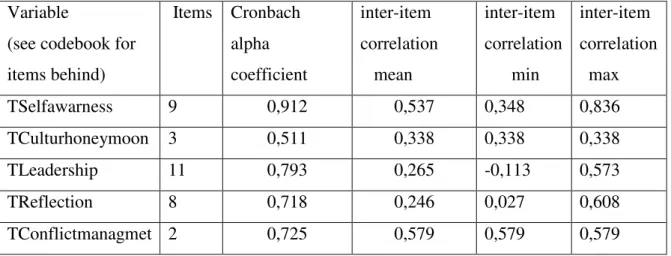
From the statements, six new variables were tested with Cronbach, shown in table 1. The variable: culture had a value 0.432 with 2 statements and honeymoon had a negative value with -0.927 with two statements. Both were small, and to increase the value the two where tried as one variable. New value after testing with different statements ended up to 0.511. Still
20 not acceptable, so the variable can only give an indication since there are too few statements behind the variable to give an answer.
Table 1: Variables tested with Cronbach
Variable
(see codebook for items behind) Items Cronbach alpha coefficient inter-item correlation mean inter-item correlation min inter-item correlation max TSelfawarness 9 0,912 0,537 0,348 0,836 TCulturhoneymoon 3 0,511 0,338 0,338 0,338 TLeadership 11 0,793 0,265 -0,113 0,573 TReflection 8 0,718 0,246 0,027 0,608 TConflictmanagmet 2 0,725 0,579 0,579 0,579
Tselfawarness has a preferable value, TLeadership, TReflection and TConflictmanagment have an acceptable value while TCulturnomeymoon has to low value of Cronbach alpha. The sample can make the reliability of the scale vary. Therefor it is necessary to check each scale’s reliability with the thesis’s sample.
3.3.7 Code
To code open-ended questions is more complicated. They were coded by scanning through the answers and looked for common themes. In the codebook, I listed the major groups of responses and assigned a number. Each response was compared with the list and compared before entered the appropriate number into the data set. All the answers were assigned a numerical code before entered into SPSS (Pallant, 2010). There was made a codebook for the answers to questions 16-18 and 22 that where entered into the data view and variable view in SPSS. All the responses were coded in the codebook, no one fell out of the listed categories and therefore there was no need for another numerical code like, another = 99 (codebook can be seen in appendix D).
21 3.3.8 Presentation of categories
The analysis process of the statements led to five categories. They were founded on the variables made by the assumptions graded in the survey that can answer the question for this thesis. Categories have been tested and there are inputs from the open-ended questions that the respondent have answered to that can be used to discuss the influence of the different variables. From these open-ended questions the sixth category came after analyzes was made of the data. To find differences in answers from the leaders participated in leadership
development programs there was done analyzes on differences between the genders. From this result the last category came.
The thesis will be organized by the five categories based on statements (se appendix E: Self-awareness, Reflection, Culture and Honeymoon effect, Leadership and Conflict Management, and one category; Gender differences in leadership is found through analyzes of open ended questions asked in the survey.
3.4
Quality of research
The research gives a snap shot of how leaders are influenced personally through participating in a leader development program. In total 84 leaders had answered the whole or parts of the survey out of 136 that started. After the respondent that had not answered all their questions were removed the total respondent was down to 57 leaders. This was done to prevent having a data foundation that could not be tested on. This gave a total response of 41 leaders with leader development programs and 16 without. This means that the thesis cannot allow for a generalization for a large population of leaders, just indications.
Although all the leaders that got the invite to this survey, it ended up with 84 that were willingly to participate and only 57 responded completely. This gives the survey a response rate at 62%, with only 42% complete answers. This willingness to participate may suggest a common element among these leaders and their interest for leadership and development as a leader, thereby contribute to a limitation of comparability to a larger group of leaders. It was explained to survey respondents that their answer could not be identified through the online survey, which gave them anonymity. Leaders from the municipality had the
22 email address in the opening letter of the survey. That made it possible for me to answer any questions the participants had about the survey.
3.4.1 Survey online
By choosing a survey online there is a possibility to reach more participants, but also a risk that less fill out the questionnaire. The use of Select Survey and e-mail raises the concern that the respondents may have ignored an e-mail, because they may have felt less obligated to participate. Drawback may be high drop out and few control possibilities (Ringdal, 2007). The experience after this survey is that 136 have had a look at it, but 84 have filled out all or some of the questions. Out of the 84 there are 57 that have answered all the questions. There are variations on the response rate on each question. This could have been prevented if the participants have had to fill out each page before go to the next. The risk could have been that less actually answered it they were forced. Alternative could have been handing the survey out at leader gatherings, but there where time limits that did not make it possible. This weakness can influence the value of this research.
3.5
Ethical Considerations
In research that directly affects humans, it is important that ethical considerations are done, especially in data collections through electronic means (Johannessen et al., 2004). That has been done in this study.
All the leaders participated in this survey of their free will. The copy of the complete study will be offered to the leaders in the municipalities by email.
One of the six municipalities that are participating in the survey is my work place. Ideal research should been done by an outsider, but the researcher will always have influence on the result. The respondents have had total anonymity and the researcher have no ability to know which answers belong to the different municipalities or from NTNU.
To ensure research is done ethically there are ethical guidelines for good research methods that contains permission and confidentiality. The respondents were informed at the start of the questionnaire (see appendix B). SelectSurvey.NET was used when questionnaire was sent out with a link to email addresses and on Its-Learning NTNU. This method provides full
23 confidentiality for the respondents, but no possibility to withdraw the questionnaire since its full anonymity. The Survey was sent in and approved by Norwegian social science data services, Privacy Ombudsman for Research (see appendix A). The data will be destroyed after the thesis is handed in. By using Select Survey, the participants are secured a high degree of anonymity. The leaders or I could not monitor whom that participated or not.
24
4
RESULTS
This chapter identifies and highlights areas of impact leadership development programs have had on leaders development related to theories of leadership presented in chapter 2. In the initial phases of this study, I had many questions about how leaders experience leadership programs and if it develops them to be a better leader. With these results I will attempt to create a picture of this on the basis of the data that is relevant.
In this chapter I will describe the results found on basis of the analysis process described in the chapter 3; methodology. Main categories are Gender differences, Self-awareness, Culture and honeymoon effect, Reflection, Leadership and Conflict management. The self-awareness and culture and honeymoon effect are only asked to leaders attending leadership development programs.
4.1
Background information
The survey had both open and closed questions with alternatives, and grading of statements. A relatively small sample makes it more challenging. However, I have chosen to run analysis to see if there are any differences.
4.1.1 Population
57 leaders completed the entire survey in this study, 36 females and 21 males. Out of this, 41 leaders had participated in a leadership development program. The data was analyzed as a whole and divided between the two groups of participants to see if there were any differences.
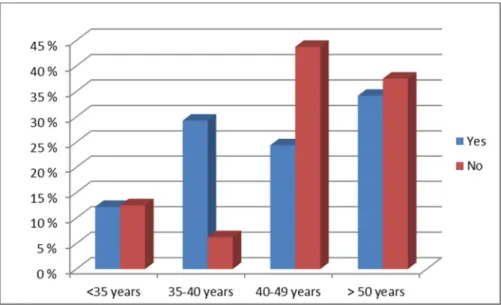
25 Are there any differences between the ages of participants in leadership development
programs?
Figure 1: Age difference in participating in LDP
The figure indicates that leaders that 75% of the 16 leaders that did not participate in
leadership development programs were over 40, while the same age range covered only 60% of those who participated. That could indicate that younger people were more inclined to participated, especially in the 35-40 age range.
There was a Chi-Square test done of independence to test this. The assumption of chi-square was violated since not the entire expected cell sizes are greater than five. Three cells (37,5%) had expected countless 5, minimum expected count is 1,96.
Other Chi-Square tests that violated the assumption of chi-square was: Formal education and LDP (2 cells, 33.3%, min count 0.27), Length as a leader and LDP (5 cells, 62.5%, min count 1.68), Size unit you lead and LDP (4 cells, 50%, min count 1.68).
26 Are there any differences between genders and participated in leadership development programs (LDP)?
The Chi-Square tests had a continuity correction with a value of 0.26 and an assumption. Sig. (2-sided) of 0.394. That means that the proportion of males participating in development programs is not significantly different from the proportion of females that participated. The Phi has a value of -0.153 meaning small effect (see appendix E for full table).
Are department leaders more likely to participate than the head of the company?
The Chi-Square test for independence (with Yates continuity correlation) indicated no significant association between leader level and leader development.
There were run Chi-Square test for independence on associations between leadership development programs and age/education/length as a leader, but all had violated the assumption of Chi-Square with cells expected to count less than 5 (see appendix E for full table).
4.2
Experiences from leadership development program
The leaders that participated in leadership development programs were asked open questions about what motivated them to participate, positive experiences and what it contributed to them as a leader. These responses were coded and used to form the charts in this part. What I realize might not be totally clear here, is that these charts and responses are from your coding of the open questions? Or are they scaled survey responses? I think this could be made clear somewhere up front.
27 4.2.1 The motivation to participate in a leadership development program
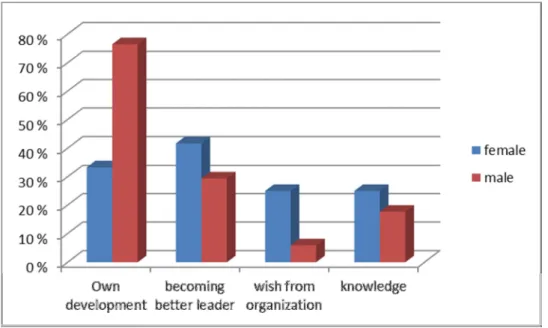
The leaders in the survey that participated in the program were asked what their motivation was, some had multiple answers. Answers were summed up into four main categories shown in figure 2.
Lack of knowledge and support in the role as leader, need of changes in the organization, motivation and new impulses to develop my leadership and me as a human are some of the answers in the survey.
Figure 2: Motivation behind participating in a leadership development program differ by gender.
Males and females main motivation seems to be the same, just in different order. Own development scores highest among the male leaders, and number two is becoming a better leader. The female leaders is opposite and more even divided among the four categories. Common is that they all want to develop and become a better leader.
More female leaders participated as a wish from their organization than men with 25% against 6%. One of the comments from these leaders were that even though they didn’t choose
themselves to participate are that she/he sees the value of learning more, and understood that she/he needed to learn and is motivated to continue.
28 4.2.2 Positive experience of participating in a leadership development program
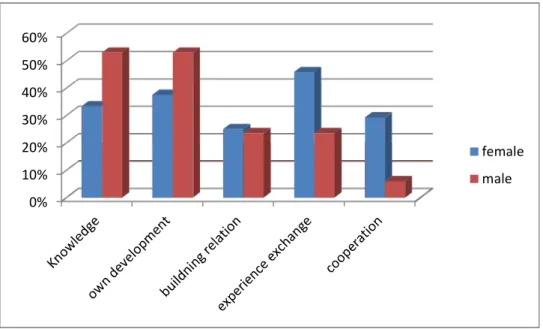
The leaders answers were divided up into five main categories; knowledge, own development, building relation, experience exchange and cooperation. The chart is based on responses that are coded from open questions in the questionnaire.
One of the leaders experienced a better connection and understanding among the leaders. It was also important to see what other leaders struggled with and have experienced. Very useful to take time to analyse myself as a leader, gain better self-awareness on how others perceive me.
Figure 3: Positive experience from participating in a leadership development programs divided by gender.
The main two equal positive experiences male leaders had were increased knowledge and own development. Female leaders favoured the exchange of experienced through other leaders, as well as own development.
Some of the leader’s answers indicated that others experiences and reflections are valued high and give motivation to improve as a leader. Leaders have said that this program has given them time to reflect and learn skills that they use to reflect over own practice. Learning how I affect others in the way I behave and how others affect me. It has given me a better self-awareness and confidence, as well as an increased understanding on how other people react and why. I have time to reflect over leadership.
0% 10% 20% 30% 40% 50% 60% female male
29 4.2.3 Contribution to you as a leader by participating in a leadership development
program
The questionnaire asked the leaders how participating in a development program had changed them as leaders. One major focus was confidence in the role as a leader, independent from which sex you have.
Figure 4: What have the leadership development programs contributed to you as a leader divided into gender.
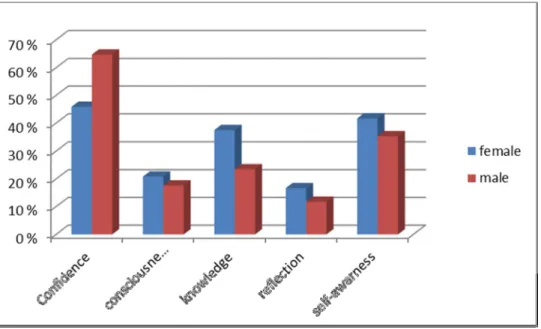
The figure 5 indicates that all the five major contributions are ranked the same, female or male leader. Confidence, self-awareness and knowledge are the three things that have
contributed to become a better leader, except for one that did not feel the program have given him/her anything. There is a difference in percentage between the top three among the
genders. It appears that men have gained 20% more confidence than women through the program and women on the other hand have 15% more gain in knowledge.
A leader sums it up: Strengthen my knowledge and not least, the awareness of myself as a leader, and the opportunities I have to make other better, co-ownership etc. The only thing that I can change is myself, and to facilitate development, motivate changes to those I lead.
One leader says; I have become more analytic, now I see patterns where I used to see people. I have gotten a better sense of relations. Another; Self-developing, refill of theory, confident in the role as a leader, more aware of my role as a leader. One leader has changed the way of
30
in a different way than before. Dare to increase demands towards my coo-workers. Another
says that effect has been; I have become more clearer, and that I now dear to rise and work through uncomfortable cases. As one sad: I know got the toolbox to handle situations in a different way.
Does age effect the contribution from leadership development programs?
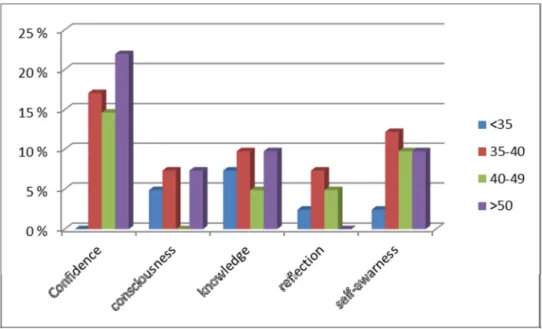
Figure 5: Is there any difference in contribution depending on the age among the leaders.
The figure indicates that for younger leaders under the age of 35, consciousness and knowledge are the two major effects from the program. Confidence on the other hand is valued lowest, while leaders from the age of 35 and up, puts it highest together with self-awareness. This group is the smallest with only five leaders; the other groups are from 10-14. Can that explain the difference? Younger leaders may be new to their role and therefore focus more on knowledge and consciousness of the role as a leader.
31 Does the background for participating in a leadership development program have an effect on the impact?
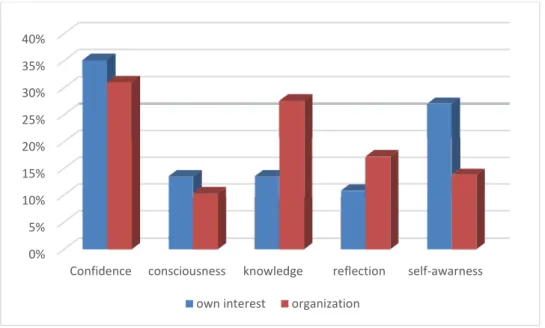
Figure 6: Contribution, differ in background for participating in leadership development program
The figure indicates that leaders who participate on a wish from own organization have valued confidence and knowledge as the main contribution from participating in LDP. Leaders that participated on the base of own interested focus on confidence and self-awareness. Knowledge and self-awareness have the biggest differences between the two groups. Figure 6 indicates that leaders participated on a wish from the organization have learnt more about theories of leadership, while leaders with an interest to develop as a leader focus on self-awareness. This indicates that there can be different approach to becoming a more confident leader.
4.3
Self-awareness
The variable Tselfawareness is build up with nine statements from the scaled statements in the survey, asked to leaders participating in LDP (n=41). Mean for the variable is 38.73 with trimmed min 5% at 39.06, indicating very small difference at 0.33. Std.dev 5.094 with min: 24 and max: 45. To test normality on the variable, Kolmogorov-Smirnov statistic was used. This assesses the normality of the distribution of scores. When none significant result with sig. value is higher than 0.05 there is an indication of normality. Tselfawareness sig. value is
0% 5% 10% 15% 20% 25% 30% 35% 40%
Confidence consciousness knowledge reflection self-awarness own interest organization
32 0.01 suggesting that there is violation of this assumption indicating that scores are not
normally distributed (see tests done on self-awareness in Appendix F).
Are there any differences between self-awareness scores for males and females?
An independent-samples t-test was conducted to compare the self-awareness scores for males and females. The Levene’s test for equality of variance is 0.192 indicating that the variances for the two groups are the same. There was no significant differences in scores for males (M=40 SD=4.243) and females (M=37.83 SD=5.53) t(41)=-1.356, p=0.183 (sig. two tailed). The differences in the means are 2.17, Cl: -5.399 to 1.066.
Eta squared= -1.3562/( 1.3562+(24+17-2))= 0.045, indicating a small to moderate effect (Pallant, 2010).
Figure 2 indicates that own development is one of the main factors for participating in a leadership development program. As one leader describes the positive effect with LDP;
increased self-awareness by increased knowledge about how I affect others and how they affect me. Another’s states; more conscious on what I do and say; Better insight and
understanding over mine and others behavior; Better insight in how I react in meeting with others.
Are there any differences in Self-awareness score on leaders that have chosen themselves to participate in a leadership development program compared with leader that have not?
An independent-samples t-test was conducted to compare the self-awareness scores for leaders with own interests or by organization. The Levene’s test for equality of variance is 0.052 indicating that the variances for the two groups are the same. There was no significant differences in scores for leaders with own interests (M=40.16 SD=3.834) and by organization (M=37.5 SD=5.78) t(41)=1.705, p=0.096 (sig. two tailed). The differences in the means are 3.66, Cl: -0.495 to 5.811.
33
4.4
Cultural and honeymoon effect
The variable is tested with Cronbach’s Alpha and founded on the base of statements grades in the survey. Culture and honeymoon were intend to be two variables, but after testing the different statements compared with the Cronbach’s Alpha it became one built on three statements (see test results from variable cultural honeymoon in Appendix G).
The variable Tculturhoneymoon is build up with eight statements asked to all leaders (n=41). Mean for the variable is 10.71 with trimmed min 5% at 10.79, indicating very small
difference at 0.08. Std.dev 1.94 with min:5 and max:14 (see more in the appendix G). Kolmogorov-Smirnov statistic was used to test normality on the variable of the label using. Tculturhoneymoon has sig. 0.00< 0.05 suggesting a violation to the assumption of normally distributed. A none-significant result with sig. value of more than 0.05 indicates normality. The cultural and honeymoon effect indicates how the impacts of the leadership development program have lasted after participation. There have been two different tests used to find out if sex or whom you participated with has any influence on the effect. Tests used have been T-test of independence and one-way between-group ANOVA with post-hoc T-tests.
Are there any differences between the cultural and honeymoon scores for males and females?
An independent-samples t-test was conducted to compare the culturalhoneymoon scores for males and females. There was no significant differences in scores for males (M=10.35 SD=1.869) and females (M=10.96 SD=1.989) t(41)=0.984, p=0.331 (sig. two tailed). The differences in the means are 0.61, Cl: -0.639 to 1.85 was very small.
34 Does who you participate with in a leadership development program have any influence on effect?
The leaders that participated in a program were asked whom they participated with, if they took the program together with only colleagues from their own organization, leaders from other or a mix with colleagues and others.
To test this one-way betwee