CEP Discussion Paper No 741
August 2006
Dynastic Management
Abstract
The most striking difference in corporate-governance arrangements between rich and poor countries is that the latter rely much more heavily on the dynastic family firm, where ownership and control are passed on from one generation to the other. We argue that if the heir to the family firm has no talent for managerial decision making, dynastic management is a failure of meritocracy that reduces a firm’s Total Factor Productivity. We present a simple model that studies the macreconomic causes and consequences of dynastic management. In our model, the incidence of dynastic management depends, among other factors, on the imperfections of contractual enforcement. A plausible calibration suggests that, via dynastic management, poor contract enforcement may be a substantial contributor to observed cross-country differences in aggregate Total Factor Productivity.
Keywords: Meritocracy, Family firms, Financial Development, TFP JEL Classifications: E1, E2, G1, G3, O1, O4
This paper was produced as part of the Centre’s Macro Programme. The Centre for Economic Performance is financed by the Economic and Social Research Council.
Acknowledgements
We acknowledge useful comments by Nick Bloom, Max Bruche, Luigi Guiso, Berthold Herrendorf, Bart Hobijn, Tim Kehoe, Pete Klenow, Casey Mulligan, Vincenzo Quadrini, Richard Rogerson, Jim Schmitz, Andrei Shleifer, Silvana Tenreyro, and John Van Reenen. Jas Ellis was the invaluable research assistant.
Francesco Caselli is an Associate of the Macro Programme at the Centre for Economic Performance, London School of Economics ([email protected]). Nicola Gennaioli is with the Institute of International Economic Studies, University of Stockholm ([email protected]).
Published by
Centre for Economic Performance
London School of Economics and Political Science Houghton Street
London WC2A 2AE
All rights reserved. No part of this publication may be reproduced, stored in a retrieval system or transmitted in any form or by any means without the prior permission in writing of the publisher nor be issued to the public or circulated in any form other than that in which it is published.
Requests for permission to reproduce any article or part of the Working Paper should be sent to the editor at the above address.
© F. Caselli and N. Gennaioli, submitted 2006 ISBN 0 7530 2038 6
1
Introduction
There is broad agreement that differences in aggregate Total Factor Productivity (TFP) constitute a large fraction of the existing cross-country differences in per-capita income. That is, not only do poor countries have fewer productive resources, such as physical and human capital, but they also employ those resources less effectively than rich
coun-tries. The current consensus is that such differences in TFP account for upwards of
50% of income inequality.1 Naturally, then, attention is increasingly turning to
po-tential explanations for these TFP differences, and various authors have emphasized
lags in technology diffusion, geography, vested interests and other institutional fail-ures, and several other causes. We believe, however, that a potentially critical source
of inefficiency has so far been largely overlooked by the TFP literature: failures of
meritocracy.
Individuals are manifestly heterogeneous in their decision-making skills. Diff er-ences across countries in the accuracy with which the best decision makers are selected for important decision-making responsibilities — i.e. differences in meritocracy — can clearly result into differences in the returns countries reap from their productive
re-sources — i.e. differences in TFP. Meritocracy can fail spectacularly in the public
sector [e.g. Caselli and Morelli (2002)]. But meritocracy can also fail in the private sector. This paper studies the macroeconomic causes and consequences of an im-portant private-sector non-meritocratic practice: the inter-generational transmission
of managerial responsibilities in family firms, a phenomenon that we call dynastic
management.2
The prevalence of dynastic management is one of the most glaring differences
in corporate-governance arrangements between developed and developing countries.
In rich countries concentrated ownership and owner-managedfirms, particularly when
the owner is not the founder, are more the exception than the rule, and managers are usually selected based on their talent and record rather than their ownership status in
1See Islam (1995), Caselli, Esquivel, and Lefort (1996), Klenow and Rodriguez (1997), Hall and
Jones (1999), Parente and Prescott (2000), Hendricks (2002), and Caselli and Coleman (2005). Caselli (2004) presents a survey and assessment of this literature.
2Failures of meritocracy are distinct from the problem of “misallocation of talent” emphasized by
Murphy, Shleifer, and Vishny (1991). In the latter, talented individuals maximize the private but not the social return on their abilities. In the former, the talented maximize neither the social nor the private return of their skills.
the firm. In developing countries not only are firms prevalently owned and controlled
by the members of a family, but ownershipandcontrol also pass on across generations
of the same family. We argue that this systematic difference may be a proximate source of TFP differences: even allowing for self selected initiators of family businesses, as long as managerial talent is not perfectly correlated across generations, assets will sooner or later end up “in the wrong hands,” i.e. those of a managerially inept descendant.
If mostfirms in an economy are managed dynastically, therefore, aggregate TFP may
be negatively affected.
But why is dynastic management more prevalent in some countries than oth-ers? In our model the frictions that give rise to dynastic management are linked to a country’s contract-enforcement infrastructure. Untalented heirs of family firms would like to transfer control to new talented owners, or hire talented managers. However,
imperfect contract enforcement means that financial markets are underdeveloped, so
that it is difficult for potential buyers to obtain financing for the purchase. Similarly,
poor contract enforcement makes it difficult for the owner to protect himself from
abuse by an outside manager. Since contract enforcement is imperfect, if not entirely lacking, in developing countries, the incidence of dynastic management will be more severe there.3,4
3To be sure, there are many family-owned and -managedfirms also in the rich world, where contract
enforcement is reasonably good, and we do not mean to argue that poor contract enforcement is the only cause of dynastic management. In particular, it is likely that members of a family that has historically been associated with a particularfirm will derive a sense of identity from continuing in the association (see, e.g., Mann, 1901), and will be more tolerant towards untalented heirs. Another, more benign, view of dynastic management is that it is easier to transmit firm-specific managerial human capital to one’s offspring than to outsiders. As we will discuss, the empirical evidence is rather unfavorable to benign views of dynastic management. More to the point, neither “identity” nor
firm-specific human capital explain why dynastic management is vastly more prominent in developing countries. Our view is that identity and, perhaps, human-capital issues generate some roughly common non-zero incidence of descendent-operatedfirms in all countries, but the added mechanism of poor contract enforcement is still needed to give rise to the marked cross-country variation we observe. See Morck and Steier (2005) for further discussions of the historical and political reasons for the ebbs and
flows of family capitalism.
4Our theory also has implications for the role of rich-country FDI: foreign investors with deep
pockets do not need to borrow on localfinancial markets to take control of badly managed companies. This suggests that, if the trend towards globalization continues, dynastic management may become less of a problem even if contract enforcement remains poor. However, there is another friction that deters FDI: the risk of expropriation by the local government, as recently highlighted by the experience
We study a growth model where dynastic management arises endogenously as a consequence of poor contract enforcement, and look at the consequences of this failure of meritocracy for TFP, capital accumulation, and other macroeconomic variables. A plausible parametrization of our model is able to generate a cross-country dispersion of TFP which is roughly half as large as the one observed in the data. Since the model shuts down by construction all of the possible additional sources of TFP differences, this is to be interpreted as the potential explanatory power of dynastic management alone.5 The model also generates large differences in capital-labor ratios, equal to roughly three quarters of the observed ones. This is not only because the lack of con-tract enforcement deters lending and therefore investment, but also because talented managers invest more than untalented ones, and in the presence of dynastic
manage-ment many managers are untalented. Combined, the predicted differences in TFP and
in capital-labor ratios yield predicted differences in GDP per worker equal to roughly 70 percent of those in the data.
We also perform some comparative static exercises that highlight the key
pa-rameters influencing the quantitative importance of poor contract enforcement, via
dynastic management, for TFP differences. For example, we find that a higher
de-gree of heritability of a parent’s talent dampens the adverse impact of dynastic man-agement on TFP. Essentially, a high degree of inheritability of talent increases the intra-generational correlation between talent and wealth. Since with credit constraints wealthy individuals invest more, a larger fraction of the capital stock is well managed.
We alsofind that changes in the saving rate have an ambiguous impact on TFP: on the
one hand, a larger saving rate increases the “cash on hand” of new generations, and talented outsiders can more easily use this cash to buy out untalented heirs to family firms. On the other hand, the same “collateral effect” allows untalented but rich heirs to expand their scale of operation, and thus their profits, which makes them less will-ing to sell theirfirms. Finally, larger differences in productivity between talented and untalented managers translate into lower aggregate TFP (relative to the benchmark
of multinationals that invested in Argentina and in Bolovia during the 1990s.
5We stress this point because some readers of previous versions of the paper have made the baffling
remark that anything short of approximately 100 percent was not “enough,” since it failed to explain all of the cross-country variation. Of course it is unthinkable that there would be a single explanation for the entire variation in world TFPs - there would surely be something wrong with our work if we came up with a 100 percent explanation. Indeed, if anything we are more vulnerable to the accusation that 50 percent istoo much.
of perfect meritocracy) when contract enforcement is very poor: the less able the
un-talented, the larger the cost of dynastic management. However, for sufficiently large
values of contract enforcement, a larger talent gap increases aggregate TFP. This is because a larger talent gap increases the gains from trade between the talented and the untalented, thereby reducing the share of dynastically managedfirms.
To sum up, wefind that the quality of legal institutions can shape the incidence of dynastic management (and its sensitivity to other economic factors) via two channels.
First, poor contract enforcement inhibits the working of the market for firms thus
preventing the replacement of untalented managers by talented ones. Second, poor enforcement prevents talented managers from borrowing and expanding their scale
of operations. These two effects increase the share of the capital stock managed by
untalented managers and adversely impact TFP. As a result, our analysis indicates that poorly functioning legal institutions may importantly shape cross country differences in TFP.
This paper contributes to a small theoretical literature on family firms [Bhat-tacharya and Ravikumar (2001, 2003), Chami (2001), Burkart, Panunzi and Shleifer (2002), and Almeida and Wolfenzon (2005)]. This literature focuses on the
microeco-nomic causes and consequences of family firms, rather than on their macroeconomic
causes and consequences, as here. Nonetheless, our work is closest to Burkart, Panunzi and Shleifer (2002), who — like us — view dynastic management as a second-best re-sponse to agency problems (stemming in their case from poor shareholder protection).6 In our model one of the reasons why poor contract enforcement leads to dynastic
management is that poor contract enforcement impedesfinancial development.
There-fore, we also contribute to the literature onfinancial development and macroeconomic outcomes, and in particular to that subset of this literature that focuses on the
inter-6In Bhattacharya and Ravikumar (2001, 2003) familyfirms exploit family-specific business skills.
Since the family skill isfixed, the return on capital invested in suchfirms declines as thefirm grows and
firms reach a “cashing out” threshold (or a professionalization of management threshold in the 2003 paper). The threshold is higher whenfinancial markets are less developed. Chami (2001) views family
firms as principal-agent relationships between parent/owner and child/employee. Trust, altruism, and the prospect of succession mitigate the agency problem relative to the situation where the parent hires outside employees [some of these arguments are also in Mulligan (1997, ch. 13).]. Almeida and Wolfenzon (2005) explain why families use pyramidal ownership structures. Contributions in business and sociology also emphasize the importance of shared cultural values and common beliefs in fostering commitment and long run planning (Gersick 1997, Lansberg 1983, Davis 1983). An excellent recent survey of the literature on familyfirms is Morck, Wolfenzon,and Yeung (2004).
action between heterogeneity of wealth and heterogeneity of innate ability. Hence, our model is close in spirit to Lloyd-Ellis and Bernhardt (2000), though theirs is a qualita-tive study of patterns of industrialization and inequality, whereas ours is mostly geared to a quantitative assessment of TFP differences.7 The paper is also complementary to
(independent) work of Gin´e and Townsend (2004) and Jeong and Townsend (2004),
who use the wealth-talent-credit constraint interaction to quantitatively explain time series changes in TFP (as opposed to cross-country differences, like here) in Thai-land. Closest to ours is an independent paper by Quintin (2003), who also focuses on quantifying the ability of imperfect enforcement to explain cross-country differences in aggregate output, the size distribution offirms, and other outcomes in an environment with inheritance of wealth and heterogeneity in talent (though he does not emphasize the inheritance of talent nor TFP differences).8
As mentioned above, many authors have proposed possible explanations for
cross-country differences in TFP. Our explanation emphasizes misallocation of
re-sources among heterogeneous firms/agents. Independently, Restuccia and Rogerson
(2003) analyze a model in which policymakers dish out subsidies that distort the allo-cation of resources amongfirms with different productivities, while Burstein and Monge (2005) focus on the choice of talented managers on which countries to operate in.
2
Some Data on Family Firms and Dynastic
Man-agement
Our arguments links three well-known facts about developing countries: (i) they have deficient contract enforcement, (ii) they have a high incidence of dynastic management,
7There are also important theoretical differences: for example, they do not study the role of the
intergenerational transmission of talent; moreover, while they focus on the accumulation of physical capital and on entrepreneurship, we take the level of entrepreneurship (i.e. the number offirms) as given and ask whether the market for corporate control can improve TFP by improving meritocracy.
8Other papers studying the wealth-talent-credit interaction include Evans and Jovanovic (1989),
who may have been thefirst to emphasize that credit constraints are especially bad for thetalented
poor; Kiyotaki (1998) who is interested in the possibility that this mismatch leads to cycles; Ghatak et al. (2002), who in a static model stress the possibility of multiple-equilibria; and Cagetti and De Nardi (2002), who try to replicate the US wealth distribution. Also related are the models on intergeneratonal mobility and growth of Galor and Tsiddon (1997), Maoz and Moav (1999), and Hassler and Mora (2000).
and (iii) they have low levels of TFP. We propose that (i) is one of the reasons for (ii) and that, in turn, (ii) is one of the contributing factors to (iii). Fact (i) is documented in a large and growing literature that goes back at least to Knack and Keefer (1995).9 The higher incidence of familyfirms in developing countries is one of the key stylizedfindings of La Porta et al. (1999), who survey the control structure offirms in a sample of 25
countries. Their findings are supported by additional data from Claessens, Djankov,
and Lang (2000), as well as from a wealth of easily accessible anecdotal evidence.10,11. The low levels of TFP in developing countries are documented in the literature cited in the Introduction.
Historical evidence is also consistent with the idea that contract enforcement and thusfinancial development as an important influence on the incidence of dynastic management. Becht and DeLong (2004), Morck et al. (2004), and Aganin and Volpin (2004) show how the deepening and broadening of stock markets led to periods of relative decline in the hegemony of families in the US, Canada, and Italy, respectively. But historians have also blamed the greater incidence of familyfirms for the industrial decline of the UK and France relative to Germany and the US in the early Twentieth Century [Landes, (1969), Chandler (1994)], thereby supporting the view that dynastic
management may be a source of economic inefficiency.
This last observation brings us to a key building block of our argument, namely that dynastic successions hurtfirm performance on average. There is a growing body of evidence that this is indeed the case. Perez-Gonzales (2001) examines a sample of CEO
9Other influential examples include Djankov et al. (2003), Rodrik et al. (2002), and Acemoglu at
al. (2001).
10For example,The Economistreports that familyfirms generate 70% of total sales and net profits
of the biggest 250 Indian (contract enforcement 4.5, TFP 211) private companies (October 5th, 1996). It is trivial to observe that diffuse ownership and/or outside professional management are virtually non-existent in most Sub-Saharan African countries and most of the poorer Latin American ones.
11Simple correlations calculated using the available cross country data, reveal a clear tendency for
family capitalism to be less prevalent in countries with better contract enforcement. For instance, by regressing the La Porta et al. (1999) country-level measure of family capitalism (fraction of publicly-quoted firms controlled by a single individual among the 20 largest publicly traded companies in each country in 1995) on the Knack and Keefer (1995) “contract enforcement” index, one finds a significantly negative coefficient. Of course, this regression establishes only a simple correlation, but it shows that in the available cross country data the presence of familyfirms is indeed negatively related to the quality of the legal system. Moreover, the correlation we found in the data is almost certainly likely to underestimate the true one because the sample is skewed towards high to middle-income countries.
transitions in US familyfirms. He defines a familyfirm as one where the retiring CEO is related to thefirm’s founder, andfinds that when the incoming CEO is related to the retiring CEO the firm’s performance suffers, relative to the case where incoming and retiring CEOs are unrelated. In particular, returns on assets in the “inherited control” cases fall 20% within two years of the new CEO’s tenure, while in unrelated transitions
they don’t change much on average. He also finds that cases where inherited control
is accompanied by declines in performance are largely explained by the poor academic record of the inheriting CEO. This suggests — consistent with the view emphasizing problems of managerial quality — that the efficiency losses are linked to the managerial abilities (or lack thereof) of the heir. Villalonga and Amit (2004) reach very similar conclusions.
Similar findings emerge elsewhere in the world. Bennedsen et al. (2005)
com-pare dynastic and non-dynastic successions in Denmark, with a plausible instrumental variable that overcomes selection issues. Theyfind a substantial decline in the return on assets in dynastic cases. Bertrand et al. (2004) look at 70 of the largest busi-ness families in Thailand, and find a deterioration of performance after control passes on from the founder to his descendants, the more so the larger the number of family members involved in management. Bloom and Van Reenen (2005) survey managerial
practices in the US, UK, France, and Germany. They find substantial cross-country
differences in the quality of management, but about half of these differences disappear when they control for the intensity of product market competition and the greater
incidence of familyfirms managed by descendants of the founder. Morck, Strangeland
and Yeung (2000) look at a sample of Canadianfirms managed by heirs of the founder
andfind that they under-perform similar US firms with dispersed ownership. Another
piece of evidence consistent with the existence of a cost of bundling management and control comes from Volpin (2002). He examines the determinants of executive turnover and firm valuation for all Italian traded companies from 1986 to 1997, and finds that poor governance — as measured both as a low sensitivity of executives turnover to per-formance, and as a low Q ratio — is more likely when the controlling shareholders are also top executives.12
12Less direct, but nonetheless relevant evidence comes from Banerjee and Munshi (2002). They show
that in the Indian city of Tirupur members of the locally entrenched communal group (analogous to our heirs) operate less efficient firms than non-members (outsiders). Consistent with the view that the persistence of inefficient insiders in business is linked tofinancial constraints that limit take-overs by outsiders, the average size of the insider-runfirms is larger (despite their lower efficiency).
The Morck, Strangeland and Yeung study also contains a macroeconomic
ver-sion of these tests. Using information from Forbes 1000 they show that countries in
which inherited billionaire wealth is larger with respect to GDP grow less. The oppo-site holds with respect to the wealth of self-made business entrepreneurs. These results suggest that hysteresis of control along dynastic lines is an important determinant of macroeconomic performance, as postulated in our paper.
3
The Model
3.1
Endowments
We study an economy in discrete time. In each period there is a measure-1 continuum of one-period-lived individuals. A fractionω of these individuals are inheritors offirms. We call these individuals “the heirs.” Formally, we think of afirm as a license to operate a production technology (to be specified below) and sell the output. Hence, heirs are people who inherit such licenses. These licenses are mostly a convenient modelling device to capture the incumbency status of heirs. Nevertheless, licences to run firms are an accurate description of many developing countries (e.g. the Indian “License
Raj”). We will typically use the words “firm” and “licence” interchangeably. The
remaining 1−ω agents born in each period are the “outsiders.”13
Whether or not he inherits a license, each agent i may also begin his life with
an endowment of bi units of the consumption good, which we will refer to as “initial
wealth.”
Finally, each agent i is endowed with managerial talent θi, which can be high,
θH, or low,θL.Some heirs are born talented, some untalented, and the same holds true
for the outsiders. λ is the economy-wide fraction of agents of type θH. We assume
ω ≤ λ so that inefficiency does not arise trivially for a lack of a sufficient number of talented managers.
13Other models of the wealth-talent-credit interaction typically assume entry barriers in the form
of a fixed investment cost. In our model, the incumbency status of firms’ inheritors could also be captured by introducing afixed cost of entry and letting the number offirms ωadjust endogenously. However, in order to focus on how contract enforcement affects the working of credit markets and of the market forfirms (rather than entry) we take the number of licencies as given [a realistic assumption in developing countries, since entry costs are typically very large there (Djankov et al (2003))]. We return to the issue of barriers to entry in the Conclusions.
The state of the economy at the beginning of each period can therefore be sum-marized by the joint distribution of three individual-level characteristics: firm owner-ship status (does the agent own a licence or not), initial wealthbi, and talent θi. We explain how these variables evolve over time in the next few sections.
3.2
Market for Firms
The first set of decisions to occur in any period are buy and sell decisions on the
market where outsiders can purchasefirms from heirs. As will be seen below, there are two chief reasons for such exchanges of ownership. First, talented individuals generate
a greater surplus from running firms than untalented individuals, so there are gains
from trade by transferring control from untalented heirs to talented outsiders. Second, individuals with greater initial wealth can make larger physical-capital investments, so there can also be gains from transferring control from low wealth to high wealth individuals in order to expand the scale of operations.
On the market for firms licences are exchanged at price p. For simplicity we
assume that each person can own at most onefirm - the idea being that of introducing a particularly convenient form of decreasing returns to managerial time. This is similar in spirit to the span of control idea of Lucas (1978). Given this assumption, the demand forfirms is the number of outsiders who wish to purchase a license at price p, and the supply is the number of heirs who wish to sell one. We assume that a mechanism
leading to market clearing exists, i.e. that in equilibrium p equalizes demand and
supply.14
3.3
Capital Market and Investment
All individuals have access to a storage technology for their initial wealth, whose within-period return is normalized to 1. In other words, inherited amounts of the consumption good can be stored without loss until the end of a person’s life.
Alternatively, initial wealth can be transformed into physical capital, for use in the production of new output, as detailed below. The investment technology is linear: one unit of good invested yields one unit of physical capital. We assume for simplicity that all physical capital is entirely consumed in production within a period. This is not an unrealistic assumption given the non-overlapping generations demography of our
14Given that licenses are homogeneous, there is no scope for exchanges of licences among heirs.
economy. Nevertheless, we did perform robustness checks with respect to incomplete depreciation (available upon request) with very modest changes in the results that matter.
Since initial wealth can be turned into physical capital, there is a role for a
capital market where firm owners borrow funds from non-owners and invest them.
The interest factor on this market isR. Because the storage technology is accessible to all, we must haveR≥1. The capital market meets just after the closing of the market forfirms, andR equalizes desired borrowing with desired lending.
In sum, agents who do not own firms can either store their endowment for
the period or lend it to firms at the interest factor R. Firm owners have the same
two possibilities (storage, and lending to other owners), as well as investing their own wealth into their own firm.15
3.4
Labor Market and Production
The third market to meet is a competitive labor market. Labor supply depends on
the number of active firms, f, where f ≤ ω. The number of active firms may be less
than the number of licences as some owners may decide not to operate theirfirms. We
assume that all non-owners, and all owners who leave their firm idle (and whose time
is therefore not tied up with managerial responsibilities), inelastically supply their unit
labor endowment. Hence, labor supply is 1−f. Labor demand is expressed by active
firm owners, who take the market-clearing wage w as given.
Next, the economy turns to production. Each firm i combines the capital it
installed, Ki and the labor it hired, Li to produce output according to the production function:
Yi =AiKiαL1i−α.
The key assumption is that the efficiency level Ai reflects the ability of the owner: if the owner is talented then Ai =θH, if he is not, then Ai =θL.
Owners are residual claimants to income net of wage payments, which we (im-properly) call “profits,” and denote byπi.16
15Agents who do not own firms never invest in physical capital because they would then lack a
license to operate it.
16Implicitly we assume that labor input is homogeneous, i.e. talent only matters for managerial
tasks. It would be trivial to extend the model to have two labor types, and doing so should enhance the impact of dynastic management on TFP. Intuitively, having two labor types implies a lower wage
3.5
Enforcement
At the end of the period, those who borrowed on the capital market owe funds to
lenders. Furthermore, some of the purchases of firms may also have been externally
financed. Thus, debtors must now decide whether or not to repay their debts. We
assume that courts in this economy have the ability of seizing a fraction φ of the
resources of a party in violation of contractual commitments, such as a debtor who
fails to repay the creditor in full. If φ = 1, then enforcement is perfect. Default
decisions will clearly depend onφ, which is therefore our key parameter describing the efficiency of contractual enforcement.
3.6
Inter-Generational Dynamics and Objective Functions
We introduce two sources of inter-temporal linkages. The first is a bequest motive,
and the second is a mechanism for the inter-generational transmission of abilities. One could say that the first regulates the inter-temporal transmission of physical capital, and the latter of human capital.
Each agent engages in asexual reproduction of one offspring, who will live next period. If an agent owns afirm, he bequeaths the licence to the offspring. Whether or not an agent owns afirm, he also bequeaths to his offspring a fractionγ of any wealth he owns at the end of his life (and consumes the rest). Hence, our bequest behavior is akin to a constant saving rate´a laSolow (1956). Finally, the offspring of an untalented agent is untalented with probabilityηL, and the offspring of a talented agent is talented with probabilityηH. Each agent’s objective is to maximize current income. Because of computational constraints our behavioral assumptions are necessarily simplistic, but we believe that more sophisticated consumption-bequest decisions would not significantly affect our results.
3.7
Market for Managers
In Appendix A.1 we further extend this model to a situation where — as an alternative to selling the firm — untalented firm owners can transfer control by hiring a talented manager. We show that this extension does not change our results. The reason is that manager-owner relationships are also generally more or less viable, depending
for the untalented, and hence less of an incentive for untalented heirs to sell theirfirms. We expect this effect to be small.
on the quality of an economy’s contract-enforcement infrastructure. Countries where
the courts have a difficult time enforcing debt contracts, will also have a difficult
time providing managers with the incentives not to steal a firm’s profits — if not its assets — from the owner-principal. Hence, when one solution (transfer of ownership) is unfeasible, so is the other (hiring a manager).
4
Equilibrium Analysis
In this section, we highlight the key behavioral and equilibrium relationships of our model. The model is best analyzed by backward revisiting the various stages of eco-nomic life laid out above, starting with the labor market and production.
4.1
Output, Wages and Pro
fi
ts
Since agents maximize income, firm owners seek to maximize profits, which are given by πi = AiKiaLi1−α −wLi, taking the wage w as given. Aggregating over all firms’
demand functions labor demand turns out to be
Ld= µ1 −α w ¶1 α · (1−s)θ 1 α L +sθ 1 α H ¸ K,
where K is the aggregate capital stock (K = RiKidi), and s is the fraction of the
aggregate capital stock infirms run by talented managers [s =Ri;Ai=θH(Ki/K)di]. We will sometimes refer tosas an index of “meritocracy.” Clearly, the term (1−s)θ
1 α L+sθ 1 α H
is a measure of the average efficiency in the economy.
Setting labor demand equal to labor supply 1−f, we can solve for the equilib-rium wage: w= (1−α) Ã K 1−f !α· (1−s)θ 1 α L +sθ 1 α H ¸α . (1)
Intuitively, the wage depends on the aggregate capital-labor ratio,K/(1−f), and on the way the capital stock is distributed between talented and non-talented owners: the greaters, the greater the overall efficiency of the economy, the higher workers’ wages. Plugging thefirm’s labor demand and the wage functions in the expression for the firm’s output, and aggregating across firms, we obtain aggregate GDP per worker:
Y 1−f = Ã K 1−f !α· (1−s)θ 1 α L +sθ 1 α H ¸α , (2)
where Y = RiYidi. This illustrates the nice aggregation properties of the model: de-spite the existence of arbitrary heterogeneity in the firm distribution of capital and
efficiency, aggregate output can be decomposed into the contributions of capital
in-tensity, K/(1−f), and a “TFP” term,
· (1−s)θ 1 α L +sθ 1 α H ¸α
. This will be useful when assessing the quantitative predictions of the model against cross-country evidence on
TFP differences. Even more importantly, the meritocracy index s entirely determines
TFP, and is therefore the endogenous variable of greatest interest in this paper. Firmi’s profits Yi−wLi are given by
α A 1 α i · (1−s)θ 1 α L +sθ 1 α H ¸1−α K1−α Ki ≡π(Ai)Ki. (3)
Profits increase linearly infirm’s size,Ki. Profits per unit of installed capital,π(Ai), are increasing in managerial talentAi, and decreasing in meritocracy s and the aggregate capital stockK. The latter two effects are mediated by the wage: the largerK and s, the higher the wage, the lower the profits left over for firm owners’ to collect. Hence, individual owners prefer to compete against untalented rivals.
4.2
Borrowing, Lending, and Investment
Borrowing, lending, and investment take place after the meeting of the market for
firms, so the ownership status of agents is known. Consider then the situation of an
outsideri, with talent Ai and initial wealth bi, who has acquired a licence at price p. If he operates afirm of sizeKi his life-time income is
π(Ai)Ki−R[Ki−(bi−p)]. (4)
In words, he earns profits π(Ai)Ki, out of which he repays any debts. Since his net worth is (bi −p), his indebtedness is [Ki − (bi −p)].17 If one sets p = 0, then (4) represents the income of a heir who did not sell his licence.
The income equation shows that the owner’s choice of physical capital will typically feature a corner solution: ifπ(Ai)> R the owner borrows as much as he can, while ifπ(Ai)< R he does not operate thefirm and lends his net worth on the capital markets (or store it, if R = 1). Only if π(Ai) =R he is indifferent about the amount he borrows.
17IfK
i< bi−pthe agent is a lender, and the second term in the income equation is interest income.
Consider then the caseπ(Ai)≥R. How much is the owner allowed to borrow? This depends on the borrower’s incentive to default. If the borrower defaults, his income is (1−φ)π(Ai)Ki: default allows the debtor to avoid debt-service charges, but
incurs him a proportional cost φ associated with foreclosure. Incentive compatibility
requires that this quantity is no larger than the quantity in (4), which is the borrower’s income if he does not default. Comparing the two expressions we see that incentive compatibility is not binding if R ≤ φπ(Ai). We rule out this case below. If instead
R >φπ(Ai), the maximum scale of operations the owner can reach is:
K(Ai, bi) = R(bi−p)
R−φπ(Ai). (5)
The function K(.) represents an owner’s “capital capacity.” Capital capacity increases more than one-to-one with the owner’s initial wealth, asbi also operates as a basis for leverage. The larger the initial wealth of the owner, the more he stands to lose from defaulting, the more he can borrow from others - a well known property of models with imperfect credit markets. Capital capacity is also larger for talented owners: since
they earn larger profits, they have more to lose from defaulting. The macroeconomic
variables that adversely affect capital capacity areR, because an increase inRincreases the amount of debt to be serviced and thus the incentive to default;p, which reduces the borrower’s net worth, and with it his capacity to borrow; andK ands, which lower profits and hence the cost of default. Notice that, ceteris paribus, the dependence on
pimplies that heirs are able to borrow more than buyers of firms.18
Substituting for Ki in (4) and rearranging we get that the life-time income of an owner who decides to run his company is
R(1−φ)π(Ai)
R−φπ(Ai) (bi−p). (6) The next question we must address is whether an owner will indeed choose to operate his firm. An alternative strategy would be to let the firm idle (i.e. forego using the
18A more accurate statement of an owner’s capital capacity is
K(Ai, b) = max · R(bi−p) R−φπ(Ai;K, s) ,0 ¸ .
To see why capital capacity is zero whenbi < pnotice that a borrower with none of his own wealth
invested would surely default, as R >φπ(Ai). But only individuals with positive net worth bi−p
can invest some of their own wealth. The reason why the statement in the text is accurate is that individuals such thatbi< pnever buyfirms, so this case never arises. Individuals withbi < pnever
licence), lend his net worth, and join the labor market. We already know that, if
π(Ai) < R, the owner always chooses this path. But he could also choose it if it provided life-time income greater than the life-time income associated with running the firm. His life-time income from not running thefirm is w+ (bi−p)R. Comparing this with (6) we see that an owner operates hisfirm if and only if
w≤ π(Ai)−R
R−φπ(Ai)R(bi−p). (7) Hence, wealthier and more talented owners are more likely to operate theirfirms. Also, more owners will choose to operate theirfirms if the wage (i.e. K ands) and the interest factor are low.
Given the foregoing observations, we can now introduce some general-equilibrium considerations. First, there are no equilibria where π(θH) ≤ R. For, in this case, no owners would wish to operate their firms [as π(θH)≤ R implies π(θL) < R], and the
aggregate capital stock would be zero. But π(θH) - the revenue for unit of capital
invested - goes to infinity as K goes to zero, leading to a contradiction. Second, in equilibrium R > φπ(θH); otherwise, firm owners have an infinite borrowing capacity and, given π(θH)> R, demand for capital would also go to infinity. This triggers an upward adjustment inR. Note that since φπ(θH)< R then also φπ(θL)< R.
We can summarize this discussion as follows. In equilibrium, talented firm
owners whose net worth exceeds the one implicitly defined in (7) operate their firms. Their scale of operations is given by their capital capacity K(θH, bi). Low net worth talented owners leave the firm idle, earn R on their wealth, and sell their services on the labor market. Ifπ(θL) < R all untalented firm owners shut down their firm, lend or store their wealth, and join the labor force. If π(θL) > R untalented firm owners behave as talented ones: those with sufficient net worth operate theirfirm at maximum capacity, while the others leave thefirm idle, lend or store their wealth, and earn wage income. The total demand for funds on the capital market is the sum of the capital capacities of all the owners who decide to operate theirfirms. If this aggregate capital
capacity is less than the aggregate net worth, then the equilibrium features R = 1,
and lenders are indifferent between lending and storing. (For, if the interest factor was greater than 1, lenders would compete to lend, driving the interest factor down.)19
19In other words, the supply of capital is a step function, equal to 0 forR <1, equal to the aggregate
net worth of the economy forR >1, and equal to anything in between forR = 1. The demand for capital is the total capital capacity of active entrpreneurs, and is downward sloping.
4.3
Market for Firms
We canfinally step back to the most interesting market in this economy, wherefirms’ ownership is determined. On the supply side of this market, each heiridecides whether to keep or sell hisfirm. If he keeps the firm and subsequently operates it, his income is given by (6) (withp= 0). If instead he sells his license, his income is w+ (bi+p)R. Comparing these two options, and rearranging, the set of heirsi who wish to sell their license is given by:
w≥ π(Ai)−R
R−φπ(Ai)Rbi−Rp. (8)
Hence, higher R, p, K, and s increase the supply of firms. Also, less talented and poorer heirs are more likely to sell.20
On the demand side there are talented and untalented outsiders. An outsider
i will compare (6) (his income if he buys) with w+Rbi. Hence, buyers are identified by the condition:
w≤ π(Ai)−R
R−φπ(Ai)Rbi−
R(1−φ)π(Ai)
R−φπ(Ai) Rp. (9)
Higher K, s, R, and p reduce the demand for firms. Furthermore, more talented and
richer outsiders are more likely to be seeking to purchasefirms.
Conditions (8) and (9) embody a number of important properties of the model. First, the conditions under which an outsider wishes to buy a license are more stringent
than the conditions under which a heir wishes to keep the firm. In other words, the
average buyer is richer and more talented than the average keeper.21 This is because
outsiders have to pay price p in order to buy their firm. Second, exchange of firms
may happen for two reasons. (i) Untalented heirs may transfer control to talented outsiders who maximize thefirm’s productivity. (ii) Poor insiders may sell theirfirms to rich outsiders who expand the scale of operations. Third, and most important, when π(Ai) > R better enforcement (a higher φ) increases the value of running a firm, reducing firm owners’ incentive to sell, and increasing outsiders’ incentive to buy. Yet, equations (8) and (9) imply that this effect is asymmetric for talented and
20Condition (8) is derived assuming that heirs compare their payofffrom selling with their payoff
from keeping and using the license. It is clear that all those who would not use the license should they remain in possession of it, will try to sell it irrespective of the pricep. Hence, a subset of the sellers is identified by condition (7). However, condition (8) is less stringent than condition (7), so it completely describes the set of sellers.
untalented people. Ceteris paribus, a higher φ renders talented heirs relatively less willing to sell and talented outsiders relatively more willing to buy. Thus, absent
wealth heterogeneity, improvements in φ lead to greater meritocracy. However, if
agents start their lives with different wealth levels, better contract enforcement may allow untalented but rich agents to leverage their wealth to such an extent that they are more willing to ownfirms than talented agents. It is the correlation between wealth
and talent that determines the impact of financial development on meritocracy.
We conclude this section with general equilibrium observations that are useful in solving the model. If the price p is positive then there can be no idle firms: their owners would sell them. Conversely if there are idlefirms, i.e. heirs who wish to sell but were not able tofind a buyer, then it must be the case that p= 0.22
4.4
Equilibrium
The search for an equilibrium in any given period proceeds as follows. We start with a proposed set of equilibrium values forp,R,f,s, andK. Givenf,s, andKwe compute
w from (1), and π(θH) and π(θL) from (3). With these values, as well as with p and
R, we use (8) to classify all heirs into keepers and sellers. The sum of the sellers is the supply offirms. We use (9) to identify all outsiders who wish to buy afirm, which
gives the demand for firms. If the supply of firms exceeds the demand (a situation
that can be an equilibrium only when the price p is 0), the unsold firms are idle, and involuntary keepers are drawn randomly from the population of aspiring sellers. This generates f0, or the number of active firms implied by the proposed set of solution
values. Also, given the new ownership structure determined on the market for firms,
the demand for capital K0 is the sum of the capital capacities of all the owners, (5),
and the implied level of meritocracy s0 is the fraction of this that accrues to talented
owners. We have found an equilibrium iff0 =f, K0 =K, and s0 =s.
Once wefind an equilibrium, we calculatefirm ownership-status and the end-of-period wealth of all the agents. We then use our assumptions on the intergenerational transmission of wealth and talent to determine the next period’s initial distribution of
22This discussion has not taken into account the possibility that the buyer defaults on the purchase
pricep. The reason why there is no incentive compatibility constraint is that, as we argued in footnote 18, and is also implied by (9), only outsiders i such that bi > p buy firms. Hence, there is no loss
in generality in assuming that all purchases of licences arefinanced by direct out of hand payments from buyer to seller.
wealth, ownership status, and ability.
We do not have generic proofs of existence and uniqueness of the equilibrium, but in our simulations we have encountered no instances where an equilibrium did not
exist. Also, our simulations attempt to find all possible equilibria. Again we have
encountered no instances of multiplicity.
5
Calibration
The parameters required to simulate the model are α (production function), θH/θL
(relative TFP of well runfirms),ω(number of licences per person),λ(percent of agents
who could make a good manager), ηL and ηH (probability of inheriting one’s parent
talent), γ (generosity of bequest, or saving rate), and of course our key enforcement
parameterφ. Our goal is to assess the quantitative importance of variation inφ. Hence, we proceed as follows. First, we identify the empirically relevant range of variation for
φ. Then, we choose all other parameters so that the model is consistent with US macro-or micro-economic statistics. Finally, holding all these other parameters constant, we
look at predicted values of TFP, and other outcomes, in countries with lower φ. The
idea of course is to isolate the effect of contract enforcement on efficiency in economies that are otherwise identical.
Identifying the empirically relevant range of variation forφis relatively straight-forward. In the US, and perhaps in a few other rich economies, contract enforcement
simply works. As a result, most viable (positive NPV) projects are financed and
implemented.23 A piece of evidence on the value of φ in rich countries is provided by Franks and Torous (1994), whofind that deviations from absolute priority in favor of equity holders in distressed exchanges and Chapter 11 reorganizations (a concept akin
to 1−φ in our model) are well below 10 percent on average. To be conservative, we
set the US value of φ to 0.9. In practice, it turns out that for most macroeconomic
outcomes the quantitative predictions of the model become insensitive to the particular value ofφfor φ≥0.5, so the choice ofφ at the high end is not particularly critical. At the other end of the contract-enforcement spectrum, there are obviously many coun-tries whose judicial system is so inefficient and corrupt that contract enforcement is virtually non-existent. Hence, we argue that the empirically relevant lower bound for
23For example, Hurst and Lusardi (2004)find that in the U.S. entry in entrepreneurship is
φ is around 0.
For the parametersαandγ it is fairly easy to identify plausible values (or inter-vals). The production function parameterαis the share of capitaland entrepreneurial effort in income. It thus includes all of capital income plus the share of labor income that accrues to the top management. Cooley and Prescott (1995) set the capital share at 0.4. It is hard to pin down the managerial share of labor income exactly, so we add
ten percent and set α = 0.5. For the bequest parameter γ we chose a benchmark of
0.3, which is an historically plausible figure for the saving rate. Needless to say, we will present extensive robustness checks to these and the other parameter choices.
For the number of licensesω we use the strategy of matching moments from the
model to moments from the data. In particular, we choose ω so that, conditional on
all other parameter choices, the model’s steady state number ofactivefirms per person
f equals 0.04, which is the number of firms in the US as a percent of the labor force according to the US Census’ web site.
Next we turn to the inheritance parameters ηH and ηL. We choose these two
numbers so as to match two statistics that are (somewhat) easier to think about. The first is the intergenerational correlation of managerial talent, q. The second is the
fraction of managerially-talented individuals, λ. In the appendix we show how, in
order to replicate an intergenerational correlation of talent,q, while at the same time
maintaining a constant share λ of talented individuals in the population, ηH and ηL
must be, respectively
ηL = 1−λ+λq (10)
ηH =λ+q−λq. (11)
The question is now one of choosing q and λ. For q, we use estimates of the
intergenerational correlation of IQ. We do not mean to suggest that managerial talent is synonymous with IQ, but we think it is plausible to assume that IQ and managerial talent follow similar rules of intergenerational inheritance. In the Appendix we review the psychological literature on the persistence of IQ, based on which we set our bench-mark value for q at 0.40.24 This choice clearly abstracts from (at least) two powerful intuitions about the inheritance patterns of managerial talent. On the one hand, one may expect that heirs will absorbfirm-specific human capital by interacting with their parents. This suggests a larger value of q than the one for IQ. On the other, heirs of
24Interestingly, a similarfigure is obtained by Solon (1992) and Zimmerman (1992) as an estimate
of the intergenerational correlation of income.
familyfirms are often deemed to suffer from the “Carnegie effect,” according to which inherited wealth “deadens the talents and energies of the son, and tempts him to lead a less useful and worthy life than he otherwise would.”25 This suggests a lower value of
q. The reader will no doubt have these effects in mind when we present our robustness checks to alternative values ofq.
Turning now to λ, or the share of the population that can successfully run
a business, we cannot rely on “off the shelves” estimates, because managerial talent
is hard to measure. In addition, for economies with good contract enforcement, our model’s predictions for the key observable macroeconomic aggregates are independent of λ. Indeed, to anticipate one of the key bresults below, for φ≥0.5 all firms are run
by talented managers (at least as long as λ ≥ω). As a result, we cannot calibrate λ
to match some U.S. benchmark. However, we reason as follows. In an economy with low entry barriers like the U.S. [Djankov et al. (2003)], talented managers are unlikely to be prevented from using their talents by entry regulations (which would potentially be the case if λ > ω). If they are prevented from operating firms it must be because it is endogenously optimal to have fewer thanω firms operating, or because contract-enforcement imperfections (as opposed to regulatory constraints on the number of
firms, which is not the focus of this paper) keep some firms in untalented hands.
This considerations imply that λ = ω, i.e. that the number of people who could
effectively run a firm does not exceed the number of available licenses. As a result,
in our benchmark calibration we set λ =ω. Later, we show that our simulations are
robust to alternative values ofλ.
ForθH/θLwe rely on Perez-Gonzales’ (2001) estimate that dynastic successions in the US lead to an average decline in the return on assets of 20 percent. We use this number by reasoning as follows. First, to anticipate one of our results below,
under virtually any combination of parameters a country with φ = 0.9 — which we
argued is the case for the US — will have only talented owners, or s= 1. This implies that all successions are from a high level of talent in the previous generation. Next,
we imagine that the offsprings of the previous CEO “try out” as CEOs for a few
years. This is the stage when they are observed by Perez-Gonzales, who picks up the lack of talent among some of them. Subsequently, those who under-perform transfer control to someone talented (but not before their underperfomance provides us with
25Bill gates has expressed similar concerns, and a large number of American billionaires have publicly
the information needed to calibrate θH/θL ). Given these assumptions, the average change in the return on assets after a dynastic succession is (1−ηH)[1−π(θL)/π(θH)], or the percentage (1−ηH) of untalented heirs times the drop in performance associated with the fall in talent. Using (3) and the Perez-Gonzales estimate this boils down to
θL θH = Ã 1− 0.2 1−ηH !α .
The set of benchmark values resulting from this calibration strategy is reported in Table 1.
α θH/θL ω ηh ηl γ
0.5 1.33 0.10 0.46 0.94 0.3
Table 1: Data and Implied Estimates of M P K and P M P K
We simulate the dynamic evolution of an economy populated by 5000 individu-als. We randomly generate a period-0 distribution of initial wealth across them using a uniform distribution on the [0,0.25] interval. We randomly assign a talent (low or high) and an ownership status (yes or not) to thefirst generation of agents. Both initial
tal-ent and ownership status are drawn from binomial distributions with parametersλand
ω, respectively. Given these initial conditions, we observe the evolution of the economy for our benchmark calibration, for a variety of values of the enforcement parameterφ. For each value ofφwe let the economy evolve over 30 periods (generations), though in practice all of the endogenous variables seem to settle down to “steady state” values after 5 periods or so. We report such steady state values for the endogenous variables as averages over periods 10 to 30.
6
Results
6.1
Benchmark Parameter Values
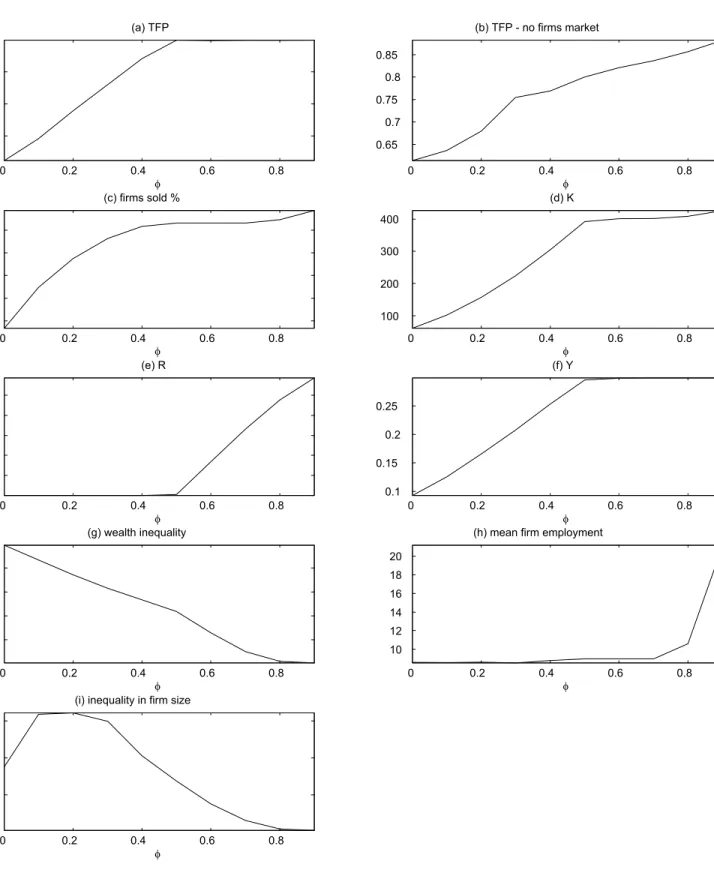
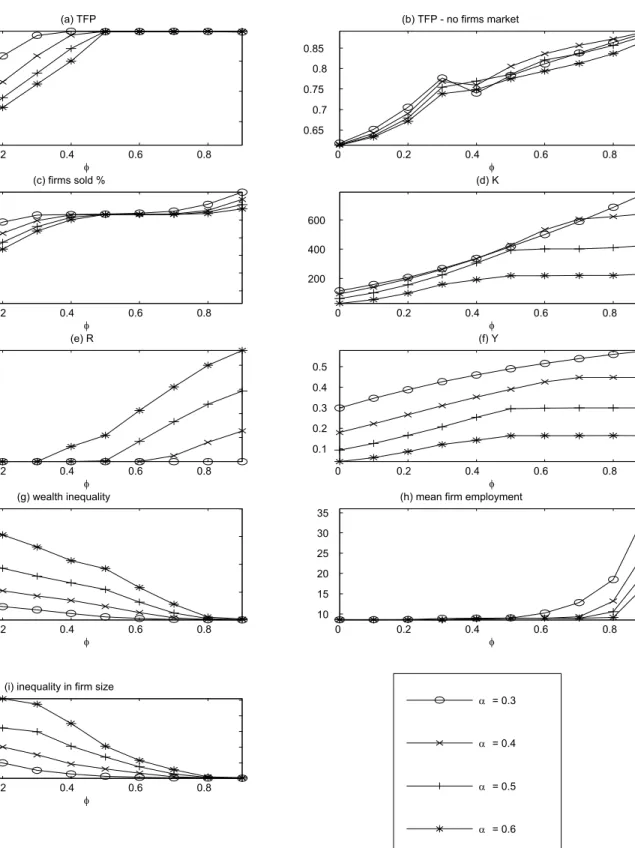
Our benchmark results are depicted in Figure 1. The endogenous variable of greatest interest in this paper is TFP, i.e. the quantity
· (1−s)θ 1 α L +sθ 1 α H ¸α
. The steady state
value of TFP is plotted in panel (a) against 10 possible values of φ between 0 and
0.9 — the empirically relevant range as discussed in the previous section. TFP is 21
(weakly) upward sloping, indicating that improvements in contractual enforcement lead to improvements in governance. The relationship levels off for φ = 0.5, because at this value and above it becomes possible for all inept owners to sell theirfirms.
Quantitatively, the effect of φ is large: the economy with the poorest
enforce-ment has TFP levels as low as 60 percent of the TFP of the most efficient economy.
Hence, we conclude that the model can account for a 40 percent TFP gap between the
most efficient and the most inefficient economy,due to dynastic management alone. In
a 93-country data set for the year 1996, the 10th percentile of the TFP distribution is computed to be about 30% of the 90th percentile [Caselli, 2004]. Hence, the fraction of the observed TFP gaps potentially explained by the model is 40/70 = 0.57. Since
we have shut down all other possible sources of TFP differences we regard this as a
very large effect.
In our model there are two mechanisms through which improved contract
en-forcement reduces the inefficiencies caused by dynastic management. First, on the
market for control, more untalented heirs sell their licenses to talented outsiders. Sec-ond, on the capital market, talented managers can expand their operations through borrowing relatively more than untalented ones. Both mechanisms result in an increase in the relative amount of capital in the hands of talented individuals. To gauge the relative importance of these two mechanisms we have simulated an alternative version of the model where there is no market for control: licenses always stay with the initial owner. The steady state TFP level of this economy is plotted in Panel (b). It seems clear that the market for control is at least as important as the capital market in de-termining the long-run aggregate efficiency of the economy: even with almost perfectly efficient capital markets (or φ = 0.9), in the absence of a market for control TFP is only 85 percent of what it would be with a market for control.
The role of contract enforcement in facilitating transfers of control is further
underscored by Panel (c), which plots the fraction of active firms that change owner
in an average period in steady state, always againstφ. Here we observe a steep rise in the fraction offirms changing hands as φ increases. When we looked at the identity of buyers and sellers we found that all buyers were talented and all sellers untalented, so all sales are motivated by differences in talent, as opposed to differences in wealth.
In the remaining panels of Figure 1 we document the implications of our model for a variety of additional macroeconomic variables of interest. In line with standard predictions from growth models under imperfect credit markets, the amount of capital
0 0.2 0.4 0.6 0.8 0.7 0.8 0.9 φ (a) TFP 0 0.2 0.4 0.6 0.8 0.65 0.7 0.75 0.8 0.85 φ (b) TFP - no firms market 0 0.2 0.4 0.6 0.8 0.1 0.2 0.3 0.4 0.5 φ (c) firms sold % 0 0.2 0.4 0.6 0.8 100 200 300 400 φ (d) K 0 0.2 0.4 0.6 0.8 1 1.1 1.2 1.3 1.4 1.5 φ (e) R 0 0.2 0.4 0.6 0.8 0.1 0.15 0.2 0.25 φ (f) Y 0 0.2 0.4 0.6 0.8 1.1 1.2 1.3 1.4 φ (g) wealth inequality 0 0.2 0.4 0.6 0.8 10 12 14 16 18 20 φ
(h) mean firm employment
0 0.2 0.4 0.6 0.8
1.5 2 2.5
φ
(i) inequality in firm size
Figure 1: Benchmark Results 23
in use infirms, K, is strictly increasing in contract enforcement, and the quantitative
impact of φ on capital accumulation is large [Panel (d)]: the lowest-highest gap is
about 75% of the 10th−90th percentile gap in the data. While credit constraints would
tend to reduce capital accumulation in any growth model, in the current version their adverse effect is boosted by the heterogeneity in talent. We quantify the extra effect of talent heterogeneity in subsection 6.4 below. Panel (e) shows the interest factor,
R. For low values of φ the aggregate “capital capacity” of firms in this economy is
small, as potential lenders are weary of default. Hence, only a fraction of the overall liquid wealth with which every period begins is transformed into physical capital and the interest-factor is anchored to the rate of return on the storage technology (R= 1). Forφ large enough, however, the capital capacity of firms becomes sufficiently strong to absorb the entire liquid wealth, and competition for finance drives up the interest rate (R > 1). Hence, as in other models of financial imperfections, interest rates are not necessarily higher in countries with a high physical marginal product of capital.26
Coming back to Panel (d), this reasoning also explains the kink in the profile of K
againstφ.27
Bringing together our predictions on TFP and the capital stock, Panel (f) shows that per capita GDP, the measure of welfare in our economy, increases monotonically
inφ. The quantitative impact of financial development, which combines the separate
effects of φ on TFP and investment, is large, as the country with the worst contract
enforcement has about 0.3 of the per capita GDP of the country with the best contract enforcement. The 90th-10th interpercentile ratio in the data is 0.05, suggesting that by
merging dynastic management with factor accumulation effects allows credit frictions
to explain about 0.7/0.95=73 percent of the observed per capita income gap.
In Panel (g) we plot steady state wealth inequality — as measured by the ratio of mean to median end-of-period liquid wealthbi — implied by the model for different
values of φ. Consistent with empirical evidence the relationship is negative (better
contract enforcement implies less inequality). In financially underdeveloped (i.e. low
26Caselli and Feyrer (2005) present evidence on the divergence between physical marginal products
andfinancial rates of return across countries.
27Castro, Clementi, and McDonald (2004)find that better investor protection mayreduce capital
accumulation by lowering the income of the (young) entrepreneurs, who have to give a larger share of profits to the (old) investors. In our model it is also true that a higherφmaps into higher interest rates, with a potentially negative effect on the demand for capital. However, in our model the benefit of relaxing the incentive compatibility constraint with a higherφdominates the Castro et al. effect.
φ) countries, owners enjoy large rents and wages are low, while withfinancial
develop-ment rents decline and wages grow.28 Also consistent with empirical evidence is that
richer countries have larger average firm size in terms of workers (or, equivalently, the number of firms per capita is declining in φ), as shown in Panel (h).29 Finally, as depicted in Panel (i), inequality infirm sizes is inverted-U shaped inφ: countries with intermediate values of contract enforcement exhibit the biggest spread between the mean and the medianfirm. Indeed, whenφ is very low borrowing is limited andfirms’ dispersion is bounded by the distribution of initial wealth; whenφ is large wealth does
not matter for investment and talented managers run equally sizedfirms. When φ is
intermediate, contract enforcement is not good enough to induce all untalented heirs to sell but it still allowsfirm owners to leverage their wealth and expand the scale of operation. In this range credit markets magnify the differences between the size of the firms owned by rich/poor and/or talented/untalented agents, leading to the inverted-U shaped relationship betweenfirm size dispersion and aggregate TFP.30
6.2
E
ff
ects of Inheritability of Talent
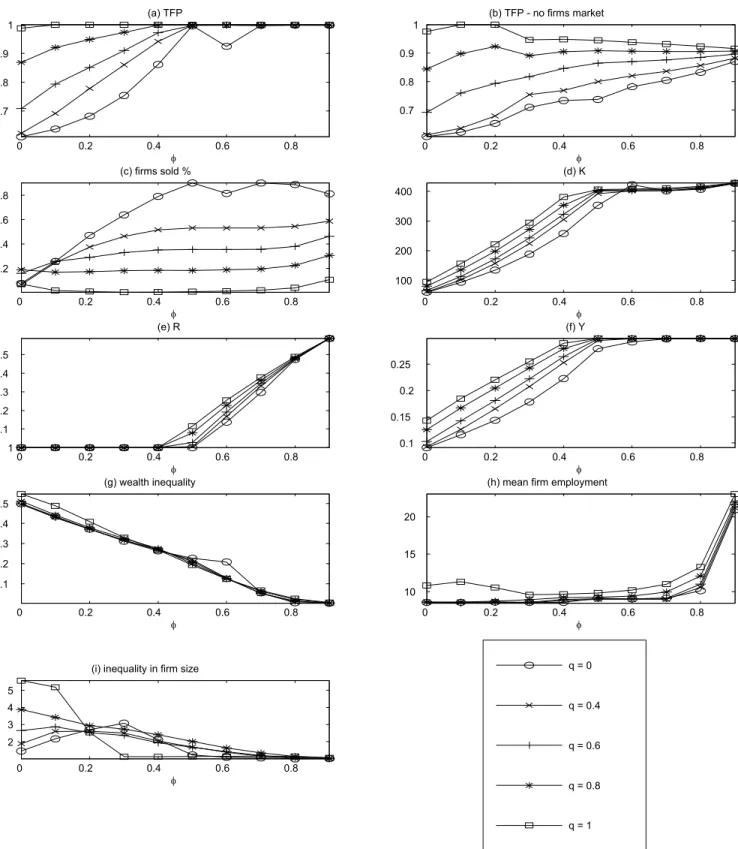
In Figure 2 we begin probing the robustness of our results to deviations from our benchmark calibration, starting with the most interesting case in the context of dynas-tic management, i.e. the talent-inheritance parameter, q. Figure 2, as all subsequent figures, reproduces the same information as Figure 1, but adds results for various de-viations from the benchmark calibration. Hence, for example, in Panel (a) we look at TFP as a function of φ for 5 possible values of q: 0 (corresponding to i.i.d. talent draws), 0.4 (our benchmark), 0.6, 0.8, and 1 (corresponding to perfect intergenerational transmission of talent).
Our simulations show that a high degree of heritability of talent pushes the
economy towards greater efficiency: for any level of φ, steady state TFP is (weakly)
larger at higher values of q. The mechanism that makes dynastic management less of
28See Cagetti and De Nardi (2002) for another model were better enforcement leads to less inequality. 29This is the main focus of Quintin (2003).
30Also inverted-U-shaped is the relationship between the market price offirms andφ(not plotted
for reasons of space). A largerφincreases the demand for firms by increasing the ability of talented outsiders to buy, but it also favors the concentration of the existing capital in the hands of talented heirs, thus inducing untalented ones to sell. This last effect increases the supply offirms and dominates thefirst one whenφis large enough.
0 0.2 0.4 0.6 0.8 0.7 0.8 0.9 1 φ (a) TFP 0 0.2 0.4 0.6 0.8 0.7 0.8 0.9 1 φ (b) TFP - no firms market 0 0.2 0.4 0.6 0.8 0.2 0.4 0.6 0.8 φ (c) firms sold % 0 0.2 0.4 0.6 0.8 100 200 300 400 φ (d) K 0 0.2 0.4 0.6 0.8 1 1.1 1.2 1.3 1.4 1.5 φ (e) R 0 0.2 0.4 0.6 0.8 0.1 0.15 0.2 0.25 φ (f) Y 0 0.2 0.4 0.6 0.8 1.1 1.2 1.3 1.4 1.5 φ (g) wealth inequality 0 0.2 0.4 0.6 0.8 10 15 20 φ
(h) mean firm employment
0 0.2 0.4 0.6 0.8 2 3 4 5 φ
(i) inequality in firm size q = 0
q = 0.4
q = 0.6
q = 0.8
q = 1
a problem with high talent inheritability is simple. In every period talented managers make higher profits and bequeath larger assets. A high intergenerational correlation of talent increases likelihood that their offsprings are talented as well, thereby increasing the correlation between talent, wealth, andfirm ownership. This high positive correla-tion between talent, wealth, and ownership implies that the markets for control and for capital play less critical a role in efficiently allocating ownership and assets. In Panel (c) we show that reallocation of ownership does indeed decline asq increases.31
6.3
E
ff
ects of the Saving Rate
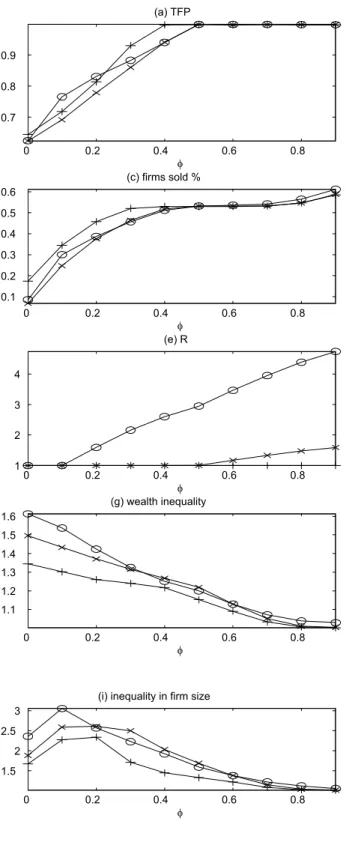
We next consider the effects of variation in the saving/bequest rate γ (Figure 3).
Because γ governs the dynamics of the wealth distribution, and because the wealth
distribution affects the outcome in the market for firms, it is possible that γ will exert a direct causal impact on TFP. On the market for control, there are two opposing effects at play. On the one hand, a higherγ increases the size of the bequests received by talented outsiders, thus facilitating their purchases offirms. On the other hand, a higher γ increases the persistence of liquid wealth across dynastic lines, thus making more likely that rich but untalented heirs hold on to managerial responsibilities. Panel (c) shows that these effects lead to some nonmonotonicity in the relationship between
γand the amount of ownership changes, though quantitatively the net effect is modest. On the market for capital, the saving rate affects the allocation of capital
to-wards talented agents, and hence TFP, mainly through a general equilibrium effect
mediated by the interest rate. A lower saving rate implies a dimished supply of capital [Panel (d)] and hence a higher interest rate [Panel (e)]. A higher interest rate hurts untalented agents because the talented ones can afford to pay a higher interest rate, so it tends to reallocate capital towards the latter. Also, the smaller the saving rate, the smaller the impact on a dynasty’s current investment of incomes it earned far in the past. Thus, dynasties that were untalented one period ago (and are thus very likely to be untalented today as well), are going to invest very little in the current period.
31The nonmonotonicity in the graph for TFP for q = 0.5 is due to a numerical aberration: for
φ= 0.6 there happens to be a dynasty that accumulates a disproportionate amount of wealth [see panel (h)], and this dynasty happens to have several untalented draws, which means that a significant amount of capital remains badly managed. This effect would disappear if the number of agents grew asymptotically. Another nonmonotonicity is documented in Panel (j): when the inheritance of talent is sufficiently high inequality infirm size is monotonically decreasing inφ.
0 0.2 0.4 0.6 0.8 0.7 0.8 0.9 φ (a) TFP 0 0.2 0.4 0.6 0.8 0.65 0.7 0.75 0.8 0.85 φ (b) TFP - no firms market 0 0.2 0.4 0.6 0.8 0.1 0.2 0.3 0.4 0.5 0.6 φ (c) firms sold % 0 0.2 0.4 0.6 0.8 200 400 600 800 1000 φ (d) K 0 0.2 0.4 0.6 0.8 1 2 3 4 φ (e) R 0 0.2 0.4 0.6 0.8 0.1 0.2 0.3 0.4 φ (f) Y 0 0.2 0.4 0.6 0.8 1.1 1.2 1.3 1.4 1.5 1.6 φ (g) wealth inequality 0 0.2 0.4 0.6 0.8 10 15 20 25 φ
(h) mean firm employment
0 0.2 0.4 0.6 0.8 1.5 2 2.5 3 φ
(i) inequality in firm size
γ = 0.1
γ = 0.3
γ = 0.5
These effects determine why in an economy without a market for control TFP tends to decline monotonically with the saving rate [Panel (b)]. When all these effects are
taken into account, the overall effect of the saving rate on TFP is nonmonotonic but
pretty small [Panel (a)].
6.4
E
ff
ects of Relative Ability
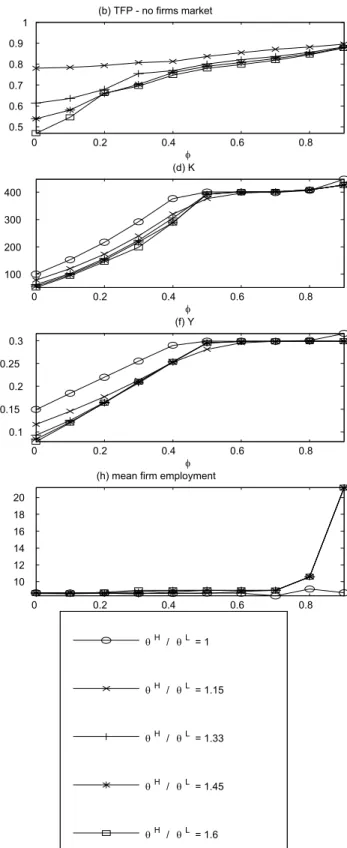
Another interesting nonmonotonicity arises in connection with the relative ability
θH/θL. We consider five cases: 1, 1.15, 1.3 (our benchmark), 1.45 and 1.6. In Panel (a) of Figure 4 we see that at low levels of φ a greater efficiency gap between talented and untalented managers leads to larger losses in aggregate TFP. This reflects the loss in efficiency of those firms that are badly run. But another effect of an increase in
θH/θL is that the gains from trade between the talented and the untalented increase, leading to greaterfirm reallocation [as also seen in Panel (c)]. Hence, a greater ability
gap also means that fewer firms are in untalented hands. The figure shows that this
second effect becomes dominant for larger values of φ. Another result of interest in thisfigure is Panel (d), where we can gauge the additional role of heterogeneity in tal-ent in depressing capital accumulation over and above