Economic Efficiency Control on Data Centre
Resources in Heterogeneous Cost Scenarios
Benjamin Heckmann, Marcus Zinn,
Ronald C. Moore, and Christoph Wentzel
University of Applied Sciences Darmstadt Haardtring 100, 64295, Darmstadt, Germany
Andrew D. Phippen
University of PlymouthDrake Circus, PL4 8AA, Plymouth, U.K.
Abstract—Optimisation of resource selection in hybrid cloud data centres depends on the control of resource usage. The primary criterion for this resource selection is economic effi-ciency. The presented approach considers operational efficiency aspects in service providing and therefore focuses on technical criteria, such as resource load, as well as economic criteria, such as the costs of resource usage. When services are offered at different service levels the approach enables revenue optimisation in cases of excessive load. The concept is prepared to handle heterogeneous IaaS scenarios.
Keywords—Business, Cloud, Efficiency, Services-oriented Ar-chitecture, Utility Computing
I. INTRODUCTION
The following concept characterises an approach to optimise the resource selection in data centres. Both runtime and deployment time are considered as point of decision about the usage of resources. Primary criterion for this decision is economic efficiency.
The project was conducted as an applied research in the field of business informatics in close cooperation with a business partner [1]. The developed approach for efficient control on data centre resources in heterogeneous cost scenarios was also implemented as a proof-of-concept [2]. The concept is restricted to the following technical solutions for IT resource offers specified by our business partner.
IaaS: Offering hardware resources located in data centres (e.g., servers, storage, network) based on virtualisation tech-nologies (e.g., VMware, Xen) is defined as Infrastructure as a Service (IaaS) in this concept. Virtualisation enables the sep-aration of hardware resources into smaller fractions, whereby each fraction offers the same virtual hardware interfaces as an actual hardware. In this context the IaaS focus is on server virtualisation. These server fractions are called virtual machines (VM). Hardware resources can be allocated to VMs as demanded, depending on the features of the virtualisation technology used. IaaS thereby describes the basic management layer for data centre operations.
SaaS: Software applications can be deployed based on an IaaS layer. In this context deploying business software in one or several VMs to ease deployment and operation of multiple parallel instances of this software is called Software as a Service (SaaS). Thereby, SaaS describes the basic layer for the consumer interaction.
Hybrid Cloud: In this paper the provisioning of resources or IT services based on the paradigm of IaaS or SaaS is also called cloud-based provision, conforming to the cloud defi-nition of the National Institute of Standards and Technology (NIST) [3]. In this paper hybrid clouds are compositions of clouds offering the same type of service while their operation technology may vary. The services analysed in this project are operated as a hybrid cloud hosted in several data centres across the world. A data centre may expose its resources as a single cloud, but more often as the sum of multiple clouds, each representing an individual technical solution grown over time.
II. BACKGROUND A. Cost Domains
Here it is assumed that in most cases the technical boundary of a cloud also reflects an individual cost domain. This is true when clouds reside in different data centres, even more obvious in different countries. Clouds can also differ in the applied technology for their operations. Distinguishable cost domains can also originate out of significantly different hardware performance, as in scenarios where older and newer hardware are operated simultaneously within the same data centre.
B. Utility Computing Service Life Cycle
Our concept takes major aspects of Heckmann et al. and extends them significantly. The works of Heckmann et al. reflect the characteristics of a service life cycle (business planning, development and operations) in the context of Utility Computing (UC). The business model of UC offers scalable IT-based services metered by usage.
The main contributions aggregated from these results are:
• Technology-independent Provision Model [4]
The developed component architecture describes the min-imum necessary functionalities and dependencies in an operations environment for a UC service. This architec-ture is used when services should be operated as part of a service-oriented architecture (SOA) and hosted on a cloud platform and are incorporated in an UC business plan. Those scenarios (SOA and cloud and UC) are called UC scenarios herein.
• Technology-abstracted Resource and Cost Simulation [5] When services are orchestrated [6] using other services and used in UC scenarios, complex service cascades are formed. These cascades can be complex both ar-chitecturally and economically. Both challenges can be addressed with a simulation framework to analyse the interaction between resource allocation and costs, service orchestration, service purchasing costs, and service pric-ing. A proof-of-concept implementation of such a simu-lation framework for multi-tier operations environments was implemented.
• Specification Paradigm for Service Quality [7]
Within the introduced results a new approach on agreeing on service level for services in UC scenarios is described. This approach offers a specification paradigm for service quality description straight from a usage perspective. In this case service levels are no more defined by technical conditions. They are called business service level(BSL) and are specified by describing the quantity and quality of the consumers’ behaviour in using a service.
C. Research Objectives
The research objectives are examined from the perspective of a service provider.
We assume a service provider with multiple data centres spread worldwide. The data centres are operated as a hybrid cloud with multiple clouds per data centre hosting SaaS offers for a multiplicity of varying customers. Each service is offered with more than one service level. Each cloud is considered to be its own cost domain. The research objective is to make potential savings accessible between different cost domains. We provide an approach for a technical solution, including a proof-of-concept implementation. This optimisation should be performed at the initial resource allocation during deployment of a service as well as continuously during its operations.
III. RELATEDWORK
This research offers an approach to technically converge the quality-related ontologies of service, experience, and busi-ness as introduced by Moorsel [8] or Dobson and Sanchez-Macian [9]. In the literature, three focuses on data centre control related approaches can be found: effective data distri-bution, quality of service (QoS) in networks [10] and reduction of power consumption. The focus on effective data distribution resides in the field of grid computing. Here large amounts of data have to be distributed over several nodes so that parallel calculations on the data slices accelerate the overall processing of the data. In most grid architectures there is an architectural component called broker [11]. This broker controls the distribution, processing and result aggregation, sometimes supplemented by billing or marketplace features, like auctions and bidding. Different approaches are known to accelerate processing, for example using resource reservation or considering the problem as a queueing system [12].
In networks, QoS approaches mainly are focused on the network layer. MDCSim [13] instead offers an approach for
a multi-tier data centre simulation, but focuses their outcomes onto a comparison of Infiniband and 10 Gigabit Ethernet network technologies.
The focus on reduction of power consumption centers on server consolidation. Approaches for load prediction for servers in a single data centre are shown by Speitkamp [14] using historical data analysis, Bi [15] using a non-linear optimisation model or based on a limited lookahead control framework by Kusic [16]. Wang introduces an approach to combine server consolidation and dynamic voltage and fre-quency scaling [17]. An approach for service level manage-ment in distributed infrastructures, including QoS translation and support for self-adaptation, is shown by Freitas [18].
Load balancing on the level of data centres within and between client devices is addressed by Peoples [19].
None of these approaches sufficiently covers the relation between resources, services and consumers introduced in Section 5 of this paper.
IV. RESEARCHAPPROACH
The following steps were taken to obtain the research objectives of making potential savings accessible between different cost domains for SaaS providers:
1) Analysis of the customer-service-resource relation in SaaS provision scenarios in the context of our business partner (see section V).
2) Design of a generalised concept to efficiently control data centre resources in heterogeneous cost scenarios based on the previous analysis (see section VI). 3) Implementation of the design as a proof-of-concept (see
section VII).
V. ANALYSIS OF THEBUSINESSPARTNERCONTEXT A. Model of the Customer-Service-Resource Relations
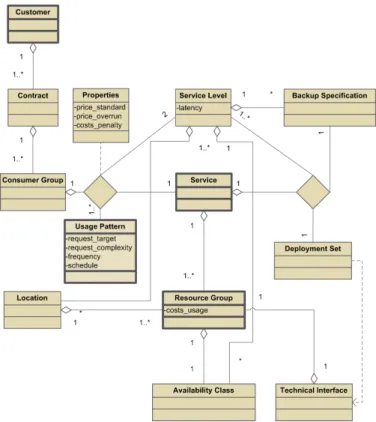
The relationships between a SaaS provider and its customers are modelled with a data structure. This data structure is subsequently used as the basis for the optimisation, and must be modified only when the relationships between the provider and the customers change. The provider and the customers are represented by the nodes in a graph; the edges in the graph represent the services provided.
Customers can have one or more contracts with the provider. A contract applies to one or more consumer groups (e.g., branches) within the organisation of the customer. Each con-sumer group relates to one or more services of the provider. This relation incorporates the link to two service levels and one usage pattern. A Usage Pattern is a quantitative and qualitative description of the service usage behaviour of a consumer group [7].
The price (per unit) and the contract penalty (per unit) are stored attached to the link between the first service level, a service and a consumer group. Accordingly, the price (per unit) is also stored attached to the link affecting the second service level. A penalty for this relation is not necessary, as it reflects the service usage over and above the contracted usage pattern.
Figure 1. Relations Between Resources, Services and Consumers
Services, one or several, act as connector between provider and customer, more precisely between resource groups on the provider side and consumer groups on the customer side. Also a service relates to a backup specification and a technical deployment set. Such a set contains necessary files and configuration properties for deployment.
Resources are managed in groups. The primary grouping criterion is technical, for example the virtualisation software used. The secondary criterion is the geographical location, for example the hosting data centre. The cost of the resource usage (per unit) is an attribute of a resource. Linked to a resource is the according technical interface for its administration and monitoring (e.g., virtualisation management API). Addition-ally, an availability class is linked to a resource group. The availability classification enables an abstract categorisation to distinguish between different level of technical availability assurance.
Service level serve as abstract categorisation to differentiate between varying level of service quality. Beside their previ-ously described relations, a service level links to one or more locations, one availability class and one backup specification. The customer-service-resource relation is elaborated in the data model in Fig. 1.
B. Mediation Conditions
In the research context resource groups are only considered during resource selection when they conform to the required quality properties. Resource selection should respect the tech-nical load of resource groups and customer constraints such
as processing location. Only incoming service requests (e.g., from the consumer towards the service) should be considered.
VI. SOLUTIONDESIGN
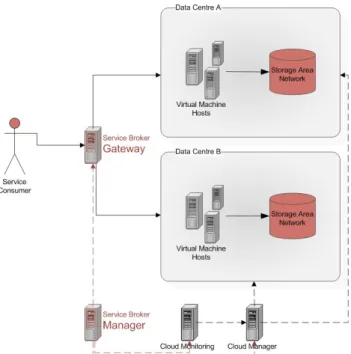
The required functionality for an efficient control on data centre resources in the analysed context is distributed among two architectural components, namedService Broker Manager
andService Broker Gateway.
The Service Broker Manager implements the elaborated data model described above and offers interfaces for inter-action (e.g., graphical user interface (GUI), application pro-gramming interface (API)). Beside the storage of the data model the broker offers a method to match a service request from a certain customer with a suitable resource. The broker continuously analyses the monitoring data from all resource groups and redirects service requests, including service relo-cation, accordingly.
The matching between a customer’s service request and a suitable resource is done in six steps. Preconditions are a given service request and at least two resource groups:
1) Service type, service consumer and the service level corresponding to the service request are determined. Postcondition 1: identifiers for service type, service consumer, and service level are known.
Precondition 2: service request and service type are known.
2) Resource demand for the service request is estimated. Postcondition 2: service request’s resource demand is known.
Precondition 3: service request’s resource demand, ser-vice type, and serser-vice level are known.
3) Pools of resource groups are selected by available re-sources and matching service level.
Postcondition 3: two pools of resource groups are known, where each resource group offers enough re-sources for request processing and one pool complies with the demanded service level and the other does not. Precondition 4: service request’s resource demand, ser-vice type, and serser-vice consumer are known.
4) The estimated revenue per pooled resource group for request processing is calculated.
Postcondition 4: per given resource group the estimated revenue is known.
Precondition 5: service request’s resource demand, ser-vice type, serser-vice consumer, and serser-vice level are known. 5) Estimated costs for service level violation (latency
ex-ception and request failure) are calculated.
Postcondition 5: estimated costs for latency exception and request failure are known.
Precondition 6: two pools of resource groups with sufficient processing resources distinguished by service level compliance, estimated revenue per pooled resource group and estimated costs for latency exception and request failure are known.
6) The most efficient opportunity out of the following actions is selected:
Figure 2. Service Broker Component Architecture
• Request is processed by a service level conforming resource group.
• Request is processed by a non-conforming resource group.
• Request is not processed.
Postcondition 6: action for further request processing determined.
The Service Broker Gateway acts as a load balancer on the network layer. It reroutes service requests to appropriate service instances, including the capability of dynamically shaping the traffic up to the blocking of certain requests. This is especially useful in cases of excessive load. Here requests can be forwarded (or blocked) based on economic efficiency. ThisService Brokerconcept enables resource selection and control on load distribution based on the elaborated relation. An overview on the component architecture is given in Fig. 2.
VII. INITIALRESULTS
As proof-of-concept the Service Broker Manager including a GUI, API and the request-resource matching method has been implemented. As a scenario for the evaluation of the request-resource matching method a database with four cus-tomers, each with two contracts affecting two consumer groups is defined. Five services are available, whereby each consumer group uses two services. As hosting environment two resource groups are provided, hosted in two data centres as varying cost domains. The self-service cloud portal of the business partner uses the Service Broker API to retrieve a suitable resource address during service deployment.
First tests using the self-service portal show the broker’s ability to pick the most cost effective resource with enough load reserve. This leads to a significant overall change in
load (and service instance) distribution among the two cost domains. The load distribution shifts in favour of the more cost-effective data centre. Without the broker-enriched self-service portal, the deployment of new self-service instances took about three weeks for the whole business process to terminate, due to internal measurements of the business partner. Using the broker-enriched portal the deployment time was reduced to approximately 30 minutes.
These first outcomes demonstrate the proof-of-concept’s ability to efficiently control data centre resources in hetero-geneous cost scenarios.
VIII. FURTHERWORK
Feasibility of Business Processes: Our concept creates an opportunity to also associate business process steps with our data model. A similar approach was introduced by Heckmann, but not elaborated to work based on resource load information.
Simulation-based Load Prediction: The Service Broker can be extended based on the simulation framework for Utility Computing elaborated by Heckmann [5]. Instead of retrieving the current load through a service for resource monitoring (referring to step three in Section 6) the broker can use load forecasts.
Utilisation of External Services: From a provider’s per-spective, at the current stage, the concept only addresses incoming service requests. In addition, the concept could also be extended to represent outgoing service requests to external service providers. This could expand the efficiency of the service provision one step further.
IX. CONCLUSIONS
This paper introduces and evaluates the Service Broker
concept.
The Service Broker is an approach to optimise the resource selection in data centres. The concept enables the control of resource usage both at runtime and deployment time. In this research context, the primary criterion for resource selection and subsequent request forwarding is economic efficiency. The broker was evolved and evaluated in close cooperation with a business partner. The evaluation of the concept was done through a proof-of-concept implementation presented on CeBIT 2011 as an applied research in the field of business informatics.
The elaborated concept considers technical criteria, such as resource load, as well as economic criteria, such as the costs of resource usage. When services are offered at different service levels the broker enables revenue optimisation in cases of excessive load. Additionally, the concept is independent of the technical solution for resource management (e.g., virtualisation framework) and is prepared to also handle heterogeneous technical scenarios.
REFERENCES [1] P. Opper, “T-Systems International GmbH,” 2011. [2] M. Zinn, “Cebit 2011,” 2011.
[3] P. Mell and T. Grance, “The NIST definition of cloud computing,” Jul. 2010, (Access Date: 04/05/2011). [Online]. Available: http: //csrc.nist.gov
[4] B. Heckmann, A. D. Phippen, R. C. Moore, and C. Wentzel, “Agreeing on and controlling business service levels in Service-Oriented architectures,”International Transactions on Systems Science and Applications, vol. Vol. 7, no. No. 3/4, pp. 173–178, Dec. 2011. [Online]. Available: http://siwn.org.uk/press/sai/itssa0007.htm [5] B. Heckmann, I. Stengel, A. Phippen, and G. Turetschek, “Utility
computing simulation,” inESM’2009 The 2009 European Simulation and Modelling Conference. Leicester, United Kingdom: EUROSIS-ETI, Oct. 2009, pp. 175–180. [Online]. Available: http://www.eurosis.org [6] T. Erl,SOA Principles of Service Design (The Prentice Hall
Service-Oriented Computing Series from Thomas Erl). Prentice Hall PTR, 2007.
[7] B. Heckmann and A. Phippen, “Quantitative and qualitative description of the consumer to provider relation in the context of utility computing,” inProceedings of the Eighth International Network Conference (INC 2010), Heidelberg, Germany, Jul. 2010, pp. 335–344.
[8] A. Van Moorsel, “Metrics for the internet age: Quality of experience and quality of business,”5TH PERFORMABILITY WORKSHOP, 2001. [Online]. Available: http://citeseerx.ist.psu.edu/viewdoc/summary?doi= 10.1.1.24.3810
[9] G. Dobson and A. Sanchez-Macian, “Towards unified QoS/SLA ontolo-gies,” inIEEE Services Computing Workshops, 2006. SCW ’06. IEEE, Sep. 2006, pp. 169–174.
[10] R. Braden, D. Clark, and S. Shenker, “RFC 1633 -integrated services in the internet architecture: an overview,” http://www.apps.ietf.org/rfc/rfc1633.html, Jun. 1994. [Online]. Avail-able: http://www.apps.ietf.org/rfc/rfc1633.html
[11] S. Venugopal, R. Buyya, and L. Winton, “A grid service broker for scheduling distributed data-oriented applications on global grids,” in
Proceedings of the 2nd workshop on Middleware for grid computing, ser. MGC ’04, 2004, pp. 75–80, ACM ID: 1028506.
[12] A. Afzal, A. S. McGough, and J. Darlington, “Capacity planning and scheduling in grid computing environments,” Future Generation Computer Systems, vol. 24, p. 404414, May 2008, ACM ID: 1350010. [13] S. Lim, B. Sharma, G. Nam, E. K. Kim, and C. Das, “MDCSim: a multi-tier data center simulation, platform,” inCluster Computing and Workshops, 2009. CLUSTER ’09. IEEE International Conference on, 2009, pp. 1–9.
[14] B. Speitkamp and M. Bichler, “A mathematical programming approach for server consolidation problems in virtualized data centers,”Services Computing, IEEE Transactions on, vol. 3, no. 4, pp. 266–278, 2010. [15] J. Bi, Z. Zhu, R. Tian, and Q. Wang, “Dynamic provisioning modeling
for virtualized multi-tier applications in cloud data center,” in Cloud Computing (CLOUD), 2010 IEEE 3rd International Conference on, 2010, pp. 370–377.
[16] D. Kusic, J. Kephart, J. Hanson, N. Kandasamy, and G. Jiang, “Power and performance management of virtualized computing environments via lookahead control,” in Autonomic Computing, 2008. ICAC ’08. International Conference on, 2008, pp. 3–12.
[17] Y. Wang and X. Wang, “Power optimization with performance assurance for multi-tier applications in virtualized data centers,” inParallel Pro-cessing Workshops (ICPPW), 2010 39th International Conference on, 2010, pp. 512–519.
[18] A. L. Freitas, N. Parlavantzas, and J. Pazat, “A QoS assurance framework for distributed infrastructures,” inProceedings of the 3rd International Workshop on Monitoring, Adaptation and Beyond, ser. MONA ’10, 2010, p. 18, ACM ID: 1929567.
[19] C. Peoples, G. Parr, and S. McClean, “Energy-aware data centre man-agement,” in Communications (NCC), 2011 National Conference on, 2011, pp. 1–5.