The Impact of IT Management Processes on Enterprise Agility
Maik VerbaanM ICT
HU University of Applied Sciences Utrecht [email protected]
A.J. Gilbert Silvius
HU University of Applied Sciences Utrecht [email protected]
ABSTRACT
In dynamic business environments, the ability to adapt is highly important for organizations in order to best their competition. This is necessary because throughout the years of doing business, organizations have experienced but one constant factor: change. The concept of enterprise agility is designed to counter this phenomenon. In this regard, IT is perceived to play a vital role in enterprise agility, most often viewed as an enabler. However, IT can be an inhibitor of enterprise agility as well because of its potentially restricting nature, structural thinking, bureaucracy, rigor, etc. This especially becomes apparent in information systems (IS) that have been operational in organizations for several years. This research aims at discovering processes of IT management that empower or obstruct enterprise agility. We identify processes on the one hand and aspects of enterprise agility on the other and relate them to each other using propositions. We conclude with the identified contribution of IT management to enterprise agility, propose directions for optimization as well as offer suggestions for additional research.
Keywords: Enterprise agility, IT management, IT service management, functionality and information management, application management, technical infrastructure management, agility, processes.
INTRODUCTION
Throughout the years of doing business, organizations have experienced but one constant factor:
change (Brown & Eisenhardt, 1997). Businesses are constantly trying to cope with this factor. Intense competition, globalization, time-to-market pressure, etc. are amongst the causes for this phenomenon (Sambamurthy, Bharadwaj, & Grover, 2003). No business or organization can be sustainably successful through rigid continuous exploitation of a product or service (Collins, 2001). Competition will eventually catch up, through innovations, new approaches, etc. Organizations need to adapt and therefore be agile.
The concept of agility has been approached from many different angles. A frequently applied approach is to view agility as the ability to handle change (Tsourveloudis & Valavanis, 2002; Yusuf, Sarhadi, & Gunasekaran, 1999). This ability is resulting from several capabilities, for example the capability to sense change and the ability to respond to change. Without detection,
there is no trigger to respond. However, detecting change without being able to respond to it, leads to ‘outdated’ businesses and eventually to unsustainable businesses (Overby, Bharadwaj, & Sambamurthy, 2006). However, agility requires more than just sensing and responding capabilities. Sherehiy, Karwowski, and Layer (2007) mention the necessity of a culture of change, speed, and the ability to integrate.
Information technology (IT) plays an important role in an organization’s ability to sense and respond to changes (Sambamurthy et al., 2003). However, adapting IT to a changing environment is also often perceived to be a difficult and tedious job involving development, testing, retesting, implementing (Lee & Xia, 2010), etc. This paper addresses the seemingly paradox role of IT in business agility, enabling agility on the one hand, but also hindering it on the other.
RESEARCH QUESTION
The practical problem which inspired this research is derived from both practice and theory. IT management, with its structures, processes and rigidity, often makes quick response to changes difficult, thereby hindering agility (Overby et al., 2006; Versendaal, van Giles, & Janssen, 2010). However, proper and professional IT management potentially builds a better vantage point for adopting and implementing change (Looijen, 2004; Overby et al., 2006; Sambamurthy et al., 2003; van Duivenboden & Thaens, 2008). In order to provide a more detailed insight in the relationship between IT management and enterprise agility, we formulated the following research question for the study:
Which IT management processes enable enterprise agility? And which hinder agility?
Naturally, there are different aspects of IT management that can be considered in regards of enterprise agility. We have selected processes as a central construct, based on the following:
Seeing as Enterprise Agility is about change, the domain of organizational change management offers an interesting perspective. Change management mainly focuses on business processes (Kettinger, Teng, & Guha, 1997; Trkman, 2009; van der Aalst, ter Hofstede, & Weske, 2003).
Processes exist on the operational level and are crucial for actually getting the work done. Looking at a specific model for business process change (Kettinger & Grover, 1995), we see that factors such as management, structure, information technology and people are important factors for processes, but they do not define the processes themselves.
According to Hoving and van Bon (2010), IT management is built using three different ingredients: people, products and processes. In this definition, ‘people’ refers to employees and organizational culture, ‘products’ to systems and tools, and ‘processes’ refers to procedures, methods and way of working. Based on these three components, we conclude that processes are the only ingredients that are relatively self-supporting and independent of the others.
In the next sections of this paper, first the relevant literature on IT management, IT management processes and enterprise agility will be reviewed. Based on the concepts and factors found in
literature, the conceptual model of our study will be derived. Based on this model, we will develop a number of propositions on the relationship between IT management and enterprise agility to exist. These propositions will be validated using a mixed method expert study.
IT MANAGEMENT
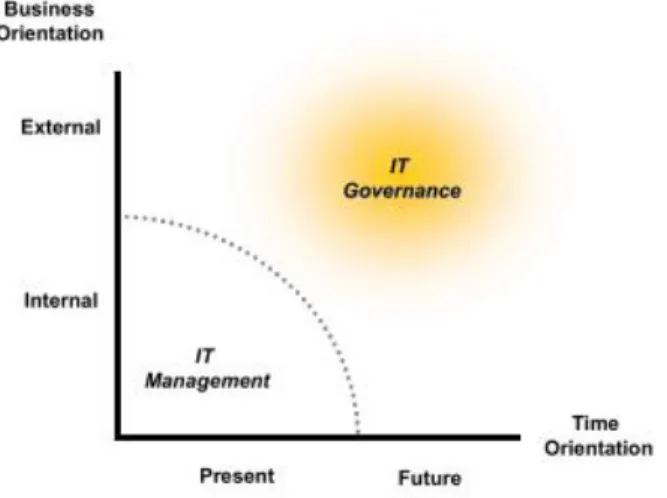
Given the research question of our study, we are especially interested in the role of IT and IT management as an enabler or inhibitor of change; change as the difference between a current situation and a different future situation. Peterson (2004) includes this time dimension in the distinction IT management and IT governance. This distinction is illustrated in Figure 1.
Figure 1: IT Governance and IT Management (Peterson, 2004).
In this view, IT governance plays a vital role in reviewing the potential future situation. Sohal and Fitzpatrick (2002) support this view by defining IT governance as “The creation of a setting in which others can manage effectively” where IT management is limited to “the making of operating decisions” (Sohal & Fitzpatrick, 2002). It could be argued that this time oriented distinction between IT management and IT governance, excludes a strategic aspect in IT management. However, enterprise agility is not just resulting from strategy, but also from implementation and execution. And according to Peterson (2004), implementation and execution are highly dependent on the current IT organization and IT management.
Looijen (2004) defines IT management as “The operation and maintenance of information systems and services as specified from a user perspective, accounting for situational organizational factors and the characteristics of information system components” (Looijen, 2004). Based on this definition, he distinguishes three domains within IT management: Functional management, Application management and Technical or Infrastructure management. This decomposition is firmly grounded in practice (Meijer, 2008) and the three domains are frequently implemented as separate processes within IT management. However, the terminology that is used, both in literature and in practice, may differ a bit in wording (van Bon et al., 2010; Cater-Steel & Tan, 2005; Meijer & Boer, 2004). Table 1 provides a description of the three domains.
Domain Description Functionality & information management (FIM)
Definitions of this term include “Conserving and maintaining the functionality of information systems” (Looijen, 2004), “Business information management” (Meijer, Zwaal, & Koppens., 2005), “Functional management, development and maintenance of IT from a functional perspective” (Thiadens, 2008) and “Managing and directing the delivery of information supporting the organization and its processes” (Pols & Backer, 2007).
Based on the above definitions, we conclude that objects of management are: functionality and information. Information is derived from information delivery and functionality is derived from the functional perspective as well as plain conserving and maintaining functionality of information systems. We therefore adopt the term functionality & information management (FIM) and define it as:
Managing and directing delivery of information and IT functionality to support the organization and its processes.
Application management (AM)
This domain aims at proper management and control of IS, focused at source code and databases. Looijen defines application management as following:“Conserving and maintaining applicational programs and applicational database” (Looijen, 2004). Pols and Meijer-Veldman (2002), have extended this definition with the term evolution of information systems: “The contracted responsibility for the management and execution of all activities related to the maintenance and evolution of existing applications, within well-defined service levels” (Pols & Meijer-Veldman, 2002).
Using these definitions we derive the definition for application management as:
Maintenance and evolution of existing applications and related databases.
Technical infrastructure management (TIM)
Although Looijen originally named this domain ‘technical management’, Meijer et al. (2005) included the term ‘infrastructure’ in this domain in order to address its content better. We followed this view and adopted the term ‘Technical infrastructure management’ for this domain. We define this domain as:
Conserving and maintaining hardware, infrastructure, IT-support applications and IT-support databases (based on Looijen, 2004).
Table 1: IT Management Domains.
IT MANAGEMENT PROCESSES
This section reviews the three domains of IT management in more detail. The result of this paragraph is the decomposition of the respective domains into processes.
Functionality & Information Management (FIM) Processes
The most complete process framework for the FIM domain is provided by the Business Information Services Library (BiSL) (Hoving & van Bon, 2010; van Bon & Verheijen, 2006). BiSL has been developed in order to enable organizations to better achieve the following goals (van Bon & Verheijen, 2006): 1) Adequate IT support of business processes, 2) Support of end-users in both change of information systems and daily operation, 3) Control of internal and external IT suppliers, 4) Realization of appropriate cost/benefit ratio (financially and qualitatively) for information systems, 5) Timely adapting of information provisioning to changing business needs, business processes, user organization and business environment. These goals clearly link to the agility of the supported business or operations.
In order to achieve these goals, Pols and Backer (2007) distinguish the following main tasks in FIM, as proposed in the BiSL framework: 1) recognize needs or demand in the business, 2)
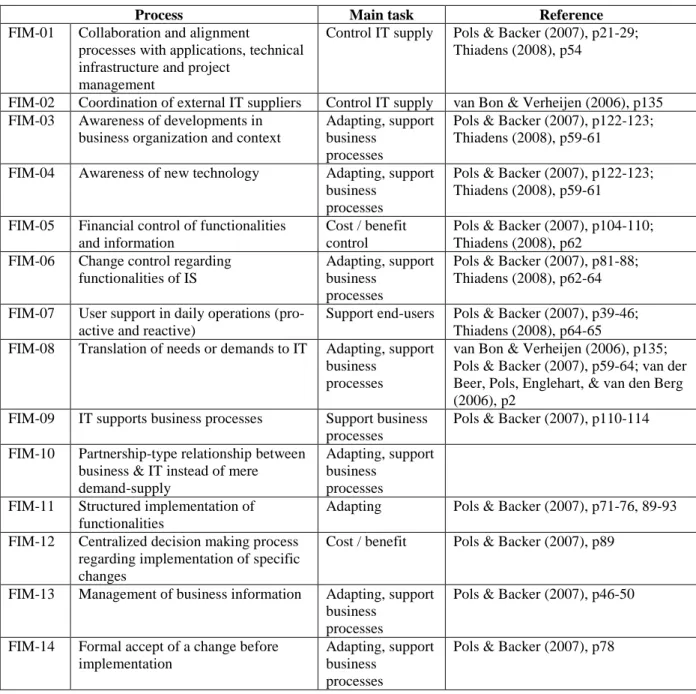
translating needs or demand to IT solutions, 3) coordinating IT suppliers. Based upon these goals and main tasks, we identified the following FIM processes (Table 2).
Process Main task Reference
FIM-01 Collaboration and alignment
processes with applications, technical infrastructure and project
management
Control IT supply Pols & Backer (2007), p21-29; Thiadens (2008), p54
FIM-02 Coordination of external IT suppliers Control IT supply van Bon & Verheijen (2006), p135 FIM-03 Awareness of developments in
business organization and context
Adapting, support business
processes
Pols & Backer (2007), p122-123; Thiadens (2008), p59-61
FIM-04 Awareness of new technology Adapting, support business
processes
Pols & Backer (2007), p122-123; Thiadens (2008), p59-61
FIM-05 Financial control of functionalities and information
Cost / benefit control
Pols & Backer (2007), p104-110; Thiadens (2008), p62
FIM-06 Change control regarding functionalities of IS
Adapting, support business
processes
Pols & Backer (2007), p81-88; Thiadens (2008), p62-64 FIM-07 User support in daily operations
(pro-active and re(pro-active)
Support end-users Pols & Backer (2007), p39-46; Thiadens (2008), p64-65 FIM-08 Translation of needs or demands to IT Adapting, support
business processes
van Bon & Verheijen (2006), p135; Pols & Backer (2007), p59-64; van der Beer, Pols, Englehart, & van den Berg (2006), p2
FIM-09 IT supports business processes Support business processes
Pols & Backer (2007), p110-114 FIM-10 Partnership-type relationship between
business & IT instead of mere demand-supply
Adapting, support business
processes FIM-11 Structured implementation of
functionalities
Adapting Pols & Backer (2007), p71-76, 89-93 FIM-12 Centralized decision making process
regarding implementation of specific changes
Cost / benefit Pols & Backer (2007), p89
FIM-13 Management of business information Adapting, support business
processes
Pols & Backer (2007), p46-50
FIM-14 Formal accept of a change before implementation
Adapting, support business
processes
Pols & Backer (2007), p78
Table 2: Overview of FIM Processes.
Application Management (AM) Processes
Pols (2001) describes a set of goals which application management aims to achieve. These are: clarity, controllability, heredity, flexibility, reliability and uniformity (Pols, 2001). In order to enable organizations to achieve these goals, Pols identifies five generic aspects of application management (Pols, 2001; Versendaal et al., 2010): 1) Quality management, 2) Service team thinking: creating a central office in order to offer clarity to the users, 3) Controllability, 4) Pro-active innovation of applications and services, 5) Public-domain thinking. Using these aspects
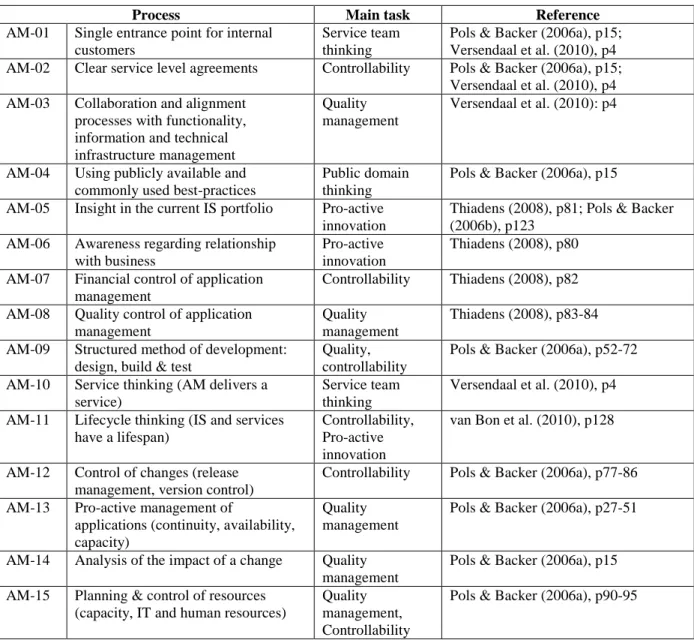
and goals as selection criteria for processes of application management, we derived the following AM processes (Table 3).
Process Main task Reference
AM-01 Single entrance point for internal customers
Service team thinking
Pols & Backer (2006a), p15; Versendaal et al. (2010), p4 AM-02 Clear service level agreements Controllability Pols & Backer (2006a), p15;
Versendaal et al. (2010), p4 AM-03 Collaboration and alignment
processes with functionality, information and technical infrastructure management
Quality management
Versendaal et al. (2010): p4
AM-04 Using publicly available and commonly used best-practices
Public domain thinking
Pols & Backer (2006a), p15 AM-05 Insight in the current IS portfolio Pro-active
innovation
Thiadens (2008), p81; Pols & Backer (2006b), p123
AM-06 Awareness regarding relationship with business
Pro-active innovation
Thiadens (2008), p80 AM-07 Financial control of application
management
Controllability Thiadens (2008), p82 AM-08 Quality control of application
management
Quality management
Thiadens (2008), p83-84 AM-09 Structured method of development:
design, build & test
Quality, controllability
Pols & Backer (2006a), p52-72 AM-10 Service thinking (AM delivers a
service)
Service team thinking
Versendaal et al. (2010), p4 AM-11 Lifecycle thinking (IS and services
have a lifespan)
Controllability, Pro-active innovation
van Bon et al. (2010), p128
AM-12 Control of changes (release management, version control)
Controllability Pols & Backer (2006a), p77-86 AM-13 Pro-active management of
applications (continuity, availability, capacity)
Quality management
Pols & Backer (2006a), p27-51
AM-14 Analysis of the impact of a change Quality management
Pols & Backer (2006a), p15 AM-15 Planning & control of resources
(capacity, IT and human resources)
Quality management, Controllability
Pols & Backer (2006a), p90-95
Table 3: Overview of AM Processes.
Technical Infrastructure Management (TIM) Processes
The Information Technology Infrastructure Library (ITIL) states for its Version 3 the following main goal (van Bon et al., 2010): “enabling the IT service provider to improve the overall quality of service to the business within imposed constraints, while improving the overall effectiveness and efficiency of IT”. ITIL operationalizes this goal using several process groups:
• Service Strategy: identify competition and compete by distinguishing oneself and delivering superior performance;
• Service Design: contribute to business objectives, minimize or prevent risks, assess and improve effectiveness and efficiency of IT, support development of standards and policies;
• Service Transition: supporting change process, reduce variations in performance and errors; • Service Operation: coordinate and fulfill activities and processes required to provide and manage services;
• Continual Service Improvement: continual improvement of effectiveness and efficiency of IT services.
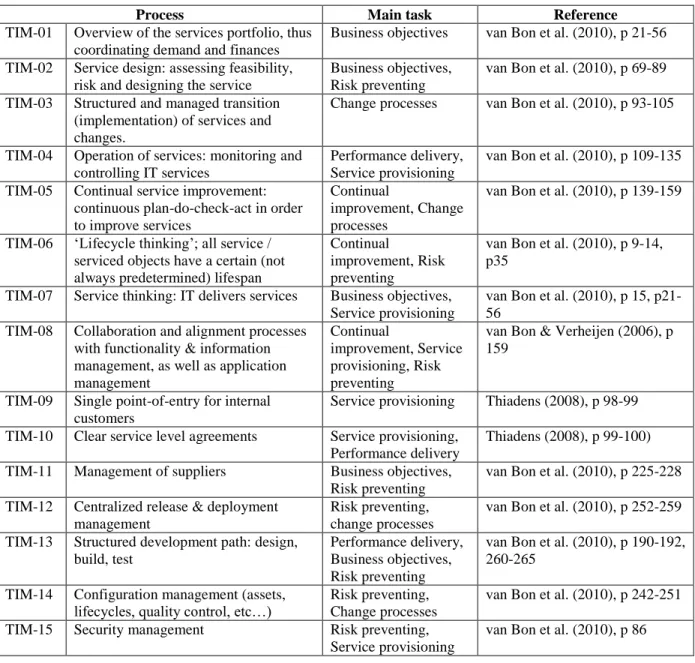
These groups overlap to some extent. Therefore, we derive from them the following key aspects: 1) performance delivery, 2) business objectives, 3) risk preventing, 4) continual improvement, 5) change processes, and 6) service provisioning. Using these key aspects, we derived the following processes from available literature.
Process Main task Reference
TIM-01 Overview of the services portfolio, thus coordinating demand and finances
Business objectives van Bon et al. (2010), p 21-56 TIM-02 Service design: assessing feasibility,
risk and designing the service
Business objectives, Risk preventing
van Bon et al. (2010), p 69-89 TIM-03 Structured and managed transition
(implementation) of services and changes.
Change processes van Bon et al. (2010), p 93-105
TIM-04 Operation of services: monitoring and controlling IT services
Performance delivery, Service provisioning
van Bon et al. (2010), p 109-135 TIM-05 Continual service improvement:
continuous plan-do-check-act in order to improve services
Continual
improvement, Change processes
van Bon et al. (2010), p 139-159
TIM-06 ‘Lifecycle thinking’; all service / serviced objects have a certain (not always predetermined) lifespan
Continual
improvement, Risk preventing
van Bon et al. (2010), p 9-14, p35
TIM-07 Service thinking: IT delivers services Business objectives, Service provisioning
van Bon et al. (2010), p 15, p21-56
TIM-08 Collaboration and alignment processes with functionality & information management, as well as application management
Continual
improvement, Service provisioning, Risk preventing
van Bon & Verheijen (2006), p 159
TIM-09 Single point-of-entry for internal customers
Service provisioning Thiadens (2008), p 98-99 TIM-10 Clear service level agreements Service provisioning,
Performance delivery
Thiadens (2008), p 99-100) TIM-11 Management of suppliers Business objectives,
Risk preventing
van Bon et al. (2010), p 225-228 TIM-12 Centralized release & deployment
management
Risk preventing, change processes
van Bon et al. (2010), p 252-259 TIM-13 Structured development path: design,
build, test
Performance delivery, Business objectives, Risk preventing
van Bon et al. (2010), p 190-192, 260-265
TIM-14 Configuration management (assets, lifecycles, quality control, etc…)
Risk preventing, Change processes
van Bon et al. (2010), p 242-251 TIM-15 Security management Risk preventing,
Service provisioning
van Bon et al. (2010), p 86
Validation
As earlier stated, the domain of IT management is a frequent topic of discussion, especially in regards of structuring, optimizing, organization, etc… (Meijer, 2008; Meijer & Boer, 2004; Meijer, Zwaal, & Koppens, 2006). Considering this, it is necessary to validate the results thus far. In order to do so, we approached members of knowledge organizations, employees of banking, insurance, retail, wholesale and educational organizations in order to conduct a questionnaire. A requirement for our respondents was that they are actively working or have worked in at least one of the aforementioned IT management domains (FIM/AM/TIM).
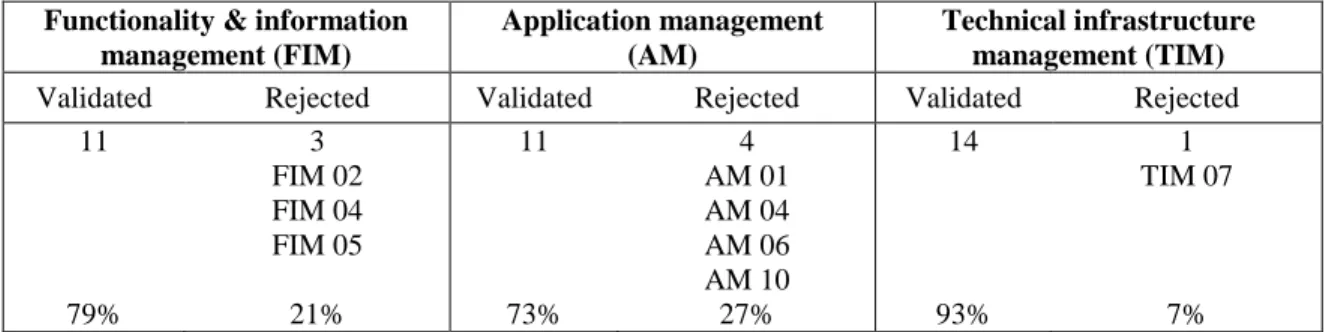
We based our questionnaire setup on the work of Versendaal et al. (2010). Respondents were asked to rate to what extent they were to agree or disagree with the contribution of a specific process to the goals of the IT management domain the process is part of. Table 5 presents the results of this validation. Based on the results of the validation, eight processes were rejected and removed from the study.
Functionality & information management (FIM)
Application management (AM)
Technical infrastructure management (TIM)
Validated Rejected Validated Rejected Validated Rejected
11 79% 3 FIM 02 FIM 04 FIM 05 21% 11 73% 4 AM 01 AM 04 AM 06 AM 10 27% 14 93% 1 TIM 07 7%
Table 5: IT Management Processes Validation Results.
In our questionnaire, we also asked respondents what processes were potentially missing. Although the answers did not give reason to add a process, we consider the list of IT management processes to be a list that can be developed further, as the IT management field advances (Davis, 2010; Hoving & van Bon, 2010; van Bon & Verheijen, 2006).
ENTERPRISE AGILITY
There are many different labels covering the concept of agility; examples are: adaptability, changeability, flexagility, flexibility, maintainability, manageability, etc. The same is true for agility frameworks, applied to different concepts such as: manufacturing, supply chain, organization, enterprise, information systems development, software development, project management, planning, etc. There appears to be confusion among practitioners regarding overlap in terminology and definitions of terms expressing agility (Sherehiy et al., 2007; Wadwha & Rao, 2003). Viewing agility as an intrinsic ability to adapt diminishes the difference between flexibility and agility. Agility is more regarded as the ability to change in order to comply with a yet unknown context, whereas flexibility is regarded as an ability to change in order to comply with a known context. We interpret this aspect of agility as having a good vantage point. In our research, we adopt the following definition of enterprise agility: “The ability of firms to sense
environmental change and respond readily” (Overby et al., 2006). Following this definition we find that sense is less valuable without the ability to respond and vice versa.
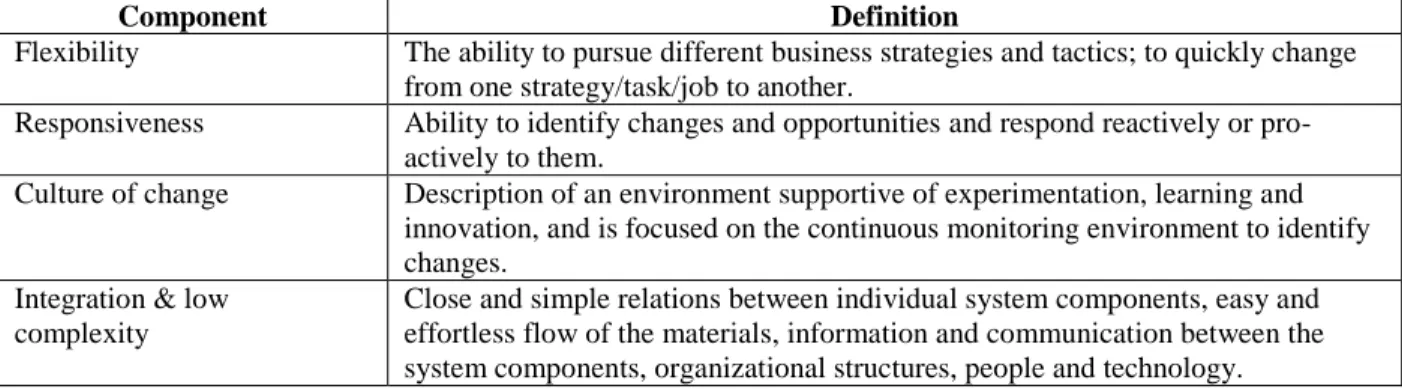
Table 6 presents the components of enterprise agility as identified in our study (based on Sherehiy et al., 2007). Sherehiy et al. (2007) also identifies ‘speed’ as a component of agility. We, however, argue its usefulness in our research, because of its relationship with all other agility aspects and general character. Speed is a logical component of agility; however it is also a part of flexibility, responsiveness, culture of change and is affected by integration and complexity.
Component Definition
Flexibility The ability to pursue different business strategies and tactics; to quickly change from one strategy/task/job to another.
Responsiveness Ability to identify changes and opportunities and respond reactively or pro-actively to them.
Culture of change Description of an environment supportive of experimentation, learning and innovation, and is focused on the continuous monitoring environment to identify changes.
Integration & low complexity
Close and simple relations between individual system components, easy and effortless flow of the materials, information and communication between the system components, organizational structures, people and technology.
Table 6: Components of Enterprise Agility.
Regarding the last component, integration and low complexity, despite of the fact that these appear to be two separate aspects, we concur that they are interdependent. Integration of information systems (interconnecting) may increase complexity because of interdependencies in information systems, therefore potentially decreasing agility. Integration in combination with low complexity counteracts the potential drop in agility. For this reason, we adopted them as a whole.
RESEARCH DESIGN
Based on the conceptualization of the main constructs in our study in the previous sections, the conceptual model of the study can now be depicted as follows in Figure 2. Based on this conceptual model, 144 propositions can be identified (in total 36 processes in IT management multiplied with four enterprise agility components). The identified processes already included some indications on the relationship between IT management and enterprise agility. For example:
The processes in the FIM domain appear to be supportive of change in their pursuit of aligning information systems with business processes.
The processes in the AM domain focus more on overview and control. Being in control implies better ability to switch strategies and enables timely response.
Figure 2: Conceptual Model of the Study.
These findings are complemented by the fact that Looijen (2004) states that professional IT management is necessary in order to cope with external influences. Based on these arguments, we formulate the following hypothesis: Effective and efficient IT management processes support enterprise agility.
Propositions were validated in a mixed method expert study: Five experts in the field of IT management filled in a questionnaire in which they assessed the impact of each IT management process factor on the four components of agility on a Likert scale. Respondents were highly recommended practitioners, experts and authors in IT management. This structured data collection was then followed-up by semi-structured interviews with the experts. The scope of each interview was adjusted to match the field of expertise of the expert.
FINDINGS
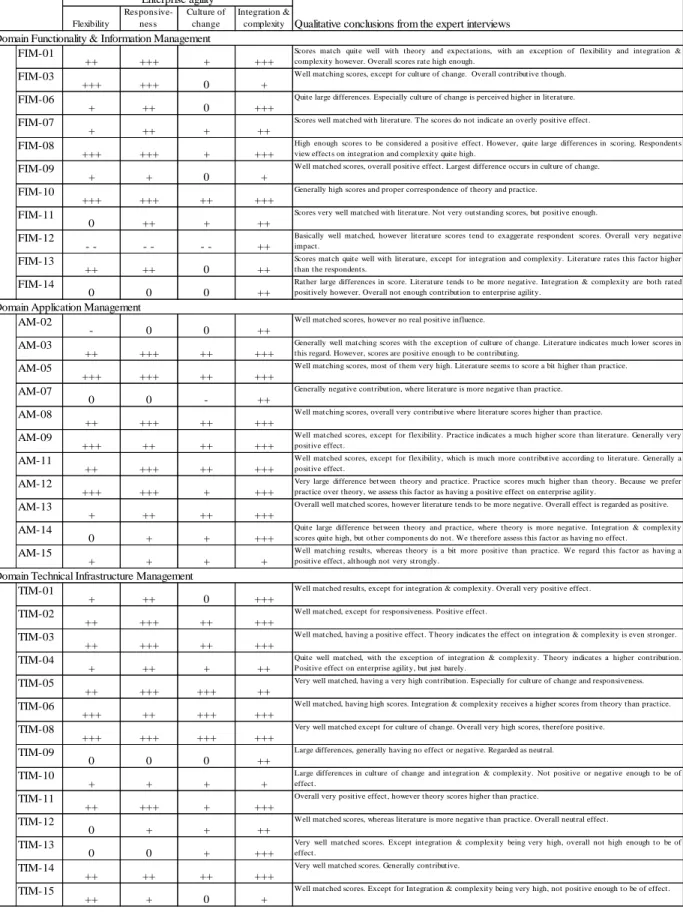
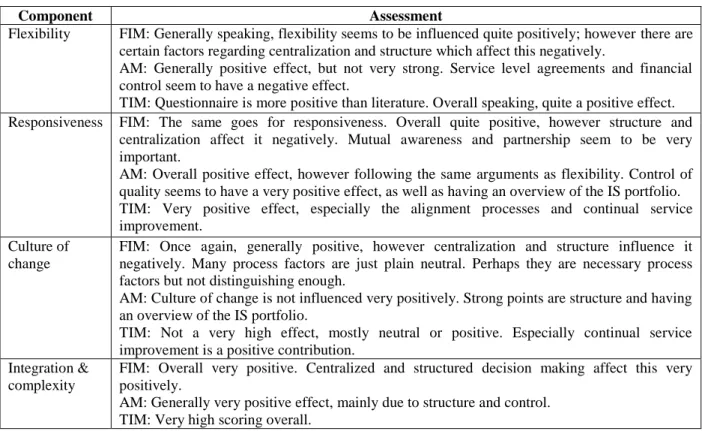
Table 7 presents the results of the expert study (depicted on the next page due to its size). Summarizing this analysis, we find the overall contribution of IT management to enterprise agility to be very positive. 24 of 36 process factors are assessed to have an overall positive effect on enterprise agility. And only two processes, FIM-12 (centralized decision making regarding implementation of specific changes) and AM-07 (financial control of application management), were found to contribute negatively. This result is overall very supportive for our hypothesis and leads us to conclude that IT management does in fact have a positive effect on enterprise agility. Table 8 analyzes how the IT management processes enable enterprise agility, by summarizing the assessed impact per agility component.
F unc ti ona li ty & Inform a ti on M a na ge m e nt FIM 1FIM 3 FIM 7 FIM 9 FIM 11 FIM 13 FIM 6 FIM 8 FIM 10 FIM 12 FIM 14 A ppl ic a ti on M a na ge m e nt AM 3 AM 5 AM 7 AM 9 AM 11 AM 13 AM 15 AM 2 AM 8 AM 12 AM 14 T e c hni c a l Inf ra st ruc ture M a na ge m e nt TIM 1 TIM 3 TIM 5 TIM 9 TIM 11 TIM 13 TIM 15 TIM 2 TIM 4 TIM 6 TIM 8 TIM 10 TIM 12 TIM 14 Flexibility
IT Management Enterprise Agility
Responsiveness
Culture of change
Integration & low complexity
Table 7: Results from the Expert Study. Flexibility Responsive-ness Culture of change Integration & complexity FIM-01 ++ +++ + +++
Scores match quite well with theory and expectations, with an exception of flexibility and integration & complexity however. Overall scores rate high enough.
FIM-03
+++ +++ 0 +
Well matching scores, except for culture of change. Overall contributive though.
FIM-06
+ ++ 0 +++
Quite large differences. Especially culture of change is perceived higher in literature.
FIM-07
+ ++ + ++
Scores well matched with literature. T he scores do not indicate an overly positive effect.
FIM-08
+++ +++ + +++
High enough scores to be considered a positive effect. However, quite large differences in scoring. Respondents view effects on integration and complexity quite high.
FIM-09
+ + 0 +
Well matched scores, overall positive effect. Largest difference occurs in culture of change.
FIM-10
+++ +++ ++ +++
Generally high scores and proper correspondence of theory and practice.
FIM-11
0 ++ + ++
Scores very well matched with literature. Not very outstanding scores, but positive enough.
FIM-12
- - - ++
Basically well matched, however literature scores tend to exaggerate respondent scores. Overall very negative impact.
FIM-13
++ ++ 0 ++
Scores match quite well with literature, except for integration and complexity. Literature rates this factor higher than the respondents.
FIM-14
0 0 0 ++
Rather large differences in score. Literature tends to be more negative. Integration & complexity are both rated positively however. Overall not enough contribution to enterprise agility.
AM-02
- 0 0 ++
Well matched scores, however no real positive influence.
AM-03
++ +++ ++ +++
Generally well matching scores with the exception of culture of change. Literature indicates much lower scores in this regard. However, scores are positive enough to be contributing.
AM-05
+++ +++ ++ +++
Well matching scores, most of them very high. Literature seems to score a bit higher than practice.
AM-07
0 0 - ++
Generally negative contribution, where literature is more negative than practice.
AM-08
++ +++ ++ +++
Well matching scores, overall very contributive where literature scores higher than practice.
AM-09
+++ ++ ++ +++
Well matched scores, except for flexibility. Practice indicates a much higher score than literature. Generally very positive effect.
AM-11
++ +++ ++ +++
Well matched scores, except for flexibility, which is much more contributive according to literature. Generally a positive effect.
AM-12
+++ +++ + +++
Very large difference between theory and practice. Practice scores much higher than theory. Because we prefer practice over theory, we assess this factor as having a positive effect on enterprise agility.
AM-13
+ ++ ++ +++
Overall well matched scores, however literature tends to be more negative. Overall effect is regarded as positive.
AM-14
0 + + +++
Quite large difference between theory and practice, where theory is more negative. Integration & complexity scores quite high, but other components do not. We therefore assess this factor as having no effect.
AM-15
+ + + +
Well matching results, whereas theory is a bit more positive than practice. We regard this factor as having a positive effect, although not very strongly.
TIM-01
+ ++ 0 +++
Well matched results, except for integration & complexity. Overall very positive effect.
TIM-02
++ +++ ++ +++
Well matched, except for responsiveness. Positive effect.
TIM-03
++ +++ ++ +++
Well matched, having a positive effect. T heory indicates the effect on integration & complexity is even stronger.
TIM-04
+ ++ + ++
Quite well matched, with the exception of integration & complexity. T heory indicates a higher contribution. Positive effect on enterprise agility, but just barely.
TIM-05
++ +++ +++ ++
Very well matched, having a very high contribution. Especially for culture of change and responsiveness.
TIM-06
+++ ++ +++ +++
Well matched, having high scores. Integration & complexity receives a higher scores from theory than practice.
TIM-08
+++ +++ +++ +++
Very well matched except for culture of change. Overall very high scores, therefore positive.
TIM-09
0 0 0 ++
Large differences, generally having no effect or negative. Regarded as neutral.
TIM-10
+ + + +
Large differences in culture of change and integration & complexity. Not positive or negative enough to be of effect.
TIM-11
++ +++ + +++
Overall very positive effect, however theory scores higher than practice.
TIM-12
0 + + ++
Well matched scores, whereas literature is more negative than practice. Overall neutral effect.
TIM-13
0 0 + +++
Very well matched scores. Except integration & complexity being very high, overall not high enough to be of effect.
TIM-14
++ ++ ++ +++
Very well matched scores. Generally contributive.
TIM-15
++ + 0 +
Well matched scores. Except for Integration & complexity being very high, not positive enough to be of effect.
Domain Functionality & Information Management
Domain Application Management
Domain Technical Infrastructure Management Enterprise agility
Component Assessment
Flexibility FIM: Generally speaking, flexibility seems to be influenced quite positively; however there are certain factors regarding centralization and structure which affect this negatively.
AM: Generally positive effect, but not very strong. Service level agreements and financial control seem to have a negative effect.
TIM: Questionnaire is more positive than literature. Overall speaking, quite a positive effect. Responsiveness FIM: The same goes for responsiveness. Overall quite positive, however structure and
centralization affect it negatively. Mutual awareness and partnership seem to be very important.
AM: Overall positive effect, however following the same arguments as flexibility. Control of quality seems to have a very positive effect, as well as having an overview of the IS portfolio. TIM: Very positive effect, especially the alignment processes and continual service improvement.
Culture of change
FIM: Once again, generally positive, however centralization and structure influence it negatively. Many process factors are just plain neutral. Perhaps they are necessary process factors but not distinguishing enough.
AM: Culture of change is not influenced very positively. Strong points are structure and having an overview of the IS portfolio.
TIM: Not a very high effect, mostly neutral or positive. Especially continual service improvement is a positive contribution.
Integration & complexity
FIM: Overall very positive. Centralized and structured decision making affect this very positively.
AM: Generally very positive effect, mainly due to structure and control. TIM: Very high scoring overall.
Table 8: Contribution to Enterprise Agility Components of Different IT Management Domains.
From Table 8 it can be concluded that the ‘Culture of change’ component is expected to be least influenced by IT management. We should also note that IT management is not the sole ingredient for building agile enterprises (Tsourveloudis & Valavanis, 2002). The IT component is but one factor, however based on the enterprise agility assessment framework by Tsourveloudis & Valavanis (2002), we conclude IT is an highly important ingredient for enterprise agility.
CONCLUSIONS
We reviewed the domains of IT management and enterprise agility and offered decompositions of both these constructs for our research. Using these decompositions we were able to assess the influence of IT management on enterprise agility on a deeper level, and explore arguments behind the relationship as well.
The results of our study show support for our hypothesis that, in general, effective and efficient IT management processes support enterprise agility. Most IT management processes are assessed to contribute positively to enterprise agility. Two process factors were found to contribute negatively: FIM-12 (centralized decision making regarding implementation of specific changes) and AM-07 (financial control of application management). Both process factors were perceived as bottlenecks in regular IT processes, therefore obstructing quick and nimble response. According to our respondents, a possible method of diminishing the negative effect of those bottlenecks would be to set-up an alternate route to bypass the bottleneck. To make this work effectively and avoid abuse of such a bypass, clear agreements and criteria are necessary.
Of the components of enterprise agility it was found that IT management processes support most of all flexibility, responsiveness and integration & low complexity. The culture of change component was least supported.
When decomposing enterprise agility into sense and respond, we find that out of all domains, the FIM domain is best suited for sensing, therefore supporting its domain goals. Basically, sense and response are blended here, from which the desired response is a message to AM or TIM, to produce a specific deliverable.
Reviewing the concept of agility, being able to respond readily is generally improved by having a good starting point or vantage point. This is a trait which many of the reviewed process factors share. Interestingly enough, this also appears to be a foundation of many of the best practice frameworks used in this research. From discussions with our respondents we concluded that although it is good to have a proper vantage or starting point, this also requires an investment of resources. Therefore expenses required for agility need to be justifiable.
A limitation of our study is the limited number of experts. This limitation provides an opportunity for further research. Another suggestion for refinement of the hypothesis would be the addition of situational variables, such as organizational culture, strategy and business and IT alignment maturity.
REFERENCES
Brown, S. L., & Eisenhardt, K. M. (1997). The art of continuous change: Linking complexity theory and time-paced evolution in relentlessly shifting organizations. Administrative Science Quarterly, 42(1), 1-34.
Cater-Steel, A., & Tan, W. G. (2005). Implementation of IT infrastructure library (ITIL) in Australia: Progress and success factors. In IT Governance International Conference, Auckland, New Zealand (pp. 14–16).
Collins, J. (2001). Good to great: Why some companies make the leap . . . and others don’t, New York, NY: HarperBusiness.
Davis, C. L. (2010, February 11). Improving the implementation of ITIL and CMMI frameworks. Retrieved from http://ectd.du.edu/source/uploads/23563383.pdf Hoving, W., & van Bon, J. (2010). De ISM-methode (pp. 45-48; 117).
Kettinger, W. J., & Grover, V. (1995). Special section: Toward a theory of business process change management. Journal of Management Information Systems, 12(1), 9-30. Kettinger, W. J., Teng, J. T. C., & Guha, S. (1997). Business process change: A study of
Lee, G., & Xia, W. (2010). Towards agile: An integrated analysis of quantitative and qualitative field data on software development agility. MIS Quarterly, 34(1), 87–114.
Looijen, M. (2004). Beheer van informatiesystemen (6th ed., pp. 34-36, 52-53, 155-188, 247-260). Hagen & Stam Uitgevers. (In Dutch)
Meijer, M. (2008). BiSL is geen echt procesmodel , geen rolmodel , maar wel een goed hulpmiddel. Management, (April), 39-43. (In Dutch)
Meijer, M., & Boer, H. (2004). De betekenis van ASL en ITIL AM voor applicatiebeheer. IT Service Management: Best Practices (pp. 419-430). (In Dutch)
Meijer, M., Zwaal, M., & Koppens, S. (2005). ASL and ITIL: powerful together.
innovativeconsulting.it,.
Meijer, M., Zwaal, M., & Koppens, S. (2006). ASL and ITIL: powerful together. IT Service Management: Best Practices, 1-17.
Overby, E., Bharadwaj, A., & Sambamurthy, V. (2006). Enterprise agility and the enabling role of information technology. European Journal of Information Systems, 15(2), 120–131. doi: 10.1057/palgrave.ejis.3000600
Peterson, R. R. (2004). Integration strategies and tactics for information technology governance. In W. van Grembergen (Ed)., Strategies for information technology governance (pp. 37-73). Hershey, PA: Idea Group.
Pols, R. (2001). ASL: Een framework voor applicatiebeheer. (In Dutch)
Pols, R., & Backer, Y. (2007). BiSL: A management guide (8th ed., p. 21). Zaltbommel, Netherlands: Van Haren Publishing.
Pols, R., & Meijer-Veldman, M. E. E. (2002). ASL, second generation application management. Retrieved from http://maise.nl/en%20ASL%20second%20generation%20AM%20.pdf Sambamurthy, V., Bharadwaj, A., & Grover, V. (2003). Shaping agility through digital options:
Reconceptualizing the role of information technology in contemporary firms. MIS Quarterly, 27(2), 237–263.
Sherehiy, B., Karwowski, W., & Layer, J. (2007). A review of enterprise agility: Concepts, frameworks, and attributes. International Journal of Industrial Ergonomics, 37(5), 445-460. doi: 10.1016/j.ergon.2007.01.007
Sohal, A. S., & Fitzpatrick, P. (2002). IT governance and management in large Australian organisations. International Journal of Production Economics, 75(1-2), 97-112. doi: 10.1016/S0925-5273(01)00184-0
Thiadens, T. (2008). Sturing en organisatie van ICT-voorzieningen (pp. 26-33). Zaltbommel, Netherlands: Van Haren Publishing.
Trkman, P. (2009). The critical success factors of business process management. International Journal of Information Management, 30, 125-134. doi: 10.1016/j.ijinfomgt.2009.07.003 Tsourveloudis, N. C., & Valavanis, K. P. (2002). On the measurement of enterprise agility.
Journal of Intelligent and Robotic Systems, 33(3), 329–342. doi: 10.1023/A:1015096909316
van der Aalst, W. M. P., ter Hofstede, A. H. M., & Weske, M. (2003). Business process management: A survey. Business Process Management, 1019–1019.
van der Beer, R. D., Pols, R., Engelhart, P., & van den Berg, D. (2006). Inrichting van
functioneel beheer in grote organisaties. IT Service Management Best Practices Deel, 2. (In Dutch)
van Bon, J., de Jong, A., Kolthof, A., Pieper, M., Tjassing, R., van der Veen, A., & Verhijen, T. (2010). Foundations of ITIL V3 (pp. 9-159). Zaltbommel, Netherlands: Van Haren Publishing
van Bon, J., & Verheijen, T. (Eds.). (2006). Frameworks for IT management (pp. 127-129). Zaltbommel, Netherlands: Van Haren Publishing
van Duivenboden, H., & Thaens, M. (2008). ICT-driven innovation and the culture of public administration: A contradiction in terms? Information Polity, 13(3, 4), 213–232. Versendaal, J., van Gils, B., & Janssen, W. (2010). Operational excellent application
management: A case study at an insurance company. IADIS. Retrieved from
http://www.research.hu.nl/~/media/sharepoint/Lectoraat%20Extended%20Enterprise%20 Studies/2010/2010-Versendaal_Gils_Janssen_2010.pdf
Yusuf, Y. Y., Sarhadi, M., & Gunasekaran, A. (1999). Agile manufacturing: The drivers,
concepts and attributes. International Journal of Production Economics, 62(1-2), 33–43. doi: 10.1016/S0925-5273(98)00219-9