A Statistical Analysis of Bicycle Rider Performance:
The impact of gender on riders’ performance at
signalized intersections
Nikki Wheeler, Ryan Conrad
Graduate Research Assistants
Miguel Andres Figliozzi*
*corresponding author, Assistant Professor
Civil and Environmental Engineering
Portland State University
Published
Proceedings 89th Annual Meeting Transportation Research Board January 10–14, 2010
To be referenced as:
WHEELER, N., CONRAD, R. & FIGLIOZZI, M. A. (2010) A Statistical Analysis of
Bicycle Rider Performance: The impact of gender on riders’ performance at signalized
intersections. Proceedings 89th Annual Meeting of the Transportation Research Board
January 10–14, 2010.
A Statistical Analysis of Bicycle Rider Performance: The impact of gender on riders’ performance at signalized intersections
Miguel Andres Figliozzi Ryan Conrad Nikki Wheeler
ABSTRACT
Bicycling for transportation purposes has become a popular activity across a wide range of demographic groups, ages, and fitness levels. To design safe roadways and intersections it is necessary to understand and quantify distribution of speeds, accelerations, and reaction times among the population of cyclists. This study was conducted to investigate the effect of gender on commuter cyclists’ intersection crossing times. Data collection took place during peak commuting hours in winter and summer months at two intersections in Portland, Oregon, with consistent commuter bicycle traffic. Statistical analyses were performed on both the aggregated and disaggregated data samples to investigate the effects of gender and intersection grade on cyclists’ crossing times. Categorical and parametric tests found statistically significant differences for male-female groups. Gender has an impact on the crossing times of cyclists traveling uphill, as indicated by the 15th percentile crossing times. In addition, the observed average speeds are significantly slower than the 12 ft/s recommended by AASHTO for basic/beginner cyclists. These finding have important implications for traffic signal design and safety since slower cyclists may require longer clearance times during signal phase changes and longer minimum green and yellow times at demand-actuated signals.
1. INTRODUCTION
The city of Portland, Oregon has taken great strides in bringing bicycling facilities into the current roadway infrastructure, and has aimed to make cycling a safe and attractive option for people as a means to travel around the city. Portland’s bike planning goals are focused on improving safety for cyclists, increasing connectivity between cycling facilities throughout the city, and creating a comfortable environment that will encourage all users to cycle. The city’s focus on providing a mix of facilities and accommodations for cyclists has correlated with continuing growth in cycling’s steadily increasing modal share. A recent report from the City of Portland Bureau of Transportation (CPBT) found significant increases in bicycle traffic, with volumes in 2008 nearly tripling those found in 2001, after only minor additions in the total bikeway miles [1]. Additionally, CPBT reported a shift in the population of female cyclists, who contributed to roughly 32% of all riders in 2008 compared to 26% in 1997 [1]. These findings suggest a possible change in overall demographics of the Portland cycling community (particularly the female cycling population) responding positively to the City of Portland’s commitment to create a cycling environment that appeals to all user types. Studying the current demographic mix of Portland cyclists is the primary goal of this research.
In order to continue to adequately accommodate Portland’s diverse cyclist population on the public right-of-way, it is vital to understand that there may be physical differences among the users tied to particular demographics, which may ultimately require engineers to make special design considerations. Bicycle rider performance studies are important in particular for intersection and traffic signal design, to adequately accommodate slower cyclists that may require longer clearance times during signal phase changes and longer minimum green time at demand-actuated signals. Often these particular features are designed according to motor vehicle speeds and accelerations, which may be inadequate for cyclists of an average performance level.
Wachtel et al. highlight the most common signal timing issue related to car-bike collisions; that of a cyclist hit after lawfully entering an intersection on a yellow phase by a motorist on the intersecting street restarting or accelerating into the intersection upon receiving a green phase [2]. In this situation, the clearance time is not sufficient for a cyclist at cruising speed to travel safely across the intersection. Another signal timing issue can occur at the start of a green phase at an actuated signal. If the signal provides only a minimum green time designed for motor vehicles (a result of low vehicle demand), the green time may not be long enough to
accommodate the time needed for cyclists to react, accelerate and traverse the intersection, especially in situations where multiple cyclists may have formed a queue.
Because there may be differences among cycling demographics, it is possible that strong riders may have the speed necessary to clear an intersection safely in situations where clearance and green time may be minimal. However, a user who requires more time to cross safely (such as a child or older cyclist) may be caught midway through the intersection when opposing traffic receives a green. For this reason, Pucher and Buehler also stress the importance of designing facilities with proper detection to recognize cyclists and to provide facilities that accommodate all riders, particularly children and older adults that may not otherwise choose to cycle in the typical urban setting because it creates a stressful environment [3].
Cyclist performance at urban intersections is an important area of research into bicycle safety, for which only a meager amount of research and data are available. Additionally, looking at how performance varies between age groups and gender groups can provide engineers with information on specific demographics that may aid them in accommodating a wide range of potential users. This can ultimately improve their ability to properly design bicycle facilities for all user types. The purpose of this research is to determine factors that affect the overall performance of cyclists by studying intersection crossing times for typical commuter cyclists at various intersections in Portland, Oregon. Differences in performance are analyzed according to intersection grade and gender. Additionally, two intersections are studied and discussed in this report: 1) an intersection with an approximately level grade and 2) an intersection with a steady uphill grade.
2. LITERATURE REVIEW
This review begins with a survey of existing design guides for intersection design with specific regards to bicycle traffic. Following this is a review of the state of research into cyclist crossing times and other performance measures at intersections. Next, a brief review of social factors that can influence design accommodations for cyclists is covered. Lastly, an overview of some of the most recent research into such behavioral aspects as route and trip choice of typical Portland commuter cyclists is provided.
The American Association of State Highway and Transportation Officials (AASHTO) Guide for the Development of Bicycle Facilities contains the national guidelines for bicycle
facility design and also has recommendations for traffic signal timing. Additionally, the guide provides a formula for adjusting the duration of the all-red phase [4]. Accelerations of 1.5 to 3.0 ft/s2 and average speeds of 12.7, 12.0 and 9.1 ft/s for advanced, basic/beginner and child cyclist are specified, respectively [4]. These guidelines provided by AASHTO on cyclist speed and acceleration are typically used by engineers during traffic signal design where cyclists are being considered in addition to motor vehicle traffic.
There is some dispute as to whether or not the AASHTO recommended values are reasonable estimates for the speeds of different cyclists. A handful of studies have been conducted to measure average speeds and accelerations and compare them to the guide. Rubins and Handy (2005) measured intersection clearance times for cyclists in Davis, California from stopped, slowed and rolling positions across a wide age range [5]. Their results for average cyclist speed within the intersections studied showed a slightly lower cyclist speed when compared to the AASHTO guide. Pein measured the average speed and approximated the acceleration of cyclists on multi-use paths (MUPs) and T-intersections and obtained similar results to the AASHTO guidelines [6]. To the best of the authors’ collective knowledge, there are no studies that look specifically at speeds of different age groups and genders, although the AASHTO guide recognizes that there are differences in speed between adult and child cyclists.
Signal timing intervals and the physical performance of cyclists are critical safety factors in urban environments, and research has been conducted to help reduce the possibility of dangerous car-bike collisions. Wachtel et al. established guidelines for determining clearance intervals of different intersections for cyclists and also determined that cyclists have stopping distances similar to most motor vehicle traffic [2]. They also highlight the most common facility-associated cause of car-bike collisions, where a cyclist is struck midway through an intersection where there is insufficient clearance time for the cyclist to cross the intersection safely. Such accidents tend to be most common when a cyclist is traversing a wide intersection from a minor street or collector. These authors also discuss the implications of traffic laws with regards to this problem and assess risk levels for different clearance times [2].
While intersection clearance time is important to the safety of cyclists, Pucher and Buehler identify social considerations affecting cyclists in the U.S. with regards to infrastructure and accommodations [3]. The authors discuss the problems associated with failing to consider bicycle traffic when designing intersections. For instance, neglecting to install detector loops can
also be problematic for cyclists in addition to clearance time issues. Pucher and Buehler also stress the importance of designing facilities that will accommodate the needs of all riders [3].
In addition to a cyclist’s physical limitation, the roadway characteristics also play a role in determining the speed and acceleration that a cyclist is capable of achieving. Taylor and Davis present a literature review of scientific research into bicycle facility design and traffic analysis. They note that research to date has not been conducted on the effects of roadway grade on cyclist performance at intersections or on cyclist reaction times in response to traffic lights [7]. Although no research has been conducted at intersections with grades, research by Navin verified theoretical guidelines for speed for riders climbing a grade that was not near an intersection. The experiment looked at 10-year-olds (male and female) and 25-year-old males traveling uphill—the study did not look at downgrade [8]. These two age groups of riders were intended to represent a lower and upper limit for speed, respectively. The study verified that the 25 year-old males achieved the higher speed, which indicates a relationship between age and a cyclist’s speed when traveling on a grade.
The Portland area presents a unique opportunity to study cyclists in an urban environment where there is a varied population of cyclists actively using existing bicycle facilities. Portland also shows a strong potential to attract additional rider groups that may be underrepresented. Regionally, the CPBT classifies cyclists into four basic categories based on surveys of rider perceptions and opinions of safety [9]. The largest group identified by these surveys (roughly 60% of the total population) are those that express interest in becoming avid cyclists, but are concerned about safety issues when riding with (or adjacent to) motor vehicle traffic. For some (33% of the surveyed population), perceived safety concerns are enough to deter potential cyclists from even considering cycling; this group is classified as “No Way, No How”. Roughly 7% of those surveyed are classified as being “Enthused and Confident” and “Strong and Fearless”. In 2006, it was also identified that approximately twice as many Portland males ride than Portland females [10]. The city reported that those areas that are more “bicycle-friendly” (with facilities such as bicycle boulevards) see more females than areas that may be perceived as less “bicycle-friendly” [10]. This emphasizes the importance of providing facilities that will accommodate all user types.
In order to study Portland cycling demographics more closely, research by Dill and Gliebe investigated cyclist route choice decisions and surveyed the riders to gain an understanding of why cyclists make the choices they do [11]. The adults in the study were
equipped with GPS units to gather data on the riders during their daily cycling activities in Portland. Key findings showed that riders prefer using available bicycle facilities, even when they increase travel time to the destination. Women and inexperienced riders particularly, prefer to travel in lower traffic areas. Bike facilities that provide routes with reduced motor vehicle traffic or lower speeds (such as bike boulevards) are recommended as a feature that may increase the perception of safety for women and inexperienced riders.
3. METHODOLOGY
Two intersections were studied for this work during two collection periods: winter and summer. In order to increase sample size, collection was performed on two days during the summer. A description of each intersection is provided, as well as data collection methods used.
Level Intersection Study
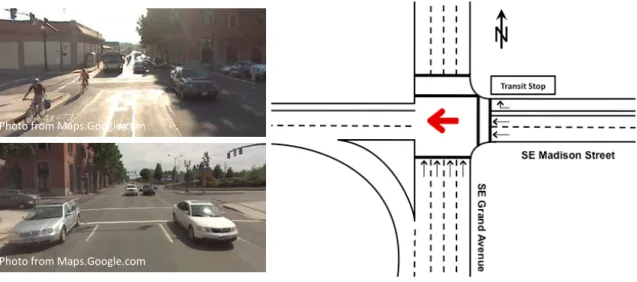
The first investigation, referred hereafter as the level intersection study, was the intersection of SE Madison Street and SE Grand Avenue in Portland, Oregon. Crossing time data were collected for cyclists traveling on SE Madison Street westbound and crossing SE Grand Avenue. This intersection is located along a popular morning commute route into downtown Portland, and has a high volume of bicycle traffic with mixed and varied demographics and ages. The intersection is nearly level, and pavement was in relatively good condition at the time of data collection. The following photos shown in Figure 1 present the intersection from different approaches.
FIGURE 1 Level intersection
Clockwise from top left: E Madison Street Facing East; SE Madison Street & SE Grand Avenue Intersection Diagram; SE Grand Avenue Facing South.
Photo from Maps.Google.com Photo from Maps.Google.com
Figure 1 also provides the intersection configuration. SE Madison Street is one-way with westbound traffic. SE Grand Avenue is one-way with northbound traffic. On the east leg approach, SE Madison Street has two through lanes, and a bike lane located between a right-turn-only lane and the right most through lane. On the south leg approach, SE Grand Avenue has four through lanes; a slip-lane off of the left most through lane allows vehicles onto SE Madison Street just west of the intersection. A bus stop is located at the east leg approach in the right-turn only lane. To accurately and consistently measure cyclists crossing times and minimize confounding factors, data were collected only for cyclists who had come to a complete stop at the designated start position (the first crosswalk line), and were not impeded by the westbound buses.
Because the intersection of SE Madison Street and SE Grand Avenue is located along a popular morning commute route, data collection took place during the expected morning peak hour between 7:00 AM and 10:30 AM. Temperature data were obtained from a weather station located at the Portland International Airport for all collection periods at both the level and grade intersections. During the hours of the winter data collection at the level intersection, the temperature was between 36 °F and 48 °F, with partly clouding skies, and no wind or rain [12]. During the hours of the summer data collection, the temperature was between 64 °F and 71 °F, with clear skies, and no wind or rain.
Grade Intersection Study
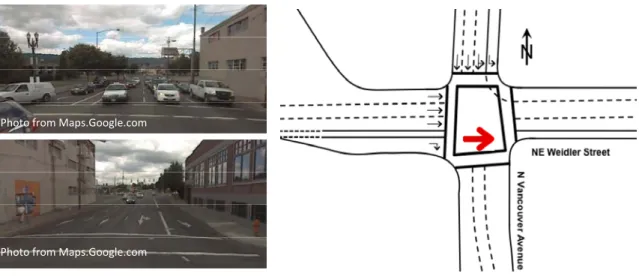
The second investigation, referred hereafter as the grade intersection study, was the intersection of NE Weidler Street and N Vancouver Avenue in Portland, Oregon. Crossing time data were collected for cyclists traveling uphill on NE Weidler Street eastbound and crossing N Vancouver Avenue. This intersection is located along another popular commute route leaving downtown Portland, also with varied demographics and ages. Many cyclists travel from downtown Portland on their evening commute along this route. Pavement conditions were relatively good at this intersection at the time of each data collection. Photos of the intersection from different approaches are provided in Figure 2 along with the intersection configuration.
NE Weidler Street is one-way with eastbound traffic traveling uphill. On the west leg approach, NE Weidler Street has three through lanes, and a bike lane located between a right-turn-only lane and the right most through lane. Although buses are present, there is no bus stop located directly at the intersection and therefore no buses interfered with bike traffic during the data collection period. N Vancouver Avenue is one-way with southbound traffic, and provides
access to a southbound Interstate 5 on-ramp. On the south leg approach, N Vancouver Avenue has two through lanes, a through-left lane, and a left-turn only lane onto NE Weidler Street as shown in Figure 2.
FIGURE 2 Grade Intersection
Clockwise from top left, NE Weidler Street Facing West; NE Weidler Street & N Vancouver Avenue Intersection Diagram; N Vancouver Avenue Facing North.
Data collection coincided with the expected afternoon peak period between 3:00 PM and 6:30 PM for the summer and winter collection periods. The temperature during the hours of the winter data collection was between 43 °F and 50 °F, with partly cloudy skies, and no wind or rain [12]. It became dark during the winter collection at approximately 4:45 PM, however, street lamps provided enough visibility for data collection to continue. The temperature during the hours of the summer collection was between 87 °F and 95 °F, with clear skies and no wind or rain.
Data Collection Procedure
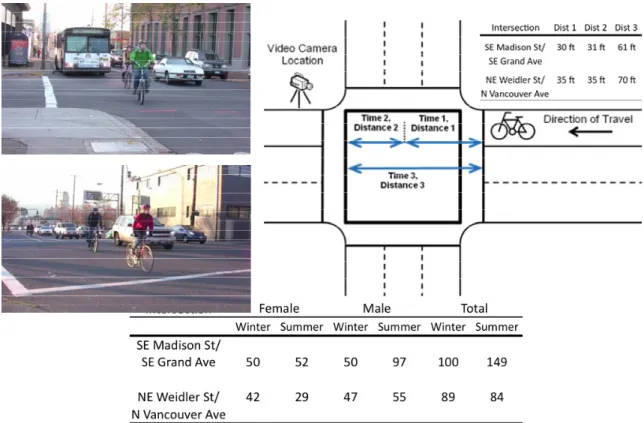
It was determined that acquiring crossing time data manually using video footage of the data collection would be the most accurate and feasible method. For each intersection, a video camera was located at the far-side of the intersection (relative to the direction of bike traffic), on the sidewalk adjacent to the bike lane. This provided a view of the cyclists approaching the intersection, stopping at the near-side of the intersection on a red light, and traveling through the intersection on a green light. Figure 3 shows the view from the video camera at each intersection and a diagram of the field setup.
Photo from Maps.Google.com
Each intersection was divided into two sections in order to distinguish the portion of the intersection where cyclists would be accelerating (D1) from the portion of the intersection through which cyclists should have reached a cruising speed (D2). The first section (D1) was designated as the distance for a rider to travel between the first crosswalk line (at the near-side of the intersection) to a point roughly midway through the intersection (designated by an orange line painted in the field). The second section (D2) was designated as the distance for a rider to travel from the point midway through the intersection to the third crosswalk line (first crosswalk line at the far-side of the intersection). D3 refers to the distance for the rider traverse the entire intersection and was the measured distance between the first and third crosswalk lines.
Figure 3 below presents the locations of D1, D2, and D3 within an intersection and the measurements taken in the field for these distances for the level and grade intersection studies. During each collection, two data collectors were present to record rider and bicycle characteristics such as gender, bicycle type, pedal type and clothing type. Relative age was also investigated, but results were determined to be less conclusive due to methods used for classifying riders into age categories and a self-selection bias in the riders studied.
For each of the distances discussed above, the corresponding times for each rider to travel that distance were measured using the video footage; these crossing times are referred to as T1, T2 and T3. T1 was measured from the point the rider lifted his or her foot until the front wheel of the bicycle crossed the line midway through the intersection, and corresponds to a period of initial acceleration. Data were collected only for those riders starting from a complete stop with at least one foot on the ground, and the front wheel of the bicycle at the first crosswalk line.
T2 was measured from the point the front wheel of the bicycle crossed the line midway through the intersection to the point the front wheel crossed the third crosswalk line, and corresponds to a period during which cyclists have likely reached a cruising speed. T3 is the time measured from the point the rider lifts his or her foot to the point the front wheel crosses the third crosswalk line (i.e., the sum of T1 and T2). Figure 3 presents the locations of T1, T2, and T3 within an intersection. A summary of the total number of cyclists collected in each gender group is provided in Figure 3.
FIGURE 3 Camera location and measurements
Clockwise from top left, Video Camera Perspective for the Level Intersection Study on SE Madison Street Facing East; Field Setup Diagram with Intersection Distance Measurements; Summary of Cyclists by Group; Video Camera Perspective for Grade Intersection Study on NE Weidler Street Facing West.
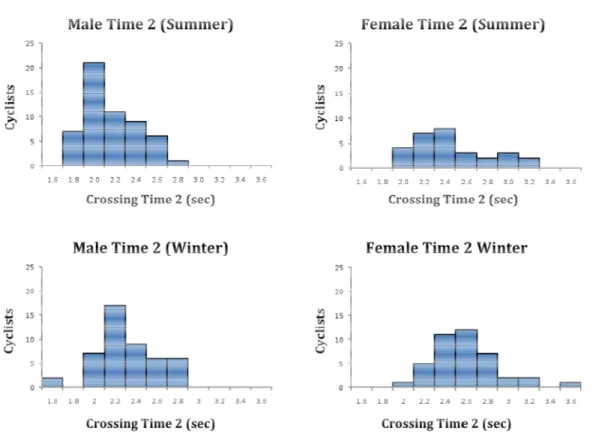
The histograms presented in Figure 4 show the distribution of crossing T2 between male and female cyclists during the summer and winter collection periods at the grade intersection. The figure shows a skew in male cyclists achieving faster crossing times, while the female cyclist distributions tend to be more normally distributed.
4. DATA ANALYSIS
The purpose of this investigation was to study rider performance in terms of crossing time among different rider populations. The initial hypotheses was made that, gender does not affect a cyclists’ crossing time performance. In order to test the hypotheses, statistical tests were performed on the data and are discussed in the following sections. These statistical tests are the chi-square test for homogeneity and unpaired t-tests on the mean and 85th percentiles crossing times [13].
FIGURE 4 Comparison of T2 crossing times at the grade intersection.
Significant differences in the mean T2 crossing times were observed along with differences in the distribution of times.
The chi-square test for homogeneity is performed to determine if the distributions in crossing times between categorical groups are homogenous; this test gives an indication as to whether or not the crossing time distributions between the groups being studied are significantly different or not. Unpaired t-tests are conducted to determine if a statistically significant difference in mean and 85th percentile crossing times between age and gender groups exists. The variances of populations represented by the compared samples were assumed to be equal and unknown. Chi-Square Test for Homogeneity
Test Overview
Results are discussed for the three measured crossing times (T1, T2 and T3), where the data are binned using crossing time percentile ranges (0-25%, 25-50%, 50-75%, 75-100%). This produces four bins in which the data samples are grouped. The null hypothesis (that the distributions are
homogenous, and do not exhibit a statistically significant difference) was tested at a confidence interval of 95%, where the null hypothesis is rejected at an alpha value of 0.05 or less.
Discussion of Results
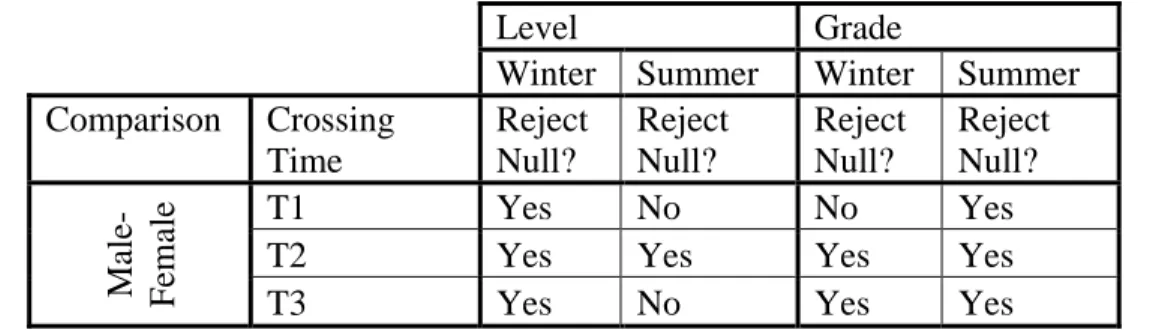
Table 1 presents the results for the level and grade intersection studies during the winter and summer collections.
At the level intersection during the winter collection, the null hypothesis (that the data are homogenous) was rejected for the male-female comparison for T1, T2 and T3. During the summer collection, the male-female comparison shows a rejection of the null hypothesis for T2 only. This suggests that the distributions between male and female T1 crossing times in the summer collection period are similar. A possible explanation is that, because T1 corresponds to the portion of the intersection where cyclists are accelerating, the reaction time and accelerations for male and female cyclists may be similar. But for crossing T2, males may continue accelerating, while females may have reached peak cruising speed.
At the grade intersection, the results for winter and summer are very similar to the level intersection. The null hypothesis was rejected for the male-female comparison for all three measured crossing times, expect for T2 in the winter collection. These results may be explained by male cyclists having a physical advantage on the grade, where they may continue accelerating after the midpoint of the intersection, while female cyclists may have already reached a cruising speed.
TABLE 1 Chi-square test results for the level and grade intersection study crossing times; data grouped by percentile ranges 0-25th, 25th-50th, 50th-75th, 75th-100th (3 Degrees of Freedom, 4 bins)
Level Grade
Winter
Summer
Winter
Summer
Comparison Crossing
Time
Reject
Null?
Reject
Null?
Reject
Null?
Reject
Null?
Male-
Female
T1 Yes
No
No
Yes
T2 Yes
Yes
Yes
Yes
T3 Yes
No
Yes
Yes
**A confidence interval of 95% was used for the Chi-square Test Conclusions
In general, results for the level and grade intersection studies support a rejection of the null hypothesis (that distributions of the data are homogenous) when looking at T1, T2, and T3
for male and female categories. This is particularly true for T2, which shows a rejection of the null hypothesis at an alpha of 0.01, for both the grade and level intersections during the winter and summer collection periods
T-tests Between Gender Groups Test Overview
Unpaired t-tests were conducted between gender groups to determine if a statistically significant difference between mean crossing times exists. Test results are presented in Table 2 with the level of significance indicated for each t-statistic and associated p-values provided.
Discussion of Results
Significant differences were observed between most mean crossing times of observed male and female cyclists during all collection periods. Women generally had longer crossing times compared to men, particularly at the grade intersection. At the level intersection, Time 1 crossing times were not significantly different, suggesting that initial acceleration does not vary greatly by gender on a more level grade. However, at the grade intersection all crossing times were significantly longer for female cyclists at greater than the 99% confidence interval and the observed differences between male and female mean crossing times was also greater. This suggests that when considering signal timing at grade intersections, longer crossing times may be required.
TABLE 2 Unpaired t-tests between mean crossing times
Level Intersection
Grade Intersection
Male vs Fe
male
Winter μfemale μmale t-stat p-value μfemale μmale t-stat p-value
T1 3.77 3.73 8.00E-01 4.28E-01 4.69 4.40 2.66** 9.38E-03
T2 2.23 2.00 5.07*** 1.86E-06 2.55 2.23 4.55*** 1.74E-05
T3 6.00 5.73 2.23* 2.83E-02 7.24 6.63 4.51*** 1.98E-05
Summer μfemale μmale t-stat p-value μfemale μmale t-stat p-value
T1 3.65 3.54 1.51 1.33E-01 5.07 4.37 4.81*** 6.78E-06
T2 2.21 2.07 2.95** 3.65E-03 2.40 2.07 4.93*** 4.19E-06
T3 5.86 5.61 2.26* 2.54E-02 7.48 6.44 5.14*** 1.77E-06 * Indicates greater than 95% significance
** Indicates greater than 99% significance *** Indicates greater than 99.9% significance
Conclusions
In general, results for the level and grade intersection studies in both the summer and winter collections show significant differences in the mean crossing times for male and female cyclists. T-tests on 15th Percentile Crossing Times by Gender Groups
Test Overview
The observed 15th percentile crossing times were compared using a noncentral t-test to determine statistical significance. Critical values from a one-tailed noncentral t-distribution are provided for the 95% confidence interval. The critical values are a function of the difference between the mean and 85th percentile values for each tested sample and thus vary for each test.
TABLE 3 T-tests on 85th percentile crossing times
Level Intersection
Male vs Fe
male
Winter μfemale,85th μmale,85th t-stat t0.05,98 p-value
T1 4.18 4.33 -1.41 -8.00E-02 3.76E-01
T2 2.53 2.20 7.39*** 4.02 3.28E-06
T3 6.57 6.50 0.52* 6.00E-02 1.75E-02
Summer μfemale,85th μmale,85th t-stat t0.05,98 p-value
T1 4.02 4.15 1.41 4.23 8.68E-01 T2 2.40 2.25 2.84** 1.78 3.70E-03 T3 6.34 6.30 0.28* -5.00E-02 2.45E-02
Grade Intersection
Male vs Fe
male
Winter μfemale,85th μmale,85th t-stat t0.05,982.92 p-value
T1 5.34 4.91 3.62* 2.92 1.07E-02
T2 2.79 2.56 3.20*** 4.90E-01 1.13E-05
T3 7.89 7.41 3.38*** 7.00E-01 1.40E-05
Summer μfemale,85th μmale,85th t-stat t0.05,98 p-value
T1 5.95 4.89 7.00*** 4.11 2.37E-05
T2 2.91 2.35 8.03*** 5.06 2.68E-05
T3 8.70 7.29 6.77*** 3.51 5.28E-06 * Indicates greater than 95% significance
** Indicates greater than 99% significance *** Indicates greater than 99.9% significance
Discussion of Results
Table 3 indicates that differences in 85th percentile times for the comparison of female and male groups are significant. For the grade intersection, the differences in 85th percentile times had high statistical significance for all measured crossing times. These results largely agree with those from the mean crossing time tests both in significance level and relative differences between the compared gender groups.
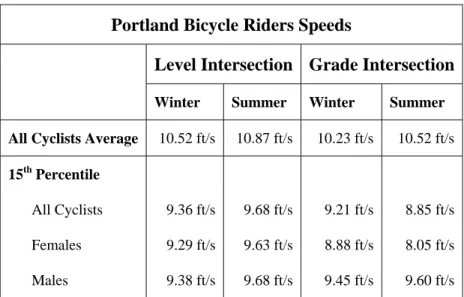
Also of interest is the comparison between the average speed of cyclists traversing the intersection in times equal to the 15th percentile crossing time and mean crossing time for a particular demographic. For instance, at the grade intersection during the summer collection, the average cyclist speed was 10.52 ft/s (see Table 4 in the following section). In the time it would take the average cyclist to travel the 70 feet to clear the intersection, a female at the 15th percentile crossing time would have traveled only 53 feet. At wide intersections, this speed difference may present a significant risk factor for car-bicycle collisions of the types discussed in the literature review. If the minimum green phase and clearance time only accommodate the average cyclist, a female for example traveling at the 15th percentile crossing time would be caught in the intersection with (in the case of the grade intersection) roughly two lanes to cross.
5. DISCUSSION
As mentioned in previous sections, bicycle rider performance has important applications to signal timing. Because signal timing guidance is most often based on motor vehicle minimum green and clearance times (when pedestrians are not present, and vehicle volumes are low), there may be insufficient green or yellow time for a cyclist to cross the intersection. According to the results of this research, females may require additional green or yellow time to cross comfortably and safely at grade intersections.
Research by Prasad et al (2007) has investigated the use of bicycle detection in order to provide bicycle-specific timing only when bicycles are present. Because the bicycle timing (which is longer than motor vehicle-based timing) is only applied when cyclists are present, additional delay for opposing traffic will only occur on cycles when a cyclist has been detected. This increases the safety of the intersection for cyclists while maintaining the efficiency of the signal timing. However, in order to design bicycle specific timing, the speed of the cyclists must be estimated (Prasad et al used 12 ft/s as recommended by AASTO, [14]). It is therefore
important that the crossing speed is representative of the population of cyclists the signal is intended to serve. When young cyclists or males are heavily represented, it is not clear whether the crossing time should accommodate at least 85th percent of all the population or each of the demographic groups in terms of gender and age. Furthermore, short green or yellow times can lead to self-exclusion by certain groups, i.e. groups with longer crossing times may choose to use an alternative intersection with longer crossing times or simply not to cycle.
TABLE 4 Average Speeds vs. 15th Percentile Speeds
Portland Bicycle Riders Speeds
Level Intersection Grade Intersection
Winter Summer Winter Summer
All Cyclists Average 10.52 ft/s 10.87 ft/s 10.23 ft/s 10.52 ft/s
15th Percentile
All Cyclists 9.36 ft/s 9.68 ft/s 9.21 ft/s 8.85 ft/s Females 9.29 ft/s 9.63 ft/s 8.88 ft/s 8.05 ft/s Males 9.38 ft/s 9.68 ft/s 9.45 ft/s 9.60 ft/s
Cyclist speed generally falls somewhere between motor vehicle speed and pedestrian walking speed. Table 4 presents the various average speeds for the demographics studied in the winter and summer collection periods. It can be seen that even for the slowest cyclist demographic (female riders), the average crossing speeds are still roughly two times as fast as the slowest recommended walking speeds (4ft/s). However, the observed average speeds are significantly slower than the 12 ft/s recommended by AASHTO for basic/beginner cyclist.
The results from Table 4 show that the grade intersection appears to have a greater impact on crossing time and speed compared to the level intersection. This is evident in the greater differences in speed between the 15th percentile male and female cyclists in comparison to the level intersection. Additionally, the grade intersection also presents differences in crossing speed for each gender when comparing between seasonal collections. The 15th percentile speeds found in the summer were consistently slower than those found in the winter, indicating that a more diverse group of cyclists with varying skill level may have been present in the summer months.
With bicycle traffic in Portland steadily increasing, it will become increasingly important to recognize the needs of all cyclists at signalized intersections. This research intends to contribute by providing additional information and analysis of the demographic factors that influence cyclist performance.
Conclusion
The observed average speeds are significantly slower than the 12 ft/s recommended by AASHTO for basic/beginner cyclist. The differences are even greater if the comparison the speeds a broken down by gender or the slowest 15th percentile of the population. A better understanding of performance levels among the population of cyclists will allow engineers to improve intersection crossing safety and/or convenience of travel for all cyclist types while avoiding unnecessary reductions in intersection capacity. From the statistical analyses performed, there are significant differences in cyclists’ crossing times when comparing male and female cyclists. These differences can be observed during both study periods (summer and winter) at both level and grade intersections.
It is expected that as cycling ridership increases, the cyclist population will become more diverse in terms of age, gender, and fitness levels. Cycling is a voluntary activity and more physically fit individuals are more likely to take up cycling on a regular basis. On the other hand, individuals with longer crossing times or lower fitness levels may have a negative perception of the safety and comfort levels experienced while cycling. Furthermore, short green or yellow times can lead to self-exclusion by certain groups, i.e. groups with longer crossing times may choose to use an alternative intersection with longer crossing times or simply not to cycle. Additional research is needed to obtain a greater understanding of the impacts of population characteristics
References
1. CPBT,
Portland Bicycle Counts 2008. 2008.
2.
Wachtel, A., J. Forester, and D. Pelz, Signal Clearance Timing For Bicyclists. Ite
Journal-Institute Of Transportation Engineers, 1995. 65(3): p. 38-&.
3.
Pucher, J. and R. Buehler, Cycling for a Few or for Everyone: The Importance of
Social Justice in Cycling Policy. World Transport Policy & Practice, 2009. 15(1).
4. AASHTO,
Guide for the Development of Bicycle Facilities. 4th ed. 1999,
Washington, D.C.: American Association of State Highway and Transportation
Officials, U.S. Department of Transportation.
5.
Rubins, D.I. and S. Handy, Times of bicycle crossings - Case study of Davis,
California, in Bicycles And Pedestrians; Developing Countries 2005. 2005,
Transportation Research Board Natl Research Council: Washington. p. 22-27.
6. Pein,
W.,
Bicyclist Performance on a Multiuse Trail. Transportation Research
Record, 1997. 1578(-1): p. 127-131.
7.
Taylor, D. and W.J. Davis, Review of Basic Research in Bicycle Traffic Science,
Traffic Operations, and Facility Design. Transportation Research Record, 1999.
1674(-1): p. 102-110.
8. Navin,
F.P.D.,
Bicycle Traffic Flow Characteristics - Experimental Results And
Comparisons. Ite Journal-Institute Of Transportation Engineers, 1994. 64(3): p.
31-36.
9. CPBT.
4 Types of Transportation Cyclists. 2009 [cited Jan 15, 2009]; Available
from:
http://www.portlandonline.com/transportation/index.cfm?c=44597&a=158497
.
10. CPBT.
Data and Information. 2009 [cited Jan 15, 2009]; Available from:
http://www.portlandonline.com/transportation/index.cfm?c=44597&a=156490
.
11.
Dill, J. and J. Gliebe, Understanding and Measuring Bicycling Behavior: A Focus
on Travel Time and Route Choice Final Report. 2008, Oregon Transportation
Research and Education Consortium.
12.
National Oceanic and Atmospheric Administration. NNDC Climate Data Online.
[cited 2009; Available from:
13.
Washington, S.P., M.G. Karlaftis, and F.L. Mannering, Statistical and
Econometric Methods for Transportation Data Analysis. 2003: Chapman &
Hall/CRC.
14.
Prasad, A., et al., Adaptive Signal Timing for Bicycles. Transportation Research
Board, 2007: p. 11.
List of Tables
Table 1 Chi-square test results for the level and grade intersection study crossing times 13
Table 2 Unpaired t-tests between mean crossing times ... 14
Table 3 T-tests on 85th percentile crossing times ... 15
Table 4 Average Speeds and Recommended Pedestrian Walking Speeds ... 17
List of Figures