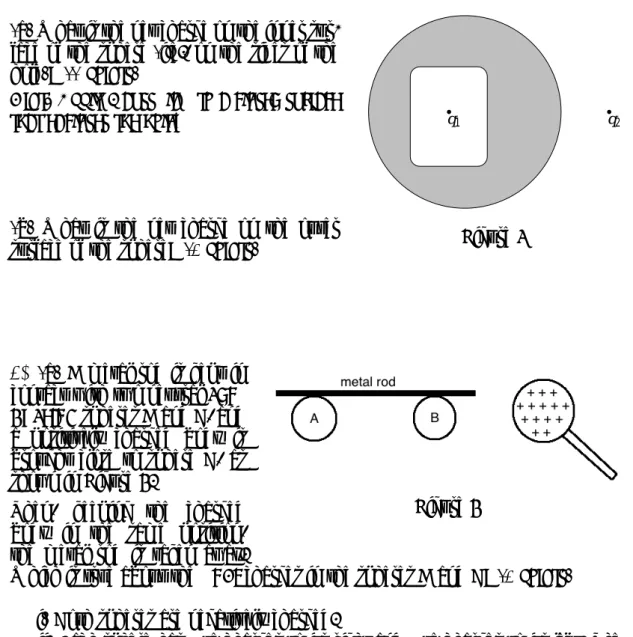
1. Figure 1 shows aconductingsphere which has a rectangular hole in it. A point charge q1 = +2µC is placed inside the hole and another point charge q2 = +5µC is placed outside the sphere. The conductingsphere itself has zero total charge.
+q1 +q2
Figure 1 (a) What is the net charge on the inner
sur-face of the sphere (i.e., on the sides of the hole)? (4 points)
Hint: Apply Gauss’ law to a closed surface that encloses the hole.
(b) What is the net charge on the outer surface of the sphere? (3 points)
Figure 2 2. (a) A metal rod is kept in
contact with two neutral con-ductingspheres A and B, and a positively charged body is brought close to sphere B, as shown in Figure 2.
Then, keeping the charged body in the same position, the metal rod is taken away.
Which is true about thefinal charges in the spheres A and B? (3 points) i) Both spheres are negatively charged.
ii) Each sphere has −ve charges to its right and +ve charges to its left. The total charge on each is zero.
iii) Sphere A is positively charged and sphere B is negatively charged. We have an electric dipole.
iv) Sphere B is positively charged and sphere A is negatively charged. We have an electric dipole.
(b) If the two spheres A and B were non-conducting, which would be true about the final charges in them? (3 points)
i) Both spheres are negatively charged.
ii) Each sphere has −ve charges to its right and +ve charges to its left. The total charge on each is zero.
iii) Sphere A is positively charged and sphere B is negatively charged. We have an electric dipole.
iv) Sphere B is positively charged and sphere A is negatively charged. We have an electric dipole.
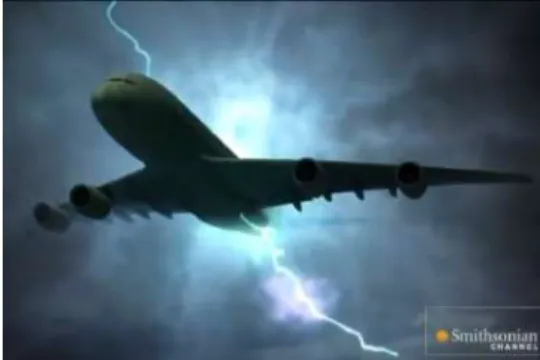
Figure 3: lightning strikes an airplane! 3. Lightning on airplane!
Most aircraft bodies are made out of Aluminium. It’s estimated that lightning strikes each plane in the U.S. commercial fleet about once a year.
How big an issue is lightning to pas-sengers? Choose your answer: (3 points)
i) It cannot penetrate inside the aircraft since its body is a conductor.
ii) It cannot penetrate inside the aircraft since the aircraft skin is very thick. iii) It can penetrate inside the aircraft and give you a shock.
iv) It is sure to cause a plane crash!
4. Consider the circuit shown in Figure 4. Q denotes the charge on the capacitor C, and i1 and i2 denote the currents in the resistors R1 and R2 respectively. For t < 0, the double-throw switch S is kept open at position 1, and the capacitor plates have no charge. At t= 0, the switch is quickly moved to position 2.
Figure 4
(a) Just after t = 0, what are the values of the following quantities ? (6 points)
i)Q= ii)i1 = iii) i2 =
(b) After a long time, when steady state is reached, what values do the charge and currents take ? (6 points)
i)i1 = ii)i2 = iii) Q=
Hint: In steady state, is there any current through the capacitor ?
5. You are given three 2 µF capacitors. How would you connect them to get an equivalent capacitance of 3µF ? Draw below. (4 points)
6. A current i is driven through a rectangular sample of some material, as shown in Figure 5. Throughout the sample, there exists a uniform magnetic field B pointing into the page. Land R denote the two sides of the sample.
i i
´
B R L E Figure 5 For parts (a) and (b), assume that thecur-rent is carried by electrons in the sample. (a) Which side are the electrons deflected toward by the magnetic field ? L orR ? (3 points)
(b) In steady state, which of the two sides, Lor R, is at a higher electric potential ? (3 points)
(c) If the same current in the sample were carried by positive ions in the sample, instead of electrons, which side would have a higher electric potential ? (3 points)
(d) If the current is increased by increasing the battery emf E, will the potential difference between the two sides increase or decrease in magnitude ? (3 points)
7. (4 points) Consider the situation shown in Figure 6. A clockwise current flows along a square loop which is placed close to a long straight wire carrying a current in the upward direction.
i1
i2
Figure 6 Under the influence of the magnetic field of the
long wire, the loop will i) move towards the wire. ii) move away from the wire. iii) remain stationary.
iv) rotate about the wire.
8. Figure 7 shows an Amperian loopC and a number of currents. If the circulation of the net magnetic field (counterclockwise along C) is
I ~
B.d~l=−4π×10−7 T-m,
find the value of the current i0 shown in the diagram. (4 points)
Figure 7
9. If a non-conducting loop is placed in a time-varying magnetic field, which of the following is true ? (3 points)
(i) Both the induced emf and the induced current are zero. (ii) Both the induced emf and the induced current are non-zero.
(iii) The induced emf may be non-zero but the induced current is zero.
10. Two conducting loops are moved in the vicinity of a long straight wire carrying a currenti in the downward direction, as shown in Figure 8.
Figure 8
(a) Which is true about the induced currents in the two loops ifv >0 ? (4 points)
(i) #1: clockwise, #2: counterclockwise (ii) #1: zero, #2: clockwise
(iii) #1: zero, #2: counterclockwise (iv) None of the above
(b) Keeping the loops stationary (v = 0), the direction of the current i is flipped over some time interval. Which is true about the induced currents within that time interval ? (4 points)
(i) #1: clockwise, #2: counterclockwise (ii) #1: counterclockwise, #2: clockwise (iii) #1: zero, #2: counterclockwise (iv) #1: zero, #2: clockwise
11. Consider the circuit shown in Figure 9. iL denotes the current through the
inductor. The switch S is closed at t= 0. Before closing the switch, there was no current in the circuit.
Figure 9
(a) Just after t= 0, iL = ? (2 points)
(b) After a long time, steady-state is reached, i.e., currents are not changing any more. Then,iL= ? (3 points)
12. You may have seen the warning “Objects in mirror are closer than they appear” on side-view mirrors in cars. This means that for such mirrors the image is always smaller than the object.
Figure 10 (a) Are these mirrors convex, concave, or
straight ? (2 points)
(b) Suppose such a mirror has a focal length of magnitude 1 m. If an object is 1 m behind the mirror, by what factor will its height be reduced in the image ? (3 points)
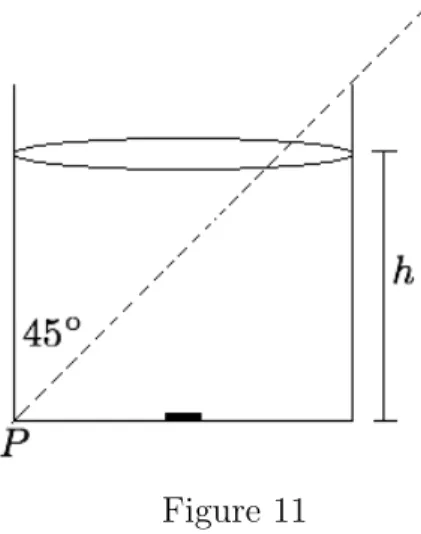
13. A coin is glued to the bottom of a container. Suppose you are looking straight at the corner pointP as shown in Figure 11. Without any liquid in the container, the coin is not visible. You start pouring liquid until its height becomesh, when you can see the coin.
Figure 11 (a) In Figure 11, draw the light ray that
starts from the coin and reaches your eye. (2 points)
(b) If the liquid has a refractive index n = √
2, what is the incident angle in the liquid for this ray ? (3 points)
(c) Oil has a higher refractive index than water. For which of these two liquids will h be larger ? (2 points)
14. Interference Reflection Microscopy is a technique often used to study cell-substrate adhesion patterns. Figure 12 shows how this works. A cell is separated from a thick glass substrate by a thin film of culture medium. Depending on how the cell membrane adheres to the glass at different places, the film thickness varies. One can track this variation by shining light and seeing how strongly it is reflected from different parts of the film.
Assume that green light of wavelength (in vacuum) 532 nm is incident normally on the film from the glass.
Figure 12
(a) Suppose the film thickness is neg-ligible along line L1 (or L2). Shall we get strong reflection or no reflection at these locations ? (2 points)
(b) Suppose the light is strongly reflected along line L3. What is the minimum possible film thickness at this location ? (3 points)
15. Figure 13 shows an infrared image of the Horsehead Nebula taken by the Hubble Space Telescope. Hubble uses a parabolic mirror of diameter 2.44 m. It took the image using light of wavelength 200 nm, and could barely resolve two points on the nebula which are separated by 2×10¹² m (50000 times the earth’s circumference)! Find out how far the Horsehead Nebula is from earth. (4 points)
Figure 13
16. A source of light S is placed at a height h above a mirror, as shown in Figure 14. Light can reach a point on the screen to the right either directly or after getting reflected. The direct and the reflected ray interfere to produce fringes.
Θ S y h Mirror wavelength= Λ Figure 14
(a) Shall we see a bright fringe or a dark fringe near y = 0 ? (2 points)
(b) One can show that the reflected ray travels an extra distance of 2hsinθ. What is the condition for getting a dark fringe at angle θ ? (4 points)
(c) Take λ = 0.5 µm and h = 50 µm. Find out the total number of dark fringes on the screen. (3 points)
17. If oil is used instead of air as the medium between the specimen and the lens in a microscope, will its resolution increase, decrease, or stay the same ? (2 points)
Section: 205 Your Name:
1. You are told
that
an infinite sheet of charge produces a uniform electric fi.eld of magnitude o f (2eo), whereo
is the charge perunit
area. The field points arrayfrom the sheet for positive charge and towards it for negative charge.
*o + ++++++++++++ ++++ ++*++++++-t-++ *o ++i+++++++++++++++++++++++f ++
Figure
showstwo
parallel
plateswith
charges on their four surfaces.*o
or
-o
givesthe
chargeper unit
area.Each surface resembles an infi.nite sheet of charge.
(a) Find the net electric field
atPoint
A
(insidethe
upperpiate)
pro-duced by the four charge sheets (Don't forget
to
include directions when you add the fields).oB
eQ
(b) Find the net electric fields at Point
B
and Point C.(c) Let
Ee, Es,
andEs
denote the magnitudes of the net electric fieldsat
A,B,
and C. \Altrich of the foliowing is true?i)E,nlEelEc
ii)
EB1E.q
I
Ec
iii)
EAI
EB-
Ec
(d)
If
the plates are made of conductors, can we get such a charge distribution(as given
in
flgure)in
electrostatic equilibrium?Why
or why not?Section: 203 Your Name:
1.
"Sirius" is the brightest star in the night sky. Its distance from the earth is 5 x 10⁵ times the earth-sun distance. Suppose a measurement of the iight intensity(1) at the earth shows tha|
I"ariur:
10-101"rr,. Assuming the inverse square lawfor intensity, calculate the ratio of the powers emitted, i.e., P"iriu"lPrur.
2.
A
coin is glued to the bottom of a non-transparent container. Suppose you are looking straight at the pointP
as shown inFig.
1. Without any liquid in the container, the coin is not visible. You start pouring }iquid until its height becomesh, when you can see the coin.
(a) In Fig. 1, draw the light ray that starts from the center of the coin, and reaches your eye.
(b)
If
the liquid used has a refractive index n:
t/2,
what is the incident angle in the iiquid for this ray?(c) Vegetable
oil
has a higher refractive indexthan water. For which of the two liquids
will
h beIa.rger? (You don't need any calculation.) Figure 1
3
3.
If
iight is passed through a sugax solution,ization. The amount of rotation A0 depends on For red light, A9r"d (in degrees)
it
rotates the direction ofwavelength.
:6c1,
polar-For blue light,
A06lr"
(in degrees):
L2 c I ,where c is the concentration of the solution
in g/ml,
andI
is the length of the solution in cm.Suppose you shine linearly polarized purple light (an equal mixture of red and blue) through a 1
g/ml
sugar solution.(a) What minimum length of solution
will
make the outcoming red and blueIight polarized perpendicular to each other?
(b)
Forthis
length and concentration, suppose the outcoming red and bluelight are polarized along
r
and gr respectively. You hold a metalgrill
in the path of this light and see the transmitted light from the other side.i) If
the bars/
rods in the grill are parallel to r, youwill
see A.blue
B.red
C.purpie
D. none of theseii)
If
the bars/
rods in thegrili
areparallelloy,
youwill
see A.blue
B.red
C.purple
D. none of theseiii)
If
the bars/
rods in the grill are equally inclined tor
andU,yor wili
see A.blue
B.red
C.purple
D. none of these(c) Keeping the metal
grill
fixedwith
its bars parallei tor)
yolr continuouslyincrease the concentration of the solution by adding more sugar. As you do this, the light transmitted through the griil
i)
remains blue.ii)
remains red.iii)
takes on all possible colors obtained by mixing red and blue.iv)
none of these.Section: 203 Your Name:
1.
A
point object O is placedin front
of athin
lens whose upper half has arefractive index p and lower half has a refractive index
{,
&s shownin
Fig.
1. If
instead the enti,re lens had indexp
(or q), an image would form atP
(or Q).Fbr the lens shown
in Fig.
1, which ofthe follouring image(s) shall we see?
i)
A single image at a point midwaybe-tween
P
and Q.ii)
No image at all.iii)
A blurred image betweenP
ar,d Q.iv) Two images, one at P, and the other
at
8.
Figure 1
2. Figure 2 shows the path of a light ray in a primary rainbow, which undergoes two refractions and one reflection
in
a water drop.It
is knownthat
the incident angle for the reflection is about 40". Some part of the incident tight might also be refracted into air at point P,h
which case? they are not shown.(a) Is
it total
internal reflection or normalreflec-tion at point P?
(b) Find out the Brewster's angle for this
reflec-tion.
How doesit
comparewith
the actual angle of incidence?Figure 2
(.)
If you look at the rainbow wearing polaroid sunglasses (vertical transmission*ir),
you would seei)
*
bright a rainbow as with the naked eye.ii)
half as bright a rainbow as with the naked eye, asit
is unpolarized.iii)
very dim rainbow (if at all) sinceit
is strongly polarized.iv)
none of these.t\
J
I
40'
n = 1.33
F
U
N
P
R
O
B
L
E
M
Find out the size of an atom and its energy levels yourself !
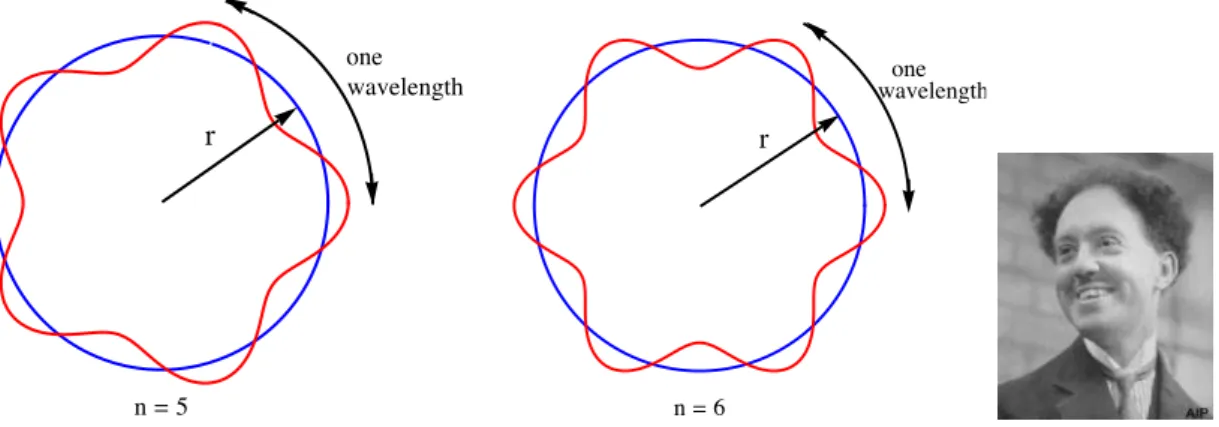
According to de Broglie, in the n-th energy state of the Hydrogen atom, the electron moves in a circular orbit such that the orbit fitsn number of de Broglie wavelengths. Figure shows two such examples forn = 5andn = 6, and the only smiling photo of de Broglie I could find!
one wavelength n=5 r one wavelength n=6 r
Figure 1: Electron orbits for the n = 5 and the n = 6 states, and de Broglie. (a) Find the wavelength in the n-th energy state in terms of the radius r. (Circumference of a circle = 2r!)
(b) What is the momentum p of the electron for the wavelength you found?
Don’t substitute numerical value ofh. (p = h=, remember?)
(c) UsingK = p2=(2m), find the kinetic energy of the electron in then-th energy state. Don’t substitute numerical values of h and m!
(d) In the first part of this course, you learned that the potential energy of two point chargesq1andq2at a distancerisq1q2=(40r). Write down the expression for the potential energy U of the electron (charge e) and the nucleus (charge
e) in terms of the radius r. Don’t substitute numerical values of eand 0!
(e) Last semester you probably learned about the Virial theorem (remember?) which says that for a circular orbitK = U=2. Let’s apply this theorem to what you found in (c) and (d), and find out the radiusr in terms of h, m, e, 0, and
n. Don’t substitute the numerical values yet.
(f) Now that you’ve got the radius, find out the total energyE = K + U = U=2 by substituting for r in part (d) and dividing by 2.
(g) Using the following values of the universal constants, find out the radius and energy of the ground state (n = 1)! (If you need,1eV= 1:60 10 19 J.)
h = 6:63 10 34J-s
m = 9:11 10 31 kg
0 = 8:85 10 12C2 N 2 m 2
e = 1:60 10 19C