You wouldn’t be satisfied collecting
only 60% of your rent money.
So why settle for collecting only 60%
of CSA violations?
Even if you’re using a Vacant Cost Recovery (VCR) program, you’re leaving a lot of money on the table. VCR can’t identify move-out violators or misprocessed bills.
This white paper reveals how multifamily owners can: Reduce annual electricity expenses by $8,000 to
$20,000 per community, with little effort. Increase valuation by as much as $330,000 per
community (at a 6% cap rate) due to these savings.
CSA Secure Team 9/10/2007
Executive Summary
Vacant Cost Recovery (VCR) Programs
Have Become the Gold Standard for Collecting
on CSA Violations.
But Are They Enough?
Multifamily owners often don’t know the extent of CSA
violations at their communities or think they are recovering most of the cost. It’s difficult to track and usually not a high priority because the issue seems minor.
However, we found electrical utility theft in two-third of the units in our database, with major NOI and property valuation
ramifications. The observations detailed in this white paper are based on an analysis of 7.9 million utility transactions covering 99 properties and 33,393 units in the state of Texas.
We used the findings to estimate the problem for the one million apartment units in the de-regulated areas of Texas. These multifamily owners are paying as much as $67 million per year for electricity expenses that should be paid by their residents. Extrapolating the study findings to the 20 million apartment units in the United States,we estimate that owners are losing $760 million to $1.3 billion annually in unrecovered electricity costs
(at per kwh rates of 8.7 to 15 cents).
The impact of unrecovered utility costs will continue to grow as energy costs escalate and knowledge of this loophole spreads throughout the industry. But there is solution. The next generation CSA solution—CSA Secure— can help you:
Break the costly cycle of losing NOI through CSA violations
Identify and collect the remaining 40% of your CSA operating expenses
Not by VCR Alone
Our research has shown that 60% of total electric CSA violations (utility theft) may be recovered through a Vacancy Cost Recovery (VCR)
program.
However, 40% or about $8,000 annually per
community is never identified or recovered through current methods. And if you don’t have a VCR program, the
unrecovered loss could be as high as $20,000 a year for a typical 300-unit community. At a cap rate of 6%, owners can increase property valuation by$130,000 to $330,000 per communityif all electricity theft is eliminated.
CSA Violations Impact NOI and Community
Valuation Much More than You Think
If you are in charge of energy management, ancillary services, asset management or site operations in the multifamily industry, you are probably concerned about energy expenses and their impact on NOI. In the past 10 years, many multifamily owners have implemented energy-efficiency programs ranging from water conservation to lighting retrofit aimed at lowering energy
consumption and, ultimately, utility costs.
In addition, many have adopted other ancillary programs such as water bill back (RUBs or a submetering system) and Vacant Cost Recovery (VCR) programs to reduce utility operating costs. These energy-efficiency practices certainly have positive impact on NOI. But have you reached their true potential? How do you measure the effectiveness of your current energy programs?
One of the key elements of any energy-efficiency program is benchmarking—defined as the process of identifying, sharing, and using knowledge and best practices. It focuses on how to improve any given business process by exploiting topnotch approaches rather than merely measuring the best performance.
Do you have a Vacant Cost benchmark?
Do you have a Continuous Service Agreement (CSA) benchmark?
Have you implemented Vacant Cost Recovery (VCR)? If so, how do you measure its effectiveness?
When the VCR process falls short, how are you notified?
To determine the impact of CSA violations on multifamily properties, we analyzed 7.9 million utility transactions for four clients covering 99 communities and 33,393 units during the period August 2006–July 2007. The findings are summarized in this white paper.
Did you know…
FACT: Even with the best VCR or VR program in place,40%of all
recoverable expenses are not identified due to mis-processing of utility bills and move-out violations. FACT:Retail electric providers(or the utility companies serving your communities)do not provide vacant cost identification. FACT:Without a VCR process, a typical 300-unit community loses an average of$20,000in annual cash flow.
FACT:Even with a VCR process implemented, an average community of 300 units loses a minimum of $8,000per year in annual cash flow.
FACT: 76.2%of all residents who moved into a multifamily unit did not have electricity transferred to their name at the time of move-in, as required by the lease.
* All data are derived from BluTrend’s analysis of 99 multifamily properties from August 2006-July 2007.
What Is a CSA?
Continuous Service Agreements (CSA’s) are contracts between property owners and utility companies to ensure uninterrupted utility service in rental units when they become vacant.
While CSAs have advantages for multifamily owners, they also make it easy for residents to commit utility theft. When a new resident fails to apply for utility service under his name, the property receives—and is responsible for—the utility bills for the occupied unit. Likewise, at move-out, if a resident closes his account too early, the property becomes responsible for the utility bills under a CSA. This is referred to as a CSA violation since the resident is in violation of the lease by not taking responsibility for his energy costs.
When a resident is responsible for enrolling with an electricity provider and “forgets” to do it, you will bear the cost.
0.00% 10.00% 20.00% 30.00% 40.00% 50.00% 60.00% 70.00% 80.00% 90.00% 100.00%
Dallas Houston Dallas Houston Dallas Houston Dallas Houston Company A Company B Company C Company D %of ResidentsNot Enrolled With a Retail Electric
Provider at Move In
The chart above shows the percentage of residents who did not take responsibility for electricity service at the time of move-in, as their leases required. In Dallas 65% of residents moving in did not have electricity in their own name, compared to 87% of residents in Houston.
FACT:10.1%of move-in violators were delinquent2 to 6 monthsin enrolling with an electric provider, necessitating constant invoicing and additional vacant bill payment charges.
FACT:At a cap rate of 6%, owners can increase
property valuation by $130,000 to $330,000 per communityif all electricity theft is eliminated.
FACT: 11.4%of move-in violators did not have electricity service in their name20 days after move-in. Many went on for months, never taking responsibility for their electricity service.
* All data are derived from BluTrend’s analysis of 99 multifamily properties from August 2006-July 2007.
The chart above shows that the average percentage of move-in residents who fail to enroll with an electric provider 10 days after move-in is 10% larger in Houston (average of 25%) versus those in Dallas at (15%).
High Turnover = High Exposure = High Opportunity for Theft
How about residents who close out their electricity account before they move out? This is no longer a case of “forgetting to enroll” but a purposeful act of theft.
Because the average resident turnover in multifamily units is high, the use of a CSA program is necessary to reduce administrative work. But it also exposes property owners to a significant amount of utility-related expense.
Owners often don’t know the extent of CSA violations at their communities or think they are recovering most of the cost. It’s difficult to track and usually not a high priority because the issue seems minor. However,we found electrical utility theft in two-third of the units in our database, with major NOI and property valuation ramifications.The impact of unrecovered utility costs will continue to grow as energy costs escalate and knowledge of this loophole spreads throughout the industry.
How much does CSA violation cost each of your communities per year?
$1000? $5000? $10,000?
$20,000? Or more? Your answer depends on the size of the community, its location and utility rates, among other factors.
However, our research based on studying CSA data for 99 communities over a 12-month period showed that a typical 300-unit community can reduce annual operating expenses by an average of $19,985 (if no VCR process is in place) or $8,000 with a VCR process implemented.
* All data are derived from BluTrend’s analysis of 99 multifamily properties from August 2006-July 2007.
Do you provide resident data to your Electric provider? Probably not. But if you believe your electric provider is doing a great job serving your communities, you may need to look more closely. No provider can identify CSA violations without access to your resident turnover information. It’s impossible to identify CSA violations without knowledge of move-ins and move-outs. Remember, electric providers are not responsible for CSA violations—you are! They send out a bill for all CSA accounts, including the CSA violators, for which you are responsible. Some electric providers can provide a list of all accounts for residents who have enrolled with them. But, these are not the people you are looking for! CSA violators have not opened an account, so the provider has no knowledge of them. Therefore, the responsibility for comparing utility transactions with the rent roll will fall with your site manager.
Based on our research, it takes an average of 10 hours per month for an experienced site manager to identify violators. The bad news is that this effort is far from 100% effective. Managers report that the comparison task can be very tedious even for the most experienced manger.Shouldn’t site managers be focusing on more important tasks than comparing utility reports and rent rolls?
Whether outsourced or not, collection of vacant bills is made even more difficult due to unit turnover and the fact that unpaid bills are often 45-60 days in arrears before they are discovered. Our analysis showed that over 12% of the violators were delinquent by 2 to 6 months, necessitating constant invoicing and collections activities.
The longer the time lag, the less likely you will recover the CSA violations. This is especially true at move-out, where the vacant bill typically arrives after the resident’s deposit has been returned, greatly reducing the potential for recovery.
Think that CSA violations are not a major concern for your company?If you answer yes to any of the questions below, you should take a closer look at what CSA violations arereallycosting you.
-Do you believe that the savings are not large enough to justify investing time on this matter?
-Is your electric provider doing a good job? -Do you have a Vacant Recovery Program (VCR or a VR) in place?
-Do you believe that CSA violations are not taking place or are only a minor cost? -Do your site managers have CSA violations under control? -Is a third party vendor already taking care of CSA violations?
-Do you have too many other projects and priorities to take time for this issue?
The graph above is the estimated violation amount per unit for each owner in 2007, based on actual violation amounts known through July and prior history. The average move-out violation of $23 per available unit is not likely to be identified or recovered without a CSA Secure program.The average CSA violation charge is estimated at $67 per unit per year or about $20,000 per community per year, 40% of which is never identified or collected by current methods—even with a VCR program in place.
* All data are derived from BluTrend’s analysis of 99 multifamily properties from August 2006-July 2007.
Although we invented the VCR process in 1999, we believe you should not depend on it alone to identify and collect 100% of all opportunities. Here’s why:
-A VCR program based on utility bills cannot identify move-out violations and misprocessed utility bills, which together are estimated at 40% of total available CSA violation dollars.
-If you just recover vacant cost through VCR and don’t eliminate the CSA violation after the first month, you will continue to pay for additional utility bills every month. -Pay first and recover later is not a good cash flow policy. -You lose the “door” or “marketing” money for CSA violators.
-You have more negative interactions with residents. It’s harder to collect for several months of violation than for a few days of misuse.
-You cannot identify skips with a VCR program.
The chart above shows that over 60% of violation charges for residents at the time of move-out are for prior months. In other words, these residents put the responsibility for electrical service back on the community months before they moved out.Isn’t this theft?
More importantly, the charges for the last month and possibly the last two months (first two rows in the table above) are never identified and recovered due to the delay in receiving the associated utility bills. (Data for Company B, C and D are
conservative due to limited resident data for those companies prior to the start of the program.)
Wouldn’t you want to eliminate these costs from your operating expenses?
* All data are derived from BluTrend’s analysis of 99 multifamily properties from August 2006-July 2007.
How do VCR or VR programs work?
With a Vacant Recovery program, aging utility bills are matched with current resident data to identify violators. A VCR bill is sent to violators for their portion of utility
consumption since move-in. But, a VCR program cannot capture move-out violations. When a resident moves out with outstanding violation days, the owner ends up paying for as much as two months of the resident’s electricity bill. That’s because the utility bill will not arrive until after the resident has moved out and received his deposit back.
What can you do about move-out CSA violations?
Move-out violations under a CSA Secure program are identified and a final bill is generatedBEFOREthe resident moves out. CSA Secure can identify any move-out violation within 24 hours, allowing the site manager to take action immediately and stop the theft.
The chart above shows violation cost per community for move-in residents from August 2006 to July 2007. Notice that, again, over 50% of all violation charges are for multiple months. These are the CSA violators who continue their violation month after month, sometimes for as long as 6 months.
Pay particular attention to the month and the greater than 6-month violations. If any of the these residents have leases that expire in 6 months and they move out, the associated charges will not get collected from them.
* All data are derived from BluTrend’s analysis of 99 multifamily properties from August 2006-July 2007.
Why do residents fail to enroll with an electric provider at move-in? They may be thinking:
The last resident forgot to end his service and it‘s ok to leave it as is.
The electric provider made a mistake by leaving the service on –and it has more money than I do.
The community manager forgot to make the switch and will not find out. After all, they made the mistake and I pay enough money for rent. Or, the new resident simply forgot to enroll with a provider or can’t afford to sign up due to bad credit, deposit
Impact of CSA Secure
The graph above shows the average cost of violation paid by owners on the behalf of residents who failed to enroll with an electric provider 10 days after move-in. The average total cost ranged from $458 in April to $1,781 in July. Notice that violation cost per community increased for Company B, C and D (who are not using CSA Secure), while Company A’s violation cost dropped monthly after implementation of CSA Secure at all communities in April.
Implications for Texas and the Nation
We used the findings from our analysis to estimate the problem for the one million apartment units in the de-regulated areas of Texas. These multifamily owners are paying as much as $67 million per year for electricity
expenses that should be paid by their residents.
Extrapolating the study findings to the 20 million apartment units in the United States,we estimate that owners are losing $760 million to $1.3 billion annually in unrecovered electricity costs(at per kwh rates of 8.7 to 15 cents). At today’s 6 percent cap rate, that’sa loss of $12.6 to $22 billion in property valuation,
in addition to the annual lost cash flow.
Total violation cost per available unit for violators with more than 10 days, 15 days and 20 days of violation is graphed over 12 months versus move-in percentages for Company A.
$0 $10 $20 $30 $40 $50 $60 $70 $80 $90
Move In Violation Move Out Violation Total Violation Company A (2006) $65 $21 $86 Company A (Estimated - 2007) $41 $20 $61
Yearly Comparison of CSAViolationsper unit for Company A
It is important to note that Company A has improved over 30% compared to the prior year. The year-end estimation for 2007 will continue to improve as time passes. It should also be noted that a large percentage of company A’s violation losses for 2007 had already taken place prior to May 2007, before the CSA Secure program was 100% implemented at all sites.
Company A’s Success with CSA Secure
The violation cost for all three categories has dropped over time, particularly since April when all communities were trained on the CSA Secure process.
We estimate the cost per unit for this client will drop even further in the coming months as the program takes full effect. This client reports that interaction with residents on collection of VCR charges has improved considerably, as evidenced by the lower VCR amounts.
How Did Companies B, C, D Fare?
The companies in the study that didn’t use CSA Secure had less success in stopping utility theft than Company A. As their turnover percentages increased, so did the violation cost per unit in all three categories of greater than 10 days, 15 days and 20 days violations(See Figures 1-3 in the Appendix).Two out of three companies are recovering the move-in portion of violation costs but not the move-out cost.
The problem is compounded for owners who collect fees on-site through an AR push back from a third party. With this process, many charges identified at the beginning of the month by the bill payment company have to wait until the end of the month for data transfer.
This delay will cause even larger VCR bills as time goes by, making the process of collecting from these residents even more difficult. The longer they stay in violation of their lease, the greater the likelihood that the charges will continue until move-out and never be recovered.
Violators Extend for Several Months
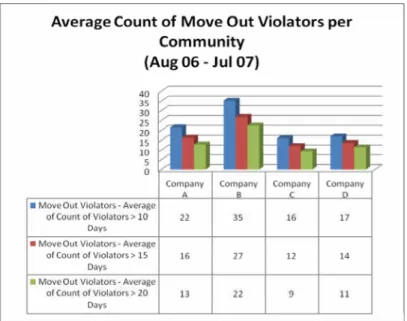
Next, we compared the average number of violators per community for each category of violation from August 2006 through July 2007(see Figure 4 in the Appendix).
On average, over 10% of move-out violators put the responsibility of their electricity back on the community for more than 10 days prior to move-out.
Often these residents will continue to be in violation of their lease until they move-out, resulting in a minimum of two months of electricity to be paid by the owners. Further, residents staying on the CSA account will result in fewer marketing dollars from retail electric providers.
CSA Secure can help you:
Break the costly cycle of losing NOI through CSA violations
Identify and collect the remaining 40% of your CSA operating expenses
Would you be satisfied collecting only 60% of the annual rent money? Then why settle for collecting only 60% of the CSA violations?
CSA Secure can help you achieve 100%.
Not by VCR Alone
The average move-out violation of $23 per available unit is not likely to beidentified or recovered without a CSA Secure program. The average CSA violation charge is estimated at $67 per unit per year or about $20,000 per community per year, 40% of which is never identified or collected by current
methods—even with a VCR program in place.
CSA Secure: the Next Generation CSA Solution CSA Secure compares utility transactions with resident data nightly and reports violations within 24 hours versus 45 to 60 days later with a VCR program. This permits timely notice to CSA violators within few days of move-in. The CSA Secure program automatically alerts you—within 24 hours of violation
occurrence—of those residents who have switched the
responsibility of electricity service back to you during the lease term.
CSA Secure is a proactive approach that facilitates 100% identification and collection of charges at move-in, during the lease term and prior to move-out.No other system can make this claim.
We offer a 30-day free “proof of concept” to determine your benchmarks. We work side-by-side with your other business partners—including your utility and VCR providers—to identify, eliminate and recover CSA theft within 24 hours of its occurrence.
Comparison Chart of CSA Secure to Other Methods
CSA Secure
Recovery Methods (VR or VCR)Electric Provider CSA Reports Identifies Move-in Violators Yes Yes No Identifies Move-out Violators Yes No No Notification Time
Within 24 hours After 30-45 days N/A
Notification Frequency
Daily Monthly Report Weekly Report
Effectiveness 100% 60% - (10% lost due
to bill mis-processing and 30% due to move-out violation) N/A Notification of Violators Proactive – system automatically notifies site managers and residents of violations and pending switch transactions Reactive – only allows the property to notify the resident 30-45 days after violation has taken place
Does not identify violators – Shows all units going into and out of CSA. The responsibility of matching utility transactions and rent roll remains with site managers Average Vacant Electric Cost Paid by Owner $26.25 $315 Unlimited liability -Reports do not identify violators. Owners are responsible for all charges associated with CSA thefts.
CSA Secure
Recovery Methods (VR or VCR)Electric Provider CSA Reports
Manual labor Requirements
Fully automated Semi automated – Site managers have to verify if a switch has taken place
Site Managers have to review weekly reports and compare utility
transactions with rent roll to identify violators
Resident Interaction
Positive since the residents are notified within a couple of days
Large recovery bills can result in a negative interaction with residents N/A Source Used to Identify Violations Utility Transaction Records & Resident
Data
Utility Bills & Resident Data Utility Transaction Records – No interface to Resident Data Status Notification (i.e. disconnects, pending switch,…)
Yes No Some electric providers
Recoverable Service Cost
Yes Yes N/A
Management Reporting
Over 50 reports with multi-tiered structure Many reports available Limited reports – Available on websites Trending Reports Yes Yes No Alert Capability Yes No No Scheduling Capability Yes Yes No
APPENDIX
Figure 1
Figure 3
Figure 4 shows the average number of violators per community for each category of violation from August 2006 through July 2007. Company A had most residential data available while Companies B, C and D joined the program at a later time. For Companies B, C and D any violator who actually moved out prior to the start of the program was not tracked in the analysis, since those violators were inactive at the start of CSA Secure program.
Figure 5
Figures 6 and 7 below show the number of violation days per community for each company and each category from August 2006 through July 2007. The average cost per violation day for Dallas and Houston is $5.20 per day at 15 cents per kwh. This number varies based on season, region, electricity rate, size of unit and individual consumption habits, but it is a good industry average to use.