INNOVATION OBJECTIVES, KNOWLEDGE SOURCES,
AND THE BENEFITS OF BREADTH
Aija Leiponen
Department of Applied Economics and Management
251 Warren Hall
Cornell University
Ithaca, NY 14853-7801
Constance E. Helfat
Tuck School of Business at Dartmouth 100 Tuck Hall
Hanover, NH 03755
March 2005
This paper benefited from presentations at the Academy of Management meeting, Boston University, Carnegie Mellon, Cornell, Dartmouth, Informs College of Organizations meeting, INSEAD, New York University, and the University of Illinois, and the comments of Bob Hansen, Joe Mahoney, Steve Michael, and Jim Utterback. The usual caveat applies.
INNOVATION OBJECTIVES, KNOWLEDGE SOURCES, AND THE BENEFITS OF BREADTH
ABSTRACT
Given the inherent risk of innovative activity, firms can improve the odds of success by pursuing multiple parallel objectives. Since innovation draws on many sources of ideas, firms also may improve their odds of successful innovation by accessing a large number of knowledge sources. In this research study, we conduct one of the first firm-level statistical analyses of the impact on innovation of breadth in both innovation objectives and knowledge sources. The analysis utilizes detailed data on the innovation activities of firms for a broad sample of firms and industries in the Finnish economy. The empirical results suggest that broader horizons with respect to innovation objectives and knowledge sources are associated with successful innovation.
INTRODUCTION
Innovation is a risky business. Industrial R&D often fails to achieve innovation. Given the inherent risk of innovative activity, early research on the economics and management of innovation argued that multiple objectives in innovation activity, or what Nelson (1961) termed a “parallel-path strategy,” could improve the odds of success (see e.g., Jewkes, Sawers, and Stillerman, 1958). More recently, Baldwin and Clark (2000, 2003) have emphasized the benefits of conducting “multiple parallel searches” in innovation activity. Consistent with this sensible but little-tested argument, recent empirical work has shown that at the industry level, a greater range of innovation objectives is associated with greater rates of new product and process introduction (Cohen and Malerba, 2001). These innovation objectives also can benefit from a range of knowledge sources that provide the opportunity for technological advance (Klevorick et al., 1995). As a consequence, access to a greater range of knowledge sources may help firms to improve their odds of successful innovation. Here we conduct one of the first firm-level statistical analyses of the impact on technological innovation of breadth in both innovation objectives and knowledge sources. The results suggest that firms benefit from technological broadening with regard to innovation objectives and knowledge sources.
A great deal of research in strategic management has examined technological search and innovation in business firms. Much of the work on technological search has investigated research and development (R&D) and patenting in different areas of scientific and technological knowledge (e.g., Ahuja and Katila, 2004; Helfat, 1994; Henderson and Cockburn, 1996; Rosenkopf and Nerkar, 2001). The knowledge based-view of the firm (see e.g., Kogut and Zander, 1992; Grant, 1996) has focused attention on the importance of knowledge sources of all types to innovative success, including but not limited to knowledge gained from R&D. For example, knowledge useful in innovation may come from sources such as customers (von Hippel, 1976;) and suppliers (Leiponen, 2000).
In addition to knowledge sources, innovation objectives affect the ability of firms to successfully innovate. As in all endeavors, business and otherwise, objectives inform the
actions that people take, and therefore affect outcomes. Empirical research on technological search, however, has focused little attention on the objectives that firms pursue in their innovation activities, perhaps due to the difficulty of obtaining data about these objectives. In this study, we combine an investigation of the role of knowledge sources in innovation with an analysis of the role of innovation objectives.
Following the lead of early research on industrial innovation, we focus on the parallel-path strategy in innovation. We ask whether firms have greater innovation success when they pursue a larger range of innovation objectives and obtain information from a larger range of sources. Since firms that devote more resources to innovation may be able to pursue a greater range of objectives and knowledge sources, our analysis controls for the amount of funding for innovation activity within the firm.
We assess our basic proposition about the benefits of technological broadening using unusually detailed data from a broad sample of Finnish manufacturing firms. Although empirical studies have investigated the association between knowledge sources and firm innovation success (e.g., Laursen and Salter, 2003; Veugelers and Cassiman, 1999), empirical research on firm innovation success has yet to incorporate the role of objectives or combine the analysis of knowledge sources with an analysis of objectives. Innovation objectives and the knowledge sources that firms use to try to achieve these objectives, however, are different aspects of technological search. By separating them conceptually and empirically, we can better understand the nature and consequences of innovation activity.
This study also takes an approach that differs somewhat from current prescriptions in strategic management, which often highlight the benefits to firms of focusing on a narrow range of businesses. Our analysis deals with specific types of business activities for which too much focus may be counterproductive. In particular, business activities such as technological innovation that are subject to high uncertainty may benefit from breadth of approaches.
In asking the question of whether greater innovation success is associated with a parallel-path strategy for innovation objectives and knowledge sources, we first define what,
for purposes of this analysis, we mean by the terms: innovation success, innovation objectives, knowledge sources in innovation, and parallel paths (or breadth) in innovation activity. We then draw on extant research on technological innovation to develop propositions about the effects of breadth in firm innovation activity. We also describe the data and empirical methodology used to assess the association between innovation performance and breadth in innovation objectives and knowledge sources. Then we report and discuss the empirical results, and conclude with implications for future research.
INNOVATION ACTIVITY
Our analysis pertains to innovations of a technological nature. To begin, we provide definitions of innovation success, innovation objectives, knowledge sources in innovation, and parallel paths (or breadth) in innovation activity.
Innovation Success
The success of a technological innovation can be considered along several dimensions, including technical, commercial, and financial success (Mansfield et al., 1971). Projects that meet with technical success, in the sense that a workable product or process results, may or may not meet customer needs at a reasonable enough cost to permit commercialization. Even then, the financial returns to the project may or may not exceed the cost of capital. In this study, we focus on commercialization of technological innovations, either product or process, within the firm as our measure of innovation success. This measure has the advantage that the introduction of a new product or process by a firm is observable and quantifiable.
Innovation Objectives
An objective is an aim or a goal. Prior research on technological innovation and search does not contain a comprehensive or detailed definition of different types of innovation
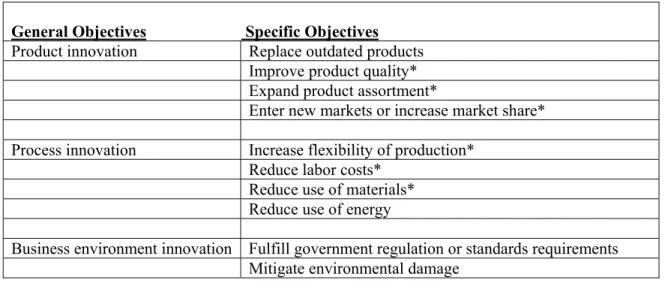
objectives. We therefore propose the following typology as a starting point, depicted in figure 1.
Most effort directed toward technological innovation takes place within a particular domain of science and technology, sometimes termed a “technological trajectory” (Dosi, 1988). We analyze objectives within a single technological domain. Within any particular technological domain, studies of innovation activity often distinguish between product and process innovation. This distinction suggests that, at the most general level, firms may have goals or objectives regarding whether to pursue product innovation or process innovation or both. Within these types of general objectives, firms also are likely to have more specific objectives that they seek to accomplish. More specific product objectives may include goals such as the development a completely new product or the improvement of an existing product. More specific process objectives may include goals such reduction of labor costs or improved manufacturing flexibility. Cohen and Malerba (2001) have used the term “technical goals” with reference to these types of more specific objectives. In addition, to meet each of these specific objectives, firms may undertake a number of individual innovation projects directed toward the specific innovation objective.
The foregoing typology suggests that innovation objectives nest in a hierarchy from most to least general. Although we could increase the number of levels in this typology, the three-tiered hierarchy of objectives provides a useful starting point. As an example, within the automotive sector, an auto company may seek product or process innovation or both. In the product innovation area, more specific company objectives may include the introduction of new cars or improvements to existing models. Within each of these more specific product innovation objectives, such as the introduction of a new car, the company may run several projects to develop different designs for a proposed new car.
The question of whether a parallel-path strategy of breadth of objectives is associated with innovation success applies to each of these levels of innovation objectives: general objectives, specific objectives, and projects. In this study, we analyze breadth in both general
and specific innovation objectives. Because of to data limitations, we are unable to investigate the breadth of project level objectives; large sample data on individual technological innovation projects within firms are hard to obtain. Even at the level of general and specific objectives, individual firm data are relatively scarce.
Knowledge Sources in Innovation
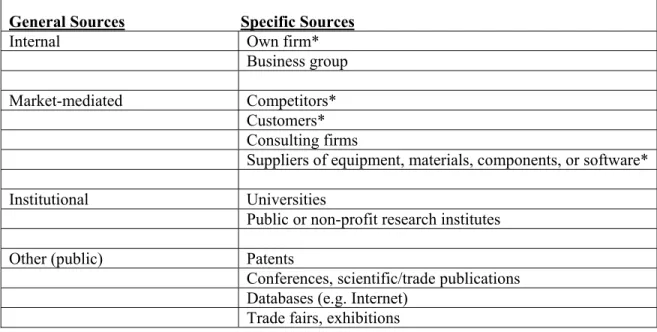
We define knowledge sources in innovation as sources of information that the firm may seek to use in the technological innovation process. In this research study, we examine different types of knowledge sources that are connected to different parts of the firm’s value chain or activity system. Examples include knowledge gained from the firm’s own R&D, as well as information gained from sources such as competitors, customers, suppliers, and universities. Similar to objectives, we can differentiate between general and specific types of knowledge sources, as shown in figure 1. For example, at the most general level, research in the knowledge-based view of the firm often differentiates between knowledge obtained from within the firm versus knowledge obtained from outside of the firm. More specific types of knowledge from outside the firm may come from different stages of the value chain/activity system, such as suppliers or buyers. Within each of these more specific sources of information, firms may seek knowledge from different individual providers of information, such as different customers or different suppliers. Thus, like objectives, knowledge sources nest in a hierarchy from most to least general. In this study, we analyze breadth in both general and specific knowledge sources.
Parallel Paths (Breadth) of Objectives and Sources
We define breadth in innovation activity in a manner that conforms with prior research. In a classic study of sixty-one technological innovations, Jewkes, Sawers, and Stillerman (1958) argued that “safety would seem to lie in numbers and variety of attack” (p. 184). Nelson (1961) echoed this logic in his analysis of the benefits of pursuing multiple research
projects in industrial R&D, which he termed a “parallel-path” R&D strategy. Baldwin and Clark (2003) have made a similar point regarding the benefits of “multiple design experiments” in product innovation. We therefore investigate whether the benefits of “numbers and variety” and “multiple experiments,” which we term “breadth” for short, apply to firm-level objectives and knowledge sources in innovation activity. Empirically, we investigate whether firms that have a greater number of different objectives and knowledge sources also have greater innovation success. In addition, some of the theoretical arguments in favor of breadth in objectives and sources imply diminishing returns to breadth. We therefore investigate whether innovation objectives and sources display diminishing returns to breadth. Finally, we investigate whether the potential interaction between breadth in objectives and breadth in sources has any additional benefit for innovation success.
TECHNOLOGICAL BROADENING IN INNOVATION SEARCH
Research has shown that it is difficult to predict the outcome of industrial research and development projects ahead of time. For example, in an in-depth study of research and development (R&D) projects in 16 companies, Mansfield et al. (1971) found that the average probability of commercialization was 37 percent. Early RAND Corporation studies also documented the difficulty of predicting R&D cost, technical performance of the innovation, and development time (see Nelson, 1961). These studies documented that innovation activity is risky and the likelihood of success is uncertain. In light of these risks, scholars have proposed two reasons why breadth of innovation objectives may be associated with greater innovation success. First, under conditions of uncertainty, firms may be able to increase the likelihood and value of innovation success by sampling a range of objectives. Secondly, firms may be able to offset diminishing returns to current research programs by pursuing a range of objectives. In what follows, we explain these arguments and also discuss potential drawbacks to breadth in innovation objectives. Then we turn to arguments regarding breadth of knowledge sources.
Breadth of Innovation Objectives
The concept of technological opportunity, which denotes the potential for technological advance in a particular environment, is helpful in analyzing the inherent risks of innovation activity. Klevorick, Levin, Nelson, and Winter (1995) conceptualized the inherent risk of innovation search as akin to drawing balls from an urn of innovation outcomes. The potential for innovation, or technological opportunity, is the distribution of the values of the balls in the urn. When the firm undertakes innovation activity, it does not know ahead of time which ball it will draw from the urn. The firm may know the distribution of possible outcomes, but its draw is a random variable. Although stylized, this depiction captures the basic logic of innovation search: a firm cannot predict with certainty whether its innovation efforts (draws from the urn) will produce a marketable product or a process that can be implemented. A few mathematical models have analyzed this problem at the level of individual research projects directed toward a specific innovation objective. We next explain these models and how the underlying logic of these models applies to the general and specific objectives analyzed in this study.
Sampling of Innovation Objectives
Nelson (1961), Evenson and Kislev (1976), and Baldwin and Clark (2003) have used order statistics to model research projects directed toward a particular innovation objective as draws from a distribution of possible outcomes. The examples used in these models include guided missile systems (Nelson, 1961), agricultural innovations (Evenson and Kislev, 1976), and software designs (Baldwin and Clark, 2003). Nelson (1961) and Baldwin and Clark (2003) provide an analysis of sampling from an initial distribution of innovation outcomes. Evenson and Kislev (1976) include an additional analysis of the subsequent evolution of technologies and basic science over time. Here we focus on the initial sampling from a distribution, which can be either simultaneous or sequential (Baldwin and Clark, 2003), because this model contains the essential logic having to do with breadth of innovation activity. Adding the
analysis of subsequent technological development does not change the implications of the models regarding breadth of innovation activity.1
In these sampling models, innovation projects have a distribution of payoffs. It is helpful to think of a payoff as associated with a particular technological advance from a project that results in an increase in revenues and/or a decrease in costs. A decision maker is faced with a great deal of uncertainty about the ultimate payoff to any one individual research project when deciding whether or not to pursue that particular research objective. In a model of this type, the payoff to innovation is increasing in the number of objectives that the firm pursues, because the likelihood of obtaining a favorable draw (an objective) from a distribution of payoffs is increased as the number of draws increases. In this context, one can think of a favorable draw as one that exceeds a critical value above which it is profitable to commercialize an innovation. The greater the number of draws from the distribution, the more likely it is that one of the draws will exceed the critical value needed for commercialization. As a result, the pursuit of multiple objectives saves decision makers from putting all of their eggs in one risky innovation basket. Any one innovation objective might not lead to success, but one of many objectives might.
In the simplest form of Nelson’s model (1961), costs for each project are the same, with constant returns to scale per project. If a firm devotes more funds to innovation activity, it can afford greater breadth of projects than a firm that devotes fewer funds to innovation activity. Because greater funding allows for greater breadth of objectives, the models imply that it is important to control for funding of innovation activity in an empirical analysis.
In an extension to the model, Nelson (1961) modified it to include projects that have different costs. Evenson and Kislev (1976) further show that the model can accommodate economies of scale in projects. The simplest form of Nelson’s (1961) model also includes a
1 Nelson (1961), for example, recommended small initial outlays of funds before making a final decision to
proceed with a project, since early stages of development are often the least expensive and can yield valuable information about the likely innovation costs, technical performance, and development time for the project. This early (and unusual) real options type of analysis of innovative activity is not investigated in our analysis.
fixed time period for each project, at which point the firm evaluates the various outcomes and chooses to pursue the most promising projects. Nelson (1961) notes that the model can accommodate differing time periods for different projects without changing the overall conclusion regarding the benefits of breadth. Thus, even with realistic modifications regarding costs and timing, the basic conclusions regarding the benefits of a parallel-path strategy do not change.
The foregoing mathematical models deal with individual research projects directed toward a specific technological objective. We argue that the logic of this sampling argument also applies to the specific and general objectives introduced earlier. Specific objectives, for example, may be subject to uncertainty about both costs and customer benefits. Some specific objectives may turn out to be more difficult to achieve technically than others and therefore have higher costs. Firms may also be uncertain about customer demand associated with various specific innovation objectives. For example, it may be not clear ahead of time whether customers would be willing to pay more for an added feature to an existing product or for an entirely redesigned product. The sampling argument also applies to more general objectives, such as those related to product and process innovation, since it may not be clear whether new or improved product introduction or process-related cost reductions will have greater value. By pursuing multiple objectives, firms improve the odds that any one objective may reach its goal. It is worth noting that in these models, the aim is to increase the likelihood and value of innovation success, given the inherent uncertainty that accompanies technological innovation activity. The sampling models are particularly relevant for technological innovation because empirical research has shown that the distribution of innovation success is highly skewed, and a relatively few successes make up for a large number of failures (Scherer and Harhoff, 2000). As a result, a larger number of independent draws from a distribution of innovation outcomes increases the probability that at least one of the draws will come from the upper tail of valuable outcomes. The logic of this argument is very different from risk reduction accomplished
through portfolio diversification, wherein negative correlations of returns among businesses or financial instruments reduce the overall variance of the returns to the portfolio. 2
Thus far, we have drawn an analogy between the sampling of different projects and the sampling of different objectives. Projects and objectives, however, are not necessarily perfectly aligned. Individual projects may have multiple objectives. As an extreme example, suppose that one innovation project includes every possible innovation objective. In this situation, although the breadth of objectives is high, with only a single innovation project the odds of technological success are not improved by having multiple objectives. This example is unrealistic of course. In actuality, the greater is the number of different objectives that a firm pursues, the less likely it is that any one project could equally well satisfy all objectives. Particularly at the level of general objectives, a single project is likely to have difficulty fulfilling equally highly valued product and process innovation objectives at the same time. Even for specific objectives, it may be difficult for a single innovation project to equally well fulfill a range of objectives, such as simultaneously improving the current features of an existing product, adding new features to an existing product, and creating an entirely new product. Therefore, we expect the overall logic of the sampling argument to apply to specific and general objectives.
The analysis thus far deals with the risk that pursuing any one objective may fail to lead to an innovation. An extension to the sampling argument deals with a somewhat different situation when an objective meets with technological success and the firm continues to pursue this objective in successive research. This sort of success from a particular technological objective may carry a different sort of risk, namely, of diminishing returns to further innovative activity, or “technological exhaustion” in the terminology of Evenson and Kislev (1976). For instance, investments in improving the gasoline fuel efficiency of automobiles are likely to
2 The analysis of breadth of innovation objectives within the firm to reduce risk, however, implicitly relies on the assumption that financial markets do not work well to diversify the risk of innovation failure (see for example, Himmelberg and Petersen, 1994).
experience decreasing marginal returns eventually, because prior innovative success has pushed the firm further toward the limits of technical feasibility at reasonable cost. If a car manufacturer, however, simultaneously invests in other technological objectives such as developing alternative automobile fuel sources, filters for exhaustion gases, and electronic controls, the firm improves the potential to make significant innovations that raise the quality or cost efficiency of an automobile. Thus, the pursuit of a broader range of objectives helps to offset diminishing returns to depth of innovation activity in a single objective (Cohen and Malerba, 2001).
Limits to Breadth
The foregoing arguments suggest that by having a greater number of different objectives, firms can improve the prospects for innovation success. But how much breadth should a firm should pursue in its innovation objectives? If breadth of objectives had no disadvantages whatsoever, firms would prefer to pursue an unlimited number of objectives if they could. There are at least two potential drawbacks to breadth of objectives, however. The first drawback has been noted in the more general innovation literature, which points to the importance of cumulative learning in R&D (Cohen and Levinthal, 1990; Helfat, 1994; Nelson and Winter, 1982). Since cumulative learning requires depth of innovation activity, there is likely to be a tradeoff between depth and breadth of innovation objectives.
In addition to the need for cumulative learning, the sampling models themselves contain another limitation to the benefits of breadth. In particular, the expected increase in the value of an additional draw from a distribution of innovation payoffs decreases as the number of draws (innovation objectives) increases. That is, the sampling argument implies that the marginal benefit (e.g., an increment to sales) of adding another objective diminishes as a firm increases the number of objectives. Intuitively, as the number of draws from the same distribution increases, the more likely it is that the firm has already obtained high valued outcomes. The probability of obtaining an even higher valued draw from an additional objective therefore
diminishes. In addition, the marginal cost of adding an innovation objective may increase as the number of innovation objectives increases.3 Due to the complexity of managing a larger variety of projects, organizational and managerial costs may increase. As costs increase, firms may find it more difficult to profitably commercialize an innovation at a price that the market will bear. Thus, as a result of both decreasing marginal benefits and increasing marginal costs, increases in the breadth of innovation objectives may be subject to diminishing returns.
Mathematically, the combination of decreasing marginal benefits and increasing marginal costs of breadth in innovation objectives implies that there is an optimal number of innovation objectives to pursue (Nelson, 1961; Evenson and Kislev, 1976). This optimum occurs at the number of objectives where the marginal benefit equals the marginal cost of adding another objective. As a practical matter, it may be difficult for firms to know exactly where this optimum is, and it is possible that they could exceed this optimum.
Finally, Nelson (1961) mentions the possibility that although the model assumes independent draws from a distribution of innovation outcomes, different projects may in fact have costs (or benefits) that depend on some of the same factors. Breadth has less benefit when the projects have correlated outcomes than when projects have independent outcomes.
As the foregoing analysis indicates, the sampling models, although stylized, have a fair amount of flexibility and can accommodate a range of modifications to the basic model. The following proposition, which we investigate, summarizes the primary empirical implication of the models:
Proposition 1: A greater number of different innovation objectives within the firm is associated with greater innovation success.
We also investigate whether, conditional on Proposition 1, we observe the diminishing returns to breadth predicted by these models.
Breadth of Knowledge Sources
The Yale survey on innovation has documented the wide range of knowledge sources used in innovation at the industry level in the U.S. (Klevorick et al., 1995). The PACE survey has documented similar breadth of knowledge sources for industry sectors in Europe (Arundel, Van de Paal, and Soete, 1995). These knowledge sources include the firm’s own industrial R&D and the scientists that perform this R&D, other firms in the same industry, customers, suppliers, joint ventures and alliances, university research, government research laboratories and agencies, and professional and technical societies. Similarly, our analysis focuses on types of knowledge sources that are connected to different parts of the value chain or activity system.
Research on innovation and knowledge management suggests two reasons why multiple knowledge sources may be associated with greater innovation success. First, the sampling models that apply to innovation objectives also may apply to knowledge sources. Under conditions of uncertainty, firms may be able to increase the likelihood and value of innovation success by sampling a range of knowledge sources. Second, research on innovation through knowledge recombination suggests that firms may benefit from complementarities and synergies among knowledge sources. We next explain these arguments and discuss potential disadvantages to breadth of knowledge sources as well.
Before turning to the arguments in support of breadth in knowledge sources, we note that for these reasons to hold, knowledge obtained from different sources must differ to at least some extent. Otherwise, firms could substitute knowledge from one source for another without any benefit from multiple sources. Evidence suggests that technological knowledge from different sources often does not fully overlap, however. For example, although academic research provides knowledge essential to industrial innovative activity, basic academic research generally does not directly provide solutions to the more applied sorts of problems on which firms tend to focus (Mansfield, 1991; Pavitt, 1998). Even in a strongly science-based field such as biotechnology, agreements with universities provide firms with access to basic scientific knowledge, while agreements between firms typically focus on product-specific development
of basic research discoveries (Arora and Gambardella, 1990). Customers and suppliers provide yet other sorts of knowledge (Leiponen, 2002). Users, for example, provide feedback regarding problems with, and desired modifications of, existing products (von Hippel, 1976). Suppliers provide knowledge regarding inputs, including raw materials, plant and equipment, product components, and subsystems. These differences in the sorts of information available from alternate knowledge sources suggests that access to a number of providers of one type of information (e.g., customers) provides less breadth of information than access to the same number of providers of different knowledge sources (e.g., customers and universities). Thus, for example, different customers are more likely to have overlapping information than are customers and university scientists.
Not all knowledge from different sources is completely distinct of course. For example, spillovers of knowledge from other firms in an industry can substitute for internal firm research and development. The extent to which different knowledge sources are substitutes rather than complements is an empirical question. The greater the ability of firms to substitute knowledge from different sources, the more difficult it will be to find empirical support for the following arguments that breadth of knowledge sources improves the likelihood of innovation success.
Sampling of Knowledge Sources
The first argument regarding the benefits of breadth in knowledge sources involves sampling from a distribution of innovation payoffs as a metaphor for technological search, similar to the logic of the models for innovation objectives. In particular, by sampling a greater number of knowledge sources, the firm may improve its potential for innovation success. The knowledge sources that a firm accesses may lead to ideas for new products and processes, improve the efficiency of existing research projects, and help to overcome bottlenecks in product and process development (Cohen and Malerba, 2001). Although technological opportunity and the potential for innovation are often viewed as associated with the science and technology base in an industry, technological opportunity does not flow to firms automatically.
Instead, individual firms may be able to improve their technological opportunity by accessing various knowledge sources. For example, even though university research may produce knowledge useful for innovation in an industry, individual firms may vary in their access to this knowledge. Firms with close contacts with university researchers therefore may gain useful knowledge earlier than other firms.
When choosing knowledge sources, firms do not necessarily know ahead of time which sources of knowledge hold the highest potential for innovation. This sort of uncertainty suggests that application of a parallel-path strategy to knowledge sources may be helpful.4 In particular, we can apply the mathematical models developed for innovation objectives to knowledge sources with very little alteration. Thus, consider the situation where a firm has a single innovation objective and has a choice of knowledge sources. Under conditions of uncertainty regarding the payoff to individual knowledge sources, the structure of the sampling models suggests that the payoff to innovation is increasing in the number of knowledge sources. This occurs because the likelihood of obtaining a favorable draw from a distribution of payoffs increases as the number of draws (knowledge sources) increases. By accessing a greater number of knowledge sources, the firm improves the probability that one or more of the sources will provide knowledge that has high innovation potential. As in the case of innovation objectives, firms that devote more funds to innovation activity may be able to access a greater number of knowledge sources, since it is costly to obtain knowledge. For example, in-house R&D requires funds and so does the employment of marketing or sales representatives to obtain feedback from customers. Thus, as for innovation objectives, it is important to control for the amount of spending on innovation activity in the empirical analysis of breadth of knowledge sources. Additionally, the model can accommodate different costs of accessing different sources of knowledge. Moreover, an extension to the sampling argument suggests
4 Research on social networks also has shown the value of information from non-redundant sources, which enables
actors to span structural holes (Burt, 1982). For an application to alliances, see e.g., Baum, Calabrese, and Silverman (2000).
that breadth in knowledge sources might offset diminishing returns to depth of information from any one source.
The sampling arguments given earlier for innovation objectives suggest that the same disadvantages of breadth might apply to knowledge sources. First, cumulative learning and depth of knowledge acquisition may apply to knowledge gained from specific sources, such as in-house R&D for example. Therefore, firms may face a tradeoff between breadth and depth of knowledge sources. In addition, diminishing returns may limit the benefits to breadth of knowledge sources. The sampling argument regarding draws of knowledge sources from a distribution of innovation payoffs implies that as a firm increases the number of draws from the same distribution, the probability of obtaining a higher valued draw from an additional source diminishes. Thus, the marginal benefit to innovation success from an additional knowledge source may decline as the firm adds knowledge sources. In addition, as the number of knowledge sources increases, the firm may encounter increasing marginal costs due to increased complexity of managing both the variety of knowledge and the relationships needed to maintain access to these sources. As in the sampling models for innovation objectives, the combination of decreasing marginal benefits with increasing marginal costs of breadth in knowledge sources implies that there is an optimal number of sources. The same caveat applies here as well. As a practical matter, it may be difficult for firms to know exactly where this optimum is, and firms may exceed or fall short of the optimum number of sources.
Knowledge Recombination
The second and very different argument in favor of breadth of knowledge sources has to do with possible complementarities among these sources. Knowledge sources are complements when obtaining (or increasing the amount of) knowledge from one source increases the value of knowledge from another source (the marginal payoff from the second source increases). Arora and Gambardella (1990), Cohen and Malerba (2001), and Leiponen (forthcoming) use similar definitions of complements in innovation activity more generally.
Most arguments regarding the benefit of complementary knowledge sources for innovation success have to do with the idea that innovation proceeds through recombination of existing knowledge (see e.g., Kogut and Zander 1992; Nonaka 1994). Schumpeter’s (1934: 65-66) classic work describes innovation as a process of combining existing “materials and forces within our reach” to produce “other things, or the same things by a different method.” Recombination in innovation can include a range of combinations, including the combination of highly disparate types of knowledge as well as the application of one area of knowledge to another closely related area of knowledge. The latter sort of recombination is common in industrial innovation, such as the application of refined oil technology to the refining of synthetic fuels from coal (Helfat, 1997) and the application of audio recording to video recording technology (Cusumano et al., 1992). Since innovation often proceeds through recombination of existing knowledge, it follows that accessing a greater number of different knowledge sources could improve the potential for innovation success.
The knowledge recombination argument also has implications for diminishing marginal returns to breadth of knowledge sources. For example, due to bounded rationality, as the number of knowledge sources becomes large, scientists and engineers may find it more difficult to figure out how to effectively combine all of the various knowledge sources. In an application of Kauffman’s (1993) NK model to the process of knowledge combination, Fleming and Sorenson (2001) find that it becomes more difficult to combine technological components when the number of interactions among components becomes large. Thus, the marginal benefits of additional knowledge sources may eventually decrease. In addition, marginal organizational costs may increase as the firm adds knowledge sources, due to the complexity of managing the various external relationships as well as the interaction between internal and external knowledge sources. Increases in marginal costs in turn affect innovation success, because it becomes more difficult to profitably commercialize an innovation at a price that the market will bear.
Finally, the recombination of knowledge sources has implications for complementarities between particular types of knowledge sources, especially between knowledge internal and external to the firm. The concept of absorptive capacity (Cohen and Levinthal, 1990) suggests that organizations require prior related knowledge in order to absorb and exploit new knowledge. Thus, the firm’s own prior R&D and innovative efforts may form the basis for the capacity to assimilate and utilize scientific and technological knowledge from outside the firm. This argument implies that the firm’s internal knowledge base and outside sources of knowledge are complementary (Veugelers, 1997) and involve knowledge recombination. Consistent with this argument, Arora and Gambardella (1990) found that pharmaceutical companies with a larger internal knowledge base (measured by patents) were more active in pursuing external linkages in biotechnology.
The following proposition summarizes the primary empirical implication of the both the sampling and the knowledge recombination arguments regarding breadth in knowledge sources:
Proposition 2: A greater number of different knowledge sources within the firm is associated with greater innovation success.
We also investigate whether, conditional on Proposition 2, we observe diminishing returns to breadth. In addition, in light of the arguments regarding absorptive capacity and knowledge recombination, we examine whether internal and external sources of firm knowledge have an interaction that has a positive association with innovation success.
Innovation Objectives and Knowledge Sources Combined
The analysis thus far has considered breadth of knowledge sources and breadth of innovation objectives separately. The models of innovation objectives essentially hold the number of knowledge sources constant. In addition, the logic regarding breadth of knowledge sources essentially applies to each innovation objective that the firm holds. The same knowledge source may be useful in more than one innovation objective, however. Therefore,
firms may obtain economies of scope from knowledge transfer between innovation objectives. Firms that apply a given set of knowledge sources to a larger number of innovation objectives may be able to multiply the benefits of their knowledge sources without incurring additional costs of knowledge acquisition, relative to the application of the same set of knowledge sources to a smaller number of innovation objectives. We therefore investigate the following proposition, which is conditional on a positive effect on innovation success of breadth in both innovation objectives and knowledge sources5:
Proposition 3: The interaction of breath of innovation objectives and breadth of knowledge sources is associated with greater innovation success.
DATA
The data used to test the hypotheses come primarily from the Finnish Community Innovation Survey (CIS) collected by Statistics Finland in 1997 in connection with the European Union, which sponsored CIS surveys in several member countries. Eurostat, which is the official statistics and data collection agency of the European Union, coordinated the development of the survey instrument and the data collection techniques.
The survey includes questions about innovation output, R&D activity, innovation objectives, and knowledge sources related to innovation. The questions regarding innovation output ask whether or not the firm introduced technological innovations of any type (product and process), and what percent of firm sales derived from the introduction of technologically new products. As the CIS data have become available, scholars have begun to use these data to measure innovation output, as a complement to more traditional measures such as patents (e.g.,
5 The increased complexity of managing both a large set of objectives and a large set of knowledge sources may also cause diminishing returns to set in. As a first step, we test for an interaction effect without taking account of possible diminishing returns.
Leiponen, 2000 and 2002; Mairesse and Mohnen, 2002; Veugelers and Cassiman, 1999).6 The Finnish CIS survey included questions about 10 different innovation objectives and 12 different knowledge sources at the firm level. Relatively few data sets contain information on both innovation objectives and sources of knowledge for individual firms. For example, the Yale survey data used by Cohen and Malerba (2001) contain information regarding innovation objectives and knowledge sources only at the industry level. A recent study of innovation at the firm level (Birkenshaw and Fey, 2002) contains survey data regarding three sources of knowledge external to the firm, but does not include data on innovation objectives. Even some of the other CIS surveys lack data on innovation objectives.
For the Finnish CIS, Statistics Finland surveyed all Finnish manufacturing firms with more than 100 employees, as well as a random sample stratified by size and industry of the remainder of the population of Finnish manufacturing companies. 72 percent of the firms responded to the survey, a very high response rate for any sort of survey. The CEO or the R&D manager of each firm filled out the survey. The survey covers the three year period of 1994-96. Our data include 1030 manufacturing firms and encompass all of the 2-digit SIC code manufacturing industries in Finland.7 Because the data are confidential, the firms in the survey are not identified by name. Table 1 reports the distribution of firms by industry. The sample includes separate observations for subsidiaries of larger companies; the latter are termed “business groups.” As a result, the firms in the sample are not widely diversified, and their objectives and sources tend to represent those within a particular business area.
In addition to the Finnish CIS data, we use data from the Finnish Employment Register for control variables related to employee education levels and degrees. Statistics Finland
6Although patents reflect success in creating something new, they do not necessarily result in commercially viable innovations (Griliches, 1990). Moreover, in most industries, firms do not rely heavily on patents (Levin et. al., 1987). The CIS data provide a direct measure of success in commercializing innovations for a broad range of industries. Kleinknecht, Montfort and Brouwer (2002) found that CIS innovation output (measured as the share of sales revenue per employee derived from innovative products) was not correlated with the number of patent applications per employee. This finding suggests that the CIS data provide useful complementary measures of innovation success that more traditional measures may not capture.
7 As a check for reasonable responses to the survey questions, we required that firm R&D spending and export revenues not exceed sales. This requirement eliminated one firm from the original sample.
collected data from all employers in Finland regarding the educational attainment of their employees.
EMPIRICAL METHODOLOGY AND VARIABLES
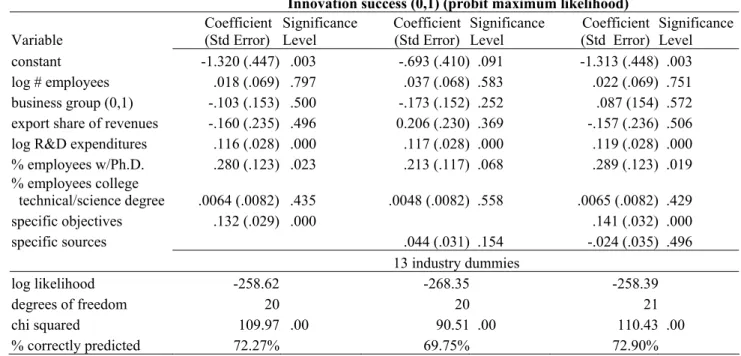
To investigate the main propositions regarding breadth of objectives and sources, we regress measures of innovation success on measures of breadth in objectives and sources, while controlling for other possible influences on innovation success. As explained in more detail below, the CIS data contain a binary indicator of innovation success (including products and processes) as well as a measure of the percent of sales from product innovations. We use probit maximum likelihood estimation for the binary indicator and tobit maximum likelihood
estimation for the sales variable, which is censored because sales of new products can only be zero or positive.
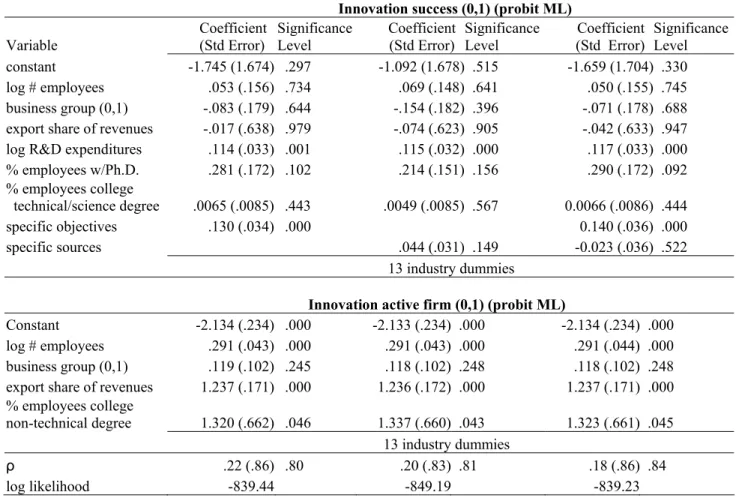
In addition, the structure of the question we are investigating may contain an inherent sample selection problem: we generally do not observe the commercialization of an innovation unless a firm has first attempted to innovate. Most studies of innovation outcomes, including the many studies of patenting output, do not attempt to correct for the possibility of this sort of sample selection bias. Implicitly, the studies assume that we only care about the determinants of innovation success for firms that have attempted to innovate. In our analysis, we first separate the firms that attempted to innovate from those that did not. Our primary sample includes only the firms that attempted to innovate. But in addition, we address the sample selection issue. The standard statistical approach for dealing with this problem is Heckman’s (1979) two-stage sample selection methodology, using maximum likelihood estimation with corrected standard errors (see e.g., Greene, 2000 and Wooldridge, 2003). 8 Using data for all firms that completed the survey, we estimate a first-stage selection equation of the probability that a firm attempted to innovate. Then for the firms that attempted to innovate, we estimate a
8 See Shaver (1998) and Mitchell and Shaver (2003) for examples of sample selection estimation in the strategic management literature.
second stage regression for innovation success conditional on the results of the first-stage equation.9 We use LIMDEP version 8.0, which contains procedures for probit and tobit regression with sample selection, to estimate all of the models.
Variables
Dependent Variable
To measure innovation success, we utilize two main proxy variables. The first is a binary (0,1) variable, indicating whether or not the firm introduced any technological innovations (product or process) during the 1994-1996 period. The survey provided a detailed explanation to respondents of what constituted a technological innovation, as explained in the footnote below.10 These innovations were new to the firm, and may or may not have been new to the market. The survey also contains information about the percent of total firm sales revenues in 1996 from the sale of technologically new products introduced during 1994-96. The data in the regressions that use the sales revenue dependent variable are lagged in that sales revenues in 1996 are regressed on right-hand side variables from the period 1994-96.
9 The sample selection methodology helps to control for the possibility that the estimated coefficients for breadth
of objectives and sources in the innovation success equation may be biased (upward in this case), because the variables are observed only when the firm has decided to engage in innovative activity. This bias will occur if unobservable or unmeasured factors affect both the likelihood that a firm attempts to innovate and the result of such attempts. If such unobserved factors are present, the error terms in the two equations will be correlated. This two-stage approach mitigates the potential problem that the coefficient estimates for innovation objectives and knowledge sources might otherwise be interpreted as proxies for the likelihood that a firm has attempted to innovate. Instead, we explicitly estimate the probability that a firm has attempted to innovate prior to inclusion of innovation objectives and knowledge sources in the equation for innovation success.
10The survey defines a product innovation as including both a technologically new product and a technologically significant product improvement. A technologically new product is one whose purpose or technological characteristics are clearly distinct from those of the existing products of the firm. The new product can be based on a new technology, a new application of existing technologies, or application of new knowledge. A technologically significant product improvement significantly improves on the characteristics or performance of an existing product of the firm, and may include improvements in components, materials, or subsystems. The survey defines a process innovation as one that is technologically new or that contains a fundamentally improved method of production or product distribution. A process innovation may include (but is not limited to) improvements based on changes in equipment, instruments, organization of production, or new knowledge. We also require that the firm indicate that it developed the innovation primarily by itself, and that any associated research and development was performed internally rather than outsourced or performed in collaboration with other firms.
The CIS survey data contain only the binary and sales types of measures used here. The two dependent variables have different strengths and weaknesses. For example, use of the product sales variable helps to reduce (but does not eliminate) the potential for endogeneity of the explanatory variables. Such endogeneity could occur in a cross-section of data if the outcome of successful innovation leads firms to add objectives and knowledge sources for subsequent innovation. A common solution to this form of potential endogeneity utilizes instrumental variables. Unfortunately, we do not have data with which to construct appropriate instruments. The use of product sales as a dependent variable mitigates this concern to some extent, however, since the variable includes only 1996 sales, while objectives and sources include the years 1994 and 1995 in addition to contemporaneous data from 1996.
Additionally, the product sales variable has the advantage that it provides a measure of the extent of commercial success, in contrast to the binary innovation variable which provides only a minimum measure of innovation success (commercialization of at least one product or process innovation). The product sales variable comes directly from a survey question that asked firms to report the share of total firm sales revenues in 1996 from product innovations. Among the firms that innovated, approximately 90 percent introduced product innovations, indicating that use of a product sales variable is appropriate. Since close to half of the innovating firms also had process innovations, however, product sales do not fully reflect innovation success. In addition, the value of total firm sales in the denominator of the product sales variable reflects any sales lost from discontinued products. The binary indicator of innovation success, however, is not affected by discontinued products and includes process innovations. By using both the binary innovation and the product sales variables, we obtain a fuller picture of innovation success. If the results for both dependent variables are similar, we can place greater confidence in the results.
Explanatory Variables
The key explanatory variables in our study represent the number of different innovation objectives that firms pursued and the number of different knowledge sources that firms accessed. The CIS survey question regarding objectives asked respondents to identify the importance of each of 10 possible technological objectives in their innovation activities. 11 The right-hand side of table 2 lists the different objectives included in the survey, which correspond to the specific objectives discussed earlier, such as expanding the product line or reducing labor costs. These specific objectives easily cluster into more general objectives that are related to product innovation, process innovation, and what we term business environment innovation.12 The latter, which includes fulfillment of government regulations and mitigation of environmental impact, might involve either product or process innovations. Therefore we analyze them separately. For purposes of empirical analysis, we analyze the grouped objectives on the left-hand side of Table 2 as general objectives, and we analyze the objectives on the right-hand side of the table that come directly from the survey questions as specific objectives. We analyze breadth in general objectives separately from breadth in specific objectives, since specific objectives nest within categories of general objectives.
Within each category of general objectives, some of the specific objectives included in the survey may overlap with one another. For example, expanding the product assortment could increase market share as well. If specific objectives in the survey overlap, a firm might have answered that it had multiple specific objectives, when the firm actually had fewer underlying objectives. This possibility works against our finding a positive association of breadth in specific objectives with innovation success, because firms would have reported a greater number of objectives than they actually had. Nevertheless, as a robustness check in the
11 The 10 objectives included in the CIS survey are very similar to the 11 objectives used in the Yale survey at the
industry level (see Cohen and Malerba, 2001).
12 Although some of the specific process objectives in Table 2 might contribute to product innovation, it seems
reasonable that the specific process-oriented objectives have process innovation as the primary goal. Similarly, the specific product-oriented objectives are likely to have product innovation as the primary goal.
empirical analysis, we conduct sensitivity tests to assess the importance of breadth of specific objectives within broader categories of general objectives.
The CIS survey also asked respondents to identify the importance of each of 12 possible sources of information used in innovation activities. The right-hand side of table 3 lists the knowledge sources included in the CIS survey. This set of knowledge sources encompasses a wide range of external sources, in addition to knowledge from within the firm and business group. We group these specific sources of information into more general categories of knowledge sources, as shown on the left-hand side of the table. This grouping comes from the United Kingdom (UK) CIS survey questionnaire. Veugelers and Cassiman (1999) also used this grouping in analyzing the Belgian CIS data. (The Finnish CIS questionnaire lists the specific knowledge sources without providing groupings.) These groupings distinguish between internal, market-mediated (from other firms), institutional (research institutes), and other (publicly available) sources of knowledge. We analyze breadth in general sources separately from breadth in specific sources, since specific knowledge sources nest within categories of general knowledge sources.
In assessing the impact on innovation of the number of innovation objectives and knowledge sources, it is important to account for the fact that some objectives and knowledge sources may have greater importance than others. If an innovation objective is relatively unimportant to the firm, or if a knowledge source provides relatively little useful knowledge to the firm, including them in the analysis would overstate the actual objectives and knowledge sources relevant to innovation.
For each objective or knowledge source listed in the survey questionnaire, the firm was asked to “evaluate the importance of the following objectives/sources of information for the innovation activities of your firm” on a Likert scale from 0 (not important at all/not used) to 3 (very important). To account for the varying importance of different objectives and knowledge sources, we adopted the approach used by Cohen and Malerba (2001) in their analysis of industry level innovation objectives. For each of the specific innovation objectives shown in
table 2, we created a binary indicator for whether the survey response indicated that the item was important to the firm. A survey response of either 2 (important) or 3 (very important) for an objective received a binary value of 1; survey responses of 0 (not important at all/not used) or 1 (some importance) received a binary value of 0. We coded the survey responses for each of the specific sources of knowledge shown in table 3 in the same manner. For each of the general objectives in table 2, the objective was assigned a value of 1 if at least one of the specific objectives in that group of general objectives received a survey response of either 2 or 3. If none of the specific objectives in the group received a survey response of 2 or 3, then the general objective was assigned a binary value of 0. We used the same procedure for the general sources of knowledge.
The variable that measures breadth of specific objectives is the sum for each firm of the binary values for the specific innovation objectives shown in table 2. The variable for breadth of general objectives is constructed as the sum for each firm of the binary values of the general objectives in table 2. The variable for the breadth of specific objectives has a maximum value of 10 and the variable for the breadth of general objectives has a maximum value of 3. The variable that measures breadth of specific knowledge sources is the sum for each firm of the binary values for the specific sources of knowledge shown in table 3. The variable for breadth of general knowledge sources is constructed as the sum of the binary values of the general knowledge sources shown in table 3. The variable for the breadth of specific sources has a maximum value of 12 and the variable for the breadth of general sources has a maximum value of 4. As a robustness check on the results, we also constructed alternative variables for the breadth of specific objectives and sources using the simple sums of the survey responses for objectives and sources, respectively. The results using these alternative variables are very similar to those reported here and are available upon request.
Tables 2 and 3 denote with an asterisk the specific objectives and sources that the survey responses on average ranked as relatively more important. The answers to the survey indicate that the specific innovation objectives that ranked as most important in the sample as a
whole were those to improve existing products and open new markets. The most important specific knowledge sources in innovation came from within the firm and from customers. Each of these objectives and sources had a raw mean score above 2.0 (out of 3.0 on the Likert scale), with a mean binary value above 0.75. Other somewhat important specific objectives and sources (mean greater than 1.50 for the raw scores on the Likert scale and greater than 0.50 for the binary values) included objectives to expand the product assortment, improve production flexibility, reduce labor costs, and reduce material consumption, as well as knowledge sources from competitors and suppliers.
Control Variables
In the analysis, it is important to control for factors other than breadth of objectives and sources that may affect innovation success. These factors include firm size, R&D spending, firm innovative capabilities, and industry of operation. Firm size is likely to be an important predictor for the binary (0,1) innovation variable in particular. Because larger firms have access to greater financial and human resources, these firms may have a greater ability to achieve at least a single innovation. Firm size is measured as the logarithm of the number of employees. In addition to firm size, because R&D spending is explicitly directed toward the development of new products and processes, greater R&D expenditures may increase the probability of successful innovation. Moreover, as noted earlier, firms that devote greater funds to innovation activity will have a greater ability to pursue a greater number of different objectives and sources. Although R&D spending does not include all funds devoted to innovation activity, which could take other forms, it should capture most direct spending on innovation. R&D expenditures are measured in logarithmic form, since they tend to increase with firm size.
Firms that have greater innovative capability also would be expected to have greater innovation success on average. We control for firm innovative capability in two ways. First, employee skills and knowledge are critical inputs to a capability for innovation. The quality of
employee skills relevant to innovation therefore may affect innovation success. Firms that have employees with research skills gained through post-graduate education may have a greater ability to innovate. We therefore include the percent of firm employees with postgraduate degrees (Ph.D. or licentiate) as a proxy for the research training of employees. In addition, since the innovations in this survey are technological in nature, employee technical skills may help a firm to innovate. We therefore include the percent of firm employees with college but not postgraduate degrees in engineering, physical sciences, or life sciences as a proxy for the technical training of employees.13 In addition to the employee skills variables, we include a (0,1) dummy variable for whether the firm is a subsidiary of a larger company. Firms that are subsidiaries of larger corporations (termed “business groups”) may have access to the resources of other subsidiaries or of the corporate office that could improve the ability to innovate.14
Industry level factors also may affect the innovation success of individual firms, including the extent of industry technological opportunity, appropriability of the returns to innovation, and customer demand. The underlying state of technology and basic science related to industry products and processes in part determines the potential for technological progress (or technological opportunity) in an industry (Klevorick et al., 1995). In addition, firms in industries with greater technological opportunity (e.g., high technology industries) may pursue a greater number of different objectives due to the greater potential for technological advance. These firms also may pursue greater breadth of knowledge sources in order to access the greater underlying technological opportunity in the industry. By controlling for industry of operation, we insure that we do not confound industry technological opportunity with breadth of firm objectives and sources. In addition to technological opportunity, the ability of firms to appropriate returns to innovation also varies by industry (Cohen and Levinthal, 1989). The greater the appropriability of returns to innovation, the greater the incentive that firms have to
13In Finland, the first degree for engineers and for most physicists and life scientists is a Master’s degree requiring 5 years of study. A licentiate degree requires the same coursework as a Ph.D. (2 years beyond the Master’s) but requires only one year of research following coursework (rather than 2-3 years for a Ph.D.).
14 This dummy variable also controls for the fact that non-group firms have one less possible source of knowledge,
innovate. Customer demand for new products also affects the incentive to innovate (Adner, 2002). To control for industry level factors, we include a dummy variable for each 2-digit level SIC industry in the sample.15
Finally, we control for the export orientation of the firm. The potential for greater sales outside of Finland may increase the incentive to innovate. In addition, firms that export their products abroad may face stronger competition than firms that sell only in Finland, which is a small economy. Stronger competition in foreign markets also may provide greater incentive to innovate. Export orientation is measured as the ratio of annual export revenues to total firm sales.
Sample Selection Variables
Earlier we mentioned the possibility of sample selection bias, whereby the firm’s propensity to engage in innovative activity might be reflected in its breadth of objectives and sources. In the regressions for innovation success, inclusion of control variables that reflect the propensity of firms to attempt innovation can help control for this form of sample selection bias. Our analysis includes several such variables, including R&D spending (indicative of the attempt to innovate), firm size (larger firms are more likely to create formal research programs), employee research skills (firms with stronger employee research skills are more likely to attempt innovation), and industry dummy variables (firms in more technologically advanced industries may be more prone to attempt technological innovation).
In addition to including the foregoing control variables in the analysis of innovation success, sample selection estimation techniques can be used to control for the fact that only firms that attempted to innovate would likely have succeeded in commercializing a technological innovation. We therefore estimate a first-stage selection regression which includes all firms that responded to the CIS survey. For this regression, we created a binary
15 The data make it difficult to utilize a more fine-grained classification of industry membership, which would
(0,1) dependent variable to indicate whether or not the firm attempted to innovate. This variable has a value of 1 if the firm indicated that it had ongoing innovation projects or R&D investments of any type (internal to the firm as well as collaborative and contract arrangements) and a value of 0 otherwise. Forty-six percent of the firms in the sample received a value of 1 and were classified as innovation active. In addition, the selection equation includes a new right-hand side variable, which is the percent of firm employees with non-technical college (but not postgraduate) degrees other than in the technical areas of engineering, physical sciences, and life sciences. Since firms that are more knowledge-intensive may be more likely to attempt innovation, this variable provides an indicator of the extent to which firms are knowledge-intensive in their general employee base (as reflected in the percentage of college educated employees). The selection regression also includes the other control variables used in the second stage regression for innovation success, with the exception of the variables for R&D spending and employee research skills. The latter variables are closely associated with internal firm research and development activity and are likely to have a strong direct effect on innovation success.16
Common Method Variance
All of the variables except those dealing with education come from the CIS survey, which had a single respondent per company. We therefore conducted a standard check for common method variance, which could inflate any observed correlations between the dependent and independent variables. We used Harmon’s one-factor test to assess common method bias. If common method variance is a serious problem, a factor analysis would produce a single factor that accounts for most of the correlation between the dependent and independent variables (see Podsakoff and Organ, 1986).
16 For the selection equation, we seek to predict the propensity to attempt innovation, rather than innovation success. The latter generally is strongly affected by factors related to R&D. As a practical matter, it is not possible to include R&D spending in both the selection equation and the main innovation success equation. The model will not converge, most likely because R&D spending is highly collinear with the dependent variable in the selection equation. Firms that attempt to innovate generally have R&D spending.