Author's Accepted Manuscript
Active Learning via Query Synthesis and
Nearest Neighbour Search
Liantao Wang, Xuelei Hu, Bo Yuan, Jianfeng Lu
PII:
S0925-2312(14)00814-5
DOI:
http://dx.doi.org/10.1016/j.neucom.2014.06.042
Reference:
NEUCOM14371
To appear in:
Neurocomputing
Received date: 22 August 2013
Revised date: 26 May 2014
Accepted date: 19 June 2014
Cite this article as: Liantao Wang, Xuelei Hu, Bo Yuan, Jianfeng Lu, Active
Learning via Query Synthesis and Nearest Neighbour Search,
Neurocomputing,
http://dx.doi.org/10.1016/j.neucom.2014.06.042
This is a PDF file of an unedited manuscript that has been accepted for
publication. As a service to our customers we are providing this early version of
the manuscript. The manuscript will undergo copyediting, typesetting, and
review of the resulting galley proof before it is published in its final citable form.
Please note that during the production process errors may be discovered which
could affect the content, and all legal disclaimers that apply to the journal
pertain.
Active Learning via Query Synthesis and Nearest Neighbour Search
Liantao Wanga, Xuelei Hua,c, Bo Yuand, Jianfeng Lua,baSchool of Computer Science and Engineering, Nanjing University of Science and Technology, Nanjing 210094, China bJiangsu Key Laboratory of Image and Video Understanding for Social Safety, Nanjing University of Science and Technology, Nanjing
210094, China
cSchool of Information Technology and Electrical Engineering, University of Queensland, Brisbane QLD 4072, Australia dIntelligent Computing Lab, Division of Informatics, Graduate School at Shenzhen, Tsinghua University, Shenzhen 518055, China
Abstract
Active learning has received great interests from researchers due to its ability to reduce the amount of supervision required for effective learning. As the core component of active learning algorithms, query synthesis and pool-based sampling are two main scenarios of querying considered in the literature. Query synthesis features low querying time, but only has limited applications as the synthesized query might be unrecognizable to human oracle. As a result, most efforts have focused on pool-based sampling in recent years, although it is much more time-consuming. In this paper, we propose new strategies for a novel querying framework that combines query synthesis and pool-based sampling. It overcomes the limitation of query synthesis, and has the advantage of fast querying. The basic idea is to synthesize an instance close to the decision boundary using labeled data, and then select the real instance closest to the synthesized one as a query. For this purpose, we propose a synthesis strategy, which can synthesize instances close to the decision boundary and spreading along the decision boundary. Since the synthesis only depends on the relatively small labelled set, instead of evaluating the entire unlabeled set as many other active learning algorithms do, our method has the advantage of efficiency. In order to handle more complicated data and make our framework compatible with powerful kernel-based learners, we also extend our method to kernel version. Experiments on several real-world data sets show that our method has significant advantage on time complexity and similar performance compared to pool-based uncertainty sampling methods.
Keywords: active learning, query synthesis, pool-based sampling, kernel function
1. Introduction
Active learning is an important approach to construct-ing a high performance classifier while keepconstruct-ing the amount of supervision to a minimum by actively selecting the most valuable training instances. As an effective way to re-duce the cost of human labelling, it has been successfully applied to various applications [1, 2], especially when la-belling is difficult or time-consuming. In a typical active learning cycle, the algorithm selects the most valuable (in-formative [3] or representative [4]) instance and requests its label. Then the new labelled instance is added to the training set, and the classifier is retrained. Note that how to form a query plays a key role in an active learning algorithm. In terms of query formation, there are two scenarios of active learning in the literature: query syn-thesis [5, 6, 7] and sampling, which can be further divided into stream-based sampling [8, 9] and pool-based sampling [10, 3, 11, 12] .
In the scenario of query synthesis, the learner may gen-erate a query in the form of any unlabelled instance in the
Email addresses: [email protected](Liantao Wang), [email protected](Xuelei Hu),[email protected](Bo Yuan),[email protected](Jianfeng Lu)
input space, i.e. the query can be fictitious. By contrast, active learning based on sampling selects real instances from the unlabelled set. Note that stream-based sampling and pool-based sampling can share the same criterion of value measure (e.g. uncertainty [3], query by committee [13]), and the only difference is the way they access the un-labelled data. Concretely, stream-based sampling selects one instance at a time and decides whether to query it or not. Pool-based sampling, however, maintains a pool consisting of unlabelled data. At each iteration, it eval-uates and ranks the entire collection of unlabelled data before selecting the most valuable one. Since pool-based sampling generates queries in a greedy fashion, it is more effective and has attracted most of the research interests, while stream-based sampling is only appropriate in some special situations where memory or processing power is limited.
Since query synthesis generates a query using a small amount of labelled data, it is therefore very efficient. How-ever sometimes synthesized queries are unrecognizable to human oracle [14]. Pool-based sampling is effective as it generates a query by evaluating the entire unlabelled set, but it is very time-consuming. To make the querying both fast and effective, we have proposed a framework that
com-bines query synthesis and pool-based sampling in [15]. In this paper, we propose a new strategy for query synthesis and extend the framework to kernel version. The main idea is that, at each iteration, we synthesize an instance close to the current classification boundary and search for its nearest neighbour among the unlabelled instances as the actual query. Specifically, from the initially labelled instances, we can obtain one positive instance and one negative instance. We call these two instances with op-posite labels an Opposite Pair. According to the initial
Opposite Pair, we first use an efficient method to find an-other Opposite Pair close to the classification boundary. After that, we iteratively synthesize a query along the mid-perpendicular of the previously foundOpposite Pair. This can guarantee that the queries are close to the classifica-tion boundary and well dispersed.
Since our method synthesizes a query directly, instead of evaluating every instance in the unlabeled data pool, it has the advantage of efficiency. Also by using the real instance nearest to the synthesized one, it can make sure that the query is recognizable to a human oracle. Our algorithm can be further accelerated by using various ap-proximate nearest neighbour search techniques [16].
This strategy can select the instances closest to the decision boundary, which are most informative. More-over, instead of only considering the informativeness of the query, we also take into account the representativeness, and introduce pre-clustering in our method to exploit the local structure of the data and construct a compact and representative unlabelled pool based on local center points. In order to handle more complicated data and make our framework compatible with kernel-based learners such as support vector machine (SVM), we further extend this framework with the query strategy to kernel version. Queries can be synthesized in the feature space without knowing the explicit non-linear mapping function by kernel trick, which has been exploited in many machine learning meth-ods [17, 18, 19, 20].
The rest of this paper is organized as follows: In Section 2, we review the work related to our approach. Section 3 introduces our approach in detail. Experimental results are reported in Section 4. Section 5 concludes this work.
2. Related Work
2.1. Query synthesis
Query synthesis was first proposed in [5], and further studied in [21]. In this setting, a membership query is generated in the form of any unlabelled instance in the input space. Baum [6] used interpolation to synthesize queries to find separating hyperplane efficiently, but later demonstrated that this kind of query can not work prop-erly in vision-based task [14], because the human oracle can not recognize the query synthesized by the algorithm. After that, although King et al. [22, 7] found a promising real-world application of query synthesis, few efforts have
focused on synthesis query since an arbitrary query might be meaningless and difficult for human to label.
2.2. Pool-based Sampling
Pool-based sampling has been the most prosperous branch of active learning, due to its effectiveness. It has been widely used in many real world applications (e.g., text cat-egorization [23], video search [24], image classification [25] and action retrieval [26]). Pool-based active learning was first introduced by Lewis and Gale [10]. The algorithm maintains a pool consisting of unlabelled instances and se-lects the most informative one at each iteration. The main issue with active learning in this scenario is how to mea-sure the informativeness. The most commonly used strate-gies are uncertainty sampling [10, 27, 28, 11] and query by committee [29, 30, 13]. There are also methods aiming at expected error reduction [31, 32]. Strategies such as un-certainty sampling and query by committee can select the instances closest to the decision boundary, which is most informative. However they only measure the value of a single instance, as a result they may suffer from querying similar instances repeatedly. To overcome this limitation, the local structure of the data can be considered while se-lecting queries. For example, clustering was introduced into active learning in [33, 34] to select the most repre-sentative instances. Reprerepre-sentativeness is also taken into account in batch mode active learning [35], where the au-thors considered an instance’s similarity to the remaining unlabelled instances. Huang et.al [12] extended this min-max view of active learning to take into account both the cluster structure of unlabelled instances and the class as-signments of the labelled instances. More recently, Zhang et.al [4] used locally linear reconstruction to exploit the intrinsic geometrical structure of the data, so as to select the most representative instances.
3. Methodology
Suppose we have a training data set denoted by D=
L∪U, whereLis the labelled set with very small size andU consists of large amount of unlabelled instances. The goal is to select the most valuable instances for the classifier training from the unlabelled set.
3.1. Algorithm
Similar to many other active learning algorithms, we assume the instances close to the classification boundary are generally more ambiguous and their labels will provide more information to the classifiers. As a result, we aim to find instances close to the classification boundary.
Suppose {x+,x−} is an Opposite Pair. We can find instances on a separating plane with high precision by in-terpolating iteratively similar to binary search: We always query the point located in the middle of the closest Op-posite Pair. Concretely, let x1 = (x++x−)/2 and query its label. If x1 is positive (negative), we then query the
midpoint of x1 and x− (x+). Repeating this process b
times, we can guarantee that xb is on a separating plane with bbits of precision [6]. An illustration of this process is show in Fig. 1. Since the synthesized query may not be recognized by the human oracle, in practice we instead query its nearest neighbour rather than itself.
X- X+ 1 2 3 4
Figure 1: The binary search process used to find a point very nearly on the separating hyperplane given {x+,x−}. Queries are always generated by the midpoint of the closest Opposite Pair. The first point1is positive. The second query thus is the midpoint between query1andx−. Afterbqueries, we have a point on the hyperplane with accuracy 2−bd, wheredis the distance betweenx+andx−.
If we always use binary search to generate queries, it can be guaranteed that the queries are close to the bound-ary with high precision, but the queries will concentrate in a local neighbourhood. Ideally, we expect the queries to locate close to the separating plane dispersedly. As a result, after we find an Opposite Pair {x+,x−} close to
the separating plane, we make the next query by adding their midpoint with a small vector: xs= (x++x−)/2+xr.
Since we want the queries always close to the separating plane, the small vector xr should be orthogonal to the connecting line of the Opposite Pair. Similarly, we search its nearest neighbour denoted by xq. If the label of xq is positive, we then repeat this process usingxq andx−. See Fig. 2 for a simple example.
Overall, given a dataset with a small labelled set, we initialize theOpposite Pair with the centroids of positive labelled set and negative labelled set. Then we find an
Opposite Pair close enough to the separating hyperplane. After that, we generate queries along the midperpendicu-lar of newly founded Opposite Pair. We expect that the queries are distributed in the shape of net on sides of the separating plane.
We now specify these procedures. Letc+ and c− be
the centroids of positive and negative labelled instances.
c+= 1 |L+| xi∈L+ xi, c−= 1 |L−| xi∈L− xi.
We then synthesize the first instancexs=12(c++c−) and
query its label. Since this is a pseudo instance, it might not be recognized by the human annotator, especially in vision-based tasks. Instead, we search its nearest neigh-bour (denoted by xq) from the unlabelled set and query
X- X+ 1 2 3 4
Figure 2: A simple procedure for rest queries after finding an Op-posite Pair {x+,x−} close to the separating hyperplane. We syn-thesize the next query using a vector starting from the midpoint of their connecting line and orthogonal to the connecting line. Queries are always generated by the latest foundOpposite Pair.
its label. If positive, we then use the midpoint ofxq and
c− as a new synthesized instance. Repeating this process
b times, we can find an Opposite Pair {x+,x−} close to the classification boundary. See Algorithm 1.
Algorithm 1 Find Opposite Pair close to separating hyperplane. {x+,x−},L,U
=
f indP air{xo+,x−o},Lo,Uo, b
Require: {xo+,xo−}- InitialOpposite Pair;Lo- Current labeled set;Uo - Current unlabeled set;b- Number of binary search
Ensure: {x+,x−} -Opposite Pair close to separating
hyperplane;L- Updated labeled set;U - Updated un-labeled set; 1: fori= 1 tobdo 2: Synthesize an instancexs= (x++x−)/2 3: xq ←nnSearch(xs,U) 4: Query xq 5: L=L ∪xq,U =U\xq 6: if xq is positivethen 7: x+←xq 8: else 9: x− ←xq 10: end if 11: end for 12: return {x+,x−},L, U
After we find an Opposite Pair close enough to the classification boundary, we generate the next query in the direction of its midperpendicular. This new synthesis can be obtained by adding an orthogonal vector to the mid-point. We can find the vector by orthogonalizing a random vector using Gram-Schmit process and normalize its mag-nitude to λ. See Algorithm 2 for details. Similarly, we search for its nearest neighbour from the unlabelled set and query the label. If positive, we then usexq andx−to
generate the next query. The entire algorithm is shown in Algorithm 3.
Algorithm 2Synthesize midperpendicular query for Op-posite Pair. xs=getP erpQuery{x+,x−}, λ
Require: {x+,x−} -Opposite Pair; λ- Magnitude of
midperpendicular vector; Ensure: xs- Synthesis
1: xo=x+−x−
2: Generate a random vectorxr
3: Use Gram-Schmit process to make xr orthogonal to
xo,xr=xr−<xr,xo> / <xo,xo>∗xo
4: Set the magnitude toλ,xr=λ/norm(xr)∗xr
5: Translate it to the midpoint,xs=xr+ (x++x−)/2 6: return xs
Algorithm 3Proposed framework of active learning. Require: L- Labeled set;U - Unlabeled set;n- Number
of instances to select;b - Number of binary search; λ
- Magnitude of midperpendicular vector; Learner -Learner Ensure: h- hypothesis 1: Obtainc+ andc− 2: {x+,x−},L,U=f indP air{c+,c−},L,U, b 3: fori=b+ 1 tondo 4: xs=getP erpQuery{x+,x−}, λ 5: xq =nnSearch(xs,U) 6: Queryxq 7: L=L ∪xq,U =U\xq 8: if xq is positivethen 9: x+←xq 10: else 11: x−←xq 12: end if 13: end for 14: h=Learner(L); 15: return h
The proposed approach can overcome the issue of mean-ingless queries by using their nearest neighbors instead. As to computational complexity, since query synthesis only works on a small set of labeled data, most computational cost of querying is on the nearest neighbor search. The computational complexity of the linear search is O(kd), where k is the size of the pool and dis the dimensional-ity. Our algorithm can be further sped up by using fast approximate nearest neighbour search.
3.2. Kernel Extension
In order to extend our framework to kernel version, we need to address the issues of binary search and midperpen-dicular synthesis in feature space. Consider the same data
set D = L ∪ U, we project the data into an appropriate
feature space by a nonlinear mapping φ(x).
3.2.1. Binary Search in Feature Space
In 3.1, we use an Opposite Pair {x+,x−} to obtain
instances close to the separating hyperplane with binary search. We can also do this in feature space. Given an
Opposite Pair {x+,x−}, i.e.
φ(x+), φ(x−)
in feature space, the unlabelled instance nearest to their midpoint in feature space can be obtained by solving:
min x∈U φ(x)−1 2 φ(x+) +φ(x−) 2 2 ,
which can be reformulated by introducing kernel functions min x∈U k(x,x)−k(x,x+)−k(x,x−) .
3.2.2. Midperpendicular Synthesis in Feature Space
Suppose we already have an Opposite Pair {x+,x−}, and in feature space they become φ(x+), φ(x−). Simi-larly we should generate a random vector, here we ran-domly select an instance xr in the dataset, then used Gram-Schmit to orthogonalize it and set its magnitude to
λ. After we obtain the synthesis, we then search its near-est neighbour in the unlabelled pool as the actual query. The instance in unlabelled pool closet to the synthesized query can be obtained by solving:
min x∈U k(x,x) +m1k(x,xr) +m2k(x,x+) +m3k(x,x−), where m1=−2λ k(xr,xr)−α2/β, m2=−1 + 2λα β2k(xr,xr)−α2β, m3=−1−2λα β2k(xr,xr)−α2β. with α = k(xr,x+)−k(xr,x−), and β = k(x+,x+) + k(x−,x−)−2k(x+,x−).
3.3. Representative and Compact Pool
To also take into account the representativeness of our queries, we exploit clustering techniques on the whole data set as a pre-processing, and collect the unlabelled instances nearest to the local centers to construct a representative and compact unlabeled data pool.
We first use a clustering technique (e.g., k-means) to process the original data set. In this process, Dis parti-tioned intoKclusters{D1,D2, ...,DK}, whereDi∩Dj=∅
for any i = j and D =Ki=1Di. Each cluster consists of a group of data points that are similar to each other. For cluster Di(1 ≤i ≤K), the centroid (cluster mean vector )ciis ci= 1 |Di| xj∈Di xj
Then, the data pointxci inU nearest toci can be found by nearest neighbor search strategies. We therefore obtain a setUc containing nearest neighbors of centroids.
Uc= arg min x∈Ux−ci 2 2, i= 1, . . . , K 4
With clustering techniques, a set of clusters{D1, . . . ,DK}
and their best representation Uc can be obtained to rep-resent the general distribution of D. If the label ofxci is given, it will provide important information for the labels of data points in Di. We therefore generate queries from
Uc in our approach. Note that |Uc| = K and Uc ⊂ U.
The size of the compact pool Uc is smaller than that of the original unlabelled data set, the proposed approach is computationally efficient and practical for large scale problems.
For the pool construction in feature space, we first project the data set D into an appropriate feature space by a nonlinear mapping φ(x). Similarly, kernel cluster-ing technique can be used to partition D into clusters
{D1,D
2, . . . ,D
K}. So, we now construct the compact and
representative unlabeled data pool by finding the nearest neighbour to the centroid of each cluster. Concretely, for each cluster Di(1≤i≤K), the centroid in feature space can be represented byci= |D1
i|
xj∈Di
φ(xj), where |Di|is the number of instances in cluster Di. Then the nearest neighbour can be obtained by
min x∈Uφ(x)−c i22, which is equivalent to min x∈U k(x,x)− 2 |D i| xj∈Di k(x,xj).
Then a compact and representative unlabeled data pool can be constructed: Uc= arg min x∈U k(x,x)− 2 |D i| xj∈Di k(x,xj) , i= 1, . . . , K . 4. Experiments
In this section, we demonstrate the performance of the proposed method on an artificial data set, UCI data sets [36] and MNIST database of handwritten digits [37].
We compared our methods with random sampling, and uncertainty-based sampling method and LLR-based active learning [4]. i) Random sampling: The algorithm ran-domly selects an instance in each round of iteration.This is actually a passive learning method. ii) Uncertainty-based sampling: The algorithm selects the most uncertain in-stance as next query. For Nearest Neighbour learner, the uncertainty of each unlabeled point is measured by the vote entropy of its five nearest neighbours. For the SVM learner, we used libsvm [38] to get a posterior probability for each instance. The most uncertain instance is the one with a posterior probability closest to 0.5. iii) LLR-based active learning in [4] selects the most representative in-stance at each iteration based on locally linear reconstruc-tion. We evaluated the performances of different competi-tors by the curves of classification accuracy against the size of labeled set.
For each data set, we randomly partitioned it into the initial labeled data setL, the test setT and the unlabeled data pool U, which accounted for 5%, 25% and 70% of the total size Ntotal respectively. This partition process was repeated 200 times to reduce randomness. All the results shown in this section are the average values over 200 repetitions. In addition, as described in Section 3.3, we clustered the whole data set into Ntotal/10 groups using (kernel) k-means. Instances closest to centroids in
U was selected to construct the compact poolUc for query generation. A PC with AMD Athlon 7550 CPU (2.50GHz) and 2GB RAM with 64-bit Win7 and Matlab 2013a was used as the experimental platform.
4.1. Artificial Data Set
The artificial data set consists of two classes of data that are linearly separable inR100. We first got a hyper plane in the space by randomly generating its normal vec-tor w ∈ R100. Then we randomly sampled in the space, and collected 250 data points withwTx>0 and 250 data points with wTx < 0. To validate the effectiveness of
our synthesis strategy, we compared our algorithm without pre-clustering with the baselines. The results are shown in Fig. 3. It can be seen that our synthesis-based query strat-egy outperforms the baselines significantly, which demon-strates the effectiveness of our synthesis query even with-out pre-clustering. 0 10 20 30 40 50 60 70 80 90 100 0.550 0.555 0.560 0.565 0.570 0.575 0.580 0.585 0.590 Number of Iterations Accuracy Ours Zhang Uncertainty Random
Figure 3: Results on artificial data set by Nearest Neighbour learner without pre-clustering.
4.2. UCI Data Sets
We investigate the performance of the competitors on 6 UCI data sets, which are described briefly in Table 1.
Table 1: Description of data sets
#cls #attr #inst |L| |U| |T| bupa 2 6 345 35 224 86 diabetes 2 8 768 77 499 192 heart 2 13 270 27 175 68 ionosphere 2 34 351 35 228 88 spambase 2 57 4601 460 2991 1150 wdbc 2 31 569 57 370 142
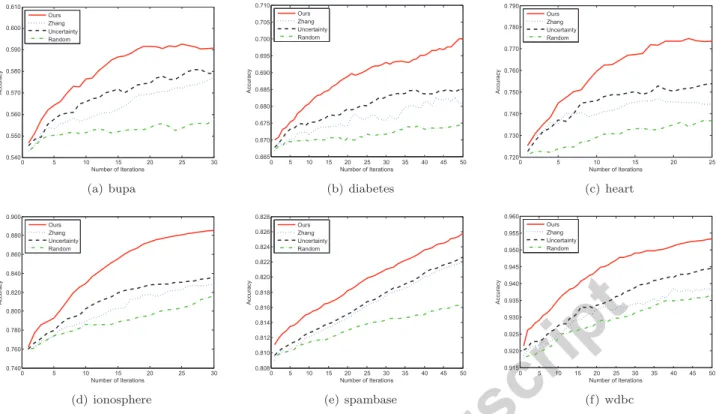
We first consider the comparison using Nearest Neigh-bour learner. Since Nearest NeighNeigh-bour learner has shown good applicability to nonlinear problems, we do not use nonlinear mapping, i.e., these querying proceeds in the original space. As we can see from the plots in Fig. 4, our methods outperforms all the others in terms of aver-age accuracy. To explore the efficiency of our strategy, we also listed the average CPU time costs of each round of iteration of different methods in Table 2. The time cost of our framework included that for pre-processing (clustering and kernel matrix computation for SVM), which was av-eraged into every iteration. Note this cost can be reduced when the number of iteration is increased. So we listed the cost in smaller fonts. It is clear that the time costs of our methods are similar to those of random sampling, which are much smaller than those of uncertainty sampling and [4].
Table 2: Time of querying using Nearest Neighbour learner (×10−4 s)
Ours Zhang Uncertainty Random
bupa 5+1 3904 96 1 diabetes 7+5 106893 231 2 heart 4+2 1999 78 1 ionosphere 6+3 5125 111 2 spambase 12+177 1072720 8236 3 wdbc 7+6 45540 194 2
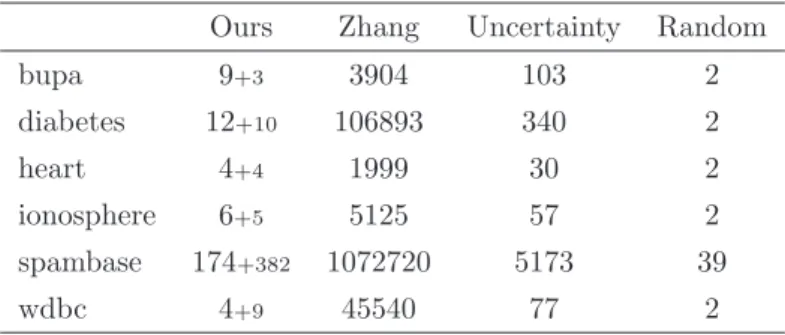
In order to show the ability to be compatible with ker-nel learners and get higher accuracies, we evaluate the performance of our framework combined with SVM. For every competitor, all of the data were mapped into a high-dimension space using RBF kernel. Fig. 5 shows the curves of the average classification accuracies of each com-petitor using SVM learner. As we can see from the plots, our methods are superior to method in [4] and random sampling and have slightly worse performance than un-certainty sampling. As we have developed kernel version, our framework can be combined with more powerful kernel SVM learner, the accuracies of every competitor are higher than that obtained using Nearest Neighbour learner. The average CPU time costs of each round of iteration of differ-ent methods are shown in Table 3. It is clear that the time costs of our methods are similar to those of random sam-pling, which are much smaller than those of uncertainty sampling and [4].
4.3. Handwritten Digit Recognition
Lang and Baum’s query learning failed in a handwrit-ten digit recognition task because the human oracle could not understand the image synthesized by the algorithm [14]. To address this problem, our algorithms query the real instance closest to the synthesized one. In order to
Table 3: Time of querying using SVM learner (×10−4 s)
Ours Zhang Uncertainty Random
bupa 9+3 3904 103 2 diabetes 12+10 106893 340 2 heart 4+4 1999 30 2 ionosphere 6+5 5125 57 2 spambase 174+382 1072720 5173 39 wdbc 4+9 45540 77 2
demonstrate the competence of our algorithms in vision-based recognition tasks, we conducted handwritten digit recognition experiments on MNIST database. MNIST database is a popular handwritten digit data set containing 60000 images in the training set and 10000 images in the test set (images with size of 28×28). Some instances are shown in Fig.6.
Figure 6: Examples of MNIST data.
We tested our framework with Nearest Neighbour learner on ’3’ vs ’5’, ’7’ vs ’9’. In these two groups of experiments, we randomly chose 500 examples from each class to create the experimental data set. PCA was employed to reduce the dimension from 784 to 122. The partition of the data set was exactly the same as described above.
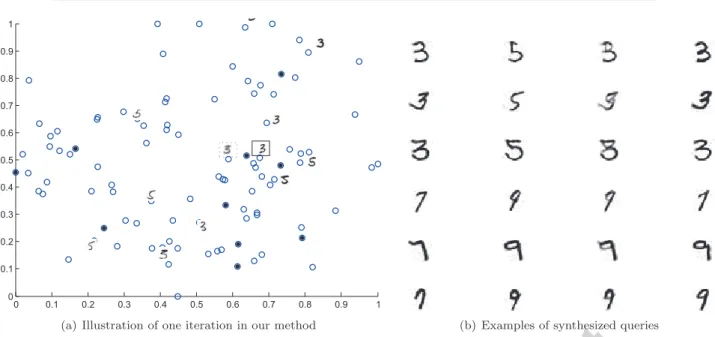
An illustration of a single iteration of our approach is given in Fig.7(a). Data points are plotted in the subspace specified by the first two principal components. Some Op-posite Pairsand their synthesized queries according to our approach are shown in Fig.7(b). Similar to the work by Lang and Baum, the synthesized instances are tricky to understand. However, instead of using the synthesized in-stances directly, we query their nearest neighbors, which are normal instances and easily recognizable.
The comparison of accuracy is shown in Fig. 8. Time consumption is shown in Table 4. In the classification of ’3’ versus ’5’ and ’7’ versus ’9’, the accuracy of our method 6
0 5 10 15 20 25 30 0.540 0.550 0.560 0.570 0.580 0.590 0.600 0.610 Number of Iterations Accuracy Ours Zhang Uncertainty Random (a) bupa 0 5 10 15 20 25 30 35 40 45 50 0.665 0.670 0.675 0.680 0.685 0.690 0.695 0.700 0.705 0.710 Number of Iterations Accuracy Ours Zhang Uncertainty Random (b) diabetes 0 5 10 15 20 25 0.720 0.730 0.740 0.750 0.760 0.770 0.780 0.790 Number of Iterations Accuracy Ours Zhang Uncertainty Random (c) heart 0 5 10 15 20 25 30 0.740 0.760 0.780 0.800 0.820 0.840 0.860 0.880 0.900 Number of Iterations Accuracy Ours Zhang Uncertainty Random (d) ionosphere 0 5 10 15 20 25 30 35 40 45 50 0.808 0.810 0.812 0.814 0.816 0.818 0.820 0.822 0.824 0.826 0.828 Number of Iterations Accuracy Ours Zhang Uncertainty Random (e) spambase 0 5 10 15 20 25 30 35 40 45 50 0.915 0.920 0.925 0.930 0.935 0.940 0.945 0.950 0.955 0.960 Number of Iterations Accuracy Ours Zhang Uncertainty Random (f) wdbc
Figure 4: Plots of mean accuracy with respect to the number of iterations on UCI data sets using Nearest Neighbour learner.
0 5 10 15 20 25 30 0.570 0.580 0.590 0.600 0.610 0.620 0.630 Number of Iterations Accuracy Ours Zhang Uncertainty Random (a) bupa 0 5 10 15 20 25 30 35 40 45 50 0.700 0.705 0.710 0.715 0.720 0.725 0.730 0.735 Number of Iterations Accuracy Ours Zhang Uncertainty Random (b) diabetes 0 5 10 15 20 25 0.750 0.760 0.770 0.780 0.790 0.800 0.810 0.820 0.830 Number of Iterations Accuracy Ours Zhang Uncertainty Random (c) heart 0 5 10 15 20 25 30 0.810 0.820 0.830 0.840 0.850 0.860 0.870 0.880 0.890 Number of Iterations Accuracy Ours Zhang Uncertainty Random (d) ionosphere 0 5 10 15 20 25 30 35 40 45 50 0.892 0.894 0.896 0.898 0.900 0.902 0.904 0.906 0.908 0.910 Number of Iterations Accuracy Ours Zhang Uncertainty Random (e) spambase 0 5 10 15 20 25 30 35 40 45 50 0.950 0.955 0.960 0.965 0.970 0.975 0.980 0.985 Number of Iterations Accuracy Ours Zhang Uncertainty Random (f) wdbc Figure 5: Plots of mean accuracy with respect to the number of iterations on UCI data sets using SVM learner.
0 0.1 0.2 0.3 0.4 0.5 0.6 0.7 0.8 0.9 1 0 0.1 0.2 0.3 0.4 0.5 0.6 0.7 0.8 0.9 1
(a) Illustration of one iteration in our method (b) Examples of synthesized queries
Figure 7: Illustration of experiments on MNIST data. (a) Illustration of a single iteration in the proposed method. The hollow points indicate unlabeled data points and the solid points indicate local center points. The digit images without frame indicate the labeled data points. The digit image with dotted frame indicates the synthesized query using binary search. The digit image with solid frame indicates the nearest neighbor of the synthesized query among local center points. (b) Examples of queries by the proposed method. The first two columns are
Opposite Pairsfound in the experimental process. Their midpoints (the synthesized queries) are shown in the third column. The unlabelled instances nearest to the synthesized queries are shown in the last column.
outperforms the uncertainty sampling, while the time cost is much smaller. Method in [4] yields best accuracy, but the time consumption is tremendous. Experimental re-sults show that our algorithms are not only practical but also competitive compared to the existed pool-based un-certainty sampling methods, which have been widely used in practice. 0 5 10 15 20 25 30 35 40 45 50 0.870 0.880 0.890 0.900 0.910 0.920 0.930 0.940 Number of Iterations Accuracy Ours Zhang Uncertainty Random (a) 3 vs 5 0 5 10 15 20 25 30 35 40 45 50 0.860 0.870 0.880 0.890 0.900 0.910 0.920 Number of Iterations Accuracy Ours Zhang Uncertainty Random (b) 7 vs 9
Figure 8: Plots of mean accuracy with respect to the number of iterations on MNIST data sets.
Table 4: Time consumption on MNIST database (×10−4 s)
Ours Zhang Uncertainty Random
3 vs 5 7+25 168680 1494 2
7 vs 9 6+22 145649 1393 2
5. Conclusion
We proposed a novel framework of active learning that combines query synthesis and pool-based sampling. The
basic idea is to synthesize an instance on the classifica-tion boundary according to the current labelled data in an efficient way, and then select the real instance nearest to the synthesized query from a compact representative unlabeled data pool as the query point. The proposed approaches not only enjoy the efficiency of query synthe-sis but also make the queries reasonable and meaningful for human oracles to label. Furthermore, we extended this novel technique into feature space, to better cope with non-linearly separable data and be compatible with more pow-erful kernel learners such as SVM. Experimental results on several real-world data sets indicate that the proposed method outperforms the random sampling in terms of ac-curacy significantly and has distinct speed advantage and similar performance compared to pool-based uncertainty sampling methods.
Acknowledgment
The work in this paper was supported in part by Na-tional Natural Science Foundation of China (NSFC) (No. 61233011, 91220301), Jiangsu Natural Science Foundation (No. BK20131351), Ministry of Human Resources of China via the Science and Technology Activities Grant for Re-turned Scholars, the Jiangsu Key Laboratory of Image and Video Understanding for Social Safety (Nanjing Uni-versity of Science and Technology) (No. JSKL201304, 30920140122007), the Programme of Introducing Talents of Discipline to Universities (No. B13022), the Funda-mental Research Funds for the Central Universities (No. 30920130122004, 30920130122005, 30920130121006) and the China Scholarship Council.
References
[1] B. Settles, Active learning literature survey, Computer Sci-ences Technical Report 1648, University of Wisconsin–Madison (2010).
[2] B. Settles, Active Learning, Synthesis Lectures on Artificial In-telligence and Machine Learning, Morgan & Claypool Publish-ers, 2012.
[3] S. Tong, D. Koller, Support vector machine active learning with application sto text classification, in: ICML, 2000, pp. 999– 1006.
[4] L. Zhang, C. Chen, J. Bu, D. Cai, X. He, T. S. Huang, Active learning based on locally linear reconstruction, IEEE Trans-actions on Pattern Analysis and Machine Intelligence 33 (10) (2011) 2026–2038.
[5] D. Angluin, Queries and concept learning, Machine Learning 2 (4) (1988) 319–342.
[6] E. B. Baum, Neural net algorithms that learn in polynomial time from examples and queries, Trans. Neur. Netw. 2 (1) (1991) 5–19.
[7] R. D. King, J. Rowland, S. G. Oliver, M. Young, W. Aubrey, E. Byrne, M. Liakata, M. Markham, P. Pir, L. N. Soldatova, A. Sparkes, K. E. Whelan, A. Clare, The Automation of Science, Science 324 (2009) 85–89.
[8] L. E. Atlas, D. A. Cohn, R. E. Ladner, Training connectionist networks with queries and selective sampling, in: NIPS, 1989, pp. 566–573.
[9] S. Dasgupta, D. Hsu, C. Monteleoni, A general agnostic active learning algorithm, in: ISAIM, 2008.
[10] D. D. Lewis, W. A. Gale, A sequential algorithm for training text classifiers, in: Proceedings of the 17th Annual International ACM SIGIR Conference on Research and Development in In-formation Retrieval, Springer-Verlag New York, Inc., New York, NY, USA, 1994, pp. 3–12.
[11] B. Settles, M. Craven, An analysis of active learning strategies for sequence labeling tasks, in: Proceedings of the Conference on Empirical Methods in Natural Language Processing, 2008, pp. 1070–1079.
[12] S.-J. Huang, R. Jin, Z.-H. Zhou, Active learning by querying informative and representative examples, in: NIPS, 2010, pp. 892–900.
[13] P. Melville, R. J. Mooney, Diverse ensembles for active learning, in: Proceedings of the Twenty-first International Conference on Machine Learning, ACM, New York, NY, USA, 2004, pp. 74–81. [14] K. Lang, E. Baum, Query learning can work poorly when a human oracle is used, in: Proc. IEEE International Joint Con-ference on Neural Networks, 1992, pp. 335–340.
[15] X. Hu, L. Wang, B. Yuan, Querying representative points from a pool based on synthesized queries, in: Proceedings of the International Joint Conference on Neural Networks, 2012, pp. 1734–1739.
[16] P. Indyk, R. Motwani, Approximate nearest neighbors: To-wards removing the curse of dimensionality, in: Proceedings of the thirtieth annual ACM symposium on Theory of computing, 1998, pp. 604–613.
[17] B. Sch¨olkopf, A. J. Smola, K.-R. M¨uller, Nonlinear component analysis as a kernel eigenvalue problem, Neural Computation 10 (5) (1998) 1299–1319.
[18] O. Dekel, C. Gentile, K. Sridharan, Selective sampling and ac-tive learning from single and multiple teachers, Journal of Ma-chine Learning Research 13 (9) (2012) 2655–2697.
[19] K. Yu, L. Ji, X. Zhang, Kernel nearest-neighbor algorithm, Neu-ral Processing Letters 15 (2) (2002) 147–156.
[20] J. Shawe-Taylor, N. Cristianini, Kernel Methods for Pattern Analysis, Cambridge University Press, 2004.
[21] D. Angluin, Queries revisited, in: Proceedings of International Conference on Algorithmic Learning Theory, 2001, pp. 12–31. [22] R. King, K. Whelan, F. Jones, P. Reiser, C. Bryant, S.
Muggle-ton, D. Kell, S. Oliver, Functional genomic hypothesis genera-tion and experimentagenera-tion by a robot scientist., Nature 427 (5) (2004) 247–52.
[23] S. C. H. Hoi, R. Jin, M. R. Lyu, Batch mode active learning with applications to text categorization and image retrieval, IEEE Transactions on Knowledge and Data Engineering 21 (9) (2009) 1233–1247.
[24] X.-Y. Wei, Z.-Q. Yang, Coached active learning for interactive video search, in: Proceedings of the ACM International Confer-ence on Multimedia, 2011, pp. 443–452.
[25] X. Li, Y. Guo, Adaptive active learning for image classification, in: Proceedings of the 26th IEEE Conference on Computer Vi-sion and Pattern Recognition, 2013, pp. 1–8.
[26] S. Jones, L. Shao, K. Du, Active learning for human action retrieval using query pool selection, Neurocomputing 124 (0) (2014) 89–96.
[27] S. Tong, D. Koller, Support vector machine active learning with applications to text classification, The Journal of Machine Learning Research 3 (2001) 45–66.
[28] M. Lindenbaum, S. Markovitch, D. Rusakov, Selective sampling for nearest neighbor classifiers, Machine Learning 54 (2) (2004) 125–152.
[29] H. S. Seung, M. Opper, H. Sompolinsky, Query by committee, in: Proc. ACM Workshop on Computational Learning Theory, 1992, pp. 287–294.
[30] N. Abe, H. Mamitsuka, Query learning strategies using boost-ing and baggboost-ing, in: Proceedboost-ings of the Fifteenth International Conference on Machine Learning, Morgan Kaufmann Publish-ers Inc., San Francisco, CA, USA, 1998, pp. 1–9.
[31] N. Roy, A. Mccallum, Toward optimal active learning through sampling estimation of error reduction, in: In Proc. 18th Inter-national Conf. on Machine Learning, Morgan Kaufmann, 2001, pp. 441–448.
[32] Y. Guo, R. Greiner, Optimistic active learning using mutual information, in: International Joint Conference on Artificial In-telligence (IJCAI), 2007, pp. 823–829.
[33] H. T. Nguyen, A. Smeulders, Active learning using pre-clustering, in: Proceedings of the 21st International Conference on Machine Learning, ACM Press, 2004, pp. 623–630.
[34] S. Dasgupta, D. Hsu, Hierarchical sampling for active learning, in: Proceedings of the 25th International Conference on Ma-chine Learning, ACM, New York, NY, USA, 2008, pp. 208–215. [35] S. C. Hoi, R. Jin, J. Zhu, M. R. Lyu, Semi-supervised svm batch mode active learning for image retrieval, in: Computer Vision and Pattern Recognition, 2008. CVPR 2008. IEEE Conference on, Ieee, 2008, pp. 1–7.
[36] A. Frank, A. Asuncion, UCI machine learning repository (2010). URLhttp://archive.ics.uci.edu/ml
[37] Y. LeCun, et al., Comparison of learning algorithms for hand-written digit recognition, in: Proc. International Conference on Artificial Neural Networks, 1995, pp. 53–60.
[38] C.-C. Chang, C.-J. Lin, LIBSVM: A library for support vector machines, ACM Transactions on Intelligent Systems and Tech-nology 2 (2011) 1–27.