he global business environment provides emergent
business opportunities as well as challenges. To tap these
opportunities and to respond to uncertainties in global
business environments, firms must not only develop global
business strategies but also support them with information
systems aligned with these strategies. Such systems are
increas-ingly being developed in globally distributed environments,
especially in countries with availability of low-cost, advanced
technical expertise.
There are two challenges in the development and deployment of
globally distributed systems. First, from the development
perspec-tive, the complexities of coordination, communication, culture, and technology
create challenges due to the disparate compositions of teams in dispersed
geo-ALIGNING IT COMPONENTS TO ACHIEVE
AGILITY IN GLOBALLY
DISTRIBUTED SYSTEM
DEVELOPMENT
I l l u s t r a t i o n b y P a u l Z w o l a k
T
By
ONE-KI (DANIEL) LEE, PROBIR BANERJEE, KAI H. LIM,
KULDEEP KUMAR, JOS VAN HILLEGERSBERG,
andKWOK KEE WEI
Agile IT strategy, infrastructure, and project management are
key elements for realizing agility in GDSD projects.
graphic locations. Second, from the deployment perspective, firms need to cater to the specific local require-ments of the sites spanning the activities of the global business. To address these challenges, firms must have the capability (that is, agility) to rapidly develop and deploy systems to meet emerging business needs.
While there is growing interest in agility for successful global sys-tem development, at present there are only a few studies that examine it in the context of globally distrib-uted system development (GDSD) projects. The objective here is to provide a better understanding of the role of agility in developing and deploying GDSD to support
diverse local business needs in the global scenario, and to explain how such agility can be achieved in the GDSD context.
Drawing from prior studies on agility, open source software (OSS) development, and IT resources, we identify three components of agility in GDSD proj-ects: agile IT strategy, agile IT infrastructure, and agile IT project management. Also, drawing from the per-spective of business/IT alignment, we suggest these components are interdependent, and the capability to derive synergy from the interaction of these three com-ponents in an iterative manner determines the extent of agility in GDSD projects. We present a framework depicting the concept of agility and provide support-ing evidence for the framework with the case study of a successful GDSD project, a global business system development and deployment through a LEGO-like integration of multi-sourced, predesigned, existing financial service components with a component-based IT strategy [3].
AGILITY INGDSD PROJECTS
Business agility is defined as a firm’s capability to flex-ibly and rapidly respond to environmental variations by assembling and (re)configuring requisite assets, knowledge, and business relationships [10]. On the other hand, information systems agility represents the ability of information systems development and deployment methods to swiftly adapt to the changing business requirements [1]. Drawing from these con-cepts, we conceptualize GDSD agility as the collective capability of globally distributed teams to rapidly develop and deploy systems by assembling globally distributed IT assets and expertise, in order to tap
emerging business opportunities at dispersed geo-graphic locations. To provide an understanding of the components of GDSD agility, we draw from the IT resource perspective [9]. Since organizational resources underlie organizational capability to respond [6], IT resources1 can be considered as crucial enablers of
GDSD agility. We also draw from prior studies on agile software development, specifically in the OSS development context, to provide insights on the nature of each component of GDSD agility.
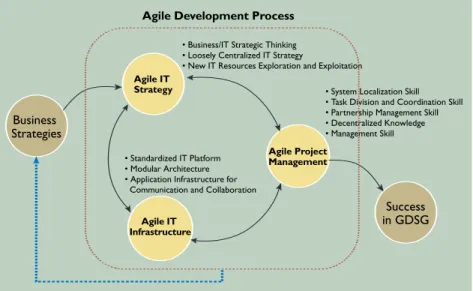
The OSS development context is characterized in terms of a highly distributed environment, cooperative and rapid development, and rapid evolution as the environment changes [5]. Similarly, in the highly dis-tributed environment of GDSD, cooperation among globally dispersed teams, rapid systems development, and an IT infrastructure that is scalable and capable of evolving are crucial to the GDSD project. Based on these understandings, we identify three interdepen-dent components of agility in the GDSD project con-text: agile IT strategy to suit changing business needs, agile IT infrastructure to enable the formulation and enactment of flexible IT strategies, and agile IT project management to enable coordination and control in the system development project. See Figure 1 for the three components of agility and their interdependent relationships, as depicted by the two-way arrows, in the GDSD project context.
Agile IT strategy. IT strategy defines the role of information systems in the organization, the business goals to be achieved through IT, the selection of IT standards and architecture, and the manner in which
Table 1: Common Reasons For Packaged Software Adoption.
Danlee fig 1 (10/06)
Agile IT Strategy
Agile Development Process
Agile Project Management Success in GDSG Agile IT Infrastructure Business Strategies
• Business/IT Strategic Thinking • Loosely Centralized IT Strategy
• New IT Resources Exploration and Exploitation • Standardized IT Platform
• Modular Architecture • Application Infrastructure for Communication and Collaboration
• System Localization Skill • Task Division and Coordination Skill • Partnership Management Skill • Decentralized Knowledge • Management Skill Figure 1. Framework of agility in GDSD projects. 1
According to Ross et al. [9], IT resources can be classified as intangible IT resources (for example, strategic partnership between business and technology sides), tangible technology resources (for example, IT infrastructure including hardware, software, data, network, and architecture), and human IT resources (for example, managerial IT skills).
IT is deployed. First, need for an agile IT strategy has its basis in the requirements for an ongoing fit between IT and business strategy [7, 9]. Thus, agile IT strate-gies are grounded in agile business stratestrate-gies respond-ing to variations in the business conditions [4]. Since market needs and technology standards vary across locations and change over time, in the global business context the development of flexible IT strategies to meet specific local business needs becomes a critical issue.
Second, to make GDSD agile, firms must exercise loosely centralized control on their development processes. In OSS development, loosely centralized control provides high flexibility in fulfilling the cus-tomization needs for various situations [5]. Accord-ingly, a loosely centralized IT strategy for GDSD would enable firms to tap emergent local opportunities by facilitating flexibility in fulfilling local needs.
The third component of agile IT strategy—new IT resource exploration and exploitation—refers to inno-vative and fast implementations of business systems by deploying and utilizing new IT resources from external sources. New IT resource exploration and exploitation can enable GDSD teams to flexibly obtain and inte-grate emerging IT resources, thus enabling firms to capture emerging market opportunities.
Agile IT infrastructure.A firm’s IT infrastructure is defined by its IT platform and its IT applications [12]. Thus, two aspects of agile IT infrastructure can be con-ceived: an IT platform amenable to rapid development and deployment of localized business systems to sup-port local business needs, and application supsup-port for agile communication and collaboration. With regard to the first aspect, a standardized IT platform can lead to fast reconfiguration and integration of IT resources [4, 9]. Moreover, loosely coupled applications, data, and other technology components in modular archi-tecture enable firms to assemble modules locally cus-tomized to suit local needs while preserving global standards.
In OSS development, standardized IT platform and modular architecture particularly provide vital support for massive parallel development. Since each team (or individual) is engaged in developing specific parts, a standardized IT platform and modular architecture facilitates seamless integration of parts to build a whole system [11]. Therefore, customization and reuse capa-bility based on standardized IT platform and modular architecture can enable agility in GDSD [8].
Regarding the second aspect, application software can streamline the system development process by pro-viding IT-based communication and collaboration support [12]. In particular, Internet-based communi-cation and collaboration tools are important
compo-nents of OSS development in streamlining networking among distributed developers separated by location and time [1]. Likewise, tools such as videoconferenc-ing and bulletin boards, are vital in GDSD projects by providing virtual space for communication and collab-oration among distributed members.
Agile project management.We conceptualize four skill sets for agile project management in the GDSD context: system localization, task division and coordi-nation, partnership management, and decentralized knowledge management skills. First, since globally dis-tributed environments have local business and tech-nology requirements, GDSD teams must adapt their IT resources across locations [8]. Therefore, manage-ment skills to clarify the extent of localization through an ongoing dialogue among various stakeholders are essential for agile project management.
Second, since GDSD members are globally distrib-uted and/or culturally diversified, the skill to divide tasks and coordinate a highly diversified GDSD proj-ect team in terms of culture and expertise is critical for successful development and deployment. The agile methods in OSS development evoke the idea of coor-dinated development processes through the rational division of tasks that are voluntarily selected and devel-oped by individuals or groups according to their inter-est and expertise [11]. Similarly, agile GDSD project management can be achieved through the rational division of tasks within member groups according to their local needs and expertise, and through the coor-dination of these divided tasks.
Third, partnership management with external part-ners, such as vendors, suppliers, and outsourcers, is another important component of a coordinated devel-opment process for GDSD [4]. Strategic partnerships with external partners can enable GDSD teams to coordinate better and quickly deploy new IT resources from external sources to achieve innovation, thus con-tributing to the rapid evolution of the IT infrastruc-ture [12]. Fourth, knowledge management skill is another important skill in agile GDSD project man-agement, because IT and business knowledge that resides across project teams is a strategic resource for global system deployment. Therefore, capturing, stor-ing, transferrstor-ing, sharstor-ing, and assimilating knowledge across locations is vital for capitalizing the distributed knowledge across diverse development teams for an ongoing development project [2].
Interdependence of the three components of GDSD agility. The three components mentioned here, though distinct, are highly interdependent [9]. According to Henderson and Venkatraman [7], orga-nizational competitive advantage can be obtained through dynamic processes of strategic alignment
between business strategy, IT strat-egy, organizational infrastructure and processes (in our case, project management), and IT infrastructure and processes. We believe these arguments are even more relevant to GDSD. For example, IT strategy to explore and exploit new technolo-gies can lead to an agile IT infra-structure that enables firms to realize business strategies in innovative ways.
On the other hand, agility in organizational IT infrastructure is essential to the formulation of IT-enabled corporate and/or local busi-ness strategies. An agile IT infrastructure, specifically a stan-dardized IT platform with modular architecture, contributes to the agility of project management by allowing fast and flexible integration of multiple system components. Furthermore, communication and
collaboration support facilitates internal coordination and external partnership management through IT-enabled linkages [12]. Likewise, IS support for com-munication and collaboration enables knowledge sharing and assimilation in distributed groups [2, 10], thereby enabling agility in the formulation of IT strat-egy.
At the same time, relationships with external part-ners provide awareness and opportunities for explor-ing new technologies, thereby enablexplor-ing the deployment of appropriate IT infrastructure to suit local needs. Thus, agile IT strategy development is heavily dependent on reciprocal understanding and collaboration between business and IT sides. Such cooperation also enables agile project management to solve unexpected problems during project execution. Thus, the three components of GDSD agility rein-force one another.
SKANDIAFINANCIALCONCEPTS: A CASEANALYSIS
Established in 1855 and listed in the Stockholm Stock Exchange in 1863, Skandia is among the world’s top 20 life and casualty insurance companies. In late 1990s, Skandia, together with its technology partner, Tata Consultancy Services (TCS),2 identified two
promising opportunities: a growing customer group, internationally mobile, with sizable financial assets and regular demand for managing its varied accounts
and investments from international locations, and an emerging need expressed by small and medium-size regional banks and non-traditional actors (such as insurance companies, supermarkets, employee unions, and automobile associations) for providing Internet-based financial services to their customers. To capital-ize on these opportunities, Skandia established a subsidiary, Skandia Financial Concepts (SFC),3 to
develop, execute, and implement a novel business model with supporting organizational and IT strate-gies.
SFC’s business model was based upon the modu-larization of financial services and cooperation with external financial service providers. This business model allowed SFC to rapidly create a variety of new IT-enabled financial institutions in different countries for Skandia and its client organizations. It did so by a LEGO-like integration of predesigned, existing finan-cial service components. This deployment was facili-tated by agility in global project management fostered by a multi-layer4modular IT infrastructure. Moreover,
due to the variations in specific country requirements, such as language, currency, reporting and regulatory requirements, and specific business strategies for dif-ferent channel preferences of customers, there was a strong need for country-specific localization of services.
In collaboration with TCS, SFC developed a com-prehensive and flexible Internet-based financial
ser-Danlee fig 2 (10/06)
System Localization Skill
Client-value addition by customizing existing modules and/or developing new modules to fulfill the specific needs of each local client
Task Division and Coordination Skill
Efficient development using onsite-offshore model Clear definition of the role and responsibility for each site
Partnership Management Skill
Selecting vendors with appropriate expertise and with high feasibility for long-term relationship development
Decentralized Knowledge Mgt. Skill
Rotating people among different sites for smooth knowledge transfer
Standardized IT Platform
Achieving functional and multi-channel scalability from standardized multi-layer architecture
Modular Architecture
Increasing reusability of service components by adopting standalone functional components loosely coupled with other components
Application Infrastructure for Communication and Collaboration
Reducing the impact of distance by providing remote access to the development and testing systems Streamlining the onsite-offshore collaboration utilizing interactive communication technologies
Business/IT Strategic Thinking
Strategic Consistency through logical extension of Skandia's business concept to SFC's IT strategy (component-based modular approach)
Loosely Centralized IT Strategy
Strategic flexibility from the independent relationships with Skandia, TCS, and other service component providers
New IT Resources Exploration and Exploitation
Capitalizing emerging opportunities by exploring new component-based technology (such as Quartz banking engine)
SFC's GDSD Agility
Agile Project Management Agile IT Strategy
Agile IT Infrastructure
Figure 2. Specific lessons learned from the SFC case.
2
TCS is Asia’s largest IT-services and software consultancy.
3
The original case was published on the Society for Information Management Web site as the Honorable Mention Award for 2003.
4
Standardized components for the bottom layer, service platform for the middle layer, and customer specific applications for the top layer.
vices platform with a modular architecture to meet these needs. This platform was used as a basis for inte-grating a variety of software and service components sourced both from TCS and other third-party vendors of technology and IT-enabled services in Europe, the U.S., and India. These innovative organizational and technical architectures enabled Skandia to successfully develop and execute a novel business strategy with agility acquired from the interactive synergy of IT strategy, IT infrastructure, and project management.
SFC’s execution of business and IT strategy was in the nature of a truly globally distributed environment. To capitalize on the emerging business opportunities, SFC adopted an onsite-offshore delivery model that included a combination of onsite, offshore, and onsite-offshore development activities distributed in accor-dance with task characteristics. While user requirements and release management were primarily onsite activities, component coding and unit testing
were sent to TCS’s software development sites in Delhi and Mumbai, India. On the other hand, interface design, integration of system components, and inte-gration testing were done through the collaboration5
among client sites, SFC site (Zurich, Switzerland), and TCS sites.
Various service components were developed inde-pendently based on SFC’s requirements by third-party vendors at their own sites and later incorporated in SFC’s integration platform, that is, Apollo platform based on TCS’s Quartz banking engine. One such example was the development of Web site content and WAP interface by Mogul in Sweden. Collaborative development involving 16 vendors in globally distrib-uted locations made it possible for SFC to develop its first bank, Skandia Bank Switzerland (SBS), within 20
months, its second bank, the Coop Bank in Sweden, within nine months, and its third bank, eQ Pankki OY in Finland, within just six months.
Interdependency of agile IT strategy and agile IT infrastructure. SFC’s IT strategy was to have a com-ponent-based, modular approach—a logical extension of Skandia’s business concept of collaborating with independent distributors and fund managers to deliver innovative, world-class financial services. The compo-nent-based IT strategy enabled the deployment of a novel IT infrastructure based on modular architecture to meet changing business needs. In turn, the avail-ability and knowledge of the agile IT infrastructure that could support emergent business models facili-tated the conception and execution of new business strategies to serve different types of banks in a short time.
While SFC was strategically created to tap emerging opportunities in global finance service, SFC was loosely bound with both Skandia and TCS as an organization that could independently cater to the IT needs of a variety of financial insti-tutions offering different services. These included institutions that might traditionally be considered as Skandia’s competitors. The ongoing strategic sourcing partner-ship with TCS also enabled SFC to tap business opportunities in the finance solutions market and rapidly support it with the requisite IT infrastructure. In doing so, SFC assembled existing financial service modules available from TCS and other independent third-party financial services providers instead of developing a proprietary finan-cial services platform from scratch.
Interdependency of agile IT infrastructure and agile IT project management.SFC’s standardized IT platform and modular architecture provided flexibility in developing localized financial services. Third-party service providers provided ready-made service modules for the platform and were also responsible for main-taining these services. This contributed to agility in project management by reducing development cycle time, since only those financial services that were not available from existing sources needed to be built by SFC. The main project management responsibility of SFC was the coordination of independent third-party services and the integration of these services within a SFC-developed financial service product. SFC’s agile IT infrastructure introduced considerable flexibility in
Danlee table (10/06)
• Develop strategic coherence between global business objectives and IT system development and deployment strategies.
• Develop flexibility in cultivating partnerships with other stakeholders.
• Acquire up-to-date knowledge on new technologies (beyond as well as within your industry).
• Standardize IT platform through modularization for adaptability and flexibility of IT infrastructure.
• Utilize local-specific components and expertise while keeping global standard.
• Set up ICT-architecture to support the integration of globally distributed system components.
• Clearly define the roles and responsibilities of each local site in GDSD project.
• Develop good version control of system components.
• Understand the interdependent relationships of IT strategy, IT infrastructure, and project management to achieve optimal agility during GDSD process.
Generic Guidelines to Achieve GDSD Agility
Generic guidelines to achieve GDSD agility.
5The global collaboration was supported by SFC’s IT application infrastructure,
including remote access to the development and testing systems (for example, from Zurich to Bombay) and videoconferencing for interactive communications.
the choice of standalone functional components and their reusability for such integration, thus further adding to agility in project management.
Not only did SFC’s agile IT infrastructure reduce the time from conception to market, it also provided the opportunity to localize the product to a particular market segment or customer at low adaptation costs. A product or service could be customized to a specific set of functional requirements by selecting and inte-grating appropriate service modules or customizing existing modules to the specific needs of the local con-text. Furthermore, SFC’s agile IT infrastructure was extensible as new service modules could be plugged into the platform as required.
Interdependency of agile IT strategy and agile IT project management.From its inception, SFC tried to select external vendors with the intention of build-ing long-term sourcbuild-ing relationships. These strategic relationships with external partners enabled SFC to maintain up-to-date knowledge on technologies. These relationships also enabled SFC to be more flex-ible in exploring new IT resources. New requirements to tap emergent business opportunities normally resulted in extensions to some components. By assigning a version number to each component and by recording change histories, SFC kept track of the various configurations deployed from multiple ven-dors. The ease with which the components were extended and managed in terms of version control through a configuration management strategy added to the agility in project management. Thus, compo-nent-based IT strategy aided agile project manage-ment.
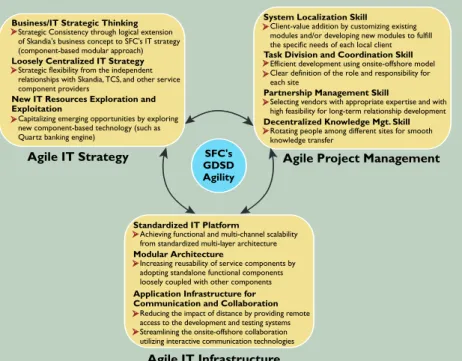
The summarized analysis of the case with respect to the fit with the proposed framework and the spe-cific lessons learned from the case are presented in Figure 2.
CONCLUSION
Through a framework that identifies the components of GDSD agility and describing their interactions, we have attempted to provide an understanding of agility in systems development and deployment in a globally distributed context. Our framework finds support from a case analysis of a global business group, SFC, which tapped opportunities in global finance service through an agile GDSD process. The generic guide-lines that practitioners may draw from the study are presented in the accompanying table.
Our study serves to understand agility in a globally distributed work environment. Future research can aim at measuring agility with respect to the three identified IT components and tracing their causal paths through extensive study.
REFERENCES
1. Abrahamsson, P., Salo, O., Ronkainen, J., and Warsta, J. Agile Software Development Methods: Review and Analysis.Technical Research Centre of Finland, 2002.
2. Alavi, M. and Leidner, D.E. Review: Knowledge management and knowl-edge management systems: Conceptual foundations and research issues.
MIS Quarterly 25,1 (2001), 107–136.
3. Alexandersen, C., Kumar, K., and van Hillegersberg, J. Bank-in-a-box: Skandia’s agile and customizable financial services platform. Honorable Mention in SIM 2003 Paper Awards Competition.
4. Bharadwaj, A.S. A resource-based perspective on information technology capability and firm performance: An empirical investigation. MIS Quar-terly 24, 1 (2000), 169–196.
5. Feller, J. and Fitzgerald, B. A framework analysis of open source develop-ment paradigm. In Proceedings of the 21st International Conference in Infor-mation Systems, (Brisbane, Australia, 2000).
6. Grant, R.M. The resource-based theory of competitive advantage: Impli-cations for strategy formulation. California Management Review 33, 3 (1991), 114–135.
7. Henderson, J.C. and Venkatraman, N. Strategic alignment: Leveraging information technology for transforming organizations. IBM Systems J.
32, 1 (1993), 4–17.
8. Ross, J.W. Creating a strategic IT architecture competency: Learning in stages. MIS Quarterly Executive 2, 1 (2003), 31–43.
9. Ross, J.W., Beath, C.M., and Goodhue, D.L. Developing long-term com-petitiveness through IT assets. Sloan Management Review 38, 1 (1996), 31–42.
10. Sambamurthy, V., Bharadwaj, A., and Grover, V. Shaping agility through digital options: Reconceptualizing the role of information technology in contemporary firms. MIS Quarterly 27, 2 (2003), 237–263.
11. Sharma, S., Sugumaran, V., and Rajagopalan, B. A framework for creat-ing hybrid-open source software communities. Information Systems Jour-nal 12 (2002), 7–25.
12. Weill, P., Subramani, M., and Broadbent, M. Building IT infrastructure for strategic agility. MIT Sloan Management Review 44,1 (2002), 57–65.
One-Ki (Daniel) Lee([email protected]) is Ph.D. candidate in the Department of Information Systems at the City University of Hong Kong.
Probir Banerjee ([email protected]) is a visiting fellow in the Department of Information Systems at the City University of Hong Kong.
Kai H. Lim ([email protected]) is an associate professor in the Depart-ment of Information Systems at the City University of Hong Kong.
Kuldeep Kumar ([email protected]) is currently a visiting professor in the Department of Information Systems at the City University of Hong Kong. He is also a professor of IS research at RSM/Erasmus University in The Netherlands and a professor of IS at Florida International University.
Jos van Hillegersberg ([email protected]) is head of the Department of Information Systems and the chair of Design and Implementation of IS at the University of Twente, Enschede, The Netherlands.
Kwok Kee Wei ([email protected]) is a chair professor in the Department of Information Systems at the City University of Hong Kong.
© 2006 ACM 0001-0782/06/1000 $5.00