PROGRAMA DE DOCTORADO EN
Tecnologías de la Información y las
Telecomunicaciones
Escuela Técnica Superior de Ingenieros de Telecomunicación
Departamento de Teoría de la Señal y Comunicaciones e
Ingeniería Telemática
TESIS DOCTORAL
Novel applications of Machine Learning to
Network Traffic Analysis and Prediction
Presentada por Manuel López Martín para optar al
grado de
Doctor por la Universidad de Valladolid
Dirigida por:
Dra. Belén Carro
Gracias a Estela, mi mujer, y mis hijos Arturo y Aurora por sobrellevarme en los momentos en que he estado ausente en cuerpo y…. mente. Sin su ayuda y comprensión este trabajo no lo podría haber llevado a cabo.
Gracias a mis directores de tesis Belén Carro y Antonio Javier Sanchez Esguevillas por ayudarme y darme soporte, por su motivación y preocupación en la realización de esta tesis. Les quiero agradecer también el haberme ofrecido la oportunidad de colaborar como investigador en la Universidad de Valladolid, lo que ha sido una gran experiencia tanto a nivel profesional como personal.
Quiero dar las gracias a Jaime Lloret por su participación y consejos en varios de los artículos aquí presentados. También quiero dar las gracias al equipo de Jaime Lloret en la Universitat Politècnica de València y a Santiago Egea de la Universidad de Valladolid por el trabajo conjunto realizado en el Proyecto Nacional de Investigación (Ministerio de Economía, Dirección General de Investigación Científica y Técnica): “Distribución inteligente de servicios multimedia utilizando redes cognitivas adaptativas definidas por software”, que ha servido como apoyo económico de esta tesis.
Gracias a Telefónica por darme la oportunidad de trabajar como científico de datos en tantos proyectos interesantes, y en particular, gracias a Javier Martínez Elicegui por su dinamización del grupo de ciencia de datos en Telefónica, por su apoyo y su ayuda en el desarrollo del primer artículo de la tesis.
INDICE
I. RESUMEN ... 4
II. THESIS ... 6
1. RESEARCH OBJECTIVES... 6
2. THESIS FRAMEWORK ... 10
3. RESEARCH CONTEXT AND RELATED WORKS REVIEW ... 12
3.1 MACHINE LEARNING IN DATA NETWORKS – OVERVIEW ... 12
3.1.1 Machine learning in data networks ... 13
3.1.2 Deep learning in data networks ... 16
3.1.3 Generative models in data networks ... 18
3.1.4 Machine learning in IoT networks ... 19
3.2 SPECIFIC APPLICATION AREAS ... 21
3.2.1 Intrusion detection ... 23
3.2.2 Traffic prediction ... 29
3.2.3 Type of traffic prediction (traffic classification) ... 32
3.2.4 QoE estimation... 35
3.2.5 Synthetic data generation ... 37
4. RESEARCH SCOPE ... 40
4.1 COMBINATION OF CONVOLUTIONAL AND RECURRENT NEURAL NETWORKS ... 43
4.2 GAUSSIAN PROCESSES ... 47
4.3 CONDITIONAL VARIATIONAL AUTOENCODERS FOR CLASSIFICATION ... 49
4.4 CONDITIONAL VARIATIONAL AUTOENCODERS FOR PRACTICAL DATA SYNTHESIS ... 52
4.5 MACHINE LEARNING FOR TIME-SERIES PREDICTION ... 54
5. CONTRIBUTIONS AND LESSONS LEARNED ... 56
5.1 CONTRIBUTIONS ... 56
5.2 LESSONS LEARNED ... 59
6. METHODOLOGY ... 61
7. PAPERS SUMMARY ... 67
7.1 PAPER 1: REVIEW OF METHODS TO PREDICT CONNECTIVITY OF IOT WIRELESS DEVICES ... 67
7.1.1 Objectives ... 67
7.1.2 Datasets ... 67
7.1.3 Models ... 67
7.1.4 Results/Conclusions ... 68
7.2 PAPER 2: NETWORK TRAFFIC CLASSIFIER WITH CONVOLUTIONAL AND RECURRENT NEURAL NETWORKS FOR INTERNET OF THINGS ... 69
7.2.4 Results/Conclusions ... 70
7.3 PAPER 3: CONDITIONAL VARIATIONAL AUTOENCODER FOR PREDICTION AND FEATURE RECOVERY APPLIED TO INTRUSION DETECTION IN IOT ... 71
7.3.1 Objectives ... 71
7.3.2 Datasets ... 71
7.3.3 Models ... 72
7.3.4 Results/Conclusions ... 72
7.4 PAPER 4: DEEP LEARNING MODEL FOR MULTIMEDIA QUALITY OF EXPERIENCE PREDICTION BASED ON NETWORK FLOW PACKETS ... 73
7.4.1 Objectives ... 73
7.4.2 Datasets ... 73
7.4.3 Models ... 74
7.4.4 Results/Conclusions ... 74
7.5 PAPER 5: VARIATIONAL DATA GENERATIVE MODEL FOR INTRUSION DETECTION ... 76
7.5.1 Objectives ... 76
7.5.2 Datasets ... 77
7.5.3 Models ... 77
7.5.4 Results/Conclusions ... 78
8. TOOLS ... 79
9. GENERAL CONCLUSIONS AND SUMMARY OF CONTRIBUTIONS ... 80
10. FUTURE LINES OF RESEARCH ... 83
11. RESEARCH DISSEMINATION PLAN... 85
12. LIST OF REFERENCES ... 86 III. PAPERS ... 95 PAPER 1 ... 95 PAPER 2 ... 111 PAPER 3 ... 128 PAPER 4 ... 147 PAPER 5 ... 161 POSTER MLSS-2018 ... 182
I.
RESUMEN
El objetivo de esta tesis es el presentar la aplicación de técnicas novedosas de aprendizaje automático (ML-Machine Learning) en el campo de la Telecomunicaciones, y en particular a problemáticas relacionadas con el análisis y la predicción de tráfico en redes de datos (NTAP – Network Traffic Analysis and Prediction).
Las aplicaciones de NTAP son muy amplias, por lo que esta Tesis se focaliza en las siguientes cinco áreas específicas:
- Predicción de la conectividad de dispositivos wireless.
- Clasificación de tráfico de red, utilizando las cabeceras de los paquetes transmitidos - Detección de intrusiones de seguridad, utilizando información de tráfico de red - Generación de tráfico sintético asociado a ataques de seguridad y utilización de
dicho tráfico sintético para mejorar los algoritmos de detección de intrusiones de seguridad.
- Estimación de la calidad de la experiencia percibida por el usuario (QoE) al visualizar secuencias de video, utilizando información agregada de los paquetes transmitidos
La intención última es crear modelos de predicción y análisis que supongan mejoras en las áreas de NTAP arriba mencionadas. Para ello, en esta Tesis se plantean avances en la aplicación de técnicas de aprendizaje automático al área de NTAP. Estos avances consisten en:
- Desarrollo de nuevos modelos de aprendizaje automático específicos para NTAP - Especificar nuevas formas de estructurar y transformar los datos de entrenamiento para
que los modelos de aprendizaje automático existentes se puedan aplicar a problemas específicos de NTAP.
- Definir algoritmos para la creación de tráfico de red sintético que corresponda con eventos específicos en la operativa de la red (p. ej. tipos específicos de intrusiones), asegurando que los nuevos datos sintéticos puedan ser usados como nuevos datos de entrenamiento.
- Extensión y aplicación de modelos clásicos de aprendizaje automático al área de NTAP, obteniendo mejoras en las métricas de clasificación o regresión, y/o mejoras en las medidas de rendimiento de los algoritmos (p. ej. tiempo de entrenamiento, tiempo de predicción, necesidades de memoria, …)
En esta Tesis se han aplicado tanto las técnicas más conocidas de aprendizaje automático (p.ej. regresión logística, arboles aleatorios, máquinas de vector soporte...) como las nuevas técnicas de aprendizaje profundo (DL – Deep Learning). En los últimos años, han aumentado la variedad y éxito en la aplicación de las técnicas de aprendizaje profundo. Las técnicas de aprendizaje profundo son un área específica de las técnicas de aprendizaje automático, caracterizándose por incluir redes neuronales con varias capas y arquitecturas y conectividad diversa. Los algoritmos relacionados con el aprendizaje profundo se han aplicado ampliamente en las áreas de: procesamiento de imágenes y video, audio, tratamiento de textos, comprensión y traducción del lenguaje natural, finanzas, medicina, ventas. En esta Tesis veremos cómo su aplicación se puede extender a las problemáticas asociadas con NTAP.
artículos publicados. Todos los artículos utilizan técnicas relacionadas (aprendizaje automático y aprendizaje profundo), unas problemáticas conectadas (NTAP), con objetivos comunes (detección y predicción) y que giran alrededor de un campo de actuación común (redes de datos). Los artículos en conjunto forman una línea de trabajo coherente, dirigida a la aplicación de técnicas avanzadas de inteligencia artificial a la resolución de problemas complejos de análisis y predicción planteados en nuevas arquitecturas de redes de datos.
II.
THESIS
1.
RESEARCH OBJECTIVES
It is now clear that machine learning will be widely used in future telecommunication networks as it is increasingly used in today's networks. However, despite its increasing application and its enormous potential, there are still many areas in which the new techniques developed in the area of machine learning are not yet fully utilized.
The aim of this thesis is to present the application of innovative techniques of machine learning (ML-Machine Learning) in the field of Telecommunications, and specifically to problems related to the analysis and prediction of traffic in data networks (NTAP - Network Traffic Analysis and Prediction).
The applications of NTAP are very broad, so this thesis focuses on the following five specific areas:
- Prediction of connectivity of wireless devices.
- Security intrusion detection, using network traffic information
- Classification of network traffic, using the headers of the transmitted network packets - Estimation of the quality of the experience perceived by the user (QoE) when viewing multimedia streaming, using aggregate information of the network packets
- Generation of synthetic traffic associated with security attacks and use of that synthetic traffic to improve security intrusion detection algorithms.
The final intention is to create prediction and analysis models that produce improvements in the NTAP areas mentioned above. With this objective, this thesis provides advances in the application of machine learning techniques to the area of NTAP. These advances consist of:
- Development of new machine learning models and architectures for NTAP
- Define new ways to structure and transform training data so that existing machine learning models can be applied to specific NTAP problems.
- Define algorithms for the creation of synthetic network traffic associated with specific events in the operation of the network (for example, specific types of intrusions), ensuring that the new synthetic data can be used as new training data.
- Extension and application of classic models of machine learning to the area of NTAP, obtaining improvements in the classification or regression metrics and/or improvements in the performance measures of the algorithms (e.g. training time, prediction time, memory needs, ...)
We have applied more classical machine learning techniques (e.g. logistic regression, random forest, support vector machines ...) as well as new deep learning techniques (DL - Deep
which is characterized by including neural networks with multiple layers and a variety of architectures and connectivity between layers. The algorithms related to deep learning have been widely applied in the areas of: image and video processing, audio, word processing, comprehension and translation of natural language, finance, medicine, sales, etc... One of the main objectives of this thesis is to show how its application can be extended to the problems associated with NTAP.
Considering the five specific areas of NTAP that are the subject of this thesis, four correspond to classification problems and one with the problem of generating synthetic data that can be used to improve a classification problem.
The four areas related with classification pose many challenges to a classification and detection algorithm: 1) highly unbalanced data with labels strongly biased to some of the classes, 2) noisy data and 3) high cardinality of the labels to classify. For these reasons, different types of deep learning algorithms have been explored: generative algorithms (variational autoencoders) and prediction algorithms based on convolutional and recurrent neural networks, considering that these algorithms have shown remarkable results in other business areas. In this thesis we show that these algorithms are applicable to NTAP and the work in this thesis contributes to provide novel architectures based on them. Specifically, it is important to mention the contributions made in this thesis to the areas of: 1) estimation (both detection and prediction) of the quality of a user's experience when viewing multimedia streaming and 2) network traffic classification based on new architectures formed by convolutional neural networks (CNN) and recurrent neural networks (RNN).
To generate synthetic data there are many over-sampling algorithms that generate the synthetic data corresponding to a specific class based on the (topological) proximity to existing data of that class. These algorithms need a predefined (often complex) distance definition. In this thesis, an alternative method for the creation of synthetic data is proposed, which is based on a latent probability distribution that is learned from the data and that does not need to assume a predefined distance function. The proposed method consists of a generative model based on a variational autoencoder, with an architecture adapted to the generation of synthetic data associated with specific events. The new method offers operational advantages (speed, simplicity) and quality in the synthesized data (similar probability distributions and improvements in their properties) compared to the usual algorithms.
In addition to the novel architectures based on deep learning algorithms, we propose also advances in the application of machine learning models to the problem of network traffic prediction. In this case, due to the time series nature of network traffic, the techniques usually applied have been methods related to the solution of time series prediction problems (e.g. ARIMA, ARIMAX ...). This thesis presents the suitability of alternative machine learning techniques for time series prediction applied to network traffic, as well as a detailed
An important type of data network is related to IoT (Internet of Things) devices. This type of network imposes some new and difficult requirements due to the large number of associated devices of heterogeneous nature and with very different connectivity and service characteristics. Therefore, IoT networks are a good place to test new machine learning models, to assess whether they can provide an improvement in their performance, manageability and/or security. This is the reason why, even when the results obtained in this thesis are applicable to any type of data networks, the IoT networks have been the focus of many of the experiments carried out in the thesis.
The modality of this thesis is the compendium of publications in JCR-indexed journals in the telecommunications and data networking field, with a total of five papers published. This thesis focuses only on the published papers. All the papers use related techniques (machine learning and deep learning), some related problems (NTAP), with common objectives (detection and prediction) and that revolve around a common field of action (data networks). The papers together form a coherent line of work, aimed at the application of advanced techniques of machine learning to the resolution of complex problems of analysis and prediction raised in new data network architectures.
The first paper [1] of this compendium: "Review of methods to predict connectivity of IoT wireless devices", focuses on the prediction of activity of wireless devices using different machine learning techniques and classical techniques for time-series prediction, unifying both types of techniques in a common framework and providing a comparative analysis between them and the behaviour of the connected devices.
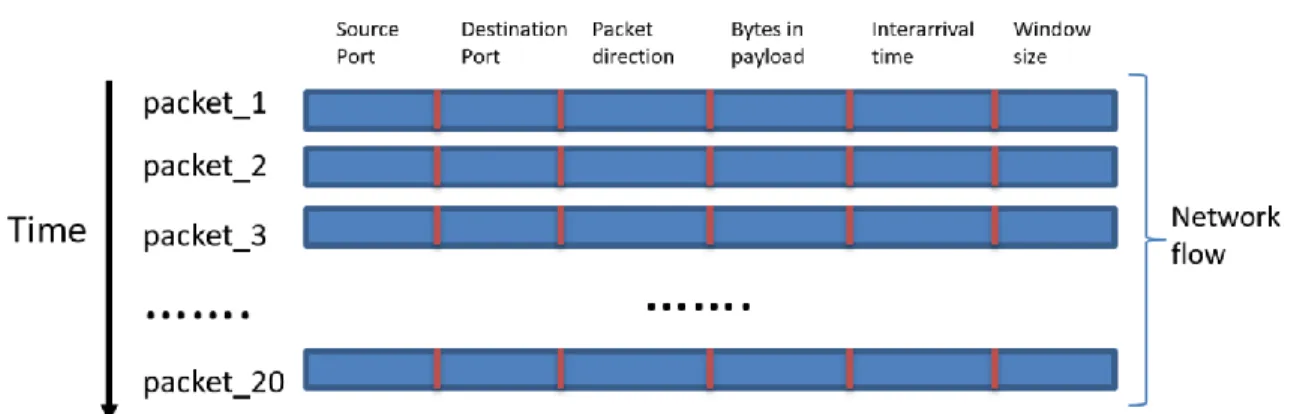
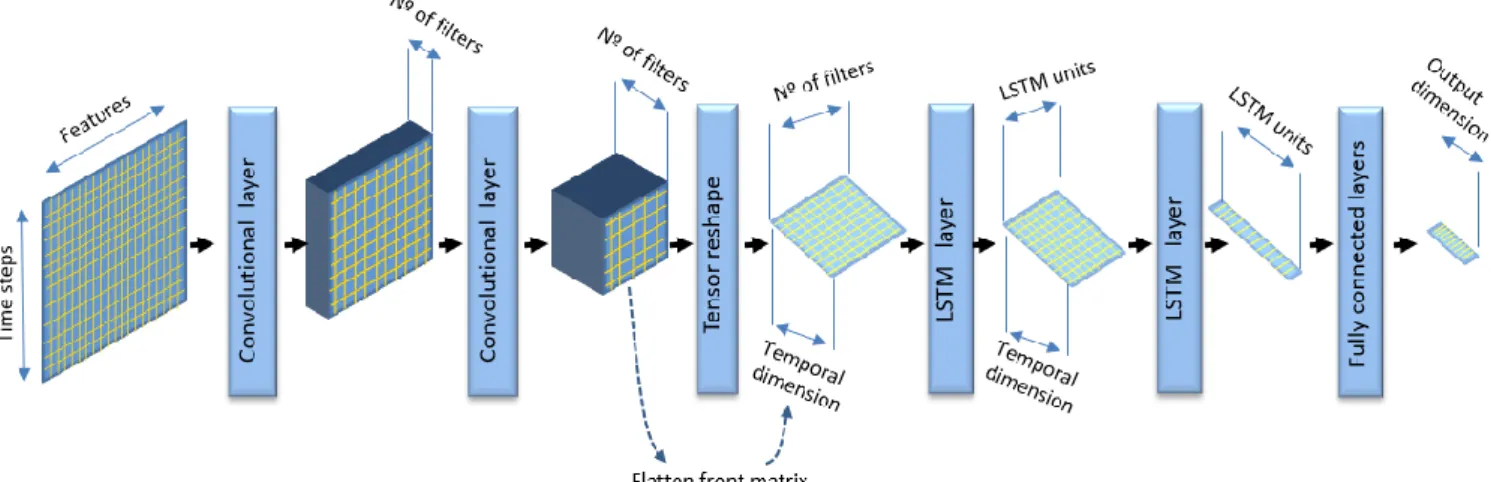
The second paper [2]: "Network traffic classifier with convolutional and recurrent networks for Internet of Things", studies the application of deep learning models based on convolutional and recurrent neural networks to the prediction of the type of service of a network flow, using exclusively information of the headers of the network flow packets.
The third paper [3]: "Conditional variational autoencoder for prediction and feature recovery applied to intrusion detection in IoT", investigates the use of generative models based on variants of variational autoencoders to the detection of intrusions in data networks, as well as for the synthesis of features associated with different types of intrusions.
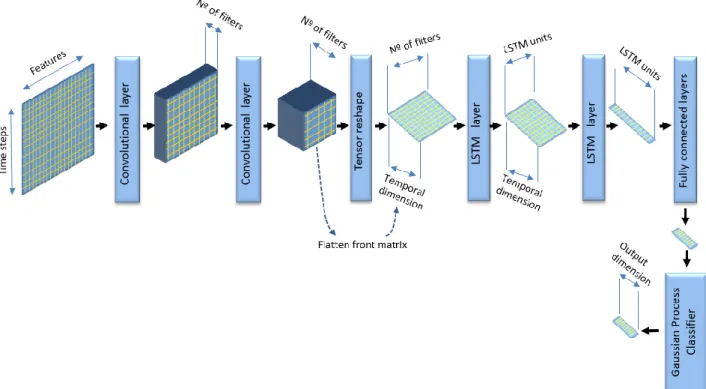
The fourth paper [4]: “Deep learning model for multimedia Quality of Experience prediction based on network flow packets”, proposes a new classifier to perform QoE estimation of multimedia content transmitted by a data network. It is based on a deep learning model (convolutional and recurrent networks) plus a Gaussian process as the final layer. The resulting classifier can perform QoE detection (current time) and prediction (short-term forecast) using exclusively aggregated information extracted from the network packets.
The fifth paper [5]: "Variational data generative model for intrusion detection ", presents the possibility of generating synthetic traffic data (with both discrete and continuous features), where the synthetic data can be conditioned to different types of intrusions (security attacks). In this way, the probability distribution of the features for the synthetic traffic follows the
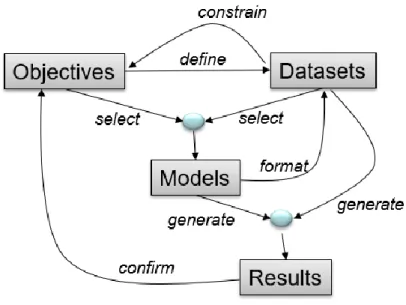
Fig. 1 presents an overview of the framework used to position the different objectives and points of interest of this thesis. We can see that the goal is to explore prediction and detection algorithms for data networks in the five areas mentioned above, with a focus on prediction/detection problems as well as to investigate the generation of synthetic data that follows the probability distribution of features associated with intrusion detection datasets (making use of generative methods).
2.
THESIS FRAMEWORK
The modality of this thesis is the compendium of publications in JCR-indexed journals in the telecommunications and data networking field.
In Fig. 1 the objectives and scope of the thesis are presented. In Fig. 2 more details on how the different papers fit into the different areas of study are shown. Each paper fits in a different area.
The first paper: “Review of methods to predict connectivity of IoT wireless devices” has been published in Ad Hoc & Sensor Wireless Networks.
The second paper: “Network Traffic Classifier with Convolutional and Recurrent Neural Networks for Internet of Things” has been published in IEEEAccess in the Special Section on Big Data Analytics in Internet of Things and Cyber-physical Systems.
The third paper: “Conditional Variational Autoencoder for Prediction and Feature Recovery Applied to Intrusion Detection in IoT” has been published in Sensors.
The fourth paper: “Deep learning model for multimedia Quality of Experience prediction based on network flow packets” has been published in IEEE Communications Magazine with the feature topic of: “Enabling Technologies for Smart Internet of Things”.
Finally, the fifth paper: “Variational data generative model for intrusion detection” has been published in Knowledge and Information Systems.
Paper 1 [1] provides a thorough study of the activity of real IoT devices, which parameters affect it and how different algorithms can be used to predict it. The paper proposes a dataset preparation which fits classic time-series algorithms (ARIMA, HMM...) as well as other machine learning algorithms (non-time-series based: Random Forest, Logistic Regression...) which are not usually applied to time-series problems. In particular, as far as we know, it is the first time that a Random Forest algorithm is presented in the literature to deal with a time-series problem as the one treated in the paper.
Paper 2 [2] studies the application of deep learning algorithms to detect the type-of-service of a network flow. It provides a comparison of results with other machine learning methods. It is, as far as we know, the first application of a CNN + RNN model to an NTC problem.
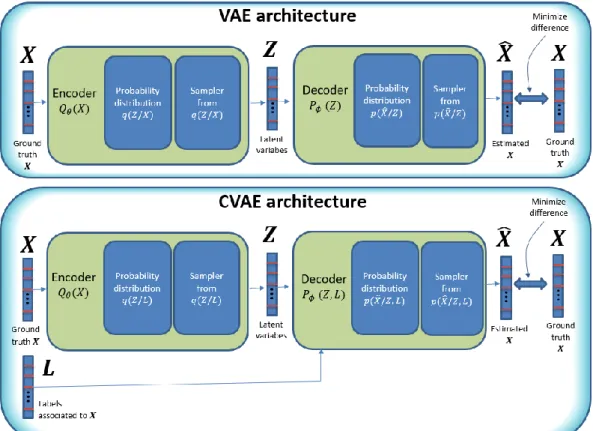
Paper 3 [3] proposes a new solution to intrusion detection in data networks. The proposal is based on a generative model using a variant of a Variational Autoencoder (VAE) whose name is Conditional Variational Autoencoder (CVAE). This variant of a VAE provides many
probability distribution according to specific types of intrusions. This is, as far as we know, the first application of a CVAE to the intrusion detection field.
Paper 4 [4] presents a new solution based in deep learning networks (a combination of CNN and RNN) to perform QoE detection and short-term prediction of seven QoE anomalies/errors. This is, as far as we know, the first application of a CNN+RNN model to video QoE estimation. In order to perform the estimates, the model uses a small time-series of vectors formed by aggregated information extracted from network packets.
Paper 5 [5] proposes the application of a CVAE to generate synthetic data in networking. The architecture of the model is specifically tuned to generate synthetic data (network traffic data) that can be used by an intrusion detection classifier to improve its training performance.
3.
RESEARCH CONTEXT AND RELATED WORKS REVIEW
The following sections present the research context for this thesis, in two aspects: (1) a general overview of the application of machine learning to data networks and (2) a more specific review of the application of machine learning to the areas of prediction and data generation covered by this thesis.
3.1 Machine learning in data networks – Overview
Machine learning [6][7][8] has been extensively applied to data networking problems. This application was done in many cases under different names inside well-known scientific disciplines as signal processing, information theory, coding theory, etc… examples of this can be observed in the application of linear and non-linear regression, statistical models, compression methods, etc…This applications have been usually limited to classic machine learning techniques, however, many recent advances in machine learning are not applied as fully in networking as in other areas (e.g. image, speech and video processing, natural language processing,…). This can be seen in the most updated reviews on the application of machine learning to networking [6][7][8][9], where the reduced application of the latest models in machine learning is pointed out (e.g. deep learning models, generative models), despite being considered important algorithms with a critical contribution in future research. For example, quoting [6] on the importance of machine learning in the future of data networks:
“……
The latest breakthroughs, including deep learning (DL), transfer learning and generative adversarial networks (GAN), also provide potential research and application directions in an unimaginable fashion.
Dealing with complex problems is one of the most important advantages of machine learning. For some tasks requiring classification, regression and decision making, machine learning may perform close to or even better than human beings. Some examples are facial recognition and game artificial intelligence. Since the network field often sees complex problems that demand efficient solutions, it is promising to bring machine learning algorithms into the network domain to leverage the powerful ML abilities for higher network performance. The incorporation of machine learning into network design and management also provides the possibility of generating new network applications. Actually, ML techniques have been used in the network field for a long time. However, existing studies are limited to the use of traditional ML attributes, such as prediction and classification. The recent development of infrastructures (e.g., computational devices like GPU and TPU, ML libraries like Tensorflow and Scikit-Learn) and distributed data processing frameworks (e.g., Hadoop and Spark) provides a good opportunity to unleash the magic power of machine learning for pursuing the new potential in network systems.
………”
Considering these opportunities and envisaged future contributions [10], the objective of this thesis is to provide advances in the application of the latest machine learning models to networking.
3.1.1 Machine learning in data networks
Machine learning algorithms can learn directly from data without an explicit prior programming task. Machine learning with its ability to learn from data is especially suitable for problems that are too complex to be fully defined or whose definition cannot be made accurately. These are, precisely, the kind of problems that arise in networking.
Many machine learning algorithms can be applied to the diverse problems that originate in data networks, such as: Random Forest [11], Gradient Boosting Machine (GBM) [12], Support Vector Machine (SVM) [13], Logistic Regression, Multinomial Logistic Regression [14], Multilayer Perceptron (MLP) [15], K-Nearest Neighbors (KNN) [14], Principal Component Analysis [14], K-Means [14], Naïve Bayes [14], and many more [7]. These algorithms can be subdivided into four main groups:
• Supervised: We start with some training data that contains the ground-truth values (responses) that we will then want to predict [14][16].
o Regression: The value to predict is continuous
o Classification: The value to predict is discrete/categorical
The challenge is to generalize the prediction to test data for which the predicted correct value is not known.
• Unsupervised: We start from some training data without values to predict. The goal is to find structure/relationships in the data, without prior information. It can be further subdivided in clustering, dimensionality reduction (latent variables discovery), anomaly/outliers detection, probability density function learning… [14][16].
The challenge is to find the latent structure of the data.
• Semi-supervised: We start with some training data that contains the correct responses plus additional training data without them [17]. The objective is similar to the supervised scenario: to predict the correct value for new test data.
The challenge is to generalize the prediction to new test data (as in the supervised scenario) while making full use of the additional information provided by the un-labeled data.
• Reinforcement learning: The objective is to learn the best sequence of actions that optimize the expected sum of future rewards [18] while interacting with a usually unknown environment that generates the rewards and state transitions that define the dynamics of the interaction.
The challenge is to learn a policy function that generates the best current action considering an uncorrelated and possibly sparse sequence of rewards without knowing the dynamics of the environment.
An important subset of algorithms employing a cascade of interconnected layers of (usually) non-linear nodes corresponds to the so-called: deep learning algorithms [19]. Deep learning algorithms are used in supervised, unsupervised, semi-supervised and reinforcement learning
Network (LSTM) [22], Variational Autoencoders (VAE) [23] and Conditional Variational Autoencoders (C-VAE) [24][25]. The following section (section 3.1.2) is dedicated to presenting these models in more detail.
This thesis is mainly focused in supervised algorithms for classification and precisely in:
• Classic ML:
o Random Forest, GBM, SVM, Multinomial Logistic Regression, Gaussian Process and MLP.
• Deep Learning:
o CNN, LSTM and combinations of both. o Generative models: VAE and variants.
In addition to the machine learning models mentioned above, and belonging to the same family of predictive algorithms, we have considered some algorithms that are normally used to make predictions for time-series data. These algorithms are not usually studied as machine learning methods, but rather in the area of statistics and time-series analysis. These algorithms have been the usual resort to make predictions when dealing with time-series data, and we have employed them as part of the methods analyzed to predict future traffic in IoT networks. The time-series algorithms considered are: Hidden Markov Model (HMM) [26], Exponential Smoothing [27], AutoRegressive Integrated Moving-Average (ARIMA) [28] and ARIMA with eXogenous covariates (ARIMAX) [28].
The authors in [6][8]provide two excellent and updated reviews on the application of machine learning in networking. In [6] the application areas of ML to networking are structured as: information cognition (route measurement), traffic prediction, traffic classification, resource management, network adaption (QoE optimization, congestion control, routing strategy), performance prediction (QoE and throughput prediction) and configuration extrapolation (automated network protocol and architecture design). The authors consider that all areas will be impacted by ML with a greater future impact on: resource management, network adaption and automated architecture design.
In [8] similar (but not identical) application areas of ML to networking are identified: traffic prediction, traffic classification, traffic routing, congestion control, resource management, fault management, QoS/QoE management and network security. Traffic prediction is mainly dominated by time-series algorithms (ARIMA, HMM…) with some few applications of non-time series methods based on: MLP, CNN/RNN and SVM. Traffic classification has employed supervised (K-NN, SVM, Adaboost, XGBoost, Decision Trees...) and unsupervised (K-Means, DBSCAN) methods with no reported deep learning works in the study. Traffic routing is driven by reinforcement learning algorithms, mainly Deep Q-Learning. Congestion control is managed with packet loss classification algorithms using classic supervised models (SVM, K-NN, MLP…) and Queue management is the territory of queue length predictors (ordinary linear regression and time-series models) and adaptive mechanisms based on reinforcement learning plus control theory. ML for Resource management is mainly focused on: a) admission control and b) resource allocation; applying prediction and decision-making
employing a full range of prediction/classification algorithms (MLP, RNN, decision trees, ensembles...) with a focus on feature selection techniques and anomaly detection based on unsupervised models (K-means, SOM...). QoS/QoE management can use ML for both prediction and adaptation, although all research focuses on prediction using most prediction/classification algorithms (SVM, Random Forest, MLP, K-NN, Naïve Bayes…) without reported works using deep learning. Network security is an intensive area of research where the majority of ML classification algorithms are applied, but in this case, there are more works that employ deep learning algorithms, mainly Deep Belief Networks (DBN), with also many unsupervised learning algorithms used for anomaly detection problems (SOM, one-class SVM…). It is also interesting the three most important points that are mentioned as problematics for a stronger adoption of ML in networking: a) lack of real-world data, b) the need for standard evaluation metrics and c) specific theory and ML techniques for networking (since most of the techniques are developed for other fields).
3.1.2 Deep learning in data networks
Deep learning [19] is a sub-field of machine learning based in neural networks with (usually) many layers. Originally the network was a simple feed-forward neural network with the later addition of new types of networks: CNN, RNN, LSTM, VAE, C-VAE… [6]
A CNN [20] is a specialized feed-forward neural network originally used in image processing but increasingly employed in many other fields. This type of network applies a collection of filters to automatically extract features from the image, creating finally a hierarchical structure of features (representation learning). The weights of the filters are learned directly from the training data. Normally, a CNN incorporates many convolutional layers creating a deep structure. A CNN performs feature engineering automatically, avoiding the lengthy and cumbersome step of doing feature engineering manually.
RNN [21] was initially applied to Natural Language Processing, but similarly to CNN it is currently incorporated to other fields. The main application of RNN is to sequential data with temporal dependencies. An RNN is able to process new data based on previous data. An important problem of RNN has been its difficulty to be trained with long time-dependent data (long time-series). In order to solve this problem a series of RNN variants have been created. The LSTM [22] network is one of these variants, being the most widely used.
An Autoencoder is a type of feed-forward neural network with at least a hidden layer having a dimension smaller than the input and output dimensions. The training of these networks is done using the same samples for the network input and output. The intention of the network is to learn the identity function. From this apparently meaningless operation, we obtain a dimensionality reduction of the input data (the values of the hidden low dimensional layer). This interesting idea is further extended in a VAE, which is based in similar principles where the internal deterministic low dimensional layer is substituted by random values generated according to a parameterized probability distribution. The parameters of this distribution are the values of a previous internal layer. The initial complexity to train such a network is solved using variational principles and stochastic gradient descent [23]. A VAE is incredibly useful to generate synthetic data similar to the data used for training. This synthetic data has the important property of being stochastic in nature but following the same probability distribution of the original data.
Currently, the area of deep learning is probably one of the most active areas of research in machine learning. The ever-increasing trend to apply deep learning to all areas that could require prediction, classification or patterns analysis is not an exception to the data networking field. Nevertheless, this field is not as active as others (medicine, finance, robotics, marketing, media…) in adopting this new technology.
Authors in [9] present a complete review of deep learning for networking considering also future directions. Of all applications considered: wireless sensor networks, network traffic classification, network flow prediction, social networks, mobility prediction, cognitive radio, self-organized networks and routing, the last four are the focus of more work in deep learning, mainly using Deep Belief Networks, RNN, CNN and MLP with several layers. Nevertheless, the inclusion of deep learning in networking remains scarce, as mentioned in [9], quoting: “While deep learning has received a significant research attention in a number of other domains such as computer vision, speech recognition, robotics, and so forth, its applications in network traffic control systems are relatively recent and garnered rather little attention.”.
Another recent and comprehensive review of deep learning for mobile and wireless networking is provided in [29]. In addition to a detailed review of current works related to deep learning applied to networking, the section on future research perspectives is especially interesting, as it points out the promising areas of future research: (a) Deep Learning for Spatio-Temporal Data Mining, (b) Deep learning for Geometric Data Mining, (c) Deep Unsupervised Learning and (d) Deep Reinforcement Learning for Network Control. Additionally, the lack and difficulty of accessing data sets related to network activity is mentioned as one of the most serious problems in the application of deep learning to networking. This is due to privacy concerns of operators and users, which are completely reasonable, but nevertheless hamper the development and application of deep learning in this area.
In particular, for the application of deep learning to intrusion detection, in [30] is provided an interesting review and taxonomy of deep learning algorithms in this area. They differentiate between the discriminative (e.g. CNN) and generative models (e.g. VAE, Boltzmann Machines, …), emphasizing the importance of autoencoders (especially stacked autoencoders) as feature extractors, which in many cases serve as the first stage to perform the classification of intrusions.
It is also important to appreciate the difficulties that deep learning can have in a strictly regulated area such as networking due to its difficulty to provide an interpretation of results. For example, European Union’s General Data Protection Regulation require such an interpretability of the results when the ML model is used to make decisions without human intervention. This problem has produced an interesting research activity to facilitate the interpretation of the results provided by a deep learning network. This “black box” problem of deep learning models is related to the problem of adversarial inputs (slightly modified inputs that cause an intentional change in the results) and the need to provide credibility to the decisions made by the network. In this line, the work in [31] analyzes this problem and presents a possible solution to estimate the nonconformity (and interpretability) of results, by finding a subset of training samples similar in cosine distance to the results produced by all
3.1.3 Generative models in data networks
The generation of synthetic data is usually made with simulation or generative techniques. With a simulation we try to create an imitation of the real environment that produces the original data. The generation of synthetic data with simulations [32] is not considered in this thesis. The second method to create synthetic data is to use a generative model. A generative model learns the probability distribution of the data. This allows making predictions but, in addition, it also enables to generate new data and to impute missing data (as it is done in [3] as part of the thesis), this is because a generative model allows taking samples of the probability distribution of the data.
We can consider two types of models to accomplish prediction in a supervised scenario: discriminative and generative models. In a supervised setting we have a set of features (𝑋) and a set of labels or values (𝑌) to predict. In a discriminative model we try to learn directly 𝑃(𝑌 𝑋⁄ ) and prediction is made by choosing the value of Y that maximises it. In this case, the intention is to learn the decision boundary between values/classes. In a generative model we try to learn P (X, Y) and prediction is made by choosing the value of Y that maximises P (X, Y) given an 𝑋. The intention is now to learn the probability distributions of the classes and of the features conditioned on the classes, or alternatively, the joint probability distribution of both features and classes. That is, in the discriminative case we try to find: 𝑎𝑟𝑔𝑌𝑚𝑎𝑥(𝑃(𝑌 𝑋⁄ )). Meanwhile, in the generative case we try to find: 𝑎𝑟𝑔𝑌𝑚𝑎 𝑥(𝑃(𝑋 𝑌⁄ ) ∗ 𝑃(𝑌)) =
𝑎𝑟𝑔𝑌𝑚𝑎𝑥(𝑃(𝑋, 𝑌))
An important consequence is that once P(X, Y) is known, we can take samples of this joint probability distribution. This is the mechanism to generate new data which is like real one or to perform data augmentation or imputation of missing values of features.
When a generative model is combined with a dimensionality reduction algorithm, we can have an interesting outcome that allows obtaining a sparse latent representation of the data. This is achieved, for example, by means of a Variational Autoencoder (VAE). In [3][5], we use a VAE to obtain all these nice properties and, at the same time, it is much easier to train than other alternative methods (e.g. stacked autoencoders). Generative models can be also used for classification [3] when labelled data is applied to a trained generative model.
In the area of networking, there are some examples of applications of generative models, being the most used algorithms: Deep Belief Networks, Naïve Bayes and Variational Autoencoders. Authors in [33] provide a review of the current state-of-the-art algorithms for generative models, among which are: Variational Autoencoders and Generative Adversarial Networks.
3.1.4 Machine learning in IoT networks
Even when the machine learning architectures and techniques presented in this thesis are applicable to generic traffic for any data network, the experiments to prove their effectiveness has been mainly done with traffic associated with IoT networks. IoT traffic poses a challenge to current network management and monitoring systems, due to the large number and heterogeneity of the connected devices. The difficulties created by the network traffic in IoT networks have been the reason to choose these networks because the solutions provided are more demanding.
The Internet of Things (IoT) has been defined in Recommendation ITU-T Y.2060 (06/2012) as a global infrastructure for the information society, enabling advanced services by interconnecting (physical and virtual) things based on existing and evolving interoperable information and communication technologies. It is a network of physical devices embedded in all kind of equipments that autonomously transfer information and operational commands between them or with some centralized system.
A complete review of machine learning algorithms applied to IoT problems is presented in [7]. Intrusion detection [34], traffic prediction [35][36][37], characterization and classification of traffic [38], and estimation of video QoE [39][40][41][42], are critical issues in IoT networks. Below is a brief analysis of the importance of NTAP for IoT in the specific areas considered in this thesis:
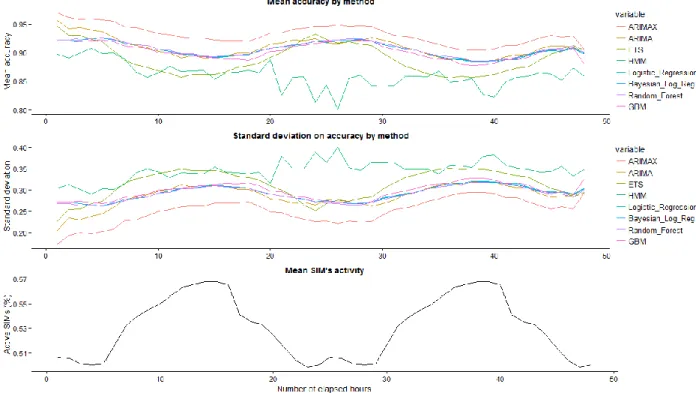
- Considering traffic prediction, from the point of view of an IoT Service Operator (namely a telecommunications operator) it is extremely useful to know in advance the probability distribution of wireless devices connectivity. It is important to anticipate the likelihood that a wireless device will send information over a certain time period, in order to: 1) anticipate the business impact, 2) accommodate the maintenance activity periods to reduce the impact of possible connectivity interruptions, 3) prepare the infrastructure required to reduce the risk of interruption of highly important services and associated devices. In the first work of this thesis [1] is provided a detailed study of the different prediction models available for time-series data and how to modify the training dataset to apply classical machine learning models (random forest, logistic regression, etc…) for time-series prediction. In this work we show that, with the proposed data pre-processing, we can obtain excellent results with a logistic regression or random forest models, which are almost as good as the results obtained with the best time-series model (ARIMAX), but, with an important reduction on the required processing time.
- In relation to intrusion detection, a Network Intrusion Detection System (NIDS) is a system which detects intrusive, malicious activities in a host or host’s network. The importance of NIDS is growing as the heterogeneity, volume and value of network data
- Similarly, the classification of traffic (type-of-service identification) is of great importance in IoT networks. A Network Traffic Classifier (NTC) is an important part of current network management and administration systems. This classifier infers the service/application (e.g. HTTP, SIP…) being used by a network flow. This information is particularly important for Quality of Service (QoS) management, since the service used has a direct relationship with QoS requirements and user contracts/expectations. Network traffic identification is crucial for implementing effective management of network policy and resources in IoT networks, since the network may need to react differently depending on traffic profile information. The work in this thesis [2] provides a new technique for NTC that considers these problematics and the need to improve the accuracy of the classifiers.
- Estimation of video QoE is important in current video transmission systems and its importance will grow with the new capabilities provides by the new network architectures (e.g. edge computing, cloud computing…), with more flexible network management systems which can make better use of quality estimates as perceived by the user of the services. The possibility of making a direct estimation of QoE from the network packets opens up the prospect of real-time quality of service (QoS) estimation, which is critical for the modern services infrastructure.
In Fig 3. is presented a high-level view of the services available for the new IoT applications based on edge computing architectures [41]. Edge computing is a way to streamline the flow of traffic between cloud computing services and particular devices (e.g. IoT) and provide real-time local data analysis at the edge of the network, near the source of the data. This diagram shows the distribution of functions and services of modern networks architectures. The four areas, mentioned in previous sections, where machine learning can be applied to prediction and traffic analysis, can be allocated to the middle layer in Fig 3. This fact allows expanding the processing and distribution capabilities of new network services and is one of the main reasons for the expected future importance of machine learning in IoT networks.
3.2 Specific application areas
It is interesting to mention possible applications of prediction and detection in the field of data networking. Here we present a summary:
- Customer churn prediction
- Customer experience, Quality of Experience (QoE) *** - Recommender systems
- Congestion prediction and mitigation ** - Network traffic prediction ***
- Performance and failure prediction at device, network and service levels - Improve customer care, marketing and pricing
- Fraud mitigation
- Improve network operations ** - Type of traffic identification *** - Intrusion detection ***
- Social media analysis - Customer behaviour - Predictive maintenance *
- Support for new networking architectures (e.g. SDN, edge-computing…) **
In the previous list, near each application, there is a series of asterisks that represent the amount of coverage of this application in the research presented in this thesis. Three asterisks mean that we completely cover the corresponding application, two asterisks that we partially cover it, one asterisk a small coverage and no asterisk means there is no coverage.
Type of traffic identification and type of traffic prediction, which are two of the application areas fully covered by this thesis, are identified in a recent IEEE Network Survey [6] as part of the most recent breakthroughs in the application of deep learning and other machine learning techniques to data networks. QoE estimation is also fully covered by this thesis. Finally, the thesis broadly covers intrusion detection from different angles: a) to improve detection and b) to generate synthetic data that can be used to improve detection.
One of the more desirable functions for any data network is the ability to perform accurate and robust detection/prediction of network characteristics which have an impact in the network operations and management, such as:
(1) the future traffic and/or activity in the network (2) the type-of-service used by a network flow
(3) the presence of security intrusions or malicious activities in the network
(4) the quality of experience (QoE) of a customer using content transmitted by the network (multimedia content).
The second point is crucial in order to implement effective management of network policy and resources, since the network must react differently according to the service profile for each network connection [45][46][47]. The detection of the service that is being used by a network flow is known in the literature as Network Traffic Classification (NTC).
It is clear the importance of the third point for any network operation, since the ability to detect intrusive, malicious activities or policy violations in a data network is critical due to the complex, sensitive and ever-increasing economic importance of modern network services [34][48].
The fourth point is relevant as the demand for video services increases in parallel with the storage and processing capabilities of these services by the network itself (edge computing, cloud services…). It is now possible to host highly demanding video processing services in the network, which allows to offer new network capacities based on automatic and intelligent analysis of video transmissions and QoE-aware network management and video traffic prioritization and scheduling [39][40][41][42]. Hence the importance of more robust and accurate QoE predictors that can make better use of the new available platforms (e.g. GPUs). In in this thesis is proposed a new QoE predictor which is based in a deep learning model that is especially suitable for these new platforms (e.g. GPU) and that provides better classification results that more classic state-of-the-art-art machine learning algorithms.
Prediction and detection in the four areas considered (traffic estimation, classification of type of traffic, intrusion detection and QoE estimation) present many challenges to a classification algorithm: scarce data, highly unbalanced datasets with a few labels having most samples, noisy data, complex and numerous features, highly correlated features and multi-class classification with usually many values. This is the reason to explore new algorithms, such as: (a) generative algorithms (variational autoencoders) that can handle noisy and complex features within a stochastic framework, and (b) classification algorithms based on convolutional and recurrent neural networks. In the latter case, our hope was that their excellent representational learning capabilities could be extended to these new areas, taking into account their good results in image, voice and text processing, thus avoiding the need for complex feature-engineering that would otherwise be necessary.
The datasets and computing resources available were additional aspects considered when selecting the application areas covered by this research work. The use of machine learning techniques in other areas of application generally requires a large infrastructure due to the volume and complexity of the data (e.g., social network analysis, customer behaviour ...). Another reason for selecting these areas was that they are more technical and less involved with the client or economic aspects of the services, which are generally more problematic due to confidentiality and commercial issues. An exception to this last point is the work done to estimate QoE that is directly related to the user experience. In this case, we created an experimental setup with real individuals who evaluated several video transmissions under different network conditions.
3.2.1 Intrusion detection
Intrusion Detection Systems (IDS) [48][49][50][51] are an important element of the entire Security Ecosystem (SE) consisting of devices, applications, systems, procedures and personnel dedicated to preventing, detecting and avoiding intrusive, malicious activities or policy violations on a host or hosts network. These systems are deployed at different levels, from the highest levels of security analysts/administrators and Security Information and Event Management Systems (SIEM) to the lowest levels of firewalls, antivirus and intrusion detection and prevention systems [52][53]. The lower levels identify and report on the threats and can provide some mechanism for automatic actions (prevention systems), while the higher levels integrate, coordinate, prioritize, decide and launch the actions to be taken.
SE components that detect, report and block threats:
• Firewalls: A firewall allows or blocks outgoing or incoming traffic to an internal network. It is a perimeter security protection. They can work at the packet level, at the connection flow level or at application level, depending on which point of the network protocol hierarchy they operate. To identify threats, they usually look for specific content or signatures in the data (signature-based). It is a first line of defense, but it does not protect against internal attacks within the perimeter protected by the firewall.
• Antivirus/antispyware: They are software installed in the host to alert and protect against virus and malware. They can be based on file scanning searching for defined bytes signatures of the virus. This is a signature-based approach. Another approach is to look for virus actions (behaviour-based approach), monitoring system events and searching for specific patterns or event correlations.
• IDS: Intrusion detection systems (IDS) identify intrusions inside the security perimeter (e.g. established by a firewall). In a first classification, they can be differentiated into host-based IDS (HIDS) and network-based IDS (NIDS), depending on whether they detect threats at the network level or are deployed on a particular host, detecting intrusions only for that host. It is also possible to classify IDS by different detection approaches as: signature-based detection and anomaly-based detection. Signature-based detection methods use a database of previously identified bad patterns to identify and report an attack, while anomaly-based (aka behaviour-based) [54][55] detection uses a model to classify (label) traffic as good or bad, based mainly on supervised or unsupervised machine learning methods. One characteristic of anomaly-based methods is the need to deal with unbalanced data. This happens because intrusions in a system are usually an exception, difficult to separate from the usually more abundant normal traffic. Working with unbalanced data is often a challenge for both the prediction algorithms and performance metrics used to evaluate systems.
All the works considered for this thesis are NIDS with anomaly-based models
• Intrusion prevention systems: They are similar to IDSs but with the capacity to react to an intrusion with an automatic response (e.g. automatic reconfiguration of a network element)
using rule-based or correlation methods. They can include capabilities to analyze user behaviors and implement complex automatic response flows.
SIEMs obtain security events by deploying agents in different elements of the network infrastructure hierarchy: hosts, servers, network elements…, and, in different elements of the security infrastructure: firewalls, NIDS, HIDS…
An additional function provided by the SIEM is an integrated visualization function with the ability to help in the consolidated visualization of threats. The visualization of security events [56][57] is a complex issue and it is essential for security analysts to be able to manage the required information which, due to its volume and rapid change, could otherwise be unmanageable.
As a summary, a SIEM collects and analyzes security events from different sources, stores them in a centralized location, correlates events and generates alerts and reports based on this information.
• Security analysts and administrators: They are the final users of the different elements of the security ecosystem, with the final responsibility for the identification and response to security threats. They operate in the Security Operations Center (SOC) [52].
Security attacks in general can be classified into eight main categories [51]:
• Physical attacks: They involve physical damage to computers or network hardware.
• Infection: This category of attacks aims to infect the target system through tampering or by installing infected files in the system (e.g. Viruses, Worms, Trojans).
• Exploding: These attacks seek to overload/overflow the target system (e.g. Buffer Overflow)
• Probe: These attacks collect information about the target system (e.g. Sniffing, Port Mapping Security Scanning).
• Cheat: They access the system with fake identities (e.g. IP Spoofing, MAC Spoofing, DNS Spoofing, Session Hijacking, XSS (Cross Site Script) Attacks, Hidden Area Operation, and Input Parameter Cheating)
• Traverse: This category of attacks uses all possible ways to match the system credentials to access the system (e.g. Brute Force, Dictionary Attacks, Doorknob Attacks).
• Concurrency: They alter the availability of the system by sending massive requests that the system cannot handle (e.g. Flooding, DoS, DDoS)
• Others: These are attacks on systems that are not configured or maintained properly and that have a known vulnerability/weakness that compromises them.
In addition, security attacks can be classified as passive and active [51]. Passive attacks only collect information (host or network traffic). Active attacks actuate on the attacked system. Active attacks are classified into four categories according to the Defense Advanced Research Projects Agency (DARPA):
• DoS: Denial of Service Attacks are designed to make computer or memory resources too busy or too full to handle legitimate network requests and, therefore, deny users access to a machine (e.g. apache2, smurf, neptune, dosnuke, land, pod, back, teardrop, tcpreset, syslogd, crashiis, arppoison, mailbomb, selfping, processtable, udpstorm,
• Probe: These attacks scan the network/hosts to gather useful information about the hosts with the intention of launching attacks (e.g. portsweep, ipsweep, queso, satan, msscan, ntinfoscan, lsdomain, illegal-sniffer)
• R2L: In this type of attacks, a user without an account in the system obtains local access (e.g. dict, netcat, sendmail, imap, ncftp, xlock, xsnoop, sshtrojan, framespoof, ppmacro, guest, netbus, snmpget, ftpwrite, httptunnel, phf, named)
• U2R: In this type of attacks, the user who has the privileges of a normal local account tries to obtain superuser privileges (e.g. sechole, xterm, eject, ps, nukepw, secret, perl, yaga, fdformat, ffbconfig, casesen, ntfsdos, ppmacro, loadmodule, sqlattack)
It is also important to mention the fundamental role played by security logs, which are critical at all security management levels. Security logs are the main entry point of information for security threats, having their own ecosystem of functions [58]: acquisition, filtering, normalization, collection management, storage, analysis and long-term storage. IDSs are an important producer of security logs; IDSs can report intrusions in real-time or off-line by security logs. Likewise, IDSs are consumers of security logs. Anomaly-based IDSs use security logs to train the classification algorithms and may need security logs as contextual information while they are in operation.
Intrusion detection based on machine learning can be supported by supervised or unsupervised methods. Supervised methods employ the usual models: MLP, SVM, Logistic Regression… [48]. Unsupervised methods can be set-up in different ways [59], adopting different approaches: probabilistic methods, clustering methods or deviation methods. In probabilistic methods, we characterize the probability distribution of normal data and define as an anomaly any data with a given probability lower than a threshold. In clustering methods, we cluster the data and categorize as an anomaly any data too far away from the desired normal data cluster. In deviation methods, we define a generative model able to reconstruct the normal data, in this setting we consider as an anomaly any data that is reconstructed with an error higher than a threshold.
In [3] we present an anomaly-based supervised machine learning method (based on a C-VAE). We will use a deviation-based approach, but instead of designating a threshold to define an intrusion, we will use a discriminative framework that will allow us to classify a specific traffic sample with the intrusion label that achieves less reconstruction error.
In relation with anomaly-based NIDS, there are several publicly available datasets containing network traffic with different types of anomalies (KDD99, NSL-KDD, UGR16, CAIDA, AWID, ADFA…). It is very difficult to compare the results obtained by different works on intrusion detection, since the datasets are usually different and even when they are similar, the test sets used to present the results are usually different from the one proposed by the creators
authors of [62] use a stacked autoencoder to detect multi-label attacks in an IEEE 802.11 network. In [63] is implemented an intrusion classifier combining spectral clustering and deep neural networks in an ensemble algorithm. An and Cho [64] presents a classifier solution using a VAE in the intrusion detection field.
The following table presents a summary of the main works related to the research carried out for this thesis (anomaly-based NIDS). It provides a reference to the document, the data set used and the scope of the work.
Objective/Area Ref. Dataset Scope
Intrusion detection [64] KDD99 -Classifier solution using a VAE in the intrusion detection field, but it is a VAE (not CVAE) with a different architecture to the one presented in this thesis.
[65] Yahoo S5
time-series dataset
-They use a recurrent neural network (RNN) with a CVAE to perform anomaly detection on a big time-series dataset. It is applied to generic multivariate time-series. The architecture is different to the one presented in this thesis, and the results are not related to NIDS.
[66] Multivariate time-series from robot movements
-It is employed an RNN with a VAE to perform anomaly detection on multivariate time-series coming from a robot. Data and results are not applicable to NIDS.
[24] MNIST -The authors apply a CVAE to a semi-supervised image classification problem. Data and results are not applicable to NIDS.
[60] Simulated IoT
network
-A neural network is used for detecting DoS attacks in a simulated IoT network, reporting an accuracy of 99.4%.
[61] In-vehicle Controller Area Network (CAN)
-This work presents a classifier which detects intrusions in an in-vehicle Controller Area Network (CAN), using a deep neural network (DNN) pre-trained with a Deep Belief Network (DBN). the DNN is trained with probability-based feature vectors that are extracted from the in-vehicular network packets. For a given packet, the DNN provides the probability of each class discriminating normal and attack packets, and, thus the sensor can identify any malicious attack to the vehicle.
[62] AWID dataset focused on intrusion detection
-The authors of this work use a stacked autoencoder to detect multilabel (4-class) attacks in an IEEE 802.11 network with an overall accuracy of 98.6%. They use a sequence of sparse auto-encoders but they do not use variational autoencoders.
[63] NSL-KDD -They implement an intrusion classifier combining spectral clustering and deep neural networks in an ensemble algorithm. They used the NSL-KDD
[67] NSL-KDD -It explains why and how the NSL-KDD data set was created. They provide results of applying several methods to the NSL-KDD data. The best accuracy reported is 82.02% with Naive Bayes Tree using Weka. They use the full NSL_KDD dataset for training and testing, for the 2-labels prediction scenario.
[68] NSL-KDD -It is applied a multilayer perceptron (MLP) with three layers to the NSL-KDD dataset, they achieved an accuracy of 79.9% for test data, for a 5-labels intrusion scenario. For a 2-labels (normal vs. anomaly) scenario they provided an accuracy of 81.2% for test data.
[69] NSL-KDD -The authors report, for a 2-labels scenario and using self-organizing maps (SOM), a recall of 75.49% on NSL-KDD test data.
[70] NSL-KDD -The authors report, employing AdaBoost with naive Bayes as weak learners, an F1 of 99.3% for a 23-labels scenario and an F1 of 98% for a 5-23-labels scenario; to obtain these figures they used 62,984 records for training (50% of NSL-KDD), where 53% are normal records and the remaining 47% are distributed among the different attack types; test results are based on 10-fold cross-validation over the training data, not on the test set.
[71] Real data of private network
-This work performs classification using a generative model based also in a Hidden Markov Model. This work reports a precision of 93.2% using their own dataset.
[72] NSL-KDD -The authors resorted to a deep belief network applied to the NSL-KDD dataset to do intrusion detection. They reported a detection accuracy of 97.5% using just 40% of the training data, but it is unclear what test dataset is used.
[73] 1998 DARPA dataset (intrusion detection)
-They employed continuous time bayesian networks as detection algorithm, using the 1998 DARPA dataset. They achieved good results on the 2-labels scenario; the metric provided is a ROC curve diagram, but no performance figures are given. [74] KDD99,
NSL-KDD, Real traffic
-This is a reference paper. It presents a survey of works related to machine learning architectures applied to NIDS, including generative models. [48] NSL-KDD -This paper explains the reasons for creating the
NSL-KDD dataset. They give results for several algorithms. The best accuracy reported is 82.02% with naive Bayes tree using Weka. They use the full NSL_KDD dataset for training and testing, for the
2-autoencoder provides better final accuracy than PCA, factor analysis and Kernel/PCA.
[76] KDD99 -It applies Restricted Boltzmann Machines (RBM) in anomaly detection using the KDD99 dataset, obtaining an accuracy of 94% on the training dataset and 83% on the test dataset.
[77] KDD99 -A Deep Belief Networks (DBN) is used to train a classifier to detect intrusions, comparing the performance to SVM and ANN. DBN obtains the best accuracy of 93.49% which is achieved with a deep DBN of 122-150-90-50-5 (nodes per layer) plus a final backpropagation 2-layer neural network ended with a softmax (classification) layer.
[78] NSL-KDD -For the 2-labels scenario, and using Naive Bayes with several feature engineering methods, they report an accuracy of 96.5% but the test set used is unclear. [79] NSL-KDD -They report an accuracy of 99.1% using several
methods (SVM, NB...) with a previously performed dimensionality reduction on the features, but again, it is not clear the test set used, and the metrics are given on subsets of the anomaly types.
[80] NSL-KDD -they report an accuracy of 99.9% with AdaBoost and a selection of features using a wrapper model; they use a subset of the NSL-KDD dataset for training and an unclear test set
[81] NSL-KDD -For the 2-labels scenario and using AdaBoost with weak learners being simple decision stumps, they report a detection rate of 90% on test data.
[82] KDD99 -The authors propose a least squares support vector machines (LS-SVM) based intrusion detection model, using kernel space approximation through greedy searching. They obtain a best detection rate of 0.98
[83] KDD99 -This paper proposes using optimized Regularized Least Square (RLS) classification combined with k-means clustering plus kernel approximation techniques. It obtains a best accuracy of 0.986 for DoS label detection in a one vs. rest detection mode.
![Fig 14 presents the best architecture [5] obtained with a Gaussian distribution for the latent layer and a Bernoulli distribution for the last layer, with a loss function formed by adding the log-loss of the probability distributions for th](https://thumb-us.123doks.com/thumbv2/123dok_us/9918291.2484851/53.893.107.691.778.1091/presents-architecture-gaussian-distribution-bernoulli-distribution-probability-distributions.webp)