QUT Digital Repository:
http://eprints.qut.edu.au/
9473
Conroy, Denise K. (2005) Non-profit organisations and accountability : A comment on the Mulgan and Sinclair frameworks. Third Sector Review, 11(1). pp. 103-116.
Submission for Refereed Journal Article: Third Sector Review
Title: Nonprofit Organisations and Accountability – A Comment on the Mulgan and Sinclair Frameworks
Author: Denise K. Conroy School of Management
Queensland University of Technology GPO Box 2434
Brisbane Q 4001
Phone: 07 3864 2746 Fax: 07 3864 1313
Email: [email protected]
Acknowledgement: This article preparation was supported by a grant from the Centre of
Philanthropy and Nonprofit Studies, QUT.
NONPROFIT ORGANISATIONS AND ACCOUNTABILITY – A COMMENT ON THE MULGAN AND SINCLAIR FRAMEWORKS.
Introduction
Richard Mulgan (2001) suggests that nonprofit organisations (NPOs) in Australia are lacking in accountability across a range of areas – legal compliance and financial reporting, overall performance, and treatment of individual clients. He attributes this to their deficiency in accountability rather than the complexity of the nature of accountability (Mulgan, 2001:203).
This analysis is reflective of the findings of Auditor General (AG) Reports on NPOs in Victoria where an audit in 2000 of significant grants to NPOs revealed ongoing, unresolved management and accountability issues from two previous AG audits in 1986 and 1994. (Auditor General of Victoria, 2001; 2000; 1994). The major finding was that the
accountability framework and supporting guidelines relating to grants to NPOs was in need of further review. (Auditor General of Victoria, 2001: 4).
Amanda Sinclair (1995) canvassed the forms of accountability from a structural and personal discourse, and determined from a literature review that accountability is defined according to prevailing ideologies, motifs and language (Sinclair, 1995: 221). Her interviews with Chief Executive Officers from the Victorian public sector identified five forms of accountability – political, managerial, public, professional and personal (Sinclair, 1995: 223). This analysis, and that of earlier work by Mulgan (1997; 2000a; 2000b), uses Harmon’s earlier writings on concepts of responsibility (accountability) (Harmon, 1981).
The primary focus of this article is to ‘explore’ two author’s studies of the ‘accountability’ literature and the extent to which their foci are applicable to nonprofit organisations (NPOs),
given that stakeholders are now demanding high standards of transparency and accountability following corporate collapses in the public sector, and public ‘scandals’ in the NPO sector.
This will be done by synthesising the frameworks of accountability by Mulgan and Sinclair to provide a comprehensive model which might address the ‘gaps ‘ in accountability identified in the literature, and by asking what accountability standards are appropriate to NPOs and how current deficiencies in standards might be addressed.
Frameworks for Accountability
The premise underlying ‘frameworks for accountability’ is good governance – a requirement of the public, private and nonprofit sectors. Waddock et. al (2002) have stated that there are ever-increasing pressures for organisations to reform and improve stakeholder-related practices, from primary and secondary stakeholders of particular organisations as well as general societal trends and institutional forces, a view endorsed by Auditors-General in Victoria (1994; 2000; 2001) and Western Australia (2000).
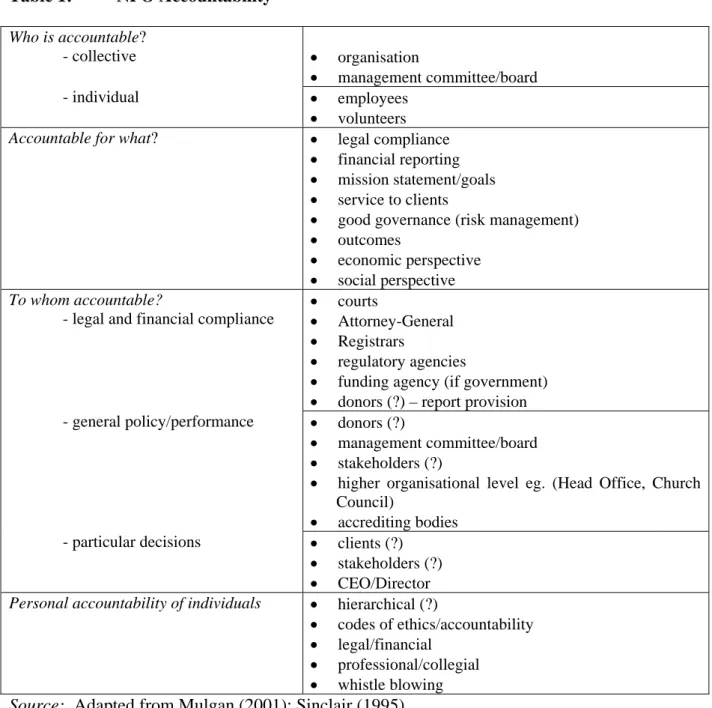
Mulgan has analysed the accountability of NPOs in Australia in comparison with public and private sector organisations according to a number of variables – who is accountable
(collectively and individually); for what they are accountable (legal compliance and financial reporting, general performance, treatment of individual clients); and to whom they are
accountable (the public, owners, and clients), and has assessed that they exhibit significantly less accountability than their private and public sector counterparts (Mulgan, 2001: 89; Mulgan, 2000(a); 2000(b); Mulgan, 1997).
His analysis, together with the findings by Sinclair (1995), is applied to nonprofit
organisations as depicted in Table 1. Both Mulgan and Sinclaire recognise that, at different times, accountability can be in a political, managerial, public, professional, or personal form.
Which ‘form’ prevails, and under what circumstances, will vary and will be influenced by the demands of different stakeholders.
Table 1: NPO Accountability Who is accountable?
- collective organisation
management committee/board
- individual employees
volunteers Accountable for what? legal compliance
financial reporting mission statement/goals service to clients
good governance (risk management) outcomes
economic perspective social perspective To whom accountable?
- legal and financial compliance
courts
Attorney-General Registrars
regulatory agencies
funding agency (if government) donors (?) – report provision - general policy/performance donors (?)
management committee/board stakeholders (?)
higher organisational level eg. (Head Office, Church Council)
accrediting bodies - particular decisions clients (?)
stakeholders (?) CEO/Director Personal accountability of individuals hierarchical (?)
codes of ethics/accountability legal/financial
professional/collegial whistle blowing Source: Adapted from Mulgan (2001); Sinclair (1995)
Other authors also suggests that, to maintain public trust, NPOs need to adopt an approach to accountability whereby an organisational response can be tactical or strategic. Kearn’s ‘accountability cube’ (Fig. 1 below) provides a three dimensional representation on internal and external authority, explicit and implicit standards for operating, and organisational
response options. This extends further, the Mulgan and Sinclair accountability perspective so that aspects of accountability not codified in law are considered (Kearns, 1996: 39).
However, whilst public trust and public interest are separate theoretical concepts, the line becomes blurred in discussions about accountability.
Fig.
Fig. 1.1. The Accountability CubeThe Accountability Cube
Higher authority Higher authority (external) (external) Higher authority Higher authority (internal) (internal) The public The public Tactical
Tactical StrategicStrategic
E x p lic it sta nda rds E x p lic it st andar d s Implic it st andar d s Implic it st andar d s Accountable Accountable for what? for what? Accountable Accountable to whom? to whom? Organizational response Organizational response Source
Source: Kearns (1996: 43): Kearns (1996: 43)
Using information technology and the media one can examin the availability of data on NPOs to researchers and the public. In the USA there is the IRS Form 9901 data available, increasingly on-line but, according to Greenlee (2000: 34, 47-48), there is still a debate as to whether CPAs should audit this form, and whether an organisation similar to the Securities and Exchange Commission should be formed to regulate the sector. According to Sarre (2002), legal requirements and financial compliance initiatives do not, of themselves, prevent corporate negligence and malfeasance. There is a limited role which the law (and government) can play in regulatory governance.
Sarre also asserts that corporate social responsibility has undergone a ‘paradigm shift’ with exposure of global disasters such as Brent Spa (oil tanker spill), Nike (workplace conditions in third world countries) and Monsanto (genetically modified crops). Corporate culture, and the notion of corporate ‘obligation’, have emerged as important aspects in company law where obligation is seen as a fair return for the granting of legal protection of limited liability (Sarre, 2002: 6; 10). This is indicative also of Harmon’s notion of discretion and personal responsibility, where integrity and moral obligation play a role in decision-making (Harmon, 1981: 128). It can be asserted that NPOs will be increasingly subjected to scrutiny, particularly those with a high profile and/or a large asset base or annual turnover.
As mentioned earlier, the Auditor-General in Victoria has provided several reports on the need to improve accountability of NPOs receiving government grants and subsidies as well as in the agencies providing such payments for capital items (Auditor General of Victoria, 2001; 2000; 1994). McDonald also found that Australian government funding bodies had difficulty in managing the accountability process and, like New Zealand and northern hemisphere counterparts, passed the responsibility for accountability onto the funded agencies for both funds and service performance (McDonald, 1997: 61). An earlier study by McGregor-Lowndes (1996) showed a move by NPOs to adopting good governance practices such as risk management, internal monitoring and review, meeting accreditation guidelines, and the implementation of TQM principles (McDonald, 1999: 19).
Many NPOs have discovered that there are heavy administrative costs associated with meeting accountability requirements. A study in Western Australia showed costs ranging from less than one percent of a NPO’s budget to more than 30 percent of budget, and were statistically unrelated to the NPO’s location or scale of operation (Auditor General Western
Australia, 2000: 34; Pearson, 2003). Because of the fine ‘margin’ between income and committed expenditure, most NPOs perceive the costs of accountability as detrimental to service delivery – a ‘conflict’ with their service ethos.
Why is Accountability Important for NPOs ?
Authors who specialise in NPO studies agree on the unique position of these organisations with respect to their operating environment. Simon (in Anheier & Seibel, 1990: 37-42) suggests that there is a three way ‘pull’ between business, government and donors for NPOs with respect to accountability via regulatory activity; Leat (in Anheier & Seibel, 1990: 144-152; Leat 1988) states that NPOs are accountable to a number of different, sometimes overlapping, sometimes conflicting groups. Other research has revealed that there are several inherent deficiencies in NPOs such as ‘goal diversion, lack of accountability, rent seeking, or philanthropic amateurism’ (Anheier & Seibel, 1990: 379).
Good governance embraces accountability and stewardship and, since the 1990s, governing boards of NPOs have been seen to address both internal governance and external accountability and transparency measures (Axelrod, 1997; Gregoire, 2000; Irish & Simon, 2000), largely as a result of the actions of a few NPOs tarnishing the credibility of the sector.
The recent scrutiny applied to the Red Cross in America and in Australia indicates that NPOs often lose sight of their accountability to donors. The American Red Cross received US$546 million to aid victims of the September 11 (2001) attacks, but held back US$246 for ‘investments in volunteer mobilization, chapter development for response to weapons of mass destruction, expanded blood security, and continuity of operations efforts’ (O’Meara, 2001: 15). In Australia, the Red Cross raised $14.3 million for its Bali appeal and, after a period of
time, questions were asked about the dispersal of funds to victims – the stated reason for the appeal. At this time only 54 per cent, or $7.7 million, had gone directly to the victims of the Bali bombing (D’Cruz, 2003: 30).
Berman and Davidson (2003) have reviewed the regulation of charities in Australia with respect to fundraising and have reported on the accountability requirements of each State (except Tasmania and the Northern Territory where there is no legislation relating to fundraising). Their ‘accountability index’ is instructive but their research shows that donors do not, as a rule, question the ‘accountability’ of the usage of funds (Berman and Davidson, 2003: 425, 428).
Past studies of charities in Victoria found that 57 per cent did not comply with disclosure requirements under the Victorian Fundraising Appeal Act; a review of 22 NPOs by the Chartered Accountants Institute found limited reporting and inadequate disclosure on a range of issues. This latter group included Red Cross, Care, WWF, World Vision and The Royal Flying Doctor with a combined income of $550 million, $250 million of which was from fundraising (D’Cruz, 2003: 31).
The question of how to ‘measure’ accountability is one that needs to be addressed so that NPOs can build this process into their governance structure. Most NPOs track their performance by metrics such as membership growth, people served, number of visitors, dollars raised, programs run and overhead costs, however, these do not measure the success of an organisation in achieving its mission.
Accountability to a range of stakeholders is achieved through performance measures which ‘match’ the prevailing requirement – legal/accounting, outcomes, or values. Management committee members and trustees tend to reflect the constituencies which the NPO sees as primary stakeholders. (Taylor, 1996: 61). The multiple accountabilities observed by authors in the foregoing discussion on its importance can be depicted along three dimensions as in Table 2 below.
Leat (1998: 34) contends that stakeholder groups will differ considerably in their ability to make accountability meaningful. They will also, according to Herman and Renz (1997: 188), present a problem for ‘measurement’ of performance as judgements of effectiveness will differ.
Table 2 Multiple Stakeholder Accountability
Higher Authority External Higher Authority Internal Public Courts Attorney-General Parliament Executive Regulatory Agencies Accrediting Agencies Funding Agencies Professional bodies Management Committee/Board Trustees Elected Officials Supervisors CEO Higher organisational level/Parent body Members Volunteers Employees Private donors Clients Taxpayers Client’s family/friends/peers Media
The Australian National Audit Office and the Auditors-General of Western Australia, Victoria and Queensland have all noted that grant schemes involve the use of public money (Industry Commission, 1995). The principal-agent theory argues that some activities are too costly or too complex to be provided by one principal, so an agent is needed to undertake particular tasks. In Australia in the last decade, many NPOs have become agents and government departments the principals in service delivery. As stated earlier, this was also to ‘shift’ the responsibility for accountability from government (giving grants) to NPOs as ‘contracted’ agents for service delivery. McDonald’s assessment (1997) is that the principal-agent framework is limited as an enhancer of accountability, as it does not take account of political processes and pressures impacting on the principal and on the relationship between principal and agent; it tends to focus on the behavioural requirements of the agent and this adversely affects the ‘independent/impartial’ relationship required for accountability assessment; the principal side of the principal-agent relationship can be actively involved in shaping markets where the supply side was uneven; and finally that it is a major requirement of a principal to specify services to be delivered and the criteria for performance measurements. (McDonald, 1997: 62). In this system the principal retains the ‘power’ over the agent but the accountability is transferred to the ageng. That is, the NPO is responsible both to higher external authorities as well as to the public (see Table 2).
Triple bottom line2 reporting has emerged in the last few years to extend the ‘traditional’ measurement metrics of assets, liabilities, profit and loss in the private sector to include sustainable development and dedication to social justice (Hayward, 2003). Nonprofit organisations, too, have had to extend their traditional metrics and, in this respect, are not significantly different from public or private sector organisations.
What Accountability Standards are Appropriate to NPOs ?
The usual approaches to measurement for legal and accounting purposes apply to NPOs (Bothwell, 2000; Otley, 2000; Sinclair, 1995), as do outcome measures (Bozzo, 2000; Fine et. al., 1998; 2000; Morley et. al., 2001; Poole et. al., 2000; Sevic & Rabrenovic, 2000; Storbeck & Waring, 2000; and Tofallis & Sargeant, 2000). Again, in this respect, NPOs are no different from public or private sector organisations.
The field of NPO evaluation has grown over the last decade and such evaluations have encompassed measures of legal accountability and outcomes which address stakeholder groups. Stakeholder involvement in evaluations of NPOs is seen as important both by evaluators and the NPO constituency, and there has been a growing acceptance of participatory evaluation where project/program stakeholders and beneficiaries are the key actors of the evaluation process, not the mere objects of the evaluation (Fine et. al., 1998). Guba & Lincoln’s Fourth Generation Evaluation (1989) was the first documented account of stakeholder-led evaluation, but it has been criticised for its post-modernist attack on the traditional, positivist foundation of program evaluation (Fishman, 1992).
Abrahams’ (1999) review of financial accountability in New South Wales NPOs has shown that all engage external auditors – not surprising given that Incorporations law and Charities law requires this, but other aspects of accountability are not so readily pursued except where an organisation may adopt an ‘accountability’ code.
Collaborative, participatory and empowerment evaluation has been debated by leaders in evaluation practice (Fetterman, 2000; Patton, 1997; and Scriven, 1997) and endorsed as a process for fostering improvement and self-determination, and for its unambiguous value orientation. It embraces evaluation for accountability, development and knowledge. All stakeholders can be involved and this approach accommodates competing interests in outcomes.
However, the accountability framework identified in Table 1 and Figure 1, and the multiple stakeholders identified in Table 2, highlight the complexities faced by NPOs with respect to meeting diverse ‘measurement’ needs in order to satisfy all stakeholder interests.
Transparency, or openness, is now being demanded by all stakeholders as a result of a diminishing trust of directors and managers due to a number of recent corporate failures. Regulatory bodies, as was seen with APRA and the HIH collapse, do not always detect problems in management.
There have also been calls for prosecution of NPO personnel who commit embezzlement, fraud, theft, accepting bribes and false billing. Exposure of public scandals worldwide in Australia, England, France, Germany, Ireland, South Africa, Ecuador, and the USA (Gibelman & Gelman, 2001) means that NPOs have to become more transparent and accountable.
The dilemma for NPOs is, as Mulgan (2001:104) states, how far the accountability deficit should be reduced. Results measurements cover efficiency and effectiveness criteria and there are common questions such as:
- how is the ‘public’ money being spent on programs and services? - what outcomes are being delivered to the clients in need?
- what standard of measurement can be used to demonstrate quality of performance?
- where is the proof that the NPO deserves to retain tax-exempt privileges based on the ‘public benefit’ test?
As Greenfield and Larkin point out, these are difficult questions to answer unequivocally, and the results will not be found in the financial statements. (Greenfield and Larkin, 2000:62).
The NPOs which receive government funding (either as grants, subsidies or as payment as agents) can adopt an accountability regime of monitoring with a focus on trends, benchmarks, services and projects; auditing, with a focus on costs, operations, systems and compliance;
reviewing, focussing on programs, projects, costs and results; and/or evaluating, looking at inputs, processes, outputs, outcomes (impacts) and policies or programs. However, measuring (or demonstrating) effectiveness and efficiency is not an easy task.
What are the measures of ‘success’ of the local church, Red Cross chapter, university, cancer society or women’s shelter? Is it in the quantity or quality of programs and services provided? Can we benchmark or compare amongst similar organisations? Is a real measure of success that there are some NPOs that go out of existence? (eg. homeless, battered women’s shelters? rescue missions?). Performance in NPOs is, to a large extent, socially constructed – that is, it tends to be judged in the ‘eye of the beholder’, the individual expectations of stakeholders, unless a more wholistic approach is adopted as discussed earlier.
Partial solutions include the setting of standards and accountability codes of conduct. Standards should embrace the accountability and transparency measures which will improve
public trust, and these include the quality of financial reporting, demonstration of stewardship and good governance at board and management levels, and opportunity for donors, volunteers and the stakeholders to have access to, and participate in, the decision-making process (including determining performance measures). Codes of conduct1 for accountability and fundraising have been developed in a number of countries3. These tend to be based on legal requirements and ethics, and are self-regulating
Waddock et. al. (2002: 137) have identified emerging global standards, codes and principles as additional sources of institutional pressures. These include labour standards and principles (ILO Conventions, ILO Fundamental Principles); human rights standards and principles (UN Declaration on Human Rights and the Environment, UN International Convention on Economic, Social and Cultural Rights); general business principles and standards (OECD Guidelines for Multinational Enterprises, Clarkson Principles for Stakeholder Management); environmental principles and standards (CERES – Coalition for Environmentally Responsible Economies – Principle, ISO 14000 and ISO 14001, responsible care principles); and anti-corruption conventions (Transparency International Core Principles and Integrity System).
This broad range of ‘accountabilty’ standards are applicable to all organisations – public, private and NPOs alike.
Conclusion
It can be argued that the Mulgan and Sinclair frameworks depicted in Table 1 are the most useful for application to NPOs as they take account of all dimensions of accountability. It has become increasingly obvious that NPOs need to be more transparent in all aspects of their governance if they wish to maintain public (and donor) support, and this requires them to go beyond obeying legal requirements and just meeting minimum standards. The evidence from accountability reviews referred to earlier and the multiple accountabilities depicted in Table 1 indicate that NPOs, at different times, demonstrate similar accountabilities to public and private sector organisations.
The multiple stakeholders (in Table 2) will delineate the accountability foci, a challenge to NPOs which remain mission-driven, reflecting only a community focus. The participatory (empowerment) performance evaluation is a means for overcoming the multiple-stakeholder dilemma but, as discussed, there is not one measurement approach which will deliver the outcomes of interest to all stakeholder groups. Measurement solutions should, therefore, incorporate a multi dimensional evaluation to satisfy all groups – the ‘higher’ external authority, the ‘higher’ internal authority, as well as the public. What is most evident is that the metrics favoured by most NPOs which focus on inputs and ‘busyness’, need to be replaced by measurements which have an outcome focus.
As indicated in the recent literature on NPO accountabilty, there are ‘gaps’ and this sector has not had to meet anything other than minimal requirements of accountability. There are very few ‘critical eyes’ looking from the outside; no shareholders, stockbrokers of specific government ‘watchdogs’ are scrutinising NPOs despite the fact that the financial ‘worth’ of
the largest NPOs far exceeds that of many listed companies. Lack of close scrutiny can breed laxity, poor standards, and lack of accountability (D’Cruz, 2003; Sarre, 2002). There is a danger that minimum standards will become the norm unless the sector adopts more professional standards or codes – either explicit or implicit. Self regulation, which is fundamental to the adoption of such codes, was not evident in recent public scandals.
The NPO sector needs to discontinue the notion that it is not subject to the expanded dimensions of accountability which are now being demanded. The Mulgan and Sinclair frameworks are valid to all sectors and can be extended to include these tactical and strategic approaches which, if followed, could anticipate such public reactions as befell the Red Cross both in the USA and in Australia.
Note 1 : IRS Form 990. This form provides information that helps government agencies (the IRS and State charity regulators) enforce the laws that govern nonprofits. It is a public document and must be shown to anyone who wants to see it. (see www.npccny.org/Form990/990.htm)
Note 2 : Triple bottom line is a measure of success that takes account of social and environmental impact, not just profit and loss – a ‘balance’ of financial, social and ecological performance.
Note 3 : See, for example, ACFOA Australia (www.acfoa.asn.au), Canadian Centre for Philanthropy (www.ccp.ca),
Standards for Excellence, Maryland, USA (www.mdnonprofit.org/ethicbook.htm).
References
Abrahams, A. (1999). ‘Financial Accountability in Non-Profit Organisations: Voluntary Audit as Self-Regulation’. Third Sector Review, 5(1): 25-40.
Anheier, H. K. and Seibel, W. (1990). The Third Sector: Comparative Studies of Nonprofit Organisations, New York: Walter de Gruyter & Co.
Auditor-General of Victoria (2001). Departmental Performance Management and Reporting, Report No. 126, Session 1999-2001, Melbourne: Government Printer.
Auditor-General of Victoria (2000). Grants to Non-Government Organisations. Improving Accountability, Report No. 52, Session 1999-2000, Melbourne: Government Printer.
Auditor-General of Victoria (1994). Grants and Subsidies to Non-Government Organisations, Special Report No. 30, Melbourne: Government Printer.
Auditor-General, Western Australia (2000), Means to an End. Contracting Not-For-Profit Organisations for the Delivery of Community Services, Report No. 3, Perth, Western Australia: Office of the Auditor General.
Axelrod, N. (1997). “The Growing Stakes for Good Governance”, Association Management, 49(1): 38-42; 126.
Berman, G. and Davidson, S. (2003), Do Donors Care? Some Australian Evidence, Voluntas: International Journal of Voluntary and Nonprofit Organisations, 14(4): 421-429.
Bothwell, R.O. (2000). “Trends in Self-Regulation and Transparency of Nonprofits in the US”, The International Journal of Not-for-Profit Law, 2(3): 604-622.
Bozzo, S. L. (2000). “Evaluation Resources for Nonprofit Organisations: Usefulness and Applicability”, Nonprofit Management and Leadership, 10(4) Summer: 463-472.
Conroy, D.K. (1994). Best Practice in Evaluation Design Means Comprehensiveness and Competence, Not Just Compliance With Standards: A Case Study of Two Evaluation Reports. Paper presented to Australasian Evaluation Society International Conference, Canberra, 21-23 September.
D’Cruz, D. (2003), The Party’s Over, IPA Review, June: 30-31.
Fetterman, D.M. (2000). Foundations of Empowerment Evaluation, Thousand Oaks, CA: Sage.
Fine, A. H., Thayer, C. E. and Coglan, A. T. (2000). “Program Evaluation Practice in the Nonprofit Sector - Research Report”, Nonprofit Management and Leadership, 10(3) Spring: 331-339.
Fine, A. H., Thayer, C. E. and Coglan, A. T. (1998). Program Evaluation Practice in the Nonprofit Sector, Washington, USA: Innovation Network Inc.
Fishman, D. B. (1992). “Postmodernism Comes to Program Evaluation: A Critical Review of Guba and Lincoln’s Fourth Generation Evaluation”, Evaluation and Program Planning, 15: 263-276.
Gibelman, M. and Gelman, S.R. (2001). ‘Very Public Scandals: Nongovernmental Organisations in Trouble’, Voluntas: International Journal of Voluntary and Nonprofit Organizations, 12(1): 49-66.
Greenfield, J.M. and Larkin, R.F. (2000). “Public Accountability”, New Directions for Philanthropic Fundraising, 27, Spring: 51-71.
Greenlee, J. S. (2000). “Nonprofit Accountability in the Information Age”, New Directions for Philanthropic Fundraising , 27, Spring: 33-50.
Gregoire, C. (2000). “The Role of Governing Boards in Fostering Accountability”, The International Journal of Not-for-Profit Law, 2(3): 610-614.
Harmon, M. (1981), Action Theory for Public Administration, New York: Longman Inc. Hayward, S.F. (2003), The Triple Bottom Line, Forbes, 171(6):42.
Herman, R. D. and Renz, D. O. (1997). “Multiple Constituencies and the Social Construction of Nonprofit Organisation Effectiveness”, Nonprofit and Voluntary Sector Quarterly, 26(2) June: 185-206.
Industry Commission (1995). Charitable Organisations in Australia, Report No. 45, Melbourne: AGPS.
Irish, L. and Simon, K. (2000). “Law and Governance - A Lesson in Limits”, The International Journal of Not-for-Profit Law , 2(3): 305-315.
Kearns, K. P. (1996). Managing for Accountability, San Francisco, USA: Jossey-Bass. Leat, D. (1988). Voluntary Organisations and Accountability, Policy Analysis Unit, UK: National Council for Voluntary Organisations, April.
McDonald, C. (1999). “Internal Control and Accountability in Non-profit Human Organisations”, Australian Journal of Public Administration, 58(1): 11-22.
McDonald, C. (1997). “Government, Funded Nonprofits, and Accountability”, Nonprofit Management and Leadership , 8(1): 51-64.
Morley, E., Vinson, E. and Hatry, H. P. (2001). Outcome Measurement in Nonprofit
Organisations: Current Practices and Recommendations, Waldorf, MD, USA: Independent Sector.
Mulgan, R. (2001). “The Accountability of Community Sector Agencies: A Comparative Framework”, Third Sector Review, 7(1): 89-105.
Mulgan, R. G. (2000a). “Accountability: An Ever Expanding Concept?” Public Administration, 78: 555-574.
Mulgan, R. (2000b). “Comparing Accountability in the Public and Private Sectors”,
Australian Journal of Public Administration, 59(1): 87-97.
Mulgan, R. (1997). “The Process of Public Accountability”, Australian Journal of Public Administration, 56(1): 25-36.
O’Meara, K. (2001), Red Cross Feathers Its Own Nest First, Insight on the News, 17(46), 10 December: 15-17.
Otley, D., (2000). “Accounting Performance Measurement: A Review of Its purposes and Practices” in A. Neely (ed). Performance Measurement - Past, Present and Future, Cranfield University, UK: Centre for Business Performance, pp 443-450.
Patton, M.Q. (1997). ‘Toward Distinguishing Empowerment Evaluation and Placing it in a Larger Context’, Evaluation Practice, 18(2): 147-163.
Pearson, D. (2003), Public Sector Contracting of Not-for-Profit Organisations for the Delivery of Community Services, The Journal of Contemporary Issues in Business and Government, 9(2): 43-50.
Poole, D. L., Nelson, J. E., Carnahan, S., Chepenik, N. G. and Tubiak, C. (2000). “Evaluating Performance Measurement Systems in Nonprofit Agencies: The Program Accountability Quality Scale (PAQS)”, American Journal of Evaluation, 21(1) Winter: 15-26.
Sarre, R. (2002), Responding to Corporate Collapses: Is There a Role for Corporate Social Responsibility? Deakin Law Review, 9(1): 137-153.
Scriven, M. (1997). ‘Empowerment Evaluation Examined’, Evaluation Practice, 18(2): 165-175.
Sevic, Z. and Rabrenovic, A. (2000). “Politico - Administrative Relationship and Performance Measurement in the Public Sector”, in A. Neely (ed). Performance Measurement - Past, Present and Future, Cranfield University, UK: Centre for Business Performance, pp 531-538. Sinclair, A. (1995). “The Chameleon of Accountability: Forms and Discourses”, Accounting Organisations and Society, 20(2&3): 219-237.
Storbeck, J. E. and Waring, C. G. (2000). “Model Support for Performance-Based Budgeting” in A. Neely (ed). Performance Measurement - Past, Present and Future, Cranfield
University, UK: Centre for Business Performance, pp 579-586.
Taylor, M. (1996). “Between Public and Private: Accountability in Voluntary Organisations”, Policy and Politics, 24(1): 57-72.
Tofallis, C. and Sargeant, A. (2000). “Assessing Charities Using Data Envelopment
Analysis”, in A. Neely (ed). Performance Measurement - Past, Present and Future, Cranfield University, UK: Centre for Business Performance, pp 593-600.
Waddock, S.A., Bodwell, C. and Graves, S.B. (2002), Responsibility: The New Business Imperative, Academy of Management Executive, 15(2):132-147.