Towards Local Classifier Generation for Dynamic Selection
by
Hiba ZAKANE
THESIS PRESENTED TO ÉCOLE DE TECHNOLOGIE SUPÉRIEURE
IN PARTIAL FULFILLMENT OF A MASTER’S DEGREE
WITH THESIS IN AUTOMATED MANUFACTURING ENGINEERING
M.A.Sc.
MONTREAL, DECEMBER 3, 2018
ÉCOLE DE TECHNOLOGIE SUPÉRIEURE
UNIVERSITÉ DU QUÉBEC
This Creative Commons license allows readers to download this work and share it with others as long as the author is credited. The content of this work cannot be modified in any way or used commercially.
BOARD OF EXAMINERS THIS THESIS HAS BEEN EVALUATED BY THE FOLLOWING BOARD OF EXAMINERS
Mr. Robert Sabourin, Thesis Supervisor
Automated Manufacturing Engineering, École de Technologie Supérieure
Mr. George D. C. Cavalcanti, Co-supervisor
Centro de Informática, Universidade Federal de Pernambuco
Mr. Patrick Cardinal, President of the Board of Examiners
Software Engineering and Information Technology, École de Technologie Supérieure
Mrs. Eulanda dos Santos, External Independent Examiner Instituto de Computaçao, Federal University of Amazonas
THIS THESIS WAS PRESENTED AND DEFENDED
IN THE PRESENCE OF A BOARD OF EXAMINERS AND THE PUBLIC ON NOVEMBER 21, 2018
ACKNOWLEDGEMENTS
I would like to address special thanks to my supervisor Professor Robert Sabourin for his guid-ance, patience, availability, and support during the last two years. Thank you for contributing to my academic and personal development.
Many thanks to my co-supervisor, Professor George D. C. Cavalcanti, for his valuable feedback and supervision despite the distance that separates us. I also, express my deepest thanks to Dr. Rafael M.O. Cruz for his support and help throughout the elaboration of this research work. I thank the members of the jury, Professor Eulanda dos Santos and Professor Patrick Cardinal, that kindly accepted to evaluate this master’s thesis.
The support of the students services (SAE), the library facilitators, as well as the Deanship of Graduate studies.
Special thanks to all my friends from LIVIA for the constant support and the nice moments we shared during several occasions.
I thank the family and friends I have here in Montreal, I wouldn’t have made this far without your precious daily encouragement and patience.
Last but not least, I would like to express my gratitude and love to my parents and my brother for their trust, love and their endless belief in my success.
Vers une génération de bassin de classificateurs adaptée à la Selection Dynamique Hiba ZAKANE
RÉSUMÉ
Les systèmes de classificateurs multiples sont axés sur la combinaison des classificateurs, pour obtenir de meilleures performances, par rapport aux performances d’un seul classificateur ro-buste. Ces systèmes se déroulent en trois phases principales: la génération de bassins de classificateurs, la sélection statique ou dynamique de ces derniers et la phase d’intégration. La sélection dynamique est un sujet de recherche très en vogue au sein de la communauté d’apprentissage machine. Elle se caractérise par la sélection des classificateurs les plus com-pétents, pour chaque échantillon de test. La sélection dynamique fonctionne en se dotant d’un bassin (pool) de classificateurs, l’estimation du niveau de compétence des classificateurs est généralement faite à partir de la construction du voisinage de l’échantillon à classer pour la plupart des techniques, et cette région locale est appelée région de compétence. Une région
de compétence composée d’instances appartenant à différentes classes est appelée : région
d’indécision et contribue souvent aux difficultés rencontrées par les méthodes de sélection dynamiques de toujours repérer les classificateurs compétents. D’autre part, la sélection dy-namique repose sur les méthodes de générations des bassins de classificateurs qui sont conçues pour les approches de combinaison statique. En d’autres termes, ces dernières adoptent une approche globale pour générer les classificateurs, ce qui n’est pas aligné avec l’aspect local qui définit le schéma de la sélection dynamique.
De ce fait, dans ce travail, nous nous concentrons sur la couverture locale des régions d’indécision, par des classificateurs compétents localement pour la sélection dynamique. Nous proposons un système qui exploite l’information locale, dans la création des classificateurs traversant les ré-gions d’indécision en séparant entre les échantillons appartenant aux différentes classes. Nous proposons aussi cinq nouvelles stratégies de sélection locale, pour la construction de bassins de classificateurs adaptés à la sélection dynamique. En généralisation, nous nous fions aux recommandations proposées lors de notre précédent travail, qui portait sur les raisons derrière le surpassement en terme de performances des méthodes de sélection dynamiques en compara-ison de l’algorithme des K-plus proches voisins, sachant que ce dernier est exploité dans la définition de la région de compétence, dans la plupart des méthodes de sélection dynamiques. Les expériences ont montré que la sélection dynamique est efficace pour les échantillons situés dans des régions d’indécision, selon une mesure de difficulté de classification d’un échantillon donné, alors que l’algorithme des K-plus proches voisins serait plus adapté pour les échantil-lons ayant un faible degré de difficulté. Ceci justifie l’utilisation la mesure de difficultés des instances pour déterminer si l’on utilise un algorithme de K-Plus proches voisins ou la sélection dynamique pour la classification.
Les expériences ont été menées en utilisant plusieurs méthodes de sélection dynamique sur les cinq stratégies proposées de création de bassins de classificateurs. Les résultats de cette recherche ont montré que la focalisation sur une approche locale pour générer des
classifica-VIII
teurs pour la sélection dynamique est une voie prometteuse pour garantir l’existence de clas-sificateurs compétents sur le plan local, car elle fournit des résultats meilleurs à ceux de la littérature et dans le cas contraire, elle présente une équivalence statistique. Cependant, il y a encore place à l’amélioration pour de telles approches qui nous mèneraient à la génération locale de classificateurs adaptés à la sélection dynamique.
Mots-clés: Apprentissage ensembliste, Sélection Dynamique, Reconnaissance de formes, classificateurs linéaires
Towards Local Classifier Generation for Dynamic Selection Hiba ZAKANE
ABSTRACT
Multiple Classifier Systems (MCS) focus on the combination of classifiers to achieve better performance than a single robust one. These systems unravel three major phases: pool of clas-sifiers generation, Static or Dynamic selection and integration. Dynamic Selection (DS) is an active research topic in the field of MCS. It’s based on the selection of the most competent classifier(s), on the fly, for every test sample. To operate, the DS scheme needs to be provided with a pool of classifiers, it will then compute the region of competence defined as a set of the test sample’s nearest neighbors (in most of DS techniques) that determines the competence of the classifiers. The regions of competence located on the decision boundaries are called "inde-cision regions" and usually contribute into the struggle of DS technique into always selecting the most competent classifiers. On the other hand, Dynamic Selection relies on classifier gen-eration techniques that are meant for static combinations. In other words, these methods adopt a global approach into generating the classifiers, which contradicts the local aspect that defines the dynamic selection scheme.
Therefore, in this work we address the problem of covering the indecision regions with locally competent classifiers in the context of dynamic selection. We propose a system that exploits local information to build classifiers that cross the indecision regions of competence guaran-teeing a separation between the samples from different classes (frienemies). We also proposed five novel local selection strategies to construct pools of these classifiers, that is adapted to the Dynamic selection system. In generalization, we rely on the recommendations of our previous work, where an investigation was conducted on the reasons behind the out-performance of the DS techniques over the K-NN classifier even though, most of the techniques rely on the defi-nition of the nearest neighbors as a competence region. It was concluded that DS techniques deal better with instances located in indecision regions according to an instance hardness mea-sure whereas the K-NN is well suited for the samples with a low degree of instance hardness. Therefore, we exploited the concept of the hardness of samples to determine whether to use the K-NN of DS techniques for classification.
Experiments were conducted using several DS techniques under the five proposed pool gener-ation approaches. The results of this research have shown that focusing on a local approach to generate classifiers for Dynamic Selection is a promising path into guaranteeing the existence of locally competent classifiers as it outperformed the results of the literature for certain tech-niques. When there is no improvement, the results remain comparable to the literature’s. Yet, there is still room for improvement for such approaches and further investigations will be lead towards the local pool generation for Dynamic Selection.
Keywords: Ensemble Learning, Dynamic Classifier Selection, Dynamic Ensemble Selection, Pool Generation, Pattern Recognition, Linear classifiers
TABLE OF CONTENTS
Page
INTRODUCTION . . . 1
CHAPTER 1 RELATED WORK . . . 7
1.1 The Oracle . . . 7
1.1.1 Dynamic Selection . . . 8
1.1.2 Region of Competence definition . . . 11
1.1.3 Measures of competence and Dynamic Selection techniques . . . 12
1.1.3.1 Individual-based measures of competence . . . 13
1.1.3.2 Group-based measures of competence . . . 18
1.1.4 Dynamic Selection Versus K-NN . . . 20
1.1.5 Dynamic Selection in the indecision Regions . . . 21
1.2 Ensemble Generation methods . . . 22
1.2.1 The wisdom of crowds . . . 22
1.2.2 Bagging . . . 23
1.2.3 Random Subspaces Method . . . 23
1.2.4 Boosting . . . 24
1.2.5 Oracle-based generation method . . . 24
1.3 Summary, discussion and a brief introduction to the proposed system . . . 26
CHAPTER 2 TOWARDS LOCAL POOL GENERATION FOR DYNAMIC SELECTION . . . 29
2.1 Basic concepts . . . 29
2.1.1 Region of Competence in the context of this study . . . 29
2.1.2 Indecision Region . . . 29
2.1.3 frienemies samples . . . 31
2.1.4 Instance Hardness . . . 32
2.1.4.1 k Disagreeing Neighbors (kDN), an instance hardness measure . . . 32
2.2 The proposed Local Pool Generation for Dynamic Selection System . . . 33
2.2.1 How does the proposed local pool generation work? . . . 36
2.2.2 A pairwise separation between frienemies . . . 38
2.2.3 Strategies for local selection of classifiers . . . 42
2.2.3.1 Strategy 1: DCS as a guide for local selection, no errors allowed . . . 43
2.2.3.2 Strategy 2 : DCS as a guide for local selection . . . 44
2.2.3.3 Strategy 3: KNORA-E as a guide for local selection . . . 45
2.2.3.4 Strategy 4 : frienemies distinction as a guide for local selection, one classifier allowed . . . 46
2.2.3.5 Strategy 5 : frienemies distinction as a guide for local selection, multiple classifiers allowed . . . 47
XII
2.3 The generalization phase . . . 48
2.4 Case study:The P2 problem . . . 48
2.4.1 Local Pool Generation for P2 . . . 49
2.4.2 Case study summary . . . 53
2.5 Discussion . . . 55
CHAPTER 3 EXPERIMENTS AND RESULTS . . . 57
3.1 Experimental protocol . . . 57
3.2 Results analyses and discussions . . . 59
3.2.1 Comparison between the proposed local pool generation strategies and the state of the art generation methods . . . 60
3.3 General discussion . . . 70
CONCLUSION AND RECOMMENDATIONS . . . 73
APPENDIX I COMMUNICATION PRESENTED IN IPTA 2017 . . . 77
APPENDIX II THE NUMERICAL RESULTS . . . 85
LIST OF TABLES
Page
Table 1.1 A summary of the the Dynamic Selection techniques and their
characteristics in a chronological order inspired from (Cruz et al.,
2018) . . . 19
Table 2.1 A summary of the strategies used as guides to locally select the
classifier(s) from the Temporary Pool TP and construct DSLP . . . 42
Table 3.1 Key features of the 17 datasets used for the experiments, IR
represents the Imabalance Ratio. . . 58
Table 3.2 Mean of the accuracy of APOS for Bagging, SGH and DSPG
(Strategy 4) given the number of example on the number of features
LIST OF FIGURES
Page
Figure 0.1 The three phases of a MCS system: pool generation, classifiers
selection and integration adapted from (Cruzet al., 2018) . . . 1 Figure 0.2 Thesis plan . . . 5 Figure 1.1 Taxonomy of the Dynamic Selection Scheme (Cruzet al., 2018) . . . 9
Figure 1.2 Classical Dynamic Selection System showing the difference
between the Dynamic Classifier Selection (DCS) and Dynamic
Ensemble Selection (DES) adapted from (Cruzet al., 2018) . . . 10
Figure 2.1 Three type of samples: safe samples (labeled as S), borderline
samples (labeled as B), and noisy samples (labeled as N). The continuous line shows the indecision region(Adapted from
(Oliveiraet al., 2017)). . . 30
Figure 2.2 Representation of pairs of frienemies (A, B), (A, D), (B, C), (B,
E), (B, F), (B,G) (C, D), (D, E), (D, F), (B,G) in the region of competence of the query in a black diamond shape (Adapted from
(Oliveiraet al., 2017)). . . 31
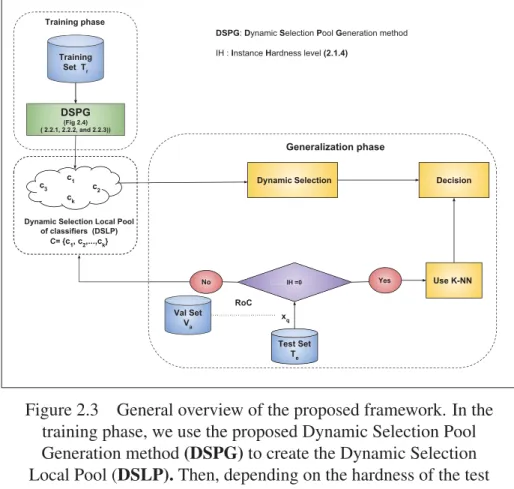
Figure 2.3 General overview of the proposed framework. In the training
phase, we use the proposed Dynamic Selection Pool Generation
method (DSPG) to create the Dynamic Selection Local Pool
(DSLP).Then, depending on the hardness of the test query sample
in generalization, the system uses either the K-NN to take the
decision or DS with the generated pool (DSLP) as suggested in
[71].. . . 34
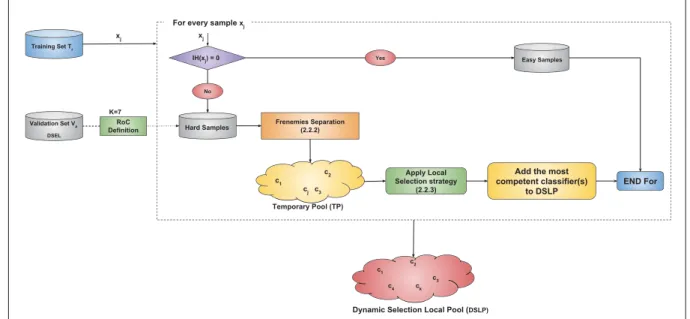
Figure 2.4 Summary of the Dynamic Selection Pool Generation (DSPG) part
with the different selection strategies . . . 35
Figure 2.5 Region of competence for a given query represented by a black
diamond. Red circle represents class 1, and blue cross represents
class 2. . . 38
Figure 2.6 The frienemies separation proposed that is closer to the minority
class (blue cross) with the pink classifier for aλ = 17. . . 40
Figure 2.7 The difference between the frienemies separation in the midpoint
XVI
Figure 2.8 Local Selection Strategy 1 . . . 43
Figure 2.9 Local Selection Strategy 2 . . . 44
Figure 2.10 Local Selection Strategy 3 . . . 45
Figure 2.11 Local Selection Strategy 4 . . . 46
Figure 2.12 Local Selection Strategy 5 . . . 47
Figure 2.13 The P2 Problem with decision boundaries, the red circle refers to class 1 . . . 49
Figure 2.14 A Region of Competence in an indecision region from the P2 problem . . . 51
(a) The features space . . . 51
(b) The first region of competence . . . 51
Figure 2.15 First iteration: the generation of a Temporary Pool (TP) for a hard sample in a Region of Competence and the local selection of the most competent classifier to be added to DSLP . . . 51
(a) The construction of TP . . . 51
(b) The remaining classifier after strategy application . . . 51
Figure 2.16 The second iteration: the generation of a Temporary Pool (TP) for the second hard sample in a Region of Competence followed by the chosen classifier to integrate DSLP . . . 52
(a) Iteration 2: TP construction . . . 52
(b) Iteration 2: remaining classifiers . . . 52
Figure 2.17 A snapshot of the classifiers chosen applying the first local selection strategy and a final coverage of the space (b) of that specific replication . . . 53
(a) The chosen classifiers within their RoCs . . . 53
(b) The final DSLP . . . 53
Figure 3.1 Instance Hardness measure for the joint use ofK−NN andDSin generalization. . . 59
Figure 3.2 Bonferroni-Dunn post hoc test for a critical value of α = 0.05 (on top) and α =0.01 (on the bottom). The strategies in which the difference in average rank is lower than the critical value are connected with a bar. . . 62
(a) Bonferoni Post-hoc test forα =0.05 . . . 62
XVII
Figure 3.3 Bonferroni-Dunn post hoc test for a critical value ofα =0.05 (a) andα =0.01 (b). The DS techniques in which the the difference in average rank is lower than the critical value are connected with
a bar. . . 64 (a) Bonferoni Post-hoc test forα =0.05 . . . 64 (b) Bonferoni Post-hoc test forα =0.01 . . . 64
Figure 3.4 Strategy 4 compared with SGH using the different DS techniques.
The colored lines (left to right) illustrate the critical values nc considering significance levels of α = {0.10,0.05,0.01},
respectively . . . 66
Figure 3.5 Strategy 4 compared with Bagging using the different DS
techniques. The colored lines (left to right) illustrate the critical valuesncconsidering significance levels ofα ={0.10,0.05,0.01},
LIST OF ALGORITHMS
Page
Algorithm 1.1 Self-generating Hyperplane Method (SGH), from (Souzaet al.,
2017) . . . 26
Algorithm 2.1 Pseudo code of the Dynamic Selection Pool Generation
technique . . . 36
Algorithm 2.2 The joint use of the K-NN rule and DS techniques in
LIST OF ABREVIATIONS
DCS Dynamic Classifier Selection
DES Dynamic Ensemble Selection
DSEL Dynamic Selection Dataset
DSLP Dynamic Selection Local Pool
DSPG Dynamic Selection Pool Generation
ÉTS École de Technologie Supérieure
KNN Dynamic Selection Dataset
RoC Region of Competence
SFR Number of sample on the number of features ratio
LIST OF SYMBOLS AND UNITS OF MEASUREMENTS
ci i-th classifier
C Pool of classifiers
C∗ Ensemble of most competent classifiers
c∗ The most competent classifier
Ω Set of class labels ofxk
wk Class label
L Number of class labels
N Number of instances in a dataset
Tr Training dataset Te Testing dataset Va Validation dataset θ Region of competence xq test query xj j-th sample
INTRODUCTION
Through the decades, various research projects have been conducted in the area of classification in a wide range of sectors. Despite the innumerable classification methods that cover different aspects of classification problems, empirical and theoretical results drove the researchers to jointly agree that building a single robust classifier isn’t always the right fit to deal with all the complex pattern recognition problems (Brittoet al., 2014). Therefore, it took years to the com-putational intelligence community to converge to a research trend that focuses on Ensembles of classifiers (EoC) or commonly called Multiple Classifier Systems (MCS).
Multiple Classifier Systems tend to mimic the human nature that usually seeks for different opinions before making a final decision (Rokach, 2010). Researchers from diverse disciplines such as pattern recognition, statistics, and machine learning have explored the use of ensemble methods since the late seventies (Rokach, 2010). They have been acknowledged for their con-ceptual simplicity and the top-level performance in many classification tasks (Tamponi, 2015; Friedmanet al., 2001). The process of MCS is constituted of three major phases: generation, selection and integration (Brittoet al., 2014). As shown in Figure 0.1, during the first phase, a pool of classifiers is generated; in the second step, one classifier or a non-empty subset of these classifiers is selected, while in the last one, a final decision is made based on the predic-tion(s)/opinion(s) of the selected classifier(s) (Brittoet al., 2014).
Figure 0.1 The three phases of a MCS system: pool
generation, classifiers selection and integration adapted from (Cruzet al., 2018)
2
Among these phases, intensive work on the selection phase became a key cause for the evolu-tion of MCS. Selecevolu-tion can be achieved in two ways, static and dynamic. In the Static Selecevolu-tion approach, the subset of classifiers is determined during the training of MCS; therefore, the same subset is applied for all test samples. On the contrary, Dynamic Selection (DS) considers dif-ferent subsets of classifiers for individual test samples (Royet al., 2016). Several techniques
have been developed through the years (Ko et al., 2008; Cruz, 2016) aiming to enhance the
strength of the recognition rates. However, there is no single algorithm that is better than any other over all possible classes of problems as stated in the “No free lunch” theorem (Cruz, 2016; Cruzet al., 2018; Brittoet al., 2014).
Problem statement
In the traditional process of Multiple Classifier Systems for DS, the phases consist on gener-ating a diverse pool of classifiers with mass generation techniques such as Bagging, Boosting,
Random Subspace etc (Britto et al., 2014; Cruz et al., 2018). Then comes the step where
dynamic selection techniques select a classifier or a subset of classifiers, for each test sample. The issue with these generation approaches is that they were designed for static combination methods. In other words, they use a global approach in generating the base classifiers (Souza et al., 2017; Cruzet al., 2018).
Although, the results of this process are efficient enough through the advancement of the field, the performance in generalization for DS depends on the initial base classifiers of the pool. Fur-thermore, the main philosophy of dynamic selection, is to select the most competent classifiers locally.
However, with ensembles generated with the static combination methods, this condition is not taken into consideration. It means that there is no guaranty for the the presence of local experts,
3
which leads to the incapacity of the DS technique to always select local competent classifiers (Cruzet al., 2018; Oliveiraet al., 2017).
Previous work in the literature, focused on the elaboration of several new Dynamic Selection methods, by creating new competence measures, and new frameworks to improve the perfor-mances(Lustosa Filhoet al., 2018; Oliveira, 2018). Recently, Cruzet al., (Cruzet al., 2018), addressed the issue of rethinking the generation phase of these base classifiers, before applying the DS techniques.
To the best of our knowledge, there exists no pool generation method that uses local infor-mation to suit dynamic selection, in its classical scheme (Cruz et al., 2018; Oliveira, 2018), apart from an online generation of classifiers conducted recently by souzaet alin (Souzaet al., 2019).
Therefore, this work aims to provide an approach leading towards local classifier generation for dynamic selection, by taking into consideration local criteria within the creation of the classifiers. Which, we believe is a promising subject to explore.
How can we generate locally competent classifiers that are adapted to the Dynamic Selec-tion scheme?
To achieve the creation of locally competent classifiers we believe that the following criteria must be met:
- The presence of at least one classifier that crosses the Region of Competence of the patterns located in indecision regions.
- The use of different guides borrowed from the Dynamic Selection scheme for pool
4
Research goals and Contributions
Therefore, our research question leads us to propose the following :
1. A novel procedure to generate local classifiers that cross the region of competence (RoC). The method takes into account the different local information regarding the samples that constitute RoC.
2. A heuristic to gather the previously generated classifiers given different types of guides for the construction of the Dynamic Selection Local Pool (DSLP), that will be detailed in chapter 2.
3. A classification system that takes in considerations the hardness of its test samples to decide whether to use the KNN classifier and Dynamic Selection techniques based on the recommendations provided in our previous work (Cruzet al., 2017).
Pursuing the research goal to rethink the usual pool generations methods by including infor-mation, holds promise towards the generation of local classifiers for Dynamic Selection.
5
Organization of the thesis
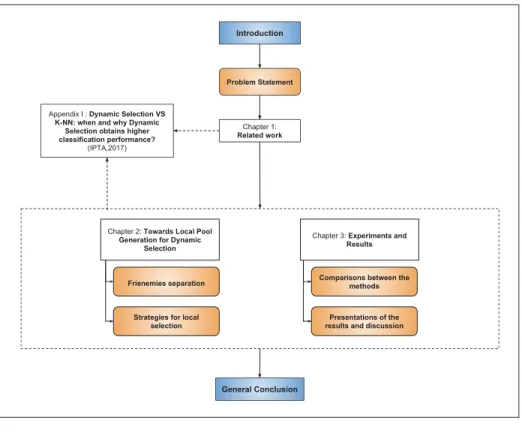
This document is organized as shows the figure 0.2: chapter one presents the related work about Dynamic Selection and Ensemble generation methods. The second chapter describes the proposed system heading towards local pool generation for Dynamic Selection, we presented in the orange boxes the titles of the most important aspects of the chapters. We expose in chapter three, the experimental protocol, as well as the results, the comparison to the state of the art and their discussion. The related work and the other chapters are linked with a dashed line to Appendix I, representing a conference paper that performs an analysis of the performances of the Dynamic Selection scheme and the K-NN classifier. This is a complementary reading that supports our research direction. Finally, we conclude by summarizing this study and give recommendations for future work.
,QWURGXFWLRQ 3UREOHP6WDWHPHQW &KDSWHU 5HODWHGZRUN $SSHQGL[,'\QDPLF6HOHFWLRQ96 .11ZKHQDQGZK\'\QDPLF 6HOHFWLRQREWDLQVKLJKHU FODVVLILFDWLRQSHUIRUPDQFH" ,37$ &KDSWHU7RZDUGV/RFDO3RRO *HQHUDWLRQIRU'\QDPLF 6HOHFWLRQ &KDSWHU([SHULPHQWVDQG 5HVXOWV )ULHQHPLHVVHSDUDWLRQ 6WUDWHJLHVIRUORFDO
VHOHFWLRQ UHVXOWVDQGGLVFXVVLRQ3UHVHQWDWLRQVRIWKH &RPSDULVRQVEHWZHHQWKH
PHWKRGV
*HQHUDO&RQFOXVLRQ
CHAPTER 1
RELATED WORK
This chapter regroups the literature review concerning the Oracle as an important concept in the Multiple Classifiers Systems. It then presents the Dynamic selection scheme and the En-semble generation methods. It also contains complementary sections that narrows down the understanding of the problem and introduces the motivations of the solutions proposed in the next chapter.
1.1 The Oracle
In the process of the ideal selection of classifiers, the concept of the Oracle is defined as an ab-stract function that always chooses the classifier that predicts the correct label for each instance (Kuncheva, 2002, 2004b; Cruzet al., 2018), if there exists such a classifier. That is to say, it represents the ideal classifier selection scheme. For a given dataset, the classifierci gives an output vectoryj (Kuncheva, 2004b) so that :
yi,j= ⎧ ⎪ ⎨ ⎪ ⎩ 1 0
if classifiercicorrectly classifiesxj otherwise
(1.1)
In the area of Multiple Classifiers Systems, the concept of the Oracle is exploited at different stages. It is used to the construction of diverse pools (Kuncheva, 2004b). Diversity is agreed that it measures how complementary the classifiers are in terms of making different mistakes in the features space (Kuncheva, 2004b). Kuncheva (Kuncheva, 2004b) states the following concerning the diversity concept: ’If we have a perfect classifier which makes no errors, then we do not need an ensemble. However,if the classifier does make errors, then we seek to com-plement it with another classifier which makes errors on different objects. The diversity of the classifier outputs is therefore a vital requirement for the success of the ensemble’. Moreover, empirical results showed that there exists a positive correlation between accuracy of the
en-8
semble and diversity among the base classifiers, which leads to a high accuracy of the Oracle when the diversity rate is high (Kuncheva, 2004b; Shipp & Kuncheva, 2002; Tanget al., 2006). On the other hand, in the context of the Dynamic Selection literature, the Oracle is used to determine whether the results obtained by dynamic selection techniques is close to the ideal accuracy (Cruz et al., 2018; Souza et al., 2017; Giacinto & Roli, 2001). In other words, it acts as an upper bound for DS techniques performances for a given pool of classifiers. It also contributes in the elaboration of many ensemble generation methods (Souzaet al., 2017; Dos Santos et al., 2008; Santos & Sabourin, 2011; Kuncheva & Rodriguez, 2007) as well as Dynamic selection techniques and frameworks (Cruz, 2016; Koet al., 2008; Oliveira, 2018). Given the quick introduction about the Oracle as an important element in the context of MCS, the next sections present the Dynamic Selection concept followed by the Ensemble genera-tion scheme as a solid background to support the research quesgenera-tion concerning the creagenera-tion of locally competent classifiers for Dynamic Selection.
1.1.1 Dynamic Selection
In the context of MCS, the selection of classifiers can be either static or dynamic (Brittoet al., 2014; Cruzet al., 2018). The former considers a subset of base classifiers for all the test patterns whereas the latter assumes that each classifier is an expert in a specific region of the features space (Brittoet al., 2014; Cruz et al., 2015b; Cruz, 2016; Cruzet al., 2018). Therefore, each query instance is classified by a single classifier or an ensemble of classifiers. Empirical studies showed that Dynamic Selection (DS) is well suited for ill defined problems, i.e., for small sized datasets and when there is insufficient training data (Brittoet al., 2014; Cruzet al., 2015b; Cruz, 2016; Cruzet al., 2018). Moreover, several research projects have been focusing on Dynamic Selection, which can be applied in several domains such as : music genre classification, credit scoring, face recognition, signature verification, bug predictions and many more (Cruz et al., 2018).
9
Based on a pool of supposedly diverse classifiersC={c1,...,cM},dynamic selection consists on finding the most competent classifier or ensemble of classifiersC⊂C to predict the class label for each test samplexq(Kuncheva, 2004b). In Dynamic Selection, the classification of a new test samples unfolds the following steps:
1. The definition of a local region in which the selection will operate called, Region of Com-petence (RoC).
2. The selection criterion used to estimated the competence of the base classifiers.
3. The selection scheme. Dynamic selection techniques can be divided into two categories:
Dynamic Classifier Selection (DCS) or Dynamic Ensemble Selection (DES). In dynamic classifier selection, a single classifier is selected for each test sample whereas in dynamic ensemble selection, a subset of competent classifiers is selected for each test pattern.
Figure 1.1 shows a diagram of the Taxonomy of DS adapted from (Cruz et al., 2018). It
shows the different processes of Dynamic Selection, enumerating the region of competence definition, the selection criteria (individual-based and group-based measures of competence) and the Selection Approach.
'\QDPLF6HOHFWLRQ'6
'\QDPLF&ODVVLILHU
6HOHFWLRQ'&6 '\QDPLF(QVHPEOH6HOHFWLRQ'(6 .11 &OXVWHULQJ 3RWHQWLDO IXQFWLRQ $FFXUDF\ 5DQN 2UDFOH 2 3UREDELOLVWLF %HKDYLRU &RPSOH[LW\
0HWDOHDUQLQJ 'DWD $PELJXLW\$ 'LYHUVLW\ +DQGOLQJ
IX 'HFLVLRQ
VSDFH 5HJLRQRI
&RPSHWHQFHGHILQLWLRQ 6HOHFWLRQ&ULWHULD 6HOHFWLRQDSSURDFK
,QGLYLGXDO *URXS
Figure 1.1 Taxonomy of the Dynamic Selection Scheme
10
Figure 1.2 shows a basic dynamic classifier selection system differentiating between the Dy-namic Classifiers Selection (DCS) and DyDy-namic Ensemble Selection (DES). Indeed, the prior uses only one classifier defined as the most competent one to identify the test sample whereas the latter uses an ensemble of competent classifier for the recognition task (Brittoet al., 2014; Cruzet al., 2018).
In this section, we address the different concepts used in the elaboration of the Dynamic Se-lection systems, we will first give a definition of the local regions where the decisions of the system occurs. Then, we expose the measures of competence evaluated for the DS techniques and introduce them in the same subsection. Furthermore, we exhibit complementary informa-tion about the behavior of the DS scheme in certain situainforma-tions to provide a broad motivainforma-tion to our research question.
'\QDPLF&ODVVLILHU6HOHFWLRQ'&6
'\QDPLF(QVHPEOH6HOHFWLRQ'(6
Figure 1.2 Classical Dynamic Selection System showing the
difference between the Dynamic Classifier Selection (DCS) and
Dynamic Ensemble Selection (DES) adapted from (Cruzet al.,
11
1.1.2 Region of Competence definition
The Region of Competence in the Dynamic Selection scheme represents the local region of the features space that encloses the queryxq, it is also where the competence of the classifiers is estimated to recognize xq. The DS techniques are very sensitive to the definition of the Region of Competence that is composed of labeled samples usually from the validation set that is called the Dynamic Selection Dataset(DSEL)(Cruzet al., 2018). The local region for several DS techniques is defined using the K-Nearest Neighbors rule, a clustering technique, a potential function, or a decision space scheme and strongly depends on the distribution of DSEL (Cruzet al., 2018; Didaci & Giacinto, 2004; Cruzet al., 2015a).
Clustering
To set the region of competence, the clusters are defined in DSEL by one of the clustering
techniques such as the K-Means algorithm (Kaufman & Rousseeuw, 2009). Then, for all the clusters, we estimate the local competence of each base classifier (Cruzet al., 2018). During the testing phase, given a new query sample,xq, we calculate the distance between this example and the centroid of each cluster. The competence of the classifiers is accessed according to the examples that belong to the closest cluster (Cruzet al., 2018).
K-Nearest Neighbors
The K-Nearest Neighbor approach is conducted within DSEL for estimating the K nearest
neighbors for a test query xq. The region of competenceθ is then defined and the decisions
taken by the DS corresponding DS techniques are based on the elements of θ (Cruz et al.,
2018).
Potential Function
The particularity of the methods based on the potential functions model resides in the use of
12
et al., 2018). Each samplexi∈DSELis weighted using its Euclidean distance (d) to the query xqusing usually, a Gaussian potential function modelK(Equation 1.3) (Cruzet al., 2018). The function gives the highest weights to samples nearest to the test sample, and lowest weights to samples distant from the test sample. As a consequence, the data points that are the closest to xqhave a higher impact on the classifiers’ competence estimation(Cruzet al., 2018).
K(xi,xquery) =exp(−d(xi,xquery)2) (1.2)
Decision Space
This category focuses on the behavior of the classifiers and the use of their predictions as in-formation sources. The estimation of the region of competence is conducted using the de-cision spaces instead of the features space inspired by Behavior Knowledge Space (BKS) (Huang & Suen, 1995). This approach transforms the test sample xq and DSEL into output profiles; which are vectors composed of predictions of the base classifiers in the pool either using the hard decisions (Huang & Suen, 1995) or exploiting the estimated posterior proba-bilities of the classifiers, as stated in (Cavalinet al., 2013, 2012; Batistaet al., 2011; Oliveira, 2018; Cruzet al., 2018). The selection of the samples that compose the region of competence is given by the points inDSELwith the most similar output profiles to the output profile ofxq.
1.1.3 Measures of competence and Dynamic Selection techniques
Classifier competence defines how much we trust an expert given a classification task (Cruz et al., 2018; Brittoet al., 2014). The level of competence of each base classifier is measured taking into account each new test instance, and only the classifiers that reach a certain level of competence for the current test instance are selected to compose the ensemble (DES) or the classifier (DCS). On the other hand, it is necessary to define the criterion to measure the level of competence of each classifier. For dynamic selection techniques, the search criterion is locally applied to fit each test pattern (Cruzet al., 2018).
13
There are two types of dynamic selection criteria, individual-based level of competences known as: Ranking, Local Accuracy, Oracle, Probabilistic, Behavior and group-based: Diversity, Am-biguity and Data handling (Britto et al., 2014; Cruz et al., 2015b; Cruz, 2016; Cruz et al., 2018).
For the definitions,θxq ={x1,...,xk}represents patterns belonging to the region of competence
of the unseen samplexq,K is the size of the RoC,ci is the base classifier from the poolC,wk is the class attribute ofxk andδi,qis the level of competence of the classifierci for classifying the instancexq.
1.1.3.1 Individual-based measures of competence
Ranking
Several Dynamic Selection techniques have been developed according to this taxonomy. For the individual-based measures,Classifier Rank(Sabourinet al., 1993; Cruzet al., 2018; Britto et al., 2014) is considered as one of the first proposed approaches to estimate the base classi-fiers’ competence level in DS. The ranking of a classifierci is found by counting the number of consecutive correctly classified samples (Cruz et al., 2018). The classifier that correctly classifies the most consecutive samples coming from the region of competence is considered to have the highest competence level (Cruz, 2016).
Accuracy
Overall local accuracy (OLA)estimates each individual classifier’s accuracy in local regions of the feature space surrounding a test sample, and then uses the decision of the most locally accurate classifier (Woods et al., 1997; Britto et al., 2014; Cruz et al., 2018). The level of competenceδi,q of a base classifierci is computed as the percentage of samples in the region
14
of competence that are correctly classified.
δi,q= 1 K K
∑
k=1 P(wl|xk∈wl,ci) (1.3)Local class accuracy (LCA)is similar toOLA, the only difference being that the local accu-racy is estimated in respect of output classes wl (wl is the class assigned to the query by ci) (Woodset al., 1997; Brittoet al., 2014; Cruzet al., 2018) for the whole region of competence.
δi,q= ∑xk∈wl
P(wl|xk,ci)
∑K
k=1 P(wl|xk,ci)
(1.4)
Modified local Accuracy (MLA)works similarly to theLCAtechnique, with the only differ-ence being that each instance in the region of competdiffer-ence is weighted by its Euclidean distance Wk to the query instance. That way, instances from the region of competence that are closer to the test sample have a higher influence when computing the performance of the base classifier (Smits, 2002; Brittoet al., 2014; Cruzet al., 2018).
δi,q= K
∑
k=1 P(wl|xk∈wl,ci)Wk (1.5) ProbabilisticIn theprobabilistic measures, two methods:A prioriandA posterioriare “evolved” versions ofOLA. The prior selects a single classifier from the pool based on a local region defined by the K-nearest neighbors of the test pattern in the training set during the testing phase without considering the class assigned to the unknown pattern (Britto et al., 2014; Giacinto & Roli, 1999; Cruzet al., 2018). This measure of classifier accuracy is calculated as the class posterior probability of the classifiercj on the neighborhood of the unknown sample.
δi,q= ∑ K k=1P(wl|xk∈wl,ci)Wk ∑K k=1Wk (1.6)
15
Similarly, the latter estimates local accuracies using the class posterior probabilities and the distances of the samples in the defined local region (Brittoet al., 2014; Giacinto & Roli, 1999; Cruzet al., 2018). δi,q= ∑xk∈ωl P(wl|xk∈wk,ci)Wk ∑K k=1P(wl|xk∈wk,ci)Wk (1.7) Behavior
Giancinto and Roli(Giacinto & Roli, 2001) proposed theMultiple Classifier Behavior (MCB) algorithm that is a mixture of the Dynamic Classifier Selection Local Accuracy with the behavior-knowledge space(BKS)(Huang & Suen, 1995). It is based on a similarity function that mea-sures the proportion of similarities between all the output profiles of the classifiers (Huang & Suen, 1995; Cruzet al., 2018; Brittoet al., 2014). The method defines the region of competenceθxq
using the K-NN method. The similarity function acts as a behavioral similarity detector that preselects fromθxq from which the classifiers showed similar behavior to the one observed for
the unknown pattern xq (Britto et al., 2014).The rest of the instances are exploited to select the most accurate classifier by using the OLA. At last, based on a predefined threshold, if the selected classifier outperforms the others in the pool; it is used to classify the unknown sample, if not, all the classifiers in the pool will perform the classification ofxq(Oliveira, 2018; Cruz et al., 2018; Brittoet al., 2014).
The similarity function is built as follows:
similarity(A,B) = 1
M×
∑
j=1MT(Aj,Bj) (1.8)whereAandBare vectors,M is the size of the vectorsAandB, andT is theXNORfunction (1 whenAj=Bj , otherwise 0).
16
Oracle
Ko et al. (Koet al., 2008) passed from Dynamic Classifier Selection(DCS)to Dynamic
Ensem-ble Selection (DES)by developing the concept of the K-nearest-Oracles (KNORA), which
is close to the concepts of OLA, LCA, the A Priori and A Posteriori methods in their consid-eration of the neighborhood of test patterns, but it can be distinguished from the others by the direct use of the oracle property of having training samples in the region of competence with which to find the most suitable ensemble for a given query (Koet al., 2008). For any test data point,KNORAsimply finds its nearest K neighbors inDSEL, assess which classifiers correctly classify those neighbors and uses them as the ensemble for classifying the given pattern in that test set(Koet al., 2008). KNORAhas different designs, we can state the following ones:
KNORA-ELIMINATE (KNORA-E) The KNORA-Eliminate approach exploits the
con-cept of the Oracle (Ko et al., 2008) which is the upper limit of a classifiers ensemble. For a region of competenceθqof a given queryxqinDSEL, sole the classifiers that correctly classify all the neighborhood samples (achieving a 100% accuracy, hence, operating as "local oracles") are selected(Ko et al., 2008) to build the ensemble. The selected base classifiers’ decision is combined using majority voting. In the case where, there exists no classifiers that perfectly classify all the neighborhood samples, the method reduces the size of θq by eliminating the samples that are most distant from thexquntil at least one classifier is chosen.
KNORA-E has another alternative called "KNORA-E-W" which is a weighted version of the original KNORA-E, according to the Euclidean distance between the samples in DSEL and the test query (Koet al., 2008).
KNORA-UNION (KNORA-U) In this scheme, KNORA-UNION operates by selecting all
17
The method grants a vote to each classifier ci that correctly classifies one sample from the neighborhood θq. This means that the base classifier ci could have more than one vote if it correctly classifies more than one sample. Therefore, the votes gathered by all the classifiers are aggregated using a majority voting rule to obtain the ensemble decision (Koet al., 2008). KNORA-U has another alternative called "KNORA-U-W" which is a weighted version of the original KNORA-E, according to the Euclidean distance between the samples in DSEL and the test query (Koet al., 2008).
Note
Recently, Oliveirael al. (Oliveira et al., 2018) proposed two new variants of the KNORA-E DES technique scheme. KNORA-B, B stands for borderline is a DES technique-based adapted from KNORA-E. It actually diminishes from the the region of competence but keeps at least one sample from each class that is in the original region of competence as opposed to the Original KNORA-E. KNORA-BI is a spin off of KNORA-B where I stands for imbalance datasets, which reduces the region of competence by only removing samples belonging to the majority class, leaving the minority untouched.
Meta Learning
Last but not least, META-DESis a recent dynamic selection framework using meta-learning
(Cruz et al., 2015a). Cruz et al. proposed five sets of meta-features to measure the level of competence of a classifier for the classification of input samples (Cruz et al., 2015a). The meta-features are used to train a meta-classifier to predict whether or not a classifier is com-petent enough to classify an input instance. On the other hand, Cruzet al., have proposed an
improvement variant to theMETA-DESframework calledMETA-DES.Oracle, presented in
(Cruz et al., 2018; Cruz, 2016) which applies a meta-feature selection scheme using Binary Particle Swarm Optimization (BPSO) to optimize the performance of the meta-classifier.
18
1.1.3.2 Group-based measures of competence
Group-basedmethods work by estimating the competence level of a whole ensemble of clas-sifiers rather than each classifier individually.
Diversity
Diversity in the context of dynamic selection has been used by some authors as a post-processing means of improving classification performance after an ensemble is selected. Sev-eral metrics for measuring diversity in an EoC have been proposed (Cruz, 2016). Of all diver-sity measures, the Double-Fault (Shipp & Kuncheva, 2002) measure received a lot of interest as it presents a higher correlation with the majority voting accuracy (Shipp & Kuncheva, 2002) when compared to other diversity measures.
Ambiguity
The second group-based measure isAmbiguityin Dynamic Selection, there are several ways
of measuring the ambiguity. As for Ambiguity-guided dynamic selection(ADS), it is measured by the number of classifiers that disagree with the result of the majority vote over the ensemble (Cruzet al., 2018; Brittoet al., 2014), the most competent ensemble is the one that produces the lowest ambiguity value.
Data handling
Data handlingis an interesting adaptive ensemble selection approach based on data handling theory (GDMH, family of inductive algorithms for computer-based mathematical modeling of multi-parametric datasets that features fully automatic structural and parametric optimization of models (Ivakhnenko, 1970) ) and complexity models was proposed in (Xiao & He, 2009). The system is based on a multivariate analysis theory for modeling complexity systems pre-sented in (Ivakhnenko, 1970). Given a new test samplexj, several ensemble configurations are
19
evaluated using the GMDH. Then, the ensemble with optimal complexity is selected (Cruz, 2016).
Summary of the previously presented DS techniques
Table 1.1 is a brief summary holding the Dynamic Selection techniques, the way the region of competence is defined, their selection criteria and the authors who elaborated these methods organized in a chronological order. The next subsections provide a complementary discussion about some particularities of the DS scheme that are useful for the elaboration of our proposed system.
Table 1.1 A summary of the the Dynamic Selection
techniques and their characteristics in a chronological order inspired from (Cruzet al., 2018)
Technique RoC definition Selection criteria Selection approach Reference Year Classifier Rank (DCS-Rank) K-NN Ranking DCS Sabourin et al. (Sabourinet al., 1993) 1993
Overall Local Accuracy (OLA) K-NN Accuracy DCS Woods et al. (Woodset al., 1997) 1997
Local class Accuracy (LCA) K-NN Accuracy DCS Woods et al. (Woodset al., 1997) 1997
Apriori K-NN Probabilistic DCS Giacinto et al. (Giacinto & Roli, 1999) 1999
Aposteriori K-NN Probabilistic DCS Giacinto et al.(Giacinto & Roli, 1999) 1999
Multiple Classifier Behavior (MCB) K-NN Behavior DCS Giacinto et al. (Giacinto & Roli, 2001) 2001
Modified Local Accuracy (MLA) K-NN Accuracy DCS P.C. Smits (Smits, 2002) 2002
K-Nearest Oracles Eliminate (KNORA-E) K-NN Oracle DES Ko et al. (Koet al., 2008) 2008
K-Nearest Oracles Union (KNORA-U) K-NN Oracle DES Ko et al. (Koet al., 2008) 2008
META-DES K-NN Meta-Learning DES Cruz et al. (Cruzet al., 2015a) 2015
META-DES.Oracle K-NN Meta-Learning DES Cruz et al. (Cruz, 2016) 2016
K-Nearest Oracles Borderline (KNORA-B) K-NN Oracle DES Oliveira et al. (Oliveiraet al., 2018) 2018
20
1.1.4 Dynamic Selection Versus K-NN
For most DS techniques, the competence of the base classifiers are heavily dependent on the K-Nearest Neighbors for the definition of the local regions (Cruz et al., 2017). Therefore, one question arose: why do we use dynamic selection instead of simply applying the K-NN classifier?
In order to answer that question,Cruz et al.performed an analysis comparing the classification results of DS techniques and the K-NN classifier under different conditions (Appendix I). Ex-periments were conducted on 18 state-of-the-art DS techniques over 30 classification datasets and results showed that DS methods present a significant boost in classification accuracy even
though they use the same neighborhood as the K-NN (Cruzet al., 2017). The reasons behind
the out-performance of DS techniques over the K-NN classifier reside in the fact that DS tech-niques can deal with samples with a high degree of instance hardness (samples that are located close to the decision border) as opposed to the K-NN (Cruzet al., 2017).1
The conclusion of this work gave a new perspective to the dynamic selection scheme. Indeed, for future work dealing with dynamic selection, they suggest a system that operates in two phases: first, the hardness of a test instance is calculated, then based on the results, the system could select whether using K-NN or applying a DS technique for classification (Cruz et al., 2017). The reason behind such a choice is that, DS scheme would be only used to classify samples associated with a high degree of instance hardness i.e. borderline samples, while K−NNwould be used for classifying samples with a low degree of instance hardness i.e. safe samples (Cruzet al., 2017). Therefore, we take this suggestion into account while building our pool generation method.
1 This work was presented in the International Conference on Image Processing Theory and
21
1.1.5 Dynamic Selection in the indecision Regions
As stated above, Dynamic Selection techniques are sensitive to the definition of the region of competence, as well as the measures of competence. In a recent paper, Oliveiraet al.(Oliveira et al., 2017) raised the following issue in this context: DS techniques have difficulties evalu-ating the competence of classifiers when a test sample is located in an ’indecision region’, a region composed of samples from different classes. DS techniques may select classifiers with decision boundaries that do not cross the region of competence and thus, assign all the samples to one class which does not reflect the representation of the RoC. Oliveira et al. (Oliveiraet al., 2017) advances that: "an ideal classifier would be the one that crosses the region of competence and correctly distinguish between the samples from the different classes."
Therefore, they designed a framework called "Frienemy Indecision Region Dynamic Ensemble Selection" for two-class problems (FIRE-DES). The method allows to detect if a test sample is located in an indecision region and, if so, prunes the pool of classifiers, pre-selecting classi-fiers with decision boundaries crossing the region of competence of the query sample (if such classifiers exist). After that, uses a DS technique from the set of pre-selected classifiers. The next section discusses the usual ensemble generations methods used for the Dynamic Se-lection scheme. One method in particular is described in more detailed since a part of it is used in the construction of our system. A general discussion of the chapter is provided in section 1.4 before heading to the proposed system.
22
1.2 Ensemble Generation methods
1.2.1 The wisdom of crowds
“Can a collection of weak classifiers create a single strong one?" is a frequently asked question in Ensemble learning indeed. Surowiecki replies, that under certain controlled conditions, the aggregation of information from several sources, results in decisions that are often superior to those that could have been made by any single individual— (Rokach, 2010; Surowieckiet al., 2007). According to Surowiecki, in order to be wise, the crowd should adhere to the following criteria (Rokach, 2010; Surowieckiet al., 2007):
- Diversity of opinion: Each member should have private information even if it is just an eccentric interpretation of the known facts.
- Independence: Members’ opinions are not determined by the opinions of those around them.
- Decentralization: Members are able to specialize and draw conclusions based on local knowledge.
- Aggregation: Some mechanism exists for turning private judgments into a collective deci-sion.
Ensemble methods have proven their worth through the years, the generation of base classi-fiers is the first step into building an ensemble. Therefore, this section explores the classical techniques and the newest techniques of generation methods, then comes a discussion part introducing our contribution in optimizing the pool generation.
23
1.2.2 Bagging
Proposed by Breiman (Breiman, 1996), Bagging is an acronym for ’Bootstrap AGGregat-ING’. It incorporates the advantages of Bootstrapping approaches (Efron & Tibshirani, 1993; Skurichina & Duin, 2002) and aggregating concepts by generating multiple versions of a clas-sifier and using these versions to get an aggregated predictor(Breiman, 1996). The idea of the method is simple and buildsnreplicate training datasets by randomly sampling, with replace-ment, from the original training dataset. Since the sampling is conducted with replacereplace-ment, some of the original instances appear more than once while some other original examples are not in the sample (Zhou, 2012). Because of such a property, some samples are similar because they are coming from the same original sample, but in the meantime, they are a bit different due to chance (Kaufman & Rousseeuw, 2009; Alpaydin, 2014). Thus, each replicated dataset is used to train one classifier member. The classifiers outputs are then combined via an appropri-ate fusion function. It is expected that 63.2% of the original training samples will be included in each replicate (Dos Santoset al., 2008). Hence, the classifiers make different mistakes in the features space and then they are diverse.
Recently, (Walmsleyet al., 2018) proposed a version of Bagging modifying its bootstrapping process. It is in which the probability of an instance being selected during the re-sampling process is inversely proportional to its instance hardness (Smith et al., 2014). The methods joins several data complexity measures and ensemble methods to improve the accuracy rate of the systems suffering from noisy data without sacrificing the samples located on the class boundaries .
1.2.3 Random Subspaces Method
The Random Subspaces Method (RSM) (Barandiaran, 1998) is considered to be a feature sub-set selection approach. It works by randomly choosingN different features from the training dataset obtaining N-dimensional random subspaces (Skurichina & Duin, 2002) from the orig-inal features space. Each random subspace is used to train one individual classifier. The N
24
classifiers are usually combined by the majority voting rule. The advantages of using random subspace in the generation and combination of the classifier is appreciated when the number of training samples is small in comparison with the data dimensionality (Skurichina & Duin, 2002). The subspace dimensionality is smaller than the original features space while the number of training samples remains intact. It is useful when there are several redundant fea-tures, we may obtain better classifiers in random subspaces than in the original features space (Skurichina & Duin, 2002) which would be reflected on the quality of the classification in favor the random subspaces.
1.2.4 Boosting
There exists many variants of Boosting. We use AdaBoost (Adaptive Boosting) method in gen-erating ensembles. Proposed by (Freundet al., 1996), Adaboost is an iterative algorithm that combines classifiers having poor performance to get a better decision rule (Skurichina & Duin, 2002). The method assigns weights to each example contained in the training dataset and gen-erates classifiers sequentially as opposed to Bagging which opgen-erates randomly and in a parallel way when sampling its training sets and constructing its classifiers. At each iteration, Boost-ing adjusts the weights of the miss-classified trainBoost-ing samples by previous classifiers. Thus, the samples considered by previous classifiers as difficult for classification, will have higher chances to be put together, to form the training set for future classifiers (Freundet al., 1996; Skurichina & Duin, 2002).
The final ensemble composed of all classifiers generated at each iteration is usually combined by majority voting or weighted voting (Dos Santos et al., 2008; Skurichina & Duin, 2002; Freundet al., 1996).
1.2.5 Oracle-based generation method
The consideration of the Oracle is a key issue in comparing between different techniques of dynamic selection. The Oracle is defined as an abstract function that always selects the
classi-25
fier that predicts the correct label, for each instance, if such a classifier exists. In other words, it represents the ideal classifier selection scheme (Cruz, 2016). Its consideration is also present for the elaboration of several methods in MCS. However, several dynamic selection techniques produce a large difference of performances compared to the Oracle. This explains that, for a certain number of instances, the DS techniques are not able to select a competent or a set of competent classifiers despite the Oracles assurance of its presence in the pool. Therefore, Souza et al. tried to investigate in (Souza et al., 2017) the reasons why the Oracle may not always be the best indicator in the search for a promising pool of classifiers for DS techniques. Souza et al. proposed a new method of generating a pool called "Self-generating Hyperplanes (SGH)’ that guarantees an Oracle accuracy rate of 100% in the training set. It is an incremental ensemble generation method which generates binary classifiers by placing hyperplanes in the feature space until at least one classifier correctly classifies each training instance in the pool. This method is faster than classical ensemble methods, since the classifiers are not trained, and it can find the pool size automatically according to the training data (Souzaet al., 2017). We provide its pseudo-code due to the fact that we used certain parts of the method that we modified in the creation of our classifiers, for instance the modified version will rely on lines 11, 12 and 13 from Algorithm 1.1.
The experiments of this work demonstrated that integrating Oracle information in the genera-tion phase of an MCS has little impact on the gap between the accuracy rates of DS techniques and the Oracle (Souzaet al., 2017). Furthermore, for a theoretical limit of 100%, the DS tech-niques were only able to select a competent classifier for at most 85% of the instances, on
average (Souzaet al., 2017). DCS techniques show struggles in choosing the most
“compe-tent” classifier, despite the existence for at least one for sure in the pool (trivially, the one that was created for that particular instance during the generation phase). The reason for this is that, the Oracle model relies on the global information confirming the existence of an adequate classifier for the task; whereas DCS techniques use only local data, as the local measures of competence and the K nearest neighbors to select the best classifier.
26
Algorithm 1.1 Self-generating Hyperplane Method (SGH), from (Souzaet al., 2017)
1 Γ← {z1,z2,...,zN}{Training dataset} 2 C← {c1,c2,...,c|C|}{Problem classes}
3 Pool ← {}
4 whileΓ={}do 5 for j←1,|C|do
6 R(j)←centroid(cj){Centroid of class j}
7 end
8 d←max(pairwiseDistance(R)){Maximum distance between centroids} 9 a,b← f indIndex(d)
10 midPoint←(R(a) +R(b))/2 11 normal←(R(a)−R(b))/d
12 wp← {normal}{perceptron p weights} 13 θp← −midPoint·normal {perceptron p bias} 14 p←perceptron(wp,θp)
15 fori←1,N do
16 iftest(p,zi) =label(zi)then
17 then {Perceptron p classifies instance i correctly}
18 Γ←Γ− {zi}{Excludes instanceifrom dataset}
19 end
20 end
21 Pool ←Pool∪ {p}{Add Perceptron pto the Pool} 22 end while
23 returnPool
Therefore, (Souzaet al., 2017) conclude that despite its use in the literature for such a task, the Oracle model is not the best guide in the search for a promising pool for DCS techniques, for the model is performed globally whilst DS techniques work with local data only (Souzaet al., 2017).
1.3 Summary, discussion and a brief introduction to the proposed system
The Oracle concept is an important element in the elaboration of Multiple Classifiers Systems. It contributes to both Ensemble generation and the classifiers selection. For DCS, it is con-sidered as an upper theoretical limit for classification and usually determines the efficiency
27
the Oracle was used in the elaboration of several Dynamic Selection methods and was stud-ied to investigate its characterization for DCS techniques (Souza et al., 2017). Although its well reputation, it was found that its aspect of spotting the ideal classifier, operates on a global level as opposed to the local treatment of instances provided the DS techniques. Therefore, the Oracle was labeled as being not the best guide for generating a pool of classifiers for DCS (Souzaet al., 2017). This conclusion played an important role into bringing more motivational elements to our research question that aims to generate classifiers adapted to the context of dynamic selection focusing on the consideration of local information.
This being stated, the related work presented first, a general overview of the dynamic selection scheme by presenting the DS techniques and auxiliary information that aligns with the prob-lematic of this thesis. Moreover, we introduced the different pool generation methods that exist and here we are narrowing down the research proposal.
The difference between the DS techniques reside in their definition of the Region of Com-petence, their selection criteria and the selection approach. The Selection criteria in the DS scheme is composed of two philosophies of considering the competence by different measures. In these individual-based measures of competence, the reliability of each base classifier is mea-sured independently from the performance of the rest of the classifiers in the pool (Cruzet al., 2018). These methods are full dependent on the methods that defined the region of competence such as the K-NN. Moreover, the distribution ofDSELhas an important impact on the perfor-mance of the system. Group-based measures of competence on the other hand, focus on how the base classifier behaves along with the other classifiers in the pool (Cruzet al., 2018) and therefore relate to the concept of relevance as opposed to the individual-based measures where they rely on the competence of the individual classifiers (Cruzet al., 2018) .
Despite the variety of the DS techniques and the different components of this classification scheme, no algorithm is better than any other over all possible classes of problems (the “No Free Lunch” theorem (Corne & Knowles, 2003)). Thus, given the overview of the different research works conducted in the area of MCS, and the recent findings on the question of the
28
locality of the classifiers; we believe we have satisfying elements and motivations to focus to-wards proposing a new pool of classifiers generation that is suitable for the Dynamic Selection Scheme. The proposed framework is provided in the next chapter with all the basics concepts that need to be known before a complete immersion into the method.
CHAPTER 2
TOWARDS LOCAL POOL GENERATION FOR DYNAMIC SELECTION The present chapter exposes the proposed system. The first section introduces the concepts needed in the elaboration of the method to generate locally competent classifiers. The rest of the sections are divided between an overview of the method, the step by step description and illustrative examples of the different strategies used to answer the research question. A case study on a synthetic problem is also provided.
2.1 Basic concepts
To begin our discussion, we believe it is necessary to present the following illustrative basics concepts that we would refer to throughout the chapter.
2.1.1 Region of Competence in the context of this study
The Region of Competence for several DS techniques is defined using theK−NN, and strongly depends on the distribution of DSEL (Cruz et al., 2018; Didaci & Giacinto, 2004). For our
proposed system, the definition of the RoC is covered by theK−NN and the value ofK =7
since it presented the best results for several DS techniques according to (Cruz et al., 2011, 2018)
2.1.2 Indecision Region
As illustrated in Figure 2.1, a test sample is located in anindecision regionwhen its region of competence is crossed by one or more classes boundaries, that is, when its region of compe-tence has borderline samples of different classes (Oliveira et al., 2017). Therefore, correctly classifying test samples located in indecision regions is a difficult task because most miss-classifications happen in areas near classes boundaries (Oliveiraet al., 2017). In fact, the
clas-30
sification performance of classifiers is strongly affected by the number of borderline samples (Oliveiraet al., 2017).
Figure 2.1 Three type of samples: safe samples (labeled as S), borderline samples (labeled as B), and noisy samples (labeled as N). The continuous line shows the indecision region(Adapted
31
2.1.3 frienemies samples
The definition of the frienemies concept is essential to the understanding of the proposed method. Indeed, according to (Oliveira et al., 2017), two samples xa and xb are considered frienemies if : (1) they are located in the same region of competence ofxquery(2) they are from a different class. Therefore, one of our research aims is to create classifiers that distinguish be-tween them. Figure 2.2 is a representation of a region of competence with its different samples A, B, C, D, E, and F for the queryxquery. The possible pairs of samples from different classes are (A, B), (A, D), (B, C), (B, E), (B, F), (C, D), (D, E), (D, F). They are called "frenemy samples" or "frienemies" given (Oliveiraet al., 2017)).
TXHU\ TXHU\ TXHU\ 5HJLRQRI&RPSHWHQFH5R& $ % & ' ( ) *
Figure 2.2 Representation of pairs of frienemies (A, B), (A, D), (B, C), (B, E), (B, F), (B,G) (C, D), (D, E), (D, F), (B,G) in the region of competence of the query in
a black diamond shape (Adapted from (Oliveiraet al., 2017)).