Nexus: A Common Substrate for Cluster Computing
Benjamin Hindman,
Andy Konwinski,
Matei Zaharia,
Ali Ghodsi, Anthony D. Joseph, Scott Shenker, Ion Stoica
University of California, Berkeley{benh,andyk,matei,alig,adj,shenker,stoica}@cs.berkeley.edu
Abstract
Cluster computing has become mainstream, resulting in the rapid creation and adoption of diverse cluster com-puting frameworks. We believe that no single frame-work will be optimal for all applications, and that orga-nizations will instead want to runmultiple frameworks in the same cluster. Furthermore, to ease development of new frameworks, it is critical to identify common ab-stractions and modularize their architectures. To achieve these goals, we propose Nexus, a low-level substrate that provides isolation and efficient resource sharing across frameworks running on the same cluster, while giving each framework maximum control over the scheduling and execution of its jobs. Nexus fosters innovation in the cloud by letting organizations run new frameworks alongside existing ones and by letting framework devel-opers focus on specific applications rather than building one-size-fits-all frameworks.
1
Introduction
Cluster computing has become mainstream. Industry and academia are running applications ranging from finance to physics on clusters of commodity servers [6], fueled by open-source platforms like Hadoop [3] and cloud ser-vices like EC2 [1]. Driven by this wide range of applica-tions, researchers and practitioners have been developing a multitude of cluster computing frameworks. MapRe-duce [23] provided a simple, low-level programming model. Sawzall [39] and Pig [38] developed higher-level programming models on top of MapReduce. Dryad [32] provided a more general execution layer – data flow DAGs. Recently, Google announced Pregel [35], a spe-cialized framework for graph computations.
It seems clear that frameworks providing new pro-gramming models, or new implementations of existing models, will continue to emerge, and that no single framework will be optimal for all applications.
Conse-quently, organizations will want to runmultiple frame-works, choosing the best framework for each applica-tion. Furthermore, for economic reasons, organizations will want to run these frameworksin the same cluster. Sharing a cluster between frameworks increases utiliza-tion and allows the frameworks to share large data sets that may be too expensive to replicate.
To allow frameworks to share resources, developers have so far taken the approach of building frameworks on top of a common execution layer that performs shar-ing. For example, Pig turns SQL-like queries into se-ries of Hadoop jobs. Unfortunately, this approach may limit performance – for example, Pig cannot pipeline data between MapReduce stages because they are sep-arate Hadoop jobs. Other efforts have proposed more general execution layers, such as Dryad [32], on which a variety of frameworks can run. However, general execu-tion layers are more complex than specialized ones, and they still incur the risk that a new programming model cannot be expressed over the execution layer – for ex-ample, the Bulk Synchronous Processes model used in Pregel, where long-lived processes exchange messages, cannot be expressed as an acyclic data flow in Dryad.
The problem with the single execution layer approach is that a single entity is performing two tasks: isolating resourcesbetween jobs and managing executionwithin a job. We think that a far better approach, following the exokernel model [25], is to define a small resource isolat-ing kernel that is independent of any framework, and let each framework control its own internal scheduling and execution. In this paper, we propose Nexus, an isolation and resource sharing layer for clusters based on this de-sign. Nexus only places a minimal set of requirements on frameworks to enable efficient resource sharing. Be-yond that, it aims to give frameworks maximum control over their scheduling and execution.
Sharing clusters is not a new problem. Multiple cluster schedulers have been developed in the High Performance Computing (HPC) and Grid communities [42, 41, 30, 47,
19]. As a general rule, these systems ask users to submit jobs to a queue and to request a number of resources (ma-chines, cores, etc) for each job.1 Jobs are then launched when enough machines become free. While this model works well for batch-oriented HPC workloads, it faces two important challenges in the environments that frame-works like Hadoop are used in:
1. Dynamic workloads:Clusters are being used for in-teractive ad-hoc queries and time-sensitive produc-tion applicaproduc-tions in addiproduc-tion to batch jobs. For ex-ample, Facebook’s Hadoop data warehouse is used for both production jobs and arbitrary user jobs [45]. Having production jobs wait in line behind a large user job would be unacceptable, as would reserving part of the cluster for production jobs and leaving it idle when they are absent. Instead, schedulers for Hadoop [45] and Dryad [33] implement fair sharing, varying jobs’ allocations dynamically as new jobs are submitted. This is possible because Hadoop and Dryad jobs consist of small independent tasks, so the number of machines a job is running on can change during its lifetime.
2. Framework semantics: MapReduce and Dryad
achieve high performance by placing computations on the nodes that contain their input data. While some grid schedulers let jobs specify locality con-straints at the level of geographic sites, most do not let jobs control their placement at the level of nodes. The problem is that the schedulers are not aware of framework semanticsthat should be taken into ac-count in scheduling decisions.
These challenges are caused by two core problems: First, thegranularityat which existing schedulers allo-cate resources is too coarse for dynamic workloads and data sharing. Second, framework semanticsneed to be taken into account in scheduling decisions. Nexus ad-dresses these issues through two main design principles: 1. Fine-grained sharing: Nexus asks that frameworks split up their work intotasks, and makes scheduling decisions at the level of tasks. This is the only major requirement we make of frameworks. Nexus can run tasks from multiple frameworks on the same node, isolating them using various OS mechanisms. Tasks can be viewed as a form of cooperative time-sharing between frameworks.
2. Two-level scheduling: Nexus gives frameworks
choice in which resources they use through a two-level scheduling model. At the first two-level, Nexus de-cideshow many resources to give each framework based on an organizational allocation policy such as fair sharing. At the second level, frameworks
1We survey HPC and grid schedulers in Section 8.
decide which of the available resources to use and which tasks to run on each machine. This is achieved through a mechanism calledresource offers.
Although we have architected Nexus to let organiza-tions define their own allocation policies, we have also defined one policy that will be widely applicable: a gen-eralization of weighted fair sharing to multiple resources that takes into account the fact that frameworks may need different amounts of CPU, memory, and other resources.
Implications The model enabled by Nexus, where a
single platform allows multiple frameworks to run on a cluster, has wide-ranging implications for cluster com-puting. First, this modelaccelerates innovationby let-ting framework developers build specialized frameworks targeted at particular problems instead of one-size-fits-all abstractions. For example, a researcher that develops a new framework optimized for machine learning jobs can give this framework to a company that primarily uses Hadoop and have it run alongside Hadoop.
Second, the isolation that Nexus provides between frameworks is valuable even to organizations that only wish to run a single software package, e.g. Hadoop. First, Nexus allows these organizations to run multiple ver-sions of Hadoop concurrently, e.g. a stable version for production jobs and a faster but less stable version for experimental jobs. Second, organizations may wish to run one separate Hadoop instance per MapReduce job for fault isolation. The stability of the Hadoop master is a serious concern in large multi-user Hadoop clusters [12]; if the master crashes, it takes down all jobs. Nexus lets each job run its own MapReduce master, limiting the impact of crashes.2We believe that this second benefit of isolation could drive adoption of Nexus, facilitating the more important first benefit of accelerating innovation.
Finally, we are also exploring using Nexus to share resources between workloads other than data-intensive cluster computing frameworks. For example, we have developed an Apache web farm “framework” that runs multiple, load-balanced Apache servers as its tasks and changes the number of tasks it uses based on load. Shar-ing resources between front-end and back-end workloads is very attractive to web application providers that expe-rience diurnal load cycles. We have also ported MPI to run over Nexus, allowing a variety of existing scientific applications to share resources with new frameworks.
Evaluation To evaluate Nexus, we have ported two
popular cluster computing frameworks to run over it: Hadoop and MPI. To validate our hypothesis that special-ized frameworks can provide value over general ones, we have also built a new framework on top of Nexus called Spark, optimized for iterative jobs where a data set is
2The Nexus master is easier to make robust than the Hadoop master
reused across many short tasks. This pattern is common in machine learning algorithms. Spark provides a simple programming interface and can outperform Hadoop by 8x in iterative workloads. To push the boundaries of the isolation and dynamic scheduling provided by Nexus, we have implemented a load-balanced elastic Apache web server farm. Finally, we have verified that resource offers let Hadoop achieve comparable data locality running on Nexus to running alone.
Contributions Our main contributions are:
• A cluster computing architecture that separates re-source isolation into a small kernel gives frame-works control over their execution and scheduling. • A two-level scheduling model for fine-grained
shar-ing of clusters based on two abstractions: tasks and resource offers.
• A generalization of weighted fair sharing to multi-ple resources.
Outline This paper is organized as follows. Section 2 explains the environment that we have designed Nexus to run in and details its assumptions and goals. Section 3 presents the Nexus architecture. Section 4 presents our current scheduling policy – a generalization of weighted fair sharing for multiple resources. Section 5 describes our implementation of Nexus and of the frameworks we run over it. Section 6 presents experimental results. We include a discussion in Section 7, survey related work in Section 8, and conclude in Section 9.
2
Assumptions and Goals
In this section, we explain the data center environment and workload that Nexus is targeted for, the assumptions it makes, and the goals it seeks to achieve.
2.1 Workload
Our target environment for Nexus is clusters of commod-ity machines shared by multiple users for analytics work-loads. Examples include the back-end clusters at large web companies that MapReduce was developed for, re-search clusters at universities, and scientific clusters such as the Google/IBM/NSF Cluster Exploratory [11].
As an example of a workload we aim to support, con-sider the data warehouse at Facebook [4, 8]. Facebook loads logs from its production applications into a 600-node Hadoop cluster, where they are used for applica-tions such as ad targeting, spam detection, and ad-hoc business intelligence queries. The workload includes “production” jobs that directly impact customers, such as identifying spam, long-running “experimental” jobs such as tests for new spam detection algorithms, and “interac-tive” jobs where an analyst submits a query (e.g. “what fraction of Spanish users post videos”) and expects an
answer within minutes. If, at some point in time, only a single job is running in the cluster, this job should be al-located all of the resources. However, if a production job, or a job from another user, is then submitted, resources need to be given to the new job within tens of seconds.
To implement dynamic resource sharing, Facebook uses a fair scheduler within Hadoop that works at the granularity of map and reduce tasks [45]. Unfortunately, this means that the scheduler can only handle Hadoop jobs. If a user wishes to write a new spam detection al-gorithm in MPI instead of MapReduce, perhaps because MPI is more efficient for this job’s communication pat-tern, then the user must set up a separate MPI cluster and import data into it. The goal of Nexus is to enable dy-namic resource sharing, including policies such as fair sharing, betweendistinctcluster computing frameworks. 2.2 Allocation Policies
Nexus decides how many resources to allocate to each framework using a pluggableallocation module. Orga-nizations may write their own allocation modules, or use the ones we have built. Because of its use in Hadoop and Dryad schedulers [45, 5, 33], the policy we have focused on most is weighted fair sharing. One of our contribu-tions over these Hadoop and Dryad schedulers is that we allow tasks to have heterogeneous resource require-ments. We have developed a generalization of weighted fair sharing for multiple resources that we present in Sec-tion 4. No matter which allocaSec-tion policy is used, our goal is to be able to reallocate resourcesrapidlyacross frameworks when new jobs are submitted, so that jobs can start within tens of seconds of being submitted. This is necessary to support interactive and production jobs in environments like the data warehouse discussed above.
2.3 Frameworks
Organizations will use Nexus to run cluster computing frameworks such as Hadoop, Dryad and MPI. As ex-plained in the Introduction, we expect that multiple, iso-lated instances of each framework will be running.
Nexus aims to give frameworks maximum flexibility, and only imposes a small set of requirements on them to support resource sharing. Most importantly, Nexus asks frameworks to divide their work into units calledtasks. Nexus makes scheduling decisions at task boundaries – when a task from one framework finishes, its resources can be given to another framework. However, it leaves it up to the frameworks to choose which task to run on which node and which resources to use, through a mech-anism calledresource offersdescribed in Section 3.2.
To allow resources to be reallocated quickly when new frameworks join the system, Nexus expects frameworks to make their tasks short (tens of seconds to minutes in length) when possible. This is sufficiently short that in
a large cluster, there will be tens of tasks finishing per second. For example, in a 600-node cluster with 4 tasks per node and an average task length of one minute, there will be 40 tasks finishing per second, and a new frame-work could achieve a share of 10% of the cluster (i.e. 240 tasks) in 6 seconds. To encourage frameworks to use short tasks, we make tasks cheap to launch by reusing “executor” processes from the same framework between tasks, as explained in Section 3.1. Interestingly, frame-works such as Hadoop already use short tasks for fault-tolerance: First, having short tasks reduces the time it takes to recover from a failed task. Second, if a node that contains outputs from multiple tasks fails, these tasks can be re-run in parallel on the other nodes in the cluster [23]. If a new framework is not being allocated resources quickly enough because there are too many long tasks running, we also reserve the right to kill tasks from run-ning frameworks after an administrator-specified time-out. Cluster computing frameworks already need to tol-erate losing tasks due to hardware failures, so requiring them to tolerate task killing is not onerous. Frameworks with long-lived tasks, such as MPI jobs, may use check-pointing [29] to recover and scale down after tasks are killed. Alternatively, their users can ask the framework to use a smaller share of the cluster than the user’s allo-cation so that it never needs to be killed.
2.4 Summary
We detail the assumptions and goals of Nexus below. Assumptions:
1. Frameworks decompose work into tasks.If rapid reallocation of resources in response to workload changes is desired, then frameworks should either make their tasks short (seconds to minutes) or avoid exceeding their share of the cluster.
2. Frameworks tolerate losing tasks.Nexus may kill tasks to enforce scheduling policies.
3. Single administrative domain.Our current imple-mentation does not attempt to make security and pri-vacy guarantees in the case of adversarial users. 4. Allocation policies are at the level of frameworks.
In order to have frameworks map onto organiza-tional entities such as users, separate users are ex-pected to use separate framework instances. Goals:
1. Maximum flexibility for frameworks.
Frame-works should be given maximum flexibility in how they schedule and execute their tasks. Scheduling concerns that are common in data-intensive frame-works, such as data locality, should be supported. 2. Dynamic, responsive scheduling.Frameworks’
al-locations should change as new jobs are submitted,
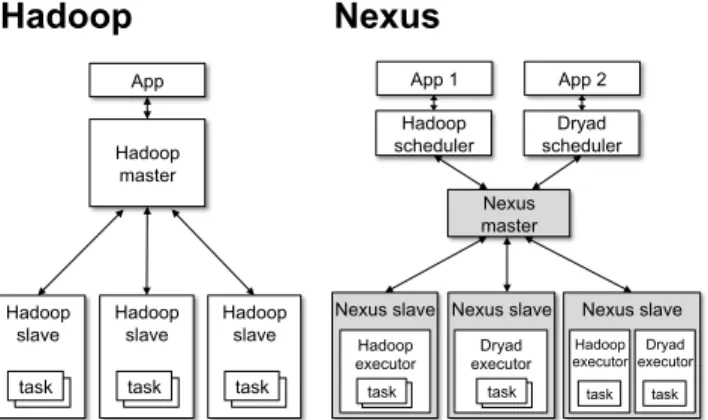
App Hadoop master Hadoop slave task task Hadoop slave task task Hadoop slave task task Nexus slave Dryad executor task task Nexus slave Dryad executor task Hadoop executor task Nexus slave Hadoop executor task task App 1 Nexus master Hadoop scheduler App 2 Dryad scheduler
Hadoop
Nexus
Figure 1: Comparing the architectures of Hadoop and Nexus. The shaded regions make up Nexus. Hadoop can run on top of Nexus, alongside Dryad.
through policies such as fair sharing, priority, etc. 3. Performance isolationfor processes from different
frameworks running on the same node. 4. Support for pluggable allocation policies. 5. Support for heterogeneous resource demands.
Different tasks, even within a framework, may need different amounts of resources (CPU, memory, etc). 6. Support for heterogeneous nodes. Cluster nodes may have different amounts of CPU, memory, etc.
3
Nexus Architecture
3.1 System Components
Nexus consists of a master process managing a num-ber of slave daemons, one on each node in a cluster. Frameworks wishing to use Nexus each register a sched-uler process with the Nexus master in order to be as-signed resources (registration also associates a user with the framework, for use by allocation policies). Resource allocation is performed through a mechanism called re-source offersthat we describe in Section 3.2, which lets frameworks pick which available resources to use. When a framework accepts resources on a particular slave, it can launch tasks to use the resources by giving Nexus an opaquetask descriptorfor each task. Each descriptor is passed to a framework-specificexecutor process that Nexus starts on the slave,3 which runs the task. The ex-ecutor is shared by all of a framework’s tasks on a given slave, allowing the framework to amortize initialization costs and to keep data cached in memory between tasks.4 An executor is free to run each task in its own thread, or
3The executor is fetched from a shared file system such as HDFS. 4If a slave accrues idle executors from too many frameworks,
to spawn any number of separate processes for each task, depending on the level of isolation it desires between its tasks. Executors from different frameworks are isolated from one another, as described in Section 3.3. Finally, as executors finish tasks, they sendstatus updatesto inform the master that resources can be re-allocated.
Nexus reports failures to frameworks but expects them to implement their own recovery mechanisms. In the event of a task failure, an executor can send a status up-date signaling the loss of the task. In the event of an executor failure, the executor and its child processes are killed and the framework’s scheduler is informed of the lost executor. Finally, in the event of a node failure, the framework’s scheduler is informed of a lost slave.
Figure 1 shows the components of Nexus and com-pares them with those of Hadoop. Many elements of Nexus—a scheduler, executors, tasks, and status updates—map closely to elements of Hadoop and other cluster computing frameworks such as Dryad. Nexus factors these elements out into a common layer, reducing the burden on framework developers and giving frame-works a common API for accessing resources so that they can share clusters. The close mapping of Nexus compo-nents to compocompo-nents of existing frameworks also makes porting frameworks to Nexus fairly straightforward. For example, our port of Hadoop reuses Hadoop’s master as a scheduler and Hadoop’s slave as an executor, and just changes the communication between them to pass through Nexus.
We note that Nexus imposes no storage or communi-cation abstractions on frameworks. We expect data to be shared through a distributed file system such as GFS [27] or Hadoop’s HDFS [3] running on each slave alongside Nexus. Tasks are free to communicate using sockets.
3.2 Resource Allocation
The main challenge with Nexus’s two-level scheduling design is ensuring that each framework gets resources that it wishes to use. For example, a Hadoop job might want to run tasks on the nodes that contain its input file, an iterative job might prefer to run tasks on nodes where it already has executors to re-use data cached in memory, and an MPI job might need 4 GB of RAM per task.
Our solution to this problem is a decentralized two-level scheduling mechanism called resource offers. At the first level, an allocation module in the master de-cides which framework to offer resources to when there are free resources in the system, following an organiza-tional policy such as fair sharing. At the second level, frameworks’ schedulers may accept or reject offers. If a framework rejects an offer, it will continue to be “below its share,” and it will therefore be offered resources first in the future when resources on new nodes become free. In detail, whenever there are free resources, Nexus
performs the following steps:
1. Allocate: The allocation module determines which framework(s) to offer the free resources to and how much to offer to each framework.
2. Offer: Frameworks are sent a list of resource of-fers. A resource offer is a(hostname, resources)pair, where “resources” is a vector containing the number of free CPU cores, GB of RAM, and potentially other resources on a given machine.
3. Accept/Reject: Frameworks respond to offers with a possibly empty list of(task descriptor, hostname, resources)tuples. A framework is free to claim as many total resources on a machine as were in the of-fer and to divide these between several tasks. A few more details are needed to complete the model. First, frameworks will often always reject certain re-source offers. To short-circuit the rejection process, frameworks can providefiltersto the master. Two types of filters we support are “only offer machines from list L” and “only offer machines with at leastR resources free”. A filter may last indefinitely, or get decommis-sioned after a framework-specified timeout. A frame-work may also choose to update its filters at any time. By default, any resources rejected during an offer have a temporary 1-second filter placed on them, to minimize the programming burden on framework developers who do not wish to constantly update their filters.
Second, to accommodate frameworks with large re-source requirements per task, Nexus allows administra-tors to set aminimum offer sizeon each slave, and it will not offer any resources on that slave until this minimum amount is free. Without this feature, a framework with large resource requirements (e.g. 2 CPUs and 4 GB RAM per task) might starve in a cluster that is filled by tasks with small requirements (e.g. 1 CPU and 1 GB RAM), because whenever a small task finishes and its resources are re-offered, the framework with large requirements cannot accept the offer but frameworks with smaller re-quirements can. We currently ask administrators to man-ually configure per-machine minimum offer sizes, be-cause there is a tradeoff between the largest task sup-ported and the amount of fragmentation incurred when resources wait idle for a large enough offer to form. We are investigating making this process more automatic.
3.2.1 Example
To illustrate how resource offers work, suppose that two MapReduce frameworks, F1 and F2, each wish to run a map function on a large data set that is distributed across all of a cluster’s nodes. Suppose that the both frame-works’ tasks require 1 CPU core and 1 GB of RAM each, and that each node has 2 cores and 2 GB of RAM. Fi-nally, suppose that the cluster’s allocation policy is fair
sharing: each framework should get an equal number of tasks.5Then, the allocation module might implement the following algorithm: “whenever resources become free, offer them to the framework with the fewest resources whose filters do not block the offer.”
When the first framework, say F1, registers, it is of-fered all of the resources in the cluster and starts tasks everywhere. After F2 registers, it is offered the resources that free up as tasks from F1 finish, until both frame-works have an equal number of resources. At this point, some nodes will be running one task from each frame-work, some nodes will be running two tasks from F1, and some nodes will be running two tasks from F2. For some time, both frameworks will stay running in the same set of locations, because whenever a task from a particular framework finishes, its resources will be offered back to the same framework (because that framework is now be-low its fair share), and the framework will launch a new task on the same node. If this situation continued indefi-nitely, data locality would suffer because F1 would never get to run on nodes that only F2 has tasks on, and vice-versa; we call this problemsticky slots[45]. However, once one of the frameworks, say F1, finishes reading all the data that it wanted to read on a particular node, it starts filtering out resources on this node. These re-sources are offered to F2, which accepts them. F2 now has a higher share of the cluster than F1. Therefore, when anyof F2’s tasks finishes, its resources are offered to F1. Consequently, F1 will be able to take resources on nodes that F2 was previously monopolizing, in effect “swap-ping places” with F1. Both frameworks will thus get a chance to run on all nodes and achieve high data locality.
3.2.2 Discussion
Our resource offer mechanism differs from the schedul-ing mechanisms used in most cluster schedulers because it is decentralized. An alternative approach would be to have each framework give Nexus a set of preferences about resources it wants, specified in some “preference language”, and have Nexus match frameworks with re-sources using a centralized algorithm.
At first, the centralized approach appears attractive because it gives Nexus global knowledge about frame-works’ needs. However, this approach has an important disadvantage: preferences that cannot be expressed in the preference language cannot be accounted for. Be-cause Nexus aims to support a wide variety of both cur-rent and future frameworks, it seems unlikely that a sin-gle preference language could be designed that is expres-sive enough for all frameworks, easy for developers to use, and useful for making scheduling decisions.
In fact, even the preferences of a fairly simple
frame-5We discuss how to define weighted fair sharing for multiple
re-sources in depth in Section 4.
work like MapReduce are complex: A MapReduce job first wants to run a number of map tasks, each on one of the nodes that has a replica of its input block. How-ever, if nodes with local data cannot be obtained, the job prefers running tasks in the same rack as one of the input blocks. After some fraction of maps finish, the job also wants to launch reduce tasks, which may have different CPU and memory requirements than maps, to start fetch-ing map outputs. Finally, until all the maps are finished, the job never wants to end up withonlyreduces running; if Nexus started sending the job only resource offers with CPU and memory amounts suitable for reduces, then the job would never finish.
Advocates of a preference language based approach argue that scheduling decisions based on global knowl-edge will be better than any distributed decisions made by frameworks responding to offers. However, we have found that for many preferences, such as data local-ity, resource offers achieve nearly optimal performance (e.g. 95% of tasks run on the nodes that contain their in-put). We discuss this in Section 6.4.
Our resource offer approach has the added advantage that it is simple and efficient to implement, allowing the Nexus master to be scalable and reliable. We hypothesize that the ability to run a wide variety of frameworks on a single, stable platform will offset any small losses in performance caused by using resource offers.
3.3 Framework Isolation
Nexus aims to provide performance isolation on slave nodes between framework executors. Given the fine grained nature of our tasks, an isolation mechanism should have the following properties:
• An isolation mechanism should not impose high overheads for executor startup and task execution. • An isolation mechanismshouldallow Nexus to
dy-namically change resource allocations after the ex-ecutors have been started, as the number of tasks an executor is running may change during its lifetime. While isolation is a first-order concern of our architec-ture, we believe we should be able leverage existing iso-lation mechanisms. Unfortunately, even given the sub-stantial amount of attention performance isolation has re-ceived, no solution has emerged that is optimal for both properties. Given that sites will have varying isolation needs, Nexus is designed to be able to support multiple isolation mechanisms through pluggable modules. We explain the mechanism we currently use in Section 5.1.
3.4 Resource Revocation
We discuss the mechanism of resource revocation in this section, and defer to Section 4.3 for an analysis of when
revocation is needed, and the magnitude of revocation that might need to be done.
Revocation policies will depend greatly on site-specific needs and desires. In general, however, the Nexus allocation module, will initiate revocation when it wants to ameliorate a disparity in some framework’s fair share. This may occur (a) when a new framework registers or (b) when an existing framework, who is be-low its fair share, revives resource offers when there are insufficient, or no, available resources.
Similar to previous work, Nexus usesvisibleresource revocation [25]. That is, the Nexus allocation module informs a framework that it needs to return a specified amount of resources to the cluster within a specified timeout (which might be statically configured, or dynam-ically determined). We augment this basic revocation scheme, however, by including revocation constraints; a revocation request will specify some subset of nodes from which the resources must be returned, where that subset may be one node, or the entire cluster. If a frame-work fails to return enough resources by the timeout, the Nexus scheduler may choose to reclaim resources itself. It may, however, choose to reclaim only a subset of the resources in the original request. A framework sched-uler receives “task killed” updates for all tasks during this process.
Using this revocation mechanism allows the Nexus allocation module to provide maximal flexibility for a framework when that flexibility is affordable. Often, this will provide a framework some freedom to pick which tasks to kill (if it needs to kill any tasks at all: a frame-work may have been offered resources that it hasn’t yet accepted that satisfy the revocation constraints).
4
Fair Scheduling
As described in Section 3, Nexus is a two-level scheduler that lets users influence scheduling decisions by their se-lection of offers. This is done when a user, which Nexus considers to be below itsfair share, is offered slots. The user can then reject undesirable offers, and accept desir-able ones. In this section, we try to answer the question of what the fair share of a user should be. This is compli-cated by that there are multiple different resources, and users have possibly different demands and constraints on them. We provide fairness properties, scheduling algo-rithms, and a mechanism for killing.
Our model is that the system consists of a discretized amount of different resources, such as32CPU slots,256
GB memory, and10GB of disk space. Each user implic-itly, or explicimplic-itly, defines ademand vector, specifying the per-task resource usage, e.g. h2,5,100i, implying tasks should each be given2CPUs etc. At runtime, the above
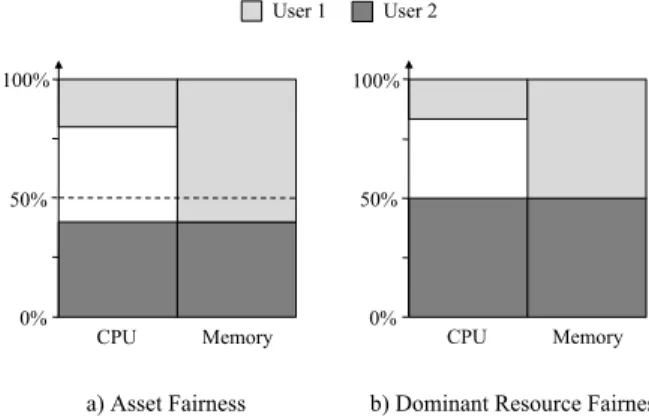
User 1 User 2
a) Asset Fairness b) Dominant Resource Fairness
100% 50% 0% CPU Memory 100% 50% CPU Memory 0%
Figure 2: Example with two frameworks with demand vectors
h1,3iandh1,1i. a) Allocation under Asset Fairness,
equaliz-ing their total resource usage. b) Allocation under Dominatequaliz-ing Resource Fairness, equalizing the share of their dominating re-source.
vectors change dynamically. Thus, Nexus’ scheduler ap-proximates this model.
We will refer to the following canonical example throughout this section. Consider a cluster with 300
CPUs and300GB memory, and two users with demand vectorsh1,3iandh1,1i, respectively.
First attempt: Asset Fairness. One intuitive schedul-ing policy we tried is to account for all resources that a user uses. We refer to this asasset fairness. The goal would then be to schedule users such that every user’s sum of all resources is the same. This might seem natu-ral since the usage of a chunk of each resource can be equated with a fixed cost, which then implies that all users would be given resources for the same amount of budget.
Asset fairness can, however, give rise to undesirable outcomes. In our canonical example, asset fairness will give the first user60tasks and the second user120tasks. The first user will useh60,180iresources, while the sec-ond will useh120,120i(see Figure 2). While each user uses a total of 240 resources, the second user has got less than half (150) of both resources. We believe that this could be considered unfair, making the second user’s owner inclined to buy a separate cluster of dimension h150,150i, using it all by itself.
4.1 Dominating Resource Fairness
The last example highlights that users might not care about the sum of their allocated resources, but instead care about their number of tasks. In other words, users care about the resource that they relatively demand most of, since that is the resource they will be allocated most of. We define a user’s dominating resource to be the resource that it percentage-wisedemands most of, e.g. with a total10CPUs and40GB memory, a user that
de-mands1 CPU and2 GB memory per task has CPU as its dominating resource, as that is the resource that dom-inates its relative demand.
It is, thus, natural to attempt to give all users equal amounts of their dominating resource. We call this, dom-inating resource fairness. This is achieved by assigning to each useriadominating sharexi, which isi’s share of its dominating resource, i.e. xi = maxj{sij}, wheresij is useri’s fractional share of resourcej.6 The scheduler allocates resources to the user with leastxi.7
If we consider our canonical example, dominating re-source fairness will allocate the two users 50 and150
tasks, respectively. Thus, the resource usage of the two users becomes, h50,150i, and h150,150i, respectively (see Figure 2). Hence, both users get half of their domi-nating resource, i.e.xi= 0.5.
Properties. Dominating resource fairness satisfies a share guaranteeproperty that we consider crucial: each user receives n1 fraction of at least one of its resources. Informally, share guarantee can be interpreted as:
Each user will get at least as much resources as it would get by running its own cluster.
Dominating resource fairness satisfies share guaran-tee, modulo fractional task allocations. To see that, note that a user which has n1 of one of its resources surely has n1 of its dominating resource, and vice versa. Share guarantee, thus, ensures that a user gets1nof its dominant resource. If every user is given exactlyn1of all resources, every user will be able to get n1 of their dominating re-source.
We compare dominating resource fairness with previ-ous work of fairness in networking. Dominating resource fairness is an adaptation ofmax-min fairnessto cluster environments [20, pg 448]. An allocation according to dominating resource fairness is max-min fair in the sense that any increase in a userp’s tasks will be at the expense of a decrease in another userq’s task, wherepalready had more of its dominating resource than q had of its dominating resource. To see this, note that dominating resource fairness is an approximation ofprogressive fill-ing[20, pg 450], in which all users’ usage of their dom-inating resource is increased at the same rate, while pro-portionally increasing its other resources, until some re-source is exhausted, in which case those users’ allocation is finalized, and this is repeated recursively for remaining users.
Another way to understand dominating resource fairness is through Jain’s Fairness Index (JFI) [34]:
6Asset fairness can be achieved by instead assigningx
i=Pjsij.
7The Nexus schedulers actually return a list of users sorted in
in-creasing order byxi. The reason for the list is that Nexus’ scheduler attempts to always schedule the first user in the list for which there are available resources. (P ixi) 2 nP ixi
2, where n is the number of users in the
clus-ter, and xi is their resource share. JFI was originally intended for sharing a single resource, but we letxi be the dominating share of useri. Thus, a maximum JFI of1.0corresponds to scheduling resources according to dominating resource fairness, as it implies that every user has the same amount of their dominating resource. Thus, dominating resource fairness can be seen as a greedy al-gorithm for maximizing JFI.
Share guarantee only ensures that each user gets a n1 share. After each user has gotn1 fraction of its dominat-ing resource, there might be room for more tasks. This is especially the case with heterogeneous demand vectors, e.g. two users with demandsh1,9i, h9,1ican both be allocated 90% of their dominating resource. We next ex-plain different ways to allocate the resources that remain after the share guarantee has been satisfied.
Maximizing Utilization. It is possible to use domi-nating resource fairness until each user has received n1 of it its dominating resource, and thereafter use another scheduler that opts for maximum utilization of the re-sources. We found one scheduler particularly efficient for maximizing utilization. It is a greedy scheduler whose goal is to schedule the user that will give the most even utilization of all resources. This is done by calculat-ing for each user,u, what the utilization of every resource would be if uwould be allocated another task accord-ing to its demand vector. It then calculates the the vari-ance of utilization across the resources, and returns the list of users sorted in increasing order of variance. We compared this to a linear program that scheduled users for optimal utilization, and found that it performs close to the optimum. Nevertheless, scheduling for utilization might not be desirable as we show next.
Gaming the Scheduler. A scheduler that optimizes for maximum utilization can always be gamed by a user that shapes its demand vector to be identical to the remaining resources. For example, if the remaining resources are h6,18,24i, a user can make its demand vectorh1,3,4i, ensuring that an allocation for it can perfectly use all re-maining resources.
Dominating resource fairness is, however, harder to game. If a user demands more of some resource that it does not need, it is likely to get hurt in scheduling. If the surplus demand changes its dominating resource, its dominating share will be higher as soon as it is allocated, penalizing it during scheduling, even though it cannot use the surplus resource. If the extra demand does not change its dominating resource, it is still possible that it gets hurt in scheduling because its surplus demand can-not be satisfied. Gaming can, however, be possible in certain specific scenarios. For instance, a user,u, might
get ahead by requesting a surplus resource, which when allocated makes other users’ demand vectors insatiable, allowinguto get ahead of them during scheduling.
4.2 Weighted Fair Sharing
We have so far assumed that resources are to be shared equally among the users. In practise, it is desirable to be able to weight the sharing. The motivation for this is that different organizational entities might have contributed different amount of resources to the cluster or that there is a payment scheme in which different cluster owners pay for parts of the cluster. In either case, sharing could be weighted on a users basis, as well as on a resource basis. For example, some organization might have con-tributed with more memory resources, and should there-fore have a higher share of the memory resources.
Weighted fair sharing is implemented in Nexus sim-ilarly to Lottery Scheduling [43]. Every user i has a vector of weights of positive real numbers wij, where
1≤j≤rforr resources. The weightwij expresses that useri’s fair proportion of resourcejis Pwij
kwkj .
The definition of a dominating share for user inow changes to xi = maxj{
sij
wij}. Thus, share guarantee says that a useriwill get at least Pwij
kwkj
fraction of its dominating resource j. Note that dominating resource scheduling now uses the new definition of a dominating share,xi.
Ifwij = 1.0for all users and resources, weighted fair sharing reduces to equal fair sharing. Another use case is to assign user-wide weights. For example, ifwij =kfor allj, whilewkj = 1.0for allk6=iand allj, then useri will have twice the proportion of all resources compared to every other user in the system. We have found that the latter use often suffices, as one would like to weight on a per-user level, and not on a per-resource level.
4.3 Resource Revocation
It is the job of the scheduler to decide which users’ tasks should be revoked, and on what machines. This is complicated by that the granularity of tasks can be a value below the specified minimum offer size,
min offer. If care is not taken, the revoked tasks
might not make enough room for a new task that is of dimensionmin offer. In the worst case, a user above its fair share might be running very small tasks on ev-ery machine, such that even if all its tasks were revoked, there might not be room for a new task.
Nexus’ avoids the above scenario by assigning to each slave machine a fairness score indicating how fair the allocation would be ifmin offerresources would be freed on that machine through killing. It thereafter se-lects the most fair machine for revokation, and repeats the process to free more resources. When a user filter ex-ists, Nexus assigns a minimum score to those machines,
ensuring that they will be selected for revokation last. The fairness score is based on JFI and is calculated for each slavem by sorting the users running onm in decreasing order of their dominating share. Nexus then traverses the list of users and marks their tasks for re-vocation until room has been made for amin offer. Thereafter, a cluster-wide JFI is calculated, discounting the marked tasks against users’ shares, and assigns the score tom.
Nexus’ will pick the slave with highest JFI for re-source revokation. It will send notification to the marked users and give them a grace period to kill tasks on that machine. If only a single user’s tasks are marked for re-vocation, Nexus offers that user the freedom to kill that amount of its tasks on any machine it is running on. After the grace period expires, Nexus selects the marked tasks and kills them.
The above scheme attempts to achieve maximum fair-ness while minimizing resource revokation. Note that in the typical case where the useruthat is most above its fair share is running more thanmin offeron a single machine, the above scheme will always always pick u for resource revocation. This is because the slave thatu is running on will receive the highest JFI score.
5
Implementation
We have implemented Nexus in approximately 5,000 lines of C/C++. The implementation, which was de-signed for any 32-bit and 64-bit POSIX-compliant oper-ating system, has been tested on both Linux and Solaris. To reduce the complexity of our implementation, we use a library which provides an actor-based program-ming model that uses efficient asynchronous techniques for I/O [9]. We use the library and its built-in message se-rialization to perform all of the communication between the different components of Nexus.
The current implementation assumes the use of social-ized utilities, such as HDFS and MapOutputServer, and only supports resource offers for CPU cores and memory (i.e., it does not provide storage and I/O isolation.)
An important benefit of using C/C++ to implement Nexus has been our ability to easily interoperate with other languages. In particular, we use the Simplified Wrapper and Interface Generator (SWIG) to generate in-terfaces and bindings in Ruby, Python, and Java. As it turns out, none of our example frameworks are written against the C/C++ API.
We use the rest of this section to accomplish two things: first, we elaborate on how we provide perfor-mance isolation between framework executors and sec-ond we discuss in detail how frameworks can be imple-mented to run on Nexus.
Nexus easily interoperates with other languages, in particular, we use the Simplified Wrapper and Interface Generator (SWIG) to generate interfaces and bindings in Ruby, Python, and Java.
5.1 Framework Isolation
Recall from Section 3.3, that a good isolation mechanism for Nexus should (a) have low overheads for executor startup and task execution and (b) have the ability to let Nexus change resource allocations dynamically.
Given those constraints, we present possible mecha-nisms below:
Processes and ulimit Using processes as the
“con-tainer” for isolation is appealing because processes are a lightweight and portable mechanism. However, ulimit and setrlimit alone are insufficient for providing aggre-gate resource limits across process trees (e.g. a process and all of its descendants).
Virtual Machines Virtual machines are an
appeal-ing container, however, virtualization imposes I/O over-heads [22] that may not be acceptable for data-intensive applications like MapReduce. In addition, VMs take a fairly long time to start up, increasing latency for short lived executors.
Cpusets, Containers, Zones, etc. Modern operating
systems are begining to provid mechanisms to isolate en-tire process trees. For example, Linux supports cpusets and cgroups for CPU isolation [16], and Linux contain-ers [15] are aimed to provide more comprehensive isola-tion. These mechanisms tend to be very lightweight and are dynmically configurable while a process is running (similar to ulimit and setrlimit).
Solaris provides a relatively advanced set of mecha-nisms for resource isolation [14], which allows, for ex-ample, one to set cumulative limits on CPU share, resi-dent set size, and OS objects such as threads, on a process tree. A nice property of the Solaris mechanisms is that you can configure, at least for some resources, the abil-ity to let idle resources get used by processes that have reached their limits.
For our current implementation, we choose to use the Solaris resource management mechanisms. This allows Nexus to isolate CPU usage and memory usage per ex-ecutor process tree.
We use the Solaris resource management mecha-nisms [14] to enable Nexus to isolate CPU usage and memory usage per executor process tree. Solaris pro-vides a relatively advanced set of mechanisms for re-source isolation which allows, for example, one to set cumulative limits on CPU share, resident set size, and OS objects such as threads, on a process tree. A nice prop-erty of the Solaris mechanisms is that you can enable, at least for some resources, idle resources to be used by
processes that have reached their limits.
One contributing factor in our decision to use Solaris was our desire to run large-scale tests on Amazon EC2, since Linux containers would have required patching the Linux kernel, which is not allowed by EC2.
As operating system isolation mechanisms improve, they should only strengthen the performance isolation guarantees that Nexus can provide. We explore how well the performance isolation mechanisms worked in Section 6.
5.2 Frameworks
We have ported Hadoop and the MPICH [21] implemen-tation of MPI to run on Nexus. Neither of these ports required changing the existing interfaces, so existing run unmodified. In addition, we built a new framework from scratch for writing machine learning applications as well as a framework that elastically scales Apache [2] web servers. We describe the implementation details of each framework below.
5.2.1 Hadoop
Porting Hadoop to run on Nexus required minimal mod-ification of Hadoop internals because Hadoop’s concepts such as tasks map cleanly onto Nexus abstractions. We used Hadoop’s existing master, the JobTracker, as our Nexus scheduler, and we used Hadoop’s slave daemon, the TaskTracker, as our executor. We needed to imple-ment two major changes:
• Factoring out the map output server from the Task-Tracker. Normally, Hadoop has each TaskTracker serve local map outputs to reduces, but if the Task-Tracker runs as an executor, it may occasionally be killed. We made the map output server a separate daemon shared across Hadoop instances.
• Changing scheduling to use Nexus’s resource offer mechanism, as we describe below.
In normal operation, Hadoop schedules tasks on its slaves in response to heartbeat messages that slaves send every 3 seconds to report their status. Each slave has a number of “map slots” and “reduce slots” in which it can run map and reduce tasks respectively. In each heartbeat, the slave reports its total number of slots of each type and the number of slots it has free. The JobTracker gives the slave new tasks if there are free slots, preferentially choosing tasks with data local to the slave.
The heartbeat mechanism provides a good opportunity to add support for Nexus because it presents a simple interface to “pull” tasks for a particular slave from the JobTracker. In our port, we take advantage of this inter-face to maximize the amount of Hadoop code we reuse. Whenever Nexus makes a resource offer on a particular slave to our Nexus scheduler (which is located in the Job-Tracker), we check whether there are any runnable map
or reduce tasks. If there are, we accept the offer (modulo a detail on data locality which we get to later), and we send a message to the slave that the offer was on to have it increase its number of map or reduce slots. Whether we choose to add a map slot or a reduce slot depends on which tasks are available; if both are available, we keep a configurable ratio of map and reduce slots on each slave (by default 1:1). After the slave receives the Nexus-level task and increases its slot count, the next time it sends a heartbeat to the master, Hadoop’s standard scheduling al-gorithm is invoked to pick a Hadoop-level map or reduce task to run. Then, whenever the slave sends a heartbeat to the master saying that a task is done, our shim layer also decrements the slave’s slot count and reports the task as finished to Nexus. Finally, if we create a slot but the slave is not assigned a task within two heartbeats (perhaps be-cause jobs finished), it removes the slot and also sends a task-done report to Nexus.
A final detail deals with data locality. When consid-ering which slaves to launch map tasks on, we take a policy of waiting up totseconds to find a slave that con-tains local data for one of the yet-unlaunched map tasks in the system. If no such slave is found, we accept a non-local task. The wait time is reset only if we ever get a local task again. This simple mechanism, called de-lay scheduling, is explained in our previous work [45], where it was found to provide near-perfect data locality in a fair scheduler for Hadoop.
In total, our changes to Hadoop were 1100 lines of code, of which 1000 are new files adding the shim layer and the map output server.
5.2.2 MPICH
MPI is a language-independent message-passing API used to implement parallel programs that run primar-ily on supercomputers and clusters. MPI works by launching daemons on machines that will participate in the computation. A user then executes the standard
mpiexecto run a program on each of the machines
run-ning daemons.
Rather than make invasive changes in the implemen-tation of MPICH, we created a framework “wrapper” around mpiexecthat registers with the Nexus master, launches a local MPI “master” daemon, accepts resource offers large enough to run instances of the specified pro-gram, and then has the executor launch an MPI daemon that connects back to the “master” daemon. Once the wrapper has acquired enough resources to run the pro-gram, it invokes mpiexec which uses the local MPI daemon to begin the distributed MPI computation. Note that because MPI uses the MPI daemon’s to launch more processes, nothing extra needs to be done to ensure sub-sequently launched processes on the slaves will be prop-erly isolated.
The simplicity of this approach is a direct consequence of how a majority of MPI jobs are executed. Since few MPI jobs actually fork and launch computation dynami-cally, we choose not to provide any mechanism for doing so, and we implemented a very simple scheduling policy – accept any offered resources that are large enough to launch the program.
Currently, the wrapper launches MPI jobs conserva-tively. That is, it never attempts to use more than its fair share of the resources to avoid resource re-vocation. Mechanisms such as Berkeley Lab Check-point/Restart [29] could be used to support revocation.
The entire wrapper was written using our Python inter-face and bindings for Nexus in about 200 lines of code.
5.2.3 Spark
Nexus enables the creation of specialized frameworks optimized for workloads for which more general exe-cution layers may not be optimal. To test the hypoth-esis that simple specialized frameworks provide value, we identified one class of jobs that machine learning re-searchers at our institution ran on Hadoop and found per-formed poorly –iterativejobs, where a data set is reused across a number of iterations. We built a framework called Spark optimized for these workloads.
Example Job A simple example of an iterative
al-gorithm used in machine learning is logistic regression [10]. This algorithm seeks to find the line that best sep-arates two clusters of labeled data points. The algorithm starts with a random separating line,w. Then, on each it-eration, it computes the gradient of an objective function that measures how well the line is separating the points, and shiftswin the direction of this gradient. The gradient computation amounts to evaluating a functionf(x, w)on each data pointxand summing these results.
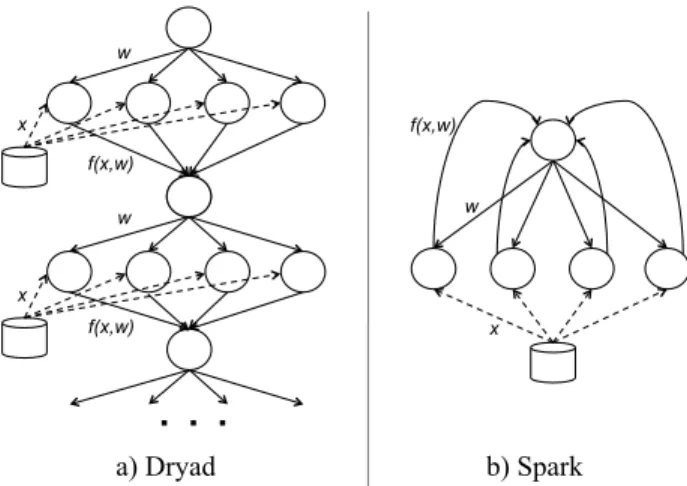
An implementation of logistic regression in Hadoop must run each iteration as a separate MapReduce job, because each iteration depends on thewcomputed at the previous one. This imposes overhead because every it-eration must re-read the input file into memory. Dryad could express the whole job as a data flow DAG as shown in Figure 3 a). However, it still has the problem that each iteration must reload the data file from disk; there is no way in Dryad to ask one vertex to evaluatef(x, w)for multiple values of w, as this requires cyclic data flow. Spark’s execution is shown in Figure 3 b). Spark uses the long-lived nature of Nexus executors to cache a slice of the data set in memory at each executor, and then run multiple iterations on this same cached data.
Spark Details Spark is implemented in Scala [13], a high-level object-oriented/functional programming lan-guage that runs over the JVM. Users write jobs in Scala, and invoke Spark through a language-integrated syntax
. . .
w f(x,w) w f(x,w) x x x a) Dryad b) Spark w f(x,w)Figure 3: Comparison of execution of the logistic regression job in Dryad and Spark. Solid lines represent data flow within the cluster computing framework. Dashed lines represent reads from a distributed file system. In Spark, the same worker pro-cesses are reused across iterations and reads only happen once.
val data = spark.hdfsTextFile(...).map(readPoint _).cache() var w = Vector.random(D)
for (i <-‐ 1 to ITERATIONS) {
val gradient = spark.accumulator(Vector.zeros(D)) val W = w
for (p <-‐ data) {
val scale = (1/(1+Math.exp(-‐p.y*(W dot p.x)))-‐1)*p.y gradient += scale * p.x
}
w -‐= gradient.value }
println("Result: " + w)
Figure 4: Implementation of logistic regression in Spark. The body of the inner loop (highlighted) runs in parallel on Nexus.
similar to DryadLINQ [44]: users write a for loop over a special “distributed data set” object, and the body of the for loop is passed as closure to run as a Nexus task on the appropriate node for each slice of the data.8 Spark allows users to ask for a parallel data set to be read from the Hadoop Distributed File System, transformed, and cached in memory at executors. It then schedules tasks to run on executors that already have the appropriate data cached, using a delay scheduling algorithm similar to our Hadoop port. Figure 4 shows how the logistic regression algorithm is expressed in Spark.
Spark is implemented in 800 lines of code, but can outperform a Hadoop implementation of logistic regres-sion by 8x, as shown in Section 6.3. Due to lack of space, we limit our discussion of Spark in this paper and refer the reader to http://www.cs.berkeley.edu/ ˜matei/sparkfor more details.
8This for-loop syntax integration has previously been used by a
Scala API for Hadoop [28].
Average time (s)
MPI 50.85
MPI on Nexus 51.79
Table 1: Overhead of running the MPI LINPACK benchmark on Nexus
Average time (s)
Hadoop 159.87
Hadoop on Nexus 166.19
Table 2: Overhead of running the WordCount Hadoop work-load on Nexus
5.2.4 Elastic Web Farm
To explore how to implement a more interactive frame-work, we built an elastic web farm. Sharing resources between web servers and other frameworks is a natural desire; when the web load is low the machines can be used for launching tasks from other frameworks and as the web load increases more instances of the web server can be launched.
We used the load balancer haproxy [7] as our front-end and Apache as our back-end, however any web server would have been sufficient. Similar to the MPI wrap-per framework, we created a framework which wraps the launching and killing of web servers on nodes. The wrapper queries the front-end for load statistics, and uses that to decide whether or not to launch, or teardown, servers. The wrapper’s only scheduling constraint is that it only launches one Apache instance per machine, and it uses filters to assist the Nexus master in this respect.
One unfortunate aspect of using haproxy as the front-end was that it does not provide good mechanisms to do hot-swapping of its configuration files. Instead, haproxy needs to be restarted for each reconfigure, which can of-ten cause certain connections to be terminated.
Like the MPI wrapper, this wrapper was written using our Python interface and bindings for Nexus and is about 250 lines of Python.
6
Evaluation
We evaluated Nexus by performing a series of ex-periements using Amazon’s EC2.
6.1 Overhead
To measure the overhead Nexus imposes on frameworks we ran two benchmarks using Hadoop and MPI. These experiments were performed on EC2 using 50 nodes, each with 2 CPU cores and 6.5 GB of memory. We used the WordCount workload for Hadoop and we used the High-Performance LINPACK [18] benchmark for MPI. Tables 2 and 1 show the average running time across three runs of Hadoop and MPI both with and without
Nexus, respectively. As these results show, the overhead of Nexus is statistically insignificant, when it exists at all.
6.2 Dynamic Resource Sharing
We wanted to evaluate how well Nexus performs with multiple different frameworks running simultaneously. This experiment was performed on EC2 with 70 nodes, each with 2 CPU cores and 6.5 GB of memory.
For this experiement we decided to run Hadoop, Spark, and MPI and allocate resources according to dom-inating resource fairness (where each framework has an equal weight). Similar to above, we used the WordCount workload for Hadoop and the LINPACK benchmark for MPI. The Spark framework was running a job perform-ing logistic regression. The logistic regression job per-forms a series of iterations, in between each of which it does not use any resources in the cluster.
The results of this experiement are shown in 5. In this experiement, CPU was the bottleneck resource in the cluster. In this experiement we first launched the Spark framework, which was offered the entire cluster and ac-cepted it. After about 15 seconds we launched Hadoop, which received its fair share (50% of the CPUS) within a few seconds. After about 50 seconds we launched MPI. Within a few seconds MPI was offered its fair share of the CPUS (approximately 13), which it accepted and be-gan running its tasks. At roughly this same point the Spark job completed its first iteration and released all of its resources, which Hadoop utilized almost instantly. Each time the Spark job began a new iteration, it was of-fered roughly 13 of the CPU resources within a few tens of seconds. Finally, around 330 seconds the Hadoop job completed, and the Spark framework was offered, and accepted, the extra resources. Because of the nature of the MPI job, it was not able to benefit from any of the extra resources.
This experiment helps to illuminate how the share of the cluster can be shared dynamically between different frameworks. In this case, we show how quickly frame-works like Spark and Hadoop can utilize extra resources when they aren’t being used while the MPI framework can continue executing below its fair share unharmed.
6.3 Benefit of Specialized Frameworks
In this experiment, we evaluate whether the specialized Spark framework described in Section 5, which is op-timized for iterative jobs, provides a benefit over the general-purpose Hadoop framework. We use a logistic regression job implemented on top of Hadoop by ma-chine learning researchers in our department to evaluate Spark. We implemented a second version of the job in Spark ourselves. We ran the job on a 11 GB data file on 43 EC2 machines with 8 cores each. The data file contained each point as plain text, which according to
0% 20% 40% 60% 80% 100% 1 61 121 181 241 301 Sh ar e o f cl u ste r Time (s) MPI Hadoop Spark
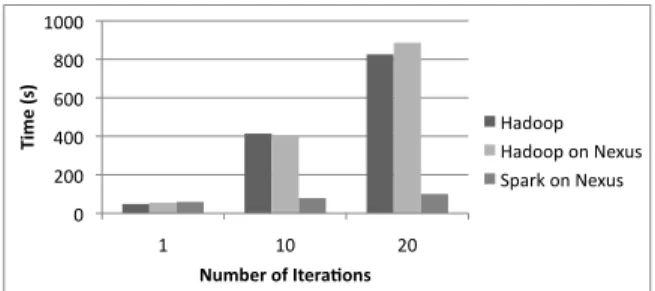
Figure 5: Timeline showing the shares of the cluster given to MPI, Hadoop and Spark in the dynamic resource sharing ex-periment. 0 200 400 600 800 1000 1 10 20 Ti me ( s)
Number of Itera2ons
Hadoop Hadoop on Nexus Spark on Nexus
Figure 6: Comparing the running time of logistic regression when implemented using Spark vs. using Hadoop.
the machine learning researchers that wrote the job is a standard format in which machine learning data sets are provided. We varied the number of iterations of logis-tic regression from 1 to 20, and ran each job on a stan-dalone Hadoop cluster, a Hadoop framework running on Nexus, and a Spark framework running on Nexus. Figure 6 shows the results, which averages values from 3 runs.
We see that each iteration of the job takes 41s on av-erage on both Hadoop and Hadoop on Nexus. Some variation happens because the jobs are so short, and Hadoop’s heartbeat intervals are 3 seconds so any varia-tion in scheduling opportunities might result in a 3 sec-ond delay. In contrast, Spark takes 60s to run the first iteration (because it uses slower text-parsing routines), but each subsequent iteration is on average 2 seconds. This is because in the logistic regression job, the func-tionf(x, w)evaluated at each iteration is so inexpensive that the cost to read the input data from HDFS and parse the text into floating point numbers dominates the com-putation. Hadoop must incur this cost on each iteration, while Spark reuses blocks of parsed data cached in mem-ory and only incurs the cost once. This leads to a 8.5x speedup on 20 iterations.
6.4 Resource Offers and Data Locality
In this experiment, we wanted to verify whether the re-source offer mechanism in Nexus allows frameworks
0% 20% 40% 60% 80% 100%
Separate Hadoops Hadoops on Nexus,
no delay sched. Hadoops on Nexus, 1s delay sched. Hadoops on Nexus, 5s delay sched.
Pe rc ent Loc al M aps 0 100 200 300 400 500 600
Separate Hadoops Hadoops on Nexus,
no delay sched. Hadoops on Nexus, 1s delay sched. Hadoops on Nexus, 5s delay sched.
R
unning T
ime
(s
)
Figure 7: Results from data locality experiment. The top graph shows the percentage of local map tasks in each setting, while the bottom graph shows the average job running time in each setting.
to achieve control over their tasks’ placement, and in particular high data locality. We ran 16 instances of Hadoop on a 93-node EC2 cluster with 4 cores per node. All of the instances were running a map-only filter job that read a 100 GB file striped throughout the cluster on a shared HDFS file system and outputted 1% of the records. We tested four scenarios: Separate Hadoop MapReduce clusters of 5-6 nodes each, to emulate orga-nizations that use coarse-grained resource managers, and all instances on Nexus using either no delay scheduling, 1s delay scheduling or 5s delay scheduling.
The results are shown in Figure 7, which averages numbers from 3 runs of each scenario. We see that data locality is very low (18%) on the separate clus-ters. Running the Hadoop frameworks on Nexus im-proves locality even with no delay scheduling because each node is running tasks from 4 random Hadoop in-stances, so each Hadoop instance has tasks on more than 5-6 nodes. Adding delay scheduling brings locality above 90%, even with a 1-second delay. Five-second de-lay scheduling achieves 95% locality, which is similar to Hadoop running alone (for comparison, a single instance of Hadoop running on the whole cluster achieves 93% locality for the job we used). Finally, performance im-proves with locality, with the 5s delay scenario running jobs 1.7x faster than separate Hadoop instances.
6.5 Elastic Web Farm
Finally, we wanted to evaluate how well interactive frameworks can co-exist with other frameworks. This
0 100 200 300 400 500 600 0 50 100 150 200 250 1-ws 2-ws 3-ws 4-ws 3-ws 2-ws 1-ws sessions time (s)
sessions load balancer sessions Apache
Figure 8: The average session load on the load balancer over time, as well as the average number of sessions across web servers.
included investigating how quickly these frameworks would be offered resources and how well the isolation mechanism we choose to use works. To do this we ran two experiements, one where the only framework run-ning in the cluster was the elastic web farm and the other where we run both the elastic web farm and a “hog” framework. The hog framework is designed to consume available resources by launching tasks that use one or more threads to read and write a specified amount of data for a specified period of time. In this case, the hog frame-work launched tasks that created ten threads that each spent approximately two minutes continuously cycling through 64 MB of data. We ran our experiment using 4 EC2 nodes each with 8 CPU cores and 6.5 GB of mem-ory. Note that to apply pressure to the isolation mecha-nism each each hog task would request only 1 CPU core and 512 MB of memory.
In both experiments we generated workload using HTTPerf [36]. Figure 8 shows the measured average number of sessions on the load balancer, as well as the average measured sessions across web servers when both the hog framework and the elastic web framework were running simultaneously. The vertical lines of the fig-ure indicate when the number of web servers is alterned. The effect of this is seen on the average web server load, which stays low relative to the generated load.
Running the same workload without the hog frame-work showed no statistically significant differences. As mentioned in Section 5.2.4, connection errors occured during the hot-swapping of configuration files, however, both of the experiements suffered equally from this issue.
7
Discussion
7.1 Philosophy
Nexus shares many goals in common with operating sys-tems. Nexus provides (1) a clean abstraction of tasks to frameworks, (2) performance and fault isolation between frameworks, and (3) fair multiplexing of CPU, memory,