Towards CloudML, a Model-based Approach to
Provision Resources in the Clouds
?Eirik Brandtzæg1,2, S´ebastien Mosser1, and Parastoo Mohagheghi1 1
SINTEF IKT, Oslo, Norway
2
University of Oslo, Oslo, Norway
{firstname.lastname}@sintef.no
Abstract. The Cloud-computing paradigm advocates the use of re-sources available “in the clouds”. In front of the multiplicity of cloud providers, it becomes cumbersome to manually tackle this heterogene-ity. In this paper, we propose to define an abstraction layer used to model resources available in the clouds. This cloud modelling language (CloudML) allows cloud users to focus on their needs,i.e., the modelling the resources they expect to retrieve in the clouds. An automated provi-sioning engine is then used to automatically analyse these requirements and actually provision resources in clouds. The approach is implemented, and was experimented on prototypical examples to provision resources in major public clouds (e.g., Amazon EC2 and Rackspace).
1
Introduction
Cloud–Computing [2] was considered as a revolution. Taking its root in dis-tributed systems design, this paradigm advocates the share of disdis-tributed com-puting resources designated as “the cloud”. The main advantage of using a cloud-based infrastructure is the associated scalability property (called elastic-ity). Since a cloud works on a pay–as–you–go basis, companies can rent com-puting resources in an elastic way. A typical example is to temporarily increase the server–side capacity of an e–commerce website to avoid service breakdowns during a load peak. According to Amazon (one of the major actor of the Cloud market):“much like plugging in a microwave in order to power it doesnt require any knowledge of electricity, one should be able to plug in an application to the cloud in order to receive the power it needs to run, just like a utility” [15]. How-ever, there is still a huge gap between the commercial point of view and the technical reality that one has to face in front of “the cloud”.
The Cloud-computing paradigm emphasises the need for automated mecha-nisms, abstracted from the underlying technical layer. It focuses on the repro-ducibility of resource provisioning: to support the horizontal scaling of cloud-applications (i.e., adding new computing resources on-the-fly), such a provision-ing of on-demand resources will be performed by a program. The main drawback
?
This work is funded by the European commission through the REMICS project (www.remics.eu), contract number 257793, with the 7th Framework Program.
associated is the heterogeneity of cloud providers. At the infrastructure level, more than ten different providers publish different mechanisms to provision re-sources in their specific clouds. It generates avendor lock-in syndrome, and an application implemented to be deployed in cloudCwill have to be re-considered if it now has to be deployed on cloudC0. All the deployment scripts that were de-signed forChave to be redesigned to match the interface provided byC0(which can be completely different,e.g., shell scripts, RESTful services, standard API). Our contribution in this paper is to describe the first version of CloudML, a cloud modelling language specifically designed to tackle this challenge. This research is done in the context of the REMICS EU FP7 project, which aims to provide automated support to migrate legacy applications into clouds [10]. Using CloudML, a user can express the kind of resources needed for a specific application, as a model. This model is automatically handled by an engine, which returns a “run-time model” of the provisioned resources, according to the [email protected] approach [3]. The user can then rely on this model to interact with the provisioned resources and deploy the application. The approach is illustrated on a prototypical example used to teach distributed systems at the University of Oslo.
2
Challenges in the cloud
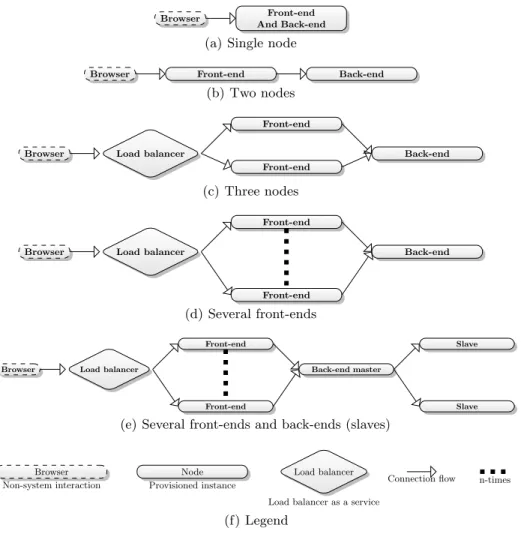
To recognise challenges when doing cloud provisioning we use an example ap-plication [5]. The apap-plication (known as BankManager) is a prototypical bank manager system which support(i)creating users or bank accounts and(ii) mov-ing money between bank accounts and users.BankManager is designed but not limited to support distribution between several nodes. Some examples of provi-sioning topologies is illustrated in Fig. 1, each example includes a browser to visualise application flow, a front-end to visualise executable logic and back-end represents database. It is possible to have both front-end and back-end on the same node, as shown inFig.1(a). InFig.1(b) front-end is separated from the back-end, this introduces the flexibility of increasing computation power on the front-end node while spawning more storage on the back-end. For applications performing heavy computations, it can be beneficial to distribute the workload between several front-end nodes as seen in Fig.1(c), the number of front-ends can be increasednnumber of times as shown inFig.1(d).BankManager is not designed to handle several back-ends because of the relational database, this can solved on a database level with master and slaves (Fig.1(e)) although this is out of the scope of this article.
We used bash scripts to implement the full deployments of BankManager againstAmazon Web Services (AWS) [1] and Rackspace [13] with a topology of three nodes as shown in Fig. 1(c). From this prototype, it became clear that there were multiple challenges that we had to address:
– Heterogeneous Interfaces: The first challenge we encountered was to sim-ply support authentication and communication with the cloud. The two
Browser Front-end And Back-end (a) Single node
Browser Front-end Back-end
(b) Two nodes
Browser Load balancer
Front-end
Front-end
Back-end
(c) Three nodes
Browser Load balancer
Front-end
Front-end
Back-end
(d) Several front-ends
Browser Load balancer
Front-end
Front-end
Back-end master
Slave
Slave (e) Several front-ends and back-ends (slaves)
Browser Non-system interaction
Node Provisioned instance
Load balancer
Load balancer as a service
Connection flow n-times
(f) Legend
Fig. 1.Different architectural ways to provision nodes (topologies).
providers we tested against had different approaches, AWS [1] had command-line tools built from their Java APIs, while Rackspace [13] had no tools beside the API language bindings, thus we had to operate against the command-line tools and public APIs. As this emphasises the complexity even further, it also stresses engineering capabilities of individuals executing the tasks to a higher technical level.
– Platform-specific Configuration: Once we were able to provision the cor-rect amount of nodes with desired properties on the first provider it became clear that mirroring the setup to the other provider was not as convenient as anticipated. There were certain aspects of vendor lock-in, so each script was hand-crafted for specific providers. The lock-in situations can, in many cases, have financial implications where for example a finished application is
locked to one provider and this provider increases tenant costs3. Or availabil-ity decreases and results in decreases of service up-time, damaging revenue.
– End-user Reproducibility: The scripts provisioned nodes based on command-line arguments and did not persist the designed topology in any way, this made topologies cumbersome to reproduce. Scripts can be “re-executed” to redo a provisioning step, but they often rely on command-line arguments that differs from a computer to another one (e.g., file paths), requiring tech-nical knowledge to be correctly executed.
– Shareable: Since the scripts did not remember a given setup it was im-possible to share topologies “as is” between coworkers. It is important that topologies can be shared because direct input from individuals with different areas of competence can enhance quality. Provisioning scripts can be shared as plain files, and the lack of modularity expressiveness in the underlying lan-guage does not support re-use as defined in the Object-Oriented community. The re-use of deployment script is empirically done through a copy-paste approach, and concerns are not modularised in shareable components.
– Robustness: There were several ways the scripts could fail and most errors were ignored. Transactional behaviours were non-existent.
– Run-time dependency: The scripts were developed to fulfil a complete deployment, and to do this it proved important to temporally save run-time specific meta-data. This was crucial data needed to connect front-end nodes with the back-end node. Shell scripts are usually executed in abatch mode, and will result in static files containing the information available from the cloud (e.g., IP addresses) at deployment time. Thus, changes in the cloud (e.g., IP re-allocation) cannot be easily propagated.
Vision: Towards a CloudML environment. Our vision is to tackle these chal-lenges by applying a model-driven approach supported by modern technologies. Our objective is to create a common model for nodes as a platform-independent model [4] to justifymulti-cloud differences and at the same time base this on a human readable lexical format to resolve reproducibility and make itshareable. The concept and principle of CloudML is to be an easier and more reliable path into cloud computing for IT-driven businesses of variable sizes. We envision a tool to parse and execute template files representing topologies of instances in the cloud. Targeted users are application developers without cloud provider specific knowledge. The same files should be usable on other providers, and alternat-ing the next deployment stack should be effortless. Instance types are selected based on properties within the template, and additional resources are applied when necessary and available. While the tool performs provisioning meta-data of nodes is available. In the event of a template being inconsistent with possibil-ities provided by a specific provider this error will be informed to the user and provision will halt.
3
For example, Google decided in 2011 to change the pricing policies associated to the GoogleAppEngine cloud service. All the applications that relied on the service had basically two options:(i)pay the new price or(ii)move to another cloud-vendor. Due to vendor lock-in, the second option often implied to re-implement the application.
Table 1.CloudML: Challenges addressed.
Challenge Addressed by
Complexity One single entry point to multiple providers. Utilizing existing framework. Platform-independent model approach used to dis-cuss, edit and design topologies for propagation.
Multicloud Utilizing existing framework designed to interface several providers.
Reproducibility Lexical model-based templates. Models can be reused to multi-ply a setup without former knowledge of the system.
Shareable Lexical model-based templates. Textual files that can be shared through mediums such as e-mail or version control systems such as Subversion or Git.
Robustness Utilizing existing framework and solid technologies.
Metadata [email protected]. Models that reflect the provisioning models and updates asynchronously.
+id: String Node * Property +min: Int RAM +value: String Location +min: Int Core +min: Int Disk +name: String Template * RuntimeInstace System * RuntimeProp * +value: Address PublicIP +value: Address PrivateIP
+build(Accout, List[Template]): System
CloudMLEngine Connector AmazonEC2 RackSpace * +name: String Account 1 Credential1 +identity: String +credential: String Password +public: String KeyPair provider drivers nodes properties node tpl credential [email protected] UserLibrary * * accounts templates
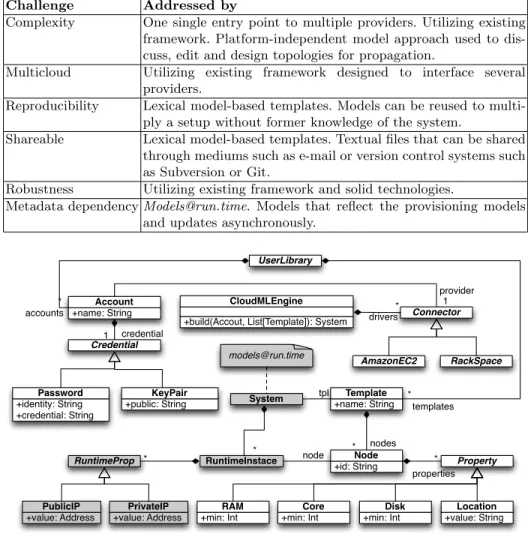
Fig. 2.Architecture of CloudML
3
Contribution
We have developed a metamodel that describe CloudML as a Domain-Specific language (DSL) for cloud provisioning. It addresses the previously identified challenges, as summarised inTab.1. We provide a class-diagram representation of the CloudML meta-model inFig.2. The scope of this paper is to describe the provisionning part of CloudML. The way application are deployed is described in [7].
Illustrative Scenario. CloudML is introduced using a scenario where an end-user (named Alice) is provisioning theBankManagerto Amazon Web ServicesElastic
Compute Cloud (EC2) using the topology shown inFig.1(c). It is compulsory that she possesses an EC2 account in advance of the scenario. She will retrieve security credentials for account and associate them with Password in Fig. 2.
Credential is used to authenticate the user to supported providers through
Connector. The next step for Alice is to model the appropriateTemplate
con-sisting of three Nodes. The characteristics Alice choose for Node Properties
are fitted for the chosen topology with more computational power for front-end
Nodesby increasing amount ofCores, and increasedDiskfor back-endNode. All
Properties are optional and thus Alice does not have to define them all. With
this model Alice can initialize provisioning by callingbuildonCloudMLEngine, and this will start the asynchronous job of configuring and creating Nodes. When connecting front-end instances of BankManager to back-end instances Alice must be aware of the back-endsPrivateIPaddress, which she will retrieve from CloudML during provisioning according [email protected] (M@RT) ap-proach. RuntimeInstance is specifically designed to complement Node with
RuntimeProperties, as Properties from Node still contain valid data. When
allNodesare provisioned successfully and sufficient metadata are gathered Alice
can start the deployment, CloudML has then completed its scoped task of pro-visioning. Alice could later decide to use another provider, either as replacement or complement to her current setup, because of availability, financial benefits or support. To do this she must change the provider name inAccountand call
buildonCloudMLEngineagain, this will result in an identical topological setup
on a supported provider.
Implementation. CloudML is implemented as a proof of concept framework [6] (from here known as cloudml-engine). Because of Java popularity we wrote cloudml-engine in a JVM based language with Maven as build tool. Cloudml-engine use jclouds.org library to connect with cloud providers, giving it support for 24 providers out of the box to minimize complexity as well as stability and robustness.
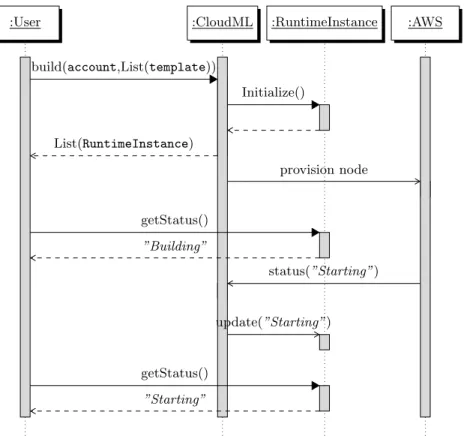
We represent inFig.3 the provisioning process implemented in the CloudML engine, using a sequence diagram. Provisioning nodes is by nature an asyn-chronous action that can take minutes to execute, therefore we relied on the actors model [9] using Scala actors. With this asynchronous solution we got con-current communication with nodes under provisioning. We extended the model by adding a callback-based pattern allowing each node to provide information on property and status changes. Developers exploring our implementation can then choose to “listen” for updating events from each node, and do other jobs / idle while the nodes are provisioned with the actors model. We have divided the terms of a node before and under provisioning, the essential is to intro-duceM@RT to achieve a logical separation. When a node is being propagated, it changes type to RuntimeInstance, which can have a different state such as Configuring, Building,Starting andStarted. When aRuntimeInstancereaches Starting state the provider has guaranteed its existence, including the most nec-essary metadata, when all nodes reaches this state the task of provisioning is concluded.
:User :CloudML :RuntimeInstance :AWS
build(account,List(template))
Initialize() List(RuntimeInstance) provision node getStatus() ”Building” status(”Starting”) update(”Starting”) getStatus() ”Starting”
Fig. 3.CloudML asynchronous provisionning process (Sequence diagram).
4
First Experiments: Sketching Validation
Our objective here is to sketch the validation of the CloudML framework, by sup-porting the provisioning of several nodes into multiple clouds. To start the valida-tion of the approach and the implemented tool, we provisioned theBankManager application using different topologies in Fig[1(a), 1(c)]. The implementation uses JavaScript Object Notation (JSON) to define templates as a human readable se-rialisation mechanism. The lexical representation of Fig. 1(a) can be seen in Listing. 1.1. The whole text represents the Template of Fig. 2 and conse-quently “nodes” is a list of Nodefrom the model. JSON is textual which makes it shareable as files. We implemented it so once such a file is created it can be reused (reproducibility) on any supported provider (multi-cloud).
1 { " n o d e s ": [
2 { " n a m e ": " t e s t n o d e " }
3 ]
4 }
The topology described inFig.1(c) is represented inListing.1.2, the main difference fromListing.1.1 is that there are two more nodes and a total of five more properties. The characteristics of each node are carefully chosen based on each nodes feature area, for instance front-end nodes have more computation power, while the back-end node will have more disk. The key idea is that the meta-model is extensible, and can support new properties in the language thanks to the extension of thePropertyclass.
1 { 2 " n o d e s ": [ 3 { " n a m e ": " f r o n t e n d 1 ", 4 " m i n R a m ": 512 , 5 " m i n C o r e s ": 2 } , 6 { " n a m e ": " f r o n t e n d 2 ", 7 " m i n R a m ": 512 , 8 " m i n C o r e s ": 2 } , 9 { " n a m e ": " b a c k e n d ", 10 " m i n D i s k ": 100 } 11 ] 12 }
Listing 1.2.Three nodes (topology:Fig.1(c))
5
Related Work
There already exists scientific research projects and technologies which have similarities to CloudML both in idea and implementation. First we will present three scientific research projects and their solutions, then we will introduce pure technological approaches. We also discuss how our approach differ from theres.
One project that bears relations to ours is mOSAIC [12] which aims at not only provisioning in the cloud, but deployment as well. They focus on abstrac-tions for application developers and state they can easily enable users to “ob-tain the desired application characteristics (like scalability, fault-tolerance, QoS, etc.)” [11]. The strongest similarities to CloudML are(i) multi-cloud with their API [11], (ii) meta-data dependencies since they support full deployment and (iii) the robustness through fault-tolerance. The mOSAIC project works at a code-based level. Thus, it could not benefit from the use of models as interop-erability pivot with other tools, to ensure verification for example. The M@RT dimension advocated by CloudML also tames the complexity of the technolog-ical stack to be used from an end-user point of view. However, model trans-formation can be designed from CloudML provisioning models to target the mOSAIC API, thus benefiting of the multi-cloud capabilities offered by the mO-SAIC platform. Reservoir [14] is another project that also aim at multi-cloud. The other goal of this project is to leverage scalability in single providers and support built-inBusiness Service Management(BSM), important topics but not directly related to our goals. CloudML follows the same underlying approach, but brings the [email protected] dimension, considering that the keystone of such
an approach should be at the model level. Vega framework [8] is a deployment framework aiming at full cloud deployment of multi-tier topologies, they also fol-low a model-based approach. Contrarily to Vega, CloudML supports multi-cloud provisioning.
There are also distinct technologies that bear similarities to CloudML. None of AWS CloudFormation and CA Applogic are model-driven, and actually fo-cus on their own specificities to ensure vendor lock-in. Access to run-time data is bound to specific interface, where CloudML advocate a M@RT representa-tion of the system, supporting reasonning at a higher level of abstracrepresenta-tion. Oth-ers are plain APIs supporting multi-cloud such as libcloud, jclouds and Delta-Cloud. The last group are projects that aim specifically at deployment, mak-ingInfrastructure-as-a-Service (IaaS) work asPlatform-as-a-Service(PaaS) like AWS Beanstalk and SimpleCloud. The downside about the technical projects are their inability to solve all of the challenges that CloudML aims to address, but since these projects solve specific challenges it is appropriate to utilize them. Cloudml-engine leverages on jclouds in its implementation to support multi-cloud provisioning, and future versions can utilize it for full deployments.
6
Conclusions & Perspectives
In this paper, we presented the initial version of CloudML, a cloud modelling language used to model the resources that a given application can require from existing clouds. The approach is defined as a meta-model, associated to a refer-ence implementation using the Scala language. This referrefer-ence implementations is connected to several cloud providers, and we described preliminary experiments that address major cloud providers: Amazon EC2 and Rackspace.
The first perspective of this work is to emphasise its validation. In the context of the REMICS project, our partners provide us several case studies (tourism, banking, scientific computation) that require the provisioning of resources in the clouds. As CloudML is as a platform-independent meta-model to support cloud resource provisioning, one can consider it as a target of a model transformation. This point will be investigated in the context of REMICS: the migration chain results in SOAML models, to be deployed on provisioned resources. We are also interested in refining the set of properties available in the CloudML meta-model to properly categorise the available resources (as for now this mechanism is lim-ited and can lead to sun-optimal provisioning). For now, we focus our effort on computational power, but other dimensions of clouds (e.g., data location, costs) should be taken into account at the CloudML level. The next challenge to be tackled by the CloudML environment is to model the complete deployment of cloud-applications. By coupling the current version of CloudML with an archi-tecture description language, it will be possible to model the needed resources and the deployment plan to be followed to support the automated deployment of the application.
References
1. Amazon: Amazon web services (2012), http://aws.amazon.com
2. Armbrust, M., Fox, A., Griffith, R., Joseph, A.D., Katz, R.H., Konwinski, A., Lee, G., Patterson, D.A., Rabkin, A., Stoica, I., Zaharia, M.: Above the Clouds: A Berkeley View of Cloud Computing. Tech. Rep. UCB/EECS-2009-28, EECS Department, University of California, Berkeley (Feb 2009), http://www.eecs.berkeley.edu/Pubs/TechRpts/2009/EECS-2009-28.html
3. Aßmann, U., Bencomo, N., Cheng, B.H.C., France, R.B.: [email protected] (dagstuhl seminar 11481). Dagstuhl Reports 1(11), 91–123 (2011)
4. B´ezivin, J., Gerb´e, O.: Towards a Precise Definition of the OMG/MDA Framework. In: Proceedings of the 16th IEEE international conference on Automated software engineering. pp. 273–. ASE ’01, IEEE Computer Society, Washington, DC, USA (2001), http://dl.acm.org/citation.cfm?id=872023.872565
5. Brandtzæg, E.: Bank manager (2012), https://github.com/eirikb/grails-bank-example
6. Brandtzæg, E.: cloudml-engine (2012), https://github.com/eirikb/cloudml-engine 7. Brandtzæg, E., Parastoo, M., Mosser, S.: Towards a Domain-Specific Language to Deploy Applications in the Clouds. In: Third International Conference on Cloud Computing, GRIDs, and Virtualization (CLOUD COMPUTING’12). pp. 1–6. Nice, France (Jul 2012)
8. Chieu, T., Karve, A., Mohindra, A., Segal, A.: Simplifying solution deployment on a Cloud through composite appliances. In: Parallel Distributed Processing, Work-shops and Phd Forum (IPDPSW), 2010 IEEE International Symposium on. pp. 1 –5 (april 2010)
9. Haller, P., Odersky, M.: Actors that unify threads and events. In: Proceed-ings of the 9th international conference on Coordination models and languages. pp. 171–190. COORDINATION’07, Springer-Verlag, Berlin, Heidelberg (2007), http://dl.acm.org/citation.cfm?id=1764606.1764620
10. Mohagheghi, P., Sæther, T.: Software Engineering Challenges for Migration to the Service Cloud Paradigm: Ongoing Work in the REMICS Project. In: SERVICES. pp. 507–514. IEEE Computer Society (2011)
11. Petcu, D., Cr˘aciun, C., Neagul, M., Panica, S., Di Martino, B., Venticinque, S., Rak, M., Aversa, R.: Architecturing a Sky Computing Platform. In: Cezon, M., Wolfsthal, Y. (eds.) Towards a Service-Based Internet. ServiceWave 2010 Work-shops, Lecture Notes in Computer Science, vol. 6569, pp. 1–13. Springer Berlin / Heidelberg (2011)
12. Petcu, D., Macariu, G., Panica, S., Cr˘aciun, C.: Portable Cloud applica-tionsFrom theory to practice. Future Generation Computer Systems (2012), http://www.sciencedirect.com/science/article/pii/S0167739X12000210
13. Rackspace: Rackspace cloud (2012), http://www.rackspace.com/cloud
14. Rochwerger, B., Breitgand, D., Levy, E., Galis, A., Nagin, K., Llorente, I.M., Mon-tero, R., Wolfsthal, Y., Elmroth, E., Caceres, J., Ben-Yehuda, M., Emmerich, W., Galan, F.: The Reservoir model and architecture for open federated cloud comput-ing. IBM Journal of Research and Development 53(4), 4:1 –4:11 (july 2009) 15. Varia, J.: Architecting for the Cloud : Best Practices. Compute 1(January), 1–23