Banking Industry Consolidation: Efficiency Issues
Robert DeYoung* Gary Whalen*
Working Paper No. 110
April 1994 Presented at: “The Financial System in the Decade Ahead:
What Should Banks Do?
A Conference of The Jerome Levy Economics Institute April 14-16, 1994
*Office of the Comptroller of the Currency
The authors thank Philip Bartholomew and Daniel Nolle for helpful comments. The opinions expressed in this paper are those of the authors and do not necessarily reflect those of the Office of the Comptroller of the Currency. All errors are the responsibility of the authors.
Please address questions of substance to Robert DeYoung, Financial Economist, or Gary Whalen, Deputy Director, Bank Research Division, Office of the Comptroller of the Currency, 250 E Street SW, Washington, DC 20019, (202) 874-5250.
Abstract: Failures, intra-company mergers of affiliate banks, and inter-company mergers and acquisitions together account for the disappearance of more than 4000 bank charters since
1987. This process of consolidation is beneficial if it drives inefficient banking organizations from the market and if it facilitates increased efficiency in the banking organizations that survive. In this paper, we consider the findings reported in previous studies and present results from new research of our own in an attempt to determine the impact of consolidation on banking industry efficiency. New evidence presented here suggests that failed banks are significantly less efficient than their peers 5 to 6 years prior to failure and that this
performance differential often becomes evident before the appearance of major loan quality problems. Consistent with existing evidence, new evidence drawn from an event study indicates that intra-company consolidation is likely to have a small but significantly positive impact on holding company efficiency and profitability. Finally, both new and existing research on inter-company bank mergers finds that many of these transactions have a potential for efficiency gains that is not systematically exploited postmerger, results that suggest a non-efficiency motivation for bank mergers. When considered together, the results presented here suggest that efficiency is a useful indicator of a bank’s competitive viability, and that intra- and inter-company mergers, at least within states, afford opportunities for banking firms to enhance their efficiency. The results also demonstrate that regulatory restrictions on geographic expansion and organizational form impose costs on banks that should be consciously considered by policy makers.
From 1986 through the end of 1993, the number of commercial banks in the U. S.
declined by over 20 percent. This consolidation occurred via three types of transactions.
Bank regulators closed 1,021 banks due to insolvency, another 2,043 banks were converted
to branches in corporate reorganizations of multibank holding companies (MBHCs), and
1.175 banks were purchased by other banks. ’ In this article, we investigate whether, and to what extent, each of these three channels of consolidation has enhanced the efficiency of the
banking industry.
Two primary factors precipitated the consolidation of the banking industry.
Geographic branching restrictions that had supported an artificially large number of banks
were lifted, and changes in technology and deregulation intensified the competition facing
banks from nonbank financial institutions as well as from foreign and domestic banks. These
forces of change continue today. Most legal impediments to intra-state branching have been
removed, barriers to interstate banking continue to fall, and legislation to allow branching
across state lines looms on the horizon. Mutual funds, brokerage firms, insurance
companies, mortgage companies, finance companies, and the commercial paper markets all
continue to make inroads into traditional banking markets.
Given the sheer magnitude of consolidation in the banking industry over the past
decade, the industry’s overall efficiency is likely to have improved. When competitive
rivalry intensifies, firms that respond by becoming more efficient--reducing unit costs, pricing
products and services more intelligently, and/or improving product quality--increase their
chances of survival. Firms that do not evolve with the industry typically fail or are acquired
’ There were also 1,091 new bank charters issued during this time period. See Nolle (1994) for a more thorough description of the banking industry consolidation of the 1980s and 1990s.
by other firms. Average efficiency in the industry improves simply through attrition, and is
likely to improve further as surviving firms look for ways to compete more effectively in the
more rivalrous environment. Assuming that the antitrust statutes and lower barriers to entry
prevent anti-competitive conduct, consumers will benefit from lower prices and improved
quality.
It is likely that each of the three major channels of banking consolidation has
enhanced industry efficiency. All else equal, banks that are operated inefficiently should be
more likely to fail than are efficiently operated banks--if so, failure will reallocate scarce
resources toward banks that will use them more efficiently. As legal restrictions on intra-
state branching have been removed, MBHCs can opt to reorganize by merging their affiliate
banks--transactions that can produce cost savings through improvements in X-efficiency or
elimination of duplicate overhead. Similarly, inter-firm bank mergers can present
opportunities to eliminate duplication, and in addition can allow banks to achieve more
optimal size, to better diversify across products or geographic markets, or to generate profits
by improving the operations at inefficient target banks.
Each of the first three sections of this paper focusses on one of the three channels of
banking consolidation. We begin each of these sections by examining the existing literature
for evidence linking efficiencies with consolidation, then complement the existing evidence
with results of our own research. The research results provide a backdrop for the final
section of the paper, in which we pose and attempt to answer two thematic questions: “What
should banks do?” and “What should bank regulators do?” We discuss how banks might
regulators might best react to the changing structure of the financial services industry.
Special attention is given to the impact that interstate branching--the most likely and farthest
reaching regulatory change in the near future--is likely to have on the patterns of industry
consolidation and efficiency.
1. Efficiency and Bank Failure
About one-quarter of the commercial banks that have disappeared since 1986 failed.’
Logic suggests that inefficiently operated banks are more likely to fail than are efficiently
operated banks. If this is true, attrition should improve the overall efficiency of the banking
industry over time. Furthermore, as failure redirects valuable resources--including branch
locations, deposits, and relationships with credit-worthy borrowers--from failed banks to
surviving banks, the remaining portion of the industry should become stronger.
The most obvious characteristic of failed banks is not poor operating efficiency,
however, but an increased volume of nonperforming loans. Nonperforming loans in failed
banks have typically been associated with regional macroeconomic problems. However, not
all banks in these troubled economic regions failed. Why did some banks become insolvent
during these episodes, while others survived?
A 1988 study of bank failure performed by the Office of the Comptroller of the
Currency concluded that “the difference between the failed banks and those that remained
* In this paper, failure refers to a bank that has been declared insolvent by its primary regulator. The FDIC seizes failed banks and disposes of their performing assets, in most cases arranging for a solvent bank to purchase the assets and assume the liabilities of the failed institution.
healthy or recovered from problems was the caliber of management. ‘I3 Based on these
findings, we might construct the following “management quality” theory of bank failure.
Superior managers not only run their banks in a cost efficient fashion, and thus generate large
profits relative to their peers, but also impose better loan underwriting and monitoring
standards than their peers, which result in better credit quality. Hence, we should observe
high (low) levels of cost efficiency, and low (high) levels of nonperforming loans, in the
same banks. Efficiently run banks should be less likely to fail during economic downturns
because of larger capital cushions, more certain streams of interest income, and lower cost
structures relative to their peers.
Testing this theory is difficult, because both inefficient operations and high levels of
nonperforming loans drive-up expenses. Aside from not producing any income for the bank,
nonperforming loans can require banks to increase monitoring activities, incur loan workout
expenses, or incur expenses in order to sell or manage seized property. If a failed bank
exhibited unusually high expense levels prior to failure, it is not immediately clear whether
this is primarily due to the administration of nonperforming loans, or whether a large portion
of these “excess” expenses were due to inefficient operations.
1.1 Recent empirical evidence
Studies of cost efficiency in banks find that the most efficient banks have a substantial
cost advantage over the most inefficient banks. After controlling for inter-bank differences in
output mix, input prices, size, organizational form, and regulatory constraints, these studies
3 See Office of the Comptroller of the Currency, Bank Fuilure: An Evaluation of the Factors Contributing to the Failure of National Banks (1988).
typically find that the average bank incurs expenses that are between 20 to 30 percent higher
than those incurred by its most efficient peers.4 Expense differentials this large lead one to
expect a higher rate of failure for cost inefficient banks.
This expectation is supported by the empirical literature on bank failure. Berger and
Humphrey (1991) identified the worst 25 percent of banks in terms of unit costs in 1980 and,
using a simple univariate analysis, showed that 41 percent of these banks had failed by 1990.
Multivariate analyses tend to find similar results.’ Among the variables typically included in
multivariate models are simple accounting measures of operating efficiency (e.g., the ratio of
overhead expenses to total assets) and measures of nonperforming loans (e.g., the ratio of
nonperforming loans to total loans). Studies typically find that both of these variables are
positively related to the likelihood of failure. It is important to note, however, that the
expense ratios in these models do not differentiate between excess expenses due to
nonperforming loans and excess expenses due to operating inefficiency.
Recent extensions of the bank failure literature replace the accounting measures of
cost efficiency with econometrically estimated measures that control for inter-bank differences
in output mix, input prices, size, organizational form, and regulatory constraints. When
measured in this fashion, cost inefficiency is usually referred to as X-inefficiency, a concept
originated by Leibenstein (1966).6 A variety of mathematical and statistical techniques have
been used to measure X-inefficiency in banks, most of which compute the difference between
4 Berger, Hunter, and Timme (1993) and Evanoff and Israilevich (1991) contain good reviews of this literature. 5 Demiguc-Kunt (1989) reviews this literature.
6 Leibenstein coined the term to describe cost overruns specifically attributable to management laxity at firms with market power. For a discussion of X-efficiency in banking see Berger and Humphrey (1992).
a bank’s actual costs and a “best practices” cost function, i.e., the lower bound of costs
attainable only by the most cost efficient banks.
Recent studies of bank failure have found positive relationships between the
probability of failure and X-inefficiency. Wheelock and Wilson (1994) use a stochastic cost
frontier approach to estimate cost inefficiency, and find that this measure of cost inefficiency
was a significant determinant of failure for Kansas-chartered banks in the 1920s. Coyne,
McManus, and Stagliano (1993) use data envelopment analysis to measure output efficiency
and find that small banks (average loans of $33 million) that failed in 1989 averaged 68
percent of possible efficiency, while similar banks that did not fail averaged 76 percent of
possible efficiency. Barr and Siems (1994) also use data envelopment analysis to measure
efficiency, and find that banks with between $30 million and $300 million of assets that failed
in 1988 averaged 70 percent of efficiency one year prior to failure, compared to an average
of 82 percent for banks that survived. Lutton, DeYoung, and Becher (1994) use a thick cost
frontier approach to measure the cost efficiency of every cormnercial bank in 1986, and find
that this measure was a significant determinant of whether these banks had failed prior to the
end of 1992.
Although the X-efficiency measures used in these models are an improvement over the
overhead ratios used in earlier models, failure prediction models that employ them may not
be separating the impact of excess expenses due to the administration of nonperforming loans
from the impact of excess expenses due to operating inefficiency. Mester (1994) attempts to
separate the expense of loan monitoring activities from other cost inefficiencies by including a
suggests that nonperforming loans should be
negatively
related to cost inefficiency (she failsto find a statistically significant relationship), hypothesizing that loans are less likely to
become nonperforming when loan monitoring is intensive.
1.2
In&Ecient operations, underwriting, and monitoring
We took a straightforward approach to determine whether cost inefficient banks are
also more likely to make bad lending decisions. We assembled a sample of 278 commercial
banks that failed in either 1990, 1991, or 1992 and were at least six years old when they
failed. Two pieces of information for each bank--a measure of nonperforming loans and a
measure of cost efficiency--were examined in each of the six years leading up to its failure.
The intensity of nonperforming loans was measured for each bank by its ratio of noncurrent
loans to total loans (NC).7 Cost efficiency was estimated using a thick cost
that yields an index of cost efficiency (Xindex) that is uniformly distributed
the most cost inefficient bank) and one (for the most cost efficient bank).8
frontier approach
between zero (for
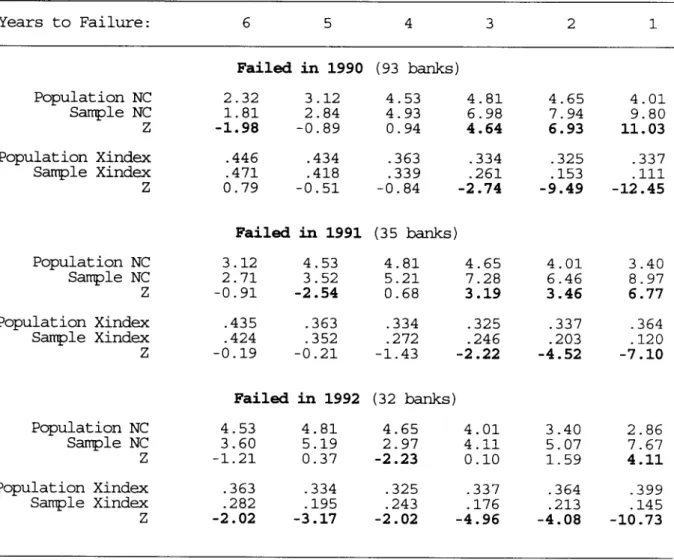
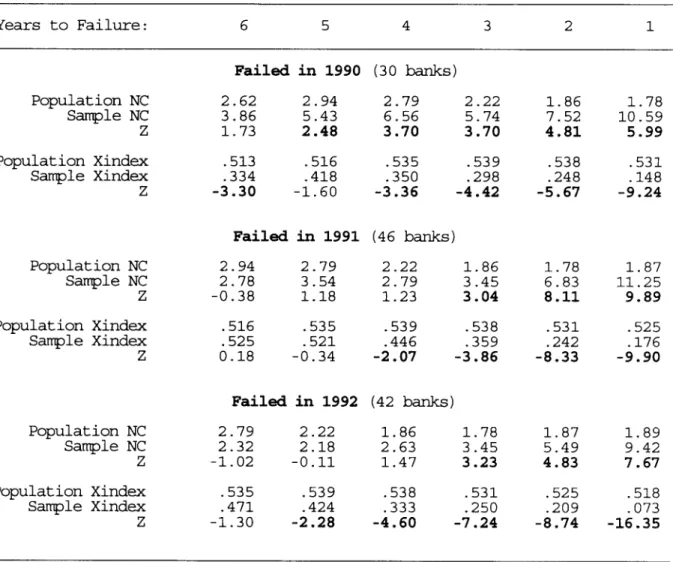
The banks were separated into two groups: 160 failed banks in southwestern states
(Texas, Louisiana, and Oklahoma) and 118 failed banks from the other 47 states. Each of
these two groups was separated further by year of failure, resulting in six subsamples. For
each of the six years leading up to failure, the mean values of NC and Xindex for the failed
’ To qualify as noncurrent, a loan must have been nonperforming (i.e., payments have not been made) for at least 90 consecutive days.
* For each year in the analysis, a thick cost frontier was estimated using a standard multi-product translog cost model and a sample of cost efficient commercial banks. (These banks were chosen based on the residual values derived for them when the cost model was first estimated for the entire population of commercial banks.) The output vector included loans, securities, transactions deposits, and fee-based income. Measures of X-efficiency were derived annually for each bank based on the distance between its actual unit costs and its unit costs had it been able to operate on the estimated frontier. See DeYoung (1994) for a thorough description of the model.
banks were compared to mean values of NC and Xindex for all other banks in their
respective regions. The results for all six subsamples are shown in Tables la and lb.
On average, all six groups of failed banks were significantly less cost efficient than
their nonfailing peers in the year just prior to failure. Mean Xindex ranged between the 7th
and the 18th efficiency percentiles (i.e., between .07 and .18) for these banks the year before they failed. This extremely low level of cost efficiency just prior to failure is likely related
to the extremely high levels of NC just prior to failure, which was significantly higher than
the regional averages in all six of the groups. Judging from this one-year-to-failure evidence
alone, it is not possible to disentangle excess expenses due to poor operating efficiency from
the costs of administering problem loans.
There is clear evidence that failed banks were also less cost efficient than their
nonfailing peers several years before failure. Three years prior to failure, mean Xindex was
significantly less than average in all six groups. In general, Xindex began to gradually
diverge from regional means between four to six years before failure. The two exceptions
are the 1992 Southwest and the 1990 nonsouthwest subsamples, in which mean Xindex was
already significantly below the regional mean six years prior to failure.
Noncurrent loans also tended to increase several years prior to failure. However, the
results in Tables la and lb suggest that cost efficiency in failed banks began to fall, or was
already at a subpar level, before noncurrent loans reached critical levels. Each of the six
subsamples fall into one of three general patterns. In the first pattern (Southwest 1990,
Southwest 1991, and nonsouthwest 1990), Xindex and NC decayed at about the same rate
approximately simultaneously.
In the second pattern (nonSouthwest 1991 and nonsouthwest
1992), both Xindex and NC gradually decayed across the entire six year period, but Xindex
became significantly different from regional means either one or two years earlier than did
NC. In the third pattern (Southwest 1992), Xindex was significantly lower than regional
means during each of the six years prior to failure, but NC dis not begin to increase until
three years before failure, and did not become significantly greater than the regional mean
until the year before failure.
Although these results are crude, they are consistent with the “management quality”
theory of bank failure extended above, i.e., that banks with low levels of operating efficiency
are also more likely to have poor underwriting and/or loan monitoring practices, resulting
(eventually) in more bad assets and a higher likelihood of failure. Of course, alternate
explanations of these results are possible.’ Future research might on this topic might,
following from Mester (1994), attempt to control for monitoring costs when estimating cost
efficiency measures.
2.
Efficiency and Corporate Reorganizations
Roughly half of the reduction in commercial banks since 1985 can be accounted for
by intra-holding company mergers of affiliate banks--in other words, corporate
reorganizations.
The effect of these reorganizations has been to reduce the number of
9 For example, loans do not move to noncurrent status until they are nonperforming for 90 days. If loans typically are 30 to 60 days past due for, say, nine months prior to becoming noncurrent, banks may also incur increased monitoring costs--and hence show increased cost inefficiency--nine months prior to showing an increase in noncurrent loans.
affiliate banks in multi-bank holding companies (MBHCs), or in some cases to completely
transform these firms into one-bank holding companies (OBHCs).
The choice of organizational form can be an important determinant of the efficiency of
a company’s operations. Observers often argue that the overhead required to maintain
multiple affiliates can be a costly drag on performance. Historically, however, considerations
other than efficiency have influenced banking companies’ choice of an organizational form.
that By choosing to organize as a MBHC, a bank could avoid legal constraints on both the
geographic scope of its operations and the breadth of its product offerings--advantages
could outweigh any intrinsic efficiency disadvantages.
Several recent developments have affected this tradeoff. The first is the easing in
many states of restrictions on intra-state branching. Most companies responded, in varying
degrees and at different rates over time, by consolidating all of their existing subsidiaries into
branch banks. lo This has not been the universal response, however, to the elimination of branching restrictions. Some MBHCs elected to merge only some--and in some cases none--
of their bank subsidiaries. The variety of responses suggests actual or perceived differences
in the efficiency benefits of complete consolidation.
The second development is the increase in competition in virtually all of the product
and geographic markets in which banks operate. One of the effects of increased rivalry is
pressure on banks to improve efficiency. The large number of intra-holding company
consolidations that have occurred
independent of changes in branching laws
suggests that thislo It is not uncommon for companies to maintain two bank subsidiaries rather than one. Typically, one will be relatively small and have a different charter type than the larger subsidiary. This allows companies to fully exploit existing or future advantages associated with state or Federal charters.
type of reorganization is perceived by the companies involved as enhancing efficiency.
2. I
htra-Compaq
Consolihtion and E_tjicienq
The seminal work on the relationship between organizational form and firm
performance is presented by Williamson (1970). Williamson argues that firms with a
multidivisional structure, like MBHCs, will usually outperform alternatively structured rivals.
Williamson’s discussion indicates that the he expects that the source of the superior
performance would be greater X-efficiency, although he does not use the term. In addition,
he emphasizes that optimal performance depends not only on the existence of a multi-
divisional structure, but also on which decisions and functions are centralized, and which are
located at the division level.
The exact nature of the relationship between organizational form and performance in
banking firms remains unclear. Intra-company consolidation will enhance organizational
performance if it permits holding companies to significantly lower costs. Cost savings might
materialize if organizations consisting of a single bank with branches are more able to exploit
size-related economies than are MBHCs. Intra-company consolidation might also lower costs
by facilitating improvements in X-efficiency. Banking researchers usually attribute inter-bank
differences in X-efficiency to “superior management, ” but it is possible that some of this
difference is attributable to differences in organizational form. Achieving optimal X-
efficiency may require combining separate, semi-autonomous operating subsidiaries into a
OBHC with branches.
adverse impacts on costs. MBHCs might realize the bulk of any potential scale economies by
centralizing decisions and functions. In this type of merger, branch offices are not typically
closed--an often cited source of cost savings in inter-company transactions.” Gains in
operating efficiency might be offset by increased “coordination costs.” In addition, there is
no guarantee that the quality of parent company management is significantly better than that
of its bank subsidiaries.
It is also possible that intra-company consolidation could improve performance by
increasing revenues. A consolidated organization might hold fewer low risk, low yielding
assets than would separate affiliate banks--although a MBHC might also implement this
reallocation by exercising centralized control over subsidiary bank asset/liability management.
Intra-company consolidations are not likely, however, to enhance revenues through pricing
changes because they do not alter local market structure.
2.2 Recent Empirical Evidwce
Empirical evidence on the performance effects of intra-holding company mergers is
scarce. Most of the recent research on bank mergers has focused on mergers between, or
acquisitions of, unaffiliated institutions.
In a recent study, Newman and Shrieves (1993) attempted to investigate Williamson’s
hypothesis using 1988 data and a sample of over 1700 banks. They examined differences in
operating efficiency for MBHC subsidiary banks relative to both OBHC subsidiaries and
independent banks. A critical assumption in their study is that all MBHC’s approximate
Williamson’s M-form structure. The authors organize their sample into four revenue classes,
and use a cost frontier approach to estimate efficiency measures for each bank in each
revenue class. They find that MBHC subsidiaries are more efficient than independent banks
in the three smallest revenue classes, but that OBHC banks are more efficient than
independents only in the smallest revenue class. Consistent with these results, MBHC banks
were signiftcantly more efficient than OBHC banks in each of the two middle revenue
classes. No significant differences in efficiency across organizational forms were found for
banks in the largest revenue class. The authors also generate a mean efficiency level at each
of the banking companies in their sample by aggregating the efficiency measures of the
subsidiary banks in each organization. Using pair-wise tests, they find that the mean
efficiency of OBHCs is significantly better, while the mean efficiency of MBHCs is no
different, than that of independent banks. Thus, this study finds that organizational form
affects bank efficiency without concluding that any single form is optimal. l2
DeYoung (1993) uses a thick cost frontier to estimate pre- and postmerger cost
inefficiency in 348 mergers approved by the OCC in 1987 and 1988. This study examines
only mergers that involved two banks, and includes (unlike most bank merger studies)
acquisitions by “active” firms that made additional purchases in the years immediately before
or after the observed acquisition. Forty-three percent of the observed mergers were within-
holding company reorganizations. Prior to the merger, the acquiring affiliate in these intra-
I2 Newman and Shrieves assumed that all of the MBHCs in their sample had the same “real” organizational form. Survey evidence, however, has consistently demonstrated that the degree of centralized control exercised by MBHC parent companies over the decisions and operations of their subsidiary banks varies considerably across holding companies. Whalen (1983) found bank profitability to be significantly greater at subsidiaries of MBHCs that exercised a higher degree of centralized control, evidence that “real” organizational form, even within the same nominal structure, can have an impact on bank performance.
company mergers was more cost efficient than the target affiliate only 42 percent of the time.
In contrast, acquirers in mergers of unrelated banks were more cost efficient than their
targets 64 percent of the time. Although these premerger results suggest that intra-company
mergers are less likely than inter-company mergers to produce efficiency gains, postmerger
(three years after the merger) cost efficiency improved in about 64 percent of the intra-
company mergers compared to only 54 percent of the mergers of unrelated institutions.
When mergers involving “active” banks were excluded, however, cost efficiency improved in
only 56 percent and 43 percent, respectively, of the observed transactions. (Section 3
contains further discussion of this study.)
Linder and Crane (1992) examine the pre- and postmerger performance of all bank
mergers in New England from 1982 through 1987. Of the 47 cases in their complete sample,
25 were intracompany mergers of previously owned affiliates. The authors calculated a
variety of performance measures for both merger partners on a pro forma basis one year
prior to each merger, and one year and two years after the merger for the merged entity.
Relative to their peers, more than three-quarters of the banks involved in intracompany
mergers improved their ROA one year after the merger, and this improvement was sustained
during the second postmerger year. Improvements in net interest margin, related to pricing
changes, were determined to be the source of the increase in ROA for these mergers.
Although the banks involved in intracompany mergers were found to have below-industry
profitability in the year prior to merger and so had more room to improve their performance,
Linder and Crane report that intraholding mergers out-performed mergers of newly acquired
noninterest expense to assets increased postmerger relative to peers for both types of mergers,
a finding that is not consistent with improved efficiency.
2.3
Evidence from capital markets
Whalen (1994) uses a standard event study methodology to investigate the impact of
intra-company consolidation on stockholder wealth. The critical event in this study is the
first public announcement by a MBHC of its intention to consolidate substantially all of its
subsidiary banks, effectively transforming itself into a OBHC with branches. Significant
positive abnormal returns around this event date would suggest that the announced
consolidation is expected to boost future profitability--through cost efficiencies, revenue
increases, or both--thus enhancing the wealth of holding company shareholders. The absence
of significant positive returns around the event date would suggest that investors believe that
the optimal organization form can be reached without a complete consolidation of affiliate
banks.
The advantage of this research methodology (as opposed to one that analyzes
accounting data) is that it yields a relatively simple estimate of the expected long run net
impact of intra-company consolidation on the future profitability of firms making this type of
structural change. However, this approach reveals only the market’s expectation of the
impact of reorganization on future profits, rather than actual profitability, and does not
identify the source of any profitability improvements that are detected.
their subsidiary banks within their headquarters state. l3 These consolidations are spread over
a relatively lengthy time period spanning the years 1974 through 1993. To be included in
the sample each company had to be publicly traded and have a readily identifiable premerger
announcement date. Estimates of the abnormal returns for each holding company were
generated using a one factor market model and stock returns for the period beginning 90 days
before, and ending 90 days after, each company’s event date.14 Cross-sectional averages of
abnormal and standardized abnormal returns for the sample were calculated for each day over
the examination period and were also summed over various meaningful segments of event
time to produce cumulative average abnormal return (CAAR) measures. The sign, size and
statistical significance of these average and cumulative average return measures indicate the
capital market’s estimate of the wealth impact of MBHC consolidation.
The key results are presented in Tables 2 and 3. In both tables, results are presented
for the complete sample as well as for a subsample that excludes companies with interstate
bank subsidiaries.
Table 2 contains average abnormal returns (AAR) and associated test statistics for the
period beginning 3 days before and ending 3 days after the event date (t=O). Looking first
r3 Nine of these MBHCs owned subsidiary banks outside of their headquarters state that were not part of the announced reorganization. In addition, several of the holding companies in the sample consolidated all but one of their subsidiaries into a large lead bank holding more than 90 percent of the banking assets of the company, leaving one smaller unconsolidated bank affiliate (typically with a different charter than the lead bank). I4 The market model equations were estimated using OLS over a 80 day estimation period beginning 11 days after, and ending 90 days after, each company’s announcement date. Alternately, the coefficients were estimated using a statistical technique that corrects for problems related to non-synchronous trading. Results obtained using a preannouncement day estimation period (beginning 90 days before and ending 11 days before the announcement date) and a combined pre- and post-announcement date period (the entire period from 90 days before to 90 days after the announcement date with the exception of the 21 day period immediately surrounding it) were also analyzed. The results obtained in every case are basically the same as those reported in the paper.
at the results for the complete sample, the tests indicate significant and positive, although
small, average abnormal returns on days t-2 and t-l. The average return on day t =0 is
positive but not significant. The same pattern occurs when companies with interstate banking
subsidiaries are excluded. A reasonable explanation for this pattern is that the market had
information on the consolidation one or two days prior to date it appeared in the financial
press. Comparing the average return figures for the full sample and the subsample on these
three days shows a somewhat larger positive response for the companies that consolidated
basically all of their existing banking subsidiaries (i.e., those without interstate
operations).
banking
Table 3 contains cumulative average abnormal returns calculated over a variety of
narrow and wide time intervals. l5 For narrow intervals near the event date, the CAAR figures for both samples are positive and the z-statistics indicate that they are significantly
different from zero. Thus, the empirical results are consistent with the hypothesis that
consolidation generally enhances shareholder wealth. Though statistically significant, these
CAAR figures are not large, suggesting that the performance effects of consolidation are
relatively modest. CAAR over wider pre- and post-announcement time intervals are not
significantly different from zero, suggesting that the abnormal returns observed around t =0
are in fact attributable to the announced event.
The pattern and size of the abnormal returns around the announcement day varied
considerably from company to company. To obtain insight on the determinants of these
inter-company differences, the cumulative standardized return for each company over the t-2
to t=O interval was regressed on alternative sets of variables hypothesized to influence the
benefits and/or costs of consolidation.‘6 The regression results identified three variables as
having a significant impact on abnormal returns. First, returns to consolidation were
positively related to the number of subsidiaries consolidated, with positive returns to an
additional bank occurring only in reorganizations involving 16 or more banks. Second,
larger returns were found for companies whose lead bank was larger than $1 billion but
smaller than $10 billion in total assets. Third, returns to consolidation were negatively
related to the average size of the non-lead bank subsidiaries that were consolidated.
Returns
were not significantly related to efficiency, profitability, the year of consolidation, or the
extent of interstate banking operations.
The statistically significant and positive abnormal returns detected here suggest that
intra-company consolidation within state boundaries can be expected to significantly improve
future profitability.
Admittedly, these findings reflect investor expectations and are based on
the analysis of a relatively small sample, but they are robust with respect to changes in
estimation period and estimation techniques, are consistent with the intrastate trend toward
branch banking (as opposed to retaining MBHC forms), and complement the empirical
evidence reported by DeYoung and Linder-Crane.
While the analysis suggests that consolidation of holding companies across state lines
could also yield efficiencies and enhance profitability, such a conclusion is tentative at best.
It may be that further material performance gains might not be possible for interstate MBHCs
that have already consolidated within the boundaries of each of the states in which they
operate. This possibility is supported by discussions in the trade press, as well as the rather
rudimentary regression results reported above which indicate larger abnormal returns for
companies that consolidate a considerable number of relatively small subsidiary banks into
moderately sized lead banks. l7
3.
Efficiency and Mergers & Acquisitions
About 25 percent of the commercial banks that disappeared between 1986 through
1992 were acquired by other banking organizations. Given the high degree of cost
inefficiency observed in the industry, one would expect that at least some of these
acquisitions were
the bank mergers
motivated by efficiency concerns. Like corporate reorganizations, some of
in the 1980s may have been motivated by the postmerger opportunity to
eliminate duplicate overhead. Other mergers may have allowed banks to achieve a more
optimal size, product mix, or geographic coverage. Still others may have been designed to
generate profits by improving the operating efficiency of the cost-inefficient banks acquired.
Banking companies may also be motivated to acquire other banks for non-efficiency
reasons. Growth into new markets is often easier via a market extension merger rather than
through
de rwvo
entry. Market extension mergers may better situate a bank to takeadvantage of the likely relaxation of interstate branching restrictions. Banks might enhance
their profitability via intra-market mergers that increase their market power. Bank managers
may simply be motivated by their desire to run a larger banking empire.
” See Barton Crockett, “Cost Savings From Branching May Fall Short,” American Banker, March 15, 1994 for a discussion.
What does the existing research on inter-bank mergers and acquisitions reveal about
the motivation for bank acquisitions ? Do efficiency gains appear to be a major motivation?
If so, did the bank merger wave of the past decade materially enhance the efficiency of the
industry? Finally, will the inter-bank mergers and acquisitions of the next decade resemble
the mergers of the past decade?
3. I Sources of
potential eficienq
gainsj-om bank mergers
There is substantial evidence that mergers can reduce costs by making banks larger,
but there is some disagreement about the range of bank size over which scale economies
occur. Most studies have found that the bulk of scale economies are captured, but not fully
exhausted, by the time a bank has $100 to $200 million in assets, but McAllister and
McManus (1993), Ferrier and Love11 (1990), and Hunter and Timme (1986) all find
additional scale economies for banks over $1 billion in assets. The magnitude of these
savings also varies from study to study. Evanoff and Israilevich (1991) survey the banking
scale economy literature, and show that the estimated cost inefficiency from operating at sub-
optimal scale can be as little as 3 percent, or as much as 40 percent, of total costs.
A second potential source of merger-induced savings is scope economies. However,
the existing evidence suggests only limited synergies for banks that merge in order to expand
their product offerings. Clark (1988) and Mester (1987) review the banking scope economy
literature, and conclude that offering a wide range of products does not give a bank a
significant cost advantage over its less diversified rivals.
efficiency at the acquired bank. Evanoff and Israilevich (1991) and Berger, Hunter, and
Timme (1993) review the literature on productive inefficiency, or X-inefficiency, in banks.
These studies tend to find that the typical bank incurs expenses that are 20 percent to 30
percent higher than the most efficient banks of similar size and product mix, levels that
dominate the potential for scale and scope economies in most banks. If differences in the
abilities of bank managers are the sources of these cost disparities, a merger in which
managers and/or management practices at an X-inefficient target bank are replaced by the
management practices of an X-efficient acquiring bank might generate large cost savings.
Bank mergers might also produce efficiencies that enhance revenues. The premerger
pricing scheme at the target bank may not have been maximizing revenues, and might be
adjusted postmerger. A larger postmerger bank may be able to hold a somewhat riskier, and
thus higher yielding, portfolio of assets. The postmerger bank may be able to offer a broader
product line, thus offering “one-stop shopping” to its customers.
3.2
Existing empirical evidence on p&merger eficiencies
To the extent that bank merger studies have detected postmerger improvements in
bank performance, the improvements have been revenue enhancements rather than cost
savings. Furthermore, when studies have identified the premerger potential for cost savings,
there has been no evidence that this potential is systematically realized.
In a multi-equation regression model that controls for branching laws, market
structure, bank size and risk characteristics, and executive compensation, Shranz (1993) finds
states that do not restrict acquisitions by multibank holding companies. Although this study
does not examine the results of actual bank mergers, its results suggest that banks tend to
operate more efficiently when the
possibility
of takeover exists. Regardless, stock marketevidence from actual mergers finds that mergers of publicly-traded banks do create value.
An exhaustive stock market event study of bank mergers by Hawawini and Swary (1990)
found wealth effects similar to those found in event studies of mergers between nonbanks,
i.e., target bank stockholders received significant positive abnormal returns that exceeded the
slightly negative abnormal returns to acquiring bank shareholders, resulting in an increase in
net aggregate shareholder wealth. These studies, however, measure only the market’s
expectation that mergers will improve future performance, and do not identify the underlying
reasons for these increases in wealth.
Benston, Hunter, and Wall (1992) found that the acquisition price premium in bank
mergers was positively related to acquiring bank efficiency (measured by the ratio of market
to book value) and negatively related to target bank efficiency, suggesting that the market for
corporate control of banks expected efficient managers to be able to improve the performance
of targets previously run by inefficient managers. Shaffer (1993) used thick frontier
techniques to simulate “megamergers” (mergers in which both banks have over $1 billion in
assets) between actual banks under various assumptions about the postmerger transfer of
efficiency. In hypothetical merger scenarios that paired cost-efficient banks with
cost-inefficient banks, significant savings resulted when it was assumed that 100 percent of
the cost efficiency difference was eliminated after the merger.
efficiency, but this potential does not sytematically translate into postmerger cost savings. In
a study of 57 megamergers, Berger and Humphrey (1992) used regression residuals to rank
the cost efficiency of merging banks against all nonmerging megabanks. Most of these
mergers showed the potential for efficiency gains (i.e., acquiring banks were more X-efficient
than their targets); however, this potential was not systematically exploited after the merger.
Fixler and Zieschang (1993) used index numbers to compare the productivity (output as a
ratio of inputs) of banks that merged to the productivity of hypothetical reference banks
having similar characteristics and found similar results.
A large number of studies have examined premerger and postmerger financial ratios
such as operating margins, return on assets and/or equity, and loans or noninterest expenses
to total assets. Consistent with the studies of bank mergers and X-inefficiency, Linder and
Crane (1992), Srinivasan (1992), O’Keefe (1992), and Spong and Shoenhair (1992) all find
no strong postmerger improvement in financial ratios at merging banks. These results are not
universal, however. Cornett and Tehranian (1992) studied a set of 30 large mergers and
found that, relative to nonmerging banks, postmerger ROE increased, but postmerger ROA
did not increase. Spindt and Tarhan (1991, 1993) find significant postmerger improvements
in ROE, operating margin, expenditures on employees, and in some cases ROA.
3.3
Interpreting the evidence
In general, the lack of systematic evidence of efficiency gains from bank mergers
argues strongly that cost savings were not the predominant motive for bank mergers during
post-merger efficiency gains during the 1980s points to asset growth or geographic expansion
as the motivation for many of these mergers. Mester (1994)--inferring from cost-cutting
goals announced at the time of the mergers--suggests that the motives for acquiring banks in
the 1990s may have shifted toward efficiencies gains, while mergers in the 1980s often stated
market extension and growth as their objectives. When external growth is the motivation for
making acquisitions, acquirers may target franchises with attributes that will ease the
acquirer’s entry into a new geographic market, such as extensive branch networks. These
targets may in fact be cost-inefficient (for example, the targets may be over-branched), and as
a result appear to offer “potential” for efficiency gains. However, access to new customers is
essential to establishing a new regional franchise, and cutting excess costs by closing
branches will reduce that access.
If these observations are accurate, they suggest the possibility of a two-part strategy
for mergers of non-affiliated banks. In the first step, banks get a toehold through a market
extension purchase of a bank with an extensive branch network. The acquiring company
might for a period of time operate the target as-is (i.e., with excess labor and excess branch
locations remaining in place) in order to preserve existing customer relationships and
establish brand presence in the new market. Once customer loyalty has been solidified,
moves to cut costs--reducing office hours or eliminated branch locations--could be made at
less risk to the value of the acquired franchise.
DeYoung (1993) contains some evidence consistent with this two-part merger strategy
scenario. Table 4 reports a portion of his results for 105 acquisitions made by national banks
banks by acquiring banks that had not made any other acquisitions three years after or two
years before. These transactions are split into two groups in Table 4, which shows pre- and
postmerger efficiency results for 61 “acquisitions” of banks in the same holding company as
the acquiring bank (i.e., corporate reorganizations) and 44 acquisitions of unrelated banks.
There are two measures of X-efficiency reported for each group of mergers in Table
4. Xassets equals X-inefficiency per dollar of assets, and is derived from a thick cost frontier
model.18 Xindex is based on Xassets and is uniformly distributed from 0.0 for the most X-
inefficient bank to 1.0 for the most X-efficient bank. Both Xindex and Xassets were
estimated separately for the target bank and the acquiring bank the year prior to the merger,
and for the combined bank three years after the merger. To determine whether a merger
enhanced efficiency, postmerger Xindex (or Xassets) was compared to the asset-weighted
average of Xindex (or Xassets) for the acquirer and target banks.
The results are markedly different for the two different categories of mergers. The
target bank was less efficient than its acquirer in 32 of the 44 mergers of unrelated banks.
Acquiring banks averaged in the 56th efficiency percentile with an average of $.0089 of
excess costs per dollar of assets, while targets averaged in only the 44th efficiency percentile
with an average of $.0130 of excess costs per dollar of assets. In both cases, the means were
different from each other at the 10 percent level of significance
Although these premerger
results are consistent with mergers that are motivated by the chance to make efficiency gains
at a poorly managed target, the transactions did not systematically deliver postmerger
efficiency gains. Postmerger Xasset improved by a nonsignificant amount, and postmerger
I8 The model is virtually identical to that used in Section 1 of this paper, with the exception of the output vector. See DeYoung (1993) for a complete description of this model.
Xindex actually fell.
In contrast, in the majority of intraholding company mergers the “target” affiliate
tended to be more X-efficient than its “acquirer.” Furthermore--consistent with Whalen’s
results reported in section 2--both Xasset and Xindex improved after these transactions.
Postmerger Xasset improved in 33, and postmerger Xindex improved in 34, of these 61
transactions. Mean Xasset improved from $.0117 to $.0086 per asset dollar, and Xindex
improved from the 48th to the 50th efficiency percentile, although neither of these changes
was significantly different from zero.
These results suggest that intra-company mergers and inter-company mergers in the
1980s were motivated by different objectives, at least in the short-run. Acquisitions of
unrelated banks had the potential for cost efficiencies, but did not enhance postmerger
efficiency within three years. This is what we would expect to observe if the primary
motivations are market extension and customer retention in these new markets. In contrast,
average postmerger X-efficiency improved in intraholding company mergers, although the
change was not statistically significant. Because market extension is not a possible motivation
for intra-company mergers, cost savings might be more likely in these mergers.
4.
Industry Consolidation in the Next Decade: Strategies for Banks and Regulators
Overall, the evidence presented in the previous three sections suggests that the
banking industry has become more efficient as it has consolidated. We have seen evidence
evidence that MBHC consolidations increase the value of the firm. Finally, we have seen
evidence that mergers of unrelated banks enhance (expected or actual, depending on the study
in question) postmerger profitability, and may hold the potential for gains in cost efficiency in
the future. l9
Given the increased competitive pressures facing banks, the efficiency improvements
that have already been captured do not ensure that banks--or a least banks as we currently
know them--will maintain a profitable niche in financial services markets. Further industry
consolidation may be inevitable if banks are to remain viable producers of a wide variety of
financial services.
What does the decade ahead promise for industry consolidation and industry
efficiency? One factor that will obviously shape the process of future consolidation is the
lifting of restrictions on interstate branching. But much also depends on the competitive
positions that banks choose to occupy in the financial services industry. How might banks
best shape themselves to take advantage of the future environment, and how should bank
regulators respond?
4. I W%at should banks do?
Whatever banks do, they will have to do it more efficiently. The evidence presented
above confirms the obvious, that inefficient business firms do not survive. Efficiency
I9 Although the evidence presented here suggests that the three channels of consolidation (failure, reorganization, and merger) are efficiency-enhancing, not all studies have concluded that the banking industry as a whole became more efficient during the consolidation of the 1980s. Analysis of productivity and cost efficiency in banks by Bauer, Berger, and Humphrey (1993) suggests that industry-wide efficiency remained relatively constant across the 1980s. On the other hand, Elyasiani and Mehdian (1990) found evidence that the industry- wide production frontier shifted inward (i.e., productive efficiency increased) between 1980 and 1985.
supports earnings and, in the worst case, helps a bank weather potentially fatal economic
shocks. Growing competition from other depositories and nonbanks makes efficient banking
operations critical for survival in the next decade. Rationalizing existing corporate structure,
and expanding geographic reach, are two tactics that banking companies might use to enhance
efficiency.
Much of what banks should do on these fronts is constrained by what they are
permitted to do. Restrictions on interstate operations are currently a binding constraint for
many banking companies that already own banks in multiple states and wish to consolidate
their organizations. Although many banking organizations have announced their intentions to
consolidate their affiliates across state lines as soon as possible, these actions are dependent
on the lifting of interstate branching restrictions.
A distinction must be drawn between the MBHC consolidations that have occurred in
the past and those that interstate branching legislation will allow in the future. Although the
evidence presented here suggests that consolidating MBHCs
within
state boundaries hasresulted in small but significant efficiency gains, MBHCs that have already consolidated in
this manner may have exhausted the bulk of available cost savings. Further consolidation
across
state lines may yield only inconsequential efficiency gains for multi-state MBHCs thathave already consolidated each of their within state operations. Furthermore, banks should
consider whether a consolidated organization is consistent with their basic managerial
approach. Some banking organizations that have chosen not to consolidate their affiliates into
a single bank--Bane One is the example generally cited--have been very successful.
postmerger efficiency gains, while others have not--there is little hard evidence on what
separates the two groups. The lack of systematic cost savings from bank mergers may be
because the objectives of acquisitions in the 1980s were market extension rather than cost
savings. The anecdotal evidence, as well as the research presented above, is consistent with
this reading of recent bank merger activity. In the next decade, banking companies might do
well to make fewer acquisitions for external growth and concentrate instead on extracting
efficiencies from the multi-bank organizations put in place by the market extension mergers
of the past decade. This being said, the expected passage of some form of interstate
branching legislation has accelerated purchases by MBHCs across state lines. Even if such
acquisitions do not provide productive synergies or scale economies, they may eventually
provide an opportunity for overhead reduction via interstate corporate reorganization. The
success of these acquisitions, then, hinges to a large extent on the same arguments just
discussed concerning corporate reorganizations.
Banking companies should not choose organizational structures or plot acquisition
strategies without considering their strategic position in financial services markets. Banks
should make their expansion and consolidation plans based on a firm understanding of their
competitive advantages relative to other bank and nonbank financial services firms. It is
possible to get carried away with efforts to cut costs. Cutting waste and duplication is an
ongoing tactic that enhances profitability at every organization regardless of its competitive
strategy. At some point, however, cutting costs can reduce the quality or range of services a
bank can provide its customers. A bank has to ask itself, “given the strengths and
provider of financial services in our market?”
Because banks incur some expenses that their competitors do not, such as paying
deposit insurance premiums and preparing for examinations by (often multiple) regulators, it
is difficult for them to offer generic, commodity-type services at competitive prices. Banks
may be better off focussing on providing fee-based products and services, preferably to
customers willing to pay extra for personal service.20 The actions necessary to cut costs to
the bone--closing branches, shorter hours, fewer customer service representatives, lower
salaries (i.e., less expertise)--reduce a bank’s abilities to attract and retain the business of
high-margin customers who value personal relations and financial expertise. Banks should
consider these trade-offs carefully when contemplating cost cuts through reorganization or
acquisition. Banks cannot afford to be blind cost-cutters without regard to the quality and
breadth of financial services necessary to maximize profits.
4.2 JT7mt should the regulators do?
Regulators, as well as bankers, need to be acutely aware of the critical importance
efficiency. The evidence indicates that inefficient banks are more likely to require closer
supervisory scrutiny and ultimately fail, perhaps imposing additional costs on third parties of
in
the process. But more importantly, whatever their primary purpose (encouraging safety and
soundness, consumer protection, etc.), the constraints imposed by regulators can affect the
ability of banks to compete successfully with nonbank firms by constraining bank efficiency.
Regulatory constraints can also penalize consumers by limiting choice and by raising search
*’ See William Isaac, “Emphasizing Low Pirces Over Good Service is a Risky Strategy,” American Banker, February 16, 1994, for a discussion.