CLUSTER-BASED SEMI-SUPERVISED
ENSEMBLE LEARNING
by
RODRIGO GABRIEL FERREIRA SOARES
A thesis submitted to
The University of Birmingham
for the degree of
DOCTOR OF PHILOSOPHY
School of Computer Science
College of Engineering and Physical Sciences
The University of Birmingham
University of Birmingham Research Archive
e-theses repository
This unpublished thesis/dissertation is copyright of the author and/or third parties. The intellectual property rights of the author or third parties in respect of this work are as defined by The Copyright Designs and Patents Act 1988 or as modified by any successor legislation.
Any use made of information contained in this thesis/dissertation must be in accordance with that legislation and must be properly acknowledged. Further distribution or reproduction in any format is prohibited without the permission of the copyright holder.
To my grandparents.
And to my lovely Kelly.
Abstract
Semi-supervised classification consists of acquiring knowledge from both labelled and un-labelled data to classify test instances. The cluster assumption represents one of the potential relationships between true classes and data distribution that semi-supervised algorithms assume in order to use unlabelled data. Ensemble algorithms have been widely and successfully employed in both supervised and semi-supervised contexts. In this Thesis, we focus on the cluster assumption to study ensemble learning based on a new cluster regularisation technique for multi-class semi-supervised classification. Firstly, we introduce a multi-class cluster-based classifier, the Cluster-based Regularisation (Cluster-Reg) algorithm. ClusterReg employs a new regularisation mechanism based on posterior probabilities generated by a clustering algorithm in order to avoid generating decision boundaries that traverses high-density regions. Such a method possesses robustness to overlapping classes and to scarce labelled instances on uncertain and low-density regions, when data follows the cluster assumption. Secondly, we propose a robust multi-class boosting technique, Cluster-based Boosting (CBoost), which implements the proposed cluster regularisation for ensemble learning and uses ClusterReg as base learner. CBoost is able to overcome possible incorrect pseudo-labels and produces better generalisation than existing classifiers. And, finally, since there are often datasets with a large number of unlabelled instances, we propose the Efficient Cluster-based Boosting (ECB) for large multi-class datasets. ECB extends CBoost and has lower time and memory complexities than state-of-the-art algorithms. Such a method employs a sampling procedure to reduce the training set of base learners, an efficient clustering algorithm, and an approximation technique for nearest neighbours to avoid the computation of pairwise distance matrix. Hence, ECB enables semi-supervised classification for large-scale datasets.
Acknowledgements
Firstly, I would like to greatly thank my supervisor, Prof. Xin Yao, for his insightful comments, diligent guidance, generosity and kindness towards me. He has facilitated and encouraged this research tremendously. I’m extremely grateful to him for accepting me as his doctoral researcher. My career has immensely benefited from his encouragement, vast wisdom and discernment in conducting this research.
I would also like to give many thanks to my friend, Dr. Huanhuan Chen, for immensely helping to clarify various ideas in this research. He has always been hugely helpful to me. He has encouraged this work and provided many valuable advices to enhance this research and my professional life.
I’m very grateful to my thesis group members, Dr. Ata Kab´an and Dr. John Bullinaria, for closely observing this work and offering insightful comments and advices.
I would like to thank the support from The CAPES Foundation, Ministry of Education of Brazil. My thesis research was also supported by the EU iSense grant (No. 270428).
Special thanks to Jakramate Bootkrajang who has been my Ph.D. student mate, office mate and house mate for three years. He has also helped with various discussions of ideas. Many special thanks to Dr. Leandro Minku who has welcomed me in Birmingham. He has been one of the most helpful people that I have had the fortune to meet. Aside from these, I thank all my research student mates who have helped in all these years.
My very special thanks to my family, who has given me unconditional love, support and encouragement throughout my entire life. And my deepest gratitude to my lovely
future wife, Kelly. I hardly have words to express how amazing she has been in order to make this journey possible.
Contents
1 Introduction 1
1.1 Semi-supervised learning . . . 1
1.2 Semi-supervised classification . . . 2
1.2.1 Transductive and inductive learning . . . 4
1.2.2 Semi-supervised learning assumptions . . . 5
1.3 Discussion on supervised and semi-supervised classification . . . 6
1.4 Cluster-based classification and ensemble learning . . . 9
1.5 Motivations . . . 10
1.5.1 SSC with cluster regularisation . . . 11
1.5.2 Ensemble learning in SSC . . . 12
1.5.3 Efficient algorithm for large datasets . . . 13
1.6 Contributions . . . 15
1.7 Publications resulting from the thesis . . . 18
1.8 Outline of the Thesis . . . 19
2 Semi-supervised Algorithms 21 2.1 Generative methods. . . 21 2.2 Self-training . . . 22 2.3 Co-training . . . 23 2.4 Manifold-based methods . . . 24 2.5 Cluster-based methods . . . 26 2.6 Ensemble methods . . . 28 2.7 Discussion . . . 32
2.7.1 Limitations in cluster-based methods . . . 32
2.7.2 Unlabelled data in ensemble design . . . 33
2.7.3 Time and memory requirements . . . 34
2.8 Conclusions . . . 35
3 Multi-class Semi-supervised Classification with Cluster-based Regular-isation 37 3.1 Introduction . . . 38
3.2 Cluster-based Regularisation algorithm . . . 44
3.2.2 A new semi-supervised loss function with cluster-based regularisation 47
3.2.3 Cluster-based regularisation . . . 49
3.2.4 Multi-class cluster-based loss function . . . 52
3.2.5 Initialisation procedure . . . 53
3.3 Cluster-based Regularisation with Radial Basis Functions Network . . . 54
3.4 Cluster-based Regularisation with Multilayer Perceptron . . . 59
3.5 Experimental studies . . . 60
3.5.1 Methods and parameter tuning . . . 60
3.5.2 Transductive setting . . . 64
3.5.3 Inductive setting . . . 66
3.5.4 Computational time . . . 70
3.6 Discussions . . . 72
3.7 Conclusions . . . 78
4 A Fully Semi-supervised Ensemble for Multi-class Classification 81 4.1 Introduction . . . 82
4.2 Background . . . 89
4.3 Cluster-based Boosting algorithm . . . 91
4.3.1 Gradient boosting . . . 92
4.3.2 General architecture and notations . . . 93
4.3.3 Gradient boosting for multi-class classification . . . 95
4.3.4 Multi-class cluster-based loss function . . . 97
4.3.5 Multi-class boosting with cluster regularisation . . . 99
4.3.6 Radial Basis Functions Network as base learner and initialisation procedure . . . 102
4.4 Experimental studies . . . 104
4.4.1 Methods and parameter tuning . . . 104
4.4.2 Transductive setting . . . 107
4.4.3 Inductive setting . . . 109
4.4.4 Computational time . . . 112
4.5 Discussions . . . 114
4.6 Conclusions . . . 121
5 Efficient Boosting for Semi-supervised Classification 123 5.1 Introduction . . . 124
5.2 Background . . . 126
5.3 Efficient Cluster-based Boosting . . . 130
5.3.1 General architecture and notations . . . 130
5.3.2 Multi-class loss function with cluster regularisation . . . 132
5.3.3 Cluster-based regularisation . . . 134
5.3.4 Initialisation procedure . . . 134
5.3.5 Approximate nearest neighbours and large-scale clustering . . . 135
5.3.7 Radial Basis Function Network as the base learner. . . 138
5.3.8 Boosting for large-scale multi-class classification . . . 139
5.4 Experimental studies . . . 142
5.4.1 Methods and parameter tuning . . . 142
5.4.2 Transductive setting . . . 145
5.4.3 Inductive setting . . . 146
5.4.4 Large-scale datasets. . . 148
5.5 Discussions . . . 151
5.6 Theoretical discussion on Efficient Cluster-based Boosting . . . 162
5.7 Conclusions . . . 164
6 Conclusions and Future Work 167 6.1 Contributions . . . 167
List of Figures
1.1 How SSC algorithms generate decision boundaries.. . . 7
1.2 On the left-hand side, GMM considers only labelled data. On the
right-hand side, both labelled and unlabelled data influences the decision boundary. 7
1.3 On the left-hand side, both labelled instances lie in the same high-density region. On the right-hand side, each labelled instance is a different cluster. In this dataset, true decision boundary does not correspond to the gap between high-density regions. The data distribution is not useful for the inference of the class distribution. In this case, SSC algorithms might not
improve generalisation when compared to supervised methods. . . 8
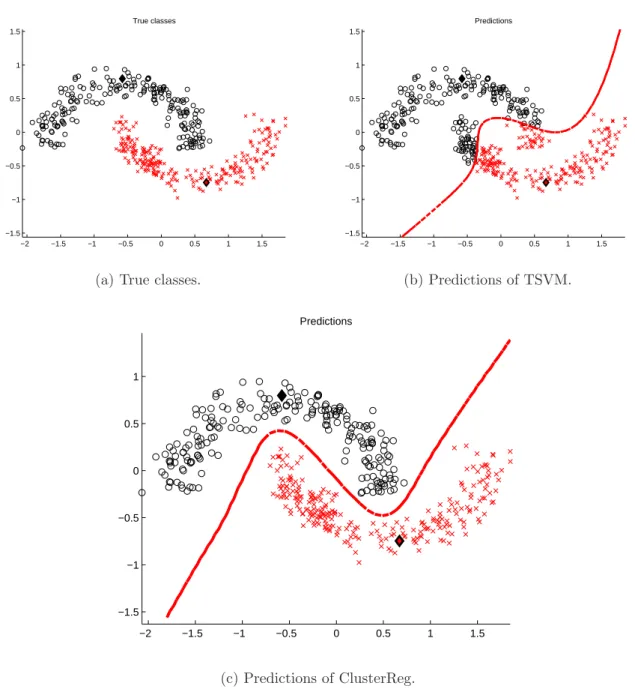
3.1 Synthetic two half-moons dataset. Each half-moon corresponds to one class. 39
3.2 Inverted two half-moons. . . 40
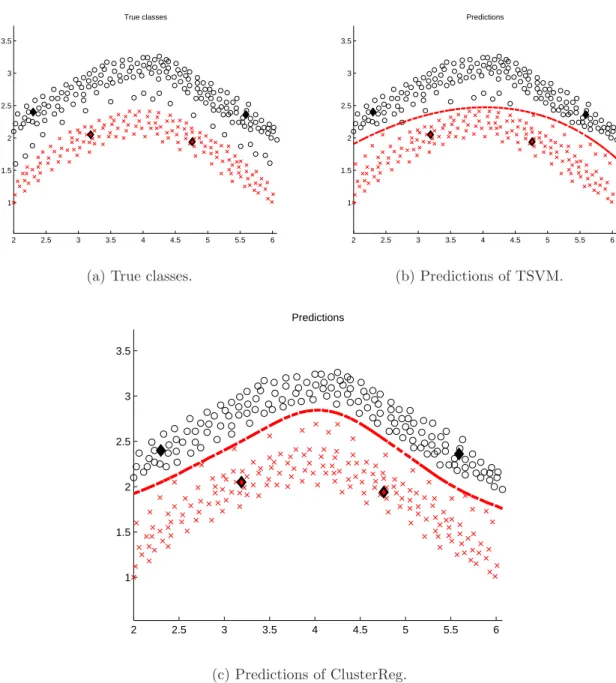
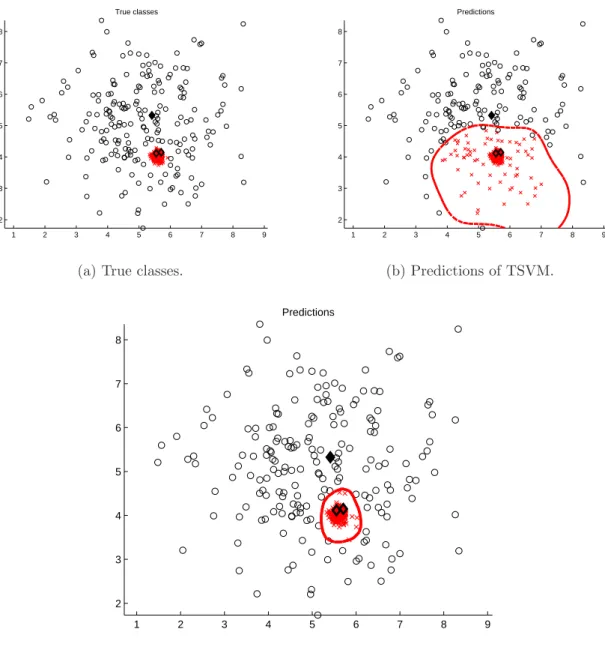
3.3 Dataset with one sparse and one dense classes corresponding to clusters. The denser cluster is placed in the sparser cluster. The labelled instances are arbitrarily chosen to mislead the classifiers. They would tend to classify the instances on the bottom of the sparse class as belonging to the tighter class. TSVM is sensitive to the position of the instances in the clusters, therefore it might not find the correct decision boundary. ClusterReg, as STSC can deal with clusters of arbitrary shapes, can take into account such partition and properly generate a decision boundary. . . 41
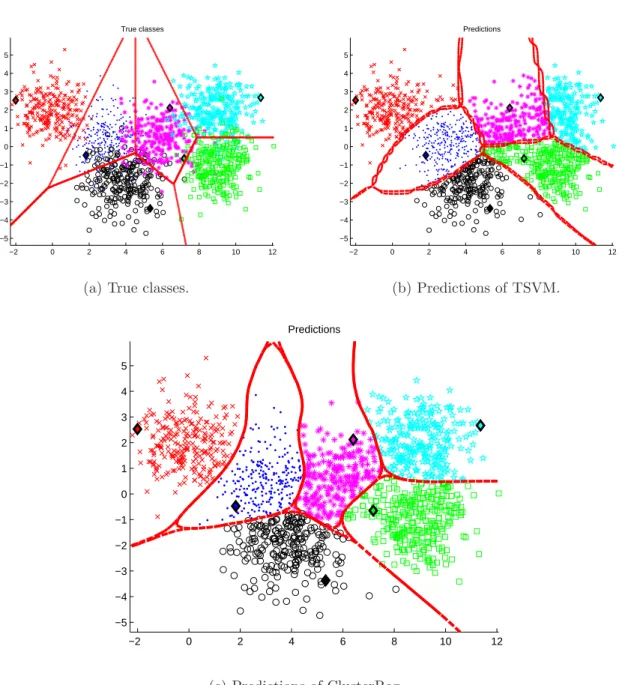
3.4 Dataset with 6 overlapping classes drawn from unit-variance isotropic Gaus-sians (N(µ,I)) and translated. Due to overlapping clusters, TSVM cannot find the appropriate decision boundary. ClusterReg, by considering the partition of a clustering algorithm, is able to find a better decision boundary. 42
3.5 ClusterReg’s architecture. . . 47
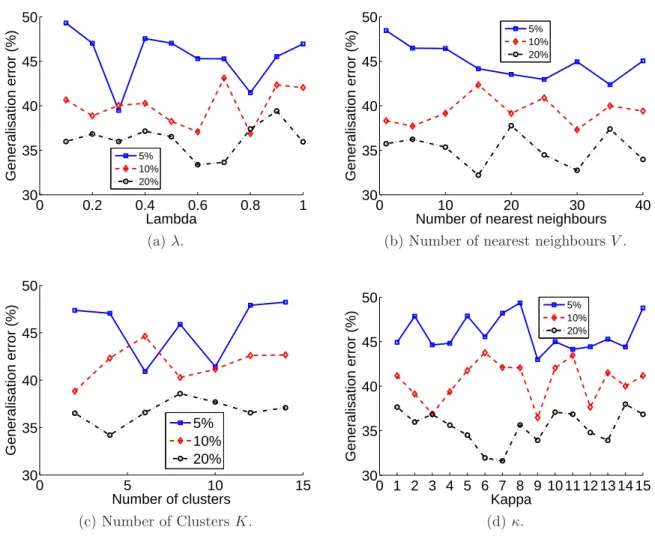
3.6 Generalisation error from 10-fold cross-validation with different values of λ,V,K and κacross three different percentages of labelled data (5%, 10% and 20% in relation to the total number of instances) in BUPA dataset [Frank and Asuncion, 2010]. . . 64
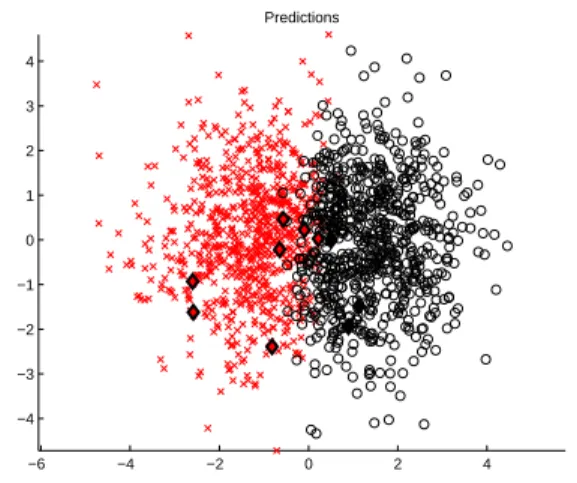
3.7 Two-dimensional projections of true classes and predictions from Cluster-Reg for g241c and g241d with 10 labelled instances, denoted by dark dia-monds. . . 69
3.7 Plots of mean and standard deviation of the computation time of 10-fold cross-validation executions for 5%, 10% and 20% of labelled data, on the datasets where ClusterReg obtained the best results. . . 74
4.1 Steps of ensemble learning using the two half-moon dataset. represents the labelled instances. Figure 4.1a represents the true class assignments. Figure 4.1b shows a predefined incorrect decision boundary as the ensemble output. And Figure 4.1c denotes the pseudo-labels (posterior class proba-bilities) generated by Gradient boosting that will be used to train a base learner.. . . 84
4.2 Posterior class probabilities (Figure 4.2a) and resulting decision boundary (Figure 4.2b) of a supervised base classifier. . . 85
4.3 Posterior class probabilities (Figure 4.3a) and resulting decision boundary (Figure 4.3b) of a semi-supervised base classifier. . . 87
4.4 CBoost’s architecture. . . 96
4.4 Boxplot of test errors (%) of ClusterReg, CBoost-Sup and CBoost-Semi. . 111
4.4 Plots of mean and standard deviation of the computational time of 10-fold cross-validation executions for 5%, 10% and 20% of labelled data. . . 116
5.1 ECB’s architecture. . . 132
5.2 Plots of generalisation error (5.2a) and computational time (5.2b) versus the increase of the number of unlabelled instances for the SecStr dataset. Points used in one run are also employed in next runs. . . 152
5.3 Plots of generalisation error (5.3a) and computational time (5.3b) versus the increase of the number of unlabelled instances for the Acoustic dataset. Points used in one run are also employed in next runs. . . 153
5.4 Plots of generalisation error (5.4a) and computational time (5.4b) versus the increase of the number of unlabelled instances for the Shuttle dataset. Points used in one run are also employed in next runs. . . 154
5.5 Performance of various sample sizes. . . 155
5.6 Performance of various sample sizes. . . 156
5.7 Plot of generalisation error and number of iterations (number of base learn-ers) in ECB. Sample size was fixed to B = 100. Such a plot shows that ECB reaches its minimum test error with a small number of base learners despite the small amount of sampled data. . . 157
List of Tables
3.1 Summary of tuned parameters for ClusterReg. . . 63
3.2 Summary of datasets for transductive setting. . . 65
3.3 Average of errors (%) of runs with 12 subsets of 10 labelled instances. For all the algorithms, the test sets are fixed. The table reports only the mean of the results, as in Chapelle et al. [2006, Chapter 21]. All results shown in Tables 3.3 and 3.4 were reported in Chapelle et al. [2006, Chapter 21], except for AdaBoost, ASSEMBLE and RegBoost, which were produced in Chen and Wang [2011]. The results of SAMME, ClusterReg-MLP and ClusterReg-RBFN were obtained in our experiments. Bold face denotes the best result among each group of algorithms. And n/a denotes the absent results in Chapelle et al. [2006, Chapter 21]. . . 67
3.4 Average of errors (%) of runs with 12 subsets of 100 labelled instances. For all the algorithms, the test sets are fixed. The table reports only the mean of the results, as in Chapelle et al. [2006, Chapter 21]. All results shown in Tables 3.3 and 3.4 were reported in Chapelle et al. [2006, Chapter 21], except for AdaBoost, ASSEMBLE and RegBoost, which were produced in Chen and Wang [2011]. The results of SAMME, ClusterReg-MLP and ClusterReg-RBFN were obtained in our experiments. Bold face denotes the best result among each group of algorithms. And n/a denotes the absent results in Chapelle et al. [2006, Chapter 21]. . . 68
3.5 Summary of datasets for inductive setting. . . 70
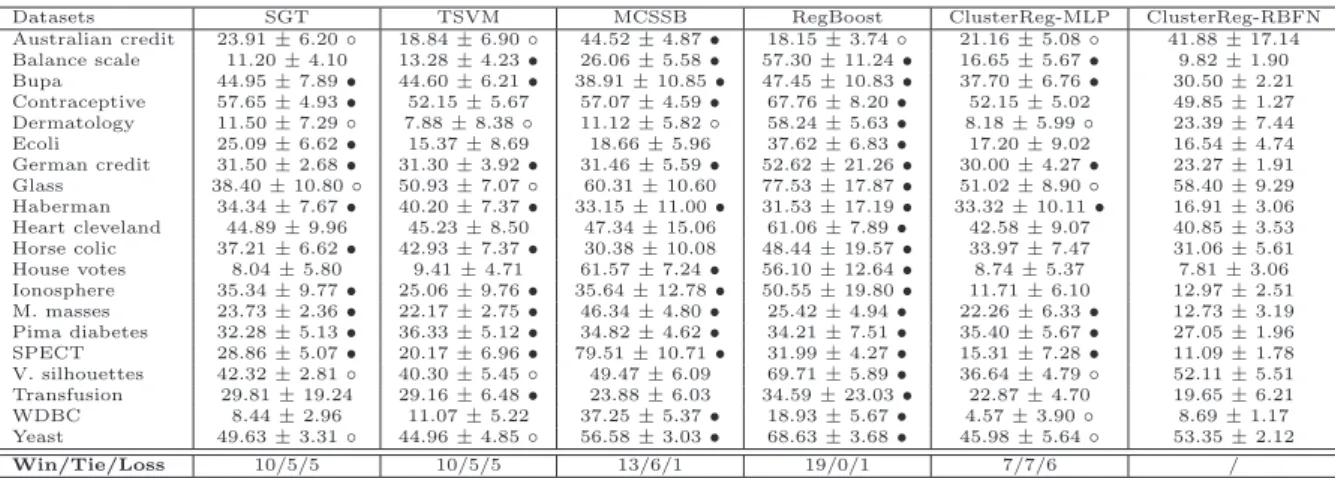
3.6 Mean and standard deviation (%) of 10-fold cross-validation error at 5% of labelled data. •/◦ indicates whether ClusterReg-RBFN is statistically superior/inferior to the compared method, according to pairwise t-test at 95% of significance level. Win/Tie/Loss denotes the number of datasets where ClusterReg-RBFN is significantly superior/comparable/inferior to the compared algorithm. . . 71
3.7 Mean and standard deviation (%) of 10-fold cross-validation error at 10% of labelled data. •/◦ indicates whether ClusterReg-RBFN is statistically superior/inferior to the compared method, according to pairwise t-test at 95% of significance level. Win/Tie/Loss denotes the number of datasets where ClusterReg-RBFN is significantly superior/comparable/inferior to the compared algorithm. . . 71
3.8 Mean and standard deviation (%) of 10-fold cross-validation error at 20% of labelled data. •/◦ indicates whether ClusterReg-RBFN is statistically superior/inferior to the compared method, according to pairwise t-test at 95% of significance level. Win/Tie/Loss denotes the number of datasets where ClusterReg-RBFN is significantly superior/comparable/inferior to the compared algorithm. . . 72
4.1 Summary of tuned parameters for CBoost. . . 107
4.2 Average of errors (%) of runs with 12 subsets of 10 labelled instances. For all algorithms, the test sets are fixed. The table reports only the mean of the results, as in Chapelle et al. [2006, Chapter 21]. All results shown in Tables 3.3 and 3.4 were reported in Chapelle et al. [2006, Chapter 21], except for AdaBoost, ASSEMBLE and RegBoost, which were produced in Chen and Wang [2011]. The results of SAMME, ClusterReg-MLP and ClusterReg-RBFN were obtained in our experiments. Bold face denotes the best result among each group of algorithms. And n/a denotes the absent results in Chapelle et al. [2006, Chapter 21]. . . 108
4.3 Average of errors (%) of runs with 12 subsets of 100 labelled instances. For all algorithms, the test sets are fixed. The table reports only the mean of the results, as in Chapelle et al. [2006, Chapter 21]. All results shown in Tables 3.3 and 3.4 were reported in Chapelle et al. [2006, Chapter 21], except for AdaBoost, ASSEMBLE and RegBoost, which were produced in Chen and Wang [2011]. The results of SAMME, ClusterReg-MLP and ClusterReg-RBFN were obtained in our experiments. Bold face denotes the best result among each group of algorithms. And n/a denotes the absent results in Chapelle et al. [2006, Chapter 21]. . . 109
4.4 Mean and standard deviation (%) of 10-fold cross-validation error with 5% of labelled data. •/◦ indicates whether CBoost-Semi is statistically supe-rior/inferior to the compared method, according to pairwise t-test at 95% of significance level. Win/Tie/Loss denotes the number of datasets where CBoost-Semi is significantly superior/comparable/inferior to the compared algorithm. . . 113
4.5 Mean and standard deviation (%) of 10-fold cross-validation error with 10% of labelled data. •/◦ indicates whether CBoost-Semi is statistically supe-rior/inferior to the compared method, according to pairwise t-test at 95% of significance level. Win/Tie/Loss denotes the number of datasets where CBoost-Semi is significantly superior/comparable/inferior to the compared algorithm. . . 113
4.6 Mean and standard deviation (%) of 10-fold cross-validation error with 20% of labelled data. •/◦ indicates whether CBoost-Semi is statistically supe-rior/inferior to the compared method, according to pairwise t-test at 95% of significance level. Win/Tie/Loss denotes the number of datasets where CBoost-Semi is significantly superior/comparable/inferior to the compared algorithm. . . 114
5.1 Summary of tuned parameters for ECB. . . 145
5.2 Average of errors (%) of runs with 12 subsets of 10 labelled instances. For all the algorithms, the test sets are fixed. The table reports only the mean of the results, as in Chapelle et al. [2006, Chapter 21]. All results shown in Tables 3.3 and 3.4 were reported in Chapelle et al. [2006, Chapter 21], except for AdaBoost, ASSEMBLE and RegBoost, which were produced in Chen and Wang [2011]. The results of SAMME, ClusterReg-MLP and ClusterReg-RBFN were obtained in our experiments. Bold face denotes the best result among each group of algorithms. And n/a denotes the absent results in Chapelle et al. [2006, Chapter 21]. . . 147
5.3 Average of errors (%) of runs with 12 subsets of 100 labelled instances. For all the algorithms, the test sets are fixed. The table reports only the mean of the results, as in Chapelle et al. [2006, Chapter 21]. All results shown in Tables 3.3 and 3.4 were reported in Chapelle et al. [2006, Chapter 21], except for AdaBoost, ASSEMBLE and RegBoost, which were produced in Chen and Wang [2011]. The results of SAMME, ClusterReg-MLP and ClusterReg-RBFN were obtained in our experiments. Bold face denotes the best result among each group of algorithms. And n/a denotes the absent results in Chapelle et al. [2006, Chapter 21]. . . 148
5.4 Mean and standard deviation (%) of 10-fold cross-validation error at 5% of labelled data. •/◦ indicates whether ECB is statistically superior/inferior to the compared method, according to pairwise t-test at 95% of signifi-cance level. Win/Tie/Loss denotes the number of datasets where ECB is significantly superior/comparable/inferior to the compared algorithm. . . . 149
5.5 Mean and standard deviation (%) of 10-fold cross-validation error at 10% of labelled data. •/◦ indicates whether ECB is statistically superior/inferior to the compared method, according to pairwise t-test at 95% of signifi-cance level. Win/Tie/Loss denotes the number of datasets where ECB is significantly superior/comparable/inferior to the compared algorithm. . . . 149
5.6 Mean and standard deviation (%) of 10-fold cross-validation error at 20% of labelled data. •/◦ indicates whether ECB is statistically superior/inferior to the compared method, according to pairwise t-test at 95% of signifi-cance level. Win/Tie/Loss denotes the number of datasets where ECB is significantly superior/comparable/inferior to the compared algorithm. . . . 150
5.7 Summary of large datasets.. . . 150
CHAPTER
1
Introduction
This Chapter introduces the semi-supervised learning (SSL), the research questions and the contributions of this Thesis. Section 1.1 discusses the SSL problem. In Section 1.2.2, we describe the underlying assumptions in SSL algorithms. Section 1.4 discusses the usefulness of ensemble techniques in SSL. In Section 1.5, we highlight the research ques-tions that we address in this Thesis. Section1.6 summarizes the significant contributions achieved in this work. And, in Section 1.8, we conclude this Chapter with the outline of this Thesis.
1.1
Semi-supervised learning
Traditional machine learning techniques use only labelled instances (that is, the pairs of features and labels) to perform training. However, labelled data is usually expensive and time consuming to obtain. For example, a learning task might require expensive sensors and human experts to gather and label all the data.
On the other hand, it might be convenient to collect plenty of unlabelled data, which are typically cheap and abundant. Therefore, it is natural to employ such unlabelled data to improve predictive performance. SSL aims to use large amounts of unlabelled instances
along with labelled data to build better learning machines. As SSL requires less human effort and delivers potentially higher accuracy, it became popular in the machine learning community, in both theory and practice [Zhu, 2008].
In the SSL context, we have three main problems: supervised clustering, semi-supervised regression and semi-semi-supervised classification. The semi-semi-supervised clustering refers to the problem of clustering data with some labelled points in the form of con-straints: there should be some points that must belong to the same cluster and others that must not. The goal is to deliver a better partition than using the unlabelled data alone. Semi-supervised regression aims to learn a function. And semi-supervised classifi-cation (SSC) consists of predicting labels of test data. The algorithms of both regression and classification attempt to improve the generalisation accuracy in comparison with using only labelled data.
In this Thesis, we will focus on SSC, where algorithms learn from both labelled and unlabelled instances in order to assign a label (or posterior class probabilities in multi-class classification) to test instances.
1.2
Semi-supervised classification
Semi-supervised classification consists of using the available training instances to train a classifier that can be used to predict the classes of test data. These test instances are assumed to follow the same probability distribution as the available training data. The predictive accuracy of a trained classifier is evaluated by its generalisation from the training instances to test data.
Formally, we can define SSC as the choice from the given set of functions f ∈ F →
X×Y based on a training setDof random independent identically distributed (i.i.d.) ob-servations drawn from an unknown probability distributionp(x,y), such that the obtained function f(x) best predicts the true class for test instances (x,y), which are assumed to
follow the same probability distribution p(x,y) as the training set. The training setD =L∪U is composed of L labelled instances
L= (x1,y1), . . . ,(xL,yL)∈X×Y,
and U unlabelled instances
U=x1, . . . ,xU ∈X.
The total number of training instances is N =L+U and often U ≫L. For multi-class classification, the labels yn are class probabilities, where 0 ≤ yni ≤ 1 and PCi=1yni = 1, where C is the number of classes.
Typically, SSC algorithms learn the optimal functionf∗(x) by minimising a loss func-tion L,
f∗(x) = argminf∈F(L(f(x),y)),
which measures the loss or discrepancy between input and desired output associated with the learning machine, and then choosing the function from the given set of candidates with the lowest loss.
The aim of SSC is to improve a classifier in comparison to using the labelled data
L alone. However, the effectiveness of SSC relies on the prerequisite that the data dis-tribution, which unlabelled instances will help to elucidate, is related to the true class distribution. That is, the data distribution p(x) should be useful for the inference of classes, p(y|x). If such a SSL fundamental assumption holds, a semi-supervised classifier will outperform a supervised method trained with only labelled data [Chapelle et al.,
2006]. And, in recent years, various studies have shown that these two fundamental char-acteristics are true for a number of datasets [Chapelle et al.,2006,Chen and Wang, 2011,
Valizadegan et al.,2008]. In order to link the knowledge acquired from the unlabelled data distribution to the class distribution, SSC algorithms employ one or more assumptions.
In Section1.2.2, we discuss such assumptions.
As we will discuss later in this Thesis, the learning from unlabelled data is achieved by matching the assumptions in the classifier with the actual class structure. If this matching is not found, the use of unlabelled data may degrade the original supervised classification accuracy. So, although we have cheap and easily obtained unlabelled data, some decisions (for example, regarding design of good models, kernels, similarity functions, etc.) become more critical in SSC context than in supervised learning. This is the trade-off for the lack of label information in training data.
1.2.1
Transductive and inductive learning
SSC can be either transductive or inductive [Chapelle et al., 2006]. A classifier is trans-ductive if test instances are employed as unlabelled training data. Such a method is not able to generalise predictions to unseen data and its generalisation is evaluated with its predictions on unlabelled data. The aim of transductive learners is to use the distribution of the available test data while predicting labels to such instances. Typically, classifiers that build graphs to represent the data are transductive (for example, the Spectral Graph Transducer (SGT) algorithm [Joachims,2003]). Such methods use both test and training instances in the construction of graphs in order to predict labels for test points.
In contrast, inductive learners can generalise their predictions to unseen data. The training set of an inductive learner is composed of both labelled and unlabelled data and accuracy is measured on unseen data. As in supervised classification, inductive methods in SSC learn a decision boundary that will be used to generalise labels for unseen test instances. The classifier introduced in Valizadegan et al. [2008] is an example of an inductive learner.
1.2.2
Semi-supervised learning assumptions
Besides the fundamental assumption that states that the data distribution should be relevant for the classification problem, SSC algorithms also possess other assumptions in order to relate the distribution of instances, which the unlabelled data will help to clarify, to the inference of the class distribution.
In order to link the knowledge acquired from the unlabelled data to the true class distri-bution, SSC algorithms employ one or more of the following three assumptions [Chapelle et al., 2006].
• The smoothness assumption assumes that if two instances are close to each other, they are likely to yield similar outputs. Such an assumption is necessary for the generalisation from a finite set of training instances to a set of test points [Chapelle et al., 2006]. That is, if two instances x1 and x2 are similar, the output of the
learnerf(x1) andf(x2) should be also similar. This assumption is fundamental for
any machine learning algorithm in order to generalise from one instance to others.
• The cluster assumption states that if two instances x1 andx2 are similar and lie on
the same cluster (high-density region), they are likely to be of the same class, yielding similar outputsf(x1) andf(x2). That is, it is assumed that two different classes are
unlikely to lie in the same high-density region. Equivalently, the cluster assumption can be formulated as the low-density separation assumption, which states that the decision boundary should lie in a low-density region [Chapelle et al.,2006]. Although both definitions are equivalent, they might lead to different algorithms.
• The manifold assumption assumes that the true structure of the data lies in a low-dimensional manifold embedded in the high low-dimensional data space. And, by using such manifold instead of the original structure, the classifier would have higher generalisation accuracy. That is, the learning of a transformation ϕ(x1) of instance
x1 into a lower dimension manifold delivers more accurate generalisation than the
use of the original instancex1.
1.3
Discussion on supervised and semi-supervised
clas-sification
In order to facilitate the understanding on how semi-supervised classifiers can improve generalisation performance, we can analyse the Figure 1.1 (figure extracted from Zhu
[2009]). Assuming each class is a coherent group (for example, we have two gaussian clus-ters), we can notice that the decision boundary can shift if we use the unlabelled data in the training of a classifier. The dashed line denotes the decision boundary generated with only labelled instances (intuitively, a line at the mean distance between the two labelled points would be the best generaliser for this dataset). While the solid line represents the shifted decision boundary, produced with both labelled and unlabelled data. In this case, when we consider unlabelled data, besides the influence of labelled instances, the data distribution (including labelled and unlabelled points) also affects the resulting decision boundary. This fact might produce stronger generalisation since the learning algorithm is using more information: the unlabelled data.
Another example of semi-supervised classification can be depicted from a generative model, such as Gaussian Mixture Models (GMM). Figure 1.2 (figure extracted from Zhu
[2009]) shows the impact of unlabelled data on decision boundaries. The gaussians de-scribing each class are adjusted with unlabelled data, due to the parameter optimisation procedure (usually the Expectation-Maximisation algorithm) maximising different quan-tities: the probabilities p(L,y|θ) and p(L,y,U|θ), where θ is the parameter vector of GMM.
Figure1.3(figure extracted fromZhu[2009]) shows the sensitiveness of SSC algorithms to SSL fundamental assumption: the data distribution should possess a relationship with
Figure 1.1: How SSC algorithms generate decision boundaries.
Figure 1.2: On the left-hand side, GMM considers only labelled data. On the right-hand side, both labelled and unlabelled data influences the decision boundary.
the true class distribution. Such a figure depicts the difference between the classical Support Vector Machine (SVM) [Vapnik, 1998] and one of its semi-supervised versions, Semi-Supervised Support Vector Machines (S3VM) [Bennett and Demiriz, 1998]. SVM attempts to find the largest gap between two groups of data. In such an example, the true decision boundary is the dotted line. On the left-hand side of the figure, the super-vised decision boundary (depicted by the solid line) is generated exactly between the two
labelled instances. When considering unlabelled data, S3VM shifts the decision bound-ary (denoted by the dashed line), however they are both on a local minimum. On the right-hand side, the true decision boundary is not related with the data distribution. As expected, S3VM generated an incorrect decision boundary, as it finds the opposite diag-onal of the figure. This is due to the fact that the fundamental SSL assumption does not hold in such a dataset. In this sense, in the attempt to find the largest gap considering the unlabelled instances, S3VM is not able to not learn the true decision boundary that lies outside of such a gap. Therefore, for the dataset in Figure1.3, SSC algorithms might not improve generalisation when compared to supervised methods.
Figure 1.3: On the left-hand side, both labelled instances lie in the same high-density region. On the right-hand side, each labelled instance is a different cluster. In this dataset, true decision boundary does not correspond to the gap between high-density regions. The data distribution is not useful for the inference of the class distribution. In this case, SSC algorithms might not improve generalisation when compared to supervised methods.
As we can notice, a certain degree of relationship between SSL assumptions and data structure is essential to the performance of SSC algorithms. This is the compromise for the lack of label information. We showed examples where classifiers improve generalisation with unlabelled data (Figures 1.1 and 1.2) and a situation where the use of unlabelled instances is harmful to the performance of SSC algorithms (Figure 1.3).
It is important to highlight that the example on the left-hand side of Figure 1.3
represents a pathological case where we have only two labelled instances that are not rep-resentative of the classes. Although labelled points are usually scarce, they are important to identify regions of potential classes. Labelled instances should be i.i.d. samples from the underlying distribution of the dataset. Uninformative labelled points cause classes to be neglected. The absence or unfair distribution of labelled points for one class lead to predictions with bias either towards or against that particular class. If such instances are not representative of the class distribution, the decision boundary generated by a SSC algorithm might be degraded.
1.4
Cluster-based classification and ensemble
learn-ing
SSC is challenging due to the unknown relationship between the true decision boundary and the data distribution. In supervised learning, such a relationship might be irrelevant, as a decision boundary may be generated regardless the data distribution. In contrast, even if there is such a relationship in a given SSC dataset, we might not know which of the aforementioned SSL assumptions should be implemented in a classifier. However, when the implemented assumption is correct, the generalisation accuracy of a SSC algorithm is generally higher than supervised methods.
For real-world datasets, we might not have prior knowledge of the true class structure and its corresponding SSL assumption. Intuitively, if the dataset has a manifold struc-ture, it is expected that algorithms that use the manifold assumption to deliver a better performance when compared to other SSC methods. This is also the case for datasets where the cluster assumption holds [Chapelle et al., 2006].
Various existing classifiers implement all three assumptions: smoothness, manifold and cluster assumptions. Such algorithms may yield better generalisation performance than
specialised methods (for example, classifiers that implement only the cluster assumption) with the incorrect assumption [Chen and Wang, 2011]. However, for example, in cases where there is a clear cluster structure for classes, the quality of the decision boundary generated by these algorithms might be limited by the search for a manifold in such datasets. Moreover, such methods also depend on the compromise between assumptions, which might be a challenging task. Therefore, in such situations, classifiers specialised in finding cluster structures, cluster-based classification, may yield significantly superior generalisation performance.
Ensemble techniques are widely employed in supervised classification due to the ability of reducing individual error made by base classifiers [Liu and Yao,1999,Tang et al.,2009,
Wang et al.,2009,Yao and Liu,2004]. The combination of classifiers is also helpful in semi-supervised classification [Zhou,2009]. The reasons for such a fact are: the performance of ensembles can be further improved, even though individual learners cannot be improved using unlabelled data; when there are very few labelled instances, unlabelled data should be exploited for constructing a strong ensemble; and unlabelled data can also increase the diversity of base learners [Zhou, 2009].
Therefore, combining a group of suitable classifiers, as an ensemble of classifiers, can improve the generalisation performance when compared with a single classifier in both su-pervised [Nguyen et al.,2006] and semi-supervised classification [Zhou,2009,Valizadegan et al., 2008, Chen and Wang, 2011]. In this Thesis, we focus on investigating ensemble learning for cluster-based classification.
1.5
Motivations
In this section, we summarise the research questions that we address in this Thesis. Firstly, we highlight the limitations of existing cluster-based algorithms. Secondly, we highlight an important issue that arises when ensemble techniques are employed in SSC.
And, finally, we describe the limitations of applying existing classifiers to large datasets in SSC.
1.5.1
SSC with cluster regularisation
In cluster-based approaches, most algorithms attempt to find a low-density region (largest margin separator) to separate classes, avoiding generating a decision boundary inside clusters (traversing high-density regions). Transductive Support Vector Machine (TSVM) [Joachims, 2002] is a typical example of a margin-based classifier.
Most of the existing cluster-based SSC approaches might not produce a suitable de-cision boundary when classes are overlapping, due to the search for a largest margin sep-arator with very few labelled instances. In such a case, the decision boundary should be generated in an overlapping region, however margin-based algorithms might not find such regions, especially when there is limited labelled data to constrain the decision boundary in the optimum region.
Such algorithms are sensitive to the position of the few labelled instances within a high-density region. If there are labelled points in an overlapping region (on the border of a cluster), margin-based methods might produce an incorrect decision boundary, since labelled instances have a greater impact on the learning than the unlabelled points. That is, decision boundaries generated by most of the cluster-based algorithms are mainly determined by the position of limited labelled instances. Therefore, such classifiers are not robust to few labelled data.
In contrast, some clustering algorithms can often easily achieve better performance with overlapping classes when compared to margin-based methods, as demonstrated in Chapter 3. Intuitively, in some cases where there is no clear gap between clusters, dis-covering high-density regions might be less challenging than finding low-density gaps between these regions. And clustering algorithms are specifically designed to search for
high-density regions. Therefore, in some cases, clustering algorithms can deliver more accurate estimates over the data distribution than methods that seek the largest margin. We discuss such issues in detail in Chapter 3.
In this sense, we can apply soft cluster structure, in the form of posterior probabilities, to regulate the impact of each labelled and unlabelled instance on the training of a classifier according to their position within a high-density region. Hence, such a classifier would be able to identify labelled instances in the borders of clusters and minimise their importance for the learning process, while increasing the influence of instances in centres of clusters. Therefore, the decision boundary produced by this classifier would also be a function of such a cluster structure. This learning technique would be more robust to the position of the few labels in the clusters and, hence, would improve its generalisation performance.
1.5.2
Ensemble learning in SSC
As in other SSC techniques, the performance of ensemble learning is strongly affected by the use of unlabelled data. Particularly for ensemble learning, an important question arises: at what level of an ensemble one should consider using unlabelled instances. To our knowledge, such an issue was not addressed in literature. Therefore, we present a study on the usefulness of employing unlabelled data at both ensemble and base learner levels, comparing to using such data at ensemble level only. In this sense, this Thesis will investigate solutions for such an issue.
In SSC literature, most ensemble methods optimise a semi-supervised loss function at ensemble level and use supervised base classifiers [Valizadegan et al., 2008, Zheng et al.,
2009, Chen and Wang, 2011]. That is, the unlabelled data is only considered for the ensemble algorithm and the base classifiers receive such data as pseudo-labelled instances.1
However, if the ensemble algorithm (for example, boosting framework [Friedman, 2001])
1
In this work, pseudo-labels are posterior class probabilities artificially assigned to unlabelled instances by some method.
does not predict an instance correctly, relying on pseudo-labels for unlabelled instances might reinforce errors in the optimisation process, since supervised base classifiers will learn exactly the class that is assigned to a given instance.
In this context, the use of semi-supervised base learners might alleviate such an issue by handling the pseudo-labelled instances as actual unlabelled data. That is, the learning of pseudo-labelled data, as presented to the semi-supervised base learner, is dependent on the pseudo-label distribution, instead of learning each instance and its possibly erroneous pseudo-label individually. Therefore, the optimisation might not propagate a previous error caused by an incorrect pseudo-label. Whereas a supervised base classifier would learn exactly the labels that are presented to it. Thus, such a supervised base classifier would generate an incorrect decision boundary and would propagate the errors to the remainder of the ensemble training.
Semi-supervised base classifiers based on cluster assumption (as detailed in Chapter3) address an incorrect pseudo-label according to its situation in the dataset. If an instance is in a high-density region, the pseudo-labels of its neighbours should be shared with such point. That is, the distribution of pseudo-labels would be employed to assess whether two instances should belong to the same class. Therefore, semi-supervised base learners might alleviate the problem of incorrect decision boundary (especially when it traverses high-density regions) by considering the distribution of unlabelled data, instead of using only the pseudo-label assigned to an instance. In this sense, we would have more reliable use of pseudo-labels than learning the exact pseudo-label of each instance independently.
1.5.3
Efficient algorithm for large datasets
Due to the large number of available unlabelled data, semi-supervised training sets often have tens of thousands of instances. Therefore, the learning algorithms must be able to handle such large-scale datasets. Recently, various ensemble algorithms have been
introduced with improved generalisation performance when compared to single classifiers. However, the existing ensemble algorithms are not able to handle large-scale SSC datasets. The typical large number of unlabelled instances has a great impact on the efficiency of existing semi-supervised classifiers. Among methods that implements the cluster assump-tion (cluster-based algorithms), TSVM [Joachims, 2002] is a popular choice. However, this method requires time O(N3) where N is the number of instances. Classifiers based
on the manifold assumption (manifold-based algorithms) are also time consuming with computational complexity of O(N3) or O(V N2) where V is the number of neighbours
[Szummer and Jaakkola, 2002, Zhu and Ghahramani, 2002]. For such binary classifiers, this issue is aggravated in multi-class classification, where decomposition approaches, such as one-vs-all, are employed, which require additional computational time.
As mentioned before, ensemble learning has been successfully employed in both su-pervised [Nguyen et al., 2006] and semi-supervised [Valizadegan et al., 2008, Chen and Wang, 2011] classification to improve generalisation when compared to single classifiers. However, the use of existing ensemble techniques in large-scale SSC datasets is lim-ited due to time and memory requirements. For example, RegBoost [Chen and Wang,
2011] is a binary ensemble classifier that, if implemented with SVM,1 requires time of
O(V NlogN +T S3+T V U), where T is the number of base learners andS is the sample
size. And, due to the computation of nearest neighbours, RegBoost requires memory of
O(N2), which also might prevent its application to large datasets.
A few multi-class ensemble approaches have been proposed [Valizadegan et al.,2008], however, despite having implemented the cluster assumption, these algorithms do not ex-ploit the soft partition information, considering clusters as disjoint sets (hard clustering). And, likewise RegBoost, the classifier proposed by Valizadegan et al. [2008] also requires memory of O(N2), which might degrade both time and memory efficiencies and might
1
limit its use in large datasets.
1.6
Contributions
We introduce relevant research questions in SSC: the use of soft partitions as regularisation for multi-class classification; the impact of unlabelled data in ensemble design; and en-semble techniques that enable SSC for large-scale datasets. We describe the contributions of this Thesis as follows.
1. Algorithms for multi-class semi-supervised classification.
Most existing SSC methods in literature are binary classifiers, therefore such al-gorithms depend on suboptimal decomposition techniques, such as one-vs-all and
one-vs-one, to perform multi-class classification. And they are prone to issues with imbalanced classes and different output scales of binary classifiers [Valizadegan et al.,
2008]. Thus, in this Thesis, we focus on developing cluster-based classifiers that can perform multi-class classification effectively and efficiently.
2. Semi-supervised classification with cluster regularisation.
In order to design an ensemble technique to solve the issues mentioned in Section
1.5, we design a new multi-class semi-supervised single classifier that overcomes the limitations of existing methods highlighted in Section 1.5.1.
As mentioned before, most cluster-based methods attempt to find the largest margin between high-density regions (clusters). When overlapping high-density regions are present, with sparse labelled instances on their borders, these classifiers may not produce good predictions, although these inherent clusters might be easily identified. In this Thesis, we propose a cluster-based multi-class algorithm, ClusterReg (Cluster-based Regularisation). Unlike other cluster-(Cluster-based algorithms, it does not depend on gaps between potential clusters, but captures the partition information, as posterior
probabilities, from a clustering algorithm in order to improve the decision boundary. By employing soft partitions in our method, the generalisation becomes more robust to the position of the few labels in the clusters. Unlike other cluster-based methods, our algorithm can easily establish a decision boundary between clusters without being misguided by neither the overlapping classes nor the few labels, when the dataset possesses a cluster structure for classes. ClusterReg achieves such robustness by incorporating soft clustering into a new regularisation technique.
ClusterReg regards the structure arising from the clustering algorithm as a soft partition. That is, each instance is assigned a probability of belonging to a given cluster, unlike hard partition where clusters are strictly disjoint. By using soft partitions (also known as soft clustering), we can address uncertain instances (likely lying on low density region, that is, on the border of clusters) differently from the more confident ones (likely lying on denser regions of clusters). Soft clustering helps the algorithm to address uncertain instances (with low probabilities for all clusters) as instances lying in gaps, therefore helping the classifier to generate the decision boundary in low-density regions.
One contribution of this work is to introduce a classifier that employs any clustering algorithm into SSC to regularise its decision boundary. The proposed algorithm (i) is robust in the presence of fewer labelled points, and is robust to the position of labelled data in clusters by considering the strength of clustering algorithms in a natural way and (ii) is able to improve the performance of a given classifier when the classes or clusters overlap, compared to other cluster-based algorithms.
ClusterReg can use any clustering algorithm with a proper processing of its output. It can employ any classifier that is able to minimise the proposed loss function. Therefore, ClusterReg can be seen as a framework for SSC methods.
3. A fully semi-supervised ensemble for multi-class classification.
In Section 1.5.2, we raised the question of which level of an ensemble should use the available unlabelled instances. Such unlabelled data can be considered at the ensemble level, the base classifier level, or both. To our knowledge, such issue has not been addressed until now, as most algorithms use unlabelled data only at the ensemble level and employ supervised base classifiers. In this Thesis, we present a study on the usefulness of employing unlabelled data at both ensemble and base learner levels. We compare such an approach to the use of unlabelled instances at the ensemble level only. We propose the Cluster-based Boosting algorithm (CBoost) for multi-class classification. Such a method extends ClusterReg and, unlike most semi-supervised ensembles in the literature, is composed of semi-supervised base classifiers.
Unlike other ensemble classifiers where unlabelled data is presented to the base classifiers as pseudo-labelled instances, both ensemble algorithm and base classi-fiers optimise the loss function introduced in Chapter 3, which uses both clustering algorithm and unlabelled data in a regularisation mechanism.
CBoost is able to learn from the clustering neighbourhood structure of pseudo-labels assigned by the ensemble, which leads to better generalisation when compared to learning the exact pseudo-labels individually. CBoost can overcome incorrect pseudo-label assignments used in the training of a new base classifier. CBoost is robust to the position of labelled data within a cluster and is able to handle the potential presence of overlapping classes. Experiments in Chapter 4confirmed that the proposed method is significantly superior to state-of-the-art ensemble methods and can improve the generalisation of single classifiers.
As discussed in Section 1.5.3, due to the large number of available unlabelled data, a semi-supervised training set can often have tens of thousands of instances. There-fore, the learning algorithms must be able to handle such large-scale datasets. Re-cently, various ensemble algorithms have been introduced with improved gener-alisation performance when compared to single classifiers. However, the existing ensemble algorithms are not able to handle typical large scale datasets.
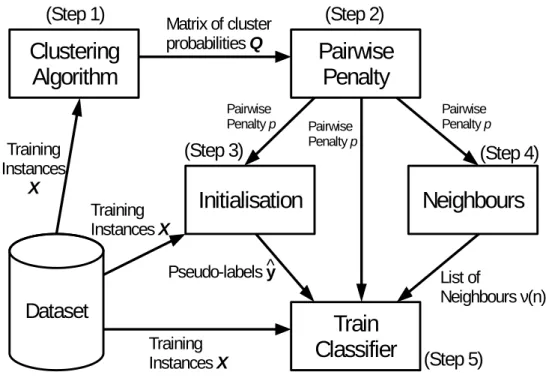
In order to perform classification in large datasets, we propose the Efficient Cluster-based Boosting (ECB) algorithm. ECB uses a regularisation technique, Cluster-based on posterior cluster probabilities, to avoid generating a decision boundary in high-density regions. In order to reduce the computational complexity of ECB, (i) base learners are trained with a subset of the unlabelled data along with all available la-belled instances at each iteration; (ii) we also employ an approximation technique to increase the efficiency of time and memory in the computation of nearest neighbours; (iii) and use an efficient clustering algorithm. We provide a theoretical discussion on the reasons why ECB might be able to achieve good performance with small amounts of sampled data and a relatively small number of base learners. Our ex-periments confirmed that ECB scales to large datasets whilst delivering comparable generalisation to state-of-the-art methods.
1.7
Publications resulting from the thesis
The research outcome from Chapter 3 was reported in the following publication.
[Soares et al., 2012] R. G. F. Soares, H. Chen, and X. Yao. Semisupervi-sed classification with cluster regularization. IEEE Transactions on Neural Networks and Learning Systems, 23(11): 1779–1792, November 2012.
R. G. F. Soares, H. Chen, and X. Yao. A fully semi-supervised ensemble approach to multi-class classification. Submitted to IEEE Transactions on Neural Networks and Learning Systems.
And the investigation in Chapter5 was reported in
R. G. F. Soares, H. Chen, and X. Yao. Efficient boosting for semi-supervised classification. Submitted to The Journal of Machine Learning Research.
1.8
Outline of the Thesis
This chapter presented the concepts that will be used throughout this Thesis: Semi-supervised classification and its assumptions, cluster-based classification and ensemble learning. We also summarised the contributions of this Thesis. The remainder of this Thesis is as follows.
Chapter2discusses several relevant algorithms in the literature of SSC. We categorise such methods according to implemented assumptions and internal mechanisms. And we discuss the limitations of existing classifiers, which are related to the research questions introduced in Section 1.5.
In Chapter 3, we address the motivations discussed in Section 1.5.1 and introduce a new algorithm with regularisation based on soft partitions. Such a method performs predictions according to the cluster structure along with scarce labelled data. Such a chapter also presents an instantiation of the proposed algorithm and provides an experi-mental analysis on the impact of such a regularisation technique on both transductive and inductive settings. Such an analysis confirms the improvement in generalisation ability over state-of-the-art methods.
Chapter 4 presents an analysis on the research question raised in Section 1.5.2. It introduces a study on the usefulness of employing unlabelled data at both ensemble and base learner levels, in comparison with using such data at the ensemble level only. We propose an ensemble technique that extends the classifier introduced in Chapter 3. And,
unlike other semi-supervised ensembles in the literature, it is composed of semi-supervised base classifiers. We also present experiments that confirm that the proposed method is significantly superior to state-of-the-art ensembles and can improve the generalisation of single classifiers.
In Chapter 5, we propose a multi-class boosting algorithm designed for large-scale datasets, such a method uses a regularisation technique, based on posterior cluster proba-bilities. We theoretically discuss how ECB is able to achieve good performance with small amounts of sampled data and a relatively small number of base learners. Our experiments confirmed that ECB scales to large datasets whilst delivering comparable generalisation to state-of-the-art methods.
Finally, Chapter 6 summarises this Thesis and describes potential subjects for future research.
CHAPTER
2
Semi-supervised Algorithms
In this Chapter, we report relevant SSC algorithms according to underlying assumptions and internal mechanisms. Section 2.1 describes generative algorithms, sections 2.2 and
2.3 present the self-training and Co-training frameworks. In Section2.4, we describe clas-sifiers with the manifold assumption. Section 2.5 discusses cluster-based algorithms and highlights potential drawbacks in their mechanisms. In Section 2.6, we report ensemble techniques that possess multiple assumptions. And, in Section 2.7, we discuss the limita-tions of the algorithms described in this Chapter and we relate such shortcomings to our motivations, as shown in Section 1.5.
2.1
Generative methods
Generative models are one of the earliest semi-supervised methods [Zanda and Brown,
2009]. Such algorithms attempt to estimate the conditional density P(x|y) by making explicit assumptions on the form of the data: the conditional distributions P(x|y) and class priors P(y), where x and y are the input and target variables, respectively. For example, Gaussian Mixture Models (GMM) assume that P(x|y) is a Gaussian and use the Expectation-Maximisation (EM) algorithm to find the parameters that describe each
class [Dempster et al.,1977, Zhu,2008]. GMM implements the cluster assumption, since a given cluster belongs to only one class [Chapelle et al., 2006].
Since generative methods learn how the data is distributed, P(x), instead of the association between attributes and classes, such algorithms can naturally incorporate unlabelled data. However, these classifiers do not possess the knowledge about the true data distribution beforehand, such as the class of functions to describe the data. Thus, generative methods have to use strong assumptions on the data distribution. If the mixture model assumption is correct, the use of unlabelled data is guaranteed to improve the supervised classification accuracy. Otherwise, considering unlabelled instances may decrease classification accuracy [Castelli and Cover,1995, 1996, Ratsaby et al.,1995].
Another approach is the cluster-and-label technique [Demiriz et al.,1999, Dara et al.,
2002], which employs a clustering algorithm for finding structures in the data. It aims to match the generated partition with the real structure of the data. With the partition at hand, such an algorithm labels each cluster according to the labelled instances that belong to the given cluster. This method fails in the cases where the clustering does not represent the underlying structure of the data.
The EM algorithm was also employed in the prediction of fault-prone modules in the software engineering context [Seliya et al., 2004, Seliya and Khoshgoftaar, 2007b]. The authors could successfully employ a generative technique to find the data structure and classify software modules with limited fault-prone data (imbalanced datasets). And
Seliya and Khoshgoftaar [2007a] formulated the software quality estimation problem as a semi-supervised clustering task.
2.2
Self-training
Self-training is commonly used in semi-supervised tasks [Zhu et al., 2009]. In such an algorithm, a given supervised learner is trained with only labelled instances. Afterwards,
such a learner predicts labels for a set of unlabelled instances. Then, the most confident instances along with the predicted label (pseudo-labels) are added to the labelled data to form a new training set, which will be used to retrain the given classifier. This procedure is repeated until a stopping criterion is met. Self-training is a wrapper method, in which any supervised learning algorithm can be used. Mixture models using the EM algorithm can be seen as self-training procedures.
If an error occurs in the classification, such a self-training process might reinforce the error, leading to low classification accuracy (its performance might be lower than the accuracy delivered by training with labelled data alone).
Moreover, since self-training selects only the most confident instances to be included in the new training set, only the easily classified instances are considered in the learning process. In this sense, the algorithm might only learn the instances that have already been learnt, without any improvement on the decision boundary when compared to using only labelled data.
2.3
Co-training
In the Co-training algorithm [Blum and Mitchell, 1998], the features in the training set are divided into two different sets (views). Such a division can be naturally achieved if the data intrinsically have two possible feature sets, or by applying some artificial method to separate attributes, such as random selection. The algorithm also assumes that both feature subsets are, at some extent, meaningful for the training of a classifier and such subsets are conditionally independent with respect to the class. Co-training consists of two classifiers, where each learner is assigned to a view. Initially, each method is trained with the labelled data from its respective view. Then, each classifier labels the unlabelled data of its own view (pseudo-labelling) and adds the most confident instances along with their predicted labels to the training set of its counterpart. Afterwards, both learners are
retrained with the newly labelled instances. In fact, both classifiers teach each other, and tend to agree on labelled and unlabelled instances.
The assumption on the quality of the views is essential to the generalisation of both classifiers. And the assumption of conditional independence between the views is neces-sary for mapping the most confident instances of one classifier into training points of its counterpart [Zhu,2008].
Nigam [2001] demonstrated that co-training delivers good performance when the sumption of conditional independence holds. However, co-training possesses strong as-sumptions on the division of attributes. In order to relax this assumption, Zhou and Li
[2005] proposed the Tri-training algorithm, which uses three learners. In order to train one classifier, such a framework employs the agreement between the remainder two learners to label unlabelled instances that will be used in the training set of the given learner.
Tri-training and Co-training may overfit with the use of the most confident instances, leading to the degradation of classification accuracy. This fact arises when the division of the feature set is not straightforward. That is, both methods depend on the quality of the subsets of attributes.
More generally, multiview learning [de Sa,1993] represents the paradigm in which co-training and tri-co-training are included. This paradigm is based on the agreement among various learners that use distinct views. In multiview learning, several different classifiers (with different learning mechanisms) are trained with only labelled data and are required to agree on predictions of unlabelled instances. Brefeld et al. [2006], Sindhwani et al.
[2006] successfully applied multiview learning to semi-supervised regression.
2.4
Manifold-based methods
Most manifold-based methods assume that there should be a low dimensional manifold structure embedded in the data space. Typically, these algorithms build graphs to
rep-resent all instances [Zhu, 2008]. The nodes represent the instances (both labelled and unlabelled) and the edges denote similarity between points. In order to perform predic-tions, these methods usually assume label smoothness in the obtained graph.
Most of algorithms that implement the manifold assumption are graph-based methods. Their loss functions estimate two objectives: the predicted labels should be similar to the neighbouring labels and predicted labels should deliver smoothness across the graph. Some of these methods only differ from each other by the choice of the cost function and the regulariser. For example, Blum and Chawla [2001] address semi-supervised learning as a graph mincut problem.
Spectral Graph Transducer (SGT) [Joachims,2003] can be seen as a semi-supervised version of the K nearest-neighbours classifier. This binary classifier uses unlabelled in-stances to build a graph. The nature of its manifold assumption is in the fact that predictions are based on the neighbourhood of an instance within the graph.
The Semi-supervised Multilayer Perceptron [Malkin et al., 2009] is an extension of the standard Multilayer Perceptron (MLP) to binary SSC. In order to handle unlabelled data, such an algorithm includes four terms in its loss function. The first term produces the supervised learning; the second term is a graph regulariser (leads to smooth solutions over the graph); the third is an entropy regulariser; and the last is the term for weight decay. It uses stochastic gradient descent to optimise such a loss function. Malkin et al.
[2009] demonstrated significant improvements when compared to supervised MLP. [ Con-stantinopoulos and Likas, 2008] proposed the use of Probabilistic Radial Basis Function networks (PRBF) based on the EM algorithm for multi-class SSC. Such a method was employed in order to implement an incremental active learning procedure.
Most of the graph-based approaches only focus on the optimisation functions. The graph construction, an important part of the learning procedure, is not often included in such frameworks. In consequence, the issue of graph construction has not been extensively
studied yet [Zhu, 2008].
Manifold-based classifiers usually cannot generalise to unseen (test) data, that is, they are often inherently transductive, which is the case for the methods proposed inBelkin and Niyogi[2003],Joachims[2003],Zhu et al.[2003],Zhu and Lafferty[2005]. This can prevent the application of graph-based methods in problems requiring fully inductive classifiers. However,Belkin et al.[2006] proposed the Laplacian Support Vector Machine (LapSVM) classifier, an alternative extension to graph-based algorithms that is able to predict labels of newly available test instances, which avoids the retraining of the algorithm. And
Melacci and Belkin [2011] reduced the computational complexity of LapSVM by solving its primal formulation.
These methods, except PRBF, are proposed for binary classification, which could be a shortcoming. They depend on the decomposition of multi-class datasets into a set of different binary tasks, leading to problems of imbalanced classification and different output scales of binary classifiers [Valizadegan et al., 2008].
2.5
Cluster-based methods
Among the methods based on cluster assumption, we can highlight the Transductive Support Vector Machine (TSVM) [Joachims, 2002]. It is an extension of SVM (Support Vector Machine). TSVM uses unlabelled data to find the decision boundary with the largest margin between classes. Unlike SVM, TSVM tries to maximise the margin with a linear boundary by considering both labelled and unlabelled instances, which might deliver higher generalisation accuracy [Vapnik, 1998]. Unlabelled instances help to avoid generating the decision boundary in dense regions [Zhu,2008]. However, if dense regions are overlapping, TSVM might not find the correct decision boundary between such regions (clusters). And, in this case, this algorithm might be sensitive to the position of the limited labelled points in such clusters.
Chakraborty[2011] introduced the Bayesian semi-supervised Support Vector Machine (Semi-BSVM) for binary classification. Semi-BSVM aims to find the largest margin using both labelled and unlabelled data. Its loss function was designed with a penalty term to represent unlabelled data. Semi-BSVM was successfully compared to supervised classifi-cation methods when the unlabelled data was informative, especially in cases where the amount of unlabelled instances was greatly larger than labelled data. However, similarly as TSVM, Semi-BSVM is a binary classifier that is sensitive to overlapping high-density regions with labelled data in low-density regions.
Moreover, for multi-class classification problems, these methods have a similar draw-back to other binary SSC algorithms: they depend on a suboptimal decomposition of the dataset into a number of independent binary classification problems.
Wang et al. [2012] proposed a multi-class classifier that, as TSVM, seeks the largest margin separator. It employs a loss function that uses the concept of label membership to weight the pertinence of a given instance to each class. In order to have more reliable labels for unlabelled points, such a function also considers each instance as a weighted average of its neighbours. However, this method does not distinguish between instances in low and high density regions, that is, an uncertain instance (with respect to its membership) lying on the border of a cluster has the same influence in the training as any other instance, whereas the intuition behind the cluster assumption suggests that the sharing of labels should be more reliable in high density regions.
As mentioned before, these cluster-based methods try to find potential gaps between high-density regions (clusters). When overlapping high-density regions are present, with sparse labelled instances on their borders, these classifiers may not produce good predic-tions, although these inherent clusters might be easily identified by clustering algorithms.
2.6
Ensemble methods
Combining several suitable classifiers, as an ensemble of learners, can enhance the gen-eralisation performance of the group when compared to a single classifier [Nguyen et al.,
2006]. Some of these methods use an ensemble of supervised algorithms, while others use an ensemble of semi-supervised methods as base learners.
Semi-supervised MarginBoost (SSMB) [d’Alch´e Buc et al., 2002] is a generalization of MarginBoost [Grandvalet et al., 2001]. It relies on the assignment of pseudo-labels, based on the current ensemble predictions, to unlabelled data. Such unlabelled instances are sampled for the training of a new semi-supervised base classifier at each iteration. SSMB minimises a loss function that includes a monotonically decreasing cost function, the margin for labelled instances and a pseudo-margin.1 Such a method requires semi-supervised base classifiers.
ASSEMBLE [Bennett et al., 2002] is a semi-supervised margin-based boosting algo-rithm. Such an algorithm performs a greedy optimisation by maximising pseudo-margin using a boosting method and relies on pseudo-labels to perform the training of base clas-sifiers. ASSEMBLE uses only instances with the highest confidence into the training set of base classifiers, which may only increase the margin without improving the current de-cision boundary. The trained base learners are likely to share the dede-cision boundary with other classifiers at early iterations. Then, in case of early incorrect pseudo-labels, errors will affect future base learners and might degrade generalisation ability of the ensemble.
SemiBoost [Mallapragada et al.,2009] combines the similarity information among the instances and the classifier predictions to obtain more reliable pseudo-labels. It is a graph-based ensemble approach and its loss function has the smoothness, manifold and cluster
1
Pseudo-margin is the confidence of a classifier on the predicted labels for the unlabelled instance. In order to increase the pseudo-margin between two instances, a classifier can increase its confidence for one instance and decrease it for the other point. It can also be interpreted as the decision boundary between unlabelled points.