International
Education Services
Productivity Commission
Research Paper
April 2015
ISBN 978-1-74037-546-7 (PDF) ISBN 978-1-74037-547-4 (Print)
Except for the Commonwealth Coat of Arms and content supplied by third parties, this copyright work is licensed under a Creative Commons Attribution 3.0 Australia licence. To view a copy of this licence, visit http://creativecommons.org/licenses/by/3.0/au. In essence, you are free to copy, communicate and adapt the work, as long as you attribute the work to the Productivity Commission (but not in any way that suggests the Commission endorses you or your use) and abide by the other licence terms.
Use of the Commonwealth Coat of Arms
For terms of use of the Coat of Arms visit the ‘It’s an Honour’ website: http://www.itsanhonour.gov.au
Third party copyright
Wherever a third party holds copyright in this material, the copyright remains with that party. Their permission may be required to use the material, please contact them directly.
Attribution
This work should be attributed as follows, Source: Productivity Commission, International Education Services.
If you have adapted, modified or transformed this work in anyway, please use the following, Source: based on Productivity Commission data, International Education Services.
An appropriate reference for this publication is:
Productivity Commission 2015, International Education Services, Commission Research Paper, Canberra.
Publications enquiries
Media and Publications, phone: (03) 9653 2244 or email: [email protected]
The Productivity Commission
The Productivity Commission is the Australian Government’s independent research and advisory body on a range of economic, social and environmental issues affecting the welfare of Australians. Its role, expressed most simply, is to help governments make better policies, in the long term interest of the Australian community.
The Commission’s independence is underpinned by an Act of Parliament. Its processes and outputs are open to public scrutiny and are driven by concern for the wellbeing of the community as a whole.
Further information on the Productivity Commission can be obtained from the Commission’s website (www.pc.gov.au).
CONTENTS iii
Contents
Acknowledgments v
Overview 1
International education services are important to the economy 3
Government involvement in international education 6
Swings in visa policy settings 9
Quality regulation is a ‘work in progress’ 13
Alternative frameworks for student visa processing 16
The use of education agents is extensive and risky 19
1 Introduction 21
1.1 The international education sector’s contribution to the
economy 21
1.2 Snapshot of the international education services sector 24
1.3 International education policy levers 28
1.4 The Commission’s approach 33
2 Trends in international education services 35
2.1 Global trends in international education services 36
2.2 Trends in Australian international education services 47
3 Student visa policy settings 63
3.1 The student visa program 64
3.2 Implications of Streamlined Visa Processing 75
3.3 Post-study work rights 90
4 Quality regulation of international education services 99
4.1 Regulatory framework for quality assurance 100
4.2 Risks to quality and how they are being addressed 109
4.3 Transnational education services 121
iv INTERNATIONAL EDUCATION SERVICES
5 Student visa processing alternatives 125
5.1 Summary of the current problems 126
5.2 DIBP’s proposed model 127
5.3 Alternative approaches 130
6 Education agents 133
6.1 Education agents in international student recruitment 133
6.2 Institutional arrangements around agents 136
6.3 Concerns with agent behaviour 138
6.4 Risks arise from the incentives faced by agents and
providers 141
6.5 Mitigating agent risk 143
A Conduct of the project 149
ACKNOWLEDGMENTS v
Acknowledgments
The Commission is grateful to everyone who has taken the time to discuss the issues canvassed in this research project. Particular thanks are extended to those who participated in the Commission’s roundtable held in Melbourne on 4 December 2014, and provided written comments.
The Commission would also like to thank officers of the Department of Immigration and Border Protection, the Department of Education and Training, the Department of Employment, the Australian Skills Quality Authority and the Tertiary Education Quality Standards Agency for their high level of engagement and the provision of data and information.
Paul Lindwall Commissioner 30 April 2015
2 INTERNATIONAL EDUCATION SERVICES Key points
• International students make a major economic and social contribution to Australia. In 2014, there were over 450 000 international students onshore, representing around 20 per cent of higher education students and 5 per cent of students enrolled in vocational education and training.
– The international education sector is back on a high-growth trajectory following a major downturn from 2009 to 2011. Students from China and India account for 37 per cent of all international students in Australia.
• In parallel with rapidly growing demand for international education, principally from middle-income economies in Asia, competition for international students is intensifying among traditional provider countries and new entrants. While Australia’s share of the international student market is only around 6 per cent, it has one of the highest concentrations of international students in total national tertiary enrolments.
• Whether Australia remains an attractive destination will depend on how well education providers respond to students’ expectations for their learning experience and provide a value proposition as technology and business models evolve.
• The Australian Government has a role in providing a policy and regulatory framework that encourages behaviours by education providers, international students and other stakeholders that support its immigration and education policy objectives, and enables the market for international education services to function well within these policy settings.
– The sustainability of international education exports is more closely linked to regulatory settings than in many other sectors. Regulatory settings around student visas and education quality are crucial.
– The lack of a synchronised and coherent strategy for these two interacting policy levers has the potential to undermine the sector’s ability to take advantage of the opportunities offered by growth in the global education market.
• In terms of student visas, the introduction of streamlined visa processing has contributed to a reversal of the downward trend in international student numbers, with the higher education sector as the predominant beneficiary. However, the implementation of this system has introduced a number of perverse incentives that put at risk the quality and reputation of Australia’s education systems.
• The potential broadening of access to streamlined visa processing by a wider spectrum of education providers carries risks to the reputation of Australia’s education system.
– There are several options to mitigate these risks. The preferred option should provide the highest net benefit to Australia as a whole. But they all require a high level of engagement between the Department of Immigration and Border Protection and the Department of Education and Training.
• In terms of education quality, the enforcement of regulatory settings has moved increasingly to a risk-based approach in recent years. However, the current emphasis on teaching standards should be rebalanced so that learning standards have a greater role in quality assurance.
• There is also a strong case for publicly available information on the comparative quality ranking of providers in order to assist domestic and international students to make informed decisions about provider choice.
OVERVIEW 3
Overview
International education services are important to the
economy
The global market for education services is expanding as incomes and participation in education in emerging economies continue to rise. Australia is an attractive destination for international students at all levels of education. There is also a high demand for Australian education providers delivering courses abroad.
In 2014, international education services (IES) contributed around $17 billion to the Australian economy. Around half of this was from the fees paid to educational institutions, with the remainder from expenditure on goods and services by international students living in Australia. The sector represented around 27 per cent of services exports and close to 5 per cent of total Australian exports.
There were over 450 000 international students on a student visa in Australia in 2014. International students accounted for around 20 per cent of students enrolled in higher education and around 5 per cent of students enrolled in vocational education and training (VET). Around three quarters of all international students enrolled in Australia in 2014 were from Asia, with China and India accounting for 26 and 11 per cent of all international students respectively (figure 1, panel a). Of the 160 000 enrolments in courses delivered offshore, more than two thirds were in the higher education sector.
Students enrolled in higher education provided the greatest economic contribution (68 per cent of the value of education exports). New South Wales ($5.8 billion) and Victoria ($4.7 billion) generated the highest export income from the sector.
The sector is back on a high-growth trajectory
Following a period of rapid growth in the international education sector from 2007 to 2009 — partly driven by the direct pathway from the student visa program to permanent skilled migration — the sector experienced a major downturn from 2009 to 2011. The high Australian dollar, the global economic downturn, the introduction of a series of visa integrity measures, negative publicity about student safety in Australia, and uncertainty about college closures were key contributing factors.
The sector has since recovered from this decline and is back on a high-growth trajectory (figure 1, panel b). In 2014, the number of international students in Australia increased by more than 10 per cent on 2013 levels and education-related exports also grew by a similar
4 INTERNATIONAL EDUCATION SERVICES
rate. However, this growth has been uneven across the sector. Over the period from 2012 (when streamlined visa processing (SVP) was introduced) to 2014, the Commission estimates the average annual growth rate in the number of international students was 4.6 per cent in higher education, 2.9 per cent in VET, 11.8 per cent in intensive English language courses (a major study pathway to higher education and VET), with a marginal fall in the growth rate in school enrolments.
A number of factors contributed to this rebound. These include the introduction of an expansionary student visa policy through SVP, post study work rights, and improved economic conditions following the global financial crisis.
The changing playing field is intensifying competitive pressures
Various economic, demographic and social factors drive the mobility of students globally. Some of the factors affecting the demand for IES are intertwined with those factors which shape people’s decisions to migrate permanently — of which economic opportunity is a prime motivator.
For international students primarily seeking an educational outcome rather than permanent migration, key factors influencing where students choose to study include the reputation of an education provider (and the quality of the learning experience they offer), tuition fees, the cost of living, safety, lifestyle, the presence of support networks, visa policy settings (including the time and cost in procuring a visa) and any associated work rights. The rationale for studying overseas is multifaceted, and the relative weighting of these drivers of student choice is contingent on individual circumstances and motivations.
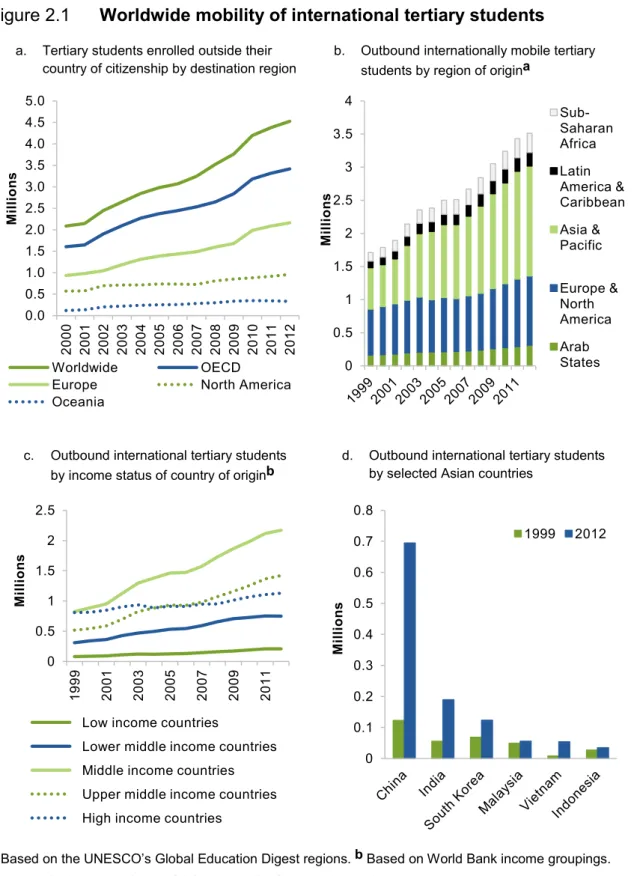
From 2000 to 2012, the number of international students globally grew by more than 5 per cent a year on average. Most of this growth has come from middle income Asian economies — notably China, and to a lesser extent India, South Korea and south-east Asian countries. Growth in international student numbers has also been strong from other middle income economies such as Brazil and Russia.
The four leading English-speaking destination countries — the US, the UK, Australia and Canada — dominate the global market for the provision of IES, with market shares of 16, 13, 6 and 5 per cent respectively. While the US remains the top destination for international students, Australia and the UK have the highest concentration of international students in total national tertiary enrolments (18 per cent) (figure 1, panel c).
Tertiary institutions in English-speaking OECD countries have generally responded well to the increased demand for international advanced degrees by research (principally doctorates). However, the ratio of enrolments in advanced degrees by research to enrolments in bachelor’s and master’s degree programs remains lower in Australia than in comparable countries (figure 1, panel d).
OVERVIEW 5
Figure 1 A snapshot of the international education services sector
a. Student enrolments in Australia by source
country, 2014 b. Total onshore education exports
c. Number and percentage of international tertiary student enrolmentsa
d. International student enrolments as a percentage of total tertiary enrolments
a Bubble size reflects the share of international students in total national tertiary enrolment.
0 30 60 90 120 150 180 C hina India V iet nam S out h K or ea Thailand B raz il M alay sia N epal Indone si a P ak is tan Thous an ds
Higher Education VET Schools ELICOS Non-award 0 5 10 15 20 25 30 35 0 2 4 6 8 10 12 14 16 18 Per cen t $ B illions
Total onshore education exports Education as a proportion of total services exports (RHS) 0 100 200 300 400 500 600 700 800 1998 2003 2008 2013 Thous an ds US UK Australia Canada 0 20 40 60 2005 2012 2005 2012 2005 2012 2005 2012 2005 2012 Au st ra lia C ana da NZ UK US
Advanced research programs
Bachelor's & master's degree programs VET programs
6 INTERNATIONAL EDUCATION SERVICES
In parallel with the growth in demand for international education, competition in the provision of international education is increasing globally. Many of the ‘traditional’ providers of IES are extending their international reach through the delivery of courses offshore, often in partnership with education providers in host countries or through consultancies for a corporate clientele.
Further, many countries in Asia and in the Middle East are seeking to develop world-class capacity in higher education and research, and are investing heavily in higher education systems. Countries such as Singapore and Malaysia have a significant interest in positioning themselves as regional hubs for higher education. China is also actively engaged in improving the range and quality of its education services.
The digital economy is broadening the options available to those seeking an education with an international orientation. Technological advances have enabled the growth of so-called massive open online courses, as well as a wider range of teaching and study modes. However, until these online offerings provide equivalent and recognised formal qualifications, they will be likely to remain a part of an educational offering rather than a substitute for traditional delivery modes.
Government involvement in international education
Government involvement in the IES sector is more ubiquitous than in many other sectors. This occurs for a number of reasons. Government itself is involved in the delivery of these services through the ownership of public education institutions.
More broadly, there are inherent features of that market that prevent it from operating efficiently without government intervention. These include the information asymmetries between providers and students, which prevent students from fully assessing the value of the education services they are purchasing, and the scope for poor quality providers to taint the reputation of all providers and/or adversely affect the perceived quality of Australian qualifications.
Further, the flow of international students into Australia is of necessity subject to immigration policy settings. The temporary migration and work rights afforded by international education (via student visas) directly affects its attractiveness. Hence, immigration policy directly affects the demand for international education services. Further, while the supply of international education is an export business, the provision of education to international students is largely a joint product with the provision of education to domestic students; indeed, many institutions purportedly use international student fees to cross-subsidise other activities such as research. To this extent, student visa policy settings can affect the financial viability of domestic education (more so in some segments than others) and can also affect (positively or negatively) the value of the qualifications of domestic students.
OVERVIEW 7
International education is also a pathway to permanent migration. While student visa policy settings should be set to achieve the desired short- and long-term immigration mix, governments can come under pressure from the international education sector to take their businesses into account. However, it is not the role of government to ensure a reliable supply of international students for the sector. Rather, an important role of government is to provide a stable and predictable policy and regulatory framework that supports behavioural responses by education providers, international students and other players that are consistent with broader immigration and education policy objectives, while enabling the market for IES to function efficiently and effectively within these objectives.
More generally, policies related to domestic education, notably in regard to quality, will spill over into the international education sector. The cost and quality of education services are key considerations for most students when choosing an international education provider. However, given the nature of education services and the information asymmetry between providers and purchasers, it is not easy for students to ascertain the quality of these services ex-ante. There is a role for government to support a regulatory regime that provides publicly available information on the relative quality of education services offered by providers, especially as poor quality providers can harm the reputation of other providers in Australia.1
Governments at different levels are also involved in promoting Australia (or particular regions within Australia) as a destination for international education. Such marketing has some ‘public good’ characteristics in that the benefits are able to be captured by any education provider in that destination, and it is not possible to exclude providers that benefit from the marketing but do not contribute to the costs.
While government involvement is motivated by a variety of factors, it is only warranted when the benefits to the entire community from such intervention outweigh the costs of that intervention.
The sector is interconnected and needs an integrated policy response
A key feature of Australia’s international education system is that it provides for study pathways between the four subsectors — intensive English language courses, primary and secondary schools, vocational education, and higher education by coursework and research. Courses are delivered onshore, offshore and online, and by a mix of public and private providers. Even though institutions offer programs across a wide spectrum of study fields, more than half of all international students in both higher education and VET are enrolled in business-related courses.
A range of agencies and regulators at different levels of government are involved in the international education sector (figure 2).Australian Government agencies have distinct and
1 Self-regulation and the private provision of quality indicators also have a role, but are unlikely to supplant the need for government regulation and supervision given the pervasive interactions across a range of policy areas in IES.
8 INTERNATIONAL EDUCATION SERVICES
separate responsibilities cutting across education, immigration, employment and marketing, with limited incentives to look at the sector on an holistic basis. Decisions made in one policy space have broader sectoral and economywide implications.
Further, the evidence base appears fragmented, with different datasets measuring different aspects of the sector and no obvious platform to support a whole-of-government approach to policy development and evaluation.
Figure 2 Policy and regulatory landscape for international education
services
The sector has been extensively reviewed over the past decade, including the Chaney Review in 2013, which highlighted the urgent need to develop a more coordinated government approach to international education in Australia. In addition, several relevant reviews are currently underway, including reviews into SVP arrangements, border fees, charges and taxes, and into the framework and effectiveness of the skilled migration and temporary activity visa programs.
In April 2015, the Government released a Draft National Strategy for International
Education for consultation. It noted that the Government agreed with all the Chaney
Review recommendations, including those directed at developing better coordination of
Australian Skills Quality Authority
(ASQA) Tertiary Education Quality Standards Agency (TEQSA) Education Services for
Overseas Students Act 2000 (Cwlth)
National Code of Practice for Registration Authorities and Providers of Education and
Training to Overseas Students 2007
Commonwealth Register of Institutions and Courses for Overseas Students (CRICOS)
Higher education + foundation courses + ELICOS delivered by a registered higher education provider or under an
entry arrangement with a higher education provider VET providers ELICOS providers (except when delivered by a school or higher education provider) Schools + ELICOS and foundation programs when delivered in a school Students Relevant state or territory regulators Legislation and regulation specific to IES Registration requirements Regulators Service providers Purchasers Education agents Policy oversight Department of Education and Training (IES policy development) Department of Immigration and Border Protection (visa settings) AusTrade (marketing and promotion) State and territory government departments Migration Regulations 1994 Department of Employment (labour market outcomes)
OVERVIEW 9
policies and programs affecting international education. This ongoing process provides an opportunity to develop a comprehensive and integrated policy response to the opportunities and challenges facing the sector.
Swings in visa policy settings
Over time, visa policy settings have been reviewed and adjusted frequently — perhaps too frequently. The impulses for change have been as disparate as reactions to crises, the desire to smooth out the peaks and troughs in student numbers, and the intention to balance the sustainable growth of the sector against the risks to the integrity of the immigration system (and national security) associated with the intake of international students. The swings in visa policy settings are partly symptomatic of the use of one policy lever — student visa settings — to achieve multiple policy objectives.
Streamlined visa processing has created some perverse incentives
The stated objective of the student visa program is to support the growth of the international education sector, while maintaining high levels of immigration integrity (which is essentially about ensuring that international students are genuine in their intention to complete a course of study and do not use the program primarily as a de facto migration entry point). The requirements and restrictions attached to different visa sub-classes should be designed to meet this objective in the most efficient way.
The most recent substantive shift in student visa policy settings was the introduction of SVP in 2012, which originated from the Knight Review. Against a backdrop of falling student enrolments, the review contained a series of measures to improve the competitiveness of Australia’s universities in the global market for international students. Essentially, SVP treats international students applying to higher education courses as though they were from assessment level 1 (low immigration risk) countries, irrespective of their country of citizenship (box 1).
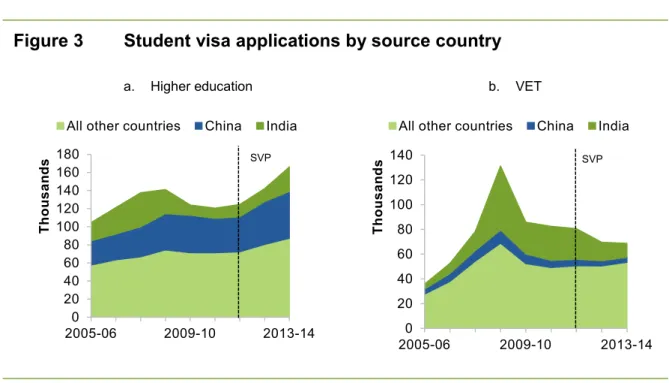
SVP is seen by eligible institutions (mainly universities) to have been beneficial to them and to their students — notably those from medium and high immigration risk countries. Notwithstanding the range of factors that drive demand for international education, student visa applications for higher education courses have increased by 33 per cent over the two years following the introduction of SVP (figure 3). By comparison, student visa applications for VET courses have fallen by 15 per cent over the same period.
10 INTERNATIONAL EDUCATION SERVICES
Figure 3 Student visa applications by source country
a. Higher education b. VET
The SVP framework has introduced a stratified system for student visa processing. Further, it has created a perception that provider access to SVP is a ‘stamp of quality’. The combination of these two factors has led to some perverse incentives for:
• agents — to channel international students into higher education pathways, regardless of their aptitude or career aspiration. This has disadvantaged high-quality VET providers
• some SVP-eligible providers — to adopt a relatively relaxed approach to immigration risk management so that they can expand their student intake up to the point that does not trigger a penalty by the Department of Immigration and Border Protection (DIBP) • providers — to add advanced diplomas to their offering since the recent extension of
SVP to these courses, with potential downside risks to the quality of these courses • some prospective students and education agents — to target institutions with access to
SVP initially, and once granted a student visa, to ‘course-hop’ to another institution offering an easier or cheaper course, potentially undermining the integrity of the visa system and imposing a financial impost on those institutions losing students to other institutions.
The challenges inherent in monitoring agents’ conduct, and concerns raised by some stakeholders about the effectiveness of enforcement of visa conditions, contribute to reinforcing these incentives.
This is particularly relevant to the issue of course-hopping. Students can change courses for a variety of reasons. It is therefore difficult to ascertain the prevalence of ‘illegitimate’ course-hopping given the often covert nature of this type of activity. However, enrolment data on actual transfers from higher education courses to VET courses point to an increase in those transfers since the introduction of SVP, both in absolute and relative terms
0 20 40 60 80 100 120 140 160 180 2005-06 2009-10 2013-14 Thous an ds
All other countries China India
SVP 0 20 40 60 80 100 120 140 2005-06 2009-10 2013-14 Thous an ds
All other countries China India
OVERVIEW 11
(figure 4), although recorded transfers are still a relatively low percentage of overall student numbers. There is also anecdotal reporting of agents being openly and actively involved in encouraging course-hopping by recruiting students already studying in Australia for transfers to cheaper, shorter or lower quality courses.
Conversely, visa data on transfers from higher education student visas (subclass 573) to VET student visas (subclass 572) show a relatively flat trend since the introduction of SVP (figure 4). While it is unclear why the pictures from these two datasets differ, the discrepancy is possibly broadly consistent with anecdotal evidence of under-reporting, whereby students are breaching their visa conditions by transferring between higher education and VET courses without applying for a new visa.
Box 1 What is streamlined visa processing?
Commencing on 24 March 2012, streamlined visa processing (SVP) created a separate ‘fast track’ or ‘light touch’ visa processing pathway for international students applying to eligible courses. In order to be eligible for SVP, students had to be enrolled in:
• a principal course of study for either an advanced diploma (since November 2014), a bachelor’s degree, a master’s degree or a doctoral degree
– the principal course of study is provided by an eligible education provider (any institution registered on the Commonwealth Register of Institutions and Courses for Overseas Students) and which offers courses at the advanced diploma level and above
• a course leading to a principal course of study provided by an SVP-eligible provider.
The SVP pathway is premised on education providers sharing the immigration risk attached to student visas in exchange for simpler and faster visa processing at the institution’s level. All applicants are still subject to basic requirements such as having health insurance and not being a security or health risk. However, the Department of Immigration and Border Protection (DIBP) essentially take the institution’s word that the student is suitable. In return, the institutions are accountable for the visa outcomes of their students. The visa outcomes of these institutions are reviewed regularly, and consistently poor outcomes can lead to a withdrawal of their eligibility for SVP. The effectiveness of risk sharing under SVP depends on whether the threat of having access to SVP withdrawn is credible.
If access to SVP is removed, institutions can still enrol international students, but they are processed under the assessment level framework — the ‘traditional’ pathway for the assessment of student visas, which usually takes longer and carries a more onerous regulatory burden. Under that framework, assessment levels are specified from 1 to 3, with assessment level 1 pertaining to low immigration risk passport holders, assessment level 2 — medium risk, and assessment level 3 — high risk. Evidentiary requirements for visa applicants are aligned to immigration risk, and the assessment is undertaken by the DIBP, taking into account rates of visa refusal, cancellation and non-compliance.
12 INTERNATIONAL EDUCATION SERVICES
Figure 4 International student transfers from higher education to VET
The DIBP has recently conducted a number of information campaigns to encourage visa compliance, in combination with regular discretionary processes for visa cancellations. Nonetheless, the fact remains that the current configuration of the student visa processing framework inherently provides an incentive to course-hop, particularly for international students whose primary motivation may not be an educational outcome and who may not be suited to higher education.
The jury is still out on post-study work rights
Many international students consider host country work experience to be an attractive element of the overseas study ‘package’. In particular, they often see it as a potential pathway to obtaining permanent residency or to enhance employment prospects in their home country.
Changes to Temporary Graduate Visas in 2013 gave longer and less restrictive post-study work rights to higher education graduates than to VET graduates — thereby creating two distinct visa categories. These changes also came from the Knight Review, which argued that the absence of clearly defined post-study work rights puts Australian universities at a serious disadvantage against some of our major competitor countries.
Post-study work visas are far from uniform internationally, and Australia’s program differs in several ways from those of other countries that provide comparable education services (chapter 3).
Given that these changes were implemented in 2013, their impacts are yet to flow through to the take-up of temporary graduate visas. It is therefore premature to assess the link between the post-study work rights policy settings and labour market outcomes. In any case, there is a general lack of data to inform an analysis of the impacts of the relatively
0 2000 4000 6000 8000 2008 2009 2010 2011 2012 2013 2014 Enrolment transfers from Higher Ed. to VET
Transfers from student visa subclass 573 to subclass 572
OVERVIEW 13
large and uncapped pool of temporary migrants with work entitlements on labour market outcomes in Australia. More evidence in this area is needed for the purpose of informing policies related to post-study work rights for both higher education and VET students. Nonetheless, some barriers to graduate labour market entry are emerging as an issue for international students. A recent study by Deakin University noted that many international graduates are poorly prepared for the labour market and have unrealistic expectations of graduate employment. The study pointed to the key role that universities can play in enhancing the employment prospects of these students, and in conditioning their expectations (either directly or through their agents).
Quality regulation is a ‘work in progress’
The quality and reputation of Australia’s education services rank highly as a determinant of student demand. Reputation can be hard to gain but easy to lose. Australia has a specific regulatory framework aimed at providing quality assurance and consumer protection for education services supplied to international students. This complements the regulatory framework that applies to the provision of domestic education services more generally. Two national regulators were established in 2011 — the Tertiary Education Quality Standards Agency (TEQSA) and the Australian Skills Quality Authority (ASQA).
Further, changes to student visa policy settings (notably the delinking of the student visa program from the pathway to permanent skilled migration since 2010) have removed some of the systemic incentives for providers and students to behave in a manner inimical to the provision of high quality IES in Australia.
Stakeholder concerns about the quality of IES appear to be mainly confined to some segments of the VET sector — although there is an acknowledgment that quality issues in one segment can have broader ramifications for the whole sector. Concerns about the VET sector stems partly from experience (namely, the emergence of poor-quality providers in the 2007–09 boom years) and partly from the very nature of the sector (relative to the higher education sector) in terms of:
• the larger number of providers (around 500 registered to offer courses to international students, compared with 133 in higher education)
• the prevalence of small scale operations
• the prevalence of relatively short duration courses compared with higher education • lower barriers to entry and exit for providers.
Ongoing risks to the quality of education services offered by some VET providers remain. Education providers’ compliance with regulations aimed at managing those risks has improved in recent years as evidenced by the ratio of registration applications approved to registration applications rejected rising materially. Providers also seem responsive to regulatory intervention.
14 INTERNATIONAL EDUCATION SERVICES
However, poor levels of compliance against some key standards remain (figure 5, and chapter 4). In June 2014, ASQA reported that 33 per cent of all registered training organisations were rated as having a medium or high risk of their not complying with the relevant legislative obligations, with 11 per cent not yet having a risk rating assigned. Comparable data for TEQSA are not published. Recent media reports have also highlighted poor practices being used by some providers across both the higher education and VET sectors (chapter 4).
Australian providers of offshore education services (transnational education) that do not lead to Australian qualifications are outside the regulatory reach of TEQSA and ASQA. Thus, these providers also pose a potentially significant risk to Australia’s reputation as a quality provider of IES. ASQA has planned a strategic review of transnational VET services in 2015.
Figure 5 Compliance with standard 15a found at audits of providers
registered under CRICOSb to deliver VET
2013–14
a S. 15.1 — Continuous improvement of training and assessment, S. 15.2 — Training meets the
requirements of the training package, S. 15.3 — Required staff, facilities, equipment and material, S. 15.4 — Qualified and competent trainers and assessors, S. 15.5 — Assessment is undertaken properly.
b Commonwealth Register of Institutions and Courses for Overseas Students.
There has been a move to risk-based regulation
Since their inception, both ASQA and TEQSA have moved to a risk-based framework, with resources targeted at areas that pose the greatest risk to quality. A pertinent question is whether the Australian Government’s budget allocation to each agency is reflective of the
88 61 43 53 36 93 83 76 82 75 0 10 20 30 40 50 60 70 80 90 100 15.1 15.2 15.3 15.4 15.5 per cen t Standard
OVERVIEW 15
risks inherent in each segment. The Braithwaite Report noted that, in 2013-14, TEQSA would have funding of over $117 000 for each provider it regulates on average, whereas ASQA would have approximately $9500 for each provider on average.
The 2014-15 Federal Budget included a significant reweighting of funding for the two national regulators. Future funding for TEQSA has been significantly reduced below its 2013-14 appropriation of around $24 million. Its funding for the three years from 2014-15 was reduced by around $21 million. In contrast, ASQA’s funding for those three years was increased by around $68 million.
This raises a broader question about the sustainability and effectiveness of having two national regulators over the medium term. The Commission sees merit in revisiting the case for having one regulator for both the VET and the higher education sector, which would allow an even stronger focus on risk-based regulation, help reduce the regulatory burden (particularly for those institutions that offer both higher education and VET courses), and provide a more consistent approach to quality regulation across the board.
A rebalancing from teaching to learning standards is called for
In order to be registered as a higher education provider or a training provider, organisations must satisfy standards related to provider characteristics and governance, qualification, information, and the quality of teaching and learning. Within the teaching and learning standards category, the current quality assurance frameworks used by TEQSA and ASQA are largely underpinned by compliance with input-based or teaching standards, such as the quality of teaching and the availability of supporting infrastructure.
Such standards are valuable as leading indicators of quality. However, given that student achievement is the ultimate goal of education, outcome-based or learning standards such as the demonstration of generic and discipline-specific learning objectives (including competency in the English language), are equally important from a quality assurance perspective. This suggests that the current emphasis on teaching standards should be rebalanced to provide for learning standards to have a greater role in quality assurance arrangements.
That said, the Commission understands that both regulators already consider, to differing extents, various outcome measures in their risk framework. As these measures are already being collected and used, this suggests it could be a short step to formalise outcome measures in the mandated standards against which providers are assessed for registration and course accreditation purposes.
… as is better information to inform student choice
Information on courses for international students is available through various web portals hosted by government agencies, individual institutions, industry bodies and education agents.
16 INTERNATIONAL EDUCATION SERVICES
While the regulatory regime imposes a requirement on providers to supply students with information that will enable them to make informed decisions about their studies in Australia, it does not require the national regulators to make public other information that would assist students to make comparisons between providers.
ASQA and TEQSA already collect such information. Their auditing of providers’ against registration and/or course accreditation standards generates information about relative performance. At present, though, these audit results are not publicly available.
Equally, the current regulatory regime provides no publicly available information on the relative quality of education services offered by providers, or measures of comparative education outcomes such as completion rates or the distribution of levels of attainment for students completing their studies.
Notwithstanding the challenges in measuring relative quality outcomes, the availability of such information would offer greater transparency about the comparative ‘quality’ ranking of providers and would benefit prospective students — both domestic and international. It would help counteract misleading information provided to international students by education agents. It may also strengthen the incentive for individual providers to improve the quality of their education services.
Alternative frameworks for student visa processing
DIBP is currently undertaking a strategic evaluation of SVP arrangements and expects the evaluation to play a key role in informing the policy guidelines that expire in mid-2016. As part of its consultation informing the review, DIBP has proposed a revised model for assessing immigration risk that would take into account the immigration risk outcomes of a particular education provider (as is the case under the current system) and the immigration risk applicable to the student’s country of citizenship (figure 6).
Such a model would have some advantages compared to the current model — it would simplify the framework by having a single visa processing system applicable to all education providers recruiting international students; and it would provide a more granular approach to the management of immigration risks.
OVERVIEW 17
Figure 6 DIPB’s proposed framework for student visas
As always, implementation is the crux. How the proposed model is implemented will have implications for the effectiveness of the student visa program. Principles of good regulatory design would suggest that the proposed model should be clear and easy to understand, proportionate to the risks posed, transparent and accountable.
Further, there are strong connections between international and domestic education services. International education is also an established pathway to permanent migration. An optimal student visa program cannot be designed in isolation from broader education and immigration policy objectives. This calls for a coordinated approach to policy.
Indeed, it makes little sense for TEQSA or ASQA to be disciplining a provider while DIBP is rewarding the same provider with a streamlined visa process under an immigration risk framework.
Further, by focusing exclusively on immigration risk, the DIBP approach would do little to address the perception among students and agents that an institution’s eligibility for SVP is a marker of high education quality.
If the DIBP model is universally applied, all education providers with low immigration risks, including VET providers, could potentially be granted access to SVP — and hence be perceived as institutions of high quality education. Yet there are a number of low quality providers. This presents a potential reputational risk to the international education sector.
While there are high quality VET providers, the very nature of VET, with a much higher churn rate of providers than in higher education, lends itself to relatively higher risks in terms of educational quality compared to the higher education sector. This was one of the reasons originally advanced by the Knight Review for limiting SVP to universities.
18 INTERNATIONAL EDUCATION SERVICES
An expanded SVP program may also increase immigration risks, at least in the short-term. This is because it could encompass a large number of new VET providers, some with little or no experience in offshore student recruitment. In fact, the latter providers might initially be advantaged by a system that is primarily focused on providers’ immigration risk history.
Two practical improvements to the DIBP proposal
One approach to mitigate the risks to perceptions of quality would be to build on the DIBP proposed model by incorporating an additional dimension to capture education provider quality risk — the risk that a provider would offer an international student a poor-quality learning experience. Provider quality risk could draw on compliance ratings as already assessed by the national regulators — TEQSA and ASQA — as an initial basis for assessing education provider quality risk. This approach could involve the same institutional settings currently used for the processing of student visas. However, it would harness a broader range of evidence on which to base decisions on student visa grants. Under this approach, each risk — country of citizenship immigration risk, education provider immigration risk, and educational quality risk — would need to be assessed and weighted to give an overall risk rating for each student visa applicant. Evidentiary requirements for each risk rating should then be proportionate to the risks involved.
An alternative approach would seek to manage the systemic risks to quality that could emerge from an extension of streamlined visa processing by making the quality of education providers more explicit and transparent — as a way of breaking the nexus between access to streamlined visa processing and perceptions of quality. This would require TEQSA and ASQA to publish the quality risk ratings of individual providers and for DIBP to more explicitly and credibly advertise that SVP is not a quality marker. Perhaps this would involve a move away from terminology such as streamlined visa processing.
The benefit of this approach is that it would quarantine immigration risks to one regulator and one policy lever — DIBP through its visa settings and compliance framework, while education quality risks would be managed through another policy lever by the education regulators (TEQSA and ASQA) through their standards compliance regime.
Delineating responsibilities in this way could remove any misperceptions of educational quality surrounding current arrangements. In relation to education quality it would leverage off work already being done by TEQSA and ASQA, meaning that SVP requirements would not add to the compliance and administrative costs for educational quality assurance purposes.
Both approaches would require the DIBP and the Department of Education and Training to have a high level of engagement to minimise the risk of policy coordination failure.
OVERVIEW 19
The Commission understands that the DIBP is developing its option further. The preferred option should provide the highest net benefit to Australia as a whole.
The Commission’s ongoing inquiry into migration and its current study on barriers to services exports will provide further opportunities to explore issues associated with student visas.
The use of education agents is extensive and risky
Education agents can play a useful advisory and intermediary role for international students and can be a cost-effective option for institutions looking to recruit students across a range of countries (at least in the short-term).
Educational institutions in Australia use agents extensively for recruiting international students, more so than in other comparable countries. Further, on average, Australian institutions tend to pay higher commissions to agents relative to other countries, although commissions paid by an institution are typically undisclosed. Commissions paid on a per student basis on admission create incentives for agents to maximise the volume of international students, with little regard to the quality of the advice provided to students (affecting student expectations) or the quality and aptitude of the students.
The Commission received considerable anecdotal evidence that suggested unscrupulous behaviour of agents is an issue, particularly in relation to providing false or misleading advice and information, and the onshore poaching of international students. Many of these concerns were also highlighted by the NSW Independent Commission Against Corruption in its recent report.
In some cases, problems arise because there is a misalignment of incentives between agents, providers and students. In other cases, incentives may be aligned, but providers, agents and students may be acting against the interest of the Australian community more broadly.
Agents are generally driven by their own profit motives (which are largely a function of
the quantity of students they recruit and the level of the course fees paid by students). They
are faced with inherent conflicts of interest because of the nature of their position — they work on behalf of both education providers and students, and they also work for a range of institutions in Australia and around the world. This is compounded by the limited ability of education providers to observe the actions of their agents on the ground. This information asymmetry, when combined with a misalignment of incentives, can lead to sub-optimal outcomes.
Like several other countries, Australia does not regulate education agents directly. At a national level, the National Code of Practice, established under the Education Services for
20 INTERNATIONAL EDUCATION SERVICES
between providers and agents. At an institutional level, the risks are managed through their relationships with agents.
The lack of a system for tracking agents and their clients’ outcomes, the lack of transparency about provider-agent relationships, and the offshore location of many agents make the oversight of the conduct of agents challenging. However, there are ways to mitigate these risks, including through internalising the risk and reducing the reliance on agents for recruitment through:
• a more direct recruitment approach by flagship Australian education institutions targeted to the higher end of the value chain
• greater transparency around the relationships between agents and providers (including the commissions paid)
• data systems that allow agent conduct and performance to be tracked over time (including by tracking student outcomes over the longer term)
• the provision of training and information exchange programs.
Overall, excessive reliance on agents may lead to a less than optimal mix of international students, with some of the best students enrolling in institutions in other countries such as the US and the UK. While agents will remain an important part of the Australian international education sector, there is scope for institutions to reduce their over-reliance on agents and the potential to thus better target the best students from source countries. This could be achieved by institutions investing more in the direct recruitment of students.
INTRODUCTION 21
1 Introduction
1.1 The international education sector’s contribution to
the economy
In 2014, Australian international education services (IES) delivered onshore (box 1.1) contributed almost $17 billion to the Australian economy, or around 1 per cent of gross domestic product. Of this, around half was made up of fees paid to education institutions, with the remainder being expenditure on goods and services (figure 1.1, panel a). The sector represented 27 per cent of services exports in 2014, and close to 5 per cent of total Australian exports (in gross value terms as measured in Australia’s balance of payments). In 2013-14, students enrolled in higher education (figure 1.2) provided the greatest contribution to export income (68 per cent). Geographically, students studying in New South Wales ($5.8 billion) and Victoria ($4.7 billion) generated the highest income for the sector (figure 1.1, panel b).
International education also makes a significant contribution to employment in Australia — both directly and indirectly. Deloitte Access Economics estimated that the expenditure of international students generated jobs for just over 130 000 full time equivalent workers in 2011 (DAE 2013). Further, international students add to the temporary labour pool in Australia as they have work rights both while they study and post study.
At a micro level, IES provide a major source of revenue for Australia’s education institutions (figure 1.1, panels c, d). In 2012, international students accounted for 16 per cent of the revenue of public universities on average (figure 1.1, panel c) (TEQSA 2014b). However, the importance of international student fees for universities varies, ranging from around 5 per cent of revenue for universities such as the University of Notre Dame, the University of New England and Charles Darwin University to 20-30 per cent for universities such as RMIT University, Macquarie University, and the University of Technology, Sydney (DET 2014b).
International student fees account for a smaller proportion of revenue for public vocational education and training (VET) institutions (around 2.6 per cent), while limited data for private VET make comparisons difficult. Around 82 per cent of commencements in higher education in 2014 were at publicly-owned institutions, while the majority of commencements in the VET and English language intensive courses for overseas students (ELICOS) sectors were in private institutions (85 per cent and 78 per cent, respectively) (figure 1.1, panel d).
22 INTERNATIONAL EDUCATION SERVICES
Box 1.1 International education services data
Data for offshore education services
Data limitations mean that it is difficult to determine the value of export services offshore. Typically there are four modes of services export: mode 1 is cross border supply (for example distance education provided to an offshore student); mode 2 is consumption in Australia (for example, international students studying in Australia); mode 3 is a commercial presence in a country of export (for example, an offshore campus of an Australian university); and mode 4 is the presence of natural persons in a country of export (for example, an Australian educator travels to deliver an education service abroad but returns to Australia within a 12 month period). In general services exports provided through mode 3 are not included in balance of payments estimates and, moreover, there are limited data on exports through commercial presence (PC 2015a). This means that modes 1 and 4 are only partial estimates of the value of education export income derived from offshore services. Accordingly, where it is mentioned in this study, export values are based on the mode 2 definition.
Types of IES data
A range of data is collected to measure international education services. Each data set measures different aspects of IES (though sometimes overlapping), and therefore needs to be placed in context.
Enrolment data — counts a student enrolment in a course. A student enrolled in two different courses is counted as two enrolments. As a result, enrolment data generally do not represent the number of overseas students in Australia or the number of student visas issued, but rather, counts actual course enrolments. Enrolment data overstate the number of international students in Australia.
Commencement data — counted as a new student enrolment in a particular course at a particular institution. Commencement figures show the flow of international students in Australia.
Visa applications lodged — the number of applications received by the Department of Immigration and Border Protection (both in hard copy and electronically).
Student visas granted — the number of visas where the decision maker assesses the application and decides to award the visa. It usually includes primary visa holders (the student) and secondary visa holders (those who have satisfied a secondary criteria for the grant of a visa, generally dependants of the primary visa holder).
Student visa holders in Australia — the number of student visa holders in Australia at a particular point in time. Some student visa holders may not be in Australia at the time of the snapshot.
ELICOS data — most data for ELICOS are confined to those ELICOS students in Australia on a student visa (chapter 2, box 2.1).
Education institutions — particularly universities — state that revenue from international students allows institutions to expand their staff, increase funding for research and enhance their investment in infrastructure (Go8 2014b). Further, it enables them to enhance the quality and diversity of the courses that they provide, take advantage of scale economies
INTRODUCTION 23
and diversify their funding base (provided they also make sufficient infrastructure and other investments to provide a quality learning environment for international students).
Figure 1.1 The significance of international education servicesa
a. International student expenditure by sector 2013-14b
b. Division of income from IES by jurisdiction, 2013-14
c. Sources of university revenue, 2012 d. International student commencements by provider ownership type, 2014
a Data are for onshore international education services only. b Expenditure by those on a student visa.
Sources: ABS (International Trade in Services by Country, by State and by Detailed Services Category,
Calendar Year, 2013 Cat. no. 5368.0.55.004); Deloitte Access Economics (2011); NCVER (2014b).
0 2 4 6 8 10 12 $ billion s Expenditure on fees
Expenditure on goods and services
0 10 20 30 40 50 60 70 80 90 100 per cen t NSW Vic Qld WA SA ACT Tas and NT 0 50 100 per cen t Other
State and territory governments Consultancies
Investment and royalty income Australian Government Domestic fee paying students Domestic HELP
International student fees
0 20,000 40,000 60,000 80,000 100,000 120,000 Public Private
24 INTERNATIONAL EDUCATION SERVICES
Figure 1.2 Levels of education
While it is not the intention of this report to quantify the net benefits of international education exports, the economic literature has generally found that international students bring broader benefits. For example, international students — and particularly postgraduate students — have been found to have positive impacts for innovative activity in the economy (Chellaraj, Maskus and Mattoo 2008; Stuen, Mobarak and Maskus 2012). Further, international students make a significant contribution to Australian society, diversifying and enriching communities, strengthening Australia’s global networks and facilitating future research collaboration (ABS 2011).
1.2 Snapshot of the international education services
sector
The sector is large and diverse
The IES sector is characterised by a complex network of institutions, government agencies, regulatory frameworks and other participants (figure 1.3).
Bachelor’s Degree Doctoral Degree Master’s Degree Bachelor’s Honours Degree,
Graduate Certificate, Graduate Diploma
Advanced Diploma, Associate Degree Diploma Certificate IV Certificate III Certificate II Certificate I Post-graduate study Vocational Education and Training (VET) Tertiary education Higher education
School system (including kindergarten, primary school,
high school) English language courses for overseas students (ELICOS)
C our ses w ithi n t he Aust ral ian Q ual ifi cat ions Fr am ew or k ( AQ F) O ut si de t he AQ F
INTRODUCTION 25
Figure 1.3 Policy and regulatory landscape for international education
services
The services undertaken as part of the sector — while focused on education — are broad and interconnected. Education is provided at a range of levels, in varied locations, through both public and private providers. It ranges from school level (primary and high school), through to ELICOS, VET and higher education both by coursework and research (figure 1.2; figure 1.4, panel a). Providers deliver courses to international students across a wide field of education sectors (table 1.1).
In 2014 there were just over 450 000 international students in Australia (DET 2015c). The number of total enrolments was higher at around 590 000 enrolments — reflecting that some students are enrolled in several courses concurrently (box 1.1; figure 1.4, panel b). About 5 per cent of all VET students are international students and around one fifth of all higher education students are international students (chapter 2).
Australian Skills Quality Authority
(ASQA) Tertiary Education Quality Standards Agency (TEQSA) Education Services for
Overseas Students Act 2000 (Cwlth)
National Code of Practice for Registration Authorities and Providers of Education and
Training to Overseas Students 2007
Commonwealth Register of Institutions and Courses for Overseas Students (CRICOS)
Higher education + foundation courses + ELICOS delivered by a registered higher education provider or under an
entry arrangement with a higher education provider VET providers ELICOS providers (except when delivered by a school or higher education provider) Schools + ELICOS and foundation programs when delivered in a school Students Relevant state or territory regulators Legislation and regulation specific to IES Registration requirements Regulators Service providers Purchasers Education agents Policy oversight Department of Education and Training (IES policy development) Department of Immigration and Border Protection (visa settings) AusTrade (marketing and promotion) State and territory government departments Migration Regulations 1994 Department of Employment (labour market outcomes)
26 INTERNATIONAL EDUCATION SERVICES
Table 1.1 Number of courses and number of providers registered to
deliver to international students by field of educationa
Field of education Courses Providers
Number Per cent Number Per cent
Management and commerce 3 169 22.9 317 16.1 Society and culture 2 930 21.1 347 17.6 Engineering and related technologies 1 184 8.5 114 5.8 Health 1 065 7.7 111 5.6 Mixed field programs 1 070 7.7 453 22.9 Creative arts 899 6.5 120 6.1 Information technology 849 6.1 131 6.6 Natural and physical sciences 801 5.8 58 2.9 Food, hospitality and personal services 738 5.3 133 6.7 Education 480 3.5 86 4.4 Architecture and building 344 2.5 55 2.8 Agriculture, environmental and related studies 328 2.4 49 2.5
Total 13 857 100.0 1 974 100.0
a Data as at February 2015.
Source: Department of Education and Training data 2015.
In 2014, the largest sub-sector for student enrolments was higher education (45 per cent of total international student enrolments), with VET the second largest sub-sector (25 per cent of enrolments) (figure 1.4, panel b). Of higher education international students, 81 per cent commenced with public providers, while only 15 per cent of VET international student commencements were with public providers (Austrade 2014b). The largest source country for international students was China, with 26 per cent of all international student enrolments in Australia, followed by India, with 11 per cent of total international student enrolments (figure 1.4, panel c) (DET 2014c).
Transnational education may be delivered by an Australian institution based offshore or through a collaboration or partnership with local education providers. Offshore education currently represents just over one quarter of international education enrolments (figure 1.4, panel d).
The digital economy is also broadening the options available to those seeking an education with an international orientation. Technological advances have enabled the growth of ‘massive open online courses’ (MOOCS), as well as a wider range of teaching and study modes. The number and availability of MOOCs continues to grow but has so far not detracted from growth in traditional delivery modes.2
INTRODUCTION 27
Figure 1.4 Profile of international education services
a. Number of international education providers, 2014a b. Number of students enrolled by sector, 2014
c. Student enrolment by source country, 2014 d. Student enrolments onshore and offshore, 2013b
a The diagram does not include around 70 providers in the higher education, VET, ELICOS and schools
sectors that also offer ‘other’ courses. ‘Other’ courses are non-award courses such as foundation/entry requirement courses or study abroad courses. b Total offshore enrolments excludes distance education and private VET providers (for which accurate data are unavailable).
Sources: DET (2014c, 2014i); data from the Department of Education and Training.
0 100 200 300 400 500 600 700 Thous an ds
Higher Education VET Schools ELICOS Non-award 0 40 80 120 160 Thous an ds
Higher Education VET Schools ELICOS Non-award 0 100 200 300 400 500 600
Total onshore IES
enrolments Total offshore enrolments
Thous
an
28 INTERNATIONAL EDUCATION SERVICES
Supporting the services provided by education institutions are other participants in the sector, such as education agents. Education agents identify prospective students for Australian institutions based in Australia and in competing countries, provide students with information about lifestyle, courses and education providers, assist students with enrolment and visa applications, and sometimes collect course fees on a provider’s behalf (chapter 6).
Governance and promotion is through a range of organisations
A range of government agencies and regulators at different levels of government are involved in the international education sector, reflecting the Council of Australian Government’s view that ‘all governments are responsible for the international student experience’ (COAG 2014, p. 2).
The Education Services for Overseas Students Act 2000 (Cwlth) (ESOS Act) is the main
legislation governing the sector and is designed to protect the interests of student visa holders. Australian Government agencies take a lead role in areas such as IES policy development (Department of Education and Training), visa policy settings (Department of Immigration and Border Protection), work opportunities (Department of Employment) and marketing the Australian brand (Austrade, through its Future Unlimited Study in Australia portal).
There are two national regulators of quality for the delivery of IES in the higher education, VET and ELICOS sectors3 — the Tertiary Education Quality and Standards Agency
(TEQSA) and the Australian Skills Quality Authority (ASQA) (figure 1.3, chapter 4). State and territory governments are intrinsically linked to the system, particularly as they fund and have ownership of many education institutions that teach international students. State or territory regulatory bodies remain responsible for the oversight of international students enrolled in schools. State and territory bodies (such as StudyNSW and Study Perth) market international education opportunities in their respective jurisdictions.
1.3 International education policy levers
Government involvement in international education
Government involvement in the IES sector is more ubiquitous than in many other sectors. This occurs for a number of reasons. Government itself is involved in the delivery of these services through the ownership of public education institutions.
3 In the VET sector, ASQA is the national regulator for all IES provided across Australia. For VET service providers that do not deliver IES, Victoria and Western Australia retain their own regulatory authorities, with ASQA regulating the rest of the country.