1
STRUCTURING LEAN LEARNING
Nicola Bateman Ann Esain Peter Hines
Lean Enterprise Research Centre, Cardiff Business School, Cardiff University Aberconway Building, Colum Drive, Cardiff, Wales
ABSTRACT
The ability to implement new ideas and techniques within organisations lies at two levels; the first is based on individual learning and the second on the ability of that individual to apply the learning within the organisation. This paper seeks to assess individual learning whilst paying attention to the needs of the organisation within the area of lean learning. The methods employed for this paper are structured brainstorming with an expert group, desk research and review with small expert working groups.
The concept that different roles (Dimancescu, et al. 1997) within a lean organisation are to be addressed with different learning packages is explored. Thus this paper provides a proposal for a lean learning framework that addresses the needs of eight types of learners range from shop floor operators to board directors. The paper also emphasises the application of theory into practice through learning by doing.
Keywords: Lean, learning, skills
INTRODUCTION
Learning can be defined as the means by which a change in behaviour occurs which is relatively enduring and often is as a result of reinforced practice (Nonaka & Takeuchi, 1995). Learning therefore needs to have a time dimension which enables a ‘change in behaviour’ to be evaluated.
The development of a framework to evaluate lean learning was the culmination of a number of strategy reviews within the Lean Enterprise Research Centre (LERC). In common with many other research centres the range of postgraduate courses offered at LERC include executive courses, on-site bespoke courses and more conventional Masters courses. These courses are all focused around the idea of Lean Thinking (Womack and Jones, 1996) and have been developed mainly from requests the industrial community. The majority of these courses require translation of “academic knowledge into practical application” (Borger & Seaborne 1996).
2
At the Lean Enterprise Research Centre (LERC) there are many enquiries from potential students wanting to improve their lean skills or organisations seeking to employ people with lean skills. Individual potential students are either in organisations that are undergoing a lean transformation or they want to enhance their career development and broaden their skills to include lean.
Organisations generally want to upgrade capabilities (Treece et al 1997) for competitive success by either developing a training programme for their employees to upgrade skills or by employing specialists with core competencies who can guide them through their lean transformation (Prahalad & Hamel, 1990).
It has become evident that both organisations and potential students find it difficult to know what level of training and/or education they need. This reflects both the lack of a formal structure in education for lean thinking and related topics and a large variation in the knowledge potential students have obtained from there own experiences.
Thus a structure for lean learning was needed. The objective of providing a standard framework for both for potential learners and deliverers was set. The need was to allow learners to understand where they were in such a structure and enable them to better select training and education. This then would require some element to evaluate a change in behaviour which in turn would allow deliverers of training and education to know at what level they should pitch their material. Potentially an outcome would be an audit of courses and identification of issues and opportunities.
METHODOLOGY
The need for the review of learning discussed above was initiated from a strategic meeting within LERC. The centre is research led and cross-functional in nature. Its make-up endeavours to reflect the type of business systems that underpin the centre’s research portfolio. Hence the methodology employed pulls on the specialism of the group employed. A structured brainstorm followed by a debate with twenty staff from the centre was used to gather the group’s wide experiences across operations management, economics, systems dynamics, new product development, supply chain development etc. The debate centred on three ideas, that of lean (Womack and Jones, 1996), Six Sigma (green belt, black belt, etc, Shah 2002) and Jonah training (Goldratt 2003). A feature of the Six Sigma approach which was considered valuable to potential students and organisations was the ‘belt system’. The progressive structure of Six Sigma is shown by an analogy to martial arts using the colour of belts to denote development, this is a clear and easily understood progression. “The curriculum in the belt system varies from organisation to organisation and consultant to consultant; however it needs to be provided by identifying the key roles of the people directly involved in applying Six Sigma. For example the training for becoming a Black Belt within Motorola is a minimum of one year. In order to be accredited to Black Belt, candidates must complete an application form to demonstrate how they have met the requirements in both training and Six Sigma practice” (Antony, et al, 2002). The general understanding of Six Sigma qualifications in the industrial community means that it the benefit of portability for individuals and recruiters can specify it as an employment requirement. The assessment method of Six Sigma of a real project to
3
demonstrate application as well as knowledge was considered a strength as it represents a good method of evaluation of applied learning. From these discussions the idea of a lean framework, referred to as the ‘Lean Learning Ladder’, was formed.
Thus the goal of the research was to provide a developmental path to the individual learner which has portability across organisations and becomes a recognised standard. This path should be capable of determining the learning point of an individual which not only takes note of formal education schemes but ‘on the job training’ with outputs that demonstrate ability to apply learning.
A small working group undertook desk research to investigate whether any lean educational structure already existed. This research revealed that some structures existed but none were sufficiently extensive to satisfy the goal outlined.
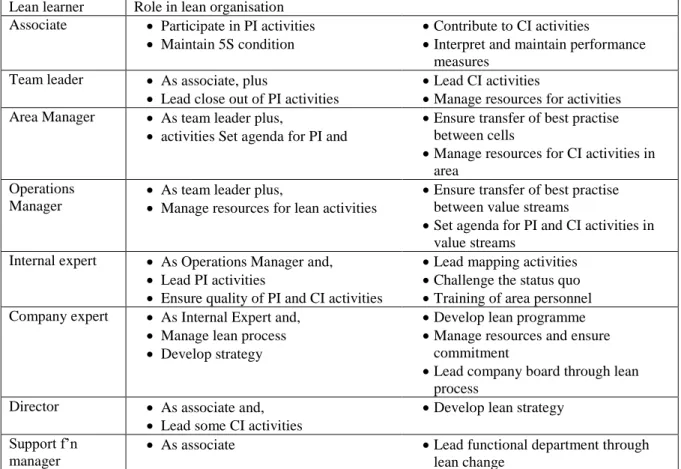
The next stage was to use both the insights of the staff at the centre and the existing sources to develop the ‘Lean Learning Ladder’ to meet the initial needs identified. In line with first of the five lean principles (Womack and Jones, 1996) the needs of the customer formed part of the input model, so the working group identified types of learners in terms of job functions. The working group identified eight types of job functions (Table 1) and considered their role within a lean organisation. This then allowed the group to consider the learning needs and then translate these learning needs into packages of education whilst taking into account the educational theory that should guide this type of course development.
THEORETICAL BACKGROUND
The lean learning ladder’s purpose is to provide a clearer path to the learner to allow them to judge their own level of achievement and so select appropriate methods of obtaining lean knowledge and skills. This approach, of individual led learning “is the direction in which Skinnerian thinking (1959) has developed….. [and] aim to hand over, progressively, the control of the learning sequence to the learner himself” (Borger & Seaborne 1966). De Bono (1996) reinforces this need to differentiate skills and provides a warning that “the skills of action are every bit as important as the skills of knowledge [education]. That this is not recognised in education is a tragedy”. However, education often works on an immediate time frame and perhaps the constraint is as Zbaracki (1998) notes that the speed of new learning flows a slow and fitfully path and regression is common, thereby making it difficult to combine both action and knowledge skills. This need to address the gap between knowledge of tools and the knowledge obtained from applying tools and seeing them in action is an issue that affects many education aspects of operations management (Goffin 1998, Ammar and Wright 1999)
To fulfil the skills of knowledge and action the learner needs to complete a learning – doing cycle which takes account of the potential for a false learning curve (Scholtes, 1998). In other words the individual and the organisation masters the rhetoric and believes that the skills needed are now present however there is a second phase of learning which is to master how to actually apply what has been learnt. This is particularly true for elements of a lean systems transformation where theoretically simple techniques such as 5S are not always straightforward to implement (Monden, 1994). From observations of the Toyota
4
Production System (Imai, 1997) the need for ‘doing’ is recognised as part of the overall training and development of staff. Imai, 1997, states “the mainstay of Toyota’s training is on the job training that develops the skills of the workers”. However there is less of an acceptance of ‘tacit’ knowledge as described by Drucker (1992) that is knowledge that “could not be explained in words it could only be demonstrated”. It may be possible therefore to develop education and training which enable the transfer of knowledge in a way best for both the learner and the topic being taught.
Jones and Hendry (1994) note that to develop overall learning capability there is a need to have both formal learning and training systems. This supports the initial insights from the cross functional group involved in the brainstorming session.
The literature suggests that a lean learning framework needs to tie packages of learning (delivered in whatever mode is appropriate to the learner)in both the context of formalised classroom education and ‘on the job’ reinforcement. This seems to also reflect specific courses identified within EMTA’s recently developed NVQ’s in Business Improvement techniques.
The different views on knowledge and learning discussed influence the development of the ‘Lean Learning Ladder’ and particularly the application of Kolb’s (1984) learning cycle where an individual has a learning experience, draws conclusions about that learning experience, plans what to do next and finally draws conclusions about that experience. Hence the framework developed must include elements of flexibility to enable the learner and the learning organisation to reflect and draw conclusions getting the most from the experience.
CURRENT LEAN STRUCTURES
Research into existing lean education revealed a large number of courses offered by different universities, institutions and commercial enterprises. However, few organisation provided structures that linked together separate courses into a progressive framework. EMTA (Engineering and Marine Training Authority) offered the most comprehensive structure in the form of their NVQ’s in Business Improvement techniques (EMTA 2002) . This structure addresses NVQ’s in Quality Improvement and Process Improvement from level 2 to level 4 and encompasses 35 units.
Level 2 NVQ’s are aimed operators who work in a team involved in Process Improvement or Quality Improvement or other people involved in an organisation undergoing these strategies who require a basic understanding. Level 3 awards are aimed at team leaders, supervisors and people who require a more in depth understanding of Business Improvement. Level 4 awards are aimed at middle managers who have responsibility for Business Improvement and full time facilitators of Business Improvement delivering training across a business. Director level requirements were not addressed in this structure The two Process Improvement and Quality Improvement strands relate to each other in that they have some core modules required for both routes at each level and some option modules in common. The Quality Improvement route has been modelled on the Six Sigma
5
structure that pre-existed the NVQ structure with level 2,3 and 4 based on yellow, green and black belt levels.
An example of an industrial course provider with a structured approach to lean education is The Renault Institute that provides a single page summary of lean education that covers ‘top management’ to ‘employees’ (Renault Institute 2003 - see “learning paths”). This is a good overview of the whole issue of lean education across an organisation however only four groups of learners are addressed; employees, work unit personnel, change agents and top management. Specific ‘products’ i.e. training courses and programmes are then listed conventionally under process subjects such as ‘toolbox management processes’ ‘distribution processes’ and ‘design processes’. The Renault Institute takes an enterprise orientated approach rather than a learner centred approach.
Other educational organisations such as The Manufacturing Institute at Trafford Park Manchester and Michigan University offer lean courses and link them in to their masters courses. The Manufacturing Institute offers a Diploma in Manufacturing and is quality assured by The University of Manchester, UMIST, The University of Salford and The Manchester Metropolitan University. The diploma is identified as an entry route to “some Master’s programmes” (Manufacturing Institute 2003).
Michigan University takes a more integrated approach and promotes individual modules such as “overview of Lean Manufacturing” that earn credits towards awards such as Masters or Lean Manufacturing Certificate Program (Michigan University 2003).
The review of existing educational structures provided some good models on which to build. However none provided a learner centred structure that covered all types of learner from shop floor operator to director level.
TYPES OF LEAN LEARNERS
To have a greater understanding of the potential individuals who seek learning a number of classifications were developed through a small group review. Eight types of people who typically require some kind of learning in the lean area were identified; associate, team leader, area manager, operations manager, internal expert, company expert, director and support functional manager. The first four types of learner in Table 1, associate, team leader, area manager and operations manager are involved at the operational level and typically participate in Process Improvement (PI), also known as Kaizen activities (Bateman and David 2002). The associate often called simply an operator is managed by the team leader. A team leader will manage a small group of operators and is turn managed by an area manager. An area manager will manage a small group of team leaders who work in the same or similar areas. The operations manager will usually have control of a factory or equivalent functional area such as a sales team. These are the people at the front line of lean application.
6
Table 1- Types of Lean Learners
Lean learner Role in lean organisation Associate Participate in PI activities
Maintain 5S condition
Contribute to CI activities
Interpret and maintain performance measures
Team leader As associate, plus
Lead close out of PI activities
Lead CI activities
Manage resources for activities Area Manager As team leader plus,
activities Set agenda for PI and
Ensure transfer of best practise between cells
Manage resources for CI activities in area
Operations Manager
As team leader plus,
Manage resources for lean activities
Ensure transfer of best practise between value streams
Set agenda for PI and CI activities in value streams
Internal expert As Operations Manager and,
Lead PI activities
Ensure quality of PI and CI activities
Lead mapping activities
Challenge the status quo
Training of area personnel Company expert As Internal Expert and,
Manage lean process
Develop strategy
Develop lean programme
Manage resources and ensure commitment
Lead company board through lean process
Director As associate and,
Lead some CI activities
Develop lean strategy Support f’n
manager
As associate Lead functional department through
lean change
The remaining four types internal expert, company expert, director and support function manager fulfil a more facilitating and strategic role. The internal expert is required to co-ordinate and often lead activities. They typically have to challenge and interact with associates, team leaders, area mangers and operational mangers, they are often also called Change Agents. The company expert is the person, often called the Change Champion, who leads the lean transformation. The company expert has to have technical knowledge but also inspire the company to change as well as project managing the programme. The company expert is often at director level.
The director and support function manager often find themselves in a situation where lean is beginning to impact on their activities but they have not yet been directly involved. They need to understand what lean is and how it will change the way they do their jobs and run their teams. The director also needs to understand the fundamentals of lean to make strategic decisions. Pfeffer and Sutton (1999) note that organisations like Toyota begin with a philosophy or set of guidelines about how the organisation will work, not a set of tools and techniques and this is the type of understanding that the director should have.
The support function manager (SFM) such as an accounts manager needs to lead his or her team through the lean change and also consider how their functional department works with in a lean context. The SFM should then implement any changes to required so that their department fits well with in a lean organisation.
7
THE LEAN LEARNING GRID
The definitions of the eight types of lean learners allowed the working group to consider what knowledge base would be needed to fulfil their roles. Ideally all people in an organisation should have a deep and comprehensive understanding of lean, however this is not necessarily a practical approach so the working group specified reasonable requirements for each type of learner.
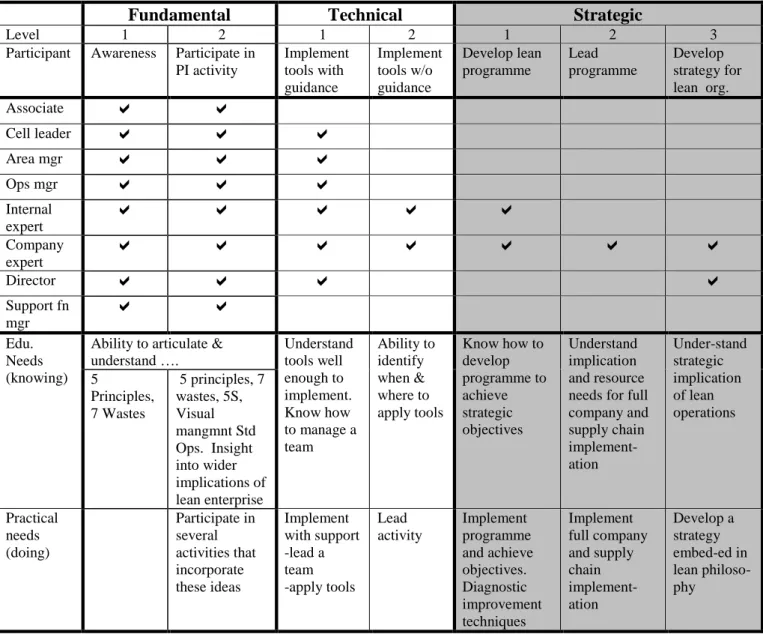
The lean learning grid shown in Table 2 summarises the learning needs of the eight types of learner. All types of learner need the fundamentals so that they can operate effectively in a lean environment. The fundamentals have been split into two levels because the time commitment required to obtain the level 2 fundamentals is often too high as an initial introduction. Having two levels of fundamental courses also allows a period of absorption between the level 1 and level 2 concepts.
Table 2- Lean learning grid
Fundamental Technical Strategic
Level 1 2 1 2 1 2 3
Participant Awareness Participate in PI activity Implement tools with guidance Implement tools w/o guidance Develop lean programme Lead programme Develop strategy for lean org. Associate
Cell leader
Area mgr
Ops mgr
Internal expert
Company expert
Director
Support fn mgr
Edu. Needs (knowing)Ability to articulate & understand …. Understand tools well enough to implement. Know how to manage a team Ability to identify when & where to apply tools Know how to develop programme to achieve strategic objectives Understand implication and resource needs for full company and supply chain implement-ation Under-stand strategic implication of lean operations 5 Principles, 7 Wastes 5 principles, 7 wastes, 5S, Visual mangmnt Std Ops. Insight into wider implications of lean enterprise Practical needs (doing) Participate in several activities that incorporate these ideas Implement with support -lead a team -apply tools Lead activity Implement programme and achieve objectives. Diagnostic improvement techniques Implement full company and supply chain implement-ation Develop a strategy embed-ed in lean philoso-phy
8
The technical levels address the issue of skills required to implement some tools and techniques particularly those used in Process Improvement activities. The difference between technical level 1 and 2 is largely one of experience of leading a Process Improvement team.
The strategic level focuses on giving managers the tools to be able to implement lean initially in their own organisation, and then in their supply chain. Strategic level 1 is about having the tools to participate in taking an organisation through a lean transformation. The diagnostic tools mentioned in the ‘practical needs’ section refer to mapping tools such as big picture mapping, demand amplification mapping (Hines and Taylor 2000). Level 2 is about leading an organisation through a lean transformation and needs to address considering the fundamental change in philosophy of a company to elicit such a change. Strategic level 3 is about influencing a whole supply chain and will often require a change of culture in number of companies. This level of achievement represents a significant shift in an industries’ practices and is unlikely to occur either quickly or easily. The working group acknowledge there are likely to be few people who achieve this standard, none the less it is required as part of the grid for completeness and inspirational purposes.
One of the issues with this grid (and why it became a grid rather than a ladder) is that it is not linear for all types of people. It easy to envisage a middle manager progressing from the fundamental levels to strategic level 1 in a linear fashion. However, a director in a lean company needs to have an understanding of tools and techniques but does not necessarily need the skills identified in technical level 2.
Translating the knowing into doing is an essential part of learning especially with in the area of lean. To meet the doing-loop it is proposed that participants are recommended activities to support courses. So for example to support a fundamental level 2 lean course, a participant should take part in a PI activity, to demonstrate ability at technical level 2 the lean learner should be able to lead PI teams, apply a range of tools in the right situation and manage the PI process.
TRANSLATING THE GRID INTO REALITY
The first stage for LERC is gather feedback on this structure and make any modifications required. The next major step is to review the current courses offered by LERC against the grid. It is envisaged that this will be a difficult process because current courses will already serve some existing function i.e. meet a business need, and also some courses are set with in alternative existing structures such as Masters courses which need to comply with academic regulations. Thus modification of existing courses may not be possible over a short time scale.
The benefits of such a review over the longer term are to provide a more structured range of lean courses that allows real progression by learners. It also is a vehicle by which the current courses can be updated and reviewed as an integrated range of courses. In the short term such a review may well reveal opportunities for new courses for which there should be a business need.
9
The other major element of making such a grid work is the assessment of the ‘doing’ element. The ability to ‘do’ as well as know is crucial to the success of such a grid as it is anticipated that potential employers will expect candidates with for example a technical level 2 certification to be able to lead Process Improvement activities.
Whatever method of assessment is used it should not be excessively onerous on the lean learner as they will be busy implementing lean and do not want to write up academic material. So it is planned that at the foundation and technical levels the assessment will take some form of presentation with questions and ‘log book’ type of written material as proof of implementation. For the strategic levels there is likely to be more written material as part of the implementation anyway, but an ability to critically review such material will also be an important part of assessment.
The assessment element of each course will be on a voluntary basis, but only those who are assessed will be certified. It is anticipated that the take up of assessment will be quite high in the foundation level 2, technical level 1 and 2, and strategic level 1. The two higher strategic levels (2 and 3) are less likely to utilised as few people actually have the opportunity to implement lean at such a level.
CONCLUSIONS
The goal of this paper was to propose a means for the individual learner to position themselves in a progressive structure for lean learning. The lean learning grid will enable a common currency similar to the Six Sigma belt structure to be applied so that a standard for lean learning would result.
The strategic review of lean learning at LERC has raised issues that are common to many aspects of learning in operations management related to the need to change behaviour. (Nonaka & Takeuchi, 1995) This is particularly true of the ‘knowing’ ‘doing’ loop where translating what the operations managers knows into reality is where problems are often encountered. The second major area for operations management is matching industrial needs in terms of delivery to existing academic theories of learning and educational structures.
These issues are addressed by starting with the individual learner, outlining their role and learning needs and then meeting the needs of their organisation. The next stage for evaluating the model to fit this with in an academic structure, this has yet to be tackled although there is an awareness of some of the issues likely to be encountered.
Over the long term it is the aspiration of LERC to have the lean learning grid modified and improved by other organisations such that it can become an accepted standard for lean education with in the lean community.
REFERENCES
Ammar S. & Wright R (1999) “Experiential learning activities in Operations Management” International Transaction in Operational Research Vol. 6 pp 183-197
Antony, J., Banuelas, B., & Knowles, G., (2002). “Implementing Six Sigma” Manufacturing Engineer, Volume 81, No 4, August 2002.
10
Bateman N., & David A (2002) “Process improvement programmes: a model for assessing sustainability”
International Journal of Operations and Production Management Vol.22 No. pp 515-526 0144-3577 Borger R., & Seabourne A., (1966). The Psychology of Learning. Penguin Books Ltd., Middlesex, England. De Bono, E., (1996). The Edward De Bono Book of Wisdom. Penguin, London.
Dimancescu, D., Hines P., and Rich N., (1997) The Lean Enterprise, Designing and Managing Strategic Processes for Customer-Winning Performance. AMACOM, New York
EMTA (2002) Business Improvement Techniques NVQ and SVQ levels 2,3 &4 Standards and Qualifications Structure Feb. 2002
Goldratt (2003) http://www.goldratt.com
Goffin K (1998) “Operations management teaching on European MBA programmes” International Journal of Operations and production Management Vol 18 no 5 pp424-451
Heath, H., (1997) Teaching and Writing Case Studies. ECCH, Cranfield. Imai, M (1997). Gemba Kaizen. McGraw Hill, New York.
Jones A., and Hendry C., (1994). “The Learning Organisation: Adult Learning and Organisational Transformation” British Journal of Management, 5 (2)
Hines P. and Taylor D. (2000) Going Lean a guide to Implementation. Lean enterprise Research Centre Cardiff 0 953798208
Kolb, D., (1984). Experiential Learning: Experience as a source of Learning and Development. Prentice Hall, Englewood Cliffs, N.J.
Manufacturing Institute (2003) http://www.manu-online.co.uk/courses/profdiploma/prof_dip_assessment.asp
Michigan University (2003). http://cpd.engin.umich.edu/ index.html . Monden Y., (1994) Toyota Production System, Chapman and Hall, London.
Nonaka, I, & Takeuchi, H., (1995). The Knowledge Creating Company. Oxford University Press, Oxford. Pfeffer, J & Sutton, R., (1999). “Knowing ‘what’ to do is not enough: Turning knowledge into action”.
California Management Review Fall vol 42 iss1
Prahalad, C., & Hamel, G., (1990) “The Core Competence of the Corporation” Harvard Business Review, May June 1990.
Renault Institute (2003) http://www.renault-institute.com/anglais/f_presa.html
Senge P. (1990). The Fifth Discipline: The art and practice of the learning organisation. Century Business, London.
Shah, U (2002). “Business Integration at Motorola” IQPC Conference Paper, London
Scholtes, R (1998) The leaders handbook Mc Graw-Hill London Skinner, B., (1959) Cumulative Record, Methuen London
Treece D., Pisano G., and Shuen A., (1997) “Dynamic Capabilities and Strategic Management”. Strategic Management Journal, Vol 18. No 17.
Zbaracki, M (1998). “The rhetoric and reality of TQM”. Administrative Science Quarterly, Issue 43, pp 602-636