ISSN: 0022-3891 print / 1532-7752 online DOI: 10.1080/00223891003670133
ARTICLES
Leading North American Programs in Clinical Assessment
Research: An Assessment of Productivity and Impact
LESLIEC. MOREY
Department of Psychology, Texas A&M University
To identify doctoral programs with strong concentrations in clinical assessment, I measured productivity and impact of faculty at North American institutions with American Psychological Association accredited clinical programs. Publications, citations, and h-indexes derived from 4 top assessment journals were calculated over a 10-year period (1999–2009). I identified a total of 42 leading programs that collectively accounted for more than half of the publications and citations in these journals. I found a moderate relationship between assessment productivity and bothUS News & World Reportprogram rankings as well as general productivity rankings of clinical programs reported in an earlier study.
Although the field of clinical assessment is one of the oldest in psychology, the past few decades have seen continuing interest in assessment as evidenced by the emergence of new journals such asPsychological AssessmentandAssessment during the 1990s, the development of an assessment-focused organization within the American Psychological Association (Division 12, Section 9), and the publication of numerous specialty assess-ment book series such as theEssentialsassessment series by John Wiley & Sons. Research and application of psychological assessment played a central role in the development of the dis-cipline of clinical psychology, and these recent trends suggest a continued and future role for assessment in the discipline.
Given the centrality of assessment within clinical psychology, it is not surprising to find that a number of applicants to grad-uate training programs express particular interest in assessment training and research. Although accreditation guidelines and disciplinary practices assure that virtually all doctoral trainees in clinical psychology will receive assessment instruction, there are distinct differences among training programs in the degree to which the field of assessment represents a particular area of fo-cus. However, the information available to prospective trainees about such focus is limited. Applicants can rely on reputational rankings of clinical psychology programs, such as those pro-vided annually byUS News & World Report,but these rankings are fraught with problems (e.g., Winter, Healy, & Svyantek, 1995), and even if accurate, do not convey strengths in particu-lar clinical content areas such as assessment. Researchers such as Stewart, Roberts, and Roy (2007) have attempted to pro-vide a more empirically informed appraisal of programs based on publication productivity. The Stewart et al. article focused on publications by program faculty, which correlated mod-estly at best withUS Newsrankings; it identified University of
Received September 21, 2009; Revised December 21, 2009.
Address correspondence to Leslie C. Morey, Department of Psychol-ogy, Texas A&M University, College Station, TX 77843–4235; Email: [email protected]
California San Diego/San Diego State, Pittsburgh, and Penn as among the most productive clinical programs. However, at this point, it is unknown whether productivity across all clinical areas is associated with having faculty publishing work on clin-ical assessment. The purpose of this article was to provide some information about the top doctoral programs in clinical assess-ment in terms of research productivity and determine the extent to which such top programs are consistent with those identified in previous studies of clinical program research productivity (e.g., Matson et al., 2005; Stewart et al., 2007) or reputational prestige (e.g.,US News & World Report,2008). The former will provide important guidance for the aspiring doctoral trainee in clinical assessment; the latter may provide the field of assess-ment psychology with information about its role in perceived reputation of clinical doctoral programs as a whole.
METHOD
Although empirically based surveys of research productivity and impact seem considerably more objective than reputation ratings, constructing this empirical base is fraught with compli-cations. These complications involve decisions that will invari-ably lead to dramatically different conclusions; for example, two such studies of accredited clinical doctoral programs (Matson et al., 2005; Stewart et al., 2007) that have examined data from an overlapping interval reached conclusions that were in many instances appreciably different. As an illustration, one of these studies reported that Louisiana State University’s program ranked 6th in research productivity, whereas the other ranked it as 101st. Obviously, there is no “standard” means of defining variables such as productivity, program boundaries, or scientific significance of produced research for the purposes of such stud-ies. In the following paragraphs, I describe the specific approach adopted in this study with a brief rationale for each decision. Database
I obtained information regarding publications and citations using Thomson Scientific’s Institute for Scientific Information
207
Web of Science, and I collected it in December 2009. I selected the top four journals, in terms of journal 5-year Impact Factor in theJournal Citation Reports Social Sciences Edition(Thomson Reuters, 2009), which included the wordassessment in their title, to be surveyed under the assumption that these journals (unlike most others) would be exclusive in a focus on assess-ment research. These journals included Psychological Assess-ment(5-year impact factor=3.63),Assessment(2.35),Journal of Personality Assessment(2.08), andJournal of Psychopathol-ogy and Behavioral Assessment (1.61). Selecting the top four seemed like a natural dividing line as the fifth journal, Euro-pean Journal of Psychological Assessment,primarily publishes papers from universities outside of North America, which is the focus of this survey. It is important to note that the largest cate-gory of articles in these four journals deal with the assessment of personality and psychopathology, with smaller proportions involving other assessment areas such as psychometrics, intel-lectual or neuropsychological, marital and family, vocational, or other types of assessment. I included all articles published in the previous 10 years—1999 to 2009, inclusive—in these four journals in the survey. A total of 2,225 articles were indexed in these journals during this 10-year period.
Doctoral Universities/“Programs”
I searched the database described previously using the Orga-nization key in the Web of Science data using terms representing the university or school name for all doctoral clinical psychology programs accredited by the American Psychological Associa-tion (total number of programs=234). Previous studies have been criticized on the basis of inclusiveness or exclusiveness of particular faculty within a “clinical program” (e.g., Andersen et al., 2008; Heesacker & Elliott, 2007), and this issue is not easily resolved given the multitude of joint, adjunct, and cross-appointments that exist in most academic settings. In this study, my focus was on the organization unit rather than on individ-ual faculty members, with the intent of more comprehensively representing the breadth of research and training opportunities available to prospective assessment trainees. Thus, a program was credited with a publication regardless of whether the author was primarily appointed in a clinical program, another program in psychology, or another department in the same university in the belief that any such person would represent an important potential resource for a trainee. Unlike the Stewart et al. (2007) study, accredited programs awarding the Doctor of Psychology (PsyD) were also included in this survey.
Attempting to represent a broad representation of potential training opportunities necessitated some decisions about the boundaries of a university. I made the decision to combine infor-mation from all programs (even if separately accredited) located on the same campus or (in the case of medical schools) located in the same metropolitan area. Thus, for example, separately ac-credited programs at the University of Kansas and at Vanderbilt University were treated as a single program to fully represent the broader set of training opportunities potentially available to trainees in either program. As another example, the representa-tion of the program at Harvard University included work con-ducted at units associated with Harvard Medical School (such as Massachusetts General Hospital), as the latter represents an important potential assessment resource available to trainees in the Harvard doctoral program. As a contrasting example, the
doctoral program at University of Texas–Austin did not include work conducted at the University of Texas Health Sciences Cen-ter at Houston (a separate metropolitan area), as the distance between the two would likely preclude the latter from serving as a training resource for the former.
Authorship
For the purposes of this study, I gave equal credit for a sin-gle author, first author, or a later author of any paper published in the target journals. Although other surveys have attempted to distinguish between contributions based on authorship order (e.g., Gibby, Reeve, Grauer, Mohr, & Zickar, 2002), this can be problematic due to different conventions such as the practice within medical school settings for senior authors of a labora-tory to be listed last. Because the unit of the search was based on organization rather than individual faculty members, when multiple authors from the same institution contributed to a par-ticular paper, this paper only counted once for that institution. However, if coauthors were from different institutions as defined previously, I credited all contributing distinct institutions with the paper.
Productivity and Impact Indicators
To represent both the amount and the significance of the assessment research conducted in the training programs, I ex-amined three different measures.Total publications indicated the sum of all publications in the target journals with at least one author from a particular university.Citations tracked the number of times that these publications had been cited since they were published, with more influential papers being cited more frequently. Finally, theh-index(Hirsch, 2005) for a given university was obtained as a combined representation of both production and impact. Theh-index is the number of papers with citation count≥h; thus, a program that produces four pa-pers that have been cited at least four times has an h-index of 4.
RESULTS
The 2,225 journal articles published in the four study jour-nals included authors affiliated with 177 distinct universities with American Psychological Association accredited programs. Given that there are 234 such accredited programs (some in the same university), this number suggests that trainees in most clinical doctoral programs have access to an active assessment researcher; and this appears to underscore the importance ac-corded to assessment coverage in clinical doctoral training. These 2,225 articles received a total of 19,539 citations, mean-ing that the average article in this time span was cited a total of 8.78 times during this 10-year period.
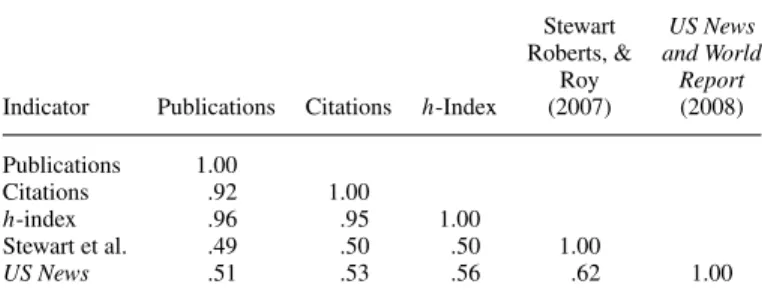
Table 1 provides the intercorrelations (Spearman’s rho) among the rank ordering of all accredited programs according to the three impact and productivity indicators as well as the corre-lation of program rank order with two other “program quality” measures: the total number of program publications provided by Stewart et al. (2007) and the 2008 program ratings as listed inUS News & World Report(2008). As might be expected, the three productivity indicators I examined in this article corre-lated substantially, with all correlations in excess of .90. The three indicators demonstrated moderate correlations with both the publication count ratings from Stewart et al. as well as with
TABLE1.—Rank order correlation of productivity and impact indicators. Stewart US News
Roberts, & and World
Roy Report
Indicator Publications Citations h-Index (2007) (2008) Publications 1.00
Citations .92 1.00
h-index .96 .95 1.00
Stewart et al. .49 .50 .50 1.00
US News .51 .53 .56 .62 1.00
Note. N=234; all correlations significant,p <.001.
theUS Newsrankings. Given that there is overlap in year cover-age with the Stewart et al. survey (which sampled articles from 2000–2005), it is interesting that the correlation with their esti-mates is no larger than with theUS Newsrankings, indicating
that the most “productive” doctoral programs are not necessar-ily the most productive assessment programs. Consistent with numbers reported by Stewart et al., their productivity estimates demonstrated a significant correlation (.62) with the most recent
US News rankings. To determine whether assessment-specific productivity contributes to reputational rank independently of general productivity, I calculated the partial correlation between total assessment publication ranking and US News rankings, controlling for Stewart et al.’s total publication rank, and found it to be .31 (p <.001), suggesting that a significant portion of the association of assessment productivity and program reputation is independent of general productivity.
Table 2 provides a rank of the top assessment programs listed by total publications but including only those programs ranking in the top 25 on at least one of the three productivity indicators. As a means of comparison, also listed are the rank orderings of these programs according to total publications as calculated by
TABLE2.—Doctoral programs ranked by total publications in four top assessment journals. Stewart et al. US News
Publication Citation h-Index Total and World Assessment
Rank Rank Rank Pubication Rank Report(2008) School Publications Citations h-Index
1 1 2 42 4 University of Minnesota 54 939 15
2 4 3 58 57 University of South Florida 53 506 13
3 5 3 n/a n/a Harvard University 52 453 13
4 8 7 7 83 Kent State 50 382 11
5 2 1 21 33 University of Kentucky 48 855 16
6 28 24 34 71 Texas A&M University 43 244 8
7 3 7 3 9 University of Pennsylvania 41 599 11
7 33 24 86 71 University of Tennessee 41 214 8
9 7 10 8 33 Boston University 37 436 10
10 10 15 20 43 Florida State University 36 352 9
11 40 36 n/a 131 Virginia Consortium: ODU/EVMS/W&M 34 197 7
12 25 15 35 43 SUNY-Buffalo 33 248 9
13 56 36 141 92 Texas Tech University 32 138 7
14 6 5 122 99 University of North Texas 31 443 12
15 9 5 2 9 University of Pittsburgh 28 373 12
15 30 10 54 6 Yale University 28 225 10
15 14 15 1 25 San Diego State/UCSD 28 319 9
18 19 10 33 9 University of Iowa 27 290 10
19 37 15 30 25 University of Missouri–Columbia 26 200 9
19 36 24 94 n/a Adelphi University 26 203 8
21 14 15 6 1 University of California–Los Angeles 25 319 9
21 27 15 101 62 Louisiana State University 25 245 9
21 64 50 74 131 University of Toledo 25 124 6
24 18 10 106 16 University of Virginia 24 292 10
24 69 50 83 n/a Fairleigh Dickinson University 24 105 6
26 11 7 79 92 University of Hawaii 23 341 11
26 12 10 46 n/a University of British Columbia 23 335 10
26 23 15 88 116 University of Tulsa 23 256 9
26 31 24 37 9 Pennsylvania State University 23 221 8
26 38 24 126 110 University of Arkansas 23 199 8
26 43 24 62 33 University of Georgia 23 178 8
33 20 24 90 16 University of Texas–Austin 22 279 8
36 22 36 32 9 Duke University 20 268 7
36 25 24 41 6 University of North Carolina–Chapel Hill 20 248 8
36 40 24 103 n/a Simon Fraser University 20 197 8
41 24 24 26 25 Emory University 18 255 8 44 13 15 13 1 University of Wisconsin–Madison 17 326 9 48 17 36 12 62 University of Alabama–Tuscaloosa 15 302 7 50 21 36 61 25 University of Miami 14 270 7 55 14 24 11 8 Indiana University 13 319 8 55 35 24 22 n/a York University 13 213 8 55 39 15 36 9 Stony Brook–SUNY 13 198 9
Note.Stewart et al.=Stewart, Roberts, and Roy (2007); n/a=not applicable; ODU=Old Dominion University; EVMS=East Virginia Medical School; W&M=William and Mary; SUNY=State University of New York; UCSD=University of California San Diego.
Stewart et al. (2007) and as ranked byUS News(2008). Note that the Virginia Consortium in Clinical Psychology was not ranked by Stewart et al. because it is a PsyD program. The list of top programs also includes a number of programs not ranked byUS News,although in some instances, this involves Canadian universities that are not included in their survey. The Harvard program was not included in either survey, perhaps because it was only accredited by American Psychological Association in 2008.
DISCUSSION
This study provides useful information about the distribu-tion and density of clinical assessment researchers across var-ious institutions. The results make it apparent that there are many different doctoral programs with significant intellectual resources for psychological assessment research and training. The 42 schools listed in Table 2 combined for 1,194 articles (some overlapping) and 13,106 independent citations, account-ing for 53.6% of the publications and 67.1% of the citations to work in four top assessment journals. The data also underscore previous cautions against an overreliance on “reputation” as an indication of program quality. In many instances, some of the strongest assessment programs in the country received markedly discrepant US Newsrankings (e.g., South Florida, Kent State, Tennessee, Texas A&M, North Texas, or the Virginia Consor-tium). Nonetheless, Table 2 also includes most of the programs ranked at the top of the US Newslisting, supporting the con-tention that many of the most reputationally prestigious clinical doctoral programs continue to earn that prestige, at least with respect to their contributions to assessment research.
The comparison with the data reported in Stewart et al. (2007) is also interesting in that there is only a moderate association between total publications represented in the two databases. There are a number of reasons why these numbers would be discrepant. First and most obvious, a program may include many productive clinical faculty but have few who do research in clinical assessment. However, differences in study methodology also play an important role, with this study’s organizational-level focus (as opposed to the individual faculty emphasis of Stewart et al., 2007) attempting to include all research on a given campus. This approach thus seeks to recognize important contributions to assessment made by nonclinical (e.g., quantitative, cognitive) psychology faculty as well as contributions made by faculty in other colleges such as Education or Medicine.
It is noteworthy that the associations between productivity indicators in this study correlated as well with the US News
rankings as they did with Stewart et al.’s (2007) more general productivity data. Although factors contributing to reputational rankings are often quite complex, the finding that assessment-related productivity predicted reputational rankings of clinical doctoral programs above and beyond general research produc-tivity may suggest that expertise in assessment continues to be viewed as an important part of a quality doctoral program, at least by the department chairs that complete theUS Newssurvey. It would be interesting to replicate this study with similar investi-gations of the other major content areas within clinical psychol-ogy, such as clinical geropsychology (American Psychological Association Division 12, Section 2), to obtain a more specific picture of the impact of various content areas within clinical psychology on perceived program quality.
As with any study of program productivity, this study is lim-ited in a number of respects. For example, there is a considerable amount of high-impact assessment work published in other jour-nals than the four included here; and for some specialty areas (e.g., neuropsychological assessment), these other journals may be particularly important outlets. However, unlike the four tar-get journals, these other journals are typically not exclusively assessment in their focus. Thus, this study should be considered as a sampling of the assessment literature rather than an exhaus-tive coverage. As another limitation related to coverage, certain important works in the assessment field (such as books, test manuals, and technical papers) are not indexed in the Thomson Scientific database and thus are not represented in these data. In addition, the selection of the organizational unit as the fo-cus of analysis, rather than individual faculty members as in Stewart et al. (2007), has certain disadvantages: It tends to favor organizations of greater size, it does not capture differences be-tween researchers who are core faculty in a program and those more peripheral to that program, and it obviates “per capita” analyses as reported in earlier surveys that could characterize the breadth of different researchers in a program. However, it does provide a more comprehensive coverage of research on a given campus, and it eliminates the need to make ambigu-ous and potentially arbitrary distinctions between “core,” “ad-junct,” “joint,” “clinical,” “visiting,” and other forms of faculty status.
Finally, it should also be recognized that there is considerably more to a quality clinical doctoral program than just assessment research productivity or high publication counts (Heesacker & Elliott, 2007). For example, such research productivity does not necessarily translate into practical training in assessment, course offerings, or even program philosophy. It is important to underscore that these data are not intended to evaluate such programs as a whole—simply to help identify programs with particularly strong assessment concentrations. Furthermore, it is important to recognize that this study is a characterization of programs during a given period of time—but programs evolve and change, and a program with a strong assessment concen-tration at one point may look quite different 5 to 10 years later. Inspection of the list of leading programs in Table 2 is illustra-tive. A school at the top of the list, the University of Minnesota, has been recognized as a premier program in assessment since the 1930s and the era of Strong, Hathaway, and Meehl. How-ever, other programs with strong traditions, such as the Stanford of Terman and Merrill, or Illinois during the Cattell era, have evolved toward different emphases and do not appear on this list, and many of the programs listed have developed a strong assessment focus relatively recently. Recognizing such limita-tions, these data are useful nonetheless as a characterization of the assessment community. The clinical assessment field is one clearly rooted in data, and this study at least provides the prospective scholar with some basis to select a program with strong opportunities in assessment research and training. Fortu-nately for the trainee and for the discipline, it appears that there are a number of impressive programs from which to choose.
REFERENCES
Andersen, B. L., Beck, S. J., Bornstein, R. A., Emery, C. F., Fristad, M. A., Kiecolt-Glaser, J. K., . . . Yeates, K. O. (2008). Problematic methods in the assessment of scholarly productivity in clinical PhD Programs.Clinical Psy-chology Science and Practice, 15,102–104.
Gibby, R.E., Reeve, C.L., Grauer, E., Mohr, D., & Zickar, M. J. (2002). The Top I-O psychology doctoral programs of North America.The Industrial-Organizational Psychologist, 39,17–25.
Heesacker, M., & Elliott, T. R. (2007). My dog’s better than your dog: Publica-tion counts and quality of clinical psychology training.Clinical Psychology Science and Practice, 14,175–178.
Hirsch, J. E. (2005). An index to quantify an individual’s scientific research output.PNAS, 102,16569–16572.
Matson, J. L., Malone, C. J., Gonzalez, M. L., McClure, D. R., Laud, R. B., & Minshawi, N. F. (2005). Clinical psychology PhD program rankings: Evalu-ating eminence on faculty publications and citations.Research in Develop-mental Disabilities, 26,503–513.
Stewart, P. K., Roberts, M. C., & Roy, K. M. (2007). Scholarly produc-tivity in Clinical Psychology PhD programs: A normative assessment of publication rates. Clinical Psychology: Science and Practice, 14, 157– 171.
Thomson Reuters. (2009).2008 Journal Citation Reports, Social Science Edi-tion. Philadelphia, PA, and London, England: Author.
US News & World Report. (2008).Health disciplines: Clinical Psychology (doctorate).Retrieved from http://grad-schools.usnews.rankingsandreviews. com/best-graduate-schools/top-clinical-psychology-schools/rankings/.aq Winter, J. L., Healy, M. C., & Svyantek, D. J. (1995). North America’s top I-O
psychology doctoral programs:U.S. News and World Reportrevisited.The Industrial-Organizational Psychologist, 33,54–58.