
THE INSCRUTABLE SPIRIT OF LOUIS SULLIVAN:
TRANSCENDENTALISM AND AMERICAN ARCHITECTURE AT THE TURN OF THE TWENTIETH CENTURY
Isaiah Ellis
A thesis submitted to the faculty at the University of North Carolina at Chapel Hill in partial fulfillment of the requirements for the degree of Master of Arts in the Department of Religious
Studies in the College of Arts and Sciences.
Chapel Hill 2017
Approved by:
Randall Styers
Brandon L. Bayne
ii
© 2017 Isaiah Ellis
iii
ABSTRACT
Isaiah Ellis: The Inscrutable Spirit of Louis Sullivan: Transcendentalism and Modern Architecture at the Turn of the Twentieth Century
(Under the direction of Randall Styers)
This thesis examines the religious influences on Louis Henri Sullivan (1856-1924), a key
figure in the birth of American modernist architecture and a prolific writer on architecture’s
relationship to nature, democracy, and individual genius. Its argument is that, although
implicated in and to a great extent beholden to industry’s effects on Chicago’s built environment,
Sullivan was intent to raise the stakes of architectural practice and of urban aesthetics more
broadly beyond crude materialism, and to do so he used transcendentalist discourses already at
work in the American architectural world. With the concept of form as its key way of explaining
how Sullivan connected transcendentalists’ literary productions to his material practice, this
thesis charts the genealogy of Sullivan’s theory of architecture and shows how Sullivan made use
iv
TABLE OF CONTENTS
INTRODUCTION: CONCERNING THE SPIRITUAL IN ARCHITECTURE………1
I. Modernism and Spirit………...1
II. Nature, Capital, and Form………...5
PART I: METAPHYSICAL RELIGION FROM TRANSCENDENTALIST LITERATURE TO ORGANIC ARCHITECTURE………..13
I. Sullivan’s Theory of Architecture………..13
II. Metaphysics in Architecture………..14
III. Inspiration in Nature, Mass, and Ornament……….18
IV. The “Active Powers” of Architecture………..22
V. Between Emerson and Sullivan: Transcendentalism and American Architecture…...27
VI. Conclusion………...30
PART II: ARCHITECTURAL IDEAS AND THE SENTIMENTS OF DEVELOPMENT IN THE GREAT WEST………..32
I. The Matter of Architecture……….32
II. City, Country, and the Naturalized Life………34
III. “The Racket of Cities”……….39
IV. The “Daemon” of Innovation………..44
V. Conclusion………47
PART III: EROTICISM AND MATERIALS IN KINDERGARTEN CHATS………..50
I. Sullivan’s Gospel………50
v
III. Bodies and Letters………55
IV. Conclusion………...59
CONCLUSION: ARCHITECTURE, RELIGION, AND THE HUMANITIES………...61
APPENDIX: FIGURES……….68
1
INTRODUCTION: CONCERNING THE SPIRITUAL IN ARCHITECTURE
I. Modernism and Spirit
What is the chief characteristic of the office building? … It must be tall, every inch of it tall. The force and power of altitude must be in it, the glory and pride of exaltation must be in it. It must be every inch a proud and soaring thing, rising in sheer exaltation that from bottom to top it is a unit without a single dissenting line—that it is the new, the unexpected, the eloquent peroration of most bald, most sinister, most forbidding conditions.
—Louis H. Sullivan, “The Tall Office Building Artistically Considered” (1896).1
As the prolific and influential career of the architect Louis Henri Sullivan (1856-1924)
began to take flight in the 1880s, he took as many opportunities as he could to speak and write in
sweeping terms about his own work as well as the state of architecture in the United States.2 In
one of his most well-known essays, “The Tall Office Building Artistically Considered,” Sullivan
links closely the musings reproduced in the epigraph above with extended enumerations of tall
buildings’ technological and structural requirements, like uniform floor-plans and the
newly-invented electric elevator. Sullivan staunchly opposed utilitarian approaches to tall commercial
structures, believing that they squandered “one of the most magnificent opportunities that the
1 Louis H. Sullivan, “The Tall Office Building Artistically Considered,” in Kindergarten Chats and Other Writings
(New York: Dover, 1979), 207.
2 A brief note on primary sources: this project deals extensively with Sullivan’s written body of work, most of which
was collected and published decades after his death in the form of edited volumes. The volumes I use contain transcribed speeches, essays published in architectural journals, and personal correspondence found in Kindergarten Chats and Other Writings. What does not appear in Chats has been collected and edited by Robert Twombly in
2
Lord of Nature in His beneficence has ever offered to the proud spirit of man”—the opportunity
of social and spiritual actualization through architecture.3 Sullivan’s objections to materialistic
architecture acted as social and spiritual critiques that took as their subject architecture and
democracy as national projects. For Sullivan, the defeat of intuition and creativity at the hands of
expediency was a defeat of cosmic proportions. The powers of the creative mind could only
triumph under the guidance of the “Inscrutable Great Spirit of Nature,” which above all else
elevated artistic inspiration to a meaningful plane.
As a theoretical text addressed to architects involved in new skyscraper projects, “Tall
Office Building” offers solutions that are as much transcendent as they are technical. More
specifically, Sullivan’s interest lay in the pairing of height and “exaltation” as tall office
buildings’ correspondent physical and metaphysical properties—its material and spiritual form
(Fig. 1).4 In 1898, an anonymous author penned an editorial in the magazine Forms and
Fantasies addressing Sullivan’s body of work: “if it be true that no man can be a great architect without being a metaphysician, then Mr. Sullivan is without rival.”5
Sullivan would have agreed
with this observer’s conceit: great architecture is something more than material. But, perhaps as
part of his desire for architecture’s spirit to remain, like nature’s, “inscrutable,” Sullivan found
3 Quoted in Lauren S. Weingarden, “Louis Sullivan’s Emersonian Reading of Walt Whitman,” in Walt
Whitman and the Visual Arts, ed. Geoffrey M. Sill and Roberta K. Tarbell (New Brunswick, NJ: Rutgers University Press, 1992), 114.
4 The phrasing of this point came to me when I first read the introduction to Eugenie Brinkema’s The Forms of the
Affects (Durham, NC: Duke University Press, 2014). On p. xiv she proposes that “Affect is not the place where something immediate and automatic and resistant takes place outside of language. The turning to affect in the humanities does not obliterate the problem of form and representation.” Needless to say, my project and hers differ considerably. But I take her basic premise to be that the turn toward affect in the humanities has attempted at times to supersede representation as an analytical orientation—hardly the best choice in a world flush with filmic, literary, and architectural creations. I turn, with Brinkema, to the question: what is the content, material, symbolic, or otherwise, of forms meant to do ostensibly non-signifying work?
5 Quoted in Lauren S. Weingarden, Louis H. Sullivan and a 19th-Century Poetics of Naturalized Architecture
3
little value in trying to explain the connection between architecture and its transcendent
properties until late in his career. “I have no words to characterize what you see here,” Sullivan
said to a journalist writing about Hooley’s New Theater, a project Sullivan completed in 1882
while a junior partner in the firm of Dankmar Adler (Fig. 2). He continued: “The vaguer you are
in such matters the better I shall be pleased. It would be fatal to attempt anything like a
discursive consideration of art and architecture in Chicago just now. People are not prepared for
it.”6
Only a little ruffled by Sullivan’s arrogant waffling, the interviewing journalist was content
to refer to Sullivan in his final report as the “master spirit” behind the theater’s design.
Spirit is an important and problematic word in scholarship on Sullivan and on modernist
art overall—as is religion. Art historians often call upon those terms as part of an attempt to
affirm their subjects’ aspirations to produce socially and spiritually-meaningful work. They thus
offer well-meaning historians the opportunity to regurgitate as historical facts the things
modernists believed about themselves. Carl Condit, an influential historian of Chicago
commercial architecture, argues that while many nineteenth century architects shrank away from
“the new structural materials and utilitarian demands” emerging within industrial and corporate
capitalism, a heroic cohort of architects in Chicago recognized the problems of their age “with
relentless clarity of insight.”7
Unlike those who retreated into the history books to find their
eclectic architectural aesthetic, those in the Chicago school “were concerned with the technical
and aesthetic problem of creating in the older combination of masonry and iron a form
appropriate to the needs and the spirit of the new industrial culture.”8
The term spirit appears
6
Quoted in The Daily Inter-Ocean (August 12, 1882), 13. See Twombly, ed., The Public Papers, 2.
7 Carl W. Condit, The Chicago School of Architecture: A History of Commercial and Public Building in the Chicago
Area, 1875-1925 (Chicago: University of Chicago Press, 1964 [1952]), 11-12.
4
here to be merely idiomatic but, as I will show in this thesis, idioms play key roles in guiding
architectural production and interpretation. In Condit’s estimation, an architect not “in the spirit”
of the times suffered from cultural “malaise,” unable artistically to “be nourished by what his age
gives him.”9
For Condit, what connected Sullivan and his Chicago colleagues, and what justified their
collective work, was an indefinite and ineluctable capacity of genius capable of filling the
cultural void left by architects who either failed to face their zeitgeist or cowered before it. The language of spirit and the idea that an era or nation had a particular “spirit,” commonplace by the
end of the nineteenth century, does not constitute a demand for a new, secular divinity for
devotion such as progress or capital. Nature’s “inscrutable spirit” was, for Sullivan, a force
demanding a direction, an expression, a monument. The spirit to which Sullivan refers made
itself known not through devotional literature, not through efficacious artifacts, and not through
capital accumulation, but through a shape and shadow on the landscape that told its own story
about national progress in the midst of the economic booms and busts that punctuated the
late-nineteenth and early-twentieth centuries.
I argue in this thesis that Sullivan was particularly effective at raising the stakes of
architectural practice and of urban aesthetics more broadly. He propounded an architectural
gospel in professional settings and in front of practitioners who, though equally enmeshed in the
development of modern (and mostly commercial) forms in Chicago and elsewhere, were willing
to hear it.10 Sullivan’s concerns were not strictly interior, as my continued use of the terms
9
Condit, 3.
10 See, for instance, the works of Claude Fayette Bragdon, an architect from Rochester, New York, who was an
5
“spirit” and “spiritual” to describe them might suggest. They faced outwards toward the broader
urban and social fabric in which he lived and worked. Sullivan hoped to harness architecture as a
source of power in service to a society perched on the edge of decay, in desperate need of the
divine light of imagination. The central tension of Sullivan’s work, and this thesis, thus lies
within the relationship between modernism and capitalism in their late-nineteenth and
early-twentieth century incarnations. I invoke the word “tension” in the dialectical sense: even though
modernism and capitalism reinforced each other materially, ideologically they maintained a
relationship of conflict that did not result in the destruction of either, but rather enabled both to
gain richer expression as a force in the story of the United States. I do not mean to maneuver a
monolithic thing called modernism against a monolithic thing called capitalism for the purposes
of putting them at odds. I mean, rather, that the intellectual lineages of modernism shaped
capitalism in the literal sense of creating forms to shelter and structure industrial and financial
life. If American architecture around the turn of the twentieth century took its shape in the
shadow of capital, then it is also true that during this time period buildings and their architects
offered more than sites for and representations of corporate power and financial transactions.
Furthermore, they also offered ways of understanding the relationship those sites would bear to
American society.
II. Nature, Capital, and Form
Historical discussion of Sullivan, like that of many modernists and modernism itself, has
largely resembled a kind of artistic hagiography that imagines him as demiurge of an artistic
cosmos, manifesting and giving voice to the “national spirit… the people’s genius.”11 Condit’s
11 David Morgan, The Forge of Vision: A Visual History of Modern Christianity (Berkeley: University of California
re-6
invocations of spirit are comparatively subtle, not on offer as a cornerstone of the finer points he
makes in The Chicago School about the development of steel riveting and flame-resistant supports for office buildings. Yet they resonate even with architect Anthony W. Barker’s 1901
essay on Sullivan, the earliest major piece of historical assessment. Barker writes that “the creed
of [Sullivan’s] art is therefore democratic and progressive; it finds its inspiration neither in the
past nor the future, but in the immediate and the present, and its optimism and vitality are of the
kindred of the spirit that has brought forth the greatest art of the world.”12
Sullivan’s “kindred
spirits” invoked here populate almost every important survey text of modern architecture, which
trace the intellectual sources of modernism back to the beginnings of the theory of art Sullivan
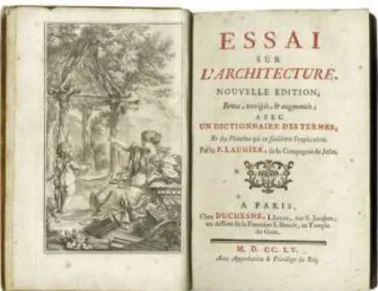
would popularize: “organic” architecture. In his 1758 text, Essay on Architecture, Jesuit
Marc-Antoine Laugier set forth a narrative of architecture’s mythic beginnings in the lonely quest of
“primitive man” to find shelter. Without family or community, Laugier’s primitive hero retreats
to a cave to escape the elements. Growing weary of the damp darkness, the man resolves to find
shelter in the light of day. He finds four strong trees and lays two others, which he has chopped
down, atop them, forming two lintels supporting a canopy of leaves (Fig. 3).13
Laugier’s origin myth uncovered architecture’s “original” principles by claiming they
were “founded on simple nature.”14 The mythic story also sets the stage for nineteenth century
German idealist aesthetes like G.W.F. Hegel and Gottfried Semper, along with British Romantics
sacralizing a disenchanted world are the second and third of three fundamental links Morgan identifies between modernist art and modern Christianity. The first is the use of Christian symbols and biblical themes as subject matters for art, which on the whole does not apply to Sullivan.
12 Anthony W. Barker, “Louis Sullivan: Thinker and Architect,” The Architecture Annual, Second Edition, ed.
Albert Kelsey (Philadelphia, PA: The Architectural Annual, 1901), 50.
13 Marc-Antoine Laugier, An Essay on Architecture, trans. Wolfgang and Annie Herrmann (Los Angeles, CA:
Hennessey & Ingalls, Inc., 1977 [1758]), 11-12.
7
like John Ruskin and A. W. N. Pugin, to link architecture with period-specific notions of natural
law—and architects as masters, in a certain sense, of that law’s dispensation (Fig. 4).15 From the
time Europeans became conscious of a newness to their moment with respect to past ones, in
terms of capital, nationhood, and colonialism, architects, art critics, and aesthetic philosophers
have kept their ear to the ground, seeking an understanding of the moral implications of
technology and industry, interpreting those changes through developments in the arts. Whether
tied explicitly to a religious group or not, this lineage of modern aesthetic thinkers and
practitioners, along with the specific set of circumstances surrounding industrialization in the
North Atlantic, would make it possible for early-twentieth century modernist painter Vassily
Kandinsky to write his most famous written text, Concerning the Spiritual in Art (1911). In that text he argues that true art works toward “the non-material” and that “every man who steeps
himself in the spiritual possibilities of his art is a valuable helper in the building of the spiritual
pyramid which will someday reach to heaven.”16
Since he wrote explicitly from the perspective
of Russian Orthodoxy, and chiefly about painting, it is unclear whether Kandinsky understood
the breadth of artistic and religious lineages his claim included.
Religious studies scholars are uniquely positioned to uncover the breadth of modernists’
religious affiliations and to excavate the meaning of the religious idioms by which many of them
constructed their theories of art and society. For Kandinsky, it is Russian Orthodoxy; for
15 It is worth mentioning here that Pugin and Ruskin were both Catholic. Both championed Gothic revival
architecture, and both explicitly made architecture and Europe’s early-nineteenth century urban landscape a key site for the expression of the “three centuries of mingled devastation, neglect, and vile repair” wrought in the time since Protestantism’s arrival in England. See Augustus Welby Pugin, Contrasts, or, a Parallel Between the Noble Edifices of the Middle Ages, and Corresponding Buildings of the Present Day, Shewing the Present Decay of Taste (London: Charles Dolman, 1836),35. Pugin was unapologetic in his condemnation of “modern” building forms, which though they were neo-Classical in style, he always associated with Protestantism and contrasted with Catholicism by way of visual comparison (Fig. 4).
16 Vassily Kandinsky, Concerning the Spiritual in Art, trans, M.T.H. Sadler (Toronto, ON: Dover, 1977 [1911]),
8
pioneering French modernist architect Le Corbusier, it is Calvinism and theosophy;17 for
Sullivan, transcendentalism. Yet it remains tricky to simply “find the religion” in art or
architecture, particularly when, as with Sullivan, the art avoids representing religious figures or
stories and instead lingers on the edge of the abstract (Fig. 5). Adding to this murkiness, as Mark
C. Taylor points out, is modernist architecture’s dastardly collusion with fascism in Europe and
capitalism in the Americas.18 Though Sullivan participated early in his career in the design of a
synagogue, a masonic temple, and Chicago’s Moody Tabernacle Church, he made his career and
his reputation designing opera halls, office buildings, and department stores in cities across the
American Midwest and South.19 In his designs for tall office buildings, Sullivan searched
tirelessly for “eloquent peroration[s]” of modernity’s “forbidding conditions,” not solutions or
actions against those conditions, as many labor organizers in Chicago and New York did.20 On
the spiritual plane, argues Robert Orsi, modern American metropolis’ vertical growth “drained
away the vitality of the local, making it difficult for city people to feel secure or grounded or
even present on the street.”21
Sullivan did not belong to a religious community, nor did he
17 See Mark C. Taylor, Disfiguring: Art, Architecture, Religion (Chicago: University of Chicago Press, 1992); and
Nicholas Fox Weber, Le Corbusier: A Life (New York: Alfred A. Knopf, 2008).
18 Taylor, 11.
19 There is a reasonable case to be made for including Sullivan in the recent turn towards business history in the
study of religion. Key texts in this turn, from religion and the field of history, include Bethany Moreton, To Serve God and Walmart: The Making of Christian Free Enterprise (Cambridge, MA: Harvard University Press, 2009); Timothy Gloege, Guaranteed Pure: The Moody Bible Institute, Business, and the Making of Modern Evangelicalism
(Chapel Hill: University of North Carolina Press, 2015); and most recently, Amanda Porterfield, Darren E. Grem, and John Corrigan, eds., The Business Turn in American Religious History (London: Oxford University Press, 2017).
20 Union organizers in cities like Chicago offered swift and direct responses to the skyscraper phenomenon , often
directly addressing their symbolic qualities vis-à-vis class and labor relations. See Joanna Merwood-Salisbury,
Chicago 1890: The Skyscraper and the Modern City (Chicago: University of Chicago Press, 2009).
21
9
contribute his time or money to any as a participant. Indeed as an architect working primarily on
tall office buildings and opera houses for the wealthy, Sullivan and his design partner Dankmar
Adler would fall into current paradigms of American religion as a force disruptive of religious
and communal life on the ground.
My thesis thus necessarily departs from a “grounded” perspective on architecture and
American urban religious life. Its subject of study, a highly influential man operating at the
crossroads of industry and art, seems by all accounts to have believed that people and places “on
the ground” found their truest expression in the “proud and soaring” buildings around them, and
vice versa. Sullivan forces us all to consider how forms, entwined with but also aside from
beliefs and practices, are always at play in the ways scholars talk about religious claims on sites,
landscapes, and cities. For example, Orsi’s argument against modernist commercial architecture
(and thus implicitly against Sullivan) is not only based on an antagonistic dualism, communal
life versus capital growth, but also centers around dueling forms: the local neighborhood versus
the skyscraper. A study of Sullivan that suspends disbelief about that dualism reveals multiple
logics involved in the emergence of the modern built environment. Such a study also points
toward the dense genealogies within American religious history that serious consideration of that
environment brings into focus, and outlines the shape of the forms Sullivan took as his primary
objects of scrutiny in determining architecture’s relationship to America’s social and spiritual
future.
I use the term “forms” often in this thesis, and I mean something specific. Generally the
word refers to narrative techniques in literature and specific shapes of architectural elements—
“the form of the doorway,” “the form of a sphere,” and so on. Caroline Levine expands the term
10
“to include patterns of socio-political experience,” such that “the form” of a piece of literature or
a created artifact is no longer considered a distinct object, but rather as deeply—even
ontologically—enmeshed in its context.22 A form is a shape, but is also more. A form is a shape
with “affordances”—with conceptual tendrils and material echoes buried deep in the
socio-cultural world from which that form emerges. As Mark C. Taylor’s work affirms, forms travel.
They emerge because of multifarious engagements with “common problems” associated with
modernity.23 But does this mean that any idea, any conceptual connection across a group of
thinkers, any social context, can be a form, or create one? Levine offers a helpful clarification:
Is there any way outside or beyond form? My own answer is yes—there are many events and experiences that do not count as forms…fissures and interstices; vagueness and indeterminacy; boundary-crossing and dissolution.24
A writer with more of a mind for deconstruction than I might bank on Levine qualifying this
claim by arguing that forms themselves are slippery, given naturally to indeterminacy and
heterogeneity, and that the forms Sullivan created unintentionally affirmed the capitalist power
relations under which he operated, or indeed may have ushered along political and economic
hegemony in the United States by helping to establish an iconic form lending iron’s solidity to
the naturally unstable Anglo-American political project.
These things are important to consider, and may all be true. It is also important to know
that Sullivan would never have believed it. He viewed forms as fundamentally transparent,
utterly revealing of the ideologies at work within them, and in the minds and bodies of the artists
behind them. In a building, he wrote in 1901, “everything is there for us to read … [it] tells us
22
Caroline Levine, Forms: Whole, Rhythm, Hierarchy, Network (Princeton, NJ: Princeton University Press, 2015), 2.
23
Ibid., 21.
11
“more truths about him who made it, who thought it, than he in his fatuity imagines; revealing
his mind and his heart exactly for what they are worth.”25 As Taylor writes, modernists’ tragic
flaw was their “aesthetic arrogance”—their absolute confidence in form. “Cooptation of wrong
forms was destiny… cooptation of right forms was impossible.”26 Sullivan, like other modernists
after him, was not at all interested in abetting or creating indeterminacy within modernity. With
forms as his trusted aid, indeed as his only worthwhile tool, he worked to stem modernity’s wild
flows, and to guide them back towards nature, far away from the world in which he and his
contemporaries found themselves. Each section of this work focuses on a different dimension of
Sullivan’s engagement with and use of forms to solve problems in contemporary American
society and spirit. Section One stresses that any characterization of Sullivan’s religious thought
must begin with its historical referents. His architectural forms had intellectual and aesthetic
origins, as did his literary ones: his sources were transcendentalist. The section follows
transcendentalist ideas about evolution, human progress, and invention as they traveled from
Ralph Waldo Emerson to Louis Sullivan through an unbroken chain of friends, colleagues, and
mentors.
Having laid out the historical context, in Section Two I analyze Sullivan’s geographic
context as he remembered it in his carefully crafted memoirs. This section explores his childhood
in rural Massachusetts, his career in Chicago at the birth of the skyscraper, and his life’s
denouement after what he felt was the death knell of American architecture, the World
Columbian Exposition of 1893. Sullivan’s relationship to Chicago was in general one of fervent
hope that the city would come to embody architecture’s potential to grapple with the raw forces
25 Sullivan, “What is Architecture?: A Study in the American People of Today,” in Louis Sullivan: The Public
Papers, 181; this essay was printed originally, in three installments, in The Craftsman 10 (May 1906): 145-9; and (June 1906): 352-8; and (July 1906): 507-13.
12
of industrial modernity. He often referred to Chicago as a young man—foolish, but virile,
flexible, and still growing. It was hardly the “city of big shoulders” for Sullivan, but he liked that
it continually provoked itself to re-invention.
Sullivan’s concerns about progress and regression, vitality and decay, virility and
feebleness, came together between January 1901 and January 1902 in his most famous text,
Kindergarten Chats, the subject of Section Three. Originally a serial publication, Chats became a monograph in 1918 meant as an evangelistic text on art, democracy, and spiritual growth.
Immensely important within the practice of architecture and its study, Chats used erotic bodily language to describe buildings as a part of a holistic expression of his spiritual program. I focus
on this text because in Sullivan’s mind it detailed clearly the spiritual dimensions of his
architectural program, and in its comparisons of buildings to male bodies it foregrounds
13
PART I: METAPHYSICAL RELIGION FROM TRANSCENDENTALIST LITERATURE TO ORGANIC ARCHITECTURE
I. Sullivan’s Theory of Architecture
My introduction argued for Louis Sullivan’s importance to the infrequently told story of
religion’s place in the canon of modernist architecture, and for future work on the subject of art,
material religion, and U.S. religious history to consider the concept of “form” as a way of
broaching the difficult tangle of materiality and metaphysics in discussions around art. Building
on that argument, this section delves with as much specificity as sources allow into the roots of
Sullivan’s thought, finding his architectural theory knotted together inextricably with
transcendentalist ideas of progress and growth. My argument here is that transcendentalism and
the “organic” theory of architecture together formed the basis for Sullivan’s early elaborations on
the spiritual dimensions of architecture.
Catherine Albanese’s term “metaphysical religion” is helpful for understanding how
Sullivan fits within this lineage of aesthetically-minded transcendentalists as well as
spiritually-minded architects. For many art historians, the key feature of Sullivan’s transcendentalist design
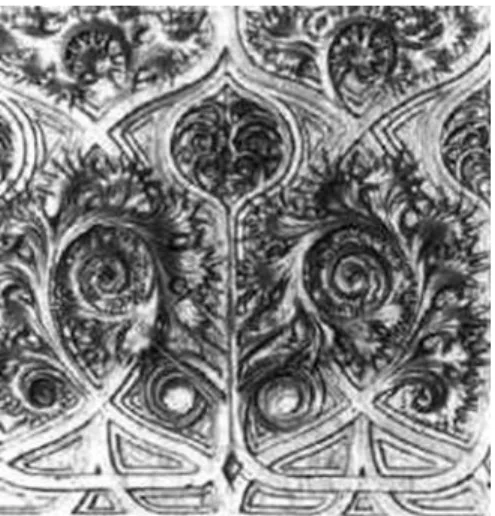
is his ornament. Floral yet abstract, naturalistic yet geometric, Sullivan’s style of ornamentation
echoes the drawings of John Ruskin, the English Catholic political thinker and an important
figure in Romantic thought and artisanal design across the nineteenth century North Atlantic
(Figs. 6 & 7). Sullivan used ornament to lend artistic and moral credibility to his industrial and
corporate buildings, particularly in his designs for “tall office buildings.” To adopt Lauren S.
14
“naturalizing technology”—infusing cold steel foundations with the poetic warmth of terra cotta
flowers. Yet for Sullivan, ornament comprised only one possibility for linking spirit and form.
For a more holistic understanding of that linkage, we should consider Sullivan as a part of a
lineage of thinkers who sought to put inspiration into practice in the United States in order to
create an aesthetic representative of what they thought of as the American spirit.
After I locate Sullivan within Albanese’s evolving framework of metaphysical religion, I
analyze several of his early speeches, in whose language his influences become clear. I trace that
lineage from Ralph Waldo Emerson through Emerson’s lifelong friend and fellow
transcendentalist, Rev. William Henry Furness, and through the youngest of the Furness
children, Frank, who was Sullivan’s first full-time architectural employer in 1873. Though major
economic depression that year shortened Sullivan’s term of employment, for about eight months
the two colluded around floral ornamental designs and aesthetic philosophies whose authors
found a readership among both architects and transcendentalists (Fig. 8).
II. Metaphysics and Architecture
My argument requires that I examine very specifically what it meant in the
late-nineteenth century for Sullivan to have a “metaphysic” deployed through architecture. I take the
specific meaning of metaphysic from Catherine Albanese, whose work charts the development of
a strain of religious thought and practice in the United States encompassing transcendentalist
literature, Spiritualism and spiritual healing, and what she earlier called “Nature religion.” To
generalize, metaphysicals are intellectuals or practitioners of any religious persuasion who seek
sites of spiritual authority apart from denominational traditions or received interpretations of
religious truth, and instead intuitively mine contemporary scientific knowledge about the human
15
craft literary, bodily, and (in Sullivan’s case) material or architectural testimonies to forces and
truths that lie beyond institutional and rational horizons of possibility. Metaphysicals rebel
particularly against doctrines emphasizing sin, evil, and suffering, insisting instead that humans
exude cosmic energies, embody divinity, and hold the harness of unseen forces at work in the
world. An important mantra among the metaphysicals that appear in this section—and
throughout this thesis—is progress, the movement of right-thinking humans (though most often
men) away from the strictures of the past and into an intellectually and spiritually free future.
Importantly, for Sullivan and others technological and artistic forms offered evidence of progress
or its lack.
Though the term “metaphysical religion” shows up only in her more recent work,
Albanese’s texts on transcendentalists give us two helpful points of analysis.27
First, she
investigates and names nature veneration as a continuous religious trend in the United States. For
Albanese, nature in its real and imagined forms in North America acted as an “orienting idea”
and a primary object of attachment for nineteenth century intellectuals and practitioners of
spiritual healing. What kept this veneration alive through the nineteenth century and beyond was
a dual view of nature as an ideal place to contemplate higher truth and to build the perfect
society, and nature as a site where divine truth presents itself immediately and immanently. The
former view conceives of nature as a tool for human enlightenment and mastery of the world,
and the latter view emphasizes nature’s individual forms and its totality as enchanted substances
flush with divine power. There was thus, according to Albanese, a “creative confusion” for
27
The progression proceeds as follows: Catherine Albanese, Corresponding Motion: Transcendental Religion and the New America (Philadelphia, PA: Temple University Press, 1977); Catherine Albanese, Nature Religion in America: From the Algonkians to the New Age (Chicago: University of Chicago Press, 1990); Catherine Albanese,
16
thinkers such as Emerson and Thoreau “between—on the one hand—a view of matter as ‘really
real,’ the embodiment of Spirit and the garment of God, and—on the other hand—a view of
matter as illusion and unreality, ultimately a trap from which one needed to escape.”28
Sullivan
sidestepped this particular problem with ease. He did not reflect much on the question of nature’s
physical and metaphysical composition. Instead, he imagined the relationship between architects
and nature as one of mental effectuality, in that an architect should seek clarity and inspiration in
nature rather than a classroom, and of formalistic guidance, in the sense that the forms of nature
evidenced the most truthful aesthetic solutions for the problems presented by clients’ needs and
current building methods and technologies.
Albanese’s second helpful move is to eliminate, in later work, the notion that nineteenth
century transcendentalists “confused” matter and spirit for one another and muddled the
hierarchies between them. By placing nature veneration in the broader context of Enlightenment
rationalism as well as Anglo religious perceptions of the New World, Albanese comes to “a
second definition of the term ‘Nature’” that would have been much more meaningful to Sullivan:
nature was “the law that turned sun and stars in their orbits, ordering the regular motion of the
planetary bodies” as well as the political organization of rights-bearing citizens.29
Natural law
sets human polities, ecosystems, and the cosmos itself in harmonious motion—“a grand
symmetry of order and form.”30
If we think of matter and spirit as the constituent forms (which is
to say, the shapes) of a universal order, we get closer to a nuanced reading of religion’s role in
28 Albanese, Nature Religion, 82. 29
Albanese, Reconsidering Nature Religion, 8.
17
the mind and works of metaphysicals.31 In her 2007 book, ARepublic of Mind and Spirit, Albanese argues that Ralph Waldo Emerson, as well as healers like Phineas Parker Quimby,
“found the ingredients for Self-transformation in a ‘Spirit’ immanent in matter, so that—like the
Hermeticists of old and the worldwide spiritual teachers they admired—they could be as gods,
identified with a power of ‘Good’ that kept on giving.”32
Conceived as both a gift (the effect of
nature) and giving (the effectual cause of the human power to act on the world), spirit as
Albanese describes it here is in energetic conversation with the material world through its
intellectual and practical expositors. The question of what forces or projects guide artists’ hands
was crucially important to Sullivan, and it provides the best frame for studying his own work.33
Sullivan was not an advocate for bringing nature as such—plants, grass, trees, and bodies
of water—into the city. He was a spiritual aesthete, believing inspiration and its translation in
form to be both cosmically powerful and socially effective. In this respect, we can contrast him
with Frederick Law Olmsted, another famous nineteenth century designer of urban spaces,
whose spiritually inflected notion of democracy led him to posit that designed natural spaces,
like Central Park in New York City, would foster interpersonal encounters in a rapidly
de-personalizing city. Olmsted attempted to insert nature into the city as a means of moral and
democratic development, proposing a social symbiosis between city and countryside.34 Sullivan,
on the other hand, proposed that city buildings be designed according to the principles of nature.
31 We also get further away from the problematic notion that permeates Albanese’s earlier work of an unbroken
tradition passing from an American indigenous tribe to a Transcendentalist-oriented architect working in a commercial metropolis built on indigenous lands.
32 Albanese, Republic, 258-9.
33 In some of his later written work, Sullivan discusses an “architectural alphabet”—pier, lintel, and arch—as the
building blocks for an aesthetic and moral theory of architecture, which I discuss in section three.
34 Carol J. Nicholson, “Elegance and Grass Roots: The Neglected Philosophy of Frederick Law Olmsted,”
18
While Olmsted worked with pieces of nature designed to create social accord within a city,
Sullivan worked with pieces of a city designed in accordance with nature (Fig. 9). The
intellectual lineage that enabled Sullivan to conceive of design in this way—as natural without
involving plants or animals—displays the ways he wanted to create forms corresponding to
divine realities rather than venerate already-existing forms in nature. Scholars of religion cannot
consider metaphysical religion on the whole, transcendentalism in particular, or architecture as a
practice elaborating its ideas or ideologies without occupying a space between matter and spirit,
shape and concept—the space of form, in which orderings of matter exist in order to address
problems its creator has identified. I will now examine how these ideas emerge in Sullivan’s
early speeches and their resonances to Ralph Waldo Emerson and the people linking him to
Sullivan intellectually.
II. Inspiration in Nature, Mass, and Ornament
In 1886, Sullivan delivered a speech on “Inspiration,” which is known as the first public
expression of his spiritual program and a crucial step in his contributions to broader
conversations happening in the American architectural world.35 Attendees at that year’s annual
meeting of the Western Association of Architects (the group’s third) must have expected the
keynote remarks directly to address their technical expertise, their understandings of
composition, or at least the state of their profession. Were they to ask—and they must have—
Sullivan would have insisted that if they knew better, they would be satisfied with his remarks’
relevance to their cause.
35
19
The speech opens with the “tender light of dawning spring” emanating from “the ardent
sun,” which, “flushed and impatient, pulsates hotly toward the summit of the heavens,” melting
winter snows and waking up the earth—and with the earth, the soul.36 It presents the seasons,
and indeed life itself, as circular and progressive, not as linear or even repetitive—spring
emerges to thaw the ice of winter and to best previous springtimes in its verdant splendor.
“Through lesser springtime…courses mysterious life, unfolding toward greater, ever greater,
ever broadening springtimes,” with each most recent thaw more fully “comprehending and so
transmitting the past, fulfilling the present, gestating the future—ever fecund and joyous.”37
Creativity emerges along with spring from the cold dark of winter, signaling and even bringing
about a “melodious succession” of times, peoples, and artistic styles. The disciplinary term “art
history” would likely have struck Sullivan as wrong-headed. It was not the past of art but the
rhythms of time that the artist with something important to say must heed. Inspiration lived and
died on the turning of these rhythms. That is to say, it depended utterly on its temporal context.
“Of such [rhythms] are we,” Sullivan told his fellow Western architects. “High above our
struggling, joyous verdure, our parting mists, our urgent and propulsive dawn, posed serenely,
soaring ever toward the azure heights rises the immortal spirit of man… a spring song to the
waiting soul, a hymn of praise to nature’s bounty, a sweet and unnamed outburst of itself.”38 The
evocative image of man’s spirit soaring into “azure heights” must have resonated with his
audience, who as architects working in and around Chicago would have been well aware of the
recent applications of steel foundations and scaffolding, as early as the 1860s, in the construction
36 Louis Sullivan, “Inspiration,” in Twombly, ed., Public Papers, 11-12. 37
Sullivan, “Inspiration,” 12-13.
20
of tall buildings. The other image hinted at here, one Sullivan would explore in his next delivered
speech in 1888, is one of pine trees as unique “individuals” within their taxonomic lineage.39
“Ever unsatisfied” to merely identify the pines’ traits, Sullivan argues, the right-minded
investigator would see that each pine tree “possesses a subtile [sic] and permanent charm of
personality.” In discovering this, the investigator “draw[s] nearer to nature’s heart.”40 The
energies spilling out in the turning of the seasons take on unique forms as they course through
human, arboreal, and architectural bodies. Each achieves a uniqueness that inheres in their being,
which Sullivan interchangeably calls “style” and “soul.”41
Each is “an outburst of itself.”42
These remarks on the height of pine trees constitute the first iteration of Sullivan’s
fascination with the metaphysics of height. This fascination would continue through much of his
career, manifesting in a preoccupation with youth and virility, as I will show in the next section,
and with male bodies specifically, as I will show in the final section. Some of his major buildings
of the 1880s anticipate the ways he later linked nature and bodies, including a balance of angular
volumes and curvaceous ornament, which he saw as representing the masculine and feminine
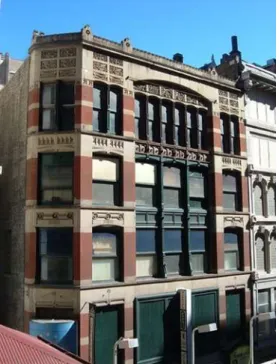
energies in architecture. Take, for example, the nine-story Wainwright Building, completed in St.
Louis in 1892. The tall, smooth terra cotta surface covering its base dominates the sidewalk,
minimizing and dominating passing pedestrians (Fig. 10). As the façade moves upward, its unity
dissolves into a series of vertical supports that, on the street-level, are so pronounced as to evoke
39 Recent historical research has shown that trees of all kinds had quite a vibrant cultural life in the nineteenth
century—e.g. the Civil War was often visualized as a struggle between Pine and Palm. Trees had myriad and contested meanings, but their usefulness as symbols emerged in their propensity to naturalize the discourses employing them. See Deagan Miller, “Reading Trees in Nature’s Nation: Toward a Field Guide to Sylvan Literacy in the Nineteenth-Century United States,” American Historical Review 121(4) (October 2016): 1120.
40 Sullivan, “Style,” in Public Papers, 50. 41
Ibid., 49-50.
21
the idea of height itself, as well as to exaggerate the impression the nine-story building gives as it
looms over the sidewalk (Fig. 11). Accenting the bottom of each support as well as each of the
façade’s windows and the main doorway are small linear wreaths of ornament, set in different
patterns on each story. Collectively, these small strips of detail echo the much larger horizontal
band of “modular” ornament at the building’s capital (Fig. 12).43
From the ground level, the
ornamental features at the building’s top look like fine-grained clouds; in actuality, they are
comprised of repeating modules: plant stems and leaves curling around each other to form
semi-circles of stems crowned and bookended by leaves.
For Sullivan, his early mentor Frank Furness, and many others, the proper solution to
design problems was, as Furness himself advocated, to turn to the forms “daily presented” to
humans by nature.44 Scholars like Lauren Weingarden have interpreted their mutual vision as
progress toward a transcendentalist ornamental design,45 but Sullivan’s treatment of the
Wainwright Building displays just as much a commitment to shaping ornament in tandem with
the qualities of the building’s body—its height, its girth, and the angular shapes that surround
and support its ornamental detail. The Wainwright’s ornament performs the same visual
operation as the mass of the building does; its patterns are repetitive like the seasons and
recursive like the leaves and branches of trees. The Guaranty (1896) and Condict (1899)
buildings maintain the same aesthetic, with the abstract turning of the leaves atop the
43 According to online dictionaries the term modular means composed of a set of independent units that “fit together
to form a more complex structure.” My use of the term “capital,” as well as base and shaft, is a concession to the theory that many office buildings of Sullivan’s era were designed with the structure of the classical column in mind.
44 Frank Furness, “Hints for Designers,” in Furness: The Complete Works, ed. George E. Thomas, Jeffrey A. Cohen,
and Michael J. Lewis (New York: Princeton Architectural Press, 1991), 348.
45 Sullivan, “Tall Office Building,” 112-4. See also my introduction, p. 1. Despite Sullivan’s apparent prohibition on
22
Wainwright having made way for the next heralds of art’s great Spring: the row of angelic
figures emerging from the Condict’s vertical supports (Fig. 13 & 14).
My analysis of Sullivan’s progressive ornamentation across the 1880s suggests that his
solutions to the design problem of the tall, tree-like building operated on the level of structural as
well as ornamental detail. Sullivan’s interest in recasting the “stone and mortar” of buildings as
trees or, as I will discuss in the next section, as human bodies, imbues angles, bricks, and stone
with the metaphysical significance that comes with embodying a natural entity. Though a
properly “virile” system of ornament is not itself a spiritual good for Sullivan, it would act to
uplift the “spiritual and emotional quality” that “resides in the mass of a building … from the
level of triviality to the heights of dramatic expression.”46
IV. The “Active Powers” of Architecture
The real value of height as a form of exaltation, enhanced through an accompanying
ornamental scheme, would for Sullivan emerge organically from an architect’s “protean thought
and action… roused and sustained in eagerness by the touch and impulse of desire.”47 Though
speeches like “Inspiration” and their corresponding ornamental projects found their literary voice
in Whitman’s poetry, they also evoke shades of Emerson’s quasi-evolutionary thought
concerning human endeavor. Where Sullivan writes that “imagination rising quickly to the
heights makes thoughtful action magically vocal and complete,” we are reminded of Emerson’s
famous text, Nature,where he avers that “the intellectual and the active powers seem to succeed each other” in art. “Therefore does beauty, which [comes] unsought… remain for the
46
Sullivan, “Ornament in Architecture,” in Kindergarten Chats and Other Writings, 187, 190 (emphasis in original).
23
apprehension and pursuit of the intellect; and then, again, in its turn, of the active power.”48 With
cyclical rhythms foregrounded in both texts, here Emerson and Sullivan both set up beauty,
intellectual activity, and action as a natural progression of the forces of human life and the
inevitable result of the forces of nature. Emerson’s version of the eternal cycle, in which
“nothing divine dies,” is not merely about “barren contemplation,” but more importantly “new
creation.”49
This is how Emerson manages to link beauty—through its first cause, nature—to
what was new about his context. People “no longer [wait] for favoring gales, but by means of
steam” they make real “the fable of Aeolus’s bag, and [carry] the two and thirty winds in the
boiler of [their] boat.”50
Even the most utilitarian of arts, Emerson recognized, provided unique
opportunities to project, or at least exhibit, the power latent in human ingenuity and in so doing
to meld the material and mythological. Far from abandoning the material world, as the
oft-bandied label “idealist” would suggest, Emerson finds a great deal of potential for enchantment
in the grit of American ingenuity.51 Emerson is known among art historians primarily for linking
both high art and industrial craft with the divine potential of the human mind and of human
progress.52 True to form, in Nature he did not readily separate the “natural” or “spiritual” from the technological.
48 Ralph Waldo Emerson, Nature, in Essays and Lectures: Nature; Addresses and Lectures; First and Second
Series; Representative Men; English Traits; The Conduct of Life (New York: Literary Classics of the United States, 1983), 18.
49 Emerson, Nature, 18. 50 Ibid., 12.
51 Some scholars have qualified Emerson’s status as an exemplary American thinker by referring to his involvement
in the colonial and race relations of his time. See Colleen C. O’Brien, “’What Mischief Would Follow?’: The Emersons, Haiti, and Romantic Racialism,” ESQ: A Journal of the American Renaissance 58(2) (2012): 219-254.
52
See also Menocal, Architecture as Nature; and Madden, “Transcendental Influences.” Indeed Emerson appears as
the “gravitational center” for American Transcendentalism on the whole in literary studies and the broader historiography on Transcendentalism. See Albert J. Von Frank, “On Transcendentalism: Its History and Uses,”
24
Emerson is particularly important in helping us understand how Sullivan came to find a
meeting point between Transcendentalist thought and architectural theory, and sculptor Horatio
Greenough represents the first link between the two. In his influential collection of essays on
architecture, Form and Function,53 Greenough, an avid reader of Emerson, defined organic architecture as architecture developed according to the functional problems a given building was
meant to resolve. Rather than advocate for certain proper patterns and proportions in building
design, as European architects oftendid, Greenough argued that “the law of adaptation is the
fundamental law of nature in all structures.”54
Evoking a Darwinian evolutionary framework,
Greenough’s comments mirror Emerson’s claim that “arising out of eternal Reason, one and
perfect, whatever is beautiful rests on the foundation of the necessary.”55
Inspired by Greenough and his resonances with Emerson, Sullivan’s early speeches
constitute an exemplary case study in what architectural historians call the theory of “organic”
architecture. As clearly illustrated in Sullivan’s early writings, in addition to being a method for
design organicism was a way of thinking, writing, and speaking about architecture. It was a
series of ideas aimed at shaping design. It was also a way of reframing architectural history and
practice in terms of its consonance with a transcendent principle of individualism and, on a
civilizational level, of progress. Louis Sullivan would come to understand and deploy this
principle in dynamic ways. For Sullivan, nature—along with its “Inscrutable Spirit”—would
53Form and Function was a collection of essays written and published separately before Greenough’s death in 1852
and collected under their current title in 1947.
54 Quoted in Mark Mumford, “Form Follows Nature: The Origins of American Organic Architecture,” Journal of
Architectural Education 42(3) (Spring 1989): 26.
55 Ibid. This particular link between the beautiful and the necessary would, later in the century, inspire the writings
of Claude Fayette Bragdon, a young architect from Rochester, New York. Bragdon’s The Beautiful Necessity: Essays on Architecture and Theosophy reveals not only his influence by theosopher Annie Besant but also his admiration for Louis Sullivan, whom he visited in Chicago in the 1890s and brought along with him to one of Besant’s lectures.
25
provide the honest seeker with aesthetic taste and moral judgment. For Sullivan, leaves and trees
were “primordial forms” ripe for representation, ultimately featuring in his later, broader
commentaries on the character of civilizations, from Egypt and Rome to Western Europe to the
United States. To the extent that Sullivan’s ideas remained consistent as they traversed scales big
and small, they anchored themselves in notions of “growth and decay, the elemental rhythms of
birth and death.”56 As art historian Lauren Weingarden points out, this interpretation of
architecture is distinctly Emersonian in its attempt to unify the fine and utilitarian arts and to use
nature as a “picture-language,” a representation of deeper truths.57
Greenough and Emerson shared a concern for what Emerson called the “real
foundations” of human life, which they specifically distinguished from institutional knowledge
production associated with doctrinaire Old World religious institutions.58 For Emerson, tradition
and institutional structure stymied life-affirming expression, restricting the vocabulary of life and
meaning to those that custom and liturgy provided—a poor substitute for “the sentiments” that
inspired, among other things, religious art and architecture.59 These real foundations, more
urgent than priestly dictates and more fundamental than traditions, would buttress a morally and
56
Quoted in Weingarden, 19-20; original in Sullivan, “Kindergarten Chats,” 125.
57 Weingarden, 19th Century Poetics, 21-22. At 22, Weingarden quotes Emerson’s notion of “picture-language”; this
concept originates in Emerson’s “The Poet,” in Essays and Lectures, ed. Joel Porte (New York: Library of America, 1844), 1983.
58 Ralph Waldo Emerson, “Religion,” in Essays and Lectures, 883. See also his “Harvard Divinity School Address.” 59 Emerson, “Religion,” 883-4, makes a fascinating analogy to marriage: “It is with religion as with marriage. A
26
socially significant art free of the yoke of tradition, and bound instead to nature.60 Greenough
argues in a similar vein that, if American artists were content to look to Europe for guidance in
the arts and accept Old World wisdom as truth, they “might as well [propose] a national church
establishment.”61 In Americans’ blind acceptance of received aesthetic principles, “systems and
manner take the place of sound precept. Faith is insisted on rather than works. The pupils are
required to be not only docile, but submissive. They are not free.”62 Europe and “religion” serve
Emerson and Greenough as dramatic foils for American artists who sought inspiration not in
their craft’s past, but within themselves, their continent, and their cities.
It is not enough to claim that Emerson, Greenough, or Sullivan seem to espouse
American individualism. If Emerson or Greenough meant to stake claim to individualism, they
did so in a very specific space at the meeting point of religion and the arts. Acknowledging the
existence of this intersection in their writings is crucial to understanding the full social and
cosmic impact that Sullivan and others expected “organic” forms to have as they attempted to
cultivate an American style. For Sullivan as for Greenough, European art was form without
function, religion without inspiration. It stood as a dramatic foil to the evolution necessary for
the emergence of inspired style. The idea of American art as an “organic” enterprise was thus
closely linked to Northeastern elites’ preoccupations with finding within individuals spiritual
alternatives to churchly intellectualism, at least in the sense that the path artists and seekers alike
were to follow was one of invention rather than imitation.
60 I would argue that the “foundations” architects like Sullivan latched onto were more important to them when
considered in and of themselves—linking them overtly to a tradition would have, in Sullivan’s mind, denuded their spiritual significance.
61 Greenough, Form and Function, 43. 62
27
V. Between Emerson and Sullivan: American Transcendentalism and American Architecture
The Unitarian movement from which Emerson hailed is probably the first place most
religious historians would look to explicate individual invention as a religious idea in the
nineteenth century United States. Most Unitarians and Transcendentalists showed minimal
interest in Greenough’s thought relative to Emerson, but many of them supported the notion that
breaking with certain kinds of tradition, particularly those associated with Old World religious
institutions and aesthetic practices, would allow for a greater appreciation of both male and
female individuals as godly in their capacities.63 Among that group was William Henry Furness,
the leader of Philadelphia’s Transcendentalist salon, a life-long friend of Emerson and father to
Frank Furness, Sullivan’s first architectural mentor.64
Emerson and Rev. Furness attended Harvard Divinity School together, parting company
when Rev. Furness moved to Philadelphia in 1825 with his new bride, Annis P. Jenks, to lead the
Philadelphia chapter of the Unitarian Society.65 Rev. Furness often shared his love (and his
translations) of German idealist and aesthetic philosophy with Emerson through private
correspondence, and between poetry readings, Bible studies, and frequent visits from Emerson as
well as noted abolitionists William Lloyd Garrison and Lucretia Mott, the Furness family parlor
became the center of Philadelphia’s liberal intellectual life in the antebellum period. At the same
time that Emerson was sending the final drafts of Nature off for publication in 1836, Furness was
63 These debates occurred mostly among males, but in a letter, Emerson enumerated various artistic and spiritual
figures according to whether they represented the “male” or “female” energies present in America. Greenough was listed as representing a female energy.
64 See Ralph Waldo Emerson and William H. Furness, Records of a Lifelong Friendship, 1807-1882, ed. Horace
Howard Furness (Boston: Houghton Mifflin Co., 1910).
65 Joseph Priestley founded the Philadelphia Unitarian Society in 1794. See Michael J. Lewis, Frank Furness:
28
writing his “Remarks on the Four Gospels,” which earned him the scorn of some of his former
Harvard Divinity classmates and unkind comparisons to Emerson. In “Remarks,” Furness argues
that Jesus was a human being and that Jesus’s propensity for “unprecedented wisdom and
greatness always speaking and acting from within” stemmed not from divine parentage but from
“the very manner of Nature.”66
Two years later, Emerson argued in his “Harvard Divinity School
Address” that Jesus “belonged to the true race of prophets” because of his singular ability to
“estimate the greatness of man.”67
Furness and Emerson maintained a close personal and
intellectual dialogue before, during, and after these well-known texts were written. The exact
nature of their influence on each other’s writings is unclear, but they shared two important
concerns: the individual as creator, and Jesus Christ as the individual par excellence. We are
reminded of the lonesome scenario in which Laugier’s “primitive man” founded architecture, as
well as Sullivan’s persistent erasure of his longtime partner, Dankmar Adler, from post-facto
accounts of his success.68 A large part of public consciousness today of genius architects—
including Sullivan’s own pupil Frank Lloyd Wright—is the result of Sullivan’s and Wright’s
collision with transcendentalism and with each other in the 1870s and 1880s.
Rev. Furness’s enthusiasm for aesthetic philosophy influenced all four of his children,
especially Frank, though it is not entirely clear whether or in what specific ways Frank Furness
66
Quoted in Mark B. Orlowski, “Frank Furness: Architecture and the Heroic Ideal” (Ph.D. diss. University of Michigan, 1986), 16.
67 Orlowski, 17. Orlowski contends that Furness’s account of Jesus influenced Emerson’s “Harvard Divinity School
Address.” His evidence lies in the two texts’ similarities, but he offers no records of conversations between the two authors around these specific works.
68 Not only did Sullivan attribute many of the firm’s buildings to his own genius, but he also fudged the process by
which he and Adler came to be partners in his 1924 memoir, Autobiography of an Idea. He writes in the
29
directed Sullivan towards the writings of Emerson, Greenough, or his father.69 Frank showed a
promising inclination towards the arts as a child, but almost none for his authorities at school, an
attitude that Rev. Furness was comfortable cultivating and that bonded Frank and Sullivan as
colleagues.70 Furness collected several medals in service to the Union Army in the Civil War,
and after traveling the American West for several years he returned to Philadelphia, opening up
an architectural practice and joining the newly founded Philadelphia branch of the American
Institute of Architects in 1868. Rev. Furness played a continuing, if minor, role, in Frank’s
career, giving a lecture at the AIA’s 1870 annual meeting on architecture and German idealism.71
For his part, Frank wrote very little except to urge artists to look for the “everyday forms” nature
presents to its viewers for aesthetic ideas.72
Emerson and Rev. Furness’s shared thoughts on art and spirit offered aesthetic cues as to
how their lofty ideals might emerge in artistic practice, cues that Sullivan took up in dynamic
ways. It is easy, for example, to transpose the image of the tree—a singular organism, feeding on
planetary energies by reaching downward into the earth as well as up towards the sky—onto the
theologically and aesthetically-inflected ideas of the individual circulating in transcendentalist
circles. Sullivan’s concern with the material valences certain built forms could carry linked
directly to his exposure to transcendentalist notions of progress—of the dialectical “intellectual
and active powers.” In an 1886 letter to Walt Whitman, sent along with a copy of his speech
69 All of Annis and Rev. William’s children showed a great inclination toward the arts. Their eldest, William Henry,
Jr. (1827-1867) became a painter; Annis Lee Furness (1830-1908) became a translator of German literature; and Horace Howard Furness (1833-1912) became an eminent scholar of Shakespeare at the University of Pennsylvania.
70 The first and only formal architectural training program Furness did seek out, a relatively informal workshop with
the famous Richard Morris Hunt, ended within two years on account of Furness’s joining the Union Army in 1861.
71 Orlowski narrativizes this ten-year stretch of Furness’s life in chapters two through six of his dissertation. I have
not yet been able to obtain a copy of Furness’s talk at the AIA.
30
“Inspiration,” Sullivan extolled his honored recipient as “a man who can resolve himself into
unison with Nature and Humanity … who can blend the soul harmoniously with materials.”73
Whitman worked with words in just the way Sullivan, as an architect, desired to work with
building materials.
Sullivan’s vocabulary of height and exaltation remained relatively undeveloped in early
essays like “Inspiration,” but they would reappear ten years later in “The Tall Office Building
Artistically Considered.” While the later essay weaves some of the motifs elaborated in
“Inspiration” into detailed considerations of the structure, material, and function of tall office
buildings, the younger Sullivan was content to claim that his poetry was born among the trees
and within the turning of the seasons. Sullivan’s comparison of buildings to trees and—later in
life—to human bodies stems from the transcendentalist focus on the divine individual and the
unfolding, recurrent cosmos. If, as Lewis Mumford has argued, these musings did not amount to
a “coherent aesthetic theory which was directly applicable to architecture,”74
at least they
provided a foundation on which the idea of organic architecture could rest.
VI. Conclusion
It would limit our understanding of Sullivan and his work to insist that that he was a
“religious” person per se, that he was a part of a “religious movement,” or that he “had a
religion” easily identifiable in his texts. Sullivan was an architect. Architecture was for Sullivan
a mirror for individuals’ and societies’ self-understanding and self-reckoning and a vehicle for
73 Quoted in Weingarden, “Louis Sullivan’s Emersonian Reading,” 102-3. 74





![Investigation of the electronic and thermal rearrangement properties of SPIRO[2,4]HEPTA-4,6-DIENES](data:image/gif;base64,R0lGODlhAQABAIAAAP///wAAACH5BAEAAAAALAAAAAABAAEAAAICRAEAOw==)