SNOMED CT Implementation
Mapping Guidelines Facilitating Reuse of Data
A. Randorff Højen; K. Rosenbeck GøegDepartment of Health Science and Technology, Medical Informatics, Aalborg University, Denmark
Keywords
SNOMED CT, electronic health record, ter-minology, guidelines, semantic interoperabil-ity, information retrieval
Summary
Clinical practice as well as research and quality-assurance benefit from unambiguous clinical information resulting from the use of a common terminology like the Systematized Nomenclature of Medicine – Clinical Terms (SNOMED CT). A common terminology is a necessity to enable consistent reuse of data, and supporting semantic interoperability. Ma-naging use of terminology for large cross
Methods Inf Med 2012; 51: 529–538 doi: 10.3414/ME11-02-0023
received: August 22, 2011 accepted: May 21, 2012 prepublished: October 1, 2012
Correspondence to:
Anne Randorff Højen
Department of Health Science and Technology Medical Informatics Aalborg University Fr. Bajers Vej 7 C2 9220 Aalborg ∅ Denmark E-mail: [email protected]
specialty Electronic Health Record systems (EHR systems) or just beyond the level of single EHR systems requires that mappings are kept consistent. The objective of this study is to provide a clear methodology for SNOMED CT mapping to enhance applicabil-ity of SNOMED CT despite incompleteness and redundancy. Such mapping guidelines are presented based on an in depth analysis of 14 different EHR templates retrieved from five Danish and Swedish EHR systems. Each map-ping is assessed against defined quality crite-ria and mapping guidelines are specified. Fu-ture work will include guideline validation.
1. Introduction
To support a consistent and unambiguous representation of information in eHealth, clinical terminology systems have been focus of attention in scientific research. The unique identifiers and the conceptual structure representing each concept in a terminology system allow an unambiguous interpretation of the concept’s meaning across systems. This is beneficial for the use of information in both clinical practice and for secondary purposes [1]. In clinical practice the potential benefits are the capa-bility of creating patient oriented over-views, based on specific queries, which can provide the physician information relevant for a current treatment or diagnostic pro-cess. For secondary purposes different ac-tors may benefit from an unambiguous
data representation for aggregation and comparison of clinical data supporting quality assurance and research .
The Systemized Nomenclature of Medi-cine – Clinical Terms (SNOMED CT) is a promising clinical terminology system. SNOMED CT contains more than 311,000 active concepts organized into hierarchies. The top level hierarchies define the types of concepts available to describe clinical in-formation e.g. clinical findings, observable entities, procedures and body structures. Also concepts are available to clarify the meaning of other concepts as e.g. social context and qualifier value. SNOMED CT has a complex multi axial and composi-tional structure. Composicomposi-tional means that if a given term cannot be mapped to SNOMED CT, two or more SNOMED CT concept can be combined to form the
meaning of the term. This is referred to as post-coordination whereas terms that can be represented with one SNOMED CT concept are pre-coordinated [2]. SNOMED CT has shown superior coverage and flexibility compared to other terminol-ogies [3 – 6], and studies have been per-formed in multiple clinical fields [7– 9]. The current content and structure gives rise to expressiveness of SNOMED CT, but there are also a number of issues. Actually, studies show that even by the use of SNOMED CT, as a common clinical ter-minology system, redundant represen-tations of identical clinical information occur [10, 11]. The issue of redundancy leads to a limited applicability of SNOMED CT, as retrieval, aggregation and compari-son of clinical data across systems cannot be done in an accurate and trustworthy manner.
Redundancy problems are highlighted in coding variability studies. In a study per-formed by Andrews et al. [11] the variabil-ity found was partly due to different levels of contextualizing the data and also due to different approaches to perform post-coor-dination. Overall, the study emphasizes the need for consensus and communication re-garding the use of SNOMED CT. Addition-ally [12], documents comparable results. Also, redundancy is not the only shortcom-ing in SNOMED CT that hinders efficient use, also, gaps in the terminology, a lack of compositional structure and consistency problems are reported issues [13].
At least two main approaches, not mutually exclusive, has been proposed to improve the limited applicability of SNOMED CT, namely, structural improve-ment and selective retrieval. Structural im-provement denotes the wide range of re-search contributing to improve the formal logic/formalism of SNOMED CT. The re-search includes e.g. improvements of for-mal logic [14], standardising the forfor-mal logic by using OWL [15] and improving
Health Information Sear
consistency of post-coordination [16]. As for the second approach, Dolin et al. has in-troduced the method of ‘selective retrieval of pre and post-coordinated concepts’, to overcome the issue of redundancy and coding variation. The idea with this method is to use the defining character-istics of a concept expressed in a common form to query and retrieve stored informa-tion. So, instead of being limited to only re-trieve information based on the hierarchi-cal structure, each of the defining char-acteristics of a concept can be used as en-tries for detailed queries. However, the primitive concepts in SNOMED CT hinder the use of this approach, due to the lack of established definitional roles [10, 17]. “If a concept is primitive its place in the subtype hierarchy may be known but it cannot be checked for equivalence with another con-cept expression or post-coordinated ex-pression” [18].
Even though the research community continuously adds to the improvement of SNOMED CT, reported use of SNOMED CT for practical purposes is limited [19]. One possibility for practitioners could be to wait until the structure and content of SNOMED CT is complete. However, com-pleteness is seldom cost effective, since much of the terminology would never be used in practise [20]. Therefore, how can the use of a terminology system like
SNOMED CT be beneficial for primary and secondary purposes despite its incom-pleteness?
2. Objective
The objective of this study is to provide a clear methodology for SNOMED CT map-ping to enhance applicability of SNOMED CT despite incompleteness and redundan-cy. Redundancy can be reduced by apply-ing a set of rules that clarifies which SNOMED CT term to choose among a set of candidate mappings. Earlier studies has shown that consistency can be improved through mapping guidelines [1, 21]. In this study guidelines are designed to make sense in a organisational and multi-speciality context and to allow clinically meaningful querying for primary and secondary purposes.
3. Methods
The method section contains a presenta-tion of the material chosen for this study, the guideline design method, the map-ping quality criteria, and the mapmap-ping process.
3.1 Material
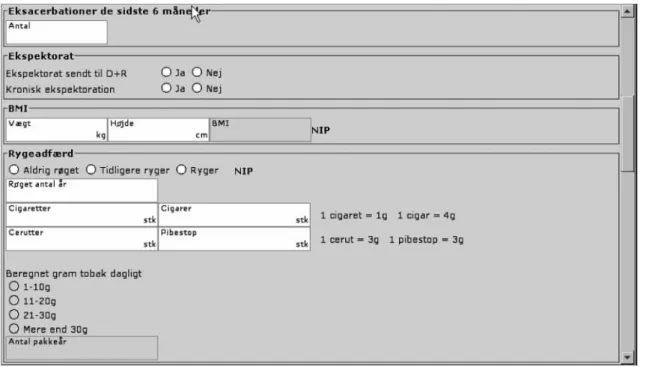
In order to obtain a multi organisational and multi speciality focus, the guidelines presented are based on an in depth analysis of 14 different Electronic Health Record (EHR) templates from five EHR system im-plementations – three Danish and two Swedish. The EHR templates describes the mark up of clinical information rather than the clinical information itself and are used for documentation in clinical practise (see example in 씰Fig. 1).
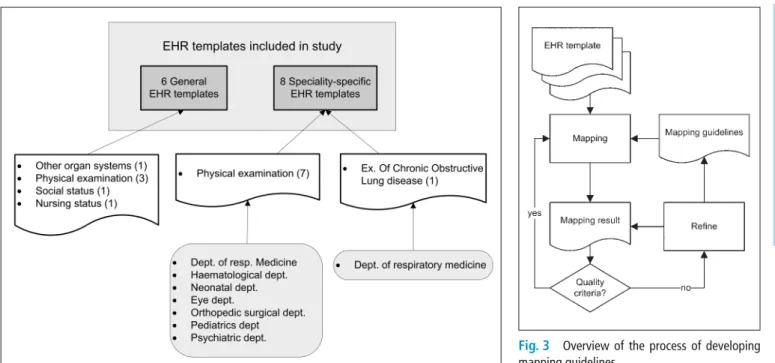
The EHR templates, included in this study, represent a variety of granularity, as both general and specialty specific infor-mation is represented. Thus, the guidelines can be adapted to different types of infor-mation and different levels of granularity. Also, the variety allows investigation of how mapping on different granularity lev-els can be kept consistent. The EHR tem-plates, included in the study, are shown in
씰Figure 2.
3.2 Iterative Guideline Design Method
The guidelines are developed iteratively as shown in 씰Figure 3. Initially, we developed at set of quality criteria that would support meaningful querying. We used these to
de-Fig. 1 An excerpt of the EHR template used for registration of examinations of Chronic Obstructive Lung Disease (COPD)
Health Information Sear
fine the first set of guidelines. The guide-lines were used to map the interface terms of EHR templates to SNOMED CT. The mapping result was assessed using the quality criteria. Problems were identified and possible solutions formulated as new guidelines that replaced or supplemented the original guidelines. The refined guide-lines were used to edit earlier mappings and continue with mapping the interface terms of more EHR templates. We continued until all 14 templates were mapped and ful-filled the quality criteria.
3.3 Quality Criteria
The quality criteria were formulated on a basis of the objectives of supporting mean-ingful querying in a multi organisational context. Meaningful retrieval requires re-lations between SNOMED CT concepts, so that querying for e.g. findings of the car-diovascular system will retrieve various re-lated information like ECGs, pulse and nar-ratives describing cardiac assessments. Also, consistency is important, so that dif-ferent interface terms in difdif-ferent organi-sations with similar semantic content are mapped to the same term. This means that querying for e.g. blood pressure will result
in retrieval of blood pressures from EHR systems in the organisations.
These quality criteria have to be refined, given the incompleteness of SNOMED CT. Firstly, the primitive concepts miss defining relationships. Secondly, the redundancy causes different organisations (or even the same organisation) to choose to map similar content to different SNOMED CT codes.
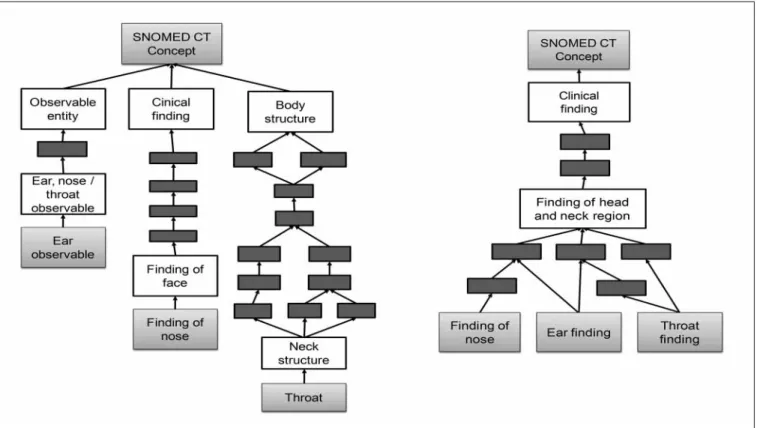
The implications of not refining the quality criteria can be illustrated with an example. The three interface terms ear, nose and throat can be used to represent three text fields in an EHR template. With-out considering the shortcomings of SNOMED CT, the mapping could be done in various ways as illustrated in 씰Figure 4 (left side figure), where the term ‘ear’ could be found in the observable entity hierarchy, the term ‘nose’ could be found in the clini-cal finding hierarchy and the term ‘throat’ could be found in the body structure hier-archy. In 씰Figure 5, the same interface terms are mapped to the clinical finding hierarchy. Mapping to the same hierarchy means the IS-A relationships provide the information that the three concepts are in-herited from the concept ‘Finding of head and neck region’. A single query on ‘Head and neck region’ will therefore result in in-formation about ear nose and throat
coming from the three text fields, without having to specify their exact concept IDs.
Being aware of the importance of consist-ency in the selection of hierarchies and con-cepts facilitate the possibility of introducing fields for more granular information within the same clinical domain. Selecting concepts that are inherited by the coarse grained in-formation will solely enlarge the sample space for a given query without being de-pendent on any query modification. There-fore, this approach supports the bridging be-tween the coarse grained expressions ap-plied in most of the general EHR templates and the fine grained expressions that are seen in the specialty specific templates.
In conclusion, the quality criteria are: ● Meaningful relationships between
SNOMED CT concepts must be en-sured. Given the issues of SNOMED CT, meaningful relationships are IS-A rela-tionships, as these are always present. ● Consistent mapping should be ensured
within and across organisations.
3.4 Mapping Process
The mapping was done by the two authors, who are both familiar with official SNOMED CT guides [2, 18, 22]. Our own
Fig. 2 Illustration of the included EHR templates. Six general and eight speciality specific EHR templates are included. A total of 14
Fig. 3 Overview of the process of developing mapping guidelines
Health Information Sear
set of guidelines was chosen over official guides, when they conflicted, to ensure ful-filment of the quality criteria. The first en-coding of an EHR template was done by one of the authors in accordance with the guidelines. Furthermore all encoded terms were reviewed by the other author to en-sure accordance between coding and guidelines. When the guidelines were not sufficient to ensure unambiguous map-ping, the cases were assessed and discusses using the quality criteria as guidance. When in doubt about the meaning of an interface term, we discussed the meaning of the term with the organisation, from which the term originated. Also, difficult mapping cases were discussed with the national release centre. We chose not to measure inter rater variability, because we wanted to formulate a clear methodology to ensure similar coding practice. Discussions throughout the encoding process were therefore con-sidered more appropriate. Doing this, in the beginning, many discussions and a lot of time was used to ensure consistency, this continued until the point where all the
guidelines were formulated. After this point we mapped the rest of the material without needing much discussion.
4. Results
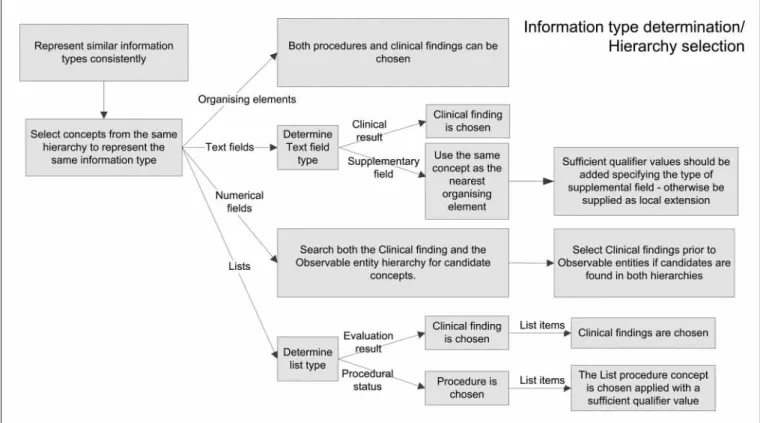
The result section presents the guidelines in three parts: The first part is about how SNOMED CT hierarchies can be chosen based on types of information in the EHR template. The second part is about how mapping consistency can be balanced with mapping precision. The third part is about consistency in post-coordination. An over-view of the developed guidelines is shown in 씰Figure 5.
4.1 Hierarchy Selection Based on Type of Information
In 씰Figure 4, the hierarchy selection based on type of information is illustrated. The types of information are presented in the following.
4.1.1 Types of Information
The highest level is ‘organizing elements’ and ‘result elements’. The title of an EHR template, such as ‘Physical examination’ or ‘Nursing status’ is considered an ‘organiz-ing elements’. However, an EHR template may consist of multiple section headings e.g. ‘smoking behavior’ or ‘cardiovascular stress testing’. These are also organising el-ements. Result elements can be subdivided into text fields, numerical fields and lists – and lists of cause consists of list items. They specifies result fields where the underlying SNOMED CT concept should represent the meaning of the interface term. Lists can refer to both drop down menus, check boxes and radio buttons.
The mapping result is presented in
씰Table 1. The expressions were categor-ized as ‘not mapped’ when the exact mean-ing of the clinical expression were not rep-resented in SNOMED CT, and thereby hin-dered achieving the quality criteria.
As we have mapped templates with simi-lar clinical purpose from different
organi-Fig. 4 Left: Illustration of how the expressions, ear, nose and throat can be represented by SNOMED CT without considering the sufficient hierarchy and concept selection. Right: Illustration of how the expressions, ear, nose and throat can be represented by SNOMED CT considering the sufficient hier-archy and concept selection
Health Information Sear
sations, many fields have similar semantic content. This is actually the strength of the material since a clear encoding methodolo-gy will reveal similar information in differ-ent templates. This meant that in our study 234 SNOMED CT pre-coordinated con-cepts represented 435 interface terms. The number of uniqe SNOMED CT concepts is reflected in the ‘unique’ categories in
씰Table 1.
4.1.2 Organizing Elements
As a main rule ‘organizing elements’ were represented by procedures or clinical find-ings. Procedures were selected when the ‘organizing element’ represented an evalu-ation method for obtaining a set of results. E.g. ‘physical examination (procedure)’ were chosen for the outer ‘organizing el-ement’ as it represented the content of the entire EHR template and the concept ‘re-spiratory finding (finding)’ were selected as ‘organizing element’ for the expressions ‘Finding of rate of respiration’, ‘Finding of arterial oxygen concentration’ and ‘Peak expiratory flow rate’. Because ‘organizing elements’ served as parents for a group of more detailed expressions, and therefore represented a coarse grained expression, SNOMED CT performed with high pre-coordinated coverage, as only three cases of post-coordination were needed.
4.1.3 Text Fields
These are fields where the content is repre-sented by free text narratives. The SNOMED CT concept representing the content of ‘text fields’ should balance the issue of not being too general and thereby insignificant for the meaning of the con-tent, and not too specific and thus peril to be misinterpreted. ‘Text fields’ were mapped to concepts in the clinical finding hierarchy. This guideline deviates from the recommendation provided by IHTSDO, where the observable entities serve the pur-pose of representing a question or pro-cedure which can produce an answer or a result [2]. However, in [23] we documented that clinical findings reap more benefits in terms of retrieval and reuse purposes than of observable entities. It can also be argued that the semantics of the text fields are
clinical findings, as the free text narratives represent an answer/result.
The majority of the EHR templates in-cluded some types of supplementary fields. These fields, as the rest of the text fields, cover for some free text narrative. However, the characteristics of these fields are that the expressions representing these fields do not explicitly specify a specific content. Typi-cally, the expressions for these fields are ‘comment’, ‘other findings’, ‘conclusion’, etc. The mapping of ‘supplementary fields’ was difficult to generalize as the content of these fields were template dependent. Still, these fields were represented consistently by assig-ning the concept code of the nearest ‘organ-izing element’ post-coordinated with a de-scriptive qualifier value. This approach fa-cilitated the possibility to retrieve and reuse the information, as the concepts chosen
were descriptive for the content of the field and not solely describing the type of supple-mentary field. 씰Figure 6 exemplifies how to map the ‘supplementary fields’ of the sec-tions ‘Physical examination’ and ‘Respir-atory finding’ by the use of this guideline.
An additional finding was that the qualifier values available for representing supplementary fields lack consistency in their composition and lack coverage. 4.1.4 Numerical Fields
Both clinical findings and observable en-tities can be chosen. In some situations where clinical expression covers a ‘numeri-cal field’ it is seen that observable entities cover a whole group of concepts better than that of clinical findings. There were 121 nu-merical fields in the material of which 85
Table 1 Overview of the mapping result. A total of 583 clinical expressions were included in the 14 EHR templates, divided into the different types of information. The table shows the distribution of ap-plyed pre and postcoordination.
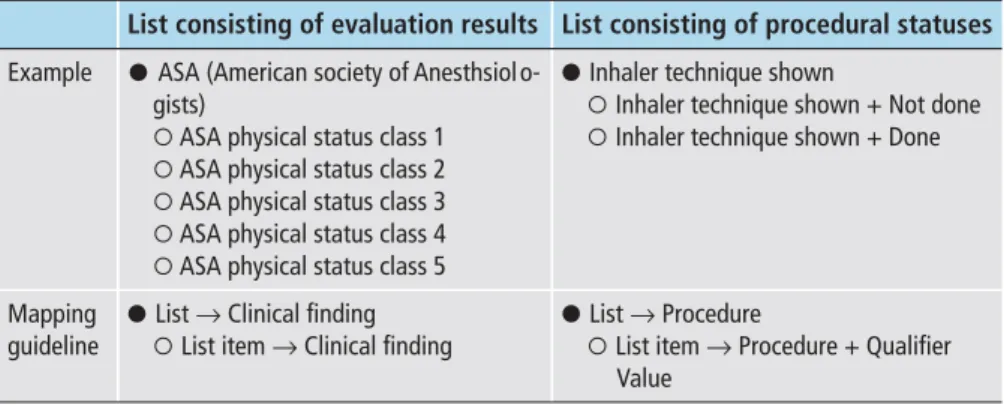
Table 2 Examples of the two types of lists represented in this study. The guideline for mapping the list and additional list items is also illustrated
Type of informa-tion
Organizing el-ements
Result elements Total
Text fields Numerical fields
Lists List items
Total 31 326 121 27 78 583
Pre coordination 24 242 85 17 67 435
Unique pre coor-dination
21 106 38 14 55 234
Post coordination 3 42 24 5 3 77
Unique post coor-dination
3 31 18 4 3 59
Not mapped 4 42 12 5 8 71
List consisting of evaluation results List consisting of procedural statuses Example ; ASA (American society of Anesthsiol o-
gists)
< ASA physical status class 1 < ASA physical status class 2 < ASA physical status class 3 < ASA physical status class 4 < ASA physical status class 5
; Inhaler technique shown
< Inhaler technique shown + Not done < Inhaler technique shown + Done
Mapping guideline
; List → Clinical finding < List item → Clinical finding
; List → Procedure
< List item → Procedure + Qualifier Value
Health Information Sear
were mapped as precoordinated concepts, 24 as post-coordinated concepts and 12 concepts were not mapped (씰Table 1). Of the 38 concepts uniqe pre-coordinated SNOMED CT concepts, 23 were repre-sented by clinical findings and 15 ex-pressions by observable entities. A cor-responding result was found in the post-coordinated expressions where clinical findings were the primary concepts in 7 cases, and observable entities were primary concept in 5 cases. Additionally, situations with explicit context are used to represent 6 cases as they facilitate the possibility to specify the ‘family history of ’ some specific clinical finding.
In general observable entities are used to represent groups of information, such as a group of information related to the respir-atory measures or cigarette consumption etc. However, it is not clear when SNOMED CT discriminate the use of observable en-tities and clinical findings regarding such specific measures. Therefore, it is recom-mended to search both hierarchies when representing an expression covering the content of a numerical field.
4.1.5 Lists and List Items
In this study two types of lists are present, representing either:
1. a result of some specific evaluation 2. a procedural status
The mapping of the lists and the list items depended on the actual type of list. Hence, for ‘lists’ that represent an evaluation re-sult, as ‘text fields’, clinical findings are selected as the main hierarchy. For the latter, the procedural hierarchy is selected as the ‘list’ that should be represented by the exact concept for the procedure. Examples of the two types of lists are given in 씰Table 1.
In this study a total of 27 lists with a total of 78 list items were represented. From the 27 lists, 14 cases represented results of a specific evaluation whereas 13 represented procedural statuses. In five cases, it was not possible to map the list to SNOMED CT, but for all other cases the described mapping guideline was adapted. coordination was applied in five cases to specify the semantics of the expression.
When mapping ‘list items’ for ‘lists’ rep-resenting result values for an evaluation, clinical findings are used, as they per defini-tion represent the result of a clinical obser-vation, assessment or judgment, and in-clude both normal and abnormal clinical states [2]. For the list items representing a specific status of a procedure, the list item is represented by the post-coordinated ex-pression of the specific procedural concept combined with a qualifier value descriptive for the status of the procedure.
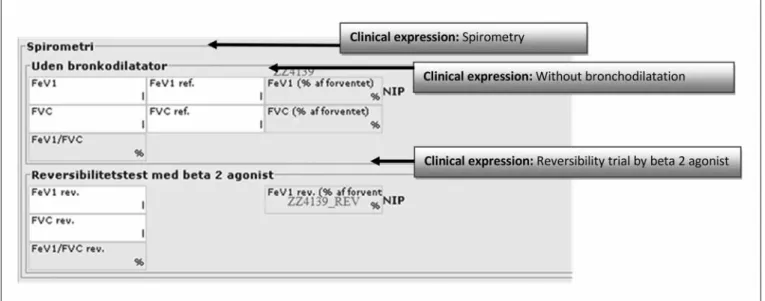
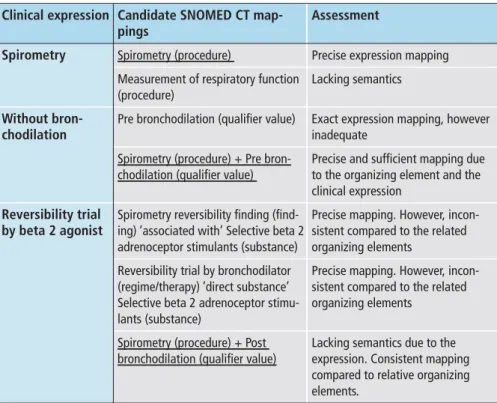
Balancing mapping consistency with mapping precision This guideline specify that consistency in the concept mappings are prior to performing the most exact con-cept mapping. This recommendation is in-cluded, because the most precise mapping due to the actual clinical expression may in some cases induce inconsistency in the SNOMED CT concept representation of the total set of interface terms, hereby viol-ating the quality criteria. This can either be due to inconsistency in the terminology composition or due to inexpedient choice of expressions in the EHR templates. 씰Fig -ure 7 shows the interface terms in
‘Spiro-Fig. 5 Illustration of the mapping guidelines related to the type of information of the clinical expression. Through the iterative approach, we selected con-cepts from as few hierarchies as possible to represent the interface terms.
Health Information Sear
metry’. The example in 씰Table 3 illustrates how mapping consistency is selected prior to precision.
The three underlined mapping selec-tions in 씰Table 3 were selected even though part of the information in the interface term ‘reversibility trial’ and ‘beta 2 agonist’ is neglected. It is assessed that the main semantics of the expression is maintained, as the reversibility trial typically is performed by a spirometry trial, and the beta 2 agonist is a type of bronchodilator.
4.2 Consistency of the Primary Concepts of Post-coordinations
As a main rule, pre-coordinated ex-pressions are chosen over post-coor-dinations. However, post-coordinated ex-pressions may be chosen if that means im-proving the overall consistency, like in the spiometry example in 씰Table 3.
Post-coordination by refinement or post-coordination by qualification is used in accordance with the official SNOMED CT guides. However, the primary concept
in the post-coordination should follow the additional guidelines specified in this study. The primary concept is the concept that is subject to the refinement or the qualification. This means that querying can be based on the primary concept but not the other parts of the post-coordination.
Mapping the EHR templates showed that interface terms can be compound ex-pressions like ‘Family/network’ or ‘Sexual-ity and reproduction’.
These expressions usually involve ‘AND’ or in some situations the symbol ‘/’. It would be best from a semantic viewpoint, to divide the concepts into separate con-cepts and fields, each with their unique SNOMED CT representation. Thus, each term representing the contents of a single free text field, leading to a more accurate and consistent registration compared to keeping the terms composite. E.g. in the example of ‘sexuality and reproduction’ keeping the concepts composite will inflict a situation where it is not possible to dis-tinguish whether the information relates to:
● a) The patient's sexuality, related to the patient's behavior.
● b) The patient's abilities in relation to reproduction, related to the patient's physiology.
But, in situations where this is not possible or feasible, or as in this study, where we did not change the structure of the EHR tem-plates, post-coordination by combination is performed. Post-coordination by combi-nation” is defined in [22] as the type of post-coordination to be used for cases where neither of the concepts is really a qualifier of the other. To ensure consisten-cy, the concepts in the post-coordination should inherit from the same top level hier-archy. This is possible for all of composite clinical expressions involved in this study, as only expression from the hierarchy 'clinical findings' were used.
5. Discussion
Meaningful relationships and consistency has been prioritized in the mapping pro-cess. This means that queries will make sense even though the EHR templates are developed in different organisations i.e. the
Fig. 6 Illustration of how supplementary fields can be encoded by referring to the nearest organizing element and added by a descriptive qualifier value
Health Information Sear
Fig. 7 Illustration of the expressions and the composition of the organizing elements related to the spiromety trial
EHR templates related to physical exami-nations now all have coded their ‘eye/vision finding’ field with the same SNOMED CT code. Also, aggregations can be made e.g. searching for ‘Cardiac finding’ and descen-dants will retrieve information like ‘blood pressure finding’, ‘pulse rate finding’ and ‘finding of peripheral pulse’ from various EHR templates. However, searching for ‘Cardiac finding’ and descendants will not retrieve ‘electrocardiogram findings’ be-cause of missing relationships between them. The missing IS-A relationships should be handled either by refining SNOMED CT or in queries. Another issue arises, because numerical fields are coded with both observable entities and clinical findings. This means that e.g. the lung par-ameter ‘Forced expired volume in 1 second before bronchodilation’ is an observable entity, and will not be obtained when searching for ‘respiratory finding’. Queries should therefore be designed to use both the clinical finding and observable entity hierarchy as point of departure if the con-tent of numerical fields should be obtained. This will also apply for the other types of information where more than one hier-archy is used. Still, querying is simpler than if only official SNOMED CT mapping guidelines had been applied, because the developed guidelines makes the limitations known and manageable.
Throughout the study, we assessed the mapping result using predefined quality
criteria. However, practical experimental testing of the guidelines, showing whether they improve real cross organisation query tasks, is not within the scope of this paper. We agree with the concerns stated by Rogers in [20] that testing terminology can only be done if they are tightly integrated with complex information systems. This induces a fundamental evaluation prob-lem, since it is difficult to distinguish the success or failure of the information system from the success or failure of the terminol-ogy. Sample retrieval tasks are a good sug-gestion in terms of meaningful evaluation but, basing the test on the same material that we used to develop the methodology would not be a fair evaluation. For evalu-ation, a method based on a new set of EHR templates and sample retrieval of informa-tion will be explored.
The fact that SNOMED CT has shown great coverage within many clinical do-mains may be regarded as a quality measure due to the extensive amount of pre-coordi-nated concepts . However, Zhang et al. state that the amount of pre-coordinated con-cepts can challenge the applicability of the terminology in terms of reusability. “From a quality assurance perspective, what is im-portant is to ensure that pre-coordination is used consistently in SNOMED CT, so as to facilitate usage” [24]. Additionally, Alan Rector discussed whether all terms cur-rently part of SNOMED CT are actually operational: “It is a significant clinical task
to find out what situations the term is in-tended to cover which might actually be recorded in an operational record” [25]. Therefore, we argue that mapping guide-lines are a necessity for implementing SNOMED CT in EHR systems that support data retrieval, because this demands for a consistent concept selection. The approach taken in this study differs from other studies by the fact that the quality criteria of consistency and meaningful relationships are explicated as the point of departure of the guidelines and that a cross organisa-tional focus is chosen. However, implicitly some of the same mapping issues have been addressed in other papers. Bakhshi Raiez et al. have developed an interface terminology on SNOMED CT for intensive care using the Apache IV terminology as a point of de-parture [26]. To ensure consistency they e.g. applied general rules for mapping cer-tain Apache IV categories to cercer-tain hier-archies in SNOMED CT, much like we have mapped types of information to certain hierarchies in SNOMED CT. They also ac-cepted partial matches to superordinate concepts, which show that considering the precision of mappings, is not a new phe-nomena. Also, Park et al. have studied con-tent coverage of SNOMED CT represent-ing INCP concepts. They included similar rules in their guidelines, both in terms of categories to hierarchy mappings and par-tial matches. Furthermore, they discus that sometimes INCP parent and child concepts
Health Information Sear
Table 3 The table illustrates the candidate concepts for mapping the expressions in the ‘Spirometry’ section in an EHR template. The assessment of the specific candidate is shown in the right column, and the selected concept is underlined in the center column.
Clinical expression Candidate SNOMED CT map-pings
Assessment
Spirometry Spirometry (procedure) Precise expression mapping Measurement of respiratory function
(procedure)
Lacking semantics Without
bron-chodilation
Pre bronchodilation (qualifier value) Exact expression mapping, however inadequate
Spirometry (procedure) + Pre bron-chodilation (qualifier value)
Precise and sufficient mapping due to the organizing element and the clinical expression
Reversibility trial by beta 2 agonist
Spirometry reversibility finding (find-ing) ‘associated with’ Selective beta 2 adrenoceptor stimulants (substance)
Precise mapping. However, incon -sistent compared to the related organizing elements
Reversibility trial by bronchodilator (regime/therapy) ‘direct substance’ Selective beta 2 adrenoceptor stimu-lants (substance)
Precise mapping. However, incon -sistent compared to the related organizing elements
Spirometry (procedure) + Post bronchodilation (qualifier value)
Lacking semantics due to the expression. Consistent mapping compared to relative organizing elements.
were mapped to different hierarchies e.g. ‘weight’ in the observable hierarchy and ‘overweight’ in the findings hierarchy [27]. The fact that we, as well as others, have de-veloped SNOMED CT mapping lines, indicates that official IHTSDO guide-lines should be expanded to ensure a more comprehensive official standard.
The guidelines provided by this study are based on a limited set of templates, and therefore not adequate for the entire spec-trum of EHR templates and exceptions. However, the guidelines provide a starting point for unambiguous representation of information in EHR systems. Therefore, exception situations, or situations not covered by this material, should be assessed and the best compensation should be ar-gued and documented.
This study shows that guidelines can be designed to support consistent mapping in a cross institutional and cross speciality context. However, the study has not touched upon how the resulting consistent sets of concepts can contribute to cross or-gaisational interoperability and cooper-ation. Obtaining semantic interoperability requires both consistent terminology and information models, which was beyond the scope of this paper. Future investigations could explore how the proposed guidelines would affect the reported overlap between data models and terminology, which can lead to a conflict between the semantics of a given expression [28, 29]. How to balance the benefits of consistent encoding with the time and resource consumption of the mapping process is another unexplored theme that will be subject of future re-search.
6. Conclusions
This study has resulted in a methodology to obtain consistency and meaningful rela-tionships in SNOMED CT mapping pro-cesses. The heterogeneous material applied in this study ensures that the mapping guidelines do not solely conform to a single EHR system or a single organization. The vision of semantic interoperability de-mands for a unique data representation across borders. The variety of the material, characterized by the different EHR systems
and the different clinical specialties show that common guidelines can be developed to facilitate semantic unambiguousness, despite differences in IT solutions and clinical practices.
Even though, a common terminology system can support reusability of clinical information, it is necessary to be rigorous in the selection of the concepts from the terminology. Otherwise, redundancy or unsuitable hierarchy selection can chal-lenge the possibility to request uniform in-formation. The prerequisite of the quality criteria, is to apply SNOMED CT in accord-ance with the refined guidelines, consider-ing the type of information, the balance be-tween consistency and precision and con-sistency of the primary concepts of post-coordinations
In conclusion, the overall mapping rule is to represent related information homo-genously by selecting concepts from the same sub-hierarchy. The guidelines pro-vide a framework for achieving a consistent mapping procedure and thereby a well-de-fined foundation for data retrieval. This ap-proach is practical when we want to
com-pare clinical information based on the hier-archical structure in SNOMED CT. Also, it will not limit the use of selective retrieval methods, as proposed by Dolin et al. [17] when sufficient definitions is added to SNOMED CT as the future. Future work should strive at qualifying and validating the specified guidelines by applying them to other domains and EHR systems.
Acknowledgment
This research is part of our PhD studies that are co financed by Region Northern Jut-land, CSC Scandihealth and Trifork A/S.
References
1. Elkin PL, Trusko BE, Koppel R, Speroff T, Mohrer D, Sakji S, et al. Secondary use of clinical data. Studies in health technology and informatics 2010; 155: 14 – 29.
2. IHTSDO. SNOMED CT Clinical Terms. User Guide. 2010. Available at: http://ihtsdo.org/ fileadmin/user_upload/doc/.
3. Wasserman H, Wang J. An applied evaluation of SNOMED CT as a clinical vocabulary for the com-puterized diagnosis and problem list. AMIA Annual
Health Information Sear
Symposium Proceedings: American Medical In-formatics Association; 2003.
4. McClay JC, Campbell J. Improved coding of the primary reason for visit to the emergency depart-ment using SNOMED. Proceedings of the AMIA Symposium: American Medical Informatics As-sociation; 2002.
5. Brown SH, Rosenbloom ST, Bauer BA, et al. Direct Comparison of MEDCIN® and SNOMED CT® for Representation of a General Medical Evaluation Template. American Medical Informatics Associ-ation; 2007.
6. Chute CG, Cohn SP, Campbell KE, Oliver DE, Campbell JR. The content coverage of clinical clas-sifications. Journal of the American Medical In-formatics Association 1996; 3 (3): 224 –233. 7. Wade G, Rosenbloom ST. Experiences mapping a
legacy interface terminology to SNOMED CT. BMC medical informatics and decision making 2008; 8 (Suppl 1): S3.
8. Elkin PL, Brown SH, Husser CS, et al. Evaluation of the content coverage of SNOMED CT: ability of SNOMED clinical terms to represent clinical prob-lem lists. Mayo Clinic Proceedings: Mayo Clinic; 2006.
9. Brown SH, Bauer BA, Wahner-Roedler DL, Elkin PL. Coverage of Oncology Drug Indication Con-cepts and Compositional Semantics by SNOMED-CT®. AMIA Annual Symposium Pro-ceedings: American Medical Informatics Associ-ation; 2003.
10. Spackman KA. Normal forms for description logic expressions of clinical concepts in SNOMED RT. Proceedings of the AMIA Symposium: American Medical Informatics Association; 2001.
11. Andrews JE, Richesson RL, Krischer J. Variation of SNOMED CT coding of clinical research concepts among coding experts. Journal of the American Medical Informatics Association 2007; 14 (4): 497– 506.
12. Chiang MF, Hwang JC, Alexander CY, Casper DS, Cimino JJ, Starren J. Reliability of SNOMED-CT coding by three physicians using two terminology browsers. AMIA Annual Symposium Proceedings: American Medical Informatics Association; 2006. 13. Smith B, Brochhausen M. Putting biomedical on-tologies to work. Methods Inf Med 2010; 49 (2): 135 –140.
14. Schulz S, Hanser S, Hahn U, Rogers J. The Semantics of Procedures and Diseases in SNOMED® CT. Methods Inf Med 2006; 45 (4): 354.
15. Rector AL, Brandt S. Why do it the hard way? The case for an expressive description logic for SNOMED. Journal of the American Medical In-formatics Association 2008; 15: 744–751. 16. Cornet R. Definitions and Qualifiers in SNOMED
CT. Methods Inf Med 2009; 48 (2): 178 –183. 17. Dolin RH, Spackman KA, Markwell D. Selective
retrieval of pre-and post-coordinated SNOMED concepts. Proceedings of the AMIA Symposium: American Medical Informatics Association; 2002. 18. IHTSDO. SNOMED Clinical Terms. Technical
Reference guide. 2008; Available at: SNOMED_ CT_Technical_Reference_Guide_20080731.pdf, 2010.
19. Cornet R, de Keizer N. Forty years of SNOMED: a literature review. BMC Medical Informatics and Decision Making 2008; 8 (Suppl 1): S2.
20. Rogers J. Quality assurance of medical ontologies. Methods of Information in Medicine – Methodik
der Information in der Medizin 2006; 45 (3): 267– 274.
21. Lee DH, Lau FY, Quan H. A method for encoding clinical datasets with SNOMED CT. BMC medical informatics and decision making 2010; 10: 53. 22. IHTSDO. SNOMED Clinical Terms. Technical
Implementation Guide. 2010; Available at: http:// ihtsdo.org/fileadmin/user_upload/doc/. 23. Rasmussen AR, Rosenbeck K. SNOMED CT im
-plementation: implications of choosing clinical findings or observable entities. Studies in health technology and informatics 2011; 169: 809 – 813. 24. Zhang GO, Bodenreider O. Large-scale, exhaustive
lattice-based structural auditing of SNOMED CT. AMIA Annual Symposium Proceedings: American Medical Informatics Association; 2010. 25. Rector AL. Clinical terminology: why is it so hard?
Methods Inf Med 1999; 38: 239 – 252.
26. Bakhshi-Raiez F, Ahmadian L, Cornet R, de Jonge E, de Keizer NF. Construction of an Interface Ter-minology on SNOMED CT. Generic Approach and Its Application in Intensive Care. Methods Inf Med 2010; 49.
27. Park H, Lundberg C, Coenen A, Konicek D. Evalu-ation of the content coverage of SNOMED CT rep-resenting ICNP seven-axis version 1 concepts. Methods Inf Med 2011; 50 (5): 472– 478. 28. Ryan A, Eklund P, Esler B. Toward the
interoperabil-ity of HL7 v3 and SNOMED CT: a case study mo-deling mobile clinical treatment. Studies in health technology and informatics 2007; 129: 626 – 630. 29. R. Qamar R, Kola JS, Rector AL. Unambiguous data
modeling to ensure higher accuracy term binding to clinical terminologies. AMIA Annual Sym-posium Proceedings: American Medical In-formatics Association; 2007.
Health Information Sear